

Orchestrating Professional Services with AI Agents An End to End Project Management Workflow
To download this as a free PDF eBook and explore many others, please visit the AugVation webstore:
Introduction
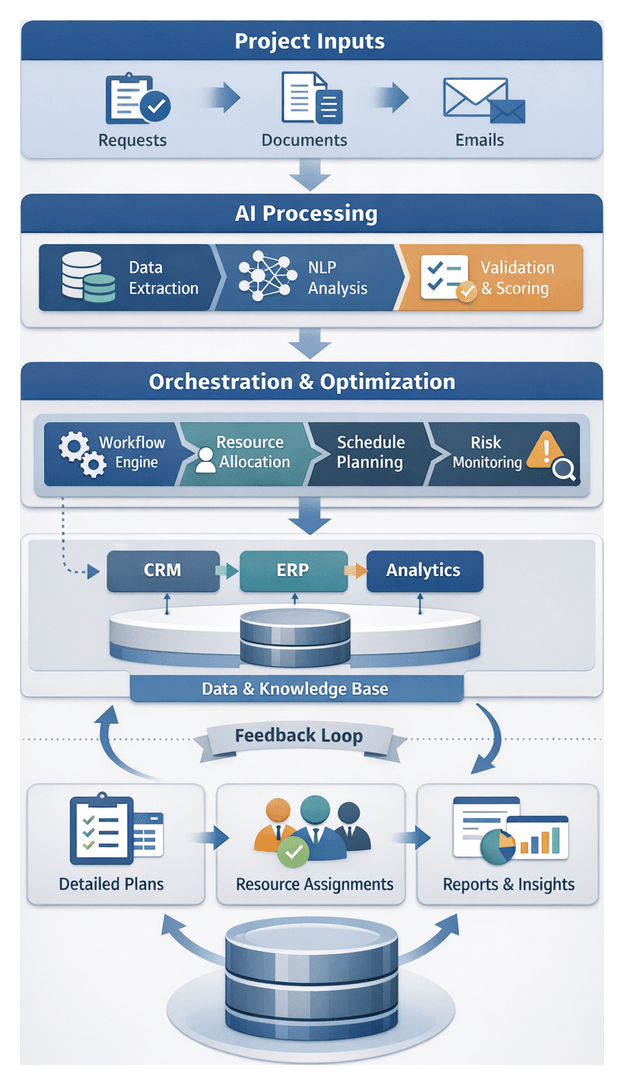
Industry Context and Operational Complexity
Professional services firms operate at the intersection of specialized expertise and rapidly evolving client demands. Market shifts, regulatory frameworks, and technological innovation increase engagement complexity, requiring coordination across consultants, subject-matter experts, and external partners. Traditional reliance on spreadsheets, email threads, and ad hoc processes creates transparency gaps, governance challenges, and risks of misalignment with strategic objectives. Without a formal framework, firms face bottlenecks, rework, and unpredictable outcomes as engagements scale in scope, budget constraints tighten, and quality standards intensify.
Benefits of a Structured AI-Driven Workflow
Embedding an AI-driven orchestration layer into project management delivers three core advantages:
- Consistency: Standardized templates, validation rules, and automated checks enforce best practices for intake, scope definition, and resource planning.
- Error Reduction: Intelligent data capture and rule-based engines identify omissions or inconsistencies early, preventing costly downstream corrections.
- Predictability: Defined stage gates and handoff points enable accurate forecasting of timelines, budgets, and staffing needs.
These benefits shift firms from reactive firefighting to proactive governance. By leveraging AI for natural language understanding, predictive analytics, and optimization, organizations gain data-driven insights that support sustained operational excellence and high client satisfaction.
AI-Enhanced Project Intake
The intake stage is the gateway to the project life cycle. AI integration transforms manual proposals and unstructured emails into a rich, standardized dataset that underpins planning and execution.
AI-Driven Data Capture and Standardization
Proposals arrive in varied formats—email narratives, PDFs, slide decks, or web submissions. AI agents use advanced document understanding to extract key fields such as project titles, stakeholder names, deliverables, timelines, and budgets. Tools like IBM Watson Discovery and Google Cloud Document AI employ optical character recognition and transformer models to map unstructured text into structured schemas. Standardization libraries reconcile terminology and units—aligning “consulting hours,” “advisory days,” and “professional service units” against internal taxonomies maintained in graph databases—ensuring consistent inputs for downstream modules.
Natural Language Processing for Proposal Interpretation
NLP pipelines apply named entity recognition, intent classification, and sentiment analysis to interpret client priorities, risk indicators, and implicit constraints. Engines such as OpenAI’s GPT-4 and Hugging Face transformers fine-tuned on domain-specific corpora identify urgency phrases (“must launch by Q3,” “regulatory deadline”) and categorize requirements into strategic objectives, compliance needs, technical specifications, or quality criteria. Correlating these classifications with historical data in cloud data lakes enables AI agents to infer feasibility scores and suggest clarifications before formal approval.
Automated Validation and Feedback
Extracted data undergoes intelligent validation against internal and external reference systems. Budget figures compare against averages in Oracle NetSuite or SAP S/4HANA, while timelines align with delivery benchmarks stored in project portfolio management tools. Discrepancies trigger automated alerts through rules engines such as Camunda, prompting intake coordinators to review specific fields. This reduces back-and-forth communications and accelerates decision cycles.
Integration with Enterprise Systems
Validated intake records flow into CRM, ERP, and portfolio management platforms via integration platforms as a service. Solutions like MuleSoft, Microsoft Power Automate, and Apache NiFi enable low-code connectors that map AI-processed outputs to target APIs. Client information in Salesforce is enriched, contract metadata in SAP is updated, and project initiation triggers procurement requisitions—maintaining a single source of truth and auditability.
Priority Scoring and Recommendations
Machine learning models assess each opportunity’s strategic value by analyzing win rates, margin performance, client lifetime value, and resource alignment. Frameworks like TensorFlow and PyTorch compute priority scores, while CRM analytics modules such as Salesforce Einstein present recommendations to sales leaders. Automated workflows route low-scoring proposals for leadership review or propose adjustments—optimizing staffing, deal structure, and risk mitigation strategies.
Continuous Learning and Improvement
Project outcomes feed back into the AI ecosystem. MLOps platforms like MLflow and Azure Machine Learning track model performance, manage versioning, and orchestrate retraining pipelines based on real delivery metrics. User feedback from intake coordinators and collaboration tools injects active learning signals, enabling models to adapt to evolving terminology, regulatory changes, and client expectations.
Architecture and Orchestration
The solution architecture provides a blueprint for orchestrating data flows, component interactions, and service integrations across all project stages. A layered model separates concerns, simplifies development, and supports independent scaling of critical services.
Layered Architectural Model
- Presentation Layer: Web portals, API gateways, and virtual assistants that capture intake forms and display dashboards. Outputs: Validated inputs, API calls, event messages.
- Orchestration Layer: Workflow engines and message brokers managing task sequences, AI triggers, and notifications. Dependencies: Messaging infrastructure (Kafka, RabbitMQ), rules engines, scheduling services.
- AI Services Layer: NLP parsers, predictive analytics, and optimization agents. Dependencies: Model serving platforms such as Google Cloud AI, AWS SageMaker.
- Data Management Layer: Relational and NoSQL databases, document stores, and data lakes. Outputs: Persisted artifacts, audit trails, historical analytics.
Core Components and Interactions
Modular components communicate through an event bus or message broker, ensuring loose coupling and reliable delivery. Key components include:
- Intake Agents: Validate fields and extract metadata, publishing standardized records to requirement parsers.
- Requirement Parsers: Use NLP to identify deliverables and constraints, routing structured objects to scope workflows.
- Resource Optimizers: Apply algorithms to match skills with needs, feeding allocations to the scheduling engine.
- Schedule Generators: Build timelines based on dependencies and availability, delivering schedules to task assigners.
- Task Assigners: Allocate tasks dynamically, integrating with collaboration hubs and notification services.
- Monitoring Dashboards: Aggregate KPIs and visualize trends, alerting risk engines and executives.
- Financial Modules: Consolidate time and expense data for variance analysis, supplying forecasts to analytics services.
- Closure Repositories: Archive deliverables and lessons learned, exposing knowledge packages to audit systems.
Data Flow and Handoff Contracts
Clear contracts define message schemas, validation rules, delivery protocols, security requirements, and versioning strategies. Schema registries and API specifications prevent mismatches and support backward compatibility. Automated gates and monitoring alerts detect contract violations, triggering remediation workflows.
Integration Patterns and Dependency Management
- Event-Driven Orchestration: Services react to published events, enabling asynchronous processing, retries, and dead-letter queues.
- API-First Design: REST or gRPC interfaces with SDKs and client libraries accelerate adoption.
- Microservices Isolation: Containerized or serverless deployments reduce blast radius and simplify upgrades.
- Centralized Configuration: Feature flags and policy engines enable real-time tuning of AI models and thresholds.
- Service Discovery: Dependency injection frameworks and registry services ensure reliable endpoint resolution.
Scalability, Security, and Governance
Auto-scaling clusters, stateless services, and partitioned data stores support performance demands. Security controls include mutual TLS, role-based access control, and audit logging. A governance layer enforces compliance with GDPR, SOC, and industry standards, maintaining metadata on origin, transformations, and access history.
- Audit Trails: Log every data mutation with timestamps, user or agent identifiers, and version history.
- Compliance Reporting: Prebuilt templates extract metrics for audits.
- Model Governance: Versioned AI models with documented training data, performance metrics, and bias assessments.
Chapter 1: Opportunity Identification and Project Intake
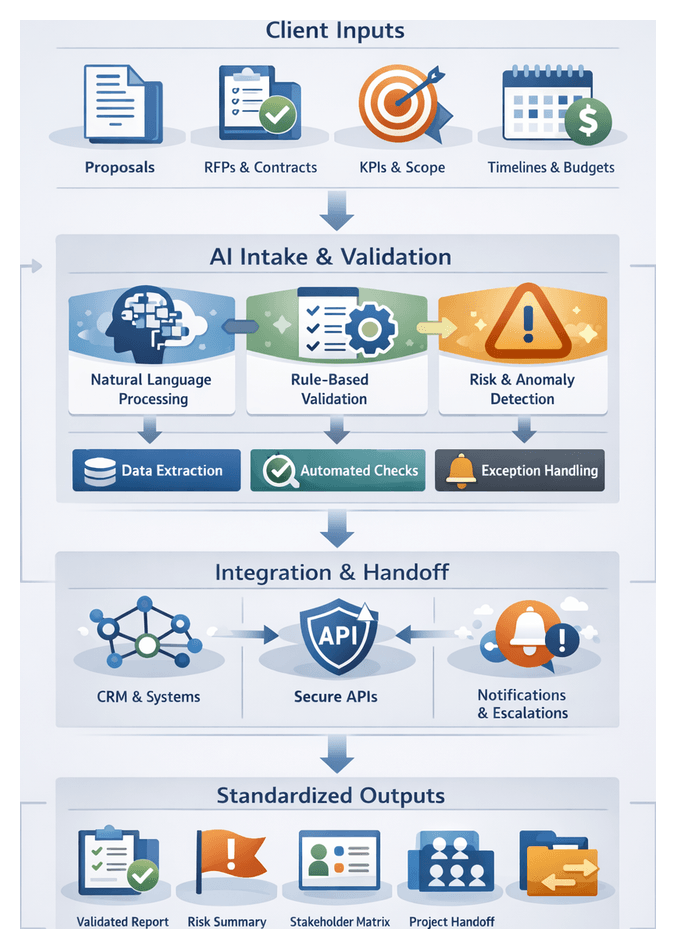
Intake Objectives and Foundational Inputs
In professional services, the intake stage transforms unstructured client inquiries into standardized data that fuels planning, resource allocation, and scheduling. A robust intake process mitigates miscommunication, aligns stakeholders early, and establishes transparency, efficiency, predictability, and scalability across engagements.
The primary objectives are:
- Capture Client Intent: Extract core goals and outcomes from emails, proposals, or presentations to prevent scope drift.
- Standardize Input Data: Record budgets, compliance mandates, and performance metrics in a consistent template to support analytics and automated workflows.
- Identify Early Risks: Surface unrealistic timelines, conflicting requirements, and regulatory gaps through structured validation rules.
- Secure Stakeholder Commitment: Obtain formal sign-off on intake summaries to align expectations before detailed planning.
Key foundational inputs include:
- Client proposal artifacts such as RFPs, contracts, and briefing documents.
- Business objectives and KPIs, for example revenue targets, cost savings, or compliance thresholds.
- Scope boundaries detailing deliverables, geographic reach, user populations, and service levels.
- Budgetary parameters including estimates, billing rates, and payment milestones.
- Timeline constraints with target dates, milestones, and blackout periods.
- Resource profiles covering required skills, certifications, and availability.
- Technical prerequisites such as infrastructure dependencies, data access permissions, and security protocols.
- Stakeholder directory listing decision-makers, technical contacts, and communication preferences.
Prerequisites for effective intake include a governance framework defining approval paths, a standardized digital form or portal with conditional logic, an automated validation engine, integration with CRM systems, AI-powered natural language processing—enabled by solutions such as the OpenAI GPT-4 API—and security controls for role-based access, encryption, and audit trails. Training and adoption plans ensure teams follow best practices and maximize tool usage.
Automated Intake Workflow and Validation
The automated intake workflow centralizes submissions from web forms, emails, CRM tickets, and chatbots into a unified queue. An orchestration layer connects to each channel via APIs, performing ingestion, metadata enrichment, preliminary classification, and secure storage. This ensures every request receives a unique intake ID and maintains end-to-end visibility through integration with identity directories and notification services.
Automated Validation and Quality Assurance
An AI-driven validation engine combines rule-based scripts with natural language processing to verify data integrity. The rule-based layer checks required fields, value formats, duplicates, and attachment conventions. Concurrently, NLP modules extract deliverable types, compliance standards, and risk indicators, flagging contradictions and mapping unstructured descriptions to templates via domain ontologies. This generates a dashboard reporting pass, warning, or fail statuses for intake coordinators.
Exception Handling and Stakeholder Alerts
Records with missing or inconsistent data enter an exception sub-flow where automated notifications request client clarification. Domain-specific queries are routed to subject matter experts via collaboration platforms. Integrated chatbots powered by knowledge bases answer real-time questions. Every interaction is logged to maintain an audit trail. Critical failures require approver override before proceeding.
Handoff Readiness and Continuous Improvement
Upon validation, the system packages structured data into JSON or XML payloads and pushes them via REST API to requirements gathering platforms. Role-based notifications alert project managers and resource planners. Dashboards update to reflect the record’s status. Intake coordinators perform final sanity checks and business leads grant digital sign-off.
Metrics such as time to validation, exception loops, and common failure causes feed continuous improvement. Data scientists tune validation rules and NLP models, analysts refine intake templates with inline guidance, training materials address confusion patterns, and RPA bots automate frequent manual corrections. These feedback loops reduce exceptions, accelerate cycles, and enhance the client experience.
AI Parsing and Stakeholder Coordination
AI parsing transforms unstructured proposals—PDFs, slide decks, emails, or audio recordings—into structured data and aligns stakeholders for review. Advanced natural language processing, machine learning models, and collaboration platforms accelerate intake cycles, reduce manual effort, and ensure accurate capture of critical details.
Natural Language Processing for Proposal Interpretation
A multi-stage NLP pipeline performs text segmentation, OCR for scanned content, tokenization, part-of-speech tagging, dependency parsing, and sentiment detection. Cloud services such as IBM Watson Natural Language Understanding and Microsoft Azure Cognitive Services Text Analytics provide pre-trained models optimized for professional language.
Entity Extraction and Relationship Mapping
Named entity recognition identifies client names, dates, budget figures, deliverable descriptions, and contractual terms. Tools like spaCy and the OpenAI API detect domain-specific entities when fine-tuned. Extracted entities form a semantic graph linking deliverables to dependencies and approval authorities, enabling reviewers to query relationships without reading entire documents.
Semantic Classification and Prioritization
Supervised and unsupervised learning tag content by theme—compliance, technical scope, commercial terms—and assign priority based on patterns from historical projects. Topic modeling and transformer-based classifiers deliver clarity by grouping related requirements and focus by ranking items such as regulatory constraints or high-value deliverables.
AI-Driven Stakeholder Identification and Role Assignment
AI analyzes organizational charts, project histories, and communication logs to recommend approvers and subject matter experts. Workflow engines like UiPath Document Understanding and ServiceNow AI Document Intelligence propagate tasks based on predicted roles, ensuring correct routing and multi-level sign-off where required.
Collaboration Platforms and Notification Systems
Integrated hubs centralize communication, embed context, and automate notifications. Slack bots and Microsoft Teams integrations alert stakeholders when parsed summaries are ready. Platforms such as Asana generate task cards listing actions and deadlines. Threaded discussions and audit logs preserve decision paths and compliance evidence.
Continuous Learning and Model Refinement
Reviewer corrections and feedback signal misclassifications or missing entities, triggering automated retraining pipelines. MLOps frameworks manage version control, performance monitoring, and deployment of updated models. Metrics on precision, recall, and processing time guide refinements, ensuring the parsing engine improves over time and reduces manual intervention.
Standardized Intake Output and Handoff
The standardized intake output packages validated data into a consistent, machine-readable format and executes a structured handoff protocol. This transition ensures downstream teams receive complete information for requirements gathering without manual re-entry or interpretation errors.
Key Deliverables and Data Outputs
- Structured intake record as JSON or XML with project details, objectives, and budget estimates.
- Client profile summary generated by NLP agents, with links to external systems like Salesforce for enriched context.
- Stakeholder matrix listing decision-makers, experts, and communication preferences.
- Risk and flag list enumerating potential issues detected during validation.
- Validation report documenting checks, missing fields, and resolution actions.
- Metadata package including timestamps, data lineage, NLP model versions, and processing status codes.
Dependencies and Integration Points
Outputs rely on upstream platforms such as Microsoft Power Automate for data capture, integration with IBM Watson for NLP parsing, rules engines like Drools or MuleSoft for validation, security gateways for compliance, and middleware such as ESB or iPaaS for routing to downstream systems.
Handoff Process to Requirements Gathering
- Package outputs into a secure payload with checksum verification.
- Publish to a central repository, for example SharePoint Online or Git-based systems, with metadata tags.
- Trigger the requirements workflow in tools like Jira or ServiceNow via event-driven iPaaS scripts.
- Notify scope definition leads with links to artifacts and outstanding items.
- Record handoff events in an audit log with user identifiers and timestamps.
- Obtain digital confirmation of receipt and governance checks before completing the handoff.
This repeatable, transparent handoff mechanism eliminates manual bottlenecks, maintains data integrity, and ensures requirements gathering begins with trusted information, accelerating project timelines and driving predictable delivery outcomes.
Chapter 2: Requirement Gathering and Scope Definition
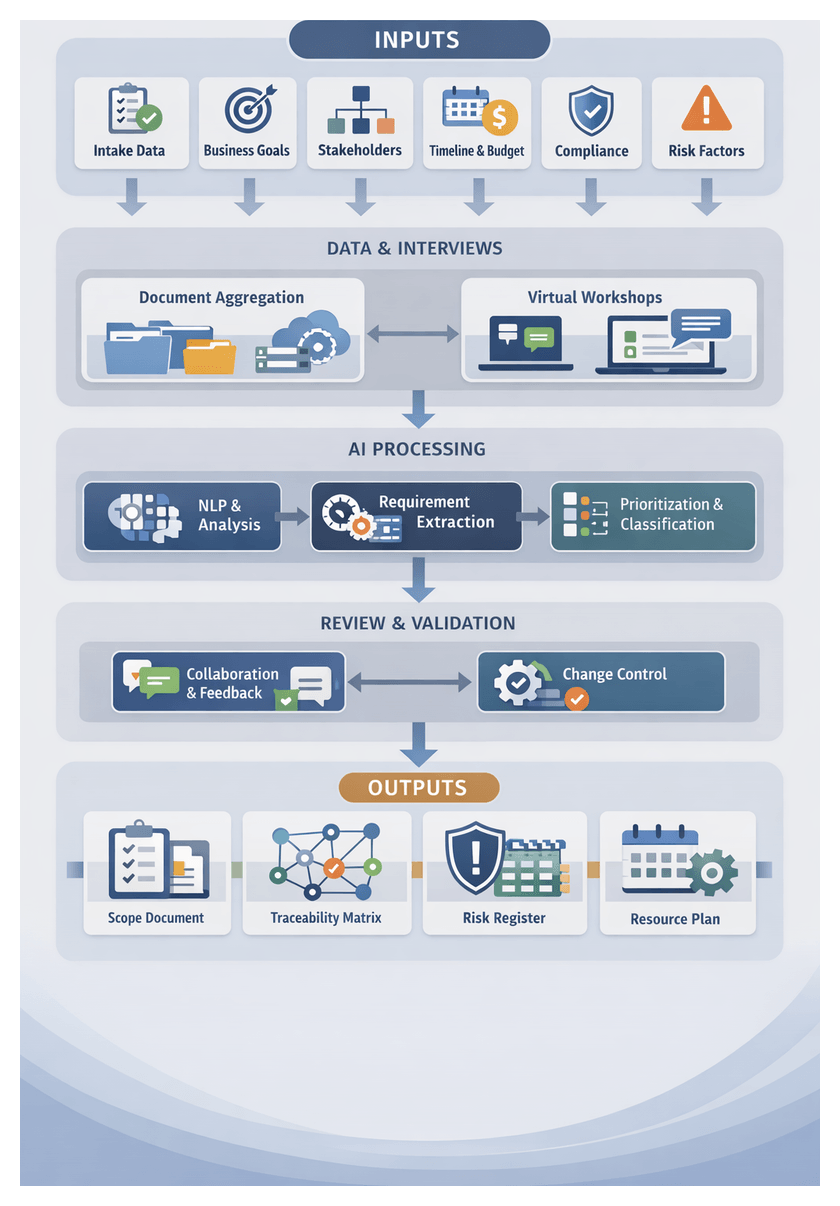
Purpose and Strategic Importance of Scope Definition
The Scope Definition stage translates validated intake information into a detailed project blueprint, outlining deliverables, constraints, and measurable success criteria. By defining boundaries and expectations early, professional services firms establish a foundation for resource planning, scheduling, budgeting, and risk management. This structured approach reduces ambiguity, aligns stakeholder expectations, and minimizes costly rework or scope creep. Moreover, precise documentation of engagement parameters enables confident resource allocation, effective procurement negotiations, and proactive risk mitigation. Firms excelling at scope definition strengthen their reputation, improve proposal win rates, and achieve higher margins by avoiding late-stage changes and disputes.
Essential Inputs and Initiation Conditions
Successful scope definition depends on assembling comprehensive inputs and satisfying key prerequisites. Required inputs include:
- Validated Intake Package: Consolidated client proposal, intake form data, and stakeholder feedback.
- Business Objectives Document: Agreed goals, success metrics, and priority outcomes.
- Stakeholder Roster and Roles: Internal and external participants with decision-making authority.
- Preliminary Timeline and Milestones: Target dates for deliverables and governance checkpoints.
- Budget Parameters: Initial cost estimates, funding limits, and billing models.
- Regulatory and Compliance Requirements: Industry mandates, contractual obligations, and data protection standards.
- Risk Identification Log: Draft register of potential technical, legal, and resource challenges.
- Historical Benchmarks: Performance data from similar engagements for realistic estimates.
- Technical Constraints: Details on existing systems, network environments, and integration dependencies.
- Organizational Standards: Internal frameworks, templates, and process guidelines.
Initiation conditions must include:
- Formal Intake Approval: Stakeholder sign-off confirming readiness.
- Confirmed Availability: Scheduled workshops and interviews with client and internal teams.
- Data Access: Credentials to legacy documents, technical specifications, and policies.
- Data Quality Verification: Completeness and accuracy checks for intake information.
- Communication Channels: Established collaboration platforms and notification workflows.
- Legal Clearance: Executed non-disclosure agreements and compliance approvals.
- Baseline Objectives: Alignment on deliverables, scope boundaries, and acceptance criteria.
- Tool Configuration: Deployment of specialized software for AI analysis and document management.
The workflow comprises four primary phases: data aggregation, stakeholder engagement, AI-driven analysis, and documented scope handoff. Each phase coordinates among client representatives, project managers, subject-matter experts, and technology systems to ensure a repeatable, transparent process.
Data Ingestion and Aggregation
- Automated Pull: Scheduled jobs query repositories such as SharePoint and Box to ingest requirement artifacts.
- Metadata Enrichment: AI agents tag documents by industry, service line, and regulatory domain using tools like Microsoft Azure Cognitive Services.
- Version Control: Each item is tracked with unique identifiers, timestamps, and source references for auditability.
Virtual Interviews and Collaborative Workshops
- Scheduling Integration: Calendar APIs propose optimal slots based on participant availability.
- Pre-Interview Briefs: Context packs generated from intake data align participants on objectives.
- Real-Time Transcription: Captures dialogue, attributes speakers, and identifies action items.
- Action Item Extraction: AI agents flag commitments, deadlines, and decisions, assigning follow-up tasks automatically.
AI-Powered Requirement Extraction
- Segmentation: NLP models break transcripts and documents into candidate requirements.
- Entity Recognition: Tools such as OpenAI models and IBM Watson Discovery identify system components, user roles, and performance metrics.
- Priority Scoring: Machine learning classifiers assign priority levels based on stakeholder roles, keywords, and risk factors.
Classification, Prioritization, and Traceability
- Scope Segmentation: Requirements are grouped into user experience, infrastructure, security, and compliance workstreams.
- Priority Matrix: A weighted scoring model evaluates business value, complexity, and regulatory urgency.
- Traceability Ledger: Each requirement links back to its source and approval history, supporting impact analysis.
Interactive Review and Change Management
- Reviewer Notifications: Automated alerts assign review tasks with deadlines.
- Inline Collaboration: Stakeholders comment on requirements directly, proposing edits or clarifications.
- Conflict Detection: AI monitors annotations to flag contradictory feedback or unresolved queries.
- Approval Workflow: Gating mechanisms require explicit sign-off before finalizing requirements.
System Integrations and API Coordination
- Webhook Notifications: Events trigger downstream processes like budget estimation upon requirement approval.
- Bi-Directional Sync: Updates in planning tools such as Jira or Microsoft Project reflect back to the requirement repository.
- Audit Trail Integration: Compliance systems automatically receive tagged requirements for reporting.
Scoped Deliverable Assembly and Handoff
- Document Generation: AI populates templates for scope documents, including clauses and acceptance criteria.
- Final Approval: Digital signatures validate commitment to the defined scope.
- Handoff Notification: Resource planning and scheduling teams receive automated alerts that scope artifacts are ready.
AI-Driven Analysis for Requirement Classification
AI-powered analysis transforms unstructured data—emails, transcripts, specifications—into structured requirement sets. By leveraging NLP, semantic role labeling, machine learning, and knowledge graphs, organizations accelerate classification, enforce consistency, and enable data-driven decisions.
Natural Language Processing Techniques
- Tokenization and Lemmatization: Normalizing text using services like Google Cloud Natural Language.
- Part-of-Speech Tagging: Identifying verbs for functional requirements and adjectives for quality attributes.
- Dependency Parsing: Mapping modifier-object relationships to distinguish core requirements.
- Named Entity Recognition: Recognizing entities with Amazon Comprehend and Microsoft Azure Cognitive Services Text Analytics.
Semantic Role Labeling and Ontology Integration
Semantic role labeling assigns predicate-argument structures, mapping actors, actions, objects, and conditions to conceptual frames. Custom models built with AllenNLP or spaCy integrate with knowledge graphs managed in platforms like Neo4j or Stardog. This framework enables semantic validation, redundancy detection, and compliance checks against domain ontologies.
Machine Learning for Prioritization
- Feature Engineering: Incorporating requirement type, stakeholder weight, regulatory level, and historical data.
- Supervised Learning: Training algorithms such as Random Forest and Gradient Boosted Trees on past projects.
- Ranking Models: Pairwise ranking approaches to order large requirement sets.
- Active Learning: Incorporating human feedback to refine models on evolving domains.
Integration with Requirements Management Systems
- API Connectivity: Bi-directional links with Jama Connect, IBM Engineering Requirements Management DOORS Next, or Atlassian Jira ensure seamless updates and model retraining data capture.
- Traceability Links: Automatic connections between requirements, user stories, and test cases.
- Collaboration Workflows: Automated review assignments maintain governance and accountability.
- Audit Trails: Version control records AI actions and human overrides for compliance.
Human-in-the-Loop Governance
- Review Dashboards: Present classifications with confidence scores for analyst validation.
- Feedback Mechanisms: Capture corrections to feed continuous model improvement.
- Governance Policies: Define roles, approval thresholds, and escalation paths for AI outputs.
- Performance Metrics: Monitor precision, recall, and override rates to demonstrate ROI.
Scalable Orchestration and Continuous Improvement
Deploy classification services as microservices, event-driven pipelines, or serverless functions. Implement a model registry with CI/CD for consistent testing and rollout. Measure impact through reduced manual review time, classification accuracy, cycle time improvements, and stakeholder satisfaction.
Deliverables and Handoff to Resource Planning
The final outputs of Scope Definition include a comprehensive deliverable set that underpins downstream planning, resource allocation, and execution. These artifacts, validated through quality gates, ensure alignment and traceability across the project lifecycle.
Primary Deliverable Artifacts
- Formal Scope Document: Consolidated requirements, deliverables, assumptions, and success criteria with revision history.
- Requirements Specification: Categorized functional, non-functional, and regulatory requirements, each tagged and prioritized.
- Deliverable Breakdown Structure: Hierarchical decomposition into work packages with effort estimates and acceptance criteria.
- Acceptance Criteria Matrix: Listing of requirements with test scenarios and sign-off authorities.
- Traceability Matrix: Links requirements to intake inputs, interview transcripts, and AI-classified entities.
- Constraints and Assumptions Log: Record of budget, regulatory, and technical constraints alongside assumptions.
Supporting Risk and Change Artifacts
- Preliminary Risk Register Inputs: Mapped to affected requirements with probability and impact ratings.
- Change Request Templates: Standardized forms including impact analysis and approval paths.
- Stakeholder Alignment Summary: Report capturing decisions, open questions, and sign-off status.
Dependencies and Quality Gates
- Validated Intake Data: Reconciliation of Chapter 1 context with detailed scope items.
- Interview Transcripts and Artifacts: Accessible recordings and documents in the repository.
- AI-Classified Tags: Verified outputs from IBM Watson Natural Language Understanding or OpenAI GPT models.
- Stakeholder Sign-Offs: Recorded via electronic signatures or workflows in ServiceNow Project Portfolio Management.
- Change Control Baseline: Established for any future modifications.
Automated Validation and Consistency Checks
AI engines like Microsoft Azure Form Recognizer scan scope documents for completeness, numbering consistency, and template adherence, flagging discrepancies for review.
Handoff Mechanisms to Resource Planning
- API-Driven Exchange: Export scope artifacts in JSON or XML for consumption by planning engines.
- Collaboration Integration: Post links to finalized documents in Jira or Asana with automatic synchronization of tasks.
- Notification Triggers: Automated alerts inform resource managers that scope definition is complete.
- Version Control: Check in documents with timestamps and change logs for auditability.
Mapping Scope to Resource Requirements
- Work Package Complexity: Effort estimates and technical tags guide seniority matching.
- Priority Sequencing: Milestone dates drive the allocation order for critical path items.
- Skill Requirements: Roles such as data modeling, UX design, or compliance review are matched via AI-driven talent platforms.
- Timeline Constraints: Milestone deadlines feed into scheduling engines to align availability.
Ensuring Smooth Transition
- Formal Handoff Meeting: Review artifacts with scope, planning, and delivery leads to confirm clarity and timelines.
- Automated Checklists: AI agents verify completion of required fields, approvals, and templates.
- Governance Sign-Off: Sponsors and boards sign off within the PM system.
- Real-Time Visibility: Dashboards display deliverables, effort estimates, and dependencies for delivery teams.
By rigorously defining scope and establishing clear handoff protocols, professional services organizations enable AI-driven planning engines to generate accurate capacity plans, assign the right talent, and maintain alignment with client expectations throughout the project life cycle.
Chapter 3: Resource Allocation and Capacity Planning
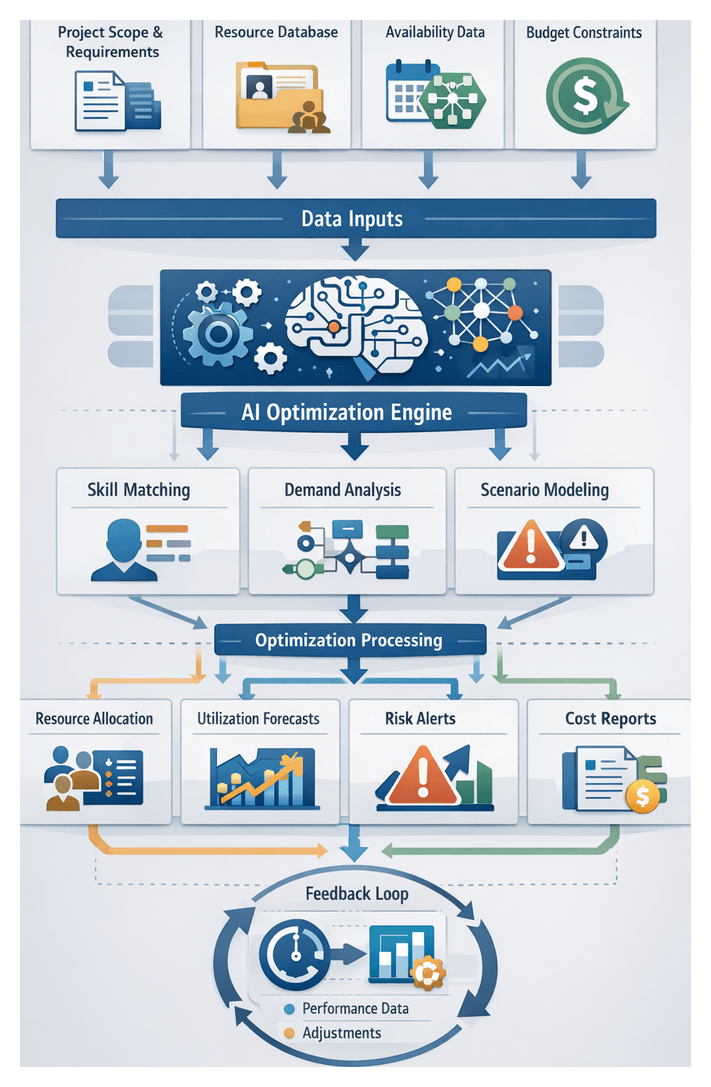
In professional services organizations, escalating project complexity demands a structured approach to align staffing with strategic objectives. Resource allocation and capacity planning transforms scope documents and effort estimates into a dynamic resource model that balances demand with available talent. By integrating real-time availability, historical performance, and organizational policies, firms shift from reactive staffing to proactive workforce management. This structured process enhances utilization, mitigates risks, and underpins financial performance while delivering credible capacity forecasts for downstream scheduling and task assignment.
Key Objectives of the Resource Planning Stage
- Demand-Supply Alignment: Match project workload estimates with resources by skill, certification, and location to ensure predictability and client satisfaction.
- Utilization Optimization: Balance billable hours with professional development and bench time, preventing burnout and informing hiring or redeployment.
- Bottleneck Identification: Use analytics to flag tasks at risk due to capacity constraints, enabling timely corrective actions such as reassignments or subcontracting.
- Cost Control: Embed labor rates, overtime rules, and subcontractor fees into allocation decisions to protect profitability.
- Strategic Prioritization: Allocate scarce resources to high-value or strategic engagements first, based on contract criticality or ROI metrics.
- Scenario Analysis: Evaluate what-if scenarios—including scope changes or resource unavailability—to guide robust planning decisions.
Essential Inputs for Effective Planning
- Project Scope Documentation: Deliverables, work breakdown structures, and task durations form the basis for demand forecasting.
- Role and Skill Requirements: Standardized competency definitions ensure accurate matching of resources to tasks.
- Resource Inventory: Profiles of employees, contractors, and vendors with metadata on skills, certifications, performance, and cost rates.
- Availability Calendars: Integrated schedules from systems like Microsoft Outlook or Google Calendar capture absences and training.
- Utilization and Demand Forecasts: Historical and predictive data from Workday Adaptive Planning or SAP SuccessFactors inform capacity trends.
- Budget Constraints: Labor budgets, billing rate structures, and profit margin targets guide allocation boundaries.
- Organizational Policies: Rules for overtime, subcontractor use, diversity, and compliance embedded into planning engines.
- Integration with HR and ERP Systems: Bi-directional data flows with AI modules such as AgentLinkAI ResourceAllocator ensure consistency and reduce reconciliation.
- AI-Driven Optimization Engine: Machine learning modules from platforms like Azure Machine Learning analyze utilization patterns and recommend assignments.
- Data Quality and Governance Standards: Ownership, validation rules, and update frequencies maintain data integrity.
Prerequisites and Organizational Readiness
- Standardized Skill Taxonomy: A unified framework of roles, competencies, and proficiency levels to enable precise matching.
- Data Integration Layer: Middleware synchronizing HR, project management, and time-tracking data into a single source of truth.
- Governance and Compliance: Policies for labor regulations, data privacy, and procurement enforced in the planning engine.
- Stakeholder Endorsement: Executive sponsorship from finance, HR, and PMO to define decision rights and accountability.
- Stable Intake and Scope Artifacts: Validated intake forms and scope documents to reduce rework and resource churn.
- Technology Readiness: Infrastructure and training programs for resource planning platforms and AI modules.
- Continuous Improvement Mechanism: Feedback loops capturing actual versus planned outcomes to refine forecasting models.
Optimization Algorithm Workflow
The optimization stage ingests validated resource profiles, demand forecasts, and project constraints to generate an optimized assignment plan. It applies mixed-integer programming, constraint programming, and metaheuristic techniques to balance objectives such as utilization, cost, and workload equity.
Data Ingestion and Preprocessing
Automated pipelines extract resource skills, availability, and performance scores from HRIS, time-tracking databases, and project intake systems. Data validation flags anomalies, while normalization converts metrics—such as part-time percentages—into fractional full-time equivalents. Change data capture ensures incremental updates, and logging frameworks surface transformation errors for rapid remediation.
Constraint Definition and Model Configuration
Hard constraints—such as skill matches, regulatory compliance, and maximum hours—are strictly enforced. Soft constraints—team composition preferences, utilization targets, and strategic priorities—are weighted within objective functions. Resource managers can adjust weights in a configuration interface or allow reinforcement learning to tune them over time based on project outcomes.
Engine Execution Modes
The core solver leverages linear programming solvers and decomposition strategies to handle large portfolios. Batch runs produce nightly master plans, while event-driven triggers enable near-real-time reoptimizations for high-impact changes. Heuristics prune infeasible options, ensuring timely delivery of candidate allocation scenarios.
Results Evaluation and Collaboration
The engine outputs ranked scenarios detailing resource-to-project mappings, utilization rates, and cost impacts. A dashboard highlights soft constraint violations and feasibility metrics, enabling rapid trade-off analysis. Automated alerts notify project and resource managers, who can annotate, override, or escalate proposed allocations. All decisions are logged for auditability and model training.
Integration with Scheduling and HR Systems
Approved allocations are exported via secure APIs and message queues to scheduling engines and HRIS platforms. Connectors translate data for tools such as CapacityPro and WorkFlowX, while transactional safeguards prevent partial updates. Error handling routines—retry policies and manual reconciliation tasks—ensure data consistency across systems.
Feedback Loop and Continuous Optimization
Actual utilization data from time-tracking and ticketing systems feeds back into the optimization engine. Variance analysis identifies model underperformance, prompting adjustments to constraint weights, performance scores, and cost estimates. Structured retrospectives capture lessons learned and update the engine’s knowledge base, driving successive improvements in forecast accuracy.
AI Capabilities and Supporting Systems
AI-driven modules and integrated platforms elevate capacity planning through predictive analytics, skills mapping, and dynamic monitoring.
- Demand Forecasting: Time series models (ARIMA, Prophet) and ensemble regressors (random forest, gradient boosting) predict resource needs. Platforms include Microsoft Azure Machine Learning and Google Cloud AI.
- Skills Ontology and Competency Mapping: Knowledge graphs and NLP pipelines extract and standardize skill tags from profiles and performance reviews. Authoritative systems include SAP SuccessFactors and Oracle Cloud HCM.
- Optimization Engines: Linear programming solvers and metaheuristics balance utilization, cost, and priorities. Libraries include IBM CPLEX and Google OR-Tools.
- Real-Time Monitoring: Continuous ingestion of timesheet entries and calendar updates enables anomaly detection and automated remediations. Visualization tools such as Microsoft Power BI and Tableau display capacity heatmaps and recommendations.
- Integration Middleware: Data orchestration with MuleSoft and Dell Boomi synchronizes ERP, CRM, and HRIS systems. Project management connectors update Microsoft Project, Jira, or Asana assignments based on capacity plans.
- Human-in-the-Loop: Explainable AI interfaces present ranked options with rationale, allowing managers to override recommendations. Overrides and confirmations feed back into learning pipelines to refine future allocations.
- Data Pipelines and MLOps: ETL workflows managed by Apache Airflow feed data into centralized warehouses. Model versioning and deployment are streamlined via Databricks, ensuring reproducibility and auditability.
- Security and Compliance: IAM enforces least-privilege access, encryption protects data at rest and in transit, and audit logs capture every recommendation and approval. Role-based controls and regulatory policy configurations ensure governance.
Capacity Plan Output and Dependencies
The culmination of the planning process is a detailed capacity plan comprising:
- A resource allocation matrix mapping tasks to roles, skills, and utilization percentages.
- A capacity forecast report outlining headcount needs, overtime projections, and under-utilization windows.
- A variance dashboard highlighting gaps between planned and available capacity by practice, geography, and time period.
- Machine-readable exports (JSON, XML) for seamless ingestion by scheduling engines and workflow orchestrators.
- Versioned plan artifacts stored in a centralized repository with audit trails for approvals and change history.
Accurate outputs depend on validated scope documents, up-to-date resource master data, real-time availability calendars, historical utilization metrics, and staffing policies. Integration with external feeds—vendor schedules, subcontractor availability, and tooling constraints—ensures end-to-end alignment.
Integration and Handoff Protocols
- Data Exchange: Machine-readable exports transmit via secure APIs or message queues to scheduling engines. Payloads are validated against an enterprise schema registry.
- Governance Approval: Formal sign-off from project managers, practice leads, and client stakeholders via digital workflows flags the plan as baseline.
- Notification Triggers: Automated alerts inform resource managers and team leads, linking to detailed profiles for confirmation or dispute.
- Dependency Linking: Scheduling tasks are programmatically annotated with capacity references, ensuring timeline generation respects utilization constraints.
- Feedback Loop: Confirmations and adjustments from the scheduling engine reconcile back to the capacity planning module for continual alignment.
Quality Assurance and Governance
- Automated validation checks prevent over-allocation and enforce utilization thresholds.
- Cross-validation routines compare forecasts with historical patterns to flag anomalies.
- Role-based access controls restrict modifications to authorized users, ensuring accountability.
- Regular governance reviews surface capacity shifts and enable timely corrective actions, with all revisions versioned and communicated.
Risks and Mitigation Strategies
- Data Drift: Periodic model retraining and master data governance mitigate changes in skill definitions or team structures.
- Over-reliance on Historical Trends: Scenario what-if analyses validate allocations for novel project demands.
- Bottleneck Concentration: Resource pools and shadow assignments provide fallback options for high-value specialists.
- Integration Latency: Near real-time APIs and event-driven architectures reduce the risk of stale capacity data.
Key Performance Indicators
- Utilization Variance: Difference between planned and actual utilization over defined periods.
- Forecast Accuracy: Deviation between modeled capacity requirements and realized staffing needs.
- Resource Conflict Rate: Frequency of schedule clashes or over-allocations identified during scheduling.
- Adjustment Turnaround Time: Time from change request to updated plan distribution.
By integrating AI-driven forecasting, optimization, real-time monitoring, and rigorous governance, firms transform capacity planning into a strategic capability. The resulting data-driven resource plans enable predictable delivery, optimized utilization, and enhanced stakeholder confidence across complex, multi-project portfolios.
Chapter 4: Intelligent Scheduling and Timeline Optimization
Defining Scheduling Requirements and Data Sources
Purpose and Context
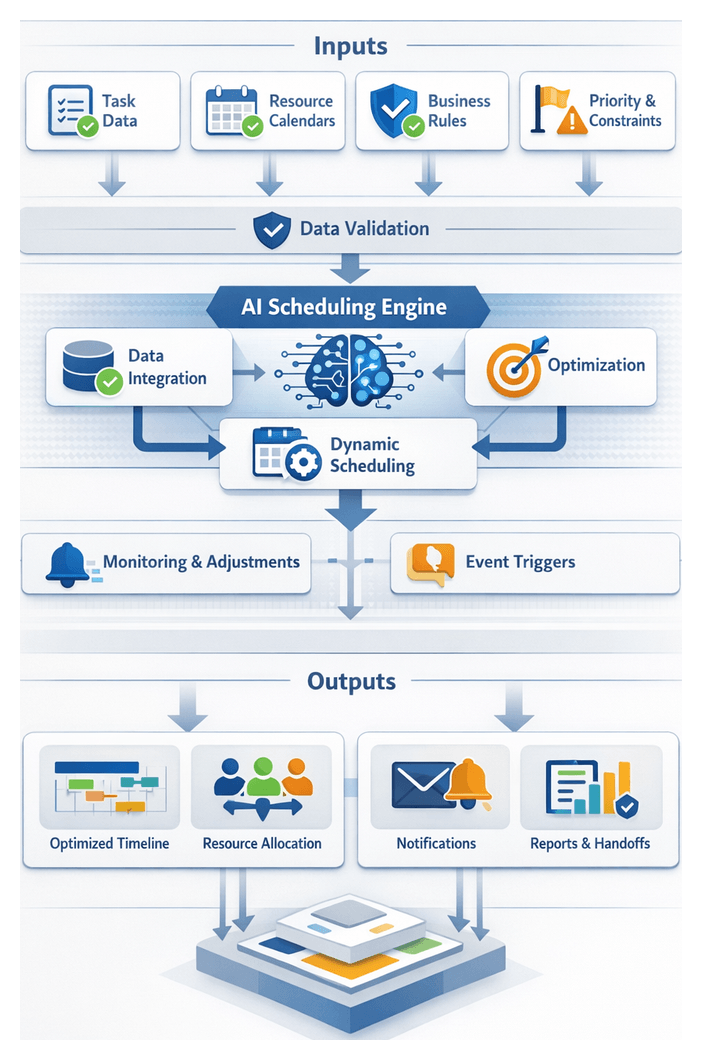
This stage establishes the foundational inputs and conditions necessary to generate an optimized project schedule. By defining precise scheduling requirements and identifying authoritative data sources, firms ensure that AI-driven engines have the context needed to model dependencies, resource availability, and organizational constraints into a coherent dataset that drives intelligent scheduling.
Objectives and Prerequisites
- Define the universe of data elements required to drive intelligent scheduling.
- Identify and validate the sources of each data element to ensure completeness and accuracy.
- Establish prerequisites and quality checks that gate the transition to the scheduling engine.
- Project scope and deliverables have been formally defined and approved.
- Resource allocation and capacity planning outputs are finalized.
- Governance rules and business calendars (holidays, blackout periods) are documented.
- Task dependencies and work breakdown structures are reviewed for accuracy.
- Stakeholder alignment is achieved on scheduling assumptions, including overtime policies and escalation protocols.
Required Inputs and Validation
- Task Definitions and Dependencies: A detailed work breakdown structure listing every task, milestone, and predecessor/successor relationship.
- Resource Availability and Calendars: Individual and team availability, including working hours, planned time off, and utilization targets, integrated with tools such as Forecast or Resource Guru.
- Business and Compliance Constraints: Organizational calendars defining holidays, maintenance windows, and regulatory reporting deadlines.
- Project and Client Priorities: Data on high-value tasks, contractual milestones, and regulatory deliverables to guide resource allocation.
Before invoking the scheduling engine, inputs must pass validation checks that verify task completeness, non-conflicting availability, alignment with organizational policies, and consistency between scope documents and task breakdowns.
Transition to Dynamic Scheduling
- Approval of task and dependency data by project managers.
- Confirmation of resource availability with team leads.
- Verification of business calendar constraints by operations teams.
- Sign-off on priority and risk settings by stakeholders.
Dynamic Scheduling and Adjustment Workflow
Input Collection and Pre-processing
The workflow begins by aggregating data from multiple systems to construct an initial view of tasks, dependencies, and availabilities. Inputs include:
- Task definitions and durations from the approved scope document.
- Dependency mappings illustrating sequencing constraints.
- Resource calendars from Microsoft Exchange and Google Calendar.
- Current workload snapshots from modules such as Reschedulr.
- Priority profiles and deadline updates via collaboration tools.
An AI-driven normalization agent reconciles date formats, aligns time zones, and flags anomalies, ensuring the scheduling engine processes a coherent input set.
Iterative Schedule Computation
An intelligent engine such as Optimal.ai computes feasible timelines using constraint-based optimization and machine learning to balance objectives:
- Minimize project duration while respecting dependencies.
- Maximize resource utilization without exceeding capacity.
- Adhere to priority weights assigned to critical tasks.
- Accommodate soft constraints like preferred working hours or skill preferences.
The engine generates a baseline in its first pass and refines through iterative heuristics and predictive models, scoring each candidate timeline against defined objectives.
Event-Driven Adjustments
Live updates trigger real-time adjustments via subscriptions to event feeds:
- Leave approvals from HR systems.
- Scope changes from ChangePilot.
- Task completion notifications from Slack or Microsoft Teams.
- Client feedback on milestone dates via customer portals.
A scheduling agent evaluates impact using decision models and proposes alternative slots or resource substitutions automatically, minimizing manual re-planning.
Cross-System Coordination and Notifications
- Push revised timelines into platforms like Asana or Jira.
- Synchronize event changes with corporate calendars.
- Alert resource owners and project managers through email or messaging channels.
- Log adjustments in configuration management databases for audit.
AI-driven notification services prioritize messages based on role and urgency, ensuring timely updates without fatigue.
Validation and Stakeholder Approval
Certain adjustments—such as executive presentations or contractual milestone changes—require human sign-off. The workflow generates approval requests with:
- A comparison view of original and proposed schedules.
- Impact analysis on downstream tasks, costs, and resource utilization.
- An AI-generated rationale explaining the optimization.
Stakeholders respond via integrated interfaces like ApproveNow, triggering final commits or rollbacks.
Continuous Feedback and Integration
Metrics from each scheduling run—estimate accuracy, adjustment frequency, utilization variance, and approval turnaround—feed back into machine learning models. Over time, the engine refines duration predictions and resource matchmaking. Once stable, the finalized timeline is packaged for handoff to task assignment modules, including detailed start/end dates, resource allocations with confidence scores, and audit trails.
AI-Driven Conflict Resolution and Resourcing
Core AI Capabilities
- Constraint Analysis: AI engines apply satisfaction techniques to detect overallocation and dependency violations across millions of combinations in seconds.
- Resource Leveling: Optimization algorithms (mixed-integer programming, genetic algorithms) rebalance workloads based on skills, contractual obligations, and preferred hours.
- Scenario Simulation: Real-time what-if analyses generate alternative timelines for resource substitutions, duration adjustments, or priority shifts.
- Predictive Reassignment: Machine learning forecasts potential bottlenecks, suggesting proactive reassignments to prevent conflicts.
- Enterprise Integration: Modules exchange data with ERP systems, human capital platforms, and time-tracking applications to ensure decisions reflect real-time availability and certified skills.
- Continuous Learning: Reinforcement learning refines recommendations by learning from accepted adjustments and manual overrides.
Supporting Systems and Integration
- Data Integration Platform: Tools such as MuleSoft or Zapier unify data from human capital, project portfolio, and calendar systems.
- Centralized Analytics Repository: Platforms like Snowflake store historical records, enabling AI to learn from past outcomes.
- Workflow Orchestration: Engines such as Apache Airflow schedule ingestion jobs and trigger conflict detection routines.
- Notification and Collaboration Hub: Alerts and proposals are delivered via Slack or Microsoft Teams.
- Visualization Dashboards: Embedded BI tools display conflict heatmaps, utilization graphs, and scenario comparisons.
Conflict Resolution Workflow
- Ingest schedule data, resource calendars, and skill profiles from integrated systems.
- Run constraint analysis to detect conflicts.
- Prioritize conflicts by business impact.
- Generate resolution scenarios with estimated outcomes.
- Deliver recommendations via dashboards and collaboration channels.
- Apply approved changes automatically in the scheduling engine.
- Monitor actual progress and update AI models with real-world results.
Benefits and Best Practices
- Reduced Schedule Slippage: Automated conflict resolution cuts remediation time by up to 80 percent.
- Improved Resource Utilization: Skill-based assignments increase billable utilization rates.
- Faster Decision Making: Scenario simulations and one-click approvals accelerate approval cycles.
- Higher Stakeholder Satisfaction: Proactive alerts and clear recommendations enhance transparency and confidence.
- Data Quality and Governance: Maintain accurate resource profiles and calendars to feed reliable inputs.
- Human-in-the-Loop Balance: Define thresholds for auto-apply versus manual approval to ensure oversight.
- Security and Compliance: Implement access controls and encryption for sensitive schedule and personnel data.
Optimized Timeline and Handoff Specifications
Master Schedule and Supporting Artifacts
The finalized master schedule is a comprehensive, resource-aware plan refined through AI-driven adjustments and conflict resolution. It details every activity, planned start and end dates, resource assignments, and dependencies. Outputs include interactive web views, PDF summaries, and exportable data files.
- Task Dependency Matrix with lead/lag times.
- Resource Utilization Report highlighting allocation percentages.
- Milestone Tracker listing key deliverables and approvals.
- Scenario Baselines preserving audit trails of alternative timelines.
- Schedule Change Log recording AI suggestions and stakeholder approvals.
Dependencies and Preconditions
- Validated task list and scope document aligned with deliverables.
- Confirmed resource profiles synchronized with enterprise human capital tools.
- Integrated organizational calendars via Microsoft Project or Smartsheet.
- Codified task dependency rules and compliance constraints.
- Configured risk-adjusted buffer settings based on historical variance data.
Handoff Mechanisms
- API-Driven Data Push: Use RESTful or GraphQL interfaces to transmit schedule objects to task assignment engines.
- Calendar Synchronization: Export events in iCalendar (ICS) format for import into team calendars and Jira plug-ins.
- Document Distribution: Publish PDF or XLSX versions to a centralized repository with version control.
- Notification Workflows: Trigger automated emails or in-app notifications summarizing milestones and updates.
Communication, Access, and Audit Trails
- Self-service portals offering interactive timeline dashboards and tailored report downloads.
- Embedded reports in Slack or Microsoft Teams for contextual discussion.
- Executive briefings delivered via slide decks or email digests with milestone snapshots and variance analyses.
- Role-based access controls to restrict sensitive resource data and provide high-level overviews to clients.
- Immutable archives and diff reports to maintain a forensic record of schedule evolution.
By defining clear outputs, dependencies, and handoff protocols at the close of the scheduling stage, firms create a solid foundation for downstream automation in task assignment, execution tracking, and performance monitoring. This structured transition minimizes miscommunication, reduces rework, and ensures all teams operate from a unified, validated timeline that drives on-time delivery and client satisfaction.
Chapter 5: Automated Task Assignment and Prioritization
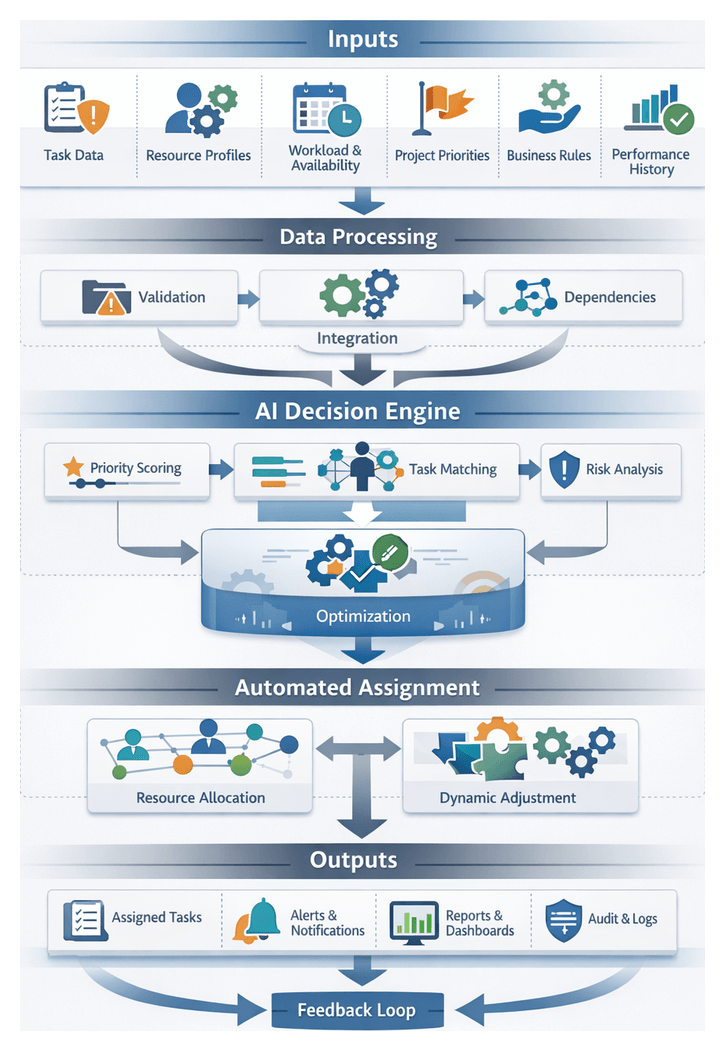
In professional services environments, efficient allocation of work tasks is essential to meeting project goals, controlling budgets, and maximizing team productivity. Automated task assignment and prioritization transforms static planning outputs—defined deliverables, resource capacity plans, and timelines—into actionable work items. By leveraging AI-driven decision engines, organizations eliminate manual bottlenecks, reduce human error in skill-to-task matching, and adapt in real time to changing project demands. The result is a dynamic, data-driven workflow that balances workloads, aligns expertise with priorities, and accelerates time to value for clients.
This approach addresses the challenge of distributing large volumes of discrete tasks across multidisciplinary teams. Automated agents process extensive datasets, recognize patterns in performance history, and respond to resource availability changes, yielding a predictable delivery cadence, improved utilization, and enhanced visibility into task status for project leaders and clients. Clear matching algorithms ensure that critical path activities receive immediate attention while lower-risk tasks are queued appropriately, driving operational efficiency and reducing uncertainty.
Inputs and Prerequisites for Dynamic Assignment
Effective automation requires validated inputs and established operational conditions. Missing or inconsistent data can lead to suboptimal recommendations and reduced confidence in AI outputs. Automated validation checks and exception notifications should surface any gaps for resolution.
- Task Definitions and Metadata: Scope, estimated effort, priority, dependencies, deadlines.
- Resource Profiles: Skills, certifications, roles, performance metrics.
- Current Workload and Availability: Real-time assignments, calendar integrations, time-off data.
- Project Priority Framework: Strategic importance, client deadlines, regulatory milestones.
- Business Rules and Constraints: Billable hours limits, skill interchangeability, geographic or time-zone restrictions, budget caps.
- Dependency and Precedence Information: Task interdependencies and critical path elements.
- Performance History: Completion times, quality ratings, stakeholder feedback.
Prerequisites:
- Approved Project Baseline: Locked scope, schedule, budget, resource plans.
- Integrated Data Streams: Bi-directional connections with ERP, CRM, talent management, calendars.
- Security and Access Permissions: Roles enabling AI agents to read and write project data, with governance policies and audit trails.
- Escalation Protocols: Workflows for skill shortages, overbooked resources, or policy violations.
- Performance Monitoring Setup: Dashboards and alerts tracking assignment accuracy, completion rates, and utilization.
- Stakeholder Alignment: Clear communication on automation role, override processes, and expectations.
AI-Driven Prioritization and Reassignment Workflow
Data Inputs and Trigger Events
The dynamic prioritization engine continuously ingests task status updates, work-in-progress indicators, and manual status changes. It monitors resource availability signals via ServiceNow or Asana, project milestone adjustments, risk and issue alerts, and stakeholder requests from intake forms or chatbots. Triggers can be rule-based—scheduled at regular intervals or sprint boundaries—or event-driven to react immediately to significant changes, balancing stability with responsiveness.
Priority Scoring and Normalization
Raw inputs are normalized to consistent scales, extracting key features:
- Business Impact Score: Strategic value of deliverables.
- Deadline Proximity: Ratio of remaining time to effort estimate.
- Resource Skill Match Quality: Alignment of personnel skills with requirements.
- Risk Exposure Level: Severity of associated risk items.
- Stakeholder Sentiment Index: Sentiment analysis via Google Cloud AI Platform or OpenAI.
A multi-criteria decision analysis algorithm—often realized through a gradient boosting model or neural ensemble—applies weighted scoring functions. Rule overrides handle compliance deadlines or contractual obligations. Final priority scores, timestamps, and contributing metadata are stored in the task database, supporting audit requirements. The model periodically retrains on historical data to improve accuracy.
Dynamic Reassignment and Continuous Optimization
Following scoring, the system reevaluates assignments in a loop:
- Identify Underutilized Resources: Query capacity planner for available bandwidth.
- Match Tasks to Resources: Use a constraint solver balancing skills, availability, and workload.
- Resolve Conflicts: Evaluate impact metrics when tasks compete for the same resource.
- Update Assignments: Persist changes and trigger notifications via messaging APIs.
Continuous optimization may include simulated annealing or reinforcement learning agents that minimize projected completion times and maximize utilization.
System Integrations and Stakeholder Notifications
Key integrations include a project management platform such as Adobe Workfront, a resource management system like Smartsheet, communication hubs in Microsoft Teams or Slack, monitoring and logging services, and a data warehouse for historical analytics. Middleware or an event bus (Kafka, RabbitMQ) orchestrates these connections.
Notifications are delivered through in-app alerts, chat messages, email digests, and mobile pushes. They include contextual details—original assignment, new priority score, responsible resource, and expected completion window—to foster trust and clarity.
Error Handling and Exception Management
The workflow handles common exceptions:
- Resource Data Unavailability: Revert to last known availability and schedule reconciliation.
- Conflicting Updates: Reconcile via last-write-wins or operational transformation, logging conflicts for review.
- Model Scoring Anomalies: Flag outlier scores for manual review and retraining.
- Assignment Rejection: Reenter declined tasks into the prioritization loop immediately.
Exception events surface in an issue management system with AI-generated remediation suggestions based on past resolutions.
AI Capabilities for Task Matching and Load Balancing
Skill Profiling and Competency Mapping
AI builds comprehensive skill profiles by aggregating data from learning management platforms, certification records, performance management systems, NLP analysis of resumes and internal bios, and on-the-job signals such as code commits or document edits. Machine learning models normalize and weight these inputs into multi-dimensional competency vectors.
Task Requirement Analysis
Natural language understanding transforms unstructured task descriptions into structured requirement sets. Entity extraction identifies skills and domain knowledge, dependency parsing reveals task hierarchies, and sentiment and urgency detection prioritize tasks based on client tone and deadlines.
Predictive Availability and Performance Forecasting
AI forecasts resource capacity using time-tracking systems, calendar APIs from Microsoft Teams or Slack, regression models predicting completion durations, and adjustments for seasonal trends, holidays, and team ramp-up periods. These forecasts prevent over-commitment and identify potential bottlenecks.
Optimization and Dynamic Matching Algorithms
At runtime, AI employs integer programming, genetic algorithms, or constraint satisfaction solvers to optimize multiple objectives: maximize skill alignment, minimize project duration, respect priority levels, and support soft constraints like learning goals. These algorithms integrate into orchestration platforms such as Asana or Jira, exposing RESTful APIs for seamless assignment updates.
Continuous Feedback Loops and Model Refinement
Continuous learning processes ingest performance feedback—actual versus estimated time logs and quality ratings—user interactions, and override events. Anomaly detection flags deviations, triggering retraining. Periodic calibration aligns skill profiles with evolving roles, ensuring models adapt to new certifications and organizational changes.
Integration with Collaboration and Workflow Tools
Assignments synchronize to platforms such as Trello, monday.com, and enterprise work management tools. Notifications and alerts via Slack or Microsoft Teams inform resources of new assignments and rebalancing. Status updates from collaboration hubs feed back into AI dashboards, closing the loop on real-time efficacy. Automated handoffs to time tracking and billing systems ensure accurate financial reconciliation.
Fairness, Transparency, and Governance
Explainability modules offer human-readable rationales for assignment decisions, listing key factors and confidence scores. Bias mitigation techniques monitor allocation patterns and trigger safeguards or manual overrides. Governance dashboards allow program managers to audit assignments, validate equity objectives, and enforce compliance. Role-based access controls protect sensitive model parameters and performance data.
Outputs and Handoff to Execution
Assigned Task List and Artifacts
The primary outputs are a structured assignment record—often machine-readable JSON or XML capturing task IDs, descriptions, assignees, priority levels, effort estimates, dates, and dependencies—and an assignment summary dashboard powered by Asana or Jira. Notification payloads—webhook events and emails—include actionable links to collaboration hubs. Integration artifacts document API endpoints, authentication tokens, payload schemas, and error-handling protocols for downstream systems.
Dependencies and System Integration
Assigned outputs rely on real-time access to the optimized timeline, resource allocation data, priority service analyses, a performance history database updated via ETL or CDC, and a governance repository enforcing policies such as segregation of duties and workload thresholds.
Handoff Mechanisms
- Webhook Notifications: HTTP callbacks to Jira or Trello when tasks are assigned.
- Message Bus Integration: Event streams via Apache Kafka or Azure Event Hubs for financial forecasting, risk monitoring, and dashboards.
- API-Driven Push: Task creation in Slack, Microsoft Teams, or Asana with rich message cards.
- Document Distribution: Automated templates populated and shared via SharePoint or Box for regulated reporting and sign-off.
- Dashboard Refresh: BI tools update live visualizations of deadlines, resource loads, and critical paths.
- Audit Trail and Logging: All API calls, webhooks, and event publications logged with timestamps and payload snapshots.
These outputs and handoff protocols ensure seamless propagation of assignments into execution channels, providing transparency, traceability, and a foundation for ongoing performance monitoring and continuous optimization.
Chapter 6: Collaboration and Communication Coordination
Purpose and Scope of the Collaboration Hub
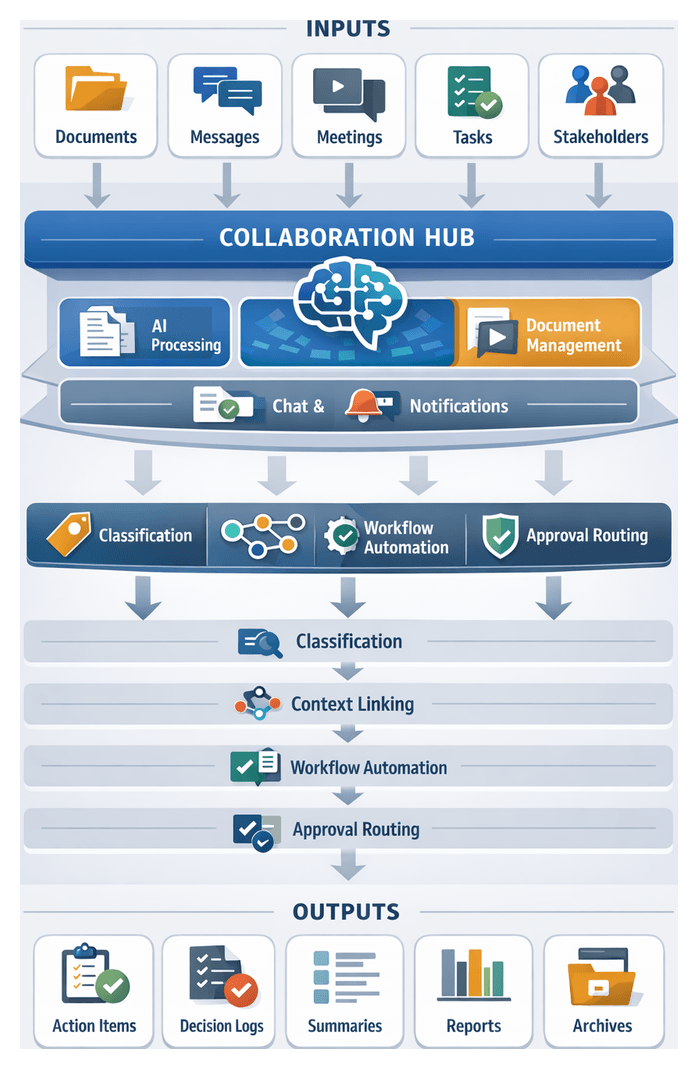
The Collaboration Hub establishes a unified environment for all project communications, documents, and decision points, breaking down silos among strategy, technology, operations, and client teams. By integrating asynchronous messaging, document repositories, meeting recordings, and AI-driven insights into a single interface, the hub ensures every stakeholder accesses the latest context. This centralized approach accelerates decision cycles, enhances accountability through auditable trails of revisions and approvals, and binds planning, execution, and review into a cohesive workflow that advances projects with clarity and alignment.
Key Objectives and Value
- Centralize project communications, documents, and events to prevent information silos and ensure consistency.
- Capture approvals, comments, and action items in context for transparent, auditable decision-making.
- Accelerate stakeholder alignment and reduce time to decision via integrated notifications and real-time updates.
- Enforce document versioning, naming conventions, and metadata tagging for efficient retrieval and compliance.
- Support synchronous and asynchronous collaboration across time zones and work patterns.
- Embed automated workflows for reviews, feedback loops, and approval cycles.
- Provide role-based access controls to safeguard sensitive information and meet data governance requirements.
Collaboration Inputs and System Integration
Effective coordination relies on high-quality inputs from diverse systems. The Collaboration Hub ingests data from:
- Document Repositories: Charters, specifications, design artifacts, and contracts stored in enterprise content management systems or cloud platforms.
- Communication Channels: Chat logs from Slack, Microsoft Teams, and email archives, ensuring all threads are captured and indexed.
- Meeting Schedules and Recordings: Calendar events and audio/video transcripts from Zoom or Webex for automated extraction of action items and decisions.
- Task and Workflow Updates: Statuses and assignments from tools like Jira and Asana.
- Stakeholder Directory: Structured data on team members, clients, and subject matter experts with roles and approval responsibilities.
- Historical Collaboration Logs: Archived communications, lessons learned, and compliance documents to inform governance and AI-driven recommendations.
- Metadata and Taxonomies: Predefined tags and classification schemas for consistent labeling and AI processing.
Key prerequisites include single sign-on and role-based access controls, robust API connectivity, unified naming and metadata standards, defined governance policies, end-user training, AI platform provisioning, and validated network performance. Upstream inputs flow from resource planning and scheduling, while downstream outputs feed risk assessment, performance monitoring, and continuous improvement processes.
AI-Enhanced Document Sharing and Contextual Communication Workflow
To maintain alignment and transparency, the document sharing workflow automates ingestion, classification, chat association, collaboration, approvals, notifications, and archival.
Document Ingestion and Routing
- Source Monitoring: Connectors poll services such as Google Drive, Box, and internal SharePoint libraries.
- File Normalization: OCR-processing of PDFs, conversion of Office formats, and versioning.
- Metadata Extraction: AI agents tag project names, deliverable types, and dates for search and compliance.
- Routing Decisions: Files are pushed to secure storage, collaboration channels, or review queues based on policies.
AI-Enabled Content Classification
- Taxonomy Matching: Natural language models categorize content into proposals, specifications, or status reports.
- Confidence Scoring: Low-confidence classifications are flagged for human verification.
- Automated Tagging: Approved labels support downstream workflows and archival rules.
Contextual Chat Thread Association
- Event Detection: Webhooks capture mentions of document IDs or titles in Slack or Microsoft Teams.
- Context Enrichment: AI extracts intent and sentiment, identifying review comments or approval requests.
- Thread Linking: Chats are bound to document metadata, preserving context for audits.
- Access Synchronization: Participants receive permissions based on role-based controls.
Real-Time Collaboration and Version Control
- Lock-Free Editing: Live edits via Google Drive or Office 365 synchronize without conflicts.
- Change Tracking: AI-powered diff engines highlight sentence-level modifications.
- Notification Triggers: Alerts for significant edits appear in chat or email.
- Audit Logging: All revisions and approvals are timestamped and attributed.
Automated Approval Routing
- Approver Selection: Machine learning models recommend reviewers based on expertise and turnaround history.
- Summary Generation: AI extracts key changes since the last review to brief approvers.
- Sequential or Parallel Routing: Workflows follow configured sequences or circulate to multiple stakeholders.
- Escalation Handling: Unanswered requests escalate to backups or project leaders after SLA thresholds.
Contextual Notifications and Alerts
- Channel-Specific Delivery: Notifications appear in designated Slack channels or Teams groups.
- Priority Tagging: Alerts labeled as normal, high-priority, or critical compliance checks.
- Aggregated Digests: Consolidated daily or hourly digests reduce notification fatigue.
- Adaptive Cadence: AI adjusts notification frequency based on user response patterns.
Integration with Task Management Systems
- Action Item Detection: Natural language understanding in chat identifies new tasks.
- Task Enrichment: Tasks inherit metadata such as due dates, priorities, and project codes.
- Status Synchronization: Updates in Asana or Jira propagate back to chat and document records.
Archival and Compliance Review
- Automated Archiving: Files and transcripts older than retention thresholds move to long-term, write-once storage.
- Compliance Tagging: AI scans for sensitive data and applies redaction or encryption.
- Audit Artifacts: Consolidated archives include final deliverables, approval logs, and communication records.
AI-Driven Meeting Capture, Context Extraction, and Summarization
AI transforms raw meeting interactions into structured intelligence, accelerating decision cycles and maintaining comprehensive records of commitments and insights.
Meeting Capture and Transcription Workflow
- Media Ingestion: Audio/video from conferencing platforms stream to processing queues.
- Speech-to-Text Conversion: Services such as Google Speech-to-Text, AWS Transcribe, or Azure Speech Services generate time-coded transcripts with speaker diarization.
- Time-Stamping: Precise timestamps map utterances to agendas and slide decks.
Natural Language Understanding and Context Tagging
- Intent and Topic Detection: Models label segments as status updates, decision discussions, or risk notifications.
- Entity and Action Item Extraction: Named entity recognition tags deliverables, dates, and budget figures; sequence labeling identifies tasks with owners and deadlines.
- Decision Capture: Formal approvals and direction changes are recorded.
- Risk and Issue Identification: Emerging concerns and blockers are flagged for follow-up.
Summarization and Highlight Generation
- Extractive Summarization: Ranking algorithms select salient sentences.
- Abstractive Summarization: Transformer models compose coherent summaries that paraphrase the core discussion.
- Structured Output: Bullet points and narrative overviews highlight action items, decisions, dependencies, and open questions.
Integration with Project Artifacts and Collaboration Platforms
- Project Task Boards: Generate tickets in Jira or Azure DevOps.
- Document Repositories: Archive transcripts and summaries in SharePoint or Box.
- Knowledge Graphs: Enrich enterprise bases with new insights and relationships.
- Collaboration Hubs: Post summaries in Microsoft Teams, Slack, or Webex Teams channels.
Supporting Systems and Security
Infrastructure components—message queues, service orchestration platforms, data lakes, and identity management—ensure scalable, secure processing. Encryption at rest and in transit, role-based access controls, consent management, data retention policies, and audit logging uphold GDPR, HIPAA, and SOC 2 compliance. AI models provide explainability for action-item identification and risk flagging, fostering trust in automated insights.
Operational Benefits
- Increased Efficiency: Teams focus on execution rather than minute-taking.
- Improved Accuracy: Automated extraction reduces omissions and errors.
- Accelerated Decisions: Near–real time summaries enable prompt stakeholder action.
- Enhanced Transparency: Standardized records ensure all participants share a single source of truth.
- Scalable Knowledge Capture: AI scales processing without proportional headcount increases.
Outputs and Handoff Protocols
The Collaboration and Communication Coordination stage yields artifacts that inform risk assessment, issue management, performance monitoring, and project closure. Key outputs include:
- Meeting Summaries and Action Item Registers: AI-generated summaries linking to recordings or transcripts.
- Contextual Chat Logs: Threaded discussions from Slack, Microsoft Teams, and Google Chat, tagged by topic and phase.
- Shared Document Repositories: Version-controlled libraries with AI-extracted metadata for rapid retrieval and compliance.
- Stakeholder Notification Logs: Records of notifications with read receipts and escalation triggers.
- Collaboration Analytics Dashboards: Reports on response times, review turnaround, and attendance rates.
- Updated Project Context Models: Knowledge graphs linking stakeholders, deliverables, milestones, and threads for predictive analytics.
Dependencies for reliable outputs include integration with scheduling and task assignment, document management systems, pretrained NLP models such as OpenAI GPT and Google BERT, real-time communication feeds, a unified stakeholder directory, security frameworks, and notification workflows configured in platforms like Zapier or Microsoft Power Automate.
At stage handoff, protocols package and transfer outputs to downstream modules:
- Issue and Risk Indicators: Negative sentiment, escalated items, and severity scores forwarded to Issue Management.
- Action Item Registers: Integrated into risk and monitoring dashboards for schedule and quality correlation.
- Communication Metadata: Indexed in the project data lake for performance monitoring and KPI computation.
- Knowledge Graph Updates: Consumed by predictive analytics to refine risk scoring and forecast escalations.
- Escalation Notifications: Alerts sent to the Project Management Office with direct links to artifacts.
- Archival for Audit Trails: Finalized summaries, logs, and threads archived in compliance repositories.
Data Governance, Compliance, and Analytical Insights
Rigorous data governance underpins effective collaboration coordination. Key imperatives include:
- Information Classification: Tagging content by sensitivity levels before ingestion.
- Retention and Disposal: Automated rules for archiving or purging based on corporate and legal requirements.
- Audit Trails: Detailed logs of access, edits, and shares for forensic analysis.
- Encryption: End-to-end encryption for data at rest and in transit.
- Privacy and Consent: Documented stakeholder consent for capturing meeting transcripts or personal data.
Structured inputs enable advanced analytics: sentiment analysis on chats to detect engagement issues, decision-point extraction from transcripts to reduce follow-up cycles, and theme identification across documents to surface potential risks. Predictive models forecast bottlenecks and recommend resource adjustments based on communication patterns. Consolidated collaboration intelligence fuels executive dashboards with real-time visibility into team performance, client satisfaction, and compliance adherence—transforming raw interactions into strategic insights that drive proactive management and continuous service improvement.
Chapter 7: Risk Assessment and Issue Management
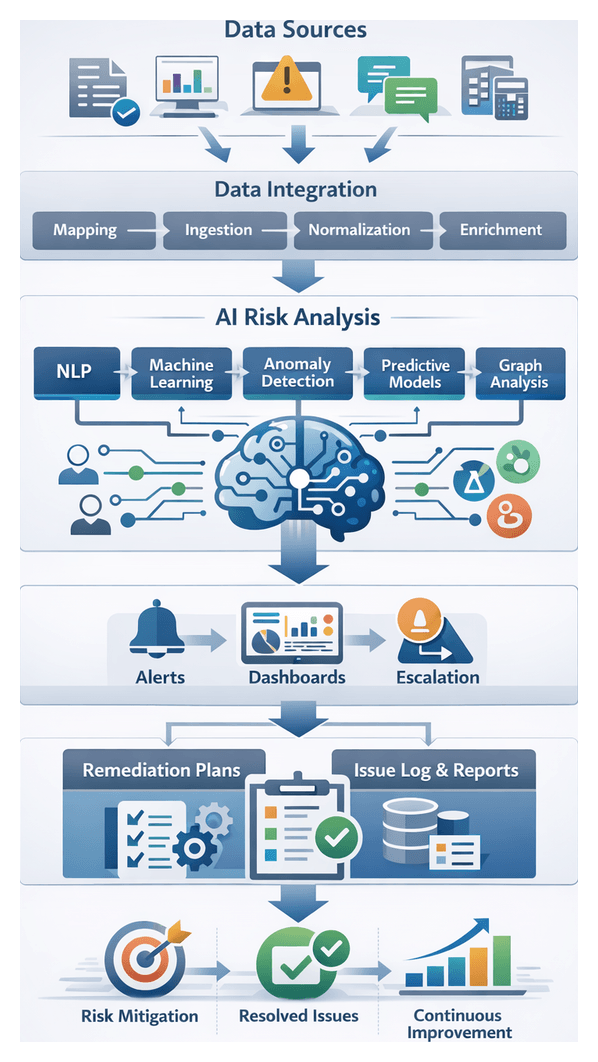
Stage Purpose and Goals
The initial phase of risk assessment in professional services transforms disparate project data into a coherent set of risk candidates for analysis, prioritization, and response planning. By systematically identifying threats to scope, schedule, budget, quality, and resources, organizations can allocate mitigation efforts proactively, align stakeholder expectations, and maintain delivery momentum. Key objectives include detection of potential risks, creation of a standardized preliminary risk register, stakeholder alignment, and preparation of data for predictive analytics and scenario simulations.
Data Inputs and Integration
Effective risk identification and monitoring depend on timely, high-quality data from multiple sources. A robust integration strategy consolidates project charters, scope documents, historical risk registers, performance metrics from tools such as Microsoft Project, anomaly detection streams from platforms like RiskLens, stakeholder feedback logs, external benchmarks, resource allocation snapshots, and financial transactions.
Integration steps:
- Data Mapping: Inventory and classify each source, defining schemas for risk attributes such as category, likelihood, and impact.
- Ingestion: Use secure APIs or connectors—employing Apache Kafka or Databricks—to extract structured and unstructured data in real time.
- Normalization: Standardize formats, reconcile naming conventions, and validate units of measure via AI-driven quality modules that flag outliers.
- Enrichment: Annotate records with project identifiers, stakeholder roles, and historical outcomes.
- Storage: Persist integrated data in a centralized repository or data lake for rapid retrieval by analytics engines.
AI-Driven Detection and Analysis
AI agents continuously monitor integrated data, leveraging advanced techniques to identify and quantify risks:
- Natural Language Processing: Agents parse meeting transcripts, emails, and collaboration logs to detect expressions of uncertainty or concern using platforms such as Google Cloud Natural Language and the OpenAI API.
- Machine Learning Classification: Models developed on IBM Watson, Microsoft Azure Machine Learning, or Google Cloud AI Platform categorize risks by type and estimate initial severity based on historical data.
- Anomaly Detection: Unsupervised learning via Elastic ML or the Splunk Machine Learning Toolkit flags deviations in time tracking, expense claims, and system performance.
- Predictive Scoring: Regression, simulation, and time-series models—such as long short-term memory (LSTM) networks—forecast risk trajectories and compute numerical exposure indicators at task and project levels.
- Graph Analytics: Platforms like Neo4j Graph Data Science map dependencies across tasks and resources, identifying critical nodes and clusters that amplify risk propagation.
This AI-driven analysis feeds continuous risk scoring engines that integrate domain rules, regulatory thresholds, and performance benchmarks to produce dynamic risk indicators for schedule variance, cost overrun probability, compliance breaches, and resource underutilization.
Alerting, Dashboarding, and Escalation
When risk scores or anomalies exceed defined thresholds, an orchestration layer generates consolidated alerts, reducing noise and guiding swift action. Alerts are routed via enterprise service buses and published to:
- Collaboration platforms such as Slack and Microsoft Teams
- Issue tracking systems like Jira or ServiceNow
- Email distribution lists and mobile push notifications via PagerDuty and Opsgenie
Each alert includes contextual metadata—project name, affected tasks, risk score evolution—and AI-generated remediation suggestions. Real-time dashboards, built on Microsoft Power BI or Tableau, display current risk exposure by category, trend charts, open alerts, and predicted trajectories. Custom views support project managers, risk officers, and executives with interactive filters and automated refresh schedules.
Escalation protocols assign low-severity issues to project managers, mid-level risks to cross-functional review boards, and high-severity or regulatory breaches to senior leadership and external auditors. Integrated AI schedulers reserve meeting rooms, populate agendas, and capture action items via natural language processing, linking decisions back into the task management system.
AI-Driven Remediation Suggestions
AI-driven remediation engines transform identified risks into prioritized, context-aware mitigation plans:
- Predictive Analytics and Root Cause Analysis: Models on Azure Machine Learning, IBM Watson Studio, and Google Cloud AI Platform forecast risk progression and isolate causal factors.
- Natural Language Processing: NLP engines scan unstructured repositories to extract corrective measures and sentiment from past projects.
- Reinforcement Learning: Frameworks such as TensorFlow Agents simulate response strategies, optimizing policies based on reward signals tied to schedule adherence and budget variance.
- Graph Analytics: Risk dependency graphs identify interrelated issues, enabling mitigation plans that address clusters of risks concurrently.
Recommendations are logged in issue trackers like Jira and ServiceNow, enriched with estimated effort and resource requirements. Notifications through PagerDuty or Opsgenie ensure that project managers and risk owners receive prioritized action items promptly. A human-in-the-loop mechanism presents suggestions in dashboards, allowing reviewers to accept, modify, or reject recommendations and feed back adjustments into retraining pipelines managed by MLflow or DataRobot.
Issue Log and Handoff Protocols
The issue log serves as the authoritative record of all active risks, ongoing issues, and agreed remediation plans. It consolidates predictive risk scores, anomaly event streams, root cause reports, AI-generated mitigation actions, and stakeholder feedback into a structured schema:
- Issue Identifier: Unique code for cross-system reference.
- Timestamps: ISO 8601 dates for creation and updates.
- Title and Description: Context, symptoms, and potential consequences.
- Category, Severity, Probability: Standardized classifications aligned with risk models.
- Root Cause Analysis: AI-assisted summaries with evidence links.
- Recommended Actions: Ordered steps with effort estimates and resource requirements.
- Status, Owner, Stakeholders: Lifecycle stage and assigned contacts.
- Related Artifacts: References to tasks, budget items, and quality cases.
- Audit Trail: Immutable change log with user or system attribution.
Integration mechanisms include RESTful webhooks and event-driven APIs—leveraging Apache Kafka or Azure Event Grid—to notify scheduling engines, resource planning modules, and financial forecasting systems of issue updates. Collaboration hub alerts, email digests, and dashboard embeddings in Power BI or Tableau ensure stakeholders remain informed. Bidirectional links provide traceability between identified risks and downstream tasks, while append-only logs and compliance tags (GDPR, SOX, ISO 9001) support audit requirements. Automated retention policies align with data governance rules, preserving critical artifacts for continuous improvement.
Governance and Continuous Improvement
To sustain an effective risk and issue management ecosystem, firms should enforce:
- Clear roles and responsibilities for risk owners, issue coordinators, and governance committees.
- Service level agreements and KPIs such as mean time to acknowledge (MTTA) and mean time to resolve (MTTR).
- Regular taxonomy reviews to align categories with evolving project types and regulations.
- Data quality standards enforcing validation and completeness at log time.
- Periodic audits of analytics pipelines, notification flows, and downstream integrations.
- AI-driven insights into historical issue data to refine predictive models and mitigation playbooks.
By integrating structured data pipelines, AI-driven detection, automated alerting, remediation suggestions, and standardized issue logs, professional services organizations establish a cohesive, end-to-end risk management framework. This framework enables proactive risk reduction, data-driven decision-making, and continuous learning, ensuring project outcomes align with client expectations and strategic objectives.
Chapter 8: Performance Monitoring and Predictive Analytics
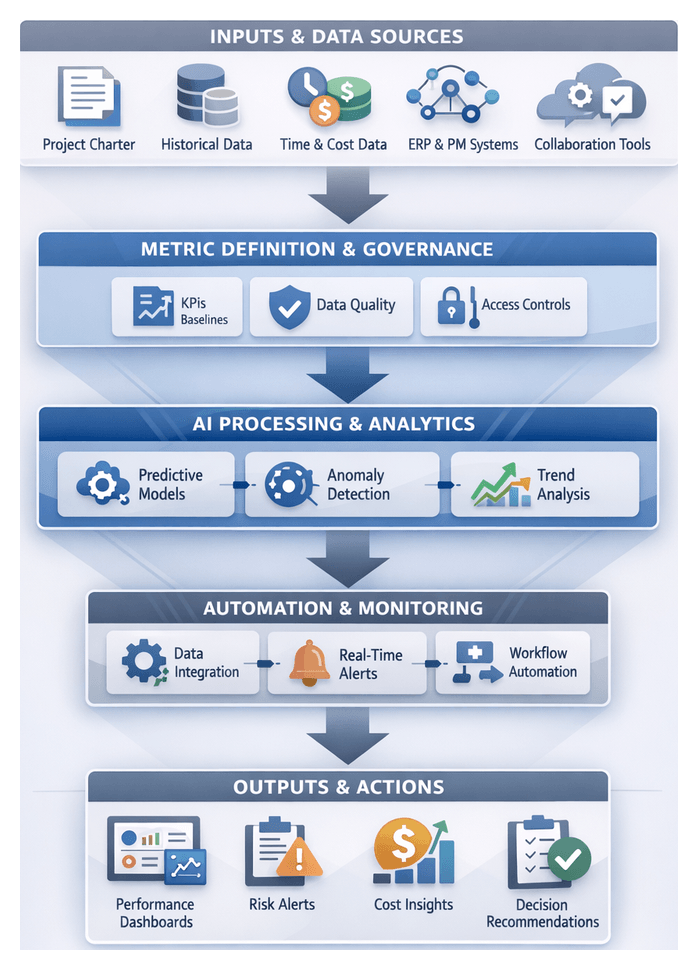
Performance Metrics Definition
In complex professional services engagements, defining performance metrics establishes the foundation for objective, data-driven oversight. Clear metrics aligned to project goals enable stakeholders to share success criteria and monitor progress across schedule adherence, resource utilization, quality, and financial health. Early metric definition avoids ambiguity, aligns priorities, and positions project teams to correct deviations before they escalate.
Firms face mounting pressure to deliver high-complexity projects on time, within budget, and to evolving client requirements. Teams spanning consultants, architects, analysts, and vendors contribute deliverables to a unified effort. Without structured performance measurement, organizations rely on subjective status updates, leading to inconsistent reporting and reactive management. AI-driven analytics and predictive modeling transform data collection and interpretation, but their effectiveness depends on precisely defined metrics, supported by robust data inputs and governance.
Key Objectives
- Align project goals with organizational KPIs and client expectations
- Identify quantitative and qualitative indicators of schedule, cost, quality, and risk
- Define data requirements, sources, and quality standards for reliable metric computation
- Assign ownership and accountability for tracking and reporting
- Set baselines and thresholds for alerts, escalations, and decision triggers
Prerequisites
- Project charter outlining objectives, scope, stakeholders, and high-level deliverables
- Data governance framework governing ownership, privacy, and quality standards
- Historical data or industry benchmarks for target calibration
- Integration capabilities via APIs or data pipelines connecting project management, time-tracking, ERP, and collaboration systems
- Stakeholder consensus on metrics selection and usage
Inputs and Data Sources
- Project charter, SLAs, and organizational KPIs
- Historical performance records and benchmarking reports
- Data feeds from time-tracking systems (for example, Harvest, Toggl)
- Project management tools (for example, Microsoft Project, Jira)
- Financial ERP systems (for example, SAP, Oracle ERP)
- Quality assurance platforms (for example, TestRail)
- Risk management solutions (for example, Riskonnect)
- Collaboration platforms (for example, Slack, Microsoft Teams, Confluence)
- Middleware and ETL tools (for example, Informatica, MuleSoft)
Performance Metric Categories
- Schedule: Schedule Variance (SV), Schedule Performance Index (SPI), milestone attainment rate
- Cost: Cost Variance (CV), Cost Performance Index (CPI), budget burn-down, forecast accuracy
- Resource Utilization: Utilization rate, billable vs non-billable hours, capacity heat maps
- Quality: Defect density, on-time delivery percentage, customer satisfaction scores (CSAT)
- Risk: Open risks, risk exposure, mean time to resolution
- Collaboration Health: Response times, meeting attendance, action item closure
AI-Driven Metrics and Tools
AI augments traditional metrics with predictive insights and natural language interpretation:
- Predictive Schedule Deviation: Forecast schedule risks using historical SPI trends
- Resource Churn Prediction: Anticipate overload or attrition with machine learning models
- Anomaly Detection in financials via Datadog or Splunk
- Sentiment Analysis on collaboration using IBM Watson Analytics
- Forecast Accuracy Scoring with Tableau and Microsoft Power BI
Baselines and Thresholds
- Derive baselines from historical data or benchmarks
- Define acceptable ranges and escalation thresholds
- Document baselines and thresholds in a central repository
- Align thresholds with contract terms and governance policies
Governance and Accountability
- Metric Owners maintain definitions, data quality, and reporting cadence
- Data Stewards ensure source data integrity and accessibility
- Executive Sponsors validate strategic alignment of metrics
- Delivery Leads interpret results, drive corrective actions, and communicate status
Real-Time Monitoring and Data Aggregation
Real-time monitoring and data aggregation form the heartbeat of an AI-driven project management solution. Continuous visibility into project health, resource utilization, and emerging anomalies enables proactive decision making and upholds client commitments. By orchestrating event-driven pipelines, API integrations, and intelligent agents, organizations can detect deviations, respond to risks, and refine execution in flight.
Data Acquisition and Integration
- Project management applications (for example, Jira, Asana)
- Time and expense tracking systems (for example, Harvest, Toggl, SAP Concur)
- Collaboration platforms (for example, Microsoft Teams, Slack)
- Version control repositories (for example, GitHub, GitLab)
- Resource monitoring tools (Datadog, Splunk)
- External data feeds (third-party APIs, calendar services, IoT sensors)
Sources emit events via webhooks or APIs to a centralized ingestion layer. Webhooks capture asynchronous triggers—task updates, time entries, document uploads—while polling retrieves batch snapshots. Secure authentication and permission checks protect sensitive project metrics throughout the flow.
Stream Processing and Validation
- Event Buffering: Message brokers such as Apache Kafka or AWS Kinesis buffer high-velocity events.
- Schema Validation: JSON or Avro schemas enforce consistent message formats and flag malformed records.
- Routing Logic: Metadata tags direct messages to pipelines for scheduling, budgeting, risk, or collaboration.
- Error Handling: Dead-letter queues capture invalid events, triggering alerts for remediation.
Normalization and Contextualization
A normalization layer enriches events with project identifiers, resource attributes, task dependencies, client codes, and priority levels. Mapping to a canonical data model enables end-to-end traceability—linking cost overruns to specific timesheet entries or schedule delays to resource constraints.
Real-Time Analytics Coordination
- Anomaly Detection modules flag outliers in logged hours or budget consumption using control charts and moving averages.
- Trend Analysis functions compute rolling metrics such as schedule variance and utilization rates.
- KPI Calculators update earned value (EV), actual cost (AC), and SPI continuously.
- Alerting Services trigger notifications via email, chat messages, or push alerts based on thresholds or predictive risk scores.
AI agents refine detection parameters by learning from historical patterns—for example, adjusting thresholds for task reassignment spikes based on past project profiles.
System Orchestration
- API Gateways for synchronous dashboard queries
- Webhooks to post alerts in collaboration tools—creating tasks in Asana or notifications in Slack
- Service mesh technology (for example, Istio) to secure inter-service communication
- Workflow engines that sequence corrective actions and automate remediation steps
Data Storage Patterns
- Time-series databases (for example, InfluxDB, TimescaleDB) for high-frequency events
- Data lakes (for example, Amazon S3, Azure Data Lake Storage) for raw and historical data
- Cloud data warehouses (for example, Snowflake, Google BigQuery) for cross-project analysis
- Graph databases (for example, Neo4j) to model task, resource, and risk dependencies
Visualization and Dashboards
Real-time dashboards deliver an up-to-the-minute view of project performance. Visualizations include dynamic charts for schedule variance, resource heat maps, and burn-down curves; alert panels for critical issues; and interactive filters for teams, time periods, or risk categories. Integration with BI tools such as Power BI, Tableau, and Grafana enables customizable reporting. Widgets refresh automatically on new events or on a configurable schedule, and stakeholders can subscribe to snapshot reports via email or collaboration channels.
AI Forecasting and Recommendations
At the performance monitoring stage, AI forecasting and recommendation modules converge real-time data and predictive analytics to guide proactive interventions. These capabilities transform raw metrics into foresight, enabling teams to anticipate schedule, resource, and quality deviations before they become critical issues.
Data Foundations
Accurate forecasting requires a unified data infrastructure that ingests, cleanses, and harmonizes sources such as historical project records, time entries, financial transactions, resource calendars, and quality assessments. Integration via APIs and event streams—leveraging platforms like Power BI and AWS Forecast—ensures continuous model updates. Data warehouses and lakes using Snowflake or Azure Synapse Analytics facilitate cross-project analytics and enrichment.
Core AI Techniques
- ARIMA models for short-term schedule variance forecasting
- Gradient boosting machines and random forests to predict resource utilization peaks
- Recurrent neural networks (RNNs) and long short-term memory (LSTM) networks for multivariate time series
- Anomaly detection algorithms to flag outliers in cost or quality metrics
Model Validation and Accuracy
Model trust depends on cross-validation, back-testing, and performance metrics such as mean absolute percentage error (MAPE) and root mean squared error (RMSE). Periodic retraining accommodates evolving staffing profiles and market conditions, preserving forecast reliability over time.
Scenario Planning
AI engines enable what-if analysis by simulating the impact of decisions such as adding headcount, adjusting task durations, or reallocating budget. Interactive dashboards visualize divergent forecast paths and sensitivity analysis highlights variables with the greatest impact on outcomes.
Recommendation Engines
Recommendation engines translate forecasts into concrete actions. For example, if a schedule delay is predicted, the engine might suggest reallocating consultants, compressing milestones, or engaging external resources. Each recommendation includes confidence scores and expected impact metrics to support informed decision making.
- Task reprioritization based on predicted critical path shifts
- Resource leveling suggestions to mitigate utilization bottlenecks
- Budget realignment when cost forecasts exceed thresholds
Embedding AI into Dashboards
Dashboards powered by Tableau and Microsoft Power BI display forecast curves alongside actuals, highlight at-risk tasks, and present next-step recommendations. Alert systems notify stakeholders when key indicators cross thresholds, embedding AI insights into governance rituals such as weekly status reviews.
Human-in-the-Loop Governance
Human oversight remains essential. Approval workflows with configurable escalation rules ensure that high-risk actions retain executive sign-off. Audit trails capture recommendation rationales and decision outcomes, and continuous feedback loops refine future suggestions based on accepted or rejected recommendations.
- Approval workflows for AI-driven adjustments
- Audit trails of recommendation rationales
- Feedback mechanisms labeling recommendations as accepted, modified, or rejected
Risk Management Integration
Predictive models flag emerging risks such as resource attrition or quality rework and integrate them into the risk register. Recommendation engines propose mitigation plans aligned with risk thresholds, synchronizing performance and risk management.
Portfolio-Level Forecasting
At the portfolio level, AI aggregates forecasts across engagements, providing consolidated views of resource demand, schedule health, and financial exposure. Cloud-based compute clusters and microservices ensure scalability as the number of monitored projects grows.
Continuous Improvement
AI systems implement improvement cycles by monitoring production model performance, triggering retraining upon accuracy degradation, and incorporating new data sources such as contractor logs or client surveys. Dedicated AI operations teams manage versioning, deployment, and compliance with ethical guidelines.
Strategic Impact
Embedded AI forecasting and recommendations shift firms from reactive to proactive management, improving on-time delivery, stabilizing resource utilization, and enhancing financial performance. Early detection of variances and swift remediation reinforce competitive positioning by increasing project throughput without compromising quality or profitability.
Key Takeaways
- Unified, high-quality data feeds are essential for accurate predictions
- Diverse AI techniques address multiple forecasting horizons
- Recommendation engines bridge insights and action planning
- Dashboard integration and approval workflows embed AI in governance
- Continuous validation and human oversight sustain trust and relevance
Further Tools and Platforms
- AWS Forecast
- Microsoft Azure Machine Learning
- DataRobot Enterprise AI Platform
- Tableau Analytics Platform
- Microsoft Power BI
Reporting Outputs and Handoff Mechanisms
Reporting outputs serve as the vital link between insight generation and decision execution. Performance monitoring and predictive analytics produce artifacts that guide stakeholders, inform governance committees, and trigger automation. Clear handoff protocols ensure that AI-generated intelligence translates into timely interventions, resource adjustments, and strategic reviews.
Performance Reports and Dashboards
- Executive Summary Dashboards: High-level visualizations of KPIs such as schedule variance, cumulative budget burn rate, and forecasted completion dates, built with Tableau or Microsoft Power BI. These dashboards refresh automatically as new data streams arrive.
- Operational Detail Reports: Tabular and graphical documents presenting granular metrics at the workstream, task, or resource level. Tools like Grafana or proprietary engines provide drill-down capabilities to investigate anomalies and compare actuals against baselines.
These reports depend on continuous data feeds, predictive models, and preconfigured visualization templates. Automated publication to BI portals distributes reports with predefined access permissions, and stakeholders receive notifications via email or collaboration platforms. Executive summaries follow a weekly cadence, while operational reports update daily or in near real time.
Exception and Alert Notifications
- Threshold Alerts: Notifications triggered when budget overruns exceed thresholds, schedule delays surpass limits, or resource utilization crosses critical levels. Alerts appear in email, SMS, or collaboration tools such as Slack or Microsoft Teams.
- Anomaly Reports: Logs summarizing outliers identified by machine learning models, feeding into issue management for remediation planning.
- Predictive Warnings: Forecast-based notifications warning of potential risks, such as projected resource shortages in upcoming sprints.
Alert rules engines and anomaly detection models drive generation. Exception records automatically create or update tickets in systems like Jira or ServiceNow, and escalation workflows ensure critical issues reach senior managers per defined timelines.
Data Exports and Integration Files
- CSV and JSON Exports: Periodic dumps of KPI datasets for ingestion by data warehouses or analytics engines.
- APIs and Webhooks: Real-time or scheduled data streams via RESTful APIs or event-driven webhooks to consumer applications.
- XML Feeds: Structured outputs for legacy systems requiring standardized schemas for financial or compliance reporting.
Data mapping definitions and secure API gateways govern exports. Automated ETL processes and change data capture mechanisms push updates to target directories or systems, ensuring downstream platforms receive only modified records.
Handoff to Stakeholders and Systems
Stakeholder Packages
- Monthly performance packets: PDF bundles of dashboards, narrative summaries, and strategic recommendations delivered via email or project portals
- Role-based views: Tailored report sets for directors, portfolio managers, finance teams, and quality leads
System-to-System Integrations
- Resource adjustment triggers: Automated requests sent to resource management systems or talent marketplaces when utilization forecasts indicate overbooking
- Financial forecast updates: Budget variance data populates forecasting modules in ERP suites such as SAP or Oracle ERP
- Risk register sync: Emerging risks and issues appended to centralized risk registers for enterprise review
Disciplined orchestration of reports, alerts, and integration files minimizes latency between insight generation and action. Structured delivery ensures that each stakeholder, whether human or system, receives the precise information needed at the right time, enabling end-to-end cohesion in project governance and execution.
Chapter 9: Budget Control and Financial Forecasting
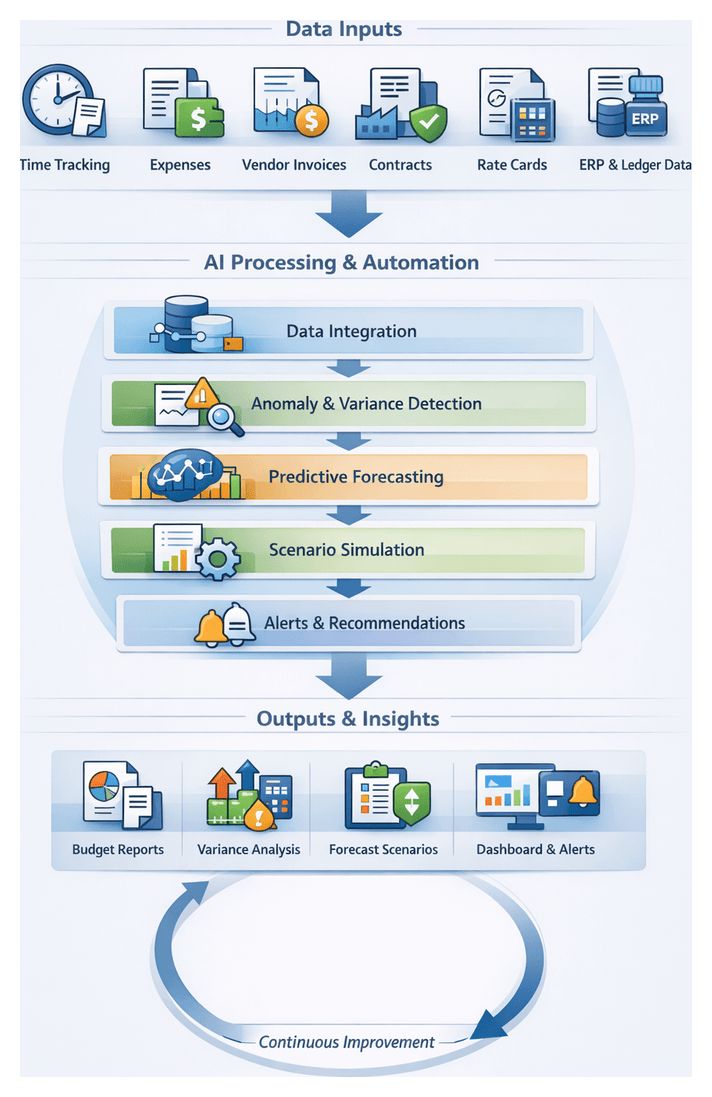
Purpose and Context of Financial Control and Forecasting
The Financial Control and Forecasting stage establishes mechanisms for professional services firms to monitor, manage, and predict project and portfolio-level financial performance. By centralizing timekeeping, expense, procurement, and invoicing data, organizations gain real-time visibility into cost drivers—billable hours, variable expenses, subcontractor fees, and change orders—enabling proactive interventions to maintain budgetary discipline and safeguard margins.
Traditional spreadsheet-based budgeting struggles to keep pace with evolving project scopes and fluctuating cost elements such as travel, software licensing, and third-party fees. Market studies show that up to 30 percent of professional services engagements exceed their budgets by double-digit percentages, eroding profitability and straining client relationships. Embedding financial monitoring at each milestone—from kickoff through closeout—positions finance as an active partner in delivery, detecting variances early and aligning corrective measures with strategic objectives.
At its core, this stage enforces:
- Cost Visibility and Accountability: Capturing and categorizing every cost element to assign responsibility and promote timely interventions.
- Predictive Insights: Leveraging historical data, real-time inputs, and AI-driven forecasting to project future expenditure curves and margin pressures.
- Compliance and Governance: Enforcing approval workflows, audit trails, and standardized reporting to meet regulatory and contractual requirements.
- Strategic Alignment: Linking project financial metrics to corporate KPIs—revenue growth, profitability thresholds, and utilization benchmarks—to ensure organizational targets are met.
Key Objectives and Data Requirements
To achieve these objectives, the financial control process ingests continuous streams of transaction data from:
- Time Tracking Records: Detailed logs of billable and non-billable hours by resource and task, from platforms like Tempo, Connecteam, or Kronos.
- Expense Submissions: Employee-submitted reports with receipts for travel, lodging, meals, and incidentals via systems such as SAP Concur.
- Procurement and Vendor Invoices: Purchase orders and invoices from solutions like Coupa or Ariba Network, including vendor rates and payment terms.
- Resource Rate Cards: Standard billing and cost rates by role, location, and service level, with adjustments for overtime or premium services.
- Contractual Baselines: Client-approved budgets, milestone payments, and change order authorizations captured at project initiation.
- General Ledger Transactions: GL entries and overhead allocations from ERP suites such as Oracle Cloud ERP and SAP S/4HANA.
Accurate ingestion and normalization of these inputs enable reconciliation of planned vs. actual costs, variance detection, and feeding of data into AI forecasting models for scenario analysis.
Prerequisites, Data Quality, and Organizational Alignment
Before automating financial control workflows, firms must establish:
- System Connectivity: Secure API or ETL integrations with time tracking, expense management, procurement, and ERP systems, supporting real-time synchronization and error logging.
- Standardized Taxonomy: Unified chart of accounts and cost codes, governed by change workflows to eliminate misclassification.
- Historical Data Repository: Multi-year financial records cleansed of anomalies to train AI models and analyze trends.
- Security and Access Controls: Role-based permissions, audit trails, and encryption to safeguard sensitive data.
- Process Documentation: Defined workflows for budgeting, expense submission, variance escalation, and service-level agreements between finance, delivery, and clients.
Rigorous data governance—mandatory fields, validation rules, reconciliation routines, and exception workflows—ensures high-fidelity inputs. Cross-functional stewardship between finance, delivery, and IT fosters shared accountability, while tailored training and feedback loops drive adoption of new workflows and cultivate a data-driven culture.
End-to-End Workflow and AI-Driven Enhancements
The automated cost monitoring workflow aggregates transactions into a centralized data lake or analytics warehouse. Connectors extract and normalize records from integrated platforms, applying validation rules to ensure completeness. Key AI-driven components include:
- Automated Data Integration: Machine learning connectors and natural language processing parse structured and unstructured inputs—timesheet entries, invoice PDFs, vendor statements—and reconcile master data across ERP instances.
- Real-Time Variance Detection: Streaming analytics engines compare actual spend to approved budgets and rolling forecasts from tools like Anaplan or Planful, calculating cost variance (CV) and schedule performance index (SPI) at defined intervals.
- Anomaly Detection: Unsupervised learning models identify outliers in spending patterns and sudden cost spikes, while NLP correlates variances to change requests.
- Threshold Calibration: AI agents adjust alert thresholds dynamically based on project size, risk profile, and historical performance to minimize false positives.
- Scenario Simulation: Time series forecasting, Monte Carlo simulations, and reinforcement learning frameworks model “what-if” scenarios—rate changes, scope adjustments, accelerated timelines—to recommend optimal contingency reserves.
- Intelligent Alerting: Context-aware notifications via email, chat platforms like Slack or embedded within project management systems, prioritized by risk scoring and including recommended corrective actions.
- Automated Recommendations: Prescriptive engines suggest budget realignments, resource reallocations, or vendor negotiations, creating follow-up tasks assigned to responsible team members.
Workflow orchestration engines enforce approval workflows—initial review by project managers, financial assessment by analysts, and executive authorization for variances beyond delegated thresholds—while maintaining audit logs and service-level agreements to prevent bottlenecks.
Integration with Financial, ERP, and Collaboration Systems
Maintaining consistency across systems requires synchronous and asynchronous data exchanges via RESTful APIs or message queues. Automated reconciliation workflows post approved adjustments to ERP ledgers, update planning tools such as IBM Cognos Analytics or Workday Adaptive Planning, and trigger procurement holds when budgets are at risk. Key integration points include:
- Ledger Reconciliation: Automatic posting of variance corrections to general ledger accounts in ERP systems like Oracle ERP Cloud.
- Planning Tool Sync: Bidirectional updates to resource and schedule plans in PPM platforms such as Oracle Primavera or Smartsheet.
- Procurement Triggers: Automated purchase requisition approvals or holds in solutions like Coupa.
- Collaboration Channels: Embedded discussion threads and alerts in Microsoft Teams or Slack, enabling cross-functional alignment without context switching.
Reports, Dashboards, and Notifications
The outputs of the forecasting stage provide a definitive financial narrative for stakeholders and downstream processes:
Core Financial Reports
- Actual vs. Budget Summary: Consolidated view of costs incurred versus budget baseline and approved change orders.
- Cost Variance Analysis: Itemized breakdown of positive and negative variances by category, with drill-down to individual line items.
- Burn Rate Forecast: Projection of budget consumption rates and exhaustion dates under current spending trends.
- Commitment Ledger: Reconciliation of outstanding purchase orders, vendor commitments, and encumbrances.
- Change Order Impact: Comparative scenarios illustrating the financial consequences of scope adjustments.
Interactive Dashboards
- Drill-down filtering by workstream, resource type, geography, or time period.
- Trend lines and heat maps highlighting high-risk cost centers.
- On-the-fly scenario modeling with embedded AI modules.
- Live data connections to visualization platforms like Microsoft Power BI and Tableau.
- Export and collaboration tools for sharing annotated snapshots.
Alerts and Notifications
- Threshold Breaches: Automated alerts when variances exceed predefined tolerances.
- Forecast Depletion Warnings: Early-warning messages for potential budget exhaustion.
- Unmatched Transaction Flags: Notifications for expenses lacking purchase orders or approvals.
- Reforecast Reminders: Scheduled prompts at major milestones or regular intervals.
Handoff to Project Closure and Continuous Improvement
As engagements wind down, the financial control outputs feed into closure and knowledge capture activities:
- Final Budget Reconciliation: Comprehensive report aligning forecasted, committed, and actual costs for contract closure and final billing.
- Lessons Learned Analysis: Narrative summaries of root-cause factors behind variances and efficiencies.
- Audit Trail Package: Documentation of change orders, approvals, invoices, and variance logs for compliance reviews.
- Continuous Improvement Recommendations: Data-driven suggestions for refining rate cards, contingency policies, and forecasting models.
These artifacts are formally transferred via workflow orchestration platforms into repositories such as SharePoint or Box, ensuring that each project contributes to an evolving corpus of best practices and benchmark data, driving maturity in subsequent financial control cycles.
Chapter 10: Project Closure and Knowledge Capture
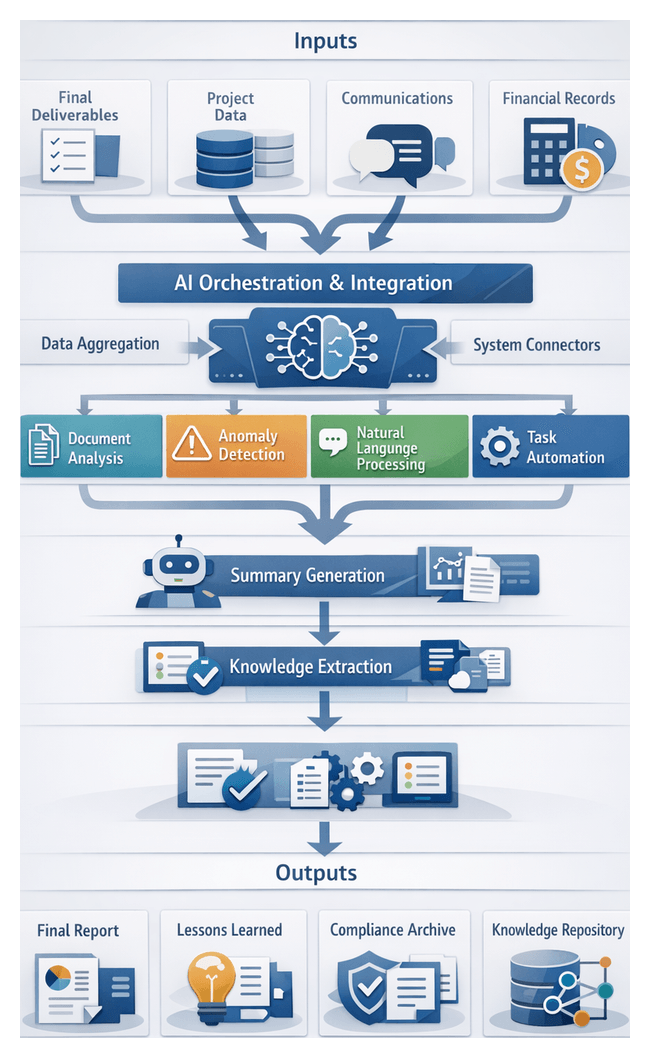
Purpose and Industry Context
Project closure consolidates deliverables, verifies compliance, reconciles finances and captures institutional knowledge to inform future initiatives. In professional services, rising complexity and client expectations demand structured closure practices. Embedding closure into an AI-driven workflow ensures repeatable processes, reduces unresolved issues and secures lessons learned for continuous operational excellence and enhanced client satisfaction.
Traditional ad hoc closure leads to lost knowledge, post-engagement disputes and hindered improvement. An AI-augmented approach automates summary generation, archives artifacts and structures lessons learned. The result is a systematic handoff that preserves intellectual capital and drives continuous improvement across the project portfolio.
Objectives and Prerequisites
This stage delivers strategic value on multiple fronts: risk mitigation, operational insight and strategic guidance. Key objectives include:
- Consolidate and verify all artifacts against scope and acceptance criteria
- Confirm contractual, regulatory and quality compliance
- Reconcile financial records, finalize billing and ensure transparent cost accounting
- Conduct structured retrospectives to identify successes, challenges and improvement opportunities
- Capture and codify lessons learned for organizational reuse
- Obtain formal client sign-off and stakeholder approval
- Transfer knowledge, documentation and access rights to operational teams or client repositories
Prerequisites for initiation include:
- Approved inventory of final deliverables aligned to scope
- Documented client acceptance criteria and governance records
- Final contract and statement of work detailing scope and timelines
- Reconciled financial records and QA reports
- Comprehensive risk and issue logs
- Communication archives and access to the project repository
- Stakeholder availability for review and retrospective sessions
- AI-driven summary engine (for example, connectors to OpenAI GPT-4 or Microsoft Azure Cognitive Services) configured
- Client sign-off templates and knowledge capture frameworks uploaded
Conditions for triggering closure workflows include completed quality assurance, stakeholder notifications, resolved high-priority issues, aggregated time and expense data, documented change controls and configured AI agents to access repositories and archives.
Integration and AI-Driven Preparation
Closure relies on data from upstream phases: resource allocation, scheduling logs, quality and risk assessments, and performance monitoring. A unified data model allows AI agents to surface gaps and generate summary reports consistent with earlier records.
AI agents automate preparatory tasks:
- Aggregation of deliverable metadata from content management systems
- Natural language processing to extract comments and action items from emails and chat
- Machine learning–driven anomaly detection to flag discrepancies in timesheet or expense data
- Workflow orchestration to schedule retrospectives based on calendars
- Intelligent reminders for outstanding sign-offs
- Preconfigured templates for closure summaries and knowledge transfer documents
By the end of preparation, teams have a clear closure plan, verified repository access, stakeholder commitments and automated pipelines for initial summary drafts.
Automated Summary and Documentation Workflow
As the project enters closure, an orchestration engine triggers AI agents to consolidate deliverables, communications and performance data into a coherent final report. Automatic initiation occurs upon final deliverable approval, detection of a closure flag or manual invocation.
Key integrations include:
- Document repositories (for example SharePoint, Box, Confluence) via REST APIs
- Collaboration platforms (for example Microsoft Teams, Slack) to harvest chat and meeting history
- Time and expense systems for effort logs
- Email archives for approvals and correspondence
- Task management tools (for example Jira, Asana) for completion reports
Artifacts are staged, validated and classified by an AI agent that assigns categories and performs preprocessing tasks such as language detection, text normalization, section segmentation and entity extraction.
An NLG agent using transformer models from OpenAI GPT-4 or Microsoft Azure Cognitive Services generates structured summaries through chunking, fact extraction, abstractive summarization and post-processing to enforce style and branding. Each paragraph is tagged with source references under a schema covering project overview, scope fulfillment, budget performance, risk resolution and recommendations.
Human-in-the-loop quality assurance routes drafts to reviewers via email and Teams. Project managers, subject matter experts and client engagement leads validate content. AI tracks comments, applies accepted edits and regenerates sections as needed. Final approval triggers document assembly.
Summaries and artifacts merge into a master closure report using templating engines and platforms. The workflow populates templates with text, charts, tables, cover pages and dynamic financial graphs, applies corporate styling and generates PDF, Word and HTML formats with version control tags.
Compliance and archival checks verify mandatory sections and capture digital signatures. The finalized package—including the master report, communication logs, reconciliation data and metadata index—is transferred to the enterprise content management system with retention schedules and access controls.
Stakeholder notifications deliver closure packages to sponsors, operations, business development and continuous improvement leads, with hyperlinks to repositories and dashboards. Error handling with retry logic, alerts and human intervention ensures robustness. Performance metrics on processing times, summary quality and exception rates feed continuous improvement through predictive analytics and model refinements.
AI-Driven Extraction of Lessons Learned
Automated lessons extraction transforms closure from archive exercise to dynamic knowledge creation. Advanced AI capabilities parse unstructured data, identify patterns and generate actionable insights.
Core AI functions include:
- Document ingestion and OCR to retrieve artifacts and convert scans into machine-readable text
- Natural language understanding for semantic interpretation, entity recognition and dependency parsing
- Topic modeling and clustering (for example Latent Dirichlet Allocation) to group related content
- Summarization engines for extractive and abstractive narratives
- Sentiment and emotion analysis to prioritize areas of concern or success
- Knowledge graph construction mapping entities and relationships for complex queries
- Predictive pattern recognition using historical data to identify success or failure indicators
Supporting systems include content management platforms (SharePoint, Confluence), collaboration hubs (Microsoft Teams, Slack), data lakes, and knowledge management platforms such as IBM Watson Discovery and Microsoft Azure Cognitive Search. Business intelligence tools like Power BI and Tableau visualize aggregated insights.
The workflow orchestrates multiple AI modules:
- Ingestion of artifacts via automated connectors
- Preprocessing with OCR and speech-to-text, language normalization
- Content enrichment through entity extraction and metadata tagging
- Thematic analysis via topic modeling and sentiment scoring
- Summarization at document, theme and executive levels
- Knowledge graph updates for interactive exploration
- Validation by subject matter experts with feedback loops for model retraining
- Publishing validated lessons to knowledge management platforms with access controls
Governance frameworks define review procedures, roles, taxonomy standards and feedback protocols. Outputs include executive summaries, tagged document libraries, knowledge graph visualizations, performance dashboards and recommendation engines. Embedding AI-driven lessons extraction accelerates knowledge capture, improves accuracy, enhances decision support and builds institutional memory that scales with organizational growth.
Closure Deliverables and Knowledge Handoff
At project end, a coherent set of deliverables and knowledge entries transitions engagement outputs into institutional repositories. Key deliverables include:
- Final project dossier with scope, objectives, milestones and outcomes
- Executive summary highlighting business impact and recommendations
- Lessons learned report synthesized by AI-supported NLP
- Compliance and governance checklist with audit trails
- Archived artifacts in standardized formats
- Knowledge repository entries for search and retrieval
- Closure presentation deck for client handoff
Dependencies for generation include validated intake data, scope documentation, resource and schedule records, collaboration archives, risk and issue logs, and performance metrics. AI-enabled anomaly detection flags missing or inconsistent data.
AI-driven packaging standardizes outputs by aligning content to templates, enriching visuals, tagging metadata, performing QA checks and formatting for archival (PDF/A, XML). Handoff mechanisms distribute artifacts to knowledge management platforms (Confluence, SharePoint), project portfolio management tools, compliance systems, client portals and learning management systems via intelligent connectors and APIs.
Integration with organizational processes embeds closure outputs into continuous improvement councils, service line strategy reviews, quality assurance programs and new project intake enhancements. Advanced platforms automate sequencing, validation, notifications and audit logging. This ensures low-friction knowledge capture, accelerates organizational learning and elevates service delivery excellence.
Conclusion
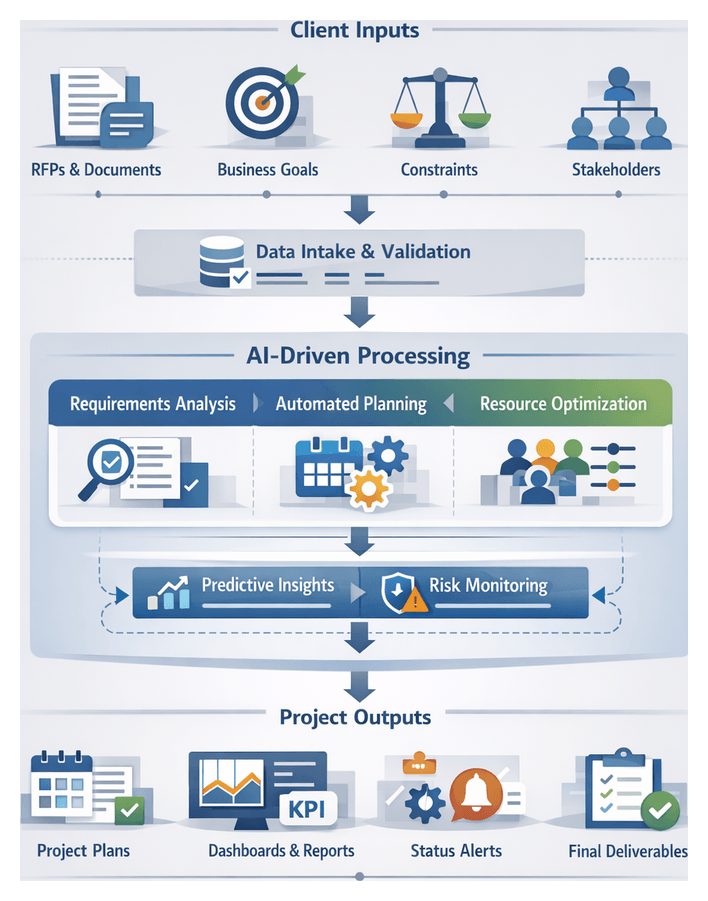
Intake Optimization and Foundational Data
Every AI-driven professional services engagement begins with a structured intake process that transforms diverse client inputs into a reliable dataset. By standardizing requirements capture, validating information, and consolidating key objectives, organizations eliminate ambiguity and accelerate decision cycles. This foundation ensures that sales, delivery, and executive teams share a common understanding of scope, success criteria, and constraints before project execution commences.
The intake stage fulfills three primary objectives:
- Capture high-level requirements, business goals, and success metrics in a consistent format
- Validate completeness and accuracy through automated checks and stakeholder reviews
- Produce a standardized intake package for seamless handoff into planning and scheduling workflows
Key inputs for a robust intake process include:
- Client documentation such as RFPs, statements of work, compliance guidelines, and historical artifacts
- Business objectives, quantifiable success criteria, and priority weightings across competing goals
- Initial constraints and assumptions covering budget ranges, timeline milestones, technical environments, and data access needs
- Stakeholder rosters identifying decision-makers, sponsors, subject-matter experts, internal delivery leads, and third-party vendors
- Preliminary resource indicators outlining required skills, technology profiles, and high-level effort estimates
Effective intake requires several prerequisites:
- Defined templates and data models capturing mandatory fields and taxonomies for industries, service lines, and deliverable types
- Integrations with CRM platforms, document management systems, and contract tools such as DocuSign CLM to retrieve client and contractual data
- Configured AI components—natural language processing models trained on domain-specific proposals, validation rulesets for format and consistency checks, and automated notification workflows
- Change management programs including stakeholder training, governance policies defining roles and approval thresholds, and communication plans to drive adoption
Organizations often deploy solutions for intelligent proposal parsing, automated validation, and standardized output generation. Embedded within existing IT landscapes, these tools enforce data standards, apply natural language understanding, and orchestrate stakeholder interactions, reducing rework, preventing scope creep, and unlocking analytics capabilities across project portfolios.
Driving Operational Efficiency at Scale
Integrating AI-driven workflows across project management phases yields both quantitative and qualitative efficiency gains. By automating routine tasks, leveraging predictive analytics, and centralizing collaboration, firms improve profitability, utilization rates, and service quality, while freeing teams to focus on strategic priorities.
Quantitative Benefits
- Time savings: Automated intake validation, scope preparation, and resource matching reduce manual processing time by up to 60 percent, saving hundreds of hours per quarter in a typical portfolio
- Increased utilization: AI-driven capacity planning and dynamic task assignment boost utilization rates by 15 to 20 percent through continuous workload balancing
- Reduced overruns: Real-time monitoring and schedule optimization deliver a 25 percent reduction in time variance and a 30 percent decrease in budget deviations
- Accelerated financial close: Automated cost aggregation and scenario planning compress monthly close cycles from days to hours, enabling proactive budget adjustments
- Lower error rates: Standardized templates and AI quality checks cut data entry errors by over 40 percent, decreasing rework costs and enhancing deliverable quality
Qualitative Benefits
- Enhanced decision agility: Centralized dashboards and AI-generated “what-if” simulations empower leaders to make evidence-based adjustments in real time
- Improved collaboration: AI-powered hubs unify document sharing, chat, and meeting summaries, eliminating silos and smoothing handoffs across functions
- Elevated client transparency: Automated status reports and proactive alerts keep clients informed, accelerating approvals and strengthening relationships
- Data-driven culture: Visible AI insights foster accountability and continuous improvement, codifying lessons learned into repeatable practices
- Scalable standardization: Proven workflows reduce onboarding time, ensure methodological consistency, and support expansion across geographies
Key Enablers
- Integrated data foundation: Centralized data lakes and APIs connect intake, scheduling, financial, and collaboration systems under a unified model
- Adaptive AI agents: Modular components perform specialized functions—risk detection, cost forecasting, language understanding—while sharing insights through orchestrated workflows
- Governance and change management: Policies for security, compliance, and model validation combined with structured adoption programs
- Performance measurement: Real-time KPI tracking via dashboards, regular reviews, and proactive adjustments
- Collaborative ecosystem: Interoperability between AI platforms, ERP systems, collaboration suites, and BI tools minimizes context switching
Sustaining and Scaling Gains
- Model retraining: Continuous updates on fresh project data maintain forecasting accuracy and risk detection
- Process improvement cycles: AI-driven pattern analysis uncovers bottlenecks, feeding refinements into workflow design
- Cross-project benchmarking: Portfolio-level performance data establishes benchmarks for time to value, utilization, and margin targets
- Executive sponsorship: Quarterly reviews align AI initiatives with strategic objectives, securing ongoing investment
- Expanding use cases: Applying AI workflows to sales opportunity management, proposal generation, and client support, tailored to industry requirements
Strategic Impact and Value Realization
Beyond efficiency, AI orchestration delivers strategic advantages by aligning engagements with business objectives, enhancing client experience, differentiating service offerings, generating financial returns, and enabling scalable growth. These capabilities turn project delivery into a source of competitive advantage and sustainable revenue streams.
Strategic Alignment
- Objective mapping: NLP agents extract goals from client proposals and corporate strategy documents, customizing project charters
- Initiative prioritization: Machine learning models score engagements based on revenue potential, resource constraints, and strategic relevance
- KPI tracking: Analytics dashboards monitor metrics such as client satisfaction, time to value, and revenue growth, linking project data to enterprise performance indicators
Enhanced Client Engagement
- Personalized communication: Language models generate tailored reports and summaries that reflect each client’s terminology and approval history
- Responsive delivery: Task assignment agents route requests to the most qualified resources, minimizing response times
- Proactive issue management: Predictive analytics trigger alerts and remediation suggestions before delays impact clients
- Transparent collaboration: Centralized portals with AI-powered tagging and meeting summaries keep stakeholders informed
Competitive Differentiation
- Accelerated innovation: Automated requirement extraction and rapid prototyping shorten time from concept to delivery
- Delivery precision: Machine learning refines scheduling and resource allocation, minimizing variability
- Advanced analytics: Interactive dashboards enable teams to demonstrate a data-driven mindset to clients focused on digital transformation
Return on Investment
- Labor cost reduction: Workflow orchestration decreases manual coordination, freeing consultants for high-value work
- Error minimization: Validation checks and anomaly detection reduce rework and scope creep
- Resource optimization: Predictive planning maximizes billable hours and minimizes bench time
- Scenario planning efficiency: Instant what-if analyses accelerate budget approvals and strategic decision making
Scalability and Long-Term Value
- Knowledge continuity: AI-extracted lessons learned populate centralized repositories to onboard new team members rapidly
- Modular workflows: Micro-services architecture and configurable AI agents adapt processes to new service lines and geographies
- Regulatory compliance: Automated audit trails and embedded checks reduce risk across diverse contexts
- Continuous improvement: Models retrain on new data, refining recommendations as service offerings evolve
Conclusion Stage Outputs and Handoff
The final phase consolidates AI-driven workflows into deliverables that capture insights, decisions, and recommendations. These outputs become the basis for ongoing operational enhancements and strategic planning.
Key Deliverables
- Comprehensive workflow blueprint: Documented process maps, AI agent orchestration diagrams, and data flow visualizations
- Performance and metrics summary: KPI reports on schedule adherence, utilization, budget variance, and comparisons against baselines
- Strategic recommendations: Prioritized improvement areas and roadmaps for AI model enhancements, workflow refinements, and governance updates
- Lessons learned repository entry: AI-curated insights with context, root-cause analyses, and remediation outcomes
- Governance and compliance documentation: Audit trails, approval records, and validation of adherence to regulations and policies
- Knowledge transfer package: Training materials, process manuals, and AI configuration snapshots for operational teams
Critical Dependencies
- Validated intake and scope definitions: Standardized requirements and stakeholder sign-off records
- Resource allocation and scheduling records: Final capacity plans, assignment logs, and rationale for changes
- Collaboration and communication data: AI-generated meeting summaries, chat transcripts, and document histories
- Risk and issue logs: Recorded assessments, remediation actions, and predictive analytics outputs
- Performance monitoring feeds: Time-series data on earned value, productivity, and quality indices
- Financial transactions and forecasts: Aggregated expense and procurement logs, scenario planning outputs
- Knowledge and AI model artifacts: Trained model versions, templates, scripts, and configuration files
Handoff Protocols
- Governance and portfolio management integration: Upload blueprints and roadmaps to PMO systems and configure review alerts
- Knowledge management updates: Publish lessons learned and process documentation to corporate wikis, indexed by service line and risk category
- Continuous improvement pipelines: Feed recommendations into backlog tools, automate tickets for retraining, workflow enhancements, and tool upgrades
- Operations team enablement: Distribute knowledge packages, schedule workshops and e-learning sessions based on AI-generated outlines
- Compliance archiving: Store governance artifacts in secure, version-controlled archives with full traceability for audits
- Feedback to AI training frameworks: Export performance metrics and error analyses for model retraining and feature updates
By executing these handoff protocols, professional services organizations transform project-level achievements into sustainable capabilities. The AI-driven framework evolves through continuous learning, ensuring future engagements benefit from refined processes, enhanced insights, and adaptive governance. This integrated approach solidifies predictable delivery, reinforces strategic alignment, and drives long-term growth.
Appendix
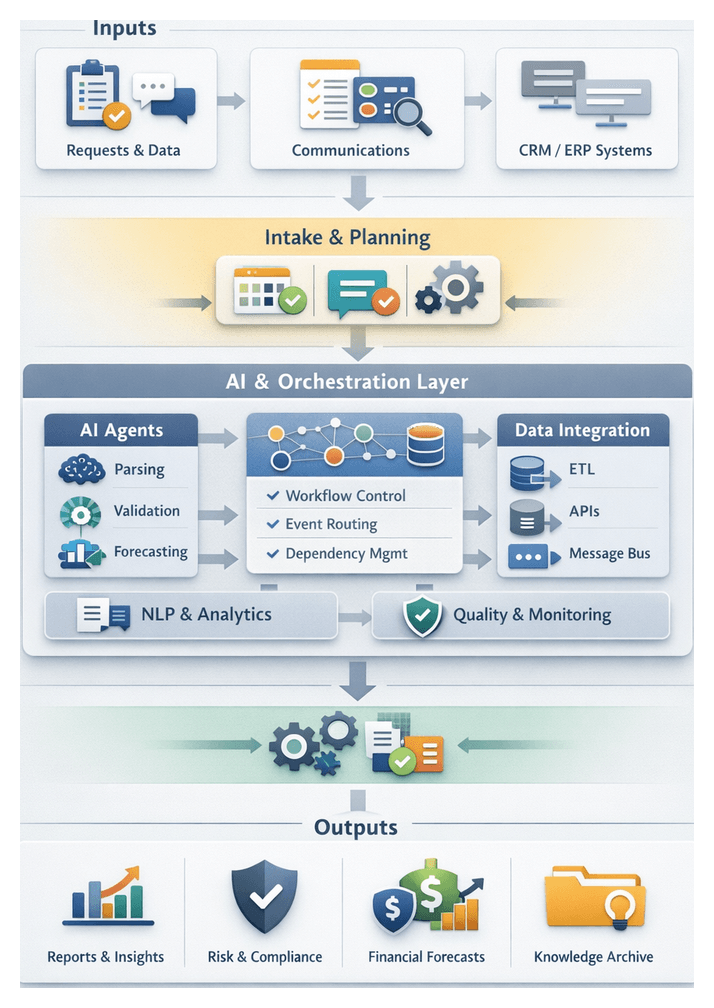
Core Workflow Architecture Terminology and Components
A shared vocabulary ensures clarity across AI-driven project management workflows. Key definitions include:
- Workflow – A series of automated and manual tasks grouped into stages such as intake, planning, execution, monitoring, and closure.
- Stage – A discrete segment of the workflow with specific inputs, outputs, and decision points.
- Orchestration – Coordination of tasks, data flows, and system interactions to enforce process logic and dependencies.
- Agent – An autonomous software component—often AI-driven—performing roles like parsing, validation, forecasting, or notifications.
- Artifact – Any deliverable or data item produced or consumed by a workflow stage (e.g., intake forms, schedules, reports).
- Integration Point – A connection between the workflow framework and external systems (CRM, ERP, collaboration platforms) for data exchange.
Orchestration Layer
The orchestration layer is the control plane that sequences stages, manages dependencies, routes events, and handles failures.
- Sequencing – Ensures prerequisites are met before advancing.
- Dependency Management – Tracks inter-stage and artifact dependencies to prevent inconsistencies.
- Event Routing – Listens for triggers (data arrival, approvals, schedules) and invokes agents appropriately.
- Failure Handling – Implements retries, fallbacks, and alerts for tasks exceeding thresholds.
Data Pipelines and Integration Patterns
Robust data pipelines enable seamless information flow among systems and agents:
- Extract-Transform-Load (ETL) – Batch processes for data cleansing and enrichment.
- Change Data Capture (CDC) – Continuous streaming of source system updates.
- API Connectors – Adapters for RESTful or SOAP endpoints.
- Message Brokers – Middleware such as Apache Kafka that decouples producers and consumers.
- Data Normalization – Standardizing formats and taxonomies for semantic integrity.
AI Agents and Microservices
Agents encapsulate focused AI capabilities as microservices:
- Parsing Agents – Use NLP to extract structured data from unstructured inputs.
- Validation Agents – Enforce business rules, schema checks, and semantic consistency.
- Forecasting Agents – Apply predictive models for resource and financial trends.
- Optimization Agents – Solve allocation and scheduling via operations research (e.g., Google OR-Tools, IBM ILOG CPLEX Optimization Studio).
- Notification Agents – Dispatch alerts and updates via collaboration channels.
Natural Language Processing and Quality Gates
NLP underpins unstructured content analysis, while validation engines ensure data quality:
- Tokenization and Named Entity Recognition for entity extraction.
- Sentiment Analysis to gauge urgency and risk.
- Semantic Mapping to align terms with organizational ontologies.
- Schema Validation and Duplicate Detection for completeness and consistency.
Event-Driven Models, Machine Learning, and Feedback
Reactive workflows and continuous improvement rely on:
- Event-Driven Architecture – Agents subscribe to topics and queues in brokers like Apache Kafka, ensuring idempotent processing.
- Machine Learning Models – Classification, regression, clustering, and reinforcement learning for forecasting and decision support.
- Feedback Loops – User corrections, performance metrics, and MLOps pipelines for model retraining and process tuning.
- Exception Handling – Conditional branching, human-in-the-loop escalation, parallel processing, and compensation transactions.
Artifact Management and Governance
Rigorous artifact practices and controls ensure compliance and traceability:
- Lineage Tracking and Metadata Schemas for auditability.
- Version Control and retention policies for historical access.
- Role-Based Access Control, audit logs, encryption, and policy engines for governance.
AI Capability Mapping by Workflow Stage
Stage 1: Opportunity Identification and Intake
- Unstructured input parsing via OpenAI GPT-4 API, spaCy, Amazon Comprehend.
- Semantic classification with LDA and IBM Watson Natural Language Understanding.
- Document checks using UiPath Document Understanding.
- Orchestration and routing via CRM connectors; real-time client chat assistance.
Stage 2: Requirement Gathering and Scope Definition
- Interview scheduling and transcription with IBM Watson Speech to Text.
- Entity and key phrase extraction via Microsoft Azure Cognitive Services Text Analytics.
- Classification and prioritization through supervised learning.
- Semantic graph mapping with Neo4j Graph Data Science.
Stage 3: Resource Allocation and Capacity Planning
- Skills ontology building via NLP profile parsing.
- Demand forecasting using Azure Machine Learning time-series models.
- Optimization with IBM ILOG CPLEX Optimization Studio or Google OR-Tools.
- Real-time anomaly detection and dynamic adjustments.
Stage 4: Intelligent Scheduling and Timeline Optimization
- Initial scheduling by Optimal.ai heuristics and metaheuristics.
- Dynamic updates via Microsoft Project or Smartsheet integrations.
- Conflict resolution through constraint satisfaction.
- Scenario simulations for what-if analysis.
Stage 5: Automated Task Assignment and Prioritization
- Skill-to-task matching using Resource Guru and custom AI modules.
- Priority scoring with multi-criteria decision engines.
- Dynamic reassignment triggered by events.
- Task updates in Asana, Jira, notifications via Slack or Microsoft Teams.
Stage 6: Collaboration and Communication Coordination
- Document tagging with Google Cloud Natural Language.
- Contextual chat linking and meeting summaries via Zoom or Webex.
- Action item extraction and sentiment analytics.
Stage 7: Risk Assessment and Issue Management
- Risk identification using classification and rule engines.
- Anomaly detection with Databricks streaming analytics.
- Predictive scoring and remediation recommendations.
Stage 8: Performance Monitoring and Predictive Analytics
- Time series forecasting (ARIMA, Prophet, LSTM) and what-if simulations.
- Root cause analysis via ML correlations.
- Reporting dashboards in Tableau and Power BI.
Stage 9: Budget Control and Financial Forecasting
- Automated transaction categorization via NLP.
- Real-time variance alerts through SAP Concur and Coupa.
- Monte Carlo simulations and corrective action suggestions.
Stage 10: Project Closure and Knowledge Capture
- Executive summaries via OpenAI GPT-4 API NLG.
- Lessons learned extraction through topic modeling.
- Knowledge graph updates in Neo4j; search with Azure Cognitive Search.
- Archival to Box or SharePoint Online.
Managing Workflow Variations and Edge Cases
Scope Change Requests
- Tiered change framework: rapid updates for minor, formal re-scoping for major.
- Automated impact analysis with AI agents populating change templates.
- Real-time dynamic reforecasting integration.
- Version control and traceability of change identifiers.
Contractual Model Adaptations
- Fixed price: strict scope validation and gating.
- Time-and-materials: real-time time-entry monitoring and client dashboards.
- Retainers: monthly capacity cycles and automated hour rollover.
- Outcome-based: KPI-tied triggers and milestone payments.
Resource Availability Fluctuations
- Continuous capacity monitoring with calendar integration.
- Shadow resource pools for rapid substitution.
- Flexible task bundling for reallocation.
- Anomaly alerts triggering resource leveling.
Parallel Project Portfolios
- Portfolio scoring engine evaluates priorities.
- Cross-project dependency mapping with knowledge graphs.
- Calendar harmonization prevents scheduling conflicts.
Regulatory and Compliance Edge Cases
- Regulatory ontology tagging for artifact compliance.
- Automated document redaction and encryption routines.
- Adaptive audit trails capturing all actions.
- Compliance alerts on new requirements.
Data Quality Variations
- Automated validation agents route exceptions to data stewards.
- Master data synchronization via MDM integration.
- Confidence scoring to flag low-quality data.
Cross-Geographic Time Zone Coordination
- Automated time zone conversion in scheduling agents.
- Dynamic reminder timing per locale.
- Global calendar overlays blocking holidays.
Client Engagement and Escalations
- Multi-channel intake capture of emails and chats.
- Escalation overrides for executive interventions.
- Stakeholder mapping intelligence to validate requests.
Legacy System Integration
- RPA bots for data extraction when APIs are unavailable.
- Custom adapters converting proprietary formats.
- Authentication gateways bridging legacy protocols.
Sudden Risk Spikes
- Emergency workflow triggers for high-severity events.
- Automated war room scheduling.
- Pre-approved contingency fund releases.
Rapid and Small Initiatives
- Minimal intake templates with optional fields.
- Single-step sign-off with delegation.
- Embedded AI summaries for quick closures.
Strategic Best Practices
- Design flexible, parameterized workflows.
- Use modular AI microservices for composability.
- Maintain robust metadata and taxonomies.
- Blend automation with human review for exceptions.
- Continuously monitor and tune thresholds.
- Institutionalize feedback into rules and models.
AI-Driven Tools and Further Resources
AI Tools Mentioned
- OpenAI GPT-4 API: An advanced natural language processing service that powers text generation, summarization, and semantic analysis. It enables AI agents to parse unstructured proposals, generate executive summaries, and extract lessons learned.
- IBM Watson Natural Language Understanding: A cloud-based AI service for entity extraction, sentiment analysis, and semantic classification of text. Used to interpret client proposals and meeting transcripts.
- Microsoft Azure Cognitive Services Text Analytics: Provides prebuilt models for language detection, key phrase extraction, and opinion mining, supporting requirement classification and contextual chat analysis.
- Google Cloud Natural Language: Delivers entity recognition, syntax analysis, and sentiment scoring for documents and chat logs, aiding AI parsing and stakeholder coordination.
- Amazon Comprehend: Offers NLP capabilities for topic modeling and entity extraction to automate intake validation and requirement tagging.
- spaCy: An open-source NLP library for advanced text processing, named-entity recognition, and dependency parsing, used for custom requirement classification.
- AllenNLP: A research-oriented NLP framework for semantic role labeling and predicate-argument analysis, supporting detailed requirement extraction.
- UiPath Document Understanding: Integrates RPA with AI to extract structured data from forms and documents, automating intake validation and invoice processing.
- ServiceNow AI Document Intelligence: Applies machine learning to classify and extract data from records and attachments within IT service workflows, supporting exception handling.
- Microsoft Azure Form Recognizer: Uses machine learning to analyze forms and extract fields, useful for automating budget report ingestion and compliance checks.
- ABBYY FlexiCapture: Captures data from semi-structured documents and performs intelligent document classification, useful for procurement and contract reviews.
- Optimal.ai: Provides constraint-based scheduling algorithms and real-time adjustment capabilities to resolve conflicts and optimize timelines.
- Microsoft Project: Offers Gantt-chart based scheduling integrated with resource leveling and critical path analysis.
- Smartsheet: A collaborative work management platform that supports dynamic scheduling, automated workflows, and integration with AI services.
- Forecast: A resource and project planning tool that integrates AI forecasting for time allocation and capacity planning.
- Resource Guru: Delivers resource scheduling and capacity management with real-time availability calendars and utilization reporting.
- Workday Adaptive Planning: Provides enterprise planning for finance and workforce, integrating predictive analytics for resource forecasting.
- SAP SuccessFactors: A human capital management suite that maintains resource profiles, skills taxonomies, and availability calendars for AI matching engines.
- Oracle Cloud HCM: Manages workforce data, certifications, and performance metrics to feed AI-driven capacity planning.
- IBM ILOG CPLEX Optimization Studio: A mathematical programming tool for solving large-scale resource allocation and scheduling problems with high performance.
- Google OR-Tools: An open-source operations research library for constraint programming and optimization used in scheduling and resource allocation.
- Apache Airflow: A workflow orchestration platform for scheduling ETL jobs, AI model pipelines, and integration processes.
- Apache Kafka: A distributed event streaming platform that handles real-time ingestion of monitoring data across systems.
- Databricks: Provides a unified data analytics platform for handling large-scale data processing, model training, and real-time analytics.
- Snowflake: A cloud data warehouse optimized for analytics and storage of project performance and financial data.
- Neo4j Graph Data Science: Enables the creation and querying of knowledge graphs to map relationships among stakeholders, tasks, and risk factors.
- IBM Watson Discovery: Extracts insights from large document collections and applies AI search capabilities to enterprise knowledge bases.
- Microsoft Azure Cognitive Search: Provides AI-powered search and indexing for knowledge repositories and lessons learned databases.
- Slack: A collaboration platform that integrates with AI agents to deliver contextual alerts, document links, and meeting summaries.
- Microsoft Teams: Supports real-time chat, meetings, and bots that post AI-generated notifications and summaries.
- Zoom: A video conferencing service whose recordings can be processed by AI transcription and summarization engines.
- Webex: Provides audio and video meetings with APIs for AI-driven transcription and context extraction.
- Asana: A work management platform that receives AI-driven task assignments and status update alerts.
- Jira: A project and issue tracking tool integrated with AI for risk management, task creation, and performance dashboards.
- Confluence: A collaboration wiki where AI agents publish closure summaries and lessons learned for organizational access.
- Box: A secure file sharing and archival service used to store final deliverables and audit artifacts.
- SharePoint Online: A Microsoft content management system for centralized document storage, versioning, and retention policy enforcement.
- SAP Concur: Automates expense report ingestion and reconciliation for real-time budget tracking.
- Coupa: A procurement and invoice management platform that integrates spend data into financial forecasting.
- Ariba Network: SAP’s procurement collaboration network for vendor invoicing and purchase order management integration.
- Oracle ERP Cloud: A comprehensive enterprise resource planning solution that synchronizes AI-driven budget adjustments with general ledger data.
- Workday Financial Management: Delivers real-time financial insights and forecasting capabilities integrated with budget control workflows.
- PagerDuty: An incident management platform used to dispatch alerts for critical budget variances and schedule anomalies.
- OpsGenie: Atlassian’s alerting and on-call scheduling service for escalating critical task reassignments and risk notifications.
Additional Context and Resources
- PMBOK Guide: Industry standard for project management practices, providing definitions of key terms and process groups.
- Agile Alliance Resources: Best practices for iterative project delivery and adaptive planning methods.
- Project Management Institute (PMI): Research articles and certification guidance on advanced project workflows.
- Harvard Business Review: AI in Project Management: Thought leadership on AI adoption roadmaps and change management for professional services.
- IEEE Xplore Digital Library: Academic papers on optimization algorithms and AI methods applied to scheduling and resource allocation.
- Gartner Research: Industry reports on AIOps platforms, predictive analytics, and enterprise AI governance.
- Forrester Research: Insights on AI-driven process automation and decision support in professional services sectors.
- OpenAI Codex and Functions: Developer resources for building AI agents and custom workflows.
- Apache Kafka Documentation: Technical reference for event streaming best practices and integration patterns.
- Azure Machine Learning Documentation: Guidance on model training, deployment, and MLOps for predictive analytics.
- IBM Lambda Architecture Patterns: Architectural blueprints for combining batch and real-time analytics in AI workflows.
- Snowflake Data Sharing: Documentation on secure data exchange and cross-account collaboration for knowledge sharing.
- Neo4j Graph Academy: Tutorials on building knowledge graphs for entity relationship mapping and semantic queries.
- Databricks Lakehouse Platform: Best practices for unified data pipelines and real-time analytics in AI projects.
- Splunk Machine Learning Toolkit: Examples and scripts for detecting anomalies and building predictive models on log data.
- Elastic Stack Guides: Documentation on text analysis, anomaly detection, and observability dashboards for AI monitoring.
- ServiceNow Developer Resources: APIs and best practices for building AI Document Intelligence workflows.
- UiPath Academy: Training courses on integrating RPA with AI Document Understanding.
- ProjectManagement.com Templates: Sample closure checklists, lessons learned templates, and knowledge sharing frameworks.
The AugVation family of websites helps entrepreneurs, professionals, and teams apply AI in practical, real-world ways—through curated tools, proven workflows, and implementation-focused education. Explore the ecosystem below to find the right platform for your goals.
Ecosystem Directory
AugVation — The central hub for AI-enhanced digital products, guides, templates, and implementation toolkits.
Resource Link AI — A curated directory of AI tools, solution workflows, reviews, and practical learning resources.
Agent Link AI — AI agents and intelligent automation: orchestrated workflows, agent frameworks, and operational efficiency systems.
Business Link AI — AI for business strategy and operations: frameworks, use cases, and adoption guidance for leaders.
Content Link AI — AI-powered content creation and SEO: writing, publishing, multimedia, and scalable distribution workflows.
Design Link AI — AI for design and branding: creative tools, visual workflows, UX/UI acceleration, and design automation.
Developer Link AI — AI for builders: dev tools, APIs, frameworks, deployment strategies, and integration best practices.
Marketing Link AI — AI-driven marketing: automation, personalization, analytics, ad optimization, and performance growth.
Productivity Link AI — AI productivity systems: task efficiency, collaboration, knowledge workflows, and smarter daily execution.
Sales Link AI — AI for sales: lead generation, sales intelligence, conversation insights, CRM enhancement, and revenue optimization.
Want the fastest path? Start at AugVation to access the latest resources, then explore the rest of the ecosystem from there.