

Orchestrating AI Agents for Creative and Content Workflows
To download this as a free PDF eBook and explore many others, please visit the AugVation webstore:
Introduction
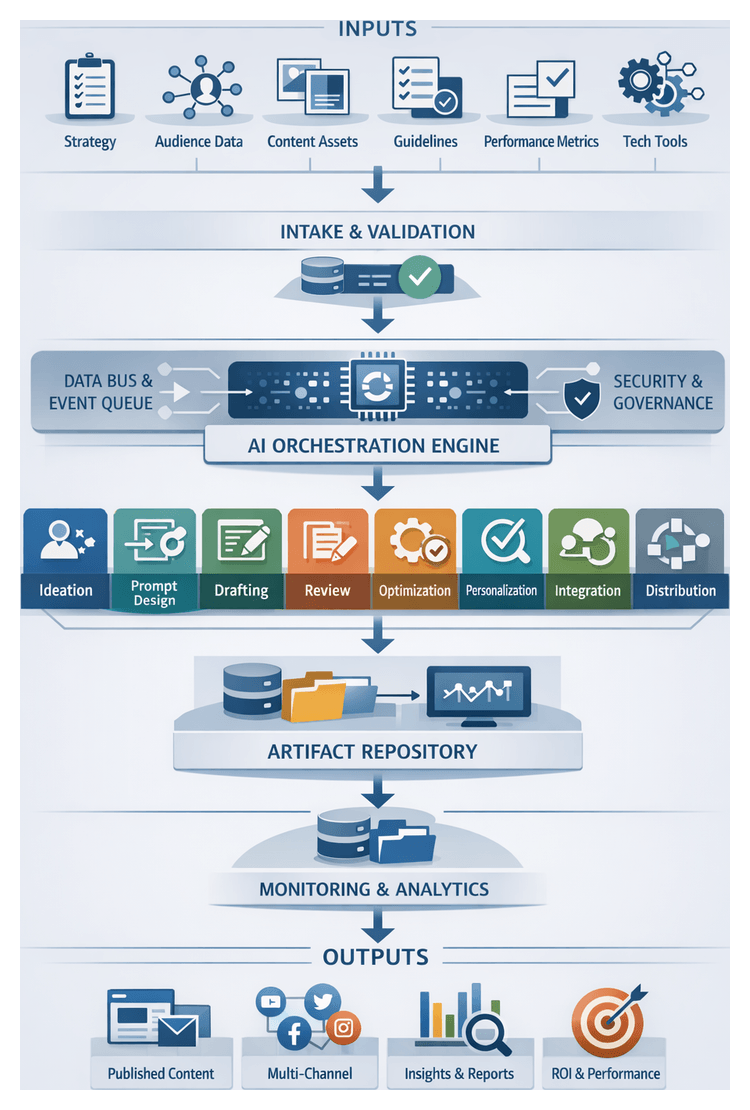
Stage Objectives and Scope
The foundational stage establishes the strategic rationale for an AI-driven content orchestration framework. Clear objectives—such as reducing manual handoffs, ensuring a consistent brand voice, and enabling scalable production—align creative, marketing, and technology teams around shared outcomes. By mapping high-level deliverables and performance targets, stakeholders transform fragmented operations into a seamless pipeline that harnesses AI agents for ideation, drafting, review, optimization, and distribution. This alignment prevents misaligned expectations and sets the course for accelerated time-to-market, enhanced engagement, and measurable return on investment.
Essential Inputs and Prerequisites
Successful implementation depends on grounding the framework in real organizational context. Core inputs and conditions include:
- Business strategy documentation: annual plans, campaign charters, and key performance indicators.
- Audience research data: persona profiles, engagement metrics, and channel preferences.
- Content inventories and brand guidelines: style guides, tone-of-voice specifications, and current assets.
- Process maps: flowcharts of existing workflows, resource assignments, and approval cycles.
- Baseline performance metrics: production speed, quality scores, and distribution reach.
- Technology inventory: content management systems, collaboration platforms, and AI or automation tools.
- Governance structures: executive sponsorship and decision-making protocols.
These prerequisites ensure data accessibility, cross-functional commitment, and an agreed governance model. Consolidating disparate sources into a unified intake stream and convening kick-off workshops with marketing leaders, creative directors, technology architects, and external partners establish the stakeholder alignment necessary to validate inputs and objectives. Training programs on prompt engineering, review protocols, and feedback mechanisms foster a collaborative culture that views AI agents as partners rather than replacements.
AI Orchestration Framework Overview
An AI orchestration framework transforms a collection of specialized tools and manual tasks into an automated pipeline with standardized stages, interfaces, and event-driven triggers. It consists of the following core components:
- Intake Layer captures requirements, source assets, audience profiles, and brand guidelines, validating and normalizing data for downstream consumption.
- Orchestration Engine schedules tasks, routes messages between agents, tracks state transitions, and enforces dependencies. Platforms such as AgentLink AI offer API-first orchestration capabilities.
- AI Agent Suite comprises specialized agents for ideation, drafting, review, optimization, personalization, integration, distribution, and analytics.
- Data Bus and Event Queue facilitate asynchronous communication, decoupling producers and consumers while ensuring reliable delivery of events.
- Artifact Repository stores inputs, intermediate deliverables, and final assets with versioning, metadata tags, and audit logs.
- Monitoring and Logging Module collects metrics, error logs, and usage data, providing dashboards and alerts for operational visibility.
- Security and Governance Layer enforces access controls, data encryption, compliance checks, and audit trails.
In this architecture, the orchestration engine listens for events on the data bus, invokes AI agents via well-defined APIs, and manages coordination through stateful workflows, bulk processing, and callback integrations. This design balances synchronous and asynchronous interactions, enabling parallel execution where dependencies allow and serial progression where handoffs require validation.
Collaboration of Specialized AI Agents
Within the structured pipeline, each AI agent assumes a discrete role, contributing expertise and preserving context throughout the workflow. Key agents include:
- Ideation Agent transforms business requirements, audience personas, and content inventories into thematic outlines, headline variations, and concept clusters using semantic embeddings and topic modeling.
- Prompt Design Agent converts concept briefs into precise, context-rich instructions for language and multimodal models. It maintains a library of templates, tunes parameters, and aggregates relevant memory context to ensure consistency.
- Drafting Agent leverages large language models such as OpenAI GPT-4 and visual generators like Adobe Firefly to produce first-pass content. Parallel generation and quality filters support rapid iteration.
- Review Agent automates grammar checks, style alignment, and brand voice verification via tools like Grammarly. It enforces style guides, readability metrics, and change tracking for human approval.
- Optimization Agent enhances SEO and engagement using platforms such as SEMrush or MarketMuse. It integrates keyword analysis, meta description generation, and performance simulation to maximize discoverability.
- Personalization Agent crafts variant messages for audience segments by assembling modular text and media blocks based on behavioral data and persona models.
- Integration Agent merges text with images, audio, or video, coordinating transcoding, layout design, and packaging into cohesive assets.
- Distribution Agent automates scheduling, formatting, and compliance checks for multi-channel publishing across CMS, social APIs, and email platforms.
- Analytics Agent aggregates performance data, normalizes metrics, and feeds insights back into the orchestration engine for continuous refinement.
Workflow Structure, Handoffs, and Feedback Loops
A comprehensive blueprint codifies every stage—Discovery, Ideation, Prompt Design, Drafting, Review, Optimization, Personalization, Integration, Distribution, and Analytics—along with objectives, inputs, outputs, and quality gates. Key deliverables include:
- Process flow diagrams that map dependencies, sequence tasks, and highlight parallel operations.
- Artifact schemas and metadata specifications that standardize content structures for seamless agent consumption.
- Integration matrices detailing API endpoints, authentication protocols, data formats, and error-handling procedures.
- Roles and responsibilities matrices assigning clear ownership for stages, deliverables, and integrations.
Explicit handoff protocols maintain momentum and prevent misalignment. For example:
- Discovery to Ideation: Aggregated input bundles are validated against schema compliance and published to the content repository with event notifications.
- Ideation to Prompt Design: Curated concept decks are delivered via API calls alongside contextual metadata and reviewed for brand alignment.
- Prompt Design to Drafting: Configured prompt templates trigger parallel generation pipelines in models such as OpenAI GPT-4 and Adobe Firefly, with sample runs verifying latency and output quality.
- Drafting to Review: Raw assets are pushed to editing queues where automated syntax and style checks route failures to human editors.
- Review to Optimization: Refined content, approved for compliance, is sent to optimization agents via RESTful APIs with callback URLs for enriched deliverables.
Iterative feedback loops enable content artifacts to flow backward when refinement is required. Conditional routing logic and decision points—governed by AI confidence thresholds or human approvals—ensure that drafts meeting performance criteria progress, while those needing revision return to preceding agents.
Scalability, Governance, and Strategic Benefits
By combining containerized deployments, serverless architectures, and modular workflow definitions, the framework scales horizontally to handle thousands of concurrent tasks. Plugin interfaces allow integration of new AI models or third-party services without disrupting the pipeline, while feature flags and versioned workflows support A/B testing and continuous improvement.
Robust security controls enforce role-based access, data encryption, and comprehensive audit logs. Policy engines validate content compliance against brand guidelines and regulatory standards, ensuring governance at every stage.
This structured approach delivers multiple strategic advantages:
- Scalability: Parallel pipelines and clear handoff contracts enable rapid capacity expansion without redesigning core processes.
- Transparency: Documented artifacts and integration points provide auditability for compliance and performance diagnostics.
- Consistency: Standardized schemas and validation rules ensure uniform quality and brand adherence across outputs.
- Agility: Modular design allows selective enhancement or replacement of stages—such as swapping a language model—without disrupting end-to-end operations.
- Collaboration: A shared blueprint aligns cross-functional teams and external partners around common objectives and governance guidelines.
With this framework in place, organizations can orchestrate creative and content workflows at scale, delivering high-quality, on-brand content with speed and precision.
Chapter 1: Discovery and Input Aggregation
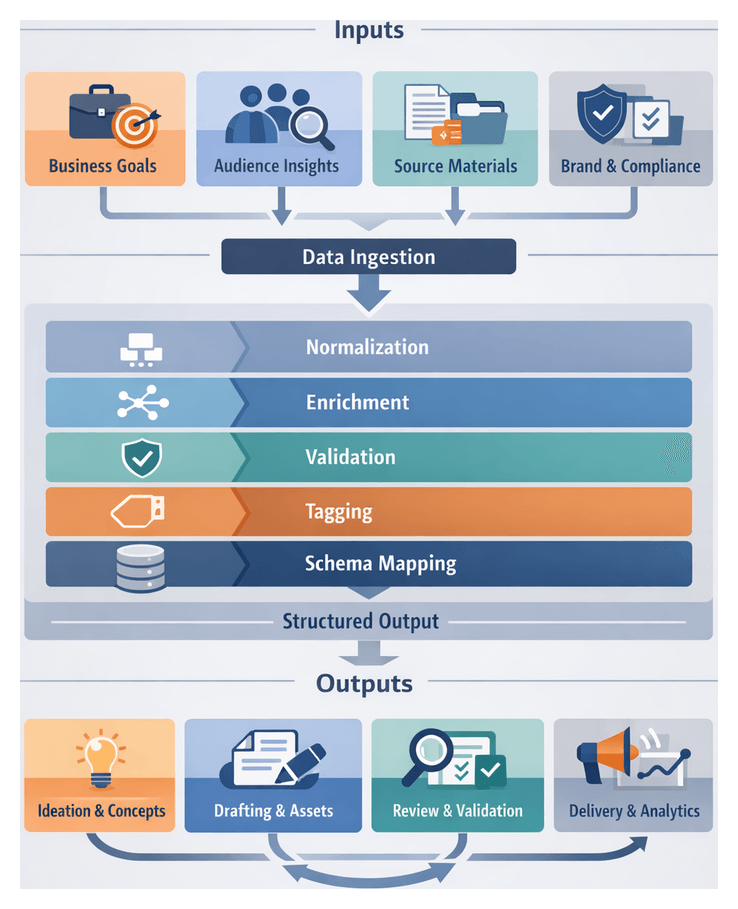
Purpose and Context of the Discovery Stage
The discovery stage establishes the strategic foundation for an AI-driven content workflow, aligning business objectives with creative execution. By consolidating stakeholder requirements, audience research, source materials, and brand guidelines into a unified, context-rich dataset, teams avoid fragmented information and ensure consistent messaging. This structured intake stream transforms organizational knowledge into machine-readable artifacts, enabling coherent ideation, drafting, and distribution at scale. In an environment marked by digital transformation and multi-channel demands, automated discovery accelerates responsiveness, preserves quality, and mitigates inefficiencies inherent in manual workflows.
- Establish a single source of truth for content requirements to minimize miscommunication.
- Capture audience insights to inform personas and tailored messaging.
- Align research reports, case studies, and competitive analyses with brand guidelines.
- Normalize and tag inputs for ready ingestion by AI agents.
- Define metadata schemas and handoff protocols for seamless transitions to ideation.
Required Inputs
Effective discovery depends on gathering diverse data types from internal and external systems and ensuring key conditions are met before pipeline initiation.
- Business Requirements: Strategic goals, campaign briefs, KPIs, compliance rules, and timelines from project management tools or stakeholder interviews.
- Audience Insights: Demographics, behavioral analytics, sentiment data, and persona documentation from CRM platforms, social listening tools, and market research databases.
- Source Materials: White papers, technical specifications, competitor collateral, intellectual property references, and performance reports from content repositories.
- Brand Guidelines: Style guides, tone documentation, visual assets, and legal disclaimers from digital asset management systems.
- Regulatory Constraints: Industry-specific rules, legal requirements, and accessibility standards.
- Technical Metadata: Format specifications, channel constraints, SEO keywords, and performance benchmarks.
Prerequisites
- Stakeholder alignment on objectives and success metrics to prevent divergent outputs.
- Configured data access permissions and integrations for secure ingestion.
- Governance framework defining roles, responsibilities, and escalation pathways for data validation.
Processing Pipeline and AI Agents
The discovery pipeline transforms raw inputs into enriched, tagged artifacts through a series of automated steps powered by specialized AI agents.
- Data Ingestion: Connector agents retrieve inputs from CRM systems, DAM platforms, content repositories, and external APIs.
- Normalization: Standardize formats, units, taxonomies, and eliminate duplicates.
- Enrichment: Apply contextual metadata—campaign identifiers, persona tags, sentiment scores—using semantic networks and knowledge graphs.
- Validation: Run compliance and brand consistency checks, routing exceptions to human reviewers.
- Tagging and Schema Mapping: Label inputs by priority, content type, audience segment, and theme according to a predefined metadata schema.
- Structured Output Generation: Package validated inputs into machine-readable artifacts (JSON or XML) for downstream consumption.
- Connector Agents: Interface with platforms such as OpenAI GPT-4 for parsing unstructured briefs and integrate with CRM or DAM APIs for structured records.
- Normalization Agents: Use rule-based and statistical methods to standardize terminology, measurements, and date formats.
- Enrichment Agents: Leverage semantic networks to infer context, extract keywords, and map to industry taxonomies.
- Validation Agents: Execute business rules and compliance checks, flagging anomalies for human review.
- Metadata Tagging Agents: Employ supervised machine learning to classify content by theme, audience, and sentiment.
Structured Deliverables and Handoff Protocols
Upon completing discovery, the orchestrator produces artifacts and protocols that guarantee seamless handoff to ideation and concept formulation stages.
- Consolidated Input Dataset: A normalized, machine-readable file containing audience profiles, brand lexicon, stakeholder requirements, and research excerpts, tagged for priority and relevance.
- Metadata Catalog: Reference document listing origins, timestamps, confidence scores, and semantic tags for each input.
- Taxonomy and Ontology Schema: Formal representation of topic hierarchies and relationship mappings to guide concept clustering.
- Input Validation Report: Summary of anomalies, missing fields, and conflicting guidelines, with error codes and suggested resolutions.
- Delivery Manifest: Listing of artifacts, file paths or API endpoints, version identifiers, and checksums to ensure traceable handoffs.
- Access to the orchestration platform with appropriate credentials and permissions.
- Availability of input repositories (for example, AWS S3 or secure databases) configured for API queries.
- Version-controlled synchronization of taxonomies and ontologies.
- Stakeholder approval of the Input Validation Report.
- Network and security policies permitting encrypted data transfers and audit logging.
- Event-Driven APIs: Delivery Manifest generation triggers an API call to initiate ideation workflows.
- Message Queues: Artifact metadata is published to queues (for example, Amazon SQS), enabling parallel retrieval by ideation agents.
- Webhooks and Callbacks: Notifications confirm stakeholder sign-off before automatic ingestion.
- Shared File System: Network-mounted directories with locking protocols prevent race conditions.
- Versioning Lockstep: Agents verify version tags against version control services to maintain consistency.
Integration protocols ensure that ideation agents receive precise data slices for prompt parameters, topic modeling, and thematic coherence checks. JSON or XML artifacts feed NLP services such as OpenAI GPT-4 for sentiment analysis, while taxonomies guide clustering agents. Strict checksum verification, schema validation, automated QA scripts, immutable version tags, and change logs preserve quality and reproducibility. Audit logs capture timestamps, artifact versions, agent identities, and validation outcomes, supporting regulatory compliance and performance analysis.
- Encrypted data in transit (TLS) and at rest (AES-256).
- Role-based access control limiting agents to required fields.
- Data retention policies and automated compliance scanning.
- Periodic governance reviews to align protocols with security standards.
- Standardized naming conventions, petri dish testing of changes, clear API documentation, health checks, and regular sync points between teams.
Unified AI Orchestration Framework
A structured, end-to-end AI orchestration framework integrates specialized agents and human inputs across the entire content lifecycle, ensuring consistency, scalability, and strategic focus.
- Intake and Validation: Automate ingestion and normalization of requirements, profiles, and guidelines.
- Ideation and Conceptualization: Use large language and multimodal models to generate themes, narratives, and outlines.
- Prompt Engineering: Configure precise prompts and contextual parameters for generation agents.
- Drafting and Asset Creation: Deploy text composition and media synthesis agents in parallel.
- Automated Review: Execute grammar checks, style audits, and compliance verifications.
- Optimization: Integrate SEO and engagement tools to refine discoverability.
- Personalization: Assemble tailored variants for audience segments.
- Multimodal Integration: Combine text, visuals, audio, and video into cohesive deliverables.
- Distribution Scheduling: Adapt formats, schedule releases, and call platform APIs.
- Analytics Feedback: Ingest performance data and refine workflows through feedback agents.
Coordination mechanisms—including event-driven triggers, shared knowledge repositories, API-first integrations, contextual memory, and priority escalations—ensure predictable, auditable workflows with minimal human intervention.
Business Impact and Implementation Considerations
- Accelerated Time-to-Market: Automated handoffs and parallel tasks can halve content cycle times.
- Consistent Brand Voice: Unified style checks preserve coherence across thousands of assets.
- Cost Efficiency: AI agents handle routine tasks, freeing teams for strategic work.
- Data-Driven Iteration: Real-time analytics feedback drives continuous performance improvements.
- Scalable Personalization: Hyper-targeted campaigns without linear workload increases.
- Risk Reduction: Gated approvals and audit trails ensure compliance and brand safety.
- Infrastructure Assessment: Map existing tools and workflows to identify integration points.
- Prioritize High-Impact Use Cases: Start with critical streams to demonstrate early value.
- Modular Architecture: Design interchangeable agent modules for future upgrades.
- Governance and Change Management: Define policies, training, and documentation for data security and approvals.
- Performance Measurement: Track cycle time, quality scores, and engagement lift via dashboards.
- Continuous Refinement: Use analytics feedback to optimize prompts, agent configurations, and workflow rules.
Chapter 2: Ideation and Concept Formulation
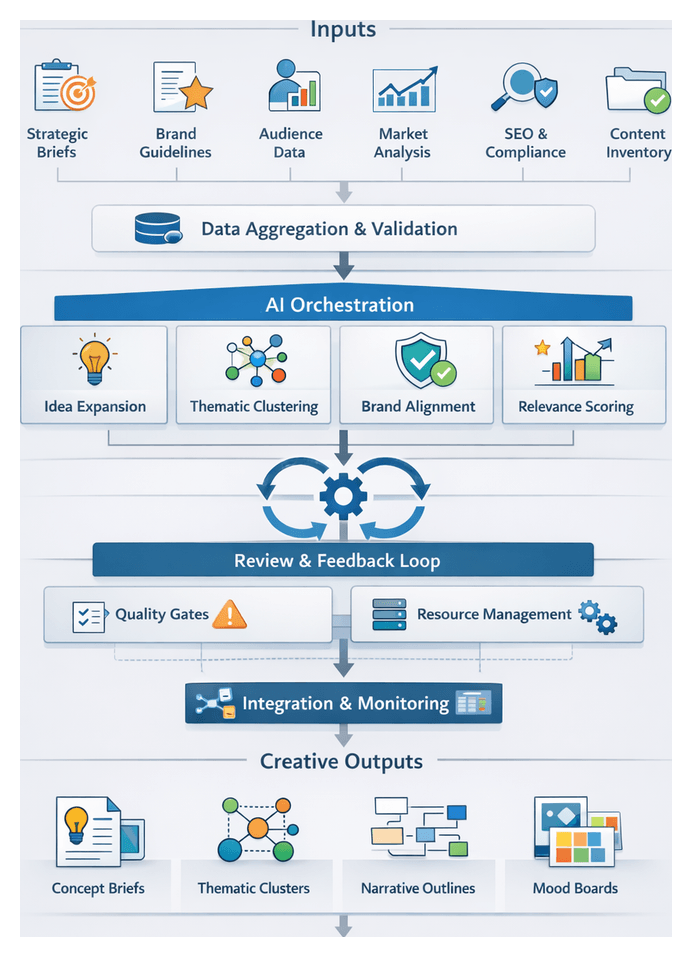
Ideation Stage Objectives and Inputs
The ideation stage transforms strategic direction and aggregated data into creative concept proposals that align with business goals, brand voice, and audience needs. By establishing clear objectives, validated inputs, and a configured environment, organizations can accelerate creative exploration, reduce rework, and maintain consistency across large-scale content operations.
- Conceptual Diversity: Generate a broad spectrum of themes, formats, and narrative angles for flexibility in content planning.
- Strategic Alignment: Ensure each concept maps directly to key performance indicators and campaign objectives.
- Brand Consistency: Embed brand pillars, tone guidelines, and design principles to preserve identity across outputs.
- Audience Resonance: Leverage personas, behavioral insights, and pain points to engage target segments.
- Scalability: Enable parallel execution of concept generation by AI agents to support rapid iteration.
- Feasibility Assessment: Evaluate resource requirements, channel constraints, and compliance factors early in the process.
Prerequisites and Environment Configuration
- Input Consolidation: Complete aggregation and tagging of strategic briefs, audience data, market analyses, and brand guidelines.
- Data Normalization and Validation: Standardize formats, perform schema checks, assign metadata tags, and score inputs for relevance and completeness.
- Tool Provisioning: Credential and tune AI platforms such as OpenAI GPT-4, Anthropic Claude, and Jasper with project-specific parameters.
- Computational Resources: Allocate sufficient compute, memory, and storage to support parallel AI agent execution and iterative loops.
- Stakeholder Alignment: Confirm project scope, timelines, deliverables, and compliance requirements with creative directors, marketing leads, and legal teams.
- Workflow Configuration: Define agent sequencing, parameter settings (temperature, token limits), retry logic, and alert mechanisms within the orchestration platform.
Input Categories
- Strategic Briefs: Business goals, KPIs, budget, timelines.
- Brand Guidelines: Voice, tone descriptors, visual identity rules, prohibited topics.
- Audience Insights: Personas, demographic and psychographic data, journey maps, behavior analytics.
- Market Analysis: Competitor audits, industry trends, SWOT findings.
- Content Inventory: Existing asset performance, SEO metrics, engagement scores.
- SEO Requirements: Target keywords, search intent, meta templates, linking guidelines.
- Compliance Constraints: Legal mandates, disclaimers, privacy and accessibility standards.
- Technical Specifications: Format requirements, CMS parameters, channel best practices.
Stakeholder Engagement Protocols
- Kickoff Workshops: Align on objectives, review inputs, and set expectations.
- Review Checkpoints: Schedule interim assessments of preliminary AI-generated themes.
- Structured Feedback Loops: Capture and tag stakeholder feedback for incorporation in subsequent agent runs.
- Approval Gates: Define criteria and decision rights for transitioning concepts to prompt design.
Workflow and AI Agent Collaboration
The ideation workflow orchestrates specialized AI agents in concert with human strategists and supporting systems. Through metadata-driven routing, message-bus communication, and iterative feedback loops, the process ensures transparent handoffs, quality control, and traceability from concept generation through handoff to prompt design.
Input Ingestion and Preprocessing
- Ingestion of validated JSON payloads containing personas, keywords, brand rules, and benchmarks.
- Automated metadata tagging by theme, channel, and audience segment.
- Normalization of text, charts, and images into unified semantic embeddings.
- Schema validation and conflict detection before passing inputs to ideation agents.
AI Agent Collaboration Model
- Idea Expansion Agent: Uses transformer models to brainstorm headlines, hooks, and narrative angles.
- Thematic Clustering Agent: Groups generated ideas via unsupervised learning to surface emergent themes.
- Brand Alignment Agent: Evaluates compliance with style guides and regulatory constraints.
- Relevance Scoring Agent: Ranks concepts based on audience engagement data and SEO priorities.
Agents communicate through a message bus; each publishes results under versioned topics, enabling audit trails and rollback capabilities.
Iterative Brainstorming Loop
- Generate initial concept batch.
- Cluster ideas into preliminary themes.
- Strategist reviews clusters, selects top candidates, and annotates with feedback tags.
- Feedback triggers refined prompts for the Idea Expansion Agent.
- Repeat until approval of 3–5 core concepts with theme titles, message pillars, and sample headlines.
Quality Gates
- Completeness Gate: Each concept must articulate a narrative arc and address key audience pain points.
- Compliance Gate: Flag regulated language and sensitive topics for legal review.
- Novelty Gate: Run semantic similarity checks against existing content to ensure originality.
- Feasibility Gate: Confirm availability of required assets and technical resources.
Integration With Supporting Systems
- Content Performance Database feeds real-time benchmarks to the Relevance Scoring Agent.
- Digital Asset Management (DAM) systems provide multimedia metadata for concept visualization.
- Brand Asset Library supplies approved logos, taglines, and style assets.
- Collaboration Platforms sync concept boards, human reviews, and audit logs.
Governance and Metrics
Every agent invocation, human annotation, and decision is recorded in an immutable audit log. Key performance indicators include:
- Concept Throughput: Number of approved themes per cycle.
- Iteration Count: Average brainstorming loops before concept sign-off.
- Review Cycle Time: Time for human strategists to annotate and approve clusters.
- Alignment Score: Brand Alignment Agent’s aggregate compliance rating.
Models and Support Systems
A diverse suite of AI models and integration layers underpins the ideation stage, enabling concept generation at scale while preserving accuracy, brand alignment, and creative breadth.
Transformer-Based Language Models
Large pretrained transformers, fine-tuned on domain-specific corpora, provide core generative capabilities:
- Create initial concept statements, headlines, and value propositions.
- Expand ideas into thematic outlines and subtopics.
- Adapt tone and style to brand voice parameters.
- Examples include GPT-4, PaLM, and Claude.
Semantic Embedding and Retrieval
Embedding models convert text into high-dimensional vectors for similarity search, enabling:
- Contextual enrichment with external examples and statistics.
- Thematic clustering to avoid redundancy and improve coverage.
- Vector databases such as Pinecone and FAISS support efficient retrieval.
Knowledge Graphs and Ontology Systems
- Enforce regulatory constraints and domain accuracy.
- Maintain brand taxonomy for product names and messaging pillars.
- Validate outputs in real time, flagging inconsistencies for correction.
Multimodal Generative Models
Integrate visual and audio capabilities to preview aesthetic direction:
- Generate moodboard imagery via DALL·E or Stable Diffusion.
- Create preliminary infographic layouts and audio motifs.
Contextual Memory and Conversational Interfaces
- Maintain state across brainstorming sessions for progressive refinement.
- Facilitate real-time dialogue between human leads and AI agents.
- Leverage frameworks such as LangChain to store and retrieve context from vector memory stores.
Data Pipelines and Integration Layers
- Input Aggregators: Connectors that ingest audience data, market research, and brand guidelines.
- Normalization Engines: Standardize formats, extract metadata, and tag content semantically.
- Metadata Enrichment: Automated annotation with named entity recognition and taxonomy mapping.
Orchestration Platforms
Sequence tasks, manage dependencies, and handle errors:
- Schedule parallel model invocations and allocate compute resources.
- Coordinate embedding retrieval, clustering, and expansion steps.
- Expose RESTful APIs and message queues for integration with CMS and collaboration tools.
- Collect telemetry on response times, token usage, and concept acceptance rates.
Generated Concept Deliverables and Handoff Protocols
Upon clearing quality gates, the ideation stage produces a set of standardized deliverables that serve as the foundation for prompt design, drafting, and downstream production. Rigorous dependency tracking, quality criteria, and integration protocols ensure seamless handoff and traceability.
Structured Concept Briefs
- Concept Title: Descriptive label for easy reference.
- Executive Summary: Two- to three-sentence overview of purpose and value proposition.
- Thematic Keywords: Tags capturing topic, tone, and audience focus.
- Narrative Angle: Storytelling approach or message framing.
- Target Persona Mapping: References to audience segment IDs.
- Asset Requirements: Required formats (e.g., blog posts, infographics, videos).
- Priority and Confidence Scores: AI-generated ratings for strategic fit and distinctiveness.
Briefs are exported in JSON or CSV and stored in repositories such as Airtable. Integration with automation tools like Zapier enables real-time notifications to prompt design agents.
Thematic Clusters and Matrices
- Cluster Labels: Unified theme names covering related concepts.
- Mapping Tables: Tabular links between brief IDs and cluster IDs.
- Visualization Artifacts: Graphs or heat maps from platforms such as Miro.
Narrative Outlines
- Act Headings: Phases of the story (Hook, Challenge, Resolution).
- Bullet Details: Descriptions of content in each section.
- Emotional Tone Guides: Language style recommendations.
- Data References: Links to research or statistics.
Outlines are delivered as annotated Word or Google Docs, or serialized JSON for drafting agents like GPT-4 and Claude.
Visual Mood Boards
- Image Sets: Curated collections tagged with style metadata.
- Color Palettes: Hex codes for primary and secondary palettes.
- Typography Guides: Font recommendations aligned to brand rules.
- Wireframe Sketches: Low-fidelity layouts from design tools.
Dependency Management and Quality Criteria
- Source Input IDs: References to discovery artifacts and data sources.
- Agent Version Tags: Records of AI model versions and prompt templates used.
- Data Quality Flags: Indicators for missing or ambiguous inputs.
- Compliance Labels: Classification of regulatory and sensitivity requirements.
Automated validation via platforms like Copy.ai and Jasper enforces brand voice compliance, originality, relevance, and regulatory adherence. Flagged concepts enter refinement loops with human editors or specialized review agents.
Handoff Protocols
- Artifact Publication: Approved briefs and clusters published to a content repository with standardized naming conventions.
- Event Triggers: Webhook notifications invoke prompt orchestration workflows.
- Schema Translation: JSON schemas map concept fields to prompt parameters automatically.
- Access Control: Role-based permissions govern retrieval of concept details.
- Version Tracking: Integrated version control records changes from ideation through publication.
Alignment With Subsequent Stages
- Precision Prompt Engineering: Clear mapping of concept elements to prompt variables reduces ambiguity in draft generation.
- Parallel Drafting Scalability: Consistent metadata enables orchestration engines to launch multiple drafting agents simultaneously.
- Streamlined Reviews: Standardized documentation simplifies automated and human review.
- Attribution and Analytics: Persistent concept IDs allow performance metrics to be tied back to original ideas for future optimization.
By integrating these deliverables and protocols into an end-to-end AI-driven pipeline, organizations achieve a scalable, transparent, and efficient content production process that consistently delivers high-impact creative at scale.
Chapter 3: Prompt Design and AI Agent Orchestration
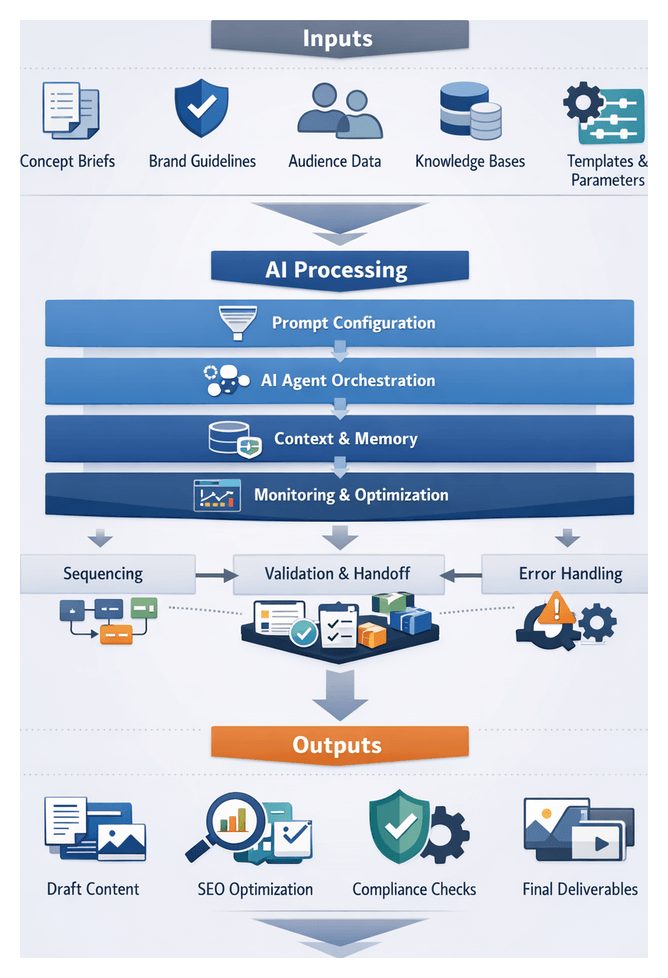
Prompting Stage Objectives and Configuration
The prompting stage transforms strategic concepts into precise instructions that guide AI agents toward consistent, brand-aligned content generation. By defining clear objectives, contextual parameters, and quality constraints, this phase reduces ambiguity, minimizes iteration cycles, and establishes the guardrails for downstream workflows.
- Establish Clear Objectives: Translate high-level themes, tone, and deliverable formats into explicit prompt instructions.
- Configure Contextual Parameters: Set context window sizes, memory retrieval settings, and external knowledge references.
- Embed Quality and Compliance Constraints: Incorporate style guides, legal requirements, and performance targets into prompt templates.
Prerequisites and Core Inputs
Successful prompt configuration relies on validated artifacts, accessible knowledge sources, and defined governance structures.
- Concept Briefs: Topic clusters, thematic outlines, and campaign objectives.
- Brand Guidelines: Tone of voice rules, approved terminology, and visual directives.
- Audience Profiles: Demographic segments, personas, and behavioral insights.
- Source Materials: Research reports, technical documents, and prior content indexed via vector stores.
- Prompt Templates: Version-controlled frameworks for common tasks with variable placeholders.
- Model Selection Criteria: Temperature settings, token limits, and stop sequences for each model.
- Performance Metrics: Readability, SEO rankings, engagement projections as embedded success criteria.
- Technical Configurations: API credentials, rate limits, and access controls for each AI endpoint.
- Governance Workflows: Approval processes for data privacy, brand compliance, and creative review.
AI Tools and Platforms
- PromptLayer: Prompt version control, performance monitoring, and cost analysis.
- PromptOps: Governance automation, access controls, and compliance checks.
- LangChain: Modular prompt construction, context injection, and streaming pipelines.
- LlamaIndex: Ingestion and retrieval of unstructured data for dynamic context augmentation.
- Weights & Biases: Experiment tracking, hyperparameter logging, and output analytics.
Agent Sequencing and Interaction Patterns
Orchestration defines how specialized agents execute tasks in sequence or parallel to build and refine prompts.
- Sequential Chaining: Dependent tasks execute one after another, persisting outputs to a shared store.
- Parallel Invocation: Independent subtasks run concurrently, reducing latency and improving throughput.
- Hybrid Patterns: Groups of chained tasks execute in parallel, merging results before final optimization.
Communication among agents follows standardized messaging and storage patterns:
- Request-Reply: Synchronous exchanges for critical validations with immediate feedback.
- Event-Driven Notifications: Asynchronous triggers via a message bus to initiate downstream tasks.
- Shared Context Store: Persisted artifacts in a document database or LlamaIndex for retrieval by any agent.
- Stream Processing: Continuous pipelines using LangChain for high-volume prompt generation.
Coordination mechanisms ensure harmony across agents:
- Central Orchestrator: Master service that maintains workflow definitions and monitors progress.
- Distributed Coordination: Peer-to-peer negotiation and result merging via consensus protocols.
- Priority Queues: Task prioritization for urgent or high-impact content requests.
- Concurrency Control: Locks or versioning to prevent conflicting updates to shared contexts.
Shared Context Management
A robust context layer tracks all artifacts and metadata through the sequence, enabling traceability and auditability.
- Context Objects: Bundles of original inputs, transformed drafts, annotations, and quality scores.
- Metadata Enrichment: Provenance data—timestamps, agent IDs, parameter settings—appended at each step.
- Versioned Storage: Snapshots of context changes stored in a versioned document repository.
- Semantic Indexing: Vector indexes supporting similarity queries to reference past prompts or examples.
Error Handling and Reliability
- Retry Mechanisms: Automated retries with exponential backoff for transient failures.
- Fallback Agents: Generic language models that assume specialized tasks when primary agents are unavailable.
- Dead-Letter Queues: Storage of irrecoverable messages for manual review.
- Alerting and Escalation: Notifications to on-call engineers with context snapshots and error logs.
Monitoring and Optimization
- Central Logging: Unified capture of request parameters, response payloads, execution durations, and resource usage.
- Traceability: Unique trace IDs linking related tasks across agents for end-to-end lifecycle analysis.
- Performance Dashboards: Real-time metrics on throughput, error rates, and latencies to identify bottlenecks.
- Compliance Records: Immutable audit logs preserving context snapshots and metadata for governance.
- Bottleneck Analysis: Identification of slow agents for optimization or replacement.
- Batching Strategies: Grouping small tasks to amortize invocation overhead.
- Dynamic Parallelism: Adjustment of parallel execution levels based on system load.
- Adaptive Sequencing: Conditional workflow branches that skip non-critical agents when thresholds are met.
Roles and Parameters for AI Collaboration
Defining agent roles and tuning parameters ensures complementary capabilities and streamlined workflows.
- Briefing Agent: Validates inputs and enriches context with knowledge-graph lookups or semantic tags.
- Drafting Agent: Generates text based on prompts, with adjustable creativity via temperature and top-p settings.
- Review Agent: Enforces grammar, style, and policy compliance using editing models or rule-based systems.
- Optimization Agent: Applies SEO analysis, keyword density checks, and structured data enrichment.
- Aggregation Agent: Merges parallel outputs, resolves conflicts, and assembles final deliverables.
Common parameters include temperature, max tokens, context window size, stop sequences, and memory retrieval settings. Continuous monitoring against readability, compliance, and SEO metrics enables dynamic parameter adjustment.
Prompt Artifacts and Metadata
- Prompt Templates: JSON or YAML definitions with placeholders and conditional logic.
- Parameter Profiles: Configured settings for temperature, token limits, and sampling strategies.
- Execution Logs: Records of API requests, responses, latency metrics, and error codes.
- Generated Candidates: Raw text or multimodal snippets with confidence scores.
- Memory Snapshots: Serialized context states capturing prior exchanges or retrieved data.
- Relevance Scores: Semantic alignment with keywords and brand descriptors.
- Diversity Metrics: Lexical and thematic variety across candidates.
- Compliance Flags: Automatic detection of policy violations or sensitive content.
- Resource Usage: Token consumption, compute time, and memory utilization per agent.
Dependencies and Integrations
- Knowledge Bases: Corporate wikis, product documentation, and domain datasets.
- Brand Repository: Centralized tone, terminology, and style guidelines.
- AI Endpoints: OpenAI GPT-4, Anthropic Claude.
- Orchestration Platforms: Prefect, Apache Airflow.
- Parameter Store: Version-controlled sets ensuring reproducibility and auditability.
Handoff Mechanisms and Validation
- Automated Selection Engine: Filters and ranks candidates by relevance and compliance flags.
- Payload Packaging: Bundles selected excerpts, templates, metadata, and execution context into a drafting payload.
- Event Triggers: Signals downstream drafting agents via message brokers.
- API Ingestion: Drafting services receive payloads through REST or gRPC endpoints with acknowledgment logging.
- Versioning: Incremental tags correlate drafts with original prompt contexts.
- Schema Validation: Automated checks against JSON schemas to prevent missing fields or type mismatches.
- Quality Gates: Threshold checks on relevance and compliance before handoff completion.
- Health Checks: Verification of model endpoints and knowledge sources with fallback strategies.
Downstream Draft Integration
- Contextual Assembly: Reconstruction of memory snapshots and reference URIs from payloads.
- Prompt Enrichment: Augmentation with localization parameters, user preferences, or A/B test identifiers.
- Parallel Processing: Sharding payloads across multiple drafting instances with ordering controls.
- Draft Storage: Persistence in content management systems, each linked back to the original prompt artifacts.
Scalability and Resilience
- Clustered Brokers: Horizontal scaling of message queues to distribute load.
- Backpressure Management: Rate limiting and circuit breakers to protect drafting services.
- Retry and Dead-Letter Policies: Automated retries with limits and manual remediation for persistent failures.
- Endpoint Redundancy: Failover routing to alternate AI providers under heavy load or rate limits.
By integrating these configurations, sequencing patterns, artifacts, and handoff protocols, the prompting stage lays a robust foundation for scalable, consistent, and compliant AI-driven content production. Each element ensures seamless progression into drafting, review, and optimization, upholding strategic intent and operational efficiency.
Chapter 4: Content Drafting and Generation
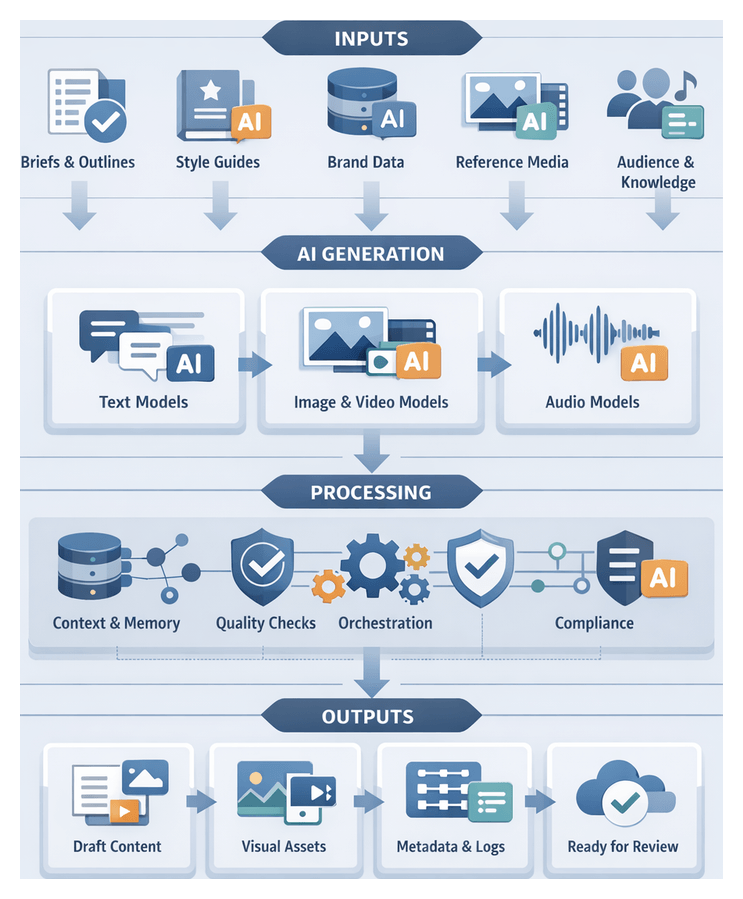
Drafting Stage Overview
The drafting stage is the critical junction where conceptual outlines and thematic frameworks are transformed into first-pass content assets. Within an AI-driven workflow, this phase leverages specialized language, visual and multimedia models in parallel to generate on-brand text, imagery and supporting media at scale. Key objectives include rapid first-pass creation, consistent brand voice enforcement, multimodal asset production and traceable, metadata-rich outputs that underpin subsequent review and optimization.
- Rapid first-pass drafting using models such as OpenAI GPT-4 for narrative prose and Anthropic Claude for conversational segments.
- Brand and voice consistency driven by embedded style guides and terminology glossaries.
- Scalable, parallel generation of text, visuals and multimedia elements.
- Preservation of narrative continuity through managed context memory and versioned prompt schemas.
- Metadata annotation for end-to-end traceability and auditing.
Core Inputs and Readiness Conditions
Essential Inputs
Successful drafting depends on structured upstream artifacts that guide AI agents. Each input must adhere to machine-readable schemas (JSON, YAML) and include:
- Conceptual outlines and document skeletons defining sections, headings and key messages.
- Prompt specifications with system roles, tone directives and style constraints.
- Brand guidelines and voice profiles stored in standardized repositories.
- Audience and persona data shaping narrative angles and personalization hooks.
- Domain knowledge assets such as technical specifications, compliance rules and glossaries.
- Multimedia references including design mockups, image libraries and audio cues.
Prerequisites and System Integration
Prior to invoking drafting agents, the following conditions must be met:
- Model selection and configuration: Models assigned per modality—GPT-4, Claude, Google Vertex AI, diffusion engines like DALL·E 2 or Stable Diffusion.
- Compute resources provisioned: GPU/TPU clusters, cloud inference endpoints and autoscaling policies via Kubernetes or serverless services.
- API endpoint access and security: Rate limits, authentication tokens and monitoring hooks for each AI provider.
- Contextual memory initialization: Retrieval-augmented stores or dynamic vectors populated with upstream inputs.
- Workflow definitions: Orchestration scripts or state machines in Apache Airflow or proprietary platforms with retry and timeout policies.
- Access controls and audit trails: Role-based permissions and logging of prompt versions, input sources and draft iterations.
Quality and Compliance Conditions
Draft outputs must satisfy predefined metrics and rules:
- Automated style checks: Readability scores, vocabulary complexity and brand voice alignment via services like Grammarly Business.
- Regulatory guardrails: Embedded legal, medical or financial compliance rules in prompt definitions and post-draft filters.
- Inclusive language enforcement: DEI lexicon filters and context-aware rewriting policies.
- Security and privacy protocols: Redaction, encryption and data residency compliance.
Readiness Checklist
- Validated concept outlines and prompt templates available.
- Model endpoints health-checked and performance verified.
- Compute quotas and concurrency limits confirmed.
- Input schemas validated and tagged with metadata.
- Brand guidelines and compliance rules loaded into the orchestration environment.
- Monitoring, logging and alerting subsystems activated.
Deployment and Orchestration Architecture
Model Selection and Role Specialization
Mapping content objectives to model capabilities is essential for quality and efficiency:
- Transformer-based language models: GPT-4, Cohere for long-form text.
- Retrieval-augmented generation for fact-based outputs.
- Diffusion and GAN-based engines: DALL·E 2, Stable Diffusion, Adobe Firefly for imagery.
- Domain-specialized agents for audio/video synthesis.
Infrastructure and Supporting Systems
Robust deployment relies on containerized services and orchestration layers:
- Containerization with Docker and container registries.
- Kubernetes clusters for auto-scaling inference pods.
- API gateways exposing versioned endpoints.
- Model registries like MLflow and Hugging Face Model Hub.
- Data pipelines integrating knowledge bases and embedding stores.
Integration with Prompt and Workflow Pipelines
- Prompt templating services for centralized instruction definitions.
- Stateful context stores (Redis, PostgreSQL) to maintain dialogue history and revision state.
- Workflow engines (Apache Airflow, Camunda) coordinating dependencies and retries.
- Event buses triggering model invocations and downstream processes.
Parallel Generation Process
Task Segmentation and Agent Orchestration
A centralized orchestrator divides outlines into discrete subtasks and dispatches them to specialized agents:
- Segment text sections, image requests and video script tasks.
- Map subtasks to suitable models or microservices.
- Package prompts with style guidelines and reference materials.
- Dispatch requests concurrently via asynchronous message queues or HTTP/2 multiplexing.
- Monitor agent status and collect partial outputs in real time.
Concurrency and Resource Management
Intelligent distribution ensures stability and throughput:
- Priority queues for time-sensitive assets.
- Rate limiting to avoid API throttling.
- Batching large documents into logical chunks.
- Affinity rules to maintain context with consistent model instances.
- Backpressure handling to prevent overload.
Auto-Scaling and Cost Optimization
- Horizontal Pod Autoscaling in Kubernetes based on CPU, queue length and latency.
- Use of spot and on-demand instances for workload differentiation.
- Model sharding across GPUs for large inference loads.
- Real-time cost monitoring dashboards for budget-aware scaling.
Synchronization, Monitoring and Resilience
Output Aggregation and Handoff Criteria
As subtasks complete, outputs are validated, reassembled and staged for review:
- Schema and checksum validation to ensure structure compliance.
- Concatenation of text segments and association of images with captions.
- Duplicate detection and de-duplication workflows.
- Metadata attachment: timestamps, model versions, confidence scores.
- Staging assets in DAM or CMS until batch completion.
Handoff depends on finished states, cleared quality flags and metadata enrichment.
Error Handling and Dynamic Tuning
- Retry policies with exponential backoff for transient failures.
- Alternate model routing (fallback to earlier GPT-4 endpoint or Claude Core).
- Graceful degradation using placeholders for noncritical assets.
- Automated alerts and quarantine queues for persistent errors.
- Dynamic parameter adjustment: latency tracking, prompt refinements, temperature and top-k calibration.
Integration with Asset Management
- Automatic ingestion into DAM with metadata tagging.
- Version control of draft artifacts with rollback capabilities.
- Access controls for review agents and editors.
- Notification hooks triggering the review stage.
- Content indexing for search and preview generation.
Deliverables and Handoff Protocols
Draft Artifacts
- Primary text drafts in plain text or HTML, annotated with prompt and concept identifiers.
- Multimedia placeholders and low-resolution proxies with descriptive alt text.
- Structured metadata manifests (JSON/XML) detailing style metrics, word counts and coherence scores.
- Versioned output bundles including agent configuration snapshots.
- Integration adapters for CMS platforms like Contentful or WordPress.
Packaging for Automated Review
- Consolidate text, metadata and multimedia references into ZIP archives or JSON payloads.
- Annotate segments with review tags: grammar, style, factual checks, SEO readiness.
- Compute checksums (SHA-256) for integrity validation.
- Include priority levels and SLA targets for review routing.
- Deliver packages via message queues, cloud storage events or API calls.
Handoff Protocols and Collaboration Integration
- Emit event-driven notifications to trigger review workflows.
- Use short-lived API vouchers for secure draft retrieval by review agents.
- Automate task creation in project management tools (Jira, Asana) with due dates derived from SLAs.
- Update dashboards with handoff acknowledgements and status tracking.
- Implement retry logic and escalation paths for transfer failures.
Content Management and Collaboration
- CMS ingestion via RESTful APIs into platforms such as Contentful or WordPress.
- Document exports to Google Docs or Microsoft Word for inline feedback.
- Git repository commits with pull request templates and automated quality gates.
- Real-time chat notifications in Slack or Teams with summary cards and action buttons.
Governance and Compliance Considerations
- Detailed audit logs of all handoffs and draft versions.
- Schema version management and backward compatibility controls.
- Error categorization with clear escalation mechanisms.
- Performance monitoring of handoff latency and failure rates.
- Additional checkpoints for regulated content (WCAG, data privacy, legal review).
Chapter 5: Automated Review and Refinement
Unifying Content Operations with AI Orchestration
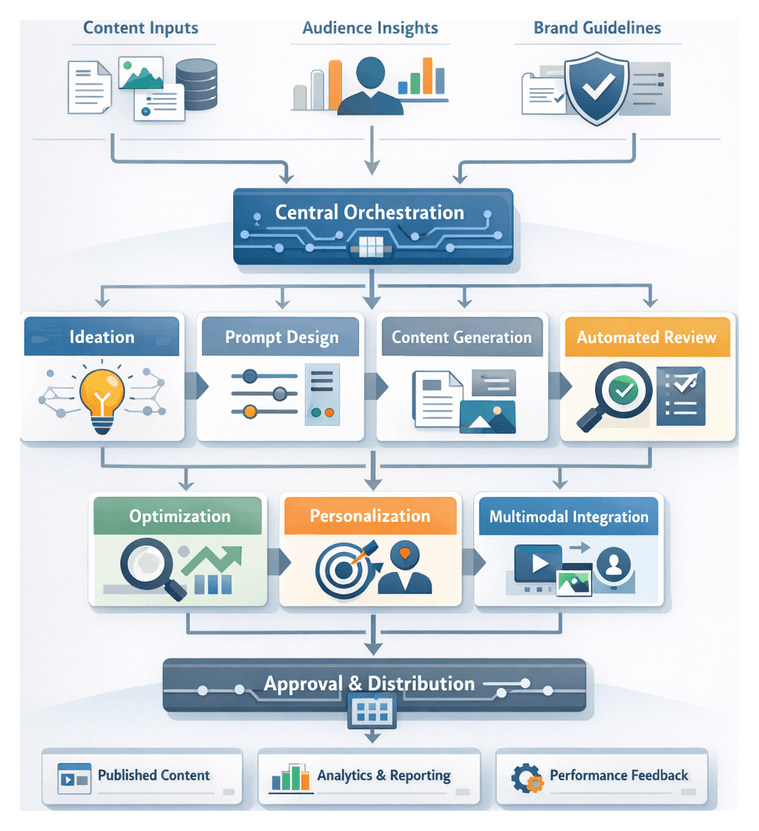
Organizations face growing pressure to deliver high volumes of consistent, on-brand content with minimal latency. Traditional workflows built on siloed teams and disconnected tools introduce bottlenecks, inconsistent messaging, and manual overhead when stitching together drafts, reviews, and optimizations. A unified AI orchestration framework provides a structured, end-to-end mechanism that aligns content inputs, creative processes, and distribution channels. By coordinating specialized AI agents through a central controller, teams achieve reliable quality, accelerated time to market, and scalable creative output.
The rapid adoption of generative AI unlocks possibilities for automating ideation, drafting, review, and optimization tasks. However, fragmented implementations of standalone AI tools—such as Jasper.ai for text generation or Adobe Sensei for image and video assistance—often lack overarching governance. A cohesive orchestration layer standardizes data handoffs, enforces brand and compliance rules, and provides transparency into each stage of production.
Core Principles and Workflow Sequence
Effective AI orchestration rests on four foundational principles:
- Modularity: Encapsulate each stage as a discrete module with defined inputs, outputs, and performance criteria.
- Interoperability: Use standardized data schemas and communication protocols to enable seamless metadata and artifact exchange.
- Governance: Maintain centralized policy management for brand guidelines, regulatory compliance, and quality thresholds.
- Observability: Implement logging, tracing, and analytics to capture agent decisions and workflow performance.
The typical end-to-end workflow sequence is:
- Input Aggregation: Normalize business requirements, source assets, and audience insights into a structured repository.
- Concept Ideation: AI agents generate themes and outlines using models like GPT-4 or Claude.
- Prompt Configuration: Design context-aware prompts with parameter settings managed via orchestration consoles.
- Content Generation: Run language models and multimodal engines in parallel via tools like Copy.ai or in-house transformer services.
- Automated Review: Editing agents conduct grammar, style, and factual checks using Grammarly and Hemingway Editor.
- Optimization: SEO agents enrich content with keywords, meta descriptions, and readability improvements through platforms like Surfer SEO.
- Personalization: Tailor variants for audience segments using behavioral models and CRM data.
- Multimodal Integration: Assemble text, images, audio, and video into cohesive deliverables.
- Distribution Scheduling: Adapt formats and schedule releases via CMS and social media APIs.
- Analytics Feedback: Ingest performance metrics to refine prompts, retrain models, and adjust workflows.
AI Agents and Their Roles
Assigning clear responsibilities to specialized AI agents ensures consistent quality and scalable creativity:
- Ideation Agents: Analyze audience data and market trends to propose content themes and narrative frameworks, leveraging large language models.
- Prompt Design Agents: Translate concepts into precise prompts, managing parameters and version control for reproducibility.
- Content Drafting Agents: Generate initial drafts, social posts, email copy, and video scripts using text and multimodal engines.
- Review and Quality Assurance Agents: Perform automated editing, fact-checking, and brand consistency audits with tools such as Grammarly and Hemingway Editor.
- Optimization and SEO Agents: Evaluate keyword integration, readability, and meta tags, guided by analytics and platforms like Surfer SEO.
- Personalization Agents: Customize tone, calls to action, and imagery based on persona profiles, CRM insights, and behavioral signals.
- Distribution Orchestration Agents: Manage multi-channel publishing, format adaptation, and scheduling through CMS connectors and social APIs.
The automated review and refinement stage serves as the critical quality gate in the content pipeline. It employs AI agents for grammar correction, style alignment, factual verification, and compliance checks to ensure every draft aligns with brand standards and regulatory requirements.
Objectives and Outputs
This stage aims to:
- Validate adherence to editorial and brand guidelines at scale.
- Identify and correct linguistic errors and factual inaccuracies.
- Enforce legal, regulatory, and accessibility standards.
- Enhance clarity and readability for the target audience.
- Produce structured feedback reports and annotated drafts for iterative refinement.
Required Inputs
Effective review relies on four key inputs:
- Draft Content Assets: Text drafts, image placeholders, scripts, and metadata tagged with unique identifiers and version numbers.
- Editorial and Style Guidelines: Brand manuals, tone documents, and style sheets accessed via CMS or APIs.
- Terminology and Glossaries: Approved term lists, product names, and legal phrases enforced through repositories and tools like Grammarly.
- Regulatory Specifications: Data privacy rules, accessibility standards, and sector regulations sourced from compliance platforms.
Prerequisites and Integration
Success depends on:
- Structured metadata handovers with author IDs, timestamps, and campaign tags.
- Agent configuration for error thresholds and domain adaptation via orchestration consoles.
- Real-time connectivity to knowledge bases, style repositories, and compliance engines.
- Version control and audit trails for all edits and feedback annotations.
- Defined escalation paths for severe issues routed to human approvers.
Refined Outputs and Approval Handoffs
Upon completion of review, the system delivers polished content assets alongside validation metadata. These artifacts provide transparency, traceability, and seamless handoff to optimization and distribution stages.
Artifact Specifications
- Final content body in HTML, Markdown, or JSON formats.
- Inline editorial annotations with automated change-tracking.
- Compliance and brand-voice reports generated by validation agents.
- Revision history logs capturing edit iterations and agent IDs.
- Quality scorecards detailing grammar error rates, readability grades, and SEO readiness.
- Metadata bundles with taxonomy tags, entity extractions, and focus keywords.
Dependency Matrix and Quality Gates
Key dependencies include:
- Initial drafts and multimedia assets from the generation stage.
- Brand voice and style guides managed in platforms like Contentful.
- Editorial policies and compliance checklists from systems such as Acrolinx.
- Tone and terminology models trained with tools like ProWritingAid.
- SEO parameters and readability thresholds provided by Surfer SEO.
- Metadata schemas and taxonomy hierarchies for downstream tagging.
Quality gates enforce criteria such as a Flesch-Kincaid score above 60, grammar error density below 1 per 1,000 words, and style compliance above 95 percent. Failed checks trigger automated rerouting or notifications for manual intervention.
Handoff Mechanisms
Refined artifacts enter the next stage via:
- API-Driven Transfer: RESTful endpoints consume JSON payloads containing content bodies, annotations, and metrics.
- Message Queues: Serialized artifacts published to Kafka or AWS SNS/SQS and consumed by optimization agents.
- Repository Commits: Versioned commits to Git or object storage with webhooks triggering downstream workflows.
- Content Operations Platforms: CMS connectors tag content as “Ready for Optimization” in systems like Contentful.
- Stakeholder Notifications: Automated alerts via email, Slack, or Microsoft Teams, with approvals tracked in platforms such as Jira.
Authentication, schema validation, and error handling are enforced at each integration endpoint. Successfully handed-off content is consumed by optimization agents to enrich keywords, generate meta descriptions, and adjust structure while preserving editorial context through inline annotations and compliance reports. This rigorous approach ensures dependable quality and alignment with strategic guidelines as content moves through a scalable, AI-driven workflow.
Chapter 6: Optimization for Engagement and SEO
Fragmented Content Production Challenges
Organizations today produce diverse content—blog posts, white papers, social media updates, videos and interactive assets—across multiple channels, formats and languages. Traditional manual workflows struggle under disconnected processes, disparate tools and siloed responsibilities, leading to inefficiencies that undermine consistency, quality and scalability. Without unified frameworks, teams rely on email chains, shared drives and ad-hoc meetings, causing lost feedback, version confusion and last-minute rework. As asset volumes swell, tracking requirements and maintaining brand voice across hundreds of deliverables per quarter expose the fragility of manual production models.
Process fragmentation arises when tasks lack standardized workflows. Locally defined checklists and folder structures inhibit cross-project reuse and scaling. Technology fragmentation occurs when multiple point solutions—content management systems, project management tools and file-sharing platforms—operate without integration, slowing workflows and risking data inconsistency. Knowledge fragmentation results from scattered brand guidelines, asset data and performance metrics, eroding the ability to learn from past campaigns.
Siloed teams exacerbate misalignment: marketing strategists draft outlines without visibility into design capacity or legal review guidelines; designers and writers scramble to reconcile conflicting requirements. Manual handoffs introduce communication breakdowns—comments buried in email threads, track-change conflicts and outdated documents—leading to duplication of effort and overlooked feedback. Without automated version control, each revision cycle amplifies delays and frustration.
Inconsistent quality and brand alignment become common. Style rules, tone of voice and compliance requirements are interpreted variably, eroding brand integrity and audience trust. Data and insights remain locked in siloed analytics platforms, CRM systems and research reports, depriving teams of unified, real-time feedback for data-driven decision making. As content volumes grow, manual workflows buckle under increased demand, forcing either headcount expansion or extended timelines—neither of which align with agile market expectations. Bottlenecks concentrate around resource-intensive tasks such as legal review, editorial approval and multichannel formatting, lengthening time-to-market and diminishing competitive advantage.
Stakeholder frustration mounts as meetings multiply, manual status updates consume valuable time and creative teams experience workflow fatigue. Turnover rises, morale falls and operational expenses increase. This diagnostic stage of mapping current workflows—documenting tools, processes, sample artifacts, brand guidelines, performance data and stakeholder interviews—lays the foundation for a unified, AI-driven framework. Cross-functional commitment, governance frameworks and baseline metrics are prerequisites to transition from fragmented, manual production to orchestrated processes powered by AI agents.
Orchestrating AI-Driven SEO and Readability Enhancement
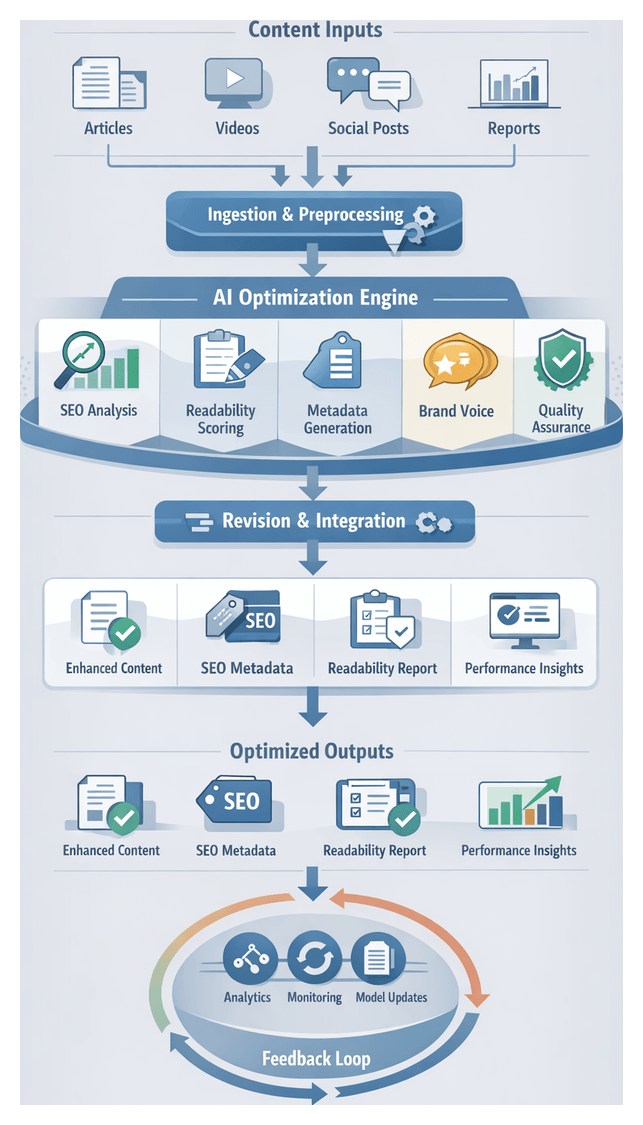
Optimizing refined drafts for search engine visibility and reader comprehension involves coordinating specialized AI agents within a modular orchestration framework. The Optimization Orchestrator functions as a control plane, dispatching tasks, aggregating results and managing dependencies through RESTful APIs, messaging queues or SDK integrations.
Workflow Architecture and Key Components
- Content Ingestion Module: Normalizes formatting, extracts semantic tags and appends contextual metadata.
- SEO Analysis Agent: Integrates with Semrush, SurferSEO and Clearscope to perform keyword benchmarking, heading optimization, semantic clustering and automated keyword integration via large language models.
- Metadata Generation Service: Uses MarketMuse or Frase to craft optimized title tags, meta descriptions, Open Graph and Twitter Card snippets with brand guidelines.
- Readability Scoring Agent: Leverages Hemingway Editor and Grammarly to compute Flesch-Kincaid, SMOG and clarity metrics, proposing sentence simplifications, active-voice transformations and jargon reduction.
- Brand Voice Agent: Loads predefined voice profiles to ensure formality, empathy and technical depth align with style guides.
- Quality Assurance Agent: Validates SEO compliance, readability thresholds and WCAG 2.1 accessibility standards, routing failures back for remediation.
- Revision Integration Engine: Applies AI-driven suggestions to content, maintaining change logs and version control for auditability.
Optimization Sequence
- Ingestion and Preprocessing: The orchestrator receives drafts with structured fields, performs normalization, semantic tag extraction and registers documents in the pipeline.
- Parallel SEO and Readability Analysis: The SEO Analysis Agent evaluates ranking factors, performs competitive gap analysis, suggests heading adjustments and integrates keywords contextually. Simultaneously, the Readability Scoring Agent calculates readability indices and generates linguistic refinements.
- Metadata Generation: After body optimization, the Metadata Generation Service generates title tags and meta descriptions within character limits, prioritizing keywords and brand integration. Alt text for images is crafted to boost accessibility and SEO.
- Brand Voice Consistency: The Brand Voice Agent scores drafts against voice profiles, adjusting tone and enforcing terminology conventions.
- Automated Quality Assurance: A QA agent executes final checks on SEO, readability and accessibility, triggering alerts or automated handoffs for compliance failures.
- Deliverable Packaging: The orchestrator compiles enriched content, metadata, optimization reports and revision logs into a final package for personalization or distribution agents.
This scalable, repeatable flow ensures every piece of content meets search engine requirements, human reader expectations and brand standards, maximizing impact across digital channels.
Data-Driven Optimization Agent Roles
Specialized AI agents leverage performance data and content analytics to refine discoverability, engagement and relevance. By integrating with analytics platforms, content management systems and SEO tools, these agents apply targeted enhancements to refined drafts and metadata.
- Analytics and Insights Agents: Ingest data from Google Analytics, Adobe Analytics, social platforms and email campaigns. They normalize metrics, detect anomalies, identify trending topics and generate dashboards highlighting optimization opportunities.
- SEO Integration Agents: Perform keyword discovery with semantic analysis, generate metadata, suggest keyword placements, analyze backlink opportunities and monitor algorithm updates via Ahrefs, Moz and other SEO suites.
- Readability and Accessibility Agents: Calculate readability scores, optimize structure with hierarchical headings and bullet lists, validate image alt text, verify color contrast and offer language simplifications to support diverse audiences.
- Semantic Enrichment Agents: Identify entities, recommend contextual internal and external links, suggest topic expansions and integrate knowledge graph schemas to enhance topical authority.
- Predictive Performance Modeling Agents: Use historical data and machine learning to forecast engagement, conversions and search rankings. They simulate optimization strategies, estimate ROI and guide prioritization.
- Tone and Engagement Calibration Agents: Analyze sentiment and emotional triggers, generate headline variants, refine calls to action for clarity, urgency and brand alignment.
- Personalization and Segment Scoring Agents: Build audience profiles from CRM and behavioral data, predict content variant performance per segment, inject dynamic parameters for personalization and monitor segment-specific metrics.
- Automation and Workflow Orchestration Agents: Coordinate job scheduling, manage dependencies, connect to external services via API gateways or message queues, and handle error logging with monitoring tools like Grafana and Prometheus.
- Model Retraining and Feedback Loop Agents: Aggregate post-publication metrics, detect performance drift, automate model retraining pipelines, manage model versioning and validate updated models before deployment.
Supporting infrastructure includes cloud data lakes or warehouses, integration middleware, SEO suites, analytics platforms and orchestration frameworks such as Apache Airflow or Prefect. Robust monitoring and logging ensure observability into agent performance and system health.
Optimized Content Deliverables and Integration Handoffs
The optimization stage produces a comprehensive deliverables package bridging content crafting and personalized distribution. Clear definitions of outputs, dependencies and handoff protocols ensure consistency, reduce rework and accelerate time-to-market.
Primary Deliverables
- Enriched Content Assets: AI-enhanced text with keyword annotations, updated headers, optimized alt text and refined calls to action.
- Metadata and Tagging Package: Title tags, meta descriptions, structured data snippets (JSON-LD or microdata), Open Graph attributes and social card specifications.
- Readability and Engagement Report: Detailed Flesch-Kincaid scores, sentence complexity metrics and predicted time-on-page.
- Keyword Mapping Overlay: Section-level distribution of primary, secondary and long-tail keywords, with hierarchy recommendations.
- SEO Audit Summary: Automated checks for broken links, missing alt attributes, duplicate headings, internal linking opportunities and page speed insights.
- Performance Prediction Models: Machine-learning estimates of click-through rate, bounce likelihood and engagement forecasts.
- Compliance and Brand-Voice Validation: Confirmation of adherence to style guides, regulatory constraints and tone consistency.
Dependencies and Prerequisites
- Refined Draft Content: Clean copy with resolved placeholders and asset references.
- Keyword Taxonomy and Strategy: Validated target keywords and competitive benchmarks from SurferSEO and MarketMuse.
- Brand and Regulatory Guidelines: Style guides, legal copy requirements and WCAG 2.1 standards.
- Analytics and User Data Streams: Historical metrics from Google Analytics and Adobe Analytics.
- Technical Constraints: CMS templates, URL limits, image dimensions and page-speed parameters.
- Integration Credentials: Secure API keys or service accounts for headless CMS, personalization engines and distribution platforms.
- Agent Configuration Profiles: Parameter sets for SEO workflows, readability thresholds and compliance checklists maintained in orchestration tools.
Handoff Protocols
- Packaging Formats:
- ContentPayload.json: Enriched text, metadata tags and keyword mappings.
- SEO_Audit_Summary.xml: Structured audit results for CMS integration.
- ReadabilityReport.pdf: Audit of readability analysis.
- Versioning and Change Tracking: Semantic version identifiers linked to Git commits or CMS revisions.
- API-Driven Transfer: Orchestration agents push payloads to personalization engines via RESTful endpoints or message queues.
- Confirmation and Quality Gates: Handshake protocols using checksums or digital signatures to verify integrity before downstream processing.
- Human-In-The-Loop Notifications: Alerts via email or Slack for manual review of sensitive content, with links to assets in a centralized DAM.
Asset Packaging Specifications
ContentPayload.json
- id: Unique content identifier
- version: Semantic version tag
- body: HTML string with keyword span annotations
- metadata: Object containing titleTag, metaDescription, ogTitle and ogDescription
- keywords: Array of objects with frequency, intent and priority fields
SEO_Audit_Summary.xml
- <pageSpeed> Numeric score
- <altTextReports> List of image alt attributes
- <linkChecks> BrokenLinks, InternalLinks, OutboundLinks </linkChecks>
ReadabilityReport.pdf
- Executive summary of key scores
- Section-by-section readability breakdown
- Recommendations for simplification
Validation and Quality Gates
- Schema Validation: Against registered JSON-Schema and XSD.
- Checksum Comparison: To ensure file integrity.
- Cross-Field Consistency Checks: Verifying metadata and content alignment.
- Accessibility Audit: Assessing alt text and semantic HTML structure.
- Brand-Voice Verification: Scoring alignment against style-guide vectors.
Integration into Downstream Systems
- Personalization Engines: Ingest ContentPayload.json for segment-specific variants, dynamic token replacement and user-profile adaptation.
- Distribution Platforms: Consume metadata manifests for scheduling websites, email campaigns and social channels, with format conversions as needed.
- Analytics and Feedback Systems: Log performance predictions and SEO audit results for post-publication comparison against real-world metrics.
By defining optimized outputs, specifying dependencies and codifying handoff protocols, organizations achieve end-to-end automation without sacrificing quality or brand alignment. This streamlined, repeatable process connects AI-driven optimization directly to audience-focused delivery, maximizing efficiency and impact.
Chapter 7: Personalization and Audience Targeting
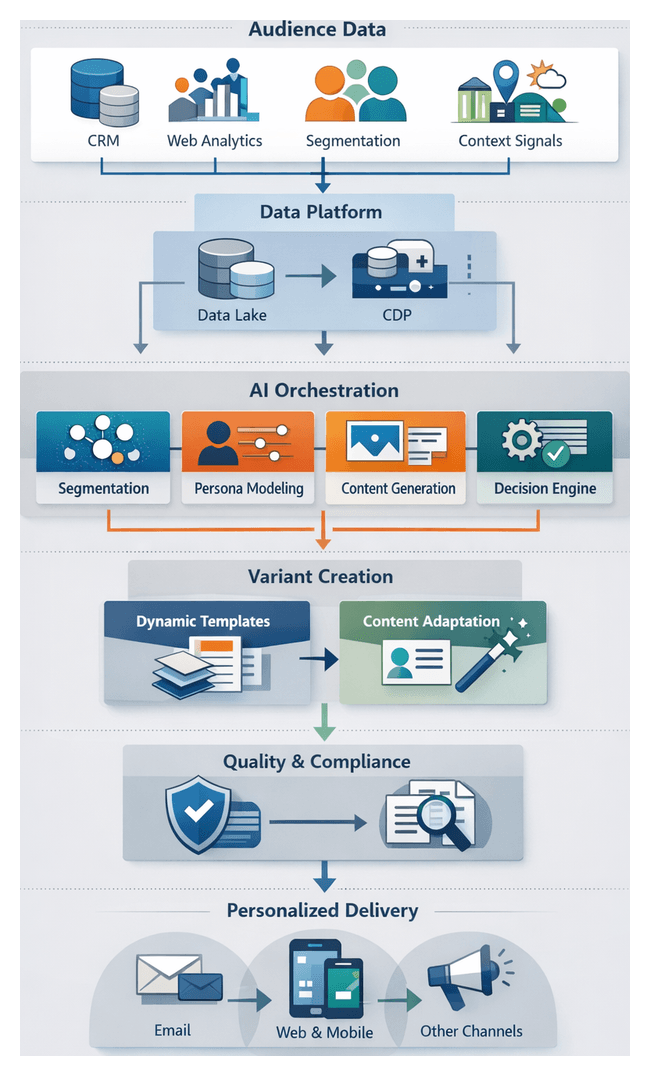
The personalization stage transforms generic content into tailored experiences by leveraging behavioral, demographic, and contextual data. By aligning messaging with individual preferences and real-time signals, organizations can boost engagement, improve conversion rates, and foster customer loyalty. This stage relies on a coordinated AI orchestration framework to generate, validate, and distribute multiple content variants while ensuring brand consistency and regulatory compliance.
Personalization Objectives and Data Requirements
Clear objectives guide AI agents and define the necessary data inputs for effective personalization:
- Deliver contextually relevant content using user profiles and messaging templates
- Improve conversion rates with dynamic calls to action aligned to individual intent
- Enhance user experience by selecting optimal format and tone for each segment
- Maintain brand consistency via centralized style and messaging guidelines
- Scale content variants efficiently through automated generation and selection
Successful personalization depends on robust audience data and infrastructure components:
- Unified Customer Profiles: Consolidated data from CRM, web analytics, email marketing, and offline sources
- Segmentation Strategy: Defined segments based on demographics, behavior, purchase history, lifecycle stage, and predictive intent
- Behavioral Data Streams: Real-time tracking of page visits, clicks, session duration, and consumption patterns
- Contextual Signals: Device type, location, time, weather, and campaign parameters
- Brand Guidelines: Centralized assets specifying tone, messaging hierarchy, and compliance rules
- Privacy Metadata: Consent statuses and data usage policies for GDPR, CCPA, and other regulations
Data Infrastructure and Integration
A scalable, low-latency data architecture is essential to feed AI agents with accurate, up-to-date inputs:
- Data Lake or Warehouse: Central repository for raw and processed audience data
- Customer Data Platform (CDP): Unified user profiles with real-time updates
- API Layer: Standardized interfaces for segmentation outputs and contextual signals
- Data Pipelines: ETL/ELT workflows to normalize, clean, and enrich data
- Event Streaming: Platforms such as Apache Kafka or AWS Kinesis for real-time behavior delivery
Integration ensures AI agents access complete, accurate profiles. Latency and throughput must support use cases like on-site personalization or send-time email optimization.
Audience Modeling and Agent Collaboration
Audience modeling interprets raw data to build detailed personas and inform content assembly. AI agents collaborate to segment users, generate profiles, and enable real-time decisioning.
Data Sources and Preprocessing
- CRM systems for transactional history and support interactions
- Web analytics for navigation paths, session duration, and engagement metrics
- Social listening tools for sentiment and topical interest
- Third-party demographic databases to enrich profiles
Feature engineering agents cleanse data, derive RFM scores, engagement indexes, and propensity indicators. Natural language processing extracts themes from feedback and social posts.
Behavioral and Psychographic Modeling
- Clustering algorithms to identify cohorts with similar behavior
- Classification models to predict response likelihood
- Topic modeling for latent interests
- Sentiment analysis to gauge emotional drivers
Models are retrained as new data streams in, ensuring personas remain current and relevant.
Agent Roles and Orchestration
- Segmentation Agent: Clusters users and assigns propensity scores
- Persona Generation Agent: Produces human-readable profiles with motivations and tone guidelines
- Behavior Monitoring Agent: Updates segment membership in real time
- Context Enrichment Agent: Integrates external signals like seasonal trends or industry news
- Decisioning Agent: Selects content variants on the fly based on current session behavior
An orchestration layer schedules tasks, manages dependencies, and monitors SLAs. An event bus supports asynchronous communication, while feature stores and model registries maintain version control. Governance agents enforce privacy, consent, and data lineage requirements.
Variant Generation and Targeting Workflow
This workflow converts static assets into personalized messages for each segment or user.
- Audience Segment Identification: A segmentation agent queries the CDP or Adobe Experience Platform for user attributes, interaction history, and scores.
- Segmentation Rule Evaluation: A rules engine applies business logic and exclusion criteria to assign segment IDs and priority scores.
- Variant Template Selection: A template agent matches segments to layouts and placeholders. AI recommendation services like Dynamic Yield may suggest optimal designs.
- AI-Driven Content Adaptation:
- Persona Modeling Agent: Refines tone and vocabulary according to brand voice and user traits, leveraging the Google Cloud AI Natural Language API.
- Variant Generation Agent: Populates placeholders with personalized headlines, recommendations, and CTAs via prompt orchestration.
- Quality Assurance and Compliance:: A validation agent checks grammar, legal terms, brand consistency, and privacy rules before tagging variants with quality scores.
- Variant-to-Channel Mapping:: An orchestration agent routes approved variants to email service providers, on-site personalization platforms like Optimizely, mobile engagement tools, or other channels via API integrations.
- Real-Time Delivery:: Runtime engines intercept user requests, match profiles, and serve the corresponding variant, updating offers dynamically based on live interactions.
System Interactions
- Event Bus Notifications: Broadcast stage-completion and approval events for decoupled coordination.
- API Orchestration Layer: Enforces security, rate limits, and data transformations among CDP, AI services, rules engine, and delivery platforms.
- Shared Metadata Repository: Central store for templates, variant definitions, quality scores, and segment assignments.
- Data Synchronization: Incremental jobs or CDC ensure the personalization engine uses fresh segment data without sacrificing throughput.
Outputs and Handoff Protocols
Deliverables
- Personalized Variants: Tailored headlines, body copy, CTAs, image recommendations, dynamic placeholders, and version manifests.
- Segmentation Metadata: Segment IDs, behavioral triggers, content scores, and audit trails of AI decisions.
- Rules and Profile Updates: Refined personas, updated decision logic, and feedback annotations from performance data.
Dependencies
- Approved content assets from prior optimization stages
- Reliable audience profiles and real-time feeds via CRM or CDP integrations
- Centralized brand guidelines and style parameters
- Analytics feedback on previous personalization cycles
Personalization outputs are packaged into structured payloads, typically JSON or XML, conforming to API schemas. Payloads include:
- Variant IDs, segment mappings, text blocks, image URIs, and placeholders
- Segmentation attributes, performance scores, persona updates, and audit logs
- Security tokens for authentication
For example, an HTTP POST to a multimodal integration endpoint might follow vendor API specifications.
- Validate schema compliance against JSON Schema definitions
- Map variants to assembly templates
- Invoke text, image, audio, and video synthesis agents in parallel
- Merge assets into unified deliverables
Quality Gates and Confirmation
- Automated QA: Grammar, tone, and style checks with Grammarly; brand compliance and privacy verification.
- Alerts and Rollback: Failures trigger alerts and fallback to default variants until issues are resolved.
- Handoff Logging: Timestamps, payload checksums, and endpoint acknowledgments logged for traceability and audits.
Best Practices
- Version control: Semantic tagging of payloads for rollback capabilities
- Idempotency: Design endpoints to handle repeated submissions without duplication
- Monitoring and alerts: Real-time dashboards for failed handoffs and schema mismatches
- Documentation: Up-to-date API contracts, payload examples, and error code guides
- Data governance: Strict access controls on personalization metadata to protect privacy
By consolidating objectives, infrastructure, agent collaboration, workflow sequencing, and handoff protocols, organizations establish a robust personalization stage that delivers targeted experiences at scale, upholds governance, and accelerates time to impact.
Chapter 8: Multimodal Content Integration
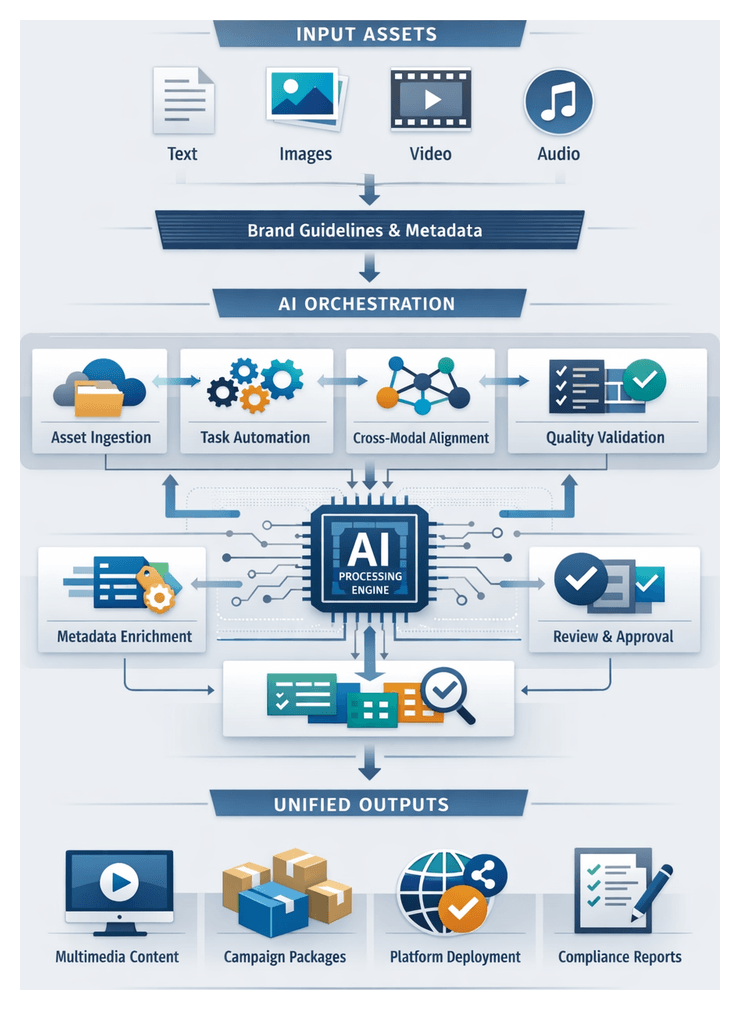
Integration Stage and Multimodal Alignment
The integration stage serves as the orchestration hub where text, imagery, video, and audio assets converge into unified, branded deliverables ready for publication. By enforcing consistent tone, style, and messaging, this phase bridges parallel content streams and transforms standalone outputs into cohesive campaigns. Multimodal alignment is achieved through structured inputs and automated validation, enabling organizations to scale omnichannel production without sacrificing quality or brand integrity.
Key objectives of the integration stage include:
- Aligning all media types with a single narrative arc and visual identity.
- Enforcing brand guidelines across text, visuals, motion graphics, and audio.
- Resolving style and metadata discrepancies introduced by individual asset workflows.
- Automating packaging of campaign materials to meet platform constraints.
- Providing checkpoints for cross-modal review and approval.
The integration workflow relies on a defined set of inputs and prerequisites:
- Refined text segments annotated with semantic tags, tone indicators, and formatting metadata.
- High-resolution images and graphics with aspect ratio, color profile, and usage context metadata.
- Edited video clips and motion sequences, complete with storyboards, timing markers, and target codecs.
- Audio recordings, music tracks, and sound effects trimmed, normalized, and tagged with duration and channel mix information.
- Machine-readable brand guidelines specifying color palettes, typography, logos, and usage permissions.
- Technical specifications for file sizes, aspect ratios, frame rates, bitrates, and format containers per channel.
- Version control references and licensing documentation to ensure the latest approved assets and usage rights.
An automated aggregation and validation workflow prepares these inputs for seamless assembly. Assets are ingested from content management and digital asset repositories, normalized to standard formats, enriched with metadata, and verified against brand and accessibility standards. Only after passing these readiness checks does the integration stage commence, preventing late-stage changes and ensuring reliable assembly.
Automated quality assurance measures run throughout the integration phase, including format validation, brand compliance audits, cross-modal consistency tests, accessibility checks, and simulated previews. AI-driven validation agents generate actionable readiness reports, enabling teams to address discrepancies before final assembly into publication-ready packages.
Cross-Modal Orchestration Workflow
The cross-modal orchestration workflow choreographs specialized AI agents, core services, and artifact repositories to align disparate media types into composite assets. It operates on three pillars: task sequencing, metadata exchange, and adaptive coordination. Task sequencing defines dependencies, metadata exchange ensures contextual alignment, and adaptive coordination monitors progress and scales resources dynamically.
Orchestration engines such as AWS Step Functions and Apache Airflow interface with AI agents via APIs or message queues, maintaining state, triggering tasks, and handling retries. A typical workflow sequence includes:
- Asset Registration: Ingest script outlines, images, video clips, and audio tracks into a digital asset management system, tagging each asset with identifiers, version metadata, and source context.
- Task Dispatch: Evaluate the dependency graph and dispatch jobs—text-to-speech synthesis waits for finalized copy, while image generation runs in parallel.
- Metadata Enrichment: Append structured metadata—timestamps, style parameters, storyboard references, brand guidelines—to each asset.
- Quality Checkpoints: Automated agents verify format compliance, resolution, and style adherence. Anomalies trigger alerts or retries.
- Final Assembly: Aggregate media elements into composite outputs (for example, a narrated video), then encode and optimize for target channels.
Illustrative toolchain interactions:
- Text outline passes to an image generation agent like DALL·E or Runway ML to produce illustrations.
- Generated visuals and footage combine in a video editor such as InVideo, which applies transitions and overlays.
- Script narration is synthesized by Murf.ai or Descript and time-aligned with video frames.
- Brand assets from a service like Cloudinary are overlaid according to guidelines.
- A composite render agent encodes final outputs into MP4 or WebM formats.
- The orchestration engine then publishes asset links and metadata back to the CMS or distribution scheduler.
Engine-to-agent communication uses RESTful APIs or message queues (RabbitMQ, Kafka). Agents sync outputs to repositories via webhooks. Error handling may trigger parameter adjustments or escalate to human review. Parallelism is managed by the orchestration engine, which provisions compute resources to maximize throughput while maintaining reliability. An audit trail captures all interactions for monitoring, performance tuning, and compliance.
Adaptive coordination responds to processing time or quality variation by scaling agent instances via container orchestration platforms, adjusting quality parameters, or reprioritizing tasks. A shared metadata schema links text segments to visual frames and audio timestamps, carries style tokens, and tracks version history. Human-in-the-loop checkpoints allow reviewers to annotate and adjust inputs, after which automated tasks resume. Finally, integration with scheduling and publishing APIs ensures composite assets deploy seamlessly to social media, streaming platforms, or web channels.
Specialized Media Synthesis Agents
Specialized agents perform domain-specific tasks to generate, process, and align multimedia assets. Clear role definitions enable scalability, consistency, and efficiency.
Creative Vision Agents
These agents define visual themes, mood boards, and style guides based on high-level briefs. They extract color palettes, composition rules, and mood descriptors, then draft structured specifications—resolution targets, aspect ratios, frame rates, and audio thresholds—to guide downstream synthesis models.
Image Synthesis Agents
- Stable Diffusion: Generates detailed images from textual prompts with fine-tuning for brand styles.
- DALL·E 3: Produces high-fidelity illustrations, supports inpainting and variation controls.
- Midjourney: Enables rapid exploration of artistic imagery through iterative prompts.
- Topaz Gigapixel AI: Upscales images to meet high-definition requirements.
Video Generation and Editing Agents
- Synthesia: Creates AI-driven avatars and video segments from text scripts in multiple languages and voice styles.
- Runway ML: Offers motion tracking, background replacement, and style transfer for video experimentation.
- Pictory: Converts long-form text into short videos by selecting key sentences, sourcing imagery, and adding narration.
- Adobe Premiere Pro (Generative Fill): Applies generative fill and auto-edit features for content-aware video completion.
Audio Synthesis and Editing Agents
- Descript: Enables text-based audio editing, voice cloning, and filler-word removal.
- ElevenLabs: Provides lifelike text-to-speech voices with emotion, emphasis, and cadence controls.
- AIVA: Composes original music scores tailored to mood, length, and instrumentation.
- Soundraw: Generates royalty-free music tracks with adjustable tempo, genre, and structure.
Cross-Modal Alignment Agents
- Automatic Captioning with models such as Whisper, generating time-coded subtitles.
- Lip-Sync Correction to match avatar mouth movements to audio tracks.
- Storyboard Conformance checks comparing video frames to reference images.
Quality Assurance and Style Consistency Agents
- Visual Artifact Detection using convolutional neural networks.
- Color and Brightness Analysis against style guide thresholds with corrective LUTs.
- Audio Loudness and Clarity Checks measuring LUFS levels and denoising routines.
- Accessibility Verification for legible subtitles and descriptive metadata.
Infrastructure and Orchestration Services
- GPU-enabled compute clusters managed by platforms like Kubeflow or MLflow.
- Centralized asset management systems with version control and metadata indexing.
- Microservice APIs for submitting prompts, retrieving outputs, and monitoring jobs.
- Pipeline orchestration engines sequencing agent interactions and enforcing SLAs.
Unified Asset Bundles and Handoff Procedures
Upon completing synthesis and validation, the workflow produces unified asset bundles: multimodal packages that serve as a single source of truth for downstream systems. Each bundle includes:
- Core content files in HTML, Markdown, or XML, with localized variants.
- Visual media assets (JPEG, PNG, SVG, PDF) optimized for print and digital.
- Video segments (MP4, MOV, WebM) with thumbnails and storyboard references.
- Audio tracks (WAV, AAC) with normalized stems and transcripts.
- Interactive elements (HTML5 or JSON modules, data visualizations).
- Machine-readable metadata catalog detailing identifiers, sizes, durations, and licensing.
- Quality reports summarizing compliance, style alignment, and accessibility checks.
- Localization chunks with translation memory references and glossaries.
Technical dependencies and preconditions for bundle integrity include validated draft outputs, SEO and readability logs, personalization blueprints, alignment tables linking media types, version control snapshots, controlled taxonomies, and system configuration files for downstream platforms.
Standardized output specifications ensure seamless handoff:
- File naming conventions such as:
- prefix_projectcode_assettype_language_version.ext (for example, PRJ123_video_en_v02.mp4)
- Resolution and encoding guidelines (300 dpi for print images, 1080p H.264 for video, 44.1 kHz WAV for audio masters).
- Metadata schemas (Dublin Core or custom JSON) covering title, description, creator, date, rights, and usage context.
- Accessibility compliance with SRT captions, transcripts, and alt-text metadata.
- Localization markers using ISO 639-1 language codes.
A manifest file describes asset relationships and dependencies, including unique identifiers, file paths, checksum values, processing flags, and dependency links. Automated integrity checks verify checksums and sizes before delivery.
Bundles are distributed via:
- Direct API integration to DAMs like Bynder or OpenAsset.
- SFTP or secure file share with automated notifications.
- CMS import connectors such as the Contentful import API.
- Cloud storage buckets with pre-signed URLs on AWS S3, Google Cloud Storage, or Azure Blob Storage.
- Webhooks and event triggers notifying recipients of package availability.
Handoff protocols define roles, SLAs, acceptance criteria, checklists, escrow paths for issue escalation, and collaboration guidelines. Downstream integration considerations include metadata endpoints (REST or GraphQL), preview links for stakeholder review, transformation rules for channel-specific resizing or transcoding, and access permissions in DAM or CMS.
Continuous quality monitoring tracks delivery confirmations, performance metrics (download counts, preview impressions), error logs, and version audits. These feedback loops enable repackaging or updates as needed, closing the loop on content production and distribution.
By unifying assets into metadata-rich bundles and adhering to clear orchestration, delivery, and handoff protocols, organizations streamline content operations, reduce manual coordination, and accelerate time-to-market across every channel.
Chapter 9: Distribution Workflow and Scheduling
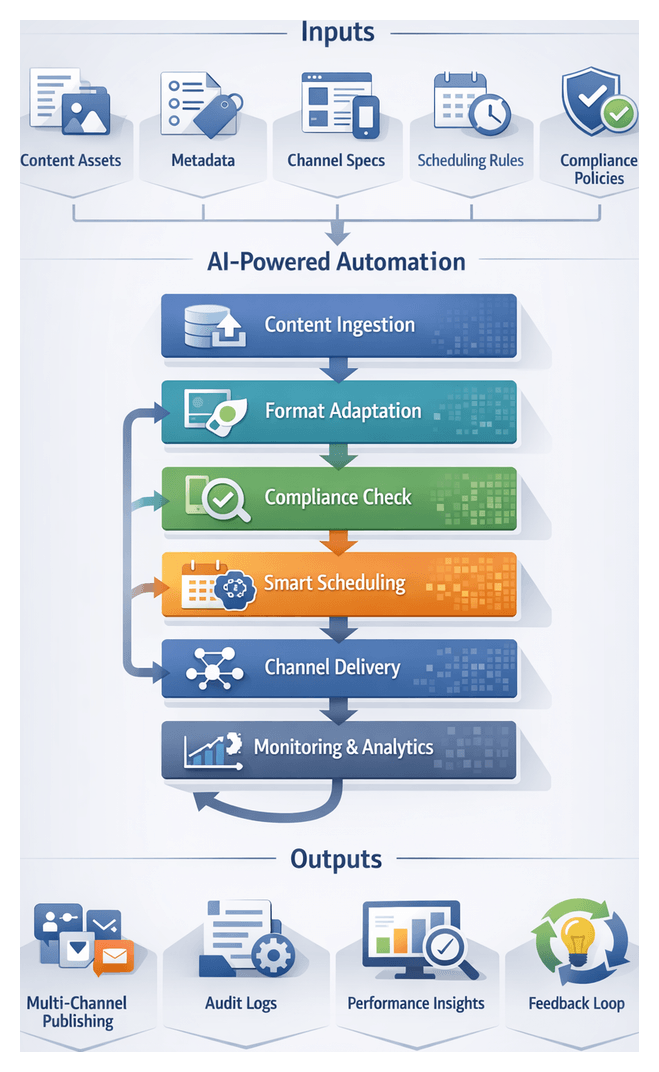
Strategic Objectives and Essential Inputs for Content Distribution
At the heart of a robust content pipeline, the distribution stage ensures that finalized assets are delivered to audiences across multiple channels in the right format, at the optimal time, and in full compliance with organizational policies and platform requirements. By automating metadata enrichment, format adaptation, scheduling logic, and compliance checks, organizations can bridge the gap between creation and engagement, consistently reinforcing brand identity at scale.
This stage is defined by six strategic objectives:
- Timeliness: Publish content when target audiences are most active, using predictive engagement windows derived from historical data.
- Consistency: Enforce uniform branding, voice, and design across channels through templated formatting and automated style verifications.
- Compliance: Automatically apply platform policies, regional regulations, legal clearances, and brand safety rules to minimize risk.
- Scalability: Support high-volume, multi-channel distribution without proportional increases in manual effort.
- Traceability: Generate audit logs and distribution reports capturing metadata, timestamps, and performance indicators for downstream analytics.
- Flexibility: Handle last-minute updates, embargoed releases, and localized adaptations with minimal human intervention.
Traditional distribution workflows often involve manual adaptation of assets for each platform—adjusting file formats, resizing media, and scheduling posts via disparate tools. This leads to bottlenecks, human error, and inconsistent brand experiences. By contrast, an AI-driven orchestration framework unifies these tasks under a shared set of business rules, channel-specific templates, and dynamic scheduling algorithms. The result is accelerated time to publication, reduced operational costs, and improved content quality.
To meet these goals, the distribution stage depends on a comprehensive set of inputs:
- Finalized Content Assets: Approved text, images, videos, audio files, and document packages in source or canonical formats, stored in a central repository.
- Metadata Package: Titles, descriptions, keywords, categories, localization tags, and audience segments adhering to standardized taxonomies.
- Channel Specifications: Requirements for character limits, aspect ratios, file sizes, tagging conventions, and content templates for web, social media, email, and partner platforms.
- Scheduling Parameters: Publication windows, embargo dates, time zones, frequency rules, and priority levels defining when and how often assets should be released.
- Compliance and Policy Rules: Legal guidelines, copyright clearances, content approval statuses, moderation criteria, and regional restrictions managed by AI agents.
- API Credentials and Access Tokens: Secure authentication details for automated publishing to content management systems, social networks, email platforms, and distribution networks.
- Localization Data: Translations, region-specific imagery, cultural guidelines, and regulatory requirements for global audiences.
- Fallback and Escalation Procedures: Protocols for retries, error handling, and human intervention when automated processes encounter failures or policy violations.
Several prerequisites must be satisfied before automated distribution can proceed:
- Content approval workflows must be complete, with stakeholders’ sign-offs recorded.
- Metadata fields should be validated against configuration repositories and standardized taxonomies.
- Channel connectors and templates must be configured, tested, and audited to verify API connectivity.
- Publication schedules must be synchronized with organizational calendars and global events.
- Compliance clearance procedures, including legal and regulatory checks, must be finalized.
- System capacity, such as server resources, CDN endpoints, and platform rate limits, must be confirmed.
- Failover mechanisms and notification protocols should be defined for exception handling.
Organizations that standardize distribution inputs—such as metadata schemas, channel configurations, and compliance rules—establish clear handoff protocols. These protocols ensure that optimization, personalization, and multimodal integration outputs flow seamlessly into distribution agents, minimizing rework and manual intervention. As a result, teams can scale operations to support global campaigns, launch swiftly into new channels, and maintain audit-ready records for internal governance and external regulations.
From a strategic perspective, a mature distribution capability delivers tangible business outcomes:
- Improved audience engagement by aligning content release with real-time trends and behavioral insights.
- Enhanced brand protection through automated compliance enforcement and consistent style checks.
- Higher operational efficiency by reallocating human resources from repetitive tasks to strategic initiatives.
- Actionable insights captured at distribution events that feed optimization loops and drive continuous improvement.
Automated Publishing Pipeline Flow
By breaking down the distribution process into discrete, automated stages, the publishing pipeline transforms a traditionally siloed workflow into a cohesive, transparent operation. Each stage is governed by AI agents that execute specialized tasks, while the central orchestrator maintains end-to-end visibility, manages dependencies, and enforces service-level agreements. This approach reduces manual coordination, eliminates handoff delays, and provides a single source of truth for content readiness, distribution status, and audit logs.
The pipeline follows six core stages:
- Content Ingestion and Asset Retrieval
- Format Adaptation and Template Mapping
- Automated Compliance Verification
- Scheduling and Publish Trigger Generation
- Channel-Specific Transformation and Delivery
- Post-Publish Verification and Logging
Content Ingestion and Asset Retrieval
The pipeline begins when optimized and personalized assets enter the distribution queue. A retrieval agent—often implemented as a serverless function or containerized microservice—fetches content from a digital asset management system or headless CMS via webhooks or event streams from platforms like WordPress. Alongside the assets, metadata, version history, localization tags, and scheduling parameters ensure accurate downstream processing.
Format Adaptation and Template Mapping
Upon retrieval, a format adaptation agent transforms assets to comply with each channel’s specifications. Long-form content is rendered as HTML or markdown for web posts, while social media snippets are generated with embedded media references. The agent merges content with channel templates—such as email layouts for Mailchimp or post formats for Buffer—ensuring brand consistency and design fidelity across outputs.
Automated Compliance Verification
Before publication, assets undergo automated compliance checks by a policy engine. This agent applies rules derived from legal guidelines, platform policies, and brand standards to detect issues like missing disclaimers, prohibited terminology, or trademark violations. For regulated industries, the agent references external compliance databases, routing flagged items to a human review queue and clearing compliant content for scheduling.
Scheduling and Publish Trigger Generation
A scheduling agent analyzes historical engagement data—integrated from analytics platforms or internal BI tools—to recommend optimal publication times. Underpinning this agent is a data integration layer that ingests signals from social analytics APIs, website traffic logs, and email engagement records. Predictive models, often leveraging the OpenAI API, forecast peak audience activity. Business users can approve or override these suggestions via a dashboard or enable fully automated scheduling. Once confirmed, the agent generates triggers that enqueue tasks in the channel delivery subsystem according to predefined SLA and frequency rules.
Channel-Specific Transformation and Delivery
The channel delivery subsystem uses connectors that interface with platform APIs—handling authentication, payload formatting, rate limiting, and error handling. Connectors for networks like Facebook Graph API, Twitter API v2, and LinkedIn Marketing API enrich content with metadata, hashtags, mentions, and tracking parameters. The orchestrator dispatches delivery tasks in parallel, ensuring simultaneous publication across multiple channels without bottlenecks.
Post-Publish Verification and Logging
After dispatch, a verification agent confirms successful publication via API callbacks or status endpoints. It validates HTTP response codes, post identifiers, and timestamps. Failures trigger automated retries with exponential backoff, and persistent errors escalate to human operators. All events—successes, retries, and escalations—are logged in a central event store for compliance auditing and downstream analytics.
Example Pipeline Execution
Consider a global product launch that includes a long-form blog post, social media teasers, and an email announcement. Upon final approval, the system emits a distribution event consumed by the retrieval agent. After fetching the blog content from the CMS, the format adaptation agent generates an HTML post for the website, extracts quotes and images for social snippets, and assembles an email template for Mailchimp. The compliance agent validates required legal disclaimers, while the scheduling agent assigns staggered publish times based on target regions and audience segments. At the appointed times, connectors deliver the blog to WordPress, social posts to Buffer and LinkedIn, and the email to segmented subscriber lists. The verification agent confirms each publication and logs results for performance analysis. Downstream, analytics agents ingest engagement data to refine scheduling models for future campaigns.
The pipeline relies on several coordination patterns to ensure reliability and scalability:
- Event-Driven Triggers: Each stage emits events that invoke subsequent tasks, decoupling components and supporting horizontal scaling.
- Task Queues and Message Brokers: Systems like RabbitMQ or Apache Kafka buffer tasks, manage concurrency, and provide persistence through failures.
- Orchestration Engine: A central controller—such as Apache Airflow—coordinates task sequences based on dependencies and SLA requirements.
- Microservice Architecture: Specialized agents run as independent services, enabling parallel execution, fault isolation, and independent scaling.
- API-First Integrations: Connectors adhere to RESTful or GraphQL standards, facilitating maintainable interactions with external platforms.
Effective error handling involves context-aware compensation mechanisms. If an image asset fails to upload due to size constraints, the system may select a lower-resolution variant or switch to an alternate template. Workflow-level compensation can roll back related distribution tasks to maintain message coherence. All corrective actions are documented in the event store for root-cause analysis.
To accommodate peaks in content volume, containerized agents on Kubernetes or serverless platforms auto-scale based on queue length and CPU utilization, while sharded queues distribute load by channel or content type. Caching strategies—such as precompiled templates and tokenized payloads—further reduce latency.
Integration with analytics and feedback agents completes the closed-loop workflow. Publish logs and performance events feed into AI-driven analysis, informing continuous optimization of formats, scheduling strategies, and audience targeting for future campaigns.
Specialized AI Agent Roles in Channel Management
In a sophisticated distribution pipeline, dedicated AI agents assume distinct responsibilities—scheduling, API connectivity, format adaptation, policy compliance, quality assurance, and monitoring—ensuring that content deployment is efficient, consistent, and governed by organizational rules.
Scheduling and Orchestration Agent
This agent coordinates publication timing across channels, balancing campaign priorities and audience engagement forecasts. Its core functions include:
- Calendar Integration: Synchronizes with enterprise schedules in Microsoft Outlook and Google Calendar to align releases with marketing events, product launches, and seasonal promotions.
- Engagement Forecasting: Uses predictive models—leveraging the OpenAI API—to forecast optimal posting windows based on historical performance and evolving audience behavior.
- Conflict Resolution: Detects overlapping campaigns or resource constraints, automatically rescheduling or escalating conflicts for human review via integrations such as Zapier.
- Batch Publishing: Groups related assets—such as a series of social posts or coordinated email sends—into logical batches that trigger parallel distribution workflows.
Behind the scenes, the agent ingests signals from social analytics APIs, website traffic logs, and email engagement records, applying time-series forecasting models to anticipate peaks in user activity and adjust schedules dynamically.
API Integration and Connectivity Agent
This agent abstracts the complexity of multiple platform APIs, providing a unified interface for high-level distribution logic. Key capabilities include:
- Authentication Management: Securely stores and rotates API credentials, OAuth tokens, and certificates, ensuring uninterrupted access.
- Endpoint Abstraction: Maintains connectors for platforms such as Facebook Graph API, Twitter API v2, and LinkedIn Marketing API, mapping generic publish commands to platform-specific API calls.
- Error Handling and Retries: Implements exponential backoff for rate-limit responses, logs detailed error contexts, and escalates persistent failures.
- Metadata Injection: Appends UTM parameters, campaign tags, and tracking codes to URLs and assets to ensure accurate performance attribution.
Connectors are version-aware and track API schema changes to minimize maintenance overhead, while secure vaults protect credentials and enable seamless token rotation.
Format Conversion and Adaptation Agent
To satisfy diverse channel specifications, this agent automates the transformation of raw assets:
- Image Resizing and Optimization: Employs ImageMagick or Adobe Creative Cloud services to resize, compress, and watermark images.
- Video Transcoding: Invokes AI-powered media services—such as AWS Elemental MediaConvert or Microsoft Azure Video Indexer—to convert videos into channel-appropriate formats and bitrates.
- Text Truncation and Localization: Automatically adjusts copy to respect limits like Twitter’s 280 characters, abbreviates where necessary, and substitutes localized phrases for regional audiences.
- Adaptive Templates: Merges content into pre-designed layouts using tools like Canva or Figma with plugin integrations, preserving brand aesthetics.
Media conversion tasks often leverage serverless processing or cloud functions to achieve high throughput. The agent caches precompiled templates and frequently used media presets, minimizing repeated processing and optimizing performance.
Content Policy Compliance Agent
This agent enforces brand safety, legal guidelines, and platform standards:
- Automated Policy Scanning: References platform guidelines—such as Facebook’s Community Standards, Twitter’s Hateful Conduct Policy, and LinkedIn’s Professional Community Policies—to flag violations.
- Machine Learning Classification: Leverages transformer models from Hugging Face to detect sensitive content categories, defamatory language, or disallowed imagery.
- Regulatory Checks: Integrates with compliance engines like OneTrust and TrustArc to verify data privacy and industry regulations such as GDPR or COPPA.
- Escalation Workflows: Routes flagged content to legal or policy teams with contextual annotations and recommended edits to expedite review cycles.
Policy rules are versioned in a centralized repository, enabling audits to reference the exact criteria applied to each asset. Classifiers are retrained regularly to adapt to emerging content risks.
Quality Assurance and Consistency Agent
To maintain brand voice and style, this agent performs final audits:
- Brand Voice Verification: Uses models trained on the organization’s style guide to detect deviations in tone, terminology, or message hierarchy.
- Grammar and Spell Checking: Employs advanced language tools such as Grammarly to correct syntax errors and ensure linguistic accuracy.
- Design Consistency Audits: Applies computer vision techniques to verify compliance with brand assets—logos, color palettes, and typography—in image-based content.
- Automated Approval Gates: Defines quality-score thresholds; content falling below standards is rerouted to editors for resolution.
The agent integrates human-in-the-loop review interfaces, allowing editors to accept or reject AI-suggested corrections and feeding back decisions to improve model accuracy over time.
Monitoring, Logging, and Feedback Agent
After publication, this agent captures system and performance data to support analytics and infrastructure optimization:
- Delivery Confirmation: Validates successful postings via API callbacks or status endpoints, logging timestamps and platform-generated identifiers.
- Error and Exception Logging: Aggregates logs in centralized systems like ELK Stack or Splunk for real-time alerting and troubleshooting.
- Performance Metrics Collection: Streams engagement indicators—impressions, clicks, shares—into analytics databases for downstream feedback loops.
- Usage Analytics: Monitors agent throughput, latency, and resource utilization to guide infrastructure scaling and optimize performance.
Beyond basic logging, the agent triangulates metrics across channels to detect systemic issues—such as elevated failure rates after an API update—and triggers incident management workflows for rapid remediation.
Published Deliverables, Metadata Records, and Downstream Integration
The culmination of the distribution stage is the generation of deliverables and comprehensive records that support auditability, performance analysis, and integration with marketing and operational systems. These outputs are stored in a central repository and indexed for easy retrieval by compliance, analytics, and business teams.
Final Content Assets and Manifests
- Channel-Specific Formats: JPEG files for Instagram, MP4 videos for YouTube, HTML snippets for email newsletters, and other platform-optimized files.
- Metadata Manifests: JSON or XML documents detailing titles, descriptions, tags, tracking parameters, and version identifiers.
- Distribution Manifests: Records of publish timestamps, channel identifiers, content URLs, approval flags, and version history linking back to source drafts.
Delivery Confirmations and Error Logs
- API Response Records: HTTP status codes, success acknowledgments, and platform-assigned post IDs.
- Retry and Failure Details: Counts of automated retries, failure reasons, and system-generated alerts for manual intervention.
- Audit Trail Logs: Timestamped checkpoints, user and agent credentials, and compliance gate pass/fail records.
Metadata Registries and Compliance Documentation
- SEO Attributes: Primary keywords, meta titles, and descriptions that optimize discoverability.
- Accessibility Tags: Alt text for images, closed-caption files for videos, and other assistive descriptions.
- Regulatory Records: Copyright clearances, licensing confirmations, legal disclaimers, and data privacy verifications.
Dependency Tracking and Version Control
- Versioned Asset References: Unique identifiers, immutable hashes, and branching logs for A/B or localized variants.
- Inter-Stage Dependency Maps: Links connecting distribution manifests to specific optimization, personalization, and multimodal integration outputs.
- Change Management Records: Logs of emergency hotfixes, post-publish edits, approval overrides, and roll-back snapshots.
Operational Metrics and Reporting Artifacts
- Distribution Performance Dashboards: Aggregated reports displaying publish success rates, average time-to-publish, channel throughput, and queue backlogs, accessible via BI tools or custom dashboards.
- Compliance Audit Reports: Summaries of content checks, policy violations, and remediation actions, used by legal and brand teams for governance reviews and regulatory filings.
- Cost and Resource Utilization Records: Tracking of media spend attribution, API usage costs, and infrastructure consumption to inform budgeting and scaling decisions.
Handoff to Analytics, Feedback, and Marketing Systems
Distribution outputs feed directly into analytics platforms and downstream operational tools, creating a closed-loop ecosystem for continuous refinement.
- Automated Data Exports: Distribution manifests pushed to Google Analytics; engagement streams to Hootsuite and Buffer; email metrics forwarded to Salesforce Marketing Cloud.
- Performance Threshold Alerts: AI-driven dashboards monitor KPIs—reach, impressions, engagement rate—and trigger real-time anomaly detection and notifications.
- Feedback Loop Initiation: Aggregated user comments, sentiment analysis, and social listening result in recommendation packages for creative pivots and trigger upstream refinement cycles.
- Marketing Automation Integration: Assets ingested into drip campaigns in HubSpot or Mailchimp to nurture leads based on engagement signals.
- CRM Synchronization: Content interactions mapped to contact records for lead scoring, lifecycle management, and sales enablement.
- Knowledge Management Archiving: Finalized assets and metadata archived in enterprise wikis or SharePoint libraries for training and organizational learning.
- Business Intelligence Feed: Distribution and performance data federated into visualization tools like Google Analytics and Looker for cross-channel reporting.
These handoff mechanisms—implemented using RESTful APIs, webhooks, and batch exports—ensure seamless integration between distribution operations and broader marketing, sales, and analytics workflows. By closing the loop between content delivery and performance feedback, organizations continuously optimize their strategies, maximize ROI, and uphold governance standards across all channels.
Chapter 10: Analytics Feedback Loops and Continuous Enhancement
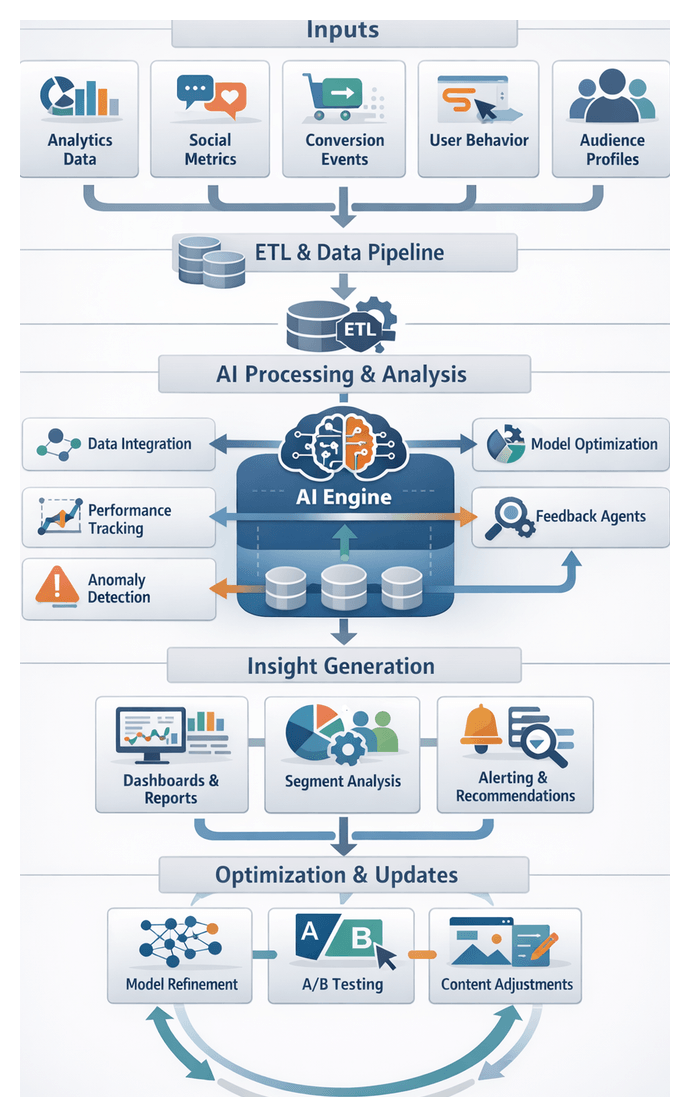
Analytics Stage as the Engine of Continuous Improvement
The analytics stage serves as the critical feedback mechanism in an AI-driven content workflow, transforming performance metrics into actionable insights that drive continuous enhancement. By systematically capturing engagement rates, conversion events, audience behaviors and platform-specific KPIs, organizations gain a precise understanding of content impact. These insights inform iterative refinements to AI agents, enabling dynamic adjustment of model parameters, prompt templates and creative approaches, and ensuring that content workflows remain adaptive, data-driven and aligned with evolving business goals.
- Quantifiable validation of content effectiveness against defined objectives
- Evidence-based detection of performance gaps and bottlenecks
- Prioritization of optimization efforts based on impact potential
- Continuous improvement of AI models through real-time feedback
Core data sources include:
- Web analytics metrics from Google Analytics or Adobe Analytics
- Social engagement signals via platform APIs (Facebook Graph API, Twitter API)
- Conversion and revenue data integrated through HubSpot or Salesforce
- Email performance indicators from Mailchimp or SendGrid
- Search and SEO analytics from Google Search Console, SEMrush or Moz
- User behavior insights via Hotjar or Crazy Egg
- Audience and demographic profiles through Segment or Tealium
AI-powered ETL agents automate data extraction, transformation and loading into centralized repositories. Scalable platforms such as Databricks or Snowflake support complex analytical workloads and real-time processing.
Prerequisites for robust analytics include:
- Instrumented tracking framework with standardized tags, UTM parameters and custom dimensions
- Centralized data repository supporting structured querying and reporting
- Data governance and compliance protocols (GDPR, CCPA) with consent management and access controls
- Defined KPIs and success metrics aligned to business objectives
- Integration with AI workflow orchestration for seamless feedback loops
- Skilled analytics personnel proficient in statistical methods, visualization tools and AI-driven analysis
Maintaining data quality is imperative. Key conditions include:
- Accuracy of instrumentation verified via regular audits and automated validation agents
- Consistency of taxonomy enforced through a centralized naming convention
- Timeliness of data ingestion meeting real-time or batch requirements
- Completeness checks with alerting for missing fields or anomalies
- Normalization of metrics and standardization of date/time stamps
- Data lineage tracking to document origin and transformation history
Unified AI Orchestration for End-to-End Coordination
Fragmented content operations rely on disconnected tools and manual handoffs, causing inefficiencies, misaligned messaging and delayed delivery. Unified AI orchestration remedies these challenges by establishing a central control plane that manages sequencing, data exchange and governance of AI agents across every workflow stage. Inputs—business objectives, audience profiles and creative briefs—feed discovery, ideation, drafting, review, optimization, personalization and distribution agents in a cohesive pipeline.
- Improved consistency through a single source of truth for brand guidelines and style rules
- Scalable throughput via parallel execution of AI agents without proportional headcount increases
- Operational efficiency through automated data exchange and staged approvals
- Enhanced agility with real-time monitoring and dynamic pipeline reconfiguration
- Data-driven optimization via integrated analytics feedback loops
Architectural considerations include a workflow engine coordinating agents via APIs and message queues, input aggregation services normalizing source data, ideation modules for concept generation, prompt design components sequencing instructions, parallel review and SEO optimization agents, personalization engines tailoring variants, and distribution orchestrators transforming assets into channel-specific formats. Throughout the pipeline, a metadata layer tracks dependencies, version history and approval statuses to maintain auditability.
Platforms provide modular agent templates and integration points for orchestration, while open API standards, containerization and serverless compute models ensure scalability and interoperability. Observability tools capture logs, metrics and traces for continuous monitoring and governance.
Effective deployment requires cross-functional alignment among marketing, creative, IT and legal teams. Change management and training empower strategists and editors to transition from manual execution to oversight and quality assurance. Robust governance frameworks manage data privacy, intellectual property and ethical considerations. Access controls, model validation procedures and audit trails ensure compliance and risk mitigation. Organizations should pilot orchestration within a specific content domain, iterate on schemas and protocols, then expand scope to additional content types and channels while maintaining a central repository of templates and best practices.
Feedback Agents Driving Iterative Model Refinement
Feedback agents bridge raw performance metrics and actionable model improvements. They ingest analytics outputs, detect anomalies, assess quality against brand guidelines, generate adjustment proposals and trigger retraining or A/B tests when performance thresholds are breached.
- Performance analysis of click-through rates, engagement duration and conversion indicators
- Anomaly detection to surface content fatigue or data collection issues
- Quality assessment against editorial standards and compliance requirements
- Recommendation generation for prompt parameters, hyperparameters and training data composition
- Automated triggering of retraining cycles, prompt revisions and controlled experiments
Feedback data sources encompass:
- Quantitative metrics from Google Analytics, social media insights and email open rates
- Qualitative signals from user comments, survey responses and sentiment scores
- Operational logs tracking API latency and error rates
- Behavioral data such as clickstream, scroll depth and heatmap analytics
- Comparative benchmarks and historical performance baselines
Advanced AI capabilities for refinement include continual learning, online learning, prompt tuning, hyperparameter optimization and automated retraining via Amazon SageMaker or Weights & Biases. A robust MLOps infrastructure integrates:
- Model registry for versioning, metadata and evaluation metrics
- Data lake and feature store for raw feedback and preprocessed features
- Pipeline orchestrators such as Apache Airflow or DataRobot MLOps
- Evaluation frameworks with automated test suites for unit, integration and performance checks
- Monitoring dashboards for real-time KPI visualization and drift alerts
The refinement workflow sequence is:
- Ingest analytics data on a scheduled or event-driven basis
- Analyze and diagnose with statistical methods and anomaly detection
- Generate adjustment proposals for prompts, training data or model parameters
- Validate via A/B tests or sandbox evaluations under controlled conditions
- Deploy updated models with canary releases and rollback safeguards
- Continuously monitor post-deployment performance and feed metrics back into the loop
Governance measures enforce transparency and compliance through model versioning, audit trails, automated compliance checks, role-based access controls and data privacy safeguards. Best practices include defining clear KPIs, balancing automation with human oversight, prioritizing high-impact adjustments, documenting iterations, scaling gradually and fostering cross-functional collaboration.
Insight Outputs and Iterative Handoff Processes
The culmination of analytics and feedback loops delivers structured insight outputs that guide strategic decision-making, model refinement and subsequent content creation. Deliverables must balance tactical detail with strategic context and adhere to defined schema and naming conventions with metadata annotations for traceability.
- Performance dashboards via Google Analytics or custom BI platforms
- Executive summaries as PDF or slide decks highlighting trends and risks
- Anomaly and alert reports issued in real-time or batched digests
- Segmented audience profiles in data tables or JSON payloads for personalization engines
- Model performance metrics as CSV exports or API responses
- Predictive insights packages delivered via RESTful endpoints
Key dependencies and validation steps include source data consistency, schema compliance, latency and freshness checks, data quality monitoring with automated remediation and model input validation against training baselines.
Handoff mechanisms ensure seamless integration:
- API-driven exchanges exposing insight packages to prompting agents and personalization engines
- Event-based notifications via Apache Kafka or AWS EventBridge
- Shared data repositories in data lakes or warehouse tables
- Pipeline orchestrator tasks in Apache Airflow or Prefect
- Collaboration platforms such as Confluence or SharePoint embedding API links
Iterative loop triggers include performance thresholds, anomaly alerts, cyclical cadences and manual intervention. All artifacts are versioned in source control or a model registry with tags for data snapshots, hyperparameters and release notes.
- OKR integration linking dashboards to corporate objectives
- Stakeholder review cycles for cross-functional alignment
- Actionable recommendation logs pairing insights with next-step actions
- Feedback capture mechanisms to record adoption or modification requests
Governance controls include role-based access, immutable audit logs, anonymization protocols and retention policies. Once insights are consumed, the orchestrator triggers subsequent stages—rediscovery of audience needs, prompt template refinement, optimization parameter tuning and personalization rule updates—closing the loop and embedding perpetual improvement into the AI-driven content workflow.
Conclusion
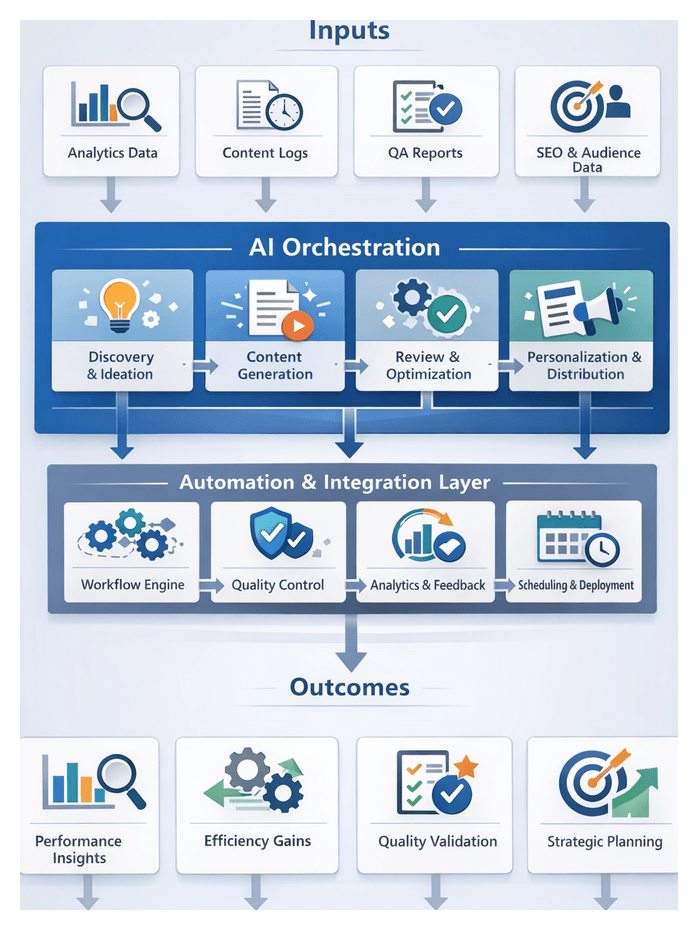
Stage Objectives and Scope
The final evaluation phase of an AI-driven content workflow consolidates the outputs of all preceding activities into a strategic review that aligns operational results with business objectives. This stage is designed to recap the end-to-end orchestration process, document efficiency gains, validate quality improvements and prepare a roadmap for future cycles. By formally naming and codifying the conclusion stage, organizations ensure that content production is treated as a living system, complete with feedback loops that drive continuous innovation.
Through systematic analysis, stakeholders transform raw performance metrics and qualitative insights into a unified narrative. This narrative highlights how AI agents collaborated—identifying high-performing sequences, flagging bottlenecks and quantifying the value delivered by each component. It makes transparent the interplay between discovery, drafting, optimization and distribution, allowing teams to validate their investments in technologies such as Google Analytics and SEMrush for tracking outcomes.
Embedding a structured wrap-up stage prevents lessons learned from dissipating after launch. Automated orchestration agents dispatch notifications to conclusion coordinators the moment final performance metrics are ingested, ensuring a smooth handoff from operational pipelines to strategic review workshops. These sessions bring cross-functional stakeholders together to interpret findings, reconcile distributed assets against delivery schedules and document both successes and areas for improvement.
The outputs of this stage feed directly into executive reporting, resource planning and product roadmaps. By capturing a clear record of accomplishments, challenges and data-driven recommendations, teams reinforce governance standards for compliance, brand voice and technology integrations. Ultimately, this stage cements the role of AI-driven workflows as adaptive frameworks that evolve with changing market demands, audience behaviors and emergent AI capabilities.
Required Inputs and Prerequisites
Effective evaluation depends on comprehensive inputs and formal readiness checks. Key artifacts include:
- Performance reports from analytics platforms such as Google Analytics and SEMrush
- Content delivery logs capturing timestamps, platform identifiers and format variants
- Automated quality assurance summaries from review agents, documenting style compliance and error rates
- Optimization records with keyword integration outcomes, readability scores and engagement metrics
- Personalization dashboards showing variant performance across audience segments
- Multimodal integration reports tracking coherence of text, image, audio and video assets
- Distribution schedules with channel confirmations and timing metadata
- Feedback loop outputs, including anomaly alerts and suggested model adjustments
Prerequisites for conclusion activation include completion of all workflow stages with formal sign-off, calibrated data pipelines, established governance criteria for data quality and brand alignment, stakeholder availability for review, version-controlled content repositories, defined KPIs and benchmarks, integrated analytics agents, and access to centralized dashboards. Automated triggers tied to analytics feedback loops ensure no manual steps are omitted, while channel-management agents reconcile publication logs and flag discrepancies before analysis proceeds.
Dependencies Across Workflow Stages
The conclusion stage relies on handoff outputs from every preceding phase. Reliable dependency tracking and automated notifications are essential to maintain a seamless evaluation pipeline:
- Discovery and Input Aggregation: Metadata inventories and tagged source materials establish baseline context
- Ideation and Concept Formulation: Concept iteration records inform creative diversity assessment
- Prompt Design and Agent Orchestration: Prompt logs and interaction sequences reveal efficiency and accuracy
- Content Drafting and Generation: Draft version histories and model configurations highlight speed and consistency
- Automated Review and Refinement: Editing agent reports capture error rates and style deviations
- Optimization for Engagement and SEO: Enriched artifacts and SEO analytics gauge search visibility and click-through performance
- Personalization and Audience Targeting: Variant mapping and response metrics measure segmentation effectiveness
- Multimodal Content Integration: Integration logs evaluate cross-modal asset coherence
- Distribution Workflow and Scheduling: Distribution confirmations verify cadence and reach
- Analytics Feedback Loops: Performance data streams shape comprehensive appraisal
Conditions for Effective Evaluation
To ensure a data-driven assessment, the following conditions must be met:
- Unified metrics framework with consistent definitions across tools
- Agreed data latency thresholds for timely metric availability
- Cross-agent audit trails documenting decisions and parameters
- Governance board empowered to interpret findings and authorize adjustments
- Continuous documentation of process changes and integrations
- Performance baselines and control groups for validating improvements
- Security and compliance sign-offs for data handling
- Technical health checks monitoring platform stability and agent uptime
Efficiency and Quality Improvements
Orchestrated AI agents transform operational efficiency and content quality through parallel task execution, seamless data exchange, automated quality gates and adaptive feedback loops. This unified approach reduces cycle times, enforces consistent standards and elevates every deliverable.
Streamlined Task Parallelism and Reduced Latency
By assigning distinct agents to discrete actions under a centralized scheduler, the framework eliminates idle time and overlaps critical processes. In practice, a DiscoveryAgent indexes research materials while an IdeationAgent generates concept outlines concurrently. As soon as the first outline is ready, a DraftingAgent begins producing content, cutting total latency by up to 60 percent. Continuous pipeline throughput is maintained as ReviewAgents and OptimizationAgents trigger automatically upon draft completion, turning days of work into hours.
Seamless Integration and Data Handshaking
An orchestration layer manages authentication, API calls and schema transformations so each agent receives precise context. A shared metadata repository—including audience profiles, brand guidelines and performance metrics—is accessible via RESTful APIs. An event-driven messaging bus delivers asynchronous notifications that trigger downstream agents, eliminating polling delays. Context enrichment pipelines normalize and semantically annotate raw inputs, enabling a PersonalizationAgent to tag variants with segment identifiers that persist through optimization and distribution stages, preserving traceability and reducing rework.
Automated Quality Gates and Consistency Enforcement
Embedded validators uphold grammar, style, brand voice and compliance standards without human bottlenecks. A grammar and style agent interfaces with Grammarly to correct errors and flag unresolved queries. A brand-voice agent cross-references content against stored profiles—adjusting tone or alerting for off-brand language. Compliance agents verify regulatory language and policy adherence, scanning for GDPR disclosures or HIPAA statements. These gates reduce revision cycles by up to 70 percent and engage human reviewers only for exceptions.
Adaptive Feedback Loops and Continuous Improvement
Post-distribution metrics feed back into the orchestration system, enabling dynamic agent refinement. An AnalyticsAgent ingests engagement data from email and web channels, while an InsightsAgent applies statistical models to correlate content features with outcomes. A PromptRefinementAgent updates templates and tuning parameters, and a TrainingAgent orchestrates incremental fine-tuning of language models using top-performing examples. Weekly review cycles identify underperforming themes, adjust creative briefs and schedule retraining during off-peak hours, ensuring sustained uplift over successive iterations.
Enhanced Collaboration Between Human and AI Actors
The orchestration layer mediates interactions, routing high-value tasks to experts and translating complex data into clear recommendations. A TaskAssignmentAgent prioritizes critical reviews such as legal sign-offs, while an InsightTranslationAgent synthesizes analytics into actionable strategies for marketing leaders. An ApprovalWorkflowAgent manages version control and audit trails for human sign-offs, ensuring compliance. This human-in-the-loop model leverages AI for transactional work while preserving expert oversight where it matters most, bolstering stakeholder confidence.
Scalable Infrastructure and Resource Optimization
Elastic compute infrastructure scales AI workloads on demand. Kubernetes operators monitor job queues and launch containerized agents as needed, then scale down when demand subsides. A SharedModelCache reuses warmed instances of large models from OpenAI, reducing cold-start latency. A CostAnalysisAgent tracks compute usage in real time, reallocating tasks to lower-cost nodes or scheduling batch processes during off-peak hours. This alignment of infrastructure consumption with actual workload minimizes cloud spend while maintaining performance across thousands of concurrent productions.
Quantifiable Improvements and Business Outcomes
The combined effect of parallelism, integrated systems and automated governance delivers tangible ROI:
- Content production time reduced by up to 60 percent, accelerating campaign launches
- Error rates in published assets drop by over 80 percent through AI-driven validation
- Engagement metrics—time on page, click-through and social shares—increase by 25–40 percent
- Routine editing headcount declines by 30 percent, freeing budget for strategic initiatives
- Case studies include a 40 percent reduction in review staffing and a 200 percent increase in monthly output for large enterprises
Business Impact and Strategic Value
An orchestrated AI content workflow transforms content operations from a cost center into a strategic competency. Organizations realize immediate cost savings, revenue acceleration, enhanced engagement and long-term differentiation by aligning technology capabilities with strategic objectives.
Return on Investment
Direct cost reductions stem from automating ideation, drafting, review and distribution, reducing reliance on manual labor. An UsageControlAgent optimizes API calls to models like GPT-4 and Anthropic Claude, while consolidated licensing and volume discounts lower overall spend. Automated quality gates decrease rework costs, and freed resources shift toward high-value creative and strategic tasks.
Revenue Growth and Audience Engagement
Faster time-to-market and personalized messaging drive conversions and lead generation. Predictive analytics from Google Cloud AI and Microsoft Azure AI identify high-potential segments, enabling outreach sequences that lift conversion rates by up to 20 percent. Scaled A/B testing orchestrates real-time optimization of offers and calls to action. Dynamic content variants tailored to demographic and behavioral profiles boost dwell time and social sharing.
Brand Consistency and Compliance
Centralized guidelines enforced by BrandGovernanceAgents ensure uniform tone, terminology and design across channels. Automated checks for legal disclosures and policy adherence mitigate compliance risk and reduce brand safety incidents by over 90 percent. Consistent brand voice and messaging reinforce trust and credibility, elevating customer perception.
Strategic Agility and Time to Market
Automated review, scheduling and distribution shorten cycle times from weeks to days. Modular pipelines support sandboxed experimentation with new formats, channels and AI models—such as interactive chatbots or augmented reality experiences—without impacting production. This agility enables rapid response to market shifts, seasonal trends and competitive campaigns.
Risk Mitigation and Governance
Transparent audit trails capture every AI agent interaction, parameter setting and content revision. Policy enforcement agents validate compliance with legal, privacy and industry standards. Audit logs and version histories facilitate regulatory reporting in finance, healthcare and other regulated sectors, providing rapid rollback mechanisms during crises.
Scalability and Future-Proofing
Cloud-native microservices architecture allows independent scaling of language, vision and analytics modules. As content volumes grow or new channels emerge, the system elastically provisions inference capacity and integrates novel AI capabilities with minimal disruption. Multilingual production supports global campaigns with locale-specific models and compliance extensions.
Cross-Functional Collaboration
A unified orchestration dashboard provides end-to-end visibility for marketing, product, legal and creative teams. Shared workflows and co-authored guidelines reduce miscommunication and align stakeholders on KPIs—engagement, conversion and quality metrics—driving faster, data-driven decision cycles.
Continuous Improvement
Analytics feedback loops automatically detect model drift and content performance deviations. InsightsAgents recommend prompt refinements, model retraining and workflow adjustments. This iterative process embeds a culture of evidence-based adaptation, compounding business value over successive cycles.
Framework Flexibility and Reuse Scenarios
The modular design of an AI orchestration framework empowers rapid onboarding, efficient pivots across content types and consistent quality at scale. By encapsulating functionality in reusable artifacts and defining clear handoff protocols, teams maximize return on AI investments while maintaining agility.
Modular Configuration Artifacts
- Agent profiles defining roles, input schemas, quality thresholds and memory contexts, exportable across environments
- Template libraries for blogs, email campaigns and video scripts with parameterized outlines, style guidelines and SEO fields
- Integration connectors abstracting authentication methods and payload formats for CRMs, CMSs and analytics dashboards
Dependency Management
- Shared schema definitions and taxonomy models ensuring metadata consistency and interoperability
- Semantic version control with compatibility declarations, enabling controlled artifact rollouts
- Standardized security protocols, role-based access controls and audit logs accompanying each module
Handoff Protocols
- Versioned configuration bundles with manifests detailing dependencies, parameter defaults and extension points
- Documentation packages including setup guides, customization scenarios, troubleshooting tips and sample workflows
- Lightweight approval gates validating brand alignment, security posture and performance benchmarks
- Automated onboarding workflows registering connectors, provisioning API credentials and deploying baseline resources
Adaptation Scenarios
- Long-form editorial: narrative planning agents with research citation integration, expert review workflows and in-depth SEO optimization
- Social media campaigns: microformat summarization agents, social platform connectors and scheduling templates tailored to peak engagement windows
- Interactive experiences: conversational AI agents for real-time Q&A, low-latency inference models and analytics modules for user interaction monitoring
Scaling Across Contexts
- Shared core services maintained by central teams—such as brand-voice validation agents and compliance connectors—consumed on demand by business units
- Localized extensions: regional teams clone and adapt bundles with locale-specific language models and compliance rules, then register variants as new reusable artifacts
- Federated governance matrix balancing global consistency with local innovation, reviewing module updates and risk assessments
Continuous Evolution
- Incremental agent upgrades: integrate next-generation language or vision models without disrupting stable pipelines
- Plug-and-play innovation: sandbox proof-of-concept modules for emerging AI capabilities, graduating successful experiments to production bundles
- Feedback-driven refinement: analytics agents provide performance insights that guide iterative improvements to templates, thresholds and process parameters
By encapsulating workflow logic in reusable artifacts, managing dependencies rigorously and prescribing explicit handoff protocols, the framework accelerates time to value, maintains consistent quality and ensures that AI-driven creativity remains aligned with strategic objectives as needs evolve.
Appendix
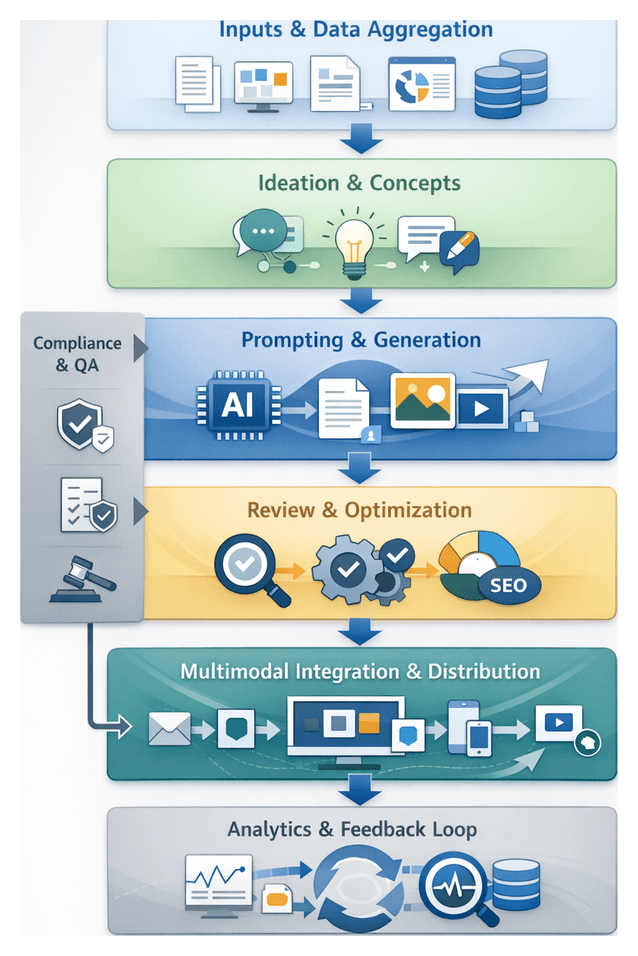
Stage Definitions and AI Capabilities
Discovery and Input Aggregation
This stage consolidates business requirements, audience insights, brand guidelines and source materials into structured data artifacts. AI-driven connector agents ingest content from CRM platforms, analytics engines and repositories. Normalization agents standardize terminology and formats, while enrichment agents leverage knowledge graphs and semantic vectors for context inference. Validation agents apply brand and compliance rules, and metadata tagging agents classify inputs by theme, priority and audience segment. The result is a consistent intake package ready for downstream processing.
Ideation and Concept Formulation
AI models synthesize aggregated inputs into creative concepts. Large language models generate narrative hooks, thematic clusters and headline candidates. Embedding models and vector databases enable semantic search for inspiration. Clustering agents group ideas into coherent themes and relevance scorers rank concepts based on engagement metrics and keyword priorities. Brand alignment agents audit outputs against style guides and compliance constraints. Conversational memory modules preserve context across iterative brainstorming loops, yielding a portfolio of vetted concepts.
Prompt Design and Content Generation
Prompt templating agents construct parameterized frameworks defining tone, word count and style constraints. Role assignment agents designate system roles and quality requirements for each AI model. An orchestration engine sequences tasks with event-driven triggers, shared context stores maintain continuity, and error-handlers implement retry policies. Language generation agents powered by transformer models compose text aligned with brand voice, while multimodal synthesis agents create images, infographics and animations. Parallel execution frameworks and resource managers optimize throughput, delivering diverse draft assets tagged with confidence scores.
Automated Review, Optimization and Personalization
Systematic editing agents perform grammar and style checks against brand lexicons. Fact-verification agents cross-reference trusted knowledge bases, and readability agents assess complexity, suggesting simplifications. SEO optimization agents integrate keywords, generate meta descriptions and recommend internal links. Personalization agents segment audiences using clustering and predictive scoring, then generate tailored content variants based on real-time signals such as location and session history. Compliance agents enforce legal and regulatory rules throughout.
Multimodal Integration and Distribution
Cross-modal orchestration agents sequence text, image, video and audio assembly tasks according to storyboard metadata. Image agents apply style transfer and color correction; video editors synchronize clips, transitions and captions; audio agents mix voiceovers and soundscapes. A composite renderer encodes final packages into channel-specific formats. Distribution agents schedule multi-channel publishing, format conversion and API integration with CMS, social platforms, email services and real-time content networks, ensuring reliable delivery and compliance verification.
Analytics Feedback Loops and Continuous Enhancement
Feedback agents ingest performance metrics—time-on-page, conversion rates and engagement patterns—from analytics platforms and user behavior tools. Anomaly detectors flag deviations, drift monitors track model input shifts, and feedback loops inform prompt adjustments, hyperparameter tweaks and retraining pipelines. Model registries, version control and A/B testing frameworks support iterative improvements, aligning AI capabilities with evolving audience needs and business objectives.
Orchestration and Integration Concepts
A unified orchestration framework coordinates AI agents, data handoffs and governance controls across stages. Key concepts:
- Workflow Engine: Sequences tasks, manages dependencies and handles retries using platforms such as Apache Airflow or Prefect.
- Event-Driven Triggers: Automated signals launch downstream processes upon stage completion.
- Parallel and Sequential Execution: Concurrent agent runs accelerate throughput; ordered chaining ensures correct data transformation sequences.
- Contextual Memory: Shared storage of intermediate artifacts and conversation history maintains continuity.
- API Contracts, Message Queues, Webhooks: Define schemas and asynchronous channels for reliable handoffs, integrity checks and notifications.
- Role-Based Access Control and Audit Trail: Enforce permissions and capture immutable logs for governance and troubleshooting.
Governance, Quality and Compliance
- Compliance Rules Engine: Automates legal, regulatory and brand safety checks, flagging exceptions for human review.
- Style Guide Enforcement: Ensures brand voice consistency through programmatic lexicon and tone models.
- Accessibility Validation: Verifies alt text, captions and structural compliance with WCAG standards.
- Quality Gates and Escalation Flows: Checkpoints where automated validation agents enforce thresholds, routing issues to human specialists.
- Audit Trail and Version Control: Track prompt iterations, model versions and content modifications for reproducibility and compliance.
Workflow Variations, Edge Cases and Scalability
To accommodate diverse needs, workflows can be tailored with alternative patterns and fallback mechanisms:
- Rapid Deployment: Parallelize discovery, ideation and prompt design with high-confidence templates for time-sensitive campaigns.
- Extended Compliance Loop: Insert specialized regulatory review agents and external counsel approval stages for high-stakes content.
- Hybrid Human-AI Collaboration: Human-in-the-loop gates after critical AI outputs, with collaborative annotation interfaces for expert feedback.
- A/B Testing Branches: Fork workflows into variant pipelines to compare performance and refine strategies.
- Content Recycling: Reverse pipelines extract metadata and performance history from legacy assets for repurposing.
Tailoring for Scale and Complexity
- Small Teams: Merge stages, use lightweight orchestration and curated templates to minimize overhead.
- Enterprise Deployments: Microservices architecture with dedicated agents, strict RBAC, audit logging and disaster recovery.
- Matrixed Approval: Multi-tiered review gates managed by metadata-driven routing services.
- Departmental Customization: Local units register custom agent profiles and prompt libraries within a central governance framework.
Compliance-Driven, Data-Limited and Localization Scenarios
- Regulated Sectors: Regulatory clause insertion, external data validation and immutable audit trails for record-keeping mandates.
- Low Maturity Environments: Use public datasets, heuristic rules, manual persona definitions and template-driven SEO to approximate advanced AI functions.
- Multi-Language Localization: Locale-specific prompt templates, translation validation agents (e.g., DeepL), dynamic right-to-left handling and fallback to human translators for sensitive content.
Platform Constraints, Fallbacks and Upgrades
- API Rate Limits and Quotas: Rate-limit aware scheduling, exponential backoff, fallback endpoints with providers such as Anthropic Claude or Cohere.
- Dead-Letter Queues and Alerts: Capture failed tasks for manual review and send real-time notifications for human intervention.
- Dynamic Auto-Scaling: Provision agent instances based on queue depth, caching embeddings in vector stores to reduce inference costs.
- Model Versioning: Canary deployments, dark launches, version tagging and automated compatibility tests to manage upgrades without disruption.
AI Tools Mentioned
- OpenAI GPT-4: A state-of-the-art large language model delivering advanced capabilities in natural language understanding and generation for ideation, drafting, and analysis.
- OpenAI DALL·E 2: A generative vision model that creates high-resolution images from textual descriptions, enabling rapid visual asset production.
- Anthropic Claude: A conversational AI model optimized for safety and coherence, used for interactive brainstorming and complex content generation.
- Google Vertex AI: A unified machine learning platform offering model training, deployment, and MLOps tools for scalable AI workflows.
- LangChain: A framework for building applications with language models, supporting prompt chaining, memory management, and external data retrieval.
- LlamaIndex: A data indexing library that ingests and retrieves unstructured documents to augment language model prompts with relevant context.
- PromptLayer: A prompt management service providing version control, monitoring, and analytics for large language model interactions.
- PromptOps: A governance platform for prompt libraries and execution pipelines, enabling access controls and policy enforcement.
- Hugging Face: A model hub and ecosystem for sharing and deploying transformer models across NLP and multimodal tasks.
- Grammarly: An AI-driven writing assistant that performs grammar corrections, style suggestions, and tone adjustments.
- SEMrush: An SEO platform delivering keyword research, competitive analysis, and on-page optimization recommendations.
- Surfer SEO: A data-driven optimization tool integrating content analysis with SEO best practices to improve search rankings.
- Jasper: A generative AI assistant focused on marketing copy, supporting blog posts, social media, and ad creatives.
- Copy.ai: An AI content generation tool designed for rapid drafting of ad copy, emails, and blog outlines.
- Hemingway Editor: A readability tool highlighting complex sentences and suggesting simpler alternatives to improve clarity.
- Adobe Sensei: An AI and machine learning framework powering automated editing, tagging, and asset curation in Adobe Creative Cloud.
- AWS SageMaker: A managed service for building, training, and deploying machine learning models at scale.
- Azure Machine Learning: A cloud-native platform for MLOps workflows, model versioning, and automated retraining.
- Pinecone: A fully managed vector database that powers semantic search and retrieval for embedding-based applications.
- FAISS: A library for efficient similarity search and clustering of dense vectors at scale.
- Apache Airflow: An open-source workflow orchestrator for defining, scheduling, and monitoring complex data pipelines.
- Prefect: A modern orchestration tool designed for dynamic workflows and real-time monitoring of task execution.
- Kubeflow: An open-source MLOps platform for deploying, scaling, and managing machine learning pipelines on Kubernetes.
- MLflow: A model lifecycle management tool that tracks experiments, registers models, and packages code for reproducibility.
- Weights & Biases: A suite for experiment tracking, hyperparameter tuning, and model performance visualization.
- Descript: A text-based audio and video editor with features for transcription, overdub, and filler word removal.
- Murf.ai: An AI voiceover platform generating realistic speech in multiple styles and languages for multimedia assets.
- AIVA: An AI composer that creates custom background music tracks tailored to mood, tempo, and instrumentation requirements.
- Synthesia: An AI video generation service that produces speaking avatars and localized video segments from text inputs.
- Runway ML: A creative toolkit for video synthesis, style transfer, and generative editing of multimedia content.
- Hotjar: A behavior analytics tool providing heatmaps and session recordings to visualize user interactions.
- Crazy Egg: A heatmapping and A/B testing platform that identifies user engagement patterns and optimization opportunities.
- Zapier: An automation service connecting applications and automating repetitive tasks through workflows called “Zaps.”
- Airtable: A flexible database and collaboration tool used to manage content briefs, metadata catalogs, and editorial calendars.
- Contentful: A headless CMS that delivers structured content to any channel via APIs.
- WordPress: A widely used CMS platform for publishing blog posts, pages, and multimedia integrations.
- Mailchimp: An email marketing service for designing, automating, and analyzing email campaigns.
- Buffer: A social media scheduling and analytics tool for planning and automating multi-platform posts.
Additional Context and Resources
- AI Agent Solutions by Category: A curated catalog of creative and content AI agents across use cases and industries, detailing capabilities and integration patterns.
- OpenAI Research: Publications and technical papers on GPT-4, DALL·E, and multimodal AI advancements.
- Anthropic Research: Insights into Claude’s safety-focused AI model design and alignment methodologies.
- Google Vertex AI Documentation: Guides for building, deploying, and managing machine learning models on Google Cloud.
- LangChain Documentation: Tutorials on chaining language model calls, memory integration, and external data connectors.
- LlamaIndex Documentation: Instructions for ingesting unstructured data into vector indexes and querying with language models.
- Hugging Face Documentation: Model cards, inference APIs, and tutorials for transformer-based language and vision models.
- Apache Airflow Documentation: Reference for defining DAGs, scheduling tasks, and monitoring pipelines.
- Prefect Documentation: Resources on building reactive workflows and real-time orchestration patterns.
- MLflow Documentation: Guides on experiment tracking, model packaging, and registry workflows.
- Kubeflow Documentation: Tutorials on deploying and scaling ML pipelines in Kubernetes environments.
- Weights & Biases Library: Examples and best practices for experiment tracking, hyperparameter sweeps, and visualizations.
- Grammarly Business: Enterprise features for style enforcement, brand voice consistency, and compliance integrations.
- Surfer SEO Blog: Articles on data-driven content optimization strategies and SEO workflows.
- SEMrush Knowledge Base: In-depth tutorials on SEO, keyword research, and competitive analysis tools.
- Copy.ai Blog: Use cases, tips, and best practices for AI-assisted copywriting.
- Hotjar Resources: Guides on user behavior analysis, heatmaps, and conversion optimization.
- Zapier Blog: Automation tutorials, workflow recipes, and integration ideas for content operations.
- Contentful Developer Center: API references and SDKs for headless CMS integrations.
- Mailchimp Resources: Email marketing guides, templates, and analytics tutorials.
The AugVation family of websites helps entrepreneurs, professionals, and teams apply AI in practical, real-world ways—through curated tools, proven workflows, and implementation-focused education. Explore the ecosystem below to find the right platform for your goals.
Ecosystem Directory
AugVation — The central hub for AI-enhanced digital products, guides, templates, and implementation toolkits.
Resource Link AI — A curated directory of AI tools, solution workflows, reviews, and practical learning resources.
Agent Link AI — AI agents and intelligent automation: orchestrated workflows, agent frameworks, and operational efficiency systems.
Business Link AI — AI for business strategy and operations: frameworks, use cases, and adoption guidance for leaders.
Content Link AI — AI-powered content creation and SEO: writing, publishing, multimedia, and scalable distribution workflows.
Design Link AI — AI for design and branding: creative tools, visual workflows, UX/UI acceleration, and design automation.
Developer Link AI — AI for builders: dev tools, APIs, frameworks, deployment strategies, and integration best practices.
Marketing Link AI — AI-driven marketing: automation, personalization, analytics, ad optimization, and performance growth.
Productivity Link AI — AI productivity systems: task efficiency, collaboration, knowledge workflows, and smarter daily execution.
Sales Link AI — AI for sales: lead generation, sales intelligence, conversation insights, CRM enhancement, and revenue optimization.
Want the fastest path? Start at AugVation to access the latest resources, then explore the rest of the ecosystem from there.