

Maximizing Content Impact A Practical Guide to AI Driven Repurposing Workflow in Social Media
To download this as a free PDF eBook and explore many others, please visit the AugVation webstore:
Introduction
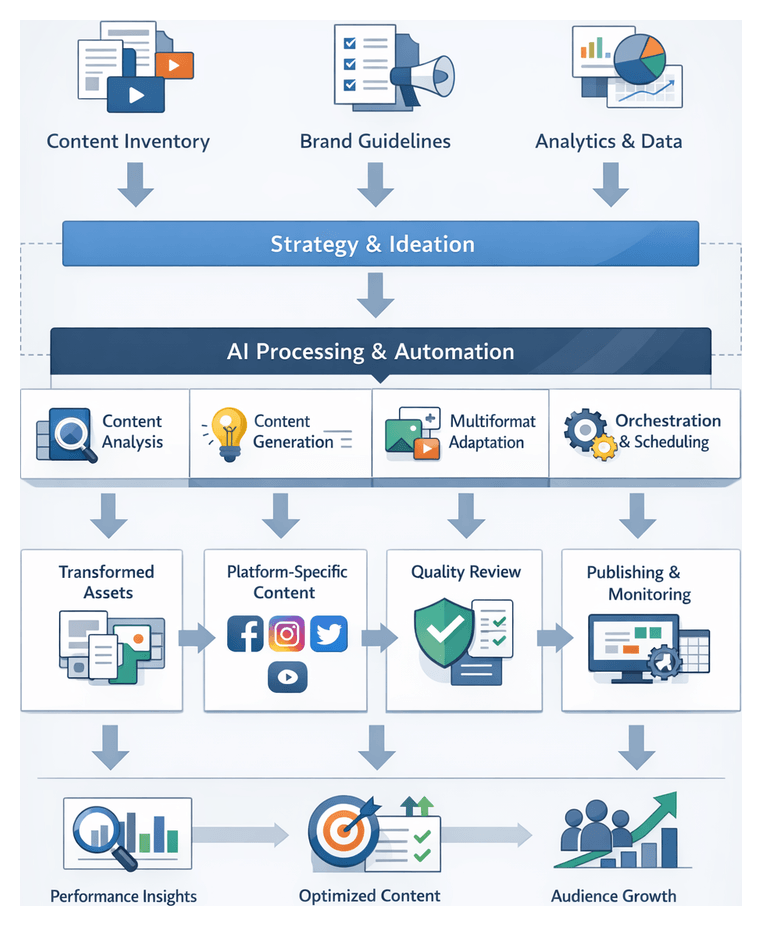
Purpose and Context of Social Media Content Operations
Organizations today face an ever-expanding landscape of social media platforms, each with unique content formats, audience behaviors, and engagement mechanics. From short-form video on TikTok to in-depth articles on LinkedIn, marketing and content teams must manage an unprecedented volume of assets. This proliferation creates strategic and operational challenges: maintaining a consistent brand voice, adhering to platform specifications, and responding quickly to emerging trends. By clearly defining these challenges and documenting existing pain points, organizations lay the groundwork for a structured workflow that can scale without sacrificing quality.
The strategic importance of this exercise extends beyond operational efficiency. When teams align on documented workflows, they can prioritize investments in people, processes, and technology. A clear understanding of channel requirements, content performance baselines, and stakeholder roles informs decisions about whether to build custom tools, adopt third-party platforms, or engage AI services. Without this foundation, attempts to automate or optimize are likely to introduce new bottlenecks or inconsistencies, undermining both agility and brand integrity.
Key prerequisites for diagnosing content operations include a comprehensive content inventory, defined brand guidelines, performance metrics, cross-functional alignment, and a connected technology stack. A centralized repository of existing assets—annotated with metadata on creation date, format, audience segment, and historical engagement—serves as the single source of truth. Living brand guidelines provide rules for voice, tone, visual identity, and compliance. Performance metrics establish a baseline against which improvements are measured. With these inputs in place, teams are positioned to integrate AI-driven tools and orchestrate a repeatable workflow that accelerates time to publish while preserving brand consistency.
Operational and Scaling Challenges
- Channel Fragmentation and Format Diversity: Each social media outlet imposes its own dimensions, caption lengths, and interactive features. Manually converting long-form content into image carousels, short videos, stories, and tweets is labor intensive and prone to errors.
- Inconsistent Brand Voice and Style: As content passes through creative, editorial, design, and compliance teams, messaging drift can occur without standardized guidelines and automated checks, eroding audience trust.
- Ad-Hoc Repurposing and Fragmented Accountability: Reactive workflows coordinated via email, spreadsheets, and chat lead to unclear ownership, missed deadlines, and duplicated effort.
- Siloed Collaboration and Handoffs: Disconnected systems inhibit version control, introduce feedback loops that span multiple tools, and slow down the production cycle.
- Lack of Data-Driven Decision Making: In the absence of integrated analytics, teams rely on intuition rather than real-time insights into engagement, reach, and conversion, resulting in suboptimal content allocation.
- Scaling Constraints and Resource Limitations: Rising demand for new content strains budgets and headcount, leading to burnout, missed opportunities, and diminishing returns.
- Regulatory Compliance and Governance Overhead: Industries such as finance and healthcare require multiple layers of legal and policy reviews, adding delays and administrative complexity to every asset.
When repurposing remains an ad-hoc activity, organizations sacrifice both agility and consistency. Without a repeatable framework, content operations become unpredictable, slowing response to market opportunities and diluting the strategic impact of social media investments.
Foundations for an AI-Driven Repurposing Workflow
Before deploying AI agents or orchestration platforms, teams must establish the foundational inputs and conditions that enable process clarity and automation readiness:
- Comprehensive Content Inventory: A central repository of all source assets—including articles, white papers, videos, images, and past campaigns—enriched with metadata on performance, audience segment, format, and compliance status.
- Defined Brand Guidelines and Style Rules: A living document capturing voice, tone, visual identity, terminology, and legal requirements. This guide serves as the benchmark for both AI validations and human reviews.
- Analytics and Performance Baseline: Historical data on engagement metrics, click-through rates, conversion statistics, and audience demographics. These inputs inform AI-driven prioritization and provide benchmarks for continuous improvement.
- Cross-Functional Alignment: Clearly defined roles, responsibilities, and communication protocols among marketing, creative, legal, compliance, and IT teams. Formal handoff criteria and review cycles prevent delays and ensure accountability.
- Integrated Technology Stack: Identification and integration of core systems such as CMS, DAM, project management tools, and analytics platforms. API accessibility, secure data governance, and consistent metadata schemas enable seamless data flow.
- AI Readiness and Training Data: Curated, high-quality training datasets—including tagged samples and performance annotations—are vital for tuning AI models to the brand’s voice and thematic structures. Establishing annotation guidelines and data hygiene practices accelerates model accuracy.
With these prerequisites satisfied, organizations can proceed to design a structured workflow that leverages AI for classification, transformation, orchestration, and optimization—eliminating manual bottlenecks and enhancing strategic focus.
Structured Repurposing Workflow Framework
A well-defined repurposing framework codifies process stages, metadata standards, roles, governance, and performance metrics. By formalizing each element, teams achieve consistent outputs, transparency, and scalable throughput.
- Stage Taxonomy: Clearly documented phases—Audit & Inventory, Strategy Definition, Automated Ideation, Content Transformation, Platform Adaptation, Orchestration & Scheduling, Quality Control, Publishing & Distribution, and Optimization—each with entry and exit criteria that enforce handoff protocols.
- Metadata Schema: A unified tagging model capturing asset attributes such as format, theme, sentiment, risk level, target persona, and priority. Standardized metadata enables AI agents to route tasks, enforce business rules, and prioritize high-impact content.
- Role Matrix: Precise mapping of AI modules, content strategists, creative teams, compliance officers, and publishing coordinators to decision rights and review responsibilities, minimizing contention and ensuring accountability.
- Handoff Protocols: API events, task assignments, and approval flags serve as standardized triggers that move assets through stages automatically, reducing manual coordination and hand-off delays.
- Governance Rules & SLAs: Embedded style guides, legal checklists, and brand policies are enforced through AI validations and human review checkpoints. Service-level agreements track metrics such as turnaround time, review accuracy, and error incidence to maintain process health.
Core Workflow Stages and System Interactions
In a cohesive pipeline, assets progress through a sequence of stages powered by AI services, orchestration engines, and collaborative tools:
- Audit & Inventory: A CMS ingests existing assets. AI classification services—using OpenAI and Azure Cognitive Services—analyze performance data, detect themes and sentiment, and populate a DAM with enriched metadata for a complete content inventory.
- Strategy Definition: A collaborative strategy portal aggregates audit outputs, brand guidelines, and campaign objectives. AI analytics modules surface high-value audience segments and recommend platform priorities based on historical engagement patterns.
- Automated Ideation: Natural language generation engines produce thematic outlines, headline variations, and content angles. Generated ideas are stored in a central repository, annotated with metadata, and presented for human refinement.
- Content Transformation: AI models perform summarization, paraphrasing, translation, and multimedia script generation within an authoring environment. Draft assets—text drafts, video scripts, and graphic mockups—are generated in parallel to maximize throughput.
- Platform Adaptation: A styling service such as Adobe Sensei applies design templates and resizes media to meet social media specifications. AI generates captions, hashtags, and accessibility labels, validated against platform rules to ensure compliance.
- Orchestration & Scheduling: An orchestration platform coordinates task queues, prioritizes time-sensitive campaigns, and routes assets to appropriate systems or human reviewers, while optimizing posting windows via social media APIs.
- Quality Control: A human-in-the-loop portal surfaces AI-flagged style deviations, compliance risks, and policy checks. Reviewers address issues within the interface, and approved assets receive a governance stamp before distribution.
- Publishing & Monitoring: Approved content is scheduled through platforms like Buffer or Hootsuite. Real-time algorithms adjust schedules based on live performance data, ensuring maximum audience engagement.
- Optimization: Analytics dashboards ingest engagement metrics, A/B test results, and audience feedback. AI engines such as Google’s Vertex AI forecast performance impact and recommend iterative adjustments to headlines, calls-to-action, and publishing schedules.
AI Integration and Automation Across the Workflow
Embedding AI capabilities throughout the repurposing pipeline delivers intelligence, speed, and consistency that manual or rule-based approaches cannot match. From analysis to orchestration, AI agents automate routine tasks, enforce guidelines, and surface strategic insights.
Content Analysis and Insights
- Theme Extraction: Natural language processing models—such as those in OpenAI GPT and Hugging Face transformers—scan thousands of assets to identify recurring topics, sentiment trends, and brand-related keywords.
- Audience Segmentation: Machine learning algorithms analyze engagement patterns to cluster audiences by demographics, interests, and behavioral signals, enabling precise targeting.
- Format Classification: AI classifiers automatically tag assets by media type—text, image, video—and complexity level, driving decision logic for appropriate repurposing pathways.
- Performance Benchmarking: Predictive analytics models evaluate historical data to forecast the potential reach and engagement of different content themes, guiding strategic prioritization.
Automated Generation and Adaptation
- Paraphrasing and Summarization: Large language models condense long articles into concise captions or bullet lists. Fine-tuned instances of OpenAI GPT ensure that generated copy adheres to brand voice.
- Multilingual Translation: Neural machine translation services—from Hugging Face or DeepL—rapidly localize content for global audiences while preserving nuance.
- Creative Variations: AI engines generate multiple headline and caption options for A/B testing across platforms such as Instagram, Twitter, and TikTok, enabling experimentation at scale.
- Media Conversion: Automated script generators produce storyboard-ready video scripts, while image generation and layout tools like Adobe Sensei and Canva assist in creating visual mockups aligned with platform dimensions.
Intelligent Orchestration and Task Routing
- Dynamic Task Scheduling: AI orchestrators assess asset status and trigger subsequent transformation steps—summarization, translation, or style adaptation—based on predefined rules and real-time conditions.
- Error Detection and Recovery: Machine learning monitors pipeline health, flags processing anomalies, and either reroutes tasks or alerts human operators via Jira and Slack integrations.
- Resource Optimization: Predictive algorithms allocate compute resources to high-priority tasks in cloud environments, balancing throughput with cost efficiency.
- Collaboration Integration: Orchestration platforms synchronize with collaboration tools to provide real-time status updates, collect feedback, and enforce approvals.
Quality Assurance and Governance Automation
- Style and Compliance Checks: Natural language understanding models compare generated content against brand lexicons and regulatory term lists, identifying deviations.
- Image Moderation: Computer vision algorithms scan visual assets for inappropriate content, logo misuse, and design inconsistencies.
- Metadata Validation: Automated scripts verify that captions, tags, and descriptions meet platform-specific requirements, reducing post-publish corrections.
- Human-in-the-Loop Reviews: Intelligent alerting surfaces flagged items to reviewers with contextual annotations, streamlining feedback loops and expediting approvals.
Continuous Learning and Optimization
- Performance Data Ingestion: Analytics platforms feed engagement metrics and audience feedback into AI engines, refining predictive models over time.
- Model Retraining: Periodic retraining incorporates fresh data, ensuring that theme extraction, segmentation, and generation remain aligned with evolving audience preferences.
- Impact Forecasting: Advanced simulations project the potential outcomes of new repurposing strategies, helping teams prioritize high-impact experiments.
- Automated Recommendations: AI-driven dashboards surface actionable insights—such as headline adjustments, call-to-action refinements, or schedule shifts—to maximize content resonance.
Implementation Best Practices and Quantifiable Benefits
Successful deployment of an AI-enhanced repurposing workflow requires careful planning and change management:
- Pilot with High-Impact Content: Validate process design and tooling integration on a priority campaign or content silo before broad rollout.
- Define Clear SLAs and KPIs: Track metrics such as audit turnaround, ideation cycle time, review accuracy, and scheduling latency to measure workflow health.
- Develop a Living Playbook: Maintain a centralized knowledge base documenting workflow rules, role responsibilities, and system configurations for ongoing reference.
- Invest in Training and Change Management: Educate users on AI capabilities, collaboration protocols, and governance requirements to drive adoption and build confidence.
- Monitor Continuously and Iterate: Use real-time dashboards to identify bottlenecks, quality gaps, and compliance issues, making data-driven adjustments to optimize throughput.
Organizations that formalize and automate their repurposing processes report significant gains, including:
- Cycle Time Reduction: Up to 50 percent faster content turnaround through parallel processing and automated handoffs.
- Consistent Messaging: Centralized governance and AI-driven style enforcement achieve uniform brand voice across channels.
- Scalable Output: Ability to double content production without proportional increases in headcount.
- Improved ROI: Data-informed prioritization focuses resources on high-impact assets, boosting engagement and conversions.
- Transparency and Control: Comprehensive audit logs and dashboards provide executives with clear insights into workflow health and content performance.
Deliverables and Handoff Guidelines
Audit & Inventory
Deliverables include an asset inventory report, channel matrix, audience mapping dossier, and taxonomy document. Dependencies comprise access to CMS, DAM, analytics platforms, text classification tools such as OpenAI, and sentiment analysis via Azure Cognitive Services. Handoff involves publishing CSV and JSON files with a metadata guide, followed by a kickoff meeting to review critical findings, confirm taxonomy validity, and identify content gaps.
Strategy Definition
The strategy stage produces a repurposing blueprint, platform prioritization matrix, defined success metrics, and a high-level content calendar. Dependencies include audit outputs, brand guidelines, performance benchmarks, and AI modeling tools. Handoff criteria require stakeholder approval, deliverable completeness, and alignment on priorities. Approved artifacts trigger automated tasks in the project management system and a strategy briefing session.
Analysis Outputs
Deliverables encompass segmentation reports, theme maps, audience personas, format classification lists, and a prioritized asset ranking. Dependencies include integration with analytics tools and data warehouses, as well as AI services like OpenAI NLP engines and computer vision APIs for video analysis. Handoff to ideation occurs once outputs are validated; a review meeting ensures consensus on priority segments and confirms data integrity before creative work begins.
Ideation
Idea deliverables consist of briefs, thematic outlines, headline variations, and concept boards. Dependencies include segmentation and strategy reports, brand guidelines, and ideation platforms such as Jasper. Handoff into transformation requires sign-off on idea briefs, alignment with KPIs, and a kickoff call to clarify creative intent and performance targets.
Content Transformation
Transformation outputs include draft assets—rewritten text, summaries, video scripts, infographic outlines, and translations—each tagged with source, platform, and version history. Dependencies comprise idea briefs, original asset access, and AI services such as OpenAI and DeepL. Deliverables are uploaded to a shared workspace with embedded metadata; a preprocessing checklist verifies format readiness before adaptation.
Adaptation
Adaptation produces platform-specific assets—resized images, formatted videos, caption sets, hashtags, and metadata manifests—along with a style compliance report. Dependencies include repurposed drafts, platform guidelines, and AI agents like Canva. Handoff to orchestration begins once assets pass automated and manual quality checks; integration with the CMS triggers scheduling workflows and notifies the publishing team.
Orchestration & Scheduling
Orchestration deliverables comprise execution logs, task status reports, API event triggers, and a master queue of scheduled tasks. Dependencies include adapted assets, schedule parameters, and credentials for social media APIs. AI orchestrators such as AgentLink AI coordinate with project management and CMS APIs. Handoff to quality control is automated via triggers; a manifest details asset bundles and review criteria.
Quality Control
Quality control outputs include approved asset packages, annotated feedback logs, compliance checklists, and governance reports. Dependencies involve orchestration manifests, brand guidelines, legal requirements, and AI-assisted tools like Grammarly. Handoff to distribution initiates once assets achieve final approval; approved packs are exported via API or CSV to the scheduling system, accompanied by a distribution readiness report.
Distribution
Distribution deliverables consist of publication logs, channel performance forecasts, and an updated content calendar. Dependencies are approved assets, channel credentials, posting schedules, and predictive analytics platforms such as Buffer or Hootsuite. Handoff to performance monitoring involves exporting logs and forecasts to the analytics platform, mapping published assets to engagement metrics for real-time tracking.
Optimization
Optimization outputs include interactive dashboards, A/B test results, recommendation reports, and update trigger logs. Dependencies encompass distribution data, audience feedback, A/B testing platforms, and AI engines like Google’s Vertex AI. Handoff to audit or strategy occurs via automated alerts and task creation in the workflow tool, prompting teams to revisit asset inventories or adjust strategic documents—completing the closed-loop process for continuous improvement.
Chapter 1: Understanding the Content Ecosystem
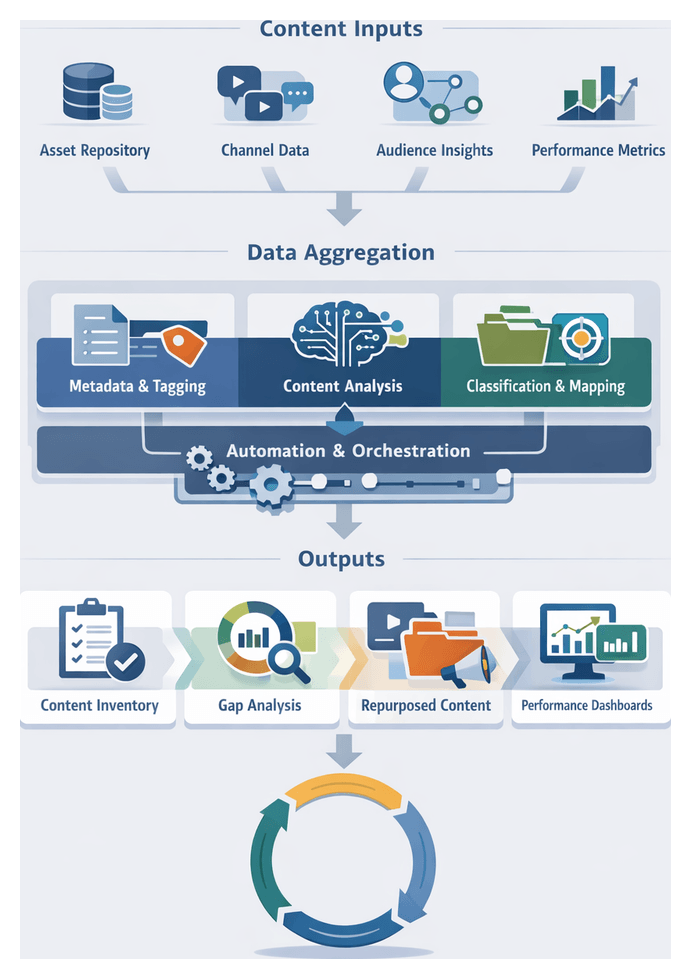
Purpose and Scope of the Content Audit Stage
The content audit stage establishes a comprehensive, data-driven foundation for AI-powered social media repurposing. By systematically discovering, cataloguing, and analyzing every published, archived, and in-development asset, organizations gain a unified view of their content ecosystem. This clarity addresses critical challenges—duplicate content, thematic gaps, and inconsistent brand voice—while aligning existing materials with strategic objectives. A disciplined audit process not only identifies high-performing assets for rapid transformation but also flags underperforming pieces for revision or retirement, ensuring efficient use of resources.
In an era of rapidly evolving platforms and audience expectations, the audit stage anchors content operations in measurable insights. It mitigates risk by enforcing brand guidelines, secures executive sponsorship through transparent reporting, and fosters cross-functional collaboration among marketing, creative, analytics, and IT teams. With audit outputs feeding directly into AI engines, organizations achieve a seamless transition from inventory to ideation, maximizing the impact of every social media initiative.
Key Inputs and Prerequisites
To execute a thorough content audit, teams must assemble critical inputs, secure necessary access permissions, and align organizational stakeholders. The primary prerequisites include:
- Centralized Asset Repository: A single source of truth—hosted in a Content Management System (CMS) or Digital Asset Management (DAM)—containing blog posts, videos, podcasts, infographics, and social media content. Integrations allow for automated ingestion and metadata extraction.
- Channel Inventory and Permissions: A catalog of every publishing outlet—corporate blogs, YouTube, LinkedIn, Instagram, TikTok—and administrative access to analytics consoles. Unified credential management via Hootsuite or Buffer enables automated data retrieval.
- Audience Segmentation Data: Persona definitions and behavioral profiles sourced from CRM systems, CDPs, or platforms like Segment and Amplitude. These datasets include demographics, engagement history, and content preferences.
- Performance Metrics: Historical engagement statistics—views, shares, comments, conversion rates—collected from Google Analytics, native platform reports, BuzzSumo, and Sprout Social. Data must be exportable in structured formats (CSV, JSON).
- Brand Guidelines and Voice Documentation: Style guides, tone-of-voice manuals, and visual identity standards. AI models fine-tuned through Microsoft Azure Custom Neural Voice or OpenAI’s service use these guidelines to enforce consistency.
- Technology Environment: API credentials, integration middleware such as Mulesoft or Zapier, and secure sandbox environments for testing connectors and workflows without impacting production systems.
- Organizational Alignment: Executive sponsorship to secure resources, data governance policies to maintain quality and compliance, and a change management plan to communicate process shifts and stakeholder roles.
Audit Workflow and System Orchestration
Asset Ingestion and Consolidation
The audit begins with the discovery and ingestion of content assets from disparate repositories. Automated connectors and API integrations pull files, metadata, and performance records into a unified staging area. Each asset is assigned a unique identifier and tagged with source information, creation date, and content type. Ingestion errors—unsupported formats or authentication failures—trigger alerts to IT or DevOps teams, ensuring no asset is overlooked.
Metadata Standardization and Enrichment
Inconsistent metadata hampers effective management and analysis. A two-step process ensures uniformity: first, scheduled jobs normalize field names (for example, author, publish_date, content_type) to match the organization’s taxonomy. Second, AI-driven enrichment services populate missing attributes. Natural language processing agents, such as OpenAI’s GPT-4 and Hugging Face transformers, generate concise summaries and extract topic tags and sentiment scores. Computer vision models detect branded imagery and color palettes. Assets with confidence scores below predefined thresholds are flagged for manual review by content analysts.
- Establish required metadata schema and field definitions
- Normalize existing tags to align with taxonomy
- Invoke AI taggers for theme extraction and persona relevance
- Flag low-confidence enrichments for human validation
Classification, Thematic Tagging, and Audience Mapping
Once enriched, assets undergo classification through a tiered approach. Rule-based filters detect formats—articles, videos, infographics—and route them to specialized classifiers. Natural language understanding pipelines identify primary topics, subtopics, and tone in text, while computer vision services analyze visual elements in images and video frames. Thematic labels—such as “product_update,” “industry_insight,” or “customer_testimonial”—are consolidated in a theme index.
Audience mapping aligns each asset with one or more personas by cross-referencing thematic tags, engagement metrics (click-through rates, watch durations), and CRM data. High-engagement technical white papers may map to “Technical Decision Maker,” while emotional social videos link to “Brand Enthusiast.” Multiple persona associations are stored as arrays in metadata records. Marketing operations teams review initial mappings, adjusting weighting rules or segment definitions to reflect strategic priorities.
- Format detection and routing to appropriate classifiers
- Natural language processing for topic modeling and tone analysis
- Visual recognition for imagery classification
- Automated persona matching using CRM and performance data
Error Handling and Iterative Review
An orchestration layer coordinates the sequence of audit tasks, logging execution details and managing retries. Failed jobs—such as enrichment timeouts or classification errors—enter a dedicated support queue for manual intervention. Regular review cycles engage content strategists and subject matter experts to validate thematic tags and persona mappings. Feedback is incorporated into AI models as new training data, improving accuracy over successive iterations. Governance checkpoints allow legal and compliance teams to flag sensitive content before repurposing.
AI Integration and Automation
AI-Driven Content Analysis
Natural language processing and computer vision automate the extraction of themes, entities, and sentiment across large content repositories. Semantic tagging tools, including OpenAI’s GPT models and Hugging Face transformers, identify core messages, brand mentions, and emotional tone. Visual recognition services detect objects, scenes, and logos for precise asset classification. Machine learning algorithms then segment assets by persona, engagement patterns, and performance trends, forming the input for prioritized repurposing.
Intelligent Ideation and Transformative Repurposing
AI ideation engines generate creative angles, headlines, and thematic frameworks that adhere to brand voice guidelines. By analyzing historical data and market signals, these systems surface high-potential content concepts and clusters. Platforms like Jasper propose multiple headline variants optimized for each channel. Unsupervised learning groups assets around emerging topics, ensuring cohesive storytelling.
Transformative repurposing leverages summarization APIs and fine-tuned models—OpenAI Codex, custom GPT instances—to distill long-form content into micro-blogs, bullet points, or tweet-length posts. Paraphrasing tools adjust style and formality for platform-specific audiences. Script generation solutions such as Descript convert text into video and audio scripts with scene and dialogue suggestions, accelerating multimedia production.
- Headline and caption generation tailored to social channels
- Summarization, paraphrasing, and tone adaptation at scale
- Automated script generation for video and audio content
Cross-Platform Adaptation and Style Transfer
AI modules ensure assets conform to each platform’s technical requirements and aesthetic conventions. Computer vision APIs automatically resize and crop images, preserving focal points for Instagram, LinkedIn, TikTok, and emerging channels. Language models generate caption variants with embedded keywords and hashtags to maximize reach. Rule-based systems and machine learning enforce brand fonts, color palettes, and tone, maintaining consistency across diverse formats.
- Automated image resizing and focal point detection
- Caption optimization with embedded keywords and hashtags
- Style enforcement for visual and verbal brand alignment
Orchestration with AI Agents
Workflow orchestration platforms manage end-to-end repurposing pipelines, sequencing tasks and integrating AI services with enterprise systems such as DAM and CMS. Engines like Zapier handle task scheduling and event triggers, while microservices architectures connect NLP, vision, and scheduling APIs to central data stores and collaboration tools. Real-time monitoring and alerting enable rapid intervention in case of anomalies.
- Task scheduling and dependency management across AI-driven steps
- RESTful API integrations and microservices for modular workflows
- Error detection, alert notifications, and automatic rerouting
Human-in-the-Loop Governance and Continuous Optimization
Despite extensive automation, human oversight ensures brand compliance, legal alignment, and nuanced quality control. Automated policy checks scan content for sensitive terms, regulatory risks, and brand guideline violations. Suggestion overlays highlight grammatical and stylistic issues for reviewers, streamlining edits. Integrated approval workflows manage version control, comments, and sign-offs before publishing.
Post-publishing, AI-driven analytics tools collect performance data—engagement rates, conversion metrics, sentiment analysis—and feed insights back into repurposing workflows. Predictive modeling forecasts optimal posting times and formats, while automated A/B testing evaluates content variations. Real-time dashboards reveal performance trends, opportunities for iteration, and content gaps, driving a continuous improvement cycle.
- Automated compliance and style checks with flagging
- Reviewer support through suggestion overlays and sign-off modules
- Closed-loop optimization via predictive analytics and A/B testing
Audit Deliverables and Handoff Guidelines
Completing the audit yields a standardized package of deliverables to inform strategic planning and AI-driven transformation. Core outputs include:
- Asset Inventory Spreadsheet: A detailed table listing every item—posts, images, videos, articles—with unique IDs, channel origin, publish date, status, and enriched metadata.
- Performance Metrics Dashboard: Interactive visualizations or PDF exports summarizing likes, shares, comments, reach, and conversions by content type and channel, highlighting top and underperformers.
- Metadata and Tagging Schema Export: CSV or JSON files capturing existing tags, categories, audience segments, and custom fields, forming the taxonomy foundation for AI workflows.
- Theme and Format Classification Report: AI-generated mappings using OpenAI GPT-4 and IBM Watson NLU, including confidence scores and cross-references to source metadata.
- Content Gap Analysis: Analytical summary identifying missing topics, underrepresented formats, and audience segments lacking tailored content.
- Audit Summary Presentation: Slide deck synthesizing key findings, metrics, gaps, and recommended next steps to align stakeholders before strategy definition.
Handoff packages are version-controlled, named with standardized prefixes and date stamps (for example, AUDIT_Assets_YYYYMMDD.csv), and delivered via secure file shares or project management tools. Acceptance criteria require minimum metadata coverage—such as 95 percent of assets tagged—and validated persona assignments. Structured feedback loops address anomalies within defined service-level agreements.
Governance, Version Control, and Collaboration
Maintaining consistency and traceability across audit outputs demands robust governance and collaboration protocols. Key practices include:
- Naming Convention Standards: Predefined templates for file names, folder structures, and column headers, using consistent delimiters and date formats.
- Metadata Schema Documentation: Comprehensive data dictionaries and change approval processes to govern taxonomy updates and field modifications.
- Version Control and Change Logs: Committing deliverables to systems like Git or SharePoint with automated logs, enabling rollbacks and historical audits.
- Centralized Repository Structures: Hierarchical folders organized by audit date and content type, with Access Control Lists to manage permissions.
- Audit Governance Committee: Regular reviews of change requests, impact assessments for taxonomy updates, and scheduled refresh cycles to keep audit data current.
- Collaboration Protocols: Designated Slack or Teams channels, weekly stand-ups, shared Kanban boards, and clear escalation paths for data discrepancies.
Timeline and Milestones
- Week 1: Data Extraction, Access Validation, and Initial Asset Ingestion: Entry Criteria: CMS/DAM credentials, API tokens, channel analytics access Exit Criteria: Complete asset discovery with unique identifiers
- Week 2: Metadata Standardization, AI Enrichment, and Theme Mapping: Entry Criteria: Metadata schema definitions, AI model configurations: Exit Criteria: 90 percent of assets enriched and classified
- Week 3: Performance Dashboard Finalization and Content Gap Analysis: Entry Criteria: Consolidated performance exports and taxonomy alignment: Exit Criteria: Gap analysis report delivered with prioritized themes
- Week 4: Audit Summary Presentation and Stakeholder Review: Entry Criteria: Draft deliverables and summary slides prepared: Exit Criteria: Stakeholder sign-off and remediation requests logged
- Week 5: Delivery of Final Handoff Package: Entry Criteria: Incorporation of feedback and final quality checks: Exit Criteria: Handoff package versioned, shared, and acknowledged
- Week 6: Formal Sign-Off and Transition to Strategic Planning: Entry Criteria: Acceptance criteria met and sign-off form completed: Exit Criteria: Strategy teams equipped with validated, high-quality data
Chapter 2: Defining Repurposing Objectives and Strategy
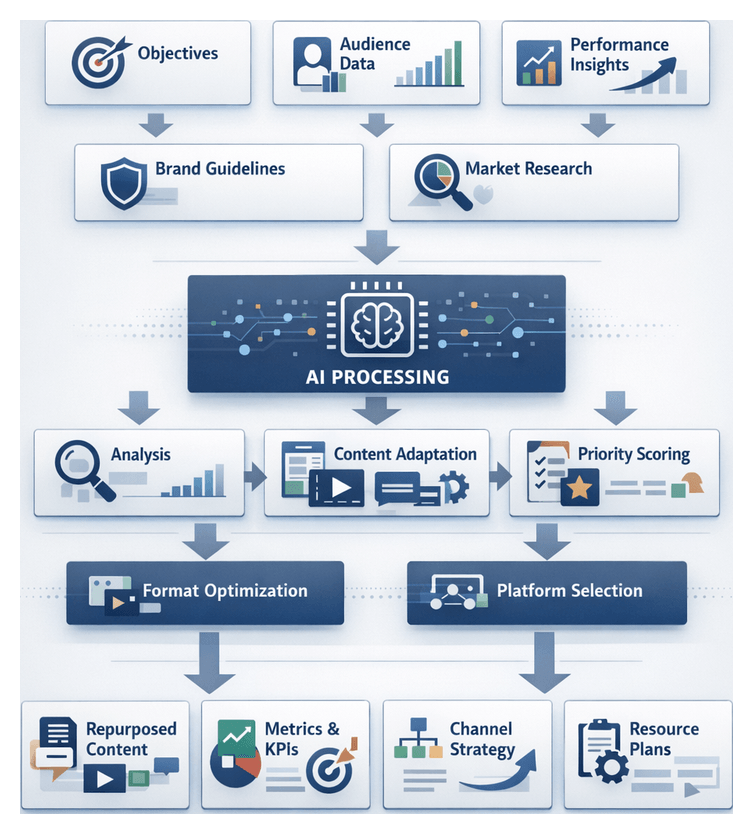
Purpose and Context for Defining Repurposing Strategy
In today’s content-rich landscape, organizations face mounting pressure to adapt and distribute existing assets across an expanding array of social channels. Defining clear objectives and gathering the right inputs at the outset of the repurposing workflow prevents misalignment, reduces redundant effort, and accelerates turnaround. By translating high-level business imperatives—such as brand consistency, audience engagement, and campaign ROI—into actionable goals, teams can ensure every piece of source content is adapted with intent and measured against agreed metrics.
The proliferation of short-form videos, ephemeral stories, community forums and emerging platforms has magnified the complexity of content operations. Manual approaches to cropping, rewriting and retargeting long-form materials struggle to scale, often resulting in inconsistent voice, diluted messaging and missed performance benchmarks. A structured, purpose-driven strategy for repurposing content is now a strategic necessity for sustaining audience trust, maximizing asset lifespan and optimizing resource allocation across marketing ecosystems.
Defining Objectives and Gathering Inputs
At the core of a robust repurposing strategy lies a precise definition of objectives and a comprehensive catalog of inputs. Typical objectives include:
- Enhancing audience engagement through platform-tailored messaging and formats
- Maximizing content longevity via strategic format conversions
- Maintaining brand integrity by enforcing tone, style and visual guidelines
- Measuring impact with predefined KPIs such as reach, click-through and conversions
- Optimizing resources by identifying high-value assets and repurposing opportunities
Key inputs that inform and validate these objectives include:
- Brand guidelines, voice and style documentation
- Historical performance benchmarks and audience demographics
- Campaign goals, seasonal or event-driven priorities
- Audience personas and behavioral profiles
- Channel specifications—dimensions, character limits, metadata requirements
Content audit outputs: asset inventories, theme maps, classification tags
- Competitive insights from social listening and market research
- Budget, headcount and technology constraints
Collecting these inputs ensures that objectives are data-driven, aligned with brand strategy and feasible within organizational limits.
Establishing Alignment and Prerequisites
Effective strategy definition requires cross-functional consensus and a clear governance framework. Prerequisites include:
- Facilitated stakeholder workshops to review inputs and define success criteria
- Access to shared data repositories for performance dashboards and audit reports
- Governance frameworks detailing decision-making hierarchies and review protocols
- Technology readiness assessments confirming that AI platforms—such as OpenAI’s GPT-4—are configured to process inputs
Additional conditions for a predictable, repeatable process include:
- Completion of a comprehensive content audit with assets tagged by format and performance tier
- Defined roles and handoff points across audit, strategy, ideation and execution teams
- Freshness of performance data and audience insights
- Validated toolchains, from asset management systems to AI engines
- Scheduled brand, legal and compliance reviews integrated into the workflow
When these prerequisites are in place, strategy moves swiftly from planning into execution without unnecessary friction.
Analytical Framework and AI-Driven Validation
To prioritize objectives effectively, organizations apply an analytical matrix that scores goals on strategic impact and operational feasibility. By categorizing initiatives into quick wins, strategic projects and lower-priority items, teams focus on efforts that promise maximum return.
AI accelerates and refines this prioritization. By feeding performance benchmarks, audience data and competitive insights into natural language processing engines such as GPT-4 or clustering modules, teams can:
- Generate engagement lift scenarios for different repurposing angles
- Receive format and channel mix recommendations based on historical patterns
- Detect gaps in brand voice coverage across objectives
- Model resource requirements and throughput times for adaptation techniques
Upon completion, teams produce:
- A prioritized list of repurposing objectives with success metrics
- An input inventory cataloging data sources and assets
- Stakeholder approval records confirming alignment
- An AI configuration blueprint to initialize models with objectives and validation criteria
These deliverables become the foundation for strategic action planning and ideation.
Strategy Actions and Workflow
Translating objectives into execution entails a structured flow of actions and collaborations between human teams and AI platforms.
Consolidating Strategic Inputs
All brand guidelines, performance reports, audience insights and campaign briefs are centralized in a collaboration workspace. An AI engine normalizes file formats, tags content by category and consolidates conflicting versions.
Performance Benchmark Analysis
Using AI-driven tools, machine learning algorithms identify top-performing formats, optimal post times and engagement drivers. Natural language processing highlights high-impact captions and themes, while predictive models forecast reach under various scenarios.
Platform Suitability Assessment
An AI agent retrieves channel guidelines and content specifications, scores platforms on audience alignment and format compatibility, and produces a ranked channel matrix. Human teams flag emerging or niche channels for inclusion.
Defining Strategic Pillars and Themes
Through an ideation interface, stakeholders select AI-generated theme suggestions derived from high-performing content. Keyword clusters and theme relationships are visualized in a clustering map, and approved themes become metadata for each repurposing task.
Prioritization Algorithm and Task Scoring
An AI-driven scoring engine evaluates tasks on strategic impact, resource requirements, channel readiness and compliance risk. Composite scores determine execution order, with configurable weighting to reflect evolving priorities.
Sequencing and Scheduling
An orchestration module integrates with project management tools and content calendars to schedule tasks. Sequencing logic accounts for asset availability, parallelization opportunities and campaign deadlines. Interactive views allow manual adjustments, which automatically update AI processing schedules and resource assignments.
Coordination with Downstream Teams
Each task is handed off with a detailed brief—theme, format, target audience, success criteria—along with resource links, timeline dependencies and assigned roles. Integrated notifications and real-time dashboards ensure transparency and accountability as the workflow advances to ideation and execution.
AI-Driven Strategy Roles
Intelligent systems embedded in the strategy stage transform disparate data into actionable roadmaps.
Data Aggregation and Performance Analysis
AI systems ingest metrics from social platforms, CRM and analytics dashboards. Solutions such as OpenAI GPT parse unstructured feedback, while AWS Comprehend classifies sentiment and topic relevance. Clustering and time-series analysis reveal top assets and emerging trends.
Priority Recommendation Engines
Using frameworks like Google Cloud AI and IBM Watson Studio, reinforcement learning models rank repurposing opportunities by projected ROI, social share potential and alignment with campaign KPIs.
Scenario Modeling and Impact Forecasting
Monte Carlo simulations and “what-if” analyses quantify risk and opportunity under varying conditions, generating impact curves and probability distributions to guide trade-off decisions.
Audience Segmentation and Personalization Alignment
Machine learning classifiers segment audiences into micro-cohorts. Platforms recommend tailored content angles, ensuring resource investment aligns with revenue potential.
Sentiment Analysis and Tone Optimization
Natural language processing models extract tonal attributes from existing content. Generative language models propose style variants calibrated to platform conventions, streamlining preliminary drafting.
Risk Assessment and Compliance Enforcement
AI governance modules scan themes against regulatory databases and policy repositories. Tools such as Google Cloud AI Vision and NLP APIs extend checks to image and video assets.
Feedback Loop and Iterative Refinement
Post-publication metrics and feedback continuously train predictive models. Dashboards visualize variances between forecasts and outcomes, prompting recalibration when model drift exceeds thresholds.
Decision Support and Collaboration
Interactive platforms present scenarios, priority rankings and risk assessments, enabling cross-functional teams to run rapid “what-if” variations and maintain alignment across marketing, compliance and operations.
Key Strategy Deliverables and Handoffs
At the conclusion of strategy definition, a set of formal deliverables guides the ideation and execution teams:
- Prioritized Platform Matrix: Ranked channels and formats based on impact and feasibility
- Repurposing Roadmap: Sequenced plan mapping assets to milestones, formats and channels
- Success Metrics Framework: Defined KPIs, both quantitative and qualitative, with integrations to tools like Sprout Social
- Resource and Responsibility Assignments: Roles, ownership and AI platform integrations such as GPT-4
- Risk and Compliance Checklist: Regulatory and brand safety registry
- Budget and Timeline Estimates: Financial outline and key deadlines
- AI and Data Requirements Document: Model specifications, data schemas and integration details
Integration points include asset inventories from platforms like HubSpot, performance data from Tableau, project management in Monday.com and API integrations via MuleSoft. Handoff to ideation follows these guidelines:
- Formal sign-off by marketing, legal and brand governance stakeholders
- Cross-functional briefing sessions with strategy leads, creators and AI specialists
- Secure transfer of assets, metadata and performance logs
- Setup of dedicated collaboration channels—Slack, Microsoft Teams or project boards
- Alignment on ideation milestones and quality baselines
Best Practices for Smooth Transition
- Maintain a single source of truth in a cloud knowledge repository or integrated marketing platform
- Visualize dependencies with lightweight orchestration tools such as ZenHub or Trello
- Implement change‐control protocols to manage updates to strategy deliverables
- Ensure transparent communication with AI engineering teams when adjusting model parameters
- Continuously refine handoff documentation based on ideation team feedback
Chapter 3: AI-Driven Content Analysis and Segmentation
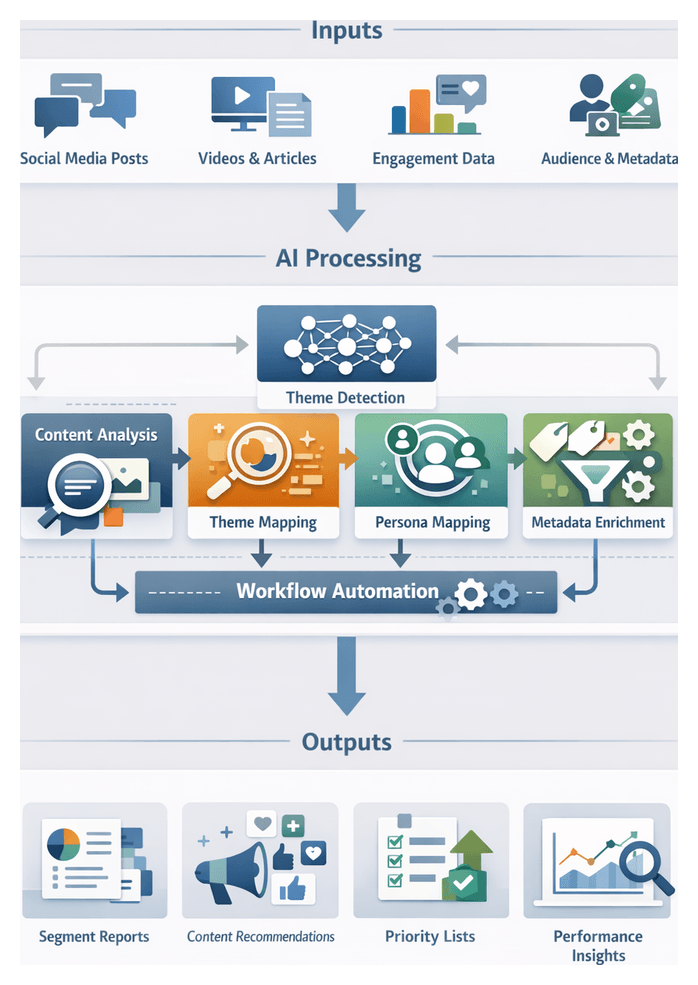
AI-driven content analysis and segmentation transforms disparate social media posts, videos, and articles into structured insights that guide targeted repurposing strategies. By applying advanced natural language processing, computer vision, and predictive modeling, organizations gain a precise mapping of content themes to audience segments. This enables prioritization of high-impact assets, alignment with brand voice, and optimized resource allocation across multi-channel environments.
Automated pattern detection and thematic extraction accelerate decision making, while codified workflows ensure repeatability and governance. Continuous performance data feeds refine theme taxonomies and segment definitions, creating a virtuous cycle of improvement. As a strategic compass, this stage empowers stakeholders from content strategists to data engineers to align on objectives, metrics, and handoff criteria, ultimately elevating engagement and preserving brand integrity.
Data and Infrastructure Prerequisites
Reliable AI-driven analysis depends on comprehensive inputs and robust technical conditions. Organizations should validate data completeness, consistency, and accessibility before initiating segmentation.
- Engagement Metrics: Quantitative measures—likes, shares, comments, watch times, click-through rates—sourced from platforms such as Google Analytics and social listening tools.
- Content Metadata: Information on publication dates, authorship, tags, categories, and campaign identifiers maintained in content management systems.
- Audience Demographics and Behavior: Attributes and signals—age, location, interests, session durations, conversion events—from platforms like Salesforce.
- Brand and Style Guidelines: Machine-readable tone, voice, and visual rules that inform theme extraction and segment definitions.
- Historical Performance Benchmarks: Baseline KPIs—engagement rates, conversion ratios, return on ad spend—that calibrate AI thresholds.
- Technological Infrastructure: Scalable storage and processing frameworks, including cloud data warehouses such as Snowflake, and real-time AI services like OpenAI GPT-4 and Google Cloud Natural Language API.
Key organizational and technical readiness conditions include:
- Data Quality Governance: Automated validation for missing values, inconsistent tags, and duplicates, with dashboards for anomaly detection.
- Compliance and Privacy: Encryption, consent management, and anonymization protocols to meet GDPR, CCPA, and other regulations.
- Cross-Functional Collaboration: Aligned objectives, performance thresholds, and risk parameters across marketing, data engineering, and legal teams.
- Model Validation and Bias Mitigation: Auditing AI outputs for fairness and relevance, leveraging tools like IBM Watson Natural Language Understanding.
- Compute and Orchestration Framework: Containerized AI services and schedulers with platforms such as Hugging Face Transformers and Kubernetes for elasticity and high availability.
Segmentation Workflow
The segmentation workflow orchestrates content ingestion, AI classification, persona mapping, metadata enrichment, and handoff to ideation.
Content Ingestion and Preprocessing
- API-Driven Retrieval: Orchestrator fetches text, images, video transcripts, and metadata from CMS or DAM repositories.
- Normalization and Cleaning: Standardize encoding, resize media, extract transcripts, remove boilerplate, and correct formatting anomalies.
- Parsing and Tokenization: Apply NLP tokenizers to split text into sentences, paragraphs, and named entities; tag media with basic descriptors.
- Logging and Monitoring: Capture ingestion timestamps, asset IDs, and exceptions for real-time visibility.
AI-Driven Theme Detection and Classification
Preprocessed assets are classified to surface themes, sentiment, and relevance scores.
- Classification API Calls: Submit batches to a classification service with pretrained and custom models aligned to organizational taxonomies.
- Theme Extraction and Sentiment Analysis: Generate ranked themes and polarity scores to tailor repurposed content.
- Confidence Filtering: Assets below score thresholds enter a secondary review queue or AI quality-assurance loop.
- Taxonomy Evolution: Automated concept mining proposes new themes, with human review and model retraining to integrate updates.
Audience Persona Mapping and Segment Scoring
- Persona Retrieval: Query enterprise CDP for persona definitions, content preferences, and engagement patterns.
- Feature Embeddings: Compute semantic vectors using the OpenAI GPT-4 embedding API.
- Similarity Matching and Scoring: Align content embeddings to persona profiles via cosine similarity; assign composite scores reflecting thematic fit and historical engagement.
- Priority Queuing: Route high-scoring assets to ideation workflows; archive or defer lower-priority items.
Metadata Enrichment and Orchestration
- Format, Tone, and Complexity Tags: Classify assets by format and assign mood indicators and readability levels.
- Channel Suitability Predictions: Tag optimal platforms—LinkedIn, TikTok, Instagram—based on format and persona alignment.
- Workflow Coordination: Orchestrator schedules classification, matching, and enrichment tasks; manages retries and error recovery.
- Deliverables and Handoff: Produce segment reports, enriched asset records, priority queues, and collaboration links for the ideation stage.
AI-Driven Techniques and Architectural Components
Natural Language Understanding and Topic Extraction
Apply named entity recognition, sentiment scoring, dependency parsing, and topic modeling (LDA, NMF) to surface key concepts and prevailing tones across large content sets.
Semantic Embedding and Similarity Analysis
Convert text into high-dimensional vectors via transformer encoders, use cosine similarity and vector databases to detect related assets and support clustering and deduplication.
Unsupervised Clustering and Pattern Detection
Employ k-means, hierarchical clustering, and DBSCAN to partition embedding space into natural theme clusters and surface anomalies for discovery.
Supervised Classification and Metadata Tagging
Fine-tuned transformer classifiers map assets to brand taxonomy with multi-label support and confidence scoring, feeding feedback loops for continuous improvement.
Graph Analytics and Relationship Mapping
Construct knowledge graphs of assets, topics, influencers, and personas to reveal multi-hop connections and identify high-impact nodes and relationships.
Supporting Systems
- ETL Pipelines: Automated data ingestion, normalization, and enrichment via streaming frameworks and batch processes.
- Feature Stores and Vector Databases: Central repositories for ML features and embeddings enabling low-latency retrieval.
- MLOps Platforms: Model versioning, retraining pipelines, drift detection, and performance monitoring.
- Workflow Orchestration: Task scheduling, dependency management, and dynamic resource allocation.
- Visualization Dashboards: Interactive theme maps, sentiment trends, and cluster heat maps for stakeholder insights.
- Human-in-the-Loop Interfaces: Annotation tools for expert validation, taxonomy updates, and governance checkpoints.
Analysis Deliverables and Transition Mechanisms
- Segment Reports: Grouped asset profiles by theme, persona, format, with engagement metrics and confidence scores.
- Theme and Topic Maps: Visual or tabular layouts showing clusters, coverage gaps, and emerging opportunities.
- Priority Asset Lists: Ranked inventories sorted by performance indicators to guide resource allocation.
- Metadata Enrichment Files: Standardized packages of tags, keywords, sentiment scores, and channel recommendations.
- Performance Analytics Extracts: Filtered KPI datasets segmented by platform and demographic cohort.
Successful delivery relies on data quality assurance, clear taxonomy and schema definitions, documented AI model configurations, secure integration with data warehouses, and defined governance roles.
Transition mechanisms include API-driven data pushes, exportable BI dashboards, automated notifications, structured CSV/JSON files for downstream engines, and versioned documentation with audit trails. These ensure seamless handoff to ideation and repurposing teams, accelerate time-to-market, and maintain transparency across stakeholders.
Governance, Auditing, and Feedback Loops
- Change Logs and Audit Trails: Track taxonomy updates, model retraining events, and manual overrides.
- Quality Review Checkpoints: Scheduled validations by strategists and analysts to correct AI outputs.
- Performance Feedback Integration: Capture creative acceptance rates and audience response to refine models.
- Access Control Policies: Role-based permissions to safeguard taxonomy and metadata integrity.
Scalability and Reusability
- Modular Reporting Templates: Adaptable layouts for new markets or verticals with localized data.
- Extensible Metadata Schemas: Flexible attribute sets that accommodate emerging content types.
- Parameterized AI Pipelines: Configurable workflows for campaign- or region-specific analysis.
- Centralized Knowledge Repositories: Libraries of validated outputs, taxonomy versions, and performance baselines for rapid onboarding and insight reuse.
Chapter 4: Automated Content Ideation and Theme Generation
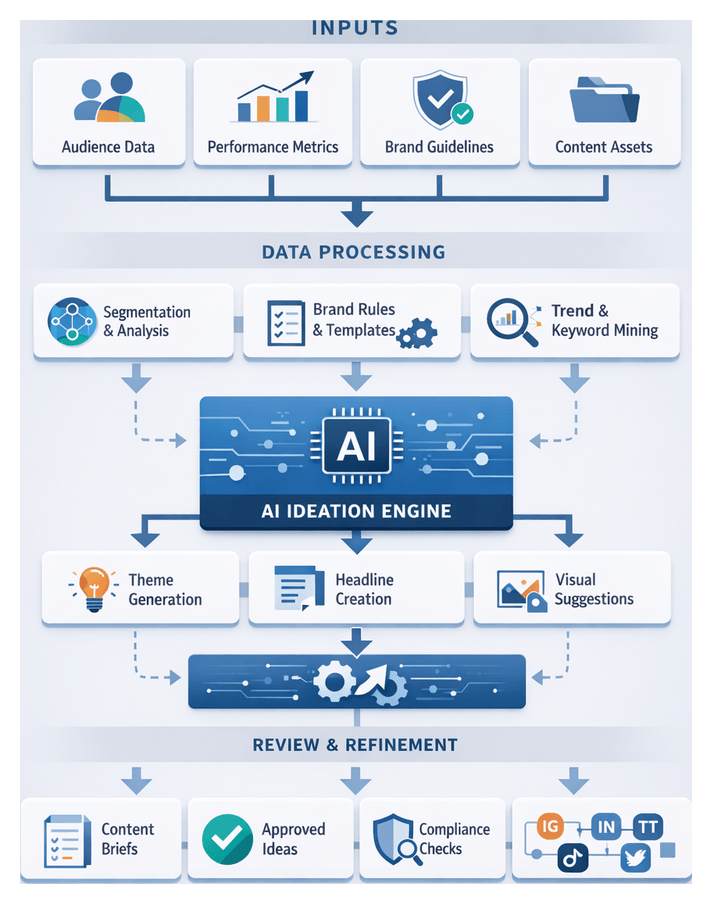
Purpose and Context of Automated Content Ideation
The automated content ideation stage transforms data insights into structured creative concepts, accelerating thematic generation while ensuring strategic alignment. By ingesting outputs from content audits, performance analytics, audience segmentation, and brand guidelines, AI-driven workflows produce on-brand idea briefs that guide writers, designers, and marketers. This approach mitigates creative bottlenecks, reduces brand drift, and delivers a repeatable system for uncovering angles tailored to defined audience segments across channels such as Instagram, LinkedIn, TikTok, and Twitter.
Advances in natural language generation and pattern recognition have made tools like GPT-4 and Google Vertex AI integral collaborators. These systems leverage historical performance metrics and brand directives to suggest headlines, themes, and narrative strategies in seconds. By defining clear ideation objectives—such as boosting engagement or reinforcing thought leadership—organizations guide AI toward outcomes that support key performance indicators like click-through rates, share counts, and conversion metrics. This human-machine feedback loop drives continuous improvement in concept relevance and creative impact.
Objectives and Governance
Well-articulated objectives direct AI systems to generate concepts that advance strategic goals. They serve as guardrails, preventing generic outputs and enabling transparent measurement. To maintain quality and compliance, organizations must establish governance structures that define roles and responsibilities for AI operators, creative leads, and compliance reviewers. Clear escalation paths for approvals, modifications, and compliance checks ensure that each idea adheres to legal, ethical, and brand standards before entering content transformation and adaptation stages.
Inputs and Prerequisites
Successful automated ideation relies on comprehensive inputs and technical readiness. Essential prerequisites include:
- Segment data from audience analysis, including thematic clusters and format preferences
- Historical performance metrics, such as engagement rates and click-through ratios
- Brand voice, tone guidelines, and approved vocabulary lists
- Audience personas and behavioral profiles capturing motivations and pain points
- Content audit reports, asset inventories, and gap analyses
- Market trends, competitive insights, and social listening data
- Campaign objectives, key messages, and SEO keyword clusters
- Cultural, seasonal, and event calendars
- Technical environment readiness: API credentials, CMS and DAM integration, and secure data pipelines
Integration of AI Tools and Platforms
Integrating AI services requires secure API connections, prompt template configuration, and real-time data ingestion. Platforms or custom orchestration pipelines built on Apache Airflow establish the technical foundation. Prompt libraries embed brand guidelines and audience cues, while analytics integrations feed performance and trend data into AI engines. Early collaboration between IT, marketing operations, and creative teams ensures seamless setup and governance enforcement.
Ideation Workflow
Triggering and Initiation
The workflow begins when the orchestration layer detects readiness signals—completed segment reports, updated performance benchmarks, and validated brand assets. A management system enqueues an ideation job, allocating compute resources and retrieving inputs from content repositories and analytics platforms. Tasks are scheduled based on priority, resource availability, and campaign timelines.
Data Ingestion and Preprocessing
Diverse inputs undergo consolidation and validation:
- Segment Aggregation: Retrieval of audience definitions, past performance data, and thematic tags.
- Asset Fetching: Import of text, images, and transcripts from the DAM system with associated metadata.
- Brand Guideline Integration: Extraction of style rules and tone directives from a centralized repository.
- Prompt Assembly: Population of templates with segment keywords, thematic phrases, and format instructions.
Automated validation ensures data completeness and quality, triggering alerts for manual resolution when discrepancies arise.
AI-Driven Concept Generation
With inputs prepared, specialized AI services operate in parallel:
- Theme Expansion: A natural language generation model like ChatGPT proposes overarching themes and narrative arcs.
- Headline and Angle Generation: Pattern-recognition modules analyze high-performing headlines and recombine structures for each channel.
- Visual Concept Suggestion: Image suggestion APIs advise on mood boards and key imagery descriptors.
An API gateway orchestrates prompt payloads, monitors execution, and aggregates responses into a unified workspace. Standardized JSON schemas, retry logic, and rate-limit handling maintain throughput under heavy load.
Iterative Refinement and Collaborative Review
Concepts undergo cyclical refinement combining automated scoring and human insight:
- Automated Scoring: A microservice assesses sentiment alignment and relevance using historical engagement data.
- Human Curation: Strategists review high-scoring ideas via a collaborative dashboard, upvoting, annotating, or requesting revisions.
- Feedback Integration: Curator inputs refine prompt templates and enforce brand lexicon compliance for subsequent AI cycles.
Typically two to three refinement cycles balance creative breadth with strategic focus, and all decisions are logged for audit trails.
Quality Assurance and Selection
Final evaluation ensures compliance with criteria:
- Alignment with campaign objectives and key messages
- Uniqueness across audience segments
- Readability and emotional resonance via readability algorithms
- Legal and regulatory compliance enforced through an AI-powered checker
Concepts meeting threshold scores are approved; others are revised or discarded based on curator guidance.
Packaging and Handoff
Approved ideas are compiled into structured briefs containing:
- Theme title and description
- Primary and secondary headlines
- Visual concept prompts or storyboards
- Target segment and channel notes
- Source asset references and data charts
- Version history and approval stamps
The briefs are exported to the content operations platform, triggering content transformation workflows. Metadata tags ensure correct style and format conversions, and notifications alert downstream teams.
AI Functional Roles in Ideation
Semantic Pattern Detection
Transformer-based models analyze content corpora to surface recurring concepts, sentiment clusters, and lexical relationships. Tools like GPT-4 and Google Vertex AI use embeddings to detect topic clusters, emergent sub-themes, and sentiment shifts that reveal narrative opportunities.
Concept Mapping and Theme Clustering
AI-driven topic modeling platforms such as IBM Watson Natural Language Understanding organize semantic insights into hierarchical theme structures. These systems integrate with centralized knowledge graphs in the CMS to store and retrieve themed entities, preserving institutional knowledge and reducing duplication.
Headline and Angle Generation
NLG engines produce headline variants and creative angles from theme clusters. An orchestration layer manages prompt variations, filters outputs by tone and length, and enforces compliance rules.
Tone and Style Consistency
Controlled generation techniques and style transfer algorithms embed brand tokens—such as “professional yet approachable” or “innovative and bold”—into outputs. Reinforcement learning from human feedback fine-tunes models, and real-time checks against the brand repository flag divergences for review or regeneration.
Audience-Centric Personalization
AI models adjust framing based on persona profiles, emphasizing segment-specific motivators. Integration with customer data platforms ensures personalization rooted in real user behavior, enabling parallel testing of multiple angles without sacrificing relevance.
Trend Analysis and Real-Time Adaptation
Streaming analytics ingest social listening data from platforms like Twitter, TikTok, and LinkedIn. Event-driven architectures using Apache Kafka or Google Pub/Sub update theme clusters and regenerate angles to reflect emerging trends, maintaining contextual relevance.
Collaborative Co-Creation Tools
Interfaces combining side-by-side editing, suggestion tracking, and version control enable human strategists and AI agents to co-create content outlines. Inline suggestions for synonyms, tone adjustments, and headline tweaks, along with AI-summarized comment threads, ensure alignment. Integrations with Slack and Microsoft Teams capture feedback and approvals within the ideation workflow.
Continuous Learning and Improvement
Post-distribution performance data—engagement rates, click-throughs, and sentiment analysis—feeds back into automated retraining pipelines managed by MLOps frameworks like MLflow or Kubeflow. This closed-loop learning adjusts theme weightings and prompt templates, driving ongoing enhancement of ideation quality.
Idea Deliverables and Handoff Criteria
Deliverables encapsulate thematic direction, creative prompts, and metadata, ensuring downstream teams can seamlessly transform ideas into content assets. Primary deliverables include:
- Idea briefs with working titles, theme summaries, persona alignment, and suggested formats
- Thematic outlines mapping key messages, subheadings, and supporting data points
- Headline and hook options generated by tools like Jasper and Copy.ai
- Visual prompts and mood boards from platforms such as Midjourney or Canva
- Metadata annotations: SEO tags from SurferSEO, analytics insights from Google Analytics, and trending hashtags
- Priority and sequencing recommendations based on strategic value and resource estimates
Deliverables advance only after validating dependencies:
- Up-to-date segment definitions and profile attributes
- Integrated brand guidelines enforced by AI workflow tools
- Loaded performance benchmarks and A/B test results
- Content inventory alignment to avoid duplication
- Applied regulatory and compliance filters for industry-specific requirements
Handoff criteria ensure readiness for transformation:
- Completion Indicators: Peer-reviewed briefs, headline sets meeting engagement thresholds, fully populated metadata fields
- Quality Gates: Automated brand compliance, audience alignment scoring, and regulatory approval codes
- Technical Integration: CMS API ingestion of JSON payloads, DAM transfer of visual assets, auto-created tasks in Trello or Asana, and notifications via Slack or Microsoft Teams
- Temporal Criteria: Scheduled batch releases aligned with editorial calendars and adaptive re-ideation triggers based on real-time analytics
When all criteria are satisfied, deliverables are marked “Ready for Transformation,” triggering downstream AI agents for content repurposing, format conversion, and platform adaptation. This structured approach ensures predictable throughput, consistent quality, cross-team visibility, and scalable production of content ideas at enterprise scale.
Chapter 5: Transformative Content Repurposing Techniques
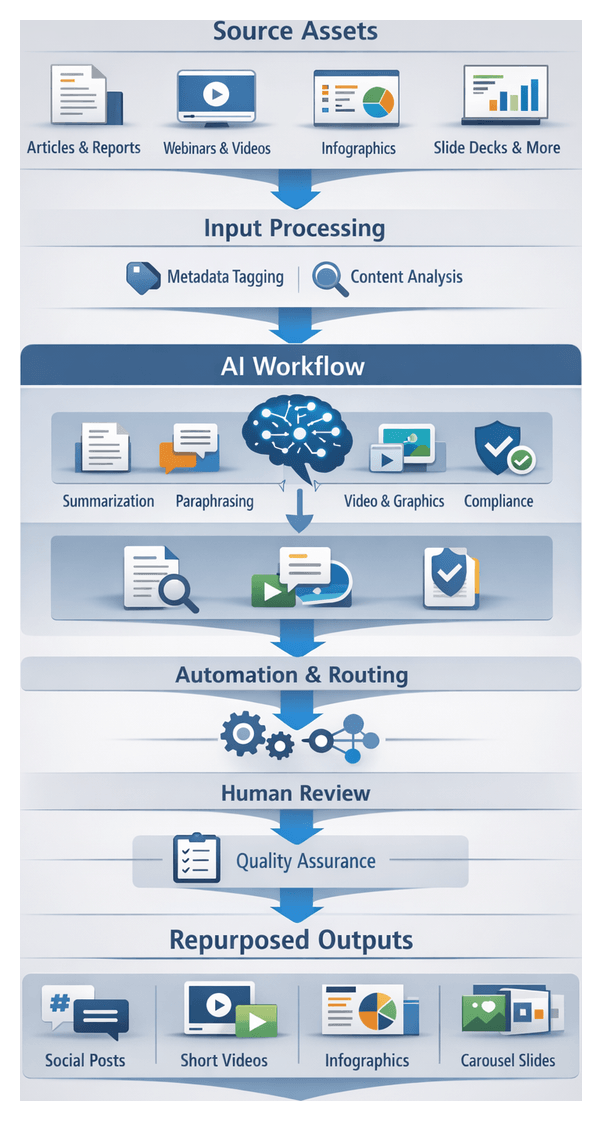
Repurposing Objectives and Input Requirements
In advanced social media strategies, repurposing transforms long-form assets into channel-specific formats that maximize reach, engagement, and brand consistency. By converting articles, white papers, webinars, and reports into bite-sized posts, short videos, infographics, carousels, and interactive elements tailored for Instagram, TikTok, LinkedIn, and Twitter, organizations extend discoverability and accelerate throughput. Defining clear objectives and assembling high-quality inputs upfront ensures each repurposed asset aligns with brand guidelines and strategic priorities.
- Enhance Reach and Visibility: Optimize content length, style, and interactivity to platform norms, improving discoverability and share rates.
- Maintain Brand Voice: Preserve narrative tone and key messages through AI-powered paraphrasing and style-rule guardrails.
- Optimize Engagement Metrics: Leverage performance benchmarks—click-throughs, shares, comments, view completions—to prioritize formats with highest impact.
- Accelerate Scalability: Automate summarization, paraphrasing, formatting, and layout generation using AI tools to scale production without linear labor increases.
- Ensure Accessibility and Compliance: Integrate closed captions, alt text, and readability adjustments, adhering to legal and regulatory standards.
Effective repurposing requires robust prerequisites and well-structured inputs.
- Governance Framework: Define roles, responsibilities, and approval checkpoints for legal, brand, and compliance reviews before and after AI processing.
- Style Guide and Brand Guidelines: Document voice attributes, terminology preferences, formatting rules, and visual identity elements to guide AI models.
- Metadata and Taxonomy Schema: Implement standardized tags for topics, segments, formats, and campaign identifiers to enable automated filtering and classification.
- Technology Integration: Establish API connectivity between content management systems like Contentful, digital asset management platforms, AI services from OpenAI and Hugging Face, and collaboration tools.
- Quality Baselines: Use historical performance data to set engagement rate benchmarks that inform AI prioritization and continuous optimization.
- Asset Audit and Classification: Tag source assets by format, performance history, and repurposing potential, assigning suitability scores for specific transformations.
- Team AI Literacy: Provide training so content creators and editors understand AI configuration, output interpretation, and manual intervention requirements.
Source assets must be validated against quality criteria before entering the repurposing pipeline:
- Long-form text (articles, case studies, white papers) clear of typos with identifiable key messages.
- Audio/video recordings (webinars, podcasts) with high audio quality, transcripts generated via Lumen5 or similar tools, and accurate time-codes.
- Graphic files (infographics, slide decks) in editable formats (Photoshop, InDesign) with version history and style annotations.
- Interactive data visualizations with clean source datasets and configuration parameters for chart reformatting.
- Captions and transcripts in SRT or VTT formats for accessibility and subtitle styling.
- Pre-approved templates and brand collateral for rapid assembly using Jasper AI or AI-powered layout assistants.
Validating metadata tags, resolution standards, and compliance ensures AI engines receive well-structured inputs, reducing errors and preserving quality during transformation.
Transformation Workflow Overview
The repurposing operations workflow converts approved assets into a diverse portfolio of social media deliverables through a sequence of automated and manual phases. Key stages include content ingestion, metadata enrichment, automated task routing, AI-driven conversion, human review, asset management integration, and handoff to adaptation and scheduling. Consistent triggers and API interactions across specialized platforms eliminate ad-hoc processes and maintain governance.
Content Ingestion and Metadata Enrichment
Automated retrieval fetches source assets from a central repository via API endpoints—for example, Contentful or a proprietary DAM. Webhooks or scheduled jobs extract text, images, video, slide decks, and existing metadata. An enrichment microservice powered by OpenAI or Hugging Face models analyzes text to extract themes, sentiment scores, and named entities. These attributes populate custom fields—tone, primary keyword, target persona—within the asset object to guide downstream conversions.
Automated Routing and Scheduling
An orchestration platform evaluates each asset’s type, priority, and SLA requirements, enqueuing tasks into specialized pipelines:
- Text summarization and paraphrasing for blog posts and articles
- Video script generation from transcripts
- Bullet-to-graphic conversion for infographics
- Slide condensation for carousel formats
Message brokers (e.g., RabbitMQ, AWS SQS) manage queue workloads, while SLA metadata tracks turnaround times and compliance levels for full visibility.
AI-Driven Conversion Engines
Conversion tasks invoke AI engines tailored to content type:
- Text Transformation: Summarization condenses content to target word counts; paraphrasing engines from Jasper AI or fine-tuned LLMs rewrite with brand voice; format conversion maps segments into templates for Twitter threads, LinkedIn posts, and Instagram captions.
- Multimedia Generation: Video scripting services produce time-coded scripts; computer vision modules auto-crop images for social dimensions; data points populate infographic templates via Canva API or similar tools.
Each output is tagged with metadata—aspect ratio, file type, resolution—to drive subsequent adaptation tasks.
Human Review and Orchestration
After AI processing, assets enter the digital asset management system with status flags (In Progress, Pending AI Review, Pending Human Review, Ready for Adaptation). Designated reviewers receive notifications and access a central interface to verify message accuracy, brand tone, legal compliance, and visual consistency. Feedback loops route corrections back to AI pipelines or advance assets to the next stage.
A central orchestration dashboard tracks metrics such as processing time, error rates, throughput, and SLA compliance. Automated alerts address bottlenecks or repeated rejections, while dynamic routing reassigns tasks to backup AI engines or human operators as needed.
Handoff to Adaptation and Scheduling
Assets meeting quality criteria and marked Ready for Adaptation are bundled into packages containing finalized text, multimedia files, metadata tags, style guide pointers, and channel mappings. A webhook notifies the adaptation system—which may integrate with scheduling tools via Zapier or direct APIs—that new content is available. This seamless handoff minimizes idle time and ensures repurposed deliverables flow efficiently into format-specific adaptation and publishing workflows.
AI-Driven Format Transformation
AI engines power the core of format transformation, automating paraphrasing, summarization, style transfer, template rendering, and metadata enrichment at scale while preserving brand integrity.
Semantic Preservation and Brand Voice
Large language models like OpenAI GPT-4 and transformer systems from Hugging Face capture nuanced meanings and tone markers. Fine-tuning on brand corpora and integration with CMS style-rule engines enforce guardrails against forbidden phrases and tone drift, ensuring authentic, compliant outputs.
Automated Paraphrasing and Rewriting
Sequence-to-sequence models generate unique text variations for A/B testing and platform differentiation. Controlled rewriting parameters balance novelty with fidelity, entity anchoring preserves key names and dates, and version metadata maintains an audit trail. Orchestration platforms parallelize paraphrasing tasks across AI agents, slashing turnaround times.
Smart Summarization and Highlight Extraction
AI summarization combines extractive and abstractive methods to produce bullet lists, executive abstracts, or social captions. Services like SMMRY deliver quick summaries, while fine-tuned GPT models generate marketing-grade micro-stories. Summaries are stored alongside source files in the DAM for review and retrieval.
Multimodal Adaptation and Style Transfer
Vision-language models generate descriptive alt text, guide image cropping, and support style transfer to align tone with channel conventions. NLG paired with speech synthesis produces voice-over scripts optimized for timing. AI agents reference platform specification libraries to adjust word counts, sentence complexity, and calls to action.
Template-Driven Generation and Metadata Enrichment
Template engines in CMS or marketing suites scaffold repurposed assets. AI modules populate headlines, captions, and metadata—taxonomy codes, SEO keywords, campaign IDs—using named-entity recognition and topic modeling. Each asset emerges structured and annotated, ready for validation or direct publishing.
Quality Assurance and Feedback Loops
AI-powered quality control tools flag tone deviations, factual inconsistencies, and compliance issues. Review interfaces highlight changes and suggested corrections. Editor feedback via annotation APIs feeds active learning loops, continuously retraining models to reduce error rates and improve precision.
Deliverable Packaging and Cross-Platform Handoff
The final repurposing output is a deliverable package adhering to metadata, format, and brand standards, ready for adaptation, quality control, and scheduling.
Package Composition
- Draft social media posts in text and HTML, conforming to character limits and tone guidelines
- Video and audio scripts segmented by scene or timecode with visual and audio cues
- Copy blocks for graphic overlays or infographics with layout notes
- Annotated transcripts and bullet summaries for accessibility and multi-platform reuse
- Reference links to original long-form assets for traceability
Each item includes metadata—theme, platform, persona, version—facilitating automated retrieval from a shared repository.
Dependencies and Integration Points
Deliverables align with upstream inputs and downstream requirements:
- Brand guidelines dictating tone, terminology, and visual style
- Platform specifications—image dimensions, caption limits, hashtag conventions
- Content calendar and campaign schedules for priority and publication timing
- Compliance checklists for regulated industries
- APIs or file shares for adaptation tools and QC systems
Packaging Standards
- File naming: Platform_ContentTheme_Version_Date (e.g., LinkedIn_Sustainability_Rev02_20260226)
- Metadata manifest: JSON or CSV listing properties like audience, language, approval status
- Supporting documentation: Brief summarizing objectives, creative rationale, KPIs
- Link references: URLs to source files in the DAM
Standardized packages allow adaptation scripts to parse contents and route assets without manual tagging.
Handoff to Adaptation and Quality Control
Adaptation systems poll repositories or listen for webhooks to retrieve packages. Validation scripts verify naming conventions and manifests, triggering alerts for discrepancies. Pre-processing converts text into JSON for scheduling tools and extracts visual overlays for graphic teams. Integration with tools like Lumen5 or InVideo enables rapid video and reel creation. Status flags—Pending Adaptation, In Review, Ready for QC—provide visibility and prevent bottlenecks.
- High-risk assets trigger human-in-the-loop reviews with style checklists from tools such as Grammarly Business.
- Reviewers use inline annotation to provide feedback, recorded in an audit log for compliance reporting.
Version Control and Tracking
- Incremental version numbering with change logs for traceability
- Branching for A/B text variations or regional language versions managed in an enterprise DAM
- Automated archiving of superseded versions to maintain a lean working directory
- Dashboard visualizations summarizing version counts, approval rates, and turnaround times
Alignment with Scheduling and Distribution
- Map asset IDs to content calendar slots aligned with peak engagement windows
- Embed tracking parameters—UTM codes, campaign tags, influencer IDs—in metadata
- Configure distribution rules for posting cadence, cross-channel coordination, and retry logic
- Notify social media managers with preview links and context briefs
This cohesive handoff ensures repurposed assets flow seamlessly into automated scheduling engines, ready to maximize reach and engagement in line with strategic goals.
Chapter 6: Cross-Platform Adaptation and Formatting
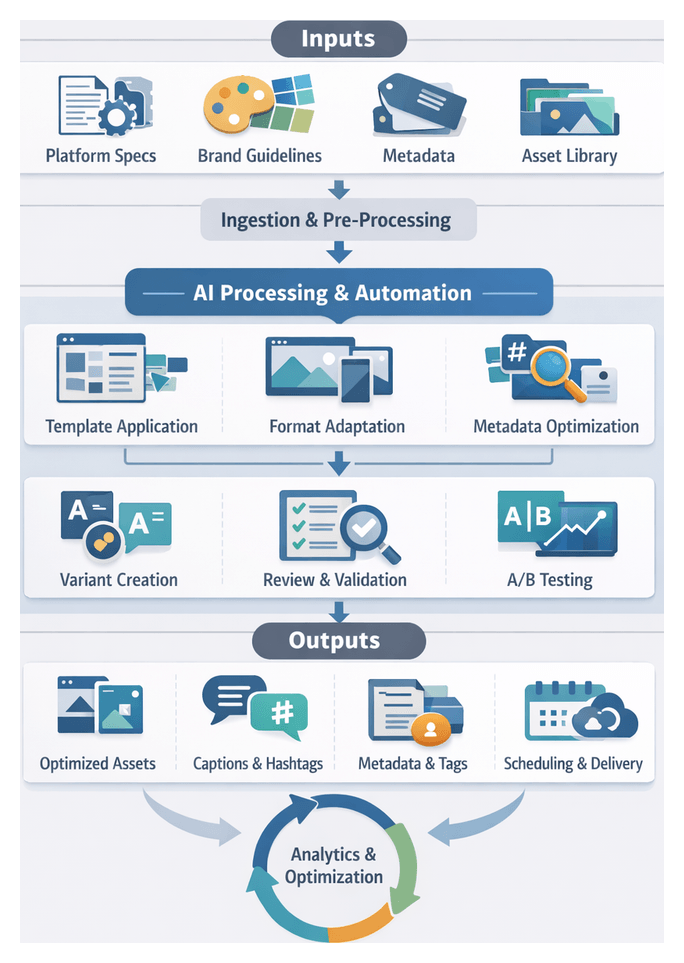
Platform Specifications and Input Collection
Cross-platform adaptation begins with assembling technical specifications, brand guidelines, and metadata standards for each social media channel. This preparation empowers AI-driven agents and human editors to format, style, and enrich assets with precision, reducing revision cycles and maintaining brand consistency at scale.
Dimension and Format Requirements
- Instagram Feed: 1080×1080 px square; 1080×1350 px portrait; 1080×566 px landscape
- Instagram Stories and Reels: 1080×1920 px vertical with safe zones for interactive elements
- Facebook Posts: 1200×630 px for link shares; 1080×1080 px for images; minimum 1280×720 px for videos
- Twitter Posts: 1200×675 px single images; 1280×720 px video with file size limits
- LinkedIn Feed: 1200×627 px images; 1080×1080 px supported; videos from 256×144 to 4096×2304 px
- TikTok Videos: 1080×1920 px vertical; durations from 15 seconds up to 10 minutes
- YouTube Thumbnails: 1280×720 px 16:9 aspect ratio; up to 2 MB file size
Style, Branding, and Metadata Inputs
Defining aesthetic and contextual inputs allows AI engines to enforce brand rules and automate metadata generation. Essential inputs include:
- Brand color palettes with hex or RGB values and hierarchy for text, backgrounds, and accents
- Typography specifications for headlines, captions, and body text, including font families, weights, sizes, and line spacing
- Logo placement standards, clear space requirements, and approved graphic overlays
- Tonal guidelines for captions, including emoji usage, voice consistency, and character limits
- Hashtag taxonomies, caption templates aligned to platform character limits, and alt-text prompts for accessibility
- Link preview parameters with open graph tags and call-to-action modules customized per channel
Prerequisites and Data Sources
Before adaptation, teams must secure up-to-date brand guidelines, creative asset libraries, channel audits, audience personas, and technical API access. Integration with digital asset management platforms and content management systems underpins seamless adaptation workflows.
Adaptation Workflow and AI-Driven Styling
Asset Ingestion and Pre-Processing
Draft assets—text overlays, graphic layouts, and video snippets—are ingested into a centralized repository, often via API integration with platforms such as Cloudinary. Automated pre-processing validates file types, extracts metadata, and classifies content using AI modules. This standardization provides a unified starting point for downstream styling tasks.
Automated Styling and Template Application
AI-driven styling engines draw from brand libraries in tools like Canva and Adobe Sensei to select and apply templates. These engines consider platform requirements, content themes, and historical performance data to auto-apply color schemes, typography, and logo placements. Designers review and annotate these decisions in collaborative environments such as Figma.
Dimension and Format Transformation
A central adaptation service generates platform-specific asset versions in parallel. For images, AI-powered resizing algorithms maintain focal points—detected faces or key visuals—while adapting ratio and resolution. Video conversions use intelligent cropping, padding, and codec adjustments to produce formats suitable for Instagram, TikTok, YouTube, and other channels. Processing logs capture performance metrics and exceptions requiring human review.
Metadata Enrichment and SEO
Natural language processing and computer vision modules enrich assets with descriptive metadata. Systems such as MonkeyLearn generate alt-text descriptions, algorithmic hashtag suggestions, and category tags. Integration with scheduling platforms like Buffer and Hootsuite ensures enriched metadata flows directly into content calendars and analytics dashboards.
Variant Generation and A/B Testing Preparation
To support experimentation, AI agents produce multiple style variants for each asset. Headline spin-off modules create text alternatives, image variant tools adjust visual compositions, and metadata grouping automates A/B testing setups. Each variant is labeled for analytics systems such as VWO, enabling statistically significant performance comparisons.
Collaborative Review, Compliance, and Accessibility
Styled assets enter a collaborative review queue. Human reviewers can approve, annotate, or flag items for re-adaptation. Simultaneously, AI compliance modules such as Acrolinx scan for policy violations, medical claims, or copyright issues. Accessibility checkers verify WCAG compliance, generating subtitles and transcripts and validating color contrast thresholds.
API-Driven Deployment and Orchestration Integration
Upon approval, assets are deployed back to the DAM or sent to orchestration systems via secure API calls. Packages include high-resolution source files, web-optimized versions, and metadata manifests in JSON format. Orchestration engines trigger scheduling, update project boards, and notify stakeholders, ensuring seamless handoff to publishing workflows.
Adaptation Outputs, Validation, and Handoff
Clear definitions of deliverables, validation checks, and handoff mechanisms ensure assets are ready for distribution without manual rework. This stage produces optimized media, captions, metadata manifests, and compliance reports packaged for orchestration.
Key Deliverables and Output Formats
- Optimized media files resized and encoded per channel specifications (e.g., JPEG at 1080×1080 for Instagram; MP4 H.264 at 1080p for Facebook)
- Caption collections with platform-compliant text, hashtags, and emoji sets
- Metadata manifests in JSON or CSV containing alt text, keywords, content categories, and scheduling parameters
- Accessibility assets: WebVTT/SRT subtitles, audio transcripts, and screen reader descriptions
- Style compliance reports documenting color profiles, typography checks, and branding overlays
Validation and Acceptance Criteria
Automated validators confirm completeness, format conformity, quality, accessibility, and metadata integrity. AI vision APIs detect logo placement and color consistency, while text parsers ensure caption length and policy compliance. Assets passing all criteria are flagged as ready for orchestration; failures generate error reports for rapid remediation.
Naming Conventions and Metadata Schemas
File names embed channel codes, content themes, dates, and version numbers (e.g., IG_Feed_Sustainability_20230215_v02.jpg). Metadata schemas include standardized fields for campaign ID, audience segment, language, and accessibility tags, enabling orchestration platforms to filter, schedule, and report on content automatically.
Packaging, Delivery, and Integration
Assets, captions, metadata manifests, and compliance reports are bundled into channel-specific packages. Delivery occurs via DAM platforms such as Contentful or Bynder, or through cloud repositories. APIs push packages into scheduling tools like Buffer or Hootsuite, with webhooks confirming successful ingestion.
Feedback Loop and Continuous Improvement
Post-publication analytics on engagement, view durations, and click-through rates feed back into AI modules. Performance data informs refinements in subsequent adaptation cycles, such as adjusting caption length, exploring alternative aspect ratios, or optimizing variant selection. This iterative feedback loop drives ongoing improvement in cross-platform adaptation workflows.
Chapter 7: Workflow Orchestration with AI Agents
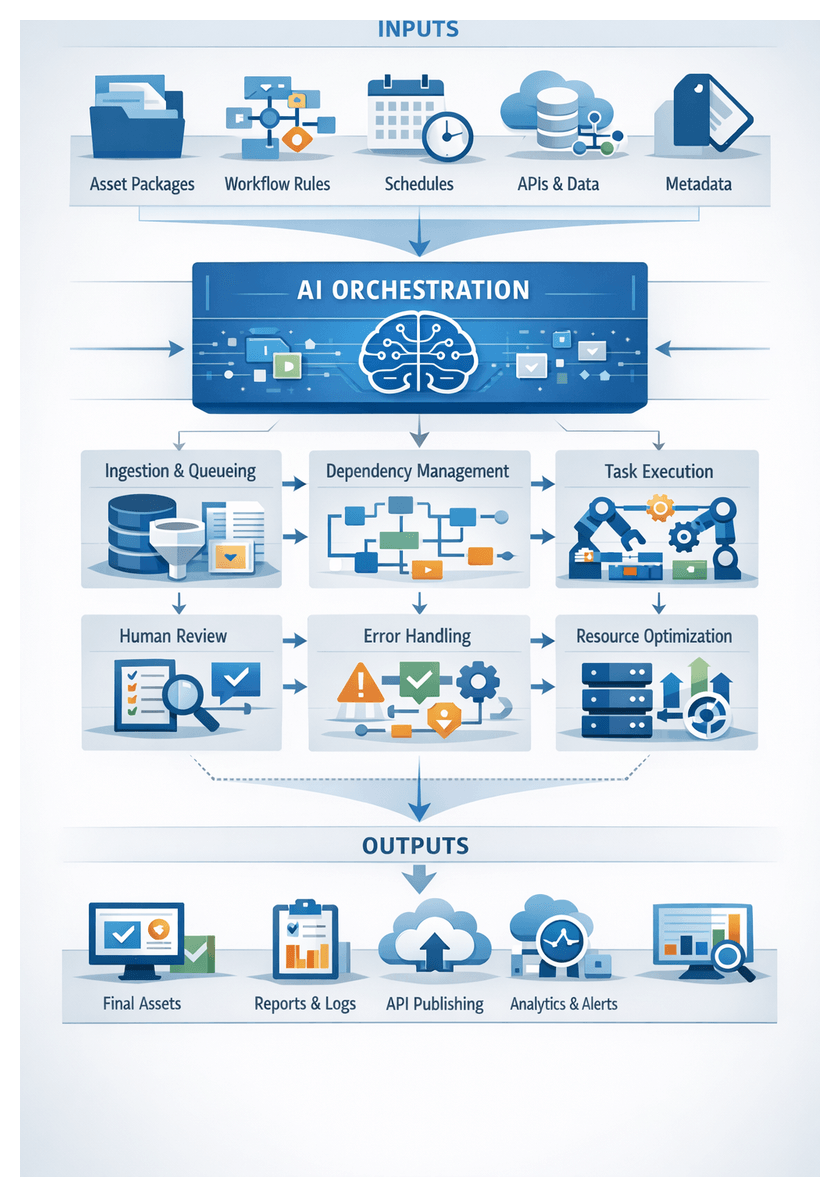
Purpose and Core Objectives of AI-Driven Workflow Orchestration
In complex social media content repurposing frameworks, an AI-driven orchestration layer functions as the central command center. It aligns downstream tasks—from content transformation and adaptation to quality control and publishing—into a coherent, automated sequence. By eliminating manual handoffs and enforcing service-level agreements, orchestration minimizes operational delays, maintains full pipeline visibility, and ensures end-to-end automation under predefined rules and priorities.
The core objectives of the orchestration stage include:
- Task coordination and scheduling that respects dependencies and deadlines.
- Error handling and recovery with automatic retries, escalation paths, and fallback mechanisms.
- Resource optimization across compute, storage, and AI services based on priority and workload.
- Real-time monitoring and reporting of pipeline status, task progress, and SLA compliance.
- Dynamic routing that adapts workflow paths to new inputs, shifting priorities, or exception conditions.
- Integration management with content management systems, digital asset repositories, metadata databases, and external APIs.
- Auditability and traceability through comprehensive logs of decisions, inputs, outputs, and user interactions.
Essential Inputs, Prerequisites, and Integration Management
Effective orchestration relies on well-defined inputs, system readiness, and secure integrations. Key input categories include:
- Asset Packages: Bundles of repurposed content outputs—text drafts, video scripts, image files, and metadata profiles—each with a manifest detailing file locations, formats, brand guidelines, and version information.
- Workflow Definitions: Declarative or code-based logic that specifies task sequences, parallel branches, conditional gates, timeouts, retry policies, and escalation paths. These may be authored using Apache Airflow or Prefect.
- Schedule Parameters: Calendar triggers, cron expressions, event-driven triggers, or manual kick-offs that define when tasks start.
- API Endpoints and Credentials: Connection details for external services such as Contentful, SharePoint, digital asset management, social media APIs, and AI-as-a-Service providers like OpenAI’s GPT APIs or Hugging Face Inference APIs.
- Dependency Maps: Graph representations of task interdependencies to prevent deadlocks and ensure tasks execute only when prerequisites are met.
- Content Metadata and Business Rules: Structured information on content type, target platform, audience segment, language, regulatory classification, brand voice, and compliance guidelines.
- Operational Thresholds: Limits for resource usage, execution times, concurrent tasks, and failure rates that inform scaling and error escalation.
Prerequisites and conditions for successful orchestration include:
- Validated Deliverables: Upstream assets and metadata must pass audits, content classification, ideation sign-offs, and quality control reviews.
- Infrastructure and Access Configuration: Network connectivity, role-based access controls, secrets management, and capacity planning for compute and storage resources.
- Workflow Engine Configuration: Deployment of orchestration platforms—such as AWS Step Functions or Apache NiFi—in cluster mode, with configured agents, worker nodes, monitoring via Prometheus or Grafana, and error queues like RabbitMQ or Apache Kafka.
- Governance Alignment: Defined service-level objectives, data retention policies, regulatory workflows for industries like finance or healthcare, and approval processes that delineate automated continuation versus human intervention.
Integration management ensures seamless interactions with downstream systems:
- Quality Control APIs: Endpoints for validation and compliance checks.
- Scheduling Engines: Interfaces for publication scheduling, approval workflows, and channel reservations.
- Reporting and Analytics Platforms: Data pipelines ingesting logs and metrics into dashboards or BI tools.
- Collaboration Tools: Notifications via Slack, Microsoft Teams, or Jira to keep stakeholders informed.
Orchestration Workflow and Task Flow
The orchestration workflow converts abstract deliverables into executable tasks, routing work items through AI agents, human reviewers, and external systems. Coordination is maintained via a controlled sequence of phases:
Ingestion and Queueing
Transformed assets enter an ingestion layer that validates input packages against schemas, extracts metadata—such as asset identifiers, target platforms, priority levels, and compliance flags—and assigns items to task queues. A metadata broker groups similar items for batch processing, supporting FIFO and priority-based modes to expedite high-stakes content.
Dependency Resolution and Prioritization
Tasks are modeled as a directed acyclic graph based on predefined workflow templates. The orchestration engine dynamically adjusts the DAG to insert remediation nodes or reschedule downstream tasks in response to failures or revisions. Business rules permit priority overrides for time-sensitive posts, enabling parallel processing and accelerated paths.
Task Execution and AI Agent Coordination
With dependencies resolved, the orchestration engine dispatches tasks to specialized AI agents—natural language generation services for copy rewriting, computer vision models for image cropping and style transfer, voice synthesis modules for narration, and metadata extraction engines. Agents retrieve input payloads from a central object store, process them according to task parameters, and return standardized JSON envelopes containing output URIs, processing logs, performance metrics, and confidence scores. Heartbeats and execution times are monitored to trigger retries or escalations.
Human Task Integration and Notifications
Compliance reviews, legal approvals, and creative sign-offs require human judgment. The engine creates review tickets with contextual asset links, sets SLA targets, and sends notifications via email, chat platforms, or in-app alerts. Reviewers use consolidated dashboards to access pending items, historical comments, and guidelines. Their feedback updates the task graph in real time.
Error Handling and Recovery
Failures—such as timeouts, API unavailability, or validation violations—are addressed through:
- Automatic retries with exponential backoff.
- Fallback routes to alternate AI models or manual queues.
- Escalation workflows notifying administrators when thresholds are exceeded.
- Graceful degradation, for example generating text-only versions if image transformations fail.
Dynamic Scaling and Resource Management
Autoscaling policies interface with cloud resource managers to adjust AI agent instances and containerized environments based on queue depths and utilization. Threshold monitors track usage, while scaling policies define minimum and maximum instance counts. Resource tagging enables accurate cost allocation to campaigns or departments.
Monitoring, Logging, and Analytics
Real-time metrics—task throughput, latency, agent success rates, queue backlogs, SLA compliance, and error incidents—feed dashboards built on tools like Grafana and Prometheus or BI platforms. Analytics modules use telemetry to identify bottlenecks, forecast capacity needs, and recommend workflow optimizations.
Handoff and Output Delivery
Upon task completion—including AI transformations, reviews, and compliance checks—the orchestration engine compiles final assets and metadata into structured packages. Delivery mechanisms include:
- API calls to content management or digital asset platforms.
- Automated uploads to social media scheduling tools.
- Notifications to project management applications.
The handoff payload contains final asset URIs, version tags, platform-specific metadata, and audit logs, enabling downstream systems to ingest content without further transformation.
AI Roles in Orchestration
AI-driven orchestration embeds several critical roles to optimize workflow performance:
- Agent Coordination and Task Scheduling: AI models analyze incoming assets, estimate processing times, and sequence operations to maximize parallelism while enforcing SLAs.
- Predictive Monitoring and Proactive Error Detection: Anomaly detection flags deviations in processing times or error rates, root-cause suggestion recommends remediation, and automated health checks validate system components like RabbitMQ or Apache Kafka.
- Resource Allocation and Throughput Optimization: Time-series forecasting predicts peak loads and autoscaling thresholds in environments like Kubernetes, while reinforcement learning agents balance cost and performance.
- Intelligent Exception Handling and Retry Logic: Adaptive strategies determine contextual retries, fallback services, and graceful degradation paths, supporting self-healing pipelines.
- Adaptive Prioritization and SLA Management: Regression models score assets by urgency and impact, driving scheduling sequences. Real-time dashboards built on platforms such as Grafana and Prometheus enable proactive interventions and escalation workflows.
- Seamless Integration with APIs: Connector libraries and semantic data mapping harmonize metadata schemas across services like Apache Airflow and Prefect, while event-driven triggers automate workflow initiation.
- Facilitating Human-AI Collaboration: AI-generated review checklists, smart notifications, and feedback loops guide human approvers and refine future routing and error classification.
Orchestration Outputs and Handover to Downstream Systems
The orchestration stage produces a suite of artifacts and signals for downstream consumption:
- Execution Logs: Detailed records of task executions, including timestamps, status codes, and resource metrics.
- Status Reports: Real-time summaries of asset progress, pending actions, and estimated completion times.
- Asset Packages: Bundles of transformed assets, original sources, AI variants, and enriched metadata for quality control and scheduling.
- API Payloads and Triggers: Structured data packets formatted for CMS, DAM, scheduling, or message bus consumption.
- Error and Exception Reports: Diagnostics with error codes, stack traces, and remediation suggestions.
- Throughput Metrics: Performance measures for capacity planning and optimization.
Key Dependencies and Integration Points
Orchestration outputs depend on integrations with:
- Content management systems such as Contentful or Bynder.
- External AI service endpoints like OpenAI’s GPT APIs and Hugging Face Inference APIs.
- Workflow engines such as Prefect, Apache Airflow, or Dagster.
- Metadata repositories for controlled vocabularies and taxonomy services.
- Scheduling and distribution platforms such as Hootsuite or Buffer.
- Monitoring and analytics tools like Datadog, New Relic, Looker, and Tableau.
Handover to Downstream Stages
- Quality Control Invocation: Asset packages and exception reports are queued for human review via webhooks or project management tools.
- Scheduling and Publishing: API payloads are forwarded to scheduling engines with publication timestamps, channel identifiers, and business-rule validations.
- Analytics Onboarding: Metrics and status reports are streamed into analytics platforms for dashboarding and feedback loops into AI models.
- Asset Archives: Final assets and metadata are archived in digital asset management systems for version control and future retrieval.
- Error Escalation Paths: Unresolved exceptions trigger alerts with execution log links and remediation steps via email, Slack, or other channels.
By standardizing outputs, dependencies, and handover mechanisms, AI-driven orchestration ensures end-to-end traceability, operational resilience, and accelerated content velocity across social media operations.
Chapter 8: Human-in-the-Loop Quality Control and Governance
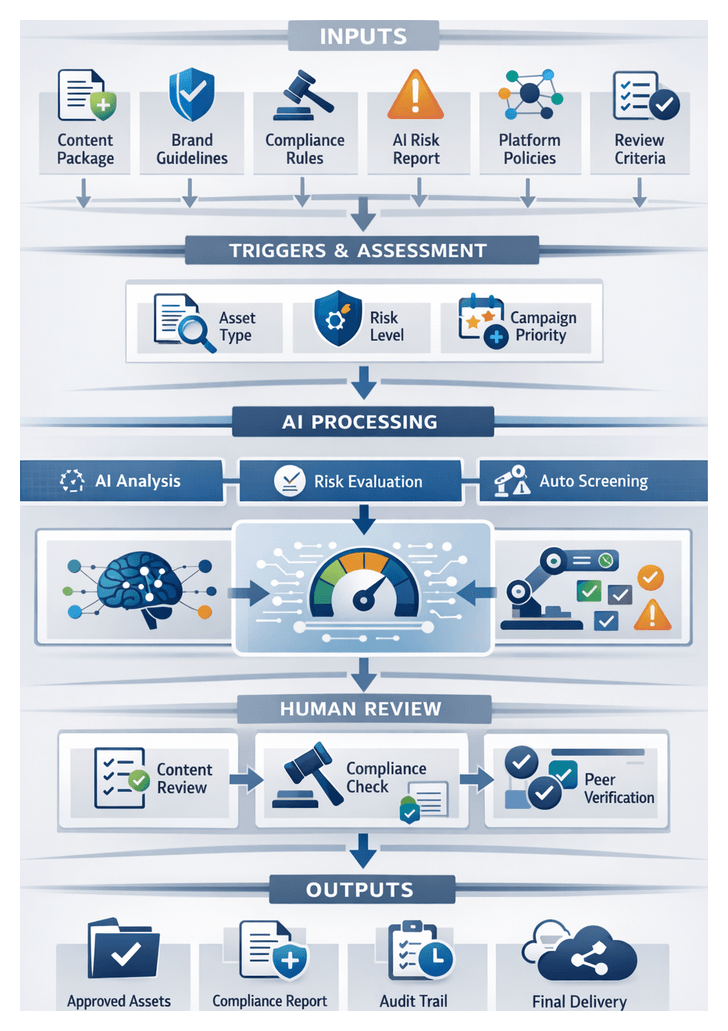
Quality Control Goals and Objectives
The human-in-the-loop quality control stage ensures that every repurposed content asset aligns with brand voice, meets regulatory and compliance standards, and resonates with audience expectations. By embedding structured review checkpoints, organizations balance the speed of AI-driven content operations with the nuanced judgment of human experts, preventing costly errors, mitigating legal and reputational risks, and maintaining consistency across channels.
Primary Objectives
- Brand Consistency: Verify tone, style, terminology and visual elements against brand guidelines.
- Regulatory Compliance: Confirm adherence to industry regulations, legal disclaimers and intellectual property requirements.
- Accuracy and Factual Integrity: Ensure data points and references are correctly cited and sourced.
- Cultural Sensitivity: Screen for bias, offensive language or imagery.
- Platform Policy Compliance: Validate adherence to channel-specific rules and guidelines.
- Production Quality: Assess grammar, spelling, visual clarity and overall polish.
Triggers, Inputs and Thresholds
Input Triggers and Review Conditions
Not every asset requires the same level of review. Triggers based on asset type, risk level, campaign priority and platform rules initiate the quality control process and optimize reviewer workload by focusing attention where it matters most.
- Asset Type and Format: Long-form scripts or regulated-industry materials warrant deeper review than low-stakes captions.
- Risk and Sensitivity Scores: AI-driven classifiers assign risk scores; assets above thresholds are routed for manual review.
- Regulatory Requirements: Financial or medical content invokes mandatory legal checks.
- Campaign Tier: High-profile launches or crisis communications receive enhanced scrutiny.
- Platform Rules: Channels with strict community guidelines prompt specialized review workflows.
- Custom Business Rules: Embargoed releases or trademark usage flag assets for additional checks.
Required Inputs
- Repurposed Asset Package: Draft content, metadata and style annotations from the orchestration stage.
- Brand Guidelines and Style Manuals: Documents detailing voice, tone, visual standards and glossaries.
- Compliance Frameworks: Regulatory guidelines, legal checklists and template disclaimers.
- AI-Generated Risk Reports: Analyses from tools that flag potential policy violations or sensitive content.
- Platform Policy Summaries: Reference guides for character limits, content types and privacy requirements.
- Review Logs and Feedback Histories: Past quality control findings and reviewer comments.
- Reviewer Roles and Assignments: Definitions of responsibilities among brand, legal and editorial teams.
Risk and Compliance Thresholds
Preconfigured thresholds determine review depth, balancing speed with thoroughness. Quantitative risk assessments and qualitative guidelines guide which assets require AI-only checks versus full human review.
Risk Score Bands:
- Low Risk (0–30): AI validation only, no manual review required.
- Medium Risk (31–60): Light review by content editor.
- High Risk (61–100): Full review by legal/compliance team.
Sentiment Polarity Index:
- Neutral to Positive: Standard review.
- Strongly Negative or Controversial: Escalate to senior reviewer.
Compliance Flags Count:
- Zero Flags: No manual intervention.
- One to Two Flags: Quick editorial pass.
- Three or More Flags: Comprehensive legal review.
Platform Violation Probability:
- Probability < 10%: Publish after AI check.
- Probability 10–25%: Human spot-check.
- Probability 25%: Manual policy audit.
Quality Control Workflow
Triggering and Assignment
After AI-driven adaptation, the orchestration layer issues a quality control trigger. This triggers packaging of the final draft, metadata and AI analysis reports, and the assignment of a QC ticket in the content management system.
- Asset Complexity and Type
- Regulatory or Compliance Risk
- Campaign Priority and Timeline
- Revision History and Escalation Flags
Reviewer Allocation
- Primary Reviewer: Expert in brand tone and platform conventions.
- Secondary Compliance Review: Legal or regulatory specialist if required.
- Peer Verification: Third reviewer for high-stakes assets.
Review Checklists and AI Guidance
Reviewers follow dynamic checklists tailored to asset type and context. AI tools provide inline suggestions and flag deviations from approved patterns, enabling faster decision-making.
- Brand Voice Consistency
- Factual Accuracy
- Legal and Compliance Disclosures
- Platform Formatting Rules
- Image and Video Standards
Iteration and Audit Trail
- Reviewer annotates required edits or checklist items.
- AI agents propose corrections or alternative phrasing.
- Content creators or AI modules update the asset.
- Updated versions re-enter the review queue.
- Version history and reviewer actions are recorded.
Comprehensive audit trails capture timestamps, reviewer identities, applied AI suggestions and annotations, preserving accountability and traceability.
AI-Powered Quality Assurance
AI enhances human review by automating routine checks across linguistic, visual, compliance and metadata dimensions. Integrated into an orchestrated pipeline, these capabilities accelerate reviews and reduce error rates.
Language and Tone Validation
- Grammarly for grammar, spelling and punctuation checks.
- Acrolinx and Writer for brand voice enforcement.
- IBM Watson Natural Language Understanding for sentiment and tone analysis.
Content Moderation and Policy Compliance
- Perspective API and Microsoft Content Moderator for text moderation.
- Clarifai and IBM Watson Visual Recognition for image and video screening.
- Custom rule engines enforce client-specific policies and legal disclaimers.
Visual Consistency Verification
- Brandfolder and Clarifai for logo detection and trademark checks.
- Adobe Sensei for color palette and typography validation.
- Automated layout analysis ensures adherence to social media templates.
Accessibility and Inclusivity
- Microsoft Azure Computer Vision and Google Cloud Vision for alt-text generation.
- IBM Watson Speech to Text and Azure Speech to Text for captioning and transcript validation.
- Automated contrast and readability tests against WCAG guidelines.
Metadata Integrity and SEO
- MonkeyLearn and IBM Watson NLU for keyword extraction and tagging.
- Hashtag optimization based on performance projections and content calendar alignment.
- Validation of titles and descriptions for character limits and SEO best practices.
Outputs and Handoff Procedures
Approved Asset Packages
Final deliverables include all content files in platform-specific formats, embedded version metadata and style annotations, and localization and accessibility resources.
- High-resolution images, video masters and finalized copy.
- Version identifiers, timestamps and reviewer sign-off records.
- Style and compliance annotations for brand and legal adherence.
- Closed captions, alt-text summaries and regional disclaimers.
Governance Logs and Quality Reports
- Review checkpoint records with pass/fail status and flagged issues.
- Issue tracking details, resolution notes and re-review approvals.
- Policy reference attachments and escalation logs.
- Defect rate analysis, review turnaround metrics and recurring feedback themes.
- Workflow optimization recommendations.
Logs are stored in platforms such as Jira or Monday.com and reports delivered via Adobe Analytics or Microsoft Power BI.
Dependency Matrix and Release Criteria
- Cross-stage metadata alignment with asset catalogs.
- Orchestration trigger readiness and API endpoint specifications.
- Version control tagging consistency in repositories or DAM systems.
- Compliance with channel-specific dimension and metadata requirements.
Automated gatekeeping via tools like Zapier or Integrate.io ensures all dependencies are satisfied before handoff.
Handoff Mechanisms
- API-Driven Transfer: Pushing packages into platforms such as Hootsuite or Buffer via REST or GraphQL.
- Asset Management Workflows: Publishing to Bynder or Cloudinary with automated triggers updating calendars in Asana or Slack.
Notifications, Escalations and Monitoring Integration
- Automated alerts to content operations teams on handoff readiness or transfer errors.
- Escalation rules with SLAs and reassignment protocols.
- Audit trails of handoff events recorded in Splunk.
- Version tags in analytics and reviewer commentary as metadata in performance dashboards.
- Feedback loops connecting performance insights back to governance for continuous improvement.
Chapter 9: Scheduling, Publishing, and Distribution Automation
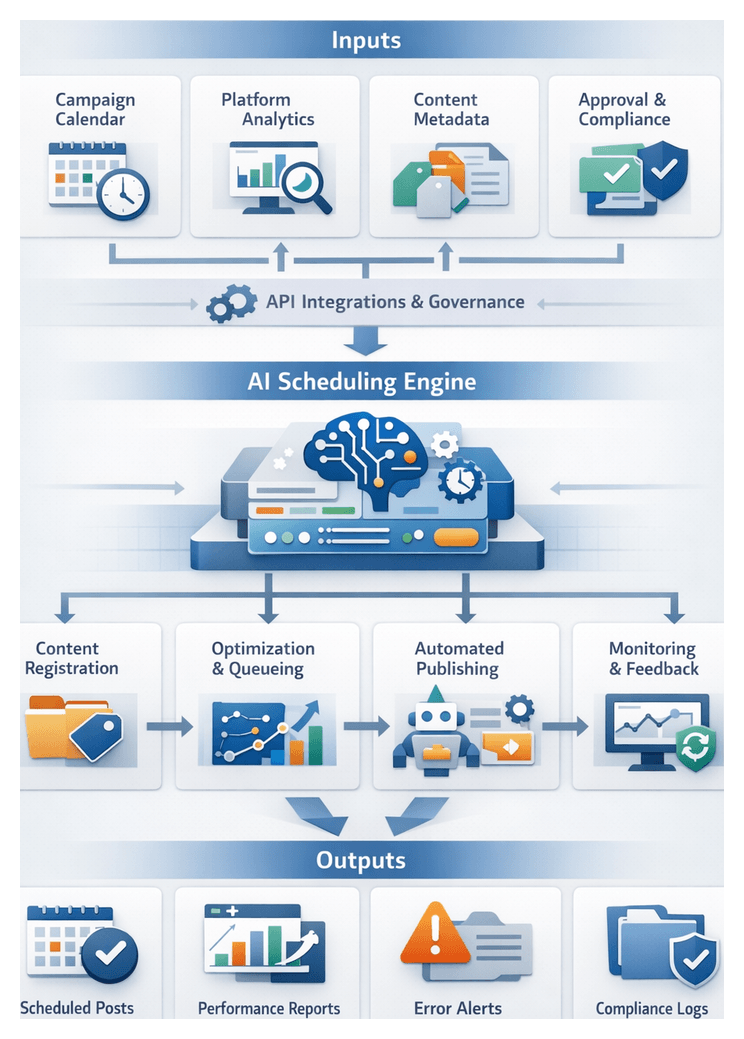
Scheduling Objectives and Data Inputs
The scheduling stage establishes systematic timing and coordination for distributing repurposed content across multiple social media channels. By automating deployment at optimal moments, organizations maximize reach, engagement and consistency while reducing manual errors. This stage synthesizes strategic campaign calendars, historical engagement analytics and channel best practices into a unified scheduling engine that aligns with brand governance and legal requirements. Automated scheduling functions as a critical control point in the end-to-end AI-driven content workflow, enabling real-time adjustments and continuous optimization based on performance signals.
Effective scheduling relies on comprehensive inputs that capture both strategic and tactical requirements. Essential data sources include:
- Content Calendar Frameworks: Master schedules outlining campaign milestones, product launches, seasonal events and thematic windows, often maintained in project management tools or editorial calendars.
- Channel Preferences and Algorithms: Audience active hours, time-zone distributions, peak engagement windows and post-frequency restrictions sourced from platform analytics or third-party tools such as Buffer, Hootsuite and Sprout Social.
- Asset Metadata and Classification Tags: Content format, topic clusters, language variants, content pillar alignment and priority levels generated during audit and analysis phases.
- Approval and Compliance Statuses: Flags confirming human review, brand compliance and legal sign-off that govern automation triggers.
- Supportive Data: Audience demographics, sentiment analysis reports and real-time trend signals from social listening platforms.
To ensure reliable operation, several prerequisites must be satisfied before scheduling automation can commence:
- API Integrations and Access Tokens: Secure connections to social media APIs and third-party platforms with managed authentication credentials and permission scopes.
- CMS and DAM Alignment: Integration with content management or digital asset management systems to retrieve approved asset versions and metadata updates.
- Governance Policies and Posting Guidelines: Documented brand voice guidelines, image usage policies, caption length limits and regulatory rules that inform validation scripts.
- Role-Based Permissions: Access controls specifying which users or system roles can modify schedules or override recommendations.
- Failure and Exception Handling Protocols: Procedures for managing API rate-limit errors, publishing failures and system downtime, including retry logic and notifications.
With these inputs and conditions in place, automated scheduling engines deliver a steady, predictable brand presence, eliminate duplication risks and refine posting recommendations through closed-loop performance analysis.
Scheduling and Orchestration Workflow
The scheduling workflow transforms approved content packages into timed publishing actions across channels, balancing AI-driven optimization with final human oversight. Key actors include social media managers, content operations specialists, compliance officers and marketing leadership. Core systems encompass CMS platforms, AI-based schedulers, social media APIs and collaboration suites such as HubSpot or Slack. Critical inputs are finalized content sets, approval metadata, channel calendars and performance forecasts.
Pipeline Initialization and Task Registration
Once content passes quality control, approved packages—comprising media assets, captions, hashtags, metadata tags and intended posting windows—are ingested into the orchestration platform. AI schedulers like Buffer and Later receive packages via API or webhook, while enterprise suites such as Sprinklr and Hootsuite integrate directly with the CMS.
During initialization:
- Content Package Registration: Assets are tagged with campaign IDs, target audience segments and priority levels.
- Approval Metadata Attachment: Final sign-off timestamps, reviewer comments and compliance stamps are embedded.
- Platform Mapping: Format requirements, character limits and optimal time windows are assigned per channel.
- Conflict Detection: Scheduled items are cross-checked to prevent overlaps or content cannibalization.
- Time Zone Alignment: Global campaigns adjust posting windows to regional peak hours.
This phase yields a ranked queue of scheduled items ready for optimization and dispatch.
Dynamic Queue Orchestration
AI agents continuously monitor the task queue, applying business rules and performance forecasts to refine posting sequences. Platforms like CoSchedule and Lately.ai incorporate predictive analytics modules that leverage sentiment analysis, audience heatmaps and engagement trends.
- Priority Evaluation: Tasks are reordered based on topical relevance, urgent campaigns and emerging trends.
- Slot Optimization: Algorithms select optimal posting slots by assessing historical click-through, reach and conversion metrics.
- Batch Coordination: Series content is scheduled with consistent time gaps to preserve narrative flow.
- Error Handling Rules: Failed format validations or API errors route tasks to retry queues or human review.
- Dependency Management: Synchronized posts for influencer collaborations or teaser campaigns wait until all prerequisites are met.
Automating these operations eliminates manual rescheduling and accelerates time-to-market while logging each decision for audit and improvement.
Trigger-Based Execution and Monitoring
Execution is governed by time-based triggers that fire at scheduled timestamps and event-based triggers that respond to external or internal signals, such as trending topic alerts or campaign milestones. The flow proceeds through these steps:
- Trigger Reception: The orchestrator listens for timer events or webhook notifications.
- Pre-Publish Validation: Asset integrity, caption formatting and compliance flags are checked.
- API Dispatch: Posts are sent via platform interfaces—such as Instagram Graph API, Twitter API or LinkedIn Marketing Developer Platform.
- Confirmation and Logging: Successful posts generate receipts; failures trigger retries or alerts.
- Post-Publish Monitoring: Real-time tracking of engagement metrics initiates rapid optimization loops.
This approach supports both scheduled campaigns and reactive content strategies, ensuring agility without sacrificing governance.
System Integrations and Data Handshakes
Seamless integration between the CMS, AI scheduler, collaboration tools and social platforms maintains data consistency and transparency. Data exchanges occur at defined checkpoints:
- On import, the CMS pushes metadata to the scheduling engine.
- Following slot assignment, the scheduler updates the CMS with planned publish times.
- Upon trigger activation, the scheduler confirms dispatch status back to the CMS and collaboration suite.
- Real-time engagement data flows from platform APIs into monitoring dashboards and back into the orchestration engine for adaptive rescheduling.
Standardized RESTful APIs and webhook events, combined with secure authentication tokens and rate-limit handling, ensure enterprise-grade reliability.
Human-in-the-Loop Coordination
Critical review points preserve brand integrity and compliance within the automated pipeline:
- Pre-Execution Approval: High-visibility campaigns require final sign-off from marketing leads or legal officers.
- Exception Handling: AI-generated error flags or API failures send alerts to content operations teams.
- Performance Review Triggers: Negative sentiment spikes or unusual engagement patterns invoke human review before subsequent posts.
- Ad Hoc Interventions: Authorized users can override scheduled assets for crisis communications or live events.
Embedding these touchpoints avoids ad hoc process gaps and ensures timely oversight.
Best Practices
To maximize the benefits of automated scheduling, organizations should:
- Define clear approval thresholds for different campaign types.
- Continuously refine predictive models with fresh performance data.
- Standardize metadata schemas for consistent API interactions.
- Train teams on exception protocols to handle scheduling errors and rapid interventions.
- Audit orchestration logs regularly to identify process improvements and anomalies.
AI-Driven Distribution Capabilities
Artificial intelligence elevates distribution by automating decision-making and adapting to real-time signals. Key AI roles include predictive scheduling, dynamic personalization, automated approval management, intelligent error handling, performance-adaptive learning and integrated analytics.
Predictive Scheduling and Timing Optimization
Machine learning models analyze historical engagement data, audience demographics and content attributes to forecast optimal posting times. Data ingestion from analytics platforms or social media APIs is followed by feature engineering and supervised learning, producing prioritized scheduling recommendations. Tools such as Hootsuite, Buffer and Later embed these capabilities to reduce guesswork and scale distribution confidently.
Content Personalization and Dynamic Targeting
Clustering algorithms and collaborative filtering engines map content variants to audience segments based on preferences, geography, language and behaviors. Real-time decision systems assemble the appropriate variant and metadata for each channel, while A/B testing frameworks feed results back into personalization models. Workflows built with Zapier and deep-learning features in platforms like Sprout Social drive higher relevance and engagement.
Workflow Automation and Approval Management
Robotic process automation and natural language processing streamline multi-stage approval workflows. AI agents route content based on metadata, scan for policy violations, suggest revisions aligned with style guides and log every review action. Platforms such as CoSchedule integrate approval workflows into calendar views, while custom RPA solutions connect to internal governance systems.
Error Handling and Intelligent Rerouting
AI-driven monitoring agents detect anomalies in publishing tasks and system logs, performing root cause analysis and automated remediation. Unsupervised models flag deviations, decision trees initiate retries or endpoint switches, and escalation alerts deliver prescriptive diagnostics to operations teams. Custom Zapier bots or proprietary agent frameworks can implement self-healing pipelines for higher reliability.
Performance-Adaptive Scheduling
Reinforcement learning techniques treat engagement metrics as reward signals, iteratively optimizing posting cadences, formats and targeting rules. Reward modeling, policy iteration and exploration-exploitation balancing converge on high-performance strategies, with updated rules deployed automatically under human oversight to ensure continuous improvement.
Integration with Analytics and Feedback Systems
Bidirectional data flows between publishing schedulers, analytics dashboards, CRM systems and social listening tools close the feedback loop. AI agents manage API orchestration, sentiment analysis, attribution modeling and automated reporting. Platforms like Sprout Social and middleware such as Zapier exemplify integrated ecosystems that transform distribution into a data-driven cycle of create, distribute and analyze.
Distribution Outputs and Continuous Improvement
At the culmination of scheduling and automated publishing, the system generates outputs that feed performance monitoring, stakeholder reporting and governance archives. Effective management of these outputs ensures a smooth transition into continuous optimization.
Publication Logs and Execution Records
- Asset Identifier: Links each published item to its original repurposed asset.
- Channel Details: Platform name, account identifiers and content type.
- Timestamp and Time Zone: Publication time for schedule reconciliation and time-based analysis.
- Approval Status Snapshot: Reviewer identity, review timestamp and conditional notes.
- Orchestration Context: Workflow engine task identifiers and execution metadata.
Distribution Performance Summaries
- Initial Engagement Indicators: Impressions, clicks, reactions and comments captured within a predefined window post-publication.
- Reach and Frequency Estimates: Aggregated reach data and audience frequency metrics.
- Content Metadata Snapshot: Topic tags, audience segment labels and campaign identifiers.
- Performance Flags: AI-driven alerts for underperforming or outperforming content, generated by tools such as Hootsuite or Sprinklr.
Error and Exception Reports
- Error Code and Description: Standardized failure scenarios (authentication, rate limits, format errors).
- Retry Attempts and Outcomes: Automated retry logs with back-off intervals.
- Platform Response Payload: Raw API responses for debugging.
- Dependency Traceback: References to upstream asset versions and workflow tasks.
Archival Packages and Governance Records
- Final Asset Versions: Media files and text content exactly as published.
- Approval Audit Trail: Reviewer comments, timestamps and compliance notes.
- Scheduling Metadata: Original parameters, time zone conversions and adjustments.
- Distribution Log Bundle: Publication logs and error reports for legal or archival review.
Dependencies and Integration Points
Distribution outputs rely on:
- Scheduling Engine: Detailed parameters and trigger sequences.
- Quality Control Module: Final approval signatures and compliance flags.
- Content Repository: Version-controlled asset storage.
- Platform APIs: Distribution conduits with rate-limit and policy monitoring.
- Orchestration Logs: Context for queued, prioritized and executed tasks.
Handoff to Performance Monitoring
- Data Ingestion Pipelines: Real-time feeds into analytics platforms such as Google Analytics or Tableau.
- Alert Triggers: AI-driven notifications when performance flags cross thresholds.
- Metadata Synchronization: Updates to campaign management tools with actual publication data.
- Stakeholder Reporting: Automated summary reports via email or collaboration platforms.
Next Steps for Continuous Improvement
- Validate Early Engagement Data: Compare performance summaries against benchmarks for immediate adjustments.
- Adjust Upcoming Schedules: Refine posting times and frequency based on AI recommendations.
- Refine Content Themes: Prioritize topics with higher resonance in the ideation engine.
- Audit Handoff Quality: Review errors and exceptions to enhance handling logic and integrations.
- Archive Learnings: Store insights in a shared knowledge base for stakeholder access.
By treating distribution outputs as catalysts for iterative refinement, organizations maintain a dynamic, data-driven content lifecycle that scales strategically and maximizes business impact.
Chapter 10: Performance Monitoring and Continuous Optimization
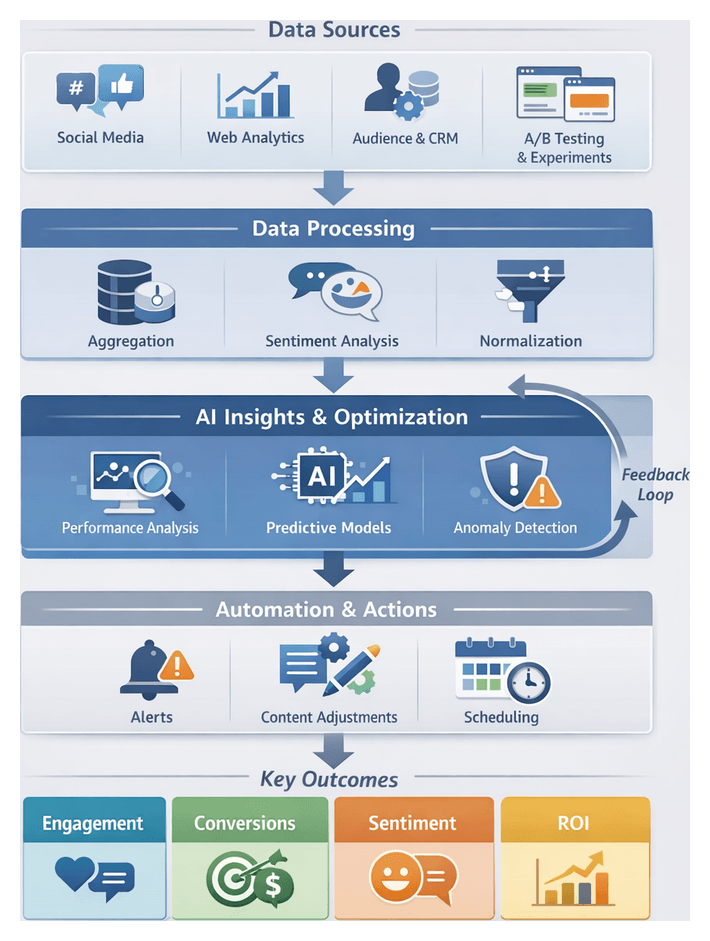
Monitoring Objectives and Strategic Alignment
The performance monitoring and continuous optimization stage establishes the feedback loop that turns repurposed content into a living asset. By tracking performance across social media channels in real time, organizations gain insights to validate initial hypotheses, inform refinements, and demonstrate return on content investment. Monitoring aligns content operations with strategic priorities—such as increasing share of voice, driving website traffic, or enhancing customer sentiment—ensuring that every asset supports measurable business goals.
Key objectives of this stage include:
- Validating Resonance: Confirming that content variants resonate with target segments as predicted by AI-driven ideation engines.
- Informing Optimization: Identifying performance bottlenecks in headlines, visuals, timing, or distribution to guide AI agents or human teams in iterative refinements.
- Demonstrating ROI: Linking engagement metrics to lead generation, conversion rates, and brand equity to quantify the impact of repurposing workflows.
Strategic alignment requires that monitoring outputs feed into annual planning and agile marketing sprints. Cross-functional coordination among marketing leadership, analytics teams, and content operations defines success thresholds, delegates decision rights for optimization interventions, and embeds performance insights into broader marketing initiatives.
Key Performance Indicators and Data Inputs
Operationalizing the monitoring stage hinges on defining KPIs that capture content impact across five categories:
- Engagement Metrics: Likes, reactions, saves, comments, shares, and click-through rates.
- Reach and Awareness: Impressions, unique views, follower growth, and hashtag performance.
- Conversion and Attribution: Landing page visits, form submissions, e-commerce transactions, revenue attribution, and lead quality.
- Sentiment and Brand Equity: Net promoter score variations, sentiment analysis outputs, and share of voice in social listening.
- Content Efficiency: Time-to-publish, cost per engagement, and resource utilization comparing AI-driven tasks to manual processes.
Each KPI links to specific content categories to enable granular analysis. Establishing target ranges during planning ensures rapid identification of underperforming assets for remediation or A/B testing.
Effective monitoring integrates diverse data inputs:
- Native Platform Analytics: Facebook Insights, Instagram Insights, LinkedIn Analytics, Twitter Analytics, video metrics from YouTube Studio and TikTok Pro.
- Social Media Management Tools: Sprout Social, Hootsuite, Brandwatch, Talkwalker for cross-channel aggregation and sentiment analysis.
- Web and Conversion Analytics: Google Analytics, Adobe Analytics, UTM parameters and tag management systems for attribution.
- Audience and CRM Data: Customer profiles and behavioral signals from Salesforce, HubSpot, Microsoft Dynamics, email platforms, webinar tools, and offline interactions.
- Experimentation Platforms: Optimizely, VWO, and internal test harnesses for AI-generated creative variations.
- AI-Generated Insights: Automated theme detection, engagement prediction scores, and anomaly alerts.
Data pipelines and integration platforms such as MuleSoft or Zapier ingest and unify these sources into a data warehouse or analytics lake on AWS, Azure, or Google Cloud Platform, laying the foundation for cross-channel reporting and AI-driven analysis.
Prerequisites for reliable monitoring include:
- Data Governance: Naming conventions for assets, campaigns, and UTM tags; access controls for analytics tools.
- Baseline Benchmarks: Historical performance metrics and industry standards for engagement and conversion.
- Segmentation and Metadata Tagging: Consistent taxonomy across CMS, social tools, and analytics platforms.
- AI Monitoring Agents: API credentials and alert configurations in platforms like Datadog or New Relic.
- Reporting Infrastructure: Dashboard templates, visualization standards, and refresh intervals aligned to campaign cadence.
- KPI Definitions and Cadence: Documented metric definitions, calculation formulas, reporting intervals, and stakeholder distribution lists.
Performance Workflow and Feedback Loop
This stage orchestrates the flow of raw engagement data, channel interactions, and qualitative feedback through a structured analytics pipeline that triggers downstream actions. It ensures every performance indicator feeds back into content planning, ideation, and scheduling for continuous optimization.
Data Ingestion and Processing
Real-time connectors harvest metrics from social APIs (Facebook Graph API, Twitter API, LinkedIn Marketing API), web analytics (Google Analytics), AI sentiment services, and CRM feedback modules. Message queues or event buses—implemented with Apache Kafka or AWS Kinesis—ensure reliable transport. Each record is enriched with metadata from a CMS or digital asset management system.
The processing sequence includes:
- Validation: Ensuring data completeness and schema compliance.
- Aggregation: Summarizing events by asset, campaign, or time bucket.
- Normalization: Converting platform-specific metrics into unified scores.
- Enrichment: Adding sentiment tags, thematic categories, and audience segments.
- Storage: Writing processed records to data warehouses for BI and AI consumption.
Systems Interaction and Integration
Performance monitoring relies on seamless integration between:
- Content Management System for asset metadata and campaign definitions.
- ETL or data pipeline platforms that ingest and process metrics.
- Analytics engines or BI tools for KPI calculation and visualization.
- AI-driven insights platforms that apply machine learning for anomaly detection and predictions.
- Workflow orchestration suites that trigger handoffs based on performance rules.
Message brokers decouple producers and consumers, handle retries, and support dynamic scaling, enabling resilient integration of new analytics modules or third-party services.
Closed-Loop Feedback and Exception Handling
Insights from analytics engines drive rule-based triggers that feed back into upstream processes:
- Alerts for underperforming posts prompt content teams to adjust repurposing templates.
- Negative sentiment trends recalibrate AI-driven ideation themes.
- Performance summaries update content calendars and reprioritize assets.
Exception handling safeguards data integrity through retry policies, circuit breakers, and automated alerts to data engineers or content managers, maintaining trust in the analytics pipeline.
Visualization, Reporting, and Coordination
Interactive dashboards and scheduled reports surface insights across channels and assets. Dashboards offer real-time heat maps, trend charts, and segment breakdowns. Weekly or monthly reports deliver comparative ROI assessments, thematic performance reviews, and recommendations for content reallocation. Each report assigns next steps and owners, closing the loop between analysis and execution.
Cross-functional teams—content strategists, social media managers, creative leads—review insights in regular sync meetings. Integration with project management platforms creates transparent task lists and decision logs, ensuring optimization efforts align with brand guidelines and campaign timelines.
AI-Driven Continuous Optimization
Artificial intelligence amplifies continuous optimization by automating diagnostics and prescribing actions. Embedding AI at every layer accelerates insight generation, anticipates engagement shifts, and automates decisions once handled manually.
Real-Time Data Ingestion and Preprocessing
Event-driven microservices collect engagement metrics, audience demographics, and sentiment signals in real time. Automated connectors pull data from social webhooks, third-party analytics suites, and AI parsing engines. Preprocessing modules apply anomaly filters, deduplicate records, and impute missing values, delivering clean datasets to AI models and dashboards.
Automated Performance Analysis
Machine learning models identify patterns and correlations beyond human perceptibility. Key functions include:
- Sentiment and Topic Modeling: Using TensorFlow libraries and NLP APIs to classify feedback and extract emerging themes.
- Anomaly Detection: Unsupervised models trigger alerts via platforms like Sprinklr when performance deviates from benchmarks.
Predictive Modeling and Optimization Algorithms
Predictive analytics forecast impressions, engagement rates, and share velocity. Regression, ensemble, and time-series models—deployed in environments such as DataRobot or Amazon SageMaker—prioritize high-impact assets and inform risk mitigation.
Optimization extends to content and scheduling through:
- A/B Testing Automation: Real-time variant distribution, statistical significance analysis, and winner declaration without manual intervention.
- Adaptive Scheduling: Multi-armed bandits and reinforcement learning that balance exploration of new time slots with exploitation of proven high-engagement windows.
Feedback Integration and BI Connectivity
AI orchestration platforms capture model outputs and trigger actions: underperforming assets are flagged for repurposing, while top performers are cloned and retargeted. Continuous streams feed visualization tools like Tableau and Looker, offering drill-down capabilities and automated reports that democratize AI insights across the organization.
Scalable Architecture and Governance
A robust technical foundation ensures reliability and security: data lakes and warehouses centralize metrics; stream processors such as Apache Kafka or AWS Kinesis handle real-time ingestion; containerized model serving on Kubernetes provides elastic scaling. Governance frameworks enforce ethical AI through automated audits, bias monitoring, versioned datasets, and role-based access controls.
Best practices include modular architectures, automated retraining workflows, clear KPI hierarchies, explainable AI techniques, and cross-functional collaboration to balance innovation with oversight.
Optimization Outputs and Handoff Mechanisms
The continuous optimization stage delivers actionable artifacts and automated triggers that drive subsequent workflow iterations. Clear deliverables, dependencies, and handoff protocols maintain a closed-loop system that improves efficiency and consistency.
Key Deliverables
- Optimization Reports: Consolidated documents with time-series charts, sentiment trends, and conversion attribution supporting strategic reviews.
- Interactive Dashboards: Real-time visualizations with custom filters and alert configurations via APIs and analytics platforms.
- A/B Test Summaries: Statistical outcomes, lift percentages, and confidence intervals cataloged for institutional learning.
- Scorecards and Annotations: Grading of assets, enriched metadata files, and performance tags that inform downstream adaptation.
- Recommendation Lists: Ranked content themes and formats predicted to yield uplift, exportable to brief generators.
- Trigger Files: YAML or JSON definitions that automatically initiate ideation, repurposing, or re-scheduling when thresholds are met.
Dependencies and Integration Points
- Real-time metric streams from social APIs and web analytics.
- Data warehouses and lakes that support cross-channel analysis.
- Machine learning models in feature stores retrained with fresh data.
- CMS repositories where metadata annotations enrich future workflows.
- Workflow orchestration platforms that interpret trigger files and manage downstream processes.
Handoff and Automation
- Shared Repositories: Central performance libraries with access controls for strategy and creative teams.
- Automated Alerts: Email, Slack, or Teams notifications linking directly to reports and raw data extracts.
- API Exports: RESTful endpoints for ideation engines, scheduling tools, and governance platforms to pull optimization artifacts.
- Ideation Integration: Recommendation lists loaded into creative brief templates to align next-round themes with proven topics.
- Scheduling Triggers: Automated re-deployment or promotion of high-value assets in optimal windows.
Traceability and Best Practices
- Versioned Artifacts: Timestamped, version-tagged reports and model identifiers for audit and rollback.
- Immutable Logs: Append-only records capturing access, trigger executions, and manual overrides.
- Change Management: Approval gates for model retraining, threshold updates, and trigger definitions.
- Naming Conventions: Standardized file and report names with date stamps and descriptive labels.
- Modular Reports: Sectioned designs—overview, channel performance, audience insights, recommendations—for targeted consumption.
- Review Cadence: Weekly or biweekly cross-functional reviews to validate findings and refine models.
- Documentation and Training: Up-to-date method guides, data definitions, and onboarding materials.
- Iterative Feedback: Soliciting user feedback on output relevance to continuously improve handoff quality.
By delivering structured optimization outputs, automating handoff triggers, and maintaining traceability, organizations close the performance loop and ensure subsequent content cycles leverage the latest audience insights. This systematic approach drives sustained improvements in engagement, relevance, and return on content investment.
Conclusion
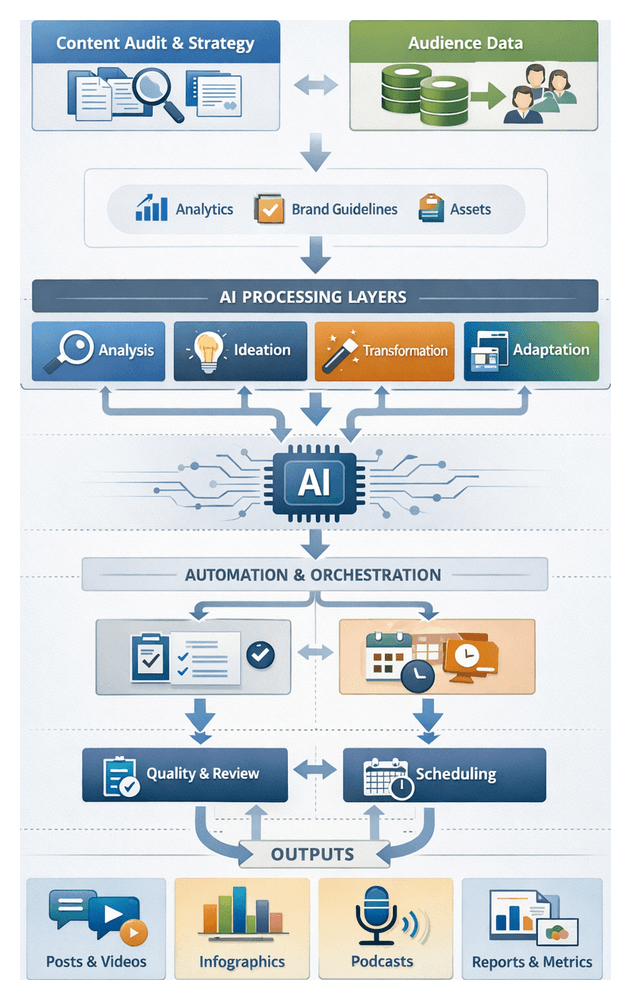
Consolidated Workflow Blueprint
The consolidated workflow blueprint provides a unified, end-to-end system for AI-driven social media content repurposing. It maps stages from initial audit through strategy, analysis, ideation, transformation, adaptation, orchestration, quality control, scheduling, and continuous optimization. By defining stage boundaries, inputs, outputs, roles, tool integrations, dependencies, and feedback loops, this blueprint aligns business objectives with operational execution and ensures stakeholder clarity across marketing, creative, AI, and IT teams.
- High-Level Stage Mapping: Sequential phases with clear transition criteria, from content audit to performance optimization.
- Input and Output Definitions: Specifications of required artifacts, data sets, and decision points for each stage.
- Roles and Responsibilities: Assignment of tasks to human teams, AI agents, and external partners with approval workflows.
- Tool and Integration Points: Inventory of AI-driven platforms such as OpenAI GPT-4 and Hugging Face, and orchestration connectors that automate asset transfers.
- Feedback Loops and Error Handling: Automated quality control feedback, exception routing, and rerun triggers for policy or compliance violations.
Key inputs for constructing this blueprint include detailed content audit reports, brand guidelines, audience segmentation data, performance benchmarks, system architecture diagrams, integration specifications, and resource allocation plans. Prerequisites span executive sponsorship, governance frameworks for data security and compliance, technology readiness with AI engines and orchestration platforms, data hygiene practices, defined roles, training programs, and a culture receptive to AI adoption.
Technical dependencies require robust API connectivity between content management systems and AI services, secure data storage, version control, and rollback capabilities. Operational dependencies include predictable publication calendars, feedback cadences, and escalation paths for content disputes. A dependency mapping exercise should identify single points of failure and resilience measures such as redundant AI instances or fallback manual processes.
- Deliverables and Validation Criteria:
- Visual workflow diagram with stages, handoffs, and feedback loops.
- Process narrative detailing objectives, inputs, outputs, and decision gates.
- Integration checklist confirming API connectivity and authentication schemas.
- Responsibility matrix mapping tasks to roles, AI agents, and vendors.
- Quality gates and acceptance criteria for stage progression.
- Risk register outlining potential disruptions and mitigation plans.
Validation involves cross-functional review sessions to confirm alignment with strategic goals and operational realities. Approval of the consolidated workflow blueprint paves the way to realize tangible business benefits, strategic value, and long-term adaptability, as detailed in the following sections.
Operational Benefits
Adoption of an AI-driven repurposing workflow yields measurable operational advantages: higher throughput, tighter brand control, dynamic scalability, cost reductions, and integrated visibility. These benefits arise from coordinated interactions among AI systems, content management platforms, human reviewers, and publishing channels.
Accelerated Throughput and Efficiency
Intelligent ingestion agents and automated transformation modules reduce processing time from hours to seconds. Platforms orchestrate parallelized workflows, leveraging models such as OpenAI GPT and Hugging Face transformers.
- Automated task queuing eliminates manual handoffs and idle time.
- Parallel processing accelerates classification, summarization, and formatting.
- Real-time error handling reroutes failed tasks without manual intervention.
- Template-driven outputs allow rapid reuse across campaigns.
Consistency and Brand Governance
Governance is embedded at every handoff via machine learning classifiers trained on corporate style guides. Automated checks enforce tone, terminology, and regulatory compliance.
- Style parameters encoded as AI configuration inputs prevent voice deviations.
- Quality control agents flag non-compliant content for human review.
- Audit trails log AI model versions, prompt parameters, and timestamps.
- Centralized policy repositories push updates to AI agents instantly.
Scalability and Flexibility
Modular services for analysis, ideation, transformation, adaptation, and orchestration enable elastic scaling. Cloud-native deployments on Amazon SageMaker and Google Cloud Vertex AI provision compute resources in response to queue depth.
- Auto-scaling orchestrators monitor throughput and spawn additional agents.
- Microservice architecture allows independent scaling and upgrades.
- Load-balanced queues distribute tasks evenly across agent pools.
- Configurable pipelines enable module bypassing for optimized resource use.
Resource Optimization and Cost Reduction
Automation liberates human teams to focus on strategic tasks. In-house AI capabilities reduce reliance on external agencies, driving direct cost savings.
- Labor hours cut through automated metadata tagging and caption generation.
- Lower agency fees via centralized orchestration platforms.
- Predictable budgeting with fixed infrastructure and licensing costs.
- Optimized compute spend through auto-scaling.
Integrated Visibility and Control
Unified dashboards aggregate logs, performance metrics, and quality flags. Managers gain real-time insight into asset status and bottlenecks.
- Real-time status boards color-code assets from audit through publication.
- Feeds from analytics tools like Sprout Social and Buffer inform repurposing patterns.
- Configurable alerts notify stakeholders of SLA breaches and compliance exceptions.
- Data-driven decision loops feed publishing insights back into strategy modules.
Strategic Value and ROI
Beyond operational gains, AI-driven workflows deliver strategic value by forecasting revenue impact, optimizing costs, enhancing brand equity, and supporting governance. Mapping AI functions to business objectives enables compelling ROI cases.
Forecasting Revenue Impact with Predictive Analytics
Predictive models ingest historical engagement, audience behavior, and market indicators to guide resource allocation and campaign planning.
- Engagement forecasting models predict click-through, shares, and conversions.
- Multi-touch attribution frameworks quantify revenue per content asset.
- Scenario planning engines model “what-if” variations for frequency and format.
Optimizing Cost Efficiencies Through Automation
Natural language engines like GPT-4 generate scripts and posts in seconds. Centralized platforms unify style rules, reducing duplication and compressing time to market.
- Significant labor cost savings via automated drafting and formatting.
- Reduced external vendor expenses through in-house AI orchestration.
- Faster responses to trends amplify engagement and conversion potential.
Enhancing Brand Equity and Audience Growth
Automated governance modules enforce brand consistency and regulatory compliance.
- Style enforcement engines flag deviations against approved lexicons.
- Personalized experiences via audience segmentation drive higher engagement.
- Consistent, high-quality content fuels organic growth and word-of-mouth referrals.
Scalability Through Modular AI Architectures
Microservice deployments and standardized APIs ensure seamless scaling and future-proofing.
- Containerized modules scale horizontally for major campaigns.
- Interoperable APIs integrate with CMS, CRM, and analytics ecosystems.
- Plug-and-play design accommodates emerging AI capabilities with minimal disruption.
Data-Driven Governance and Risk Mitigation
Policy enforcement agents, audit trails, and real-time monitoring embed compliance into workflows, reducing legal and reputational risks.
- Automated classifiers detect restricted topics and regulated language.
- Comprehensive logs support transparent audit processes.
- Continuous channel scanning enables rapid issue remediation.
Measuring ROI: Metrics and Dashboards
Clear KPIs and executive dashboards correlate AI activities with business outcomes using platforms such as Google Analytics and Power BI.
Efficiency Metrics
- Average turnaround time per content asset
- Percentage of tasks fully automated versus manual interventions
- Reduction in labor hours dedicated to repurposing
Financial Metrics
- Cost per published asset
- Incremental revenue attributed to repurposed content
- Return on ad spend (ROAS) for social media campaigns
Engagement Metrics
- Post engagement rates (likes, shares, comments)
- Audience growth velocity
- Conversion rates from social referrals
Brand Health Metrics
- Share of voice in target conversations
- Net promoter score (NPS) changes over time
- Sentiment analysis trends
Continuous Improvement Through Feedback Loops
Machine learning models retrain on fresh performance data, governance engines update policies, and orchestration systems refine scheduling. This self-optimizing cycle maximizes long-term ROI.
- Adaptive learning refines theme detection and segmentation.
- Policy refinement integrates emerging regulations and brand updates.
- Workflow tuning adjusts prioritization and resource allocation dynamically.
Adaptability and Reuse Framework
Sustaining agility in a changing social media landscape requires codified modular templates, metadata schemas, and governance guidelines. This framework defines outputs, dependencies, handoff procedures, and practices for long-term applicability.
Framework Outputs
- Modular Workflow Components: Documented process modules and decision-tree guides for each stage.
- Metadata and Taxonomy Repository: Centralized schema definitions and reusable tagging conventions.
- Template Libraries: Preconfigured ideation briefs, asset drafts, and platform-specific formats with versioned style guides.
- Adaptation Playbooks: Channel-specific guidelines and AI configuration presets for fine-tuning and formatting.
- Governance and Compliance Checklists: Risk matrices, approval workflows, and audit trails.
Dependencies and Prerequisites
- Unified Content Repository: Central asset management with version control, metadata enrichment, and AI tool interoperability.
- Performance Data Integration: Real-time analytics feeds and reporting APIs for iterative template adjustments.
- AI Model Management: Accessible registries with provenance metadata and deployment pipelines for rapid retraining.
- Governance Framework: Scalable brand guidelines, policy documentation, and automated enforcement mechanisms.
- Integration Interfaces: APIs and event-driven triggers for seamless handoff to CMS, scheduling platforms, and analytics tools.
Handoff Procedures for Downstream Teams
Documentation Package Distribution
- Publish a centralized package containing workflow diagrams, template libraries, and playbooks to an internal knowledge base or intranet.
- Version control and access rights management to maintain a single source of truth.
Training and Onboarding Workshops
- Conduct regular training sessions for content strategists, designers, and engineers on leveraging modular components for new initiatives.
- Hands-on workshops demonstrating the process of customizing templates and adapting metadata schemas for novel channels.
API Endpoint Provisioning
- Expose REST or GraphQL endpoints that allow external systems to query template definitions, taxonomy metadata, and AI model configurations.
- Provide sample code snippets and SDKs for rapid integration into third-party tools or custom applications.
Governance Gateways
- Establish approval workflows in collaboration platforms to route newly extended workflows or asset templates through legal and brand review.
- Automate compliance checks using policy-as-code frameworks to validate new channels against established guidelines.
Continuous Feedback Loop
- Schedule periodic reviews of framework artifacts with cross-functional stakeholders to capture lessons learned and emerging requirements.
- Incorporate performance insights into template versioning and adaptation rule updates, ensuring ongoing relevance.
Ensuring Long-Term Applicability
- Modular Design Principles: Decompose workflows into self-contained modules with interface contracts.
- Metadata-Driven Automation: Use rich metadata for dynamic workflow adjustments and maintain a living taxonomy of content types and performance indicators.
- Scalable Governance: Implement policy engines that ingest new rules without manual reconfiguration, with audit logging for accountability.
- Technology Agnosticism: Support multiple AI providers and content platforms using open standards for data interchange and API definitions.
- Iterative Enhancement: Apply agile sprints to refine templates, playbooks, and governance artifacts based on performance benchmarks and feedback.
By integrating this adaptability and reuse framework with a robust consolidated workflow, organizations achieve resilient, scalable, and cost-effective AI-powered content repurposing. The resulting system maximizes content velocity, ensures brand consistency, and supports continuous improvement across every frontier of social media engagement.
Appendix
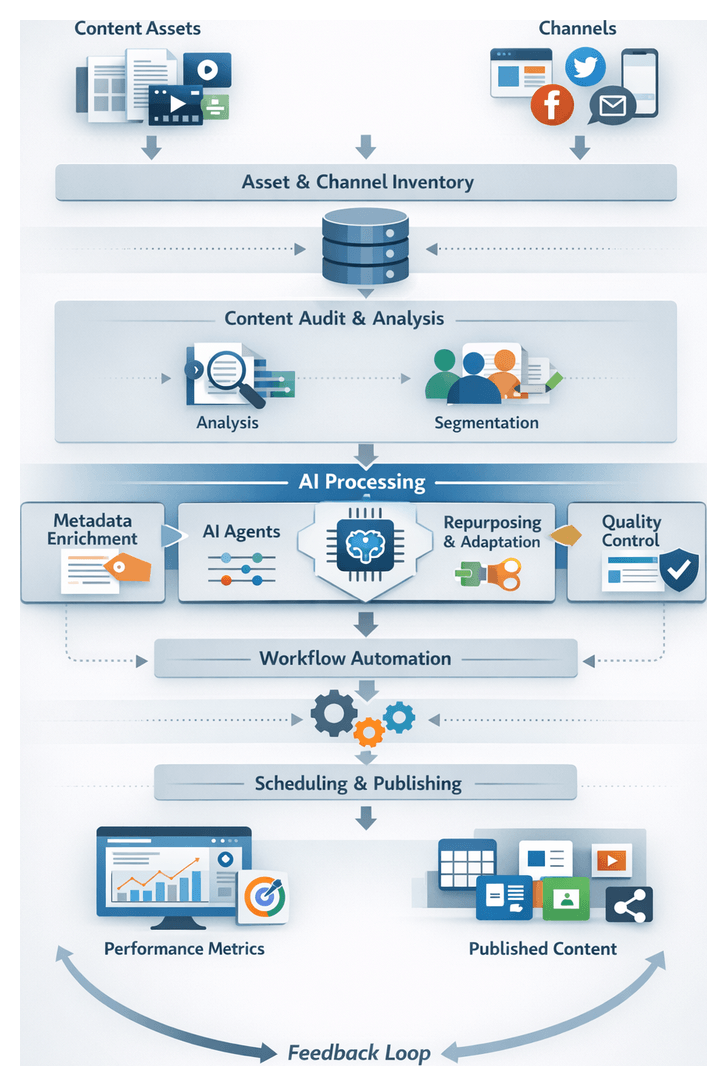
Workflow Terminology and Core Concepts
- Asset Inventory: A centralized catalogue of content assets—articles, white papers, videos, podcasts, and social posts—each enriched with metadata such as creation date, author, format, audience tags, performance history, and thematic classifications. This inventory underpins audit, classification, and repurposing efforts, ensuring comprehensive coverage and eliminating duplication.
- Channel Inventory: A register of social media accounts, publishing platforms, and distribution channels, including URLs, access credentials, API endpoints, audience demographics, and performance metrics. An up-to-date channel inventory enables precise content mapping, automated data collection, and coordinated multi-channel scheduling.
- Content Audit: The systematic discovery, cataloguing, and evaluation of existing assets. AI services ingest content from digital asset management systems and file shares, enrich metadata, align performance metrics, and produce deliverables—inventory spreadsheets, classification reports, and gap analyses—that inform strategic planning.
- Metadata Enrichment: The augmentation of asset records with AI-generated attributes—topic tags, sentiment scores, audience relevance markers, readability ratings, and visual descriptors—enhancing searchability, automated classification, and data-driven decision making.
- Thematic Tagging: Consistent labeling of assets by core themes, subtopics, or narrative angles. NLP topic extraction engines automatically suggest and validate tags, enabling targeted repurposing and personalized distribution.
- Audience Segmentation: Classification of audiences into cohorts based on demographic, psychographic, and behavioral attributes. Mapping content assets to segments improves relevance and engagement.
- Workflow Orchestration: Automated coordination of tasks, resources, and dependencies across the content lifecycle. Orchestration platforms manage sequencing, trigger AI agents, handle retries, enforce SLAs, and provide real-time status monitoring.
- AI Agents: Autonomous machine learning and NLP components that perform discrete tasks—classification, summarization, sentiment analysis, format conversion—under orchestration control, reducing manual effort and accelerating throughput.
- Human-in-the-Loop: Strategic checkpoints where human reviewers validate AI outputs, correct errors, enforce brand guidelines, and ensure compliance, safeguarding content integrity and addressing nuances beyond AI capabilities.
- Quality Control: A structured review process combining automated style and policy checks with human assessments of brand consistency, legal compliance, accessibility, and metadata integrity. QC outputs guide final approval and publication.
- Repurposing: Transformation of existing assets into new formats, lengths, or narrative angles—summaries, paraphrases, translations, video scripts, infographics—optimized for specific channels while preserving core messaging and brand voice.
- Adaptation: Technical modification of repurposed assets to meet platform specifications—image dimensions, video aspect ratios, caption lengths, metadata standards—using computer vision, style-transfer algorithms, and automated metadata insertion.
- Scheduling and Publishing Automation: Time-based and event-driven triggers deploying assets via platform APIs according to calendars and optimal posting windows, managing approvals, retries, and distribution logs.
- Service-Level Agreements: Formal contracts defining performance and availability targets—task execution times, error thresholds, review turnaround windows—that govern orchestration policies and escalation paths.
- API Integration: Programmatic connections among content repositories, AI services, analytics platforms, and social media channels, enabling secure data exchange, event-driven triggers, and real-time monitoring.
- Key Performance Indicators: Metrics—engagement rate, click-through rate, conversion rate, audience growth, content velocity, cost per engagement—embedded in dashboards and used to inform optimization algorithms.
- A/B Testing: AI-driven experiments comparing content variants—headlines, visuals, posting times—automating traffic allocation, statistical analysis, and selection of winning variations.
- Model Retraining: Iterative updates of machine learning models using new labeled data from human reviews, performance outcomes, and evolving guidelines, improving accuracy and adapting to trends.
- Continuous Optimization: Ongoing cycles of performance monitoring, predictive analytics, automated scheduling adjustments, and dynamic personalization to refine strategies and prioritize high-value assets.
- Data Governance: Policies, processes, and standards ensuring data quality, consistency, security, and compliance—which encompass taxonomy management, access controls, versioning, audit trails, and regulatory adherence.
- Taxonomy: A hierarchical classification system of categories, themes, formats, and audience segments used across metadata fields for consistent tagging and efficient retrieval.
- Sentiment Analysis: NLP techniques to gauge emotional tone—positive, neutral, negative—informing theme selection, personalization, and QC reviews.
- Workflow Templates: Predefined sequences of tasks, dependencies, and decision rules encapsulating best practices—e.g., text-to-video conversion or A/B testing—to enable rapid setup and consistent execution.
- Orchestration Dashboard: Real-time interfaces displaying workflow status, task progress, queue backlogs, error rates, and SLA compliance for operational visibility and troubleshooting.
- Audit Trail: Comprehensive records of asset ingestion, AI transformations, human reviews, approvals, and scheduling events for accountability, compliance, and root cause analysis.
- Feedback Loop: Mechanisms feeding performance data and review outcomes back into upstream stages—ideation and model retraining—to drive continuous improvement and strategic alignment.
AI Capabilities Mapped to Workflow Stages
Aligning AI functionalities with each stage of the repurposing pipeline clarifies system design, tool selection, and performance expectations. The following AI capabilities illustrate common implementations.
Content Audit
- NLP-driven Metadata Extraction: OpenAI GPT-4 parses text to generate summaries, keyword tags, and topic labels automatically.
- Computer Vision Indexing: Azure Cognitive Services Computer Vision detects logos, scenes, and visual themes in images and videos.
- Automated Duplicate Detection: Semantic embedding models from Hugging Face identify redundant assets via vector similarity.
- Sentiment and Tone Scoring: AI-powered sentiment engines assign polarity and intensity scores to historical content.
Strategy Definition
- Performance Data Modeling: Predictive algorithms in AWS SageMaker simulate engagement outcomes under varying content mixes.
- Priority Recommendation Engines: Reinforcement learning agents rank repurposing objectives based on projected ROI and resources.
- Brand Voice Analysis: NLP models extract tone guidelines and prohibited terms from governance documents.
- Risk Assessment Modules: AI scans themes for compliance and legal risk using rule-based classifiers.
Analysis and Segmentation
- Topic Modeling: Unsupervised algorithms group content into thematic clusters.
- Semantic Embeddings: Transformer encoders enable similarity search and asset clustering.
- Persona Matching: ML classifiers map content to audience segments based on behavior and demographics.
- Sentiment Trend Analysis: Time-series engines detect shifts in audience mood.
Automated Ideation
- Natural Language Generation: LLMs such as GPT-4 propose headlines and content hooks tailored to each channel.
- Thematic Clustering: AI groups related concepts and suggests narrative frameworks based on past performance.
- Creative Variant Scoring: Predictive models estimate engagement potential and rank ideas.
- Collaborative AI Prompts: Interactive interfaces guide editors through AI-generated refinement questions.
Transformative Repurposing
- Summarization APIs: Abstractive and extractive engines condense articles into bullet points or tweet-length copy.
- Paraphrasing Models: Sequence-to-sequence transformers rewrite content while preserving meaning.
- Script Generation: NLG tools convert text into video and audio scripts.
- Layout Automation: Template engines insert copy into infographics and carousels.
Cross-Platform Adaptation
- Responsive Image Resizing: Computer vision algorithms auto-crop images for various formats.
- Caption Optimization: NLP models adjust tone, length, and hashtag selection per platform.
- Style Transfer: AI applies brand fonts, color palettes, and overlays consistently.
- Metadata Enrichment: Tagging engines generate alt text, SEO keywords, and audience labels.
Workflow Orchestration
- Dynamic Task Scheduling: AI queues and prioritizes tasks based on dependencies and SLAs using platforms like Apache Airflow or Prefect.
- Error Prediction and Retry Logic: Predictive models anticipate failures and initiate adaptive retries.
- Resource Auto-Scaling: ML forecasts workload peaks and scales containers via Kubernetes.
- Real-Time Monitoring: AI dashboards powered by Grafana and Prometheus correlate pipeline metrics and flag bottlenecks.
Human-in-the-Loop Quality Control
- Grammar and Style Validation: NLP checkers such as Grammarly enforce brand voice rules.
- Content Moderation: Filters detect prohibited language via Azure Content Moderator.
- Visual Compliance Checks: Computer vision verifies logo placement and color accuracy.
- Accessibility Verification: AI generates and audits alt text and captions to meet WCAG standards.
Scheduling and Automated Distribution
- Predictive Scheduling: Time-series models forecast optimal posting windows.
- Dynamic Targeting: Personalization engines match variants to audience segments in real time.
- Automated Approval Routing: AI assigns tasks to reviewers and enforces policy checks.
- Error Recovery: Intelligent agents detect API failures and reroute tasks.
Performance Monitoring and Continuous Optimization
- Real-Time Analytics: Stream processing engines ingest engagement metrics and detect anomalies immediately.
- Predictive Impact Modeling: Supervised learning forecasts content performance and guides resource allocation.
- A/B Testing Automation: AI orchestrates experiments, analyzes results, and promotes winners.
- Feedback Loop Triggers: Optimization agents generate new ideation seeds and scheduling adjustments based on data.
Workflow Variations and Edge Case Handling
Implementations must adapt to organizational size, resource constraints, platform changes, localization needs, compliance demands, and unexpected conditions while preserving scale, consistency, and data-driven decision making.
Small Versus Large Organizations
- Small Teams: Consolidate audit and segmentation into unified AI-assisted steps. Use lightweight orchestration tools like Zapier. Human-in-the-loop focuses on high-risk content; low-risk assets proceed automatically.
- Large Enterprises: Employ federated governance with a central taxonomy service and local extensions. Implement role-based access controls on audit connectors and parallel pipelines that merge at adaptation.
Incomplete or Unstructured Repositories
- Automated Discovery: Crawlers scan drives, cloud storage, and platforms. AI-driven OCR and speech-to-text extract text from images and audio, generating provisional metadata.
- Progressive Enrichment: Begin with minimal schema (format, date, source) and iteratively add themes, audience tags, and compliance flags as resources permit.
Ad Hoc and Crisis Response
- Emergency Overrides: Event listeners detect keywords and route assets into expedited repurposing tracks with compressed approval loops.
- Targeted Compliance: Replace full QC with AI-powered policy scans and a single human reviewer for rapid validation.
Multi-Language and Localization
- Automated Translation: Integrate neural machine translation services—such as custom Google Cloud Translation—and apply sentiment analysis to preserve tone. Low-confidence translations enter human review.
- Regional Calibration: Use AI models trained on local social media data to recommend idioms, imagery, and posting schedules, feeding into adaptation and scheduling.
Platform-Specific Exceptions
- API Versioning and Feature Flags: Implement feature toggles and version checks within orchestration agents to confirm supported formats and avoid failures due to API updates.
- Beta Testing New Formats: Establish parallel pipelines for emerging content types—audio rooms, AR filters—with dedicated innovation teams and controlled adoption processes.
Regulatory and Compliance Edge Cases
- Rule-Based Compliance Engines: Reference up-to-date regulation libraries to flag content affected by new standards and initiate review of approved assets.
- Audit Queue Management: Maintain a compliance archive tracking every version of regulated content with reviewer certifications for reporting.
User-Generated Content and Rights Management
- Automated Rights Checking: AI vision services detect identifiable individuals and logos. Rights management agents cross-reference contracts; assets lacking evidence enter manual approval.
- Attribution Flags: AI identifies sponsorship messaging and appends required disclosures (#ad, Paid partnership), verified against local regulations.
Scaling and Performance
- Elastic Provisioning: Orchestration agents scale AI clusters and databases automatically based on queue depth thresholds.
- Backpressure Handling: Early warning models predict saturation and throttle submissions, rerouting non-critical tasks to lower-priority queues.
Offline and Manual Overrides
- Offline Packages: When APIs are unavailable, generate packages containing assets, metadata, and instructions for manual upload with compliance checks.
- Schedule Overrides: Authorized users can override AI-recommended schedules; exceptions are logged for governance and audit.
Continuous Process Evolution
A governance committee should regularly review workflow variations and exceptions, update process definitions, and validate AI models. Retrospectives analyze edge case patterns to refine rules and maintain a robust, adaptable standard workflow.
AI Tools and Additional Resources
AI Tools Mentioned
- OpenAI GPT-4: A state-of-the-art large language model used for natural language generation, summarization, paraphrasing, and ideation tasks.
- Hugging Face Transformers: A library of pre-trained NLP models and tools for text classification, embedding generation, and fine-tuning custom language models.
- IBM Watson Natural Language Understanding: An AI service providing semantic analysis, sentiment detection, entity recognition, and theme extraction for text assets.
- Microsoft Azure Cognitive Services: A suite of AI APIs including computer vision, speech-to-text, custom neural voice, and content moderation used for multimodal content analysis and transformation.
- Jasper AI: A natural language generation platform that automates headline creation, caption writing, and content ideation with customizable brand voice settings.
- Copy.ai: An AI writing assistant for generating marketing copy, social media posts, and creative content variations at scale.
- Descript: An AI-powered audio and video editing tool offering transcription, script generation, and scene composition features.
- Midjourney: An AI art generator used to create visual concepts and mood boards for content repurposing and style guidance.
- Canva: A design platform with a Magic Resize feature and AI-driven templates for cross-platform image and infographic adaptation.
- Lumen5: A video creation tool that converts text content into engaging short-form videos with AI-assisted storyboard suggestions.
- InVideo: A video editing and templating solution that automates the production of social media videos from scripts and assets.
- MuleSoft: An integration platform as a service (iPaaS) used to connect content management systems, analytics platforms, and AI services via APIs.
- Zapier: A no-code automation tool that orchestrates data flows between web applications, including AI engines and content repositories.
- Apache Airflow: A workflow orchestration engine for authoring, scheduling, and monitoring complex data pipelines and AI tasks.
- Prefect: A modern workflow management system that orchestrates AI-driven tasks with dynamic scheduling and error handling.
- Dagster: A data orchestration tool that enables the design and execution of reliable AI and ETL pipelines.
- RabbitMQ: A message broker supporting task queueing and communication between AI microservices in content pipelines.
- Apache Kafka: A distributed event streaming platform used for real-time ingestion and processing of social media engagement data.
- Kubernetes: A container orchestration system that auto-scales AI inference services and ensures high availability of workflow components.
- MLflow: An MLOps platform for tracking experiments, managing model versions, and deploying machine learning models in production.
- Kubeflow: A machine learning toolkit for Kubernetes that streamlines the deployment and monitoring of AI pipelines.
- Prometheus: A monitoring system that collects metrics from AI services and workflow components for real-time observability.
- Grafana: A visualization and dashboarding tool for displaying performance metrics and monitoring AI workflow health.
- Contentful: A headless CMS used to store content assets, metadata, and version histories consumed by AI repurposing workflows.
- Bynder: A digital asset management platform for organizing approved brand assets and repurposed content packages.
- Cloudinary: A cloud media management service that automates image and video transformations for distribution.
- Hootsuite: A social media management platform providing native analytics and scheduling APIs integrated into the publishing pipeline.
- Buffer: An automated scheduling tool that publishes content across multiple channels based on AI-driven timing recommendations.
- Sprout Social: A social media analytics suite that collects engagement metrics and sentiment data for continuous optimization.
- Later: A visual content calendar and scheduling platform with AI-powered best-time suggestions.
- CoSchedule: A marketing calendar tool that automates content scheduling and coordinates campaigns with team workflows.
- Lately.ai: An AI platform that analyzes past content performance to generate new social media posts and optimize distribution strategies.
- Brandfolder: An AI-enabled brand management system that enforces logo usage, color palettes, and typography rules.
- MonkeyLearn: An NLP service for customizable text classification and sentiment analysis in QA workflows.
- Acrolinx: An AI platform for enforcing style, terminology and brand guidelines at scale.
- Perspective API: A text moderation service for identifying toxic or inappropriate language in drafts.
- AWS SageMaker: A cloud-native environment for building, training and deploying machine learning models used in predictive scheduling and optimization.
- DataRobot: An automated machine learning platform for developing predictive models that forecast content performance and recommend optimizations.
Additional Context and Resources
- General Data Protection Regulation (GDPR): Regulatory framework governing data privacy in the European Union, relevant to audience segmentation and CRM integrations.
- California Consumer Privacy Act (CCPA): U.S. privacy law affecting data handling and consent in social media analytics.
- Web Content Accessibility Guidelines (WCAG): Standards for ensuring digital content accessibility, informing captioning and alt-text requirements.
- Digital Asset Management Best Practices: Industry white papers on DAM strategy and taxonomy design to support AI-driven metadata enrichment.
- MLOps Frameworks and Guides: Resources on building robust machine learning pipelines with reproducibility, model governance and version control.
- Content Taxonomy and Metadata Standards: Reference materials on defining content schemas, taxonomy hierarchies and metadata governance for enterprise workflows.
- Social Media Platform Developer Documentation: Official guides for Facebook Graph API, Twitter API, LinkedIn Marketing API and TikTok for Developers, crucial for automated publishing integrations.
- OpenAPI Specification: Standard for RESTful API design used across orchestration and integration layers.
- iPaaS Comparison Guides: Analyst reports evaluating integration-platform-as-a-service solutions such as MuleSoft, Zapier and Workato.
- Cloud Security and Compliance Frameworks: Documentation on securing AI pipelines, including identity and access management, encryption best practices and audit logging.
The AugVation family of websites helps entrepreneurs, professionals, and teams apply AI in practical, real-world ways—through curated tools, proven workflows, and implementation-focused education. Explore the ecosystem below to find the right platform for your goals.
Ecosystem Directory
AugVation — The central hub for AI-enhanced digital products, guides, templates, and implementation toolkits.
Resource Link AI — A curated directory of AI tools, solution workflows, reviews, and practical learning resources.
Agent Link AI — AI agents and intelligent automation: orchestrated workflows, agent frameworks, and operational efficiency systems.
Business Link AI — AI for business strategy and operations: frameworks, use cases, and adoption guidance for leaders.
Content Link AI — AI-powered content creation and SEO: writing, publishing, multimedia, and scalable distribution workflows.
Design Link AI — AI for design and branding: creative tools, visual workflows, UX/UI acceleration, and design automation.
Developer Link AI — AI for builders: dev tools, APIs, frameworks, deployment strategies, and integration best practices.
Marketing Link AI — AI-driven marketing: automation, personalization, analytics, ad optimization, and performance growth.
Productivity Link AI — AI productivity systems: task efficiency, collaboration, knowledge workflows, and smarter daily execution.
Sales Link AI — AI for sales: lead generation, sales intelligence, conversation insights, CRM enhancement, and revenue optimization.
Want the fastest path? Start at AugVation to access the latest resources, then explore the rest of the ecosystem from there.