

End to End AI Driven Delivery Workflow in Logistics and Transportation
To download this as a free PDF eBook and explore many others, please visit the AugVation webstore:
Introduction
Delivery Complexity and Data Foundations
Modern logistics networks operate at unprecedented scale and velocity, driven by rapid e-commerce growth, tight delivery windows and omnichannel fulfillment strategies. Customer expectations for same-day or two-hour delivery and real-time tracking have transformed delivery from a predictable, linear process into a multifaceted system. Fluctuating demand spikes—from flash sales or peak shopping events—combine with variable transportation modes, unpredictable traffic conditions and external disruptions such as severe weather or public health emergencies to create an operational landscape where agility and continuous adjustment are essential.
Geographic complexity arises from multi-hub distribution architectures, cross-dock facilities and urban fulfillment centers, each with distinct throughput capacities and labor constraints. Transfers between long-haul, intermodal rail, maritime and last-mile vehicles must be tightly synchronized to avoid bottlenecks, idle assets and missed windows. Meanwhile, emerging micromobility options—cargo bikes and on-demand couriers—serve hyperlocal routes but add further scheduling intricacies.
Regulatory frameworks at local, regional and international levels impose curfews, emission zone restrictions, driver-hours-of-service limits and customs clearance requirements. Compliance demands automated verification against electronic logging device standards and customs protocols to prevent fines, delays and reputational risk. The integration of autonomous vehicle trials and drone corridors introduces evolving safety regulations, amplifying the need for real-time governance controls embedded in operational workflows.
The final mile remains the most resource-intensive segment, often accounting for over half of total logistics costs. Residential access controls, dynamic order cancellations, varying parcel dimensions and parking restrictions render manual route planning infeasible. Organizations must factor in vehicle configurations, customer availability windows and location-specific constraints to maintain high service levels within tight cost parameters.
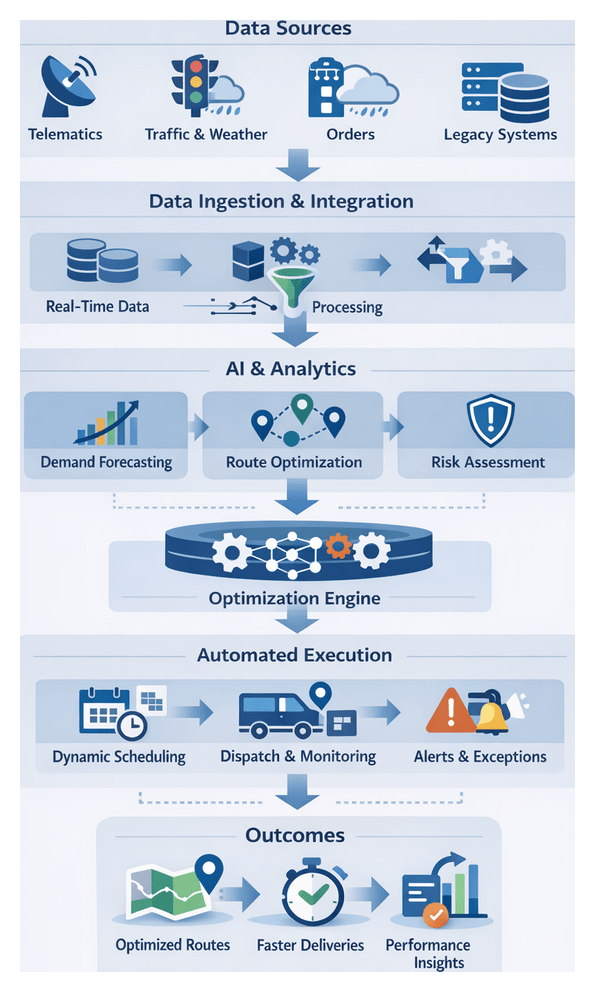
Underpinning these challenges is a vast ecosystem of data sources. Fleet telematics systems deliver live GPS, speed and engine diagnostics. Traffic feeds and incident alerts update congestion profiles. Weather services broadcast forecasts and severe event warnings. Order management platforms record delivery preferences, special instructions and load details. Each feed arrives in disparate formats and update cadences, requiring robust ingestion, cleansing and normalization to form a unified, real-time data foundation.
Legacy systems—transportation management (TMS), warehouse management (WMS) and enterprise resource planning (ERP) platforms—often operate in silos, limiting visibility. Integrating these core applications with external streams demands secure APIs, standard schemas and middleware adapters to reconcile geocoding standards, time zones and address validation. Without this integration, decision-making suffers from latency, inaccuracies and data gaps.
Establishing a resilient data architecture involves:
- High-bandwidth, secure connectivity between vehicles, field devices and cloud services
- Robust messaging frameworks (MQTT brokers, RESTful APIs) with guaranteed delivery
- Up-to-date geographic information system layers and routing graphs
- Identity and access management controls for internal and third-party applications
- Data governance policies to enforce quality, privacy and auditability standards
With these technical prerequisites in place, organizations create the foundational platform necessary to deploy advanced AI and optimization engines that drive real-time responsiveness, cost efficiency and service excellence.
Structured End-to-End AI Workflows
Ad hoc operational responses and siloed point solutions are insufficient to address the pace, volume and variability of modern delivery demands. A structured, end-to-end AI workflow provides a unified framework to orchestrate data acquisition, decision logic and resource allocation in a reliable, transparent and auditable manner. By embedding clear process flows, integration contracts and governance controls, organizations transform fragmented efforts into seamless orchestration that reduces costs, elevates service quality and ensures real-time responsiveness.
Orchestration and Sequencing
A central orchestration platform acts as the conductor of the AI workflow, sequencing stages, handling concurrency and enforcing error-handling policies. For example, pipelines built on Apache Airflow or serverless state machines using AWS Step Functions can be configured to:
- Detect schedule triggers and external events (new orders, last-mile exceptions)
- Ingest telematics feeds, traffic APIs and order databases
- Execute data cleansing and validation before publishing to shared repositories
- Run predictive models for demand forecasting and travel-time estimation in parallel
- Queue outputs for optimization engines and await completion signals
- Dispatch finalized routes to scheduling modules and notify planners of exceptions
Automated sequencing ensures correct inputs at each stage, enforces quality checks before downstream tasks proceed and captures execution metrics—task durations, failure rates and data volumes—for real-time workflow health monitoring.
Integration with Enterprise Systems
Specialized AI components for forecasting, optimization and monitoring must interoperate smoothly with TMS, ERP, CRM and WMS platforms. Key integration patterns include:
- REST or gRPC endpoints for model inference services
- Consumption of normalized data from message queues or data lakes
- Publication of optimized routes and shift plans back to TMS via APIs or EDI
- Triggering CRM notifications for high-priority shipments requiring manual review
- Alignment of pick-and-pack sequences with delivery schedules in WMS
Clear integration contracts—defining schemas, protocols and retry policies—prevent brittle point-to-point connections and simplify maintenance when systems evolve.
Human-Machine Collaboration and Governance
Even advanced AI workflows acknowledge the critical role of human expertise for complex exceptions or high-value scenarios. Collaboration points allow operators to:
- Review routes violating regulations or cost thresholds
- Approve alternative schedules when traffic disruptions threaten performance
- Override recommendations based on local insights or emergent priorities
- Annotate feedback that feeds into continuous learning loops
Task management interfaces and mobile applications deliver risk scores, forecast uncertainties and optimization trade-off summaries. Human approvals and adjustments are captured as formal inputs for model retraining, ensuring that frontline knowledge refines future decisions.
Structured workflows embed governance across all stages, producing audit trails of data provenance, model versions, decision logic and human approvals. Immutable logs, version-controlled model registries, chain-of-custody records for data transformations and automated compliance reports enable rapid reconstruction of decision paths and adherence to regulatory obligations.
Scalable Infrastructure and Continuous Improvement
Container orchestration platforms like Kubernetes and serverless compute environments elastically allocate resources to AI modules and integration tasks. The orchestration layer monitors compute utilization, message queue backlogs and service latency against SLAs. During demand surges, additional inference instances and data processing jobs spin up automatically; during low-traffic periods, resources scale down to control costs.
A closed-loop feedback mechanism captures delivery performance metrics, exception logs and customer satisfaction scores. These outcome streams feed back into training pipelines to:
- Retrain demand forecasts for shifting shipment volumes
- Adjust traffic prediction parameters based on actual versus estimated travel times
- Tune optimization constraints to reflect evolving cost structures and SLAs
- Update rescheduling policies with new business rules or regulatory requirements
This living system adapts to evolving conditions, incorporates frontline feedback and drives incremental efficiency gains over time.
AI-Powered Routing Solutions
Routing in contemporary logistics demands dynamic, real-time adaptation to traffic fluctuations, variable demand and resource availability. AI extends beyond rule-based approaches, empowering organizations to anticipate conditions, optimize end-to-end flows and continuously learn from outcomes. Key AI capabilities and supporting systems include:
- Predictive Modeling: Machine learning algorithms forecast congestion by analyzing historical traffic, weather and event schedules. These forecasts enable proactive rerouting before bottlenecks occur.
- Optimization Engines: Advanced solvers using metaheuristics or mixed-integer programming generate efficient route plans. Open source frameworks like Google OR-Tools and commercial offerings integrate with orchestration platforms to recompute plans as new data arrives.
- Adaptive Learning Modules: Reinforcement learning agents evaluate executed routes against KPIs—on-time rates, distance, fuel usage—and adjust algorithm parameters to improve future outcomes.
- Real-Time Integration Layers: Event processing systems ingest live telematics, traffic and delivery confirmations. Stream analytics detect deviations and trigger reoptimization or exception workflows within seconds of an incident.
- Feedback Orchestration: Workflow managers ensure seamless data exchange between predictive models, optimization solvers and dispatch systems, delivering updated instructions to driver apps and exception dashboards in a synchronized fashion.
Workflow Roles of AI Components
- Data Preparation: AI agents validate and enrich incoming telematics and order data, aligning schemas and filling gaps before routing calculations.
- Prediction: Machine learning services generate traffic and demand forecasts, storing results in an intermediate data store accessible by the optimizer.
- Optimization: Routing engines retrieve forecasts and constraints, execute algorithms to produce route plans and forward assignments to dispatch modules.
- Execution Monitoring: Event handlers compare live progress to planned routes, invoking reoptimization or exception-management routines when thresholds are exceeded.
- Feedback Loop: Post-delivery data—actual travel times, service exceptions, fuel usage—feeds back into predictive and optimization models, driving continuous learning.
Embedding AI in routing yields measurable benefits: up to 20 percent reduction in miles driven, 10–15 percent improvement in on-time performance, decreased manual intervention and enhanced resilience against disruptions. These gains translate into stronger customer satisfaction, efficient asset utilization and sustainable competitive advantage.
Architectural Blueprint and Implementation Readiness
The architectural blueprint delivers a detailed representation of the end-to-end AI-driven delivery framework. It serves as a master reference for implementation teams, aligning multidisciplinary stakeholders around a cohesive vision. Key elements include:
- Logical and physical diagrams of data ingestion, processing pipelines, AI model training and inference, optimization engines and delivery interfaces
- Component definitions for microservices, AI agents, orchestration controllers and optimization solvers
- Data flow maps detailing schemas, formats and transformation rules, with identifiers for message brokers and stream processing frameworks
- Technology stack inventory of recommended platforms, libraries and infrastructure services
- Integration matrix of APIs, connectors and protocol specifications for external systems
- Security and governance overlays showing access controls, encryption gateways and audit logging principles
Dependencies and Prerequisites
Successful implementation depends on addressing data, technical, organizational and regulatory prerequisites. Critical dependencies include:
- Formalized SLAs and data access agreements with telematics, traffic, weather and order system providers
- Infrastructure readiness for high-volume ingestion, real-time processing and AI model training
- Provisioning of AI and orchestration platforms, solvers and analytics toolchains
- Compliance and security approvals for data privacy, encryption and access management
- Cross-functional alignment on roles, responsibilities and communication channels
- Verification of in-house expertise in machine learning, cloud architecture, streaming and integration
Integration Points and Validation Mechanisms
Effective handoff to development and operations teams requires structured artifacts and protocols:
- Architecture specification document with diagrams, component definitions and interface descriptions
- Version-controlled data schema repository for each feed and intermediate structure
- Integration catalog of API endpoints, message topics and sample payloads with error-handling guidelines
- Deployment guide outlining environment configurations and orchestration policies
Communication and coordination protocols include architecture review workshops, dependency tracking dashboards, integration working group meetings and change control procedures. Verification checkpoints encompass proof-of-concept deployments, interface contract testing, security reviews and performance benchmarking. Continuous architecture audits detect configuration drifts and enforce compliance with foundational principles.
Transition to Detailed Design
After handoff, teams decompose work into development sprints, guided by the architecture deliverables. Key activities include:
- Component design workshops to define classes, data structures and algorithmic flows
- Sprint planning with backlog items tied to performance, security and integration criteria
- Provisioning of development, testing and staging environments matching production topologies
- Onboarding real data feeds to validate ingestion and cleansing routines
- Setup of CI/CD pipelines enforcing code quality, integration tests and automated deployments
- Provisioning of model training clusters for reproducible experiments
- Instrumentation planning for telemetry, metrics and logs across microservices
- Security hardening with identity management, role-based access and network segmentation
- Creation of operational runbooks for incident response, data backfill and failover
- Knowledge transfer sessions to align on best practices and support responsibilities
By mapping architectural components to measurable KPIs—such as reduced delivery times and lower exception rates—teams embed real-time telemetry, configure alerts and establish feedback loops that translate strategic objectives into operational outcomes. This structured transition minimizes rework, accelerates time to value and ensures alignment between business goals, technical implementation and operational readiness.
Chapter 1: Data Ingestion and Integration
Unified Data Collection for Logistics Visibility
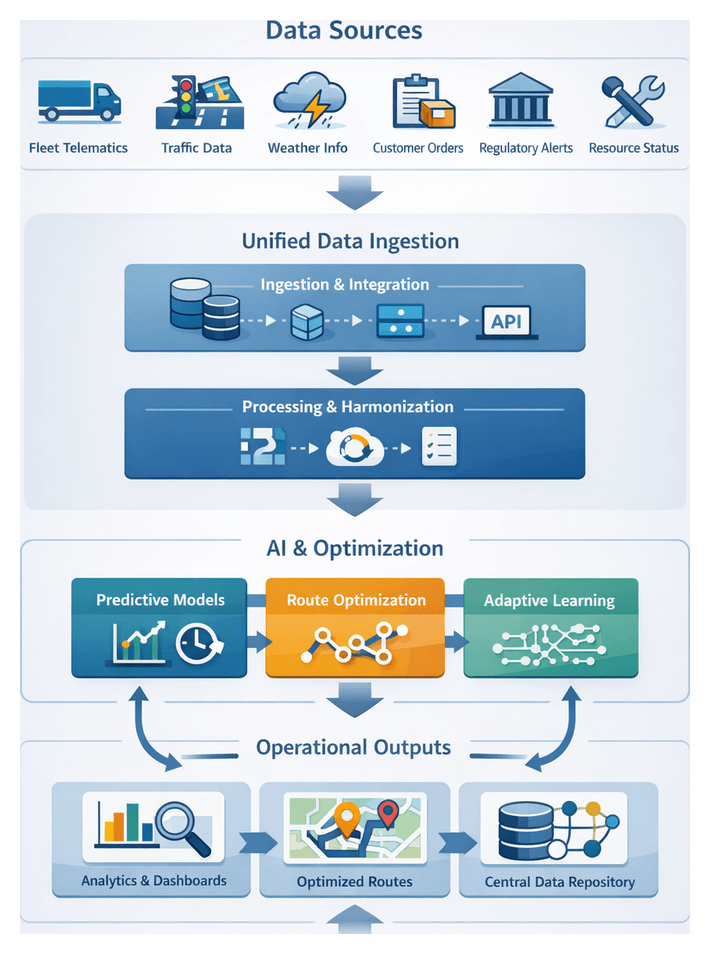
The foundational step in an AI-driven delivery workflow is the Unified Data Collection stage, which aggregates disparate operational data into a cohesive, timestamped repository. By capturing real-time fleet telematics, traffic conditions, weather events, customer orders and external constraints, this stage establishes the single source of truth that powers predictive models, optimization engines and adaptive decision making. A structured approach—with clear objectives, input definitions and validation checks—ensures downstream components receive accurate, consistent data while preserving lineage for governance and compliance.
Purpose and Scope
This stage delivers comprehensive visibility into:
- Fleet operations: GPS locations, vehicle speeds and usage metrics via platforms like Geotab and AWS IoT FleetWise.
- Traffic conditions: Real-time flow and incident data from TomTom Traffic API and HERE Traffic API.
- Weather updates: Current measurements and alerts from OpenWeatherMap and The Weather Company.
- Customer orders: Shipment details, time windows and special requirements from systems such as Salesforce, Oracle NetSuite and SAP ERP.
- Regulatory events: Road closures, permit requirements and special schedules published by government agencies or aggregators.
- Resource availability: Driver schedules, maintenance windows and depot capacity from workforce and fleet management solutions.
Embedding basic validation and harmonization routines at this stage reduces noise and inconsistencies before analytics, setting the quality bar for all subsequent processes.
Technical Prerequisites and Conditions
Reliable data ingestion demands the following:
- Network Resilience: Secure VPNs or dedicated lines, redundant paths and sufficient bandwidth for high-frequency streaming.
- API Access: Valid credentials with role-based controls and automated key rotation via HashiCorp Vault or Azure Key Vault.
- Time Synchronization: NTP alignment and unified ISO 8601 timestamps across sources.
- Schema Definitions: Versioned data contracts documented in a master catalog, specifying field types and units.
- Privacy and Compliance: Data sharing agreements, consent management and encryption (TLS in transit, at rest).
- Infrastructure: Scaled ingestion compute or serverless functions, message brokers such as Apache Kafka or Amazon Kinesis, and monitoring tools for latency and error rates.
Operational Metrics
Key performance indicators track data quality and readiness:
- Freshness: Latency from event generation to ingestion, targeted in seconds.
- Completeness: Percentage of critical fields populated, with thresholds (e.g., 98%).
- Schema Conformance: Incoming messages matching the contract, with deviation alerts.
- Error Rates: Ratio of malformed or rejected records.
- Duplication Rates: Frequency of duplicate messages within a time window.
- Uptime: Ingestion pipeline availability against SLOs.
Data Stream Integration and Consolidation Processes
This stage orchestrates real-time and batch feeds from telematics, order platforms, traffic and weather services into a unified pipeline. Connectors interface with source systems, a messaging backbone routes events for transformation, and a consolidation layer directs harmonized data into storage optimized for analytics and AI inference.
Ingestion Layer and Connectors
Specialized connectors handle:
- Change data capture from transactional databases.
- RESTful polling for order management systems.
- Publish/subscribe APIs for telematics and traffic feeds.
Common tools include Apache Kafka, Amazon Kinesis, Azure Event Hubs, Fivetran and Talend. Orchestration engines such as Apache Airflow or AWS Step Functions schedule and coordinate connector tasks, maintaining version control over workflows.
Real-Time versus Batch Processing
- Real-Time Streams: Continuous IoT, traffic and live order feeds requiring sub-second latency, processed by engines like Apache Flink or Google Cloud Dataflow.
- Batch Extractions: Periodic database dumps scheduled off-peak, loaded into staging for ELT routines.
Schema Mapping and Transformation
Captured events are transformed to a canonical logistics event model defining fields such as vehicle_id, timestamp, location and order_id. Transformation rules include:
- Field renaming and alignment.
- Unit standardization (distance, weight, currency).
- Data enrichment by joining traffic, weather or driver profiles.
Declarative mapping languages or SQL-based pipelines execute these rules with transactional consistency. AI-driven validation agents may propose corrections for ambiguous mappings.
Message Queuing and Pub/Sub Coordination
- Telematics Events Topic streams raw GPS and sensor data.
- Order Updates Queue captures new, modified or cancelled orders.
- Enriched Logistics Feed emits standardized records.
Connector instances publish to source topics. Transformation services subscribe, process and republish to target topics. Consumer groups scale horizontally, while health-check messages feed monitoring dashboards.
Consolidation into the Central Pipeline
Standardized streams and batches merge into a unified pipeline that feeds:
- A data lakehouse for raw and curated event storage.
- A data warehouse for analytics queries.
- Streaming tables for live AI inference and dashboards.
Platforms like Databricks or Snowflake support both streaming and batch ingestion, coordinating COPY or MERGE operations, partitioning strategies and retention aligned to compliance.
Data Integrity and Traceability
Each record carries metadata tags—source identifier, original timestamp, connector version and transformation references—to support audit trails and root cause analysis. AI-driven validation agents flag anomalies for human-in-the-loop review.
Transformative AI-Driven Routing Components
With a unified data foundation in place, AI transforms static route planning into dynamic, self-optimizing workflows. Predictive models anticipate demand and travel times, optimization engines generate high-quality routes under multiple constraints, and adaptive learning frameworks continuously improve performance using operational feedback.
Predictive Modeling
Forecasting components include:
- Time Series Forecasting: ARIMA, Prophet or LSTM networks project order volumes and delivery durations.
- Spatial Analysis: Graph neural networks and geospatial clustering refine localized estimates.
- Real-Time Fusion: Streaming integration of live traffic and weather feeds with continuous retraining.
Managed platforms such as Amazon SageMaker, Google Cloud AI Platform and Azure Machine Learning streamline model development, deployment and inference.
Optimization Engines
To solve the Vehicle Routing Problem under dynamic constraints, organizations employ:
- Metaheuristics: Genetic algorithms, ant colony optimization and simulated annealing.
- Exact Solvers: Mathematical programming with IBM CPLEX.
- Large Neighborhood Search: Iterative route refinement balancing exploration and exploitation.
- Reinforcement Learning: Agents adapt policies based on feedback from route outcomes.
Tools like Google OR-Tools and enterprise orchestration platforms automate resource scheduling, data preparation and solution validation.
Adaptive Learning
Continuous improvement relies on:
- Feedback collection from vehicle telemetry and customer confirmations.
- Automated retraining pipelines triggered by performance metrics.
- Hyperparameter tuning via automated machine learning techniques.
- Model versioning and rollback using platforms like MLflow.
Supporting Ecosystem
Routing AI integrates with:
- The data integration layer feeding telematics, orders and external feeds.
- A central data repository for raw and processed datasets.
- Compute orchestration engines scheduling training, inference and optimization tasks.
- APIs and microservices exposing results to Transportation Management Systems and driver apps.
- Monitoring and alerting solutions tracking route efficiency and exception rates.
Roles and Responsibilities
- Data Engineers: Build and maintain ingestion pipelines.
- Machine Learning Engineers: Develop and deploy predictive models.
- Optimization Specialists: Configure algorithms and define constraints.
- Platform Architects: Design infrastructure for orchestration and storage.
- Operations Managers: Translate objectives, monitor performance and manage exceptions.
- Driver Support Teams: Interface with AI outputs and handle field escalations.
Business Outcomes
- Cost Reduction: Optimized routes lower fuel consumption.
- Service Quality: Improved on-time delivery and customer satisfaction.
- Agility: Rapid response to disruptions and new orders.
- Scalability: Automated workflows handle growing volumes.
- Competitive Differentiation: Data-driven innovation in service offerings.
Feeding the Central Repository for Downstream Use
The final step in integration is populating the harmonized data into a central repository—whether a cloud data warehouse, data lake or hybrid platform—that serves as the authoritative source for forecasting, routing and scheduling systems. Clear outputs, dependencies and handoff mechanisms ensure seamless data delivery and real-time decision support.
Structured Outputs
- Unified Tables: Standardized schemas partitioned by date, region or fleet identifier.
- Metadata Catalog: Dataset descriptions, lineage and quality metrics tracked via AWS Glue Data Catalog or Apache Atlas.
- CDC Logs: Change streams capture inserts, updates and deletes for synchronized downstream state.
- Quality Reports: Versioned summaries of record volumes, missing values and validation violations.
- Audit Trails: Ingestion timestamps, job details and lineage records linking back to sources.
Downstream Dependencies
- Technical: Compute clusters, query engines and APIs with appropriate permissions.
- Data Contracts: Defined table names, column types, update frequency and freshness SLAs.
- Operational: Orchestration triggers based on load indicators, such as flag files or event notifications.
Handoff Mechanisms
- Event-Driven Notifications: Completion events published to Apache Kafka or Amazon EventBridge.
- File Drop: Parquet or ORC files deposited in object storage with downstream polling or event triggers.
- API Serving: REST or gRPC endpoints providing real-time access to integrated records.
- Shared Views: Logical views abstract physical tables for BI tools and training pipelines.
Versioning and Schema Evolution
- Semantic versioning of data schemas, with major/minor increments for breaking or backward-compatible changes.
- Central schema registry guiding consumers on compatible versions.
- Parallel publishing of old and new schema versions during migration periods.
Governance and Access Controls
- RBAC: Least-privilege permissions for users and services.
- Masking and Encryption: Tokenization of sensitive fields and encryption in transit and at rest.
- Audit Logs: Detailed records of repository access and queries for compliance monitoring.
Monitoring and Alerting
- Job success rates and durations to detect latency or failures.
- Data freshness indicators with alerts for SLA breaches.
- Error trend analysis for schema mismatches, validation failures and connector timeouts.
Case Study: Event-Driven Repository Handoff
A global provider writes cleansed datasets into a Snowflake warehouse and publishes load-complete events to Apache Kafka. The demand forecasting module subscribes to the ‘order_ingest_complete’ topic and immediately queries the latest orders. A traffic modeling service invokes Snowflake’s REST API for sub-hourly updates. Schema changes are managed via a registry, allowing pipelines to adapt automatically. This architecture achieves under ten-minute end-to-end latency and 99.9 percent job success rates.
Collaboration Practices
- Shared documentation of dataset definitions, update schedules and SLAs with regular cross-team reviews.
- Joint release planning to align pipeline deployments with downstream workflows.
- Cross-functional governance forums monitoring ingestion health and coordinating enhancements.
Chapter 2: Data Cleansing and Normalization
Delivery Complexity in Modern Logistics
The rapid expansion of global commerce has transformed delivery operations into dynamic, interconnected networks. Logistics providers now manage fluctuating demand driven by seasonality, promotions and omnichannel orders, while contending with urban congestion, regulatory restrictions and sustainability goals. To harness real-time data and advanced decision logic, organizations must first define the dimensions of delivery complexity and establish the inputs, prerequisites and conditions for an end-to-end AI-driven solution.
- Demand Volatility: Order volumes vary unpredictably based on market shifts and promotions.
- Traffic Dynamics: Time-sensitive congestion patterns, incidents and infrastructure changes.
- Operational Constraints: Vehicle capacities, driver hours and delivery time windows.
- Cost and Service Trade-Offs: Balancing fuel and labor expenses against on-time performance and customer satisfaction.
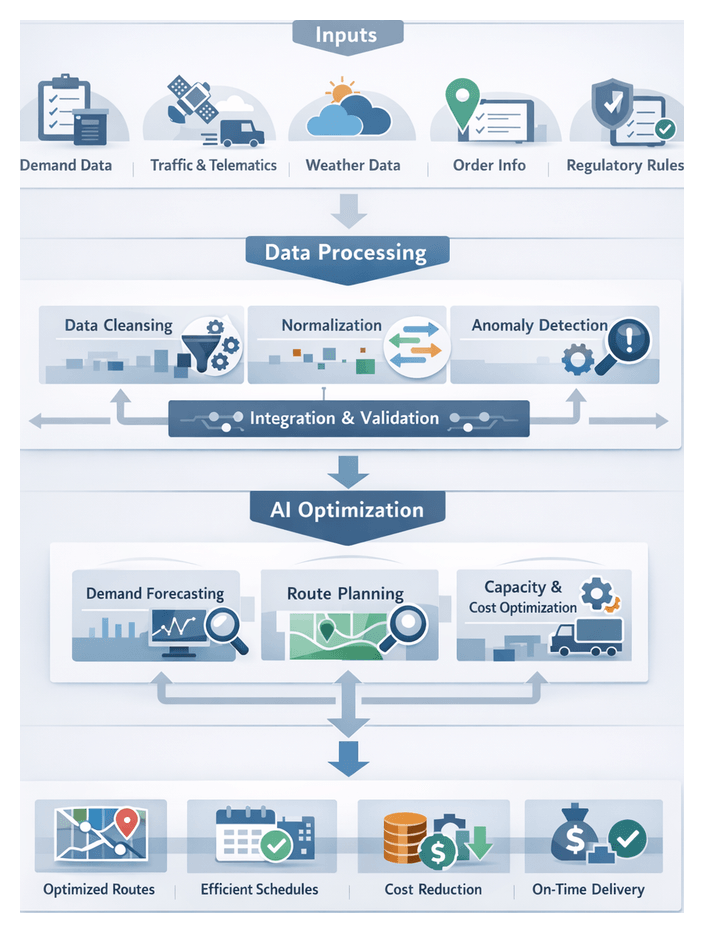
Effective complexity assessment requires high-fidelity inputs:
- Fleet telematics streams: GPS, speed, diagnostics and fuel metrics.
- Traffic and incident feeds from public sensors and crowd-sourced apps.
- Weather forecasts and real-time conditions.
- Order management data: pickup/drop-off locations, priorities and time windows.
- Regulatory policies: work-hour rules, vehicle restrictions and compliance mandates.
Prerequisites include a unified data schema that harmonizes diverse sources, standardized units of measure and robust data governance protocols. System requirements cover latency thresholds, well-documented APIs, quality assurance rules, scalability benchmarks and cross-functional alignment. Establishing clear KPIs—such as on-time delivery percentage, average dwell time and cost per mile—anchors both technical configurations and operational protocols.
Reliable predictive analytics and optimization depend on clean, consistent data. The cleansing and normalization workflow transforms raw logistics inputs into standardized datasets, eliminating errors that could compromise downstream models.
Data Profiling and Initial Audit
Profiling tools scan incoming records to detect anomalies:
- Null or missing fields (timestamps, GPS coordinates, order IDs)
- Values outside acceptable ranges (negative distances, implausible speeds)
- Format inconsistencies (mixed date locales)
- Duplicate entries from overlapping batch and stream processes
An automated audit report summarizes issue frequencies and triggers alerts or pipeline pauses when thresholds are exceeded.
Automated Correction and Reconciliation
Rule-based engines and lightweight ML classifiers remediate common defects:
- Imputation of Missing Values: Statistical or ML regressors infer delivery durations and fuel consumption.
- Format Standardization: ETL tools like Apache NiFi and Talend convert dates to ISO 8601 and unify numeric formats.
- Duplicate Elimination: Hashing and similarity algorithms purge redundant records, flagging exceptions.
- Reference Data Reconciliation: Lookup tables and API calls to master systems such as Informatica PowerCenter ensure valid vehicle, zone and service codes.
Normalization of Units and Categorical Alignment
Field values are aligned to common standards to support aggregation and comparison:
- Unit Conversion: Distance, weight and volume metrics unified (e.g., kilometers, kilograms, liters).
- Categorical Mapping: Delivery statuses and vehicle conditions harmonized via a schema registry.
- Geospatial Standardization: Coordinates validated, reprojected and enriched through geocoding APIs.
Distributed processing frameworks like Apache Spark and cloud services such as Microsoft Azure Data Factory accelerate transformations at scale.
Coordination Between Systems and Actors
Efficient workflows rely on seamless interactions:
- Pipeline Orchestration: Schedulers trigger sequential or parallel tasks, manage retries and enforce SLAs.
- Cross-System Messaging: Event streams via Apache Kafka carry metadata and status updates.
- Human-in-the-Loop Validation: Dashboards enable stewards to review anomalies and approve corrections.
- Audit Logging: Transformation metadata, rules and code versions are recorded for compliance and rollback.
Adaptive Feedback Mechanisms
Continuous improvement is driven by feedback loops:
- Anomaly Trend Analysis: AI detectors identify emerging error patterns and suggest rule updates.
- Rule Performance Metrics: Correction success rates and residual error counts inform threshold tuning.
- Collaborative Knowledge Base: Engineers and domain experts share best practices and exception procedures.
Final Validation and Data Handoff
A staged quality check quarantines failing records and publishes validated datasets—tagged with version identifiers and metadata—to the central repository. Clean outputs feed demand forecasting and route optimization modules, ensuring reliable inputs for AI-driven logistics processes.
AI-Driven Anomaly Detection and Standardization
AI agents automate the detection of data anomalies and enforce standardization rules, safeguarding the integrity of downstream models.
Anomaly Detection Capabilities
Agents employ statistical and ML methods to flag deviations:
- Numeric outliers in speed or fuel streams
- Time series irregularities such as inconsistent timestamp intervals
- Semantic anomalies in categorical fields
Detection operates in two modes:
- Unsupervised: Clustering, density estimation and autoencoders identify novel errors using frameworks like Scikit-Learn and TensorFlow.
- Supervised: Classification models recognize known anomaly patterns, leveraging decision tree ensembles or gradient boosting.
Advanced Detection Models
- Isolation Forests: Efficient outlier identification in high-dimensional telematics.
- Local Outlier Factor: Detects density deviations in speed or location data.
- Autoencoders: Reconstruction error highlights multivariate anomalies.
- One-Class SVM: Encapsulates normal data boundaries when anomalies are rare.
- Convolutional Models: Capture temporal patterns and sensor drift.
Data Standardization and Entity Resolution
Agents enforce uniform field representations:
- Unit Conversion: Context-aware modules apply real-time conversions.
- Address Normalization: NLP with spaCy and rule sets standardize free-text entries.
- Fuzzy Matching: Levenshtein distance and probabilistic algorithms resolve entity duplicates.
- Time Zone Alignment: Timestamps unified to UTC or regional zones.
Integration into the Cleansing Pipeline
AI agents plug into key stages:
- Initial profiling for domain-agnostic outliers
- Rule-based screening of invalid ranges
- Standardization pass for textual and categorical fields
- Secondary anomaly re-scoring to catch residual issues
Status codes, confidence scores and metadata feed a central orchestrator that routes exceptions for remediation.
Human-in-the-Loop and Active Learning
When confidence is low, records are forwarded to experts for validation. Their feedback enriches labels, tunes thresholds and drives periodic model retraining, reducing manual reviews over time.
Performance Monitoring and Continuous Improvement
- Throughput and latency metrics ensure SLA compliance.
- Detection accuracy tracked via precision and recall.
- Standardization coverage measures normalized record ratios.
- Feedback backlog monitors pending expert reviews.
Roles and Handoff Dependencies
AI agents serve as automated scouts, standardization enforcers, quality sentinels and adaptive learners. Their outputs feed forecasting engines, traffic models and route optimization solvers, with exception reports documenting residual uncertainties.
Delivering Consistent Data to Predictive Models
The final handoff packages clean, normalized data—alongside metadata and versioning artifacts—for use by demand forecasting, traffic modeling, capacity planning and optimization engines.
Output Artifacts and Deliverables
- Standardized data tables with uniform schemas and units
- Data quality reports and validation logs
- Metadata registries capturing lineage and quality metrics
- Versioned snapshots for reproducibility
- Configuration manifests specifying schemas and partitions
Metadata Management and Catalog Registration
Cleaned datasets are registered in a central catalog with details on sources, transformations and quality. Tools such as Apache Atlas, Snowflake and Google BigQuery provide APIs and interfaces for metadata governance.
Dataset Versioning and Snapshotting
Immutable snapshots and semantic versioning track schema changes and logic updates. Integration with data lake formats like Delta Lake or Apache Iceberg optimizes storage and query performance while supporting retention policies.
Integration with Feature Stores
Normalized features are published to repositories such as Feast, AWS SageMaker Feature Store and Tecton. Consistent batch and real-time pipelines ensure feature freshness and reproducibility.
Orchestration and Handoff Mechanisms
- Workflow schedulers like Apache Airflow and Prefect
- ML pipelines orchestrated by Kubeflow
- Event-driven triggers via Apache Kafka or cloud event buses
- Serverless post-processing with AWS Lambda and Azure Functions
Dependency Management and Impact Analysis
Dependency graphs link data sources, cleansing tasks and model pipelines. Platforms such as Dagster and Azure Data Factory visualize workflows, detect schema drift and prevent incompatible promotions.
Monitoring and Validation of Delivered Data
- Regular data quality checks on new partitions
- Statistical validation against historical baselines
- Automated alerts for threshold breaches
- Dashboards displaying completeness, accuracy and freshness metrics
Best Practices for Handoff to Predictive Models
- Define SLAs for data freshness, processing windows and error rates
- Establish standardized APIs or data contracts for model consumption
- Maintain logging and audit trails linking models to cleansing runs
- Encapsulate transformation logic in feature engineering frameworks
- Foster collaboration between data engineering, data science and operations
By rigorously defining delivery complexity, implementing structured cleansing and normalization workflows, deploying AI-driven agents for anomaly detection and standardization, and formalizing the handoff to predictive models, organizations can achieve scalable, accurate and adaptive logistics operations. This integrated approach reduces costs, enhances service reliability and builds a foundation for continuous improvement in modern supply chains.
Chapter 3: Demand Forecasting and Capacity Planning
Purpose and Industry Context
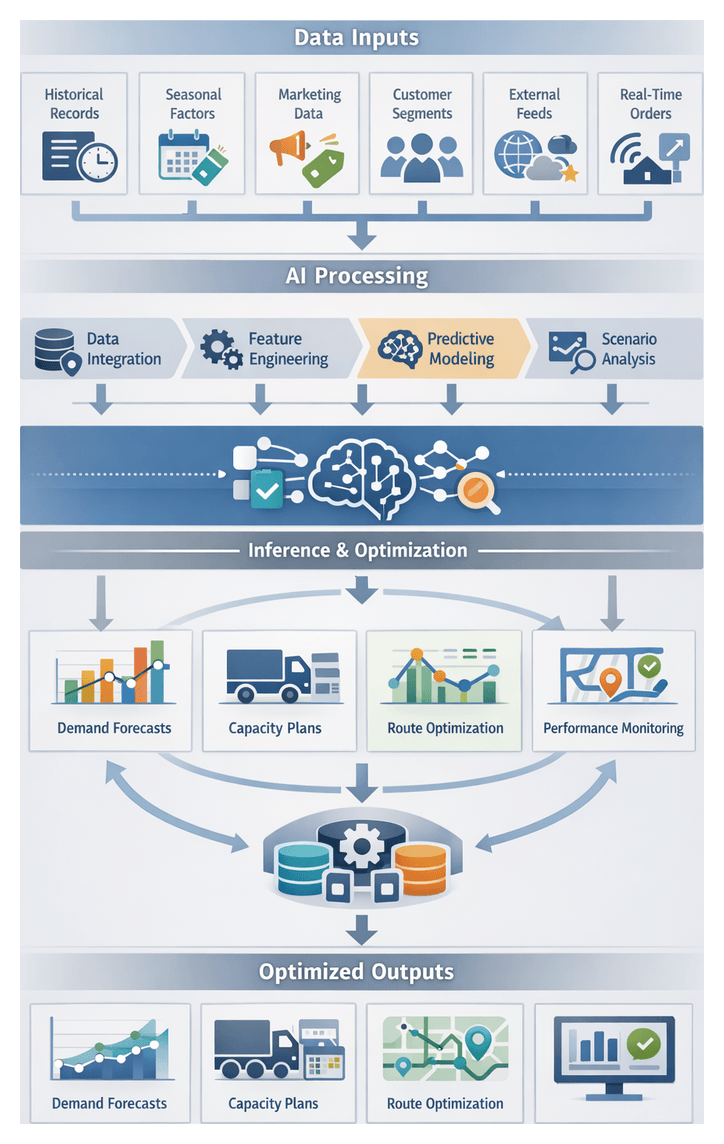
The demand forecasting and capacity planning workflow transforms raw logistics and transportation data into actionable plans that align fleet resources with anticipated shipment volumes. By leveraging AI-driven models to anticipate future order volumes, delivery timing and geographic distribution, organizations shift from reactive dispatching to proactive planning. Accurate forecasts optimize resource allocation, minimize empty miles and improve service commitments, while strategic insights inform investments in fleet assets and facility expansions. In an era of e-commerce growth, seasonal promotions and supply chain disruptions, traditional rule-based approaches struggle to capture nonlinear trends and sudden spikes in demand. AI addresses these challenges through machine learning models capable of identifying temporal patterns, correlating external factors and adapting to new data, enabling carriers to anticipate demand shifts days or weeks in advance and reduce reliance on buffer capacity.
Data Inputs, Preparation, and Quality
Robust forecasting relies on a rich blend of historical, transactional and contextual data. Inputs must be cleansed, normalized and integrated into a central repository to support high-accuracy predictions.
- Historical Order Records: Time-stamped volumes, origins and destinations, product categories and service levels over a defined retrospective window.
- Seasonal and Calendar Factors: Holidays, promotional events, billing cycles and industry peaks such as back-to-school or year-end sales.
- Marketing Schedules: Discount campaigns, product launches and incentive programs that drive order frequency.
- Customer Segmentation: Patterns by account type, geography and service preferences for differentiated forecasts.
- External Feeds: Macroeconomic indicators, consumer sentiment, weather forecasts and competitor activity.
- Real-Time Transaction Streams: Incoming order confirmations for rolling short-term forecast updates.
Data quality prerequisites include consistent schemas for order dates, SKU identifiers and geographic codes; completeness thresholds for historical coverage; validity checks for outliers and improbable distances; defined latency windows for batch and streaming feeds; metadata annotation for lineage and ownership; and security controls to ensure regulatory compliance with GDPR or CCPA. Integration requires APIs or ETL pipelines from order management, warehouse systems and customer portals; message buses such as Kafka or Azure Event Hubs for live streams; data lakes or warehouses with schema management; third-party RESTful feeds; and authentication frameworks like OAuth2 or SAML. Upstream dependencies include cleansed and normalized order data, validated contextual feeds, centralized master reference tables and quality assessment reports confirming data meets accuracy standards.
Predictive Modeling Workflow
The predictive analytics workflow applies statistical and machine learning techniques to prepared data, producing demand forecasts that feed directly into capacity decisions. It consists of data preparation, feature engineering, model training and scenario evaluation.
Data Preparation and Feature Engineering
Data preparation extracts relevant variables, enriches raw inputs and engineers features that expose demand drivers to forecasting models. Key activities include automated data extraction from central repositories; time-series alignment into consistent intervals; feature creation such as rolling averages, trend indicators and event flags; and external data fusion via APIs or batch imports. Automated quality verification uses schema inference and integrity checks with tools like TensorFlow Data Validation and anomaly detection within scikit-learn pipelines. Proprietary platforms streamline ETL orchestration. Well-engineered features and clean inputs are essential for accurate model performance and reliable capacity projections.
Model Selection and Training
Model choice depends on demand patterns, data volume and forecast horizon. Common options include:
- ARIMA and Exponential Smoothing: For stationary series with modest seasonality.
- Gradient Boosting Machines: Using XGBoost or LightGBM to capture nonlinear feature interactions.
- Recurrent Neural Networks and Transformers: For complex seasonal and trend decomposition over long horizons.
- Ensemble Methods: Combining algorithms to balance bias and variance and improve resilience to anomalies.
During training, models are evaluated on hold-out sets using metrics such as MAPE and RMSE. Cross-validation folds are orchestrated by workflow engines, enabling parallel training on compute clusters. AI agents monitor training jobs, implement retry logic on failures and log performance metrics for continuous improvement. Version control, governance workflows and rollback procedures ensure model artifacts adhere to organizational standards.
Forecast Inference and Scenario Analysis
Trained models generate demand forecasts under multiple scenarios, providing planners with insights into capacity requirements across normal, peak and stress conditions.
- Baseline Forecast: Based on recent trends, seasonality and scheduled events.
- Confidence Bounds: Upper and lower intervals to assess risk exposure.
- What-If Analyses: Simulations of hypothetical changes such as promotions or regional spikes.
Inference jobs run on nightly or intra-day cadences, triggered by workflow orchestrators that manage batch pipelines, collect outputs and push results to decision support dashboards. AI-powered monitoring services track latencies, detect throughput bottlenecks and provision additional resources during demand surges.
Capacity Allocation and Output Deliverables
The convergence of forecasting and planning produces a suite of deliverables that drive downstream operations and optimization modules.
- Demand Projection Reports: Forecast tables with daily, weekly and monthly volumes broken down by region, customer segment and order type, accompanied by trend indicators.
- Capacity Allocation Plans: Recommendations for fleet composition (vans, trucks, electric vehicles), driver shift schedules, utilization targets and inventory staging for hubs.
- Scenario Analysis Dashboards: Interactive views for best-case, worst-case and baseline forecasts with sensitivity controls and threshold alerts.
- Confidence Metrics: Probability distributions, confidence intervals and risk scores highlighting under- or over-allocation potential.
- API Feeds and Data Artifacts: Structured outputs in JSON, CSV or Apache Parquet formats; RESTful endpoints delivering daily requirements; and webhooks for real-time updates.
AI-Driven Routing and Optimization
AI extends beyond forecasting into dynamic route optimization and adaptive learning, enabling proactive orchestration of delivery operations under multiple constraints.
Predictive Modeling for Routing
Machine learning models forecast travel times, congestion maps and demand heat-maps using historical GPS traces, traffic feeds and weather data. Data scientists develop and tune these models, while data engineers maintain pipelines that aggregate telemetry. Platforms such as Google Cloud AI, AWS SageMaker and IBM Watson provide infrastructure for training and deployment. Forecast outputs inform route planners of potential delays, enabling preemptive adjustments.
Optimization Engines
Optimization engines convert predictive outputs into executable routes by solving vehicle routing problems that account for capacities, time windows, work rules and transit time forecasts. Operations research engineers define objective functions and constraints, leveraging libraries such as OR-Tools or commercial solvers embedded in transportation management systems. Workflow orchestrators manage iterative solution cycles, seeding initial plans with heuristics and refining them via local search and metaheuristics to maximize on-time performance and resource utilization.
Adaptive Learning and Feedback
As deliveries execute, telematics and status updates stream back into AI modules. Machine learning engineers design retraining pipelines to incorporate new execution data, detect model drift and trigger automated retraining. Anomaly detection agents flag deviations and initiate corrective actions. Continuous integration platforms test updated models and solver parameters in sandbox environments before promotion. Reactive updates fine-tune models in response to real-time exceptions, while proactive cycles integrate historical logs and seasonal changes. This closed-loop learning refines routing accuracy and efficiency over time.
Integration, Coordination, and Governance
Seamless integration and cross-functional collaboration are essential for end-to-end capacity planning and routing orchestration.
- System Integration: Forecast exports via APIs or message queues into ERP and TMS modules; allocation rules engines translate forecasts into resource requirements; BI platforms such as Power BI or Tableau enable interactive planning dashboards; approved plans publish automatically to inventory, scheduling and workforce systems.
- Handoff to Optimization Engines: Tools consume geocoded demand points, fleet definitions and cost matrices derived from predictive travel times. Scheduling interfaces accept XML or JSON in APS schemas, direct database writes or message queue events.
- Data Exchange Protocols: OpenAPI-compliant REST endpoints, MQTT for real-time updates and secure FTP transfers maintain consistency and security. Metadata descriptors support automated validation and reconciliation.
- Organizational Roles: Solution architects design end-to-end workflows; data engineers manage pipelines; data scientists iterate models; operations research engineers define constraints; planning managers validate forecasts; IT operations ensure infrastructure scalability and recovery; DevOps engineers maintain deployment pipelines; business analysts align objectives with SLAs and cost targets.
- Governance and Quality Checks: Automated schema validation, sanity checks on volume totals, approval workflows logging reviewer identities, and audit trails linking forecasts to data versions and model parameters.
Monitoring, Feedback, and Continuous Improvement
Embedding monitoring and feedback loops ensures that forecasts and capacity plans remain accurate and aligned with actual operations.
- Forecast Accuracy Dashboards: Track error metrics over rolling windows to detect under- or over-provisioning trends.
- Error Analysis Reports: Identify drivers of model drift, including new customer segments or market shifts.
- Automated Retraining Triggers: Initiate model retraining when performance degrades beyond thresholds, using batch and streaming pipelines.
- Continuous Governance Reviews: Validate data inputs, quality controls and model artifacts against audit requirements.
- Best Practices: Maintain version control for models and outputs, implement incremental refreshes, ensure cross-functional visibility via dashboards, automate reconciliation of actuals versus forecasts, and schedule periodic model retraining using execution feedback.
By integrating demand forecasting, capacity planning and AI-driven routing within a governed, collaborative framework, organizations achieve responsive, data-driven logistics that optimize resource utilization, elevate service quality and maintain competitive advantage in dynamic markets.
Chapter 4: Predictive Traffic Modeling and Time Estimation
Traffic Prediction Data Integration
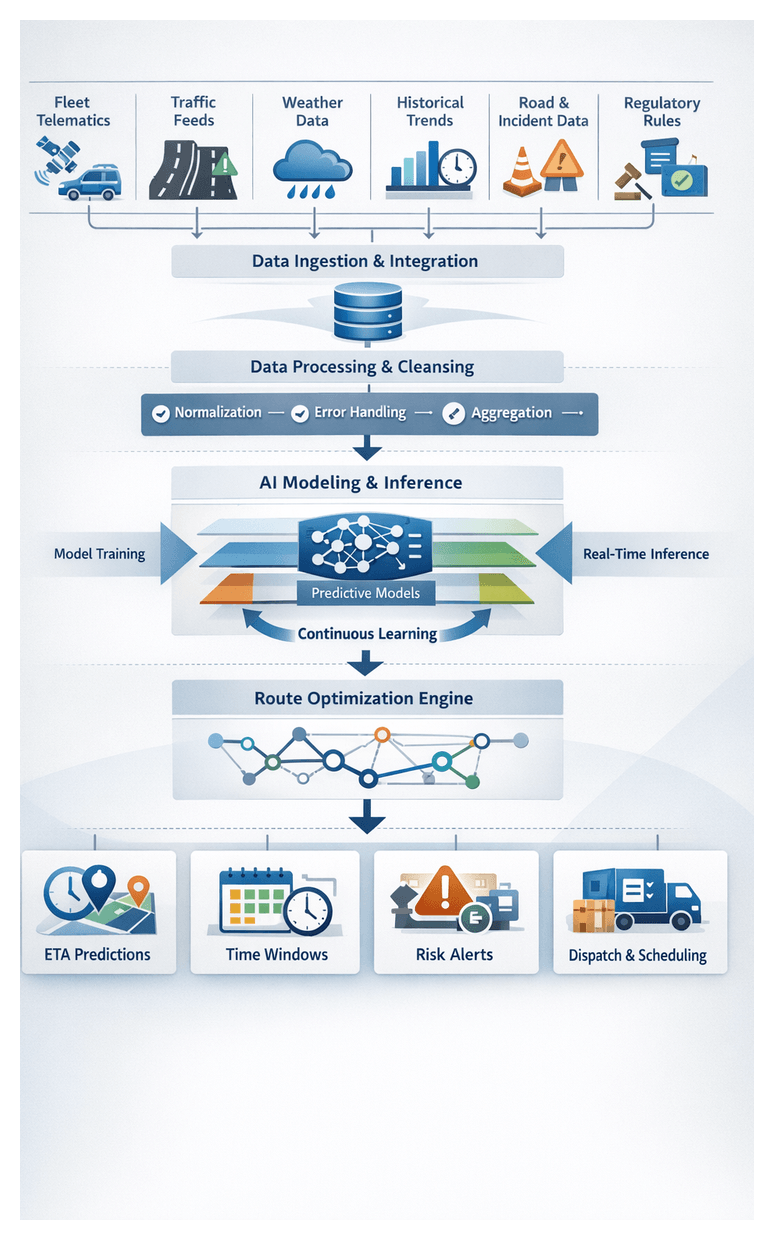
Accurate forecasting of traffic conditions is essential for AI-driven logistics orchestration. By unifying real-time vehicle telemetry, third-party traffic feeds and environmental data, organizations generate time-indexed travel time profiles that inform routing, scheduling and dispatch decisions. High-fidelity traffic predictions enable proactive management of bottlenecks, improved delivery window reliability and optimized fleet utilization across urban and intercity networks.
Key Data Inputs and Their Roles
- Fleet Telematics Streams: High-frequency GPS, speed and status signals recalibrate models with ground-truth segment travel times.
- Third-Party Traffic APIs: Network-wide insights from Google Maps Traffic API, HERE Traffic API and TomTom Traffic Index augment sparse telemetry.
- Historical Traffic Archives: Time-series patterns by hour, day and season establish baselines and distinguish recurring congestion.
- Weather and Environmental Feeds: Conditions from OpenWeatherMap and national services adjust predictions for rain, snow or extreme temperatures.
- Road Network Topology: GIS data on segment lengths, lane counts and signal timings provides the spatial framework for origin-destination modeling.
- Incident and Construction Reports: Real-time alerts on accidents, closures and planned works inject perturbations into forecasts.
- Regulatory Constraints: Time-of-day restrictions, dedicated lanes and local ordinances impose hard bounds on feasible travel times.
Prerequisites and Conditions
- Unified Data Repository: A central data lake with consistent timestamps, geospatial indexing and standardized units enables seamless correlation.
- Data Quality and Validation: Ingestion routines enforce lineage, completeness and anomaly checks, with alerts for telemetry dropouts or API outages.
- Latency Tiers: Sub-minute freshness for real-time feeds and hourly or daily updates for historical archives align with service-level agreements.
- Granularity Standards: Segment resolution and time buckets (e.g., five-minute intervals) balance model accuracy and compute performance.
- Metadata Tagging: Source identifiers, confidence scores and coverage footprints allow selective weighting during training and inference.
- Compliance and Privacy: Anonymization, consent mechanisms and regional handling of location data ensure GDPR and local regulatory adherence.
Integration Workflow Overview
- Ingestion and Staging: Raw streams and batch exports arrive via APIs, message queues or file transfers, then are time-stamped and partitioned by region.
- Schema Harmonization: Telematics, traffic and weather formats map into a unified schema with consistent geospatial projections.
- Cleansing and Error Handling: Out-of-range values, duplicates and timestamp inconsistencies are corrected or purged, with reconciliation flags for manual review.
- Temporal Alignment: Differing frequencies align to the modeling interval through aggregation or interpolation.
- Feature Enrichment: Each segment record is augmented with historical averages, incident counts, weather impact scores and regulatory flags.
- Quality Gate and Notification: Data completeness, freshness and consistency checks precede admission to the predictive engine, with automated alerts on violations.
- Handoff to Predictive Modeling: Validated datasets, accompanied by partition keys and version metadata, are published to the model input queue.
Dependencies on Upstream Processes
This integration relies on fully ingested telematics and customer order data, standardized cleansing routines, centralized traffic archives for model bootstrapping, and a metadata repository exposing network topologies and routing constraints. Satisfying these dependencies ensures the delivery of high-quality, actionable forecasts that feed dynamic route optimization and adaptive scheduling engines.
Modeling and Inference Workflow
Transforming enriched traffic inputs into precise travel time estimates involves a two-stage pipeline: offline model development and real-time inference. Data engineers and ML practitioners build and validate models in batch environments before deploying them to low-latency services that feed route optimization modules and dispatch systems.
Offline Model Development
- Data Extraction and Feature Assembly: Historical traffic, weather and incident logs are processed in Apache Spark or Apache Flink. Geospatial normalization and static attribute enrichment prepare inputs for training.
- Feature Engineering: Temporal indicators (peak hours, holidays), spatial context (urban vs suburban) and event flags (concerts, sports) are materialized into a feature store or vector database.
- Model Selection and Tuning: Algorithms such as gradient boosting with XGBoost and LightGBM, RNN/LSTM, CNNs on spatiotemporal grids and graph neural networks are prototyped in TensorFlow and PyTorch. Hyperparameter sweeps run on distributed clusters orchestrated by Kubeflow Pipelines or SageMaker.
- Cross-Validation and Backtesting: Hold-out periods and geographic zones validate generalization. Simulated delivery scenarios compare predictions to actual records to estimate confidence intervals.
- Packaging and Versioning: Approved models are registered in MLflow with metadata on training snapshots, features and hyperparameters, then containerized for deployment.
- Approval and Deployment: Operations managers review performance reports. Canary or blue-green strategies on Kubernetes minimize risk during rollout.
Real-Time Inference Pipeline
- Stream Ingestion: GPS, sensor networks, weather APIs and incident feeds flow through Apache Kafka or Amazon Kinesis into preprocessing microservices that apply training-consistent transformations.
- Inference Service: A stateless REST or gRPC endpoint running on Kubernetes or serverless platforms loads the latest model and returns segment travel time predictions with confidence scores.
- Smoothing: Temporal filters and rolling averages stabilize outputs, preventing abrupt variations that could undermine driver trust.
- Data Flow to Optimizer: Estimated times and confidence intervals feed the dynamic route optimization engine, ensuring schedules reflect current and anticipated conditions.
- Monitoring and Alerting: Prometheus and Grafana track latency, error rates and drift metrics. Anomaly detectors flag deviations for retraining triggers.
- Retraining Loop: Automated triggers launch new training pipelines when performance thresholds drop, incorporating fresh data to maintain accuracy.
System and Stakeholder Coordination
- Pipeline Orchestration: Apache Airflow or Prefect schedule preprocessing, training and deployment tasks with consistent failure handling and logging.
- Model Registry and CI/CD: Automated pipelines promote artifacts from staging to production, ensuring traceable version history and rollback capabilities.
- Dispatch Integration: Route optimization and dispatch systems subscribe to updated travel time feeds via APIs or event-driven webhooks.
- Cross-Functional Collaboration: Data scientists refine models while engineers maintain pipeline reliability. Shared dashboards provide visibility into performance and anomalies.
- Governance and Compliance: Auditors review model lineage and data usage. Automated documentation captures pipeline configurations and evaluation summaries.
Probabilistic Time Window Calculations
Beyond point estimates, probabilistic time windows assign confidence intervals around expected arrival times, enabling risk-aware scheduling and buffer optimization. Machine learning models estimate both the mean travel duration and its variance under current and forecasted conditions, transforming static commitments into adaptive delivery promises.
Key Modeling Approaches
- Gradient Boosted Trees using XGBoost or LightGBM for non-linear relationships on tabular features.
- RNNs and LSTMs capturing temporal dependencies in sequential traffic and delay data.
- CNNs on geo-gridded travel time matrices to detect local congestion patterns.
- Graph Neural Networks learning edge weights and node influences directly on road graphs.
- Bayesian frameworks, including Gaussian Processes, providing mean and uncertainty estimates for confidence intervals.
Feature Engineering and Data Integration
- Historical Travel Times aggregated by origin-destination, time of day and day of week.
- Real-Time Speeds from telematics or HERE Traffic API.
- Weather Indicators sourced from OpenWeatherMap.
- Incident Reports on accidents, closures and construction schedules.
- Road Attributes: speed limits, lane counts, intersection density, urban classification.
- Vehicle Profiles: load weight, type and historical driver behavior metrics.
Training and Continuous Learning
- Offline pipelines in Amazon SageMaker or Google Cloud AI Platform execute scheduled retraining aligned with data volume and seasonal shifts.
- Evaluation against benchmarks triggers promotions of models that improve accuracy or latency.
- Real-time feature stores supply low-latency access to precomputed features for online inference.
Handling Uncertainty and Variability
Techniques such as quantile regression, Monte Carlo dropout in neural networks and Bayesian inference yield asymmetric time windows—wider buffers where variance is high, tighter windows in stable conditions. These probabilistic outputs inform dynamic buffer sizing and risk-aware route adjustments.
Scalability and Governance
- Distributed inference on Kubernetes clusters or serverless functions using TensorFlow Serving or TorchServe auto-scales workloads based on real-time demand.
- Model governance enforces audit logs of inputs and predictions, bias detection across regions and segments, and compliance with ISO 27001 and GDPR standards.
Performance Metrics and Collaboration
- Mean absolute error, prediction interval coverage and inference latency track service quality against SLAs.
- Dashboards visualize drift and prompt retraining when deviation thresholds are crossed.
- Cross-functional teams align on evaluation criteria, feature refinement and threshold settings, ensuring operational insights feed back into model improvements.
Accurate probabilistic time windows enhance customer satisfaction, optimize resource utilization, mitigate delay risks and empower autonomous scheduling by feeding confidence scores into dispatch algorithms.
Estimated Time Outputs and Scheduling Hand-Offs
The culmination of predictive modeling delivers structured artifacts—segment-level estimates, route durations, time window boundaries and risk indicators—that feed route optimization and scheduling systems. Standardized formats, clear interface contracts and robust handoff protocols ensure seamless integration and maintain end-to-end efficiency.
Key Output Artifacts
- Segment-Level Travel Time Estimates with time-of-day adjustments.
- Route-Level Aggregated Durations summing contiguous segments.
- Probabilistic Time Window Boundaries (earliest departure, latest arrival).
- Confidence Intervals (e.g., 90th-percentile travel times).
- Delay Risk Scores derived from anomaly detection and incident feeds.
- Metadata Tags for generation timestamp, model version and input snapshot.
Data and System Dependencies
- Real-Time Traffic Feeds for transient condition capture; outages can degrade accuracy.
- Historical Archives for recurring pattern learning; gaps may skew estimates.
- Weather and Event Data subject to API availability and licensing.
- Inference Infrastructure (GPU clusters, cloud ML services) for low-latency scoring.
- Preprocessing Pipelines for data normalization; schema misalignments can propagate errors.
- Model Registry Services to ensure consistent deployment of the intended artifact.
Interface Contracts and Delivery Mechanisms
- Structured Schemas in JSON or Protocol Buffers, including fields such as segment_id, estimated_duration, confidence_interval, risk_score and timestamp.
- Time Matrix Representations as sparse or indexed matrices for efficient storage and transmission.
- API Endpoints (e.g., /api/v1/traffic/estimates) and message queues for event-driven or on-demand update delivery.
- Push vs Pull Models with defined staleness SLAs and retry policies.
- Error Handling Codes and fallback to historical averages or heuristic estimates when real-time feeds fail.
Handoff to Route Optimization Engines
- Triggering of full or incremental optimization runs based on time, events or manual requests.
- Incorporation of Confidence Bounds via chance-constrained programming or stochastic simulations.
- Data Synchronization through transactional handoffs or distributed locks to prevent processing of stale data.
- Feedback Loop Integration capturing planned vs actual travel times for later retraining.
Scheduling Dependencies and Downstream Consumption
- Time Slot Assignment using earliest and latest arrival estimates for batching and slot optimization.
- Resource Allocation of drivers, vehicles and loading docks with dynamic buffer rules based on risk scores.
- Customer Notifications conveying accurate arrival windows via SMS or email.
- Real-Time Monitoring combining live tracking data with initial estimates for continuous updates.
- Performance Reporting referencing original windows to trigger exception workflows when SLAs are at risk.
Best Practices for Reliable Handoffs
- Versioned APIs and Schemas to decouple evolution of predictive and optimization components.
- Message-Driven Architectures with partitioned topics keyed by region or fleet segment for scalability.
- Monitoring Metrics for data freshness, API latency and error rates to surface issues before impact.
- Automated Fallback Rules reverting to baselines when models or pipelines fail.
- Security Controls enforcing encryption in transit, access controls and audit logging of all handoffs.
By delivering precise, timely and well-structured travel time outputs and managing their dependencies with optimization and scheduling systems, logistics providers achieve enhanced reliability, resource efficiency and customer satisfaction. This final stage bridges predictive analytics and operational execution, realizing the promise of end-to-end AI-driven logistics orchestration.
Chapter 5: Dynamic Route Optimization Engine
Purpose of the Route Optimization Stage
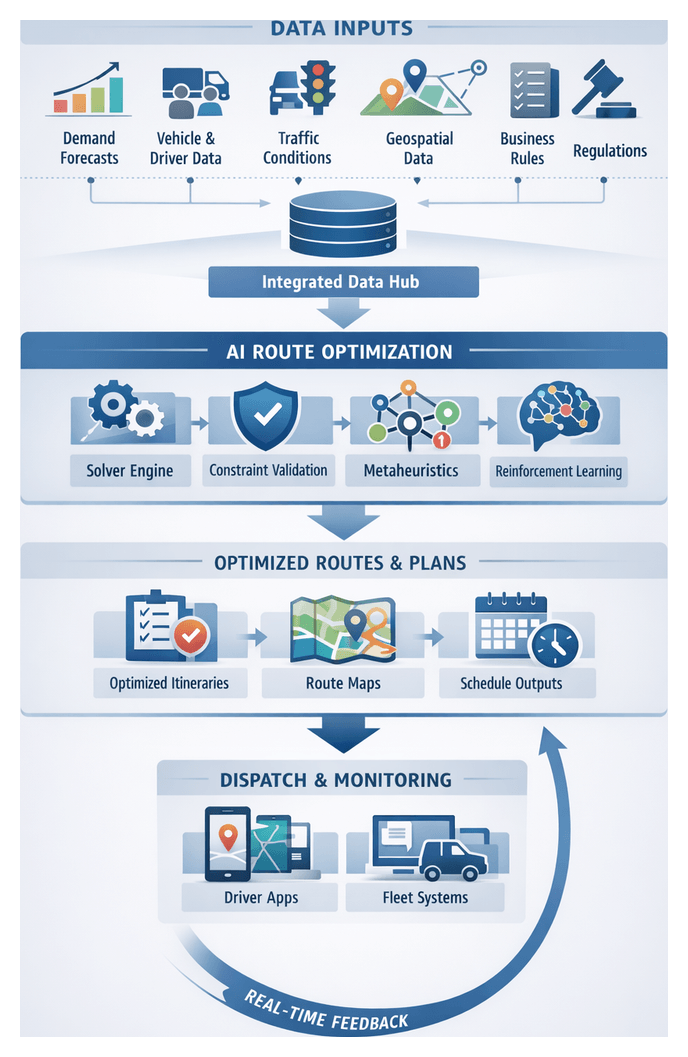
The route optimization stage is the nexus where predictive insights, operational constraints and strategic objectives converge to generate executable delivery plans. By translating demand forecasts, traffic predictions and resource availability into cost-effective, time-sensitive routes, this stage ensures service level agreements are met while controlling distance, travel time and operational expenses. Leveraging advanced solvers instead of manual routing or static heuristics, logistics providers gain the agility to adapt to fluctuating demand, evolving traffic conditions and regulatory requirements, thereby maintaining high on-time performance and customer satisfaction.
Key Data Inputs and Prerequisites
Effective optimization relies on timely, accurate and standardized data streams. Before invoking the solver, the following inputs must be cleansed, validated and synchronized:
- Demand Forecasts – Projected delivery volumes by region, time window and customer priority from the demand forecasting module.
- Vehicle and Driver Profiles – Telematics data on capacities, fuel types, operating costs, current locations; driver schedules, qualifications, hour limits and rest mandates.
- Geospatial Network Data – Digital road network graphs, distance matrices, permitted routes per vehicle type; geocoded pickup/drop-off coordinates and access constraints.
- Traffic and Time Estimates – Congestion forecasts and travel time distributions sourced from predictive traffic models with live feeds and historical patterns.
- Business Rules and SLAs – Customer time windows, priority tiers, penalty costs, maximum stops per route and preferred depot assignments.
- Regulatory Constraints – Local driver hour regulations, vehicle weight and emissions restrictions, zone-specific delivery hours.
These streams feed into a central repository exposing standardized interfaces such as RESTful APIs or message queues. Timestamp alignment across sources is essential to maintain consistency, particularly for rolling horizon updates and real-time reoptimizations.
Triggering Conditions for Optimization Cycles
Optimization may be invoked under three principal scenarios to balance computational load with operational responsiveness:
- Batch Planning – Scheduled runs (e.g., nightly) that generate the next day’s complete routes from consolidated orders and forecasts.
- Rolling Horizon Updates – Mid-day reoptimizations of a moving window to incorporate new orders, cancellations or significant traffic deviations.
- On-Demand Rerouting – Real-time triggers responding to exceptions such as vehicle breakdowns, severe weather or high-priority shipments.
An orchestration layer monitors fleet status and event alerts, deciding whether a full or partial reoptimization is warranted to maintain service levels without unnecessary compute overhead.
Integration with Optimization Engines
The solver component underpins the route optimization stage, interfacing with one or more AI-driven products and libraries. Commonly used engines include:
- Google OR-Tools for open-source vehicle routing with time windows and capacity constraints.
- Gurobi for high-performance mixed-integer and quadratic programming.
- IBM ILOG CPLEX for enterprise-grade optimization with parallel heuristics.
- OptaPlanner as a Java constraint-solving toolkit supporting metaheuristics.
An orchestration microservice transforms standardized inputs into solver-specific formats, invokes the solver API, and converts outputs back into the workflow schema. Advanced implementations embed custom AI agents to adapt parameters based on historical performance and accelerate convergence.
Constraint Validation and Compliance
Before releasing routes to dispatch, the system verifies that all hard and soft constraints are satisfied:
- Vehicle capacity limits for weight and volume.
- Adherence to customer time windows under traffic variability.
- Driver shift durations, mandatory breaks and rest periods.
- Depot operating hours and permitted service stop windows.
- Company policies on maximum stops, prioritized segments and special handling.
Violations trigger structured error reports, which the orchestration may use to retry optimization with adjusted parameters or escalate for manual intervention. Successful validation tags routes for downstream scheduling.
Algorithmic Workflow for Route Generation
The route generation workflow executes a sequence of algorithmic actions to transform initial seeds into optimized itineraries. Each step exchanges messages via APIs or message brokers, ensuring modularity and traceability.
- Initial Route Seeding: A greedy nearest-neighbor heuristic assigns deliveries to vehicles based on estimated travel times. Integration with the predictive traffic service retrieves current time matrices, and when combined with Google OR-Tools the seeding phase produces feasible starting solutions within seconds. The orchestration logs outcomes before advancing valid seeds.
- Constraint Validation: Seeded routes pass through a validation microservice enforcing capacities, time windows, driver regulations and special handling rules. Violations emit events that a coordination agent resolves by splitting loads or adjusting sequences. Valid routes receive compliance flags.
- Cost Function Evaluation: A cost engine computes metrics—distance, duration, fuel consumption, tolls and service penalties—and applies strategic weightings to form an objective score. Results are stored for comparative analysis during iterative improvement.
- Iterative Improvement: Local search operators (2-opt, 3-opt, swap, relocate) explore neighboring solutions. Each candidate returns to validation and cost evaluation. A decision logic accepts improvements based on objective gains or probabilistic criteria, updating the incumbent solution and logging progress.
- Advanced Metaheuristics: Metaheuristic methods—guided local search, tabu search, simulated annealing—are scheduled during off-peak periods or on GPU-accelerated nodes. Integration with an AI engine dynamically adjusts penalties and manages tabu lists to diversify search and escape local optima.
- Reinforcement Learning Overlay: An RL agent selects and tunes neighborhood operations based on reward signals—solution quality, convergence speed and resource utilization. Platforms like Ray RLlib, TensorFlow Agents and OpenAI Baselines support distributed training. The agent refines policies over successive routing cycles.
- Convergence and Termination: The controller monitors iterations, time budgets and improvement thresholds. Upon meeting termination criteria, it sorts candidate routes by cost and service metrics and publishes a termination event to the orchestration broker, initiating downstream handoff.
Throughout this flow, the orchestration layer coordinates execution, handles retries, aggregates logs and publishes performance metrics. Constraint, cost and improvement services expose RESTful endpoints, while message buses decouple components for fault isolation and horizontal scaling. Data engineers, optimization specialists and operations managers collaborate via dashboards to monitor system health and solution quality.
AI Optimization Modules and System Integration
Robust route optimization combines metaheuristic solvers, reinforcement learning agents and constraint programming components within a microservices framework. This architecture supports modular deployment, dynamic scaling and seamless data exchange.
Metaheuristic Solvers
Techniques such as genetic algorithms, simulated annealing, tabu search and ant colony optimization explore large solution spaces to balance multiple objectives. Open source frameworks like Google OR-Tools provide both exact and metaheuristic routines, while commercial engines such as Gurobi and IBM CPLEX deliver high-performance implementations. Key capabilities include:
- Initial seeding via greedy or insertion heuristics.
- Neighborhood search (2-opt, 3-opt, swap, relocate).
- Multi-objective balancing of distance, time, cost and workload.
- Termination by time limits, convergence or quality gaps.
Reinforcement Learning Agents
RL modules treat routing as a sequential decision process, using reward signals to learn policies that generalize across demand patterns and traffic conditions. Platforms such as Ray RLlib, TensorFlow Agents and OpenAI Baselines support distributed training. Integration requires a simulation environment, experience replay stores and inference APIs for real-time policy application.
Constraint Programming Components
CP engines excel at encoding complex business rules—driver certifications, precedence constraints and specialized handling—and use propagation techniques to prune infeasible routes. The CP-SAT solver in OR-Tools and IBM CP Optimizer offer rich modeling languages. Routes invoking CP modules pass through RESTful or language-binding interfaces before cost optimization.
Microservices and Messaging Framework
Each solver and AI agent is deployed as an independent container exposing job submission, status and result endpoints. An API gateway routes workloads based on complexity, while a service registry enables dynamic instance discovery. Message brokers such as Apache Kafka and RabbitMQ coordinate asynchronous job queues, backpressure control and event distribution. Data contracts define consistent payload schemas for inputs, constraints and solutions.
Real-Time Feedback and Adaptive Tuning
Telemetry on actual departure times, on-route speeds and delays streams back to the optimization pipeline. AI modules analyze deviations and adjust heuristic weights or RL rewards to improve future routing. For instance, increased penalties on congested zones redirect metaheuristic search, while RL policies update to reflect new travel time distributions. Regular retraining ensures alignment with evolving operational realities.
Monitoring and Logging
Comprehensive observability underpins solution quality and transparency. Metrics on service latency, queue lengths and solver convergence are collected by Prometheus and visualized in Grafana. Job submissions, solver parameters and error traces flow into the ELK Stack for audit and root cause analysis. Integration with incident management ensures rapid responses to anomalies, preserving system resilience and performance.
Optimized Route Outputs and Dispatch Handoffs
Upon convergence, the optimization stage emits standardized, validated artifacts that bridge strategic planning with tactical dispatch. Well-structured outputs facilitate seamless integration into scheduling platforms, driver applications and execution monitoring systems.
Key Output Artifacts
- Route Itineraries – Human-readable summaries of each vehicle’s stops, scheduled times, customer notes and handling instructions.
- Geospatial Path Models – GeoJSON or protocol buffer files with waypoints, turn-by-turn instructions and metadata on travel times and distances.
- Time-Window Allocations – JSON objects mapping each delivery to its service window with predictive confidence intervals.
- Load and Sequence Tables – Detailed cargo assignments per vehicle, including weight, volume and priority sequencing.
- Optimization Metadata – Summary metrics on total distance, drive time, fuel estimates and optimization score against baselines.
- Exception Flags – Listings of soft or hard constraint violations requiring manual review or secondary passes.
Dependencies and Data Validation
Output integrity relies on upstream inputs: demand forecasts, traffic predictions, regulatory rules, validated geocodes and external routing APIs such as HERE Routing API. Final validation steps include constraint re-verification, digital twin simulations and KPI checks against historical benchmarks. Exception scores above thresholds enter a human-in-the-loop review.
Handoff Mechanisms
- RESTful APIs – Secure JSON payloads over HTTPS for batch or real-time route submissions.
- Message Queues – Asynchronous delivery via Apache Kafka or AWS SQS, decoupling optimization from scheduling.
- SFTP Transfers – Secure CSV or XML drops with checksum validation for ETL ingestion.
- Database Sync – Direct inserts into shared repositories with change data capture to analytics and dispatch systems.
- Event Notifications – Webhooks signaling availability of new route packages to user interfaces and orchestrators.
Real-Time vs. Batch Distribution
High-frequency operations use continuous dispatch of incremental route updates, while daily cycles leverage batch handoffs. Near-real-time reoptimizations deliver delta updates containing only affected stops to minimize latency and data transfer.
Version Control and Consistency
- Immutable package naming with version hashes or timestamps for idempotent consumption.
- Detailed change logs capturing input seeds, constraint configurations and solver versions.
- Fallback to the last stable plan in case of downstream outages.
- Checksum and schema validation to ensure payload integrity before ingestion.
Driver and Fleet Deliverables
- Mobile Applications – Interactive route maps, turn-by-turn navigation and real-time ETA updates with offline map support.
- Fleet Consoles – Dashboard widgets displaying aggregated route metrics, driver availability and live traffic overlays.
- Customer Notifications – Automated SMS, email or in-app alerts with delivery windows and real-time updates.
Feedback Channels
Execution platforms stream events—route acceptance, driver check-in, delays and completions—back into the optimization pipeline. This feedback supports automated rescheduling of remaining stops, performance tracking against planned metrics and continuous improvement of traffic models, service time estimates and route quality.
Chapter 6: AI-Enhanced Delivery Scheduling and Dispatch
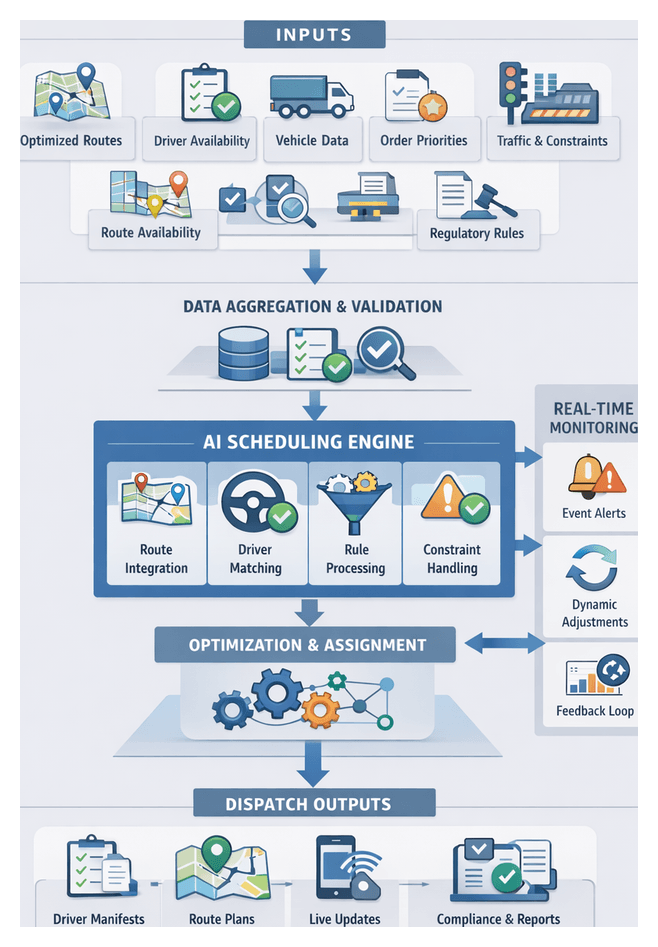
Scheduling Inputs and Dispatch Planning Objectives
Effective dispatch scheduling transforms optimized route plans into actionable driver assignments, delivery windows and resource allocations. To ensure feasibility, compliance and alignment with service commitments, scheduling engines require validated inputs, clear prerequisites and well-defined objectives. By integrating data from route optimization, workforce management, vehicle telematics and order systems, organizations can automate time slot assignment, driver-route matching and exception handling while meeting regulatory constraints and service level agreements.
Core Scheduling Inputs
- Optimized Routes: Finalized route sequences—including stops, order, distances and travel times—from dynamic optimization tools.
- Driver Availability: Real-time rosters with shift schedules, certifications, preferred zones and hours-of-service limits from systems like SAP Workforce Management or Oracle Transportation Management.
- Vehicle Fleet Data: Specifications on capacities, fuel types, maintenance status and special equipment (e.g., refrigeration, lift gates, hazardous material compliance).
- Order Priorities and Service Windows: Customer time windows, priority tiers and penalty rules sourced from order management platforms.
- Real-Time Traffic and ETA Updates: Predictive congestion and incident data from services such as Google Cloud AI Platform or in-house traffic models.
- Depot and Dock Constraints: Loading bay schedules, slot availability and queue limits integrated via warehouse management systems.
- Regulatory Rules: Local driving laws, mandatory rest breaks and safety regulations from compliance databases or third-party services.
Prerequisites for Automated Scheduling
- Unified Data Repository: Centralized, cleansed inputs adhering to a common schema, free of duplicates and anomalies.
- Forecast Synchronization: Locked and versioned demand projections to align scheduling with capacity plans.
- Real-Time Connectivity: Continuous streams from telematics, traffic APIs and warehouse systems, with fallback protocols for outages.
- Resource Status Verification: Up-to-date vehicle maintenance alerts, inspection reports and driver health checks.
- Business Rule Configuration: Defined dispatch parameters—maximum route duration, allowable deviations and customer tolerance thresholds—in a configurable layer.
- Integration Testing: End-to-end validation across optimization, scheduling and execution platforms under peak loads and disruption scenarios.
Dispatch Planning Objectives
- Maximize Utilization: Minimize idle time and empty miles to reduce unit costs and boost asset ROI.
- Ensure On-Time Delivery: Honor customer windows by incorporating traffic forecasts and strategic buffers.
- Balance Workload: Distribute assignments equitably to maintain driver satisfaction and prevent fatigue.
- Minimize Costs: Optimize sequences to reduce fuel consumption, tolls and overtime pay.
- Maintain Compliance: Enforce hours-of-service limits, rest breaks and inspection intervals.
- Support Real-Time Adaptation: Enable dynamic reallocation in response to new orders, cancellations or disruptions.
Automated Schedule Creation Workflow
An AI-driven scheduling workflow ingests optimized routes, driver profiles, order priorities and real-time event triggers to produce executable dispatch manifests. Modular components interact via RESTful APIs and message queues to validate inputs, apply business rules, generate assignments and manage exceptions. This orchestration ensures that analytical insights from optimization and forecasting translate into reliable field execution.
Input Aggregation and Validation
The aggregation module collects feeds from the optimization engine, workforce management systems, order management platforms and event buses. It maps data to a unified schema, verifying time window parameters, driver shift details and route identifiers. Records failing validation trigger alerts for remediation. Enrichment with reference data—geozones, driver performance statistics and customer profiles—prepares the dataset for matching and allocation, while preserving traceability for audit purposes.
Data Normalization and Time Slot Alignment
Temporal attributes are harmonized to a common time zone, aligning order windows and driver shifts. Spatial data is standardized via geocoding microservices, reconciling address formats and geofencing parameters. This normalization anchors all inputs to a master map index, preventing time overlaps and ensuring consistent travel time calculations across regions.
Route Integration and Driver Matching
Normalized routes are paired with live driver availability based on proximity to start locations, required certifications and shift windows. The assignment logic filters out incompatible pairings and generates ranked candidate matches by cost impact, distance deviations and driver performance. Automated compliance checks enforce fatigue regulations, simulating full route assignments to confirm adherence to labor laws and rest requirements.
Business Rules Application and Prioritization
A centralized rules engine manages prioritization criteria—premium service tiers, high-value customers and time-critical shipments. When capacity constraints arise, it evaluates batching or rescheduling within allowable tolerance windows. Cross-dock and warehousing handoffs are synchronized to avoid idle transfer times and support just-in-time inventory flows.
Constraint Checking and Exception Handling
The workflow validates vehicle capacities, sequential dependencies and customer availability windows. Exceptions—such as overbooked vehicles or time conflicts—are categorized and addressed through remediation strategies: route splitting, asset substitution or manual review. Each exception event is logged with metadata to inform continuous improvement.
AI-Driven Assignment Engine and Iterative Optimization
Machine learning models and metaheuristic algorithms explore driver-route pairing combinations, scoring candidates against multi-criteria fitness functions: on-time probability, fuel efficiency and driver satisfaction. Reinforcement learning agents adapt scoring weights based on historical outcomes, reducing manual tuning. Iterative refinement loops recalculate assignments until convergence criteria—such as minimum route distance or maximum fill rate—are met.
Scheduling Output Generation and Handoff
Upon convergence, the system produces a dispatch manifest containing sequenced stops, estimated arrival windows, driver and vehicle details. Outputs are versioned and formatted for dashboards and API endpoints. Metadata—confidence scores, risk factors and contingency plans—equips managers to monitor execution. The notification module distributes JSON payloads to driver mobile applications and telematics devices, while APIs update customer portals and warehouse systems with advanced shipping notices.
Real-Time Update Loop and Orchestration
An event-driven listener monitors new orders, cancellations and traffic incidents via platforms such as Apache Kafka or Azure Event Hubs. Incremental rescheduling adjusts only impacted assignments, preserving unaffected plans. An orchestration layer maintains workflow state, manages retries and scales horizontally to handle peak loads.
Monitoring, Governance and Human-in-the-Loop
Key performance indicators—schedule fill rate, average route length and projected on-time percentage—are computed during execution. Threshold-based alerts prompt manual review when automated outputs fall below standards. Dispatch managers can override assignments, with changes propagated through downstream modules and captured in an audit trail. Role-based access controls and data lineage tracking enforce privacy and compliance policies, while test simulations validate schedule performance under varied scenarios.
Adaptive Rescheduling with AI Agents
Adaptive AI agents continuously monitor in-flight routes, ingesting streaming GPS telematics, order updates and traffic feeds to detect disruptions. Leveraging reinforcement learning, predictive scoring and clustering algorithms, agents generate and evaluate candidate rescheduling actions—such as inserting new orders, swapping stops or redirecting vehicles—and execute optimal adjustments via APIs to the central scheduling system.
Event Detection and Decision Logic
- Event Monitor: Consumes real-time triggers—new tasks, congestion alerts or vehicle issues—to initiate rescheduling.
- Decision Maker: Generates action sets, scoring each on on-time probability, incremental distance and driver utilization, informed by traffic forecasts and predictive models.
- Executor: Applies approved changes automatically or via dispatcher review, using assignment APIs compatible with platforms like SAP Transportation Management.
Rescheduling Protocol
- Impact Analysis: Estimates delay propagation and identifies at-risk orders.
- Candidate Generation: Creates potential adjustments—route insertions, asset substitutions or load rebalancing.
- Action Evaluation: Scores options with predictive models for delivery time, cost and resource efficiency.
- Decision Execution: Automatically applies high-confidence actions; routes complex cases to a dispatcher dashboard.
Scalable Deployment and Integration
Agents run in containerized environments orchestrated by Kubernetes, leveraging Azure Machine Learning, Google Cloud AI Platform and serverless compute such as Azure Functions. They interface with mobile apps via Google Cloud Firebase Messaging to alert drivers of assignment changes.
KPI Feedback and Continuous Learning
On-time delivery rates, driver utilization, rescheduling frequency and customer satisfaction scores are collected into a central analytics repository. Periodic model retraining incorporates execution data to refine agent policies. If frequent swaps degrade satisfaction, weighting factors shift to prioritize route stability, creating a closed-loop adaptive learning framework.
Dispatch Deliverables and Driver Coordination
The dispatch stage translates schedules into precise, machine-readable instructions and human-readable manifests. Outputs serve as the foundation for real-time monitoring, customer communication and continuous improvement.
Key Deliverables
- Driver Assignment Manifests: Sequenced stop lists with customer details and priority flags.
- Route Itineraries: Geocoded waypoints, travel times and service durations.
- Digital Dispatch Packets: JSON or XML payloads for mobile apps and telematics devices.
- Printed Schedules: PDF documents for warehouse desks and in-cab reference.
- Notification Triggers: Messages to customer communication systems for ETA updates and proof-of-delivery links.
Digital Handoff Protocols
Dispatch packets are transmitted via RESTful endpoints and message brokers with acknowledgment protocols, retry logic and dead-letter queues. Unique identifiers track each handoff, ensuring drivers receive updates within seconds. Audit logs capture transmission events for compliance reporting.
In-Cab Guidance and Telematics Integration
Telematics platforms synchronize navigation devices via secure APIs or MQTT streams. Geo-fencing triggers waypoint alerts, and turn-by-turn guidance adjusts for live traffic incidents. Vehicle health and location data stream back to the operations center to enable exception detection.
Customer Communication and Monitoring Handoff
Dispatch completion events trigger SMS and email notifications, delivering delivery windows and tracking links. For high-value shipments, recipients can confirm or reschedule. Simultaneously, schedule metadata and milestone definitions feed exception management engines to detect late departures or missed stops and generate alerts or rerouting suggestions.
Audit, Compliance and Feedback Integration
Authorization controls restrict schedule modifications. Encryption and digital signatures verify payload integrity. Dispatch logs and manifests are retained per regional regulations. Execution data—actual versus planned times, exception resolution records and driver feedback—is aggregated to inform continuous scheduling and optimization improvements.
Chapter 7: Real-Time Monitoring and Exception Management
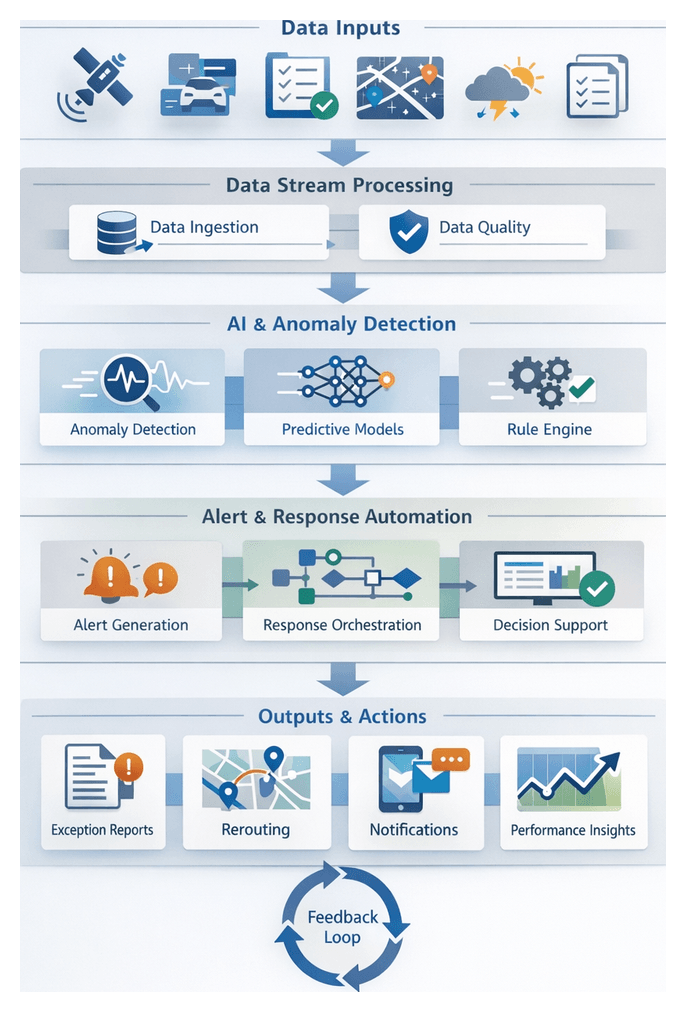
In dynamic logistics and transportation operations, continuous visibility and proactive exception handling are strategic imperatives. Real-time monitoring ingests high-frequency telematics, sensor data, traffic and weather feeds, and order events to detect deviations from planned routes and schedules. Exception management applies business rules and statistical thresholds to trigger alerts and initiate predefined workflows, shifting from reactive fixes to systematic, data-driven resilience. This integrated stage bridges planned schedules and real-world execution, orchestrating AI services and human oversight to preserve service quality, optimize resource utilization, and minimize the impact of disruptions.
Monitoring Inputs, Infrastructure Prerequisites, and Data Quality
Effective monitoring relies on timely collection and consolidation of diverse data streams, robust ingestion infrastructure, and rigorous data quality controls. Key inputs include:
- Fleet telematics and GPS feeds reporting location, speed, engine status, fuel levels and driver behavior metrics via devices that sample at high frequency.
- On-board sensors measuring cargo temperature, door open/close events, tire pressure and brake alerts, critical for sensitive or safety-critical shipments.
- Order management system events—ERP or WMS updates indicating pick-up confirmations, loading completions and delivery acknowledgments.
- Live traffic and incident data from Google Maps Traffic, Here Technologies and TomTom, enabling correlation of delays with external factors.
- Weather and environmental alerts from the National Weather Service and Weather Underground for safety-critical routing adjustments.
- Regional compliance and regulatory updates—curfews, road restrictions and permit expirations—that may impact route legality.
- Customer communications and special instructions from CRM integrations, refining delivery windows and access details.
Underpinning this data flow are essential technical prerequisites:
- A scalable streaming platform such as Apache Kafka or AWS Kinesis to handle high-throughput, low-latency ingestion.
- Cleaned and normalized data streams with consistent schemas, time-synchronization protocols (e.g., NTP) and automated validation to prevent false alerts.
- Baseline predictive models for traffic forecasting and time estimation, ready to evaluate live telemetry against expected performance.
- Geospatial reference layers loaded into spatial databases such as PostGIS or mapping services to support geofencing and proximity calculations.
- An alerting infrastructure capable of dispatching notifications via SMS, email, push messages or platforms like Slack and Microsoft Teams.
- Service-level threshold definitions encoded as business rules governing acceptable deviations in arrival times, idle durations and speed ranges.
- Resilient connectivity—cellular, satellite and Wi-Fi failover—to maintain continuous data flow from vehicles.
- Security and privacy controls, including encryption, access controls and data masking to comply with GDPR, CCPA and other regulations.
Operations teams validate readiness through diagnostics that monitor pipeline integrity, model inference latency and notification delivery performance. Data quality metrics—completeness, accuracy, timeliness, consistency and redundancy—ensure high-fidelity inputs. AI-driven schema inference and anomaly detection platforms automate identification of out-of-bound values and enforce data reliability.
Defining Alert Criteria and Exception Detection
Alert criteria translate raw monitoring inputs into actionable exceptions by applying business logic and statistical thresholds. Key categories include:
- Route deviations triggered when vehicles exit predefined geofences or stray beyond configurable distances from planned polylines.
- ETA slippage alerts generated when predicted arrival times fall outside scheduled windows by preset tolerances, using live traffic and historical variance models.
- Unauthorized stops or extended idling detected at non-approved locations or exceeding maximum idle durations to address fuel waste and security concerns.
- Sensor anomalies indicating cargo temperature excursions, unexpected door openings or abnormal acceleration patterns suggestive of accidents or aggressive driving.
- Compliance violations flagged when drivers exceed Hours-of-Service limits or enter restricted zones without permits, using ELD data streams.
- Communication failures monitored by connectivity loss thresholds, triggering fallback protocols or manual intervention.
- Customer-driven exceptions based on SLA definitions from CRM or contract systems, such as restricted delivery hours or expedited requirements.
To mitigate alert fatigue, threshold tuning leverages statistical analysis of historical performance. Percentile-based criteria and anomaly detection algorithms (for example, isolation forests or autoencoders) dynamically adjust limits, reducing false positives while preserving sensitivity to genuine disruptions.
AI-Driven Anomaly Detection and Response Orchestration
AI modules augment rule-based detection with adaptive anomaly identification and automated remediation orchestration. Core capabilities include:
- Streaming anomaly detection frameworks built on platforms such as Apache Kafka and Apache Flink, ingesting GPS, sensor and traffic feeds and executing sub-second inference.
- Feature engineering and model selection using tools like TensorFlow and PyTorch to develop RNNs, LSTMs and supervised classifiers, alongside unsupervised models such as isolation forests.
- Hybrid AI architectures combining lightweight statistical checks (z-score thresholds, moving averages) with deep learning layers for nuanced pattern recognition.
- Event correlation and contextual analysis that integrates anomaly alerts with historical fleet performance, driver profiles, maintenance records and live weather updates to assess severity and root causes.
- Automated response orchestration via workflow engines such as Apache Airflow, AWS Step Functions or Zapier, sequencing actions like dynamic rerouting, backup vehicle dispatch, maintenance checks and customer notifications.
- Integration with operational systems including dynamic route optimization engines, fleet management platforms, CRM systems and collaboration tools like Slack and Microsoft Teams, ensuring AI recommendations translate into real-world actions.
- Human-in-the-loop controls and escalation protocols that route high-severity events to supervisors via approval gates, providing dashboards with anomaly details, historical benchmarks and options to override automated responses.
- Continuous learning and model adaptation using feedback loops that retrain detection models on resolved incident data, improving precision and contextual awareness through backtesting and canary deployments.
Performance is measured by KPIs such as detection accuracy, mean time to detection (MTTD), mean time to resolution (MTTR), false alarm rate and operational impact metrics. Dashboards built with Tableau, Power BI or Grafana display real-time insights and trend analysis, guiding strategic decisions.
Exception Reporting, Rerouting Outputs, and Handoff Procedures
The monitoring stage culminates in structured exception reports and actionable rerouting instructions that drive downstream remediation and continuous improvement. Key outputs include:
- Exception summary records with identification codes, timestamps, GPS coordinates, severity levels and confidence scores.
- Telemetry snapshots capturing speed, engine diagnostics, cargo temperature and driver status at the moment of detection.
- Traffic impact analysis reports leveraging AI-powered models such as TrafficSense real-time feeds to project delay windows.
- Rerouting proposals offering alternate routes optimized for minimal additional time or distance, integrated with the same constraint definitions and cost functions used by dispatch optimization engines.
- Risk assessments quantifying anomaly reliability, predicted delay durations and reroute success probabilities.
These deliverables are exported in standardized formats—JSON payloads, message queue events via Kafka or RabbitMQ, or CSV summaries—to ensure interoperability. Structured handoff mechanisms include:
- Event messaging to publish exception events with routing keys for downstream subscribers.
- API callbacks using HTTP POST requests to trigger synchronous workflows in scheduling or customer support systems.
- Dashboard updates displaying active alerts, reroute recommendations and resolution status for human oversight.
- Mobile push notifications delivering prioritized rerouting instructions to driver applications in real time.
- Audit log entries recording each exception and reroute action in an immutable trail for governance and compliance.
Dispatch and scheduling engines ingest these outputs to adjust master plans. Alert ingestion, conflict resolution, plan adjustment and notification cascades to drivers, warehouse personnel and customers ensure consistency and traceability. Complex incidents trigger escalation flags, routing high-priority alerts to operations control centers with contextual data packages and interactive resolution workspaces. Every manual intervention is auditable, balancing automation speed with human judgment.
Finally, exception outcomes feed the continuous improvement loop by capturing delay realization records, reroute effectiveness metrics and exception frequency trends. This feedback refines predictive models, alert thresholds and optimization strategies, progressively enhancing the resilience and efficiency of the AI-orchestrated delivery network.
Chapter 8: Automated Feedback Loop and Adaptive Learning
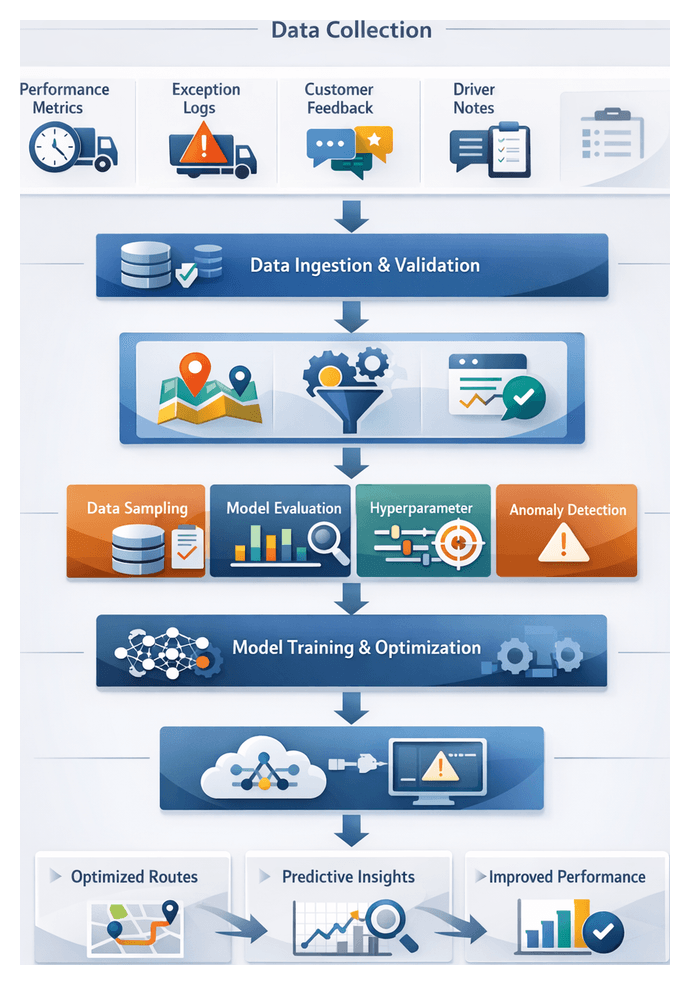
Purpose and Scope of the Feedback Data Collection Stage
The feedback data collection stage establishes the foundational mechanism for capturing outcome-oriented information after each delivery cycle. Its primary objective is to systematically gather a comprehensive set of performance indicators, exception records and qualitative insights. By creating a structured feed of empirical evidence, downstream AI modules can analyze real-world results for continuous improvement. Without this disciplined data capture, predictive accuracy erodes and optimization engines lack the context to adapt to evolving operational patterns.
In modern logistics, delivery performance hinges on dynamic variables ranging from live traffic conditions to loading and unloading delays. The feedback stage aggregates these factors into a coherent dataset that spans quantitative metrics—such as on-time arrival rates, route compliance statistics and fuel consumption figures—and qualitative inputs like customer satisfaction ratings and driver observations. Together, these inputs form the evidence base for model recalibration, parameter tuning and decision-logic refinement.
By defining clear scope and standards for data capture, organizations avoid fragmented or ad hoc feedback mechanisms. The feedback stage prescribes what to record, when to record it and how to format it for automated ingestion. Standardizing inclusion criteria accelerates the pace of learning within AI frameworks and ensures each data point aligns with business objectives, compliance requirements and system design constraints. Ultimately, the feedback collection stage closes the loop by linking predicted outcomes with actual results, transforming raw operational data into strategic assets for continuous, AI-driven adaptation.
Key Data Inputs, Criteria Definition and Quality Validation
Effective feedback capture depends on precise definitions of required inputs and validation criteria. Inputs fall into four primary categories:
- Operational Performance Metrics—Timestamped events for pickups and deliveries, actual versus planned arrival times, vehicle telematics (speed profiles, fuel usage) and idle durations.
- Exception and Disruption Logs—Structured records of delays, reroutes, mechanical failures and regulatory holds, each tagged with root-cause identifiers, resolution status and timestamps.
- Customer-Level Feedback—Post-delivery survey responses, Net Promoter Scores, audio transcripts and sentiment analysis outputs graded to a unified schema.
- Driver and Workforce Notes—Annotations captured via mobile apps or telematics interfaces, detailing site access issues, dock wait times and safety or compliance incidents.
Each input must meet defined inclusion criteria. For operational metrics, event clocks across telematics units and the central repository must synchronize within a ±5-second tolerance. Exception logs require metadata fields such as exception type, location, timestamp, resolver ID and severity level. Customer feedback must map to a consistent scale—numeric or categorical—and align with sentiment-analysis schemas. By enforcing schema conformance, value-range checks, completeness audits and referential integrity validations, the feedback stage ensures high-fidelity records that require minimal preprocessing.
Records failing validation can be automatically corrected through deterministic rules—for example, imputing missing location coordinates within defined thresholds—or quarantined for manual review. Exception metadata should capture error types, severity levels and remediation actions. Dynamic quality thresholds, adjusted based on historical error rates and operational risk tolerances, further safeguard model training pipelines from corrupted or incomplete data.
Infrastructure Prerequisites and Integration Requirements
Prior to implementing feedback capture, organizations must provision a unified data infrastructure capable of ingesting heterogeneous sources in near real time. Core components include an event streaming platform—such as Apache Kafka—and a central data lake or warehouse with schema enforcement. Without this backbone, siloed systems hinder coherent analysis.
Delivery management applications and telematics systems must emit standardized events via RESTful or gRPC APIs, webhooks and database change data capture processes. Message schemas registered in an API registry enable contract-driven validation at runtime. Authentication and authorization controls—such as OAuth2 or mutual TLS—secure data in transit. Specialized integration platforms to orchestrate complex flows between edge devices, cloud services and machine learning pipelines, supporting both batch and streaming modalities.
A governance framework must define roles, responsibilities and data access policies. Stakeholders—including operations managers, data engineers and compliance officers—need clear authority over annotating records, reviewing feedback and approving schema changes. Time synchronization through NTP or equivalent services maintains temporal coherence across IoT devices, mobile applications and servers to within milliseconds. Architectures employ fault-tolerant patterns—retry policies, dead-letter queues and back-pressure handling—to sustain performance under fluctuating event rates. Monitoring dashboards alert teams to integration errors or schema mismatches before they disrupt the feedback pipeline.
Adaptive Learning Workflow and AI Learning Modules
Once feedback data criteria and integrations are in place, the adaptive learning workflow orchestrates data extraction, staging, enrichment and training. Connectors poll operational systems or subscribe to event streams, buffering inputs in message queues to guarantee once-only delivery. In a staging layer, schema validation and integrity checks flag invalid records for manual review. Validated data proceeds to transformation and enrichment, where GPS traces are reverse-geocoded, exception codes are mapped to descriptive labels and driver feedback is text-normalized and sentiment-scored.
Enriched data merges with historical archives in a feature store optimized for time-partitioned queries. A scheduler triggers integration jobs aligned with model retraining cadences—micro-batches for hourly updates and full batches for daily or weekly cycles.
Dedicated AI learning modules then drive continuous improvement:
- Data Sampling Agent—Selects balanced subsets of feedback records to prevent drift in training sets.
- Model Evaluation Engine—Benchmarks models using metrics such as mean absolute error for time predictions and F1 scores for exception classification.
- Hyperparameter Optimizer—Applies Bayesian optimization or population-based training to refine model parameters.
- Feature Store Updater—Maintains a consistent repository of derived features.
- Deployment and Monitoring Unit—Orchestrates canary tests and drift detection post-deployment.
Specialized AI roles collaborate within this architecture:
- Trend Extraction Agent—Detects emerging patterns via time-series and sequence modeling.
- Anomaly Adaptation Agent—Flags outlier behaviors with unsupervised learning.
- Resource Allocation Learner—Refines fleet sizing and routing policies using reinforcement learning.
- Feedback Fusion Agent—Integrates structured and unstructured inputs, enriching datasets with natural language pipelines.
Orchestration and training leverage platforms such as AWS SageMaker, TensorFlow, PyTorch and scikit-learn. Workflow management tools—MLflow, Kubeflow and Apache Airflow—provide reproducible pipelines, feature versioning and lineage tracking. These modules collaborate through a shared metadata store, capturing experiment identifiers, training data descriptors and performance benchmarks, ensuring that each model update is transparent, auditable and aligned with business metrics.
Refined Models Output, Deployment and Handoff
Upon completing evaluation cycles, the system produces versioned model artifacts—compressed binaries, configuration manifests, evaluation reports and metadata registrations. Each artifact records training data windows, hyperparameters and metrics like service level uplift. A model registry maintains semantic versioning and lineage metadata, while the feature store ensures consistent transformations between training and inference.
Deployment pipelines package artifacts into inference services using blue-green or canary strategies. Options include serverless endpoints on AWS SageMaker or containerized microservices in a Kubernetes environment orchestrated via Kubeflow. Automated rollback triggers monitor live performance, reverting to stable versions if error rates or latency exceed thresholds. Integration tests validate end-to-end data flows and ensure backward compatibility through API versioning and event-bus notifications.
Handoff protocols notify downstream routing, scheduling and traffic estimation engines of model promotions. Dependency catalogs map services to specific model versions, facilitating coordinated upgrades. Real-time routing engines consume travel time confidence intervals, while demand forecast endpoints inform capacity planning. Scheduling connectors align fleet assignments with refined predictions, enhancing on-time performance, reducing fuel consumption and improving service reliability.
Monitoring, Governance and Continuous Improvement
Post-deployment, the Monitoring Unit tracks inference latency, throughput, error rates and prediction quality. Drift detection compares live feature distributions and performance metrics against historical baselines. Platforms such as Prometheus and Grafana surface automated alerts for anomalies, triggering ad hoc retraining when thresholds are breached.
Data governance and security are enforced throughout the feedback pipeline. Encryption at rest and in transit, role-based access controls and anonymization techniques protect sensitive customer and driver data. Audit logs record every action—data access, transformations and model promotions—to support compliance with GDPR and industry regulations. Data retention policies purge or archive records according to corporate and legal mandates, preserving stakeholder trust and regulatory integrity.
The refined models and their monitored outputs feed back into the data collection stage, closing the loop. Continuous evaluation triggers new training cycles in response to drift or operational insights, ensuring predictive accuracy and optimization efficacy evolve in harmony with changing traffic patterns, delivery volumes and service requirements. This iterative process solidifies a resilient, AI-driven logistics framework that delivers sustained operational excellence.
Chapter 9: System Orchestration and Scalability
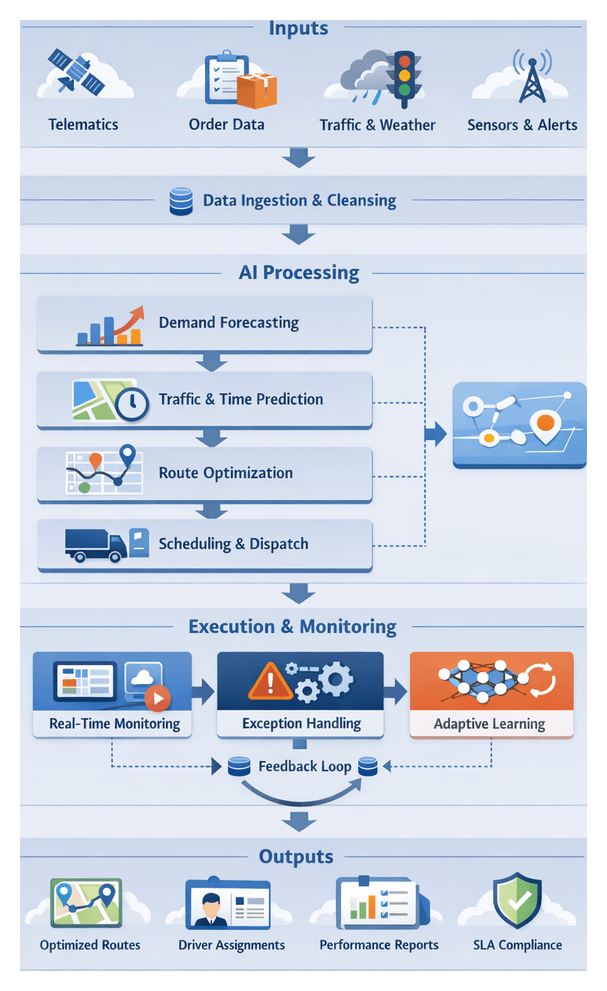
Delivery Complexity in Modern Logistics
The contemporary logistics landscape presents unprecedented operational complexity driven by e-commerce growth, customer demands for same-day delivery and the globalization of supply chains. Fluctuating order volumes, diverse shipment profiles, variable traffic patterns and stringent time-window commitments form a dynamic ecosystem that defies static planning. Traditional manual methods and spreadsheet-driven processes cannot absorb real-time disruptions without incurring high exception handling costs and eroding service levels.
- Demand volatility from promotions, seasonality and regional events challenges capacity planning.
- Network variability across multiple depots, mixed fleets and dispersed customer locations increases routing possibilities.
- Uncertainties such as weather, traffic incidents, regulatory constraints and equipment failures introduce unpredictability.
- Balancing fuel, labor and asset utilization against service-level agreements requires fine-tuned cost-service trade-offs.
- Fragmented data silos for telematics, order management, traffic feeds and weather complicate unified decision-making.
A Structured AI Workflow for Orchestration
To manage this complexity, logistics providers adopt a formal AI workflow that orchestrates data ingestion, predictive analytics, optimization and execution into a cohesive process. This structured approach replaces ad-hoc reactions with repeatable, auditable pipelines that scale across regions and business units.
- Consistency: Defined pipelines enforce standard data transformations, model executions and decision logic.
- Scalability: An orchestration layer parallelizes tasks, allocates resources dynamically and extends to new markets without reengineering core logic.
- Traceability: Stage-by-stage logs and metadata enable root-cause analysis, compliance audits and governance.
- Modularity: Discrete components for cleansing, forecasting, optimization and monitoring allow targeted improvements and model reuse.
- Agility: Predefined integration points accelerate deployment of new data sources, algorithms and business rules.
AI-Driven Routing Capabilities
Artificial intelligence transforms routing from reactive adjustments into proactive decision-making. By integrating predictive modeling, optimization engines and adaptive learning, AI enables anticipatory logistics management that maintains high performance in the face of disruption.
- Predictive modeling forecasts order demand, traffic conditions and service times with machine learning.
- Optimization engines leverage genetic algorithms, simulated annealing and mixed-integer programming for constrained route planning.
- Adaptive learning through reinforcement learning refines policies using feedback loops between predicted and actual outcomes.
- Real-time decision logic ingests telematics and incident feeds for on-the-fly alerts, rerouting and rescheduling.
- Scenario analysis enables what-if simulations of fleet expansions, policy changes or demand spikes.
Architecture of the AI Delivery Framework
The end-to-end framework is organized into modular stages with clear interfaces for seamless data and control flow. Each stage embeds AI components to prepare, predict and optimize delivery schedules.
- Data Ingestion and Integration: Consolidates telematics, order feeds, traffic and weather APIs into a unified pipeline.
- Data Cleansing and Normalization: Applies schema reconciliation, anomaly detection and standardization routines.
- Demand Forecasting and Capacity Planning: Generates probabilistic demand projections and fleet allocations.
- Predictive Traffic Modeling and Time Estimation: Fuses live traffic feeds with learned travel-time distributions.
- Dynamic Route Optimization Engine: Solves multi-constraint routing problems for cost-effective itineraries.
- AI-Enhanced Scheduling and Dispatch: Assigns drivers, vehicles and communicates schedules.
- Real-Time Monitoring and Exception Management: Tracks execution, triggers alerts and orchestrates corrective actions.
- Automated Feedback Loop and Adaptive Learning: Retrains models using performance metrics and exception logs.
- System Orchestration and Scalability: Manages task execution, retries and resource allocation.
- Governance, Security and Compliance: Enforces data privacy, access controls and regional regulations.
Orchestration Workflow Patterns
The orchestration engine acts as the conductor, coordinating event-driven triggers, state management, parallel execution and error handling. Providers implement platforms such as Prefect or Apache Airflow to formalize workflows that adapt in real time.
Event-Driven Triggers
- Event Sources: Telematics, order systems, weather APIs and traffic alerts launch workflows.
- Event Listeners: Webhooks or lightweight agents detect new events for processing.
- Conditional Triggers: Rules evaluate attributes such as priority or region to select workflow branches.
- Queue Management: Brokers like Apache Kafka buffer events for guaranteed delivery.
State Management and Sequencing
- Directed Acyclic Graphs define task dependencies and execution order.
- State Persistence in databases ensures recovery after interruptions.
- Idempotent Tasks guarantee safe re-execution without side effects.
- Checkpointing captures intermediate results to avoid full reprocessing.
Parallelism and Task Dependencies
- Task Partitioning splits large workloads by geography or delivery window.
- Resource Pools allocate dedicated compute for ML training versus lightweight API calls.
- Dependency Graphs specify which tasks run concurrently and which are serialized.
- Throttling Controls prevent resource exhaustion by limiting concurrency.
Error Handling and Retry Logic
- Automatic Retries with exponential backoff for transient errors.
- Fallback Paths use historical averages when real-time data is unavailable.
- Error Escalation routes unresolved issues to human-in-the-loop systems.
- Compensation Actions roll back partial changes in external systems.
Monitoring, Logging and Integration Actors
- Centralized Logging exports structured logs to ELK stack platforms.
- Metrics Collection with Prometheus feeds dashboards and alerts.
- Tracing via uniquely identified workflow instances surfaces latency hotspots.
- Health Checks enable container orchestration systems to manage service availability.
- Integration Actors include orchestration engines, AI microservices, data stores, message brokers and notification systems.
Scalability Considerations
- Distributed Orchestration deploys multiple engine instances behind load balancers.
- Sharding Workflows partitions by segment or region to isolate workloads.
- Elastic Infrastructure on platforms like Kubernetes auto-scales based on queue depths.
- Horizontal AI Scaling runs multiple replicas of inference services to meet throughput demands.
AI Agents for Dynamic Workflow Management and Scaling
Specialized AI agents embedded within the orchestration layer monitor system health, forecast demand surges and adjust resources in real time. This dynamic management ensures high availability, performance consistency and cost-efficient infrastructure utilization.
Real-Time Forecasting and Anomaly Detection
- Time-series models forecast short-term workloads for route optimizations and dispatch tasks.
- Continuous retraining adapts to holiday peaks and promotion-driven spikes.
- Anomaly detection triggers scaling or mitigation workflows for unexpected demand.
- Integration with Datadog and Elastic Stack provides real-time visibility and alerts.
Intelligent Resource Provisioning and Autoscaling
- AI agents interface with Kubernetes Autoscaler in Kubeflow installations to add GPU nodes for traffic modeling.
- On AWS, agents use AWS Step Functions to adjust Lambda concurrency for scheduling tasks.
- Reinforcement learning balances performance SLAs against cloud spend to avoid over-provisioning.
Adaptive Task Scheduling and Execution Flow
- Agents reorder DAGs in Apache Airflow or Prefect based on SLA deadlines and resource availability.
- Reinforcement learning agents optimize scheduling policies to minimize latency under varying loads.
- Task preemption logic prioritizes urgent rerouting over bulk batch jobs.
Automated Failure Detection, Root-Cause Analysis and Recovery
- Observability agents ingest logs from Jaeger and metrics from Prometheus to detect anomalies.
- Causal inference techniques identify failure patterns in API rates, database performance or queue latency.
- Recovery playbooks restart tasks, reroute message streams or invoke fallback services.
- Incident notifications integrate with ITSM tools providing recommended remediation steps.
Dynamic Scaling Across Regions and Business Units
- Multi-armed bandits optimize workload distribution among regions to minimize latency.
- Policy-driven scaling respects data residency and compliance requirements.
- Cost allocations tag resources to business units for transparent chargebacks.
- Service meshes like NGINX or Linkerd route traffic to optimal clusters.
Integration with Observability and Governance
- Agents enforce security policies via HashiCorp Vault and access controls with Open Policy Agent.
- Policy checks precede scaling actions to prevent unauthorized expansions.
- All decisions are logged to centralized audit trails for continuous improvement.
Scalable Outputs and Business Integration
The orchestration stage generates standardized artifacts—execution logs, dashboards, event streams, SLA reports and alert summaries—that integrate across operations, finance, customer service and compliance for consistent, enterprise-wide insights.
Execution Logs
- Detailed audit trails of stage triggers, timestamps, parameters and status codes.
- Consumed by DevOps for capacity planning, by data pipelines via Apache Kafka, and by compliance teams.
- Unified schema includes region codes, fleet identifiers and business unit tags.
Performance Dashboards
- Real-time metrics on throughput, latency, resource utilization and delivery success rates.
- Built on Grafana or Kibana with standardized templates for global and regional views.
Event and API Endpoints
- RESTful APIs and event streams that publish job state changes to message buses or webhooks.
- GraphQL interfaces for ad-hoc BI queries.
- Standards such as OpenAPI and CloudEvents ensure easy integration.
SLA Compliance Reports
- Periodic reports on on-time delivery, arrival deviations, exception resolution and penalty calculations.
- Automated feeds into contract management and governance dashboards.
Alert and Retry Summaries
- Counts and types of transient failures, retry attempts and unresolved exceptions.
- Delivered to incident management and collaboration platforms with standardized formats.
Dependencies and Integration Patterns
- Input schemas from scheduling engines and canonical events from optimization services.
- Real-time vehicle status feeds and versioned model parameters from learning pipelines.
- Service discovery via registries for dynamic component location.
- Circuit breakers and retries to handle transient failures.
- Message partitioning by region or business unit for throughput and isolation.
- Schema registries to enforce backward compatibility.
Handoffs to Downstream Systems
- Governance and compliance ingest audit logs and SLA reports for risk assessment.
- Business intelligence exports aggregated metrics to data warehouses.
- Customer service platforms receive ETAs and exception notifications.
- Finance systems synchronize cost and SLA breach data for invoicing.
- Third-party logistics subscribe to route and schedule updates via APIs.
Chapter 10: Governance, Security and Compliance
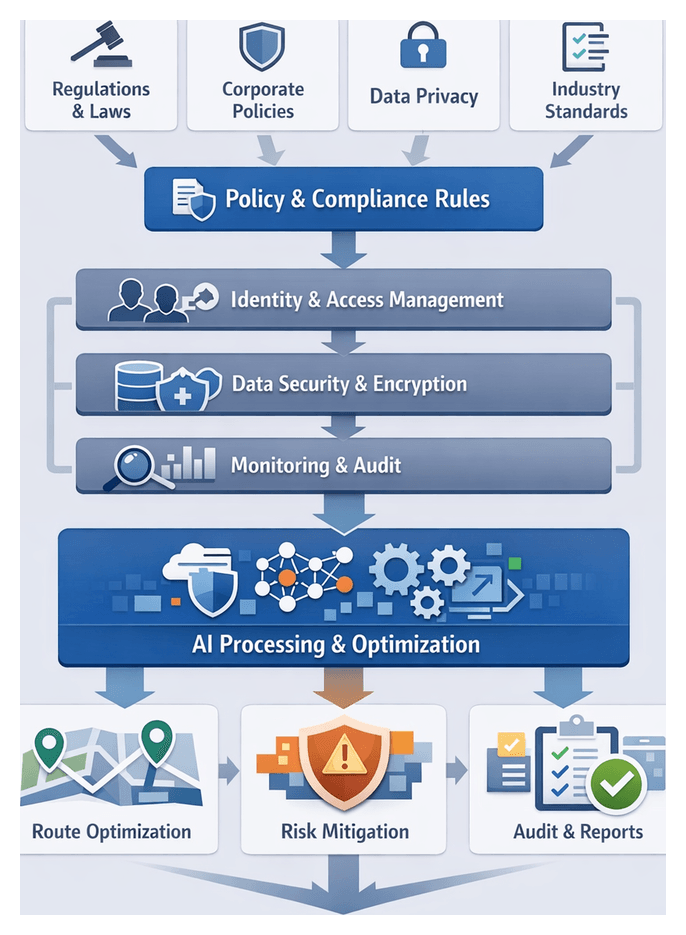
Purpose and Scope of Governance and Compliance
The governance and compliance framework establishes the rules and controls that ensure AI-driven delivery workflows adhere to legal, regulatory and corporate policy requirements. By defining data handling procedures, encryption standards, access controls and audit protocols at the outset, organizations protect sensitive information, enforce operational security and validate adherence to regional transportation laws. This foundation enables transparent, auditable system behavior, mitigates risk and sustains customer trust as AI components optimize routes, schedule deliveries and orchestrate end-to-end logistics processes.
- Define global and regional transportation regulations
- Establish data privacy and security baselines
- Map corporate policies to system controls
- Specify audit logging and reporting requirements
- Outline risk assessment and mitigation procedures
Regulatory and Policy Inputs
Managing diverse legal, regulatory and policy documents requires a centralized repository that tracks version history, approval status and stakeholder ownership. Key input categories include:
- Data Privacy Regulations such as GDPR and CCPA, defining personal data categories, consent requirements and cross-border transfer rules
- Transportation and Safety Laws including FMCSA regulations and the European ADR agreement, governing driver hours, load limits and hazardous materials handling
- Industry Standards such as ISO 27001 for information security management and ISO 28000 for supply chain security
- Corporate Policies including data classification schemes, acceptable use rules and vendor security requirements
- Service Level Agreements specifying performance metrics, data retention periods and reporting cadences
Tools like Palantir Foundry can capture and manage regulatory documentation, while enterprise ERP compliance modules ensure alignment with evolving laws. These inputs drive configuration parameters across data retention, encryption, access controls and optimization constraints.
Organizational Prerequisites
Translating policy rules into technical configurations requires foundational organizational conditions:
- Governance Committee and RACI Model: A cross-functional body with defined responsibilities for policy creation, approval and change management
- Policy Management Platform: Centralized solution for document tracking, version alerts and stakeholder collaboration
- Identity and Access Management: Systems such as AWS Identity and Access Management and Microsoft Azure Policy to enforce role-based access and multi-factor authentication
- Data Classification and Labeling: Logical tagging of datasets by sensitivity to enforce encryption, masking or anonymization
- Incident Response and Audit Capabilities: Processes for security incident detection, escalation and forensic review with comprehensive logging
- Training and Awareness: Education programs and simulation drills to reinforce compliance obligations among developers, data scientists and operations staff
Solutions embed compliance checks into AI agent workflows, automating policy enforcement in real time.
Compliance Workflow Actions and Security Controls
The compliance workflow enforces governance policies, regulatory mandates and security controls across the delivery orchestration platform, ensuring privacy, integrity and accountability at every stage.
Policy Definition and Distribution
Legal, regulatory and internal requirements are translated into machine-readable rules and stored in a centralized policy repository. Captured elements include:
- Data retention schedules and minimum storage durations
- Encryption standards for data at rest and in transit
- Access control matrices mapping roles to data domains
- Compliance checkpoints linked to GDPR, CCPA and transport mandates
Policies are versioned and distributed via API endpoints to enforcement modules, ensuring synchronized governance directives across the orchestration service.
Identity Management and Access Control Verification
Integration with enterprise identity providers such as Azure Active Directory and Okta upholds least-privilege principles. Key steps include:
- Authentication using OAuth 2.0, SAML 2.0 and OpenID Connect with multifactor enforcement for high-privilege roles
- Authorization through RBAC policies from the centralized repository
- Token issuance with RSA or ECDSA signatures and time-bounded validity
- Continuous verification by runtime policy engines to detect privilege escalations
Policy enforcement points intercept service calls and query a policy decision point to confirm compliance before granting resource access, creating a dynamic verification loop with full audit records.
Data Encryption and Key Management
Encryption safeguards data at rest and in flight. Controls include:
- Server-side encryption of databases and storage buckets with customer-managed or platform-managed keys
- TLS encryption for message queues and streaming pipelines
- End-to-end encryption of GPS telemetry between vehicles and central systems
Key management uses hardware security modules or cloud KMS services. The workflow orchestrates:
- Key generation and periodic rotation without downtime
- HSM policies restricting key usage and logging cryptographic operations
- Secure distribution of encrypted key bundles to trusted nodes
Embedding key management calls in orchestration logic ensures data remains encrypted except when accessed by authorized processes.
Secure Data Transmission and API Protection
As data flows between microservices and external systems, the workflow enforces:
- Mutual TLS handshakes for bi-directional authentication
- API gateway controls for JWT validation, schema enforcement and request rate limiting
- Input sanitization to remove malicious or malformed payloads
- Throttling to prevent denial-of-service scenarios
The orchestration engine manages service registrations, propagates certificate updates and performs real-time health checks of SSL/TLS configurations.
Audit Logging and Continuous Monitoring
Comprehensive logging captures significant events across the workflow:
- Access Logs of authenticated sessions, API token usage and privileged operations
- Configuration Changes to policies, key rotations and role assignments
- Data Modification Events for writes, updates and deletions
- Security Alerts from anomaly detection modules
Logs forward in real time to SIEM solutions such as Splunk or IBM QRadar. AI-driven analytics correlate events to detect compliance breaches, misconfigurations and insider risks.
Incident Response and Automated Remediation
On detecting a compliance violation or security incident, the orchestration platform coordinates:
- Alert generation with contextual details from the SIEM or anomaly detection module
- Escalation workflows invoking on-call notifications via email, SMS or collaboration tools
- Automated containment scripts to isolate nodes, revoke tokens or roll back policies
- Human-in-the-loop review to validate actions and determine forensic steps
- Post-incident reporting documenting root cause, remediation and lessons learned
Stateful records of incident progression and regulatory notification timelines are maintained throughout.
Metrics and Compliance Dashboards
Key metrics and dashboards provide real-time visibility into compliance posture:
- Policy compliance rate across enforcement modules
- Unauthorized access attempts blocked per period
- Encryption coverage for sensitive data fields
- Incident response times from alert to containment
- Audit log integrity and retention success rate
Metrics feed into a compliance portal offering drill-down analysis and scheduled executive reports.
AI-Driven Routing and Optimization
Artificial intelligence transforms routing by predicting emerging conditions, optimizing decision paths and learning from outcomes. AI-driven workflows integrate predictive modeling, optimization engines and adaptive learning to deliver efficient, resilient delivery plans.
Predictive Modeling for Demand and Traffic Patterns
Forecasts of order volumes and travel times guide routing decisions:
- Demand Prediction: Machine learning models analyze historical orders, customer behavior and promotions, leveraging AWS SageMaker and Azure Machine Learning
- Traffic Estimation: Time-series and spatial algorithms combine GPS traces, incident reports and weather feeds using Google AI Platform and the OR-Tools library
Optimization Engines for Route Selection
- Constraint Definition: Vehicle capacities, driver shifts and regulatory rules formulated via IBM CPLEX Optimizer
- Search and Evaluation: Genetic algorithms, simulated annealing and reinforcement learning explore route combinations with open-source and commercial solvers
- Multi-Objective Balancing: Cost, time, emissions and customer satisfaction balanced through Pareto optimization techniques
Adaptive Learning for Continuous Improvement
- Anomaly Detection: Agents flag deviations in travel times and delivery metrics
- Reinforcement Signals: Delivery outcomes inform reward-penalty mechanisms in learning agents
- Incremental Retraining: Automated pipelines using AWS SageMaker Pipelines and Azure Machine Learning Pipelines refresh models with new data
System Roles in an AI-Driven Routing Workflow
- Data Integration Platform: Aggregates telematics, traffic, weather and order data
- Predictive Analytics Engine: Serves demand and traffic forecasts via APIs
- Optimization Server: Executes routing algorithms at scale
- Learning Orchestrator: Manages retraining and validation cycles
- Workflow Orchestration Layer: Sequences ingestion, optimization and dispatch tasks
Business Impact of AI-Powered Routing
- Enhanced efficiency with up to 20 percent cost savings in last-mile operations
- Improved on-time delivery rates and customer satisfaction
- Operational agility in responding to disruptions
- Sustainable performance by incorporating emissions metrics
Audit Trails and Privacy Handoffs
The governance framework generates comprehensive artifacts documenting every action, decision and data movement. These records support regulatory audits, legal reviews and continuous improvement.
Audit Log Artifacts
- Event Logs: Entries for ingestion, cleansing, forecasting, optimization, dispatch and feedback with timestamps and statuses
- Access Logs: Authentication, role assignments and API token usage captured by Splunk or AWS CloudTrail
- Configuration Change Logs: History of policy updates, key rotations and workflow modifications
- AI Model Action Logs: Inference calls, retraining events and performance metrics managed via IBM Guardium or the Elastic Stack
Compliance Summary Reports
- Regulatory compliance certificates for SOC 2, ISO 27001 and regional data protection laws
- Exception analysis summaries with root-cause assessments and remediation recommendations
- Data privacy impact assessments supporting GDPR Articles 35 and 36
- Operational dashboards of validated events, failed checks and unresolved exceptions
Reports are distributed as PDF, CSV or via BI connectors into enterprise warehouses such as Snowflake.
Evidence Packages for Audit and Legal Review
- Scope definition files mapping data streams and system components to regulatory requirements
- Artifact index with cryptographic checksums for log files and configuration snapshots
- Policy mapping documents linking events to NIST, PCI DSS and transport regulations
Data Privacy Handoff Records
- Consent records tracking customer and employee consents and withdrawals
- Data subject access request logs with fulfillment statuses and timestamps
- Anonymization and pseudonymization artifacts demonstrating privacy-by-design processes
- Data retention and deletion logs aligned with policy schedules
Dependencies and Integration Points
- Central logging infrastructure aggregating events from microservices and AI modules
- Configuration management database tracking policies, roles and system settings
- AI model registry preserving version history, metrics and deployment statuses
- Orchestration engine emitting stage completion and remediation events
Handoff to Subsequent Systems and Teams
- Compliance operations platforms receive summary reports and exception alerts
- External auditors access evidence packages via secure portals
- Data protection officers monitor DSARs, consent expirations and anonymization logs
- Business intelligence teams ingest compliance metrics for trend analysis
- Security operations centers correlate logs with threat intelligence for anomaly detection
Retention, Archival and Lifecycle Management
- Active Retention: Online storage for ongoing investigations and monitoring
- Warm Archival: Cost-optimized storage for logs older than one year
- Cold Archival: Immutable storage for statutory retention periods
- Secure Disposal: Permanent deletion with logged proof of erasure
Continuous Improvement through Audit Insights
Analysis of recurring exceptions and audit findings feeds back into policy rules, access controls and AI governance, closing the loop to elevate the maturity and effectiveness of the end-to-end AI-driven delivery workflow.
Conclusion
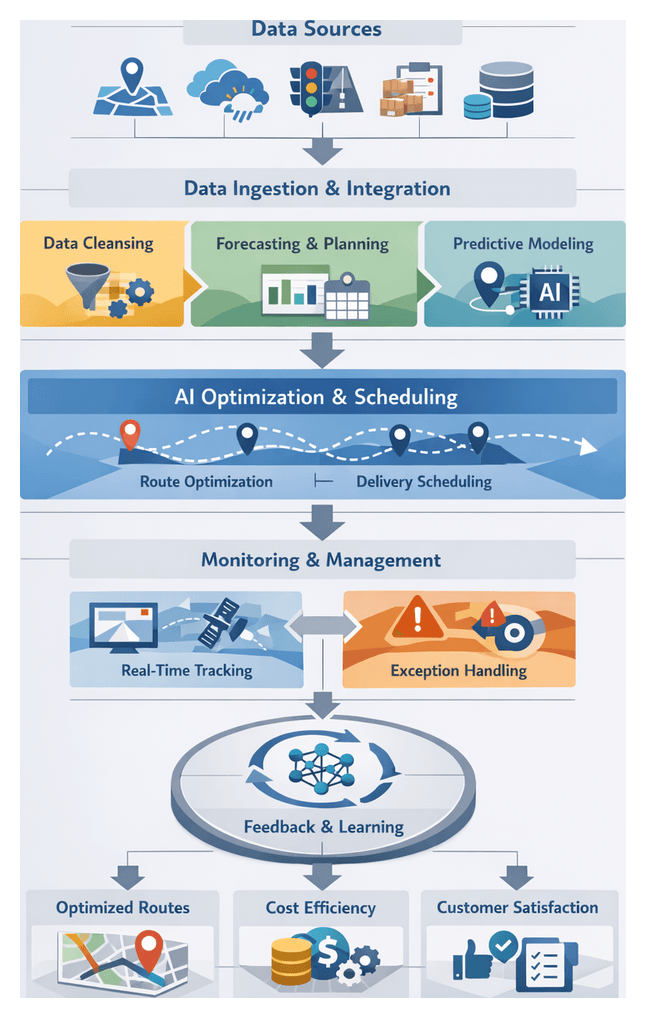
Integrated AI-Driven Delivery Workflow Overview
The AI-driven delivery workflow unifies data ingestion, cleansing, forecasting, optimization, scheduling, monitoring, feedback and governance into a coherent framework that transforms raw information into actionable delivery plans and real-time guidance. By replacing reactive decision making with proactive orchestration, logistics providers achieve consistent service levels, cost control and rapid adaptation to change.
Key stages include:
- Data Ingestion and Integration: Consolidating telematics streams, traffic feeds, weather forecasts, order exports and external context via secure, scalable pipelines.
- Data Cleansing and Normalization: Applying quality rules, error-handling policies and standard units to ensure analytical integrity.
- Demand Forecasting and Capacity Planning: Generating accurate demand projections using feature-engineered historical data, inventory levels and labor schedules.
- Predictive Traffic Modeling and Time Estimation: Combining live traffic, historical travel times and weather indices to produce dynamic time predictions.
- Dynamic Route Optimization: Balancing cost, service quality and resource constraints with high-performance solvers to determine efficient itineraries.
- AI-Enhanced Delivery Scheduling and Dispatch: Converting optimized routes into driver assignments, leveraging bidirectional APIs and communication channels.
- Real-Time Monitoring and Exception Management: Continuously evaluating GPS telemetry and performance metrics to trigger alerts and corrective actions.
- Automated Feedback Loop and Adaptive Learning: Retraining models on delivery outcomes, exceptions and customer feedback for ongoing improvement.
- System Orchestration and Scalability: Coordinating stage execution, managing dependencies and dynamically scaling compute and services.
- Governance, Security and Compliance: Enforcing access controls, encryption, regulatory checks and audit logging throughout the workflow.
This end-to-end design ensures each component operates under governed conditions, providing a checklist for readiness and risk mitigation while delivering reliable, cost-efficient operations.
Operational Efficiency Gains and Metrics
Embedding AI into logistics processes yields measurable improvements across on-time performance, resource utilization, exception handling and cost reduction. A unified metrics framework aligns with strategic objectives, monitors real-time telemetry and supports continuous improvement.
Performance Metrics Framework
Core dimensions include:
- Throughput and service level indicators
- Resource and asset utilization rates
- Cost per delivery, cost per mile and fuel consumption
- Exception and disruption frequencies
- Customer satisfaction and Net Promoter Scores
- Visibility, alert accuracy and operator response rates
- Governance metrics such as audit log completeness and policy violation incidents
- Continuous improvement measures: model drift, update cycle time and process stability
Regular governance reviews ensure data definitions and visualization standards remain consistent across teams.
Delivery Timeliness and Route Efficiency
Predictive traffic modeling and adaptive rerouting deliver 10–25 percent improvements in on-time rates and 8–15 percent reductions in total miles traveled. Key indicators are:
- On-Time Delivery Rate – Percentage of deliveries within promised windows
- Average Delay Minutes – Mean deviation from scheduled delivery times
- Total Miles Traveled – Fleet distance over a period
- Fuel Consumption per Mile – Real-time fuel usage normalized by distance
Fleet Utilization, Driver Productivity and Cost Savings
AI-enhanced capacity planning increases vehicle utilization by 12–20 percent and yields fuel cost reductions of 7–12 percent. Metrics include:
- Vehicle Utilization Rate – Active driving hours as a ratio of available hours
- Load Factor – Percent of vehicle capacity used
- Driver Idle Time – Unplanned downtime between stops
- Annual Fuel Savings – Aggregate reduction in expenditure
Exception Management and Scalability
Automated exception detection reduces manual interventions by 20–30 percent. AI-driven orchestration supports elastic scaling, adjusting resource levels in real time to meet demand surges. Metrics include:
- Exception Rate per Delivery – Proportion of orders requiring manual resolution
- Time to Resolution – Interval from detection to corrective action
- Adjusted Capacity Ratio – Change in active resources relative to baseline
- Scalability Response Time – Speed of adaptation to volume changes
Customer Satisfaction and Visibility
Enhanced KPIs often show 8–15 point gains in customer satisfaction and Net Promoter Scores. Real-time dashboards reduce data latency and improve alert accuracy. Core metrics are:
- Customer Satisfaction Index – Composite post-delivery score
- Predictive Alert Accuracy – Correctly signaled disruptions
- Operator Response Rate – Effectiveness of interventions
Operational Cost Reduction and Return on Investment
By attributing gains in performance, fuel efficiency and asset utilization to AI, organizations calculate multi-million dollar savings over a three- to five-year horizon. Financial metrics include:
- Total Cost Reduction – Operating expense decrease linked to AI
- Payback Period – Time to recoup technology investments
- Internal Rate of Return – Long-term project profitability
Strategic Impact and Business Value
AI-driven logistics orchestration delivers competitive differentiation, customer loyalty, organizational agility, innovation enablement and enhanced risk resilience. It elevates operational platforms into strategic assets that shape market positioning and drive growth.
Competitive Differentiation
Providers achieve cost leadership and service excellence by leveraging automated route optimization, dynamic scheduling and real-time exception management with advanced solvers such as Gurobi and IBM ILOG CPLEX. Tiered service offerings capture premium revenue and establish a cost-effective reliability moat.
Customer Satisfaction and Loyalty
Transparency, reduced failures and personalized interactions drive repeat business. Real-time ETAs and notifications powered by Amazon SageMaker and Azure Machine Learning, combined with NLP analysis via TensorFlow, enhance communication and feedback loops.
Organizational Agility and Market Responsiveness
Cloud-native orchestration and unified analytics platforms from Databricks and Cloudera enable elastic scaling and rapid scenario planning. Continuous feedback ensures models evolve with shifting demand and regulatory changes.
Cross-Functional Alignment and Data-Driven Culture
A central data repository, shared KPIs and collaborative tools—augmented by chatbots on Google Dialogflow—break down silos and embed AI recommendations into daily workflows, fostering a culture of innovation.
Innovation and New Revenue Streams
Dynamic pricing models based on demand forecasts, carrier marketplaces and value-added services for sensitive cargo expand revenue. Rapid model retraining with PyTorch supports real-time market responsiveness.
Risk Mitigation and Resilience
Embedded compliance checks, end-to-end visibility and simulation engines for disruption scenarios safeguard service levels. Proactive routing adjustments enhance continuity under adverse conditions.
Performance Governance and Future Outlook
Strategic KPIs—market share growth, revenue per lane and customer retention—combined with rigorous ROI analyses and ethical AI governance protocols, ensure sustained value. Emerging trends include integration with autonomous vehicles, predictive supply networks and blockchain-backed compliance layers.
Extending the Framework to New Use Cases
A modular architecture with well-defined interfaces and data contracts enables rapid adaptation to new services, from same-day grocery delivery to heavy-equipment transport. Each workflow stage produces outputs that feed the next, ensuring consistency and traceability.
Mapping Requirements and Defining Outputs
Catalog service objectives, SLAs, geographic constraints and resource profiles, then identify stages requiring customization. Document outputs—enriched data artifacts, analytical results and control signals—and register new dependencies in the orchestration layer.
Dependencies, Handoff Protocols and Governance
Utilize an orchestration platform to enforce SLAs for stage transitions. Best practices include schema registry synchronization, data quality gateways, dependency health monitoring and audit tags for traceability and rollback.
Case Example: Regional Same-Day Delivery
- Extend ingestion with hyperlocal traffic feeds from open data portals.
- Customize cleansing rules for micro-warehouse codes and courier shifts.
- Retrain demand models for hourly intraday patterns.
- Adjust optimization to prioritize sub-hour windows over cost.
- Develop a scheduler for a mixed fleet of vans and cargo bikes.
- Configure monitoring thresholds for dwell times in dense zones.
- Incorporate KPIs such as on-bike speed and micro-warehouse replenishment.
- Update compliance checklists and privacy consents for pedestrian couriers.
These targeted extensions integrate seamlessly through existing orchestration channels, enabling new services without overhauling core systems.
Strategic Benefits of Adaptability
Modular extensions accelerate time to market, control change risk, optimize investment through shared services and deliver differentiated customer value. A disciplined adaptation methodology positions providers to seize emerging opportunities and navigate operational challenges with agility and confidence.
Appendix
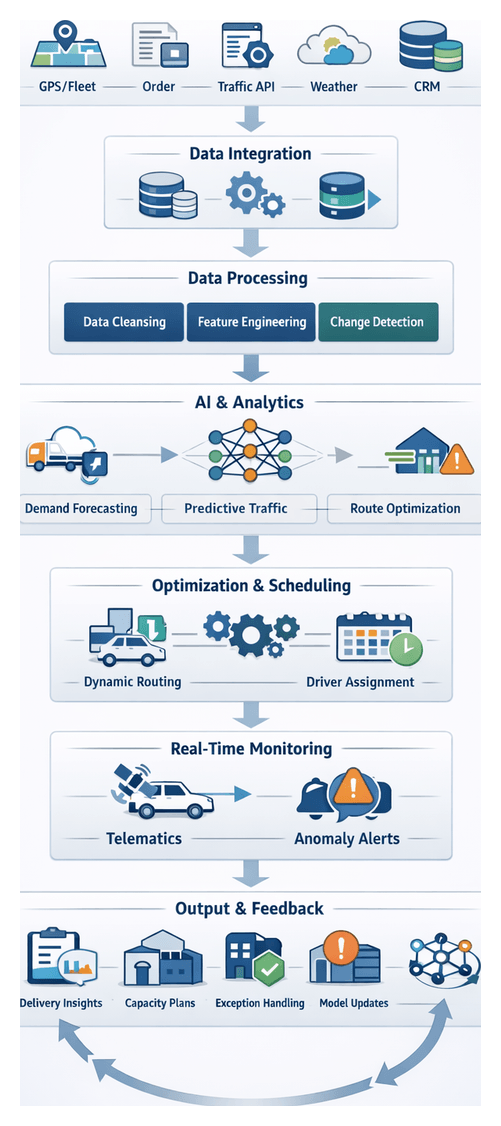
Data Ingestion and Integration
Unified data collection begins by connecting to diverse sources–fleet telematics, order management systems, traffic APIs, weather services and CRM platforms–through dedicated connectors that handle authentication, polling or streaming protocols, schema mapping and error handling. Metadata services in Snowflake and Databricks automate schema inference, registration and version control. For unstructured inputs such as free-text customer notes or regulatory instructions, natural language processing modules built with TensorFlow and PyTorch extract entities and align fields to the logistics schema. Change data capture methods detect inserts, updates and deletes in source databases, streaming only incremental records into a central repository. Distributed event streaming platforms like Apache Kafka, integration tools such as Apache NiFi and ETL services like Fivetran support high-throughput, fault-tolerant ingestion. Real-time validation pipelines flag anomalies or missing values via unsupervised models running on Apache Flink.
- Data Source: Origins of raw information feeding the pipeline.
- Connector: Interfaces extracting records from each source.
- Schema: Formal contract defining dataset structure.
- Ingestion Pipeline: Batch and streaming tasks for ETL into data lakes or warehouses.
- Change Data Capture (CDC): Incremental update streaming to reduce latency.
- Message Broker: Distributed middleware for decoupled event buffering and distribution.
Data Cleansing and Normalization
High-quality inputs are essential for accurate analytics and model training. Data profiling engines scan field distributions, value ranges and patterns to detect anomalies, guiding the creation of cleansing rules. AI-driven anomaly detection agents using supervised classifiers and autoencoders implemented with scikit-learn or TensorFlow identify outliers, sensor faults and duplicate entries. Statistical and deep learning imputation techniques deployed on Amazon SageMaker or Azure Machine Learning infer missing values. Entity resolution leverages fuzzy matching and graph-based link analysis, often powered by Elastic Stack or custom Python pipelines, to unify multiple identifiers for vehicles and customers. Normalization routines standardize units, date formats and categorical labels, while deduplication ensures each event is represented only once. Cleaned data is persisted in data lakes or warehouses managed by platforms such as Snowflake or Talend.
- Data Profiling: Automated analysis to reveal quality issues.
- Imputation: Replacing nulls with statistically or ML-derived estimates.
- Normalization: Standardizing units, date formats and labels.
- Deduplication: Eliminating redundant records.
- Feature Store: Central repository for consistent feature definitions, as with Feast or Tecton.
Demand Forecasting and Capacity Planning
Anticipating shipment volumes and resource needs leverages advanced time-series models and feature engineering. Techniques include ARIMA and Prophet for statistical forecasts, LSTM networks for sequence learning and gradient boosting machines such as XGBoost or LightGBM for ensemble predictions. Frameworks like TensorFlow, PyTorch and managed services including Azure Machine Learning and Google Cloud AI Platform facilitate model training, deployment and monitoring. Scenario analysis engines employ Monte Carlo simulations and what-if modules to evaluate capacity under promotional events, weather disruptions or supply-chain shocks. Feature stores such as Feast ensure consistent feature definitions between training and inference.
- Time Series Forecasting: Statistical and ML models predicting temporal trends.
- Feature Engineering: Derived variables–moving averages, holiday indicators or regional factors.
- Scenario Analysis: What-if demand projections under different conditions.
- Capacity Plan: Recommendations for fleet sizing, depot allocation and workforce scheduling.
- Demand Projection: Quantitative estimates driving resource allocation.
Predictive Traffic Modeling
Accurate travel time estimation and congestion forecasting require spatio-temporal machine learning. Graph neural networks and convolutional architectures process historical flows, incident patterns and geospatial features in TensorFlow or PyTorch. Bayesian models and quantile regression implemented via Statsmodels generate confidence intervals around predictions. Real-time fusion of GPS pings, traffic API feeds and weather data from OpenWeatherMap is achieved through Apache Kafka streams combined with windowed aggregations in Apache Flink.
- Travel Time Estimation: Predicted durations for road segments and origin-destination pairs.
- Congestion Forecast: Probabilistic projection of traffic density and speed reductions.
- Geospatial Feature: Location-based attributes enriching AI models.
- Predictive Model: Algorithms like ARIMA, gradient boosting or LSTM for traffic forecasts.
- Confidence Interval: Quantifying uncertainty around travel-time estimates.
Dynamic Route Optimization
Generating efficient delivery routes under multiple constraints employs a combination of operations research and AI. Metaheuristic algorithms–including genetic algorithms, simulated annealing and large-neighborhood search–are available in open-source libraries such as Google OR-Tools and OptaPlanner. When exact solutions are required, mixed-integer programming solvers like Gurobi and IBM CPLEX Optimization Studio tackle subproblems with mathematical precision. Reinforcement learning overlays built on Ray RLlib enable agents to learn dispatch policies through simulation environments. Objective functions quantify goals–minimizing distance, time or cost–and constraints enforce vehicle capacities, driver regulations and regional access rules.
- Vehicle Routing Problem: Combinatorial optimization for fleet routing under constraints.
- Constraint: Hard or soft rules restricting feasible solutions.
- Metaheuristic: High-level search strategies for near-optimal results.
- Solver: Software component executing optimization algorithms.
- Objective Function: Mathematical expression guiding the solver’s search.
AI-Enhanced Scheduling and Dispatch
Automating schedule creation and driver assignment benefits from adaptive decision logic. Unsupervised clustering groups orders by location and time window, simplifying batch assignments. Predictive assignment scoring models estimate the performance impact of pairing specific drivers and routes. Human-in-the-loop dashboards integrate AI proposals from platforms such as DataRobot or custom web UIs, allowing dispatchers to review, adjust or override recommendations. Rescheduling engines adapt to cancellations, new orders and detected exceptions to maintain on-time performance.
- Time Window: Permitted delivery interval per customer agreement.
- Slot Allocation: Assigning discrete pickup or delivery intervals.
- Driver Assignment: Matching drivers to routes based on availability, skills and expertise.
- Rescheduling: Automated or manual plan adjustments in response to changes.
Real-Time Monitoring and Exception Management
Maintaining operational integrity requires processing continuous event streams from telematics devices. Anomaly detection models–using autoencoders or one-class SVMs via scikit-learn or TensorFlow–identify deviations such as route detours, prolonged idling or speed irregularities. Exception alerts notify operations teams and trigger automated responses orchestrated by engines like Apache Airflow or Prefect. Orchestration workflows coordinate rerouting, resource reallocation and customer notifications to mitigate disruptions.
- Telematics: Vehicle data collection and transmission.
- Event Stream: Real-time flow of GPS pings, status updates and sensor readings.
- Anomaly Detection: AI-driven identification of deviations from expected behavior.
- Exception Alert: Notification of potential or actual service disruptions.
- Orchestration: Automated coordination of mitigation actions.
Automated Feedback Loops and Adaptive Learning
Closing the loop on model performance relies on feedback from delivery outcomes. Continuous retraining orchestrators built with Kubeflow or Prefect schedule updates when drift thresholds are exceeded. Reinforcement learning agents refine decision policies through reward-based training using frameworks like OpenAI Baselines or Ray RLlib. Hyperparameter optimization services and experiment tracking via MLflow tune model parameters, while feature management platforms such as Feast and Tecton ensure consistency between offline training and online inference.
- Feedback Loop: Cyclical process of collecting outcomes and refining AI components.
- Model Retraining: Updating models periodically with new data.
- Reinforcement Learning: Agents learning via rewards and penalties.
- Drift Detection: Identifying shifts in data distributions or model performance.
- Continuous Improvement: Iterative enhancement through feedback metrics.
System Orchestration and Scalability
Efficient end-to-end workflow management combines workflow engines, microservices and parallel task execution. Directed acyclic graphs represent dependencies, while retry policies with backoff intervals ensure resiliency. Autoscaling decisions informed by workload forecasting models optimize compute resource allocation in container orchestration platforms. Integrated observability systems powered by Prometheus detect performance degradation and trigger self-healing routines.
- Workflow Engine: Manages task execution, dependencies and stateful tracking.
- Directed Acyclic Graph (DAG): Defines task sequencing without cycles.
- Microservice: Independently deployable component communicating via APIs or messaging.
- Parallelism: Concurrent execution to boost throughput and reduce latency.
- Retry Policy: Configurations for handling task failures.
Governance, Security and Compliance
Embedding governance and security ensures responsible data management and regulatory adherence. Role-based (RBAC) and attribute-based (ABAC) access controls regulate permissions. Encryption in transit and at rest protects confidentiality. Immutable audit trails integrated with SIEM tools such as Splunk provide transparency. Policy enforcement agents using Open Policy Agent validate data handling and processing against compliance checkpoints like GDPR and CCPA.
- Data Governance: Framework for data quality, stewardship and lifecycle management.
- Audit Trail: Immutable records of system actions and data changes.
- Access Control: RBAC and ABAC mechanisms governing resource access.
- Encryption: Cryptographic protection of sensitive data.
- Compliance Checkpoint: Validation stages against regulatory and policy requirements.
Edge Case Variations and Workflow Adaptations
Real-world logistics must handle specialized routing patterns, data anomalies, environmental disruptions and regulatory variations. Encapsulating special-case logic in modular workflow branches, instrumenting detailed monitoring and employing human-in-the-loop safeguards ensure resilience under rare conditions.
- Multi-Modal Shipments: Integrating truck, rail, air and sea segments with transfer buffer modeling and intermodal connectors at transshipment nodes.
- Temperature-Controlled Cargo: Cold-chain models enforcing sensor monitoring, temperature setpoint alerts and exception-driven rerouting.
- Oversized Equipment: Route selection with weight-limit geospatial checks, permit buffers and alternative corridor optimization.
- Reverse Logistics: Combining returns with outbound deliveries, forecasting negative demand signals and dynamic scheduling adjustments.
- Data Outages and Schema Drift: Failover to secondary sources like HERE Traffic API, automated schema registry validation via Confluent Schema Registry and idempotent merge logic for late or partial records.
- Severe Weather and Infrastructure Failures: Contingency patterns triggered by National Weather Service alerts, event calendars and dynamic graph updates for closed road segments.
- Demand Spikes and Drops: Uplift models for promotional events, subscription sub-models for scheduled deliveries and return waves.
- Resource Constraints: AI-driven reassignments for driver shortages, hours-of-service compliance monitoring and maintenance scheduling integration.
- Regulatory Variations: Customs clearance time predictions, low-emission zone enforcement and hazardous materials routing checks.
- Fallback Strategies: Rule-based backup routing, time window relaxation and manual intervention gateways when AI services degrade.
- Integration Variations: Adapters for cloud-native vs on-premise stacks, heterogeneous databases and multiple telematics providers.
- Model Drift and Retraining Triggers: Degraded forecast accuracy, optimization plan variances and novel exception types initiating retraining workflows.
AI Tools Directory
- Apache Airflow An open-source workflow orchestration engine for authoring, scheduling and monitoring complex data pipelines using directed acyclic graphs.
- Apache Beam A unified programming model for defining batch and streaming data-processing workflows that run on multiple execution engines.
- Apache Flink A scalable stream processing framework for real-time analytics and event-driven applications, supporting windowed aggregations and stateful computations.
- Apache Kafka A distributed event streaming platform used for high-throughput, low-latency ingestion and distribution of real-time data across microservices.
- Apache NiFi A data integration tool for automating the flow of information between systems, providing visual design of ingestion, transformation and routing logic.
- Azure Data Factory A cloud-based ETL service for orchestrating data movement and transformation across on-premises and cloud sources in a serverless environment.
- Azure Event Hubs A managed platform for ingesting large volumes of telemetry and event data from devices, sensors and applications.
- Azure Functions A serverless compute service enabling event-driven execution of code in response to triggers such as new data arrivals or schedule events.
- AWS IoT FleetWise A managed service for collecting, transforming and routing vehicle telemetry from edge devices to cloud analytics platforms.
- Amazon Kinesis A platform for real-time data streaming and processing, capable of ingesting high-frequency telematics and event feeds.
- AWS Lambda A serverless function service that executes code in response to events, used for lightweight data transformations and API integrations.
- AWS SageMaker A fully managed service for building, training and deploying machine learning models at scale, supporting both batch and real-time inference.
- Databricks A unified analytics platform built on Apache Spark, offering collaborative notebooks, job scheduling and managed machine learning services.
- DataRobot An enterprise AI platform that automates model building, deployment and monitoring across diverse predictive use cases.
- Fivetran A managed data pipeline solution that automates extraction, loading and schema alignment from source systems into data warehouses.
- Gurobi A commercial solver for mathematical programming, offering high-performance optimization of linear, integer and quadratic models.
- HashiCorp Vault A secrets management tool for centralized storage and dynamic generation of credentials, encryption keys and access tokens.
- IBM CPLEX Optimization Studio An enterprise-grade optimization library for solving large-scale vehicle routing, scheduling and resource allocation problems.
- IBM Watson A suite of AI services including natural language understanding, anomaly detection and forecasting modules for enterprise applications.
- Informatica PowerCenter A data integration solution providing ETL, data quality and master data management capabilities for enterprise pipelines.
- Kubeflow An open-source platform for building, orchestrating and deploying scalable machine learning workflows on Kubernetes.
- MLflow An open-source framework for tracking experiments, packaging code and managing versions of machine learning models.
- OptaPlanner A Java-based constraint solver for planning and scheduling tasks, including vehicle routing and workforce allocation.
- OpenAI Baselines A collection of high-quality implementations of reinforcement learning algorithms for training adaptive agents.
- OpenWeatherMap A provider of real-time weather data, forecasts and historical climate information accessible via RESTful APIs.
- Oracle NetSuite A cloud ERP platform for order management, customer relationship management and financial processes in logistics operations.
- Palantir Foundry A data governance and analytics platform for integrating, managing and securing enterprise data assets.
- Prefect A modern workflow orchestration tool that emphasizes simplicity, scalability and robust error handling for data and ML pipelines.
- Prometheus An open-source monitoring and alerting toolkit for collecting system metrics and exposing them to visualization dashboards.
- PyTorch A deep learning framework optimized for flexible research workflows and production deployment of neural network models.
- Ray RLlib A scalable library for reinforcement learning that supports distributed training of agents across clusters.
- Salesforce A CRM platform for managing customer orders, service interactions and contract details that feed into demand forecasting.
- scikit-learn A Python library offering a broad range of machine learning algorithms for classification, regression and clustering.
- Snowflake A cloud data warehouse solution that unifies structured and semi-structured data for scalable analytics and AI workloads.
- Talend An open-source data integration and transformation platform that automates ETL/ELT processes across hybrid environments.
- TensorFlow An open-source machine learning framework for building and deploying deep learning models at scale.
- TensorFlow Agents A library within TensorFlow for constructing reinforcement learning environments and training agents.
- TensorFlow Data Validation A component of TensorFlow Extended for automated data schema inference and validation in production ML pipelines.
- Tecton A managed feature store service for production-grade feature engineering, versioning and real-time serving.
- TomTom Traffic API A service providing real-time traffic flow, incidents and congestion data for route planning.
- HERE Traffic API A location-based service offering live traffic conditions, incident alerts and predictive congestion modeling.
Additional Resources
- Designing Scalable Data Pipelines for Logistics: Explores architectural patterns and tooling choices for high-throughput data ingestion and processing in transportation networks.
- AI and Machine Learning for Transportation Management: Analyzes use cases, model architectures and ROI metrics for AI in logistics planning and execution.
- Scaling Workflows with Apache Airflow: Details best practices for deploying Airflow in distributed environments, optimizing parallelism and managing dependencies.
- Feature Store Fundamentals: Provides architecture patterns and API references for managing, serving and versioning features in ML pipelines.
- Reinforcement Learning in Routing Applications: Contains sample code and environment definitions for training RL agents in dynamic vehicle routing scenarios.
- Monitoring Kubernetes with Prometheus and Grafana: Covers metrics instrumentation, dashboard creation and alert configuration for containerized ML workloads.
- Implementing Secure Key Management: Outlines patterns for dynamic secrets, key rotation and access controls in cloud environments.
- ISO 28000 — Supply Chain Security: Details requirements for establishing, implementing and maintaining a security management system across supply chain operations.
- GDPR Official Text: The comprehensive legal framework governing personal data processing and transfer within the European Union.
- OpenAPI Specification: Defines a standard for RESTful API descriptions to ensure consistency and interoperability across microservices.
- Continuous Deployment for ML Models: Explains how to package, serve and roll out new model versions using CI/CD pipelines.
- Data Privacy Impact Assessments: Provides templates and best practices for conducting privacy risk assessments in data processing projects.
- Kafka Stream Processing Patterns: Surveys architectural patterns for building resilient, stateful stream processing applications in logistics.
The AugVation family of websites helps entrepreneurs, professionals, and teams apply AI in practical, real-world ways—through curated tools, proven workflows, and implementation-focused education. Explore the ecosystem below to find the right platform for your goals.
Ecosystem Directory
AugVation — The central hub for AI-enhanced digital products, guides, templates, and implementation toolkits.
Resource Link AI — A curated directory of AI tools, solution workflows, reviews, and practical learning resources.
Agent Link AI — AI agents and intelligent automation: orchestrated workflows, agent frameworks, and operational efficiency systems.
Business Link AI — AI for business strategy and operations: frameworks, use cases, and adoption guidance for leaders.
Content Link AI — AI-powered content creation and SEO: writing, publishing, multimedia, and scalable distribution workflows.
Design Link AI — AI for design and branding: creative tools, visual workflows, UX/UI acceleration, and design automation.
Developer Link AI — AI for builders: dev tools, APIs, frameworks, deployment strategies, and integration best practices.
Marketing Link AI — AI-driven marketing: automation, personalization, analytics, ad optimization, and performance growth.
Productivity Link AI — AI productivity systems: task efficiency, collaboration, knowledge workflows, and smarter daily execution.
Sales Link AI — AI for sales: lead generation, sales intelligence, conversation insights, CRM enhancement, and revenue optimization.
Want the fastest path? Start at AugVation to access the latest resources, then explore the rest of the ecosystem from there.