

AI Enhanced Visual Effects Workflow for Creative Efficiency in Media and Entertainment
To download this as a free PDF eBook and explore many others, please visit the AugVation webstore:
Introduction
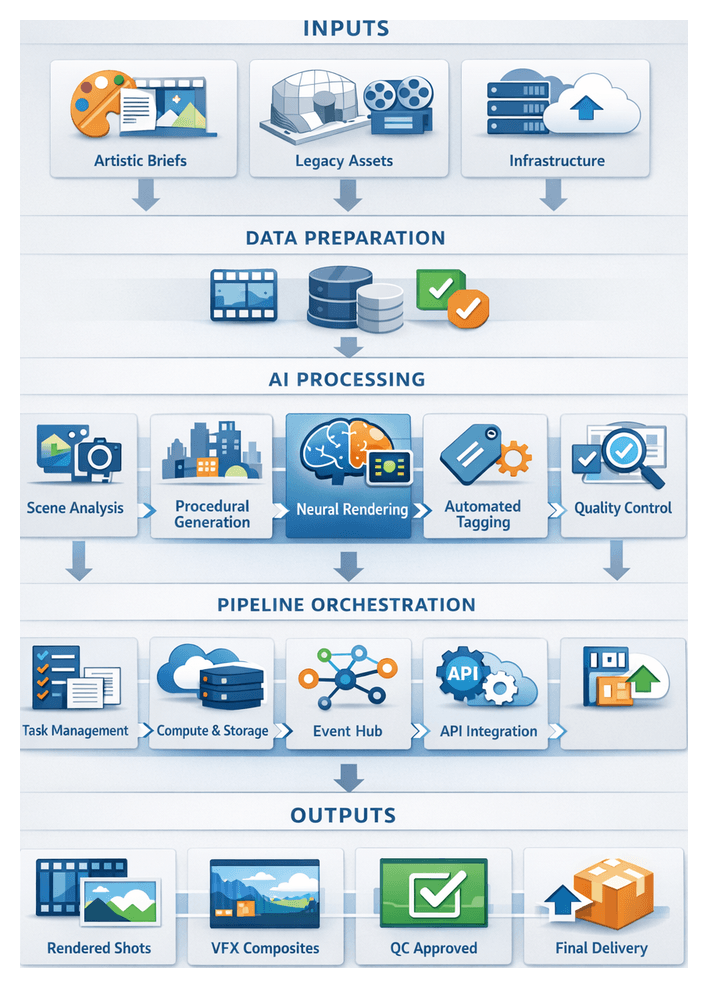
Purpose and Strategic Foundations of an AI-Driven VFX Pipeline
Establishing a clear foundation for an AI-enhanced visual effects pipeline aligns creative vision with technical execution and ensures that every component supports core business and artistic objectives. By defining targets such as accelerated asset turnover, consistent visual fidelity, and collaborative workflows, stakeholders agree on the balance between automation and creative control. This unified purpose prevents fragmented toolsets and manual handoffs, transforming repetitive tasks into measurable processes and guiding tool interoperability across production phases. A well-defined strategy also frames performance benchmarks and compliance requirements, empowering supervisors to monitor progress and maintain quality against quantifiable metrics.
Inputs, Requirements, and Prerequisites
Key Inputs and Stakeholder Alignment
Successful pipeline design begins with a comprehensive understanding of project requirements, existing assets, and technical constraints. Critical inputs include:
- Artistic Briefs and Style Guides: Concept art, genre conventions, color palettes, and compositing standards inform AI model configurations and ensure outputs match creative intent.
- Legacy Assets and Reference Media: Texture libraries, 3D models, live-action plates, and footage archives accelerate AI training cycles and maintain brand continuity.
- Infrastructure Constraints: On-premises GPU availability, cloud rendering credits, network bandwidth, and storage quotas guide decisions on model complexity and parallelization strategies.
Engaging creative directors, VFX supervisors, pipeline engineers, and IT managers through cross-functional workshops captures diverse expectations and translates high-level goals into actionable technical specifications.
Prerequisites for Scalable AI Integration
Before deploying AI modules at scale, production teams must satisfy key conditions to guarantee stability and repeatability:
- Data Normalization: Standardize footage, texture maps, and model files with consistent frame rates, color spaces, naming conventions, and resolution settings to streamline automated ingestion.
- Metadata Standards: Define schemas for asset tagging—covering taxonomy, usage rights, version history, quality scores, and AI-generated annotations—to drive searchability and conditional logic across modules.
- Infrastructure Validation: Conduct network latency tests, storage I/O benchmarks, and GPU throughput assessments to verify that hardware can sustain AI workloads without bottlenecks.
- Model Governance: Document model provenance, training data, performance metrics, and retraining procedures to support transparency, reproducibility, and compliance with industry regulations.
- Team Training and Collaboration: Provide artists, technical directors, and engineers with hands-on labs, code repository pull-request workflows, and workshops to foster a collaborative culture and accelerate onboarding.
Quality Benchmarks and Operating Conditions
Transform subjective reviews into objective validation steps by codifying benchmarks for performance, fidelity, and compliance:
- Performance Targets: Define maximum runtimes for tasks like scene segmentation, render pass generation, and noise reduction to ensure predictable scheduling.
- Visual Fidelity Thresholds: Use metrics such as peak signal-to-noise ratio (PSNR), structural similarity index (SSIM), and texture resolution comparisons against reference sequences.
- Compliance Requirements: Encode broadcast standards (SMPTE, ITU), confidentiality protocols, and licensing restrictions into automated checks to prevent non-compliant assets from progressing.
Designing a Unified AI-Driven Workflow
Orchestration and Coordination Layer
A unified workflow relies on an orchestration layer that directs data flows, schedules tasks, and monitors system health. Core components include:
- Pipeline Management System: Track tasks, versions, and approvals with ShotGrid or ftrack.
- Event Bus: Dispatch asset and metadata updates via Apache Kafka or RabbitMQ.
- Service Registry: Maintain dynamic discovery using Consul or Kubernetes API.
- Compute Controller: Orchestrate render farms and cloud batches with AWS Batch or Azure Batch.
- Workflow Engine: Coordinate AI modules and rule-based scheduling with Apache Airflow or custom schedulers.
When an artist uploads a model, the message bus triggers downstream tasks—automated texturing, look development, or scene integration—without manual intervention. Continuous health monitoring alerts engineers to potential bottlenecks before deadlines are impacted.
Data and Metadata Exchange
Consistent data exchange hinges on a common model and standardized metadata schema accessible via RESTful APIs. Key metadata fields include asset identifiers, version history, AI annotations (bounding boxes, material predictions), quality flags, and scheduling data. This shared schema enables:
- Real-time visibility of asset status and dependencies.
- Automated handoffs when metadata flags update upon job completion.
- Traceability with logged actions, timestamps, and contextual notes.
System Actors and Collaboration Flow
Even in an automated pipeline, human expertise is essential. Core actors and their roles include:
- Technical Directors: Configure AI models and troubleshoot pipeline failures.
- Artists: Enhance AI-preprocessed assets for modeling, texturing, lighting, and compositing.
- Producers and Supervisors: Monitor milestones, budgets, and resource allocations.
- Pipeline Engineers: Maintain the orchestration layer and integrate new services.
- Compute Administrators: Optimize on-premises and cloud resources for cost and performance.
The collaboration flow sequences ingest, AI preprocessing, asset tagging, scene analysis, shot scheduling, procedural generation, neural rendering, compositing, QA, and final delivery. At each handoff, both AI agents and human reviewers share visibility into asset provenance, status flags, and pending actions.
API-Driven Integrations and Triggered Actions
Diverse tools connect via APIs and plugin adapters. Applications like Houdini and Blender expose render commands and version updates to the orchestration layer, while AI services such as Amazon SageMaker and Azure Machine Learning offer inference endpoints for annotations and style transfers. Event-condition-action rules automate workflow steps, for example:
- Upon batch preprocessing completion, invoke object detection and update metadata to “analysis_in_progress.”
- When QA flags lighting inconsistencies, open a ticket and escalate priority to “high.”
- Once all shots in a sequence are approved, initiate final format conversion jobs and notify delivery coordinators.
Cross-system authentication via OAuth and certificates maintains security while enabling rapid integrations.
Real-World Scenario: Coordinated AI-Augmented Shot Delivery
- Footage ingest triggers denoising and normalization on a GPU cluster.
- Clean frames are cataloged and passed to a scene analysis service for segmentation.
- Procedural generation and crowd simulation modules produce environment assets and background elements.
- Neural rendering applies style transfer and material predictions for consistent aesthetic and dynamic lighting.
- Compositors receive pre-assembled layers with metadata annotations, enabling creative refinements without manual rotoscoping.
- Automated QA detects a shadow mismatch, enqueues corrective lighting tasks, and routes them back to rendering.
- Final outputs are packaged, manifests generated, and assets archived for future reuse.
Core AI Techniques and Their Roles
Neural Rendering and Style Transfer
Deep networks synthesize photorealistic or stylized imagery from 3D geometry and reference art. Exposed as GPU-accelerated microservices via TensorFlow or PyTorch, these models handle relighting, denoising, and aesthetic alignment, reducing render times and ensuring consistency.
Computer Vision for Detection and Segmentation
Instance segmentation and keypoint detection models generate mattes and spatial metadata for compositing and procedural tasks. Batch or streaming services integrate through NVIDIA Omniverse connectors or Google Cloud Vision APIs, eliminating manual rotoscoping and accelerating matte creation.
Predictive Analytics and Scheduling Algorithms
Forecasting models trained in AWS SageMaker analyze historical time logs and resource metrics to optimize shot schedules, balance workloads, and flag high-risk tasks, improving on-time delivery and reducing idle compute time.
Procedural Generation and Generative Adversarial Networks
Rule-based engines in tools like SideFX Houdini generate base geometry, textures, and crowd behaviors. GANs refine these outputs, adding realistic detail and variation while respecting design constraints.
Automated Tagging and Classification
Classification models embedded in digital asset management platforms or as Azure Functions assign standardized tags to textures, audio clips, and 3D models, accelerating retrieval and enforcing version consistency.
Vector Embedding Search
Asset representations are encoded into high-dimensional vectors and stored in FAISS or Elasticsearch with vector plugins, enabling semantic search by nearest-neighbor queries and surfacing relevant assets quickly.
Workflow Orchestration and API Microservices
Each AI capability is exposed as a RESTful or gRPC endpoint within Kubernetes or Apache Airflow, enabling elastic scaling, fault isolation, and real-time status tracking across preprocessing, analysis, rendering, and delivery stages.
Automated QA and Anomaly Detection
Rule-based engines and neural networks inspect composite plates, detect artifacts and continuity errors, and log structured reports to JIRA or ShotGrid, speeding defect identification and reducing rework.
Deliverables, Dependencies, and Integration Mechanisms
Key Deliverables of the Foundational Stage
The initial definition stage produces structured artifacts that guide downstream teams:
- Pipeline Objectives Document detailing goals, performance targets, and quality criteria.
- Input Specification Pack covering media types, resolution standards, metadata schemas, and reference materials.
- AI Module Interface Definitions with API contracts, data formats, model versioning, and communication protocols.
- Unified Metadata Schema encompassing technical attributes and creative descriptors.
- Quality Assurance Criteria for footage integrity, naming conventions, and consistency rules.
- Workflow Diagram illustrating stages, decision gates, and dependencies.
- Risk and Dependency Register with mitigation plans and ownership assignments.
Dependencies and Prerequisites for Handoff
To ensure a seamless transition to media ingest and preprocessing, teams must satisfy prerequisites across three areas:
- Data Readiness: Access to approved storyboards, concept art, live-action plates, and centralized asset libraries with correct permissions; metadata compliant with agreed schemas.
- Toolchain Integration: Verified API connectivity for AI services, standardized application and plugin installs, and commissioned compute resources tested for performance.
- Organizational Alignment: Formal sign-off on objectives and quality benchmarks, clearly defined roles and responsibilities, and established communication protocols for issue tracking and change requests.
Integration Points and Handoff Mechanisms
Predefined touchpoints enable immediate custody transfer of assets and data:
- Ingestion Manifest and Data Mapping: Machine-readable file lists with metadata and mapping documents correlating source files to internal identifiers and folder structures.
- Quality Validation Gate: Automated reports on QA compliance and approval stamps from QA leads or VFX supervisors.
- API Endpoint and Workflow Trigger: Authenticated requests to launch preprocessing pipelines, with webhooks or message queues for status updates.
- Metadata Injection and Repository Sync: Bundled shot-level metadata ingested alongside raw media and synchronized asset catalog updates.
Traceability and Continuous Feedback
Embedding audit trails and feedback loops at every handoff enables root-cause analysis and iterative improvement:
- Historical records of manifest versions, approval timestamps, and trigger invocations.
- Logged feedback from ingest and preprocessing teams informing future pipeline releases.
- Change management processes for controlled updates to schemas, interfaces, and quality criteria.
Chapter 1: Establishing AI Pipeline Objectives and Inputs
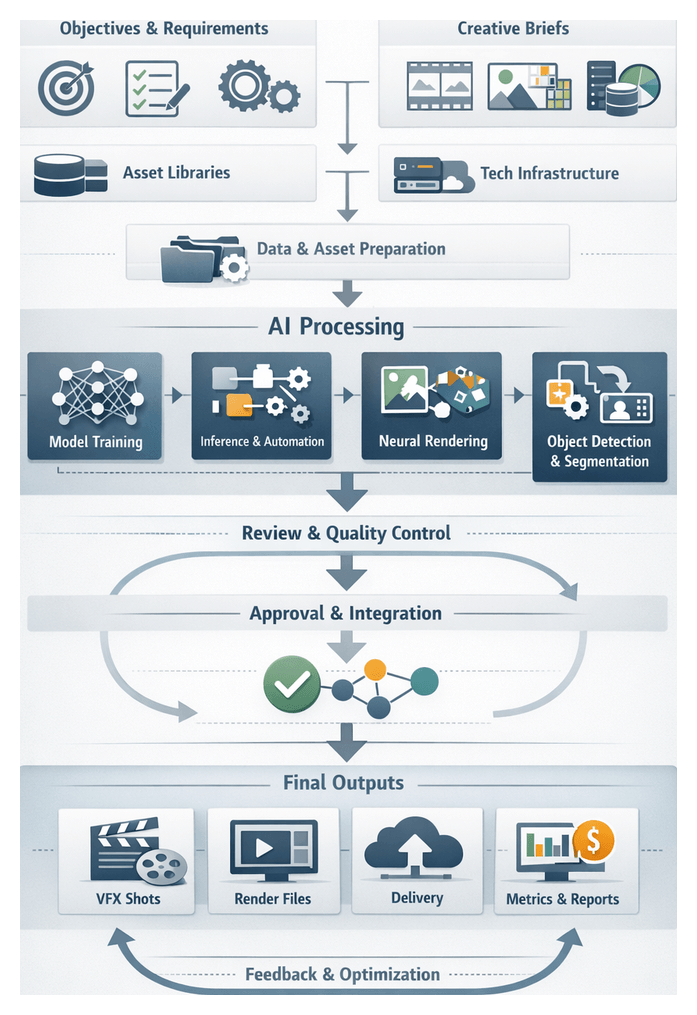
Establishing Objectives, Inputs, and Success Criteria
The foundational stage defines strategic objectives, required inputs, and success criteria to guide the AI-driven VFX pipeline. Aligning creative ambitions with operational feasibility ensures purposeful deployment of AI modules, efficient resource allocation, and consistent delivery of artistic and business outcomes.
Strategic Goals
- Clarify visual style aspirations for neural rendering and style transfer.
- Set targets for turnaround time, cost per shot, and compute utilization.
- Establish quality thresholds for artifact levels, texture fidelity, and frame consistency.
- Define collaboration protocols and data-sharing agreements across departments.
- Align pipeline capabilities with delivery schedules and platform requirements.
Required Inputs
Gather and validate all elements that drive AI modules and support downstream processes.
- Creative Briefs: Narrative context, art-direction guidelines, color palettes, concept art, storyboards, mood boards, and client specifications for resolution, color space, and delivery formats.
- Asset Libraries: 3D model repositories with version histories, texture archives annotated by resolution and UV conventions, live-action plates organized by scene and camera metadata, style reference videos, and licensed third-party datasets.
- Technical Infrastructure: Compute resources (CPU, GPU, memory, storage), network bandwidth for on-premises and cloud transfers, software stacks (deep learning frameworks, rendering engines, asset management), container orchestration platforms, and security controls.
- Data Standards: Metadata schemas for shot identifiers, timecode, camera settings; file naming conventions; interoperable formats (USD, Alembic, EXR, TIFF, FBX, USDZ); and model input/output specifications.
- Legal and Licensing: Usage rights for stock assets, open-source license compliance, talent and location releases, data privacy regulations, and audit trails for asset provenance.
Quality Benchmarks and KPIs
- PSNR and SSIM targets for denoising outputs.
- Error margins for edge artifacts and matte bleed in rotoscoping.
- Color consistency thresholds for style-transfer sequences.
- Latency goals for real-time previews.
- Throughput objectives for GPU-accelerated batch processing.
- Model accuracy rates for detection, segmentation, and stylization.
- Percentage of manual tasks automated and resource utilization efficiency.
Risk Management
Identify dependencies and mitigation strategies to prevent delays and maintain momentum.
- Data integrity risks from incomplete or corrupted inputs.
- Model performance variability due to insufficient training diversity.
- Infrastructure or cloud-service outages affecting throughput.
- Version mismatches between AI modules and creative applications.
- User adoption resistance and change-management challenges.
Core AI Integration Workflow
Mapping the integration workflow translates objectives and inputs into a coordinated sequence of actions, data exchanges, model invocations, and handoffs. This blueprint ensures that AI services, asset management systems, orchestration platforms, and creative teams operate in concert throughout the VFX lifecycle.
Key Actors and Components
- Creative Leadership: Defines artistic objectives and acceptance criteria.
- Pipeline Architects: Design APIs, data schemas, and orchestration plans.
- Data Engineers: Prepare datasets, enforce metadata standards, and secure transfers.
- AI Specialists: Train and fine-tune models for segmentation, synthesis, and rendering.
- Asset Management: Catalogs media and version histories.
- Orchestration Platform: Schedules jobs and allocates resources.
- Review Tools: Enable annotations and approval workflows.
Workflow Stages
- Conceptual Input Validation: Storyboards and style references are ingested with metadata tags for traceability.
- Data Preparation: Transcode, normalize, and enrich assets with standardized schemas.
- Model Training: Initialize networks on GPU clusters or cloud instances and track progress via the orchestration platform.
- Inference Orchestration: Expose trained models as microservices and configure sequential or parallel execution for tasks like segmentation, detection, and neural rendering.
- Automated Asset Generation: AI services produce breakdowns, layouts, and stylized frames, locking versions for review.
- Collaborative Review: Stakeholders annotate assets through integrated platforms, triggering iterative refinement.
- Quality Verification: Automated QA modules inspect artifacts and log issues back into the asset database.
- Handoff to Downstream: Approved assets are promoted to compositing or final rendering via automated triggers.
System Interactions
- Asset Management → AI Service: Secure API calls retrieve inputs with metadata.
- Orchestration → Compute Resources: Container deployments specify GPU/CPU requirements.
- AI Service → Review Platform: Outputs pushed with version tags for traceability.
- Review Platform → Orchestration: Approval or revision requests trigger conditional workflow branches.
- QA Module → Asset Management: Quality reports enrich asset histories.
Orchestration and Automation
- Declarative workflow definitions (YAML/JSON) describe stages, inputs, parameters, and conditions.
- Dynamic resource scaling optimizes GPU clusters and cloud instances.
- Pluggable connectors integrate with Autodesk ShotGrid, Foundry Nuke, or in-house systems.
- Automated retry and rollback policies handle inference or transfer failures.
Monitoring and Error Handling
- Centralized structured logs capture asset ID, model version, compute node, and timestamp.
- Health checks and alerts notify on-call teams via email, Slack, or SMS.
- Performance dashboards visualize metrics like latency and resource utilization.
- Critical errors trigger escalation workflows with ticket assignment and stakeholder notifications.
Agility and Continuous Improvement
Ongoing analysis of metrics, feedback, and error reports drives iterative refinement of models, workflows, and connectors. Regular post-mortem reviews identify bottlenecks, update orchestration scripts, and enhance efficiency and creative alignment.
Roles of AI Modules
Neural Rendering and Style Transfer
Neural rendering services transform scene representations into photorealistic or stylized images. Deployed as microservices, models trained on frameworks like TensorFlow and PyTorch, orchestrated by Kubeflow, provide GPU-accelerated inference. Generated frames are tagged with style parameters and stored in the asset system for rollback and batch re-rendering.
Object Detection, Segmentation, and Tracking
Detection and segmentation accelerate rotoscoping and compositing by producing masks and object layers automatically. AI services such as OpenCV, along with deep models on TensorFlow or PyTorch, use architectures like Mask R-CNN and YOLOv5. Outputs, delivered as structured JSON metadata, feed into compositing engines for edge refinement and automated blending.
Predictive Analytics and Resource Forecasting
Models trained on production data from Autodesk ShotGrid and streaming platforms such as Apache Kafka forecast timelines, resource demands, and cost estimates. Time-series models like Prophet or LSTM networks drive dynamic shot planning and alert producers to capacity constraints.
Automated Metadata Extraction and NLP
Natural Language Processing services extract descriptive tags, transcripts, and shot descriptions from scripts, storyboards, and dailies. Tools such as Adobe Sensei, Google Cloud Vision API, and AWS Rekognition automate indexing, normalize taxonomies, and improve asset discoverability through RESTful integrations.
Generative Models and Procedural Synthesis
Generative Adversarial Networks and Variational Autoencoders synthesize textures and environments, while procedural systems like Houdini and Runway ML apply these assets within geometry rules. Quality evaluator networks score candidates for artifact detection and style alignment before ingestion and metadata tagging.
AI-Driven Asset Search and Classification
Semantic search engines powered by Elasticsearch with k-NN and vector databases like Pinecone enable similarity queries across large catalogs. Embedding vectors update with each new asset, and in-context recommendations surface assets within applications such as Maya and Nuke.
System-Level Integration
All AI components operate as modular services in a service-oriented architecture managed by Kubernetes. Message brokers handle asynchronous workflows, while RESTful APIs and gRPC endpoints support synchronous calls. Inference metrics, logs, and feedback feed centralized dashboards, and automated retraining pipelines keep models robust against evolving production demands.
Foundational Stage Deliverables and Handoffs
Key Deliverables
- AI Pipeline Blueprint: Diagram and narrative detailing workflow stages, data flows, AI modules, and decision points.
- Data Schema Definitions: Metadata structures, file formats, and database schemas for asset management and automation.
- Model Specification Report: Catalog of selected frameworks—e.g., TensorFlow, PyTorch—with performance targets and evaluation metrics.
- Integration Interface Catalog: API endpoints, messaging protocols, payload schemas, and error handling conventions.
- Quality Benchmarks Document: Acceptance thresholds for image fidelity, metadata accuracy, throughput, and error rates.
Dependencies and Preconditions
- Provisioned compute clusters, network, and storage with container platforms configured.
- Sign-off from creative directors, VFX supervisors, and IT on blueprints and schemas.
- Access to sample footage, asset libraries, and annotation datasets with required permissions.
- Agreement on toolchain versions for render engines, asset management, and AI libraries.
- Security reviews, compliance documentation, and encryption standards finalized.
- Commercial and open-source license confirmations for all software and plugins.
Integration Documentation
- API Specifications: RESTful and gRPC definitions with URI paths, parameters, payload schemas, status codes, and authentication.
- Data Transfer Protocols: Secure FTP, HTTPS, or object storage APIs (Amazon S3, Azure Blob) with naming conventions and retry strategies.
- Messaging Interfaces: Event-driven integration using RabbitMQ, Apache Kafka, or cloud pub/sub with topic hierarchies and payload formats.
- Monitoring Interfaces: Logging formats, retention policies, and observability tool integrations (Grafana, Datadog).
Handoff to Media Ingest and Preprocessing
- Trigger Conditions: Approval and versioning of foundational deliverables and readiness checklist completed.
- Delivery Mechanism: Artifacts published to a shared repository with semantic version tags and automated notifications.
- Validation Checklist: Schema compliance checks, mock API tests, and sample inferences to verify endpoint responses and metadata alignment.
- Onboarding Session: Review of deliverables, interface specifications, and roles with the ingest team to resolve outstanding questions.
- Feedback Loop: Issue tracker for gaps discovered during implementation, enabling iterative refinement of foundational artifacts.
By rigorously defining objectives, inputs, workflows, module roles, and handoff procedures, teams establish a repeatable, transparent framework that accelerates downstream development and maintains alignment across stages, ensuring the AI-enhanced VFX pipeline delivers consistent creative and operational value.
Chapter 2: Need for a Unified AI-Driven Workflow
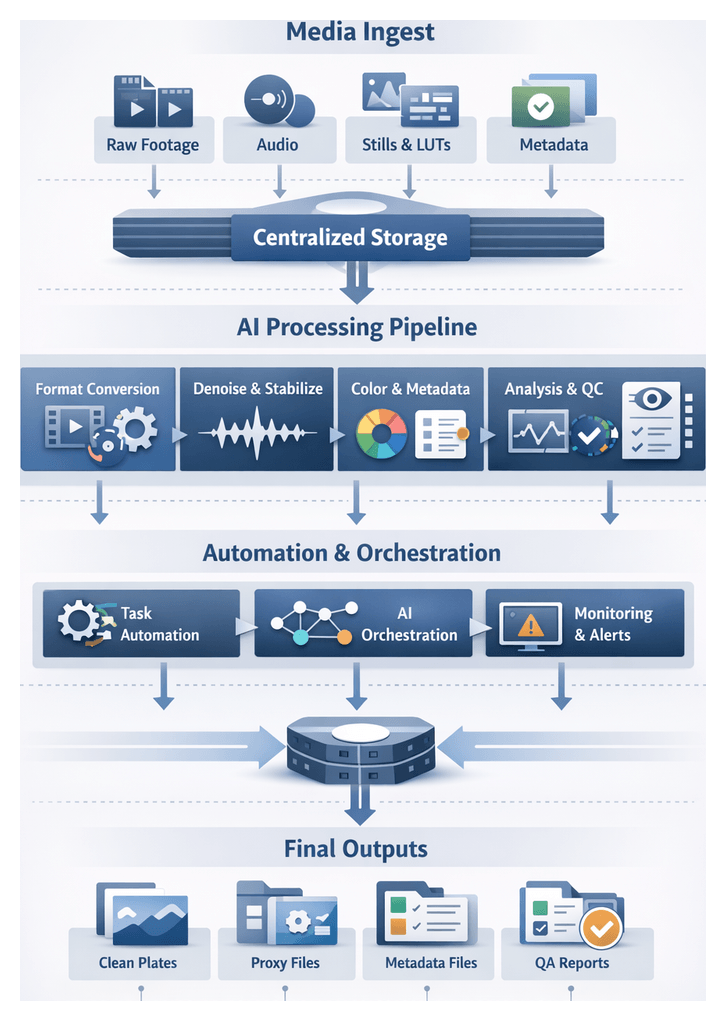
Raw Media Intake and Ingest
Purpose and Scope of Intake
The raw media intake stage establishes a unified foundation for an AI-driven visual effects pipeline by centralizing all source footage, reference materials, and ancillary assets. Automating format validation, metadata embedding, and file integrity checks minimizes manual handoffs and ensures consistent inputs for downstream modules. Key objectives include creating a single repository of standardized media, automating notifications upon ingest completion or exceptions, and embedding metadata to support search, tagging, and version control.
Input Types and Metadata Standards
A comprehensive ingest accommodates diverse formats and sidecar files while enforcing consistent metadata schemas. Typical inputs include camera RAW sequences (ARRIRAW, REDCODE, Blackmagic RAW), high-definition video (MXF, QuickTime MOV, MP4), frame sequences (EXR, DPX, TIFF), audio tracks, reference stills, LUTs, and animatics. Each asset is cataloged with capture settings and source identifiers.
- Industry schemas: Material Exchange Format (MXF), Broadcast Wave Format (BWF)
- Extensible frameworks: AAF, XML sidecar files
- Technical tags: timecode, frame rate, resolution, color space (Rec.709, ACES), audio channel mapping
- Custom fields: tracking markers, plate type, greenscreen information
AI-powered ingest managers such as AWS Elemental MediaConvert automate format validation, metadata extraction, and compliance enforcement.
Operational Environment and Acceptance Criteria
Effective intake demands robust infrastructure and clear protocols:
- High-throughput storage with scalable capacity
- Secure, low-latency networks linking on-set, dailies hubs, and central storage
- Permissioned access controls and audit trails
- Automated backup and replication
- Integration with production tracking systems (for example, ShotGrid)
- Preconfigured project profiles for ingest rules and naming conventions
- Monitoring dashboards for performance metrics and exception alerts
Acceptance criteria include bit-level checksum validation, consistency of frame rate and resolution, color space compliance, sync integrity, presence of essential metadata, and validity of tracking markers or greenscreen elements. AI-driven validators quarantine non-compliant assets for review, ensuring only verified inputs proceed.
Preprocessing Workflow and Orchestration
Format Conformation and Transcoding
Raw footage arrives in varied codecs and containers. An AI classifier inspects file signatures, frame rates, and resolution. Discrepancies trigger automated transcoding via FFmpeg or GPU-accelerated engines, aligning assets to project-standard formats. A centralized repository of profiles adapts dynamically to new camera technologies, routing tasks to on-premises GPU nodes or cloud instances for elastic scaling.
Noise Reduction, Stabilization, and Color Mapping
Once conformed, sequences pass through AI-powered denoising and stabilization. Deep convolutional networks attenuate sensor artifacts, low-light grain, and compression noise, while motion estimation corrects jitter. A confidence filter flags frames requiring manual review. Next, an AI color mapper applies lookup tables or neural transforms to convert footage into the pipeline’s working color space, embedding white balance, exposure, and dynamic range metadata.
Metadata Enrichment and QA Checkpoints
Computer vision models scan frames for scene markers and on-screen text, while speech-to-text engines transcribe dialogue. Tags ranging from camera settings to detected objects are appended in XML or JSON schemas. Integrated QA modules run frame-level anomaly detection, histogram analysis for broadcast-safe ranges, and audio-video sync checks. Automated reports summarize errors, triggering rollback or manual intervention if thresholds are exceeded.
Orchestration, Monitoring, and Human-in-the-Loop
An orchestration framework coordinates AI modules, legacy tools, and human review. Key components include:
- Event-driven messaging and RESTful APIs for task dispatch
- Kubernetes clusters hosting containerized services, auto-scaled by workload
- Pipeline schedulers defining directed-acyclic graphs of dependencies
- Resource managers allocating GPU, CPU, and memory based on real-time metrics
Human operators receive alerts when confidence scores fall below thresholds. Review dashboards present side-by-side comparisons, allow parameter adjustments, and feed corrections back into training datasets. Telemetry and logs captured by Prometheus and Grafana visualize throughput, error rates, and system health, enabling pipeline supervisors to optimize batch sizes and resource allocation.
AI Capabilities and Supporting Infrastructure
Neural Rendering and Style Transfer
Deep convolutional and transformer-based networks synthesize photorealistic frames, enforce consistent styles, and generate intermediate samples for smooth motion. GPU-accelerated inference servers using TensorRT or custom CUDA kernels serve models deployed via MLflow or Kubeflow Pipelines. High-throughput storage tiers ensure rapid frame delivery.
Object Detection, Segmentation, and Anomaly Detection
Region proposal networks and encoder-decoder architectures identify characters, props, and environments, generating masks and mattes for compositing. Anomaly detection models compare frames against learned baselines to flag mismatches in lighting, artifacts, or continuity errors. Inference clusters run atop Kubernetes, exposing gRPC and REST endpoints. Issue reports integrate with JIRA or Shotgun for streamlined remediation.
Generative Networks and Procedural Content
GANs and procedural rule engines produce textures, environments, and crowd simulations. Hybrid CPU/GPU farms orchestrated by Slurm or HTCondor execute synthesis tasks, with parameter stores retrieving dynamic rule sets. Outputs are versioned in distributed file systems, enabling rapid background generation and variation synthesis.
Predictive Analytics and Metadata NLP
Regression and time-series models forecast workload peaks and resource allocation, driving intelligent shot assignments and load balancing across on-premises and cloud renders. Data warehouses feed BI dashboards powered by Apache Superset or Tableau. NLP models analyze scripts and annotations to extract keywords, character names, and scene descriptors. Text clusters using Elasticsearch or OpenSearch enhance metadata search, with continuous retraining pipelines refining lexicons.
Orchestration Platforms and Data Exchange
End-to-end workflow definition, monitoring, and dynamic provisioning rely on Kubernetes with Helm charts and service meshes like Istio. Logging and monitoring via Prometheus and Grafana provide performance insights. Robust APIs, shared object storage (S3, NFS), and message brokers (RabbitMQ, Apache Kafka) underpin seamless data exchange, reducing friction when integrating new models or third-party tools.
Cleaned Footage Deliverables and Downstream Handoffs
Standardized Outputs and Metadata Manifests
At the end of preprocessing, the pipeline produces:
- High-resolution clean plates in EXR or DPX with consistent naming conventions
- Proxies encoded in H.264 or ProRes referencing full-resolution plates via sidecar metadata
- Timecode-aligned sequences verified against ingest logs
- Metadata manifests in JSON or XML detailing camera settings, lens calibration, color transforms, and processing logs
- QA reports from tools like Neat Video Denoiser and DaVinci Resolve Studio Neural Engine
- Color management LUTs with version identifiers and inverse transforms
- Checksum and digital fingerprint records (SHA-256) for integrity validation
Automated Handoff Mechanisms and Integration
Completion of cleaning triggers downstream workflows via:
- File system watchers monitoring output directories and checksum records
- Event-driven messages on RabbitMQ or Apache Kafka broadcasting “cleaned footage ready” events
- Asset status updates and notifications via platforms like ftrack and ShotGrid
- API-driven transfers to the digital asset management system
Upon handoff, assets are registered in the DAM with metadata, version control linkages, search indexing, and access permissions for high-resolution plates and proxies.
Data Integrity, Traceability, and Communication
- Checksum verification at rest and in transit with automatic retries on mismatch
- Append-only audit logs for ingest, processing, QA, and handoff events
- Metadata-driven lineage tracking linking raw inputs, processing modules, and parameters
- Compliance checks enforcing SMPTE timecode and DPP metadata schemas, generating certificates as needed
Real-time dashboards in ShotGrid or ftrack display progress and readiness. Automated email and chat alerts via Slack or Microsoft Teams inform stakeholders, while web-based review portals enable quick validation and sign-off. Exception reporting provides actionable remediation steps and responsible parties.
Scaling Considerations
- Elastic compute clusters that auto-scale cleaning tasks based on queue depth
- Hierarchical storage management migrating inactive assets from NVMe arrays to object storage
- Bulk API registration for parallel metadata ingestion into the DAM
- Load-balanced messaging infrastructure to prevent single points of failure
By delivering a cohesive set of high-fidelity media files, proxies, metadata packages, and QA reports—underpinned by robust handoff automation, integrity checks, and scalable infrastructure—the cleaned footage stage primes the pipeline for intelligent asset cataloging, scene analysis, and the remaining AI-enhanced VFX workflow.
Chapter 3: Asset Cataloging Objectives and Input Sources
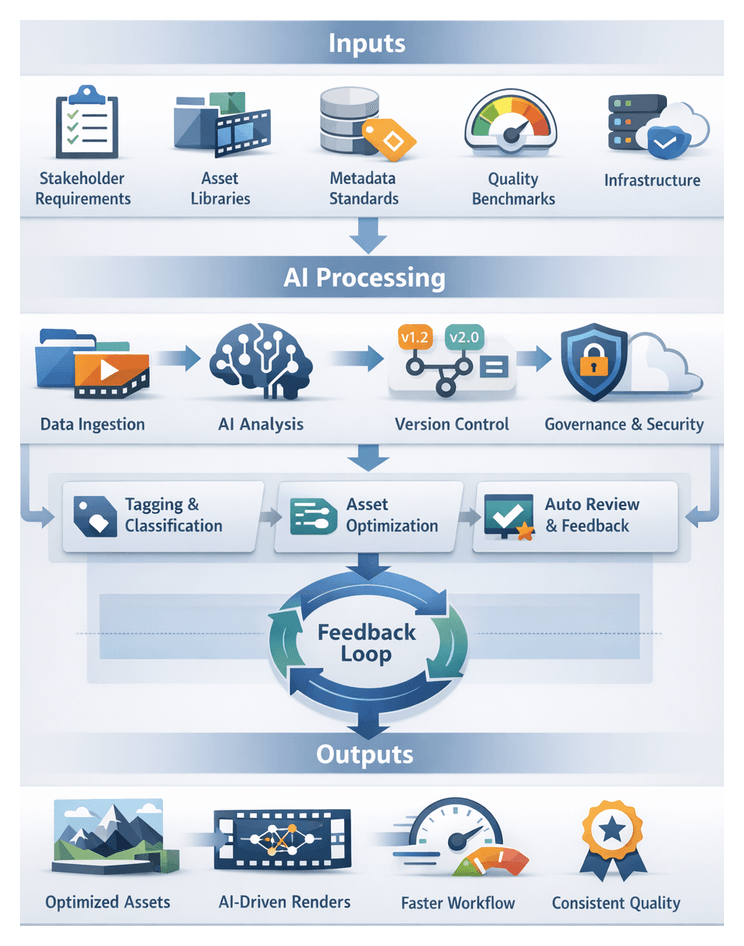
Defining Objectives and Inputs
The foundational stage of an AI-enhanced visual effects pipeline establishes clear objectives, aligns technical requirements with creative ambitions, and gathers critical data sources to drive efficiency, consistency, and scalable quality. By articulating strategic goals, codifying stakeholder requirements, and documenting asset inventories and governance policies, teams mitigate risks associated with fragmented workflows, misaligned deliverables, and redundant effort. A robust foundation ensures that every subsequent stage—from asset ingestion through final rendering—operates on a unified set of criteria and data standards.
Industry Context and Operational Pressures
Media and entertainment projects contend with accelerated release schedules, constrained budgets, and heightened audience expectations. Traditional VFX pipelines rely on fragmented toolsets, manual handoffs, and bespoke scripts that introduce bottlenecks and version conflicts. Unifying creative, technical, and production perspectives early in the process addresses miscommunication, enforces quality benchmarks, and defines the scope of AI-driven automation needed to maintain pace and precision under real-world constraints.
Strategic Objectives and Success Metrics
Project objectives typically revolve around three pillars: efficiency through task automation, consistency via standardized formats and naming conventions, and scalability enabled by flexible processes and data schemas. Defining measurable key performance indicators—such as reductions in manual prep time, adherence to naming conventions, shots per week throughput, and budget alignment—provides a north star for evaluating AI integration impact and enables continuous process improvement.
Key Input Categories
- Stakeholder Requirements: Creative briefs, technical specifications, style guides, and approval criteria from directors, producers, and supervisors.
- Asset Inventories: Model repositories, texture libraries, project archives, and reference material databases.
- Metadata Standards: Taxonomy schemas, tagging conventions, version control policies, and data governance rules.
- Quality Benchmarks: Frame-rate targets, resolution standards, color profiles, and fidelity thresholds aligned with delivery formats.
- Infrastructure Constraints: Compute resource availability, cloud platform selections, licensing considerations, and network bandwidth limits.
Prerequisites for Pipeline Initialization
- Governance Frameworks: Approved data governance policies, security protocols, and access controls to protect intellectual property.
- Data Availability: Verification that raw footage, reference assets, and metadata records are ingested into a centralized system.
- Technical Environment: Deployment of core AI frameworks such as TensorFlow or PyTorch and orchestration platforms like Autodesk ShotGrid.
- Team Alignment: Consensus on project scope, timelines, milestones, and risk tolerance among creative, technical, and production stakeholders.
- Baseline Audits: Initial assessments of asset quality, metadata accuracy, and infrastructure readiness to identify gaps and remediation plans.
Data Governance and Infrastructure Integration
Data Integrity and Governance Foundations
Security and traceability begin with clear governance constructs. Role-based permissions, encryption standards, and audit logging protect assets, while version management strategies enable branching, merging, and rollback with lineage tracking. Automated validation protocols enforce metadata completeness, format compliance, and naming conventions. Retention policies define archival schedules, deletion criteria, and backup procedures that align with organizational mandates, reducing downstream rework and enhancing trust in automated processes.
Integration with Existing Infrastructure
Studios often operate hybrid environments spanning on-premises render farms, cloud compute, and third-party services. Mapping integration points includes data ingestion APIs for secure transfer from asset management systems, job scheduling interfaces for render engines or Kubernetes clusters, tiered storage architectures for hot, warm, and cold data, and centralized telemetry platforms for monitoring pipeline health and performance. Documenting these interfaces ensures seamless orchestration of AI modules within the broader ecosystem.
Quality Benchmarks and Compliance Standards
Before AI-driven tasks commence, teams define objective quality benchmarks that align with creative intent and distribution requirements. Technical specifications—resolution, frame rate, bit depth, and codec standards—combine with visual fidelity metrics such as noise level thresholds and color accuracy targets. Review criteria utilize integrated platforms like ftrack and scoring rubrics for creative feedback. By codifying compliance standards, AI algorithms are tuned to produce outputs requiring minimal manual intervention, accelerating pass rates through review cycles.
Automated Tagging and Version Control
Automated tagging and version control eliminate manual metadata drudgery, enforce consistent naming conventions, and maintain a precise audit trail of asset evolution. By embedding AI classification engines and scalable versioning systems, production teams streamline discovery, collaboration, and iteration management across distributed projects.
High-Level Workflow
- Metadata extraction and classification
- Tag taxonomy enforcement
- Version assignment and branching
- Change tracking and merge management
- Audit logging and compliance reporting
- Feedback loops for AI model refinement
Metadata Extraction and Classification
Incoming assets pass through an AI engine that analyzes visual and technical attributes. Convolutional neural networks detect objects, materials, and environments, while semantic classifiers distinguish characters, props, and backgrounds. Technical metadata—polygon counts, texture resolutions, simulation cache durations—is extracted by specialized parsers. Microservices architecture orchestrated through message queues triggers each analysis step and publishes results to a centralized metadata store.
Tag Taxonomy Enforcement
A hierarchical taxonomy enforces standard tags at project, sequence, asset, technical, and creative levels. An AI-driven validation module cross-references generated tags against the approved taxonomy. Unrecognized terms are flagged for review by asset stewards, who can accept, reject, or propose updates, ensuring controlled evolution of the tag set as production requirements change.
Version Assignment, Branching, and Merging
Assets ingest with an initial version label following structured naming conventions. Automated version increments occur on modifications, with a ledger service tracking parent-child relationships. Branches enable parallel exploration, and an automated merge process reconciles changes through three-way comparisons. Conflict resolution is guided by a merge coordinator service that surfaces conflicts to technical directors for AI-assisted or manual resolution, preserving a complete audit trail.
Audit Logging and Compliance Reporting
Every tagging and version event is captured in robust audit logs, documenting actor identities, timestamps, and summaries. A compliance service aggregates logs into reports that support internal governance and external audits, detailing asset modifications, approval histories, and taxonomy changes.
Feedback Loops for Continuous Improvement
User corrections to tags and version conflicts feed back into training pipelines. Periodic retraining refines classification and merge models, reducing manual interventions. A metrics dashboard tracks tagging accuracy, merge conflict frequency, version turnaround time, and asset retrieval speed, enabling data-driven optimizations.
System Interactions and Notifications
- Asset Management System orchestrates ingestion and metadata storage.
- AI Classification Services handle object detection and technical parsing.
- Taxonomy Governance Module manages stakeholder reviews.
- Version Control System handles branching, merging, and delta storage for large media.
- Merge Coordinator service resolves conflicts with technical director input.
- Audit and Compliance Service collects logs and generates governance reports.
- Dashboard and Analytics Module monitors flow efficiency and model performance.
- Asset Stewards and Technical Directors guide taxonomy updates and merges.
Downstream Handoffs
- Rendering engines receive approved asset versions and metadata for neural rendering.
- Compositing platforms ingest updated assets with search-optimized tags.
- Scheduling modules adjust resource allocations based on version readiness.
- Quality assurance services use metadata to select test cases for visual consistency checks.
Security and Error Handling
Role-based permissions govern tag application, branching, and merge approvals. Authentication integrates with identity management, and encryption protects asset integrity. Automated retries and escalation paths handle classification failures, while conflict reports guide resolution of complex version conflicts, maintaining pipeline continuity.
Key AI Techniques and System Roles
A diverse set of machine learning and deep learning methods automate tasks, enhance creative options, and ensure consistent quality. Each technique integrates with supporting systems to deliver scalable performance and seamless artist workflows.
Computer Vision for Media Ingestion
Convolutional networks detect shot boundaries, extract keyframes, and label scenes. Services such as the Google Cloud Vision API integrate with message queues to notify preprocessing pipelines of new footage.
Semantic Asset Classification
Custom taxonomy models and named entity recognition assign rich metadata. Solutions like Clarifai or TensorFlow-based frameworks support batch pipelines managed by Apache Airflow and real-time metadata APIs.
Vector Embedding and Similarity Search
OpenAI’s CLIP models or custom Siamese networks generate embeddings for content-based retrieval. Indices built on Elasticsearch or FAISS provide fast nearest-neighbor queries alongside keyword filters.
Predictive Analytics for Scheduling
Regression models on platforms like Azure Machine Learning or AWS SageMaker forecast task durations and compute needs, feeding real-time recommendations to scheduling engines.
Generative Networks for Asset Creation
GANs and VAEs synthesize textures, crowd variations, and environments via engines such as Adobe Sensei or TensorFlow libraries. Rule engines orchestrate parameter sampling and ingest outputs with provenance metadata.
Neural Rendering and Style Transfer
Neural networks apply style transfer and cinematic grading. Implementations like NVIDIA’s Neural Style Transfer integrate into GPU clusters managed by Kubernetes, storing intermediate frames on object storage solutions like Amazon S3.
Deep Learning for Compositing and Rotoscoping
Convolutional matting networks generate alpha mattes for applications such as Nuke via integration with Blackmagic Design tools. Inference microservices process batch jobs and notify artists when results are ready for review.
Anomaly Detection for Quality Assurance
Unsupervised models detect continuity errors and rendering artifacts. Services like IBM Watson Visual Recognition extend with custom rules to enforce studio-specific standards, generating issue reports for manual inspection.
Integration and Orchestration Infrastructure
Container orchestration with Kubernetes hosts model serving pods, while workflow engines like Apache Airflow schedule interdependent tasks. A centralized feature store maintains embeddings, metadata, and preprocessed data. Message buses coordinate async processing, and monitoring frameworks provide visibility into latency, throughput, and model health.
Organized Asset Libraries and Cross-Project Dependencies
By this stage, tagged and versioned assets reside in a searchable library that supports current productions and future reuse. An intelligent catalog preserves provenance, exposes dependency graphs, and records usage histories, enabling artists to retrieve and repurpose assets on demand.
Primary Deliverables
- Centralized Catalog Database: A searchable index of assets with unique identifiers, content tags, and usage metadata, implemented on engines such as Elasticsearch.
- Hierarchical Taxonomy: Standardized categories and folder structures reflecting project conventions and supporting metadata inheritance.
- Version History and Change Logs: Audit trails of asset updates with timestamps, user annotations, and diff metadata.
- Dependency Graphs: Directed graphs capturing inter-asset relationships, generated by automated tools for impact analysis.
- AI-Enhanced Search Services: Content-based retrieval powered by classifiers and embedding models that continuously reindex assets.
- Access Control Matrices: Role-based permissions integrated with identity management and tools like Autodesk ShotGrid and ftrack.
Dependencies and Integration Points
- Preprocessed Assets: Tagged and versioned inputs from the tagging and version control stage.
- Storage and Data Lakes: High-concurrency file systems or object stores supporting lifecycle policies.
- Taxonomy Definitions: Controlled vocabularies and naming conventions enforced by governance teams.
- AI Models: Classification and embedding services trained on domain datasets and linked via microservices.
- Version Control Systems: Git or Perforce depots with hooks triggering metadata updates.
- Identity Services: Single sign-on and directory integrations aligning asset permissions with project dashboards.
Handoff Protocols
- Asset Manifests: Manifest files enumerating new and updated assets, semantic tags, file paths, and dependency URIs for downstream ingestion.
- API Endpoints: RESTful or GraphQL services enabling search, retrieval, and metadata queries by scene analysis and shot planning tools.
- Event Notifications: Publish-subscribe alerts for asset availability and taxonomy changes.
- Connector Plugins: Direct integration with DCC tools such as Autodesk Maya and Adobe Photoshop for in-context browsing and import.
- Analytics and Feedback: Usage metrics informing library optimization and AI model retraining.
By delivering a fully organized asset library with clear dependencies and robust handoff mechanisms, the pipeline ensures that subsequent stages—such as automated scene analysis, shot planning, and procedural generation—operate on reliable, high-fidelity resources. Cross-project dependencies are managed through shared taxonomies and versioning conventions, triggering validation checks and notifications when core assets are updated. Tiered storage, archival compliance, and metadata-driven retention policies make the library a strategic asset for future remasters and spin-offs, providing studios with a competitive edge in delivering agile, cost-effective visual effects.
Chapter 4: Framework of the AI-Enhanced VFX Workflow
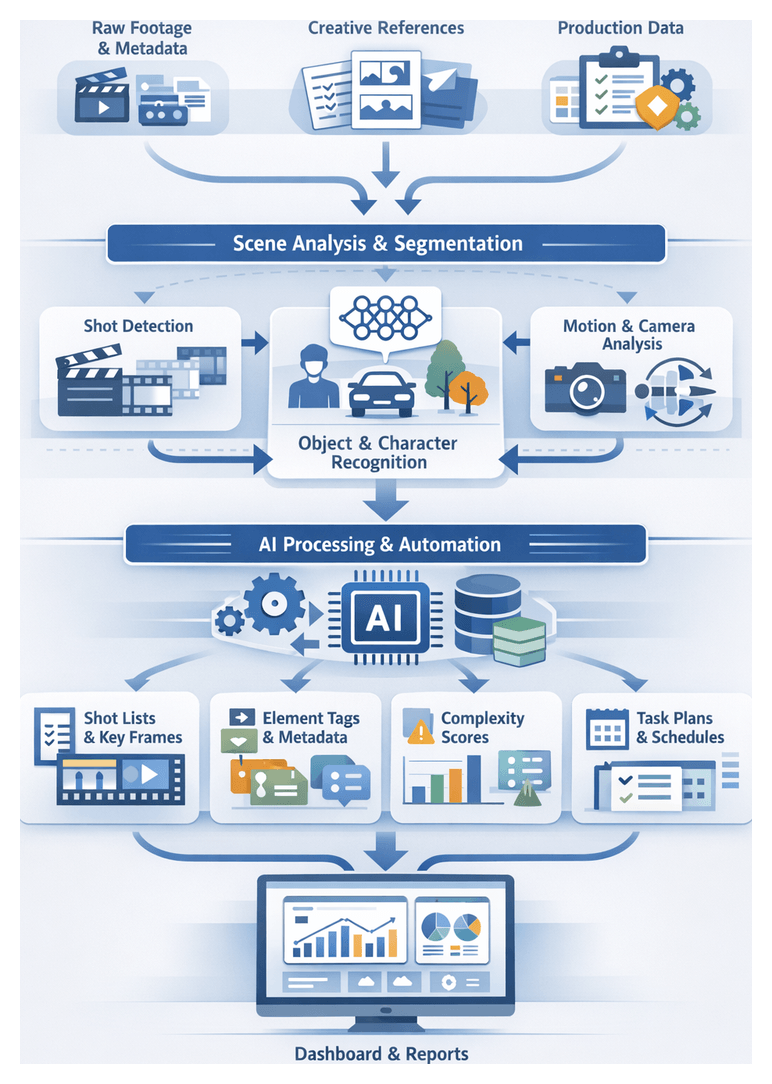
Scene Breakdown: Goals and Source Material Inputs
The scene breakdown stage transforms raw footage and reference materials into a structured blueprint that underpins every VFX task. By automating shot detection, object cataloging, and contextual prioritization, teams reduce manual ambiguity, detect complexities early, and align creative and technical stakeholders around a unified analysis.
Primary objectives:
- Shot Identification and Segmentation: AI models detect scene cuts, camera movements, and subshots to produce a definitive shot list.
- Element Cataloging: Objects, characters, environmental features, and effects requirements are recognized and labeled for targeted VFX planning.
- Contextual Prioritization: Production metadata, storyboard annotations, and creative notes are integrated to assign complexity scores, dependencies, and scheduling priorities.
Achieving these goals requires three categories of inputs:
- Raw Media and Technical Metadata: High-resolution camera plates, proxies, and on-set playback files accompanied by frame rates, resolutions, color spaces, camera model, lens data, timecode synchronization, and tracking logs. AI frameworks such as Google Cloud Vision and AWS Rekognition leverage this metadata to calibrate shot boundary detection and camera motion analysis.
- Creative Reference Materials: Storyboards linked to timecode ranges, concept art highlighting composition or lighting intentions, previz sequences with rough camera moves, and script breakdowns detailing dialogue beats or VFX notes. Solutions like Azure Computer Vision extract visual themes that enrich semantic tagging and narrative alignment.
- Contextual Production Data: Department briefs outlining VFX scope and budgets, artist availability schedules, workstation capabilities, style guides, quality benchmarks, and dependency maps. Incorporating these inputs allows predictive scheduling models to generate realistic timelines and resource plans.
Key prerequisites include standardized naming conventions, complete metadata at capture, version control for reference assets, and stakeholder agreement on analysis depth. When satisfied, the scene breakdown yields:
- Shot metadata packages for media asset management systems.
- Annotated breakdown spreadsheets with complexity metrics and task assignments.
- Structured JSON or XML files feeding automated segmentation and resource planning modules.
- Dashboards highlighting high-risk shots, compute and artist effort estimates, and scheduling recommendations.
This structured approach transforms a manual, error-prone process into a deterministic, AI-powered stage that accelerates analysis and anchors creative decision-making in objective data.
Scene Segmentation and Analysis Workflow
The segmentation and analysis workflow bridges media ingest and creative allocation by converting breakdown outputs into detailed metadata. Automated systems collaborate with asset repositories and production tools to detect shots, extract key frames, segment visual elements, and generate comprehensive breakdowns at scale.
Benefits:
- Eliminates manual shot logging and categorization delays.
- Ensures consistent footage interpretation across distributed teams.
- Feeds precise metadata into scheduling and resource allocation systems.
- Creates a robust foundation for specialized AI tools in downstream stages.
Initial Shot Detection and Key Frame Extraction
Once media ingestion completes, an asset management trigger invokes the shot detection module—using services like VisionPro AI or in-house neural models—to parse video streams into discrete shots. Representative key frames are extracted for rapid visual reference, segments are tagged with timestamp metadata, and the central tracking platform is updated to notify downstream services.
Parallel Annotation Streams
- Object and Character Detection: A convolutional neural network scans key frames to identify primary and secondary elements—actors, vehicles, props, and backgrounds. Detected objects are annotated with bounding polygons or masks and stored as structured metadata.
- Motion and Camera Analysis: A motion estimation engine tracks frame-to-frame movement vectors, identifies camera operations (zoom, pan, tilt), and computes shot complexity metrics such as motion blur prevalence and stabilization requirements.
An orchestration service consolidates annotations and motion data, performing consistency checks to verify alignment with shot boundaries and ensure no segment is overlooked.
Asset Management and Version Control Integration
Analysis data is automatically attached to asset entries in the repository, using semantic segment identifiers (for example, Scene12_Shot07_v001_analysis.json) to preserve history and allow rollback. An API contract defines endpoint specifications, authentication scopes, and data schemas for shot attributes, object lists, and motion metrics, ensuring pipeline resilience to upgrades.
Quality Validation and Compliance Checks
Before marking analysis as complete, automated routines verify:
- Presence of key frames and detected elements in every shot.
- Integrity of motion data and consistent frame sequences.
- Metadata schema conformance against versioned definitions.
Validation failures generate tickets in the production tracker and notify supervisors via email or chat, maintaining high data quality without manual oversight.
Handoff to Resource Planning Systems
Upon successful validation, the system pushes consolidated scene analysis packages—comprising shot complexity scores, compute requirements, annotated asset lists, and dependency mappings—to scheduling and resource planning engines. These inputs enable production managers to generate initial timelines and assign tasks to artists based on skill profiles and workload capacities.
Creative Collaboration and Monitoring
An interactive dashboard presents key frames alongside detected annotations for review by artists and supervisors. Change requests capture feedback, flag affected metadata, and trigger targeted reanalysis cycles. Meanwhile, an operational analytics service tracks throughput metrics—shots processed per hour, validation failure rates, time-to-handoff—and displays real-time dashboards. Automated alerts notify pipeline engineers when queues exceed thresholds, enabling proactive scaling or model tuning.
Core AI Techniques and System Roles
Advanced AI capabilities streamline routine tasks, guide creative decisions, and ensure consistency across complex VFX pipelines. Understanding their system roles enables studios to architect a cohesive environment in which models communicate seamlessly, accelerate production, and uphold quality standards.
Neural Rendering and Style Transfer
Neural rendering frameworks use learned representations of lighting, materials, and textures to synthesize photorealistic images rapidly. They serve as:
- Perceptual Consistency Engines that enforce unified color palettes and textures across assets.
- Iterative Feedback Modules generating intermediate frames for prompter review cycles.
- Compute Offload Layers deploying optimized inference workloads on GPU clusters or cloud services.
Product Example: Nvidia Omniverse integrates neural rendering with leading DCC tools.
Object Detection and Tracking
Machine vision models identify and follow elements within footage, enabling automated segmentation, rotoscoping, and context-aware asset placement. Their roles include:
- Rotoscope Accelerators that produce matte layers for compositing software.
- Tracking Coordinators outputting motion vectors and bounding boxes for match-moving.
- Data Validation Services comparing detection outputs against reference frames to ensure temporal coherence.
Product Example: Google Cloud Vision API provides robust object detection capabilities.
Generative Adversarial Networks for Asset Synthesis
GANs synthesize high-fidelity assets—textures, environmental elements, crowd personas—from limited seed libraries. System roles include:
- Procedural Expansion Units generating varied asset sets for large-scale scenes.
- Art Direction Interfaces accepting user constraints for mood, palette, and density.
- Quality Filter Pipelines evaluating outputs against discriminator networks to ensure fidelity.
Product Example: Runway offers GAN-powered asset generation.
Predictive Analytics for Scheduling and Resource Optimization
Predictive models analyze historical project data to forecast timelines, artist workloads, and compute requirements. They function as:
- Demand Forecast Engines estimating personnel and compute needs for upcoming milestones.
- Load Balancer Modules distributing tasks across on-premises render farms and cloud instances.
- Alerting Services notifying teams when forecasted utilization exceeds thresholds.
Product Example: AWS SageMaker provides time-series forecasting algorithms.
Machine Vision for Asset Categorization
AI classifiers and embedding networks automate tagging, indexing, and retrieval of digital assets. Roles include:
- Metadata Extraction Services processing assets to identify attributes and attach standardized tags.
- Semantic Search Engines using vector embeddings for similarity-based retrieval.
- Version Control Integrators tracking asset iterations and dependencies.
Product Example: Clarifai delivers AI-driven tagging and search solutions.
Rule-Based Engines and Workflow Orchestration
Rule-based systems manage dependencies, error recovery, and sequence AI services according to studio policies. They include:
- Pipeline Orchestrators scheduling and executing AI tasks, enforcing data handoff rules, and monitoring service health.
- Policy Enforcement Agents applying conventions, resolution standards, and security protocols.
- Audit and Logging Services capturing execution metadata for traceability and continuous improvement.
Product Example: Netflix’s Seer framework demonstrates large-scale workflow management (Netflix TechBlog).
Hybrid Cloud and On-Premises Integration
Hybrid deployments balance data security with scalability. Core components are:
- Data Bridge Connectors securing transfers between on-premises storage and cloud buckets.
- Auto-Scaling Controllers monitoring queue lengths and model latencies to provision resources dynamically.
- Cost Management Dashboards tracking compute usage and expenditure in real time.
Product Example: Adobe Sensei supports hybrid AI workflows within Creative Cloud.
These AI techniques, orchestrated by rule-based engines and integrated with hybrid infrastructures, form an end-to-end pipeline. Object detection feeds neural rendering; GANs generate missing assets under predictive analytics guidance; orchestration layers enforce standards; and audit logs drive model retraining and process refinement.
Analysis Reports and Resource Allocation Handoffs
Automated scene analysis culminates in comprehensive reports that translate segmentation and detection data into actionable insights for production planning, scheduling, and budgeting.
Dependencies and Input Validation
Reliable reporting depends on adherence to naming conventions, high-confidence object identification thresholds (typically above 85 percent), and version-controlled assets. Automated scripts validate shot counts, frame ranges, and asset lists against expected values, flagging discrepancies before report generation.
Report Structure and Formats
Standard deliverables include:
- A master shot breakdown in CSV or JSON for scheduling systems.
- Annotated storyboards with AI-generated object masks and environment segments.
- Complexity heat maps rendered as PNG or PDF summaries.
- Asset dependency spreadsheets detailing models, textures, and simulations.
- Risk assessment dashboards accessible via business intelligence platforms.
Uniform formats reduce friction, enabling planning and asset departments to import data without manual reformatting.
Integration with Production Platforms
Analysis reports are published to centralized tracking tools: ftrack delivers automated notifications with links to breakdown entries, while Autodesk ShotGrid ingests JSON-based shot metadata directly into task pipelines. Webhooks notify scheduling modules to update boards, and email alerts inform department leads of new assignments.
Handoff Mechanisms
Upon report completion:
- Automated export jobs write CSV and JSON files to network shares or cloud buckets.
- APIs push notifications to enterprise resource planning systems.
- Message queues broadcast events to downstream microservices.
- Email and chatbots deliver human-readable summaries with hyperlinks to detailed reports.
Parallel channels ensure both automated systems and human stakeholders receive timely information without delay.
Error Handling and Feedback Loops
Reports include an error and warning section documenting low-confidence detections, frame mismatches, missing assets, and version conflicts. Each issue entry specifies remediation steps, assigned owners, and severity levels. Tickets are created in issue-tracking systems, linked to specific report entries. Stakeholders comment on tickets, upload revised inputs, and once resolved, the system recalculates metrics and issues updated reports, maintaining an audit trail of changes.
Transition to Production Planning
Upon sign-off, the planning stage consumes deliverables to schedule:
- Artist assignments grouped by shot complexity and skill requirements.
- Render farm provisioning requests for GPU and CPU workloads based on predicted frame counts.
- Asset preparation tasks such as material optimization or model cleanup.
- Interdepartmental coordination items, including editorial alignment and vendor handoffs.
This structured handoff marks the formal transition from analysis to execution. By embedding analysis outputs into agile planning tools—such as Kanban boards or Scrum workflows with ticket creation via REST APIs—studios achieve a single source of truth, optimize resource utilization, reduce turnaround times, and minimize miscommunication. The fidelity of these reports directly influences adaptive scheduling algorithms, underscoring the strategic importance of rigorous analysis and reporting in an AI-enhanced VFX workflow.
Chapter 5: Establishing AI Pipeline Objectives and Inputs
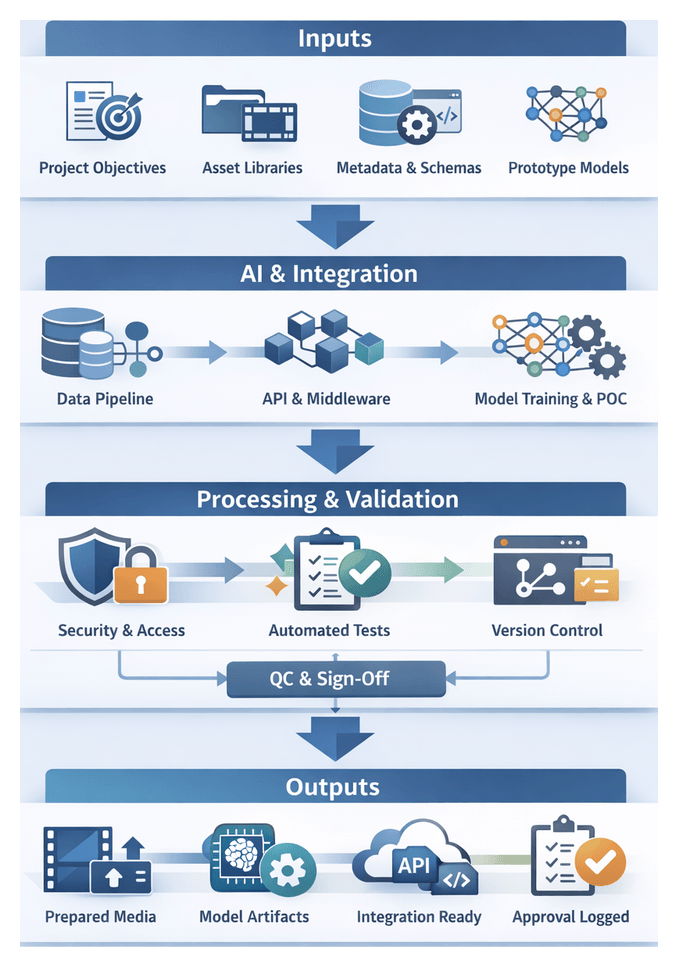
Foundational Stage Deliverables and Integration
The foundational stage of an AI-enhanced VFX pipeline establishes the baseline documentation, models, and integration agreements that guide all downstream production activities. Deliverables at this juncture serve as the contract between creative, technical, and operational teams, ensuring alignment on objectives, inputs, and success criteria. By codifying expectations early, teams reduce rework and accelerate the transition into media ingest and preprocessing.
Primary Deliverables
- Pipeline Objectives Document outlining project goals, performance targets, quality benchmarks, and stakeholder roles
- Input Specification Manifest inventorying required footage types, reference materials, asset libraries, and metadata standards
- Data Schema and Ontology Definitions for asset metadata models, annotation taxonomies, and naming conventions
- Proof-of-Concept Artifacts demonstrating AI model outputs for noise reduction, tagging, and scene analysis
- Integration Roadmap detailing API contracts, data transfer protocols, and middleware components
- Stakeholder Sign-Off Package recorded in ShotGrid for traceability
Critical Dependencies and Handoff Protocols
- Secure access to raw media repositories, whether on-premises storage or cloud buckets
- AI model licensing and provisioning, including services such as AWS SageMaker and RunwayML, with API keys and quotas
- Validation of GPU/CPU clusters, cloud instances, or on-prem render nodes configured for preprocessing workloads
- Network and security configurations aligned with corporate policies, including IAM and encryption standards
- Assignment of engineers, data scientists, and VFX supervisors trained in AI integration
- Quality assurance criteria for model performance on sample inputs, such as noise reduction thresholds and tagging accuracy
Handoff Protocols to Media Ingest and Preprocessing
- Package Release: Versioned bundle containing data schemas, model artifacts, and configuration files in a shared repository
- Automated Validation: Schema conformance checks and sample AI process runs to verify environment readiness
- Notification and Triggering: Event messages dispatched to the media ingest queue upon successful validation
- Artifact Delivery: Secure transfer of model weights, annotation guidelines, and API endpoint details
- Sign-Off Confirmation: Formal acceptance recorded in the asset management system
Governance, Version Control, and Best Practices
- Git-based repositories for pipeline definitions, schema files, and CI/CD scripts with mandatory pull request reviews
- Change logs summarizing deliverable updates and dependency changes
- Audit logs capturing handoff events, validation results, and sign-off timestamps
- Rollback mechanisms preserving snapshots of prior deliverable sets
- Automated CI/CD workflows using GitHub Actions, Jenkins, or GitLab CI for validation and deployment
- Service-level agreements defining turnaround times for packaging, validation, and sign-off
- Use of open formats such as Alembic, USD, and OpenEXR for compatibility
- Centralized schema definitions and pipeline configurations as a single source of truth
- Structured feedback loops and change-control processes to iterate without disrupting the ingest pipeline
Planning Stage: Blueprinting and Metrics
The planning stage translates scene breakdown data, asset inventories, and stakeholder requirements into a structured schedule and resource allocation plan. Acting as the bridge between preparatory analysis and creative execution, it ensures every shot is assigned the right talent, compute capacity, and timeline. By codifying prerequisites and metrics, this stage underpins predictable delivery, cost control, and optimal resource utilization.
Purpose and Context
Modern VFX productions face growing shot volumes, complex simulations, and distributed teams. An AI-enhanced planning process ingests breakdown reports, asset readiness statuses, and historical performance data to generate an optimized sequence of tasks. Tasks are assigned to artists or AI modules based on skill profiles, hardware availability, and priority rankings, reducing manual coordination and enabling dynamic schedule adjustments.
Prerequisites and Conditions
- Completed scene breakdown reports with shot segmentation, VFX requirements, and asset references
- Validated asset catalogs confirming plates, models, textures, and mattes
- Standardized metadata and naming conventions for shots and assets
- Stakeholder sign-off on creative briefs, revision scopes, and quality benchmarks
- Confirmed budgets and cost constraints
- Artist profiles detailing skill sets, availability calendars, and workload limits
- Compute resource inventories, including on-premises render nodes and cloud capacity
- Historical performance data capturing average task durations, error rates, and revision cycles
- Defined milestone dates for internal reviews, client approvals, and delivery commitments
Required Metrics
- Shot Complexity Score reflecting CG layers, simulation intensity, and compositing passes
- Artist Utilization Rate as a percentage of scheduled work hours
- Resource Availability Index measuring free compute slots and license capacity
- Task Lead Time from assignment to initial deliverable submission
- Milestone Adherence Ratio tracking deadline performance
- Historical Error Frequency indicating risk of rework
These metrics drive AI-based optimization, highlight high-risk shots for buffer allocation, and enable adaptive learning to improve forecast accuracy over time.
Scheduling Actions and Dynamic Workload Flow
In the scheduling stage, the planning blueprint becomes actionable timelines and assignments. A scheduling engine consumes scene complexity metrics, artist profiles, hardware availability, and milestone constraints to assemble a living production schedule. Predictive analytics, rule-based solvers, and real-time feedback loops enable dynamic adjustments without sacrificing creative quality.
Scheduling Workflow Sequence
- Task Prioritization based on critical path analysis, client urgency, and dependency chains
- Resource Matching aligning shots with artists and compute resources
- Timeline Construction assigning start and end dates while respecting deadlines
- Conflict Detection and Resolution identifying overlaps, shortages, and triggering automated routines
- Buffer Allocation inserting contingency time guided by historical variance data
- Schedule Publication dispatching assignments via email or chat notifications through Microsoft Teams or Slack
- Continuous Monitoring ingesting time tracking and status updates for real-time recalibration
System Interactions and Stakeholder Touchpoints
- Breakdown System to Scheduling Engine via RESTful APIs or message buses
- Engine to Resource Database using LDAP or SAML for real-time availability queries
- Engine to Notification Service integrating with Microsoft Teams and Slack
- Engine to Visualization Dashboard in ShotGrid for Gantt charts and heatmaps
- Feedback Loop from time tracking webhooks feeding into the scheduling engine
- Supervisory Overrides through interfaces
- Handling Variability with Predictive Scheduling
To address inherent uncertainty, predictive modules forecast delays and contention using historical throughput, revision rates, and peak utilization patterns. High-risk predictions trigger automatic adjustments such as reassigning tasks or provisioning additional cloud resources.
- Throughput Predictor estimating completion dates against historical curves
- Resource Contention Forecaster identifying future supply shortages
- Rework Probability Analyzer computing revision risk based on shot complexity
Dynamic Load Balancing and Real-Time Adjustments
- Trigger Detection identifying anomalies in progress or queue lengths
- Impact Analysis quantifying effects on milestones and dependencies
- Remediation Strategy Generation proposing task shifts, extended hours, or cloud scaling
- Stakeholder Notification and Approval via an approval dashboard
- Automated Rescheduling enacting the updated plan across all systems
Governance and Compliance
- Union Work-Hour Regulations enforcing daily/weekly limits and mandatory breaks
- License and Software Constraints preventing over-booking of specialized tools
- Asset Lock-Down Windows safeguarding finalized assets during reviews
- Budgetary Controls integrating cost models for artists and cloud usage
Predictive Forecasting and Resource Optimization
Predictive analytics and optimization engines form the analytical core of an AI-driven workflow. By applying machine learning to historical and real-time data, studios forecast shot durations, anticipate resource demands, and proactively align talent and infrastructure to workload.
Core Data Inputs and Feature Engineering
- Shot complexity metrics: polygon counts, particle effects, simulations
- Historical task durations from past projects
- Artist profiles detailing skills and average throughput
- Infrastructure logs of GPU/CPU utilization and network performance
- Project milestones, deadlines, and buffer allowances
Machine Learning Models for Demand Forecasting
- ARIMA and seasonal variants for time-series completion rates
- Gradient boosted trees (XGBoost, LightGBM) handling mixed features
- Neural networks (LSTM, GRU) for sequence prediction and regression
- Ensemble methods combining multiple forecasts
Cloud platforms such as Amazon Forecast and Google AI Platform streamline model training, tuning, and deployment.
Capacity Planning and Optimization Engines
- Integer linear programming for exact resource allocation
- Heuristic algorithms (genetic algorithms, simulated annealing) for large problem spaces
- Constraint satisfaction frameworks like OptaPlanner
- Mixed-integer optimization combining continuous and discrete variables
Dynamic Resource Allocation Roles
- Monitoring Agents tracking shot status, artist check-ins, and render jobs
- Anomaly Detectors flagging behind-schedule tasks or performance issues
- Reallocation Brokers invoking capacity planners to rebalance workloads
- Notification Services alerting managers and artists to reassigned tasks
Integration with Pipeline Management Systems
- Production tracking in Autodesk Shotgun or ftrack
- Asset management catalogs feeding complexity assessments
- Render farm APIs for automated provisioning and monitoring
- Collaboration tools like Slack and Microsoft Teams for real-time updates
Chapter 6: Mapping Core AI Integration Workflow
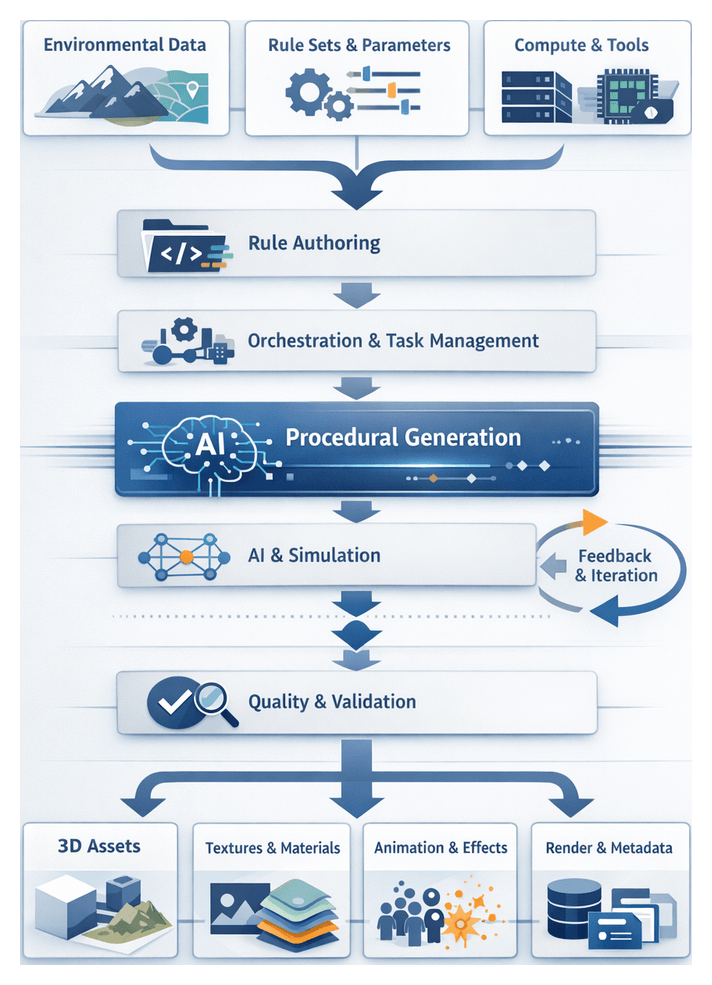
Purpose and Strategic Advantages of Procedural Generation
The procedural generation stage establishes an automated, rule-based framework for synthesizing complex visual assets at scale. By encoding artistic rules, physical behaviors, and stylistic guidelines into algorithms, teams can produce high-fidelity environments, crowds, textures, and dynamic simulations while reducing manual labor and accelerating iteration. Procedural methods deliver scalability, ensuring thousands of unique assets from minimal inputs; consistency, by applying uniform style and performance constraints; efficiency, through automated synthesis and rapid previews; flexibility, via adjustable high-level parameters; and resource optimization, by enforcing budgets suitable for real-time and final render stages. Coupled with AI-driven generative models, procedural generation empowers productions to respond swiftly to creative changes, maintain quality across sequences, and meet ambitious schedules and budgets.
Inputs, Rules, and System Prerequisites
Environmental Data and Metadata
Precise inputs form the foundation of reliable procedural synthesis. Key environmental data includes height maps and terrain meshes for topology, climate parameters for erosion and weathering, spatial coordinates for scene alignment, and material definitions for shader integration. Metadata such as shot plans, scene boundaries, and performance budgets ensures assets conform to the live-action context and technical requirements.
Rule Sets and User-Defined Parameters
Procedural rules and parameter sets translate creative briefs into executable scripts. Rule libraries, stored in version control systems, encode geometric grammars, distribution algorithms, and hierarchical relationships. Art direction constraints—style guides, mood boards, color palettes—and resource budgets define aesthetic and technical limits. User-defined controls, such as scale and density sliders, randomization seeds, and override lists, enable artists to explore variations and integrate handcrafted elements seamlessly.
Infrastructure and Team Coordination
Efficient execution demands validated inputs, robust compute resources, and integrated software. Automated data validation checks ensure geometry integrity, metadata completeness, and unit consistency. Hardware acceleration via GPU clusters and multi-core CPU servers supports simulation and AI inference. Software licensing must cover procedural engines like SideFX Houdini, AI services such as Promethean AI and Runway ML, and orchestration platforms. API connectivity and version control systems track rule and asset revisions. Close collaboration between technical artists, VFX supervisors, and production designers aligns procedural outputs with evolving creative direction.
AI-Driven Content Synthesis Workflow
Rule Definition and Parameter Authoring
Technical artists partner with creative leads to author procedural rules in languages such as VEX for Houdini or Blueprint scripts in Unreal Engine. Rule libraries reside in Git or Perforce repositories. Parameter sheets list variables—seed values, density ranges, randomness thresholds, and style presets—that drive asset variation. AI assistance from models by OpenAI can suggest initial parameter values based on concept art analysis, expediting authoring.
Orchestration and Job Dispatch
Pipelining tools schedule and allocate synthesis tasks on-premises or in the cloud. Platforms like Autodesk ShotGrid and ftrack manage job queues and dependencies. Predictive scheduling assigns workloads to CPU or GPU pools, leveraging services such as AWS Lambda for lightweight processing and NVIDIA Omniverse GPU nodes for heavy computations. Automated triggers respond to version control changes, enabling continuous asset evolution.
Procedural Engine and Generative Model Execution
Generation combines deterministic rule processing with AI-driven synthesis. The engine initializes scenes, importing base proxies and rule modules. Procedural nodes instantiate geometry operations—instancing, subdivision, noise perturbation—followed by AI-powered texture generation via Runway ML or custom StyleGANs using TensorFlow or PyTorch. Simulation modules integrate physics and behavior, with reinforcement learning agents refining crowd and vegetation dynamics. Outputs export to standard formats—Alembic for geometry, Substance Designer graphs for materials, USD for scene hierarchies—while embedding metadata on parameters and provenance.
Quality Optimization and Validation
Automated QA ensures assets meet technical and artistic standards. Neural networks audit mesh topology and detect non-manifold edges. Computer vision models validate texture consistency, flagging tiling artifacts and color deviations. Performance estimators predict memory and render times, enabling the orchestration platform to adjust parameters or reprioritize jobs. Tools like Adobe Substance Alchemist and OpenCV support these checks, preventing costly downstream rework.
Feedback and Iteration Loop
Review dashboards in ShotGrid or proprietary portals present thumbnails, metrics, and comparison overlays. Annotated feedback synchronizes with ticketing systems, driving subsequent synthesis cycles. Versioning and branching capabilities track iterations, allowing divergent explorations without disrupting the main flow. Artists refine rules or parameters, triggering automated re-runs that produce updated asset versions for approval.
Asset Ingestion and Downstream Handoffs
Approved assets register in central management systems, indexed by metadata—parameter fingerprints, model versions, and performance profiles. Dependency graphs document relationships among base rule sets and variants. Orchestration platforms emit events that notify rendering and compositing teams of new availability, initiating preloads into scene assemblies or test renders. Integration relies on standardized formats compatible with compositing channels, render engine requirements, and asset management protocols.
Asset Outputs, Specifications, and Integration Dependencies
Deliverable Categories and Specifications
Procedural outputs fall into geometry assets (high-resolution meshes, LOD variants, modular libraries), texture maps (albedo, normal, roughness, procedural masks), animation and simulation caches (crowd behaviors, particle presets, dynamic simulations), metadata manifests (naming conventions, rule definitions, provenance logs), and integration blueprints (scene layout, dependency diagrams, import/export guidelines). Standard interchange formats include USD and Alembic for geometry, TIFF and EXR for textures, and JSON or XML for metadata. Embedding metadata within USD layers facilitates compatibility with SideFX Houdini and NVIDIA Omniverse.
Effective handoff requires alignment with upstream shot definitions—camera data, previs, environment anchors—and downstream systems—asset repositories, render engines, compositors. Repository structures, tagging taxonomies, and version control protocols govern asset access. Rendering engines demand shader compatibility, UV layouts, and performance budgets, while compositors require depth, motion vectors, and ID masks in correct color spaces. Cross-department synchronization covers editorial timing, sound cues, and QA schedules to prevent miscommunication and delays.
Handoff Mechanisms and Best Practices
Automated Validation
- Geometry integrity tests for non-manifold edges and flipped normals
- Texture audits for mip-map generation and tile alignment
- Metadata checks for required fields and parameter ranges
Package Bundling
- Compressed archives with manifest files
- Checksum validation for data integrity
- Automated version stamping for traceability
Notification and Tracking
- Automated alerts via platforms like ShotGrid
- Dashboard indicators for asset readiness
- Dependency graphs highlighting upstream and downstream links
Documentation
- Reference guides on import procedures
- Sample scenes illustrating correct setups
- Contact points for issue escalation
Data Integrity and Version Control
Adopt immutable version identifiers for rule libraries and parameter sets. Embed tool versions and timestamps within asset metadata. Enforce atomic commits to prevent partial updates. Use continuous integration servers to regenerate and validate assets when core rules change. Treat procedural generation as a software build process—with version control, automated tests, and build logs—to ensure reproducibility and rapid rollback.
Case Study: Integrating Procedural Environments
In a sequence featuring a sprawling alien city, the procedural team uses Houdini to generate modular building blocks, street networks, and crowd distributions. Each district is packaged as a USD asset with embedded material assignments and LOD parameters. Metadata manifests record coordinates, population rules, and lighting presets. An automated script validates UV layouts for path tracing in NVIDIA Omniverse before checking assets into the repository. A webhook then notifies the rendering team, which ingests the USD files, applies scene lighting, and initiates test renders. Standardized outputs and integration steps preserve artistic intent, maintain visibility into asset status, and minimize friction across departments.
Chapter 7: Key AI Techniques and Their System Roles
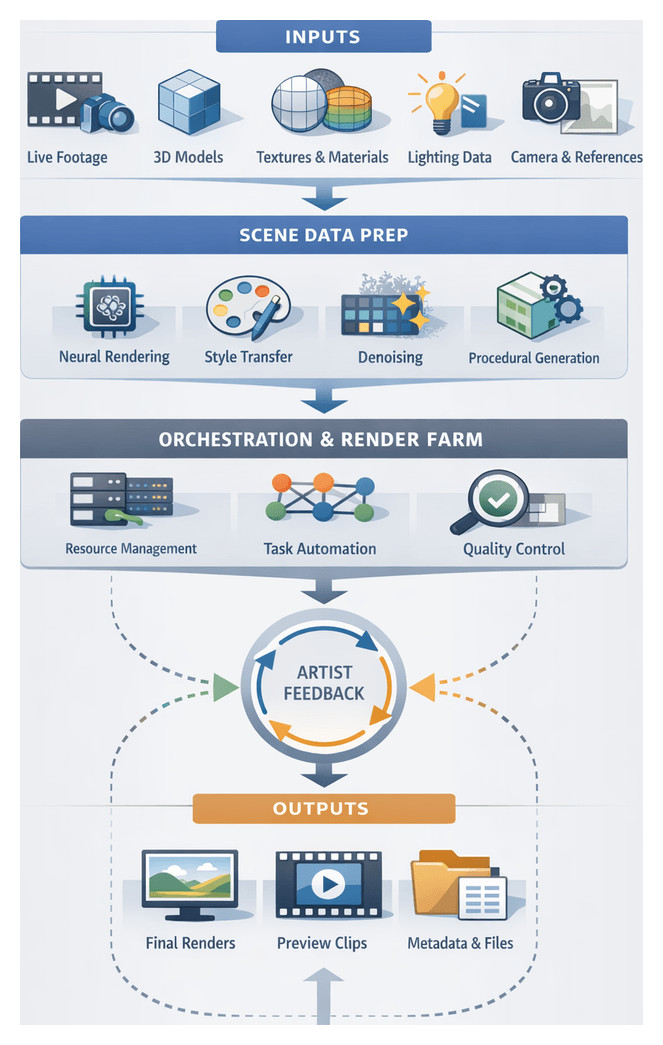
Purpose and Significance of AI-Driven Rendering Stage
The rendering stage serves as the junction where prepared scene data and procedural content are transformed into high-fidelity image outputs. By automating lighting, shading, and stylistic effects through neural rendering and style transfer, this stage accelerates look development and ensures technical precision alongside artistic intent. Traditional CPU-based ray tracing pipelines face escalating time and resource demands as project complexity grows. Integrating AI-driven modules reduces rendering latency, enforces consistent visual style across sequences, and scales across on-premises GPU clusters or cloud platforms. Studios leveraging this approach achieve rapid feedback loops for directors and cinematographers, maintain coherent aesthetics, and gain a strategic advantage in meeting tight deadlines and budgets.
Core Objectives
- Transform multi-channel scene representations into styled images that meet creative benchmarks.
- Minimize render times using neural network inference and adaptive sampling.
- Maintain visual coherence by applying consistent lighting, shading, and color grading.
- Enable iterative look development with real-time feedback for artists.
- Support hybrid workflows combining engines like Autodesk Arnold with AI-driven style transfer and denoising.
Required Inputs and Prerequisites
- Live-Action Plates: High-resolution EXR or ProRes footage with motion vectors and depth passes for neural deblurring and 3D-aware style transfer.
- 3D Geometry and Scene Graphs: Polygonal models or point-cloud data with transformation matrices and hierarchy metadata.
- Material and Texture Assets: Physically based shaders, UV-mapped textures, and neural material captures from photogrammetry or AI tools.
- Lighting References: HDR environment maps, area light definitions, and IES profiles guiding both traditional tracing and neural illumination.
- Camera Metadata: Intrinsics, extrinsics, lens distortion, and animation curves for accurate style transfer preservation.
- Concept Art and Style Guides: Reference imagery, mood boards, and LUTs to condition neural networks on target aesthetic.
- Render Pass Templates: Configurations for diffuse, specular, reflection, and ambient occlusion passes enabling hybrid compositing.
- Procedural Content Parameters: Rules and noise functions informing generative networks for synthetic detail.
Prerequisites and Infrastructure
- Upstream stages must deliver version-controlled, validated assets and metadata.
- Neural network weights for denoising and style transfer should be pre-trained or fine-tuned on project-specific data.
- Compute infrastructure must support GPU inference with CUDA or ROCm and orchestration via platforms like NVIDIA Omniverse.
- Render assemblies must reference all assets through a reliable asset management system.
- Quality benchmarks—noise thresholds, color tolerances, stylization parameters—must be defined and accessible for automated validation.
- Integration tests should verify compatibility between neural modules and traditional render engines.
Mapping Core AI Integration Workflow
Conceptual Overview
An end-to-end AI-driven VFX pipeline orchestrates media ingestion, preprocessing, scene analysis, content generation, rendering, compositing, quality assurance, and final packaging. A central orchestrator sequences tasks, enforces handoff criteria, and manages feedback loops to detect errors early and maintain data integrity. Standardized interfaces for inputs and outputs enable modular development and rapid integration of new AI capabilities.
Key Actors and Systems
- AI Modules: Services such as neural rendering, object detection, procedural generation, and anomaly detection, implemented with frameworks like TensorFlow and PyTorch.
- Orchestration Layer: Workflow managers like Kubernetes or AWS Step Functions scheduling tasks and allocating resources.
- Asset Management System: Platforms such as ShotGrid handling storage, version control, and metadata tagging.
- Render Farm: GPU clusters executing rendering and inference tasks with solutions like AWS Thinkbox and NVIDIA Omniverse.
- Artist Workstations: Local machines for reviewing outputs and annotating corrections.
- Monitoring and Logging: Tools such as Prometheus and Grafana tracking performance and errors.
Interaction Patterns and Data Handshakes
- API Requests: REST or gRPC endpoints for submitting tasks and querying status.
- Message Queues: Brokers like RabbitMQ or Amazon SQS decouple producers and consumers.
- Shared Storage: Network-attached storage or cloud buckets with sidecar metadata files.
- Event Notifications: Pub/sub channels or notifications triggering downstream jobs.
- Versioned Metadata: Checksums and version identifiers ensuring correct asset revisions.
Orchestration Mechanisms
- Dependency Graphs: Directed acyclic graphs representing stage dependencies and deliverables.
- Dynamic Scheduling: Allocation of GPU, CPU, or accelerator resources based on task requirements.
- Parallel Execution: Concurrent processing of independent stages to maximize throughput.
- Retry Policies: Automated retries, escalations, and fallbacks for failed tasks.
- Progress Tracking: Dashboards and notifications for real-time job status.
Error Handling and Recovery
- Validation Checks: Schema validation to reject malformed data before computation.
- Checkpointing: Periodic saving of intermediate results to enable restarts.
- Fallback Modules: Secondary algorithms for use when primary models fail.
- Error Classification: Tagging failures by category and routing to remediation workflows.
- Human-in-the-Loop: Escalation of critical issues to pipeline engineers for manual intervention.
Workflow Example
- Media Ingest: Plates upload to cloud storage, metadata extraction annotates timecode.
- Preprocessing: Noise reduction and normalization run in parallel with versioning.
- Scene Analysis: Computer vision segments shots and identifies primary objects.
- Shot Planning: AI generates optimized assignments based on complexity metrics and artist availability.
- Procedural Generation: Networks create and refine environment assets for rendering.
- Neural Rendering: Style transfer aligns CGI with concept art, producing review reels.
- Compositing: Deep learning mattes isolate performers and merge layers.
- Quality Assurance: Automated checks detect continuity errors and lighting mismatches.
- Final Delivery: Approved composites render across GPUs and cloud instances, then archive outputs.
Strategic Benefits
- Transparency: Clear interfaces and data contracts simplify troubleshooting.
- Scalability: Modular design accommodates new AI models and compute resources.
- Efficiency: Parallelism and dynamic scheduling reduce idle time.
- Consistency: Automated checks enforce uniform quality.
- Resilience: Error handling and fallback paths maintain continuity.
AI Rendering Models and System Integration
Core Neural Rendering Architectures
- Denoising Networks: Autoencoder models such as NVIDIA OptiX Denoiser and those in Chaos V-Ray remove sampling artifacts in real time.
- Super-Resolution: ESRGAN and networks in NVIDIA Omniverse upscale lower-resolution renders with high fidelity.
- Neural Shading: GAN and transformer models in Unreal Engine interpolate complex material responses.
- Style Transfer: Convolutional models in Adobe Sensei apply artistic palettes and concept art characteristics.
- Temporal Consistency: Recurrent and attention-based networks predict motion vectors and blend latent representations across frames.
Supporting Systems for Deployment
- Model Management: Platforms like MLflow and Kubeflow coordinate dataset versioning and hyperparameter tracking.
- Inference Servers: GPU clusters with NVIDIA RTX or Google TPU nodes orchestrated by Kubernetes.
- Engine Plugins: APIs in Autodesk Arnold and Blueprint nodes in Unreal Engine expose AI models to artists.
- Messaging Layers: Middleware such as Apache Kafka or RabbitMQ streams frame data and metadata.
- Pipeline Orchestration: Systems schedule and monitor tasks.
- Version Control: Git-LFS, Perforce, or ShotGrid track model weights, shaders, and reference footage.
Data Flow and Integration Patterns
- Shot Preparation: Engines export geometry, lighting, and materials as serialized scene descriptions.
- Inference Dispatch: Schedulers submit denoising and style transfer requests to GPU clusters.
- Metadata Annotation: Models emit enhanced frames and performance metrics to messaging layers.
- Result Aggregation: Plugins assemble tiles, apply color grading, and generate previews.
- Feedback Loop: Artists annotate outputs, and fine-tuning jobs refine models on new data.
- Final Commit: Approved frames and metadata are written to the asset management system with version tags.
Performance and Quality Practices
- Batch Processing: Tiling strategies maximize GPU utilization and manage memory.
- Mixed-Precision: FP16 and INT8 inference via NVIDIA TensorRT accelerate throughput.
- Model Pruning: Quantization and pruning reduce model size without notable quality loss.
- Automated Benchmarking: CI pipelines compare new models against performance and fidelity metrics.
- Adaptive Profiles: Draft, production, and premium presets adjust sampling and post-processing levels.
- Health Monitoring: Telemetry tracks GPU load, memory usage, and inference errors with alerting.
Roles of AI Components
- Pre-Filtering Models remove noise from raw path-traced data.
- Detail Enhancement Networks recover fine textures at lower sample counts.
- Artistic Style Modules impose color palettes and brush stroke effects.
- Temporal Engines ensure coherence across frame sequences.
- Orchestration Services manage distribution, retries, and resource accounting.
- Data Interfaces synchronize model checkpoints and metadata with asset repositories.
Stylized Frame Outputs and Handoff
Deliverable Categories and Structure
Stylized frame outputs include:
- Primary Image Sequences: OpenEXR or high-bit-depth TIFF preserving dynamic range.
- Metadata Manifests: JSON files with styling parameters, model identifiers, and source references.
- Preview Proxies: Compressed MP4 or ProRes QuickTime files with timecode burn-in.
Directories follow conventions such as:
- /project_root/07_neural_render/primary/scene05_v2\_###.exr
- /project_root/07_neural_render/metadata/scene05_v2_manifest.json
- /project_root/07_neural_render/previews/scene05_v2_proxy.mov
These structures support compositing in NUKE Studio and editorial in Adobe Premiere Pro.
Dependencies and Versioning
- Source Plate Consistency: Frame hashes in manifests ensure alignment with live-action plates.
- Model Versioning: Embedding model identifiers and data checksums preserves reproducibility with tools like RunwayML and NVIDIA Omniverse registries.
- Style References: Color palettes and texture assets accompany outputs for review comparisons.
- Compute Context: Logging GPU drivers, container tags, and scheduling IDs ensures environment consistency.
Packaging and Quality Assurance
Automated QA checks include:
- Checksum Verification: Confirms frame integrity against manifests.
- Continuity Analysis: Detects frame-to-frame consistency errors using temporal models.
- Style Conformity: Quantifies deviations from reference keyframes.
Approved assets move to the “approved” directory and notify compositors through ShotGrid. Failing assets generate tickets with logs and thumbnails for rapid remediation.
Integration into Compositing
- Watch-Folder Triggers: NUKE Studio or Adobe After Effects monitor directories and import sequences automatically.
- Metadata-Driven Layer Setup: Custom scripts parse JSON manifests to build layer stacks and node graphs.
- Version Control: Approval gates in tracking tools enforce supervisor sign-off and link feedback to frames.
Downstream Dependencies
- Color Grading: EXR sequences with embedded transforms and LUT references.
- Editorial: Proxies with timecode for assembly in Premiere Pro or Avid Media Composer.
- QA Consolidation: Logs from rendering and compositing aggregated for final reports.
Feedback Loops and Iterative Refinement
- Composite Annotations: Frame-level notes in the asset system guide revisions.
- Version Rollback: Manifests track parent versions for incremental adjustments.
- Automated Regression Testing: New outputs compared against baselines to prevent regressions.
Best Practices
- Maintain a Centralized Model Registry for style networks and training data.
- Enforce Naming Conventions with shot number, version, model ID, and timestamp.
- Archive Raw and Stylized Pairs for future re-rendering under updated styles.
- Document Manifest Schema for downstream automation.
- Integrate Automated QA Gates for continuity and style conformity checks.
Chapter 8: Defining Deliverables and Integration Points
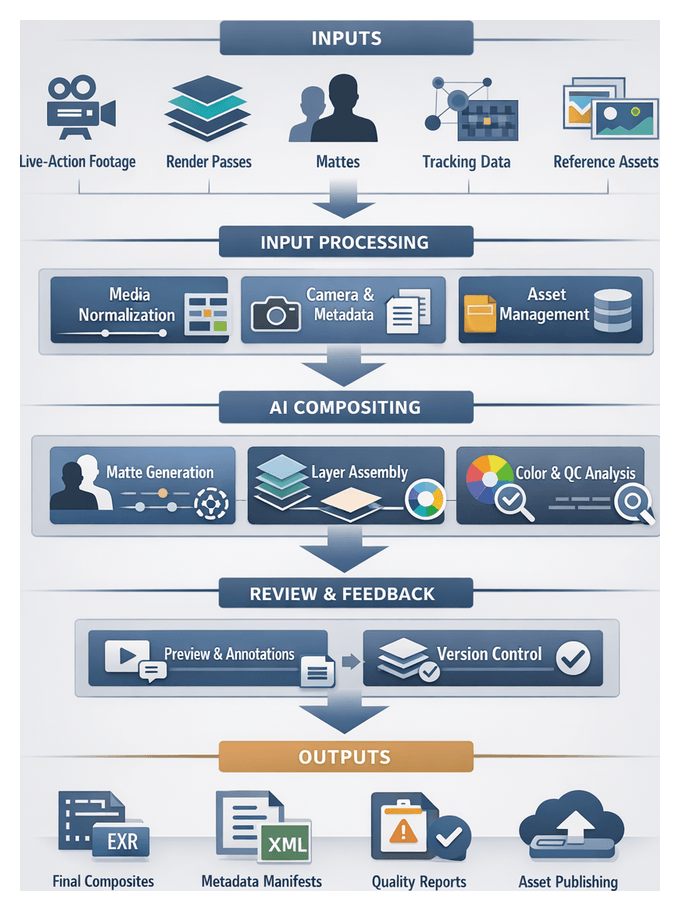
Purpose and Core Objectives
The compositing stage is the critical convergence point in a VFX pipeline where live-action plates, render passes, mattes, tracking data, and creative overlays are unified into a cohesive final frame. By leveraging AI-driven tools and precise metadata inputs, compositing transforms from a manual, shot-by-shot endeavor into an orchestrated sequence of data-driven operations. This shift accelerates delivery schedules, reduces manual errors, and elevates visual fidelity.
Automated compositing workflows pursue several interrelated objectives:
- Seamless Layer Integration: Combine foreground elements, background plates, and render passes with consistent edge handling, motion blur preservation, and depth continuity.
- Accurate Matte Generation: Employ machine learning–based segmentation to extract precise mattes without manual rotoscoping.
- Dynamic Color and Lighting Matching: Align color space, exposure, and dynamic range across layers using scene illumination metadata and reference charts.
- Automated Quality Checks: Detect compositing artifacts, seam misalignments, and keying errors through AI-driven anomaly detection.
- Configurable Artistic Overrides: Offer parameterized control points for creative adjustments, ensuring automation enhances artistic intent.
- Scalability and Consistency: Standardize operations across shots to maintain a uniform visual language throughout production.
Essential Inputs and Metadata Prerequisites
Effective AI-driven compositing relies on validated inputs and comprehensive metadata. Key visual inputs include:
- Live-Action Plates: High-resolution footage with associated lens metadata and timecode references.
- Render Passes: Multi-channel outputs—beauty, diffuse, specular, z-depth, normals, ambient occlusion—in linear color space.
- Generated Mattes: Precomputed or reviewed masks for foreground/background separation in high-bit-depth formats.
- Camera Tracking Data: 2D and 3D tracking information in formats such as FBX or .iff.
- Lookup Tables and Color Profiles: Reference LUTs for consistent color transforms across delivery formats.
- Reference Stills and Concept Art: Color keys and texture samples guiding style-transfer and grading.
- Temporal Metadata: Frame rate, shutter angle, and time-of-day annotations for motion blur and lighting continuity.
Prerequisite metadata and organizational conventions include:
- File Naming Conventions: Hierarchical schemes encoding project, sequence, shot, layer, and version for automated discovery.
- Color Space Declarations: Embedded profiles (ACES, REC.709, Log-C) guiding accurate transformations.
- Timecode and Frame Markers: Consistent numbering and embedding to synchronize across inputs.
- Render Configuration Manifests: JSON or XML exports describing render settings and pass ordering.
- Approval Flags: Database indicators for editorial, VFX supervision, and color review status.
Integration with asset management systems—such as Blackmagic Fusion—ensures compositing nodes retrieve correct versions and prevent unauthorized modifications. Metadata completeness is essential to enable autonomous pipelines.
AI-Driven Compositing Workflow
This workflow orchestrates AI services, render engines, and review platforms through scalable infrastructure comprising on-premises GPU clusters and cloud inference services—such as AWS SageMaker Inference and Google Cloud AI Platform—managed by Kubernetes and job queues like OpenCue. The main stages are:
Input Acquisition and Normalization
Live-action plates and CG renders enter a preprocessor that standardizes formats, resolutions, and color spaces. A cloud-based broker retrieves footage from the asset management platform (for example, ShotGrid) and an AI media converter such as Adobe Sensei adjusts frame rates, applies denoising, and embeds metadata. An event queue triggers downstream AI pipelines once validation is complete.
Matte Generation and Refinement
Neural segmentation engines—based on architectures like U-Net or V-Net—produce initial alpha mattes. Turn-key services such as Runway ML and models like NVIDIA’s MODNet classify pixels into foreground and background categories. A secondary AI module refines edges and enforces temporal stability using spatial attention layers and optical flow, reducing flicker and noise around fine details.
- Batch splitting of shots for GPU acceleration
- Edge refinement with The Foundry’s Nuke deep learning nodes and Boris FX Silhouette routines
- Adaptive feathering based on pixel confidence metrics
- Temporal smoothing across sliding frame windows
Layer Assembly and Color Matching
With refined mattes, a rule-based engine within compositing tools constructs layer stacks—foreground, background, shadows, ambient occlusion—and applies blend modes respecting physical light transport. AI-driven color matching leverages neural style transfer and GAN-based color transfer to harmonize CG elements with live plates. Tools like Colourlab Ai export LUTs applied in grading suites such as DaVinci Resolve, ensuring aesthetic consistency across sequences.
- Dynamic linking of asset IDs to compositing nodes
- Automated dependency resolution for partial re-compositing
- Feedback loops from review annotations to refine color transforms
Review and Version Integration
Proxy previews are generated for artist review in platforms like ftrack or ShotGrid. Structured annotations capture frame ranges, layer names, and pixel coordinates. Integration with collaboration tools—Slack or Microsoft Teams—facilitates real-time discussion. Every composite is versioned automatically, with metadata tags for artist, revision, timestamp, and change summary. Approved composites deploy to the final rendering queue through automated pipelines.
- Event-driven notifications delivering preview links
- Automated logging of approval statuses
- APIs linking compositing change logs to production dashboards
Composite Outputs and Handoff Protocols
The compositing stage concludes with deliverables that include high-fidelity image sequences, manifests, annotations, and handoff triggers. Standardized formats and clear protocols ensure downstream teams can access, review, and iterate without ambiguity.
Standardized Outputs and Manifests
Composite plates are exported as multichannel OpenEXR sequences—ShotID_Comp_v###.exr—containing RGBA, specular, diffuse, depth, motion vectors, and auxiliary mattes. A companion JSON or XML manifest lists shot identifiers, source asset paths, frame range, color profiles, layer hierarchy, blend modes, and AI confidence scores for generated mattes.
Quality Flags and Annotations
AI-driven inspection models analyze composites to flag edge artifacts, color mismatches, flicker, and depth discontinuities. Annotations are embedded as separate EXR channels or exported as markup files compatible with review tools, guiding artists directly to touch-up areas.
Asset Management Integration
An automated publisher registers composites and manifests back into the central asset management system—such as ShotGrid or ftrack. Actions include uploading sequences, attaching metadata, linking dependencies, and assigning review tasks to compositors and supervisors.
Handoff to QA and Artists
Upon publication, a handoff event dispatches the following payload to the QA orchestration engine:
- Composite image sequences with embedded metadata
- Dependency manifest files
- Annotation layers or markup files
- Version and revision history
Quality assurance systems then ingest composites for continuity checks and artifact detection. In parallel, artists receive notifications for creative refinements. The handoff process includes:
- Notification via the production management tool with links to composites and annotations
- Local checkout of a locked asset copy
- Import into compositing or grading applications—such as Nuke or DaVinci Resolve
- Real-time synchronization of edits back to the asset repository
Data Integrity and Traceability
Throughout the handoff process, audit logs capture every interaction. Version control measures include immutable object storage, checksum verification, access controls tied to user roles, and detailed event logs recording publishes, handoffs, and QA status changes. These safeguards maintain data integrity and provide a comprehensive asset lifecycle trace.
Chapter 9: Raw Media Intake Scope and Data Requirements
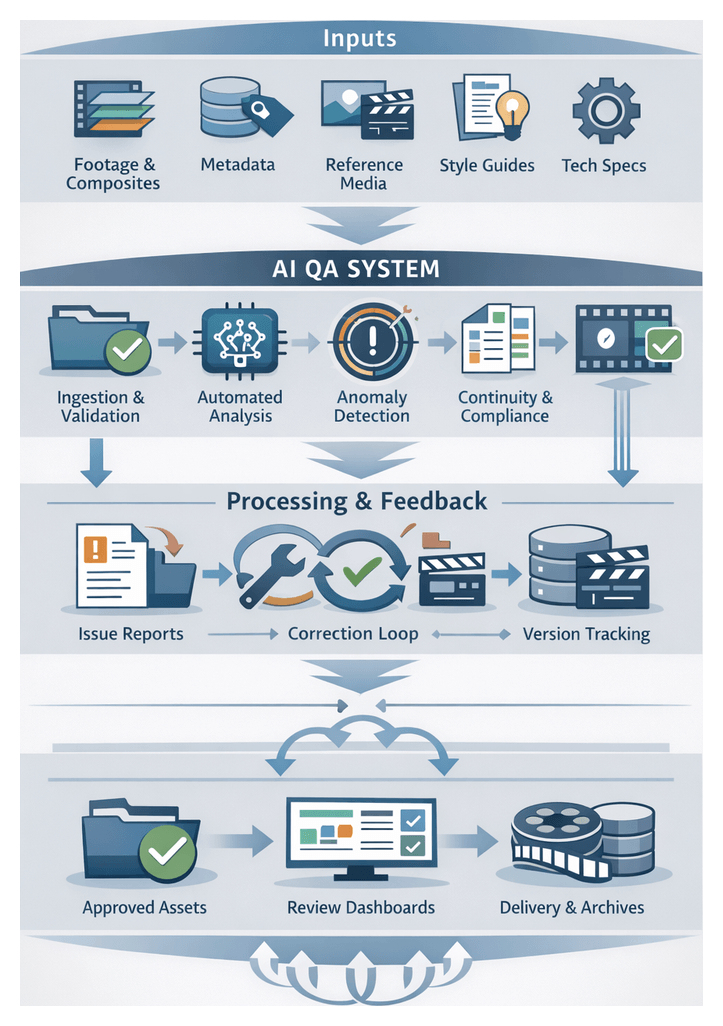
Purpose and Scope of AI-Driven Quality Assurance
The quality assurance stage serves as the critical gatekeeper that ensures visual fidelity, continuity, and technical compliance before final delivery. In high-pressure media and entertainment environments, small discrepancies can cascade into costly rework or undermine the viewer’s suspension of disbelief. By systematically evaluating composite plates, layered elements, and rendered sequences against predefined criteria, this stage verifies that each asset meets both creative intent and technical specifications while safeguarding timelines, budgets, and brand integrity.
Traditional QA often relies on manual inspection, ad hoc checklists, and isolated reviews, introducing inconsistencies, hidden errors, and bottlenecks. The integration of AI transforms QA from a reactive checkpoint into a proactive, data-driven control hub. Automated anomaly detection, continuity monitoring, and pattern recognition tools rapidly surface issues that might escape the human eye, enabling teams to address defects at the earliest point in the workflow and accelerating the feedback loop to reduce rework.
Foundational Prerequisites and Inputs
Effective AI-driven QA depends on rigorous preparation and well-defined inputs. Upstream processes—compositing, rendering, and asset generation—must adhere to consistent conventions and provide complete metadata. A centralized asset management system with API access or file watchers ensures inspection engines operate on the latest approved inputs. Stakeholder sign-off on style guidelines and technical specifications establishes the benchmarks against which AI assessments are measured.
- Consistent file naming, directory organization, and version control markers
- Comprehensive metadata tags for shot identifiers, versions, color spaces, and layer types
- Uniform resolution, frame-rate settings, and standardized LUTs for color grading
- Access to style guides, lighting references, and narrative continuity bibles
- API or file-watcher notifications signaling new or updated assets
- Stakeholder approval of creative and technical benchmarks
Key Inputs
- Composite plates, layered output files, alpha channels, and mattes
- Color space definitions and LUT files for interpreting intended grading
- Shot metadata including camera parameters, lens profiles, and temporal markers
- Reference media such as dailies, concept art, previz sequences, and approved frames
- Continuity logs capturing narrative shot orders, character coverage, and environment maps
- Previous-stage reports with manual annotations and known issue logs
- Technical specifications detailing delivery formats, codecs, and platform targets
Automated Inspection Workflow and AI Modules
The automated inspection pipeline orchestrates AI-driven actions to evaluate visual effects deliverables against defined quality criteria. Designed as an event-driven microservices architecture, this workflow captures media files and metadata, triggers inspection jobs via a message broker, and logs results in a centralized database. Parallel processing ensures rapid, scalable reviews, while priority queuing aligns tasks with production schedules.
Workflow Coordination
- Ingestion service captures file references and metadata, validating schema compliance
- Workflow manager publishes events to a message broker, invoking AI inspection services
- Microservices perform frame-by-frame and shot-level checks in parallel
- Central database logs inspection outputs, enabling dashboards and reports
- RESTful callbacks initiate feedback loops to rendering or compositing modules
Frame-Level and Shot-Level Checks
- Frame-by-frame anomaly detection using services such as Amazon Rekognition and Google Cloud Vision
- Shot-level consistency analysis comparing outputs to reference baselines stored in asset management
- Lighting and exposure evaluation via luminance curve comparison to preproduction profiles
- Temporal coherence analysis employing recurrent neural networks and optical flow models
- Sequence-level motion integrity checks using scene flow estimation and optical flow comparisons
Integration with Asset Management and Review Platforms
Inspection results integrate with asset management systems and collaborative review tools. Detected issues can be attached as comments in Frame.io or linked to jobs in ShotGrid. Metadata updates propagate through REST APIs, ensuring version control and traceability. Reviewers access annotated frames with embedded defect markers, while production managers monitor inspection status via unified dashboards.
Specialized AI Error Detection Techniques
AI-driven error detection encompasses a variety of specialized models that identify visual and audio-visual anomalies, ensuring adherence to creative and technical standards.
Visual Anomaly Detection
- Deep neural networks (ResNet, EfficientNet) trained on pristine and flawed imagery to flag pixel-level artifacts
- Anomaly scoring heads generating heatmaps for deviations beyond learned norms
- Data augmentation with noise injection, color jitter, and compression artifacts to broaden model robustness
- Integration with render farms orchestrated by Pixar’s Tractor for real-time feedback
Continuity and Consistency Checking
- Optical flow networks (FlowNet2) verifying object trajectories across shots
- Keypoint tracking models inspired by OpenPose for character animation consistency
- Scene graph alignment ensuring spatial relationships of set pieces and props remain intact
- Structured continuity reports feeding into ShotGrid dashboards
Lighting and Color Balance Analysis
- Histogram matching networks learning reference distributions from approved frames
- Perceptual metrics (LPIPS) assessing color fidelity aligned with human vision
- Semantic segmentation models delineating lighting zones for localized checks
- Deviation alerts triggering reviews in Blackmagic DaVinci Resolve
Rendering Artifact Identification
- GAN-based discriminators detecting noise and fireflies
- Convolutional networks recognizing aliasing patterns and jagged edges
- Recurrent models evaluating motion blur consistency over time
- Priority re-queuing for re-rendering via NVIDIA Omniverse
Audio-Visual Synchronization
- Phoneme detection networks based on OpenAI Whisper for lip-sync accuracy
- Cross-modal transformers correlating audio embeddings with video frames
- Temporal consistency checks alerting when sync deviation exceeds thresholds
- Integration with Avid Pro Tools to embed sync metadata
Integration, Orchestration, and Feedback Loop
A scalable orchestration platform underpins the inspection workflow, dynamically deploying AI modules based on demand. Kubernetes or similar container orchestrators manage microservices and compute resources, while serverless functions handle lightweight tasks. An event bus propagates asset status changes, inspection completions, and correction triggers, allowing seamless integration of new modules without disrupting existing operations.
Metadata Propagation and Version Tracking
- Inspection events generate metadata entries recording defect type, location, severity, and timestamp
- Synchronized entries in the central asset catalog maintain a complete audit trail
- Delta-based re-inspection optimizes processing by targeting only modified segments
Automated Feedback and Correction Triggers
- RESTful callbacks route errors to rendering farms or compositing teams based on issue taxonomy
- Automated re-rendering jobs with adjusted parameters triggered for severe artifacts
- Integration with Thinkbox Deadline for render queue management
- Human review dashboards implement triage, batching low-impact anomalies and escalating critical defects
Logging, Metrics, and Continuous Improvement
- Comprehensive logs capture model versions, input parameters, and output results
- Time-series databases aggregate metrics: inspection throughput, defect rates, turnaround times
- Monitoring dashboards (Grafana) surface real-time pipeline health and model performance
- Feedback loops collect false positives and missed detections to retrain models via A/B testing
Review Reporting, Issue Tracking, and Dependency Management
The final QA outputs include structured review reports, automated issue tickets, and dependency graphs that guide remediation and maintain traceability through iterative cycles.
Structured Feedback Packages
- Frame-level annotations with exact defect locations and error classifications
- Severity ratings, recommended remediation steps, and embedded comparison thumbnails
- Metadata linking each issue to its source shot, asset ID, and version tag
- Exported in JSON or XML schemas for compatibility with downstream tools
Issue Tracking Integration
- Automatic ticket creation in ShotGrid, ftrack, or Jira
- Populated fields: ticket ID, shot identifier, error type, priority, deadlines, and asset links
- Cross-team notifications via Slack or Microsoft Teams to broadcast critical issues
- Service level agreements enforcing resolution targets and triggering escalations
Dependency Mapping and Revision Coordination
- Dependency graphs capturing parent-child relationships, cross-shot linkages, and conditional tasks
- Prioritized remediation roadmaps aligned with production timelines and resource constraints
- Handoff protocols defining notification channels, delivery formats, and versioning conventions
- Approval checkpoints requiring sign-off from supervisors or technical directors
Dashboard Reporting and Compliance Records
- Aggregate dashboards in Tableau displaying defect trends, resolution times, and resource forecasts
- Compliance records documenting inspection actions, model versions, and sign-off logs
- Final deliverables accompanied by checksum-verified metadata files for archival handoff
By integrating AI-driven inspection, orchestration services, and structured reporting, the QA stage delivers rapid, consistent, and actionable insights. This cohesive framework accelerates issue detection and remediation, fosters collaboration between automated systems and creative teams, and elevates quality standards across visual effects production.
Chapter 10: Preprocessing Workflow for Consistent Footage
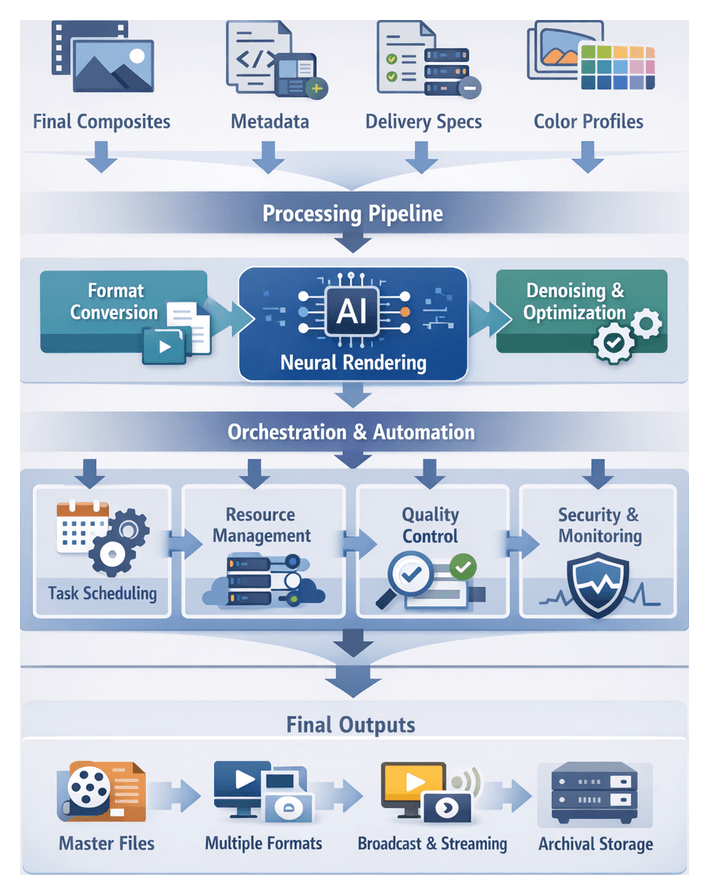
Stage Objectives and Purpose
The rendering and delivery stage represents the culmination of the visual effects pipeline, where creative vision, technical precision, and operational coordination converge to produce final assets ready for distribution. At this point, compositing, color grading, and quality assurance have been completed. The focus shifts to generating high-fidelity master files that satisfy theatrical, broadcast, streaming, and archival standards while preserving the artistic intent established during preproduction and approvals.
In an AI-enhanced workflow, intelligent orchestration accelerates render times, optimizes compute utilization, and minimizes manual intervention. Neural rendering techniques and cloud-native delivery tools enable predictable output quality and seamless handoffs to distribution channels. By automating format conversion, dynamic resource allocation, and compliance validation, teams achieve faster turnarounds without sacrificing consistency or creative nuance.
Key Inputs, Prerequisites, and Dependencies
Successful rendering and delivery depend on preparing and validating critical inputs, ensuring system readiness, and aligning stakeholder approvals.
- Final Composite Plates: Locked high-resolution image sequences or video files—typically OpenEXR or DPX—containing all visual effects elements, mattes, and color adjustments.
- Metadata Files: Scene metadata for frame rate, timecode, aspect ratio, color space, and version identifiers, delivered via EXR headers, XML sidecars, or production databases.
- Delivery Specifications: Technical requirements for codecs, containers, bitrates, and resolutions provided by broadcasters, streaming platforms, theatrical distributors, or archives.
- Color Profiles and LUTs: ACES, Rec.709, or DCI-P3 lookup tables and color management settings to ensure consistent reproduction across display environments.
- Asset Reference Library: Approved textures, HDR environments, and matte passes synchronized with the locked asset manifest.
- Orchestration Instructions: Job queues, priority settings, and resource allocation policies managed by AWS Thinkbox Deadline or custom on-premises schedulers.
Prerequisite conditions include asset lockdown and version control, render engine configuration, compute infrastructure availability, network security, color pipeline alignment, and formal signoffs from VFX supervisors, colorists, and producers. Key software dependencies include Autodesk Arnold, Chaos V-Ray, and NVIDIA Omniverse, all configured to leverage neural and ray-tracing acceleration. Infrastructure must span on-premises GPU/CPU clusters and cloud instances with secure connectivity, object storage, and encryption policies. Continuous monitoring, backup, and automated failover routines safeguard data integrity and delivery schedules.
Pipeline Orchestration and AI Integration
A unified AI integration layer orchestrates task scheduling, data exchanges, and service interactions across the VFX pipeline.
- Workflow Engine and Service Bus: Platforms such as AWS Step Functions or Apache Airflow define state machines and DAGs. Event distribution uses RabbitMQ or Google Cloud Pub/Sub for reliable message delivery.
- Task Scheduler and Dependency Manager: Automate process triggers, enforce ordering rules, and manage data prerequisites.
- Event-Driven Triggers: Completion of preprocessing or rendering tasks publishes events that automatically initiate downstream stages.
- API Patterns: Synchronous REST or gRPC calls for real-time services, asynchronous message queues for batch jobs.
- Integration Patterns: Request-Response for interactive tasks, Publish-Subscribe for asset updates, Batch Processing for offline analytics, Streaming Pipelines for real-time compositing feedback.
- Service Discovery and Scalability: Dynamic registration via Kubernetes DNS allows horizontal scaling. Auto-scaling groups and spot instances adjust compute capacity based on queue depth.
- Monitoring, Logging, and Error Handling: Health metrics, error codes, and logs routed to AWS CloudWatch or ELK stack. Automated retry with exponential backoff, alert escalations, and immutable audit trails ensure traceability and compliance.
- Security and Governance: Mutual TLS, token-based authentication, role-based access control, and data encryption at rest and in transit protect sensitive assets and intellectual property.
- Continuous Improvement: QA findings and artist annotations feed back into retraining workflows on AWS SageMaker, driving incremental quality gains through federated learning and closed-loop feedback.
AI-Driven Preprocessing Tools
AI-powered format conversion and denoising tools streamline raw footage preparation, delivering consistent assets for subsequent VFX stages.
Format Conversion
- AWS Elemental MediaConvert: Machine learning–driven transcoding that analyzes scene complexity in real time to optimize bitrate, resolution, and codec settings.
- Bitmovin Encoding: Neural networks predict perceptual quality metrics and tailor encoding presets, accelerating throughput by up to 40 percent while minimizing artifacts.
- FFmpeg with OpenVINO Integration: Hardware-accelerated AI models for video scaling and color conversion on Intel CPUs and VPUs, enabling low-latency batch conversions.
Neural Denoising
- Neat Video: Deep learning–powered temporal-spatial filtering that adapts to noise profiles and refines its model frame by frame.
- Topaz Video Enhance AI: GAN-based modules for noise removal and upscaling, preserving high-frequency detail and natural motion in batch processing.
- Adobe Sensei in Premiere Pro: Integrated denoising and stabilization using adaptive models to distinguish texture from noise without external exports.
Integration and Scalability
Asset management platforms like ShotGrid and Ftrack coordinate AI preprocessing tasks with version control, metadata tagging, and review checkpoints. Event-driven pipelines initiate format conversion and denoising jobs upon media ingest, capturing performance metrics and quality reports in a central database. Containerized deployments on Docker or Kubernetes enable hybrid cloud architectures using services such as Azure Media Services and Google Cloud Transcoder API. Federated learning enhances denoising models locally while preserving data security, and auto-scaling provisions compute resources according to queue length.
Metadata and Quality Metrics
AI preprocessing engines generate embedded metadata—color space, bit depth, encoding parameters—and confidence scores or noise-residual maps. Objective metrics such as PSNR and SSIM are computed in real time, feeding BI dashboards to track throughput, resource utilization, and conversion success rates. This data-driven visibility supports continuous pipeline optimization and early anomaly detection.
Emerging Techniques
Future innovations include end-to-end neural frameworks combining format conversion and denoising, temporal super-resolution for frame rate adaptation, self-supervised denoising that learns from production footage, and edge-based on-set preprocessing integrated into camera systems. These advances will shift VFX pipelines toward continuous delivery models, blurring the lines between production and postproduction.
Foundational Deliverables, Dependencies, and Integration Points
Clear deliverables, robust dependency management, and explicit handoff criteria form the blueprint for seamless transitions into media ingest, preprocessing, and final delivery.
Primary Deliverables
- Objectives and Requirements Document: Stakeholder goals, creative benchmarks, performance targets, compliance standards, and risk assessments aligned with industry guidelines.
- AI Capability Profiles: Specifications for each AI module—such as TensorFlow, PyTorch, OpenCV, and AWS SageMaker—detailing inputs, outputs, performance, and integration points.
- Workflow Diagram: High-level schematic of AI-driven stages, data flows, and decision points, deliverable in formats compatible with ShotGrid or similar tracking systems.
- Data Schema and Metadata Standards: JSON or XML schema definitions, naming conventions, and guidelines for embedding metadata in assets.
- Interface Specifications: API contracts, authentication methods, error-handling procedures, and message-queue configurations documented via Swagger or OpenAPI.
- Proofs of Concept: Minimal implementations—neural style transfer samples, denoising tests, automated tagging scripts—to validate feasibility and reveal integration challenges.
Dependency Management
- Stakeholder Approvals: Formal sign-offs on documents and workflows via production tracking platforms.
- Asset Repository Readiness: Populated texture libraries and reference footage in systems like ShotGrid or DAM platforms.
- Infrastructure Provisioning: Reserved on-premises GPU clusters or cloud instances, network storage, and container orchestration platforms.
- Security and Compliance: Executed NDAs, encryption standards, and access controls in line with corporate policies.
- Toolchain Integration: Installed AI frameworks, middleware for API gateways, message brokers, and authentication services.
Integration Points and Handoffs
- Metadata Manifest: JSON package of asset identifiers, version numbers, and checksums guiding ingestion workflows.
- Interface Definition Documents: Detailed API documentation specifying endpoints, payload schemas, and sample calls.
- Initial Asset Samples: Curated raw media files covering expected formats for comprehensive testing.
- Operational Run Books: Instructions for starting and monitoring AI services, ingest processes, and error recovery procedures.
- Quality Benchmarks: Acceptance criteria for image fidelity, metadata accuracy, and processing throughput.
Ensuring Seamless Transition
- Synchronization Workshops: Joint sessions to review deliverables, clarify ambiguities, and align on success metrics.
- Shared Dashboards: Real-time portals within ShotGrid or custom monitoring tools to display handoff progress and dependency statuses.
- Automated Validation Pipelines: CI/CD scripts in Jenkins or GitLab CI for schema checks, checksum verifications, and smoke tests against APIs.
- Issue Tracking and Escalation: Shared ticketing systems with defined SLAs, integration to dashboards for transparency.
Data Integrity and Traceability
- Version Control for Documentation: Git repositories to track changes and enable rollbacks.
- Immutable Asset Storage: Write-once-read-many object storage in Amazon S3 or on-premises solutions with WORM fencing.
- Audit Logs: Centralized logging of API transactions, user actions, and data transformations via ELK stack or Splunk.
Analytical Rationale
Defining deliverables, dependencies, and integration points enhances predictability, efficiency, accountability, scalability, and quality assurance. By formalizing handoffs and artifact standards, teams minimize ambiguities, eliminate idle time, and prevent cascading errors, laying the foundation for accelerated, high-quality VFX production.
Conclusion
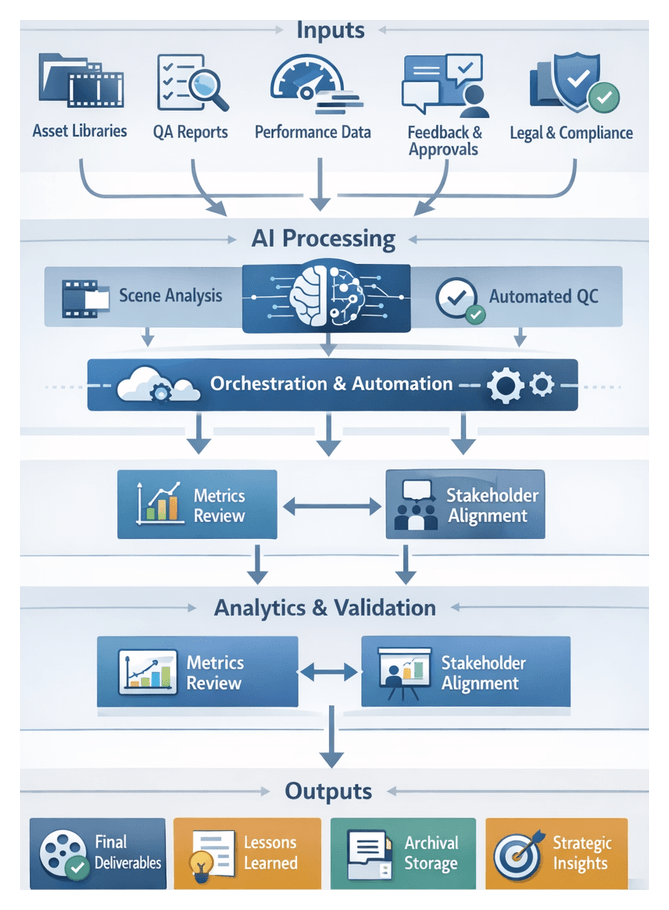
Purpose and Strategic Value of the Wrap-Up Stage
The final synthesis in an AI-enhanced visual effects pipeline consolidates all project data, validates deliverable quality, and documents lessons learned alongside strategic recommendations. This stage elevates the conversation from task completion to actionable insights, quantifying the return on investment for AI components such as neural rendering modules or automated asset cataloging systems. The resulting report guides future budgeting, vendor selection, and technical roadmaps, ensuring that stakeholders—from creative leads to executive producers—share a unified understanding of successes and improvement opportunities.
Beyond closing the loop on a single production, the wrap-up stage builds a structured knowledge base. By formalizing how AI-driven techniques accelerated scene breakdowns, streamlined compositing, and optimized rendering, teams can refine workflows, select optimal tools, and integrate emerging technologies more effectively in subsequent projects.
Essential Inputs and Success Criteria
Critical Inputs
- Finalized Asset Libraries and Version Histories: Comprehensive catalogs with version control logs from systems such as Git or Perforce.
- Quality Assurance Reports: AI-driven QA outputs covering continuity checks, artifact logs, and color consistency analyses.
- Performance and Efficiency Metrics: Data from pipeline monitoring on render times, resource utilization, and throughput.
- Stakeholder Feedback and Approval Records: Notes from creative reviews, producer sign-offs, and client mark-ups.
- Compliance and Legal Clearances: Metadata on usage rights, licensing agreements, and legal sign-off certificates.
- Archival Readiness Documentation: Specifications for long-term storage, including file formats, compression standards, and checksum validations.
Success Conditions
- Completion of All Upstream Workflow Stages: No pending tasks or unresolved review cycles remain.
- Data Integrity and Consistency: Cross-stage audits confirm alignment of metadata, version histories, and asset identifiers.
- Stakeholder Alignment Workshop: Facilitated session validates metrics and recommendations with creative leads, technical directors, and producers.
- Documented Lessons Learned: Structured narratives detail challenges, AI-module performance insights, and optimization proposals.
- Access to Pipeline Analytics Dashboards: Real-time views powered by tools such as Apache Airflow or Jenkins with AI monitoring plugins.
- Archival Storage Availability: Provisioned cloud or on-premises storage for immediate asset handoff.
Orchestration and Coordination Across the Pipeline
An AI-driven pipeline relies on tight orchestration of systems and actors. A central workflow engine monitors asset lifecycles, triggering AI services or human tasks through event-driven messaging, shared databases, and real-time dashboards. Standardized metadata schemas underlie each handoff, embedding version identifiers, quality metrics, and processing flags with every file.
Human and machine interactions converge via collaboration platforms that integrate task management with asset previews. Task assignments and notifications flow through tools like Autodesk ShotGrid and Ftrack. Supervisors approve or request revisions in-app, automatically adjusting AI parameters or reassigning tasks.
Automated triggers defined by completion flags and quality gates ensure that each stage begins only when entry criteria are met. Bidirectional triggers handle QC failures, sending assets back with linked issue tickets. Change detection services compare updated files against baselines, invoking selective reprocessing by AI modules only where needed. Annotation capture, automated prioritization, and selective reprocessing accelerate iteration loops without overwhelming compute resources.
Comprehensive monitoring dashboards track job status, resource usage, and error rates. A governance layer enforces production standards, auditing every handoff and logging metadata changes. Alerts surface deviations—such as prolonged render queues or repeated QA failures—and automated remediation can reroute tasks or initiate rollbacks. Secure collaboration is maintained through single sign-on and role-based access controls, ensuring accountability and traceability.
AI modules coordinate via a shared metadata framework that tracks version, confidence scores, and lineage. Parameter updates in one model propagate to dependent services through a centralized model registry. Interlock mechanisms protect critical path tasks with token-based locks, transferring ownership only after QC validation.
Data provenance captures the full transformation history of each asset, from raw ingest to final composite. This lineage supports reproducibility for audits, vendor handoffs, and legal compliance. Cross-project coordination and shared services enable multi-tenant operation, isolating project-specific assets while sharing common AI modules, compute clusters, and global render queues. Embedded analytics collect metrics on QC failure rates, render times, and inference latency, driving continuous improvement through periodic model retraining and process calibrations.
Long-Term Creative and Business Impact
Embedding AI at the core of visual effects pipelines transforms creative workflows and business models across three dimensions: competitive differentiation, scalable operations, and enhanced creative freedom.
- Competitive Differentiation: Automated scene breakdown, procedural asset generation, and neural rendering compress delivery schedules, enabling studios to respond rapidly to market trends. AI-driven consistency checks and predictive analytics deliver higher quality at lower cost, while generative networks support unique aesthetic signatures. Data-driven insights inform bidding strategies and pricing models.
- Scalable Operations: Cloud-based orchestration platforms such as NVIDIA Omniverse and AWS Thinkbox provide elastic GPU and CPU resources. Predictive scheduling redistributes tasks across global render farms. Checkpointing and versioning maintain workflow resilience, enabling rapid recovery from failures without rework.
- Enhanced Creative Freedom: Real-time style previews, neural rendering engines, and contextual AI agents on platforms like Google Vertex AI and OpenAI accelerate ideation and enable parallel artistic exploration. Integrated AI modules democratize advanced techniques for smaller teams, allowing artists to focus on storytelling and design rather than repetitive tasks.
The synergy between human ingenuity and machine intelligence not only streamlines production but also unlocks new service offerings—real-time virtual production, immersive content creation—and sustainable growth through value-added services.
Scalability and Customization Paths
An adaptable pipeline must handle fluctuations in asset volume, computational demand, and team size while accommodating unique studio requirements. Scalability spans data, compute, team, and process dimensions, achieved through cloud orchestration, containerization, and modular microservices. Customization enables fine-tuning of AI models, workflow variants, plugin integration, and metadata schemas without disrupting the core pipeline.
Architectural Patterns for Scalability
- Microservices — Decompose pipeline stages into discrete services (ingest, preprocessing, rendering, QA) deployed in Docker containers.
- Orchestration Layer — Auto-scale services with Kubernetes, handling updates, service discovery, and health checks.
- Serverless Functions — Offload lightweight AI tasks to AWS Lambda or Google Cloud Functions for automatic scaling.
- Message Queues — Decouple stages with Kafka or RabbitMQ to buffer spikes and prevent cascading overloads.
- API-First Design — Expose capabilities via RESTful or gRPC APIs for integration with custom dashboards and third-party tools.
- Data Partitioning — Shard assets and sequences across distributed storage tiers for parallel I/O.
Customization Layers
- Feature Flags — Toggle experimental AI models or processing steps per project or shot.
- Model Registry — Track AI models with MLflow for versioning, metrics, and rollbacks.
- Plugin SDKs — Provide Python and C extension points with defined input/output interfaces.
- Configuration-as-Code — Manage pipeline settings and resource profiles in version control, provisioning environments with Terraform.
- Dynamic Templates — Parameterized workflows instantiate tailored pipelines via web interfaces or scripts.
Best Practices and Future-Proofing
- Monitoring and Telemetry — Centralize dashboards for queue depths, resource utilization, error rates, and model performance.
- Automated Testing — Run regression tests on AI outputs and pipeline stages with synthetic and real-world samples.
- Security and Access Control — Enforce granular role-based permissions for configuration repositories, container registries, and model stores.
- Cost Management — Use cloud cost analytics, resource quotas, and automated shutdown policies to eliminate idle spending.
- Documentation and Training — Maintain clear guides for pipeline components, customization SDKs, and operational procedures.
- Governance Framework — Define approval processes for custom modules and configuration changes aligned with production milestones.
- Modular Upgrades — Enable incremental microservice replacements with API versioning to maintain backward compatibility.
- Open Standards — Adopt USD, Alembic, OpenColorIO, and ACES to prevent vendor lock-in and facilitate collaboration.
- Community-Driven Extensions — Engage open-source ecosystems to co-create plug-ins and share best practices.
- Continuous Feedback Loops — Incorporate artist and producer feedback into agile development cycles for ongoing pipeline refinement.
Appendix
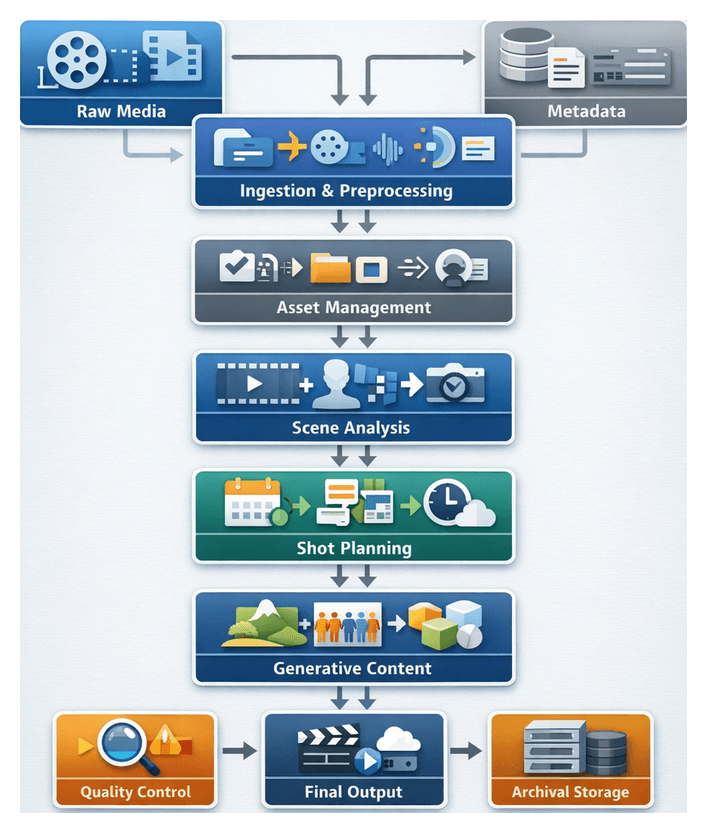
Fragmented Processes and Workflow Bottlenecks
Visual effects production often suffers from fragmented processes and manual handoffs, where editorial, VFX, compositing, and color teams operate in isolated silos using disparate tools. This fragmentation leads to duplicated assets, lost metadata, version conflicts, and delayed delivery. Manual bottlenecks—such as format transcoding, noise reduction, tagging, and rotoscoping—consume valuable artist time and introduce variability. By consolidating tasks into an AI-driven pipeline, studios can automate routine operations, maintain data continuity, eliminate single points of failure, and free creative teams to focus on high-value decisions.
AI-Driven Pipeline Overview
An AI-driven pipeline embeds machine learning, computer vision, procedural generation, and neural rendering into each production stage. From raw media intake and preprocessing to final delivery and archival, AI modules automate ingestion, tagging, scene breakdown, scheduling, generative content creation, compositing, and quality inspection. Central orchestration platforms define task dependencies, trigger automated retries, and dynamically allocate compute resources. Consistent metadata schemas enforced at ingest and throughout processing ensure accurate interpretation of asset properties and seamless integration of AI services.
AI Capabilities by Pipeline Stage
Raw Media Ingestion and Preprocessing
Objective: Normalize heterogeneous footage into standardized, metadata-rich media for downstream automation.
- Format Detection and Transcoding
- AI-enabled analysis of container and codec signatures
- Tools: FFmpeg
- Noise Reduction and Stabilization
- Convolutional denoising networks and motion estimation for jitter correction
- Tools: Neat Video Denoiser, DaVinci Resolve Studio Neural Engine
- Metadata Extraction and Enrichment
- Computer vision for slate parsing; speech-to-text and NLP for dialogue transcription
- Tools: Google Cloud Vision API, AWS Rekognition, Adobe Sensei
Asset Management and Cataloging
Objective: Index, tag, version, and retrieve assets efficiently across projects.
- Automated Tagging with Computer Vision
- Vector Embedding and Similarity Search
- High-dimensional embeddings for “find similar” queries
- Tools: Elasticsearch k-NN plugin, Pinecone
- Version Control for Binary Assets
- Delta storage and branching for large media files
- Tools: Git LFS, Perforce Helix Core
Scene Segmentation and Analysis
Objective: Automatically detect shot boundaries, generate breakdowns, and prepare for scheduling.
- Shot Detection and Keyframe Extraction
- Neural networks for scene-change detection
- Tools: Custom CNNs, VisionPro AI
- Object and Character Segmentation
- Instance and semantic segmentation for mattes
- Tools: Mask R-CNN via TensorFlow or PyTorch
- Motion and Camera Analysis
- Optical flow networks for motion vectors and camera move extraction
- Tools: FlowNet2, OpenCV optical flow modules
Shot Planning and Scheduling
Objective: Optimize shot schedules by matching complexity metrics with artist skills and compute resources.
- Predictive Analytics for Duration Forecasting
- Time-series models (ARIMA, LSTM) for completion estimates
- Tools: AWS SageMaker, Azure Machine Learning
- Resource Allocation Optimization
- Heuristic solvers for load balancing across on-premises and cloud
- Tools: OptaPlanner, in-house solvers
- Dynamic Rescheduling and Alerts
- Real-time monitoring and automated adjustments
- Tools: AgentLink AI Scheduling Module, ShotGrid
Procedural Generation and Generative AI
Objective: Synthesize environments, crowds, textures, and large-scale assets on demand.
- Rule-Based Geometry and Texture Synthesis
- Parametric engines with AI-augmented nodes
- Tools: SideFX Houdini
- Generative Adversarial Networks (GANs)
- Style-consistent texture and variation synthesis
- Tools: RunwayML, Unity ArtEngine
- Procedural Crowd and Environment Expansion
- AI-driven appearance variations in agent-based simulations
Neural Rendering and Compositing Automation
Objective: Enhance look development and automate matte extraction, color matching, and layer blending.
- Neural Denoising and Upscaling
- Autoencoders and GANs for super-resolution
- Tools: NVIDIA OptiX Denoiser, Topaz Video Enhance AI
- Style Transfer and Temporal Consistency
- Networks to apply concept art palettes with frame-to-frame coherence
- Tools: Adobe Sensei, open-source PyTorch implementations
- Automated Compositing and Rotoscoping
- U-Net, MODNet, Mask R-CNN for matte extraction; GAN-based color transfer
- Tools: Runway ML, Foundry Nuke Machine-Learning Roto, Colourlab AI, DaVinci Resolve
Quality Assurance and Compliance
Objective: Detect artifacts, continuity errors, and regulatory violations using AI-driven inspection and anomaly detection.
- Visual Anomaly Detection
- CNNs for noise, banding, and artifact identification
- Tools: AWS Rekognition, Google Cloud Vision, IBM Watson Visual Recognition
- Continuity and Motion Coherence Checks
- Optical flow and keypoint tracking for narrative consistency
- Lighting and Color Consistency
- Histogram matching and perceptual metrics
- Automated Ticket Generation
- Integration with ShotGrid, ftrack, or Jira for issue tracking
- Broadcast and Accessibility Compliance
- Detection of rapid flashes, logos, loudness violations; CEA-708 caption verification
Final Delivery and Archival
Objective: Render master files, convert to delivery formats, and archive with full metadata traceability.
- Neural-Accelerated Ray Tracing
- Hybrid AI-denoise and path-tracing pipelines
- Tools: NVIDIA Omniverse, Autodesk Arnold
- Automated Encoding and Packaging
- AI-assisted bitrate and codec optimization; checksum-verified sidecar manifests
- Tools: AWS Elemental MediaConvert, Bitmovin Encoding
- Archive Handoff and Long-Term Storage
- Tiered storage policies, secure vaulting, and retrieval QA
Handling Variations and Edge Cases
Pipelines must adapt to diverse project requirements—from multi-format ingest and legacy footage to real-time virtual production and emerging delivery platforms. Flexible configurations, model ensembling, and human-in-the-loop interfaces enable rapid responses to corrupted files, nonstandard metadata, stylized content, rush schedules, incomplete environmental data, on-site latency constraints, and unconventional layer sources. Declarative orchestration with YAML/JSON templates, feature flags, and plugin architectures empowers technical directors to customize ingest rules, AI model selections, scheduling policies, and fallback strategies without code changes, maintaining efficiency and quality under any scenario.
Machine Learning Frameworks
- TensorFlow: An open-source platform for building and deploying machine learning models at scale. Widely used for neural rendering, object detection, and custom AI model development.
- PyTorch: A flexible deep learning framework favored for research and production. Supports dynamic computation graphs and integration with computer vision and natural language processing pipelines.
- Kubeflow: An open-source MLOps platform for deploying, monitoring, and managing machine learning workflows on Kubernetes. Facilitates model training, serving, and versioning within production pipelines.
Computer Vision and Semantic Segmentation
- OpenCV: A comprehensive library of computer vision algorithms for image processing, object detection, feature extraction, and video analysis. Underpins AI-driven scene breakdown and tracking modules.
- Google Cloud Vision API: A managed service offering image classification, object detection, text recognition, and landmark identification via REST calls. Integrates easily into preprocessing and metadata enrichment stages.
- AWS Rekognition: A cloud-based computer vision service for face detection, object and scene analysis, and content moderation. Powers automated tagging and search in asset management systems.
- Clarifai: An AI platform specializing in visual recognition and custom model training. Enables semantic asset classification and advanced metadata extraction for large VFX libraries.
Asset Management and Collaboration Platforms
- Autodesk ShotGrid: A production tracking and review system that centralizes asset versioning, shot approvals, and team collaboration. Provides REST APIs for seamless integration with AI modules.
- ftrack: A project management and media review platform tailored to creative pipelines. Supports automated handoff of AI-generated assets and integrates annotations into task workflows.
- Frame.io: A cloud-based video review and collaboration tool that automates proxy generation and version control, allowing teams to annotate and approve AI-processed sequences in real time.
Orchestration and Workflow Automation
- Kubernetes: A container orchestration system that automates deployment, scaling, and management of AI microservices across on-premises and cloud environments.
- Apache Airflow: A workflow scheduler that defines directed-acyclic graphs (DAGs) for task dependencies, enabling reliable sequencing of AI preprocessing, analysis, and rendering jobs.
- RabbitMQ and Apache Kafka: Message brokers that support asynchronous communication between pipeline stages, ensuring event-driven triggers for AI services and downstream tasks.
- AgentLink AI Orchestration: A specialized orchestration engine for creative and VFX pipelines, coordinating AI agents, resource allocation, and service integrations.
Generative AI and Neural Rendering
- NVIDIA Omniverse: A real-time simulation and collaboration platform that integrates neural rendering, AI-driven USD workflows, and GPU-accelerated inference for look development.
- Runway ML: A user-friendly generative AI platform offering image synthesis, style transfer, and video editing models accessible via API or desktop application.
- Unity ArtEngine: An AI-powered texture synthesis and upscaling tool that automates creation of high-quality assets through machine learning models and procedural rules.
- SideFX Houdini: A procedural generation engine with Python and ROS interfaces that integrates AI models for environment synthesis, crowd simulation, and material variation.
- Topaz Video Enhance AI: A desktop application leveraging neural networks for video upscaling, noise reduction, and frame interpolation to improve raw footage quality before rendering.
Data Infrastructure and Analytics
- Elasticsearch: A search and analytics engine that supports vector similarity searches for AI embeddings, enabling content-based asset retrieval and recommendation.
- Pinecone: A managed vector database optimized for high-performance similarity search, powering AI-driven “find similar” asset queries.
- AWS SageMaker: A fully managed service for building, training, and deploying machine learning models at scale, used for predictive analytics and demand forecasting.
- Apache Kafka: A distributed event streaming platform that ingests real-time production data, feeding feature stores for AI model training and inference.
Monitoring, Logging, and Quality Assurance Tools
- Prometheus and Grafana: An open-source stack for collecting, visualizing, and alerting on performance metrics from AI services, orchestrators, and rendering clusters.
- IBM Watson Visual Recognition: An AI-driven service that extends anomaly detection capabilities to complex visual QA tasks, identifying continuity breaks and rendering artifacts.
- Neat Video: A plugin for professional editing and compositing applications that employs AI-trained noise profiles to perform high-quality denoising.
- Jira: A task and issue-tracking system integrated with QA pipelines to manage defect tickets, assign responsibilities, and track resolution progress.
Additional Context and Resources
- SMPTE Standards: Industry specifications for broadcast frame rates, aspect ratios, and digital cinema workflows.
- Academy Color Encoding System (ACES): A standardized color management framework ensuring consistent color reproduction across production and delivery.
- VFX Glossary by fxguide: A comprehensive resource for terminology and best practices in visual effects workflows.
- MLflow: An open-source platform for managing the end-to-end machine learning lifecycle, including experiment tracking and model versioning.
- Kubeflow Pipelines Tutorials: Guides for implementing and scaling ML workflows on Kubernetes clusters.
The AugVation family of websites helps entrepreneurs, professionals, and teams apply AI in practical, real-world ways—through curated tools, proven workflows, and implementation-focused education. Explore the ecosystem below to find the right platform for your goals.
Ecosystem Directory
AugVation — The central hub for AI-enhanced digital products, guides, templates, and implementation toolkits.
Resource Link AI — A curated directory of AI tools, solution workflows, reviews, and practical learning resources.
Agent Link AI — AI agents and intelligent automation: orchestrated workflows, agent frameworks, and operational efficiency systems.
Business Link AI — AI for business strategy and operations: frameworks, use cases, and adoption guidance for leaders.
Content Link AI — AI-powered content creation and SEO: writing, publishing, multimedia, and scalable distribution workflows.
Design Link AI — AI for design and branding: creative tools, visual workflows, UX/UI acceleration, and design automation.
Developer Link AI — AI for builders: dev tools, APIs, frameworks, deployment strategies, and integration best practices.
Marketing Link AI — AI-driven marketing: automation, personalization, analytics, ad optimization, and performance growth.
Productivity Link AI — AI productivity systems: task efficiency, collaboration, knowledge workflows, and smarter daily execution.
Sales Link AI — AI for sales: lead generation, sales intelligence, conversation insights, CRM enhancement, and revenue optimization.
Want the fastest path? Start at AugVation to access the latest resources, then explore the rest of the ecosystem from there.