

AI Driven Retail Sales Workflow Solutions
To download this as a free PDF eBook and explore many others, please visit the AugVation webstore:
Introduction
Operational Challenges Facing Retail Sales Teams
Retail organizations today operate in omnichannel ecosystems where online marketplaces, mobile apps and brick-and-mortar stores generate vast, disparate data streams—from point-of-sale transactions to web clickstreams and loyalty interactions. When these sources remain siloed, sales teams lack a unified customer view, impeding demand forecasting, personalized offer management and real-time responsiveness. Legacy processes compound the issue: regional managers, category planners and store associates follow varied procedures for inventory checks, pricing adjustments and promotion rollouts, leading to duplicated efforts, approval delays and inconsistent customer experiences. Disconnected communication channels further fracture the brand narrative as digital promotions clash with in-store offers, eroding customer trust and diminishing lifetime value.
Examining these operational challenges serves three strategic aims: establishing a baseline of existing workflows and data landscapes, pinpointing the pain points that stall sales growth and defining clear objectives for workflow unification. By mapping process diagrams, data inventories and performance metrics—such as conversion rates, transaction values and stock-out frequencies—stakeholders gain a shared understanding of where automation and data integration will deliver the greatest return. This clarity paves the way for AI-orchestrated workflows that bridge silos, automate routine tasks and ensure consistent, personalized interactions at scale.
Key Inputs for Workflow Transformation
- Process Documentation
- End-to-end workflows for order processing, inventory management, pricing updates and promotional execution
- Standard operating procedures and exception-handling protocols
- Data Source Inventory
- POS transaction logs, customer master records and loyalty data
- Inventory system exports with stock levels, replenishment lead times and warehouse allocations
- External feeds—competitor pricing, economic indicators and demand forecasts
- Technology Infrastructure Assessment
- Existing platforms: ERP, CRM, POS, e-commerce, data warehouses and middleware
- Network topology, data throughput and integration touchpoints
- Current automation capabilities—batch schedules, event triggers and API endpoints
- Performance Metrics Baseline
- Sales conversion rates, average transaction value and customer satisfaction scores
- Inventory turnover ratios, stock-out frequencies and carrying costs
- Promotion lift, markdown effectiveness and campaign ROI
- Stakeholder Interview Insights
- Feedback from sales managers, store associates and customer service teams
- Input from marketing, finance and supply chain on dependencies and priorities
- Data Governance and Quality Reports
- Assessments of data completeness, accuracy and timeliness
- Documentation of data ownership, stewardship roles and compliance requirements
Prerequisites for AI-Orchestrated Workflows
- Executive Sponsorship and Alignment: Leadership commitment to harmonize processes end-to-end, allocate resources, and champion change management.
- Cross-Functional Collaboration Framework: Governance structures—steering committees and working groups—to coordinate decisions across sales, marketing, operations and IT.
- Baseline Data Access Agreements: Data sharing protocols, security controls and privacy safeguards to grant AI teams access to source systems.
- Process Ownership and Accountability: Designation of process owners to maintain workflows, validate AI recommendations and oversee continuous improvement.
- Change Management Readiness: Assessment of culture, communication channels and training capacity for new tools and roles.
- Technical Environment Stabilization: Reliable systems with minimal unplanned downtime, consistent data pipelines and performant integration layers.
From Fragmentation to Orchestrated AI-Driven Workflows
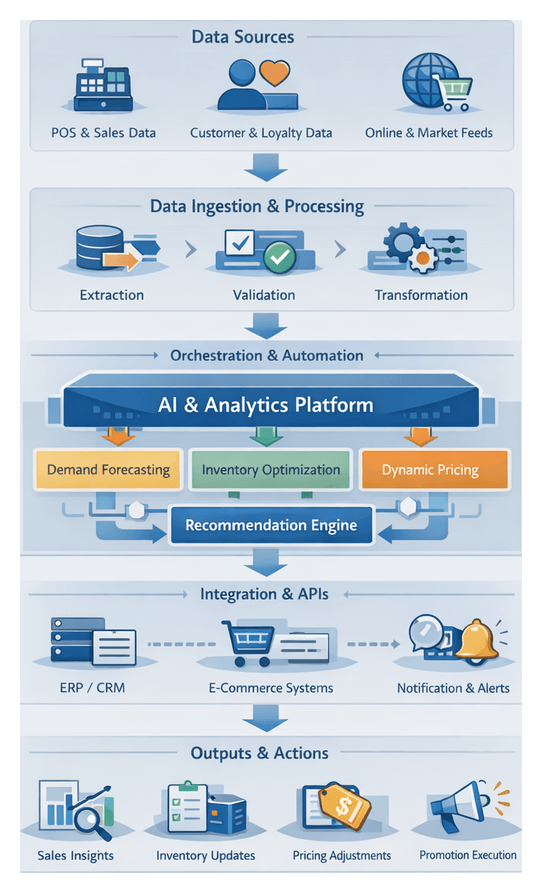
A unified workflow orchestrates data, insights and decisions across the retail sales ecosystem. Transactional, customer and inventory data flow into a centralized platform. AI agents then execute forecasting, optimization and recommendation tasks. Integration services validate outputs, route information to downstream systems or human actors and ensure transparency, speed and accuracy in delivering actionable intelligence to planning, operations and store teams.
Data Ingestion and Preprocessing
- Data Extraction: Change-data-capture connectors ingest records from POS terminals, e-commerce platforms and loyalty apps.
- Staging and Validation: Schema checkers verify format consistency; anomaly detection modules flag missing, duplicate or outlier records.
- Transformation and Enrichment: Scripts standardize units, apply currency conversions and append external attributes like regional economic indicators.
- Normalization and Loading: Cleaned, enriched records populate the unified data platform for downstream AI services.
AI Agent Orchestration and Scheduling
- Event-Driven Triggers and Time-Based Schedules: Pub/sub messages and calendars initiate AI workflows, such as daily demand forecasts.
- Dependency Management: Orchestration enforces data readiness checks before invoking inventory optimization or pricing models.
- Resource Allocation: Tasks run on compute clusters or cloud instances—Amazon SageMaker or Google Cloud AI—according to CPU, memory and GPU needs.
- Failure Handling: Automated retry policies and escalation workflows ensure rapid recovery and alert operators when needed.
System Actor Roles and Information Handoffs
- Data Engineers: Monitor pipelines, resolve validation errors and optimize storage schemas.
- Data Analysts: Validate AI model performance and provide contextual feedback.
- Inventory Planners: Adjust replenishment schedules based on demand forecasts.
- Merchandising Managers: Finalize dynamic pricing and promotion campaigns.
- Store Managers and Sales Associates: Access AI assistant insights on mobile or in-store tablets.
- IT Operations: Maintain integration health, manage API credentials and enforce security standards.
Model Retraining and Continuous Feedback
- Performance Monitoring: Dashboards track forecast accuracy, price elasticity responses and inventory turns.
- Error Analysis: Agents flag divergent predictions for root-cause investigation.
- Retraining Jobs: Updated datasets trigger automated pipelines on platforms like Salesforce Einstein.
- Validation Gates: A/B testing in controlled environments ensures only improved models go live.
Integration Layer and API Interactions
- RESTful Endpoints: Forecasting agents retrieve historical data; pricing engines push updates to e-commerce platforms.
- Message Queues: Low-stock alerts publish to topics consumed by order management and fulfillment systems.
- Microservices Architecture: Decoupled services handle inventory calculations, promotion checks and segmentation queries.
- Service Discovery: Dynamic registries ensure reliable service connectivity as instances scale.
Collaborative Review and Approval Gates
- Forecast Sign-Off: Planning teams review and adjust demand predictions.
- Pricing and Promotion Approval: Merchandising and legal teams vet dynamic price changes before publication.
- Inventory Allocation Confirmation: Regional operations managers confirm stock commitments.
Monitoring, Exception Handling and Resilience
- Real-Time Dashboards: Visualize throughput, latency and success rates for each workflow component.
- Anomaly Detection Agents: Identify unusual patterns—drops in data volume or error spikes.
- Automated Alerts and Escalation Policies: Notify teams via email, SMS or collaboration platforms; escalate persistent failures to executive dashboards.
- Auto-Scaling Compute and Multi-Region Deployments: Elastic infrastructure on cloud services ensures resilience during peak seasons.
- Disaster Recovery Plans: Regular data snapshots and infrastructure backups enable rapid restoration.
Human-AI Collaboration and Continuous Improvement
- AI-First Analysis: Agents handle high-volume tasks—price adjustments, reorder suggestions.
- Human-In-The-Loop Decisions: Strategic choices—campaign themes or regional assortments—remain under human control.
- Role-Based Dashboards: Tailored interfaces for store managers, planners and marketing leads.
- Feedback Channels: Store teams and analysts comment on AI outputs, providing business context for future model enhancements.
- Post-Event Reviews and Feature Engineering Workshops: Cross-functional teams analyze performance variances and refine predictor variables.
Core AI Components in the Retail Sales Solution
Advanced AI modules—forecasting agents, inventory optimization, dynamic pricing and in-store assistants—integrate with supporting systems to form a unified sales workflow. Each capability contributes distinct value, from demand prediction to personalized customer engagement.
Forecasting Agents
- Data Pipelines: Orchestrated via Apache Airflow or Azure Data Factory, these agents extract sales, traffic and weather data and apply feature engineering.
- Model Training: Services like Amazon Forecast or Microsoft Azure Machine Learning train ensembles of time-series and neural network models.
- Scenario Simulation: Monte Carlo analyses assess promotional impacts and supply disruptions, informing risk-adjusted forecasts.
- Delivery: Forecasts are served via APIs or message queues to inventory and pricing modules.
Inventory Optimization Models
- Safety Stock Calculations: Dynamic thresholds adjust to demand volatility.
- Replenishment Planning: Multi-echelon optimization in platforms like Blue Yonder Luminate or RELEX Solutions.
- Channel Allocation: Maximizes revenue by distributing stock across online, in-store and partner channels.
- Alerting and Exceptions: Low-stock notifications route to supply chain teams via collaboration tools.
Pricing Engines
- Competitive Intelligence: APIs or web scraping ingest competitor pricing data.
- Elasticity Modeling: Algorithms estimate demand sensitivity for personalized price optimization.
- Promotion Simulation: Scenario engines forecast margin impact; approval workflows integrate with ERP systems.
- Automated Deployment: Price updates and coupon offers push to POS, e-commerce and digital signage networks via standardized APIs.
- Leading Platforms: Pricefx and DynamicYield.
AI Assistants for Sales Associates
- Context Retrieval: IBM Watson Assistant or Salesforce Einstein surfaces customer profiles, purchase history and preferences.
- Recommendation Engines: Collaborative filtering and content-based models suggest complementary or higher-margin items.
- Inventory Lookup: Live availability across stores and fulfillment centers enables reservations and ship-to-home options.
- Task Automation and Coaching: Guides associates through upselling prompts and micro-learning modules.
Supporting Systems and Integration Layers
- Unified Data Platform: Cloud data lakes such as Databricks or Snowflake, and warehouses like Google BigQuery or Azure Synapse Analytics.
- Orchestration Engines: Apache Airflow or Prefect schedule tasks and manage dependencies.
- API Management and Service Mesh: Gateways secure access; meshes ensure reliable communication and observability.
- Monitoring and Logging: Centralized systems collect performance metrics, error traces and resource usage; anomaly detectors flag bottlenecks.
- Security and Compliance: Identity and access management, encryption in transit and at rest, and audit logging safeguard sensitive data.
Blueprint Outputs and Governance for Implementation
A comprehensive solution blueprint translates strategic objectives into actionable designs and artifacts. By defining architecture diagrams, data flow maps, component specifications and dependency matrices early, cross-functional teams share a single source of truth that accelerates development, testing and deployment.
Architectural Artifacts and Documentation
- Solution Blueprint Diagram: Layered visuals of ingestion pipelines, the unified data platform, AI orchestration layer (Apache Airflow or Kubeflow), and connectors to CRM, ERP and POS.
- Component Specifications: API definitions, authentication methods, message queue topics (Amazon Kinesis or Apache Kafka), data retention policies and model performance targets.
- Data Flow Maps: Tabular and graphical representations of extract-transform-load processes, annotated with quality checks and business logic rules.
- Integration Interface Definitions: Catalogue of REST endpoints, webhooks to CRM platforms like Salesforce, batch file formats and streaming schemas.
Dependency Mapping
- Data Source Dependencies: POS systems, ERP feeds and external market providers with SLAs and access credentials.
- Compute and Storage Dependencies: Cloud services—Amazon SageMaker or Azure Machine Learning—and container platforms like Kubernetes; data lake, warehouse and feature store requirements.
- AI Model Dependencies: Sequencing of training—for example, demand forecasting precedes inventory optimization and pricing simulations.
- Operational Dependency Graphs: Workflow tasks from data ingestion through AI inference to reporting.
Handoff to Development and Deployment Teams
- Artifact Repository Publication: Centralized storage in Git or documentation portals with controlled access.
- Design Review Sessions: Workshops with architects, engineers, data scientists and operations leads to confirm decisions, resolve issues and assign ownership.
- Implementation Roadmap: Phased milestones—data platform provisioning, model training pipeline deployment, integration testing and operational readiness.
- Deployment Playbooks: Infrastructure as Code templates (for example Terraform), CI/CD pipeline definitions, rollback procedures and validation checks.
Governance and Continuous Alignment
- Architecture Review Board: Periodic assessments of proposed changes and impact on downstream workflows.
- Configuration Management: Version control for diagrams, specifications and interface definitions.
- Continuous Feedback Loops: Post-pilot learnings and operational monitoring insights feed back into blueprint updates.
Chapter 1: Defining Sales Performance Objectives
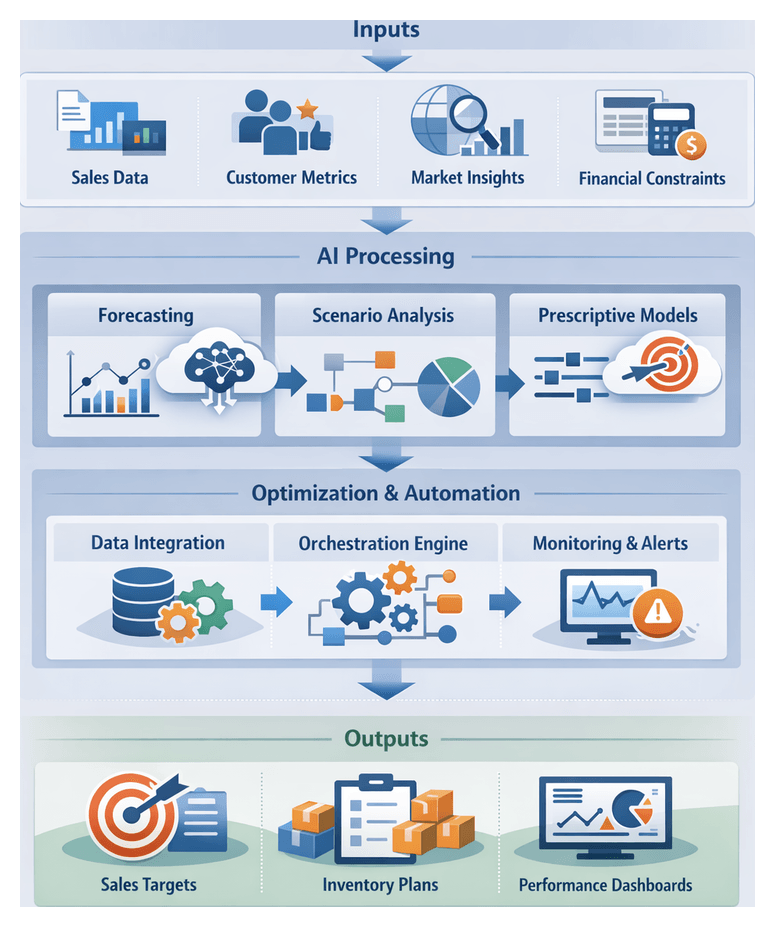
Establishing clear, measurable sales performance objectives is the strategic cornerstone of any AI-orchestrated retail workflow. By translating corporate goals into precise revenue milestones, customer satisfaction targets and operational efficiency indicators, organizations align executive leadership, sales operations, finance, marketing and technology teams around a unified vision. This clarity ensures that downstream AI components—demand forecasting agents, inventory optimization models, pricing engines and sales assistants—operate against a shared success framework. In the absence of well-defined objectives, automated processes risk misalignment, wasted resources and inconsistent customer experiences.
In today’s dynamic retail environment—characterized by rapid market shifts and evolving customer expectations—the objectives stage acts as a nexus between strategic intent and operational execution. It informs the design of data pipelines, machine learning configurations and AI agent orchestration. Investing time in this phase creates a transparent foundation for decision making, resource prioritization and continuous performance tracking.
Several industry-specialized platforms accelerate alignment and model configuration. For example, AI-driven solutions embed best-practice objective frameworks for revenue simulation, satisfaction forecasting and KPI tracking, while allowing customization to unique business needs.
Key Inputs, Prerequisites and Governance Conditions
Data Inputs
- Historical Sales Data: Transaction records by channel, region, product category and time period enable trend analysis, seasonality detection and variance decomposition.
- Customer Experience Metrics: Net Promoter Scores, satisfaction surveys, repeat purchase rates and average order values deliver quantitative and qualitative insights that balance growth with loyalty.
- Operational Performance Indicators: Fulfillment lead times, stock-out frequency, days of inventory on hand and order accuracy rates establish baseline efficiency benchmarks.
- Market and Competitive Intelligence: External forecasts, competitor pricing indices and macroeconomic indicators contextualize internal targets.
- Financial Constraints: Budget allocations for marketing, promotions, inventory investment and staffing guide objectives toward healthy top-line growth and profitability.
Organizational Prerequisites
- Executive Sponsorship and Governance: C-suite commitment and a cross-functional steering committee ensure ongoing oversight and accountability.
- Stakeholder Alignment Sessions: Structured workshops capture diverse perspectives, surface conflicts and build consensus on priority metrics.
- Data Ownership and Access Policies: Agreements on stewardship, access controls and privacy compliance align teams on data quality and usage constraints.
- Technology Infrastructure Readiness: A modern data platform or cloud-native warehouse with validated connectivity to point-of-sale systems, CRM platforms and external feeds.
- Change Management Framework: Communication plans, training curricula and feedback loops prepare the organization for AI-orchestrated performance measures.
Environmental Conditions and Governance
- Regulatory Compliance: Local regulations on pricing transparency, data usage and promotional disclosures must be integrated into objective definitions.
- Data Quality Standards: Profiling exercises confirm inputs meet accuracy, completeness and timeliness thresholds, with remediation plans for gaps.
- Baseline Performance Review: Analyzing prior results—successes, shortfalls and root causes—identifies where AI automation can deliver the greatest impact.
- Risk Assessment and Mitigation: Cataloging potential obstacles—supply chain disruptions, market shifts or integration delays—with contingency strategies ensures objectives are ambitious yet achievable.
- Governance Cadence: Weekly dashboards, monthly executive briefs and quarterly checkpoints create transparency and facilitate course corrections.
Stakeholder Alignment Workflow
Initiation and Collaboration Setup
The alignment process begins with a project sponsor convening a core team of subject matter experts from marketing, finance, operations, sales and IT. This team defines scope, timeline and communication cadence. Key activities include:
- Identifying department leads and contributors for revenue, margin and operational inputs.
- Establishing a unified collaboration platform, such as Slack or Microsoft Teams, to centralize discussion, document sharing and decision logs.
- Configuring automated notifications and reminders for timely review and workshop attendance.
- Deploying a shared repository—like Atlassian Confluence—for agendas, templates and working drafts.
Data and Requirements Gathering
Using predefined templates, teams submit historical revenue breakdowns, campaign performance summaries, lead time statistics and regional quota histories. AI-powered document intelligence tools ingest spreadsheets and presentations, extract key metrics and generate executive summaries that highlight anomalies and trends. Deliverables include a consolidated data dossier, gap analysis report and a dependency matrix mapping objectives to data sources and responsible teams.
Cross-Functional Workshops and Consensus Building
Workshops follow a structured agenda:
- Presentation of aggregated metrics and draft objectives.
- Breakout discussions by function to assess feasibility and risks.
- Plenary session to report findings and propose revisions.
- Real-time objective adjustment with collaborative editing.
- AI-driven sentiment analysis to detect unresolved concerns and assign follow-up tasks.
Conflict resolution employs decision matrices, AI-assisted negotiation tools and impact simulations—powered by platforms such as Amazon Forecast—to visualize trade-offs between cost, revenue and service levels. Executive escalation paths secure sponsor endorsement when needed.
Validation, Sign-Off and Handoffs
Finalized objectives are circulated for digital signatures or electronic acknowledgments. A dependency map links each objective to downstream workflows in the data platform and forecasting models. Approved targets are published to shared dashboards, ensuring transparency. Handoff tasks include:
- Uploading objectives and metric definitions to the centralized data warehouse.
- Configuring data feeds that merge targets with historical transactions, customer profiles and inventory records.
- Triggering scheduled workflows in orchestration engines that initiate demand forecasting runs.
- Tagging forecast outputs with objective identifiers for variance analysis.
AI-Driven Capabilities and Supporting Systems
An AI-orchestrated objective-setting workflow integrates advanced analytics methods and robust architectural components to transform raw data into adaptive goals and continuous performance insights.
Core AI Capabilities
- Predictive Modeling: Time-series and regression algorithms forecast sales, traffic and margin metrics based on historical data, seasonality and market indicators.
- Scenario Simulation: Monte Carlo and what-if analyses generate outcome ranges under various pricing, assortment and spend configurations.
- Prescriptive Optimization: Constraint-based engines—such as DataRobot Decision AI—recommend target settings that maximize revenue or profit within service and capacity limits.
- Anomaly Detection: Unsupervised learning monitors performance deviations to flag emerging risks or opportunities.
- Natural Language Generation: Automated narrative summaries translate complex analytics into executive-friendly insights.
- Unified Data Platform: Consolidates point-of-sale records, inventory levels, customer profiles, marketing spend and external indicators into a centralized repository with consistent schemas and real-time access.
- Forecasting Agents: Automated services—such as Amazon Forecast and Azure Machine Learning—that generate baseline demand projections.
- Prescriptive Analytics Engine: Platforms like DataRobot ingest forecasts, inventory policies and financial objectives to recommend optimal targets.
- Orchestration Layer: Workflow management services schedule data ingestion, trigger model runs, manage dependencies and ensure end-to-end reliability.
- Visualization and Monitoring Tools: Dashboards in Microsoft Power BI and Tableau present recommended objectives, scenario comparisons and real-time performance against targets.
Integrated Workflow Stages
- Data Aggregation and Validation: The unified platform ingests sales, inventory and market feeds. ML-based data quality agents detect anomalies and trigger cleansing routines.
- Baseline Forecast Generation: Forecasting agents produce SKU- and store-level projections that inform target calculations.
- Scenario Analysis and Recommendation: The prescriptive engine simulates pricing, promotional and supply scenarios to propose balanced objectives.
- Stakeholder Review and Adjustment: Interactive dashboards and NLG summaries highlight trade-offs for cross-functional review and manual refinement.
- Target Publication and Scheduling: Approved objectives are published to the data platform and downstream systems, with orchestration services scheduling daily progress checks and alerts for threshold breaches.
Key Deliverables, Governance and Handoffs
Primary Deliverables
- Performance Objective Document: Formal specification of revenue targets, satisfaction scores, conversion thresholds and efficiency metrics, complete with units, horizons and tolerance bands.
- KPI Catalog and Metadata Schema: Definitions, data source mappings, calculation formulas and update frequencies, enabling automated ingestion and normalization.
- Dependency Matrix: Mapping of inputs, outputs and responsible parties with data formats, delivery cadences and approval owners.
- Stakeholder RACI Chart: Roles and responsibilities for marketing, finance, operations, IT, analytics and executive oversight.
- Dashboard Prototype: Wireframes for executive and operational dashboards specifying chart types, filters, alerts and drill-down paths.
- Data Requirements Specification: Field definitions, source references, quality criteria and transformation rules for each KPI.
Stakeholder Ecosystem and Interdependencies
Core functional domains and their contributions:
- Marketing: Campaign schedules, target segments and customer lifetime value assumptions.
- Finance: Profit margins, cost forecasts and pricing assumptions.
- Operations: Throughput capacity, fulfillment metrics and labor productivity data.
- IT and Data Engineering: Platform capabilities, data access protocols and integration standards.
- Analytics and Modeling: KPI validation, data quality assessments and forecast model alignment.
- Executive Steering Committee: Final endorsement, trade-off arbitration and approval for downstream handoffs.
Handoff Mechanisms and Automation
- Shared Specification Repository: Version-controlled storage in Atlassian Confluence for traceable document access.
- API-Driven Metadata Injection: RESTful endpoints import KPI definitions into the data platform’s metadata service for lineage and dashboard templating.
- Forecasting Agent Configuration Package: A JSON/YAML bundle of targets, seasonality adjustments and scenario parameters published to the orchestration layer.
- Automated Notifications: Email and collaboration-platform alerts with links to updated artifacts and change logs.
- Integration Tickets: Automated creation of Jira issues to track data pipeline tasks, model adjustments and dashboard builds.
Governance and Version Control
- Checkpoint Reviews: Scheduled domain-owner approvals documented in steering committee minutes.
- Semantic Versioning: Major and minor version numbers for structural changes and parameter tweaks.
- Audit Logging: Timestamped, attributed modifications retained for compliance and traceability.
- Approval Workflows: Automated routing of change requests through designated approvers.
- Rollback Procedures: Defined steps to revert to prior versions in case of errors.
Preparing Systems for Downstream Integration
- Data Model Alignment: Extending canonical schemas and ingestion pipelines to include new KPI fields and metadata.
- API Contract Definition: Publishing OpenAPI or AsyncAPI specifications for forecasting agent endpoints.
- Metadata Tagging: Cataloging KPIs, data sources and dependencies with business glossaries and sensitivity labels.
- Security and Access Controls: Role-based permissions and logging for objective definitions and orchestration triggers.
- Environment Configuration: Provisioning development, staging and production environments with Infrastructure as Code.
- Automated Testing and Validation: CI pipelines verifying KPI calculations, data transformations and API responses against specifications.
By rigorously defining objectives, aligning stakeholders, embedding AI capabilities and delivering structured artifacts with automated handoff mechanisms, retail organizations lay the groundwork for seamless integration with unified data platforms and forecasting agents. This precision at the objective-setting stage accelerates deployment, reduces rework and ensures that all downstream systems operate in concert to achieve defined sales performance goals.
Chapter 2: Building a Unified Data Platform
Purpose and Scope of the Data Aggregation Stage
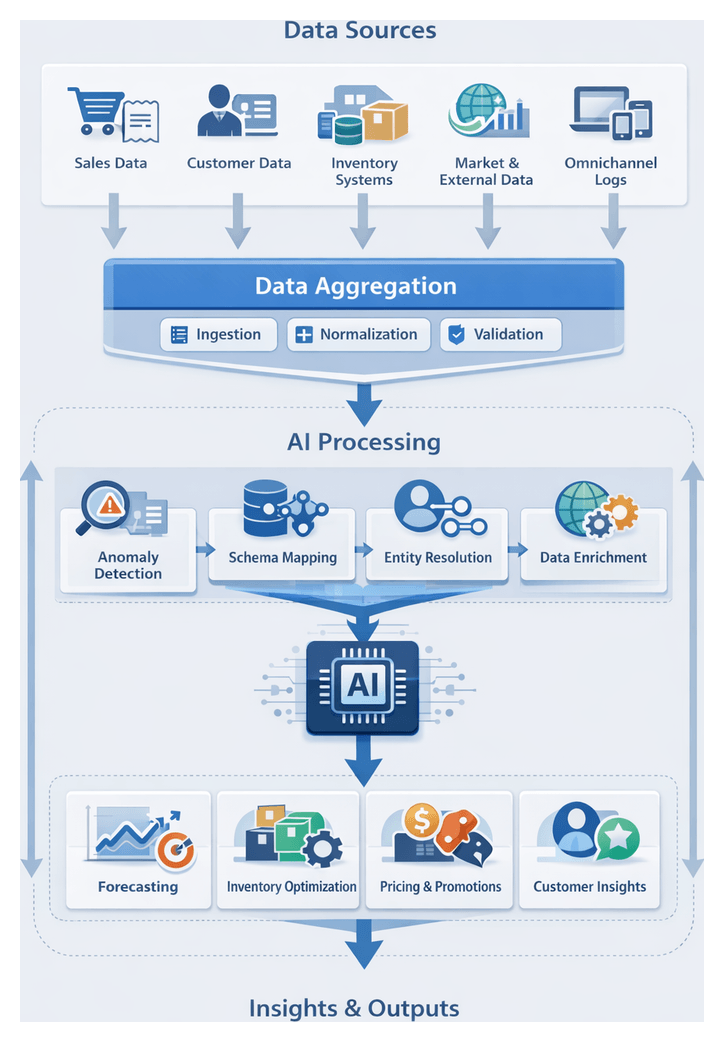
The Data Aggregation stage establishes a unified foundation for all downstream retail analytics, forecasting, and automation workflows. Diverse streams—from point-of-sale transactions to customer loyalty records—are systematically collected, standardized into a common schema, and aligned for real-time accessibility. This centralized repository resolves fragmentation across channels, enforces data governance, and validates completeness and accuracy before feeding AI agents. Without this robust framework, forecasting accuracy, inventory optimization, dynamic pricing, and personalized engagement suffer from inconsistent inputs, undermining decision confidence and customer experiences.
- Standardize heterogeneous inputs—POS, CRM, ERP, external feeds—into a query-ready repository
- Define data ownership, governance roles, and cataloging standards via metadata tools
- Validate ingestion success, schema conformity, and freshness SLAs
- Support real-time and batch feeds to match latency requirements
Core Data Sources and Technical Prerequisites
Retail organizations integrate multiple systems to create a 360° view of operations and customers:
- Transactional Sales: Point-of-sale and e-commerce platforms, including Shopify and Oracle Retail Xstore, must stream purchase events or deliver scheduled extracts.
- Customer Relationship Management: Platforms such as Salesforce CRM supply loyalty tiers, demographics, and engagement histories for personalization and segmentation.
- Inventory and Supply Chain: ERP and warehouse solutions—SAP S/4HANA, Oracle NetSuite—provide stock levels, lead times, safety thresholds, and replenishment rules.
- External Market Indicators: Economic metrics, competitor pricing and local event calendars via APIs like Quandl or subscription feeds augment internal data with context.
- Omnichannel Engagement Logs: Web sessions, mobile interactions, call-center logs and social media touchpoints require event hubs or change data capture for low-latency ingestion.
Key technical conditions include:
- Data governance framework and metadata cataloging—e.g., Collibra
- Compliance with PCI DSS, GDPR/CCPA, secure transfer (TLS), encryption at rest and role-based access
- Provisioned cloud warehouses—Snowflake, Google BigQuery, Azure Synapse Analytics
- API credentials and service accounts for ETL/ELT tools—Fivetran, Talend
- Agreed canonical entity definitions and schema registry for validation
Data Ingestion and Normalization Workflow
The ingestion and normalization workflow bridges raw inputs and the unified platform, ensuring consistency, accuracy, and readiness for AI-driven agents. The process orchestrates extraction, staging, transformation, validation, and loading into curated zones, leveraging both batch and streaming methodologies based on latency needs.
Actors and Infrastructure
Coordination spans source system owners, data engineering teams, integration platforms, streaming infrastructure, storage layers, monitoring services, and AI quality agents. Key tools include:
- ETL/ELT and orchestration: Apache NiFi, Informatica, Azure Data Factory, AWS Glue, Apache Airflow
- Streaming: Apache Kafka, AWS Kinesis
- Storage: Databricks, Snowflake, Hadoop clusters
- Monitoring: Prometheus, Grafana, cloud-native dashboards
- AI Quality Agents: anomaly detection, schema adherence checks, enrichment triggers
Ingestion Patterns
- Batch Ingestion: Hourly to daily extracts for historical loads, reconciliation and bulk updates, scheduled via orchestrators.
- Streaming Ingestion: Real-time capture of transactions and events using CDC connectors, supporting dynamic pricing and replenishment alerts.
- Hybrid Approaches: Streaming deltas for freshness, full batch extracts off-peak for reconciliation, balancing resource use and completeness.
Workflow Phases
- Source registration in metadata catalog and initial schema harvesting
- Connection setup with encrypted credentials and bulk landing zone extract
- Incremental streaming via Kafka or Kinesis with raw event staging
- Schema evolution handling through registry services and automated updates
- Normalization: canonical model alignment, date/time conversion, unit and currency standardization, enumeration mapping
- Deduplication and record matching using fuzzy and probabilistic algorithms
- Enrichment: geolocation, demographic segments, third-party market trends, AI inferrals
- Validation and quality checks: completeness, referential integrity, range checks, anomaly flagging
- Loading into curated zones in the data lake or warehouse with partitioning and indexing
- Audit logging and lineage tracking for traceability and compliance
Error Handling and Monitoring
- Retry strategies with exponential backoff for transient failures
- Dead-letter queues for exception routing and steward review
- Real-time dashboards displaying latency, throughput and error metrics
- Alerting via email, Slack or Teams when SLAs are breached or volumes deviate
AI-Driven Data Quality and Integration
AI capabilities automate detection and resolution of data inconsistencies, accelerate source onboarding, and enforce continuous governance. Embedded at pre-ingestion, schema mapping, entity resolution, pipeline orchestration, and monitoring stages, AI reduces manual cleansing by up to 80 percent and ensures downstream agents operate on high-fidelity data.
Pre-Ingestion Validation and Anomaly Detection
Supervised and unsupervised models flag unusual patterns—spikes in returns, negative prices, missing IDs—quarantining suspect batches within ETL tools such as Talend and generating alerts for rapid resolution. Core techniques include clustering, time-series reconstruction, auto-encoders, and feedback loops that refine thresholds.
Automated Schema Mapping
Natural language processing and statistical profiling speed schema alignment within metadata catalogs like Collibra. AI suggests field mappings, generates ETL recipes, handles unit conversions and maintains versioned lineage for audit. Semantic similarity algorithms and user-friendly interfaces enable rapid manual overrides when needed.
Entity Resolution and Enrichment
Graph algorithms and probabilistic matching unify duplicate customer profiles and product identifiers. Real-time enrichment uses APIs and machine learning scrapers to augment records with competitor prices, attribute details, and demographic data. Platforms like Great Expectations embed validation and enrichment, assigning confidence scores for manual review of low-certainty merges.
AI-Enhanced Pipeline Orchestration
Workflow engines—AWS Glue, Azure Data Factory—use AI modules to auto-scale compute, parallelize transformations, and prefetch external feeds. Event-driven architectures connect Kafka streams to model serving platforms such as DataRobot and Amazon SageMaker, enabling on-the-fly predictive scoring within data flows.
Continuous Monitoring and Feedback Loops
AI agents track data health indicators—completeness, accuracy, timeliness—and detect drift in source profiles. Automated tickets in governance platforms, root cause analysis via causal inference, and self-healing scripts correct minor mismatches. Feedback from forecasting accuracy, inventory optimization results, and pricing performance refines validation rules and anomaly detectors over time.
Consolidated Data Output and System Interfaces
The unified platform delivers curated data products to AI workflows and business applications via standardized schemas, metadata conventions, and flexible interfaces. This ensures forecasting agents, inventory models, pricing engines, and AI assistants receive timely, reliable inputs through well-defined handoffs.
Key Data Artifacts
- Cleaned transactional tables reconciled across channels
- Master customer profiles with unified identifiers, loyalty tiers, consent metadata
- Normalized inventory and product catalogs featuring SKUs, stock levels, lead times
- Feature store tables with precomputed demand and pricing indicators
- Metadata repository containing schema definitions, lineage and quality scorecards
Interface Patterns
- RESTful APIs for on-demand queries with OAuth 2.0 authentication
- SQL endpoints on Snowflake and Databricks Lakehouse for ad hoc analytics and batch exports
- Real-time event streams via Apache Kafka topics for low-latency updates
- Scheduled exports in CSV, Parquet or ORC to object storage with webhook or email notifications
Handoff and Orchestration
- Completion triggers from orchestration engines launch downstream forecasting and replenishment jobs
- Dependency mapping verifies dataset freshness, schema version and access rights
- Policy enforcement restricts sensitive fields, enforces retention and logs usage
- Notifications to stakeholders via email, Slack or Microsoft Teams upon updates or failures
Governance and Observability
- Lineage tracking across all transformation steps for traceability
- Performance metrics—latency, success rates, response times—monitored with AI anomaly detectors
- Comprehensive audit logs capturing schema changes, access events, orchestration actions
- Feedback loops enabling consumer teams to submit quality tickets and request schema enhancements
Best Practices for Scalable Outputs
- Define SLAs for freshness, accuracy and availability aligned to AI requirements
- Version output schemas and maintain backward compatibility
- Automate regression tests validating content and interface performance
- Adopt consumer-driven contract testing to prevent disruptions
- Decouple transformation logic from delivery layers for independent scaling
Chapter 3: Implementing AI Agents for Demand Forecasting
Forecasting Stage Objectives and Data Foundations
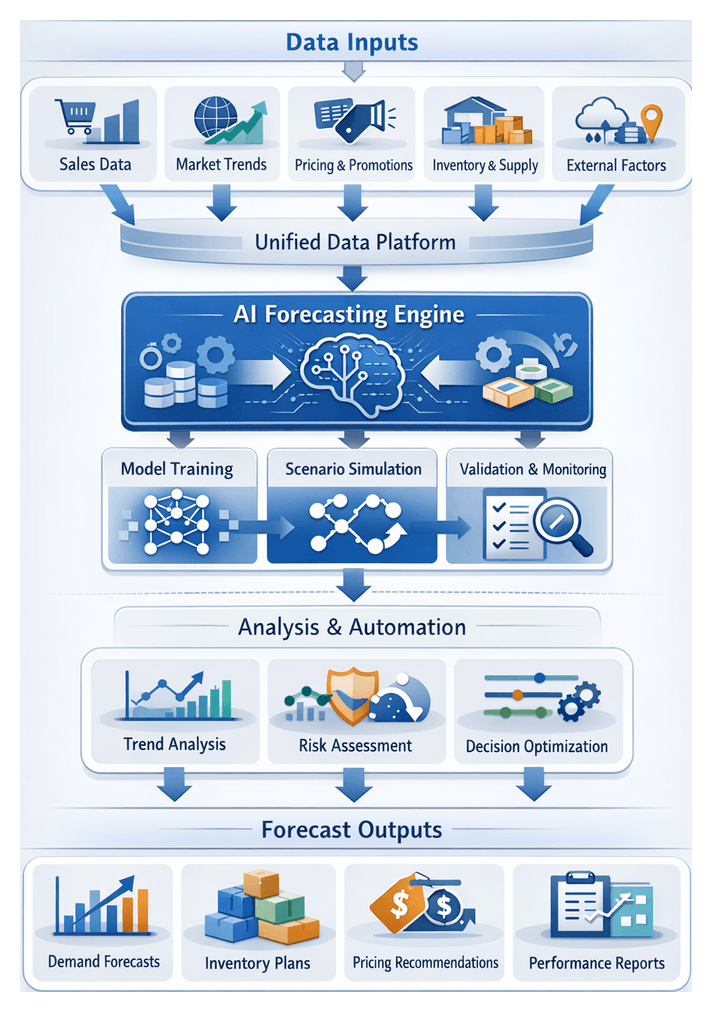
Accurate demand forecasting underpins effective inventory management, pricing strategies, promotional planning and workforce allocation in retail. The forecasting stage transforms historical transactions and contextual signals into quantitative and qualitative demand estimates, aligning cross-functional teams around common goals and enabling data-driven decision making. Key objectives include:
- Short-Term Demand Prediction: Daily and weekly sales forecasts to guide replenishment cycles and allocate stock across brick-and-mortar and e-commerce channels.
- Seasonal and Event-Driven Projections: Anticipation of demand fluctuations tied to holidays, promotions, weather events and local market activities.
- New Product Introduction Forecasts: Estimation of sell-through rates for newly launched SKUs using analogous item data and category trends.
- Channel-Level Segmentation: Separate forecasts for in-store, mobile and online channels to tailor inventory and marketing tactics.
- Risk and Uncertainty Quantification: Confidence intervals and probability distributions to support safety-stock calculations and scenario planning.
Deliverables from this stage comprise:
- Point Forecasts and Prediction Intervals for each SKU, store location and time horizon.
- Scenario Analyses under alternative assumptions—promotional spend, competitor actions or supply disruptions.
- Trend and Seasonality Components isolating recurring patterns and long-term shifts.
- Model Performance Reports measuring MAPE, RMSE, bias and service-level adherence.
- Narrative Insights explaining anomalies, emerging trends and potential drivers of demand changes.
Achieving reliable forecasts requires assembling comprehensive data inputs:
- Historical Sales Records: Transaction-level data, returns, promotions and price points.
- Promotional and Marketing Calendars: Campaign schedules, advertising spend and coupon distributions.
- Pricing and Competitive Intelligence: Historical prices, competitor pricing feeds and elasticity parameters.
- Inventory and Supply Chain Signals: On-hand stock levels, lead times, supplier metrics and distribution throughput.
- External Market Indicators: Economic data, weather patterns, local events and social media sentiment.
- Store and Channel Attributes: Footprint, customer demographics, online traffic metrics and conversion rates.
Data quality prerequisites include completeness, consistency, recency, accuracy, traceability and scalability. Organizations must integrate inputs from legacy point-of-sale systems, marketing platforms, ERPs and external feeds into a unified data repository—such as a centralized data lake or warehouse—with automated ETL/ELT pipelines managed by tools like AWS Glue or Apache Airflow. Robust governance frameworks, incorporating data profiling and anomaly detection agents, ensure ongoing adherence to quality standards.
Technical and organizational foundations encompass:
- Compute Infrastructure: GPU-enabled clusters or cloud services via AWS SageMaker and Azure Machine Learning for model training and inference.
- Orchestration Layer: Workflow engines such as Apache Airflow or Prefect to coordinate data ingestion, model execution and result delivery.
- API Management: Gateways like Amazon API Gateway or Apigee to expose forecasting services securely to downstream consumers.
- Cross-Functional Collaboration: Clear roles for data engineers, MLOps specialists, data scientists, demand planners and IT operations under a governance framework defining access controls, explainability requirements and retraining cadences.
Model training conditions demand sufficient historical depth (one to two years), aligned temporal granularity, outlier handling processes, engineered features (moving averages, holiday flags, elasticities), cross-validation strategies and scheduled retraining intervals. Establishing quantitative performance criteria—MAPE, RMSE, bias, service-level adherence and lead-time error—is essential for continuous monitoring and trust in automated forecasts.
Forecasting Agent Workflow and Orchestration
The forecasting agent workflow operationalizes demand prediction through a coordinated sequence of automated processes and human oversight. Key stages include:
Data Retrieval, Validation and Staging
- Scheduled Extraction: Orchestration jobs query the unified data platform nightly for historical sales, promotions and external indicators.
- Schema Validation: AI-driven data quality agents verify field types, missing values and anomalies, triggering alerts via ticketing or collaboration tools.
- Normalization and Enrichment: Transformation scripts align timestamps, geocode locations and enrich customer segments using machine learning clusters.
- Staging: Clean datasets are deposited into model staging areas accessible through secure API endpoints.
Model Execution Coordination
- Dependency Resolution: The orchestrator ensures data ingestion, quality checks and metadata updates are complete.
- Resource Allocation: Compute instances—from on-prem GPU nodes to cloud platforms—are provisioned based on model complexity and data volume.
- Task Dispatch: Containerized model runs receive configuration parameters—training window, seasonal adjustments and feature sets.
- Parallel Scenario Simulation: Concurrent executions produce baseline forecasts, promotional uplift analyses and real-world event simulations.
Training Pipeline and Version Management
- Configuration Retrieval: Hyperparameters and feature definitions are managed in registries like MLflow or Git repositories.
- Data Sampling: Modules select training, validation and test sets to balance recent trends with historical variability.
- Model Training: Time-series algorithms—ARIMA, LSTM networks or gradient-boosted trees—train on prepared data, logging performance metrics.
- Validation and Selection: Automated services compare candidate models, promoting the best performer to inference and archiving others for lineage.
- Artifact Storage: Serialized pipelines and transformation scripts are stored in artifact repositories with version tags linking code and data.
Forecast Generation and Quality Assurance
- Threshold Validation: Automated checks compare forecasts against historical bounds and business rules, flagging extremes.
- Residual Analysis: Scripts compute residual distributions to detect biases or mismatches.
- Human-in-the-Loop Review: Demand planners receive alerts for manual investigation and adjustments.
- Publishing: Approved forecasts are committed to forecast databases and exposed via APIs to inventory and pricing systems.
Error Handling, Monitoring and Feedback Loops
- Centralized Logging: Workflow logs are aggregated into platforms like Datadog or the ELK Stack.
- Alert Rules and Automatic Retries: Monitoring agents track failures and data latency, triggering retries or notifications.
- Performance Monitoring: Real-time sales data is compared against forecasts, with deviations recorded for root-cause analysis.
- Adaptive Retraining: Workflows initiate retraining when error thresholds are breached, incorporating new ground-truth data.
- Governance Reviews: Periodic stakeholder meetings assess performance metrics, feature efficacy and process improvements.
Roles and Responsibilities
- Data Engineers: Build and maintain data pipelines, enforce quality standards and manage schemas.
- MLOps Specialists: Oversee orchestration services, container environments and artifact repositories.
- Data Scientists: Develop forecasting experiments, select algorithms and validate performance.
- Demand Planners: Review forecasts, conduct scenario analyses and provide feedback for model refinement.
- IT Operations: Monitor infrastructure health, ensure security compliance and resolve capacity issues.
Core AI Components in the Retail Sales Workflow
A harmonized retail AI ecosystem integrates forecasting agents with inventory optimization models, dynamic pricing engines and AI-powered sales assistants, all supported by unified data platforms and orchestration layers. Key components include:
Demand Forecasting Agents
These agents fuse point-of-sale data, ERP records and external feeds to generate probabilistic demand predictions using time-series models like ARIMA, LSTM networks and Prophet. They detect anomalies, run scenario simulations and self-calibrate as new data arrives by leveraging platforms such as Amazon Forecast and Google Cloud AI Platform.
Inventory Optimization Models
These models convert forecasts into replenishment quantities and safety-stock levels across multi-echelon supply networks. They adjust dynamically for demand variability and lead-time uncertainty, prioritize channel allocations, and trigger real-time reorder events. Cloud-native solutions include the Blue Yonder Luminate Platform and Oracle Inventory Management.
Dynamic Pricing Engines
Leveraging real-time inventory positions, competitor prices and demand elasticity models, pricing engines recommend optimal price points and discount strategies. They incorporate competitive intelligence, promotion lift analyses and business guardrails, delivering updates to e-commerce sites and POS systems. Platforms such as Pricefx and SAP CPQ automate price workflows with audit trails and version control.
AI-Powered Sales Assistants
Embedded in mobile apps and CRM platforms, AI assistants analyze customer profiles, purchase history and real-time inventory to suggest personalized recommendations, upsell prompts and stock availability alerts. Conversational interfaces powered by natural language processing streamline product discovery. Retailers leverage Salesforce Einstein and Microsoft Power Virtual Agents to enable data-driven customer interactions.
Supporting Infrastructure and Orchestration
- Unified Data Platforms aggregating POS records, customer data and external feeds into a single source of truth.
- Event Streaming and ETL Pipelines using Confluent, Apache Kafka and AWS Glue.
- Workflow Engines such as Apache Airflow or Prefect for scheduling and dependency management.
- API Management for secure access via gateways like Amazon API Gateway.
- Monitoring and Logging with platforms such as Datadog to track performance and system health.
By encapsulating each AI capability behind microservices and orchestrating tasks through event-driven architectures, retailers achieve end-to-end visibility, modular scalability and rapid innovation. Real-time feedback loops ensure actual sales and customer responses continuously refine forecasting and pricing models.
Forecast Outputs, Integration and Governance
The forecasting stage produces structured outputs and integration points that feed downstream systems in inventory, pricing, supply chain and sales enablement.
Outputs and Dependencies
- Quantitative Forecasts: Point estimates, prediction intervals, scenario series and decomposed trend components.
- Qualitative Reports: Accuracy metrics (MAPE, RMSE), anomaly explanations and trend narratives.
- Downstream Consumers: Inventory optimizers, pricing engines, merchandising dashboards, ERP replenishment systems and AI sales assistants.
Integration Mechanisms
- Scheduled Pipelines: ETL jobs managed by Azure Data Factory or Apache Airflow deliver forecasts to data warehouses.
- RESTful APIs: On-demand query endpoints secured by API gateways return JSON payloads with forecast details.
- Event-Driven Messaging: Forecast updates published to queues and topics via Amazon SQS, AWS Kinesis or Apache Kafka.
- Data Streaming: Platforms like Apache Flink process sub-hourly inputs and emit incremental forecast deltas.
Governance and Version Control
- Model Registry Integration: Cataloging versions, hyperparameters and training datasets in registries like MLflow.
- Output Tagging: Embedding model version and timestamp in each record for traceability.
- Monitoring Dashboards: Tracking model drift, input distribution changes and performance alerts.
Best Practices and Quality Assurance
- Standardize Forecast Schemas with fields for SKU, location, timestamp, point estimate and prediction bounds.
- Implement End-to-End Monitoring of forecast latency and consumption with alerting for failures.
- Enforce Contract Testing to validate downstream parsing of forecast payloads.
- Document Data Contracts and Refresh Cadences for each dependent system.
- Align Model Retraining Schedules with Inventory and Pricing Planning Cycles.
Example Integration Scenario
- Daily forecast files written to a Snowflake data lake trigger an event in Amazon S3.
- An AWS Lambda function publishes messages to an SQS queue named “DailyForecastUpdates”.
- The Blue Yonder Luminate Platform ingests updates to recalibrate safety stocks and generate replenishment proposals.
- Simultaneously, the pricing engine queries the forecasting REST API ahead of the weekly markdown cycle.
- A Tableau dashboard retrieves forecast data via JDBC for regional planning meetings.
Continuous Feedback and Improvement
- Automated Sales Data Ingestion routes POS and depletion data back into the forecasting pipeline for retraining.
- Error Attribution modules correlate forecast accuracy with business outcomes like promotional uplift and stockout rates.
- Adaptive Retraining Triggers launch model updates when error thresholds are exceeded.
By ensuring rigorous data governance, defined integration patterns and closed-loop feedback mechanisms, the forecasting stage becomes the linchpin of an AI-orchestrated retail workflow—enabling synchronized, data-driven decisions across inventory, pricing and sales operations.
Chapter 4: Integrating AI Agents into Inventory Workflows
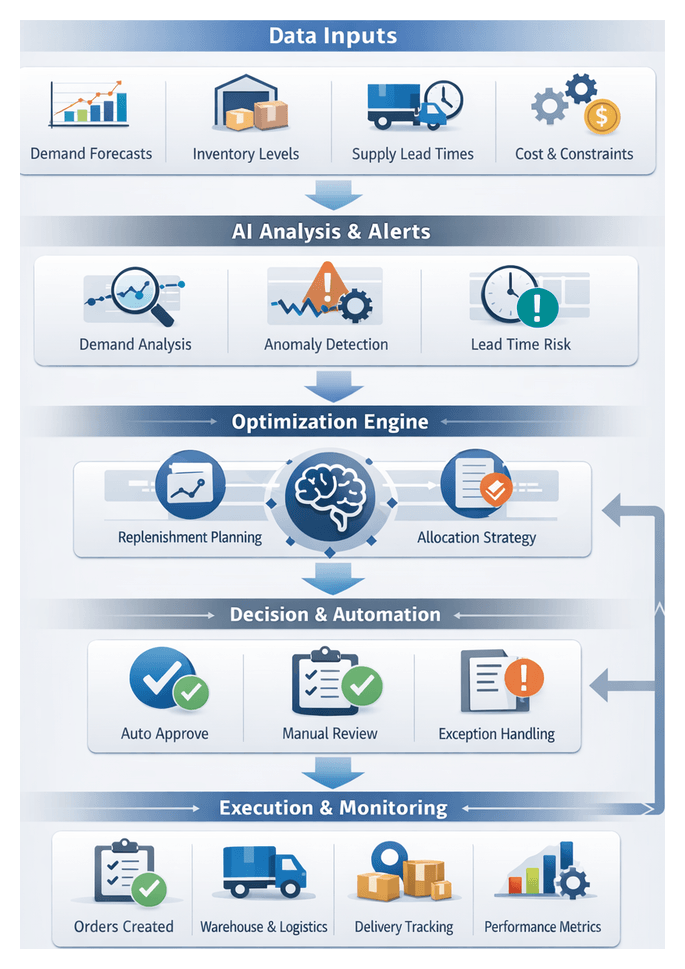
Purpose and Significance of Inventory Optimization
Inventory optimization is the pivotal stage where demand forecasts, operational constraints, and business objectives converge to guide stock distribution and replenishment decisions. In a modern retail environment marked by diverse sales channels, fluctuating consumer demand, and complex supply networks, manual inventory management falls short. AI-driven optimization ensures that each product is available at the right location, in the right quantity, at the right time, while minimizing carrying costs and mitigating stockout risks.
By translating predictive insights into actionable allocation plans and replenishment orders, the system dynamically adjusts stock levels across warehouses, distribution centers, and retail outlets. This proactive approach supports consistent customer experiences, reduces overstock and obsolescence, and aligns inventory investments with expected sales performance, ultimately protecting margins and enhancing operational resilience.
- Balance service levels and carrying costs with optimal stock buffers across channels
- Leverage demand forecasts to trigger timely replenishment and prevent stockouts
- Dynamically allocate inventory by channel priority and regional demand
- Support promotions and seasonal spikes with scalable safety stock strategies
- Respond rapidly to disruptions through continuous re-optimization
Prerequisites and System Integration
Data Readiness
- Demand Forecast Data: Granular forecasts by SKU, location, and time interval, adjusted for promotions and seasonality, validated for completeness.
- Current Inventory Records: Real-time visibility into on-hand stock across all nodes, with frequent synchronization to reflect receipts, transfers, and sales.
- Supply Lead Times: Supplier performance and transit metrics, including variability, to anticipate replenishment delays.
- Product Hierarchies and Attributes: Structured taxonomy of product families, SKUs, and variants, including perishability, size, and seasonality.
- Cost and Budget Parameters: Carrying cost rates, ordering costs, and budget ceilings for alignment with margin targets and working capital constraints.
- Service Level Targets: Defined fill-rate goals by channel or region to balance availability and cost efficiency.
System Integration and Governance
- Unified Data Platform Connectivity: APIs or messaging frameworks deliver forecast updates, inventory snapshots, and transactional events in near real time.
- Order Management Interface: Automated handoffs of replenishment recommendations into procurement or ERP systems.
- Alerting and Exception Handling: Integration with notification services and operational dashboards for timely issue resolution.
- Security and Access Controls: Role-based permissions, authentication, and encryption to protect data integrity and governance.
- Cross-Functional Collaboration: Defined decision rights and policies established by merchandising, supply chain, and finance teams.
- Performance Monitoring Framework: Dashboards tracking inventory turnover, stockout rates, and forecast bias, with AI-driven deviation detection.
AI-Driven Replenishment and Allocation Workflow
Step 1: Continuous Inventory Monitoring
Real-time telemetry is ingested from point-of-sale transactions, IoT shelf sensors, inbound shipment notices, and external market signals. A streaming platform—such as Apache Kafka or Amazon Kinesis—normalizes events into a unified store. An AI data orchestration service enriches this data with item categorization, location hierarchies, and stock health metrics.
Step 2: Trigger Generation and Anomaly Detection
An AI agent analyzes stock levels against thresholds and forecasted demand using time-series anomaly detection. Alerts may include:
- Threshold-Based Alerts when inventory falls below safety stock
- Anomaly Alerts identifying unexpected consumption spikes or drops
- Lead-Time Risk Detection flagging potential supplier delays
Alerts enter an orchestration layer queue with metadata on trigger type, confidence score, and urgency.
Step 3: Replenishment Recommendation Generation
The orchestration layer invokes an optimization model with inputs such as demand forecasts, carrying costs, service level targets, and supplier constraints. AI-driven engines—such as Relex Solutions or Blue Yonder Luminate Planning—run constrained linear programs or heuristics to produce recommendations including order quantities, supplier selection, and delivery dates. Each suggestion receives a priority score for automated or manual processing.
Step 4: Approval and Exception Handling
Recommendations are classified by a rules engine:
- Auto-Approved: Within predefined cost and budget limits
- Manager Review Required: Exceed thresholds or involve new suppliers
- Exception Escalation: Data anomalies or conflicting signals
Notifications via Slack or Microsoft Teams and procurement portals present context, visualizations, and override options. Approved items progress to order creation.
Step 5: Order Creation and Execution Tracking
Approved recommendations transform into purchase orders or internal transfers. Systems involved include:
- Order Management System for EDI 850 or API calls
- Warehouse Management System for transfer tasks
- Enterprise Resource Planning for financial postings
APIs ensure acknowledgments and capture integration failures for automated retries.
Step 6: Execution Monitoring and Confirmation
An AI monitoring agent tracks supplier acknowledgments, shipment statuses, and goods receipt validations. Discrepancies trigger corrective actions such as back-orders or credit memos. Execution metrics feed back into performance dashboards.
AI Functions in Stock Allocation
Integrated within the replenishment workflow, specialized AI functions optimize multi-echelon stock distribution:
- Demand Sensing and Real-Time Adjustment: Refines forecasts with point-of-sale, promotions, weather, and social media data; triggers rapid stock re-allocation.
- Predictive Allocation Modeling: Uses machine learning to estimate demand probabilities by SKU-location, incorporating seasonality and local factors.
- Optimization Engine: Solves mixed-integer programs or network flow models to maximize service levels and minimize total cost, subject to capacity and lead-time constraints.
- Scenario Simulation and What-If Analysis: Enables planners to test safety stock, lead-time, or promotion impacts and evaluate cost-service trade-offs.
- Reinforcement Learning and Adaptive Policies: Learns from outcomes to refine allocation strategies over time, optimizing for long-term KPIs.
- Exception Detection and Alerting: Identifies anomalous allocation patterns and delivers alerts for timely intervention.
Platforms such as Blue Yonder Luminate, Oracle Retail Inventory Optimization, and SAS Inventory Optimization embed these AI functions within comprehensive supply chain suites. Integration with ERP, WMS, OMS, TMS, POS, and third-party data feeds forms a coordinated orchestration layer that automates allocation execution and feedback loops.
Alerting and Downstream Handoffs
Alert Outputs and Formats
The alerting stage transforms analytic insights into actionable notifications:
- Low-Stock Alerts with SKU, location, projected run-out, and reorder suggestions
- Overstock Warnings with markdown or promotional recommendations
- Expiration Notices for perishable goods needing repricing or redistribution
- Allocation Imbalance Notifications recommending transfers
- Replenishment Execution Confirmations with order references and delivery windows
Dependencies and Integration Patterns
- Order Management Systems via RESTful APIs for automatic order creation—e.g., Blue Yonder Luminate Platform
- Warehouse Management Systems consuming imbalance notices—e.g., Relex Solutions
- Merchandising Tools for dynamic repricing
- Store Execution Apps delivering push alerts—e.g., Infor Coleman
- Analytics Dashboards subscribing to event streams—e.g., IBM Watson Supply Chain
Integration employs patterns such as event-driven messaging, webhook callbacks, scheduled polling, file-based transfers, and push notifications to ensure reliable delivery and context-rich payloads.
Monitoring, Acknowledgement, and Best Practices
Robust handoffs require end-to-end observability and governance:
- Delivery Status Dashboards using Prometheus or Grafana
- Acknowledgement callbacks and error retry policies with exponential backoff
- Security via encryption, API keys, and role-based access
- Idempotence and deduplication to prevent duplicate actions
- Schema versioning for backward compatibility
- Business escalations through PagerDuty for unacknowledged critical alerts
By combining comprehensive alert outputs, precise integration patterns, and rigorous monitoring, the inventory optimization workflow ensures that AI-driven decisions flow seamlessly into operational systems. This end-to-end orchestration maintains alignment between real-time demand signals and inventory positions, driving superior service levels while controlling costs.
Chapter 5: Automating Pricing and Promotion Strategies
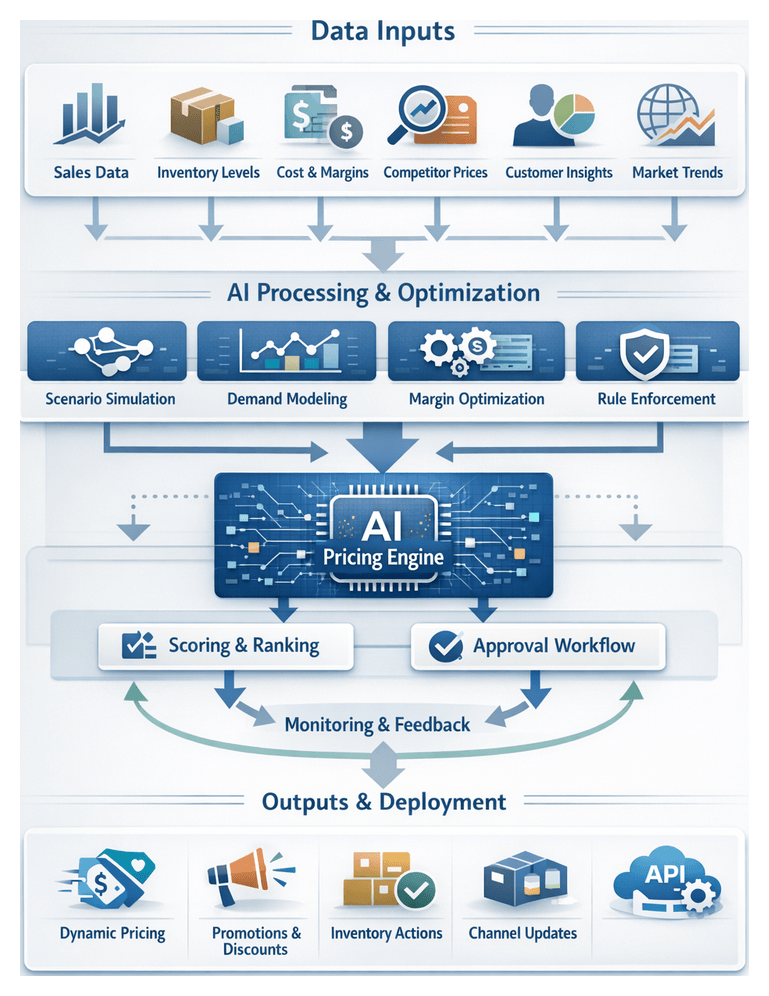
Pricing Strategy Goals and Data Foundations
Effective AI-driven pricing begins with clearly defined objectives and rigorous data prerequisites. At this stage, retailers translate high-level goals—such as target gross margin, market share expansion or inventory clearance—into quantifiable parameters for dynamic price adjustments and promotions. By aligning on numeric targets and acceptable price movement bounds, organizations ensure AI models prioritize among potentially conflicting objectives, balancing revenue growth, margin protection and customer satisfaction.
Key strategic goals include:
- Accelerating inventory turnover through optimized markdown timing and severity
- Managing customer perception by avoiding erratic price swings
- Maintaining competitive responsiveness in fast-moving segments
- Protecting profit during peak demand with surge pricing or premium assignments
To support these goals, the following data inputs must meet standards for accuracy, timeliness and completeness:
- Historical Sales and Transactions: SKU-level volumes, revenue by period, promotional lift metrics. Prerequisite: at least one full seasonal cycle retained for seasonality modeling.
- Inventory and Fulfillment: Real-time stock across distribution centers, stores and e-commerce; lead times; replenishment schedules. Prerequisite: unified ERP, WMS and POS integration.
- Cost and Margin Structures: Unit and landed costs, variable overheads, gross margin targets. Prerequisite: centralized cost repository with version control.
- Competitive Intelligence: Live feeds or daily competitor price snapshots, market basket substitution patterns. Prerequisite: integration with external providers or web-scraping services.
- Customer Segmentation and Behavior: Purchase frequency, average order value, channel preference; price sensitivity models. Prerequisite: CRM with unified identifiers and consent management.
- Promotion Calendars and Campaign Plans: Scheduled events, discount tiers, channel assignments; approval workflows. Prerequisite: marketing operations system feeding the pricing engine.
- Macroeconomic and Market Indicators: Consumer confidence indices, CPI trends, weather patterns, local events. Prerequisite: automated ingestion pipelines for third-party feeds.
- Channel Performance Metrics: Online conversion rates, cart abandonment, store footfall, fulfillment cost variances. Prerequisite: web analytics and in-store sensor data integration.
Data must be refreshed at defined cadences—sales and inventory updates every 15 minutes, competitive feeds hourly—and pass quality checks such as schema validation and anomaly detection. Pricing adjustments adhere to corporate policies, MAP agreements and regional regulations encoded in a policy engine. Robust APIs connect the unified data platform, approval workflows and POS or e-commerce systems, while audit logs capture decision lineage for compliance.
Leading AI platforms power these capabilities. For model training and inference, retailers leverage Google Vertex AI, while end-to-end dynamic pricing can be orchestrated by AI solutions. Evaluating each tool’s data ingestion, explainability and real-time deployment features ensures alignment with business roadmaps.
Orchestration of Pricing and Promotions
A centralized orchestration layer coordinates data integration, model execution, approvals and deployment sequencing. It ingests demand forecasts, inventory positions and competitive intelligence, normalizes units and currencies, and flags anomalies through exception handlers before modeling begins.
The algorithmic recommendation loop iterates as follows:
- Scenario Simulation: Reinforcement learning agents simulate customer responses under varying price and promotional conditions.
- Elasticity Modeling: Supervised models estimate demand sensitivity using historical response patterns and segment behaviors.
- Margin Optimization: Mixed-integer programming integrates cost inputs and margin targets to enforce financial policies.
- Constraint Enforcement: Business rules—price floors, channel restrictions, tax regulations—filter invalid proposals.
- Scoring and Ranking: Candidate prices and bundles are scored on revenue lift, conversion probability and inventory impact.
The top-scoring recommendations enter the approval workflow, where merchandising, finance, legal and marketing teams sequentially validate brand alignment, budget compliance, regulatory constraints and scheduling. Automated notifications and escalation policies maintain momentum, rerouting tasks to backups when necessary.
Upon approval, the orchestration layer dispatches updates across channels:
- E-commerce platforms via REST APIs
- Point-of-sale systems through secure message queues
- Digital signage connectors and mobile app push notifications
- Partner portals via SFTP or secure API integrations
Each endpoint confirms receipt; failures trigger rollback procedures or alert support teams. Exception handling routines automatically revert price floor violations, suspend promotions on insufficient stock, pause workflows on data quality alerts and enable manual overrides for senior managers. Periodic governance reports highlight exception trends and guide policy refinements.
AI Models and Supporting Infrastructure
Dynamic pricing combines supervised learning, reinforcement learning and optimization techniques. Regression and tree-based algorithms predict price elasticity, while frameworks like TensorFlow Agents and Ray RLlib train reinforcement learning policies that balance sales volume and margin objectives. Optimization engines such as PROS and Pricefx solve constrained pricing problems via mixed-integer programming and convex solvers.
Operationalizing these models requires:
- Data Ingestion and Feature Store: Streaming platforms like Apache Kafka or Amazon Kinesis feed real-time events into a centralized repository to ensure consistency between training and inference data.
- Model Training and Experimentation: Platforms such as Amazon SageMaker and Google Cloud AI Platform support versioned experiments, hyperparameter tracking and validation.
- Model Serving and Inference: Kubernetes-based environments using KFServing or cloud endpoints like Azure Machine Learning handle batch and real-time inference at scale.
- Orchestration and Workflow Management: Engines such as Apache Airflow or Prefect schedule retraining, feature computation and price generation tasks.
Integration layers expose model outputs via RESTful APIs or message queues. Commerce platforms like Shopify, Oracle Retail and SAP Commerce consume these feeds for automated price updates. Closed-loop feedback through A/B testing frameworks and real-time monitoring refines elasticity estimates and policy rewards. Explainable AI techniques, including SHAP and LIME, surface factor contributions for stakeholder review. Audit trails capture data versions, model artifacts and decision logs, while role-based access controls secure sensitive strategies.
Deliverables, Integration and Handoff
The pricing and promotion stage yields core deliverables that downstream systems and teams consume to execute campaigns:
- Price Adjustment Recommendations: Time-bound SKU price points with rationale from elasticity and competitive models.
- Promotional Calendar: Sequenced events mapped to dates, channels, customer segments and asset deadlines.
- Markdown and Clearance Plans: Tiered markdown thresholds tied to inventory age or levels, with velocity and margin projections.
- Test and Control Cohorts: Assignments for A/B testing including sample sizes, criteria and benchmarks.
- Pricing Matrix and Tiers: Loyalty, wholesale and regional structures, including volume discounts and bundle guidelines.
- Business Rules Documentation: Discount limits, regulatory notes and override protocols.
These outputs integrate with:
- Merchandising platforms (e.g., Pricefx) for assortment planning and allocation
- CRM systems for segment definitions and personalized offer codes
- POS and e-commerce platforms via API or batch loads for consistent pricing
- Inventory systems to trigger clearance or redistribution based on markdown plans
- Marketing automation for creative deployment and engagement tracking
- Analytics dashboards for post-campaign performance evaluation
Deliverables are packaged in standardized formats—CSV/TSV, XML—exposed via RESTful APIs with JSON payloads, broadcast through messaging platforms such as Kafka or Azure Event Hubs, or written directly to shared databases via ETL jobs. Handoff protocols include automated validation checks, stakeholder sign-off workflows, pre-production staging with end-to-end testing, synchronized release windows and notification acknowledgments. Quality controls verify margin floors, detect promotional overlaps, audit regulatory compliance and enforce brand guidelines.
Monitoring, Feedback and Governance
Continuous monitoring agents track real-time performance metrics—sales velocity, inventory depletion, competitive responses, margin variance and customer sentiment—from unified dashboards. Automated anomaly detectors surface underperformance or margin erosion, triggering corrective actions or human intervention workflows. Event and transaction logs feed back into machine learning pipelines to refine elasticity models and policy simulations. Periodic optimization reports summarize lessons learned, best-performing promotions and recommendations for future campaigns.
Governance frameworks oversee fairness, transparency and compliance. Explainability tools allow review of model drivers, while audit trails document data sources, model versions and decision outcomes. Role-based access controls and periodic policy reviews maintain stakeholder trust, ensuring that AI-driven pricing and promotions operate within prescribed guardrails and drive sustainable commercial impact.
Chapter 6: Empowering Sales Associates with AI Assistants
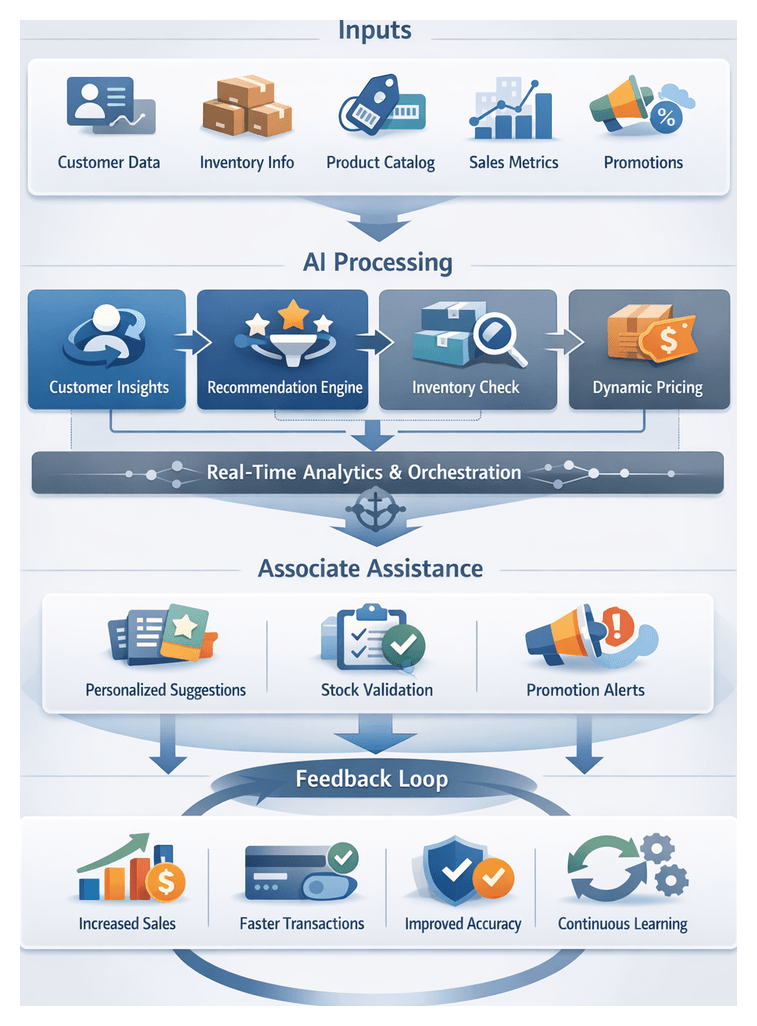
Purpose and Business Impact of AI-Powered Sales Associate Assistance
Equipping frontline staff with real-time, context-rich guidance has become essential in modern retail. AI-powered sales associate assistance delivers personalized product recommendations, stock availability alerts, and promotional suggestions at the point of interaction. By embedding intelligent agents into associate workflows, retailers reduce decision latency, improve conversion rates, and transform staff from transactional facilitators into strategic advisors.
Deploying these tools drives measurable outcomes. Faster transaction times boost customer satisfaction and throughput during peak periods. Personalized recommendations powered by real-time context and predictive analytics increase average order value through targeted upsell and cross-sell efforts. Unified data access reduces errors and discrepancies, minimizing shrinkage and improving inventory turnover. Continuous learning loops refine recommendations and inventory forecasts, enhancing both frontline support and supply chain decisions over time.
Key Inputs, Technical Prerequisites, and Organizational Conditions
Critical Data Inputs
- Customer Profile and History: Real-time access via CRM platforms such as Salesforce, including purchase history, loyalty tier and preferences.
- Inventory Availability and Location: Live stock counts and replenishment schedules from systems like Oracle NetSuite.
- Product Catalog Metadata: Item attributes, images and pricing rules from the product information management service.
- Store Operational Metrics: Sales velocity and foot traffic analytics provided by in-store analytics platforms.
- Promotional Campaign Data: Active discounts and bundling offers governed by promotion engines such as DynamicPricing.ai.
- Contextual Signals: Weather, local events and other factors influencing customer behavior.
- Communication Channel Status: Connectivity indicators for handheld devices and failover provisions.
- Unified Data Platform Integration: APIs to ingest data from POS, CRM, inventory and promotion systems into the AI assistant’s data store.
- AI Assistant Infrastructure: On-premises or cloud environment hosting natural language processing services, recommendation engines and conversational modules.
- Authentication and Access Control: Single sign-on with role-based permissions governing data visibility.
- Real-Time Event Bus: Messaging framework—such as Apache Kafka or AWS EventBridge—to deliver inventory updates and customer interactions within seconds.
- Device Compatibility: Support for tablets, handheld terminals or browser-based interfaces.
- Network Resilience and Security: Encryption in transit and at rest, compliance with PCI DSS and GDPR.
- Change Management: Training programs and communication plans preparing associates for AI-driven workflows.
- Data Governance Framework: Policies defining data ownership, quality standards and refresh cadences.
- Cross-Functional Collaboration: Coordination among IT, merchandising, marketing and operations teams.
- Performance Tracking and Feedback Loops: User satisfaction surveys and usage analytics guiding continuous refinement.
- Vendor and Tool Selection: Evaluation of platforms based on technical and security criteria.
In-Store AI Interaction Flow
The in-store interaction flow orchestrates data retrieval, decision logic and context-aware recommendations across CRM, inventory, POS and analytics systems. It guides associates through defined phases:
- Phase 1: Session Initialization and Context Retrieval
- Phase 2: AI-Driven Exploration and Recommendation
- Phase 3: Inventory Validation and Reservation
- Phase 4: Transaction Completion and Data Synchronization
- Phase 5: Feedback Capture and Continuous Learning
Phase 1: Session Initialization and Context Retrieval
Upon launch, the assistant authenticates the associate via the retail network service and retrieves role-based permissions. If a customer identifier is provided, the system queries the CRM—such as Salesforce—to fetch loyalty tier, purchase history and pending orders. Biometric verification or QR code scanning can streamline identification. Contextual parameters—active promotions, average spend, pending pickups—are cached locally to ensure low latency and support offline operation.
Phase 2: AI-Driven Exploration and Recommendation
The assistant employs a recommendation engine combining multiple models:
- Collaborative filtering to leverage segment behaviors
- Content-based matching for style and preferences
- Trend detection from social signals
- Promotional affinity aligned with campaign rules
An orchestration service aggregates and ranks suggestions by purchase likelihood, inventory freshness and revenue targets, then presents top items as interactive cards.
Phase 3: Inventory Validation and Reservation
Selected SKUs are validated via real-time API calls to the inventory system—such as Oracle NetSuite—checking on-hand, in-transit and available-to-promise quantities. If stock is insufficient, the assistant queries nearby stores or warehouses. It then requests holds through the order management service, triggering inter-store transfers or rain checks as needed. For omnichannel orders, expedited shipping options and cost trade-offs are calculated in real time.
Phase 4: Transaction Completion and Data Synchronization
The assistant interfaces with the POS—such as Square—to compile order details, apply promotions and process payment. Simultaneously, a synchronization API streams transaction events to analytics platforms like Tableau, updating dashboards with conversion metrics. Gift wrapping or additional services are scheduled via the workforce management module, and all session details are recorded in the CRM for follow-up.
Phase 5: Feedback Capture and Continuous Learning
After payment, the assistant prompts associates to collect satisfaction ratings and qualitative comments. Feedback is stored in the CRM profile. An AI training pipeline ingests anonymized session logs—selection outcomes, skipped prompts and interaction durations—into model retraining workflows. Monitoring agents flag anomalies in engagement patterns or model performance, enabling data science teams to refine algorithms and maintain accuracy.
Assistant AI Capabilities and Integration Roles
Advanced AI capabilities integrated with backend systems enable high-impact solutions. Key services and tools include:
Core AI Capabilities
- Natural Language Processing: Interprets spoken or typed queries with intent detection and entity extraction via platforms like IBM Watson Assistant and Google Dialogflow.
- Contextual Recommendation Engines: Generates ranked product lists using Salesforce Einstein and Amazon Personalize.
- Real-Time Inventory Lookup: Verifies stock with computer vision and barcode scanning, leveraging Azure Cognitive Services and inventory APIs.
- Dynamic Pricing and Promotion Insights: Recommends price adjustments and bundles via engines like DynamicPricing.ai or custom microservices.
- Customer Profile Retrieval: Accesses loyalty status and service cases through Microsoft Dynamics 365 AI and Zendesk Sunshine Conversations.
- Sentiment Analysis: Adjusts dialogue based on tone detection with frameworks like spaCy or IBM Watson Tone Analyzer.
Supporting Systems
- Point-of-Sale and Order Management: POS platforms expose APIs for price overrides and payment processing.
- Inventory and Warehouse Management: Unified data platforms deliver real-time stock information and transfer lead times.
- Customer Relationship Management: Secure OAuth connections to retrieve and update customer records in real time.
- Promotion Engines: Ensures AI-suggested offers comply with campaign calendars and eligibility rules.
- Data Lake and Analytics: Centralized storage for clickstream, transaction and feedback data supporting batch and streaming pipelines.
- API Gateway and Orchestration: Coordinates requests via message buses like Kafka or RabbitMQ, enforcing rate limits and retries.
Implementation Considerations
- Deploy AI services as versioned microservices in Kubernetes for scalability and independent updates.
- Ensure token-based authentication with OAuth 2.0 or SAML and enforce role-based access control.
- Support edge-enabled offline operation with local caches and lightweight models.
- Define fallback strategies and log errors for rule-based recommendations when AI services are unavailable.
- Implement continuous A/B testing, performance monitoring and auto-scaling to maintain sub-500 ms response times.
Recommendation Outputs and Transaction Handoffs
AI assistants generate structured outputs—product suggestion cards, upsell prompts, inventory alerts and next-best-action instructions—tailored to device form factors. Accurate recommendations depend on seamless integration with CRM, inventory management, pricing engines and connectivity layers.
Dependencies for Output Generation
- Unified Customer Profile from CRM platforms like Salesforce Einstein AI.
- Real-Time Inventory Positions via systems.
- Pricing and Promotion Data from engines like DynamicPricing.ai.
- Product Metadata from the central PIM service.
- Secure, low-latency network connections to edge devices.
Handoff Mechanisms to POS and OMS
- RESTful API calls retrieve recommendation payloads and submit selected actions.
- Event-driven messaging via Kafka or AWS EventBridge for asynchronous processing.
- WebSocket streams deliver real-time updates on inventory and pricing changes.
- Embedded UI components within POS terminals capture associate selections directly.
POS Integration Patterns
- Session Context Transfer: Shared identifiers link AI suggestions to POS tickets.
- Line-Item Injection: API requests add upsell items with proper pricing and tax calculations.
- Promotion Code Application: Distributed validation and automatic discount application.
- Order Reservation: Inventory holds enacted via the OMS to prevent overselling.
- Transaction Confirmation: Final messages close the loop and present summaries to customers.
Ensuring Data Consistency and Reliability
- Idempotent APIs prevent duplicate order lines or reservations.
- Distributed transactions using saga patterns coordinate state across services.
- Dead-letter queues capture failed messages for manual reprocessing.
- Audit logging of recommendations and associate actions for compliance.
- Health checks and retry strategies with exponential back-off for robust operation.
Example End-to-End Flow
- Associate opens the assistant app and fetches customer context via a CRM REST call.
- The assistant requests personalized suggestions from the recommendation engine.
- The engine returns ranked upsell and cross-sell items with promotional pricing.
- The associate selects a recommendation; the app adds it to the cart via POS API.
- The POS confirms inventory reservation and updates the transaction total via WebSocket.
- Payment is processed and the POS publishes a transaction event to the analytics bus.
- The assistant displays a post-sale summary with loyalty points and feedback prompts.
Monitoring, Logging, and Feedback Loops
- Real-time dashboards track recommendation acceptance rates in platforms like Azure Monitor.
- Error tracking via tools such as Sentry to surface API failures.
- Associate feedback on recommendation relevance feeds model retraining pipelines.
- Post-sale analytics in BI platforms like Microsoft Power BI correlates handoffs with conversion metrics.
- Periodic governance reviews audit integration logs for compliance and data integrity.
By defining clear outputs, managing dependencies and implementing reliable handoff mechanisms, retailers bridge AI guidance and transactional execution. This integrated approach drives customer satisfaction, revenue growth and operational excellence on the sales floor.
Chapter 7: Enabling Personalized Customer Engagement
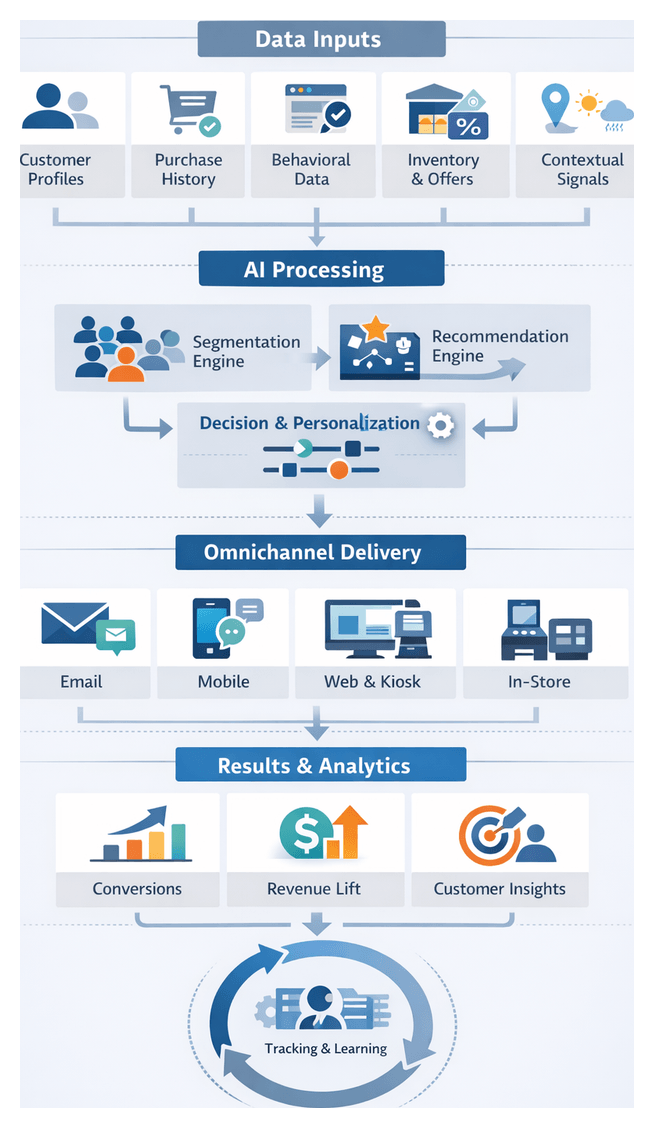
Purpose and Objectives of Personalized Engagement
The personalized customer engagement stage transforms unified customer insights into meaningful interactions that drive conversion, loyalty, and lifetime value. By shifting from generic outreach to targeted communications and recommendations, retailers deliver consistent omnichannel experiences across email, mobile, web, in-store kiosks, and other touchpoints. Leveraging real-time behavioral signals, contextual data, and predictive analytics, AI-powered workflows enable dynamic product suggestions, next-best-action prompts, and tailored offers that resonate with individual preferences and shopping habits. This level of personalization differentiates the brand, boosts customer satisfaction, and maximizes revenue per engagement.
Clear engagement goals align marketing, merchandising, and operations teams while guiding AI models and orchestration services. Primary objectives include:
- Increase conversion rate by delivering relevant recommendations at optimal moments.
- Boost average order value with context-aware upsells, cross-sells, and bundled offers.
- Enhance customer retention and loyalty through timely rewards and recognition of past behavior.
- Improve engagement metrics such as open rates, click-through rates, and time on site.
- Optimize channel performance by identifying preferred channels for each segment.
- Maintain brand consistency in tone, visuals, and offer structure across all interactions.
Data Foundations and Prerequisites
Effective personalization requires a robust data foundation and technical infrastructure. Key data inputs include:
- Customer profile data: demographics, loyalty tier, lifetime value, segment assignments, consent preferences from the CRM or customer data platform.
- Purchase history: transaction records, SKUs purchased, order value, purchase frequency, return behavior, and last purchase date.
- Browsing and interaction behavior: page views, dwell times, search queries, cart actions, email opens, and clicks.
- Inventory availability: real-time stock levels by SKU, location, and channel.
- Promotional calendar and campaign metadata: active offers, discount tiers, eligibility rules, and scheduling.
- Environmental signals: time of day, seasonality, weather, regional events, and geo-location data.
- Third-party enrichment: social media interests, demographic enrichment, market trends, and competitive pricing.
- Consent and preference records: opt-in statuses, communication frequency, and privacy consents.
Before deploying AI-driven personalization at scale, retailers must satisfy these conditions:
- Unified customer data platform with real-time identity resolution and persistent customer identifiers.
- Real-time event streaming using Apache Kafka or Amazon Kinesis for clickstream and inventory events.
- Centralized consent management to enforce GDPR, CCPA, and other privacy regulations.
- Segmentation and modeling framework with machine learning models for propensity scoring and lifetime value prediction.
- Robust API integrations to email service providers, mobile messaging platforms, web personalization tools, and in-store devices.
- Modular content management with dynamic templates and asset libraries.
- Governance and approval workflows spanning marketing, legal, finance, and compliance teams.
- Performance monitoring dashboards, alerting mechanisms, and feedback loops for continuous improvement.
- Scalable cloud or hybrid infrastructure to handle peak loads and ensure high availability.
- Cross-functional collaboration among marketing, IT, data science, operations, and legal stakeholders.
Personalized Engagement Workflow
Overview
The workflow orchestrates data retrieval, AI-driven decisioning, content selection, channel routing, and feedback collection. Each interaction leverages customer context—purchase history, browsing behavior, loyalty status, and real-time signals—while coordinating systems and teams to ensure timing precision and consistency.
Data Retrieval and Profile Assembly
The orchestration layer triggers parallel API calls to assemble a unified customer profile snapshot. It queries the customer data platform for profile attributes, the CRM for contact preferences, analytics feeds for behavioral signals, and enrichment sources for third-party data. Error handling routines log exceptions and reconcile missing data.
Segmentation and Recommendation Coordination
Two AI components run in parallel:
- Segmentation Engine assigns customers to dynamic cohorts using clustering algorithms based on recency, frequency, monetary value, and behavioral patterns. Solutions such as Amazon Personalize or custom pipelines with scikit-learn and Apache Spark ML perform this task.
- Recommendation Engine generates ranked product or content suggestions using collaborative filtering, content-based filtering, or hybrid models. Managed services like Google Recommendations AI or open source frameworks such as Apache Mahout and TensorFlow Recommenders provide real-time and batch recommendations.
Outputs from both engines, including confidence scores and metadata, are merged by orchestration logic to select top recommendations aligned with campaign objectives.
Content Selection and Personalization Rules
Business rules and creative templates from the content management system guide asset selection. The workflow evaluates promotional constraints, matches recommendations to creative variants, applies channel-specific tone and layout rules, and inserts dynamic tokens such as customer name or loyalty points. Decision logs capture rule evaluations and asset selections for auditability.
Channel Routing and Delivery Orchestration
The orchestration layer ranks channels using a preference matrix, verifies quotas and throttling limits, and initiates delivery via messaging platform APIs. It tracks delivery events—sent, delivered, opened, clicked—and streams them back to the event hub for real-time monitoring and correlation with customer records.
- Consult channel preferences to prioritize delivery (email, push, SMS, in-app, social).
- Enforce message quotas and throttling to prevent over-messaging.
- Execute API calls with content payloads and scheduling parameters.
- Capture and correlate delivery and engagement events for analytics.
Real-Time Interaction Handling and Feedback Loop
Events such as clicks or page views trigger follow-on decision paths in the real-time decisioning engine, which may recommend next-best offers or adjust message cadence. Timeout rules schedule reminders or channel escalations. All interaction data updates customer profiles and continuously trains recommendation and segmentation models.
Cross-Functional Coordination and Approvals
Marketing approves campaign parameters and creative assets. Legal and compliance teams validate messaging. IT and DevOps monitor system health. Customer service readies follow-up. The orchestration platform provides dashboards for approvals, performance tracking, and exception alerts, ensuring shared visibility and rapid resolution of dependencies.
Handoff to Fulfillment and Analytics
After delivery, the workflow sends conversion events to order management systems and updates inventory allocations. Analytics dashboards aggregate engagement metrics, channel performance, and revenue impact for executive reporting. Machine learning operations pipelines consume interaction logs to retrain models during off-peak hours. Integration contracts and automated data validation ensure reliable handoffs and anomaly detection.
Governance and Iterative Improvement
Threshold-based alerts notify teams of delivery failures, bounce rates, or engagement drops. Audit logs capture decision points and API interactions. Exception workflows route critical failures to incident response teams. Periodic health checks validate orchestration logic and data integrity. Insights from analytics inform refinements to segmentation, recommendation algorithms, and content strategies, driving a cycle of continuous learning and system optimization.
AI Engines and Microservice Architecture
Personalization relies on a modular AI architecture with discrete services for segmentation, recommendation, decisioning, and delivery. Engines operate on unified data from CRM platforms, transaction histories, browsing logs, and external signals. Core components include:
- Segmentation and profiling with clustering algorithms, predictive propensity models, and identity resolution.
- Recommendation pipelines featuring offline model training, batch candidate generation, and real-time inference.
- Decisioning services applying business rules, constraint solvers, multi-objective optimization, and offer sequencing. Platforms such as Dynamic Yield and Adobe Target provide visual rule builders and RESTful APIs.
- Personalization API layers and microservices behind API gateways with rate limiting, service mesh, and observability. Event streaming with Apache Kafka or Kinesis and caching with Redis or Memcached support low-latency performance.
- Continuous learning pipelines with automated data labeling, online learning, offline retraining, and performance dashboards. Tools like Salesforce Einstein, Kubeflow, and MLflow manage model lifecycle and feedback integration.
Engagement Deliverables and System Integrations
The final output of personalization includes machine-readable deliverables that feed downstream execution and analytics platforms. Key deliverables are:
- Personalized message payloads: content objects with text, images, recommendations, and dynamic placeholders.
- Offer catalog entries: targeted promotions with codes, validity, channel applicability, and uplift scores.
- Segmentation metadata: segment identifiers, behavioral tags, and propensity scores.
- Channel routing instructions: rules based on preferences, timing, and regulatory constraints.
- Campaign scheduling parameters: dispatch windows, frequency caps, and throttling settings.
- Compliance and consent records: opt-in statuses and do-not-contact flags.
Deliverables conform to JSON or XML schemas and decouple content generation from deployment. Dependencies include the customer data platform, recommendation engine, segmentation service, campaign orchestration layer, and compliance registry. Automated health checks, retry mechanisms, and data lineage tracking ensure reliability and auditability.
Handoff to Marketing Execution Platforms
- Email payloads to Salesforce Marketing Cloud or Mailchimp.
- SMS and push content via high-throughput mobile gateways.
- Web and in-app messages through UI SDKs for banners and pop-ups.
- Social and paid media integrations for dynamic ads and sponsored messages.
Handoff to Fulfillment and Order Management
- Order Management System integration with Oracle NetSuite to apply promotion codes and pricing adjustments.
- Inventory and fulfillment platforms for stock reservation and pick-list generation.
- Payment gateways to transmit validated pricing and discounts.
Handoff to Analytics and Reporting
- Engagement event streams to analytics services such as Tableau or cloud data warehouses.
- Redeployment metrics on redemption rates, order value uplift, and channel effectiveness.
- Attribution and incrementality analysis linking outreach to sales transactions.
- Model feedback loops for automated retraining and segmentation refinement.
This structured handoff framework empowers retailers to deploy personalized campaigns at scale, measure their impact accurately, and continuously refine strategies based on real-world feedback, ensuring a self-optimizing personalization system.
Chapter 8: Monitoring and Analytics for Continuous Improvement
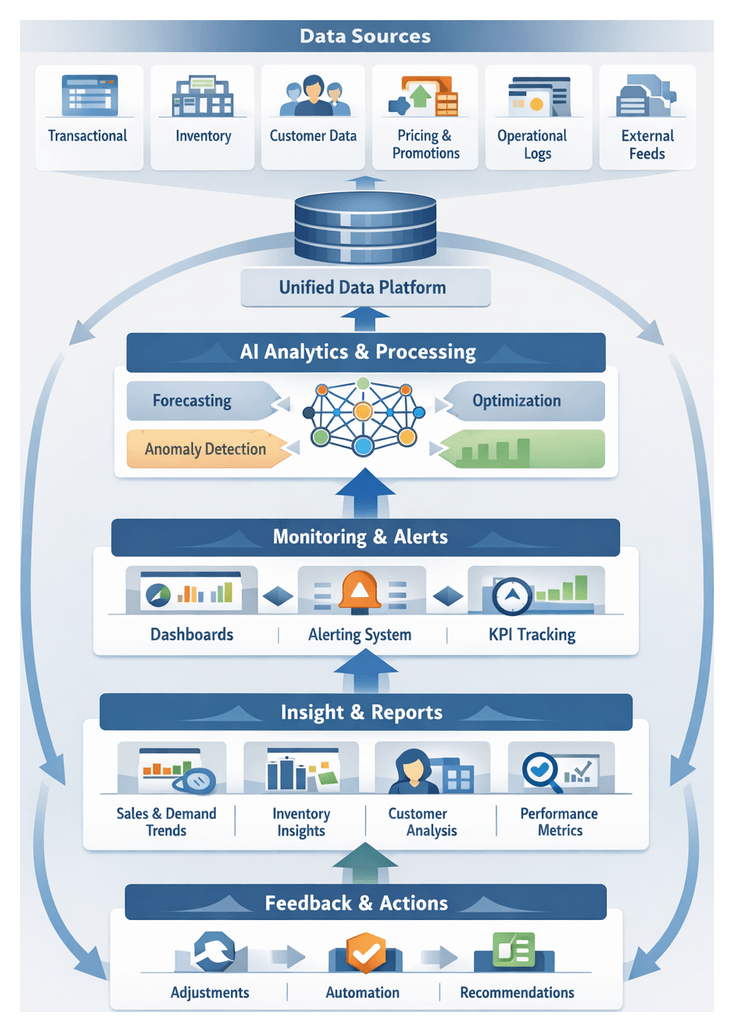
Purpose and Scope of Monitoring and Analytics
The monitoring and analytics stage establishes a continuous improvement feedback loop for AI-driven retail sales workflows. By consolidating diverse data streams—from point-of-sale transactions and inventory movements to customer interactions and external indicators—this stage transforms raw information into actionable insights. It enables retail teams to detect anomalies, refine demand forecasts, optimize inventory and pricing strategies, and enhance customer engagement in real time. Embedding structured monitoring prevents performance stagnation and ensures gains from forecasting, optimization, and personalization efforts remain aligned with evolving business objectives.
Data Inputs and Architectural Foundations
- Transactional Data: Point-of-sale records, returns, and refunds across channels
- Forecast Outputs: AI-generated demand predictions by product and location
- Inventory Metrics: Stock levels, replenishment events, safety-stock thresholds, lead-time variances
- Pricing and Promotions: Historical price changes, discount schedules, competitor price feeds
- Customer Engagement: CRM interactions, loyalty activity, web and mobile behavior
- Operational Logs: Order fulfillment times, supply-chain exceptions, staffing levels
- External Indicators: Market trends, economic indices, weather data, social sentiment
Data Platform and Prerequisites
- Unified Data Platform: Consolidated foundation with robust ETL processes and real-time ingestion pipelines
- AI Agent Orchestration: Scheduling and coordination for forecasting, optimization, and assistant agents
- Defined KPI Taxonomy: Executive‐agreed metrics spanning revenue, efficiency, customer satisfaction, operational health
- Analytics Tools Access: Provisioned dashboards and visualization platforms for all stakeholders
- Governance Frameworks: Data stewardship, metadata management, validation rules for quality and consistency
- Cross‐Functional Collaboration: Formal channels between data science, operations, merchandising, marketing, store leadership
Technology and Integration
- Visualization Platforms: Power BI, Tableau
- Streaming and Event Management: Apache Kafka, AWS Kinesis, Google Pub/Sub
- AI MLOps Services: DataRobot, Amazon SageMaker, Google Cloud AI Platform
- Data Catalog and Governance: Alation, Collibra
- Alerting and Incident Management: PagerDuty, Opsgenie
- API Gateways and Service Mesh: Secure, governed endpoints for metrics and predictions
Data Quality and Governance
- Validation Rules: Automated checks at ingestion and transformation stages
- Master Data Management: Centralized control over product catalogs, store hierarchies, promotion calendars
- Access Controls: Role-based permissions to safeguard sensitive metrics and comply with privacy regulations
- Audit Trails: Detailed logging of data changes, user interactions, and alert acknowledgments
- Retention Policies: Lifecycle management for raw and aggregated datasets
- Quality Dashboards: Continuous visibility into completeness, consistency, and timeliness metrics
Analytics Workflow and AI‐Driven Agents
Analytics Pipeline Overview
- Data Collection: Ingest events from point-of-sale, inventory systems, customer platforms, external feeds
- Preprocessing: Cleansing, normalization, feature enrichment, routing to microservices or warehouses
- Model Execution: Real-time rules and machine learning inference for anomalies and trends
- Threshold Evaluation: Hierarchical and dynamic criteria for alert generation
- Notification Dispatch: Context-rich alerts via appropriate channels
- Feedback Collection: Capture actions and refine models and thresholds
Data Ingestion and Processing Coordination
- Real-Time Streams: Sub-second event capture with Apache Kafka or AWS Kinesis
- Batch Feeds: Historical sales, promotion schedules, supplier logs orchestrated via Apache Airflow
- Stream Processing: Apache Flink or Apache Spark Streaming for real-time transforms and feature extraction
- Normalization and Enrichment: Align timestamps, currencies, add context like store region, customer segment, weather indices
Real-Time and Batch Integration
- Real-Time Engines: Evaluate lightweight models and rules for immediate issues
- Batch Jobs: Run complex algorithms—trend detection, residual analysis, seasonality decomposition
- Orchestration: Services like Kubeflow Pipelines manage dependencies and inject updated parameters
- Continuous Calibration: Propagate recalibrated thresholds and model weights without downtime
Anomaly Detection and Threshold Management
- Baseline Modeling: Define normal ranges for sales velocity, conversion rates, fulfillment times
- Feature Extraction: Compute moving averages, rate of change, comparative ratios
- Inference: Isolation Forest, Autoencoders, z-score methods via DataRobot or custom frameworks
- Hierarchical Thresholds: Warning, critical, emergency levels
- Dynamic Conditions: Adjust thresholds for time of day, promotions, regional traffic
- Suppression Rules: Prevent noise during maintenance windows or data migrations
Trend Detection and Bottleneck Analysis
AI agents identify emerging patterns and operational constraints with statistical and machine learning techniques.
- Time-Series Decomposition: Separate trend, seasonal, residual components using TensorFlow or scikit-learn
- Anomaly Scoring: Real-time deviation detection with Anodot
- Clustering: Unsupervised segmentation reveals shifts in customer behavior
- Predictive Scoring: Forecast acceleration or slowdown via Google Cloud AI Platform and Amazon SageMaker
- Process Mining: Event-log analysis with Celonis to map workflows and identify deviations
- Resource Monitoring: Integration with Datadog or Splunk for server, application, staffing utilization insights
- Bottleneck Prioritization: Compute impact-based scores to guide focus on highest-value constraints
Alerting, Notification, and Collaboration
- Incident Management: PagerDuty escalations for critical issues
- Collaboration Platforms: Slack, Microsoft Teams for real-time coordination
- SMS and Email Gateways: Immediate alerts to store managers and regional directors
- Dashboard Widgets: Embedded views in Tableau or Power BI displaying context-rich notifications
- Acknowledgment Tracking: Auditable records of alert resolution and feedback
Dashboards, Visualization, and Health Monitoring
- Real-Time Scorecards: KPIs such as sales velocity, stock-out rates, customer satisfaction indices
- Anomaly Overlays: Highlight deviations on time-series charts
- Interactive Filters: Segment by store, region, product category, time window
- Pipeline Health Checks: Processing latency, job success rates, data freshness indicators
Feedback Loops and Continuous Refinement
- Post-Incident Reviews: Document alerts, actions, outcomes in a knowledge base
- Label Collection: Use confirmed anomaly outcomes to enhance supervised models
- User Feedback: Store associates validate or dismiss alerts to tune thresholds
- Model Performance Reviews: Schedule retraining based on drift detection and quality flags
Insight Reporting and Improvement Handoffs
Insight Report Outputs
- Executive Dashboards: High-level KPIs, trend visualizations in Tableau or Power BI
- Operational Scorecards: Store and channel performance summaries, service-level metrics
- Anomaly Summaries: Incident logs with severity ratings and prioritized corrective actions
- Root Cause Analysis: Correlations among performance dips, external factors, bottleneck drivers
- Ad Hoc Reviews: Deep dives on campaigns or product launches with exportable data extracts
Dependencies and Distribution
- Real-Time Streams: Point-of-sale, clickstreams, mobile app interactions
- Analytics Models: Demand forecasting, anomaly detection, trend analysis algorithms
- External Indicators: Competitive pricing, economic and weather datasets
- Metadata Sources: ERP store hierarchies, marketing calendars, product catalogs
- Collaboration Platforms: Automated tickets to Jira, Asana; alert bots in Slack or Teams
Report Delivery and Stakeholder Engagement
- Audience Segmentation: Tailored views for executives, store managers, supply chain teams
- Delivery Channels: BI platform embeds, scheduled emails with CSV attachments, push notifications
- Review Cadence: Daily operational briefs, weekly cross-functional trend reviews, monthly executive summaries
Improvement Cycle and Actionable Feedback
- Action Item Generation: Automated remediation tickets with priority scores based on revenue impact
- Task Assignment and Escalation: Function-specific owners and senior alerts for high-severity issues
- Resolution and Verification: Post-implementation monitoring to confirm improvements
- Feedback Annotation: Root cause observations feeding into model retraining datasets
Integration with Operational Workflows
- Order Management: Automatic stock transfers and vendor portal replenishment tasks
- Pricing Engines: Dynamic price updates via APIs to PROS and Revionics with embedded approval workflows
- Marketing Automation: Promotion recommendations pushed to Adobe Campaign; refreshed audience segments
- Training and Knowledge Bases: Procedural updates in learning management systems and micro-learning content for frontline staff
Model Refinement and Governance
- Outcome Data Collection: Post-intervention metrics on sales lift, service levels, markdown reductions
- Retraining Triggers: Automated scheduling when forecast errors exceed thresholds or new labels emerge
- Process Tuning: Threshold and notification adjustments based on false positive/negative rates
- Audit Trails: Logging of data lineage, model versions, handoff events under governance board oversight
Chapter 9: Training and Change Management
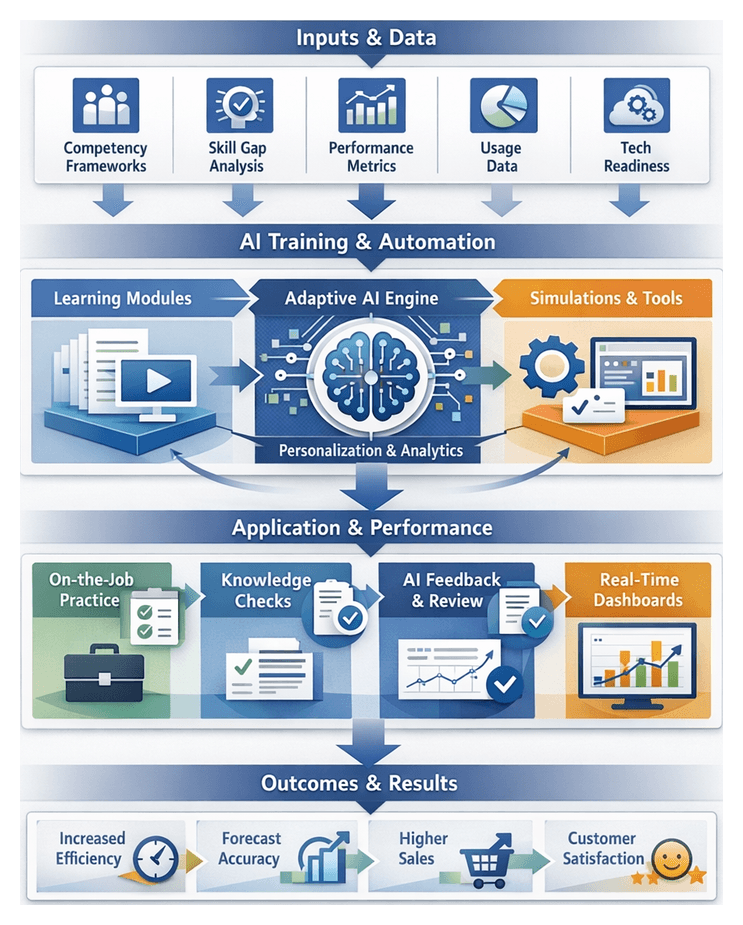
Defining Strategic Training Objectives
The design of a training program for AI-driven retail workflows begins by translating organizational goals into clear, measurable learning objectives. These objectives align with key performance indicators—such as reduced transaction times, improved forecast accuracy, and higher customer satisfaction—to ensure that every curriculum module contributes directly to business impact. Training goals typically encompass knowledge acquisition of AI concepts, skill proficiency in system navigation and data interpretation, behavioral adoption of recommended processes, and linkage to concrete operational outcomes like average transaction value and inventory turnover.
Articulating precise objectives serves as the foundation for curriculum development and assessment planning. By connecting learning outcomes to role-based competencies, training architects create a roadmap that guides learners from conceptual understanding to on-the-job mastery of AI-enabled tools. This alignment also provides stakeholders with quantifiable measures of return on investment, demonstrating how training accelerates time to proficiency and drives continuous improvement across retail channels.
Essential Inputs and Prerequisites
Effective program design depends on gathering accurate inputs and establishing foundational conditions. The following data and artifacts inform content relevance and delivery modality selection:
- Role-Based Competency Frameworks: Detailed task, skill, and decision-point descriptions for each role—sales associate, store manager, inventory analyst, and support staff.
- Skill Gap Analysis Reports: Surveys, interviews, and observations identifying current proficiency levels and priority learning needs.
- Performance Metrics: Baseline data on operational KPIs such as average checkout time, stockout frequency, and promotion uplift.
- Usage Analytics: Insights from learning management systems and AI adoption platforms revealing tool utilization patterns and friction points.
- Technology Readiness Assessments: Evaluations of device availability, network bandwidth, and software compatibility across store and corporate environments.
- Content Libraries: Existing training modules, standard operating procedures, video tutorials, and quick reference guides for reuse and consistency.
- Change Management Strategy: Communication protocols, stakeholder engagement plans, and reinforcement mechanisms to support behavior adoption.
- Compliance Requirements: Data privacy rules and industry standards incorporated into scenarios and assessments.
Before curriculum development begins, the following prerequisites must be in place to ensure smooth execution and learner engagement:
- Executive Sponsorship and Governance: Visible commitment from senior leadership, a cross-functional steering committee, and established review workflows.
- Infrastructure and Tool Deployment: Availability of the LMS and AI-enabled learning platforms such as Coursera for Business, Degreed, and Docebo.
- Instructor Preparation: Selection and training of trainers with both subject matter expertise and instructional design skills.
- Access and Engagement Channels: Defined mechanisms—email, intranet, mobile apps—for communicating training opportunities and collecting feedback.
- Data Security Protocols: Guidelines for handling sensitive datasets in sandbox environments.
- Baseline Measurement Tools: Dashboards and surveys configured to capture pre-training benchmarks.
Structured Learning Workflow and Feedback Mechanisms
A repeatable, end-to-end learning workflow guides learners through orientation, foundational concepts, practical application, and reinforcement. Embedding a robust feedback loop ensures continuous alignment with evolving retail processes and technology updates.
Mapping Training Activities
- Orientation and Onboarding: Introduce the AI-powered ecosystem, set objectives, and establish performance expectations.
- Microlearning Modules: Deliver focused lessons on topics such as interpreting forecasting dashboards or using inventory optimization tools.
- Guided Simulations: Hands-on exercises within live or sandbox environments, enabled by platforms like Docebo and Coursera for Business.
- Peer Collaboration and Coaching: Discussion forums and live sessions to reinforce learning and surface improvement opportunities.
- Knowledge Checks and Assessments: Automated quizzes and practical assignments to validate mastery and direct remediation.
- On-the-Job Application: Field exercises under the guidance of AI-enabled mentors and retail coaches.
- Performance Review and Feedback: Joint evaluations by managers and AI agents, with remedial learning paths assigned as needed.
AI-Enabled Tutoring and Adaptive Learning
Adaptive engines and intelligent tutor agents personalize the learning journey by analyzing performance data and delivering context-sensitive support. Key capabilities include:
- Adaptive Content Delivery: Systems like EdCast adjust module sequencing and recommend resources based on individual progress.
- Intelligent Remediation: When gaps are detected, AI tutors provide targeted explanations, micro-videos, and example scenarios.
- Conversational Coaching: Chatbot interfaces embedded in mobile apps enable on-demand guidance during customer interactions.
- Contextual Assistance: API integrations link tutors to point-of-sale and pricing engines, offering real-time help within operational tools.
Feedback Collection and Analysis
A multi-channel framework captures learner sentiment, performance metrics, and usage data at defined intervals:
- Surveys and Self-Assessments: Post-module polls capture confidence levels and relevance ratings.
- Manager Evaluations: Structured forms on platforms like Cornerstone OnDemand assess on-floor application.
- AI-Driven Monitoring: Agents detect error patterns and usage shortfalls, triggering reinforcement prompts.
- Analytics Reports: Login frequency, module completion rates, and resource downloads highlight engagement trends.
- Sentiment Analysis: Natural language processing surfaces themes from open feedback and discussion forums.
Integration with Enterprise Systems
- LMS Integration: APIs synchronize completion records and competency scores with HR and talent management suites.
- Sales Performance Platforms: Data flows into systems like Salesforce to correlate training with conversion rates and transaction values.
- Manager Dashboards: Reports deliver visibility into individual and team proficiency, guiding reinforcement activities.
- Executive Oversight: High-level KPIs feed corporate dashboards powered by Tableau and Power BI.
- Cross-Functional Reviews: Regular stakeholder meetings ensure training outcomes inform process and software adjustments.
Continuous Improvement Cycle
The learning workflow evolves with feedback and system updates.
- Assess Feedback: Review data to identify low-engagement modules and persistent knowledge gaps.
- Revise Content: Update simulations, videos, and assessments based on subject matter expert input.
- Pilot and Validate: Test revisions with pilot groups and analyze sentiment improvements.
- Scale Deployment: Roll out refined modules with version tracking in the content management system.
- Monitor Impact: Compare post-deployment metrics against baselines to measure learning and performance gains.
Key Roles and Responsibilities
- Learning and Development Leads: Orchestrate design, content updates, and stakeholder reviews.
- AI Learning Specialists: Configure adaptive engines, monitor algorithms, and interpret insights.
- Retail Managers and Coaches: Facilitate reinforcement, assess performance, and provide qualitative feedback.
- IT and Integration Engineers: Maintain system interoperability and manage data pipelines.
- Executive Sponsors: Review high-level metrics, secure resources, and ensure organizational alignment.
AI-Driven Tools for Adaptive Learning and Analytics
AI systems accelerate user adoption by personalizing learning pathways, delivering real-time feedback, and providing comprehensive analytics. Integration of these tools within the broader learning ecosystem ensures cohesive data flows and actionable insights.
Adaptive Learning Engines
Platforms such as Docebo, EdCast, and Cornerstone OnDemand leverage machine learning to map competency frameworks, analyze assessment results, and recommend tailored content. They curate microlearning assets and present the next-best-content based on engagement data, reducing redundancy and maintaining learner focus.
Intelligent Tutoring Systems
- Conversational AI Tutors: Solutions like IBM Watson Assistant simulate one-on-one coaching, pose questions, and guide problem-solving.
- Automatic Assessment: Machine learning engines grade quizzes, analyze written responses, and generate contextual hints to remediate misconceptions.
Performance Monitoring Agents
- Engagement Analytics: Track session duration, module completion, and resource access to surface drop-off points.
- Proactive Alerts: Platforms like Pluralsight Skills trigger coaching notifications when key indicators fall below thresholds.
Analytics and Reporting Platforms
- Dashboards: Centralized views from tools such as Microsoft Viva Learning and Cornerstone OnDemand display adoption rates, time to competence, and alignment with KPIs.
- Competency Scorecards: Numeric ratings benchmark learners against predefined frameworks, enabling targeted interventions.
Integration Best Practices
- Define learning objectives aligned to business KPIs to guide AI configuration.
- Ensure data privacy by anonymizing learner records and securing data exchanges.
- Pilot with end users to refine AI recommendations and interfaces.
- Establish governance for AI-generated content and algorithm adjustments.
Deliverables and Transition Pathways
The culmination of training and change management produces tangible outputs and defined processes that transition teams from learning environments to live operations, ensuring sustained adoption and performance gains.
Core Training Deliverables
- Certification and Completion Reports: LMS-generated records indicating module completion, assessment scores, and time-to-completion metrics.
- Competency Assessments: Evaluations measuring proficiency in data interpretation, AI assistant interaction, and decision-support tool usage.
- Knowledge Artifacts and Job Aids: Quick reference guides, flowcharts, and contextual help documents embedded within operational interfaces.
- Engagement Dashboards: Visualizations from Tableau and Power BI tracking active user counts, feature utilization, and AI interaction frequency.
- Change Readiness Scores: Composite metrics from surveys and observations guiding reinforcement activities and leadership interventions.
Dependency Mapping for Post-Training Activities
- Learning Management System: Integration with Degreed, Docebo, and Workday Learning for automated tracking and data exports to HR systems.
- Human Resources Information System: Ingests completion status and competency scores to update profiles and trigger career development workflows.
- Performance Management Suites: Feeds assessment outputs into talent platforms for coaching, succession planning, and incentive alignment.
- Operational AI Agents: Adjust user permissions and workflow recommendations based on competency reports.
- IT Service Desk: Receives onboarding logs and access requests to provision credentials and resolve technical issues.
- Change Management Office: Uses readiness scores to drive communication campaigns and targeted workshops.
Defining Transition Processes
- Competency Validation: Confirm certifications and submit consolidated reports to HR and the Change Management Office for role assignments and feature access.
- Provisioning: IT uses LMS data to configure user accounts, security roles, and connectivity to knowledge repositories and analytics dashboards.
- Role Briefings: Managers conduct in-venue sessions to review new workflows, introduce change champions, and reinforce expectations.
- Job Aid Deployment: Push quick-reference guides and interactive walkthroughs into application help menus and mobile toolkits.
- Initial Monitoring: AI agents capture real-world usage metrics—such as recommendation acceptance rates and transaction throughput—and share early indicator dashboards with leadership.
- Iterative Reinforcement: Embedded feedback forms and pulse surveys inform weekly content updates and supplemental office hours.
Continuous Learning and Institutionalization
- Adaptive Refreshers: Systems like Degreed recommend refresher modules and advanced pathways based on performance data.
- Performance Analytics: Correlate skill acquisition with business metrics to assess training ROI and inform future content investments.
- Governance Checkpoints: Regular audits and re-certification triggers maintain compliance when AI models or workflows change.
- Communities of Practice: Digital forums led by change champions foster knowledge sharing and co-creation of supplemental job aids.
Handoff to Optimization and Scaling
- Channel Expansion: Use readiness metrics and adoption patterns as blueprints for replicating training across new stores, digital marketplaces, and partner networks.
- Continuous Improvement: Feed data on skill gaps and support tickets into process optimization cycles and AI orchestration adjustments.
- Leadership Reporting: Quarterly executive reports synthesize training outputs, operational correlations, and readiness trends to inform strategic investments.
- Talent Development: Update competency frameworks with AI skill requirements to refine job descriptions, compensation bands, and succession plans.
This structured approach to training design, execution, feedback, and transition ensures that retail organizations realize the full value of AI-driven workflows. By embedding continuous learning and clear handoff mechanisms, teams move confidently from project delivery to sustained operational excellence and competitive advantage.
Chapter 10: Scaling AI-Powered Workflows Across Retail Channels
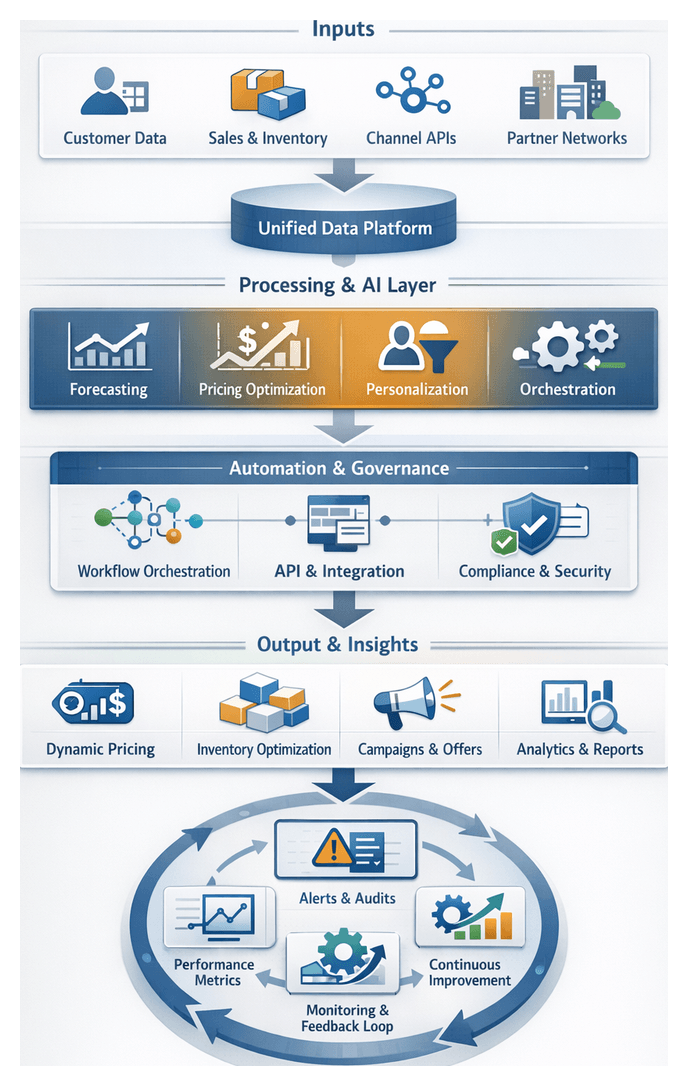
Context and Imperative for Multi-Channel AI Scaling
Modern retail demands seamless, personalized experiences across online storefronts, mobile apps, brick-and-mortar outlets and partner networks. Yet many organizations grapple with fragmented systems: e-commerce platforms isolated from point-of-sale, inventory tracked separately from promotional engines, and customer data dispersed across siloed marketing, CRM and loyalty applications. These disconnects result in inconsistent pricing, stock imbalances and disjointed customer journeys.
Artificial intelligence, cloud computing and API-driven architectures now enable retailers to centralize data, orchestrate cross-channel workflows and deploy intelligent agents at every touchpoint. Early pilots in forecasting, inventory optimization, dynamic pricing and personalized engagement demonstrate significant gains. To capture full enterprise value, businesses must scale these workflows beyond flagship channels—extending proven models and processes into new markets, partner platforms and physical stores.
Key market and technology drivers underscore the urgency: rising customer expectations for unified experiences, intensifying competitive pressure, growing operational complexity from added channels, and the maturity of cloud services such as Amazon SageMaker, Microsoft Azure AI and Google Cloud AI. A standardized, automated approach to multi-channel deployment safeguards ROI, preserves governance and delivers consistent performance as organizations expand.
Foundational Inputs and Prerequisites
Successful scaling begins with clearly defined inputs and conditions that secure data integrity, operational stability and compliance. These elements form the blueprint for replicable AI workflows across diverse retail environments.
- Unified Data Platform: A centralized data lake or warehouse consolidates point-of-sale transactions, e-commerce logs, customer profiles, inventory records and external market indicators. Real-time ingestion, schema versioning and lineage tracking are mandatory.
- Channel Endpoint APIs and Connectors: Standardized REST or GraphQL interfaces, message queues and file transfer protocols for each retail channel. Connectors manage authentication, rate limits and retry logic.
- Real-Time Data Streams: Event feeds from in-store sensors, mobile apps and partner systems to power AI agents with up-to-the-second insights on customer interactions, stock movements and promotional triggers.
- Partner Network Specifications: SLAs, integration requirements and compliance mandates for third-party resellers, marketplaces and fulfillment partners.
- Governance and Compliance Criteria: Documented policies for data privacy, security controls, audit logging and model governance aligned with regulations such as GDPR and CCPA.
- Technology Stack Inventory: Infrastructure components—including container orchestration, API gateways, monitoring tools and CI/CD pipelines—mapped to deployment and management processes.
- Configuration Parameters: Templates for region-specific variables—currency, tax rates, shipping zones and promotional calendars—to enable rapid channel replication.
Before channel expansion, organizations must validate:
- Data Quality and Lineage: Automated routines detect schema drift, missing records and outliers. Lineage tracking provides end-to-end visibility.
- Stabilized Core AI Models: Forecasting, inventory optimization, pricing engines and personalization agents completed full business cycles. Models are versioned, tested and documented.
- Governance Framework: Active data stewardship, model risk management and change control processes. Monitoring dashboards track workflow health and SLA compliance.
- Stakeholder Alignment: Clear scope, timeline and success criteria agreed by merchandising, marketing, IT and store leadership. Change champions and training plans support adoption.
- Security and Compliance Infrastructure: Identity and access management, encryption, network segmentation and vulnerability scanning in place. Privacy impact assessments reviewed for new channels.
- Scalable Infrastructure: Infrastructure-as-code templates, auto-scaling policies and disaster recovery procedures validated across regions.
- Extensible CI/CD Pipelines: Parameterized pipelines support channel-specific variables, automated testing suites, version control and rollback mechanisms.
- Vendor and Partner Readiness: Completed contracts, sandbox validations, security scans and SLAs for third-party AI services and fulfillment networks.
Governance and Workflow Replication
Robust governance and process controls are essential to replicate AI-driven workflows consistently across channels. Replication transforms proven flagship configurations into version-controlled templates, enforces policies, and orchestrates deployments to new environments.
Governance Framework and Standards
A centralized policy library defines permissible data uses, mandatory audit logging and retention schedules aligned with regulatory requirements. Data stewards maintain standards for privacy, security and model management, while compliance officers verify channel configurations against corporate policies. Versioning rules, approval thresholds and emergency fix criteria are explicitly codified to reduce risk and ensure operational consistency.
Version-Controlled Workflow Templates
Workflow templates, stored in repositories like Git, capture end-to-end processes—from data ingestion to AI inference and promotional execution—abstracted into parameterized modules. Continuous integration pipelines automatically test new commits in sandbox environments, validating data flows and model outputs before deployment. Version control enables traceability, rollback and auditability of workflow evolution.
Configuration and Policy Validation
A secure configuration service manages channel-specific parameters—tax rates, currency formats, inventory thresholds and promotional calendars—in a role-based key-value store. During replication, the orchestration layer populates templates with approved parameters. Automated validation scripts within the CI/CD pipeline inspect schemas, confirm PII masking, evaluate model fairness, and enforce pricing policies. Compliance checks integrate with the replication flow to detect and block violations early.
Orchestration Layer and Connectors
The orchestration layer, often built on platforms such as Apache Airflow or Prefect, coordinates replication tasks and interfaces with channel connectors. Connectors encapsulate API calls, data transformations and authentication protocols unique to each environment. This modular design simplifies the addition of new channels—teams configure a connector once and reuse it across multiple workflow instances.
Replication Sequence
- Trigger replication: Initiated manually or via schedule through the orchestration API.
- Retrieve templates and parameters: Fetch approved workflow definitions and channel-specific settings.
- Execute policy validation: Run compliance checks and generate reports.
- Provision resources: Connectors set up data pipelines, AI endpoints and credentials in the target environment.
- Deploy workflow components: Sequentially execute tasks—data ingestion, forecasting, pricing, promotions—through connectors.
- Run health checks: Validate performance metrics such as latency and data accuracy.
- Record audit logs: Capture all actions, approvals and validation outcomes.
- Notify stakeholders: Send deployment results and exception alerts to IT, operations and business owners.
Cross-Functional Coordination
Solution architects oversee template governance, data stewards enforce privacy and parameter accuracy, DevOps engineers maintain CI/CD pipelines and resource provisioning, while security officers audit access controls. Business owners validate market-specific rules and promotions. Regular governance meetings review replication metrics, resolve escalations and prioritize enhancements.
Exception Handling and Continuous Improvement
Predefined escalation paths categorize issues by severity. Minor discrepancies route to data stewards, whereas critical compliance failures pause deployments and trigger rollback procedures. Post-deployment reviews analyze failure patterns, performance deviations and connector bottlenecks, informing iterative updates to templates, parameters and validation rules.
AI Orchestration Architecture and Patterns
An advanced orchestration layer serves as the central nervous system, coordinating AI agents, data streams and services to deliver consistent, real-time experiences across channels.
Orchestration Responsibilities
- Workflow Management: Maintain versioned sequences of AI tasks and system calls across forecasting, inventory allocation, dynamic pricing and personalization.
- Scheduling and Coordination: Trigger agents based on time schedules, event occurrences and readiness signals, with automated retries for failures.
- Resource Optimization: Allocate compute, memory and network capacity dynamically, balancing real-time and batch workloads.
- Error Handling: Implement failover strategies and fallback services to ensure continuity.
- Policy Enforcement: Enforce data residency, pricing rules, consent management and audit logging across channels.
- Monitoring and Feedback: Aggregate performance metrics to support self-optimizing workflows.
Architectural Components
- Message Broker: Platforms like Apache Kafka or Amazon Kinesis route events—orders, inventory updates and loyalty sign-ups—to subscribing AI agents.
- Orchestration Engine: Apache Airflow or Kubeflow defines directed acyclic graphs of tasks, each node representing model inference, data transformation or system call.
- Service Mesh: Solutions such as Istio secure and monitor microservice communication with mutual TLS, retries and circuit breaking.
- API Gateway: A unified entry point that standardizes external requests with rate limiting, caching and authentication.
- Workflow Repository: Version-controlled store of definitions, parameters and environment overrides for staging, canary and production.
- Monitoring Dashboard: Interfaces with Prometheus and Grafana to visualize pipeline health, latency and failure rates.
Channel-Specific Patterns
- E-commerce Platforms: Support high concurrency for real-time pricing and personalization. Orchestration triggers autoscaling clusters during flash sales.
- In-Store Systems: Synchronize local inventory with central systems, ensure offline resilience for kiosks and POS integrations.
- Mobile Applications: Deliver lightweight inference payloads for chat assistants and push notifications.
- Partner Marketplaces: Use adapter services to translate catalogs, pricing and stock into partner APIs under contractual rules.
Dynamic Scaling and Load Balancing
- Collect metrics on queue depths, CPU usage and latency.
- Trigger horizontal scaling via Kubernetes autoscaling or serverless functions.
- Prioritize tasks through message broker partitions.
- Route traffic to regional endpoints to minimize latency.
Policy and Compliance Enforcement
- Data Residency: Deploy workflows within legal geographic boundaries.
- Pricing Engines: Centralize margin floors and competitor matching rules.
- Access Audits: Log inter-service calls and administrative actions.
- Consent Management: Verify opt-in preferences for personalized outreach.
Observability and Feedback Loops
- Distributed Tracing: Link user events to AI decisions and business outcomes.
- Anomaly Detection: Identify deviations in sales, stock levels and pricing errors.
- Performance Dashboards: Surface KPIs like response times, error rates and revenue per channel.
- Automated Optimization: Suggest parameter adjustments based on historical performance analysis.
Unified Promotion Launch Use Case
- Campaign activation event triggers orchestration.
- Deploy pricing engine updates to all channels.
- Push promotional content via the API gateway.
- Sync in-store kiosks through the message broker and cache invalidation.
- Update partner marketplaces via adapters and reconcile results.
- Monitor sales lift and dynamically adjust discounts.
Best Practices
- Design modular, channel-agnostic workflow tasks.
- Use canary and blue-green deployments for validation.
- Maintain immutable infrastructure with tools like Terraform and Ansible.
- Migrate data and models incrementally.
- Hold regular governance reviews of orchestration rules and SLAs.
Scaled Operation Outputs and Handoff
With AI workflows operational across channels, standardized outputs and performance metrics validate execution integrity, support governance and fuel continuous improvement.
Delivery Artifacts
- Integration Manifests: JSON or YAML files defining API endpoints, auth tokens and data schemas for each channel.
- Configuration Bundles: Channel-specific rule sets and feature flags managed by platforms such as IBM Watson Orchestrate.
- Data Validation Reports: Summaries from AI quality agents that flag missing records, schema mismatches and timestamp misalignments.
- Deployment Manifests: Audit trails of model deployments and microservice rollouts via Microsoft Azure Machine Learning or Google Cloud AI Platform.
Performance Dashboards
- Forecast Accuracy: RMSE, MAPE and bias metrics from services like Amazon Forecast.
- Inventory Turnover: Restocking events correlated with sales velocity and cost reduction.
- Pricing Effectiveness: Margin lift, elasticity and promotional uplift over time.
- Customer Engagement: Conversion rates, average order value and offer redemption.
Dashboards are built with Tableau, Microsoft Power BI or embedded in Salesforce Einstein, offering filterable views by region, category and channel.
Alerting and Exception Logs
- Threshold Alerts: Notifications for stock shortfalls, pricing conflicts and forecast drift via email, SMS or Slack.
- Failure Logs: API timeouts and data errors captured by Amazon CloudWatch and Google Cloud Monitoring.
- Anomaly Reports: AI-driven summaries of unexpected sales or inventory deviations.
- Service Health: Uptime, latency percentiles and error rates for microservices and workflows.
Dependency Documentation
- Data Pipeline Maps: Visual diagrams from ETL tools showing source-to-target flows.
- Model Lineage Records: Audit logs of model versions, training datasets and parameters.
- Integration Tables: Spreadsheets listing API endpoints, queues, topic subscriptions and owner contacts.
- Handoff Matrices: Assignments of workflow stages to teams or systems at defined checkpoints.
Handoff Deliverables
- Status Packets: Consolidated dashboards, logs, reports and dependencies in a governance portal.
- Operational Playbooks: Runbooks for interpreting alerts, escalating incidents and executing retraining or redeployment.
- Improvement Backlogs: Prioritized enhancement requests and integration optimizations managed in tools like Celonis.
- Governance Sign-Off: Formal approvals from data governance, security and executive sponsors.
This structured handoff empowers centralized monitoring teams to track performance trends, prioritize improvements and ensure ongoing compliance as multi-channel AI workflows evolve.
Conclusion
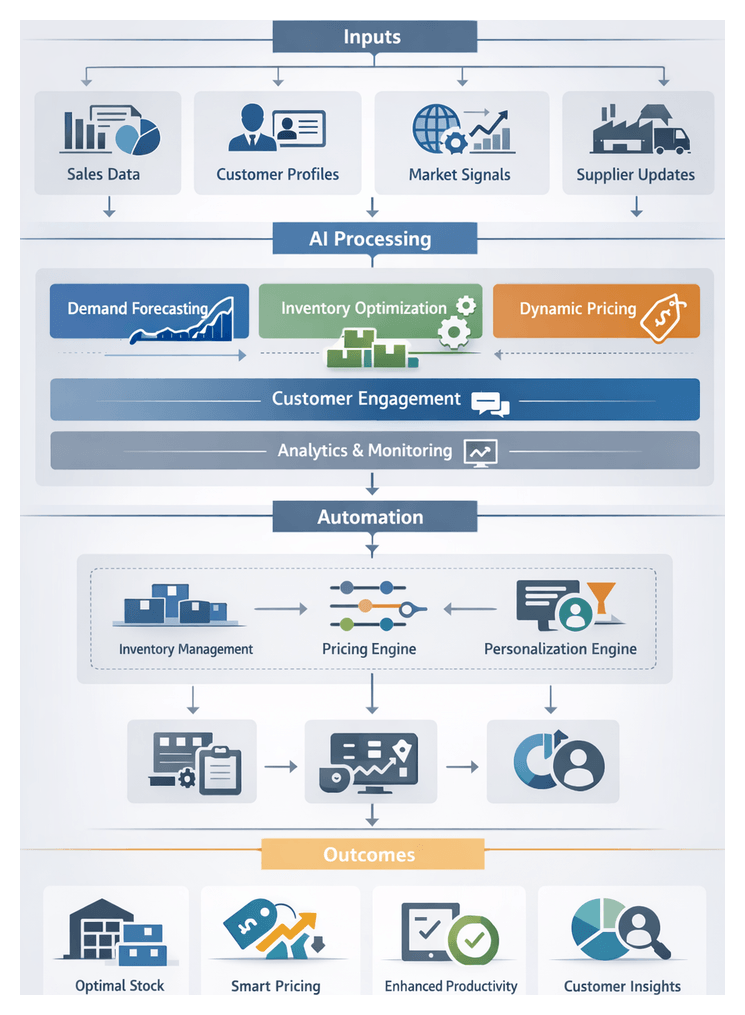
The final synthesis in an AI-driven retail sales workflow serves as a strategic capstone, transforming technical outputs into actionable intelligence. It reconciles deliverables from demand forecasting, inventory optimization, pricing engines, customer engagement systems, and monitoring dashboards into a unified narrative. This synthesis validates alignment between AI capabilities and business objectives, elevates operational findings into strategic insights, and sets the direction for ongoing governance, investment, and continuous improvement. By documenting performance achievements, lessons learned, and residual risks, the conclusion stage marks the formal handoff from project delivery to sustained operations and lays the foundation for scaling and adaptation in response to evolving market dynamics.
Deliverables typically include comprehensive reports or interactive dashboards that balance executive summaries with drill-down detail. Non-technical stakeholders gain visibility into key metrics—revenue uplift, margin expansion, forecast accuracy—while technical teams access model assumptions, data lineage, and integration logs for further optimization. A centralized knowledge base captures success factors, variance analyses, and best practices to institutionalize learning and accelerate future AI deployments.
Key Operational Outcomes
Streamlined Data Flows and Decision Automation
A unified data platform underpins end-to-end automation. Real-time ingestion of point-of-sale transactions, customer profiles, supplier updates, and external market indicators feeds anomaly detection routines and automated cleansing. Curated data populates a central data lake with versioning metadata and lineage tags. Forecasting agents retrieve these datasets to train models and publish predictions back to the platform, triggering inventory and pricing workflows without manual intervention. This closed-loop pipeline compresses processing cycles from hours to minutes and supports intraday model refreshes.
- Timestamp validation during staging ingestion.
- AI-driven data quality modules correcting outliers.
- Orchestration services assigning tasks via event triggers.
- Forecasting agents such as AgentLinkAI Forecasting Agent consuming and returning predictions.
- Inventory and pricing systems subscribing to updated forecasts.
Improved Inventory Utilization and Stock Availability
Advanced optimization engines integrate demand forecasts with lead-time profiles and safety stock policies to calculate reorder points and quantities per SKU. Automated purchase orders route to supplier APIs, while in-store allocation services rebalance stock across locations. Continuous feedback of sales and delivery performance refines future recommendations. This orchestration yields a 20 to 30 percent reduction in stockouts and a 15 to 25 percent improvement in inventory turnover, driving cost savings and revenue growth.
Dynamic Pricing Agility
Dynamic pricing engines leverage demand elasticity models, competitor price feeds, and real-time inventory data to recommend optimal prices. Pricing strategy modules define margin targets, markdown thresholds, and promotional windows. AI pricing agents issue recommendations through merchandising approval workflows, with human overrides captured in audit trails. Approved prices deploy via integrated APIs to e-commerce platforms and point-of-sale terminals. This workflow delivers margin improvements of 3 to 5 percent and enables minute-level reaction to market shifts.
Enhanced Sales Associate Productivity
AI-powered sales assistants integrate with tablets or mobile devices to surface customer context, inventory availability, and relevant promotions. Recommendation algorithms suggest complementary items or upsell offers. Associates generate digital quotes, reserve inventory, and complete transactions through POS integration, automatically logging outcomes in the customer record. This embedded guidance accelerates response times by 40 percent, raises attach rates by 10 to 15 percent, and frees staff for deeper customer engagement.
Personalized Customer Engagement at Scale
Omnichannel personalization engines aggregate behavioral signals—web activity, loyalty interactions, email responses—into segmentation models that update in near real time. Campaign orchestrators evaluate channel priority and timing rules before dispatching tailored messages via email, SMS, push notifications, or in-app banners. Integration with marketing automation platforms captures engagement metrics. This coordinated approach drives 20 to 30 percent higher conversion rates and lifts average order value by 5 to 8 percent while ensuring consistent brand experiences.
Real-Time Monitoring and Continuous Improvement
An AI-powered monitoring framework collects key performance indicators across forecasting, inventory, pricing, and engagement modules. Anomaly detection services flag deviations in forecast accuracy, stockout frequency, or latency. Automated alerts route to dashboards, email, or collaboration tools, proposing corrective actions based on historical playbooks. Feedback loops update model parameters and workflow configurations, reducing issue resolution times by up to 50 percent and fostering a culture of data-driven agility.
Strategic Impact and Alignment
The conclusion stage translates operational metrics into business value and aligns AI investment with corporate strategy. It demonstrates how forecast accuracy improvements, margin enhancements, and engagement gains contribute to revenue growth, cost leadership, and customer-centric objectives. Detailed ROI analyses and case spotlights on product categories or store clusters create a line-of-sight between AI outputs and financial outcomes.
- Performance Validation: Quantitative evidence of efficiency gains, revenue uplift, and customer engagement improvements.
- Strategic Insights: Identification of patterns, correlations, and anomalies to inform product assortments, promotional calendars, and investment priorities.
- Governance and Compliance: Documentation of decision rationales, audit trails, and system behaviors for regulatory bodies and risk committees.
- Change Management: Structured references for training refreshers, process updates, and stakeholder communications.
- Roadmap Definition: Recommended enhancements, next-phase rollouts, and exploratory pilots with clear timelines.
By embedding AI workflow outcomes within strategic planning, organizations ensure executive sponsorship, optimize resource allocation, and accelerate enterprise-wide digital transformation. Quantifying the value delivered by specific AI components strengthens vendor negotiations and informs decisions on renewals or platform extensions.
Future Adaptability and Reuse
To sustain competitive advantage, organizations define modular artifacts and standardized interfaces that support rapid adaptation for new channels, product lines, and regions. Version-controlled repositories house data pipeline templates, preconfigured AI model packages for demand forecasting, inventory optimization, dynamic pricing, and personalization, as well as orchestration blueprints and integration connectors. Governance checklists ensure compliance with data privacy and security standards.
Metadata and Documentation Best Practices
- Data dictionaries detailing schema definitions and transformation logic.
- Model specification sheets with inputs, outputs, performance metrics, and retraining criteria.
- API contracts with schemas, authentication methods, and rate limits.
- Deployment guides for container images, environment variables, and resource provisioning.
- Operational runbooks covering failure modes, escalation paths, and rollback procedures.
Embedding metadata tags within pipelines and model artifacts enables automated discovery via catalog services such as AWS Glue and Azure Data Catalog. Clear documentation speeds component selection and reduces integration risk.
Dependencies and Handoff Processes
Reusable components depend on shared services: a core data platform enforcing quality rules, a centralized feature store, a model orchestration engine for scheduling and monitoring, security frameworks for access control, and CI/CD pipelines for change management. Structured handoff sequences—from requirements intake to operational readiness—ensure new initiatives leverage existing investments. Automated validation scripts verify service availability, schema alignment, and configuration consistency.
Adaptation Scenarios and Use Cases
- New market expansion: adjust forecasting models for local seasonality and regulatory compliance.
- Product line introduction: extend feature engineering to novel attributes and retrain recommendation algorithms.
- Channel diversification: adapt messaging workflows to social commerce platforms or marketplaces.
- Flash promotions: clone promotion orchestration blueprints for dedicated SKUs and real-time monitoring.
- Partnership integrations: onboard supplier feeds and drop-ship logistics connectors without disrupting core systems.
Enablement and Governance for Reuse
Targeted enablement—including workshops on artifact catalogs, model retraining, and environment setup—combined with self-service portals and knowledge bases empowers teams to adapt workflows effectively. Adaptive learning platforms such as Salesforce Einstein and Amazon SageMaker personalize training and track adoption. A governance framework with periodic artifact reviews, semantic versioning, usage analytics, feedback mechanisms, and automated performance monitoring sustains artifact quality and prevents technical debt.
By institutionalizing modular design, metadata-driven discovery, and continuous improvement loops, retailers reduce time to market for new initiatives, maintain operational consistency, and lower total cost of ownership. This reusable AI workflow fabric empowers organizations to experiment, adapt swiftly to competitive threats, and deliver personalized customer experiences across a growing array of channels and markets.
Appendix
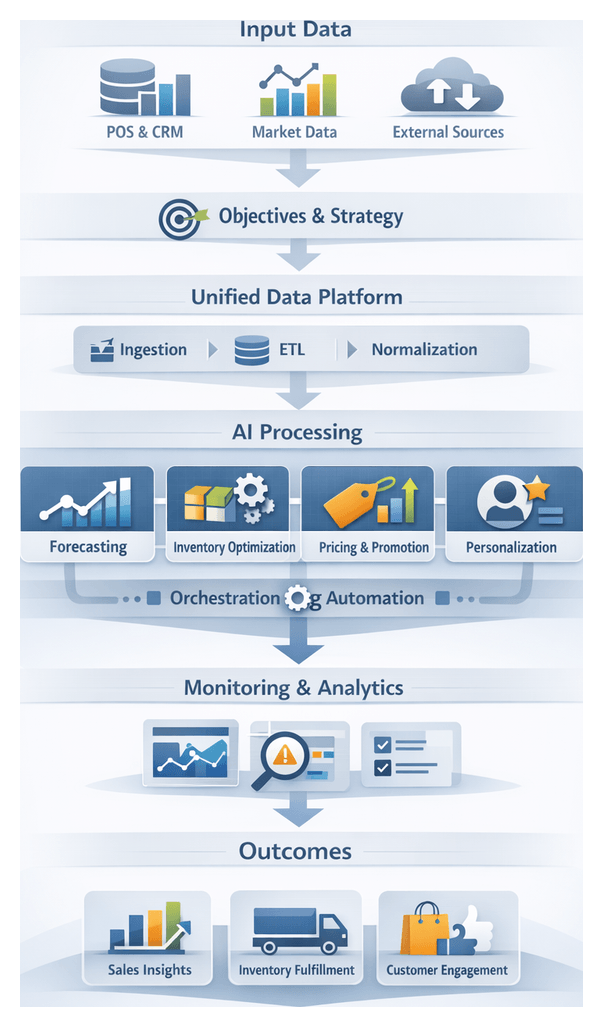
Core Concepts and Terminology
Workflow Concepts
- End-to-End Workflow: A structured sequence of interdependent stages—from objective definition and data preparation through AI execution and feedback loops—designed for consistent, repeatable retail outcomes.
- Stage: A logical grouping of related tasks with defined inputs, outputs and performance criteria.
- Task: A discrete action performed by a system, AI agent or human actor, such as data ingestion or price deployment.
- Hand-Off: The mechanism by which outputs from one task become inputs for the next, ensuring continuity and traceability.
- Dependency: A relationship indicating that a task cannot proceed until required inputs or predecessor tasks are complete.
- Orchestration Layer: The platform coordinating tasks, scheduling executions, handling retries and enforcing dependencies.
- Workflow Template: A version-controlled definition of the sequence, parameters and connectors required to replicate a workflow.
- Configuration Parameter: A variable—such as a threshold, time interval or region code—used to tailor a workflow template.
Data and Integration Concepts
- Unified Data Platform: A centralized repository ingesting, storing and exposing POS, CRM, inventory and external market data in consistent schemas.
- Data Ingestion: Extracting data from source systems—batch or streaming—and loading it into the unified platform.
- Normalization: Standardizing diverse source data into a canonical schema for downstream processes.
- Extract-Transform-Load (ETL): A workflow pattern extracting data from sources, transforming it, and loading it into target environments.
- Schema Registry: A metadata service maintaining versioned definitions of data structures and enforcing compatibility.
- API Connector: A component encapsulating authentication, request formatting and error handling for external integrations.
- Change Data Capture (CDC): Monitoring transactional systems for inserts, updates and deletes and streaming those events in real time.
- Feature Store: A centralized repository of precomputed variables used by AI models for consistent feature engineering and real-time scoring.
AI and Modeling Terminology
- AI Agent: An autonomous service applying machine learning algorithms to data inputs for specialized tasks such as forecasting or optimization.
- Forecasting Agent: Generates demand predictions based on historical sales, seasonality and promotional events.
- Inventory Optimization Agent: Computes replenishment quantities, safety stock levels and allocation rules.
- Pricing Engine: Recommends price adjustments and promotional offers using elasticity, competitor intelligence and inventory signals.
- Recommendation Engine: Ranks products or content for personalized customer engagement.
- Model Training: Fitting machine learning models to historical data, optimizing parameters and validating performance.
- Inference or Scoring: Real-time execution of a trained model to generate predictions for new data instances.
- Model Registry: A catalog of model artifacts, metadata and version history for governance and rollout management.
- Scenario Simulation: What-if analyses—varying price points, promotional intensities or supply constraints—to guide decision making.
- Anomaly Detection: Identifying data or process deviations that may indicate errors or opportunities.
Monitoring, Analytics and Governance
- Key Performance Indicator (KPI): Quantifiable metrics—forecast accuracy, stock-out rate or promotional uplift—used to assess workflow stages.
- Anomaly Alert: Notifications when monitored metrics breach thresholds, signaling intervention.
- Data Lineage: Metadata tracing the origin, transformation and consumption of data elements.
- Audit Log: Immutable records of workflow executions, data access events and configuration changes.
- Drift Detection: Monitoring model inputs and performance to detect degradation and trigger retraining.
- Governance Dashboard: A consolidated interface displaying health indicators, SLA adherence and policy compliance.
- Version Control: Tracking changes to workflow templates and model artifacts for reproducibility.
- Change Management: Processes for approving and deploying updates with minimal disruption.
- Continuous Feedback Loop: Monitoring insights and user feedback inform iterative refinements.
AI Capabilities Aligned to Workflow Stages
Mapping AI techniques and platforms to each stage ensures that forecasting, inventory, pricing, personalization and monitoring work together seamlessly.
Stage 1: Defining Sales Performance Objectives
- Predictive Modeling with time-series and regression techniques via Amazon Forecast.
- Scenario Simulation and Monte Carlo analysis through DataRobot Decision AI.
- Prescriptive Optimization balancing revenue, inventory and service levels.
- Natural Language Generation translating analytical outputs into executive summaries.
Stage 2: Building a Unified Data Platform
- Automated Data Quality checks embedded in ETL with Talend and Great Expectations.
- Schema Matching using NLP and statistical profiling.
- Entity Resolution via graph-based clustering.
- Metadata Management with Collibra for lineage and definitions.
Stage 3: Demand Forecasting
- Time-Series Modeling (ARIMA, Prophet, LSTM) on Azure Machine Learning.
- Anomaly Detection to isolate event-driven spikes.
- Probabilistic Confidence Intervals for risk-aware planning.
- Scenario Forecasting simulating pricing, marketing spend or disruptions.
Stage 4: Inventory Optimization
- Multi-Echelon Optimization with Blue Yonder Luminate.
- Dynamic Safety Stock calculations adjusting for variability.
- Reinforcement Learning agents learning long-term allocation policies.
- Real-Time Replenishment Triggers in event-driven architectures.
Stage 5: Pricing and Promotion
- Price Elasticity Modeling via Pricefx.
- Optimization under constraints using mixed-integer programming.
- Competitive Intelligence from real-time web scraping.
- Promotion Lift Analysis guiding campaign designs.
Stage 6: Sales Assistants
- Natural Language Understanding with Salesforce Einstein and Power Virtual Agents.
- Real-Time Recommendations using collaborative filtering.
- Computer Vision for shelf layout recognition.
- Contextual UI guidance and tooltips.
Stage 7: Personalized Customer Engagement
- Customer Segmentation by clustering algorithms.
- Real-Time Recommendations with Amazon Personalize.
- Decisioning Services like Adobe Target.
- Feedback-Driven Adaptation updating rules continuously.
Stage 8: Monitoring and Analytics
- Anomaly Detection Agents via Anodot.
- Process Mining with Celonis.
- BI Dashboards in Power BI or Tableau.
- Root Cause Analysis through AI-driven correlation engines.
Stage 9: Training and Change Management
- Adaptive Learning with Docebo.
- Intelligent Tutoring via IBM Watson Assistant.
- Adoption Tracking linking LMS, CRM and analytics.
- Feedback Loops correlating training outcomes with impact.
Stage 10: Scaling Across Channels
- Workflow Templates and Version Control using Apache Airflow.
- Secure API Gateways and service meshes like Istio.
- CI/CD with Terraform and Kubernetes.
- Policy Enforcement scripts for compliance.
- Observability with Prometheus and Grafana.
Variations and Edge Cases
- Retail Environments: Adapt workflows for single stores, multi-store enterprises and franchises via modular connectors and standardized templates.
- Seasonal Spikes: Preload event data, use dynamic thresholds, auto-scale forecasting compute and define manual override windows.
- Data Sparsity: Hierarchical forecasting, transfer learning, expert priors and conservative safety stocks address cold starts.
- Supply Disruptions: Integrate supplier performance data, alternative sourcing rules, contingent simulations and rapid notifications via AWS Step Functions.
- Regulatory Variations: Region-specific pricing rules, data partitioning, consent checks and compliance audits via Collibra.
- Resilience: Circuit breakers, graceful degradation to cached forecasts, automated retries in Airflow and disaster recovery clusters.
- Human-AI Exceptions: Manager approvals, human-in-the-loop reviews and escalation protocols.
- Algorithmic Variations: Options from ARIMA to LSTM, ensemble agents, single vs multi-echelon optimizers and reinforcement learning solvers.
- Organization Scale: Phased adoption, serverless for SMEs, container clusters for enterprises and flexible licensing.
- Third-Party Channels: Batch synchronization, partner-specific pricing mappings, anonymization and usage restrictions.
- Privacy and Consent: Real-time validation of consent flags, fallback content, suppression lists and audit logs.
- Data Quality and Latency: Quality scoring agents, latency-aware orchestration, fallback models and end-to-end monitoring.
- Model Drift: Automated drift alerts, adaptive retraining pipelines, shadow deployments and version lineage documentation.
- Localization: Multi-language packs, dynamic currency conversion, local holiday calendars and regional data processing.
AI Tools and Resources
Data Ingestion and Integration
- Fivetran – Fully managed data connectors automating extraction and loading.
- Talend – Open integration platform for ETL, data quality and governance.
- Informatica – Suite of data integration and master data management tools.
- Apache NiFi – Scalable data flow automation for real-time streaming.
- AWS Glue – Serverless ETL for data discovery, cataloging and transformation.
- Azure Data Factory – Hybrid data movement and transformation service.
- Apache Kafka – Distributed event streaming platform.
- AWS Kinesis – Managed real-time streaming data service.
Unified Data Platforms
- Snowflake – Cloud data platform for structured and semi-structured data.
- Google BigQuery – Serverless data warehouse with petabyte-scale analytics.
- Azure Synapse Analytics – Integrated analytics combining data warehousing and big data.
- Databricks Lakehouse – Unified analytics on Apache Spark with collaborative notebooks.
- Hadoop Ecosystem – Distributed storage and processing framework.
Machine Learning and Forecasting
- Amazon Forecast – Managed demand forecasting service.
- Azure Machine Learning – Enterprise ML model development and deployment.
- Google Cloud AI Platform – End-to-end ML services.
- DataRobot Decision AI – Automated ML with governance and monitoring.
Inventory Optimization
- Blue Yonder Luminate – AI-powered supply chain and replenishment suite.
- Oracle Inventory Management – ERP module for real-time inventory visibility.
- Relex Solutions – AI-driven forecasting and replenishment.
- SAS Inventory Optimization – Constraint-based inventory analytics.
- Oracle NetSuite ERP – Cloud ERP with inventory control and order management.
Pricing and Promotion
- Pricefx – Cloud pricing platform for dynamic pricing and rebates.
- PROS Pricing – AI-based pricing and revenue optimization.
- DynamicPricing.ai – Real-time pricing engine.
- SAP CPQ – Configure-price-quote solution.
- Revionics – Markdown optimization and pricing analytics.
Personalization and CRM
- Salesforce CRM – Customer relationship management with embedded AI.
- Salesforce Einstein – Predictive analytics and NLP within Salesforce.
- Microsoft Dynamics 365 AI – Customer insights and automation.
- Amazon Personalize – Real-time recommendation service.
- Google Recommendations AI – Managed recommendation system.
- Dynamic Yield – Omnichannel personalization platform.
- Adobe Target – A/B testing and personalization.
Sales Assistant and Conversational AI
- IBM Watson Assistant – Chatbots and voice assistants for workflows.
- Microsoft Power Virtual Agents – Low-code chatbot creation.
- AgentLink AI Retail Assistant – In-store AI assistant for recommendations and stock lookups.
Workflow Orchestration and Automation
- Apache Airflow – Open source workflow scheduling and monitoring.
- Kubeflow Pipelines – Kubernetes-native ML workflow orchestration.
- AWS Step Functions – Serverless state machines coordinating services.
- Azure Logic Apps – Low-code integration workflows.
- IBM Watson Orchestrate – AI-driven business process coordination.
Analytics and Visualization
- Tableau – Interactive data visualization platform.
- Microsoft Power BI – Cloud analytics with natural language queries.
- Qlik Sense – Associative data indexing and AI insights.
- Looker – Governed data modeling and embedded BI.
Collaboration and Documentation
- Slack – Messaging platform with workflow integrations.
- Microsoft Teams – Chat, meetings and file sharing hub.
- Atlassian Confluence – Knowledge management and documentation.
- Atlassian Jira – Issue and project tracking system.
Training and Learning
- Docebo – LMS with AI-powered content recommendations.
- Coursera for Business – Enterprise learning platform.
- Degreed – Skills tracking and personalized learning.
- EdCast – AI-curated microlearning content.
- Cornerstone OnDemand – Talent management suite.
Monitoring and Observability
- Prometheus – Time-series metrics collection and alerting.
- Grafana – Interactive dashboards for metrics visualization.
- Datadog – Cloud monitoring and security platform.
- Splunk – Machine data analytics and monitoring.
- PagerDuty – Incident management and alert routing.
- Opsgenie – Incident response orchestration.
The AugVation family of websites helps entrepreneurs, professionals, and teams apply AI in practical, real-world ways—through curated tools, proven workflows, and implementation-focused education. Explore the ecosystem below to find the right platform for your goals.
Ecosystem Directory
AugVation — The central hub for AI-enhanced digital products, guides, templates, and implementation toolkits.
Resource Link AI — A curated directory of AI tools, solution workflows, reviews, and practical learning resources.
Agent Link AI — AI agents and intelligent automation: orchestrated workflows, agent frameworks, and operational efficiency systems.
Business Link AI — AI for business strategy and operations: frameworks, use cases, and adoption guidance for leaders.
Content Link AI — AI-powered content creation and SEO: writing, publishing, multimedia, and scalable distribution workflows.
Design Link AI — AI for design and branding: creative tools, visual workflows, UX/UI acceleration, and design automation.
Developer Link AI — AI for builders: dev tools, APIs, frameworks, deployment strategies, and integration best practices.
Marketing Link AI — AI-driven marketing: automation, personalization, analytics, ad optimization, and performance growth.
Productivity Link AI — AI productivity systems: task efficiency, collaboration, knowledge workflows, and smarter daily execution.
Sales Link AI — AI for sales: lead generation, sales intelligence, conversation insights, CRM enhancement, and revenue optimization.
Want the fastest path? Start at AugVation to access the latest resources, then explore the rest of the ecosystem from there.