

AI Driven Predictive Maintenance An End to End Workflow for Transportation and Logistics
To download this as a free PDF eBook and explore many others, please visit the AugVation webstore:
Introduction
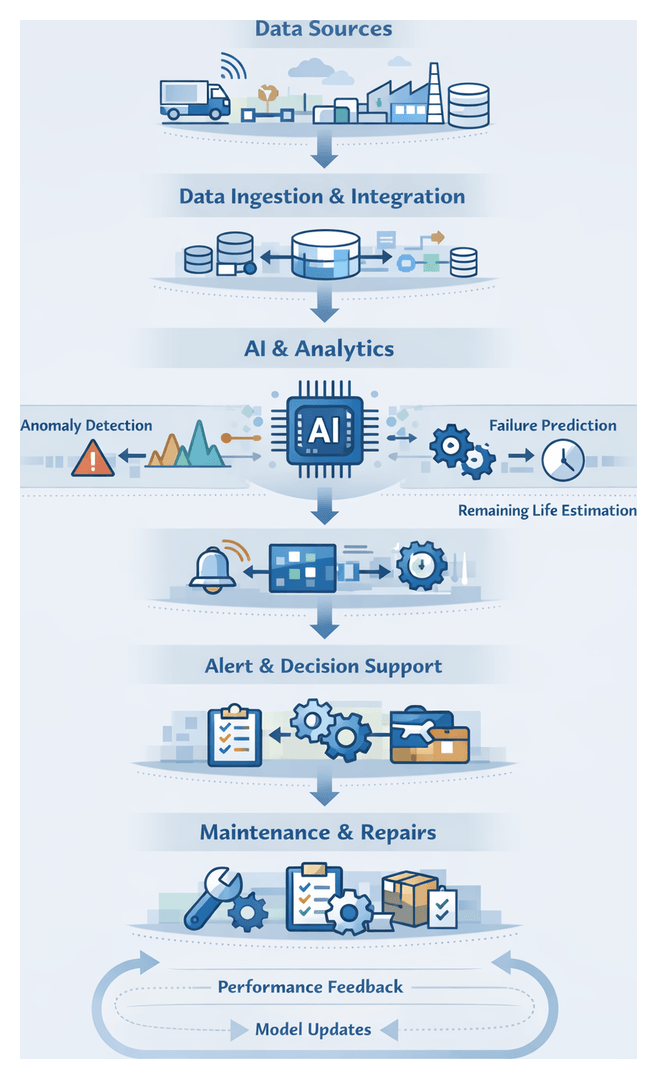
Overview of Predictive Maintenance Challenges
Asset-intensive operations in transportation and logistics face mounting pressures from unplanned equipment failures, escalating maintenance costs, data silos, and growing technical complexity. Traditional reactive repairs and fixed-interval servicing are no longer sufficient to sustain high fleet availability, control expenditures, and meet stringent safety and compliance requirements. A shift to AI-driven predictive maintenance can address these systemic issues by leveraging real-time condition monitoring, advanced analytics, and automated decision support.
- Unplanned Equipment Failures and Their Impact
- Operational disruptions such as missed delivery windows, network bottlenecks, and emergency maintenance that divert resources
- Financial penalties from idle assets, overtime labor, expedited parts procurement, and increased insurance premiums
- Elevated safety and compliance risks, including accident potential, regulatory fines, and workforce morale challenges
- Rising Costs and Resource Inefficiencies
- Over-servicing due to time-based intervals that ignore actual equipment condition
- Under-servicing that misses emerging faults, leading to catastrophic breakdowns
- Spare parts imbalances causing excess carrying costs or stockouts
- Poorly coordinated technician schedules, idle time, and emergency call-outs
- Data Fragmentation and Visibility Gaps
- Siloed telemetry in telematics platforms, CMMS records, and ERP schedules
- Inconsistent naming conventions, sampling rates, and data formats
- Latency from batch uploads and manual reconciliations that hinder real-time insight
- Increasing Asset Complexity
- Mixed mechanical, electronic, and software stacks with new failure modes
- Frequent firmware updates, networked control systems, and cybersecurity considerations
- Vendor-specific diagnostics and rapid obsolescence of sensors and control modules
Without timely warnings or a holistic view of asset health, fleets can experience up to 60 percent of repair costs from reactive maintenance. Unplanned downtime drives spare parts inflation, undermines service reliability, and erodes customer trust. To reverse these trends, organizations must establish the technical and organizational foundations for predictive maintenance, aligning data, processes, and stakeholder objectives toward a proactive model.
Prerequisites for Predictive Maintenance
Successful deployment of AI-driven predictive maintenance depends on a clear understanding of current maintenance challenges and the assembly of key inputs. These prerequisites create a common context for diagnostics, solution design, and performance measurement.
- Historical Maintenance Records: Detailed work order logs, inspection reports, repair durations, corrective actions, and cost breakdowns for labor, parts, and downtime
- Asset Utilization Metrics: Usage patterns by vehicle or equipment type (mileage, operating hours, load cycles), KPIs such as mean time between failures (MTBF) and overall equipment effectiveness (OEE), and environmental conditions impacting degradation
- Data Infrastructure: IoT networks or edge computing platforms for real-time data capture, centralized repositories, data governance frameworks for quality and lineage, and integration interfaces with ERP, finance, and scheduling systems
- Organizational Readiness: Stakeholder alignment across operations, maintenance, IT, and finance; change management processes for new workflows; and skill assessments to identify gaps in analytics and digital literacy
With these inputs and conditions in place, a predictive maintenance initiative can quantify business impact, prioritize high-value assets, and define clear success criteria for improved uptime, cost efficiency, and compliance.
AI-Driven Predictive Maintenance Workflow
An end-to-end predictive maintenance solution integrates sensors, edge computing, cloud platforms, analytics modules, orchestration engines, and human operators. Seamless data flows and clearly defined handoffs ensure that insights reach decision makers and field crews with minimal latency and maximum context.
Data Acquisition and Edge Ingestion
Sensor nodes capture vibration, temperature, pressure, and GPS signals at configurable intervals. Edge gateways aggregate these streams, perform initial filtering, and forward events to a central broker. Key components include:
- IoT device management via Azure IoT Central or AWS IoT Core
- On-device noise reduction and anomaly flagging with TensorFlow Lite or PyTorch Mobile
- Publish-subscribe infrastructure using Apache Kafka or MQTT brokers
- Operational dashboards monitoring ingestion health, dropped messages, and gateway performance
Field technicians validate sensor installations and signal quality, while network engineers ensure secure, low-latency connectivity through VPN tunnels and firewall configurations.
Data Integration and Central Processing
Edge and operational data converge in a unified platform for schema validation, metadata enrichment, and alignment with maintenance and scheduling records. Integration workflows leverage:
- Snowflake or Azure Data Factory for ETL/ELT pipelines
- AI-driven data quality modules that detect and correct missing timestamps, inconsistent units, and duplicates
- Metadata catalogs tracking data lineage and version history for compliance and model explainability
- Asset hierarchies managed in systems like IBM Maximo or SAP EAM, linked by data stewards
Shared dashboards in Microsoft Power BI or Tableau allow cross-functional teams to review ingestion metrics, quality scores, and exception reports.
AI-Enabled Monitoring and Forecasting
With a clean, unified dataset, analytics services generate features, train models, and perform inference to detect anomalies, forecast failures, and estimate remaining useful life (RUL).
- Anomaly detection engines ingest streaming data to set dynamic thresholds, recognize multivariate pattern deviations, and enrich alerts with contextual insights
- Predictive models use feature synthesis pipelines and ensemble strategies—powered by platforms such as Amazon SageMaker or Google Cloud AI Platform—to estimate component RUL with Bayesian uncertainty bounds
- Explainable AI techniques, including SHAP analysis, reveal key drivers behind failure forecasts
Machine learning engineers and DevOps teams maintain CI/CD pipelines to register, deploy, monitor, and retrain models, ensuring forecast accuracy and responsiveness to data drift.
Alerting and Decision Support
Prediction outputs feed an alerting engine that correlates failure probabilities with asset criticality and operational context to prioritize notifications. Key features include:
- Scoring logic combining model confidence, business impact, and current fleet utilization
- Multi‐channel notifications via email, SMS, or in-app alerts within IBM Maximo or Oracle Enterprise Asset Management
- Interactive dashboards showing geospatial maps, trend charts, and drill-down views of sensor anomalies
- Decision support assistants recommending optimal repair windows based on technician availability, parts inventory, and service agreements
Maintenance planners coordinate parts reservations and field crew assignments, documenting handoffs in the CMMS and tracking collaboration through integrated ticketing systems.
Maintenance Orchestration and Execution
Automated orchestration transforms prioritized alerts into actionable work orders. The orchestration engine:
- Generates structured work orders specifying tasks, tools, and safety procedures
- Optimizes technician schedules by matching skills, certifications, and proximity
- Manages parts requisitions, inventory checks, and purchase order workflows
- Guides mobile field apps to capture completion metrics, photos, and sign-off data
Supervisors monitor job statuses in real time, intervening to resolve delays or reassign tasks. The CMMS remains the single source of truth for maintenance activities and compliance records.
Continuous Improvement and Governance
Post-maintenance data—actual downtime, repair durations, parts consumption, and subsequent performance—feeds back into analytics to validate predictions and refine processes.
- Outcome analytics compare predicted and actual failure events to measure model precision, recall, and cost benefits
- Retraining pipelines update feature weights and deploy improved models via automated MLOps workflows
- Process mining uncovers bottlenecks and handoff delays in orchestration logs
- Governance frameworks enforce model versioning, auditability, encryption, access controls, and compliance with standards such as ISO 27001 and GDPR
- High-availability architectures and disaster recovery plans ensure uninterrupted monitoring and inference capabilities
This iterative cycle fosters a data-driven culture, continuously enhancing prediction accuracy, asset uptime, and maintenance productivity.
Asset Assessment and Integration
The asset assessment stage defines the fleet’s single source of truth, producing structured deliverables that guide sensor deployment, monitoring configurations, and analytics workflows.
Core Deliverables
- Asset Registry and Metadata Catalog: Central repository of unique identifiers, manufacturer specifications, maintenance history pointers, and location hierarchies with a governed schema
- Criticality Matrix: Probability of failure and operational impact scores, resulting in high, medium, or low risk classifications
- Prioritized Asset List: Ranked assets by descending risk level for focused monitoring and resource allocation
- Risk Profiles and Failure Likelihood: Quantitative scores, confidence intervals, and documented failure modes for anomaly detection calibration
- Data Quality Audit Reports: Automated validation results highlighting missing or inconsistent attributes and remediation guidance
Dependencies and Integration Patterns
- Data Sources: ServiceNow CMDB, IBM Maximo, Computer-Aided Design repositories, telematics feeds, and vendor supply chain systems
- Infrastructure: Cloud storage (AWS S3, Azure Blob Storage), ETL tools (Informatica PowerCenter, Talend), and message brokers (Apache Kafka)
- Stakeholders: Maintenance planners, reliability engineers, IT operations, data governance councils, and business leadership
Handoff Mechanisms
- API-Driven Exchange: RESTful endpoints delivering JSON payloads of asset metadata, criticality scores, and location, secured via OAuth2
- Scheduled Batch Exports: Nightly ETL jobs exporting CSV or Parquet snapshots with version tags to a shared data lake
- Event Notifications: Message topics broadcasting asset onboarding or risk score updates to sensor calibration engines and analytics orchestrators
- Documentation and Training: Data dictionaries, API specifications, sample queries, process flows, and workshops to ensure proper interpretation and use
- Feature Engineering Integration: Tagging time series data with asset risk levels and metadata to enable dynamic thresholding in anomaly detection models
- Governance and Version Control: Change control pipelines for schema definitions and registry snapshots, with automated tests and sign-off gates
By defining clear deliverables, rigorously mapping dependencies, and establishing robust handoff protocols, organizations ensure that sensor deployment, data integration, and analytics stages operate on a trusted, prioritized view of the asset fleet.
Chapter 1: Asset Inventory and Criticality Assessment
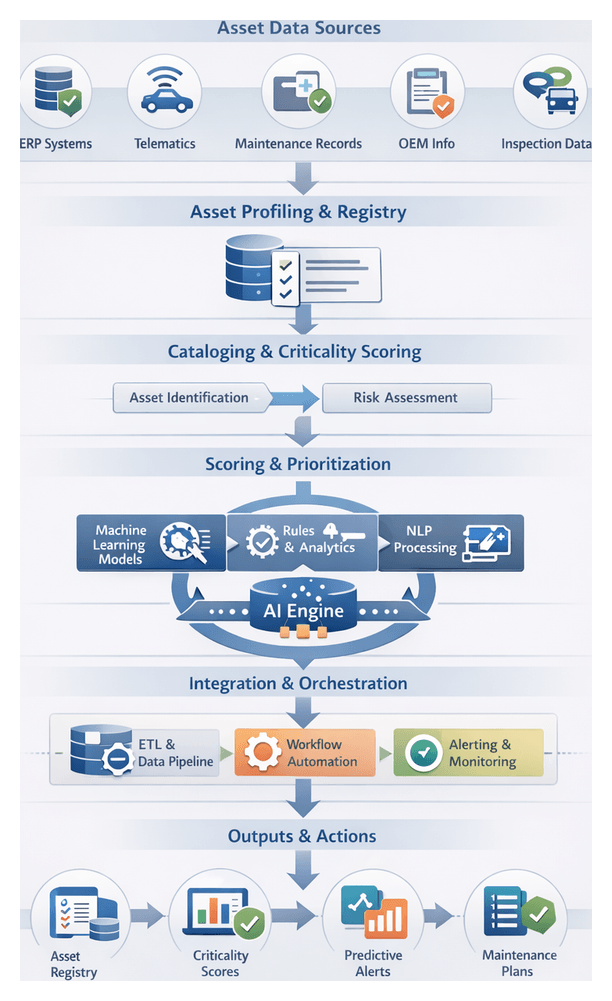
Asset Profiling and Registry
Purpose and Objectives
Establishing a comprehensive, authoritative inventory of fleet assets is the foundation of any predictive maintenance program. Asset profiling creates a single source of truth by uniquely identifying vehicles, equipment, and components, capturing manufacturer details, model specifications, installation dates, warranty information, and maintenance histories. It standardizes naming conventions and taxonomy, maps hierarchical relationships among assets and subcomponents, and aligns records with organizational structures and operational zones. Governed by policies for data stewardship, this stage ensures that machine learning models, sensor deployments, and real-time analytics operate on consistent, high-fidelity inputs.
Required Inputs
- Enterprise asset masters from ERP systems such as SAP or Oracle, CMMS platforms like ServiceNow or IBM Maximo, and configuration databases.
- Maintenance histories, including work orders, service logs, failure reports, and warranty claims.
- Telematics and usage data—mileage, engine hours, load cycles, and environmental metrics.
- Vendor and OEM documentation, technical manuals, and parts catalogs.
- Physical audit reports and field inspection records.
- Geospatial data—GPS coordinates, route assignments, depot locations.
- Regulatory certificates, inspection logs, and compliance records.
- Financial and procurement records covering acquisition costs, depreciation, and spare inventory.
Prerequisites
- Executive sponsorship and cross-functional alignment among operations, maintenance, IT, and finance.
- A data governance framework defining ownership, access controls, update schedules, and audit trails.
- Standardized taxonomy and naming conventions for asset classes, hierarchies, and attributes.
- Master data management tools or registries with API access to downstream systems.
- Secure integration capabilities connecting ERP, CMMS, telematics, and inspection applications.
- On-site verification planning with field teams and mobile data capture tools.
- Quality assurance criteria for data completeness, accuracy, and timeliness.
- Change management processes for bulk imports, overrides, and incremental updates.
Cataloging and Criticality Scoring
High-Level Workflow
- Asset discovery and onboarding
- Metadata enrichment and verification
- Risk factor assessment
- Criticality algorithm execution
- Score review and adjustment
- Registry publication and handoff
Asset Discovery and Onboarding
New and existing assets are identified through system scans and manual input, consolidating records from procurement databases, vendor catalogs, and ERP. Basic identifiers—serial numbers, acquisition dates, manufacturer details—populate the registry.
Metadata Enrichment and Verification
The registry integrates with transportation management, GPS fleet tracking, and CMMS systems to append operational schedules, maintenance histories, and route profiles. Automated validation flags missing or conflicting entries for human review.
Risk Factor Assessment
Rule-based and statistical checks evaluate factors such as failure frequency, mean time between failures, environmental exposure, and maintenance backlog. A risk engine normalizes these factors against fleet baselines to produce preliminary risk vectors.
Criticality Algorithm Execution
Machine learning models—trained on historical incidents—combine risk vectors with operational impact metrics (utilization rates, downtime costs) to generate composite criticality scores.
Score Review and Adjustment
Maintenance planners and asset managers inspect score breakdowns via a decision support interface, adjust weightings for specific contexts, and annotate rationales prior to finalization.
Registry Publication and Handoff
Validated scores update the central asset registry. Downstream systems subscribe to registry events via an event-driven message bus, triggering sensor deployment orchestration and predictive analytics modules.
Integration and Orchestration
An integration layer connects ERP, CMMS, fleet management, and data science platforms through APIs and batch extracts. A workflow orchestration engine monitors milestones, retries failed tasks, and logs execution details for auditability.
Exception Handling and Governance
- Central exception management triages data quality issues, routing critical failures to maintenance operations and minor issues to data stewards.
- Audit dashboards track model versions, rule sets, user overrides, and scoring trends.
- Scheduled rescoring (monthly or quarterly) and near-real-time scoring modes accommodate both stable and dynamic assets.
AI-Driven Risk Evaluation and Prioritization
Machine Learning Models for Predictive Risk Scoring
Supervised algorithms—gradient boosting machines, random forests, neural networks—map historical failure events to asset features and telemetry. Time-series models capture sequential dependencies, while unsupervised methods identify emerging anomaly patterns. Feature selection highlights key predictors, guiding both model transparency and condition monitoring.
Rule Engines and Knowledge Graphs
Domain rules enforce safety thresholds in real time and overlay knowledge graphs that link assets to manuals, part hierarchies, and service bulletins. Hybrid scoring merges statistical outputs with deterministic rules to produce comprehensive risk indices.
Natural Language Processing for Maintenance Logs
NLP techniques extract structured data—failure descriptions, symptoms, corrective actions—from free-text work orders. Named entity recognition and sentiment analysis surface latent risks and recurring issues.
Feature Store and Data Infrastructure
- Batch and streaming pipelines ingest sensor streams, maintenance histories, and operational logs to compute rolling aggregates and statistical summaries.
- Data quality checks detect missing values, outliers, and schema drift.
- Access controls ensure that sensitive features are visible only to authorized systems and users.
MLOps and Model Management
An MLOps platform supports automated training pipelines, a model registry, and CI/CD for machine learning. Retraining triggers on performance degradation or new failure data, maintaining model accuracy as conditions evolve.
Scoring and Orchestration Engines
High-throughput scoring engines process thousands of assets per hour, while low-latency APIs enable on-demand assessments. Orchestration coordinates scoring jobs, resource allocation, and integration with rule engines.
Explainable AI and Decision Support
Explainability tools such as SHAP and LIME quantify feature contributions to risk scores. Interactive dashboards visualize risk concentrations, score trends, and recommended maintenance actions, integrating GIS mapping for geographic context.
Scalability and High Availability
Container orchestration platforms like Kubernetes deploy scoring and preprocessing components across clusters. Auto-scaling and failover configurations ensure consistent throughput and resilience under varying loads.
Outputs, Dependencies, and Handoffs
Primary Deliverables
- Comprehensive Asset Registry with unique identifiers, manufacturer specifications, lifecycle status, and digital twin links.
- Criticality Matrix ranking assets by operational impact, failure probability, and cost implications.
- Asset Metadata Catalog defining required fields, value ranges, and unit conventions for data schemas.
- Risk Evaluation Report summarizing AI-derived scores, sensitivity analyses, and model attributions.
- Data Quality and Completeness Analysis identifying gaps, inconsistencies, and remediation tasks integrated with issue-tracking tools.
Data Source Dependencies
- ERP systems (SAP, Oracle) and CMMS platforms (ServiceNow, IBM Maximo)
- Fleet telematics and usage records
- Vendor OEM catalogs and technical datasheets
- Regulatory registries and compliance databases
Platform Dependencies
- ETL frameworks (Informatica, Talend, Apache NiFi)
- Automated ML platforms (DataRobot) and custom AI frameworks
- Metadata repositories (Apache Atlas, Collibra)
- Version control systems and identity/access management layers
Organizational Dependencies
- Cross-functional governance boards and steering committees
- Maintenance engineering and reliability teams
- IT and data operations for infrastructure and security
- Operations and fleet managers for usage validation
Handoff Protocols
Sensor Deployment
- Asset location, environmental context, and priority tiers guide sensor selection and scheduling.
- Data contracts specify payload structures and serialization formats for configuration tools.
Edge Processing and Data Ingestion
- Lookup tables map sensor IDs to asset identifiers and criticality tiers on edge nodes.
- Filtering and aggregation rules optimize bandwidth and highlight key signals.
- Metadata tags propagate with each data packet for routing and indexing.
Data Integration and Quality Management
- Schema registration in the data catalog enforces validation of incoming streams.
- Reference data synchronization updates asset metadata and criticality scores.
- Automated quality rules use asset attributes to flag anomalies and trigger reconciliation.
Governance and Compliance
- Audit trails record registry modifications, user actions, and justification codes.
- Access control lists synchronize with identity management for new or retired assets.
- Regulatory reporting feeds transmit metadata to external agencies and compliance dashboards.
Best Practices
- Maintain standardized, machine-readable data contracts for all handoff artifacts.
- Implement automated notification workflows to alert teams of new registry versions.
- Apply semantic versioning and changelogs to capture enhancements and corrective actions.
- Enforce sign-off gates with governance and engineering stakeholders before deployment.
- Leverage sandbox environments and CI/CD pipelines for end-to-end handoff testing.
- Document APIs, runbooks, and user guides in a centralized knowledge base.
Chapter 2: Sensor Infrastructure Design and Deployment
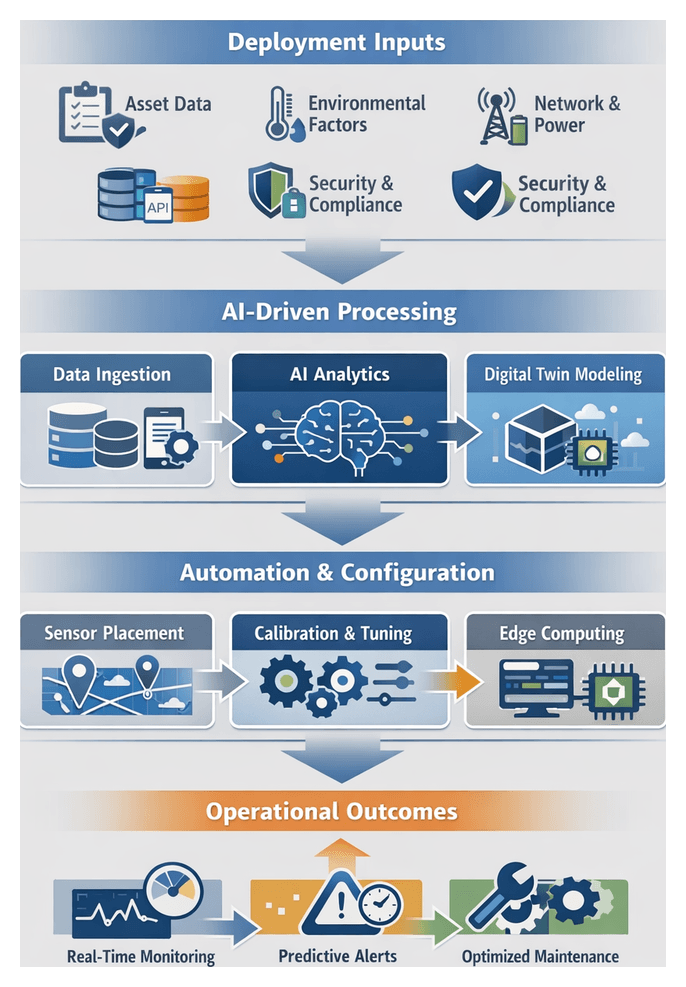
Stage Objectives and Deployment Inputs
The sensor infrastructure design and deployment stage establishes the foundation for real-time condition monitoring in transportation and logistics. Its purpose is to translate strategic maintenance goals—such as minimizing unplanned downtime, extending asset life, and optimizing repair schedules—into a concrete deployment plan ensuring that analytics and automation workflows receive high-quality, consistent data.
Key objectives include:
- Alignment with Maintenance Use Cases: Select and place sensors to support predictive scenarios—bearing vibration monitoring, engine temperature trending, hydraulic pressure fluctuations.
- Data Quality and Continuity: Define sampling rates, resolution thresholds, and retention policies for granular, historical context.
- Risk Mitigation: Standardize installation processes, failure-mode assessments, and fallback procedures to minimize rollout disruptions.
- Scalability and Flexibility: Architect a modular ecosystem that accommodates diverse assets, protocols, and future expansion.
- Security and Compliance: Integrate encryption, authentication, and regulatory requirements (e.g., FMCSA, IECEx) into hardware and network design.
Before procurement and detailed planning, projects must gather inputs across technical, operational, and organizational domains:
- Asset inventory with criticality scores and maintenance history
- Operational profiles: duty cycles, route types, ambient conditions
- Environmental surveys: temperature extremes, humidity, dust, vibration zones
- Network topology: 4G/5G coverage, LoRaWAN gateways, Wi-Fi access, satellite links
- Power and edge compute requirements: vehicle wiring, battery capacity, gateway specs
- Data integration and security policies: API specifications, protocols (MQTT, OPC UA), encryption standards
- Regulatory and safety standards: emission monitoring, explosive-atmosphere directives, electronic logging devices
- Procurement approvals and budget constraints
- Stakeholder roles, governance models, change-management plans
- Deployment timelines and sequencing guidelines
Sensor Placement and Configuration Workflow
A structured workflow ensures optimal sensor coverage, robust data capture, and seamless integration into analytics platforms. Key stages include:
Planning and Stakeholder Alignment
Project leads convene maintenance engineers, reliability analysts, IT architects, and operations managers to review criticality data, environmental constraints, and network requirements. Formal sign-off gates define roles, responsibilities, and timelines, reducing rework.
Site Survey and Asset Mapping
Field engineers and reliability specialists assess physical locations, environmental factors, and existing network and power access. Mobile survey apps such as PTC ThingWorx Navigate capture photographs, GPS coordinates, and ambient measurements. Survey outputs feed sensor modeling and risk analysis.
Sensor Selection and Placement Modeling
Engineering teams evaluate candidates by measurement range, ingress protection, edge computing capabilities, supported protocols, and power options. Placement optimizers like AWS IoT SiteWise Edge simulate field-of-view, signal attenuation, and interference to propose mounting positions that maximize data fidelity.
Network Architecture and Data Flow Design
Network architects define data flow diagrams showing connections from sensors to edge gateways and central platforms. Best practices include traffic segregation via VLANs or private APNs, redundant paths for critical sensors, device-level authentication, and QoS policies. Peer reviews ensure compliance with IT standards and security requirements.
Physical Installation and Configuration
Under maintenance-engineer guidance, technicians mount sensors with vibration-damping brackets or insulated enclosures, secure cabling, connect power, and provision devices using mobile tools or centralized platforms such as Azure IoT Central. Standardized templates define data formats, sample rates, and filter settings.
Calibration and Validation
Calibration teams apply reference signals and stress tests to verify accuracy and stability across operating conditions. AI-enhanced assistants compare live outputs to baselines, adjusting offsets and gains. Validation encompasses zero-point/spread calibration, noise and drift checks, and end-to-end data path verification.
Integration with Data Ingestion Platform
Configuration teams export metadata—location, type, units—to data catalogs and update ingestion pipelines in platforms like AWS IoT SiteWise or Apache Kafka. Schema mappings, retention policies, and security layers (TLS, token management) are defined. Automated scripts onboard new sensor streams into real-time dashboards.
Operational Readiness and Continuous Improvement
A readiness checklist verifies installation, calibration, connectivity, and documentation. Training familiarizes operations staff with maintenance procedures and health-check routines. Post-deployment, reliability engineers analyze signal patterns to refine placements and sampling settings, feeding updates back into configuration management.
AI-Enabled Configuration and Calibration
Embedding AI into configuration and calibration streamlines setup, optimizes performance, and maintains data quality via adaptive, automated processes.
Adaptive Sampling Rate Optimization
Machine learning conducts spectral analysis on historical vibration, temperature, or pressure traces to identify key frequency components. Reinforcement learning agents then propose dynamic sampling schedules aligned with operating context—engine load or ambient temperature—while respecting bandwidth and power limits.
Automated Sensor Calibration
- Model-Based Calibration: Digital twin simulations generate synthetic reference data. ML models learn mappings between raw readings and true values, auto-estimating offset and gain.
- In-Situ Self-Calibration: Neural networks on edge gateways compare overlapping streams—e.g., dual temperature probes—to infer drifts and apply real-time corrections.
- Federated Learning: Calibration adjustments from individual vehicles aggregate in a federated framework, refining global models without sharing raw data.
Edge-Based Data Quality Validation
Lightweight anomaly-detection models at the edge validate streams before cloud ingestion. Solutions like Edge Impulse deploy TinyML classifiers on microcontrollers; NVIDIA Jetson Nano runs CNNs on multi-axis accelerometer data. Detected anomalies trigger self-tests, calibration resets, or maintenance alerts.
Digital Twin-Driven Configuration
Platforms such as Azure Digital Twins build virtual replicas of assets and environments. Genetic algorithms and Bayesian optimization explore sensor placement and orientation, generating calibration curves that preempt thermal gradients or vibration resonances. Profiles export to IoT edge managers for deployment.
Continuous Calibration and Drift Compensation
Time-series forecasting models predict gradual sensor drift by comparing live data to rolling baselines. Exceeding thresholds triggers automated recalibration—remote scale-factor adjustments or technician instructions. Continuous monitoring also retrains models to evolving conditions.
Integration with Device Management Platforms
Within AWS IoT Core or Google Cloud IoT Core, AI agents assess metrics—noise floors, packet loss, anomaly frequencies—to schedule calibration profile rollouts. Staged batches and A/B testing evaluate impacts on data fidelity and network utilization.
Roles of Supporting Systems and Best Practices
- Configuration Management Databases store baseline parameters and logs.
- Digital Twin frameworks enable virtual optimization.
- IoT device registries manage credentials and firmware.
- MLOps platforms handle model versioning and deployment.
- Edge orchestration environments run containerized AI inference.
Human expertise remains essential for oversight. Interactive dashboards present AI recommendations—offset corrections, sampling adjustments—for engineer review and authorization. Operator feedback refines training data, reducing false alarms over time.
Deployment Artifacts, Dependencies, and Handoffs
At completion, the sensor infrastructure stage delivers artifacts, defines dependencies, and executes formal handoffs to data engineering and edge analytics teams.
Key Deployment Artifacts
- Network Topology: Schematics of sensor placements, gateways, and segments. Diagrams from EdgeX Foundry or Visio stencils with VLAN IDs.
- Configuration Templates: JSON/YAML files for provisioning—sampling rates, packet formats, encryption. Snippets for Microsoft Azure IoT Edge and AWS IoT Greengrass.
- Calibration Logs: Reports of reference measurements, drift corrections, and validation statuses.
- Asset-to-Sensor Registry: Tables linking sensor IDs to assets with locations and serial numbers.
- Security Credentials: Firewall rules, certificates, VPN endpoints documented in secret management services.
- Installation Checklists: Signed forms, torque settings, cable routing, geotagged inspection photos.
- Metadata Schema: Definitions for asset IDs, locations, sensor types, and data quality tags.
System and Infrastructure Dependencies
- Asset management and ERP systems (SAP, Oracle) for master data.
- IT networks for bandwidth provisioning, VLAN segmentation, and gateway connectivity.
- Mechanical specifications for mounting and power sources.
- Security frameworks (ISO 27001, NERC CIP) for encryption and access control.
- Vendor SLAs for firmware, calibration certificates, and support.
- Operational constraints: deployment windows, seasonal cycles, change-management board approvals.
Integration Points and Handoffs
- Commissioning Package: Configuration files, calibration logs, and topology diagrams in version-controlled repositories.
- Data Ingestion Configuration: Connectors and scripts for Apache NiFi or StreamSets Data Collector.
- Edge Orchestration: Deployment manifests for containerized preprocessing, integrated with Kubernetes or Docker Swarm.
- Metadata Registration: Automated ingestion into data catalogs for lineage and discovery.
- Security Handoff: Firewall changes, tokens, and certificates coordinated with security operations.
- Training and Readiness: Workshops, runbooks, and incident escalation paths for field and operations staff.
Quality Assurance and Change Management
- Artifact Review Board ensures deliverables meet naming, schema, and security standards.
- Automated CI/CD pipelines validate JSON/YAML schemas and configuration consistency.
- End-to-end connectivity tests record latency and packet loss metrics.
- Formal sign-offs by engineering leads; deviations managed via change requests.
- Git repositories track versions and peer reviews; Change Advisory Board evaluates major updates.
Best Practices for Artifact Management
- Standardize naming: include environment, asset class, and date (e.g., PROD_VEH_ENG_20260215_NETTOPO.json).
- Centralize storage in artifact management platforms with access controls and retention policies.
- Embed metadata tags for searchability and integration with data catalogs.
- Conduct quarterly audits to retire or archive deprecated artifacts.
By defining clear objectives, executing a rigorous placement and configuration workflow, leveraging AI for calibration, and formalizing deliverables and handoffs, organizations create a scalable, reliable sensor network that underpins effective predictive maintenance across the fleet.
Chapter 3: Data Acquisition and Edge Processing
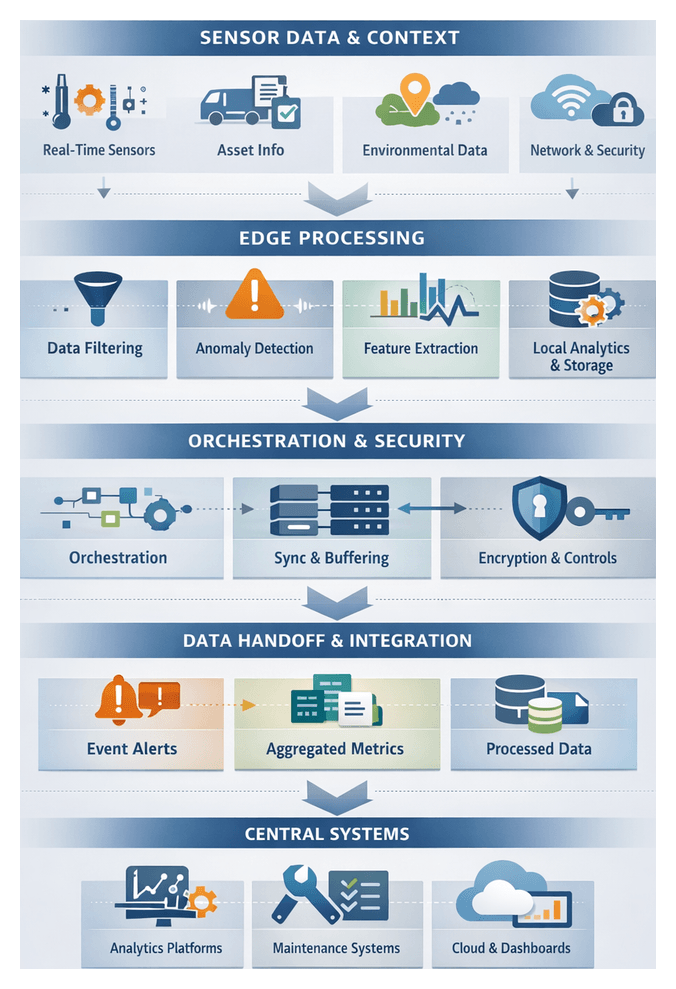
Purpose and Scope of Edge Processing
Data acquisition and edge processing form the critical bridge between raw sensor signals and centralized analytics in AI-driven predictive maintenance for transportation and logistics. By executing initial filtering, transformation, and anomaly flagging close to the source, edge processing reduces bandwidth consumption, lowers latency, and preserves data fidelity. This stage enables near–real-time detection of emerging equipment issues, supports adaptive maintenance scheduling, and ensures continued local processing during intermittent connectivity. It establishes a consistent schema and quality standards before integrating with downstream predictive models and asset management systems.
Key Inputs and Environmental Prerequisites
Successful edge processing demands comprehensive real-time and contextual data, alongside a robust operational environment. Inputs include:
- Real-Time Sensor Streams: Continuous or periodic readings from accelerometers, gyroscopes, thermal probes, pressure transducers, voltage and current sensors, and acoustic monitors.
- Sensor Metadata: Calibration coefficients, sampling frequencies, resolution parameters, and health indicators.
- Asset Static Attributes: Vehicle or equipment identifiers, manufacturing specifications, maintenance history, and criticality scores.
- Environmental Context: Geospatial coordinates, ambient weather conditions, track or road status, and loading characteristics.
- Processing Configuration: Filtering thresholds, aggregation windows, anomaly score rules, and deployment manifests.
- Network and Topology Data: Connectivity status, bandwidth availability, node hierarchy, and quality-of-service settings.
- Security Credentials: Device certificates, encryption keys, and authentication tokens.
Prerequisites include provisioned edge compute platforms—such as AWS IoT Greengrass, Azure IoT Edge, or Edge Impulse—running a lightweight Linux distribution with container support. Network infrastructure must offer LTE, 5G, Wi-Fi or satellite links with defined latency and bandwidth guarantees. Power stability, thermal management, and environmental protection ensure reliable node operation. Time synchronization via NTP or PTP aligns multi-sensor data streams, while a data governance framework enforces ownership, retention, encryption, and compliance with standards such as SAE J1939 or ISO 27001. Operational readiness requires remote provisioning, firmware update processes, and continuous monitoring of node health.
Orchestration and Workflow Management at the Edge
The orchestration layer on each edge node coordinates data pipelines, resource allocation, inter-module communication, and interactions with central systems. Processing pipelines are defined by configuration manifests that specify module order, input/output schemas, and execution triggers. When sensors stream data, the edge agent dynamically provisions containers or lightweight threads to host:
- Data Ingestion Agents that validate packets and enqueue messages locally.
- Filter Modules applying moving averages, low-pass filters or wavelet transforms to remove noise.
- Aggregators computing windowed statistics—min, max, mean, standard deviation—for feature extraction.
- Anomaly Detectors running rule-based engines or lightweight machine learning models to flag threshold breaches or probabilistic failures.
- Security Agents handling mutual TLS, key management, and authentication.
- Sync Agents managing buffered handoffs, retries, and acknowledgments with central services.
The orchestration engine uses a directed acyclic graph representation to manage dependencies, enforce timeouts, allocate CPU/GPU resources, and reroute data flows on failure. Configuration updates—filters, models or thresholds—are delivered via over-the-air updates or pulled from a central registry. Heartbeat signals and back-pressure mechanisms synchronize with a central orchestration plane, preventing overload of downstream platforms and ensuring consistent pipeline versions across the fleet.
To handle connectivity disruptions, the orchestration layer implements store-and-forward buffers with time-stamped journals, conflict resolution logic, and duplicate-suppression rules. Upon link restoration, records are replayed in order, guaranteeing no loss of critical events even in remote deployments.
AI-Driven Noise Reduction and Anomaly Detection
Edge AI models enhance signal quality and identify early fault indicators with minimal manual tuning. Noise reduction techniques include:
- Deep learning denoising autoencoders trained on paired clean and noisy signals.
- Adaptive filtering with LSTM networks that adjust parameters based on operating conditions.
- Wavelet transforms combined with neural predictors for fine-grained suppression of transient disturbances.
- Edge-optimized signal enhancement libraries in TensorFlow Lite and the AWS IoT Greengrass ML Inference engine.
Implementing these models requires profiling raw sensor noise spectra, selecting architectures that balance latency and accuracy, and converting artifacts via the TensorFlow Lite Converter or the OpenVINO™ toolkit. Models and parameters are deployed through edge platforms such as Azure IoT Edge or AWS IoT Greengrass. A local orchestration agent monitors inputs, invokes inference, and triggers fallback routines when data diverges from training domains.
Anomaly flagging leverages:
- Statistical control charts monitoring variance and kurtosis.
- Unsupervised clustering and density estimators like k-means or Gaussian mixture models.
- One-class classifiers such as isolation forests or one-class SVMs.
- Deep neural architectures including variational autoencoders and CNNs.
- Prebuilt models in Amazon Lookout for Equipment for common mechanical failure modes.
Streaming inference workflows buffer and window denoised data into fixed-length frames, prioritize high-risk segments, aggregate scores over multiple windows, and publish alerts via local brokers such as Eclipse Mosquitto or AWS IoT Core. Edge Impulse simplifies end-to-end pipeline deployment, from data ingestion and model training to live inference on constrained devices.
Supporting systems integrate AI modules with:
- Edge Data Managers maintaining local time-series databases (InfluxDB).
- Message Brokers routing metrics and alerts to central dashboards or cloud services.
- Device Management Services delivering model updates and security patches.
- Local Actuation Interfaces triggering on-device responses when anomalies exceed thresholds.
Roles in the AI decision pipeline include signal preprocessing, feature extraction, anomaly scoring, alert generation, and local decision support, guiding real-time corrective actions to reduce fault severity. Deployments must address compute and memory constraints, latency requirements, power budgets, model lifecycle management, and security compliance to ensure sustained performance.
Processed Outputs and Integration Handoffs
Edge processing yields structured data artifacts optimized for downstream analytics and enterprise systems. Primary deliverables include:
- Time-Stamped Event Logs capturing discrete occurrences—threshold breaches, state changes, anomaly flags—annotated with synchronized timestamps.
- Aggregated Metrics summarizing sensor readings over intervals to preserve trends while reducing volume.
- Compressed Data Chunks serialized in Apache Avro or Protocol Buffers with optional delta encoding.
- Anomaly Metadata embedding confidence scores or categorical labels from AI detectors.
- Preprocessed Feature Streams such as rolling standard deviations, spectral bands, and gradient profiles.
- Health-Check Heartbeats reporting node status, resource usage, and sensor health.
Reliable handoffs depend on network availability and bandwidth, secure and updated compute modules (AWS IoT Greengrass, Azure IoT Edge), accurate time synchronization, shared schema definitions, valid security credentials, and stable power and environmental conditions.
Integration patterns include:
- Broker Publishing to Apache Kafka, Google Cloud Pub/Sub, or Azure Event Hubs with QoS controls.
- RESTful or gRPC Calls for synchronous, lower-volume handoffs with retry and circuit-breaker logic.
- Batch Transfers of files to Amazon S3, Google Cloud Storage, or Azure Blob Storage using manifests and checksums.
- Hierarchical Aggregation via intermediate gateways that consolidate streams from subordinate devices.
- Secure Pub/Sub over MQTT or AMQP with TLS and token authorization.
Data integrity and lineage are maintained through immutable identifiers, SHA-256 hashing of raw inputs, embedded transformation metadata, and automatic registration in catalogs such as Apache Atlas or AWS Glue.
Security and compliance measures enforce end-to-end encryption, fine-grained role-based access control, audit logging, retention policies, and secure over-the-air updates of firmware and analytics models. Operational resilience is achieved through monitoring dashboards (Prometheus, Grafana), automatic retries and dead-letter queues, local buffering with embedded databases, and self-healing workflows using orchestration frameworks.
Scalability strategies include load-adaptive batching, stream partitioning by asset group or region, elastic resource provisioning at the edge and in the cloud, and back-pressure feedback to manage ingestion rates. An example workflow for an industrial trucking fleet applies a moving average filter, computes spectral features, packages aggregates into Avro records, publishes to a Kafka topic, purges local buffers upon acknowledgment, and sends heartbeats over MQTT secured via TLS. Central services validate schemas, register topics, decrypt payloads into a time-series database, and trigger analytics pipelines for anomaly detection and forecasting.
Clear handoff protocols with defined ownership, SLAs for data freshness, notification channels for ingestion failures, and living documentation of endpoints, topics, and schemas ensure that data engineers, maintenance planners, and operational teams can act on processed data with confidence. This structured approach enables reliable, secure, and scalable predictive maintenance workflows that minimize unplanned downtime and optimize asset utilization.
Chapter 4: Data Integration and Quality Management
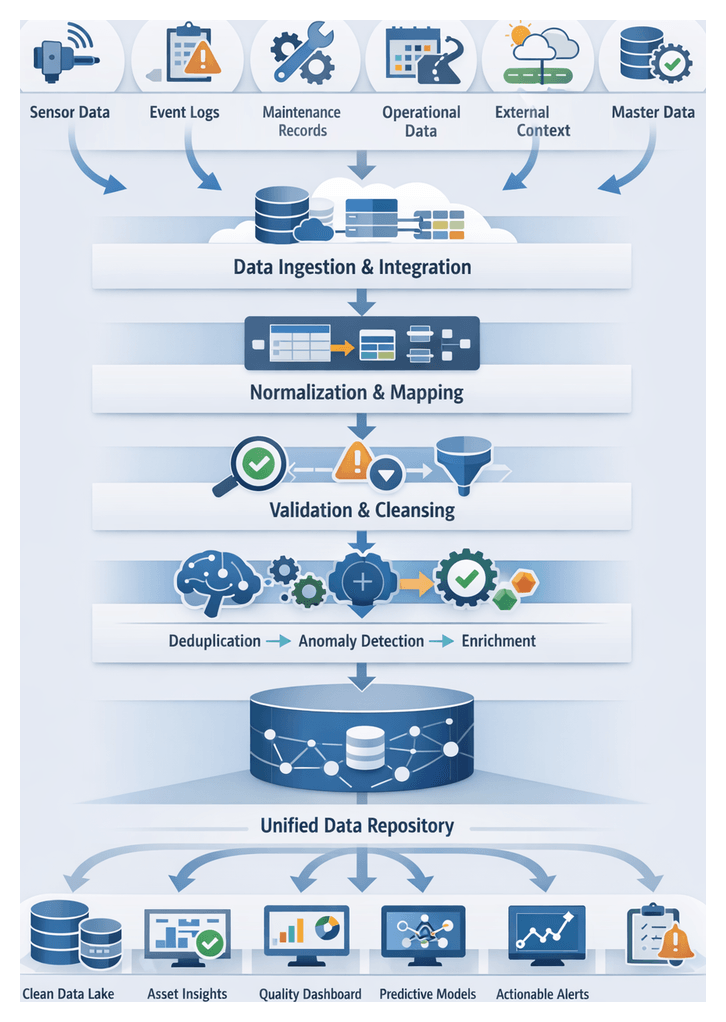
In predictive maintenance for transportation and logistics, data integration and quality management establish the unified foundation for advanced analytics, machine learning models, and maintenance orchestration. This stage consolidates real-time sensor streams, event records, maintenance logs, operational schedules, master data, and external context into a centralized, high-fidelity repository. A cohesive data environment accelerates insight generation, ensures accurate failure predictions, and supports scalable operations across a heterogeneous fleet.
Core objectives include:
- Consolidating diverse data sources for end-to-end visibility of asset health and maintenance history
- Harmonizing formats, units, and semantics via standardized schemas and ontology definitions
- Implementing automated validation, cleansing, enrichment, and anomaly detection to resolve inconsistencies at scale
- Enforcing role-based access controls, encryption, and audit trails to satisfy governance and regulatory mandates
- Maintaining real-time synchronization through incremental updates and event-driven ingestion mechanisms
Data Source Inputs
Each input stream contributes unique context to the asset health profile and collectively supports comprehensive analysis:
- Real-Time Sensor Logs: Telemetry capturing vibration, temperature, pressure, fluid levels, and GPS coordinates. Streaming frameworks such as Apache Kafka and AWS IoT Core transport data, while Azure Data Factory or Apache NiFi orchestrate flows.
- Event and Fault Records: On-board diagnostics, fault code registries, and safety alerts ingested via AWS Glue or Talend Data Integration.
- Maintenance Work Orders and Service Logs: Historical and scheduled tickets, technician notes, parts replacements, and timestamps from CMMS solutions such as IBM Maximo, SAP EAM, or Infor EAM.
- Operational and Scheduling Data: Route plans, utilization metrics, driver assignments, and shift schedules from TMS or ERP platforms like SAP S/4HANA and Oracle Fusion Cloud.
- Environmental and External Context: Weather conditions, road surface quality, cargo details, and regulatory data integrated via ETL connectors and public APIs.
- Master Data and Reference Tables: Asset metadata, part catalogs, fleet configurations, and organizational hierarchies managed through MDM services to align identifiers and support criticality scoring.
Prerequisites and Technical Foundations
- Data Governance Framework: Policies defining ownership, stewardship roles, quality thresholds, and retention guide validation rule design, access control enforcement, and lineage tracking.
- Connectivity and Network Topology: Reliable, low-latency links between edge collectors, on-premises systems, and cloud platforms, enabling appropriate use of streaming, micro-batch, or bulk ingestion.
- Schema and Ontology Definitions: Unified data models standardizing terminology, units, and attribute hierarchies. Predefined schemas support automated mapping via platforms like Informatica Intelligent Cloud Services.
- Data Security and Compliance: Encryption in transit and at rest, tokenization of sensitive fields, and adherence to regulations such as GDPR or CCPA.
- Resource Provisioning and Scalability Planning: Capacity planning for storage, compute, and networking with elastic scaling through Amazon S3, Google Cloud Storage, or Azure Data Lake Storage.
- Monitoring and Observability: Logging, tracing, and alerting via tools such as AWS Glue DataBrew or Datadog ensure timely detection of ingestion failures, schema drift, and quality degradation.
Data Ingestion and Staging
At the outset, heterogeneous inputs converge into a governed staging environment managed by an orchestration engine. Real-time streams arrive via platforms like Confluent or cloud messaging services, while batch extracts of maintenance logs and historical records are scheduled through Apache Airflow. Each pipeline includes metadata descriptors capturing source system, schema version, and ingestion timestamp to enable traceability and manage schema evolution.
Service level agreements define acceptable latency, throughput, and error budgets. The orchestration engine triggers pipelines based on time schedules, file arrival events, or upstream API calls. Incoming payloads land in raw object stores in formats such as JSON, Avro, or CSV. A metadata registry maintains the mapping between raw schemas and processing contracts, automatically notifying data stewards when schema changes occur and initiating compatibility checks. System logs record each step for audit and troubleshooting purposes.
Normalization and Schema Mapping
Once ingested, raw data undergoes normalization to align with a canonical schema. Field-level transformations convert units of measure, align timestamps to a common time zone, and cast data types using mapping definitions in tools such as Talend or Informatica. The orchestration engine retrieves versioned schemas from the metadata registry, applies transformation scripts, and routes records with unexpected fields to quarantine queues for data steward review.
Normalized data is persisted in a relational staging database or a columnar data lake. Data engineers validate sample batches against business rules—such as ensuring bearing speeds in RPM fall within plausible ranges—to confirm transformation accuracy before downstream processing.
Validation, Deduplication, and Correction
Ensuring data integrity requires a layered approach combining deterministic checks with AI-driven analytics. Validation, deduplication, and correction workflows maintain a unified, accurate repository that underpins reliable forecasting and decision support.
Intelligent Validation and Error Handling
Rule-based engines enforce constraints on required fields, data types, sequential timestamps, and reference lookups. Concurrently, AI frameworks—leveraging platforms such as Great Expectations—model expected attribute behavior, detecting subtle anomalies and proposing adaptive validation rules.
- Behavioral Profiling: Unsupervised learning establishes baseline distributions for sensor streams and maintenance events, flagging deviations with anomaly scores.
- Contextual Consistency Checks: Natural language processing correlates free-text entries—technician notes or parts descriptions—with structured data to verify cross-domain alignment.
- Adaptive Rule Generation: Statistical inference suggests new quality rules based on emerging patterns, reducing manual maintenance of validation logic.
- Error Handling Tiers: Minor discrepancies trigger automated imputation or default substitution. Critical violations spawn incident tickets in service management systems and display alerts on a centralized error dashboard, enabling rapid triage and remediation.
- Audit Logging: All validation outcomes are logged, supporting compliance reporting and periodic data quality scorecards shared with stakeholders.
Machine Learning–Driven Deduplication
Duplicate or conflicting records—arising from concurrent streams, pipeline retries, or overlapping batch windows—are resolved using AI-powered record linkage and entity resolution. Vendors such as DataRobot and custom models built with TensorFlow or PyTorch optimize matching thresholds, distinguishing true duplicates from legitimate rapid-fire events.
- Feature Embedding: Records are transformed into vectors capturing timestamps, geospatial coordinates, part numbers, and narrative text for high-dimensional similarity analysis.
- Unsupervised Clustering: Density-based algorithms group near-duplicate records despite naming variations and partial data.
- Probabilistic Matching: Graphical models estimate equivalence likelihood when identifiers are incomplete, balancing precision and recall according to business thresholds.
Consistency Enforcement and Master Data Management
An MDM hub consolidates identity attributes across source systems to maintain golden records for each asset and component. Deterministic keys—such as asset ID and event sequence—combine with probabilistic matching to detect and reconcile conflicting references. Reconciliation tasks surface in stewardship interfaces for human review, ensuring that canonical attributes—manufacturer, model, installation date—remain authoritative.
- Deterministic deduplication using unique identifiers and timestamps
- Probabilistic algorithms to resolve near-duplicates across evolving schemas
- Data steward reconciliation workflows to approve authoritative records
- Publication of golden records for downstream consumption
Automated Correction and Enrichment
AI services proactively correct errors and enrich data with inferred values and contextual metadata, minimizing manual remediation and enhancing analytic value.
- Predictive Imputation: Regression and matrix-factorization models predict missing sensor readings or maintenance attributes, tagging estimates with confidence scores for traceability.
- Canonicalization of Values: Natural language understanding maps synonyms, abbreviations, and misspellings to standardized terms. Solutions from Trifacta and Alteryx leverage transformer architectures for this alignment.
- Knowledge Graph Integration: AI-driven graphs link assets, parts, failure modes, and maintenance actions, enriching records with vendor details, lead times, and compliance requirements.
- Feedback-Driven Correction Loops: User validations from technicians and planners feed back into supervised models, refining correction logic over time without manual rule updates.
Data Enrichment and Contextual Augmentation
With clean and consistent records established, enrichment microservices augment data by linking maintenance logs to failure taxonomies, injecting operational schedules, and merging external context. Weather feeds, road surface ratings, and cargo characteristics are pulled from APIs and third-party providers. GPS coordinates map to route segments via geospatial indexes, and repair codes align with enterprise taxonomies. Each enrichment step appends lineage metadata—source, timestamp, transformation—to ensure full traceability and support feature engineering for analytics teams.
Quality Monitoring and Automated Feedback Loops
Continuous observability maintains data quality over time. Dashboards display metrics for record freshness, schema compliance, validation pass rates, and duplicate counts. Alerts trigger on sudden volume drops or quality degradations, prompting investigations by data engineering teams. Aggregated metrics over sliding windows detect gradual drifts in data patterns that static thresholds may miss.
Automated feedback loops leverage unsupervised clustering to identify emerging data distributions—for example, sensor firmware updates altering output characteristics. When new clusters deviate from established norms, the system quarantines affected records and notifies field engineers to inspect and recalibrate devices. This proactive approach prevents corrupted data from propagating into predictive models and operational decisions.
Data Products and Outputs
The integration stage delivers consolidated, high-fidelity data products that fuel downstream analytics and operations:
- Clean Data Lake: Time-aligned, gap-filled sensor streams and historical records with embedded quality metadata and anomaly flags.
- Unified Asset Histories: Harmonized chronological profiles capturing failure events, repair actions, usage patterns, and environmental contexts.
- Master Data Catalog: Indexed inventory of data domains, fields, schemas, lineage, and quality indicators.
- Data Quality Dashboard: Interactive reports visualizing missing value rates, schema compliance, validation outcomes, and duplicate summaries.
- Metadata and Lineage Reports: Machine-readable traces of each data element through ingestion, cleansing, enrichment, and integration steps.
- Enrichment Logs: Detailed records of external reference joins, semantic mappings, and AI-driven imputations.
- Schema Registry Artifacts: Versioned canonical model definitions referenced by downstream pipelines to validate assumptions and ensure compatibility.
Dependencies and Integration Requirements
- Raw Data Ingestion Pipelines: Continuous streams of sensor telemetry, maintenance logs, scheduling records, and third-party data sources powered by AWS Glue or Apache Kafka.
- Data Storage Infrastructure: Scalable object stores such as Amazon S3 or HDFS, paired with compute clusters or serverless engines for batch and micro-batch transformations.
- ETL and Orchestration Frameworks: Workflow engines like Apache Airflow
- Schema Mapping and Standardization Rules: Templates and dictionaries maintained by data architects and SMEs to reconcile field naming, units, and data types across sources.
- AI-Driven Quality Validation Modules: Machine learning models and rule-based engines embedded in environments such as Databricks, Azure Data Factory, or Google Cloud Dataflow.
- Metadata Management Systems: Catalog services like Apache Atlas or commercial catalogs storing dataset descriptions, lineage graphs, and governance policies.
- Access Control and Security Policies: Role-based permissions, encryption keys, and network controls safeguarding sensitive data during integration workflows.
- Collaborative Processes: Handoff protocols between data engineers, quality analysts, and domain SMEs to resolve mapping ambiguities, approve schema changes, and monitor SLA adherence.
Handoffs to Downstream Analytics and Operations
- Feature Engineering and Anomaly Detection: Data scientists access unified datasets via SQL interfaces or APIs to derive time series features and feed anomaly detection models, referencing canonical schema definitions from the registry.
- Predictive Model Development: Training environments consume labeled historical data and enriched records, registering model artifacts alongside dataset snapshots for reproducibility and lineage tracking.
- Real-Time Inference Deployments: Edge and cloud inference engines subscribe to change data capture topics or Kafka streams broadcasting new integrated records in lightweight JSON payloads.
- Alerting and Visualization Systems: BI dashboards and alerting services query curated data marts through semantic layers, ensuring maintenance planners view only validated, error-free information.
- Maintenance Orchestration Engines: Work order and scheduling tools invoke integration APIs to fetch asset health indicators, creating alerts or orders only when data quality thresholds are satisfied.
- Continuous Improvement Feedback Loop: Post-maintenance outcomes, technician annotations, and actual repair times are appended to unified histories and ingested back into integration pipelines, updating enrichment logs and quality dashboards for ongoing refinement.
Chapter 5: Feature Engineering and Anomaly Detection
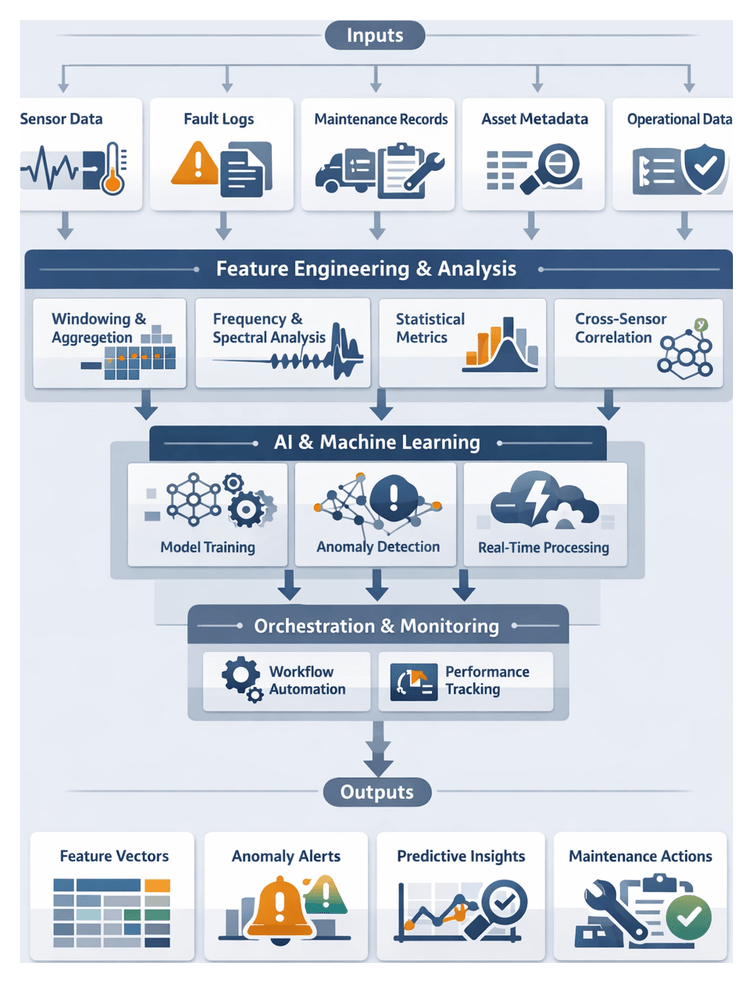
Feature Creation Objectives and Inputs
The feature engineering stage transforms high-velocity sensor streams and operational records into structured attributes that expose early indicators of component wear, system degradation, and abnormal conditions. Establishing clear objectives and precise input requirements ensures that downstream anomaly detection algorithms receive consistent, meaningful metrics tied to real-world behavior. By prioritizing data provenance, temporal alignment, and domain relevance, organizations create a solid foundation for scalable predictive maintenance across diverse fleets.
Key objectives for feature creation include:
- Deriving statistical summaries—mean, variance, skewness, and kurtosis—over sliding windows to quantify central tendencies and dispersion.
- Computing time-domain features such as rate of change, peak counts, and dwell time above thresholds to capture dynamic stress cycles.
- Performing frequency-domain analyses, including fast Fourier transforms and wavelet decompositions, to detect characteristic vibration signatures.
- Generating cross-sensor correlation metrics to identify interdependencies, for example between engine temperature and exhaust backpressure under varied loads.
- Integrating operational metadata—asset age, cumulative mileage, load profile, and environmental conditions—to contextualize sensor readings and adjust failure thresholds.
- Encoding maintenance histories, repair codes, and fault logs as categorical or temporal features that inform supervised models of past system behavior.
Feature engineering relies on diverse input categories drawn from multiple systems:
- Raw Sensor Telemetry—Continuous time-series data from accelerometers, temperature probes, pressure transducers, current sensors, and GPS devices.
- Event and Fault Logs—Diagnostic trouble codes, safety alerts, and operator-reported events providing labeled instances of anomalies.
- Maintenance Histories—Structured records of scheduled services, replacements, and unscheduled repairs for establishing baselines.
- Asset Metadata—Vehicle attributes such as make, model, manufacturing date, engine type, and configuration to support normalization and transfer learning.
- Operational Context—Route profiles, load weights, driver behaviors, and environmental factors like ambient temperature and road conditions.
- Data Quality Indicators—Metrics such as sampling rate, completeness, and sensor health status guiding feature selection and filtering.
Prerequisites and data conditions ensure engineered features reflect true system behavior rather than collection artifacts:
- Timestamp Synchronization—Align all data to a common reference, correcting clock drift and normalizing to Coordinated Universal Time.
- Data Completeness Thresholds—Require a minimum percentage of valid readings within feature windows, with imputation or exclusion of gaps.
- Unit Standardization—Convert physical measurements to consistent units to prevent model bias.
- Noise Filtering and Baseline Correction—Apply filters and drift adjustments to remove out-of-band noise and preserve anomaly signals.
- Label Availability—Link historical failure labels or maintenance flags to feature records for supervised training.
- Schema Consistency—Maintain stable data schemas and manage changes via versioning to preserve pipeline integrity.
- Data Lineage—Record input sources, transformation logic, and timestamps for auditability and interpretability.
Effective data management underpins scalable feature engineering:
- Centralize raw and engineered data in a feature store or data lake, enabling standardized access and versioning.
- Isolate development, testing, and production environments to safeguard live pipelines and support controlled rollouts.
- Version control feature definitions and transformation scripts in a code repository, enforcing peer review and documentation.
- Apply retention policies to balance storage costs and performance, archiving older records while keeping recent data accessible.
- Leverage distributed compute frameworks such as Apache Spark or Dask to parallelize feature computations and accelerate time to insight.
Popular frameworks and managed services streamline feature creation and anomaly detection:
- scikit-learn for prototyping statistical feature extractors and baseline models.
- SciPy and Librosa for advanced spectral and wavelet analyses.
- TensorFlow and PyTorch for deep learning-based feature learners such as autoencoders and recurrent networks.
- AWS IoT Analytics and Azure Machine Learning for integrated data ingestion, feature engineering, and model training pipelines.
Workflow and Pipeline Orchestration
The feature engineering and anomaly detection workflow orchestrates extraction, transformation, and enrichment tasks across batch and streaming contexts. Coordination among scheduling tools, compute clusters, metadata services, and model hosting environments ensures seamless flow of feature artifacts from a centralized repository to real-time inference engines and offline training systems.
Data Retrieval and Preprocessing Handoff
Orchestrators such as Apache Airflow or Kubeflow trigger extraction jobs that retrieve preprocessed sensor readings, maintenance logs, and contextual data from a unified data repository. A manifest describing file locations, schemas, and quality metrics passes between components to enable automated lineage tracking and dependency resolution.
Windowing and Time-Series Feature Computation
Continuous streams are segmented into time windows—fixed durations or event-driven intervals—over which statistical aggregations execute in parallel on distributed platforms. Core steps include:
- Defining window schemas and event time semantics.
- Scheduling batch tasks or streaming jobs by asset group.
- Applying aggregations—mean, variance, skewness, kurtosis, rolling percentiles—across sensor channels.
- Joining auxiliary metadata such as operating mode or geographic location.
- Writing interim feature tables to the warehouse and updating the metadata catalog.
Spectral and Frequency-Domain Pipelines
Dedicated pipelines leverage SciPy to compute fast Fourier transforms, power spectral densities, and wavelet coefficients. Operators configure frequency bands of interest via version-controlled files, and orchestration systems distribute workloads across compute nodes to balance sensor sampling rates.
Statistical Baselines and Comparative Profiles
Baseline services analyze historical feature distributions using clustering and density estimation pipelines built on scikit-learn. Reference metrics—interquartile ranges, Mahalanobis distance thresholds—are emitted to an event bus powered by Apache Kafka whenever baselines update, ensuring anomaly detectors consume current envelopes.
Batch and Real-Time Coordination
Workflows distinguish between batch feature generation for offline training and streaming computation for live detection. A shared feature store abstracts storage, unifying outputs under a consistent API to minimize training-serving skew. Synchronization mechanisms propagate new feature definitions and verify schema alignment across modes.
Integration with Anomaly Detection Models
Feature vectors feed into models hosted by TensorFlow Serving or PyTorch deployments. Batch scoring services apply models to historical feature tables and persist anomaly scores, while edge or cloud-function inference engines process streaming feature windows with millisecond latency. Model versions, input schemas, and scoring logs are tracked for traceability and rapid rollback.
Observability and Alerting
An observability framework monitors pipeline latency, feature drift, and inference rates, feeding dashboards powered by Grafana. Alerting rules trigger notifications when service-level objectives are breached or feature distributions deviate from norms, accelerating root-cause analysis and preserving trust in anomaly signals.
AI-Driven Detection Algorithms
AI-driven algorithms underpin robust anomaly detection by distinguishing between benign fluctuations and genuine fault precursors. Algorithms run on edge devices, centralized platforms, and decision engines to deliver timely, actionable insights.
Statistical Baseline Models
Moving averages, exponentially weighted smoothing, and ARIMA models establish dynamic thresholds that adapt to seasonal patterns. Lightweight implementations on edge controllers trigger local alerts, while streaming platforms maintain sliding windows for real-time updates.
Unsupervised Learning for Novel Patterns
Clustering techniques such as k-means, DBSCAN, and Gaussian mixtures segment feature spaces—combining vibration bands, temperature gradients, and usage metrics—to flag data points outside dense clusters. Batch and streaming unsupervised analyses run on TensorFlow or PyTorch frameworks, with adaptive retraining to refine cluster definitions.
Supervised and Semi-Supervised Classification
Where labeled failure records exist, classification models—random forests, gradient boosting, support vector machines—predict discrete health states. Pipelines in AWS SageMaker or Azure Machine Learning curate balanced datasets, tune hyperparameters, and manage model registries. Semi-supervised methods enhance coverage when labeled examples are scarce.
Deep Learning Architectures
Convolutional neural networks extract spatial and temporal hierarchies from spectral signatures and imagery, while long short-term memory networks capture sequential dependencies. Autoencoders compress normal behavior into compact representations, flagging anomalies when reconstruction errors exceed thresholds. GPU-accelerated clusters handle training, and edge AI chips or optimized cloud functions deliver inference at low latency. Interpretability techniques such as attention mapping and feature importance analysis provide engineers with explanations for flagged anomalies.
Hybrid Rule-Based and AI Systems
Rule engines codify domain expertise—maximum temperature rises or vibration limits—while AI models adapt to evolving patterns. Confidence scores increase when rule-based checks and machine learning predictions align, prompting immediate action. A rules management service interfaces with AI pipelines to update threshold logic without redeployment.
Streaming Analytics and Event Brokers
Frameworks such as Apache Kafka and Apache Flink orchestrate data flows through detection algorithms, ensuring at-least-once delivery and stateful computations. Streaming analytics apply windowing and incremental feature computation to preserve temporal context under variable data rates.
Alert Scoring and Prioritization
Multi-criteria fusion engines aggregate outputs from statistical, unsupervised, supervised, and deep learning algorithms, weighting signals by severity, confidence, and asset criticality. Decision-support platforms ingest scored alerts alongside asset metadata, presenting ranked work items and recommending optimal maintenance windows based on risk and operational impact.
Feedback Loops and Continuous Learning
Field feedback from maintenance confirmations and dismissals flows into annotation tools that integrate with retraining schedulers. Automated pipelines aggregate labeled events, retrain supervised classifiers, and update unsupervised cluster definitions, ensuring the detection system evolves with new failure modes and operating profiles.
Outputs, Dependencies, and Handoffs
The deliverables of feature engineering and anomaly detection serve as foundational inputs for predictive models, monitoring dashboards, and maintenance orchestration systems. Well-defined outputs, rigorous dependency management, and robust handoff protocols ensure seamless continuity across the end-to-end workflow.
Principal Deliverables
- Engineered Feature Vectors—Time-aligned metrics including trend slopes, rolling statistics, spectral components, and baseline comparisons, stored in a centralized feature store.
- Anomaly Scores and Flags—Quantitative deviation scores and categorical flags indicating potential fault conditions.
- Metadata Registrations—Records of feature definitions, computation logic, version identifiers, and data lineage in services like Feast or Amazon SageMaker Feature Store.
- Batch and Streaming Feeds—Historical exports for retraining and real-time streams for live inference.
- Event Notifications—Messages published to event buses or message brokers when anomalies exceed thresholds.
- Quality Assurance Reports—Summaries of data completeness, distribution checks, and detection performance metrics.
Upstream Dependencies
- Cleaned Data Sources—Schema-consistent, timestamp-aligned, and validated inputs from integration and quality management stages.
- Compute Environments—Scalable resources such as Apache Spark clusters, Kubernetes microservices, or serverless functions.
- Feature Store Platforms—Repositories configured with schemas and access controls for efficient retrieval.
- Machine Learning Frameworks—Version-controlled toolkits like TensorFlow, scikit-learn, and PyTorch.
- Orchestration Engines—Workflow tools such as Apache Airflow or Prefect managing directed acyclic graphs of tasks.
- Observability Stacks—Logging and monitoring platforms tracking pipeline health and performance.
- Data Governance Services—Catalogs capturing lineage, ownership, and compliance metadata.
Handoffs to Downstream Systems
- Model Development Pipelines—Batch exports of feature vectors and labeled outcomes ingested into environments for training, validation, and hyperparameter tuning using tools like MLflow.
- Real-Time Inference Engines—Streaming feature feeds and anomaly flags delivered to edge or cloud endpoints for continuous assessment.
- Alerting and Visualization Platforms—Event triggers integrated via REST APIs or message connectors into dashboards such as Grafana and incident response tools like PagerDuty.
- Maintenance Orchestration Systems—API calls or message-based integrations pushing high-confidence anomaly notifications into CMMS for automated work order creation.
- Metadata Synchronization—Automated routines registering new feature definitions and detection metrics with governance platforms to keep catalogs current.
Versioning, Traceability, and Governance
- Assign semantic version identifiers to feature definitions and transformation code, capturing changes in Git repositories.
- Record data lineage from raw sensors to engineered values using metadata services for auditability.
- Manage anomaly threshold parameters in centralized policy stores to ensure consistency across environments.
- Log event publications with timestamps and acknowledgments to support post-incident analysis and compliance.
By defining precise outputs, rigorously managing dependencies, and implementing robust handoff protocols, organizations achieve reliable, scalable AI-driven predictive maintenance. This disciplined approach ensures that engineered features, anomaly scores, and metadata artifacts power downstream models, real-time monitoring, and maintenance orchestration with precision and repeatability.
Chapter 6: Predictive Model Development and Validation
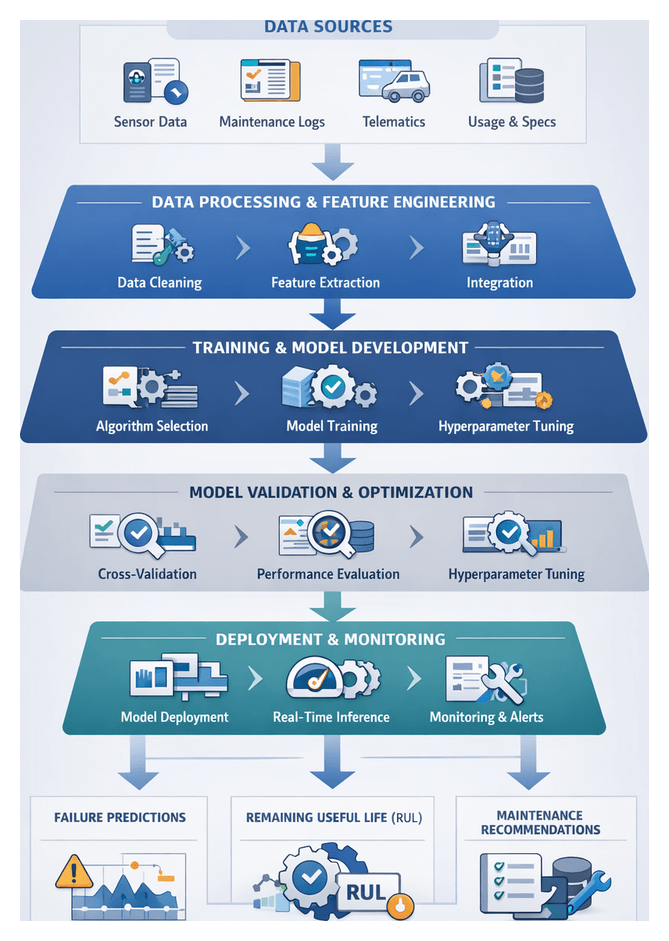
Purpose and Scope of Predictive Model Development
The predictive model development stage represents the analytical core of AI-driven maintenance in transportation and logistics. By transforming historical sensor readings, telematics logs, and maintenance records into machine learning and statistical models, organizations gain the ability to forecast failure probabilities and estimate remaining useful life (RUL) for vehicles, trailers, engines, and other mission-critical assets. These forecasts enable a shift from reactive or calendar-based servicing to condition-based maintenance, optimizing spare-parts inventory, reducing unplanned downtime, and extending asset longevity. In an industry where uptime drives delivery reliability and customer satisfaction, accurate failure forecasts support planned interventions, resource alignment, and minimized operational disruptions, while delivering quantifiable financial benefits and informed risk management.
Data Ecosystem and Prerequisites
Robust predictive models rely on a mature data ecosystem comprising integrated sources, preprocessing pipelines, and governance frameworks. Prior to training, the following prerequisites must be met:
- Comprehensive Asset Registry with unique identifiers, manufacturer specifications, and usage histories.
- Sensor Infrastructure and Edge Processing for vibration, temperature, and pressure readings, including noise reduction and event flagging at the point of capture.
- Unified Data Platform consolidating time-series sensor logs, maintenance histories, telematics traces, and operational schedules.
- Feature Engineering Outputs such as trend slopes, frequency components, and comparative baselines, prepared as model inputs.
- Data Quality Management routines for validation, deduplication, and correction to ensure completeness and consistency.
- Governance, Security, and Compliance Policies enforcing role-based access, data lineage tracking, and industry regulations (for example FMCSA and ISO standards).
Meeting these conditions ensures that predictive algorithms operate on trustworthy data, with standardized metadata that stakeholders can audit and trust.
Training Data and Annotation Standards
The effectiveness of supervised learning hinges on representative inputs and high-quality labels. Core categories of training data include:
- Time-Series Sensor Data from accelerometers, thermocouples, and pressure transducers at high sampling rates.
- Maintenance and Repair Logs detailing component replacements, service actions, failure diagnoses, and labor durations.
- Failure Event Labels with fault type, severity, initiation and resolution timestamps, and corrective outcomes.
- Telematics and Operational Context such as GPS traces, speed profiles, load weights, duty cycles, and environmental factors.
- Manufacturer Specifications and Tolerance Limits defining nominal performance thresholds.
- Usage Metrics including cumulative hours, mileage, cycles, or revolutions to contextualize wear patterns.
Annotation standards must specify clear fault definitions, threshold criteria for event detection (for example vibration or temperature limits), and contextual metadata such as operator observations. Rigorous protocols ensure that training sets reflect real-world conditions and support reliable validation.
Infrastructure, Frameworks, and MLOps Tools
Efficient model development demands scalable compute, specialized frameworks, and MLOps capabilities. Key components include:
- Distributed Computing Platforms, whether cloud-based clusters or on-premise HPC, to support parallel training and large-scale data processing.
- Machine Learning Frameworks such as TensorFlow, PyTorch, and scikit-learn for prototyping and algorithm development.
- MLOps and Experiment Tracking via MLflow, Databricks, Kubeflow, and DataRobot to ensure reproducibility, versioning, and collaboration.
- Managed AI Services like AWS SageMaker and Azure Machine Learning for streamlined deployment, hyperparameter tuning, and pipeline orchestration.
- Hyperparameter Optimization tools such as Hyperopt, AutoML modules in Azure Machine Learning, and H2O.ai Driverless AI for automated search strategies.
- Storage and Data Lakes optimized for time-series workloads, including object stores (Amazon S3, Azure Blob Storage) and distributed file systems.
- Compute Accelerators like GPUs and specialized inference hardware to accelerate training and validation.
Aligning these infrastructure choices with operational constraints and performance goals accelerates model development while controlling cost.
Model Selection, Training, and Tuning Workflow
A structured workflow transforms prepared data into production-ready predictive engines. The stages include:
- Algorithm Exploration and Prototyping
- Pipeline Orchestration and Compute Allocation
- Hyperparameter Optimization and Experiment Management
- Performance Evaluation and Selection Criteria
- Packaging and Handoff to Validation
Algorithm Exploration and Prototyping
Data scientists evaluate feature sets and business needs to select modeling approaches—gradient boosting trees for classification, survival analysis for RUL, or deep neural networks for high-frequency patterns. Rapid prototyping in interactive notebooks integrates version control and logs experiments with MLflow or Kubeflow. Early feedback from domain experts guides feature assumptions and preprocessing strategies. Successful prototypes yield configuration templates capturing hyperparameter search spaces and data splits.
Pipeline Orchestration and Compute Allocation
Production-grade training runs are scheduled via workflow engines such as Apache Airflow, Kubeflow Pipelines, or Amazon SageMaker Pipelines. Orchestration tasks include:
- Provisioning compute clusters on cloud instances or on-premise GPUs and CPUs.
- Mounting versioned datasets from data lakes or distributed file systems.
- Deploying containerized environments to ensure dependency consistency.
- Launching parallel hyperparameter sweeps and managing resource utilization.
Automated triggers can initiate retraining on new data or feature updates, with metadata streaming back to dashboards for cost and efficiency monitoring.
Hyperparameter Optimization and Experiment Management
Automated tuning frameworks such as Hyperopt, AutoML in Azure Machine Learning, and H2O.ai Driverless AI explore learning rates, regularization terms, and model architectures via Bayesian optimization, grid search, or random search. Each trial is tracked by an experiment management platform, recording parameters, metrics, and artifacts. Early-stopping rules terminate unpromising runs, conserving resources, while dashboards highlight top candidates for final evaluation.
Performance Evaluation and Selection Criteria
Candidate models are benchmarked against holdout datasets using metrics aligned to maintenance goals—AUROC for failure classification, mean absolute error for RUL, and cost-weighted confusion matrices. Automated scoring jobs ingest model artifacts and test data, visualizing results in TensorBoard or custom dashboards. Compliance checks verify audit logs and privacy requirements. Models meeting predefined thresholds advance to staging; others are archived for further refinement.
Packaging and Handoff to Validation
Final models are packaged as Docker containers or serialized artifacts registered in a model registry. Metadata captures version numbers, training snapshots, and performance reports. Integration tests verify inference outputs against reference cases, and deployment pipelines in Azure Machine Learning or CI/CD platforms are updated to prepare for production rollout. Role-based access controls and automated notifications ensure transparent handoffs across data science, MLOps, and operations teams.
Automated Cross-Validation and Calibration
Reliable predictive engines require rigorous cross-validation and probability calibration. AI-driven MLOps platforms automate these processes to ensure generalization and well-calibrated risk estimates.
Cross-Validation Orchestration
- Experiment Management via MLflow and DataRobot, tracking folds, hyperparameters, and metrics.
- Distributed Compute Coordination using Amazon SageMaker and Google Cloud AI Platform to parallelize k-fold or nested validation runs.
- Automated Hyperparameter Search orchestrated by H2O.ai Driverless AI and Azure AutoML within cross-validation loops.
- Reproducibility and Lineage Tracking capturing environment configurations and container images for auditability.
Advanced Time-Series Validation
- Purged K-Fold Cross-Validation with libraries like scikit-learn-contrib to remove look-ahead bias between splits.
- Rolling-Window Validation orchestrated by Kubeflow Pipelines to simulate incremental training and forecasting.
- Blocked Time Series Splits that partition data into chronological blocks, evaluating stability across seasons and usage cycles.
Probability Calibration and Uncertainty Quantification
- Platt Scaling and Isotonic Regression using scikit-learn and TensorFlow Probability to align predicted probabilities with observed failure rates.
- Conformal Prediction frameworks generating prediction intervals for risk assessment.
- Quantile Regression and Bayesian Models via PyTorch with Pyro or TensorFlow Probability to produce full distributions over RUL estimates.
- Calibration Monitoring using MLflow Model Registry and custom dashboards to detect drift and trigger retraining.
These automated validation and calibration routines ensure that models deliver trustworthy risk scores, enabling maintenance planners to make data-driven decisions with defined confidence levels.
Validated Artifacts and Integration Handoffs
Upon validation, model outputs are packaged, versioned, and handed off to operational teams. A comprehensive artifact portfolio includes:
- Serialized Model Files (ONNX, Pickle, PMML, or TensorFlow SavedModel) encapsulating architecture and weights.
- Evaluation Reports with metrics, calibration curves, confusion matrices, and ROC/AUC plots.
- Feature Transformation Pipelines and metadata capturing preprocessing definitions.
- Hyperparameter and Configuration Files (JSON or YAML) and environment manifests (Conda or Docker).
- Validation Artifacts such as test suites and stress-test logs for throughput scenarios.
Artifact management relies on controlled repositories:
- Model Registry Platforms like MLflow for lifecycle management and lineage tracking.
- Binary Repositories such as Amazon S3, Azure Blob Storage, and container registries (Docker Hub or private) with versioning and lifecycle rules.
- CI/CD Pipelines via Jenkins or GitLab CI automating validation checks, security scans, and promotion gates.
Integration handoffs occur at three points:
- Serving Infrastructure: provision container images or serverless packages with Kubernetes manifests, resource definitions, and autoscaling policies.
- Monitoring and Observability: integrate with Datadog or Prometheus by supplying metric exporters, alert thresholds, and drift detection rules.
- Maintenance Orchestration Layers: expose inference endpoints (REST or gRPC) with API contracts, authentication details, and schema documentation to enable scheduling systems to align predicted failures with technician assignments and parts availability.
Best practices for seamless transitions include checklist-driven releases, versioned API contracts, automated smoke tests, and canary or blue-green deployments. This disciplined approach ensures that validated predictive maintenance models move efficiently from development to real-time operation, enabling continuous improvement and scalable reliability across extensive transportation and logistics fleets.
Chapter 7: Deployment and Real-Time Monitoring
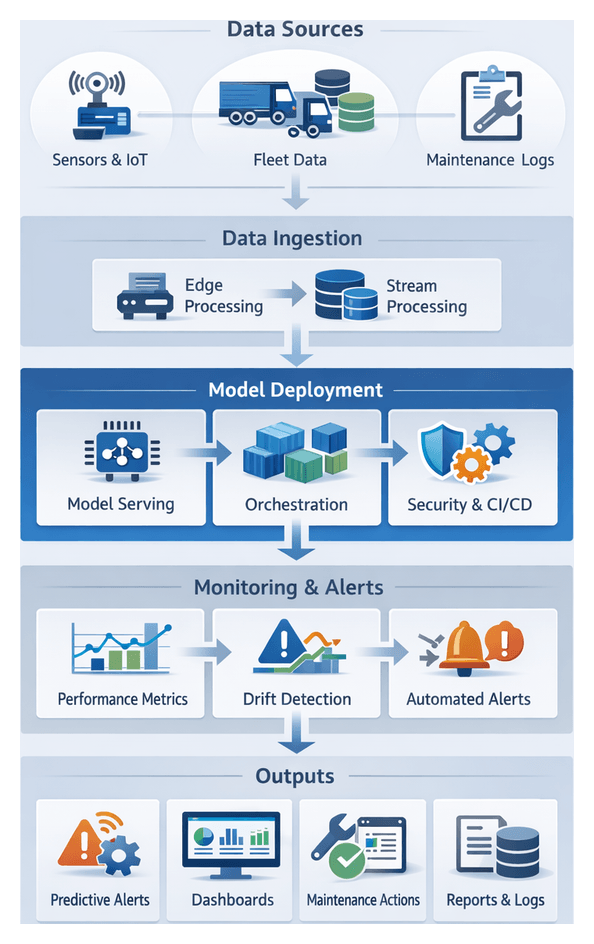
The deployment and real-time monitoring stage transforms validated predictive maintenance models into operational services that process live sensor streams, infrastructure metrics, and maintenance schedules. This continuous inference framework enables immediate alerts, automated workflows, and decision support tools, ensuring that predictive insights drive timely interventions across transportation and logistics assets. Real-time monitoring safeguards model performance and system health by tracking throughput, latency, error rates, and resource utilization, and by triggering alerts for drift, infrastructure faults, or service degradation.
Key Objectives
- Reliability: Guarantee consistent model execution under production loads, with reproducible runtimes across cloud clusters and edge nodes.
- Scalability: Elastic resource allocation to accommodate fluctuating data volumes from fleets in operation.
- Latency: Maintain inference latency within real-time thresholds to support proactive maintenance planning.
- Observability: Collect application and infrastructure metrics, logs, and traces to detect anomalies and guide remediation.
- Alerting: Integrate with notification systems to automatically escalate anomalous predictions or infrastructure issues.
Infrastructure and Security Preconditions
Successful deployment relies on production-ready infrastructure, orchestration capabilities, and robust security controls. Organizations must provision container platforms, networking, storage, compute resources, and observability stacks aligned with peak inference demands. Security configurations—network segmentation, authentication gateways, encryption in transit and at rest—must be in place, supported by vulnerability scanning and role-based access controls. A CI/CD pipeline ensures automated build, test, and deployment of container images, with version control for code, model artifacts, and configuration files to maintain an audit trail and rollback path.
- Container runtime and registry: Docker containers stored in secured registries with image signing and vulnerability scanning.
- Orchestration engine: Kubernetes (or managed services such as AWS Elastic Kubernetes Service or Azure Kubernetes Service) with auto-scaling and health probes.
- CI/CD tooling: Jenkins, GitHub Actions or Azure DevOps for automated integration, testing, and deployment.
- Infrastructure as code: Terraform or AWS CloudFormation to codify cluster configurations, network policies, and storage volumes.
- Observability stack: Prometheus and Grafana for metrics collection and visualization; ELK Stack or Splunk for log aggregation.
- Security and compliance: ISO 27001 or NIST frameworks guiding vulnerability scanning, encrypted secrets management, audit logging, and change management workflows.
Model Packaging and Deployment Orchestration
Model artifacts—including serialized binaries, preprocessing pipelines, and feature encoders—must be packaged into immutable containers or serverless functions. Build scripts (Dockerfiles or manifests) install required libraries (TensorFlow, PyTorch), drivers, and custom inference code. Image metadata specifies model name, version, training data date, and performance metrics. Automated security scans detect outdated libraries or exploits before images are published to registries such as Docker Hub, Amazon Elastic Container Registry, or Google Container Registry.
- Artifact retrieval: Models from registries like MLflow or Amazon SageMaker Model Registry.
- Dependency manifests: requirements.txt or conda environment.yml files.
- Image building: Docker containerization with GPU support via NVIDIA Triton Inference Server or TensorFlow Serving.
- Testing: Automated validation in staging environments mirroring production configurations.
- Release strategies: Canary releases, blue-green deployments, and rolling updates orchestrated via Helm charts or Kubernetes operators.
GitOps principles and policy-as-code ensure that only approved configurations reach production. Service meshes and API gateways handle routing, access control, and observability, while CI/CD pipelines enforce performance and compliance gates.
Real-Time Data Ingestion and Inference Pipelines
Live sensor data and operational metrics travel through edge gateways into event streaming platforms, feeding inference endpoints that generate failure probabilities, remaining useful life estimates, or anomaly flags. The pipeline includes:
- Edge filtering and buffering: Local validation and offline buffering to maintain continuity during network outages.
- Message brokers: Apache Kafka or AWS Kinesis for partitioned, fault-tolerant streams.
- Preprocessing microservices: Normalize, aggregate, and enforce schema consistency before model invocation.
- Inference endpoints: gRPC or REST interfaces exposed by containerized model-serving platforms.
- Result distribution: Outputs published to topics or persisted in real-time databases for consumption by maintenance orchestration engines and dashboards.
Back-pressure mechanisms and retry policies handle transient failures without data loss, while end-to-end latency monitoring ensures service-level objectives are met.
Monitoring, Drift Detection, and Automated Retraining
Comprehensive monitoring spans infrastructure metrics (CPU, GPU, memory, network I/O), application metrics (throughput, latency, error rates), and model quality metrics (feature distributions, output drift indicators). Telemetry is captured by Prometheus and visualized in Grafana, with advanced correlation via platforms like Datadog or New Relic. Alert rules notify teams through PagerDuty, Slack, or ServiceNow when thresholds are breached.
Drift detection agents apply statistical tests—Kolmogorov-Smirnov, population stability index—and multivariate metrics to incoming data. When drift exceeds thresholds, an orchestration engine such as Kubeflow Pipelines or Azure ML initiates a retraining workflow. Metadata from inference logs and feature vectors is ingested via MLflow for versioning and experiment tracking. Data engineers and scientists review drift reports, update feature pipelines, and approve retraining jobs, maintaining model relevance and accuracy over time.
Roles, Responsibilities, and Stakeholder Coordination
- Data Scientists: Validate models, define drift detection and retraining triggers, and analyze performance audits.
- ML Engineers: Package models, implement serving endpoints, and integrate inference APIs within containers.
- DevOps/Platform Engineers: Provision clusters, configure CI/CD pipelines, enforce infrastructure as code.
- Site Reliability Engineers: Manage monitoring alerts, health probes, and incident response procedures.
- Maintenance Planners: Consume real-time predictions via orchestration platforms to schedule inspections or repairs.
- Operations Managers: Track KPIs such as mean time between failures and maintenance turnaround.
- Security and Compliance Teams: Oversee encryption, access controls, audit logging, and regulatory adherence.
Formal handoff documents, runbooks, and change advisory boards ensure that all prerequisites—environment configurations, API specifications, monitoring dashboards, and rollback plans—are satisfied before go-live. Training materials prepare operations and maintenance teams to interpret alerts and execute remediation workflows.
Operational Outputs and Dashboards
At completion of this stage, the system produces a suite of operational artifacts and visualization interfaces that inform downstream decision support:
- Real-Time Inference Streams: Continuous prediction outputs tagged with timestamps, asset IDs, and confidence scores.
- Performance Logs: Time-series data on latency percentiles, throughput, error rates, and input characteristics.
- Health Reports: Resource utilization summaries and service uptimes for capacity planning.
- Model Manifests: Versioned metadata listing training datasets, hyperparameters, and container images.
- Data Quality Metrics: Indicators of missing data, anomaly rates, and preprocessing success.
Dashboards leverage Grafana for time-series visualization, Splunk or Datadog for log analytics, and Prometheus for alert management. Key panels include Asset Health Overviews, Model Drift and Accuracy charts, Resource Utilization widgets, Alert Heatmaps, and Data Quality indicators, all with drill-down capabilities to individual asset records.
Alerting and Decision Support Handoff
Structured alert streams and reporting channels integrate with enterprise notification and maintenance management systems. Alerts adhere to standardized schemas—event type, severity, asset IDs, timestamps, and recommended actions—and are routed via Datadog alerts, Prometheus Alertmanager, or ITSM tools to generate tickets or work orders. Scheduled performance reports summarize system health, model metrics, and outstanding action items.
- Event Publication APIs: RESTful endpoints exposing JSON payloads of predictions and alerts.
- Message Broker Topics: Kafka or AWS SNS/SQS queues distributing streams to subscribers.
- Shared Repositories: Versioned schemas (Avro or JSON Schema) in Postgres or NoSQL tables for reporting services.
- Service Level Agreements: Defined latency targets, uptime commitments, and error-handling procedures.
By delineating outputs, dependencies, and handoff protocols, the deployment and real-time monitoring stage establishes a reliable foundation for predictive maintenance operations. Decision support systems receive trustworthy insights on schedule, while administrators maintain visibility into model and infrastructure health, driving efficient maintenance planning and minimizing unplanned downtime.
Chapter 8: Alerting, Visualization, and Decision Support
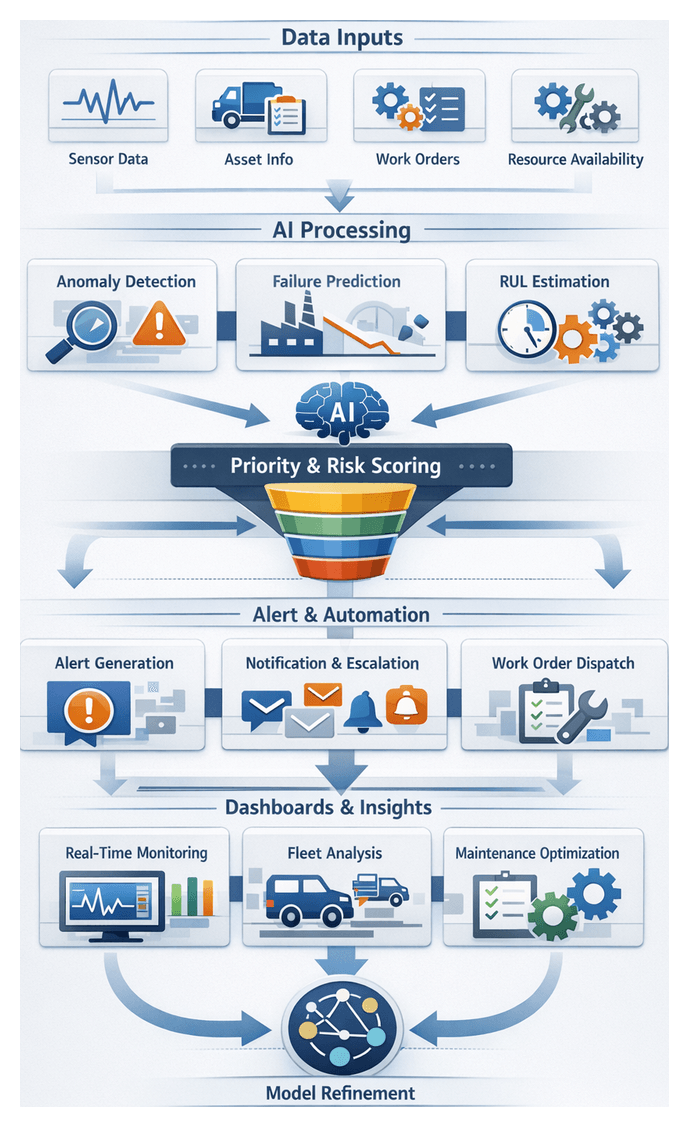
Purpose and Strategic Importance
This stage transforms predictive outputs—failure probability scores, remaining useful life estimates and anomaly flags—from deployed AI models into actionable information for maintenance planners, operations managers and field technicians. By consolidating model scores, asset metadata, resource availability and service level requirements into prioritized alerts and intuitive dashboards, organizations accelerate decision cycles, reduce response times and align maintenance activities with strategic goals. Clear, contextualized warnings enable stakeholders to assess fleet-wide risk at a glance, allocate technicians and spare parts optimally, sequence work orders to minimize downtime and escalate critical issues through predefined channels while maintaining audit trails for compliance.
As the nexus between advanced analytics and business execution, this stage ensures transparency of AI-driven recommendations, facilitates cross-functional collaboration and provides a feedback loop for continuous model refinement. Centralized dashboards create a single source of truth for asset health, critical in transportation and logistics environments where delayed response to failures on long-haul vehicles or high-value cranes can lead to multimillion-dollar disruptions.
Prerequisites and Required Inputs
- Real-time model outputs from predictive services including failure probability scores, RUL estimates and anomaly flags.
- Asset metadata detailing vehicle type, age, maintenance history, operational context and criticality ratings.
- Threshold definitions for alert severity, set statically or calibrated dynamically based on historical performance and business risk tolerance.
- Work order templates and protocols for systems such as IBM Maximo.
- Resource availability data including technician schedules, spare parts inventory and workshop capacity.
- Operational calendars, maintenance windows and SLA requirements.
- User role and access controls defining alert visibility and action permissions.
- Visualization framework connections to platforms such as Microsoft Power BI, Grafana and Looker, configured for streaming and historical data ingestion.
System Readiness and Governance
Before enabling alerting and visualization, ensure:
- Data pipeline stability with validated end-to-end latency, network bandwidth and failover mechanisms.
- Schema standardization across alert, asset and resource records.
- Governance process for threshold calibration and periodic review.
- Role-based dashboard templates tailored to executives, managers and field technicians.
- Notification infrastructure integrating email, SMS and push channels.
- Security and compliance audits meeting industry standards such as ISO 27001, GDPR and CCPA.
- Change management and training programs for stakeholder adoption.
- Performance monitoring for dashboards, alert brokers and decision support APIs.
Workflow for Alerting and Dashboard Updates
This integrated workflow converts raw predictive signals into prioritized notifications and real-time visual insights. It orchestrates event processing pipelines, rule engines, message brokers, notification services and dashboarding platforms to ensure high-risk alerts receive immediate attention while routine notifications are scheduled for standard review.
Detection to Alert Conversion
An event listener captures outputs from model inference services or message brokers such as Apache Kafka or MQTT. A conversion microservice evaluates whether each predictive signal crosses predefined thresholds—static or dynamically adjusted by AI calibration models—and generates an alert object containing asset identifiers, timestamps, failure mode classifications, confidence scores and raw sensor snapshots.
Priority Scoring and Enrichment
The prioritization engine applies a multi-factor scoring algorithm combining model severity and confidence with asset criticality, operational context and resource availability. Implementation may use AI rule engines such as IBM Operational Decision Manager or custom machine learning models. The engine enriches alerts by retrieving metadata from enterprise systems—such as SAP Enterprise Asset Management—and fleet management platforms to assign urgency levels: critical, high, medium or low.
Notification and Escalation
Based on priority, the notification service dispatches alerts via multiple channels. Critical events trigger SMS via Twilio, emails and push notifications, and integrate with incident management platforms like PagerDuty or ServiceNow. High-priority but non-critical alerts generate digital work orders in CMMS modules. Escalation rules, retry logic and acknowledgment tracking ensure unaddressed alerts are elevated to supervisors via tools like Slack or Microsoft Teams.
Dashboard Synchronization
Real-time event streams update analytics platforms—Grafana, Microsoft Power BI or Looker—through RESTful APIs or WebSocket connections. An ingestion service normalizes alerts, merges them with time-series metrics and writes to a low-latency reporting datastore. Dashboards refresh automatically to display alert counts by priority, asset group and region, supplemented by heat maps, trend charts and drill-down widgets for detailed asset timelines and sensor data.
Collaboration and User Interaction
Maintenance planners and reliability engineers use embedded decision-support widgets to view recommended repair windows based on fleet utilization and technician workload. Users can annotate alerts, override priorities and record decisions in an audit log. Integration with scheduling modules or collaboration platforms streamlines task assignment and follow-up inspections without leaving the dashboard environment.
Inter-System Coordination and Reliability
This loosely coupled, event-driven architecture connects services via message brokers (Apache Kafka, RabbitMQ) and REST APIs. OAuth 2.0 secures communications, while at-least-once delivery guarantees and idempotent processing prevent alert loss or duplication. Failover routines and retry mechanisms with exponential backoff handle transient failures in notification and dashboard synchronization steps. Service health metrics—queue depths, API latencies, notification success rates—feed into an AI-enabled operations center that triggers automated remediation workflows.
Continuous Improvement and Feedback Loops
Post-implementation KPIs—mean time to acknowledge (MTTA), mean time to repair (MTTR) and alert accuracy—are monitored to refine scoring and threshold parameters. Technicians rate alert relevance, informing supervised retraining of the prioritization engine. User behavior and feedback surveys guide interface enhancements, ensuring the alerting and visualization layer evolves with operational needs.
AI-Driven Decision Support Roles
Advanced AI capabilities embed throughout the alerting and decision support stage to transform predictive outputs into optimized maintenance plans, enabling proactive asset management and reduced downtime.
Risk Scoring and Prioritization Models
A composite risk index synthesizes failure probabilities, RUL forecasts and operational impact parameters—route criticality, load factors—using multi-factor risk synthesis, contextual weighting and temporal adjustment. Integration with BI tools such as Microsoft Power BI or Tableau allows drill-down into risk drivers and comparative fleet analysis.
Prescriptive Recommendation Engines
These modules leverage optimization algorithms and rule-based systems to propose repair windows, parts procurement plans and technician assignments. By interfacing with CMMS platforms like IBM Maximo and SAP PM, engines assess feasibility—skill sets, inventory levels, workshop capacity—and apply trade-off optimization and scenario simulation, delivering ranked action plans with labor hour estimates and confidence scores.
Natural Language Narrative Generation
NLG frameworks convert technical insights into concise summaries highlighting key risks, recommended actions and business impacts. Narratives such as risk synopses, action rationales and impact summaries integrate with maintenance tickets and mobile applications to enhance transparency and uptake.
Root Cause and Impact Analysis
AI-driven causal inference and dependency mapping tools—Bayesian networks, graph-based failure propagation and impact scoring—identify primary fault contributors and quantify cascade effects, prioritizing interventions that mitigate fleet-wide risks. These insights update EAM records, supporting continuous learning.
Resource and Schedule Optimization
Optimization agents connect to telematics and warehouse management systems to perform real-time route planning, parts allocation and shift matching. Dynamic scheduling minimizes travel time, aligns tasks with technician certifications and triggers procurement requests when inventory shortages arise.
Explainability and Confidence Metrics
Explainable AI techniques—feature importance visualizations, LIME and SHAP values, uncertainty quantification—surface model reasoning and attach confidence intervals to risk scores and prescriptions. Embedding these metrics in dashboards enhances user trust and fosters collaboration between data scientists and field teams.
Outputs, Dependencies and Handoffs
The outputs of this stage translate AI insights into executable maintenance actions, relying on upstream processes and triggering downstream systems to maintain end-to-end workflow integrity.
Key Outputs
- Structured alert packages with asset metadata, timestamps, severity scores, failure mode classifications, RUL estimates, recommended actions and parts and labor suggestions.
- Interactive dashboard artifacts including heat maps, trend charts, resource utilization gauges and drill-down widgets.
- Decision support reports summarizing alert volumes, intervention latencies, backlog projections, cost-impact analyses and KPIs.
- Event stream messages via Apache Kafka, RabbitMQ, MQTT streams and RESTful webhooks.
- API-accessible data objects adhering to OpenAPI or protocol buffer schemas for on-demand retrieval by orchestration engines.
Upstream and Downstream Dependencies
- Real-time data ingestion from edge and central processing stages with validated latency.
- Data quality management frameworks ensuring cleansed and standardized input streams.
- Feature store availability for engineered metrics, accessible with sub-second response times.
- Predictive model endpoints deployed and scaled for concurrent inference demands.
- Rule engines translating confidence scores into severity levels and action categories.
- Enterprise Asset Management and CMMS platforms—IBM Maximo, SAP Enterprise Asset Management, ServiceMax—for work order generation.
- Scheduling and workforce management solutions like Microsoft Dynamics 365 Field Service for automated calendar alignment.
- ERP and inventory systems integrated via MuleSoft Anypoint to manage parts procurement.
- Collaboration tools—Twilio, Slack, Microsoft Teams—for real-time notifications.
- API gateways secured by identity providers such as Okta.
Handoff Mechanisms
- Message-driven eventing where brokers dispatch alerts to orchestration engines, with acknowledgment to trigger work order creation.
- Transactional API calls to retrieve asset hierarchies and insert work orders, returning confirmation tokens for traceability.
- Batch exports of lower-severity alerts for aggregated scheduling in S3 buckets or file shares.
- Webhook notifications to orchestration platforms upon critical threshold breaches for low-latency push alerts.
- Dashboard deep linking that opens specific alert contexts within EAM and CMMS interfaces.
Governance, Compliance and Performance Metrics
Versioned schemas, identity-based access controls and audit logs ensure secure, traceable outputs. Data lineage tools capture transformations from raw readings to work orders, while retry policies, dead-letter queues and circuit breakers safeguard integrations. Key metrics—alert issuance latency, work order generation success rate, prediction accuracy, resolution timeliness and system uptime—are tracked to drive continuous improvement and operational resilience.
By defining a robust alerting, visualization and decision support layer, organizations bridge the gap between AI-driven insights and maintenance execution, achieving proactive asset management, optimized resource allocation and sustained operational performance.
Chapter 9: Automated Maintenance Orchestration
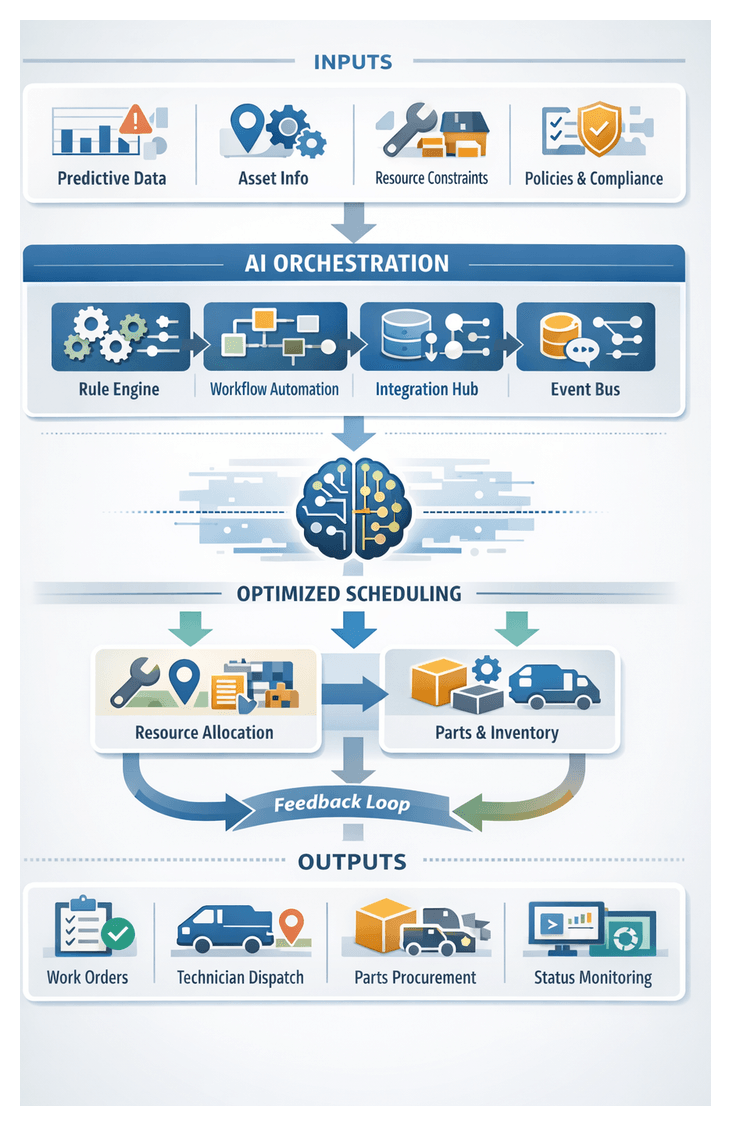
Orchestration Goals and Strategic Value
In transportation and logistics operations, the orchestration stage transforms predictive insights into coordinated maintenance actions that align with business priorities and operational constraints. By automating the generation, scheduling, and allocation of maintenance tasks based on real-time equipment health forecasts, organizations can minimize unplanned downtime, reduce overhead, and ensure consistent service delivery across the fleet.
Key objectives:
- Align maintenance windows with service schedules to prevent conflicts between repairs and asset deployment.
- Optimize resource utilization by matching technician skills, spare parts availability, and facility capacity to predicted failure events.
- Ensure compliance and safety by embedding regulatory guidelines, inspection protocols, and safety checklists into automated workflows.
- Adapt dynamically to emerging conditions such as supply chain delays or labor constraints through real-time schedule adjustments.
Strategic benefits:
- Reduced downtime via preemptive maintenance, improving asset availability and service reliability.
- Lower costs by automating work order creation and minimizing emergency repair premiums.
- Scalability through a repeatable orchestration framework that grows with fleet size or new asset classes.
- Increased transparency and accountability via centralized tracking of scheduled versus completed tasks.
Core system capabilities:
- Rule engine and decision logic: Translates model outputs into rule-based triggers and priority assessments.
- Workflow management: Sequencing and dependency handling with platforms such as Apache Airflow or Azure Logic Apps.
- Integration connectors: Adapters to CMMS solutions like IBM Maximo or SAP EAM for seamless work order synchronization.
- Event bus and messaging: Low-latency communication via Apache Kafka or MQTT to propagate triggers and updates.
- Monitoring and logging: Dashboards that track orchestration health, detect failures, and provide audit trails.
Essential Inputs and Technical Prerequisites
Effective orchestration depends on well-defined data contracts and integration points. Inputs span predictive analytics outputs, asset metadata, resource constraints, and organizational policies, supported by robust technical foundations.
Predictive Insights
- Failure probability scores estimating the likelihood of component or system failure.
- Remaining Useful Life (RUL) forecasts indicating time-to-failure windows.
- Anomaly flags and severity ratings denoting critical deviations.
- Confidence intervals and uncertainty bounds to guide risk-based decisions.
Asset and Contextual Metadata
- Asset registry entries with identifiers, locations, and operational status.
- Maintenance history logs to inform scheduling windows and resource estimates.
- Service level agreements (SLAs) defining permissible maintenance lead times.
- Operational calendars reflecting fleet deployment and demand patterns.
Resource Availability and Constraints
- Technician skill matrices, certifications, and licensing requirements.
- Real-time spare parts inventory levels and procurement lead times.
- Facility schedules, tool availability, and special handling requirements.
- Budget constraints, labor rates, and overtime policies guiding task assignments.
Organizational Policies and Regulatory Requirements
- Inspection checklists and safety verification procedures.
- Regulatory timers mandating intervals between maintenance events.
- Environmental protocols for handling hazardous materials.
- Data security controls for accessing sensitive maintenance records.
Technical Foundations
- Unified data schema across predictive models, asset registries, and resource systems.
- Well-documented API endpoints and message contracts for work orders, schedules, and inventory queries.
- Reliable connectivity between cloud services, edge nodes, and on-premises systems.
- Scalable compute infrastructure using container orchestration such as Kubernetes.
- Error handling and retry logic with exponential back-off and circuit-breaker patterns.
Orchestration Workflow: From Predictive Alert to Execution
This event-driven workflow transforms a predictive maintenance alert into actionable work orders, technician dispatches, and parts procurement requests through clear handoffs and decision points.
Triggering the Orchestration Sequence
A predictive model forecast emits a standardized event on an enterprise bus—using Apache Kafka or Azure Event Grid—including asset identifier, failure timestamp, failure mode, and repair codes. A BPM engine such as Camunda or Azure Logic Apps subscribes, validates the data, and retrieves contextual information like asset criticality and service history.
Data Enrichment and Contextual Analysis
The orchestration engine enriches alerts with:
- Shift schedules and technician availability from workforce management.
- Asset utilization forecasts from fleet management.
- Spare parts stock levels and lead times from inventory systems.
- Vendor performance metrics from procurement modules.
An AI-driven decision support service uses digital twin simulations to forecast the impact of scheduling options, guiding the selection of optimal maintenance windows.
Scheduling Algorithm and Prioritization
The core scheduler balances criticality, time-to-failure, resource constraints, and cost trade-offs. An AI scheduler—built on IBM Watson or Google Cloud AI Platform—generates and scores scenarios based on downtime minimization, workforce utilization, and supply chain reliability. The top scenario is forwarded for automated approval or manual refinement.
Resource Allocation and Technician Dispatch
The BPM engine creates work orders and assigns technicians through multidimensional matching:
- Skill matching to ensure required qualifications.
- Geographic optimization via routing APIs to minimize travel time.
- Load balancing to distribute tasks evenly.
- Shift compliance respecting labor regulations.
Technicians receive enriched job packets via a mobile app, which syncs status updates—acceptance, en route, and completion—back to the central system.
Spare Parts Procurement Coordination
- Extract bill of materials for the repair procedure.
- Check on-hand inventory through systems such as SAP Predictive Maintenance.
- Select optimal stock locations based on cost and delivery time.
- Issue replenishment requests via ERP APIs like Oracle Fusion Cloud Procurement.
- Escalate critical parts for expedited shipping when standard lead times threaten schedules.
Exception Handling and Dynamic Rescheduling
Exception paths address part shortages, technician unavailability, and emergent high-priority failures:
- Unavailable parts trigger alternative sourcing and schedule recalculation.
- Unacknowledged or ill technicians prompt automatic reassignment.
- Urgent operational conflicts invoke AI-driven re-optimization across pending work orders.
All exceptions generate audit logs and notifications, preserving traceability and enabling continuous improvement.
Monitoring, Audit Trail, and Feedback
Throughout execution, the platform logs workflow transitions, system messages, user overrides, technician records, and procurement updates. Dashboards provide real-time visibility into schedule adherence, parts performance, and resource utilization. Post-completion analytics compare actual and estimated metrics, feeding back into the AI scheduler and procurement policies to drive efficiency gains.
AI-Driven Dynamic Rescheduling and Conflict Resolution
Advanced AI capabilities embedded in the orchestration layer manage scheduling complexity under changing operational conditions, using constraint optimization, reinforcement learning, and simulation to reconcile competing demands.
Constraint Optimization
Optimization engines evaluate variables such as technician skills, part lead times, equipment criticality, SLA windows, and geolocation. Mixed-integer programming solvers or heuristic metaheuristics generate feasible assignments that balance travel time, labor costs, and downtime risk.
Reinforcement Learning
RL agents learn adaptive scheduling policies from historical outcomes by observing the impact of dispatch decisions on availability, repair durations, and cost. Over time, agents refine policies to anticipate and hedge against recurrent disruptions.
Multi-Agent Coordination
Each stakeholder—technicians, warehouse personnel, procurement teams—is modeled as an autonomous agent. Through message exchanges over a service bus, agents negotiate task handoffs and timing adjustments. AI mediation services detect deadlocks and apply resolution strategies like task splitting or priority escalation.
Digital Twin Simulations
Digital twins of assets, workflows, and supply chains enable what-if analysis of scheduling alternatives. Physics-based or queuing simulations estimate repair durations and travel delays, guiding scenario selection to meet business objectives.
Natural Language Interfaces for Exception Handling
Conversational interfaces allow planners to query and adjust schedules via plain language. NLP interprets requests, invokes optimization APIs, and returns ranked options, reducing manual lookups across systems.
Integration and Data Inputs
- Work orders and technician dispatch via IBM Maximo.
- Real-time parts inventory and procurement requisitions from ERP platforms.
- Route optimization and telematics data from Transportation Management Systems.
- Event streams from Apache Kafka for asset telemetry and notifications.
Inputs feed an inference pipeline that classifies alert severity, scores scheduling alternatives, and ranks conflict resolutions.
Continuous Learning and Governance
Execution outcomes—repair durations, travel times, parts usage—are ingested to retrain forecasting and scheduling models. Audit logs capture decision rationales, enabling human supervisors to override AI proposals and maintain compliance. Role-based access controls regulate modifications and approvals.
Orchestrated Outputs, Dependencies, and Handoffs
Primary Deliverables
- Automated work orders: Detailed instructions with diagnostics, interventions, labor estimates, and risk assessments.
- Dynamic resource schedules: Optimized timetables for personnel and equipment reflecting real-time updates.
- Procurement requests: Precise parts requisitions with component identifiers, vendors, and lead times.
- Authorization records: Electronic approvals, safety clearances, and compliance documentation.
- Audit logs: Comprehensive records of triggers, adjustments, assignments, and procurements.
- Status reports: Dashboards highlighting unfulfilled tasks, conflicts, and delays.
Integration Dependencies
- Predictive insight systems providing failure probabilities and RUL forecasts.
- Enterprise Asset Management platforms such as IBM Maximo, SAP EAM, and Oracle EAM.
- Field service tools like Microsoft Dynamics 365 Field Service and ServiceNow.
- Inventory and procurement systems for real-time stock levels and purchase orders.
- Rule engines enforcing SLAs, safety mandates, and environmental regulations.
- Geospatial services for routing and transit time calculations.
- Alerting platforms—email, SMS, and in-app notifications—to ensure timely acknowledgments.
Handoffs to Execution and Monitoring
- Work execution systems: Mobile apps and maintenance kiosks receive work orders and schedules, enabling real-time progress tracking.
- Procurement workflows: Parts requests trigger purchase orders or stock reservations, with delivery confirmations feeding back into schedules.
- Feedback to analytics: Execution metrics refine predictive models and scheduling policies in continuous improvement cycles.
- Dashboard updates: Real-time visualization of work statuses, adherence rates, and resource utilization.
- Stakeholder notifications: Automated reports on asset availability and service commitments for operations centers and logistics partners.
- Compliance archives: Safeguarded records for regulatory inspections and internal audits.
Key Considerations for Robust Handoffs
- Maintain consistent data schemas, status codes, and timestamp conventions across systems.
- Plan for API rate limits and implement retry logic to preserve data integrity under load.
- Enforce security and access controls, encrypting sensitive information throughout transmission.
- Manage version control of orchestration logic, templates, and rule sets to prevent disruptions during updates.
- Implement health checks and alerts for orchestration services to detect failed handoffs promptly.
- Architect for horizontal scalability with containerized deployments and distributed message queues.
Chapter 10: Performance Feedback and Continuous Improvement
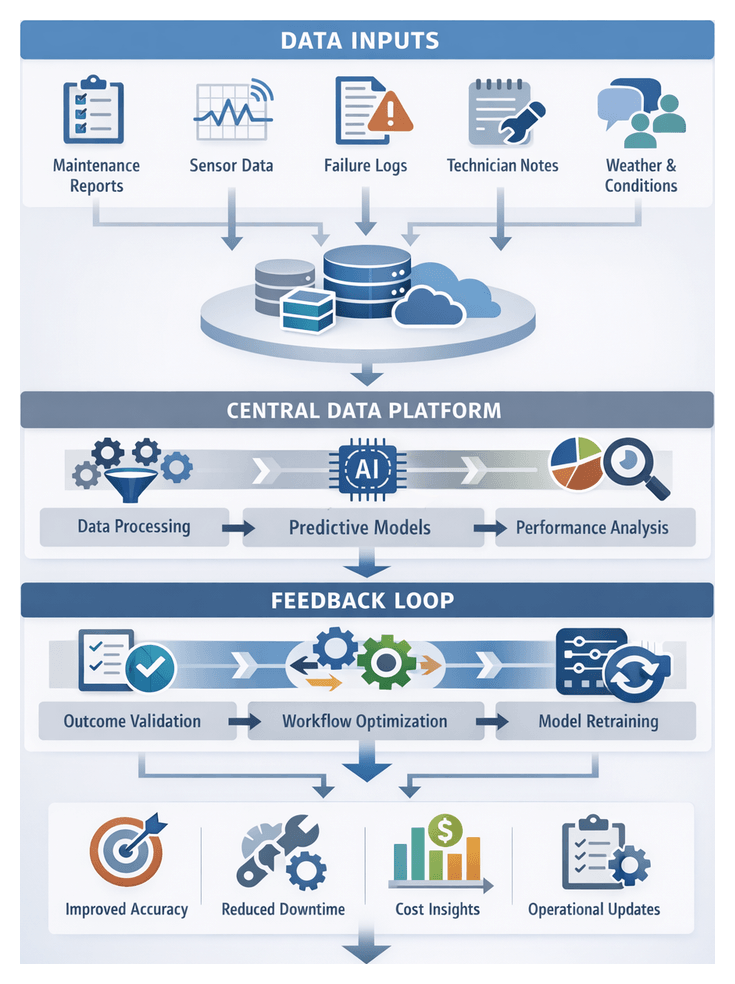
Feedback Loop Objectives and Data Inputs
The feedback loop stage establishes a self-reinforcing cycle of continuous improvement in AI-driven predictive maintenance. By capturing post-maintenance outcomes—such as repair durations, parts usage, technician observations, and real-world failure events—and comparing them against predicted behaviors, organizations can validate and refine both analytical models and maintenance workflows. This process transforms reactive incident handling into proactive system enhancements, driving increased prognostic accuracy, optimized resource allocation, and reduced unplanned downtime across complex asset fleets.
In transportation and logistics, unplanned equipment failures incur service disruptions, inflated operational costs, and customer dissatisfaction. A comprehensive feedback mechanism addresses these challenges by:
- Validating and calibrating model forecasts against actual downtime and repair timelines.
- Identifying workflow inefficiencies through maintenance cycle time and technician utilization analysis.
- Assessing feature and data quality by correlating sensor-derived metrics—such as vibration spectra and temperature trends—with observed outcomes.
- Generating actionable insights from aggregated maintenance records, environmental conditions, and stakeholder feedback to surface new failure modes and preventive strategies.
By aligning cross-functional teams—data science, reliability engineering, operations, and procurement—around these objectives and defined performance metrics (for example, precision, recall, mean time between failures, and mean time to repair), organizations create a unified roadmap for sensor investments, algorithm enhancements, and orchestration logic updates.
Key Data Inputs and Sources
Effective feedback loops rely on accurate, timely, and comprehensive data inputs:
- Post-Maintenance Reports: Work order outcomes, parts replaced, root-cause diagnoses, and cost breakdowns from enterprise asset management and CMMS.
- Operational Performance Logs: Telematics and sensor records capturing engine runtime, load profiles, ambient conditions, and anomaly flags.
- Failure Event Records: Incident timestamps, failure codes, severity levels, and related service tickets maintained by fleet management platforms.
- Technician Notes and Observations: Qualitative annotations documenting atypical symptoms and troubleshooting steps.
- User and Stakeholder Feedback: Input from operations managers, logistics planners, and end-users on asset reliability and scheduling impacts.
- Environmental and Contextual Data: Weather conditions, road quality indices, and traffic patterns affecting degradation rates.
- Model Inference Logs: Historical predictions, confidence scores, and alert timestamps for direct comparison with actual events.
These datasets are consolidated into a centralized repository—often a cloud-based data lake or structured warehouse—where schema validation, data lineage tracking, and quality checks ensure consistency and traceability.
Prerequisites for a Robust Feedback Loop
To derive actionable insights, organizations must establish foundational conditions:
- End-to-End Data Pipeline Integrity: Continuous ingestion, storage, and retrieval of sensor streams and maintenance records with redundancy and monitoring.
- Model and Workflow Version Control: Systems like MLflow and TensorFlow Model Management to track model iterations, datasets, and hyperparameters.
- Defined KPIs: Metrics for model accuracy, maintenance efficiency, and operational reliability.
- Data Governance Framework: Policies for ownership, access control, retention, and compliance with regulations.
- Cross-Functional Collaboration Channels: Communication pathways among data engineers, scientists, reliability engineers, planners, and technicians.
- Synchronized Asset Registry: Accurate inventory of sensors, hardware configurations, and equipment variants.
- Baseline Operational Benchmarks: Historical maintenance costs, failure rates, and downtime metrics for impact measurement.
Analytics Workflow for Outcomes and Efficiency Metrics
The analytics workflow processes raw post-maintenance data into strategic intelligence, bridging completed service actions and continuous improvement. It comprises orchestrated steps for data collection, normalization, metric computation, discrepancy detection, and stakeholder delivery, all governed by robust data governance and security practices.
Data Collection and Aggregation
Data is ingested from multiple systems through orchestration engines like Apache Airflow and message queues such as Apache Kafka. Core inputs include:
- Work order records from CMMS capturing labor hours, parts usage, and technician notes.
- Telematics and sensor logs streamed by IoT platforms.
- Fleet management metrics—uptime, fuel consumption, load factors.
- Field feedback documenting anomalies and unplanned events.
Data Alignment, Normalization, and Enrichment
Aggregated streams undergo:
- Timestamp synchronization across time zones and devices.
- Entity resolution using master asset registries.
- Unit standardization and outlier detection via rule engines.
- Contextual enrichment with asset metadata and procedural codes.
Tools like IBM Watson Studio automate anomaly detection and suggest data imputations, while metadata catalogs ensure auditability.
Metric Computation and Analytical Modeling
Unified datasets feed analytical pipelines—often managed by Azure Synapse Analytics—to compute metrics such as:
- Mean Time to Repair (MTTR)
- Maintenance Cost per Asset
- Uptime Improvement Rate
- Technician Productivity
- First-Time Fix Rate
Computed metrics are compared against predictions through delta analysis, root-cause inference, trend analysis, and statistical significance testing. Automated frameworks like MLflow orchestrate model comparisons and generate alerts when thresholds are breached.
Validation, Visualization, and Delivery
Flagged discrepancies undergo peer review by subject matter experts, and exception filters suppress non-critical deviations. Validated insights are packaged into:
- Executive dashboards highlighting cost savings, uptime gains, and ROI.
- Operational scorecards for maintenance managers.
- Detailed root-cause reports for reliability engineers.
- Automated notifications for critical alerts.
Interactive tools like Tableau or Microsoft Power BI enable drill-down analysis, while scheduled distributions and self-service portals ensure timely access for all stakeholders.
Integration with Continuous Improvement
Analytics outputs feed Plan-Do-Check-Act cycles by triggering:
- Model parameter updates and retraining pipelines.
- SOP refinements based on root-cause findings.
- Inventory adjustments reflecting observed failure patterns.
- Targeted technician training programs.
API-driven handoffs and automated workflow triggers minimize delays, closing the loop between insights and operational enhancements.
AI-Enabled Model Retraining and Workflow Optimization
To sustain predictive accuracy amid evolving asset behaviors and environments, automated retraining and scheduling optimization are integrated into the feedback workflow. AI capabilities detect performance drift, refresh feature sets, and recalibrate orchestration logic, ensuring that maintenance actions remain cost-effective and timely.
Automated Retraining Pipelines
Trigger criteria—such as sustained drops in precision or surges in false positives—activate retraining workflows orchestrated by tools like Apache Airflow. Pipeline steps include:
- Data extraction and schema verification from data lakes.
- Feature engineering and time series aggregation.
- Algorithm selection and hyperparameter tuning via Optuna on platforms such as MLflow or Kubeflow.
- Cross-validation, calibration, and performance benchmarking.
- Model versioning in registries and deployment readiness packaging.
Continuous integration servers like Jenkins or GitLab CI automate retraining jobs within containerized environments managed by Kubernetes.
Feature and Algorithm Optimization
Advanced AI modules perform dynamic feature pruning, adaptive thresholding, and ensemble evolution. Platforms such as DataRobot automate ensemble construction and feature importance analysis, minimizing manual intervention.
Adaptive Scheduling and Resource Optimization
AI-driven models support:
- Demand forecasting for maintenance volumes and timing.
- Technician assignment using constraint programming and reinforcement learning.
- Inventory rebalancing of spare parts based on predictive analytics.
- Conflict resolution through dynamic window adjustments.
These capabilities leverage optimization engines and integrate with ERP systems to propagate schedule and inventory updates automatically.
Monitoring and Governance
Post-deployment, tools like Prometheus and Grafana track model health, drift, and inference performance. Drift detection, anomaly feedback integration, and non-disruptive retraining windows ensure ongoing fidelity. Enterprise solutions such as Azure Machine Learning and Amazon SageMaker provide integrated governance, audit trails, and policy enforcement.
Outputs, Dependencies, and Handoffs for Iterative Improvement
Deliverables from the feedback and improvement stage encapsulate refined assets, while dependencies ensure data integrity and infrastructure reliability. Clear handoff protocols integrate these outputs into development, deployment, monitoring, and decision-support systems.
Core Outputs
- Versioned Model Artifacts: Serialized binaries, metadata, and performance metrics.
- Augmented Training Datasets: Expanded, annotated datasets capturing new failure modes.
- Updated Workflow Definitions: Orchestration DAGs, SLAs, and exception routines in tools like Apache Airflow.
- Performance and Exception Reports: Analytics on accuracy drift, MTBF variances, and root-cause insights.
- Decision Support Summaries: KPI overviews for BI platforms such as Databricks and Microsoft Power BI.
Key Dependencies
- Comprehensive Maintenance Logs: Consistent records from EAM systems for automated correlation.
- Synchronized Data Infrastructure: High-availability pipelines and data lakes with schema control—powered by tools like Apache Kafka.
- Scalable Compute Resources: Cloud or on-prem clusters supporting TensorFlow and Kubeflow training workflows.
- Monitoring and Alerting: Observability frameworks—Prometheus, Grafana, or Splunk Observability—tracking model health.
- Collaboration Channels: Integrated platforms for data science, operations, and field teams to validate and refine insights.
- To Model Development: Datasets, reports, and change logs ingested into ML experiment tracking in MLflow.
- To Deployment Orchestration: Containerized models promoted via Jenkins or GitLab CI pipelines.
- To Inference Engines: Configuration updates propagated by tools such as Ansible or Chef to distributed nodes.
- To Alerting Layers: Revised risk scores integrated into notification services and BI dashboards.
- To Maintenance Orchestration: Enhanced rule sets delivered to enterprise maintenance management systems for automated work order generation.
- To Executive Reporting: KPI dashboards and summary reports published to management portals and distribution lists.
By defining these outputs, securing critical dependencies, and orchestrating precise handoffs, the continuous improvement cycle in predictive maintenance evolves into a mature, self-tuning system. This framework not only elevates model fidelity and process efficiency but also fosters cross-functional confidence, ensuring that AI-driven maintenance strategies deliver sustained operational excellence.
Conclusion
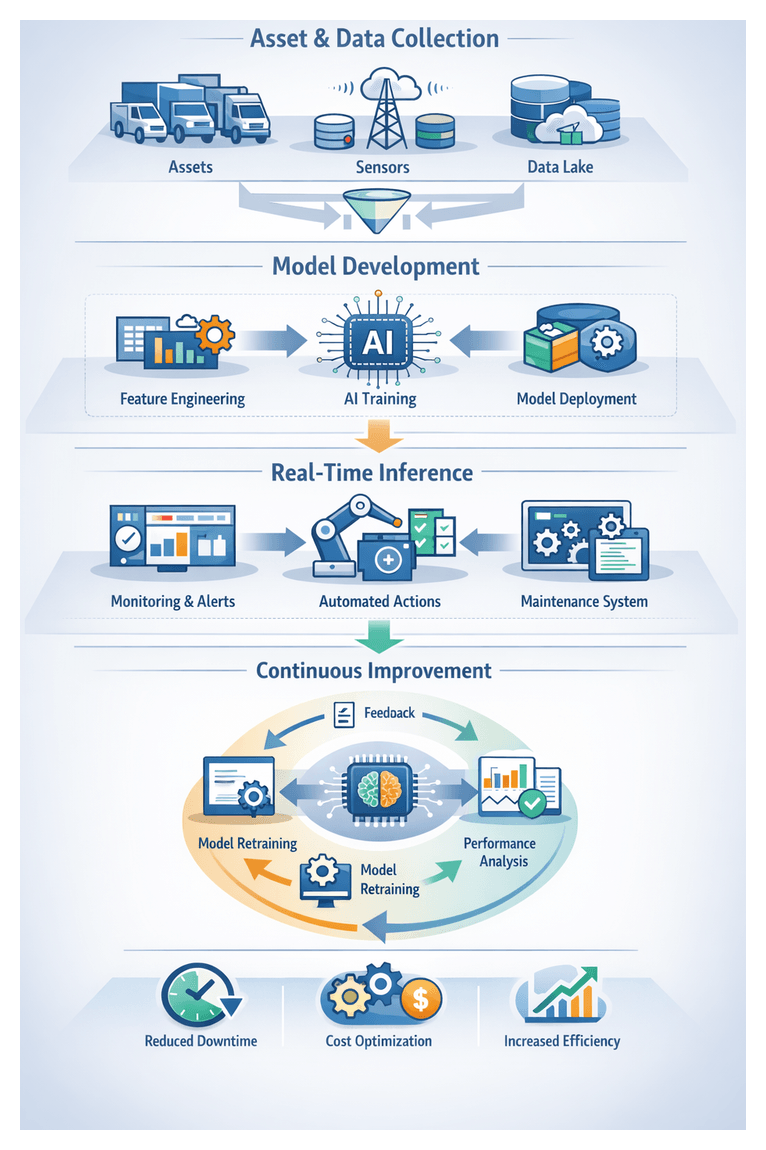
End-to-End Predictive Maintenance Workflow Overview
This unified workflow aligns strategic objectives, technical processes, and operational deliverables across the predictive maintenance lifecycle. Transportation and logistics organizations benefit from a coherent line of sight into sensor deployment, data acquisition, model development, real-time inference, and continuous feedback. By consolidating every stage—from asset profiling to continuous improvement—stakeholders gain clarity on how tactical data flows and analytic functions translate into reduced unplanned downtime, optimized resource allocation, and measurable cost efficiencies.
Asset and Data Foundation
Assets are cataloged in a registry with a criticality matrix that prioritizes vehicles and equipment by operational impact. A sensor network topology defines placement, sampling rates, and edge device configurations. Edge modules filter and aggregate raw streams, tagging potential anomalies before forwarding data to a centralized repository. The unified data lake stores sensor logs, maintenance records, and scheduling information alongside quality metadata to ensure consistency.
Model Development and Deployment
Engineered feature sets—time-series indicators, spectral analyses, and comparative metrics—serve as inputs for predictive models. Training pipelines evaluate remaining useful life and failure probabilities, often leveraging frameworks such as TensorFlow. Versioned model artifacts and container images are packaged with orchestration scripts for deployment to cloud or edge environments. Performance reports validate accuracy against established baselines prior to release.
Inference and Orchestration
Real-time inference streams deliver continuous predictions to operational dashboards and alerting engines. Configured alert rules prioritize notifications by risk score and operational context. A rule engine automates work order creation in the enterprise maintenance management system, triggers spare parts availability checks, and dispatches task assignments to mobile maintenance applications.
Continuous Improvement Loop
Post-maintenance feedback datasets capture actual repair outcomes, cycle times, and parts usage. Discrepancy analyses feed back into model retraining triggers, ensuring forecasts evolve with new failure modes and sensor modalities. Iterative refinement is guided by a continuous improvement playbook that prescribes performance reviews, data quality audits, and stakeholder workshops.
Operational Benefits
Downtime Minimization Through Predictive Alerts
Edge-optimized anomaly detection transforms reactive break-fix workflows into proactive maintenance cycles. Vibration, temperature, and pressure data stream to edge modules that flag early warning signs. Alerts containing asset ID, confidence score, and recommended actions trigger rule-based notifications and preliminary work order creation, reducing average equipment downtime by up to thirty percent.
Maintenance Cost Reduction and Resource Optimization
Condition-based maintenance aligns parts consumption and technician effort with actual equipment health. The forecasting service, powered by TensorFlow, computes remaining useful life probabilities. A decision logic layer applies business rules to initiate spare parts requisitions and optimize technician assignments. This coordination yields documented savings of up to twenty percent on labor and parts.
Enhanced Planning and Scheduling Efficiency
An AI-driven scheduling engine ingests prioritized maintenance tasks and live vehicle routing data to identify low-impact service windows. Leading solutions recommend optimal task sequences based on geographic clustering and technician skill profiles. Automated dispatch to mobile apps reduces planning overhead by over fifty percent.
Increased Asset Utilization and Fleet Availability
Integrated dashboards recalculate fleet availability metrics after each completed work order, presenting mean time between failures and mean time to repair for immediate action. Live heat maps highlight performance hotspots, while feedback loops to the retraining pipeline ensure future forecasts reflect real-world outcomes. Fleets report up to fifteen percent higher utilization, deferring capital expenditures.
Improved Safety and Regulatory Compliance
Predictive alerts trigger digital compliance checklists for safety-critical components. Inspection reports upload automatically to compliance portals, while cross-check routines compare scheduled inspections against regulatory calendars. Secure data exchange APIs support automated reporting to authorities, reducing risk of fines and reinforcing on-road safety.
Strategic Impact
Enhanced Asset Longevity and Reliability
AI-driven forecasts extend component service life by optimizing replacement intervals. Platforms like IBM Maximo integrate prognostic models into maintenance dashboards, enabling data-driven parts procurement and downtime planning. Deployments report up to thirty percent longer component life and twenty percent fewer in-service failures.
Proactive Maintenance Culture
Predictive insights elevate maintenance teams from reactive troubleshooters to strategic partners. Dashboards in SAP Predictive Maintenance and Service visualize risk profiles and prioritized work orders, shifting conversations toward fleet optimization and peak-demand alignment. This cultural shift fosters agility and cross-functional collaboration.
Data-Driven Strategic Decision Making
Forecasted downtime metrics and failure probabilities feed into capital expenditure models and route optimization studies. Machine learning platforms such as DataRobot and H2O.ai support automated model deployment and risk scoring. Leadership teams simulate scenarios to balance asset replacement versus expanded condition monitoring.
Competitive Differentiation and Market Positioning
Providers embedding AWS IoT SiteWise and Azure IoT Central demonstrate live health dashboards that reinforce reliability as a service differentiator. Transparent uptime reporting and rigorous maintenance practices support premium service offerings and strengthen brand reputation.
Operational and Financial Risk Mitigation
Anomaly detection and failure probability forecasting mitigate equipment-related risks before they escalate. Financial exposure is reduced through accurate budgeting and minimized emergency repairs. Solutions like SAS Asset Performance Analytics integrate risk scoring into governance frameworks, improving insurance terms and contingency planning.
Regulatory Compliance and Safety Assurance
Automated audit trails document condition metrics, maintenance actions, and decision rationales. Compliance modules within IBM Maximo and Microsoft Dynamics 365 Field Service automate reporting, inspection scheduling, and certificate management, reducing administrative burdens and ensuring regulatory adherence.
Organizational Agility and Scalability
Modular, cloud-native architectures support rapid onboarding of new data sources and analytic models. Kubernetes-based serving via Kubeflow or Amazon SageMaker enables automated scaling, continuous integration, and swift model rollouts. This agility aligns maintenance capabilities with evolving business demands.
Workforce Empowerment and Skill Evolution
Mobile applications connected to predictive platforms guide technicians with pre-arrival diagnostics and parts lists. Continuous learning modules in UpKeep deliver targeted training triggered by emerging failure patterns. Feedback loops refine playbooks, elevating job satisfaction and reducing mean time to repair.
Summary of Strategic Levers
- Extended asset life and fewer in-service failures
- Shift from reactive repairs to foresight and planning
- Data-informed capital allocation and route optimization
- Market differentiation through reliability transparency
- Mitigated operational, financial, and regulatory risks
- Scalable architectures supporting growth and innovation
- Empowered workforce with data-driven guidance
Deliverables, Dependencies, and Handoffs
Key Deliverables
- Consolidated end-to-end workflow blueprint with flow diagrams and interface specifications
- Executive summary report and ROI analysis quantifying downtime reduction and cost savings
- Technical artifact package: ML model files, feature schemas, data transformation scripts, and IaC templates
- Operational dashboards and reporting suite for real-time and historical KPI monitoring
- Training materials: end-user guides, quick reference cards, videos, and SOP documentation
- Integration connectors and deployment scripts supporting CI/CD pipelines
- Governance, compliance, and change management plan with roles, audit controls, and approval workflows
- Continuous improvement playbook prescribing review cadences, data audits, and model retraining procedures
- Data and infrastructure readiness: secure access to sensor feeds, maintenance logs, and scheduling databases
- Cross-functional stakeholder engagement among maintenance, operations, data science, and IT
- Regulatory and compliance alignment with data retention, reporting, and audit trail requirements
- Technology stack compatibility across IoT platforms, analytics engines, and CMMS
- Performance measurement frameworks defining KPIs such as MTBF, MTTR, and availability
- Security and access control policies enforcing encryption, authentication, and role-based permissions
- Robust change management processes for model versioning, workflow updates, and stakeholder communication
- Operations and Maintenance teams receive the workflow blueprint, dashboards, and training materials for daily execution
- IT and DevOps organizations manage integration connectors, deployment scripts, and CI/CD pipelines for model delivery
- Business Analytics and Reporting functions incorporate ROI analyses and metric definitions into performance reviews
- Continuous Improvement and R&D groups use the playbook and artifacts to pilot extensions and new asset classes
- Governance, Risk, and Compliance departments embed audit controls and oversight into organizational policies
- Executive Steering Committee reviews performance reports and strategic recommendations for scaling and future investments
By formalizing these deliverables, dependencies, and handoff pathways, predictive maintenance transitions from a project into a sustainable capability. The end-to-end blueprint, supported by governance structures and continuous improvement processes, ensures that maintenance becomes a strategic enabler, driving reliability, cost efficiency, and competitive advantage across the enterprise.
Appendix
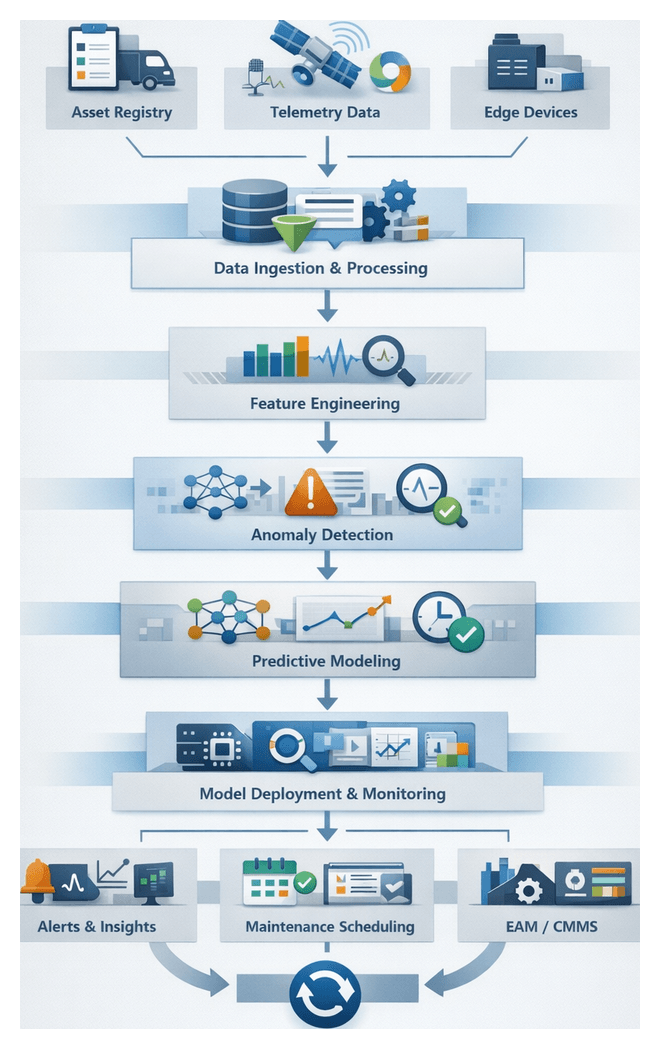
Glossary of Terms and Acronyms
- Asset Registry: A centralized catalog recording each fleet asset’s metadata—make, model, serial numbers, commissioning dates and hierarchy—to serve as the authoritative reference for maintenance and analytics.
- Criticality Matrix: A scoring system that ranks assets by failure probability, operational impact and cost, guiding maintenance prioritization.
- Telemetry: Continuous sensor‐generated data such as vibration, temperature, pressure and GPS used to monitor asset health in real time.
- Edge Processing: Local computation on or near the asset to filter noise, aggregate data and detect anomalies before sending to central systems.
- Feature Engineering: Creation of derived indicators—rolling averages, frequency components, trend slopes—that capture early signs of degradation for model input.
- Anomaly Detection: Identification of deviations from normal operating behavior via statistical or machine learning methods to flag potential faults.
- Remaining Useful Life (RUL): An estimate of operational time or usage remaining before an asset or component is likely to fail, enabling condition-based maintenance scheduling.
- Computerized Maintenance Management System (CMMS): Software that manages work orders, parts inventories, maintenance schedules and service histories.
- Enterprise Asset Management (EAM): A platform integrating asset lifecycle management, maintenance planning, procurement, compliance and financial tracking.
- MLOps: Practices and toolchains for automating and governing the end-to-end machine learning lifecycle, including training, deployment, monitoring and retraining.
- Data Lake: A centralized repository storing raw, structured and unstructured data at scale, underpinning analytics and model training.
- Drift Detection: Automated monitoring of changes in data distributions or model performance, triggering retraining when thresholds are exceeded.
- RUL: Remaining Useful Life
- MTBF: Mean Time Between Failures
- MTTR: Mean Time To Repair
- IoT: Internet of Things
- AI: Artificial Intelligence
- ML: Machine Learning
- CI/CD: Continuous Integration/Continuous Deployment
- API: Application Programming Interface
- GPU: Graphics Processing Unit
- SQL: Structured Query Language
Predictive Maintenance Workflow
Asset Inventory and Criticality Assessment
AI accelerates asset profiling by extracting component details and failure histories from maintenance logs via natural language processing, clustering assets with similar usage patterns and predicting risk scores with supervised models. Knowledge graphs link assets, subcomponents and failure modes to refine prioritization dynamically.
Sensor Infrastructure Design and Deployment
Digital twin simulations using Azure Digital Twins evaluate sensor coverage and environmental factors. Reinforcement learning agents optimize mounting locations, while physics-informed machine learning adjusts calibration parameters. Cost models project long-term ROI based on failure avoidance and sensor lifecycle expenses.
Data Acquisition and Edge Processing
Edge intelligence reduces noise and bandwidth usage. Denoising autoencoders deployed on gateways reconstruct clean signals, and one-class classifiers—such as isolation forests—flag anomalies before transmission. Adaptive sampling policies adjust frequencies based on conditions, while platforms like AWS IoT Greengrass and Azure IoT Edge manage containerized analytics and secure updates.
Data Integration and Quality Management
AI automates ingestion, validation, cleansing and deduplication of heterogeneous sources. Outlier detection models identify corrupted entries, probabilistic record linkage resolves duplicate asset records across systems, and auto-imputation fills gaps with confidence metrics. Metadata services tag fields, track lineage and enforce governance across data lakes and warehouses.
Feature Engineering and Anomaly Detection
Automated pipelines compute time-series features—rolling statistics, entropy measures and change-point indicators—using frameworks like TensorFlow. Spectral analysis via wavelet transforms and Fourier decomposition uncovers vibration harmonics. Graph-based features derived from knowledge graphs capture contextual relationships, and unsupervised clustering highlights outlier behavior.
Predictive Modeling and Validation
Supervised and semi-supervised models—including gradient boosting, random forests and neural networks—forecast failure probabilities and RUL. LSTM and temporal convolutional networks capture sequential dependencies. Purged k-fold and rolling-window cross-validation preserve temporal integrity, while Platt scaling and isotonic regression via scikit-learn calibrate probability outputs.
Deployment and Real-Time Monitoring
Models are containerized and served with platforms such as NVIDIA Triton Inference Server and TensorFlow Serving for optimized inference on CPU/GPU clusters. Kubernetes orchestrates autoscaling, while drift detection pipelines monitor feature distributions and trigger automated retraining. Observability and alerts are managed via Prometheus and Grafana.
Alerting, Visualization and Decision Support
Hybrid rule-based and ML engines prioritize alerts by severity and impact. Prescriptive analytics recommend maintenance windows, technician assignments and parts requisitions. Natural language generation converts technical insights into narratives, and explainable AI techniques—such as SHAP and LIME—provide transparency into recommendations.
Automated Maintenance Orchestration
Constraint solvers schedule tasks under resource and time constraints, and reinforcement learning agents optimize sequencing to maximize fleet availability. Digital twin simulations test scenarios before execution, and ChatOps interfaces enable planners to query and adjust schedules via natural language.
Continuous Improvement and Feedback
Model performance and maintenance outcomes feed back into the pipeline. Continuous drift monitoring, CI/CD retraining pipelines, feature set optimization and process analytics refine models and orchestration rules. Automated workflows handle data ingestion, hyperparameter tuning and versioned deployments for sustained reliability.
Operational Variations and Edge Cases
- Fleet Profiles: Variations in fleet size, asset classes and digital maturity—from manual logbooks to fully instrumented deployments—require adaptable architectures.
- Connectivity Constraints: In remote or underground sites, edge nodes perform local inference, buffer data with ordered journaling and prioritize critical alerts upon reconnection.
- Regulatory Compliance: Orchestration engines enforce jurisdictional inspection mandates, safety procedures and data residency rules, generating audit trails and certificates.
- Legacy Equipment: Retrofit sensors, manual inspection apps and hybrid digital twins estimate missing metrics. Sparse data models normalize irregular inputs.
- Emergency Overrides: Manual triggers escalate urgent tasks, re-optimize schedules, log rationale and feed post-event analytics for improved forecasting.
- Multi-Tenant Operations: Tenant-specific configurations, data partitioning, role-based dashboards and regional rule sets ensure isolation and compliance.
- Resource Variability: AI-driven schedulers ingest real-time supply, workforce and external events to simulate scenarios, reallocate tasks and balance workloads.
- Model Drift: Continuous statistical tests detect covariate and concept drift, suspending alerts and triggering retraining or rollback procedures.
- Data Quality Anomalies: Real-time validation rules, intelligent imputation and sensor health scoring maintain analytics integrity during gaps or corrupt packets.
- Human-in-the-Loop: Approval workflows, annotation interfaces and audit logs support expert overrides and continuous policy refinement.
- Scaling: Containerized microservices with autoscaling, infrastructure-as-code templates and load testing enable rapid deployment across regions and peak demand scenarios.
- Third-Party Integration: Adapter microservices, standardized schemas and orchestration hooks handle API versioning, connector libraries and compatibility testing with vendor platforms.
AI-Driven Tools and Platforms
Workflow Orchestration
- Apache Airflow: Author, schedule and monitor complex data and retraining pipelines.
- Kubeflow Pipelines: Orchestrate end-to-end ML workflows on Kubernetes with experiment tracking.
- Jenkins: Automate CI/CD for models and infrastructure code.
- GitLab CI/CD: Integrated pipelines for code, configuration and container images.
- Terraform: Provision and manage cloud and on-prem resources as code.
Data Integration and ETL
- Apache NiFi: Automate real-time ingestion of sensor streams and context feeds.
- Talend Data Integration: Design and execute ETL processes with connectors to IoT and ERP systems.
- Informatica PowerCenter: Profile, cleanse and transform data for analytics readiness.
- AWS Glue: Serverless ETL with schema discovery and data cataloging.
- Azure Data Factory: Orchestrate data movement and transformation at scale.
Feature Store and Metadata
- Feast: Manage and serve ML features consistently for training and inference.
- MLflow: Track experiments, register models and manage metadata.
- Databricks Feature Store: Discover, version and serve features on Apache Spark.
- Apache Atlas: Govern data lineage, schemas and audit trails.
- Great Expectations: Validate and profile data before model training.
Machine Learning Frameworks
- TensorFlow: Build and deploy deep learning and time-series forecasting models.
- PyTorch: Develop flexible dynamic-graph models for research and production.
- Scikit-learn: Rapid prototyping of classical ML algorithms.
- H2O.ai Driverless AI: Automated feature engineering and hyperparameter tuning.
- Amazon Forecast: Managed time-series forecasting service adaptable for maintenance workloads.
MLOps and Model Management
- Amazon SageMaker: End-to-end managed service for building, training and deploying models.
- Azure Machine Learning: Automated ML pipelines, model registry and compute management.
- Databricks MLOps: Collaborative environment integrated with Lakehouse architectures.
- KFServing: Kubernetes-native autoscaling and canary deployments for inference.
Edge Computing and IoT Platforms
- Azure IoT Edge: Deploy containerized modules for local processing and inference.
- AWS IoT Greengrass: Run Lambda functions and ML inference on edge devices.
- Edge Impulse: Develop TinyML applications for embedded devices.
- PTC ThingWorx: Industrial IoT platform for real-time data analysis and visualization.
- NVIDIA Jetson Nano: Edge AI device for vision-based anomaly detection in harsh environments.
- Azure Digital Twins: Create virtual asset models for simulation and optimization.
Visualization and Monitoring
- Grafana: Visualize metrics and create alerts from time-series databases.
- Prometheus: Collect metrics and trigger alerts based on service performance.
- Microsoft Power BI: Build interactive dashboards integrating predictive maintenance data.
- Tableau: Drag-and-drop analytics and storytelling for operational insights.
- Datadog: Aggregate logs, metrics and provide AI-driven anomaly detection.
Messaging Infrastructure
- Apache Kafka: High-throughput streaming platform for real-time ingestion and alert propagation.
- RabbitMQ: Reliable message broker supporting multiple protocols.
- MQTT: Lightweight protocol for constrained devices and intermittent networks.
- ZeroMQ: High-performance library for custom data pipelines and inter-process communication.
Enterprise Asset Management Systems
- IBM Maximo: Comprehensive EAM solution for work orders, preventive plans and compliance workflows.
- SAP Enterprise Asset Management: Integrated suite for asset records, scheduling and lifecycle costing.
- ServiceNow: Extendable IT and service management platform with predictive maintenance apps.
- Infor EAM: Configurable suite integrating IoT and AI for streamlined execution and procurement.
- Oracle EAM: Automate preventive scheduling and parts replenishment in Oracle Cloud.
Standards and References
- ISO/IEC 30141: Internet of Things Reference Architecture for interoperability and security.
- OPC Unified Architecture (OPC UA): Vendor-neutral interface for industrial automation and data exchange.
- SAE J1939: Vehicle network protocol for heavy-duty trucks and off-highway equipment diagnostics.
- ISO 14224: Standards for reliability and maintenance data exchange.
- NIST SP 800-53: Security and privacy controls for information systems guiding IoT and AI pipeline cybersecurity.
- OpenAPI Specification: Standard for describing RESTful APIs to automate client SDK generation and testing.
The AugVation family of websites helps entrepreneurs, professionals, and teams apply AI in practical, real-world ways—through curated tools, proven workflows, and implementation-focused education. Explore the ecosystem below to find the right platform for your goals.
Ecosystem Directory
AugVation — The central hub for AI-enhanced digital products, guides, templates, and implementation toolkits.
Resource Link AI — A curated directory of AI tools, solution workflows, reviews, and practical learning resources.
Agent Link AI — AI agents and intelligent automation: orchestrated workflows, agent frameworks, and operational efficiency systems.
Business Link AI — AI for business strategy and operations: frameworks, use cases, and adoption guidance for leaders.
Content Link AI — AI-powered content creation and SEO: writing, publishing, multimedia, and scalable distribution workflows.
Design Link AI — AI for design and branding: creative tools, visual workflows, UX/UI acceleration, and design automation.
Developer Link AI — AI for builders: dev tools, APIs, frameworks, deployment strategies, and integration best practices.
Marketing Link AI — AI-driven marketing: automation, personalization, analytics, ad optimization, and performance growth.
Productivity Link AI — AI productivity systems: task efficiency, collaboration, knowledge workflows, and smarter daily execution.
Sales Link AI — AI for sales: lead generation, sales intelligence, conversation insights, CRM enhancement, and revenue optimization.
Want the fastest path? Start at AugVation to access the latest resources, then explore the rest of the ecosystem from there.