

AI Agent Orchestration for Customer Interaction An End to End Workflow Solutions Guide
To download this as a free PDF eBook and explore many others, please visit the AugVation webstore:
Introduction
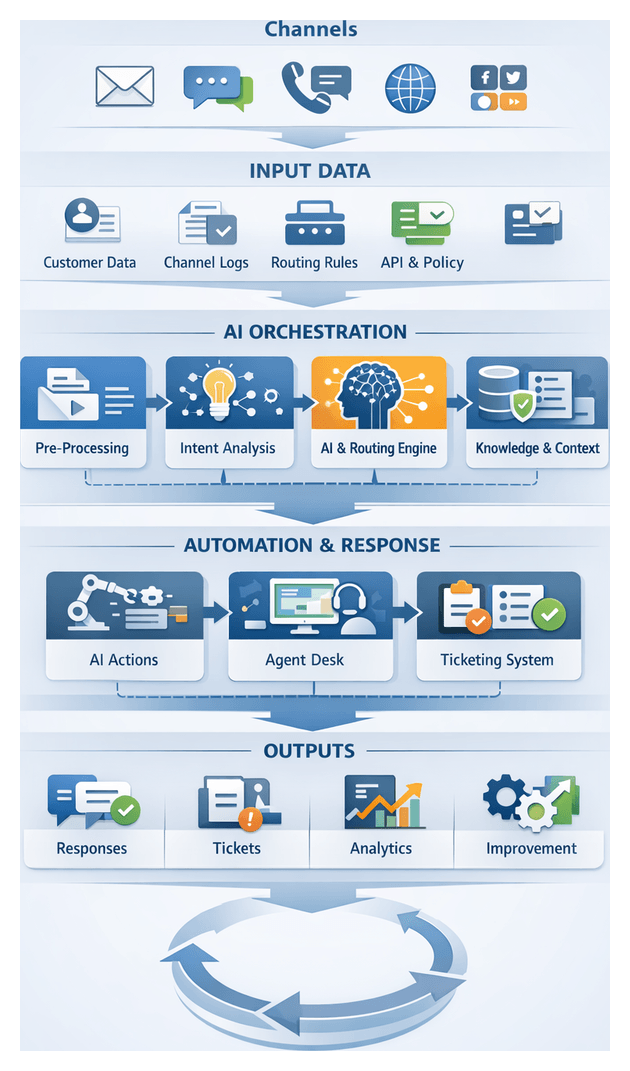
Bridging Communication Silos
Organizations engage customers through email, web chat, voice, social media and messaging apps. Each channel may be managed by separate systems and teams, resulting in fragmented information flows, inconsistent responses and manual handoffs. Agents spend time reconciling disparate records and customers must repeat context, raising resolution times and support costs while undermining satisfaction. Without a unified view of conversations and performance metrics, leadership lacks end-to-end visibility required for data-driven decisions and continuous improvement.
Eliminating communication gaps begins with a clear articulation of objectives, the data inputs required for analysis and the organizational prerequisites for integration readiness. Establishing this foundation enables the design of an end-to-end orchestration layer that preserves context, enforces consistent service levels and unlocks advanced AI capabilities.
- Strategic Objectives
- Context Preservation: Maintain complete interaction history and customer preferences across all touchpoints.
- Service Consistency: Apply uniform response standards and brand voice.
- Operational Efficiency: Remove data reentry and streamline routing processes.
- Data-Driven Insights: Aggregate holistic datasets for analytics and trend detection.
- Scalability: Enable rapid onboarding of new channels and AI services.
- Key Data Inputs
- Channel Logs: Email threads, chat transcripts, call recordings and social media feeds.
- Customer Profiles: Unique identifiers, demographics, purchase history and communication preferences.
- Routing Rules: Business logic for queue assignments, priority handling and escalations.
- System Configurations: API endpoints, data schemas and middleware specifications.
- Compliance Policies: Data retention, encryption standards and regulatory requirements.
- Integration Prerequisites
- Executive Sponsorship: Leadership commitment to cross-functional collaboration.
- Governance Framework: Steering committee with IT, support, security and compliance representatives.
- Technology Audit: Inventory of messaging platforms, CRM, telephony and middleware.
- API Access: Credentials and service agreements for each channel connector.
- Data Governance: Ownership, quality standards, retention and audit controls.
- Security Baseline: Risk assessments, privacy impact analyses and architecture reviews.
- Change Management: Training strategies and communication plans for new workflows.
- Proof of Concept Environment: Sandbox instances for integration validation.
Organizations that meet these conditions minimize technical debt, ensure compliance and align stakeholders, setting the stage for a unified interaction workflow and AI-driven orchestration.
Designing the Unified Interaction Workflow
A unified interaction workflow consolidates incoming inquiries, normalizes messages and enforces consistent processing steps from reception through resolution and analytics handoff. By applying a standardized sequence of validation, enrichment, intent analysis and routing, organizations reduce response times, eliminate context gaps and achieve real-time visibility across all customer engagements.
Workflow Scope
- Channel aggregation and message normalization
- Metadata enrichment and context assembly
- Intent detection and prioritization
- Routing to AI modules or human agents
- Response generation and delivery
- Ticket creation and long-running case management
- Logging, reporting and feedback loops
Core Components
- Channel Connectors: APIs that ingest messages from email servers, chat platforms such as Cisco Webex, voice systems like Amazon Connect and social media services.
- Message Broker: Central queue or event bus that buffers inbound messages and mediates between connectors and processing modules.
- Pre-Processor: Sanitizes content, filters noise and attaches metadata including customer identifiers and geolocation.
- Orchestration Layer: Coordinates workflow steps, invokes AI services and enforces routing logic.
- AI Services: Machine learning models for intent classification, entity extraction, sentiment analysis and response generation via platforms such as the OpenAI API.
- Agent Desktop: A unified interface displaying conversation context, recommended responses and case history for human escalation.
- Ticketing System: CRM or workflow management platforms that record complex cases, manage SLAs and track resolution progress.
Interaction Flow
- Channel Reception: Inbound message arrives via connector. Broker assigns a unique interaction ID.
- Pre-Processing: Normalize encoding, remove markup and enrich payload with profile and context data.
- Intent Detection: NLP service classifies intent and returns confidence scores.
- Prioritization & Routing: Orchestration computes priority based on intent, sentiment and SLAs, routing to AI or human queues.
- Response Generation: AI module drafts replies using templates and context variables; human agents review if needed.
- Delivery & Logging: Final response is dispatched through the connector and all actions are logged.
- Escalation: Low-confidence or complex inquiries trigger ticket creation in the workflow system with full context.
Error Handling & Fall-Backs
- Automatic Retries: Transient failures re-queue messages until successful processing.
- Confidence Escalation: Low-confidence classifications route to human agents.
- Graceful Degradation: If AI services are unavailable, send standard acknowledgments with ETAs.
- Alerts & Intervention: Persistent errors trigger alerts to operations teams via email or collaboration tools.
Benefits
- Consistent Service Levels: SLA-driven processes reduce variability in response quality.
- Improved First-Contact Resolution: Centralized context and intent insights enable faster outcomes.
- Enhanced Visibility: Real-time dashboards provide end-to-end performance metrics.
- Cost Reduction: Automating routine tasks allows agents to focus on complex issues.
- Scalability: Microservices and event-driven design support rapid channel onboarding.
- Continuous Improvement: Interaction data feeds analytics for model retraining and process optimization.
AI-Driven Orchestration Architecture
Positioned at the heart of the unified workflow, the AI orchestration layer acts as the central control plane that sequences tasks, manages state and invokes specialized services. It transforms isolated components into a coherent, automated solution capable of handling complex interactions with consistency and resilience.
The orchestration layer delivers four core capabilities:
- Message Routing & Flow Control: Directs inbound and outbound interactions across channels and AI services.
- Contextual State Management: Maintains session state, metadata and history to preserve conversation continuity.
- Service Choreography: Invokes intent detection, agent selection, knowledge retrieval, response generation, ticketing and analytics services in configurable sequences.
- Exception Handling & Escalation: Applies fallback logic for errors, low-confidence predictions and business rule breaches.
Engine Foundations
Robust orchestration relies on platforms such as IBM Cloud Pak for Integration or open-source frameworks like Node-RED. These tools provide visual workflow builders, message queue adapters and pluggable service connectors, exposing REST or gRPC APIs for management and integration.
Event-Driven Architecture
Interaction events—such as inquiry received, intent classified or response dispatched—are published to a distributed broker. Systems like Apache Kafka or Google Cloud Pub/Sub durably store and fan out events to subscribed microservices. The orchestration layer monitors streams, applies routing rules and emits new events as workflows advance.
Microservices & API Gateways
Individual AI functions and supporting systems run as containerized microservices behind an API gateway that enforces security, rate limiting and authentication. This abstraction allows the orchestration engine to invoke services without concern for network details, using standardized payloads in JSON or Protocol Buffers.
AI Microservices & Model Management
Core AI tasks—intent detection, entity extraction, sentiment analysis and response generation—are each deployed as versioned services. Models may be served via the OpenAI API or custom classifiers on Azure Cognitive Services. A model registry tracks versions, performance metrics and deployment history, enabling A/B testing and safe rollouts.
Contextual State & Session Tracking
A centralized context store holds messages, extracted entities, intent scores, knowledge references and ticket identifiers. Databases or in-memory grids such as Redis ensure low-latency reads and writes. The orchestration layer updates this store at each stage, guaranteeing that downstream services and human agents operate on the same context snapshot.
Integrating AI & Supporting Systems
- Intent Analysis: Pass sanitized text and metadata to the intent microservice; receive ranked labels and confidence scores for routing decisions.
- Response Generation: Invoke NLG services to assemble replies using templates, entities and context. Apply post-processing rules for brand compliance and localization.
- Knowledge Retrieval: Query vector search platforms such as Pinecone or Elasticsearch to fetch relevant articles and inject summaries into responses.
- Ticketing: Create and update cases in systems like Zendesk or ServiceNow, supplying priority, category and SLA metadata.
- Analytics: Emit structured logs and events to streaming platforms like Amazon Kinesis or Confluent for dashboarding and continuous learning.
Scalability & Resilience
Container orchestration with Kubernetes enables horizontal scaling of stateless services and clustering of stateful components. Message brokers provide backpressure management and event replay to prevent data loss. Deployment strategies such as blue/green and canary releases support safe updates, while distributed tracing tools like Jaeger or Zipkin offer end-to-end visibility for debugging and performance tuning.
Governance & Security
The orchestration layer enforces role-based access controls for workflow modifications and sensitive API invocations. Data encryption in transit and at rest protects customer information. Comprehensive audit logs capture every event, decision path and escalation trigger to satisfy regulatory mandates such as GDPR or HIPAA.
Modular System Blueprint and Integration
A modular architecture isolates responsibilities into discrete components that communicate via well-defined APIs and event streams. This approach simplifies maintenance, enables independent scaling and supports incremental enhancements. The primary modules include:
- Channel Integration Layer
- Natural Language Processing & Intent Detection
- AI Agent Selection & Orchestration
- Automated Response Generation
- Ticketing & Workflow Management
- Knowledge Base & Self-Service
- Escalation & Human Handoff
- Proactive Outreach Automation
- Feedback Collection & Sentiment Analysis
- Performance Analytics & Continuous Improvement
Core Components and Roles
- Channel Adapters: Connect to email servers, chat platforms, telephony systems and social media APIs to sanitize and normalize incoming data.
- Message Router: Evaluates metadata to assign priorities, detect language and forward requests to processing queues.
- Intent Analyzer: Runs NLP pipelines for tokenization, classification and entity extraction to produce structured data.
- Agent Selector: Applies business rules and confidence thresholds to route inquiries to AI modules or live agents.
- Response Composer: Uses NLG models and template engines to generate personalized replies.
- Ticket Generator: Creates and updates records in workflow systems with categorization, priority and SLA tagging.
- Knowledge Retriever: Performs semantic search against repositories, scores results for relevance and injects content into responses.
- Escalation Manager: Monitors confidence scores and complexity indicators to trigger agent handoffs with full context.
- Engagement Scheduler: Orchestrates proactive messages based on customer data, campaign rules and predictive timing analytics.
- Feedback Processor: Gathers survey responses, chat ratings and text feedback, applying sentiment and topic modeling.
- Analytics Engine: Aggregates logs and KPIs to drive dashboards, alerts and retraining triggers for continuous improvement.
Data Flow and Interaction Patterns
- A customer message arrives via a channel adapter and is normalized into a unified envelope.
- The router enriches the envelope with metadata and enqueues it for NLP processing.
- The intent analyzer generates a structured payload with intent labels, entities and confidence scores.
- The selector dispatches the payload to an AI agent or escalation manager based on routing rules.
- The response composer or human agent resolves the inquiry and produces a response object.
- The ticket generator creates or updates a case in the workflow system for multi-step issues.
- Resolved interactions feed the feedback processor to capture sentiment and satisfaction data.
- All logs and metrics are forwarded to the analytics engine for monitoring and model retraining.
Outputs Generated at Each Stage
- Normalized Message Envelope: Raw text, channel metadata, timestamps and identifiers.
- Intent Payload: Classification, extracted entities, language code and confidence scores.
- Agent Assignment Record: Selected channel, routing rationale and fallback flags.
- Response Object: Reply content, template IDs, personalization tokens and delivery metadata.
- Ticket Record: Case ID, priority, category, SLA deadline and assignment group.
- Knowledge Reference List: Ranked articles with relevance scores and retrieval timestamps.
- Escalation Bundle: Conversation history, attachments and knowledge links for live agents.
- Outreach Schedule: Timing, content variants and target segments for proactive messages.
- Feedback Dataset: Survey responses, sentiment scores and thematic codes.
- Analytics Report: Aggregated metrics, trend visualizations and model performance indicators.
Handoff Interfaces and Integration Points
- RESTful APIs for synchronous calls to intent analyzers and response composers.
- Message queues (Kafka or RabbitMQ) to buffer inbound requests and decouple services.
- Webhook callbacks for real-time notifications to CRM and ticketing platforms.
- Batch exports to data warehouses for analytics and retraining.
- OAuth-based authentication and role-based access controls for secure communication.
- JSON schemas to validate payloads exchanged between modules and external partners.
System Dependencies and Orchestration Requirements
- Container orchestration (Kubernetes) for automated deployment, scaling and self-healing of microservices.
- Service discovery tools to locate module endpoints and manage dynamic configuration.
- Distributed tracing and logging systems to monitor request flows and support troubleshooting.
- API gateways to enforce security policies, rate limits and centralized routing.
- Configuration stores (Consul or etcd) for versioned parameter control across environments.
- CI/CD pipelines to accelerate updates and maintain consistency between staging and production.
This blueprint for a unified, AI-driven customer interaction solution delivers reliable experiences, clear handoffs and actionable insights, positioning organizations to scale and innovate with confidence.
Chapter 1: Customer Inquiry and Channel Integration
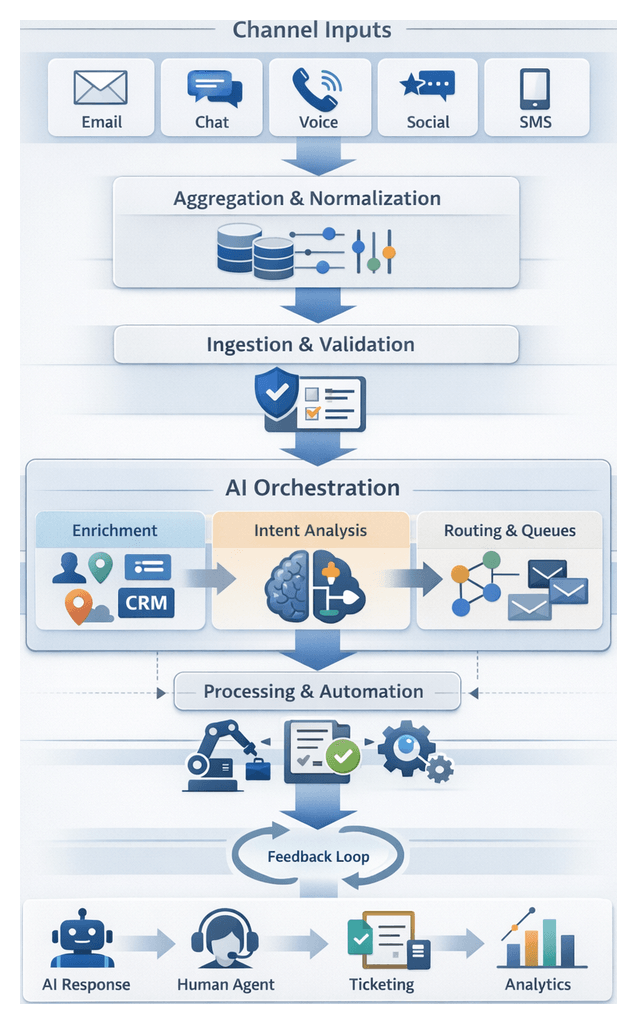
Channel Aggregation Foundation
Purpose and Industry Context
Channel aggregation consolidates customer messages from email, web chat, voice calls, social media and mobile messaging into a unified input stream. By centralizing inbound data, this layer provides a single source of truth for AI-driven processing, preventing fragmented context, duplicated efforts and inconsistent service levels. As enterprises support five or more channels, they face up to 90 percent more inquiries and threefold coordination overhead compared to single-channel operations. Leading providers such as Twilio and Zendesk break down silos, but a dedicated aggregation layer remains critical to deliver seamless omnichannel experiences, uphold regulatory compliance and reinforce risk management objectives.
Required Inputs, Connectivity and Normalization
Each channel connector must map raw payloads and metadata into a common schema. Key data elements include:
- Customer Identifier: Unique ID from CRM or identity system
- Timestamp: UTC-formatted receipt time
- Channel Type: Email, chat, voice or social
- Message Content: Text, transcript link or attachment metadata
- Session Context: Conversation ID or thread reference
- Metadata Attributes: Language code, sentiment, geolocation, user agent
- Security Tokens: API keys or OAuth tokens
Technical prerequisites for channel connectivity include secure API credentials with least-privilege roles for platforms like Twilio Programmable Chat, Twilio Voice and Amazon Connect, validated webhooks or polling endpoints, agreed JSON or XML schemas, network allowlists and TLS certificates, rate limiting policies and centralized logging pipelines.
Post-ingestion normalization enforces ISO 8601 UTC timestamps, UTF-8 encoding, attachment metadata extraction, HTML sanitization, automatic language tagging and identifier unification (for example mapping user_id and customer_id to a single field). Consistent formatting enables downstream AI services to process inputs without custom per-channel logic.
Security, Compliance and Operational Readiness
The aggregation layer must meet encryption, access control and data governance mandates. Requirements include TLS 1.2 for transit, AES-256 at rest, role-based access control, retention policies aligned with GDPR or CCPA, pseudonymization in non-production environments, immutable audit logs and consent management. Health checks and baseline tests validate readiness:
- Connectivity Verification: Test messages from each connector
- Schema Validation: Sample payloads through normalization rules
- Error Handling Simulation: Inject malformed messages to test fallbacks
- Performance Benchmarking: Latency under peak load
- Security Testing: Vulnerability scans and penetration tests
- Compliance Audit Review: Data residency and privacy checks
After validation, normalized records are published via message queues such as Apache Kafka, Amazon SQS or managed event buses, carrying routing metadata for downstream orchestration.
Orchestration of Inbound Workflows
Ingestion and Validation
Channel adapters serve as the entry point, interfacing with IMAP/SMTP servers, Twilio Programmable Chat, Twilio Voice, Amazon Connect, social APIs, SMS gateways and bots. Adapters extract payloads, transform them into a unified event schema and publish to the orchestration broker with metadata headers for language detection and priority tagging.
Validation services perform schema checks against the unified event definition, while sanitization modules apply PII redaction, antivirus scanning and content filtering. Violations route messages to dead-letter or human review queues according to business policy.
Enrichment and Routing
Enrichment services augment messages with context from CRM, identity and geolocation systems. Examples include:
- CRM lookups via Salesforce for customer profile and history
- Identity provider APIs for authentication status and loyalty tier
- Geolocation services for regional compliance and language preferences
- Sentiment pre-scoring using engines like IBM Watson Tone Analyzer
The orchestration engine aggregates metadata into an enriched event, then applies business rules—often via Drools—to evaluate priority, SLA requirements, channel constraints and workload distribution. The routing outcome assigns a target queue or API endpoint for AI services or human agent pools.
Queuing and Processing Patterns
Orchestrated events enter durable brokers such as Apache Kafka, AWS SQS or Azure Service Bus. Key considerations include message durability, consumer concurrency, idempotency keys, and time-to-live settings. Supervisors monitor queue depths and rates, generating alerts for threshold breaches to scale resources or investigate bottlenecks.
Real-time channels like live chat or voice bypass persistent queues in favor of in-memory routing and WebSocket callbacks for sub-second latency. Asynchronous channels like email accumulate in batch queues for bulk processing during off-peak hours, focusing on throughput rather than minimal response time.
Error Handling and Recovery
Error handling frameworks classify failures as transient or permanent. Transient errors such as network timeouts trigger retries with exponential backoff. Permanent errors route messages to dead-letter queues with full context for manual triage. Alerts notify operations teams via email or messaging apps. Remediation actions are applied and messages reprocessed, ensuring no customer inquiry is lost.
Fallback logic diverts critical inquiries to manual channels. For example, if the intent detection queue is unavailable, high-priority messages escalate to a dedicated inbox monitored by support agents.
Performance, Scalability and Observability
The orchestration engine scales horizontally on container platforms like Kubernetes, adjusting adapter and validation instances based on CPU, memory and queue metrics. Message brokers partition topics or shard queues for parallel consumption. Backpressure mechanisms throttle adapters or shed noncritical workloads when thresholds are reached. Circuit breakers protect against degraded external services.
Serialization optimizations leverage Protocol Buffers for high-throughput channels, and HTTP/2 multiplexing reduces overhead. Caching frequent enrichment lookups accelerates processing. Observability relies on metrics and logs collected by platforms such as Datadog and Splunk. Distributed tracing visualizes transaction flows, while dashboards display throughput, latency, error rates and queue backlogs. Alerts integrate with PagerDuty or Opsgenie for rapid incident response.
AI-Driven Coordination Capabilities
Channel Detection and Message Normalization
Upon ingestion, channel classification models detect source types and apply canonical formatting. Tools like Amazon Lex or Google Dialogflow extract structured text from transcripts and attachments, producing a normalized record with timestamp, customer identifier, content and channel metadata.
Contextual Enrichment and Intent Decisioning
AI enrichment services tag records with CRM data, session context, sentiment scores and language flags. Intent detection services powered by transformer-based models assign high-confidence labels. A decisioning engine evaluates labels against policies to select AI agents for billing, technical support or self-service, or triggers escalation if confidence is low.
Dynamic Routing and Response Generation
Routing logic maps decisions to AI modules or human queues. Asynchronous handoffs leverage brokers such as Apache Kafka or cloud event buses. Draft responses from AI agents undergo final validation for brand compliance, tone adjustments and personalization. Natural language generation engines like Microsoft Azure Language Service or OpenAI models ensure coherent, contextually relevant replies.
Integration with Supporting Systems
The orchestration layer exposes REST and gRPC endpoints via an API gateway, centralizing authentication, rate limiting and monitoring. Knowledge base queries against search platforms like Elasticsearch provide contextual articles, while ticketing interfaces invoke APIs in Zendesk or ServiceNow for deep investigation. Feedback loops retrain models on labeled outcomes to continuously optimize performance.
Strategic Value and Best Practices
An AI-driven orchestration layer delivers agility to onboard new channels, consistent customer experiences through unified context management, rapid response times via parallelized processing, and continuous improvement through analytics and model retraining. Key best practices include defining clear data contracts, robust error handling and retry policies, data privacy by anonymizing sensitive fields, versioning AI models and APIs, and governance for business rules and model drift monitoring.
Consolidated Output and Handoff Interfaces
Unified Message Record and Validation
The unified message record combines raw content, enriched metadata and contextual flags in a standardized data object. Components include a globally unique ID, channel information, UTC timestamps, sanitized content, enrichment metadata and priority or compliance flags. Records conform to JSON schema or Protocol Buffer definitions, abstracting channel-specific fields into a consistent structure.
Validation checks confirm connector health, schema compliance using JSON Schema validators or Apache Kafka schema registries, availability of enrichment services such as IBM Watson Natural Language Understanding, and execution of data privacy filters. Failures route records to exception queues for manual review.
Delivery Protocols to Intent Detection
Validated records are dispatched via:
- Message Queues or Topics: Publishing to an AWS SQS queue or Kafka topic named “intent-input”
- RESTful API Endpoints: Posting JSON payloads to NLP gateway endpoints with defined retry logic
- gRPC or WebSocket Streams: Persistent streams with flow control for low-latency delivery
- Event-Driven Triggers: Cloud functions such as AWS Lambda or Azure Functions activated on new record creation
Each protocol includes acknowledgment workflows and monitoring hooks to ensure exactly-once processing. Metrics on queue depth, latency and error rates feed centralized observability dashboards.
Audit, Versioning and Monitoring
Audit metadata appended to each record tracks processing node identifiers, stage-level timestamps and error logs. This data persists in document stores or time-series databases for traceability. Configuration management uses schema registries, feature flags and deployment tags to negotiate schema versions, enable new connectors and correlate behavior to code releases.
Operational monitoring tracks ingestion throughput, error rates, latency and queue backlogs. Predefined alerts notify on-call engineers or trigger automated remediation, integrating with platforms like PagerDuty or Opsgenie to accelerate incident response.
Flexibility for Downstream Variations
The integration layer supports adapter plugins to transform records for specific consumers, multi-channel fan-out to analytics and intent detection, and dynamic routing rules for high-priority segments. By abstracting transport and format variations, core ingestion logic remains stable while accommodating evolving business requirements and new AI services.
Chapter 2: Intent Detection and Natural Language Processing
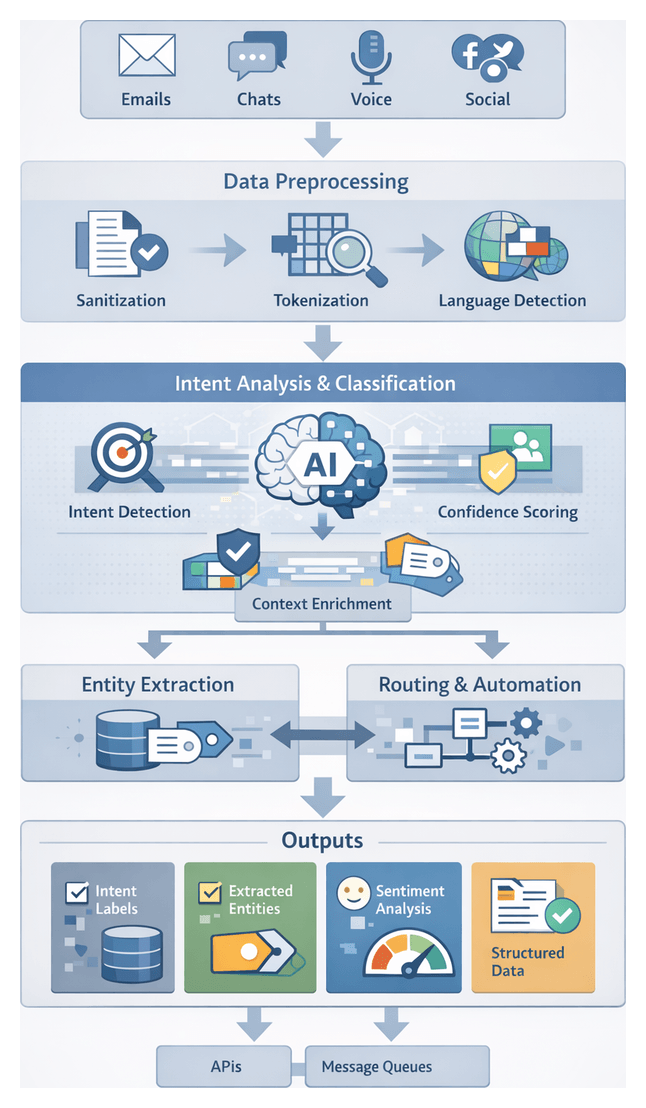
Clarifying Intent Analysis Objectives and Data Requirements
The intent detection stage transforms unstructured customer inquiries—email, chat, voice transcripts or social media comments—into structured representations that capture each message’s core purpose. By defining clear objectives, specifying required inputs and establishing data quality standards, organizations ensure consistent, high-precision AI services that minimize misclassification risk and optimize workflow efficiency.
- Identify and classify customer intents with precision, meeting defined accuracy, precision and recall benchmarks
- Normalize diverse expressions into a standardized taxonomy and enrich messages with metadata
- Provide confidence scores to inform routing, escalation and fallback logic
- Support multilingual and domain-specific variants with structured outputs compatible with APIs and message queues
- Target classification accuracy above 90% on production data
- Balanced precision and recall to minimize false positives and negatives
- Average processing latency under 200 ms per message
- Scalability to handle peak throughput without performance degradation
- Sanitized text transcripts or message bodies with standardized UTF-8 encoding
- Channel identifier, timestamp and session context metadata
- Customer profile attributes, prior interaction history and language/locale indicators
- Embedded content (files, links, emojis) annotated or normalized
Contextual signals—order history, sentiment scores, customer segments and open cases—boost accuracy by disambiguating similar requests. Prerequisites include reliable channel connectors, preprocessing microservices for normalization, language detection, tokenization, and low-latency model endpoints. Robust governance enforces consent checks, PII redaction, encrypted transport, audit logging and compliance with GDPR, CCPA and industry regulations.
Text Processing Pipeline and Integration
The text processing pipeline orchestrates microservices and middleware to convert raw messages into enriched inputs for AI models. A clear flow—from initial normalization through intent classification—ensures low latency, consistency and full traceability.
Pipeline Initialization and Preprocessing
A controller service dequeues messages from an ingestion queue, validates required fields (customer ID, channel metadata, timestamp, content) and applies sanitization routines that normalize whitespace, strip unsupported characters and enforce UTF-8 encoding.
Tokenization and Normalization
Tokens are generated and normalized by engines such as spaCy or Google Cloud Natural Language, applying case folding, punctuation removal and contraction expansion to reduce variability and improve model performance.
Language Detection and Routing
A language detection module—powered by Azure Text Analytics—returns a language code and confidence score. Supported languages proceed; unsupported queries trigger fallback flows or human review.
Preliminary Classification and Priority Assignment
Lightweight classifiers assign broad categories (billing, technical support, general inquiry) and confidence-based routing decisions. A rule engine tags priority based on customer tier, sentiment indicators or urgency keywords, influencing queue ordering and resource allocation.
Metadata Enrichment and Contextual Tagging
CRM and third-party APIs supply profile data, past interactions and open tickets. Messages are tagged—”VIP Customer,” “High Churn Risk”—to inform decision-making and model selection in downstream stages.
Intent Classification and Model Coordination
An API gateway routes enriched payloads to an intent classification cluster hosted behind a load balancer. Multiple AI endpoints—optimized by domain or language—return detailed intent labels and confidence metrics. Parallel invocations enable cross-validation and conflict resolution.
Error Handling and Quality Assurance
Services implement retry logic with exponential backoff for transient failures and alerting for permanent errors. A sampling mechanism diverts messages to a human-in-the-loop QA service, feeding corrections back into retraining pipelines.
Inter-Service Messaging and Logging
Asynchronous frameworks—such as Apache Kafka or AWS SQS—decouple services and support horizontal scaling. Status events flow into centralized observability platforms like Elastic Stack and AWS CloudWatch, enabling end-to-end traceability and real-time dashboards.
Handoff to Entity Extraction
Processed records—containing normalized text, tokens, language code, intent label, confidence scores, priority tags and metadata—are published to an entity extraction queue via a versioned API contract. Downstream services subscribe and perform fine-grained analysis of dates, product identifiers and references.
AI-Driven Orchestration of Customer Interactions
The orchestration layer applies AI to coordinate message intake, processing, routing and response generation across channels. By centralizing control, it delivers consistent service, automates manual tasks and maintains context continuity throughout the customer journey.
Core AI Components
- Message Processing Engine: Ingests and sanitizes inputs, annotates emotive cues and enriches with metadata.
- Intent Analysis Module: Uses transformer-based classifiers to assign intent labels and confidence scores, leveraging historical data for continuous improvement.
- Entity Extraction Service: Identifies product SKUs, dates, order numbers and sentiment indicators for personalized responses.
- Orchestration Logic Engine: Combines rule-based and AI-driven decisioning to route interactions to specialized AI agents or human teams.
- Response Generation Framework: Employs natural language generation models and knowledge base templates to draft compliant, brand-aligned replies.
- Context Management Store: Retains session variables, past interactions and agent annotations to prevent information loss.
Integration Interfaces
- API Gateway and Webhooks: Standardized REST or event-driven endpoints for inbound and outbound messages.
- Message Queueing: Brokers buffer and order high-volume traffic with at-least-once delivery semantics.
- Event Bus: Publish-subscribe architecture distributes state change events to logging, analytics and monitoring services.
- Backend Connectors: Prebuilt integrations with CRM, ticketing and knowledge management systems for real-time data retrieval.
Governance and Continuous Improvement
Operational Monitoring
Dashboards track throughput, intent detection latency, response accuracy and escalation rates. Real-time alerts flag anomalies for rapid intervention.
Quality Assurance and Compliance
Automated audits compare outputs against regulatory and brand standards. AI-powered scanners flag potential issues for human review.
Model Retraining and Feedback Loops
Labeled data from resolved cases, agent corrections and customer feedback feed into scheduled retraining cycles, ensuring model relevance in evolving contexts.
Strategic Benefits
- Consistent Customer Experience: Unified standards and brand voice across all channels.
- Scalable Automation: Modular AI components scale horizontally to meet demand.
- Accelerated Resolutions: Intelligent routing and real-time responses reduce handling times.
- Data-Driven Insights: Visibility into every workflow stage supports proactive optimization.
- Future-Ready Architecture: Decoupled, API-centric design simplifies integration of new channels and models.
Structured Output Artifacts and Downstream Handoffs
Intent detection produces structured artifacts—machine-readable records that downstream systems interpret and act upon. Standardized outputs ensure consistency, traceability and extensibility across integration points.
- Intent Labels: Ranked intents with confidence scores.
- Extracted Entities: Named entities tagged with type and text span.
- Sentiment Scores: Polarity and magnitude metrics indicating emotion or urgency.
- Language and Tone Metadata: Detected language codes and stylistic markers.
- Context Enrichment Tags: References to customer profile elements and conversation history.
- Processing Diagnostics: Model version identifiers, latency metrics and timestamps.
Schema and Format
Outputs typically adhere to JSON or Protobuf schemas, providing clear contracts for producers and consumers. Versioned schemas support backward compatibility and safe evolution.
- intent: { name: “OrderStatusInquiry”, confidence: 0.92 }
- entities: [ { type: “OrderID”, value: “12345”, start: 10, end: 15 } ]
- sentiment: { score: -0.35, magnitude: 0.78 }
- language: “en”, tone: “neutral”
- context: { userId: “A789”, sessionId: “S456”, previousIntent: “Greeting” }
- diagnostics: { modelVersion: “v3.1.2”, processingTimeMs: 85 }
Dependencies and Integration Points
- Model Hosting Services: spaCy, Google Cloud Natural Language API, Amazon Comprehend, on-premise frameworks like Hugging Face Transformers.
- Message Brokers: Apache Kafka, RabbitMQ.
- Metadata Stores: Graph databases or key-value stores for customer profile and context data.
- API Gateways: RESTful or gRPC endpoints enforcing authentication, rate limits and contract validation.
- Monitoring Tools: Platforms like Elastic Stack and AWS CloudWatch for observability and alerting.
Downstream Handoff Mechanisms
- Synchronous API Calls: HTTP/gRPC endpoints that process requests and return routing decisions in real time.
- Asynchronous Event Publishing: Messages published to topics or queues for downstream consumers to process at their own pace.
Error Handling and Fallback Strategies
- Confidence Thresholds: Low-confidence intents trigger fallback agents or clarifying prompts.
- Entity Resolution Failures: Missing or ambiguous values invoke enrichment services or customer clarification.
- Model Unavailability: Alternate endpoints or rule-based classifiers maintain degraded service.
- Error Logging: Structured logs capture codes, stack traces and input samples for rapid diagnosis.
Best Practices for Reliable Handoffs
- Schema Versioning: Semantic versioning with clear migration guides.
- Contract Testing: Automated validation of input/output contracts to detect breaking changes early.
- Traceability: Embed correlation IDs in every payload for end-to-end observability.
- Security and Compliance: Enforce encryption in transit, token-based authentication and role-based access control.
- Performance SLAs: Define and monitor latency and throughput targets, with alerts for deviations.
- Comprehensive Documentation: Maintain up-to-date API guides, sample payloads and integration playbooks.
Chapter 3: AI Agent Selection and Orchestration
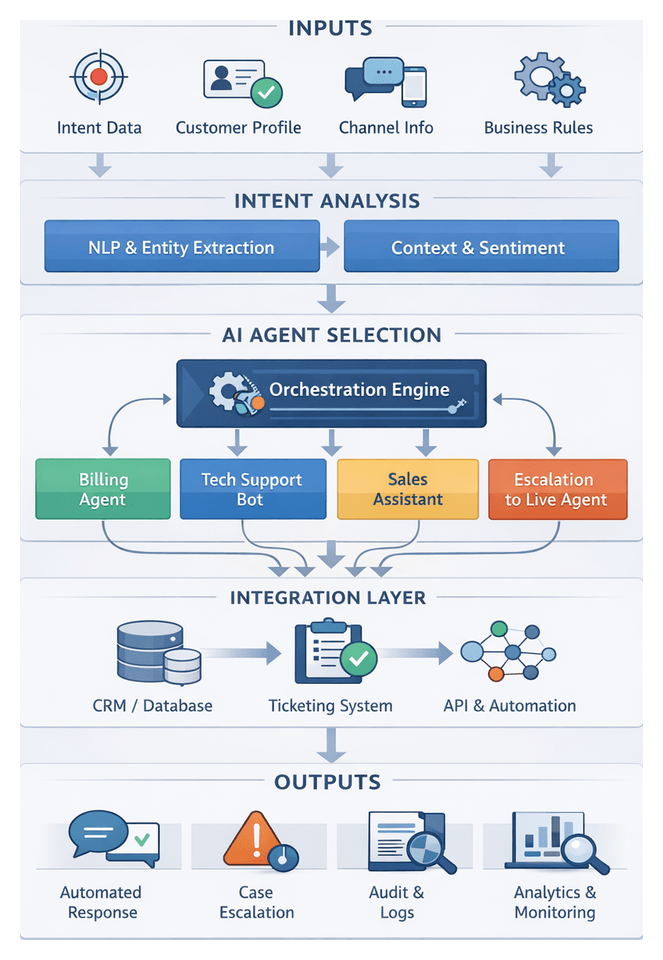
Purpose and Context of AI Agent Selection
Unifying customer interactions across email, chat, voice and social channels requires a modular orchestration layer that moves from broad intent detection to precise resolution. The AI Agent Selection stage sits at the heart of this pipeline, matching each inquiry to the optimal virtual assistant, chatbot or specialized AI module. By interpreting intent confidence, customer profile data and business rules, this decision hub minimizes manual handoffs, speeds responses and ensures consistent service quality while maintaining compliance with policy and regulatory boundaries.
Traditional monolithic chatbots often trade off depth for breadth, leading to escalations and unsatisfactory experiences. A modular approach divides responsibilities among purpose-built agents—for billing inquiries, technical support, product recommendations or account management—coordinated by a central orchestration engine. This engine evaluates metadata from upstream intent analysis, applies rule-based and machine learning criteria, and invokes downstream services such as ticketing systems or live agent dashboards. The result is a dynamic, context-aware workflow that aligns the right intelligence with each customer request.
Required Inputs and Prerequisites
Accurate agent routing depends on a comprehensive, schema-driven set of inputs delivered via APIs or message queues. Key data elements include:
- Intent labels and confidence scores from NLP classifiers
- Extracted entities (order numbers, dates, product IDs)
- Conversation context (dialogue history, sentiment trends)
- Customer profile attributes (tier, lifetime value, language, geography)
- Channel metadata (source application, timestamps, device context)
- Service level agreements and business rules
- Real-time sentiment scores and mood indicators
- Knowledge base references for relevant articles or templates
- System health and availability metrics for AI modules
Before invoking selection logic, the orchestration layer must ensure:
- Normalization of inbound data into a unified record
- High-fidelity intent classification with confidence thresholds
- Metadata enrichment via CRM connectors, loyalty databases and compliance registries
- Availability of agent modules with up-to-date registry information
- Policy and compliance checks for regulated data
- Configured fallback and escalation paths
- Loaded SLAs and routing rules
- Enabled monitoring and logging hooks
Routing Workflow and Decision Mechanics
Once inputs are validated, the orchestration engine coordinates with a business rules management system (BRMS) and machine learning classifiers to determine agent assignment. It applies a hierarchical rules workflow:
- Intent confidence thresholds: High scores proceed to assignment; low scores trigger fallback classification or human review.
- Customer priority segmentation: Premium‐tier or high-value customers route to specialized agents or live support.
- Complexity estimation: Entity counts, conversation length and sentiment volatility guide whether a simple FAQ bot or a transactional assistant is needed.
- Channel-specific rules: Voice, regulated messaging or accessibility channels may enforce dedicated agents for compliance and security.
- Real-time load balancing: Queue lengths and processing latencies across modules are monitored to evenly distribute workload.
- Fallback and escalation conditions: Retries, health check failures or low post-response confidence trigger rerouting to general assistants or live agents.
For complex inquiries, the engine may invoke parallel calls to multiple agents—for example, a transactional assistant and a returns bot—then merge their outputs into a composite response. Retry logic, exponential backoff and circuit breaker patterns maintain resilience under load or external service degradation.
Interaction patterns include synchronous API calls for low-latency tasks and asynchronous messaging via Apache Kafka or RabbitMQ for event-driven processing. Webhook callbacks and streaming ingestion support long-running sessions and continuous context updates.
Integration and Handoff Interfaces
After selecting the appropriate AI agent, the orchestration layer constructs a handoff package containing:
- Structured interaction record (transcript and data payload)
- Routing metadata (decision rationale, priority flags, SLA deadlines)
- Session context token for tracking and context persistence
- API endpoint references for the selected agent module
- Monitoring hooks for status updates and error notifications
This standardized format simplifies integration with specialized AI modules, third-party agent frameworks and human agent platforms. Common external systems include CRM platforms (such as Salesforce Service Cloud), order management APIs, ticketing tools and notification gateways. Compensating actions roll back partial updates if downstream failures occur.
Outputs and Transition to Automated Response
The assignment outputs form a self-contained artifact for downstream components. Key elements are:
- Response payload: Draft text or structured fields from the AI agent
- Agent confidence score: Numerical certainty metric guiding fallback or escalation
- Intent and entity metadata: Refined labels and data points for context
- Routing directives: Next steps such as automated reply or human escalation
- Conversation context snapshot: Serialized dialogue state and session variables
- Audit records: Timestamps, agent IDs and decision rationale
- Escalation flags: Indicators for manual intervention
- Next‐step recommendations: Knowledge base articles or actions for efficiency
Transition mechanisms include:
- RESTful APIs: Secure HTTP endpoints for low-latency scenarios
- Message queues and pub/sub: High-throughput delivery via Amazon SQS, Apache Kafka or RabbitMQ
- Callback webhooks: Signed payloads with retry logic for third-party integrations
- Data stream bridges: Mirroring outputs to Kafka topics for analytics and monitoring
- File-based drops: NDJSON exports to shared storage (for example, Amazon S3) for batch workflows
Standard headers—correlation IDs, timestamps and version identifiers—and schema enforcement via JSON Schema or Avro contracts ensure traceability and prevent drift.
Operational Monitoring and Governance
A robust observability framework captures logs and metrics across the orchestration workflow. Key practices include:
- Latency tracking: Measuring end-to-end processing time and alerting on threshold breaches
- Error and exception logging: Categorizing failures—serialization errors, timeouts, schema mismatches—for root cause analysis
- Confidence distribution analysis: Monitoring agent scores to detect model drift
- Handoff success rate: Tracking downstream ingestion rates and capacity issues
- Duplicate and sequence checks: Ensuring idempotency and correct ordering via tokens and sequence numbers
- Fallback and escalation trends: Identifying coverage gaps where AI needs enhancement
- Audit trail integrity: Reconciling logs against message bus archives for compliance verification
Automated alerts from observability tools—such as Prometheus and the ELK stack—enable rapid response to anomalies. Change management, performance monitoring, risk assessments and compliance auditing govern updates to selection rules, agent configurations and threshold adjustments.
Advanced Orchestration and Continuous Improvement
Beyond core routing, advanced capabilities drive strategic optimization:
- Multi-agent collaboration: Synchronous context sharing when multiple specialists contribute to a single inquiry
- Adaptive learning feeds: Retraining triggers based on selection outcomes and customer feedback
- Business impact scoring: Tagging assignments with KPIs to measure effects on resolution rates and satisfaction
- Governance and explainability: Applying frameworks to interpret selection decisions for compliance and ethical review
- Semantic knowledge retrieval: Using vector embeddings and tools like Elasticsearch to surface relevant articles
- Template and NLG orchestration: Filling response fragments with dynamic data via engines such as OpenAI GPT models or Microsoft Turing NLG
- Scalable architecture: Containerization and Kubernetes orchestration for auto-scaling, circuit breakers for resilience and plugin frameworks for emerging AI models
By integrating these enhancements, the AI Agent Selection stage evolves into a strategic lever for continuous improvement—refining immediate resolution paths and fueling long-term advancements in the entire support ecosystem.
Chapter 4: Automated Response and Resolution
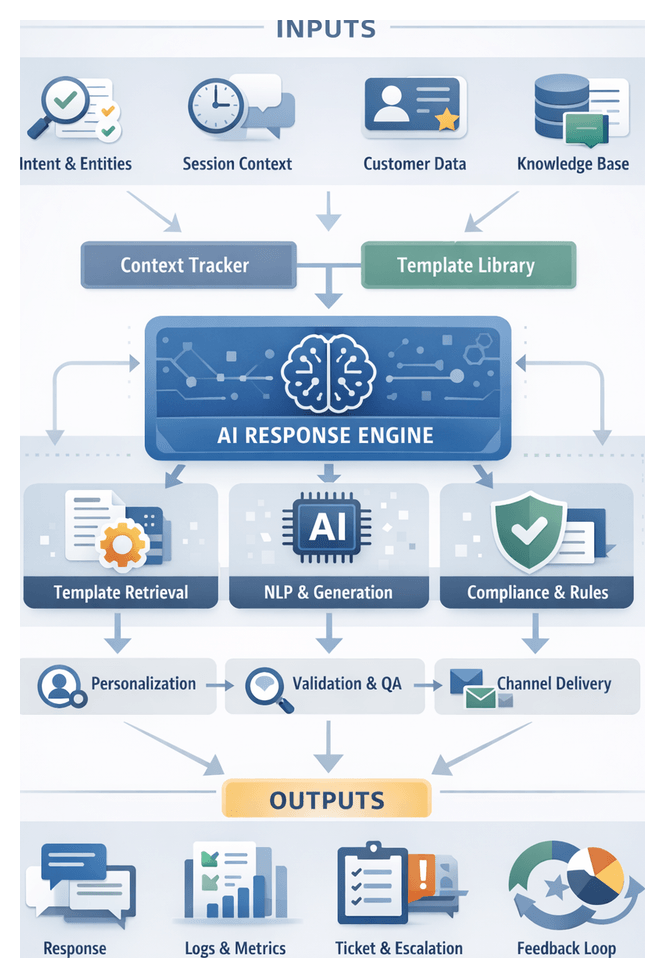
Defining Response Generation Goals and Inputs
The automated response stage transforms structured input from intent detection, entity extraction and session context into coherent, personalized replies that align with brand guidelines and service level expectations. Clear definition of objectives and requisite inputs ensures consistency, accuracy and scalability across channels.
Strategic Importance of Automated Response
- Reduced resolution time through instant reply generation, improving satisfaction and loyalty.
- Consistent brand voice and compliance via templating rules and dynamic filters.
- Scalability to absorb peak volumes without proportional headcount increases.
- Data-driven performance measurement enabling continuous model tuning.
Key Goals for Response Generation
- Accuracy: Map detected intent and entities to knowledge base entries or business logic flows.
- Relevance: Tailor responses using customer-specific context such as purchase history or support tier.
- Coherence: Maintain conversational continuity across multiple turns.
- Brand Alignment: Enforce tone, vocabulary and regulatory constraints.
- Latency: Achieve sub-second response formulation for real-time interactions.
- Escalation Readiness: Trigger human handoff when automated resolution is insufficient.
Essential Input Elements
- Intent labels and confidence scores from intent detection modules.
- Extracted entities—account numbers, product IDs, dates—identified by NLP models.
- Session context including historical transcripts and channel metadata.
- Customer profile data from CRM systems: demographics, SLA status, loyalty tier.
- Knowledge base references via semantic search engines such as OpenAI GPT-4 Retrieval Plugin or Dialogflow Knowledge Connector.
- Business rules from policy engines governing discounts, compliance and data retention.
- Template repositories containing approved phrasing, placeholders and fallback options.
Prerequisites and System Conditions
- Completion of upstream processing: channel normalization, sanitization, intent and entity analysis.
- API connectivity to CRM, knowledge management platforms and policy repositories.
- Template version control ensuring synchronized distribution across runtime environments.
- Active compliance filters for data privacy and export controls.
- Defined performance benchmarks and monitoring hooks for SLA adherence.
- Configured fallback protocols and human handoff triggers for low-confidence scenarios.
Leveraging AI platforms such as Microsoft Azure Cognitive Services Language Studio, IBM Watson Assistant and OpenAI GPT-4 ensures timely, brand-aligned natural language replies that meet enterprise objectives.
Overview of the Dynamic Response Workflow
The dynamic response workflow orchestrates template retrieval, NLG, compliance checks and multi-channel delivery to transform enriched inquiries into customer-facing messages. Centralized orchestration ensures consistent messaging, rapid turnaround and adaptive handling of edge cases.
Key Components and Actors
- AI Response Engine (for example, OpenAI GPT-4) for generative text and contextual coherence.
- Template Management Service storing response frameworks with placeholders.
- Context Tracker maintaining session history, user profile and dynamic variables.
- Compliance and Brand Consistency Module enforcing regulatory and style guidelines.
- Delivery Channels (email, SMS, chat, voice) interfacing with downstream messaging platforms.
- Ticketing and Escalation System (for example, Zendesk or ServiceNow).
- Logging and Monitoring Tools (for example, Datadog, Splunk).
Step-by-Step Workflow
- Receive Structured Inquiry: Orchestration layer accepts normalized text, intent label, entities, session context and customer attributes.
- Template Lookup: Query Template Management Service by intent and channel, retrieving base template with placeholders.
- Variable Resolution: Populate placeholders with real-time data—account balance, recent orders, loyalty status.
- Natural Language Generation: AI Response Engine refines or expands the template. Channel-specific models like Dialogflow CX or Rasa handle specialized dialogues.
- Compliance and Brand Enforcement: Draft reply passed to compliance module for prohibited term filtering and style consistency.
- Quality Validation: AI-driven validators assess grammar, sentiment alignment and factual consistency, producing a confidence score.
- Dispatch Preparation: Format reply for target channel—plain text, HTML email or SSML—and append tracking metadata.
- Delivery via Channel Connectors: Transmit reply through platform APIs and subscribe to delivery events.
- Session Update and Logging: Record delivered message, outcome data and follow-up triggers in the monitoring tool.
- Escalation Checkpoint: Trigger human handoff if confidence falls below threshold or negative sentiment is detected.
Integration Patterns
- Asynchronous Messaging Queues (for example, Kafka or AWS SQS) decouple services under load.
- API Gateways route external callbacks into the workflow securely.
- Event-Driven Triggers adjust routing and parameters on template updates or model retraining.
- State Management Stores (Redis or DynamoDB) maintain ephemeral session state.
- Monitoring Dashboards aggregate logs and metrics for real-time visibility.
- Webhooks synchronize CRM or billing updates upon resolution.
Template Selection and Personalization
- Intent Confidence maps to specialized templates.
- Customer Segment determines phrasing and offerings.
- Channel Constraints enforce character limits and media support.
- Contextual Flags invoke priority templates for urgent cases.
Placeholders such as {customer_name}, {order_id} and {next_steps_link} are populated via CRM APIs, ensuring data accuracy and privacy compliance.
Content Assembly and Validation
- Natural Language Refinement rewrites text to match brand voice and readability standards.
- Consistency Check verifies all placeholders are resolved and no markup remains.
- Sentiment Alignment scores tone against desired profiles for emotional resonance.
Compliance and Brand Consistency
- Regulatory Rule Matching ensures mandatory disclosures for GDPR or financial warnings.
- Prohibited Content Filtering redacts banned terms automatically.
- Brand Glossary Enforcement validates terminology and trademark usage.
Multi-Channel Delivery and Logging
- Protocol Adaptation converts content to REST calls, SMTP or WebSocket pushes.
- Message Sequencing respects timing constraints to avoid spamming.
- Delivery Receipts capture sent, delivered and read events via webhooks or polling.
- Error Handling and Retry Logic implement backoff and fallback to human agents on persistent failures.
Escalation and Ticketing Handoffs
- Low Confidence Score or negative sentiment triggers escalation.
- Repeated unresolved inquiries invoke human intervention.
Escalations package conversation history and metadata for ticket creation via APIs to ServiceNow or Zendesk, minimizing agent ramp-up time.
Monitoring, Logging and Feedback Integration
- Real-Time Metrics on throughput, latency and errors displayed on dashboards.
- Session Record Logs archived for audit and retraining.
- Customer Feedback Loop via surveys or ratings feeding model evaluation.
- Continuous Improvement Triggers launch retraining on identified failure patterns.
AI Response Models and Context Management
Generative AI engines and context management systems form the backbone of automated replies, combining language models with structured memory to deliver accurate, coherent and personalized interactions across channels.
Generative Response Engines
- OpenAI GPT-4 – state-of-the-art transformer model for nuanced language generation.
- Azure OpenAI Service – GPT models in a scalable, secure cloud environment.
- Dialogflow CX – combines rule-based flows with NLU for complex dialogues.
- IBM Watson Assistant – intent classification and response generation with hybrid deployment options.
Generation strategies include:
- Template-based NLG ensuring brand consistency and compliance.
- Retrieval-augmented generation combining knowledge base retrieval with generative models.
- Fine-tuned domain models trained on proprietary data for industry-specific terminology.
- Hybrid logic orchestrating sentiment-aware or compliance sub-models before final assembly.
Context Management Systems
- Rasa – open-source AI with built-in tracker store and custom actions support.
- Amazon Lex – session management integrated with AWS services and slot resolution.
- Redis and DynamoDB for scalable, low-latency dialogue state storage.
Integration Architecture
- Conversation event ingestion with enriched metadata arrives via the orchestration layer.
- Context retrieval fetches dialogue state and session memory by conversation ID.
- Model invocation supplies user message, context window and knowledge snippets to the response engine.
- Response synthesis returns candidate replies with confidence scores.
- Response validation via policy engines or classifiers checks for compliance and safety.
- Context update commits reply and state changes to the context store.
- Delivery forwards the final response to the output channel with tracking metadata.
Role of Knowledge Systems
- Vector search indexes such as Pinecone for semantic retrieval.
- Elasticsearch for keyword-based lookups.
- Knowledge graph services for entity-centric relationships.
- Content management systems storing versioned knowledge base articles.
Monitoring and Continuous Improvement
- Response accuracy metrics via automated and human evaluation.
- Context drift detection identifying misaligned state.
- Throughput and latency monitoring to enforce performance SLAs.
- User satisfaction scoring from surveys or sentiment analysis.
- Model retraining triggers on error rates or vocabulary shifts.
Delivered Outputs and Service Continuity Handoffs
At the completion of automated response processing, the system emits structured deliverables that record AI decisions, update session context and trigger downstream actions such as ticketing, escalation and analytics.
Key Deliverables
- Response Payload: Formatted reply including text, media links and actionable suggestions.
- Updated Session Context: Conversation variables, intent and entity states, and continuity flags.
- Escalation Indicators: Markers for unresolved issues requiring human attention.
- Ticket Trigger Events: Data packets initiating ticket creation in workflow systems.
- Audit and Logging Records: Timestamps, confidence scores, decision rationale and delivered content.
- Feedback Prompts: Survey or rating requests queued for presentation.
Output Schema Elements
- messageId – Unique identifier for interaction traceability.
- timestamp – ISO-8601 finalization time of the response.
- content – Text or rich media generated by the NLG model.
- channelMetadata – Platform identifier, session token and locale.
- contextBundle – Encapsulated state including intentLabel, entities and sentiment.
- resolutionStatus – Enumeration of success, partial resolution or escalation.
- nextActions – Array of recommended follow-up steps or knowledge links.
Standardized schemas enable downstream systems to parse and process interaction records without custom adapters.
Session Context Enrichment
Metadata fields such as topicHistory, customerProfileUpdates and session duration markers are persisted in high-performance stores to support seamless continuity for AI modules or live agents, reducing customer effort and avoiding repetitive queries.
Dependency on Intent and Entity Accuracy
IntentConfidence and fallbackTrigger metadata embed upstream detection results, guiding downstream trust levels and escalation rules to ensure transparency of AI decision-making.
Logging and Compliance Records
- DecisionLog: Sequence of model invocations, confidence scores and template selections.
- ContentArchive: Immutable storage references for delivered messages.
- ComplianceTags: Flags for sensitive content, PII handling and retention policies.
These artifacts feed SIEM solutions and compliance dashboards without impacting customer-facing performance.
Ticketing and Workflow Handoffs
- TicketPayload aggregates subject, priority, category and context for ticket creation.
- API calls to ServiceNow, Zendesk or Jira Service Management.
- Assignment rules based on team availability, SLA and skill profiles.
- Status synchronization ensures consistent views across AI orchestrator and human teams.
Live Agent Escalation Interfaces
- Context Snapshot summarizing intent history and prior AI responses for agent dashboards.
- Transcript Transfer to unified agent desktops preserving full conversational context.
- Suggested Knowledge Links curated by AI to accelerate resolution.
- Handoff Notification alerts agents via chat or email with deep-link access to the session.
Knowledge Base Feedback Loop
- UnmatchedQuery Reports logging inputs with no suitable template or article.
- CustomerRating Data linking satisfaction scores to response variants.
- Content Improvement Flags identifying opportunities to enrich knowledge articles.
Notifications, Alerts and Monitoring Outputs
- PerformanceMetrics—response time, API latency, model throughput—streamed to Prometheus or Datadog.
- ErrorAlerts for failed handoffs, ticket creation errors or inference exceptions.
- SLACompliance Flags triggering automated escalations as deadlines approach.
Data Persistence and Storage Dependencies
Session contexts use in-memory stores like Redis for low-latency access, while historical records and logs reside in document databases or data lakes with encryption-at-rest and role-based access controls to meet security requirements.
Analytics and Continuous Improvement
Structured records of intents, resolution outcomes and energy consumption feed data warehouses and AI retraining pipelines. Programmatic tagging of resolved, escalated or content-deficient cases generates labeled datasets that drive iterative optimization of NLU models, response generators and routing logic, ensuring the solution evolves in line with customer needs and business objectives.
Chapter 5: Ticketing and Workflow Management Integration
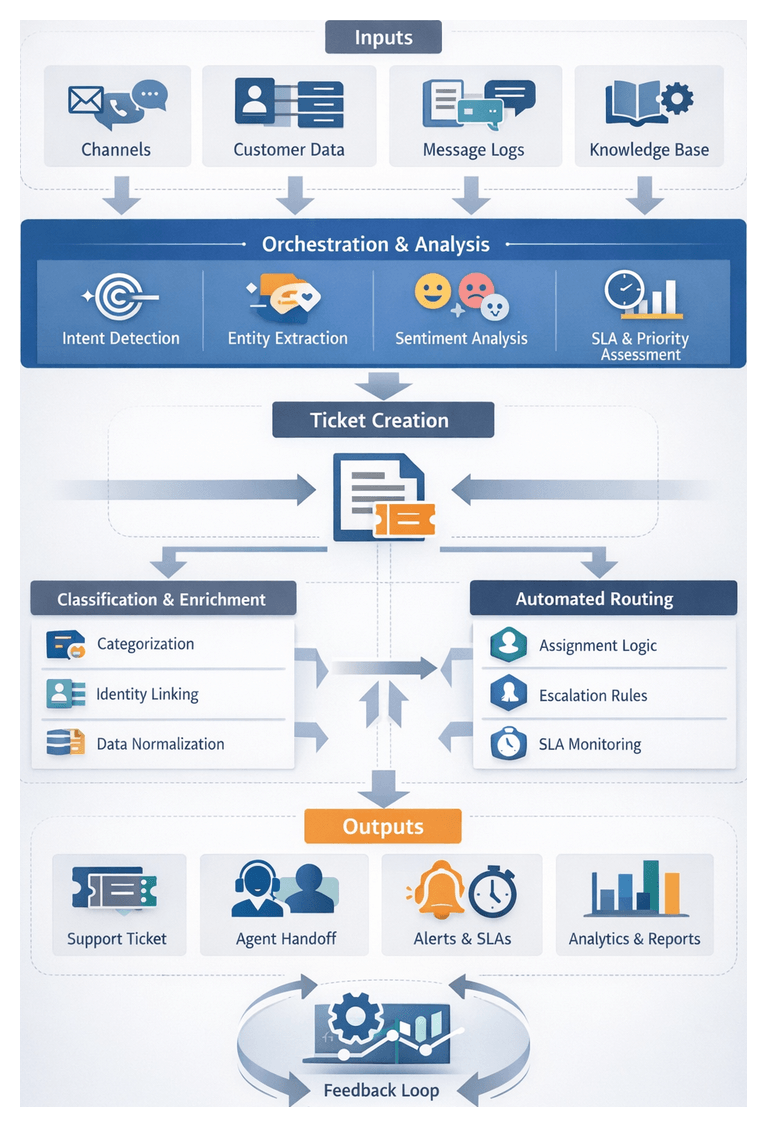
Purpose and Prerequisites for Ticket Creation
In unified customer interaction workflows, generating a support ticket marks the transition from automated resolution to structured case management. Ticket creation ensures transparent tracking, standardized handling, and consistent escalation according to service level agreements. It preserves the conversational history, captures metadata, and provides an auditable record that supports performance measurement, resource allocation, and compliance across channels.
Operational Context
Multiple communication channels—email, web chat, social media, voice bots—feed into a centralized orchestration layer. AI models address routine inquiries, resolve FAQs, and recommend knowledge articles. When an issue remains unresolved or meets escalation criteria, the orchestration engine initiates ticket creation. At that moment, the system must gather and normalize all relevant data to ensure effective handoff to human agents or specialized teams.
Key Prerequisites
- Unified Message Record: A consolidated object containing raw transcripts, intent labels, extracted entities, and sentiment scores to serve as the primary data payload.
- Identity Resolution: A persistent customer identifier, enriched via systems such as Salesforce or an internal CRM, linking the inquiry to account profiles and SLA tiers.
- Access Controls: Authorized API credentials and service accounts with role-based permissions for ticket operations.
- Taxonomy and Field Mapping: A shared data model defining categories, priorities, impacts, and custom tags to align AI classifications with routing rules.
- Service Catalog Integration: References to predefined services or offerings to automate team assignments, SLA clocks, and entitlement checks.
- Escalation Policies: Business logic specifying triggers—such as low intent confidence, repeated messages, negative sentiment, or timeout—for ticket conversion.
Required Ticket Inputs
- Customer Identifier and Contact Details: Unique customer ID, email address, phone number, or social handle, plus subaccount or organization ID in multi-tenant environments.
- Channel and Timestamp Metadata: Originating channel and normalized timestamps to ensure accurate SLA countdowns.
- Intent Labels and Confidence Scores: Primary and secondary intent classifications from NLP models, with confidence metrics to inform human review triggers.
- Extracted Entities: Structured data points—product IDs, order numbers, dates, error codes—identified via entity recognition services.
- Priority and Impact Assessment: Priority level derived from customer tier, sentiment polarity, business impact, or regulatory deadlines.
- Category and Issue Type: Taxonomy code mapping to support queues, such as “technical support,” “billing inquiry,” or “feature enhancement.”
- Subject or Summary: Auto-generated concise summary extracted from key phrases or user-provided headlines.
- Detailed Description and History: Full transcript or email thread, including attachments and screenshots, preserving chronological order.
- Sentiment and Urgency Indicators: Quantitative sentiment scores and urgency flags from real-time analysis.
- Attachments and Supporting Documents: Links or binary payloads for screenshots, logs, and error dumps, with secure storage references.
- Service Entitlement and SLA Parameters: Contractual service level definitions, response targets, and resolution deadlines.
- Correlation Identifiers: Request or trace IDs linking the ticket to preceding automated workflows or external system events.
Impact of Structured Inputs
Comprehensive, structured ticket inputs enable automated assignment, precise SLA calculations, proactive notifications, data-driven analytics, and reduced misrouting. High-quality tickets accelerate time to resolution, increase first-contact resolution rates, and improve overall customer satisfaction.
Ticket Initialization and AI-Driven Enrichment
Trigger Conditions and Data Capture
The orchestration engine triggers ticket creation when intent confidence falls below a threshold, complexity metrics exceed predefined limits, or customers request human assistance. The payload includes the original transcript, channel metadata, timestamps, detected entities, and knowledge base references used during automated resolution attempts.
Sanitization and Enrichment
Before committing the ticket, the system sanitizes sensitive data to comply with privacy regulations. Concurrently, AI services annotate the payload with classification tags, sentiment scores, and preliminary categories. Natural language processing models extract additional context—such as product identifiers or billing codes—to streamline downstream routing and reporting.
Contextual Metadata Enrichment
- Intent Labeling: Classifying the inquiry’s purpose—troubleshooting, billing query, feature request—using services like IBM Watson Natural Language Classifier or custom transformer models.
- Entity Extraction: Identifying product names, order numbers, service plans, and error codes via Azure Cognitive Services.
- Sentiment Scoring: Assessing tone and urgency to flag negative sentiment or escalation language.
- Customer Context Mapping: Enriching tickets with account tier, past interactions, and contract details through APIs such as Salesforce Einstein.
These enrichment steps produce a robust ticket record combining unstructured text with structured metadata, delivered via reliable message queues to downstream workflow engines.
Automated Classification and Routing
Classification and Priority Scoring
- Multi-Label Classification: Assigning categorical tags—technical support, account management, product feedback—using ensemble models that blend gradient-boosted trees and deep neural networks.
- Priority Estimation: Calculating urgency scores based on sentiment intensity, customer segment, and historical resolution times.
- SLA Adherence Prediction: Forecasting the probability of meeting service level agreements to flag at-risk tickets for expedited handling.
- Cross-Channel Correlation: Detecting duplicate cases across email, chat, and social media by matching topic embeddings to consolidate conversations under a single ticket ID.
Enriched and scored tickets are ingested by platforms like Zendesk AI and Freshdesk Freddy via RESTful APIs, updating dashboards and agent worklists automatically.
Routing Decision Orchestration
- Owner Recommendation: Machine learning models suggest the most qualified agent or team based on historical performance, skill profiles, and current workload.
- Escalation Path Identification: Rule-based engines informed by AI predictions trigger automatic escalation to senior tiers or specialized task forces.
- Workload Balancing: Reinforcement-learning algorithms distribute tickets in real time to maximize throughput and minimize response latency.
- Dynamic Queue Reshuffling: Continuous reassessment of assignments as new tickets arrive or agent availability changes.
Routing capabilities integrate with orchestration layers in ServiceNow Virtual Agent and Jira Service Management, exposing assignment events through webhooks and message streams.
Predictive SLA Management
- Time-to-Resolution Forecasting: Regression models predict remaining resolution time based on ticket attributes and historical trends.
- Proactive Alerting: Automated notifications to escalation contacts when breach risks exceed thresholds.
- Impact Analysis: Simulation engines evaluate the effect of reassigning tickets or reallocating staff on overall SLA compliance.
Streaming analytics frameworks connect AI inference services to management dashboards and alert systems for real-time SLA monitoring.
Feedback Loop and Model Retraining
- Outcome Tagging: Recording resolutions, reopen flags, and escalation events to label training data.
- Performance Monitoring: Tracking model accuracy, precision, recall, and drift to detect degradation.
- Automated Retraining Pipelines: Scheduled workflows that extract labeled tickets, retrain models, validate performance, and deploy updated versions.
- Human-in-the-Loop Validation: Subject matter experts review AI suggestions, providing high-quality signals and governance oversight.
Continuous learning cycles ensure enrichment and routing capabilities evolve with changing customer behavior and service offerings.
Workflow Actions, Status Tracking, and Escalations
Rule-Based Assignment and Recommendations
Upon creation, the workflow engine evaluates assignment rules that consider ticket category, customer tier, language preferences, and agent skills. Platforms like ServiceNow and Zendesk expose rule engines via REST APIs, enabling custom logic for team or agent pool selection. AI-driven owner recommendations can surface alongside rule-based assignments to guide supervisors or support fully automated deployments.
Status Automation and Notifications
Tickets progress through statuses—New, In Progress, On Hold, Resolved—driven by events captured by the orchestration layer. Automated notifications inform customers of acknowledgments and status changes via their preferred channels. Internal teams receive alerts for SLA breaches or tickets lingering beyond thresholds. Notification logic consolidates messages to prevent alert fatigue and maintain clarity of actionable items.
- Customer Acknowledgment: Confirmation messages with ticket ID, expected response time, and self-service portal links.
- Team Alerts: Summarized notifications with direct ticket links sent to support groups.
- Escalation Triggers: Real-time monitoring services dispatch alerts to management dashboards or SMS for high-priority items.
- Chat Ops Integration: Structured messages via webhooks to collaboration channels for on-the-spot discussion and case claiming.
Escalation Mechanisms and Supervisory Coordination
The orchestration layer continuously evaluates ticket age against SLA definitions. Approaching breach thresholds trigger automatic escalations to higher-level support tiers or managerial queues, including ownership reassignment and priority elevation. Supervisors access dashboards aggregating tickets by status, priority, and SLA risk. Real-time metrics and predictive alerts guide ad hoc interventions and ensure accountability across support operations.
Structured Ticket Outputs and Handover Protocols
Structured Ticket Object
- Unique Identifier: Globally unique ticket ID for cross-system traceability.
- Inquiry Metadata: Channel, timestamp, customer identifier, language code, and customer segment.
- Intent and Entity Data: Intent labels, confidence scores, extracted entities, and sentiment metrics.
- Priority and SLA Parameters: Priority level and associated service level agreement thresholds.
- Assignment Information: Suggested or assigned support group, queue, or agent.
- Contextual History: Conversation transcripts, AI summaries, attachments, and related ticket references.
- Escalation Flags: Indicators for urgent handling, compliance requirements, or regulatory considerations.
- Audit Metadata: Provenance data capturing AI model versions, action logs, and event records.
The ticket object is serialized in JSON or XML to align with schemas defined by enterprise or cloud-based workflow platforms.
APIs and Integration Protocols
- RESTful Endpoints: Create, update, and query operations for downstream systems to retrieve or modify ticket data.
- Message Queues and Streams: Asynchronous broadcasts of events—ticket.created, ticket.updated, ticket.closed—to subscribed consumers.
- Webhooks: Callback URLs receiving HTTP notifications upon defined ticket events.
- Polling Interfaces: Periodic API queries based on timestamps or sequence numbers where push integrations are not viable.
Each integration enforces authentication, authorization, and data validation to ensure security and integrity.
Downstream Dependency Management
- Knowledge Base Updates: Tickets with novel issues queue for content author review, populating self-service portals.
- Case Escalation Engines: Specialized workflows for legal reviews, engineering investigations, or compliance checks via API handovers.
- Field Service Dispatch: Resource scheduling modules assign technicians and manage routes based on on-site support requests.
- Feedback and Survey Systems: Post-closure surveys feed sentiment analysis pipelines for continuous improvement.
- Analytics and Reporting: Ticket data streams into data lakes and analytics services for monitoring resolution times, workload distribution, and quality metrics.
Collaborative Workspaces and Human Handoff
- Unified Context View: Consolidated display of conversation history, AI annotations, customer profile, and SLA status.
- Knowledge Recommendations: Contextual article suggestions ranked by relevance to ticket entities and sentiment signals.
- Response Templates: Prebuilt messages dynamically populated with extracted entities.
- Collaboration Tools: Integrated chat threads, escalation request buttons, and internal tagging for subject-matter consultations.
- Status Controls: Lifecyle actions—pending, on hold, resolved—with SLA countdown timers to alert agents of approaching deadlines.
Audit Logging and Compliance
- Timestamped events for creation, updates, assignments, and closures.
- Agent actions including status changes, internal notes, and resolutions.
- AI model version identifiers and input/output records for enrichment and classification.
- Error logs for failed handover attempts or integration timeouts.
- Change history for modifications to priority, category, or SLA parameters.
Comprehensive logs support post-incident reviews, regulatory audits, and model governance.
Feedback Loops and Continuous Improvement
- Resolution Metadata: Elapsed time, resolution codes, root cause classifications, and customer satisfaction ratings.
- Closed-Loop Feedback: Flags for knowledge base updates and model retraining based on new inquiry types.
- Reporting Aggregates: Summarized metrics for dashboards monitoring operational health and identifying bottlenecks.
These artifacts feed analytics pipelines that drive SLA compliance reporting, trend detection, and algorithmic refinements, ensuring each customer inquiry transitions seamlessly from automated handling to human resolution within a unified support ecosystem.
Chapter 6: Knowledge Base and Self-Service Enablement
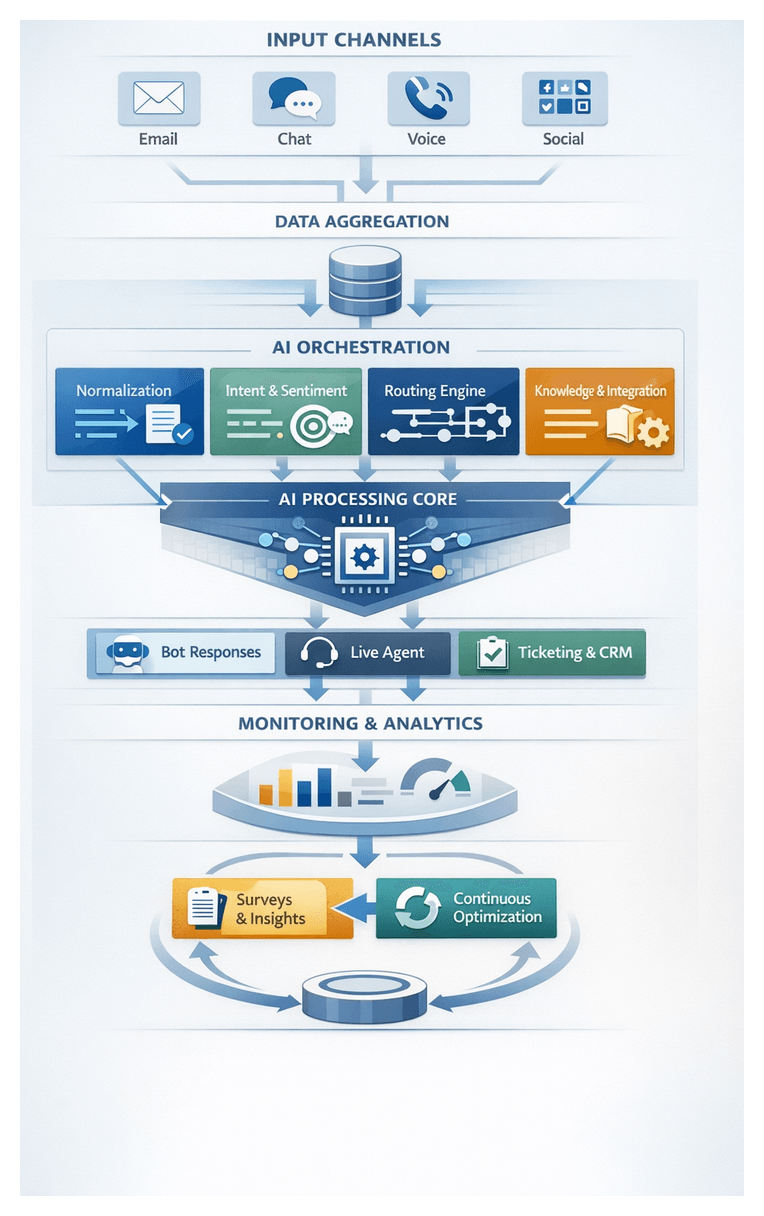
Addressing Fragmented Customer Communications
In an era defined by rapidly evolving customer expectations and proliferating channels—email, chat, voice calls and social media—organizations struggle with siloed data and inconsistent protocols. Fragmentation leads to context loss, redundant inquiries and operational overhead as agents reconcile parallel threads. Disparate metadata standards and varying SLAs across platforms result in delayed responses and uneven service quality. Poor traceability undermines the ability to personalize interactions, detect trends or resolve issues proactively. Overcoming these gaps requires a deliberate assessment of the channel landscape and unified input standards that ensure every message is captured, enriched and standardized before processing.
Establishing a Unified Interaction Workflow
A structured, end-to-end workflow serves as the architectural backbone that consolidates diverse customer inputs into a coherent service pipeline. By channel-agnostic aggregation, the system ingests messages from every touchpoint into a canonical format containing customer identifiers, timestamps, channel metadata and contextual notes. Key objectives of this workflow include:
- Data normalization and context enrichment using AI services such as Dialogflow for intent and language detection.
- Preliminary routing logic that assigns inquiries to queues, specialized AI agents or live teams based on business rules.
- Quality gates to verify message integrity, compliance and privacy before automated or human handling.
- Real-time monitoring of throughput metrics—queue depth, response times and escalation rates—to drive continuous optimization.
Implementing this workflow requires integration connectors for each channel, a centralized message bus or event queue and mapping rules that translate channel-specific attributes into the unified schema. Standard response templates, adaptive SLAs enforced via tools like Zendesk and real-time alerts ensure consistent service levels across platforms.
AI-Driven Orchestration Architecture
Artificial intelligence acts as the central orchestration layer, coordinating every stage of the interaction. Positioned between channel integration and downstream modules, the orchestration layer comprises an event bus, a workflow engine, a context store, a decisioning module and integration adapters for external systems such as CRM, ticketing and knowledge management. Exposing a unified API, this layer sequences AI service calls, applies business rules and maintains state to provide a single point of control for complex workflows.
Core AI Capabilities
AI functions underpin each decision and task within the orchestration layer. The primary capabilities include:
- Message normalization and context enrichment: Sanitization, language detection via OpenAI or Google Cloud Translation, tokenization and metadata augmentation with customer profiles.
- Intent detection and sentiment analysis: Classification of inquiries into categories and emotional scoring using models from Dialogflow or Microsoft Azure Cognitive Services.
- Dynamic routing and agent selection: Real-time decisioning that balances virtual assistants and live teams based on intent confidence, agent specializations and workload.
- Natural language generation and personalization: Response composition engines—powered by IBM Watson, T5 or GPT variants—that assemble brand-consistent, context-aware messages.
- Knowledge retrieval and adaptive learning: Semantic search via platforms like Amazon Kendra, Coveo or Elastic Enterprise Search, with feedback-driven model retraining.
- Escalation management and summary generation: Automated packaging of conversation history and knowledge snippets for efficient live-agent handoffs through connectors like Amazon Connect or IBM Watson Assistant.
- Proactive engagement orchestration: Campaign engines that schedule follow-ups and targeted messaging based on predictive analytics and customer life-cycle events.
- Feedback-driven analytics: Continuous learning pipelines that ingest satisfaction scores, handle times and resolution rates to refine models and workflows.
Modular End-to-End Solution Stages
A resilient solution decomposes the workflow into discrete, stage-based modules:
- Inquiry Aggregation: Channel integration interfaces collect raw messages, perform initial sanitation and normalize payloads.
- Intent Analysis: NLP models classify intents, extract entities and detect sentiment to update the session context.
- Routing and Orchestration: The decision engine evaluates AI outputs and business rules to select AI agents or live teams.
- Automated Response: NLG engines craft replies using dynamic templates and personalize content based on customer data.
- Ticketing Integration: Case creation and management workflows link with platforms such as ServiceNow or Zendesk when human intervention is needed.
- Knowledge Enablement: AI-driven retrieval modules access to suggest articles or auto-generate entries.
- Escalation and Handoff: Predefined triggers package context and summaries for live agent dashboards.
- Proactive Outreach: Campaign engines automate event-triggered messaging and reminders.
- Feedback and Sentiment Collection: Survey modules gather customer feedback for analysis.
- Performance Analytics: Dashboards using tools like Tableau or Power BI visualize metrics and support model retraining.
Infrastructure prerequisites include scalable message buses, API throughput capacity and security controls. Governance frameworks must define data retention, model accuracy targets and exception protocols to ensure predictable deployments and continuous enhancement.
Knowledge Output Management and Feedback Loops
In the knowledge and self-service stage, AI-driven search and recommendation engines produce artifacts that inform both customer interfaces and internal workflows. Key outputs include:
- Ranked article collections: Ordered content lists with relevance scores, metadata and confidence metrics for portal rendering.
- Navigation trees: Hierarchical guides for multi-step resolutions with conditional logic hints.
- Interactive response packages: Payloads bundling content fragments, examples and action buttons for front-end consumption.
- User feedback logs: Event records of ratings, comments and usage signals enriched with sentiment scores.
- Content enrichment annotations: Tags and metadata updates derived from query trends and feedback analysis.
These artifacts flow into downstream processes via secure API gateways or message brokers. They fuel escalation workflows, ticket creation in ServiceNow or Zendesk, personalization engine updates and analytics dashboards. Feedback loop mechanisms—automated review flags, trend alerts, user-initiated contributions and model retraining pipelines—ensure the knowledge base evolves continually.
Quality assurance and compliance gates—pre-publish validations, audit trails, privacy controls and security scanning—preserve content integrity and regulatory adherence. Operational monitoring of latency, containment rates and error rates with capacity planning dashboards enforces SLA compliance. Agile content review cycles, knowledge sprints and model performance evaluations close the continuous improvement loop, transforming static content into a living repository that scales with business demands and customer expectations.
Chapter 7: Escalation and Live Agent Handoff
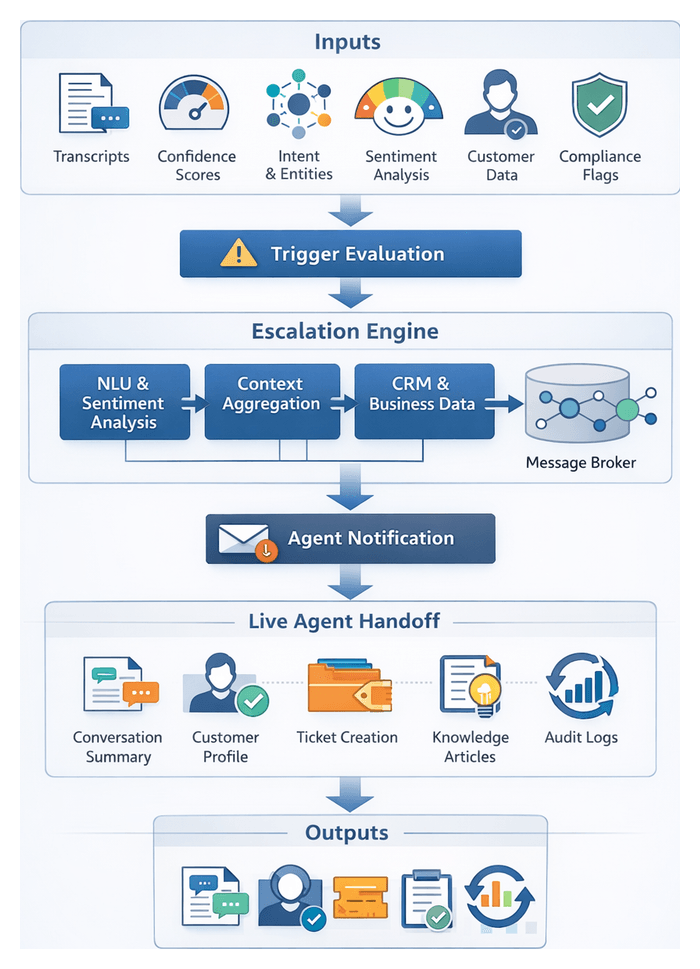
Escalation Triggers, Criteria, and Inputs
In AI-powered customer workflows, well-defined escalation triggers and input criteria ensure that interactions exceeding automated capabilities transition seamlessly to live agents. This prevents misinformation, safeguards compliance, and maintains customer trust.
Purpose and Benefits
Escalation activates when intent confidence falls below thresholds, sentiment analysis flags frustration, or sensitive requests arise. Key benefits include:
- Reduced error rates through early detection of low-confidence scenarios
- Improved first-contact resolution with context-rich agent handoffs
- Enhanced compliance by flagging regulated data or contractual obligations
- Dynamic workload management supporting scalable service architecture
- Continuous learning from escalated cases to refine AI models
Input Requirements and Data Standards
Seamless handoffs require standardized, structured data. Inputs include:
- Transcript: Complete interaction record with timestamps and channel metadata
- Confidence Scores: Numerical values for intent and entity recognition
- Detected Intents and Entities: Structured labels and extracted attributes
- Sentiment Metrics: Real-time emotional scoring
- Customer Profile: Account status, history, loyalty tier, active agreements
- Context Metadata: Channel, geolocation, language, device
- Compliance Flags: Indicators for regulated content or privacy constraints
- SLA Parameters: Response targets and escalation deadlines
Adhering to schemas—such as JSON objects with transcript arrays, intent labels and confidences, entities key–value pairs, sentiment scores, customer references, channel details, compliance flags, and SLA definitions—facilitates integration with CRM and contact center platforms. Tools provide preconfigured connectors and schema validation services.
Activation Prerequisites and Conditions
Before escalation can operate reliably, organizations must implement:
- Defined confidence thresholds for NLU performance
- Real-time sentiment monitoring inline with message processing
- Live agent availability registry tracking skills and workloads
- Secure session continuity with propagated authentication tokens
- Policy rule engine codifying compliance and data handling
- Workforce management integration for scheduling coordination
- Audit logging for escalation events and handoff details
Typical escalation conditions include low intent confidence, repeated failed resolution attempts, negative sentiment spikes, sensitive data requests, VIP customer status, delay-based triggers, explicit human agent requests, and detected query ambiguities. Organizations may apply weighted decision rules or composite scoring to balance multiple factors.
Escalation Workflow and Coordination
An organized escalation workflow minimizes delays and preserves context. It comprises discrete stages, each coordinating AI components, orchestration layers, middleware, and human agents.
Workflow Stages
- Trigger Detection: Continuous monitoring of confidence scores, business rules, and keywords
- Automation Pause: Suspending automated responses to avoid conflicts
- Context Packaging: Aggregating transcripts, metadata, customer data, sentiment scores, and attachments
- Queue Insertion: Routing the payload to an escalation queue or message broker
- Agent Notification: Alerting available agents via desktop alerts, mobile push, or email
- Session Initiation: Resuming or establishing the customer session in the agent interface
Sequential Action Flow
- Evaluate Escalation Criteria: AI models assess messages against triggers such as low accuracy, regulatory concerns, or explicit requests for human assistance.
- Invoke Escalation API: Orchestration calls a central endpoint with conversation and customer identifiers, receiving an escalation transaction ID.
- Generate Conversation Snapshot: A context service compiles transcripts, voice-to-text logs, sentiment analytics, and session metadata into a JSON document.
- Enrich with Business Data: Integration modules fetch customer details from CRM platforms like Salesforce to guide agents with up-to-date information.
- Submit to Escalation Queue: The enriched payload is dispatched to a message broker—such as Apache Kafka or RabbitMQ—tagged for escalation. Subscribers include routing services and audit modules.
- Confirm Receipt and Monitor Latency: Orchestration tracks acknowledgments and queue latency, initiating fallback alerts if thresholds are breached.
- Notify Available Agent: Routing services assign cases based on agent skills and capacity, sending notifications via the agent desktop. Overflow or supervisor escalation occurs if no match is found.
- Complete Session Handoff: Upon agent acceptance, the orchestration engine logs the event, updates session status, and resumes communication within the agent interface.
System Integration and Coordination
- AI Engine: Detects triggers and pauses automation
- Orchestration Layer: Coordinates API calls, monitors state, and routes payloads
- Context Service: Aggregates and standardizes conversation history
- Message Broker: Ensures reliable delivery of escalation events
- CRM and Backend Systems: Supply customer profiles and business rules
- Agent Desktop: Presents context and captures agent responses
- Monitoring Tools: Track SLA compliance, queue backlogs, and errors
Error Handling and Monitoring
- API Failures: Retry with exponential backoff and fall back to secondary endpoints or manual recovery
- Broker Timeouts: Requeue unacknowledged messages or divert to a dead-letter queue
- Enrichment Errors: Proceed with partial context, annotate missing fields, and alert agents
- Assignment Stalls: Bypass standard routing after timeouts and notify supervisors or use an overflow pool
- Channel Resumption Failures: Offer alternative channels or schedule callbacks
- Queue Depth and Latency Monitoring
- API Error Rate Alerts
- Agent Acceptance Time Tracking
- Customer Wait Time Measurements
- Throughput Reporting
Security and Compliance
- Encrypt all context payloads in transit and at rest (TLS, AES-256)
- Enforce role-based access controls for decryption and viewing
- Maintain audit trails of handoff events with timestamps and IDs
- Embed compliance checks to prevent unauthorized escalation of sensitive cases
- Purge expired records according to GDPR, CCPA, and other regulations
AI-Driven Orchestration Layer
An AI-driven orchestration layer unifies channels, enforces business logic, and adapts to customer needs. It ingests normalized messages, applies decision rules, and dispatches tasks to specialized modules, maintaining state and context across the conversation.
Core Functional Domains
- Routing and Queue Management: Prioritizes messages based on metadata, intent confidence, and customer value
- Context Enrichment and State Tracking: Maintains history, extracted entities, sentiment indicators, and unresolved tasks
- Decision Logic and Rules: Applies business policies, SLAs, and AI insights to determine automated responses or escalation
- Service Integration: Interacts with CRM, ticketing, knowledge bases, and payment gateways through connectors
- Monitoring and Feedback: Aggregates metrics, detects anomalies, and feeds insights back into model retraining and rule optimization
AI Services and Roles
- Natural Language Understanding: IBM Watson, Google Cloud Dialogflow, and Amazon Lex for intent classification and entity extraction
- Sentiment Analysis: Microsoft Azure Text Analytics for real-time emotion detection
- Dialogue State Management: Stateful managers for multi-step flows and slot-filling
- Recommendation Engines: Personalization modules that suggest next-best actions and knowledge articles
- Natural Language Generation: NLG models that assemble responses based on templates, data, and tone guidelines
- Anomaly Detection: Unsupervised models spotting spikes in unresolved intents or satisfaction drops
Supporting Infrastructure
- Message Bus and Event Streaming: Apache Kafka or Amazon Kinesis for high-throughput distribution
- API Gateway and Service Mesh: Unified ingress, authentication, and observability with tools like Istio
- Workflow Engine: Platforms such as Camunda BPM for visual process and decision management
- Stateful Data Stores: NoSQL for context, relational databases for records, caches for session state
- Monitoring Stack: Prometheus, Grafana, ELK, and distributed tracing (Jaeger, Zipkin) for end-to-end visibility
Interaction Patterns and Use Cases
- Real-Time Chat Escalation: NLU classifies intent, sentiment analysis detects frustration, decision engine triggers the live agent connector, and NLG generates an apology while the transfer completes.
- Voice-to-Ticket Conversion: Speech-to-text transcribes IVR input, intent recognition prompts ticket creation in ServiceNow or Zendesk, enriched with tags and SLA estimates, followed by SMS notification.
- Multi-Turn Form Completion: Dialogue manager guides field collection over multiple turns, validates entities, invokes CRM updates, and generates a confirmation message via NLG.
Benefits
- Consistency of service quality across channels
- Agility to update rules and AI services independently
- Efficiency through automated routing and real-time escalation
- Personalization with integrated recommendation engines
- Scalability via microservices and event-driven design
- Continuous improvement driven by embedded analytics and feedback loops
Handoff Outputs, Integrations, and Continuous Improvement
Structured escalation outputs and clear collaboration dependencies enable comprehensive agent views, downstream processing, and performance tracking.
Primary Outputs
- Conversation Transcript Package: Complete, time-stamped records with channel metadata
- Context Summary Document: AI-generated narrative summarizing intent, entities, sentiment, and actions
- Escalation Case Object: Structured tickets in ServiceNow or Zendesk capturing priority, category, SLA targets, and assignments
- Suggested Knowledge References: AI-recommended articles for agent reference
- Agent Dashboard Payload: UI metadata and action controls for front-end rendering
Metadata Artifacts
- Intent Confidence Scores for agent insight
- Entity Extraction Tags highlighting key data
- Sentiment Trend Indicators prioritizing high-risk cases
- Channel and Device Context informing support approach
Integration Dependencies
- Reliable message queues or event streams, such as AgentLinkAI or Apache Kafka
- Ticketing API contracts for case creation and updates
- Real-time knowledge base search endpoints with semantic AI
- Agent desktop compatibility with Salesforce Service Cloud or Microsoft Dynamics 365
- Notification channels for supervisor alerts on high-priority escalations
Downstream Integrations
- CRM Platforms synchronizing case data and interaction history
- Workforce Optimization tools for staffing forecasts
- Analytics suites like Power BI or Tableau streaming escalation metrics
- Team messaging apps for internal coordination
- Feedback services such as Medallia or Qualtrics for satisfaction surveys
Traceability and Validation
- Immutable logs with digital signatures to prevent tampering
- Event timestamps for escalation triggers and agent engagement
- User action records capturing AI suggestions and agent decisions
- Schema validation to ensure complete and correctly typed ticket fields
- AI-driven flags for low-confidence summaries requiring human review
- Latency monitoring to meet SLA targets
Collaboration and Feedback Loops
- Agent Annotations to refine intent labels and feed corrected data back into models
- Resolution Outcome Reporting for root cause analysis and trigger tuning
- Cross-Team Notifications engaging subject matter experts when needed
- Use of escalated case data for model retraining, workflow refinement, and knowledge base enhancement
Chapter 8: Proactive Outreach and Engagement Automation
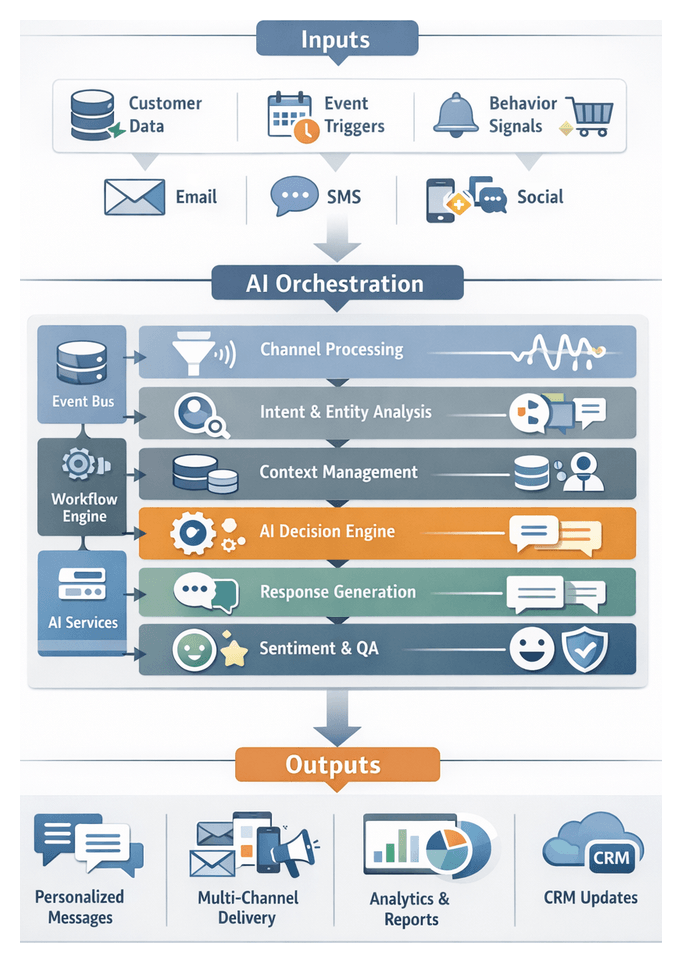
Defining Outreach Objectives and Data Inputs
Proactive engagement begins by establishing clear business objectives and specifying the data inputs required to trigger, personalize, and measure every interaction. Typical objectives include appointment reminders to reduce no-show rates, cart abandonment recovery, retention check-ins, upsell and cross-sell campaigns, and satisfaction surveys. Each objective is paired with success metrics—open rate, click-through rate, conversion rate, churn reduction, net promoter score—that inform content design and downstream attribution.
- Appointment reminders: target open and confirmation rates
- Cart abandonment messages: recover lost sales and measure conversion lift
- Retention campaigns: track churn reduction and renewal conversions
- Upsell and cross-sell: monitor incremental revenue and average order value
- Satisfaction surveys: assess service quality via response rates and NPS
Data inputs form the backbone of automation. Persistent attributes include demographics, subscription status, loyalty tier and communication preferences. Dynamic events span purchases, support case closures, product usage thresholds and website behaviors. Channels such as email via Salesforce Marketing Cloud, SMS via Twilio, mobile push through Airship, in-app notifications and social messaging require valid contact identifiers and consent flags. All inputs must conform to a unified schema with metadata fields for timestamp, campaign ID, message type and segmentation tags to enable reliable cross-channel orchestration.
Prerequisites for accurate and compliant outreach include a unified customer profile—often managed in a customer data platform such as Segment or a CRM like Salesforce Sales Cloud—with identity resolution across email, phone and device IDs. Consent management must honor opt-in status and regional privacy regulations (GDPR, CCPA). Event streaming infrastructure—using platforms such as Apache Kafka or AWS Kinesis—delivers near-real-time triggers to the orchestration layer.
- Transactional events: purchases, renewals, ticket resolutions
- Engagement signals: email opens, link clicks, SMS replies
- Enrichment data: firmographic intelligence, risk scores, third-party demographics
Triggers transform inputs into outreach events. Event-based triggers fire on specific conditions—”cart abandoned for more than one hour” or “support ticket closed with low satisfaction”—while schedule-based triggers handle periodic needs like monthly renewals. Rule definitions specify logic, evaluation windows and frequency caps. Decision automation tools such as IBM Automation Decision Services ensure consistent trigger evaluation.
Templates and content assets establish the framework for messaging, including branding elements, personalization tokens, and localization options. These templates reside in a version-controlled repository that incorporates approval workflows, ensuring that each dynamic field is clearly defined with appropriate fallback values. Delivery timing is meticulously managed through rules that account for delivery windows, post-event delays, customer time zone considerations, and frequency limits. Data hygiene practices rigorously validate email formats, phone numbers in E.164 format, and active in-app identifiers, directing any invalid records to remediation queues for correction. Validation tools seamlessly integrate into ETL processes, maintaining high standards of data quality throughout the workflow.
Monitoring and logging specifications capture send timestamps, delivery status, opens, clicks, bounces and replies. Distributed tracing identifiers link messages across systems for end-to-end visibility. Security measures—encryption at rest and in transit, role-based access controls, audit logging—safeguard sensitive data and enforce compliance. With objectives and data inputs defined, the orchestration workflow is primed for execution.
AI-Driven Orchestration and Workflow Architecture
Artificial intelligence serves as the central orchestration layer, coordinating tasks from event ingestion to response delivery. By integrating AI services—natural language processing, intent analysis, response generation—with microservices and message buses, organizations achieve a unified, scalable interaction pipeline.
- Event Bus and Message Queue: a high-throughput conduit such as Apache Kafka decouples producers and consumers and ensures durable delivery.
- Workflow Engine: a state-machine service (Camunda or Zeebe) manages execution sequences and applies routing logic.
- AI Service Registry: a directory of AI modules—intent detectors, entity extractors, NLG engines—and their API endpoints.
- Context Store: a scalable database or cache (Redis, MongoDB) that persists conversation state and session variables.
- Orchestrator API: exposes endpoints for inbound ingestion, stage transitions, health checks and administration.
Specialized AI modules are invoked at each workflow stage:
- Channel Classification and Preprocessing: identifies source channel, sanitizes text and transcribes voice interactions via speech-to-text engines.
- Intent Detection and Entity Extraction: applies models (BERT, Transformer) or services such as Google Dialogflow and IBM Watson Assistant to label intentions and extract attributes.
- Contextual Memory Management: tracks conversation history and user preferences using solutions like Rasa Core or Microsoft Azure AI Context service.
- AI Agent Selection: routes inquiries to FAQ bots, transaction assistants or human agents based on confidence scores and business rules.
- Response Generation and Personalization: leverages NLG engines such as OpenAI GPT or Amazon Lex to craft replies that reflect user data and brand voice.
- Sentiment and Quality Assurance: applies sentiment analysis and compliance checks before delivery.
Supporting infrastructure ensures resilience and governance:
- Identity and Access Management controls authentication and enforces role-based permissions.
- Monitoring and Observability with centralized logging (Elastic Stack) and tracing (OpenTelemetry) for health and performance metrics.
- Error Handling and Retry Mechanisms, including dead-letter queues and alerting for transient failures.
- Data Encryption and Compliance maintain end-to-end security for sensitive customer information.
The data flow follows a structured path: inbound aggregation, preprocessing, parallel intent and entity analysis, agent routing, response synthesis, delivery via outbound connectors, logging and, if needed, escalation to human agents. Scalability is achieved through stateless microservices, horizontal scaling, circuit breakers, multi-region deployments and graceful degradation strategies. This architecture delivers improved efficiency, consistent customer experiences, rapid deployment of new AI capabilities, data-driven insights and cost reductions.
Campaign Execution: Triggering to Delivery
The execution stage spans trigger evaluation, audience preparation, content generation and dispatch coordination.
Outreach Initiation and Trigger Evaluation: Real-time events—cart abandonment, subscription renewals, support case closures—are captured by CRM or analytics modules and forwarded to the orchestration layer. A rules engine continuously assesses events against trigger criteria, logs decisions and invokes API calls to downstream services.
Audience Segmentation and Data Enrichment: AI-driven segmentation algorithms, implemented via Segment or Azure Machine Learning, group customers into cohorts based on demographics, purchase history and engagement scores. Enrichment APIs append firmographic, psychographic or loyalty data. The unified customer data platform stores enriched profiles and passes metadata to the orchestrator.
Campaign Configuration and Scheduling: Campaign managers define goals, channel mix (email, SMS, push, in-app), frequency caps and time windows through a web console. Scheduling engines, powered by Apache Kafka or managed cloud schedulers, ensure timely dispatch aligned with local customer preferences.
Personalized Message Generation: Natural language generation services such as OpenAI transform templates with dynamic fields—customer name, product details, usage metrics—and conditional logic for tone and language. Each draft is validated against compliance and brand guidelines before advancing to dispatch queues.
Multi-Channel Dispatch and Delivery: Dispatch modules interface with channel providers—email via SendGrid, SMS via Twilio, push via mobile SDKs and social messaging APIs. The orchestrator publishes channel-specific payloads to message queues, invokes external APIs under rate limits, and listens for delivery receipts, bounces and unsubscribes to update internal status records.
Cross-System Coordination and State Management: A finite-state machine tracks each engagement through stages from trigger to delivery. Event buses and transactional outbox patterns guarantee atomic state changes and dispatch calls. Retry policies and dead-letter queues handle downstream failures, ensuring no loss of critical events.
Monitoring, Optimization, and Feedback
Post-dispatch, the system monitors customer responses—opens, clicks, SMS replies and in-app interactions—via webhooks and polling. AI-driven intent analysis classifies replies into follow-up actions: positive engagements advance to nurture sequences, negative feedback flags support tickets, and non-responses trigger reminders or alternate channels.
- Machine learning models dynamically recalibrate segments and predict optimal send times.
- Multi-armed bandit algorithms surface top-performing subject lines and message variants.
- A/B test assignments refine content before full-scale dispatch.
Aggregated metrics—open rates, click-through rates, conversion rates, sentiment scores—feed analytics platforms like Microsoft Power BI and Tableau. AI-driven analytics identify trends and calculate campaign ROI. Outcome data is funneled back into model training pipelines in TensorFlow or PyTorch, completing a continuous improvement loop and aligning outreach with evolving business objectives.
Engagement Outputs and System Integration
Each outreach campaign produces deliverables and data products that power downstream systems and analytics.
- Message Content Record: captures the exact rendered content—subject line, body text, dynamic links and media.
- Delivery Metadata: includes message ID, timestamp, channel, campaign ID, recipient details and API references.
- Personalization Profile Snapshot: a record of the customer attributes used for personalization at send time.
- Engagement Event Log: tracks opens, clicks, bounces and replies with associated timestamps and technical data.
- Follow-Up Trigger Definitions: conditional logic for subsequent outreach based on behavior, timing or sentiment.
Analytical outputs include campaign performance summaries, engagement heatmaps, behavioral cohort records, delivery performance logs and AI feedback signals. These structured payloads—JSON or XML—are transmitted via RESTful APIs or event streams into data lakes or warehouses (Snowflake, Amazon Redshift, Google BigQuery) where ELT jobs curate them for BI consumption.
Integration dependencies span:
- CRM Platforms: bidirectional sync with Salesforce and HubSpot for profile updates and event writes.
- Marketing Automation Suites: template and scheduling interfaces with Mailchimp and Marketo.
- Event Streaming Services: schema-managed pipelines in Apache Kafka relay engagement events to analytics and AI retraining workflows.
- Orchestration Platforms: tools like Zapier manage cross-system triggers and fallbacks.
Handoff mechanisms ensure workflow continuity: webhooks trigger surveys, non-responsive cohorts generate tickets in ServiceNow or Zendesk, labeled interaction data feeds model retraining pipelines, and campaign optimization workflows update parameters in marketing suites. Executive dashboards and alerts deliver high-level metrics via collaboration platforms, closing the loop and embedding continuous improvement into the proactive outreach architecture.
Chapter 9: Feedback Collection and Sentiment Analysis
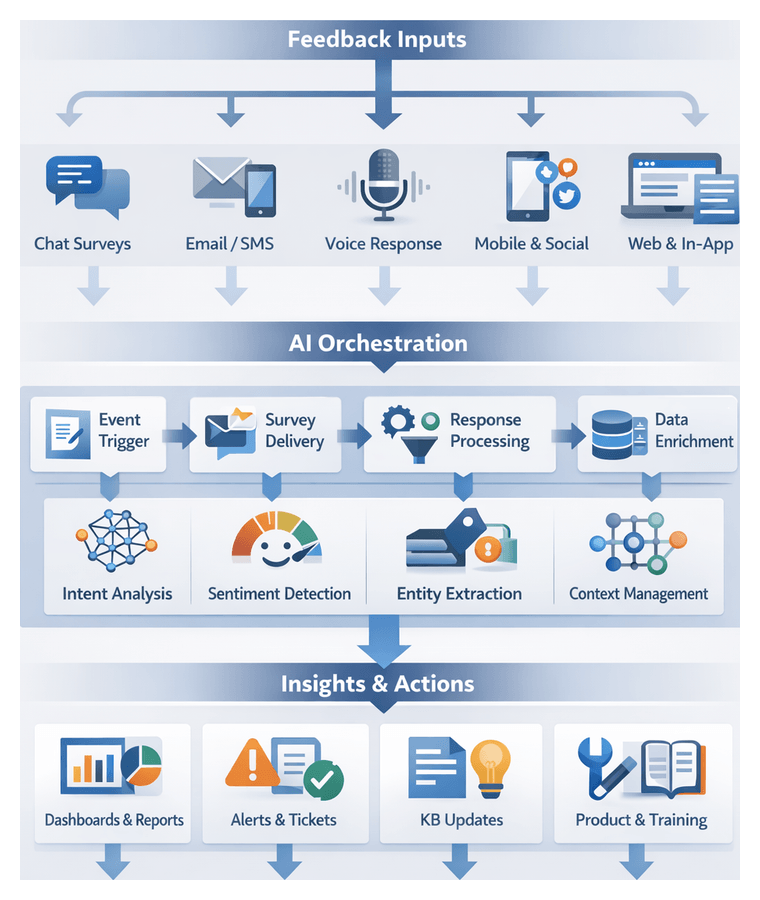
Feedback Collection Objectives and Input Sources
Capturing structured customer feedback at key interaction points is essential for continuous improvement of AI-driven service workflows. Clear objectives guide survey design, data capture, and analysis, ensuring insights directly inform model retraining, knowledge base updates, and process refinements.
The primary goals of feedback collection are:
- Assess Interaction Quality: Gauge relevance, accuracy, and ease of resolution provided by AI agents and human-assisted channels.
- Measure Satisfaction Levels: Quantify customer sentiment using metrics such as Net Promoter Score (NPS), Customer Satisfaction (CSAT), and Customer Effort Score (CES).
- Identify Systemic Issues: Surface recurring errors, misunderstood intents, and gaps in self-service content.
- Enable Sentiment Analysis: Provide raw text for AI-driven sentiment scoring and emotion detection models.
- Inform Continuous Improvement: Supply data inputs for iterative updates to orchestration logic, NLP models, and knowledge assets.
To achieve these objectives, programs must satisfy key prerequisites:
- Unified Interaction Tracking: A persistent session identifier links feedback to resolution transcripts and agent actions.
- Consent and Privacy Compliance: Survey workflows align with regulations such as GDPR and CCPA and secure explicit customer consent.
- Timing and Context Triggering: Prompts fire at logical breakpoints—post-resolution, during escalations, or at lifecycle milestones.
- Channel Consistency: Feedback mechanisms mirror inquiry channels: web chat, email, SMS, voice, or mobile app.
- Standardized Question Framework: Core rating scales and open-text questions enable longitudinal analysis across channels.
- Integration with Data Pipelines: APIs or message queues ingest responses into analytics platforms for real-time reporting.
Effective feedback programs leverage diverse input sources to maximize reach and context alignment:
- In-Session Chat Prompts: Embedded widgets invite ratings and brief comments immediately after AI agent interactions.
- Email Surveys: Follow-up questionnaires delivered via SurveyMonkey or Qualtrics support longer, open-ended responses.
- SMS and Mobile App Prompts: In-app notifications or SMS links direct users to forms hosted on Typeform.
- Voice Channel Surveys: Automated post-call prompts capture numeric ratings or verbal comments, transcribed for analysis.
- Social Media Panels: Integrations and social listening tools collect unsolicited feedback and topic signals.
- Embedded Web Surveys: Page-level forms triggered by exit intent or inactivity capture user ratings without disrupting navigation.
Standardized data elements ensure consistency and analyzability:
- Interaction ID: Links feedback to the original inquiry, AI responses, and resolution outcome.
- Timestamp: Records submission time for trend analysis.
- Channel Metadata: Identifies the feedback channel for performance comparisons.
- Structured Ratings: Numeric scales for CSAT, CES, and NPS.
- Open-Text Responses: Free-form comments for qualitative analysis.
- Customer Context: Optional fields such as segment, tier, product, or case category.
- Consent Flags: Indicate compliance with privacy policies.
Event-Driven Feedback Workflow and AI Orchestration
Feedback collection is embedded within an event-driven orchestration framework that unifies multiple channels and AI services. Once a customer interaction reaches resolution, the orchestration layer emits a resolution event via a message bus or webhook. This event triggers the feedback workflow, coordinating prompt generation, delivery, and response capture.
The core workflow sequence is:
- Resolution Event Emission: The ticketing or chatbot system publishes a JSON payload with interaction ID, customer identifier, channel type, and resolution timestamp.
- Prompt Generation: An orchestration service consumes the event, selects a feedback template, and invokes the survey engine API—such as Qualtrics or SurveyMonkey.
- Message Assembly: Dynamic fields (agent name, issue category, resolution time) are merged to personalize each prompt and boost completion rates.
- Multi-Channel Delivery: Channel adapters dispatch surveys via email, chat message, SMS, voice prompt, or in-app notification.
- Response Capture: Replies flow back into the survey engine or chat platform, tagged with original context identifiers.
At the heart of this workflow, AI serves as the central orchestration layer, coordinating four functional domains:
- Intake Coordination: Captures messages from web chat, email, voice, mobile, and social media.
- Decision Execution: Applies business rules and AI logic to trigger self-service, escalations, or feedback requests.
- Context Propagation: Maintains session state and carries conversation metadata across services.
- Outcome Delivery: Assembles final responses and initiates downstream actions like survey prompts or ticket creation.
Core AI Capabilities in the Orchestration Layer
- Language Detection and Normalization: Modules identify language and clean text inputs for downstream processing.
- Intent Classification: Services such as Dialogflow and LUIS assign probability scores to predefined intents.
- Entity Extraction: Detects attributes like order numbers or dates to enrich message profiles.
- Sentiment and Emotion Analysis: Initial tone detection informs routing decisions and feedback triggers.
- Response Generation: Natural language generation templates or generative models craft personalized messages.
Intent Routing and Session Tracking
Once enriched, messages undergo routing logic based on intent confidence, sentiment, user segment, SLA requirements, and real-time agent availability. Low-confidence intents trigger fallback workflows offering knowledge articles or clarifying prompts. A unique session identifier persists across channels via a distributed context store, enabling seamless transitions between chat, email, voice, and social interactions.
Knowledge Integration and Decision Support
The orchestration layer invokes semantic search engines—such as IBM Watson Discovery—to retrieve relevant knowledge base articles, FAQs, and policy documents. Rule engines enforce business policies for returns, discounts, or compliance checks, ensuring consistent decision execution and simplifying maintenance of complex rule sets.
Monitoring, Logging, and Infrastructure
- Event Streaming: Apache Kafka or Azure Event Grid provides durable message passing.
- API Gateway: Authenticates and rate-limits all service endpoints.
- Container Orchestration: Kubernetes manages microservice deployment, scaling, and health checks.
- Model Management: Platforms like MLflow and Amazon SageMaker handle versioning, canary deployments, and rollbacks.
- Observability: Structured logs and metrics feed dashboards in Splunk and Datadog for real-time KPIs: first-contact resolution, handling time, and sentiment trends.
- Security: TLS encryption in transit, data-at-rest encryption, OAuth2.0 or token‐based authentication, and IAM least-privilege controls support GDPR and PCI DSS compliance.
AI-Driven Analysis and Data Enrichment
Upon capturing feedback, text responses undergo normalization, tokenization, and optional translation. Preprocessed data is routed to sentiment scoring and topic modeling services.
- Sentiment Analysis: Requests are sent to services such as AWS Comprehend, Google Cloud Natural Language, or Azure Text Analytics, returning scores on a negative-to-positive scale.
- Topic Extraction: Unsupervised algorithms cluster feedback into themes like “billing,” “feature request,” or “usability,” with confidence weights.
- Metadata Enrichment: Sentiment and topic labels, processing timestamps, model version IDs, and confidence indicators attach to each feedback record.
- Quality Validation: Low-confidence analyses trigger manual review workflows or automated retries.
- Profile Linking: Feedback merges with CRM data—account tier, product subscriptions, and historical satisfaction—for segmented insights.
- Context Embedding: Original transcripts, agent notes, and resolution details join the feedback record to preserve full interaction context.
Enriched records load into a centralized data warehouse via batch ETL or streaming pipelines. Message brokers like Apache Kafka or AWS SQS decouple ingestion from downstream processing, ensuring resilience at scale.
Insight Generation, Distribution, and Continuous Improvement Handoffs
Centralized analytics transform enriched feedback into actionable insights:
- Sentiment Trend Dashboards: Track emotional trajectories over time and across customer segments.
- Topic Heatmaps: Visualize theme prevalence and emerging pain points.
- Anomaly Detection Alerts: Monitor spikes in negative feedback and trigger notifications.
- Agent Performance Metrics: Aggregate individual feedback scores for coaching and recognition.
Collaboration handoffs ensure continuous improvement:
- Automated Ticket Creation: Negative or urgent feedback items generate tickets in Jira or ServiceNow, including transcripts, scores, topic tags, and priority levels.
- Knowledge Base Updates: Recurring question clusters route suggestions to content management systems for FAQ revisions.
- Agent Training Alerts: Emotion categories indicating confusion or frustration notify training teams to develop micro-learning modules.
- Product Feedback Submissions: Feature request clusters translate into user stories in Azure DevOps or Pivotal Tracker, aligning voice-of-customer with development backlogs.
- Executive Dashboards: Aggregated trend metrics populate BI platforms such as Tableau and Microsoft Power BI, with automated alerts for leadership review.
Well-defined interfaces maintain seamless data exchange:
- Message Queues: Kafka or AWS SQS buffer analysis outputs for asynchronous consumption.
- RESTful APIs: Expose sentiment and topic data in JSON, secured via OAuth2.0.
- Database Views: Materialized joins of feedback and customer attributes support BI queries.
- Webhooks: Push critical feedback events to Slack or Microsoft Teams channels for immediate action.
Clear organizational roles drive effective outcomes:
- Data Science: Manages model performance, retraining cycles, and drift detection.
- Customer Success: Handles low-sentiment alerts and customer outreach.
- Knowledge Management: Updates self-service content based on topic insights.
- Product Owners: Integrate customer feedback into product roadmaps.
- Operations Leadership: Monitors KPIs and allocates resources for critical improvements.
Best practices for handoff effectiveness include embedding context in tasks, defining response SLOs for negative feedback, prioritizing by sentiment severity and customer value, implementing closed-loop workflows, and regularly auditing processes to align with business goals.
Chapter 10: Performance Analytics and Continuous Improvement
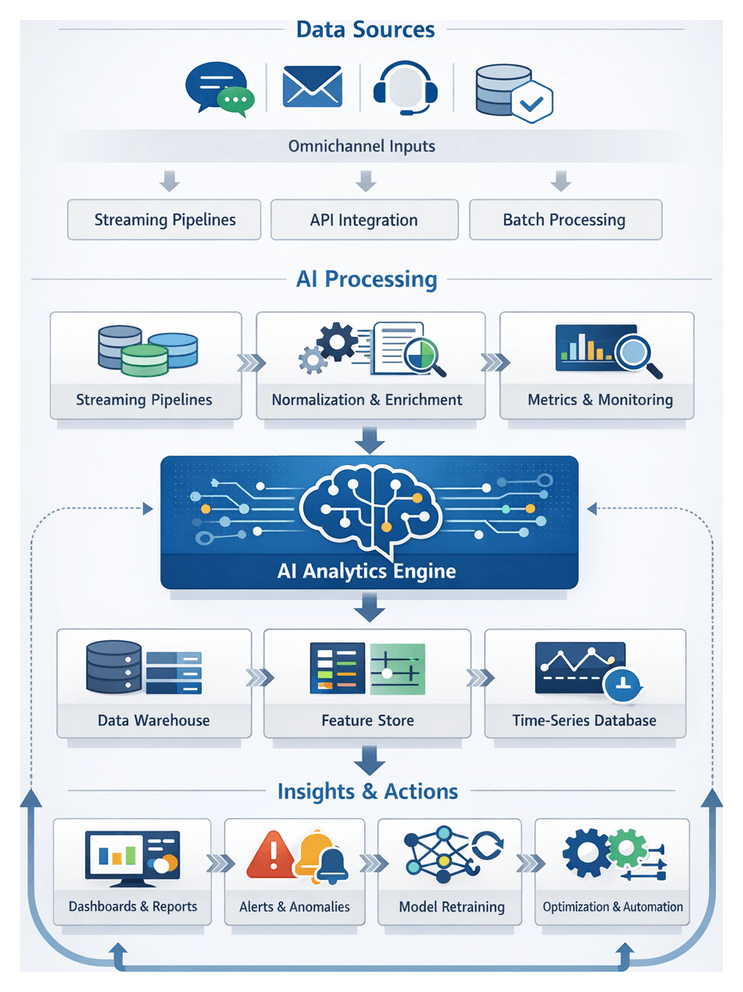
Defining Analytics Objectives and Data Inputs
Organizations engaging customers across channels—email, web chat, social media, voice and in-app messaging—must centralize fragmented data and establish clear analytics objectives to drive continuous improvement. By aligning business and technical stakeholders on performance goals and data requirements at the outset, enterprises ensure that reporting frameworks deliver accurate, actionable intelligence for decision making, compliance and competitive advantage.
Analytics objectives within AI-orchestrated workflows include:
- Performance Monitoring: tracking metrics such as average handling time, first-contact resolution and SLA breach rates
- Quality Assurance: measuring intent detection accuracy, response relevance and AI model precision
- Capacity Planning: forecasting interaction volumes and resource requirements for agents and compute infrastructure
- Continuous Improvement: feeding insights into model retraining, process redesign and knowledge base updates
- Risk Management: detecting operational anomalies that may signal faults or security incidents
Common challenges in data collection and standardization:
- Siloed Systems and Incompatible Schemas
- Inconsistent Timestamp Formats
- Incomplete Context Metadata (channel, segment, priority)
- Variable Data Quality from Manual Entry and API Failures
- High Volume Constraints Requiring Scalable Storage and Streaming
Key data inputs and metrics span multiple dimensions:
- Interaction Metadata: inquiry receipt, response and closure timestamps
- Customer Satisfaction Indicators: post-interaction survey scores and automated sentiment ratings
- Operational Logs: routing events and API call latencies and error codes
- AI Performance Data: intent detection confidence and entity extraction precision/recall
- SLA Metrics: response time targets and resolution time windows by priority
- Resource Utilization: compute/memory usage and queue depths at each stage
- Customer Profile Attributes: segment classification and historical interaction counts
Data prerequisites and quality conditions include:
- Unified Data Schema across all sources
- Complete Event Capture at every workflow stage
- Metadata Enrichment for slicing by channel, language, intent and segment
- Secure, Compliant Handling with encryption and access controls
- Real-Time Data Availability via streaming or micro-batch processes
- Automated Error Detection for anomalous or duplicate records
- Data Retention Policies aligned with legal and business needs
Stakeholder alignment covers:
- Consensus on Key Performance Indicators
- Reporting Cadence for real-time dashboards, daily operations reviews and monthly executive summaries
- Alerting Thresholds for SLA breaches and performance regressions
- Governance Model defining roles for data stewards, analysts and decision makers
- Integration with Business Intelligence Platforms and data warehouses
Integration points for analytics include:
- Omnichannel Messaging Platforms
- AI Service Monitoring Logs
- Ticketing and Workflow Systems
- Knowledge Base Engines
- Live Agent Interaction Tools
- Customer Feedback Solicitation Systems
- Infrastructure and Application Performance Monitors
Data ingestion and aggregation requirements demand pipelines that ensure:
- Scalability and Throughput under peak loads
- Transformation and Normalization into a unified schema
- Event Sequencing and Correlation across asynchronous channels
- Storage Optimization using time-series, relational or columnar solutions
- Metadata Indexing and Partitioning for efficient retrieval
- Hybrid Real-Time and Batch Processing modes
- Automated Archival and Purging for cost-effective retention
Defining analytics objectives and inputs establishes the foundation for feedback loops that power root-cause analysis, model retraining, automated workflows and cross-functional reviews, ensuring requirements evolve with operational needs.
Analytics Workflow and Reporting Flow
An effective analytics workflow maps data capture through transformation, aggregation and visualization, ensuring timely visibility into support metrics and driving continuous service improvement. Clear definition of data flows and handoff interfaces preserves integrity and automates collaboration among data engineers, analysts and business stakeholders.
Data Ingestion and Event Collection
Telemetry from AI agents, ticketing systems, knowledge bases and live agent platforms is captured via:
- Streaming Pipelines to brokers such as Apache Kafka, carrying standardized fields (timestamp, interaction ID, channel, stage, quality metrics)
- Batch Exports through ETL connectors for historical data and SLA statistics
- API Calls from CRM and survey platforms delivering ticket details and feedback
Agreements on schemas and delivery latency, plus monitoring of ingestion jobs, prevent data loss and schema drift.
Data Transformation and Enrichment
Distributed frameworks normalize formats, enrich records and index data:
- Schema Normalization into UTC timestamps and standard scales
- Contextual Enrichment joining CRM profiles, knowledge base metadata and agent skills
- Error Handling with checkpoints, retries and dead-letter queues
Orchestration via tools such as Apache Airflow coordinates tasks and maintains lineage through data catalog services.
Aggregation and Metric Computation
Pipelines generate both real-time indicators and historical trends:
- Stream Aggregation with sliding windows for near-real-time counts of inquiries, latencies and queue lengths
- Batch Summarization of daily, weekly and monthly KPIs (resolution rates, escalations, sentiment trends)
- Feature Store Updates to support model retraining (satisfaction by agent, topic popularity)
Data Storage and Access Layer
Datasets are housed in:
- Analytical Warehouses for relational KPI tables with SQL access
- Time-Series Stores for high-frequency metric writes and range queries
- Data Lakes preserving raw event archives for compliance and ad-hoc analytics
Governance policies enforce role-based access, dynamic indexing and query performance monitoring.
Report Generation and Visualization
Metrics are assembled into dashboards and scheduled reports:
- Dashboard Templates built in Tableau or Microsoft Power BI
- Secure Data Source Connections with query optimization and caching
- Scheduled Exports of PDF or CSV summaries delivered via email or collaboration portals
- Interactive Self-Service with filters, drill-downs and row-level security
Report orchestration agents schedule runs, log outcomes and alert on failures or anomalous aggregates.
Alerting and Anomaly Detection
Proactive monitoring uses:
- Anomaly Detection Models scanning metrics for statistical outliers
- Threshold-Based Alerts for sustained KPI breaches
- Notification Channels including email, SMS and collaboration integrations
An incident management system tracks alert ownership, acknowledgements and escalations.
Collaboration and Feedback Integration
Embedding analytics into business workflows involves:
- Inline Comments and Annotations on dashboards
- Issue Tracking Handoff creating tasks linked to report views
- Structured Feedback Loops for dashboard improvements reviewed by a governance board
End-to-End Workflow Orchestration
Unified schedulers define dependencies, retries and conditional executions across ingestion, transformation, aggregation and reporting. Observability dashboards monitor job health and resource usage, while automated remediation scripts restart tasks, scale resources or notify teams, ensuring a reliable, low-touch analytics operation.
AI-Driven Trend Detection and Model Retraining
To adapt to shifting user behavior and service demands, AI systems employ trend detection and retraining within the analytics and continuous improvement stage. This closed-loop process of monitoring, analysis, adaptation and redeployment sustains model accuracy and operational efficiency.
Trend Analysis and Anomaly Detection
Time series algorithms and unsupervised learning uncover performance variations:
- Time Series Forecasting with RNNs and LSTM models to predict future metric behavior
- Anomaly Detection via Isolation Forest and one-class SVM to flag outliers
- Seasonality Decomposition separating cyclic patterns from long-term trends
Drift Detection Techniques
Automated monitoring detects when data distributions or model performance degrade:
- Statistical Tests (Kolmogorov-Smirnov, Chi-square) comparing feature distributions
- Performance Tracking of accuracy, precision, recall and F1 scores against thresholds
- Drift Detectors such as ADWIN and DDM maintaining dynamic windows on input streams
Automated Retraining Triggers and Strategies
Retraining pipelines initiate based on:
- Threshold-Based Retraining when performance metrics fall below set limits
- Scheduled Retraining on fixed cadences in high-velocity environments
- Event-Driven Retraining triggered by major campaigns or product launches
- Incremental Learning updating models continuously with new labeled data
MLOps Platforms and Integration
Robust infrastructure automates data ingestion, training, evaluation and deployment:
- Kubeflow: Kubernetes-based ML pipeline orchestration
- MLflow: Experiment tracking and model registry
- TensorFlow Extended (TFX): Data validation, transformation and serving
- Amazon SageMaker: Managed model building, training and monitoring
- Azure Machine Learning: Automated ML, pipeline orchestration and drift monitoring
- Google Vertex AI: Integrated model monitoring and retraining pipelines
Governance, Versioning and Compliance
Model lifecycle governance requires:
- Centralized Model Registry tracking lineage, hyperparameters and performance
- Data Lineage Tracking for transparency in feature provenance
- Role-Based Access Controls for retraining and deployment
- Automated Compliance Reporting of drift events and retraining actions
Feedback Loops and Active Learning
Human-in-the-loop and active learning strategies accelerate dataset enrichment:
- Uncertainty Sampling prioritizing low-confidence predictions for annotation
- Agent Feedback flagging misclassifications for corrective labels
- Automated Label Propagation expanding human annotations across similar data
- Survey and Sentiment Integration augmenting training data for satisfaction and intent models
Best Practices and Implementation Challenges
Critical considerations include:
- Data Quality Assurance with automated validation checks
- Resource Management balancing retraining frequency and infrastructure costs
- Tiered Monitoring and Alerting to avoid retraining storms
- Cross-Functional Coordination among data engineers, scientists and operations
- Scalability Planning for growing data volumes and new models
- Comprehensive Documentation and Runbooks for knowledge transfer
Analytics Outputs and Optimization Handoffs
At the culmination of analytics workflows, deliverables provide the basis for strategic decisions, operational adjustments and model refinements. Effective handoff protocols ensure insights translate into action across systems and teams.
Primary analytics deliverables include:
- Interactive Dashboards displaying KPIs—volume, time, quality and resource metrics—hosted in Tableau or Microsoft Power BI
- Scheduled Performance Reports with narrative summaries, KPI scorecards and root-cause analyses
- Automated Alert Notifications for sentiment spikes, SLA breaches, model drift and queue growth via email, Slack, Microsoft Teams or Datadog
- Predictive Recommendations for retraining schedules, workflow tweaks, capacity scaling and proactive engagement, exported as JSON or CSV for systems such as Google Cloud AI Platform
Analytics outputs depend on an integrated ecosystem:
- Data Warehouse and Lake consolidating logs, tickets and feedback
- Streaming Infrastructure for low-latency event delivery
- Business Intelligence Tools for visualization and reporting
- Alerting and Incident Management Services
- Model Management Systems orchestrating retraining pipelines
Handoff protocols employ:
- Event-Driven Triggers emitting messages for downstream automation
- Scheduled Job Execution for periodic reports and retraining invocations
- RESTful API Calls pushing insight payloads to orchestration or ticketing systems
- Webhook Notifications integrating with CRM, WFM or DevOps platforms
Governance and security considerations ensure:
- Role-Based Access Controls on dashboards and report data
- Data Masking of personally identifiable information
- Audit Trails recording handoff events and alert dispatches
- Encryption of data in transit and at rest
Closing the continuous improvement loop involves prioritizing optimization initiatives, validating changes through A/B tests or canary deployments, scheduling iterative reviews aligned with business objectives and updating governance policies. Seamless transition of analytics outputs into action fosters progressively more efficient, personalized and satisfactory customer interactions.
Conclusion
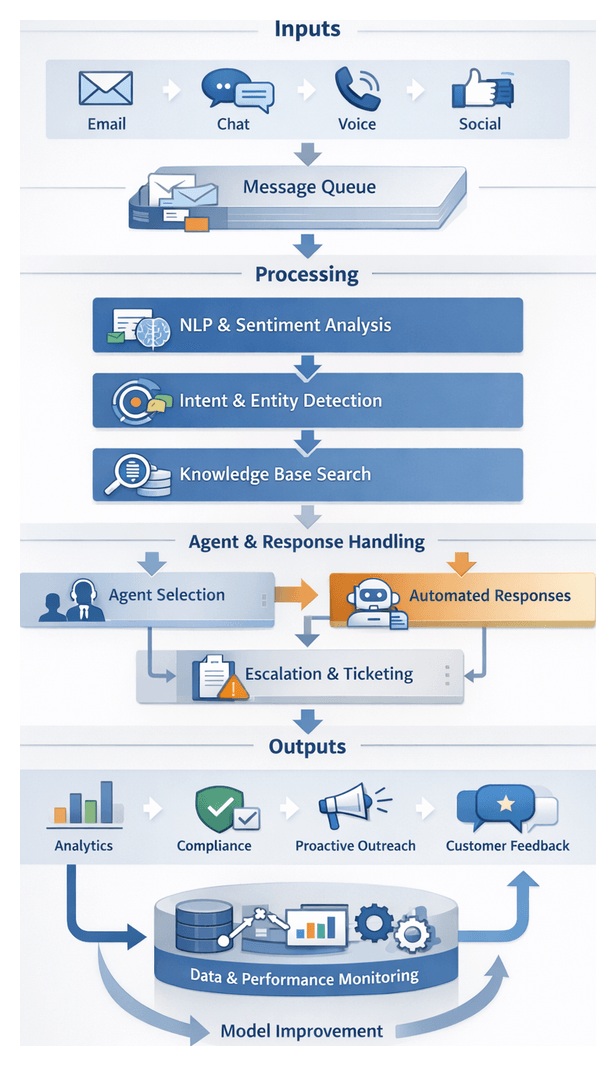
End-to-End AI-Driven Orchestration Workflow
A modern customer interaction platform integrates diverse channels, AI services, and enterprise systems into a unified, automated workflow. Incoming messages from email, chat, voice, and social media converge through a centralized message queue, preserving order and metadata. Natural language processing cleans and normalizes text or transcripts, applies sentiment analysis, and enriches data with preliminary keyword tags. Intent detection models then label requests and extract entities, producing structured outputs that inform agent selection and downstream processing.
Agent selection evaluates intent confidence, customer profile attributes—such as service-level agreements and purchase history—and real-time availability of AI or human agents. Automated response modules use the intent label, extracted entities, and conversation context, along with personalization data, to generate replies via dynamic template assembly or generative engines. Compliance filters and content validation ensure adherence to brand standards and regulatory requirements.
When issues require escalation, ticketing services create case records in the workflow management system, applying priority rules, category classifiers, and routing logic. Knowledge base connectors perform semantic searches against centralized repositories, surfacing relevant articles and FAQs. Proactive outreach modules trigger campaigns based on customer journey events—such as upcoming renewals or unresolved tickets—using scheduling engines and rules that enforce timing controls. Feedback collection prompts are delivered at defined touchpoints, capturing context, sentiment, and response timing.
Performance analytics ingest logs, metrics, and key performance indicators from each stage. Data lakes and analytics warehouses aggregate resolution times, intent accuracy rates, response quality scores, ticket abandonment figures, and sentiment trends. Real-time dashboards and ETL pipelines enable continuous monitoring and feedback loops that drive AI model retraining, routing logic refinements, and knowledge base updates. This end-to-end orchestration blueprint clarifies data flows, decision criteria, and module interfaces, establishing the foundation for implementation and ongoing optimization.
Performance Improvements Realized
Deploying a fully integrated AI orchestration workflow delivers measurable gains in efficiency, consistency, and cost optimization. Organizations monitor metrics such as average handle time, first contact resolution rate, customer satisfaction scores, agent productivity, automation ratio, and SLA compliance to quantify impact and guide continuous improvement.
Reduced Resolution Time
- Automated message classification and routing cut first-response latency by 40 to 60 percent.
- Dynamic template selection and context-aware assembly minimize drafting time.
- Inline knowledge base suggestions from Google Dialogflow or IBM Watson Assistant accelerate common-issue resolution.
- Priority escalation rules enable instant handoff for critical tickets, eliminating manual status checks.
Consistency in Customer Experience
- Centralized context storage ensures each response reflects full interaction history across channels.
- Standardized templates, managed in a single repository, maintain uniform brand voice.
- Automated triggers apply consistent escalation criteria, avoiding subjective judgments.
- Integrated quality monitoring flags deviations in real time for immediate correction.
Higher First Contact Resolution
- Intent detection models exceed 90 percent accuracy, reducing misclassification.
- Entity extraction enriches case data, enabling precise answers without follow-up.
- AI-driven FAQ bots resolve up to 70 percent of routine issues autonomously.
- Seamless handoff to live agents preserves context and prevents duplicate cases.
Cost Savings through Automation
- Automating low-complexity interactions halves average cost per contact.
- Dynamic routing balances workloads across virtual and human agents, reducing idle time.
- Predictive SLA management prevents breach penalties via proactive analytics.
- Self-service portals powered by Microsoft Azure Bot Service divert up to 30 percent of support traffic.
Enhanced Agent Productivity
- Real-time suggestions and next-best-action recommendations accelerate case handling.
- Auto-summaries of conversation history eliminate manual transcript review.
- Suggested responses based on language models reduce drafting time by up to 70 percent.
- Embedded performance analytics provide immediate feedback for skill improvement.
Scalable Peak-Load Handling
- Auto-scaling processing clusters absorb traffic surges without manual intervention.
- Load-aware routing across global data centers prevents regional bottlenecks.
- Asynchronous pipelines buffer spikes and maintain SLA compliance.
- Stateless microservices support rapid feature deployment without downtime.
Strategic Value and Long-Term Impact
Organizations that embed AI orchestration into customer service gain enduring advantages: stronger brand equity, faster market responsiveness, and continuous revenue growth. AI services transform raw inquiries into actionable intelligence, feeding data lakes and CRM systems to support proactive, evidence-based decision making.
Customer Experience Transformation
- Unified customer view aggregates interactions across email, chat, voice, and social for complete context.
- Dynamic personalization engines tailor responses and recommendations using profile and sentiment data.
- 24/7 AI agent coverage maintains responsiveness, escalating to humans only when complexity thresholds are reached.
Operational Efficiency and Cost Optimization
- Automated classification and routing minimize manual effort, allowing agents to focus on complex cases.
- Knowledge base retrieval and intent detection occur in milliseconds, compressing resolution cycles.
- Cloud-native architectures auto-allocate resources to match demand, reducing infrastructure overhead.
Innovation and Competitive Advantage
- Modular design and APIs enable rapid integration of new AI capabilities, such as advanced sentiment analysis or voice biometrics.
- Analytics-driven retraining pipelines detect model drift and update inference engines with fresh data.
- Shared dashboards and microservices foster cross-functional collaboration on novel engagement strategies.
Sustained Data-Driven Growth
- Behavioral analytics from clickstreams and transcripts guide targeted marketing and product enhancements.
- Continuous sentiment scoring surfaces emerging pain points, enabling proactive outreach before issues escalate.
- Predictive forecasting of inquiry volumes supports workforce planning and capacity management.
Measuring long-term impact requires a balanced scorecard, tracking lifetime customer value, service cost reduction, innovation velocity, and process agility. Regular reviews ensure AI investments align with strategic goals and highlight areas for reinvestment.
Scalability and Reuse
Scalable AI orchestration platforms rest on modularity, API-first design, containerization, and infrastructure as code. Decomposing workflows into channel adapters, intent detection services, response generators, and analytics modules enables independent development, testing, and deployment. Tools such as Kubernetes for orchestration and Docker Hub for image distribution ensure predictable, self-healing deployments.
Key Artifacts for Scaling and Reuse
- Packaged microservices with defined API contracts, versioned in registries.
- Infrastructure provisioning templates in Terraform, published to the Terraform Registry.
- Declarative deployment descriptors using Helm charts or native Kubernetes manifests.
- Versioned AI model artifacts stored in MLflow or proprietary registries, with metadata on training and performance.
- CI/CD pipeline definitions in Jenkins or GitLab CI/CD, integrating code analysis, testing, and security scans.
- Observability configurations using Prometheus and Grafana for service and model performance monitoring.
Supporting Infrastructure and Dependencies
- Container orchestration via Kubernetes clusters with integrated networking.
- Event brokers like Apache Kafka or RabbitMQ for decoupled communication.
- API gateways and service meshes such as Istio for traffic management, security, and observability.
- Identity and access management systems using OAuth2 or SAML.
- Data storage services for session persistence, conversation history, and artifact storage.
- Artifact repositories on GitHub, Docker Hub, and model registries.
Governance, Handoff, and Knowledge Sharing
Release management workflows publish artifacts to shared registries with detailed notes on features, fixes, and configuration changes. API documentation generated in OpenAPI format accelerates integration. Governance checklists enforce compliance and security standards, while test plans and automation assets validate compatibility. A centralized catalog of reusable modules, supported by workshops and community forums, fosters discovery and adoption.
Feature-flag frameworks and GitOps practices enable safe roll-out of new capabilities. Semantic versioning, branching strategies, and automated quality checks in CI/CD pipelines maintain reliability as reuse expands. Cross-functional roles ensure that data science teams refine models, operations teams manage infrastructure, and business stakeholders define configuration guidelines.
This modular, governed approach allowed a global retailer to repurpose its chatbot framework for in-store voice kiosks by reusing intent detection and response modules, adjusting configuration templates, and deploying existing Helm charts to a new Kubernetes cluster—reducing rollout time from weeks to days.
Looking forward, plug-in frameworks and extension points will enable seamless integration of generative models and advanced conversational agents, ensuring the AI orchestration platform evolves with emerging technologies and market demands.
Appendix
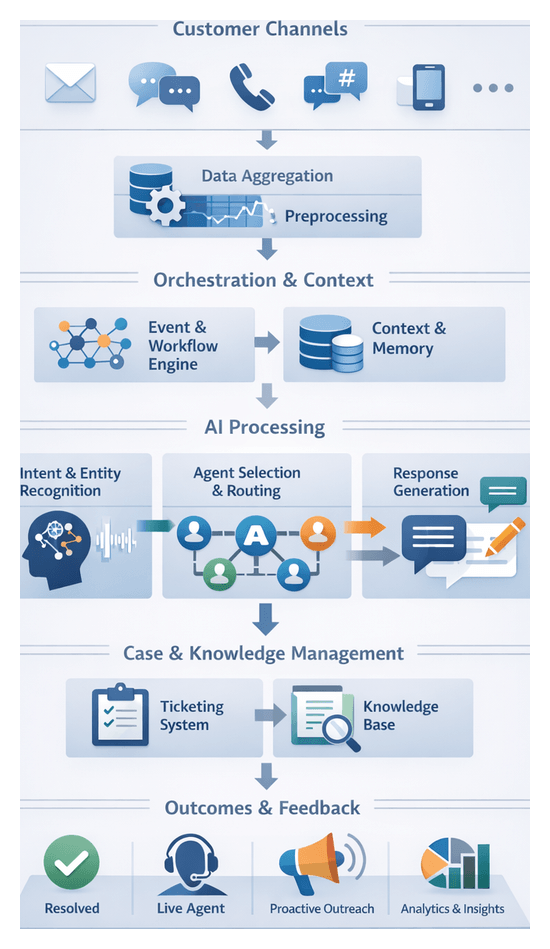
Channel Aggregation and Integration
Consolidating customer messages from email, web chat, voice, social media and mobile messaging into a unified stream establishes a single source of truth. Connectors to platforms such as Twilio and Amazon Connect capture raw payloads and metadata—customer identifiers, timestamps, channel type and session context—and normalize them into a common schema. Preprocessing modules perform channel classification, speech-to-text via services like Amazon Transcribe and Azure Speech Services, text normalization and markup sanitization. Early metadata enrichment—language detection, sentiment scoring and entity pre-tagging—reduces downstream latency and informs routing decisions. Secure API credentials, schema definitions and compliant network configurations ensure robust integration.
Orchestration and Workflow Management
The orchestration layer functions as a central control plane, coordinating message flows through AI microservices and business workflows. Event streaming platforms such as Apache Kafka or AWS EventBridge publish normalized messages to topics, while workflow engines like Camunda or Azure Logic Apps apply rules and invoke services in sequence. A context store—Redis or DynamoDB—maintains conversation history, entity values and escalation flags, enabling independent scaling of channel adapters and AI components.
Intent Detection and Entity Extraction
Unstructured text is transformed into structured intent labels and entities using NLP models from Google Cloud Natural Language, IBM Watson Assistant or transformer variants like BERT. Outputs include intent and confidence scores, extracted order IDs, dates or product names. Multilingual detectors and fallback flows handle low-confidence cases by prompting for clarification or escalating to live support.
AI Agent Selection and Routing
Rule engines evaluate intent confidence, entity completeness, customer segment and workload to assign inquiries to FAQ bots, transactional assistants or human teams. Predictive assignment models rank agents by expected resolution time. Real-time health monitoring and load balancing maintain service continuity, while assignment metadata records agent IDs and routing rationale for auditability.
Automated Response Generation
Natural language generation engines—such as OpenAI GPT models or Azure OpenAI Service—select templates, populate dynamic placeholders and refine phrasing to match brand tone and compliance guidelines. Validation modules scan for prohibited content, legal disclaimers and sentiment alignment. Responses support email, SMS, chat and voice via SSML, leveraging enrichment data to personalize replies and reduce resolution time.
Ticketing and Case Management Integration
When issues exceed automated scope, the workflow creates tickets in systems like ServiceNow or Zendesk. Tickets include transcripts, intent and sentiment data, customer profile attributes and priority assignments. Rule-based ownership recommendations, SLA breach predictions and bidirectional integrations ensure traceability and unified interaction history across automated and human channels.
Knowledge Base and Self-Service Enablement
Semantic search powered by Elasticsearch or Amazon Kendra retrieves relevant articles based on query embeddings. Continuous learning algorithms rank content by user feedback, while automated tagging enriches taxonomy. Self-service suggestions in portals and chat interfaces improve containment and reduce live-agent load.
Escalation and Live Agent Handoff
Triggers—low confidence, negative sentiment or explicit requests—initiate handoff to live agents. The orchestration layer compiles a context bundle with history, extracted entities, suggested articles and sentiment trajectories. NLG-based summaries prioritize key points, accelerating agent ramp-up. Fallback and retry logic handle unavailable agents, queue overflows and channel transitions.
Proactive Outreach and Engagement Automation
Automated campaigns for renewals, onboarding milestones or cart abandonment leverage predictive timing models and segmentation algorithms. NLG templates assemble personalized messages dispatched through preferred channels, while real-time engagement metrics feed back into models for continuous optimization.
Feedback Collection and Sentiment Analysis
Post-interaction surveys via email, chat or SMS solicit ratings and comments. Engines such as Google Cloud Natural Language and Azure Text Analytics assign sentiment scores and emotion categories. Topic modeling surfaces recurring issues, feeding dashboards and alerting systems to guide AI model improvements and knowledge base updates.
Performance Analytics and Continuous Improvement
Operational data—timestamps, intent and sentiment metrics, SLA compliance—feeds real-time dashboards. Anomaly detectors flag deviations, and drift detection algorithms on platforms like MLflow or Amazon SageMaker trigger automated retraining pipelines. Predictive analytics inform capacity planning, fostering an iterative cycle of insight-driven refinements.
Exception Handling and Edge Cases
Resilient AI orchestration anticipates malformed payloads, missing metadata, unexpected channels and service failures. Error categories invoke retry policies or route to human review queues. Data validation at ingestion, schema enforcement and dynamic enrichment mitigate missing customer identifiers or truncated transcripts. Transcript completion modules estimate missing segments, while metadata normalization infers language or geolocation when explicit attributes are absent.
- Channel-Specific Variations: Emoji normalization and slang expansion; attachment extraction with OCR and malware scanning for email; rapid-fire message batching for chat.
- Low-Confidence Handling: Clarification prompts, cross-validation across intent models and automatic ticket creation for persistently ambiguous queries.
- Service Degradation: Health checks, circuit breakers, exponential backoff and fallbacks to rule-based classifiers or human agents during latency spikes or outages.
- Compliance Edge Cases: GDPR and CCPA data deletion workflows, consent management, data masking and region-based routing for residency requirements.
- Industry Customization: Plugin-based hooks for HIPAA consent checks, fraud scoring in banking, scheduling in travel and manufacturing workflows.
- Schema Versioning: Centralized registry, adapter layers and feature flags to manage API contract changes without disrupting production.
- Scalability Variations: Autoscaling based on queue depth, rate limiting, priority queuing and graceful degradation of nonessential features under peak load.
- Manual Overrides: Secure debug endpoints, role-based controls and audit logging for real-time intervention in high-risk or VIP cases.
- Monitoring and Remediation: Multi-tier alerts, automated runbooks, integration with incident platforms such as PagerDuty and fallback workflows routing critical inquiries to live teams.
- Balancing AI and Human Touch: Dual-path workflows, customer-value–weighted handoff thresholds and transparent communication scripts to preserve empathy and trust.
AI Tools and Resources
Channel Connectivity and Integration
- Twilio: A cloud communications platform offering programmable APIs for voice, SMS, chat, and video.
- Amazon Connect: A cloud-based contact center service that provides AI-driven routing and omnichannel connectivity.
- Apache Kafka: An open-source distributed event streaming platform for high-throughput, fault-tolerant messaging.
- Amazon SQS: A fully managed message queuing service that decouples microservices and guarantees message delivery.
- Google Cloud Pub/Sub: A global messaging service for event ingestion and delivery at scale.
- RabbitMQ: An open-source message-broker implementing the AMQP protocol for reliable messaging.
Natural Language Understanding and Processing
- Amazon Lex: A service for building conversational interfaces using automatic speech recognition and natural language understanding.
- Google Dialogflow: A platform for designing and integrating conversational user interfaces with Google’s NLP.
- Microsoft Azure Text Analytics: A suite of APIs for sentiment analysis, key phrase extraction, and language detection.
- IBM Watson Assistant: An AI assistant service combining intent detection, entity extraction, and dialog orchestration.
- spaCy: An open-source Python library for advanced natural language processing.
- Rasa: An open-source framework for building contextual AI assistants with NLU and dialogue management.
- Google Cloud Natural Language API: A service for entity recognition, sentiment analysis, and syntax analysis.
- AWS Comprehend: A natural language processing service that uses machine learning to uncover insights and relationships in text.
- IBM Watson Tone Analyzer: An API for detecting emotional tones and social tendencies in text.
- IBM Watson Natural Language Understanding: A service for analyzing concepts, entities, sentiment, and emotion in text.
Knowledge Retrieval and Search
- Elasticsearch: A distributed search and analytics engine for structured and unstructured data.
- Amazon Kendra: An intelligent search service that uses machine learning to deliver relevant answers from unstructured content.
- Coveo: A SaaS platform for AI-powered search and recommendation across digital experiences.
- Pinecone: A managed vector database for similarity search and retrieval augmented generation.
Natural Language Generation
- OpenAI: A research organization providing GPT models for natural language generation and understanding.
- Microsoft Azure OpenAI Service: A managed service offering OpenAI models within the Azure security and compliance framework.
- Amazon Polly: A text-to-speech service that uses advanced deep learning to synthesize speech.
Monitoring, Observability, and Analytics
- Datadog: A monitoring and analytics platform for infrastructure, application performance, and logs.
- Splunk: A platform for searching, monitoring, and analyzing machine-generated big data.
- Prometheus: An open-source systems monitoring and alerting toolkit.
- Grafana: An open-source platform for interactive visualization and analytics.
Ticketing and Workflow Management
- ServiceNow: A cloud platform for IT service management and digital workflows.
- Zendesk: A customer service platform with ticketing, self-service, and engagement tools.
- Jira Service Management: A service desk and workflow management solution from Atlassian.
CRM and Customer Data Platforms
- Salesforce: A cloud-based CRM platform providing marketing, sales, and service automation.
- Segment: A customer data platform that collects, unifies, and routes customer event data.
- HubSpot: A CRM and marketing platform for inbound marketing, sales, and customer service.
Engagement and Outreach Automation
- Twilio Programmable Messaging: APIs for sending SMS, MMS, and chat messages.
- SendGrid: A cloud-based email delivery service for transactional and marketing communications.
- Mailchimp: An email marketing and automation platform.
MLOps and Model Management
- Kubeflow: A portable, scalable machine learning toolkit for Kubernetes deployments.
- MLflow: An open-source platform for managing the end-to-end machine learning lifecycle.
- TensorFlow Extended (TFX): A production-grade ML platform for data validation, transformation, training, and serving.
- Amazon SageMaker: A fully managed service for building, training, and deploying ML models at scale.
- Azure Machine Learning: A cloud service for accelerating ML model training and deployment pipelines.
- Google Vertex AI: A unified platform for building, deploying, and monitoring ML models.
Additional Context and Resources
- Orchestrating AI at Scale: Best practices for designing event-driven AI architectures.
- Building Conversational Experiences with Rasa: Comprehensive documentation and tutorials for open-source conversational AI.
- Designing Data-Intensive Applications: A reference on modern data architectures and integration patterns.
- ML Ops Principles and Practices: Strategies for production-grade machine learning operations.
The AugVation family of websites helps entrepreneurs, professionals, and teams apply AI in practical, real-world ways—through curated tools, proven workflows, and implementation-focused education. Explore the ecosystem below to find the right platform for your goals.
Ecosystem Directory
AugVation — The central hub for AI-enhanced digital products, guides, templates, and implementation toolkits.
Resource Link AI — A curated directory of AI tools, solution workflows, reviews, and practical learning resources.
Agent Link AI — AI agents and intelligent automation: orchestrated workflows, agent frameworks, and operational efficiency systems.
Business Link AI — AI for business strategy and operations: frameworks, use cases, and adoption guidance for leaders.
Content Link AI — AI-powered content creation and SEO: writing, publishing, multimedia, and scalable distribution workflows.
Design Link AI — AI for design and branding: creative tools, visual workflows, UX/UI acceleration, and design automation.
Developer Link AI — AI for builders: dev tools, APIs, frameworks, deployment strategies, and integration best practices.
Marketing Link AI — AI-driven marketing: automation, personalization, analytics, ad optimization, and performance growth.
Productivity Link AI — AI productivity systems: task efficiency, collaboration, knowledge workflows, and smarter daily execution.
Sales Link AI — AI for sales: lead generation, sales intelligence, conversation insights, CRM enhancement, and revenue optimization.
Want the fastest path? Start at AugVation to access the latest resources, then explore the rest of the ecosystem from there.