

The E Commerce Content Revolution AI Agents and Human Copywriters
To download this as a free PDF eBook and explore many others, please visit the AugVation webstore:
Introduction
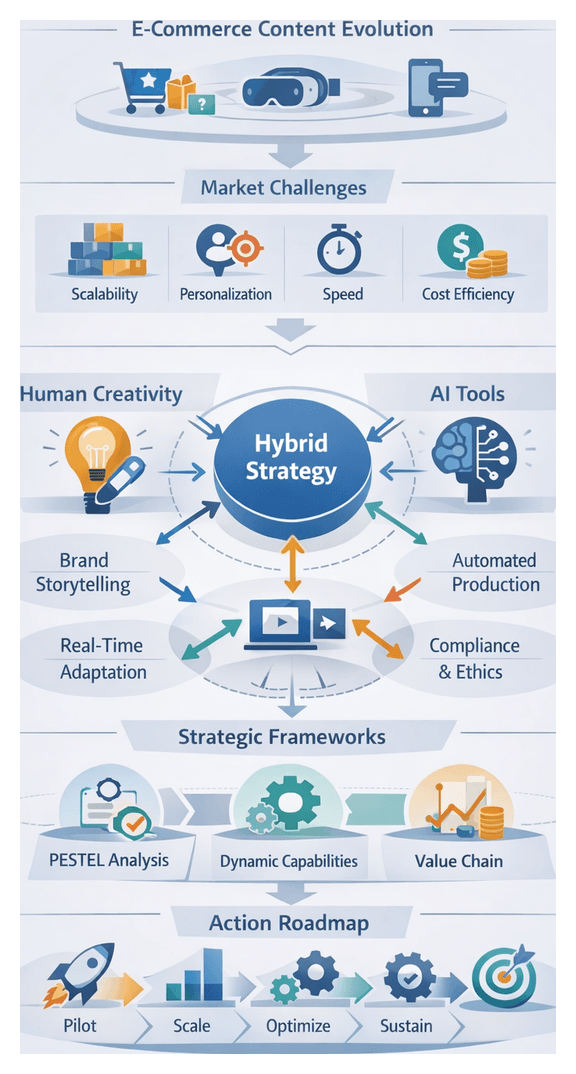
E-Commerce Content Evolution and Market Challenges
Over the past two decades, online retail content has transformed from static product listings into dynamic, multimedia-rich experiences. Early e-commerce sites offered minimal descriptive copy focused on size, color, and price. Today’s shoppers demand detailed specifications, high-resolution imagery, interactive features, and user-generated reviews. To meet these expectations, brands have invested in content management systems, digital asset libraries, and community-driven strategies that harness customer ratings, social media unboxings, and loyalty incentives.
The proliferation of marketplaces—Amazon, eBay—and social and mobile platforms has introduced diverse content guidelines, templates, and short-form formats. Voice commerce and AI-driven recommendation engines place a premium on metadata, structured content, and keyword optimization. At the same time, immersive technologies such as augmented reality and virtual reality enable virtual try-ons, 3D configurators, and experiential interactions that blend physical and digital realms.
As e-commerce barriers to entry have fallen, competitive pressures have intensified. Brands must differentiate through content that not only informs but also engages, inspires trust, and reflects unique value propositions. Leaders now treat content as a strategic asset, integral to customer acquisition, retention, and lifetime value. Poorly crafted or generic copy risks undermining conversion rates and brand reputation.
Organizations face four core challenges:
- Scalability: Producing consistent, high-quality content across thousands of SKUs and multiple channels.
- Personalization: Delivering tailored narratives and offers that resonate with diverse customer segments.
- Speed: Responding rapidly to market trends, promotions, and external events with up-to-date messaging.
- Cost Efficiency: Balancing investments in creative production with ROI objectives and budget constraints.
Meeting these demands requires robust governance, version control, and approval workflows. As brands expand globally, localization and transcreation become critical, demanding cultural nuance and linguistic accuracy at scale. Content operations must evolve into integrated centers of excellence that leverage cross-functional collaboration, strategic planning, and scalable technologies.
Balancing Human Creativity and AI Capabilities
Modern content strategies leverage both human talent and AI-driven tools to maximize quality, speed, and scalability. Human copywriters excel at brand storytelling, emotional resonance, and cultural nuance. Their ability to craft persuasive narratives, conduct in-depth research, and inject empathy ensures content aligns with audience psychographics and brand values.
AI agents, powered by large language models such as GPT-4, and specialized platforms like Jasper and Copy.ai, offer rapid draft generation, headline optimization, and bulk metadata production. SEO-centric tools like Surfer SEO integrate on-page analysis, keyword recommendations, and AI-assisted outlines to enhance search performance. Template-based systems automate repetitive writing tasks, while generative models produce novel copy that serves as a starting point for human refinement.
When mapped against quality, speed, and scalability:
- Human copywriters lead in originality, depth, and emotional engagement but lack rapid scalability for high-volume projects.
- Template-driven AI solutions excel in throughput and cost efficiency but can yield formulaic language and dilute brand voice.
- Generative AI agents strike a balance, offering varied linguistics and context awareness, yet require human oversight to ensure accuracy and alignment.
Effective deployment hinges on understanding domains of differentiation:
- Repetitive Production: Bulk product descriptions or metadata generation favor AI agents using template or model-based approaches.
- Brand Storytelling: Complex narratives, cultural subtext, and long-form content remain best handled by skilled writers.
- Real-Time Adaptation: Live events and social media engagements blend AI for rapid ideation with human review to maintain tone and appropriateness.
- Regulatory and Ethical Compliance: Human oversight is critical for nuanced legal requirements and bias mitigation.
A hybrid model, where AI produces first drafts, humans refine tone and context, and governance frameworks enforce consistency, unlocks the strengths of both modalities. Layered authorship, creative exchange loops, and quality calibration indices help organizations iteratively improve outputs and retrain AI agents on brand-specific corpora.
Urgency Drivers in Content Strategy
Several converging forces render modern content strategy an urgent priority for online retailers and brand marketers. Market saturation and global competition drive the cost of customer acquisition upward, narrowing the margin for error in messaging. Omnichannel complexity demands coherent storytelling across websites, marketplaces, email, social media, mobile apps, voice assistants, and emerging AR/VR channels.
Consumer expectations have evolved toward hyper-personalization and real-time relevance. Research indicates that over 80 percent of shoppers report higher satisfaction when content aligns with their preferences and context. Brands deploy analytics and personalization engines to deliver dynamic product recommendations and adaptive content experiences. Solutions like Surfer SEO enable teams to iterate on headlines, meta descriptions, and body copy based on search visibility and user behavior metrics.
Technological advancements in natural language processing and machine learning have accelerated adoption of AI-driven content platforms such as GPT-4, Jasper, and Copy.ai. Early adopters achieve time-to-market advantages, prompting peers to integrate AI before competitors establish irreversible leads. Operational constraints—budget limitations, lean teams, and long hiring cycles for skilled writers—compound the urgency to automate routine tasks while preserving brand integrity.
Strategic frameworks help interpret these drivers:
- PESTEL Analysis: Evaluates external Political, Economic, Social, Technological, Environmental, and Legal factors shaping content imperatives.
- Dynamic Capabilities Framework: Emphasizes sensing opportunities, seizing them through rapid resource reconfiguration, and transforming operations to sustain advantage.
- Value Chain Mapping: Identifies delays and quality gaps across content ideation, drafting, review, and distribution to target interventions.
Brands that convert urgency into disciplined action—through agile workflows, modular teams, and clear governance—distinguish themselves as proactive leaders rather than reactive players.
Key Strategic Insights and Roadmap
Leading organizations treat e-commerce content as a mission-critical asset that threads through every customer touchpoint. Five strategic insights underpin successful approaches:
- Content as Strategic Asset: Tailored omnichannel narratives drive acquisition, lifetime value, and brand equity.
- Complementarity of Human and AI Strengths: An integrated approach leverages human storytelling and AI efficiency.
- Data-Backed Decision Criteria: Quantitative benchmarks for quality, speed, and cost enable methodical selection of production methods.
- Governed Hybrid Workflows: Clear roles, approval gates, and feedback loops ensure consistency and accountability.
- Ethics and Compliance: Bias detection, plagiarism checks, and data-privacy protocols sustain trust and legal adherence.
Analytical frameworks guide comparative evaluation:
- Trade-Off Matrices: Plot quality, speed, and cost to locate optimal human, AI, or hybrid approaches.
- Capability Maturity Models: Assess infrastructure, talent, process, and governance readiness for AI adoption.
- Value Realization Curves: Map investment levels to business value to identify points of diminishing returns.
- Risk Assessment Frameworks: Evaluate legal, ethical, and brand risks associated with content production.
- Performance Dashboards: Track KPIs for human-authored and AI-generated content across channels to inform continuous optimization.
A phased roadmap enables structured adoption:
- Diagnostic Phase: Conduct content audits and capability assessments to identify priority channels and workflows.
- Pilot Phase: Test AI agents such as Jasper, and Copy.ai on targeted use cases, establish baselines, and refine feedback loops.
- Scale Phase: Roll out successful pilots across additional product lines, languages, and channels; formalize governance and style guides.
- Optimize Phase: Integrate real-time dashboards and attribution models to enhance personalization, SEO, and editorial workflows.
- Sustain and Evolve: Institutionalize continuous improvement through model retraining, governance reviews, upskilling, and monitoring of emerging AI innovations.
Critical questions for content leaders include: How do content objectives align with business goals? Which content types justify hybrid approaches? What governance ensures brand consistency without impeding agility? How will performance be measured and attributed? What ethical protocols manage IP, bias, and data privacy risks? Answering these questions lays the foundation for a resilient, future-ready content strategy that harnesses both human ingenuity and AI-driven efficiency.
Chapter 1: The E-Commerce Content Landscape
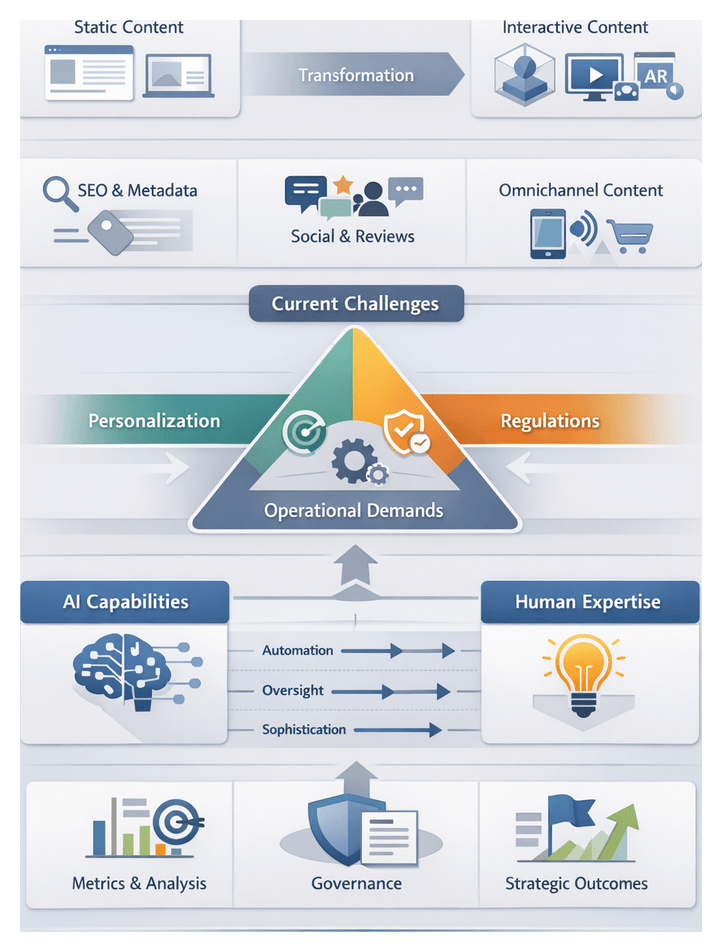
The Evolution and Current Challenges of E-Commerce Content
Over the past twenty years, online retail content has transformed from static HTML catalogs to highly dynamic, personalized ecosystems. Early e-commerce sites featured basic product listings with unadorned text and single still images. With the rise of search engine optimization, brands began embedding keywords and structured metadata into page templates, prompting the adoption of content management systems that automated repetitive tasks and enforced consistency. As content teams mastered SEO fundamentals, consumer expectations shifted toward richer experiences: embedded video demonstrations, interactive 3D models, and augmented reality previews that allow shoppers to visualize products in their own environments.
Social commerce added another dimension, making user-generated reviews, ratings, and shared images integral to decision-making. Platforms aggregated customer feedback alongside professional content, creating a feedback loop that informed product descriptions and marketing copy. Meanwhile, content workflows expanded to support multiple formats—mobile apps, voice assistants, email campaigns, social feeds and marketplaces—each with distinct technical specifications and audience needs.
Today’s challenges arise from this proliferation of channels and formats. Brands must deliver hyper-relevant experiences in real time, tailoring messaging to individual browsing histories, geographic locations, and demographic profiles. Legacy workflows based on batch creation and manual approval struggle to keep pace. New market entrants leverage lean operating models and AI-driven tools to spin up localized, targeted content at unprecedented speed, intensifying competitive pressures on established retailers to match agility without sacrificing brand integrity or regulatory compliance.
Regulatory frameworks add layers of complexity: accessibility standards, data privacy laws and disclosure requirements vary by region and channel. Content leaders must navigate legal risk while sustaining consistency across thousands of SKUs and digital touchpoints. Addressing these demands requires a strategic approach that balances speed, quality and governance, ensuring content teams remain both efficient and brand-centric.
Integrating AI and Human Creativity: Continuum and Analytical Frameworks
Creative Continuum Model
Organizations increasingly view content creation not as a binary choice between humans and machines but as a continuum defined by three core dimensions:
- Degree of Automation: The percentage of generative tasks handled by AI platforms versus human ideation and composition.
- Level of Oversight: The intensity of human editorial review necessary to align outputs with brand voice, tone and compliance standards.
- Algorithmic Sophistication: The complexity of underlying models, ranging from rule-based template engines to advanced large language models such as GPT-4.
By plotting each content initiative along this continuum, teams gain clarity on trade-offs among speed, cost, originality and emotional resonance, enabling data-driven decisions about where to allocate human expertise versus machine capacity.
Industry Interpretive Frameworks
Leading research firms provide frameworks to benchmark maturity and guide strategic roadmaps:
- Gartner’s Digital Content Maturity Model assesses AI adoption, data-driven personalization and governance protocols to categorize enterprises from “manual” to “autonomous.”
- Forrester’s Total Economic Impact Studies quantify financial and operational returns of AI augmentation versus fully human workflows, offering ROI benchmarks for technology investments.
These interpretive constructs help organizations evaluate readiness, identify capability gaps, and map technology procurement and talent investments against best practices and competitor performance.
Metrics for Assessing Contributions
Comprehensive evaluation combines objective performance indicators with subjective quality assessments:
Objective Metrics
- Engagement Rates: Click-through rates, time on page and bounce rate differentials for AI-generated versus human-written content.
- Conversion Performance: Sales lift, cart addition rates and email open-click data linked to specific content variants.
- Efficiency Measures: Throughput statistics such as words per hour, cost per asset and average turnaround time.
Subjective Quality Indicators
- Brand Consistency: Degree of alignment with style guides, brand voice documents and tone matrices.
- Emotional Resonance: Ability to evoke targeted audience responses, measured through sentiment analysis and focus-group feedback.
- Originality and Creativity: Novel narrative structures, use of metaphor or persuasive devices assessed by editorial panels.
Best practice involves paired evaluation methods—automated A/B testing for scale and qualitative editorial reviews for nuance—ensuring a holistic view of content effectiveness.
Authenticity and Theoretical Perspectives
- Pure Authenticity: Emphasizes 100% human authorship as the sole guarantor of genuine brand voice.
- Contextual Authenticity: Asserts that AI can emulate brand tone when trained on proprietary data and governed by rigorous guidelines.
- Hybrid Authenticity: Advocates co-creative workflows where AI drafts baseline copy and human editors refine for nuance and emotional depth.
Two principal theories frame the human-AI relationship: Augmentation Theory positions AI as an assistive technology that frees humans from routine tasks, amplifying creativity on high-value outputs. Substitution Theory applies cost-benefit analysis to determine when machine-only production meets quality thresholds for low-risk content such as standard product descriptions or routine email templates. Most e-commerce brands adopt hybrid models, deploying substitution for high-volume assets and reserving human writers for strategic narratives that drive brand differentiation.
Governance and Ethical Considerations
Robust governance frameworks address accountability, transparency and intellectual property:
- Accountability Models: Define editorial ownership and escalation paths for errors or compliance breaches in AI outputs.
- Transparency Protocols: Recommend labeling or disclosure of machine-generated content to maintain consumer trust and regulatory compliance.
- IP Ownership Structures: Clarify licensing terms for AI-trained models and reuse rights for generated assets across campaigns.
With emerging regulations in Europe and North America codifying definitions of authorship and liability, content leaders must embed these interpretive frameworks into editorial pipelines to manage legal exposure and uphold brand integrity.
Drivers of Urgency in Modern Content Strategy
Market Pressures and Evolving Expectations
Today’s consumers demand seamless, personalized experiences across every digital touchpoint. Legacy batch-creation models fail to satisfy real-time relevance. Key market pressures include:
- Hyper-Personalization: Shoppers expect product pages, emails and social feeds tailored to their real-time browsing behavior, purchase history and geographic context.
- Omnichannel Consistency: Inconsistent tone or contradictory information across web, mobile, marketplaces and chatbots undermines credibility and conversion.
- Attention Economy: With shrinking attention spans, content must convey core value propositions in seconds, favoring concise, benefit-driven messaging over lengthy narratives.
- Purpose-Driven Brand Values: Ethical sourcing, sustainability and cultural relevance influence purchase decisions, requiring content that authentically communicates brand commitments.
Technological Breakthroughs and Innovation Cycles
Advances in machine learning, natural language processing and data analytics have accelerated AI development and lowered barriers to adoption:
- Rapid Model Releases: AI model updates have moved from annual to quarterly cadences, making continuous experimentation essential to stay ahead.
- Multimedia Generation: Generative AI now supports image creation, video scripts and interactive experiences alongside text, compelling content teams to integrate new modalities.
- Content Intelligence Platforms: Tools like Jasper, Copy.ai and Surfer SEO specialize in headlines, product descriptions and search optimization, offering plug-and-play capabilities for rapid scaling.
- Real-Time Analytics Integration: Automated A/B testing and performance dashboards feed results back into generative engines, enabling closed-loop optimization of copy and creative assets.
Operational Agility and Resource Constraints
Volume surges from seasonal promotions, flash sales and rapid product launches create peaks that overburden manual workflows. Additional operational drivers include:
- Talent Scarcity: Skilled copywriters with brand sensitivity and domain expertise are limited, making reliance on human talent a capacity risk.
- Distributed Teams: Global brands coordinate across time zones, necessitating standardized protocols and automated handoffs to avoid delays.
- Cost Containment: Budget pressures demand a precise balance between the high per-word cost of expert writers and the efficiency gains of AI agents.
- Process Bottlenecks: Manual review and approval stages often create single-point chokeholds that slow time-to-market.
Competitive Dynamics and Differentiation
Content has become a principal vector for competitive advantage. Brands that iterate rapidly on emerging trends, cultural moments and search algorithm changes secure disproportionate share of voice. Critical factors include:
- First-Mover Advantage: Swiftly adapted content around viral phenomena or product launches captures audience attention and market momentum.
- Search Volatility: Frequent updates to marketplace and search engine ranking criteria require real-time content adjustments to maintain visibility.
- Peer Benchmarking: Competitive intelligence platforms expose gaps in tone, messaging and engagement, pushing brands to refine content strategies continuously.
- Platform Dependencies: Adhering to evolving metadata and format requirements on social and affiliate channels is essential for campaign effectiveness.
Regulatory and Ethical Imperatives
As AI content scales, governance concerns intensify:
- Intellectual Property Risk: AI engines trained on public and proprietary data may inadvertently reproduce copyrighted text, necessitating output audits.
- Algorithmic Bias: Unvetted language models can perpetuate stereotypes or insensitive messaging, requiring guardrails and bias-detection protocols.
- Data Privacy Compliance: Personalization engines must adhere to GDPR, CCPA and other privacy regulations, with robust consent-management and anonymization measures.
- Disclosure Requirements: Emerging statutes may mandate clear labeling of AI-generated content, prompting changes in editorial workflows.
Strategic Implications for Content Operations
The convergence of market demands, technological advances, operational constraints and governance obligations compels a fundamental reassessment of content strategy. Leaders must:
- Adopt Hybrid Production Models: Leverage AI for data-driven, high-volume assets while reserving human writers for brand storytelling, compliance copy and emotionally resonant narratives.
- Establish Cross-Functional Councils: Align marketing, legal, IT and data science teams around unified taxonomies, quality grading systems and escalation procedures for content edge cases.
- Orchestrate Content Across Touchpoints: Define a core brand narrative, build reusable modules (feature badges, testimonials, comparison tables) and distribute assets via headless CMS or API architectures for real-time personalization.
- Implement Governance Frameworks: Integrate content moderation platforms, bias-detection tools and IP audit routines. Assign clear editorial accountability and maintain transparency protocols for machine-generated outputs.
- Embed Continuous Learning: Create closed-loop feedback mechanisms that feed performance data into human training programs and AI model fine-tuning, driving perpetual improvement.
- Balance Speed with Brand Integrity: Define clear role responsibilities, approval workflows and style guidelines to ensure rapid iteration does not compromise brand voice or consumer trust.
Essential Takeaways for Future Content Strategies
- Consumer-First Mindset: Anchor every content decision in validated user research, behavioral analytics and ongoing audience feedback.
- Modular Design Philosophy: Construct content as reusable components to accelerate production, simplify localization and maintain consistency.
- Balanced Resource Allocation: Invest judiciously in human talent and AI capabilities based on quality requirements, volume forecasts and cost-benefit analyses.
- Robust Governance and Quality Control: Institute clear approval processes, style guides, audit routines and transparency measures to safeguard brand integrity and legal compliance.
- Continuous Measurement and Optimization: Employ quantitative metrics (A/B testing, conversion lift) alongside qualitative assessments (editorial reviews, sentiment analysis) to inform iterative refinements.
- Adaptive Strategic Roadmapping: Regularly revisit and update the content strategy to align with emerging platforms, evolving consumer behaviors and technological innovations.
By harmonizing human creativity with AI efficiency, orchestrating content across channels and embedding rigorous governance, e-commerce brands can build scalable, coherent and compelling content ecosystems. This systemic approach equips organizations to meet current market demands and to shape the future of digital retail experiences.
Chapter 2: Human Copywriting Principles and Practices
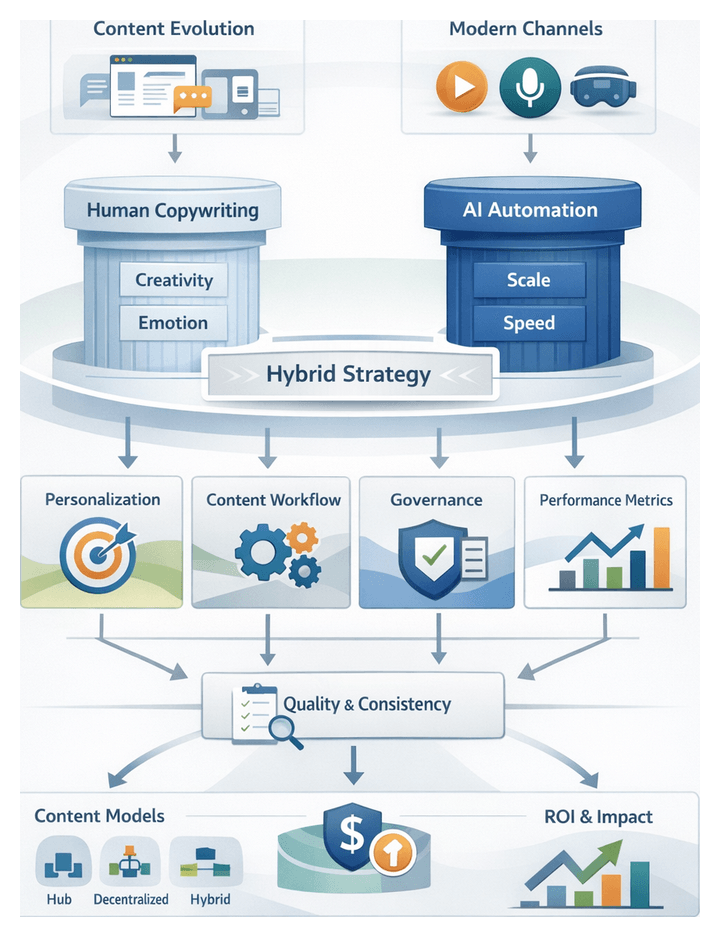
E-Commerce Content Evolution and Contemporary Challenges
Over the past two decades, online retail content has transformed from static digital catalogs into a dynamic, multi-channel ecosystem. Early e-commerce sites featured brief product specifications and pricing information, with teams optimizing for keyword density rather than narrative clarity. As social media and mobile devices proliferated, consumer expectations shifted toward richer storytelling, interactive experiences, and cohesive brand narratives that spanned web, email, social, and emerging commerce channels such as shoppable video, voice assistants, and augmented reality.
Advancements in data analytics and artificial intelligence enabled personalization at scale: real-time behavior data now drives dynamic landing pages, tailored product recommendations, and automated email sequences. Yet brands struggle to produce high-quality, on-brand content across fragmented teams and legacy systems. Silos between product descriptions, email campaigns, social media, and paid advertising slow iteration and dilute narrative integrity. Content leaders must balance agility with strategic consistency, optimize resource allocation, and maintain relevance amid shifting consumer preferences and platform algorithms.
Framing Human and AI Roles in Content Creation
Human writers bring deep domain knowledge, emotional intelligence, and strategic storytelling. They infuse brand personality into each sentence, anticipate audience pain points, and craft persuasive narratives that build trust over time. AI agents leverage natural language processing and machine learning to generate coherent drafts for product descriptions, promotional emails, and social media posts in seconds. Template-driven workflows, keyword optimization engines, and tone customization settings unlock rapid iteration on multiple variants, subject lines, and landing-page copy.
Neither method universally outperforms the other. Human authors excel at empathy-driven storytelling and aligning copy with strategic objectives. AI agents deliver consistency, scale, and rapid turnaround, freeing teams for high-impact creative work. The strategic imperative is to define performance expectations for each contributor and determine when to rely on human ingenuity versus automation for routine or high-volume tasks.
Narrative Strengths of Human Copywriting
Human narratives achieve emotional resonance, persuasive coherence, and brand authenticity in ways that automated systems cannot fully replicate. Practitioners assess human-authored content through interpretive frameworks that benchmark performance and guide refinement.
Emotional Connection and Empathy
Writers leverage personal insights, anecdotal references, and cultural cues to evoke specific feelings—joy, aspiration, or reassurance. Empathy-driven stories foster trust by reflecting lived experiences and aligning with audience values. Qualitative feedback channels such as focus groups, sentiment analysis, and ethnographic studies measure the depth of emotional engagement.
Cognitive Engagement and Persuasive Coherence
Human storytellers construct logical flows of ideas using rhetorical devices—analogies, metaphors, repetition—that guide readers toward a desired call to action. Frameworks like the rhetorical triangle (ethos, pathos, logos) and narrative structure evaluation (exposition, conflict, climax, resolution) assess how well narratives support persuasion goals without losing reader attention.
Brand Voice Authenticity and Cultural Resonance
Maintaining a consistent brand voice requires familiarity with a brand’s values, heritage, and personality. Writers internalize guidelines and infuse content with tones aligned with brand archetypes—such as the Explorer, Hero, or Caregiver—to ensure cultural resonance and differentiation. Iterative editorial processes and workshops verify that copy reflects core brand attributes across channels.
Adaptive Creativity and Contextual Sensitivity
Human writers pivot narratives in response to trends, events, or social issues, integrating timely references with sensitivity. They modulate tone—from formal to conversational—based on platform, audience segment, or campaign objectives. Social listening analytics and perception surveys reveal how these adjustments influence consumer sentiment in real time.
Limitations of Human-Generated Content
While human narratives excel qualitatively, scaling bespoke content presents operational and financial constraints.
- Scalability and Throughput Constraints: High-volume demands—large product catalogs or rapid campaign cadences—can overwhelm writers, leading to bottlenecks, creative burnout, and delayed time-to-market.
- Consistency and Quality Variability: Distributed teams introduce variation in tone and structure. Even with detailed style guides, multi-stage editing, peer reviews, and compliance checks are required to reconcile deviations and maintain brand integrity.
- Time and Cost Implications: Human-centric workflows involve briefing, research, drafting, revisions, and approvals. When narrative complexity increases, project timelines can extend by weeks and budgets strain under the weight of senior writer rates and editorial overhead.
- Subjectivity and Potential Bias: Writers’ perspectives and unconscious biases can shape word choice and framing. Diversity in writing teams, bias-training workshops, and content bias audits help mitigate risks, but residual slants may affect resonance with diverse audiences.
Strategic Imperative for Human-Centric Personalization
In a market saturated with templated messages, authentic human personalization differentiates brands. Skilled copywriters craft bespoke narratives that foster emotional resonance and reinforce brand equity. While AI excels at volume and consistency, the nuanced judgment and cognitive empathy of human authors ensure that each touchpoint reflects the brand’s voice and values.
Organizational Models for Scaling Human Writing
Three prevalent frameworks guide content operations:
- Center-led Content Hub: A centralized team of senior writers, strategists, and editors sets guidelines and quality standards, then distributes briefs to regional or product units.
- Decentralized Specialist Units: Copywriting experts embedded within product or regional teams maintain autonomy over tone while adhering to global frameworks.
- Matrixed Hybrid Model: Central governance through brand guardians and style councils combines with decentralized execution by specialist writers collaborating with marketing and product teams.
Clear role definitions—content strategist, brand voice custodian, performance editor—align responsibilities. Continuous training in narrative theory, persuasive psychology, and cross-functional collaboration with UX research and legal review embed personalization at every customer–journey phase.
Economic Value of Human-Driven Content
Justifying investment in human talent requires cost-benefit analysis that links creative outputs to business outcomes.
- Cost per Content Unit: Benchmarking the investment to produce personalized assets—landing pages, email series, product descriptions—against incremental revenue generated.
- Return on Brand Equity: Qualitative assessments of perception and loyalty through surveys and sentiment analysis.
- Customer Retention Uplift: Measuring the impact of personalized narratives on repeat purchase rates, subscription renewals, and cross-sell performance.
Contextual Applications for Human-Centric Copy
Human-authored personalization delivers the greatest uplift in scenarios that demand authenticity, complexity, or nuanced expression:
- Luxury and High-Involvement Categories—Conveying craftsmanship, heritage, and emotional value requires narrative richness.
- B2B and Technical Solutions—Translating complex specifications into compelling business outcomes demands expert storytelling.
- Multilingual and Multicultural Campaigns—Localization experts ensure resonance across linguistic and cultural contexts.
- Omnichannel Storytelling—Coordinating long-form content, blog series, and immersive experiences to maintain narrative arcs.
Analytical Frameworks and Governance for Human Creativity
Frameworks guide evaluation, governance, and deployment of human-driven content:
- Rhetorical Triangle Analysis (Ethos, Pathos, Logos): Balances credibility, emotional appeal, and logical argumentation.
- Freytag’s Pyramid: Ensures clarity of exposition, tension, climax, and resolution in narrative arcs.
- Brand Archetype Alignment: Maps tone and themes to archetypes to verify cultural resonance and brand consistency.
- Personalization Maturity Continuum: Defines stages from basic segmentation to predictive individualization.
- Governance and Quality Assurance Matrix: Assigns oversight levels based on content risk and strategic value.
These lenses help organizations allocate human resources effectively, introduce supporting technologies where appropriate, and measure strategic impact through engagement, conversion, and brand health metrics.
Balancing Human Effort and AI Augmentation
AI agents serve as draft assistants, research aggregators, and variant generators that accelerate output and free human writers for high-order creative work. A hybrid model positions human copywriters as strategic architects who refine AI-produced drafts, inject brand nuance, and verify ethical alignment. By delegating repetitive or data-driven tasks to AI, organizations optimize budgets and accelerate time to market without sacrificing authenticity.
Critical Considerations and Future Directions
Content leaders should address key questions when investing in human writing:
- Which assets demand deep emotional or cultural resonance requiring skilled writers?
- How can governance balance creative freedom with consistency and compliance?
- At what point does additional human resource allocation yield diminishing returns versus hybrid approaches?
- Which metrics will demonstrate the impact of human versus AI-assisted copy on brand equity and commercial outcomes?
- How can teams mitigate cognitive bias and ensure diversity of thought?
- Which training programs will sustain writers’ skills amid evolving trends and technologies?
Human creativity cannot scale indefinitely. Editorial rigor, governance frameworks, and selective automation are essential to maintain narrative quality and operational agility. Ongoing research into hybrid creative models, advanced governance protocols, and predictive performance analytics will refine the balance between human ingenuity and technology, ensuring that e-commerce content operations deliver measurable business impact in a rapidly changing landscape.
Chapter 3: AI Agents in Content Creation
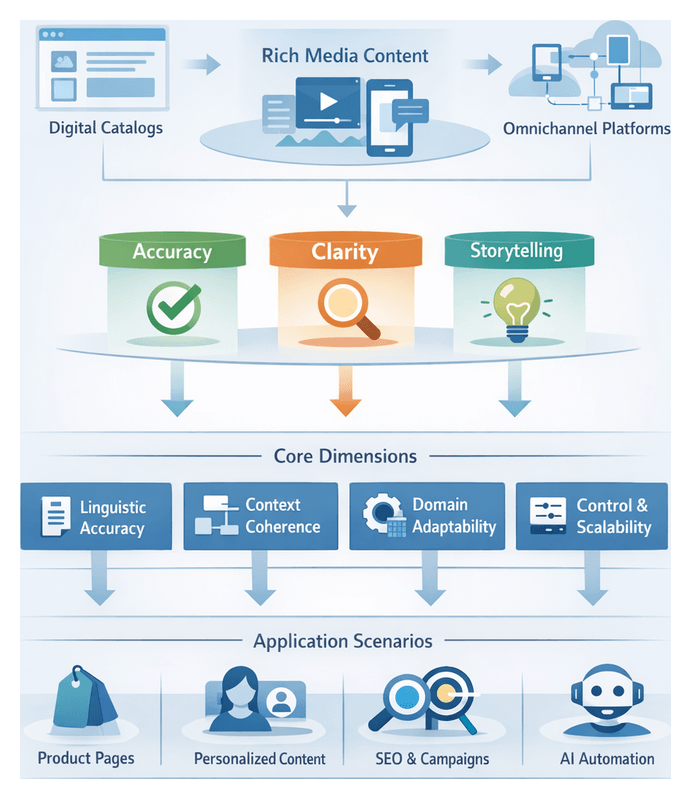
Evolution of E-commerce Content
Early online retail content functioned as digital catalogs, featuring simple product names, prices and static images. As content management systems matured in the mid-2000s, retailers began bulk uploading product details, adding multiple image galleries, editorial blogs and customer reviews. This shift revealed that compelling narratives could improve search rankings, differentiate products and build brand affinity. The mobile commerce wave of the early 2010s introduced responsive layouts and rich media—video demonstrations, interactive lookbooks and slideshows—transforming product pages into immersive experiences.
Throughout these stages, three constants emerged: accuracy, clarity and storytelling. Accuracy ensures customers understand exactly what they purchase. Clarity streamlines decision-making, reducing cart abandonment. Storytelling creates emotional connections, elevates perception and justifies premium pricing. At the same time, consumer expectations evolved: modern shoppers demand comprehensive specifications, high-resolution images and videos, user reviews, educational content and personalized recommendations based on browsing history and demographics. Yet too much information risks overload if content is inconsistent, outdated or irrelevant.
Today’s content landscape is fragmented across marketplaces, social media, mobile apps, live streaming and augmented/virtual reality, each with unique format and style requirements. Concurrently, competitive pressures—price transparency, speed to market and personalization at scale—force brands to choose among in-house studios, agency partnerships or automated platforms. Human writers excel at nuance and cultural resonance but struggle with scale; AI agents offer speed and uniformity but require governance frameworks to maintain authenticity and strategic alignment.
Performance Dimensions of AI-driven Content Generation
Industry leaders evaluate AI-driven language models along four core dimensions:
- Linguistic Accuracy—grammatical correctness, factual validity and compliance with product specifications
- Contextual Coherence—topic consistency, logical flow and correct referencing across paragraphs
- Domain Adaptability—use of vertical-specific terminology, brand voice nuances and specialized knowledge
- Controllability—the ability to steer tone, structure and length via prompts, templates or fine-tuning
Reliability and consistency are assessed through sampling methodologies, human scoring against style guides and statistical process control to detect drift. Contextual understanding for long-form content—detailed product reviews, gift guides and campaign landing pages—relies on models supporting extended context windows such as OpenAI’s GPT-4, Anthropic’s Claude, Google’s PaLM 2 and Meta’s Llama 2, which exceed 8,000 tokens.
Balancing creativity and consistency involves metrics like lexical diversity and novelty scores. Outputs span formulaic templates to free-form narratives; formulaic approaches suit high-volume product catalogs, while free-form descriptions enhance awareness campaigns. Continuous feedback loops correlate style variations with click-through rates and time on page, informing prompt guidelines and model temperature settings.
Scalability and response timelines are measured by latency (round-trip time from prompt to output) and throughput (requests per minute). Cloud-based inference for GPT-4 and Cohere’s Command R advertise sub-second latencies for short prompts, though performance may degrade under heavy loads or extended contexts. Enterprises conduct stress tests, track percentile metrics (p50, p90, p99) and evaluate cost per token against human writer benchmarks—average words per hour, ramp-up times and quality assurance cycles—to determine break-even points.
To navigate a proliferating model ecosystem, practitioners develop custom benchmarks reflecting attribute extraction accuracy, regulatory compliance and brand voice alignment. Proprietary evaluation suites combine automated validators—spell-check, consistency checks—with human-in-the-loop ratings. Dashboards visualize performance trends, enabling continuous re-evaluation of model capabilities, total cost of ownership and strategic fit for global, multilingual or highly personalized content requirements.
Application Scenarios for AI Agents
- Bulk Product Description Generation—AI agents like Jasper and Copy.ai draft SEO-optimized descriptions at scale, reserving human editors for nuance and premium SKUs.
- Rapid Campaign Ideation—GPT-4 generates headline options and promotional concepts in seconds, accelerating A/B testing and creative iteration.
- Personalized Email Messaging—Platforms ingest CRM data to auto-generate hundreds of email variants, with human audits ensuring tone consistency, cultural sensitivity and regulatory compliance.
- Multilingual Content Expansion—Machine translation augmented by generative AI accelerates localization, followed by post-editing workflows to preserve idiomatic accuracy and brand terminology.
- SEO-Driven Content Structuring—AI collaborates with keyword research tools such as Surfer SEO to propose outlines, headings and meta descriptions aligned to search intent.
- Real-Time Dynamic Landing Pages—Platforms modify copy in response to user behavior—geolocation, referral source or on-site interactions—supporting continuous A/B testing and measuring adaptation velocity.
- Social Media and Microcontent—Agents suggest platform-optimized captions, hashtags and micro-stories for Instagram, TikTok and X, balancing content velocity with authenticity through spot checks.
- Conversational Interfaces—Chatbots powered by GPT-4 craft natural dialogue and product recommendations under guardrails that define escalation thresholds and prevent hallucinations.
Across these scenarios, AI enhances operational agility, amplifies throughput and frees human talent for high-impact activities—strategic planning, creative storytelling and complex reviews. Robust governance frameworks combine automated validations with human oversight to safeguard quality, brand integrity and regulatory compliance.
Key Considerations and Governance for AI Integration
Despite advanced fluency, AI outputs remain fallible. Variability in prompt design, fine-tuning, temperature settings and model updates demands systematic benchmarking against brand standards and customer perception metrics. Narrative coherence and voice alignment require frameworks such as narrative arc models and voice consistency matrices to audit AI drafts.
Hallucinations pose risks when models generate plausible but incorrect product details, pricing or availability. Mitigations include automated fact checking, domain-specific knowledge bases and layered human review. Ethical and bias considerations are addressed through bias-detection frameworks—impact matrices and representational rubrics—to identify stereotypes and ensure cultural sensitivity.
Scaling content volume can compromise granular quality control; the quality-quantity curve highlights diminishing returns beyond an optimal throughput. Model drift—performance degradation due to evolving language norms, product changes or shifting consumer preferences—requires continuous monitoring, periodic retraining and fine-tuning to maintain relevancy and SEO effectiveness.
Effective AI integration embeds agents within existing content workflows and governance structures. Organizational maturity models assess readiness across people, processes and technology, defining decision rights, approval pathways and escalation protocols. Privacy regulations (GDPR, CCPA) mandate Data Protection Impact Assessments for AI-driven personalization, ensuring data usage aligns with consumer consent and retention policies.
Total Cost of Ownership analyses encompass subscription fees, compute infrastructure, maintenance and human oversight. Comparative cost models account for error remediation rates, QA efforts and potential gains from personalization. Successful AI adoption demands cross-functional teams with expertise in prompt engineering, model evaluation and AI ethics, supported by targeted upskilling initiatives.
Evaluative metrics extend traditional KPIs—click-through rates and conversion ratios—with qualitative ratings for brand alignment and narrative coherence. Blind A/B testing benchmarks AI outputs against human work over time. Human-in-the-loop frameworks calibrate oversight based on risk profiles and content complexity, ensuring mission-critical assets meet rigorous standards.
Localization benefits from AI-drafted translations followed by cultural review; QA matrices track linguistic accuracy, cultural appropriateness and regulatory compliance across markets. Real-time adaptation workflows must account for latency constraints—using queuing models to balance batching and pre-generation strategies against go-to-market timelines.
Explainable AI tools—attribution heatmaps, token-level influence scores and audit logs—enhance transparency, supporting accountability in regulated industries. Continuous feedback loops integrate performance data, editorial ratings and error logs into training pipelines with version control and rollback protocols, ensuring iterative improvements without unintended regressions.
Vendor lock-in risks are mitigated through ecosystem analyses of interoperability, API compatibility and exit strategies, with contracts specifying data portability, model export rights and indemnification clauses. Intellectual property policies clarify content ownership, usage rights and copyright considerations for AI-generated outputs. Emerging regulations, such as the EU AI Act, introduce classification systems and disclosure requirements, prompting content leaders to monitor standards for provenance labeling and age-appropriate design.
Looking ahead, the convergence of natural language generation with image synthesis, voice interfaces and virtual reality will demand integrated governance and consistency frameworks. Early pilot programs should anticipate multimodal orchestration, ensuring cohesive omnichannel storytelling as future capabilities emerge.
Chapter 4: Comparative Analysis of Quality, Speed, and Cost
E-Commerce Content Evolution and Market Challenges
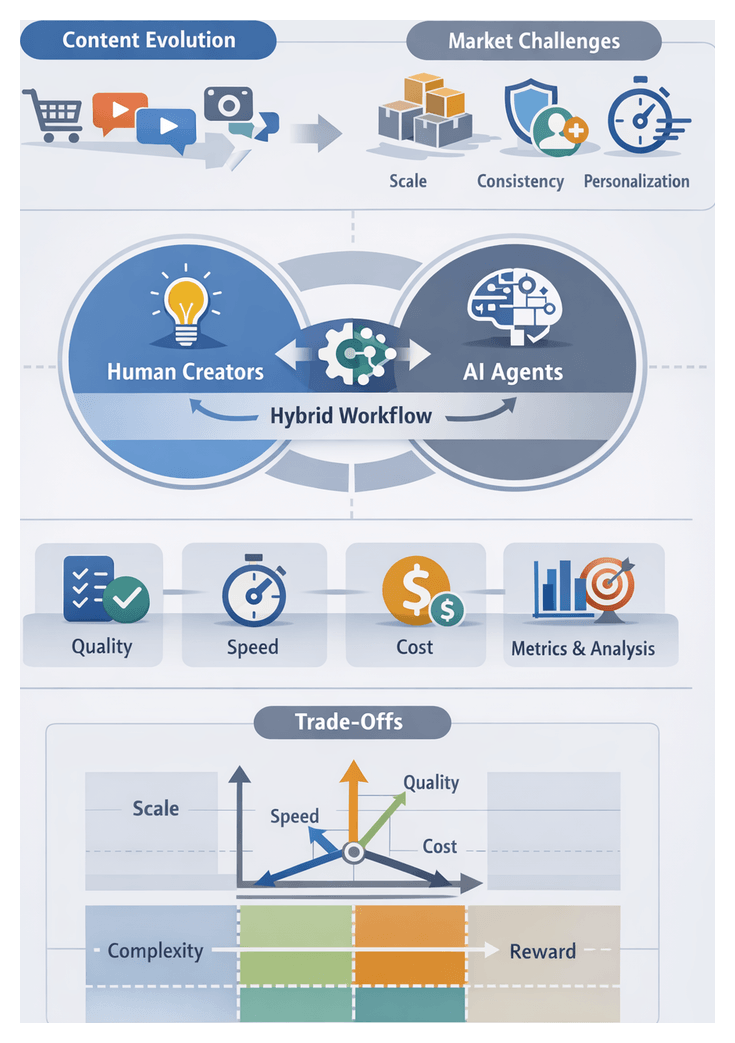
Online retail content has advanced from simple product specifications and low-resolution images in the early 2000s to rich, multimedia experiences that blend narrative, lifestyle photography and user-generated testimonials. Social commerce platforms such as Instagram and TikTok transformed how brands engage customers, integrating shoppable posts, influencer partnerships and interactive videos. Marketplaces and direct-to-consumer sites now demand coherent storytelling, tailored messaging and timely updates across websites, mobile apps, email campaigns and partner channels. Managing vast product catalogs in multiple regions exposes content teams to intense pressures for scale, consistency and speed.
- Scalability: Delivering thousands of localized product pages or campaign assets under tight deadlines.
- Consistency: Upholding brand tone and style across diverse channels and audiences.
- Personalization: Crafting individualized recommendations and messaging based on real-time data.
- Speed to Market: Responding to seasonal trends, flash promotions or competitor moves without manual delays.
- Resource Constraints: Balancing quality expectations with budgetary and talent limitations.
These challenges reveal why traditional copywriting alone strains under modern e-commerce demands and why hybrid models that combine human creativity with AI-driven efficiencies have become strategic imperatives.
Human-AI Collaboration in Content Production
Human writers bring empathy, cultural insight and narrative skill, ensuring brand stories resonate emotionally and authentically. They excel at humor, nuanced storytelling and conveying complex values. However, manual workflows can be resource-intensive and may struggle to meet sudden volume spikes.
AI agents powered by large language models offer speed and cost advantages. Platforms can automate bulk product descriptions, while solutions built on GPT-4 generate email subject lines, A/B test variants and template-driven copy in seconds. Tools such as Jasper, Copy.ai and Surfer SEO integrate SEO optimization, brand guidelines and performance analytics into automated drafts.
Despite rapid generation of error-free content, AI outputs often require human oversight to ensure contextual accuracy, preserve brand alignment and inject creative flair. Understanding the complementary strengths of humans and machines is critical to designing workflows that leverage AI efficiency without sacrificing narrative quality.
Analytical Frameworks and Performance Metrics
Content leaders rely on established analytical frameworks to compare human and AI outputs. Advisory benchmarks like the Forrester Total Economic Impact model examine cost savings, productivity gains and risk exposure, while Gartner’s Critical Capabilities evaluation scores coherence, brand alignment, scalability and error rates. Many organizations adapt the balanced scorecard approach to track performance across financial impact, customer satisfaction, internal process efficiency and learning and growth. This holistic view prevents overemphasis on a single metric such as cost per word.
Quality Metrics
- Accuracy: Factual correctness, compliance with specifications and avoidance of misinformation.
- Brand Voice Consistency: Adherence to style guides, tone modulation and personality preservation.
- Emotional Resonance: Ability to evoke trust, loyalty and desired sentiments.
- Readability and Clarity: Sentence simplicity, information hierarchy and comprehension rates.
- Engagement Indicators: Time on page, scroll depth, click-through rates and shares.
Weighted scoring models align these metrics with strategic priorities. Luxury brands may prioritize emotional resonance, while high-volume marketplaces emphasize consistency and speed.
Speed and Throughput
AI systems such as OpenAI‘s GPT models can draft hundreds of descriptions in minutes, but true operational velocity depends on post-generation review. Organizations distinguish between gross output rates—volume of raw content per hour—and net publish-ready rates, which factor in editorial revisions, fact-checking and compliance reviews. This dual metric approach clarifies end-to-end cycle times and informs decisions on when AI alone is sufficient versus when human intervention is indispensable.
Cost Analysis
A Total Cost of Ownership perspective captures direct and indirect expenditures across the content lifecycle. Direct costs include writer fees, editorial labor and AI platform subscriptions. Indirect costs cover training, governance overhead and rework due to inaccuracies.
- Acquisition Costs: Tool implementation, recruitment and system integration.
- Operational Costs: Ongoing subscriptions, writer compensation and compute expenses.
- Risk-Related Costs: Potential revenue losses from brand misalignment, legal liabilities and reputational damage.
Allocating budget lines to each tier exposes hidden cost drivers and prevents underestimating the overhead of AI oversight.
Trade-Off Matrix
Many teams use a three-axis matrix plotting quality, speed and cost. High-stakes brand narratives occupy the human-centric quadrant, while bulk listings and metadata generation suit AI-centric methods. Hybrid workflows sit in the center, enabling dynamic calibration of machine drafting and human refinement based on project profiles.
Emerging Analytics Trends
Content teams increasingly integrate AI-driven performance analytics. Tools like Surfer SEO and custom sentiment-analysis engines feed real-time dashboards that correlate content attributes with engagement metrics. Predictive models flag issues such as repetitive phrasing or voice drift before publication, guiding preemptive human edits. This predictive analytics layer represents the next frontier in balancing quality, speed and cost.
Optimal Use Cases for Content Methods
Mapping content types along dimensions of scale, complexity, risk and reward guides modality selection. Leaders deploy AI, human writers or hybrid workflows where each approach delivers maximum value.
Transactional and Bulk Descriptions
High-volume catalog listings and standardized promotional banners favor AI automation. Platforms like Copy.ai and Surfer SEO generate keyword-rich copy at scale. Human reviewers spot-check accuracy and correct anomalies.
- Priority on consistency and search optimization.
- Rapid turnaround for trend responsiveness.
- Quality focus on factual correctness over narrative depth.
Personalized Emails and Direct Messaging
Dynamic email campaigns and one-to-one messaging balance AI drafting and human refinement. Tools such as Jasper produce variant copy based on user behavior and profiles, while strategists adjust tone and offers for authenticity.
- Personalization boosts engagement but risks templated monotony.
- Hybrid workflows enable rapid A/B testing with empathetic messaging.
- Data governance and privacy constraints shape permissible personalization.
Story-Driven Narratives and Brand Campaigns
Flagship assets and long-form storytelling require human expertise. AI models like GPT-4 may suggest initial outlines, but narrative coherence, thematic depth and brand authenticity rest with experienced writers and creative directors.
- Strategic alignment demands deep brand stewardship.
- Reputational risk from tone misalignment is high.
- Investment in humans yields lasting brand equity.
Regulatory and Compliance Content
Highly regulated industries such as pharmaceuticals and finance require precise, audited language. AI can draft boilerplate disclosures under expert supervision, but legal and compliance teams validate every claim.
- Accuracy and liability considerations override speed.
- Strict governance and audit trails govern updates.
- AI expedites routine edits but does not replace domain experts.
Real-Time Dynamic Formats
Chatbots, voice assistants and interactive configurators demand context-aware, branching content. AI agents excel in generating responses at scale, while UX writers and compliance leads define guardrails and escalation pathways.
- Speed and relevance are crucial for user satisfaction.
- Guardrails and fallback messages require human design.
- Performance analytics drive iterative tuning.
Decision Frameworks
- Scale-Complexity Matrix plots volume against narrative depth to identify automation candidates.
- Risk-Reward Quadrant balances brand lift potential against compliance or reputational risks.
- Cost-Benefit Lifecycle Model evaluates total cost of ownership and projected performance gains.
- Capability Maturity Curve assesses readiness for AI integration, guiding phased adoption.
Governance, Ethical Considerations, and Future-Ready Strategies
Robust governance frameworks define roles, approval processes and audit trails for hybrid teams. Ethical guidelines and bias audits ensure compliance with intellectual property laws and corporate values. Measurement architectures integrate real-time analytics, A/B testing and customer feedback to foster continuous optimization.
Organizations build adaptive capabilities through pilot programs that pair generative models with human feedback loops, refining prompts and voice alignment. Upskilling initiatives empower writers with data literacy and AI fluency. Establishing centers of excellence or internal guilds promotes knowledge sharing across product and regional divisions.
Scenario planning and horizon scanning prepare brands for regulatory shifts, search algorithm updates and AI breakthroughs. By maintaining a forward-looking posture and embedding strategic foresight, companies secure a resilient content infrastructure that leverages both human ingenuity and machine efficiency to drive sustained engagement and growth.
Chapter 5: Hybrid Models for Collaborative Production
E-Commerce Content Evolution and Strategic Imperatives
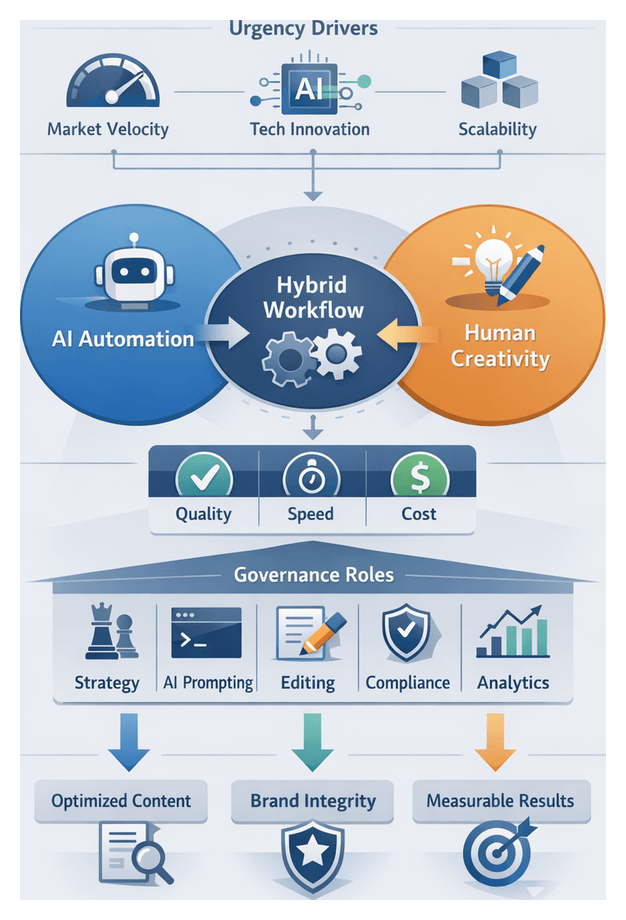
Over the past two decades, e-commerce has shifted from simple product listings to immersive multimedia experiences driven by detailed narratives, social proof, and personalized recommendations. Today’s consumers demand authentic reviews, rich imagery, and brand-aligned storytelling, raising the bar for digital merchants that must scale high-quality content across thousands of SKUs and multiple channels. Fragmentation across global marketplaces, social commerce, and direct-to-consumer sites compels tailored messaging and rapid format adaptation. Time-to-market pressures for product launches, promotional events, and seasonal campaigns force content teams to accelerate ideation and publishing cycles, while rising production budgets heighten the need for cost control.
Three urgency drivers underscore the strategic imperative for revising content production models: market velocity, technological innovation, and operational scalability. Accelerated product lifecycles and promotional calendars make delays costly. Advances in large language models and AI-powered analytics lower barriers to automated generation, rewarding early adopters with efficiency and personalization gains. Expanding assortments and omnichannel demands strain traditional teams, as recruiting specialized copy talent becomes increasingly competitive. Content leaders must explore hybrid AI-human approaches to preserve brand integrity, optimize total cost of ownership, and sustain long-term growth.
Balancing AI Capabilities and Human Creativity
Human writers offer narrative intuition, cultural awareness, and emotional resonance, while AI agents excel at pattern recognition, data-driven language generation, and high-volume tasks. Evaluating each approach across quality, speed, and cost dimensions reveals optimal use cases: human teams deliver nuanced brand storytelling at higher cost and longer turnaround; pure AI systems achieve rapid on-demand drafts with lower marginal cost but risk quality drift; hybrid models blend both to maximize efficiency without sacrificing brand voice.
Key AI-driven platforms include GPT-4 for versatile language generation, Jasper and Copy.ai for marketing-centric drafting, Surfer SEO for algorithmic keyword optimization, and others for integrated ideation. Designing workflows that leverage these tools alongside human expertise requires clear role definitions, structured approval processes, and continuous performance monitoring.
Governance Frameworks for Hybrid Workflows
Defining Roles and Responsibilities
A formal governance framework ensures clarity, consistency, and accountability in AI-human collaborations. Core roles include:
- Content Strategist: Sets editorial vision, brand guidelines, and audience parameters.
- AI Prompt Engineer: Designs and refines prompts for models such as GPT-4 to align outputs with tone and factual accuracy.
- Copy Editor and Refiner: Reviews AI drafts for coherence, style, and compliance, applying linguistic and domain expertise.
- Compliance and Legal Reviewer: Assesses content for regulatory adherence, intellectual property risks, and plagiarism avoidance.
- Data Analyst: Monitors performance metrics, identifies optimization opportunities, and feeds insights back into workflows.
- Technology Steward: Oversees AI platforms such as Jasper and Copy.ai, ensuring technical reliability and governance alignment.
Approval Processes and Quality Control
Decision rights and review cycles are mapped using RACI principles, defining who is Responsible, Accountable, Consulted, or Informed at each stage. Effective approval frameworks feature tiered escalation paths for high-risk content, centralized or federated governance models to balance consistency and agility, structured review timelines, and transparent audit trails via version control systems.
Quality control spans pre-publication checks using automated scanners for factual and brand guideline compliance, human verification of flagged issues, post-publication audits measuring readability and SEO alignment, performance feedback loops between data analysts and prompt engineers, and executive dashboards displaying compliance scores and cycle times. Organizations report 30-50 percent reductions in content errors through these controls.
Risk Management and Ethical Considerations
Hybrid governance frameworks must address intellectual property safeguards, bias detection and mitigation, regulatory compliance in sectors like finance and healthcare, and brand safety controls to prevent unintended associations. Establishing policies for AI content provenance and regular bias audits ensures responsible use of language models. Embedding exclusion lists and contextual filters preserves brand guardianship when AI proposes novel constructs.
Governance Maturity and Performance Metrics
Benchmarking against established frameworks provides an analytical lens for governance maturity:
- Gartner’s AI Governance Maturity Model: Assesses strategic alignment, process integration, risk management, and measurement capabilities.
- Forrester’s AI Readiness Framework: Evaluates people, processes, and technology readiness for AI adoption.
- ISO/IEC 38507 Guidance on Governance of IT: Emphasizes accountability, transparency, and stakeholder engagement for emerging technologies.
- Capability Maturity Model Integration (CMMI) for Content: Adapts software process concepts to content workflows.
Key metrics for governance effectiveness include approval cycle time, revision rates, compliance incident counts, and performance variance among AI-only, human-only, and hybrid outputs. Analytical dashboards enable data-driven refinement of roles, processes, and training priorities.
Hybrid Workflow Models and Applications
Collaboration Frameworks
Three archetypal hybrid workflows have emerged:
- Sequential Draft-Refine Model: AI agents generate first drafts; human writers refine for brand voice and context sensitivity.
- Parallel Production Model: AI and human teams independently create drafts; a quality gate process selects or merges the best elements.
- Embedded Assistance Model: AI tools offer real-time suggestions on phrasing, SEO optimization, and personalization as humans compose.
Strategic Use Cases
High-volume tasks such as bulk product descriptions leverage AI platforms like AgentLink.ai and Copy.ai for scalable drafts, augmented with Surfer SEO for keyword integration and human editors for brand consistency. Localization workflows combine automated translation with human linguists to ensure cultural nuance. Seasonal promotions and flash-sale campaigns use GPT-4 to generate headline variants and email subject lines, with human selection and refinement guiding A/B testing. Personalization engines dynamically tailor landing page content based on user personas, validated and enhanced by human UX writers.
Operational Integration and Scaling
Implementing hybrid models requires cross-functional coordination among marketing, IT, legal, and analytics teams. Infrastructure considerations include API management, AI model version control, and data governance. New roles such as AI Content Strategist and Prompt Engineer collaborate with copywriters and data analysts to monitor draft generation rates, human edit time, error rates, and approval durations. Reporting dashboards surface bottlenecks, enabling prompt adjustments to AI configurations or resource allocation.
Case Scenarios
- Rapid Catalog Expansion: A retailer uses GPT-4 to draft structured product descriptions for thousands of SKUs. Editors apply brand style checks and refine benefit statements, reducing turnaround from weeks to days while controlling labor costs.
- Dynamic Email Campaign Ideation: AI agents propose subject line and tagline variants. Marketers select and refine themes, creating diverse A/B testing portfolios that boost open and conversion rates without compromising brand identity.
- Personalized Landing Pages: AI inserts persona-specific headlines and benefits based on customer data. Human UX writers validate alignment and enhance emotional triggers, increasing engagement and subscription sign-ups.
Measuring Performance and Continuous Improvement
Evaluating hybrid workflows combines quantitative and qualitative metrics. Quantitative indicators include content throughput, time-to-publish, error rates, and cost per word. Qualitative assessments focus on brand alignment, readability, and semantic coherence. Customer engagement metrics—click-through rates, conversion lift, and average order value—demonstrate business impact. Pilot programs compare pure-human and hybrid outputs to isolate performance differentials. Editorial scorecards evaluating accuracy, brand compliance, and style consistency support ongoing quality assurance. Continuous feedback loops between data analysts, prompt engineers, and editors drive iterative enhancements to both AI parameters and editorial guidelines.
Key Considerations and Strategic Recommendations
- Adopt a Phased Integration Roadmap: Pilot hybrid workflows on non-critical content, refine governance protocols, and scale to core assets.
- Define Clear Success Metrics: Establish benchmarks for speed, quality, and engagement for AI-only and human-only outputs to evaluate hybrid gains.
- Invest in Cross-Functional Collaboration: Form integrated teams of AI specialists, copywriters, compliance officers, and data analysts for shared ownership of content outcomes.
- Implement Continuous Feedback Loops: Use analytical dashboards and periodic reviews to detect voice drift, model biases, and workflow bottlenecks, iterating on prompts and guidelines.
- Maintain Ethical and Compliance Vigilance: Embed automated bias detection and legal review stages to safeguard brand reputation and regulatory adherence.
- Prioritize Change Management: Communicate strategic objectives and provide training resources to ensure smooth adoption and sustained performance.
By aligning technology, talent, and governance around a cohesive hybrid content strategy, organizations can harness AI efficiency and human creativity to deliver consistent, compliant, and compelling e-commerce content at scale.
Chapter 6: Brand Voice and Storytelling in the AI Era
Evolving Demands in E-Commerce Content
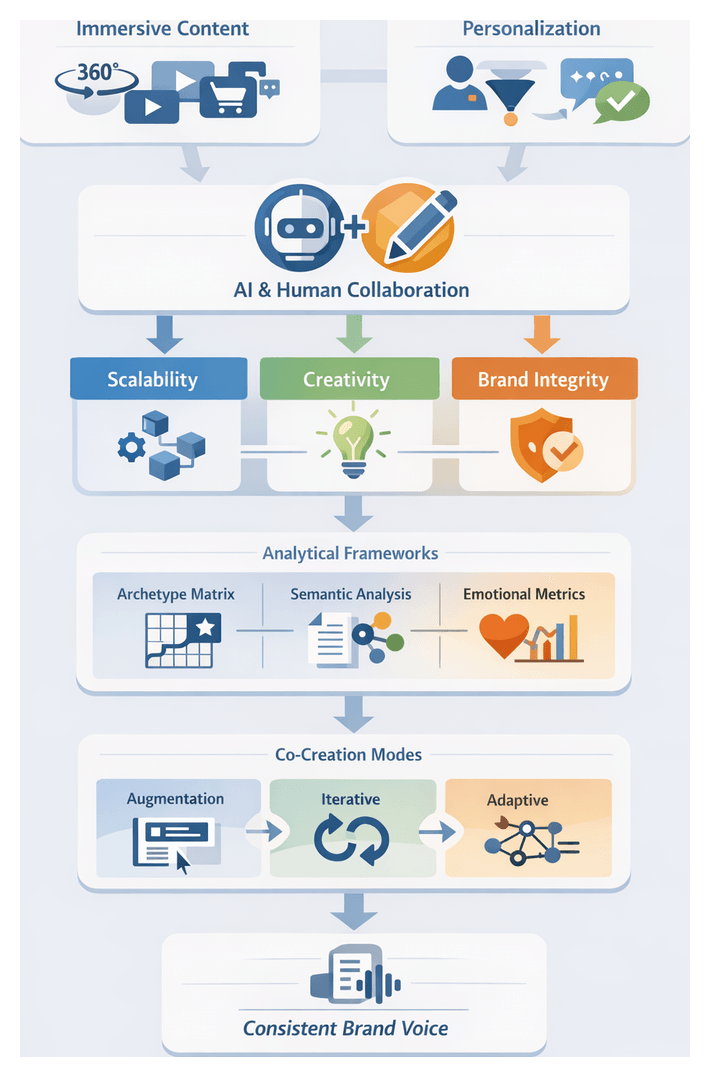
Online retail has moved from static listings to immersive, multimedia experiences that guide complex customer journeys. Platforms now deliver 360-degree views, product videos, user-generated reviews, augmented reality previews and voice-activated assistance. Social marketplaces, live streams and mobile-first apps introduce new touchpoints, while personalization engines craft dynamic recommendations based on browsing history and purchase behavior.
This shift has created a dual imperative: produce engaging, authentic content at scale while ensuring accuracy, compliance and brand integrity. Consumer attention spans have shrunk, options proliferate and competitive pressures intensify. Generative AI models—such as GPT-4, Jasper and Copy.ai—now rival human fluency, enabling rapid generation of product descriptions, email variants and social posts. Brands that delay integrating AI risk falling behind more agile competitors amid compressed development cycles, rising advertising costs and talent shortages.
Balancing AI Automation and Human Creativity
Human writers and AI agents each bring unique strengths. Expert copywriters excel in empathy, cultural nuance and complex storytelling, applying strategic insights and brand principles to craft emotionally resonant narratives. AI-driven tools deliver scalability, consistency and cost-efficiency, generating large volumes of draft content, enforcing style guidelines and automating A/B testing in minutes.
Adopting a co-creation model harnesses both capabilities. In routine tasks—drafting product blurbs or updating FAQs—AI handles initial output. Human experts then refine tone, enrich narratives and uphold brand voice. Clear roles, feedback loops and approval processes enable synergistic collaboration rather than binary choice.
Evaluating Brand Identity in Hybrid Authorship
Assessing brand identity across human and machine contributions requires structured frameworks and mixed-method evaluation. Key analytical models include:
- Archetype Alignment Matrix: Scores content against brand archetypes—Hero, Sage or Caregiver—evaluating tone and messaging.
- Semantic Consistency Index: Uses natural language processing to compare new copy with a brand corpus.
- Emotional Resonance Model: Combines audience surveys with tools like IBM Watson Tone Analyzer to gauge affective impact.
Quantitative and qualitative methods reinforce one another. Machine learning classifiers such as the OpenAI Embeddings API assign brand-fit scores based on cosine similarity, while human audits validate tone, vocabulary and narrative coherence. Audience perception surveys tie qualitative feedback to engagement metrics.
Advanced monitoring techniques detect brand drift and fragmentation. Time-series analysis tracks semantic distance over time, prompting root-cause reviews of training data or prompts. Cluster analysis groups content by stylistic features—sentence length, jargon density or emotional valence—to flag emergent sub-voices. Real-world studies illustrate these methods: a global apparel brand found Copy.ai drafts achieved 85% lexicon alignment but required human editing to boost emotional intensity, while an electronics retailer improved email click-through rates by integrating brand keywords into AI prompts to address AI’s lower urgency tone.
Co-Creating Narratives with AI Partners
Integrating AI into storytelling shifts creative collaboration. Practitioners distinguish three modes:
- Augmentation Mode: AI generates narrative frameworks or headlines; humans refine voice and context.
- Iterative Mode: Writers and AI engage in prompt-feedback loops, evolving stories through successive drafts.
- Adaptive Mode: AI repurposes brand assets for new channels or segments using data inputs and style guidelines.
Interpretive frameworks guide applications:
- Cultural Resonance: Ensures AI story elements align with brand values and audience sensibilities.
- Emotional Trajectory: Maps affective arcs from attention capture to lasting affinity.
- Contextual Integrity: Maintains consistent narrative voice across channels and repurposing.
- Data-Narrative Synthesis: Integrates user insights, segment data and real-time signals into storytelling.
Effective governance defines decision rights and oversight structures. A narrative style manifest articulates archetypes, tone descriptors and cultural touchstones, guiding AI without constraining creativity. Cross-functional councils—including brand strategists, legal and data teams—vet AI outputs. As interactive commerce environments evolve, AI assumes improvisational roles, requiring integrated workflows with UX and engineering teams to deliver dynamic, real-time narratives.
Principles for Maintaining Voice Consistency
Ensuring coherent brand voice across human and AI content demands a systematic, evolving approach. Key principles include:
- Unified Voice Framework: Codify archetypes, emotional pillars and stylistic boundaries to align copywriters and AI models.
- Clear Vocabulary and Tone Attributes: Develop glossaries of approved terms, prohibited phrases and tone dimensions embedded in stylebooks and AI prompts.
- AI-Specific Brand Guidelines: Translate abstract attributes into prompt engineering specs for tools like GPT-4.
- Controlled Prompt Engineering: Build modular prompt libraries in platforms such as Jasper and Copy.ai to calibrate voice across content archetypes.
- Iterative Oversight and Auditing: Use a Voice Consistency Index and periodic human audits to quantify tone adherence and address AI hallucinations.
- Contextual Anchors: Provide exemplar content or anchor documents in the AI context window to guide output.
- Multi-Channel Adaptation: Apply a channel adaptation matrix that modulates formality and brevity for email, social, web and chat.
- Voice Monitoring Metrics: Track semantic similarity, sentiment scores and topic models, leveraging plugins such as Surfer SEO for proactive governance.
- Cultural and Regional Nuance: Localize voice with variant style guides for target markets, referencing idiomatic and cultural guidelines.
- Collaborative Governance: Establish a RACI-based council of brand strategists, copywriters, data scientists and legal advisors to oversee guideline updates and AI tool performance.
By integrating these principles into a dynamic governance ecosystem, organizations can harness AI efficiencies, preserve authentic brand narratives and sustain competitive advantage in an ever-evolving e-commerce landscape.
Chapter 7: SEO, Personalization, and Data-Driven Optimization
Evolving E-Commerce Content and Market Challenges
Over the past decade, online retail content has transformed from static product listings into a dynamic, data-driven ecosystem of personalized descriptions, rich media and real-time search optimization. Early platforms relied on manually curated copy that often lacked consistency and failed to reflect shifting consumer tastes. The proliferation of mobile commerce and competitive marketplaces intensified the need for agile content strategies that capture attention in crowded digital channels.
Search engines now demand content that balances authentic storytelling with sophisticated algorithmic signals. Updates in keyword matching, semantic analysis and user-intent modeling require retailers to integrate real-time SEO insights, ensuring that metadata, headings and body copy align with evolving ranking criteria. Emerging formats such as rich snippets, voice search and image carousels further complicate this landscape, compelling teams to adopt flexible workflows capable of rapid adaptation.
Meanwhile, today’s shoppers expect seamless experiences across email, social, search and on-site interactions, with recommendations tailored to their browsing history, location and even conversational preferences. Manual processes alone cannot meet these demands at scale. Retailers face the dual challenge of rising consumer expectations and intensifying marketplace pressure, driving the adoption of advanced solutions that combine creative flexibility, operational efficiency and data-driven insight.
Defining the AI-Human Collaborative Model
Human copywriters contribute empathy, nuanced storytelling and deep contextual understanding of brand values, but scaling purely manual operations can be time-consuming and costly. AI agents, powered by large language models such as GPT-4, supplement human expertise by generating bulk product descriptions, suggesting SEO keywords and drafting personalized messages in seconds. Tools like Jasper and Copy.ai streamline initial content creation, while platforms such as Surfer SEO and SEMrush automate keyword research and optimization audits.
Leading organizations adopt a hybrid framework: AI accelerates draft production and data analysis, and human experts refine tone, ensure factual accuracy and enforce brand guidelines. Clear handoff points—such as using AI to generate keyword-rich frameworks followed by human voice tuning—maximize efficiency without compromising creative integrity or legal compliance.
Several urgency drivers reinforce this collaborative model. Search algorithms evolve rapidly, making lengthy manual rewrites impractical. Privacy regulations and third-party cookie deprecation elevate the importance of first-party data, demanding real-time personalization engines that leverage behavioral signals. Operational cost pressures incentivize automation of routine tasks, freeing teams to focus on high-impact initiatives like brand storytelling, interactive experiences and cross-channel campaigns. Finally, customer expectations for immediacy and relevance pressure retailers to deploy tailored messages within seconds of user engagement.
Data-Driven Personalization Frameworks
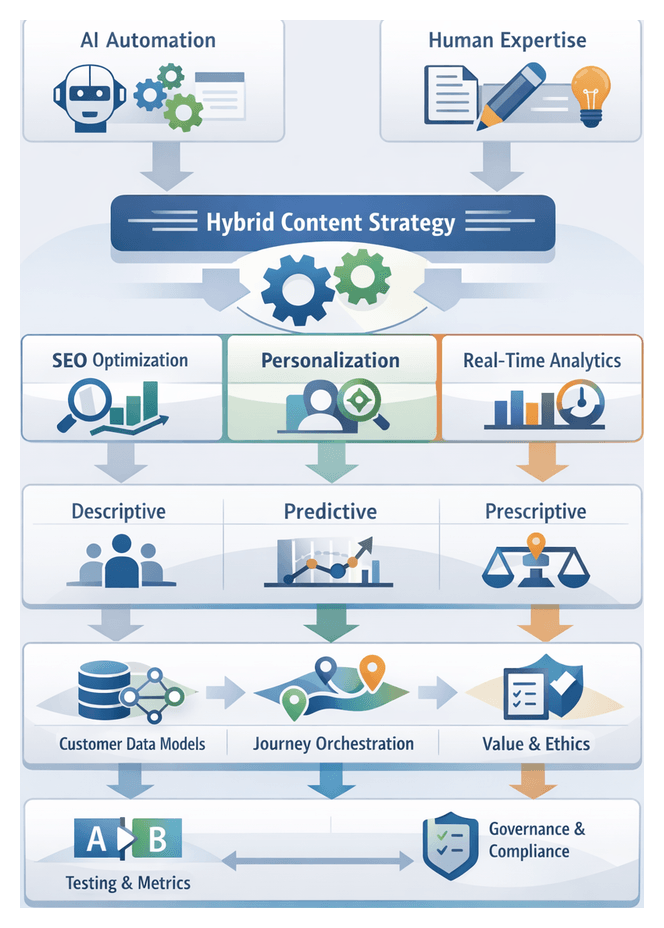
Personalization has become a strategic imperative, extending beyond superficial name insertions to dynamic message construction informed by customer behavior and predictive analytics. A three-layered approach drives robust personalization:
- Descriptive Segmentation groups customers by observable behaviors and demographics to establish baseline cohorts.
- Predictive Modeling employs machine learning to anticipate actions such as purchase propensity or churn risk.
- Prescriptive Orchestration leverages decision engines that recommend next-best actions in real time, combining historical context with emergent signals.
Analytical frameworks shape industry practice and vendor evaluation. The Customer Data Maturity Model assesses a company’s ability to unify data lakes, resolve identities and deploy AI-driven decisioning layers. The Journey Orchestration Framework identifies key moments of truth—like cart abandonment—where personalized content can influence outcomes. The Value Exchange Matrix balances data depth against perceived intrusiveness, guiding optimal data collection and deployment points. The Ethical Personalization Index evaluates privacy, transparency and bias mitigation against corporate social responsibility goals.
Organizations benchmark solutions such as Dynamic Yield and Optimizely against these frameworks, scoring capabilities for data integration, decision speed, content variation support and compliance features.
Stakeholder Perspectives and Governance
Cross-functional collaboration is essential. Marketing leaders emphasize creative freedom and brand consistency, data scientists prioritize model performance and uplift metrics, IT teams focus on system reliability and latency thresholds, and legal partners enforce consent management and bias checks under regulations like GDPR and CCPA. Successful organizations reconcile these viewpoints through personalization centers of excellence or governance councils that translate complex analytics into actionable scorecards and embed compliance checkpoints into workflows.
Measuring Personalization Impact
Beyond click-through rates, top metrics include:
- Attribution Complexity—balancing single-touch and multi-touch models or leveraging algorithmic attribution for incremental lift assessment.
- Cohort-Based Lifetime Value (LTV)—analyzing LTV trajectories of treatment groups to measure the long-term effects of personalization.
- Incrementality Testing—using hold-out experiments to isolate the causal impact of tailored messages.
- Engagement Depth—tracking micro-conversions such as time on site, scroll depth and interactive usage to capture browsing behavior shifts.
Emerging AI Technologies in Personalization
Advances in natural language generation and reinforcement learning distinguish between template-based personalization—populating predefined blocks—and contextual content generation, where AI crafts unique messages from real-time data. Editorial coherence, response relevance and operational efficiency guide evaluations of platforms like Segment for data orchestration and Braze for automated message delivery. Interpretive challenges include data quality and bias, privacy and consent, overpersonalization and cross-channel consistency. Future directions point to federated learning, edge-based personalization and ethical AI audits integrated into maturity frameworks.
Real-Time Analytics and Continuous Content Optimization
Embedding analytics into live content workflows transforms static editorial calendars into adaptive systems that respond instantly to customer behavior, trends and competitive shifts. Continuous intelligence—combining streaming analytics, decision models and automated workflows—drives immediate, contextually aware content actions. The OODA loop (Observe, Orient, Decide, Act) frames this process: observation via platforms such as Google Analytics 4 and Adobe Analytics, orientation against seasonal and competitive benchmarks, decision-making through defined thresholds and machine alerts, and action in the form of copy adjustments, metadata updates or personalized content delivery.
High-Velocity Use Cases
- Flash sales and limited-time promotions, where real-time click and departure metrics inform headline and call-to-action tweaks.
- Dynamic pricing scenarios that adapt content to inventory fluctuations or competitor rates.
- Behavior-triggered experiences, such as cart abandonment prompts based on session data.
- Geographically segmented campaigns that adjust localization instantly based on regional performance.
Analytical Frameworks and Governance
Real-time dashboards track bounce rates, time on page and conversion events, while anomaly detection models surface deviations from historical baselines. Integration with testing platforms like Optimizely and Dynamic Yield enables prescriptive A/B and multivariate experiments, creating a closed-loop iteration where data continuously refines creative elements. Governance models define roles—data engineers manage pipelines, analysts validate anomalies and content strategists authorize updates. Centers of excellence codify protocols for automated triggers, human review thresholds, version control and audit logging to maintain brand consistency and compliance.
Integration with SEO and Personalization
Real-time content updates enhance SEO by aligning on-page copy with emerging search queries and organic click-through trends. Personalized messaging engines draw on fresh analytics to surface relevant content blocks—such as eco-friendly feature highlights—based on user behavior signals. This convergence of real-time analytics, SEO and personalization drives both discoverability and conversion.
Challenges and Mitigation Strategies
- Data latency and signal noise risk misdirected content changes; establish statistical significance thresholds and require corroborative signals before high-impact updates.
- Siloed systems hinder streaming data flow; invest in unified infrastructures or partner with CDPs like Segment and Tealium for event collection and distribution.
- Privacy regulations add complexity; adopt privacy-by-design principles and consent management frameworks.
- Periodic reviews of automated triggers ensure ongoing alignment with brand guidelines and strategic objectives.
Synthesizing AI-Driven Optimization Strategies
- AI-Enhanced SEO: Machine learning platforms such as Surfer SEO accelerate keyword discovery, content gap analysis and metadata optimization. Brand stewards review algorithmic recommendations to ensure narrative coherence and user experience alignment. Analytical models like the Content Maturity Model guide incremental AI adoption and validation.
- Advanced Personalization: Behavioral signals, purchase history and predictive propensity scores inform dynamic content at the individual level. Retailers leverage RFM analysis and clustering algorithms to determine creative variants and channel timing. Centralized customer data platforms enable AI-powered orchestration of real-time product recommendations and offers.
- Real-Time Analytics Integration: Streaming data dashboards underpin rapid A/B and multivariate testing, reducing decision latency. Converged ecosystems that merge web analytics, CRM and third-party feeds allow AI models to detect trends and anomalies for swift content adjustment. The OODA loop and rolling-window analyses distinguish meaningful shifts from noise.
Strategic Considerations
- Data Quality and Governance: Define data stewardship roles, maintain transparent lineage and enforce ethical sourcing.
- Balancing Personalization and Privacy: Embed privacy-by-design, employ consent management platforms and differential privacy techniques.
- Model Interpretability and Trust: Use explainable AI frameworks to clarify optimization logic and variable importance.
- Platform Integration and Scalability: Adopt modular architectures with standardized APIs to support iterative upgrades and prevent vendor lock-in.
- Talent and Skill Alignment: Form cross-functional teams of SEO specialists, data scientists and creative strategists, and establish governance councils to guide priorities and manage trade-offs.
Limitations and Risks
- Algorithmic Bias: Implement audit frameworks and bias detection tools to surface unintended disparities.
- SEO Volatility: Develop resilience plans and diversify traffic acquisition to mitigate algorithm update impacts.
- Privacy and Ethical Constraints: Balance hyper-targeting with customer trust, honoring data minimization and transparency.
- Technical Debt: Phase AI integrations, document architectures and maintain version control to avoid brittle systems.
- Organizational Inertia: Secure senior leadership sponsorship and deliver continuous training to embed a culture of data-driven optimization.
When organizations align advanced AI technologies with rigorous governance, cross-functional collaboration and clear interpretive frameworks, they unlock the full potential of SEO, personalization and real-time analytics. This integrated, hybrid approach empowers content leaders to navigate volatility, protect brand integrity and deliver sustained customer value in the competitive e-commerce landscape.
Chapter 8: Ethical, Legal, and Governance Considerations
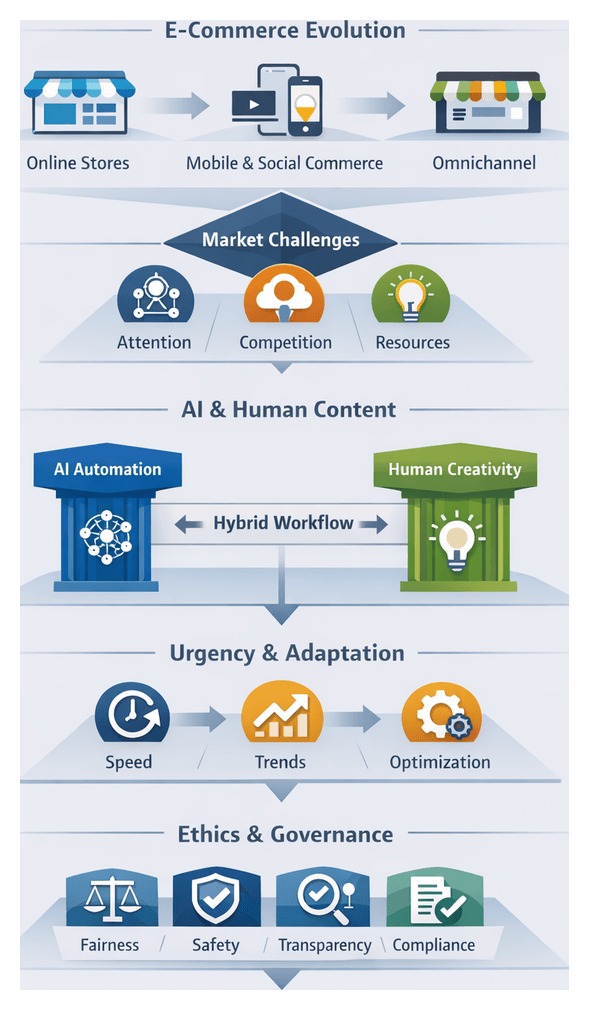
E-Commerce Content Evolution and Market Dynamics
Since the early 1990s, online retail has evolved from static storefronts to immersive, omnichannel experiences. Platforms such as Amazon and eBay introduced standardized listings, user reviews, and recommendation engines, raising the bar for persuasive, precise copy. The rise of mobile and social commerce further accelerated demand for concise, visually engaging narratives optimized for diverse screens. Today, retailers must deliver accurate product descriptions, evocative storytelling, and seamless brand voice across web pages, social feeds, email campaigns, and voice assistants, all while differentiating in increasingly crowded global marketplaces.
Modern enterprises face three interrelated challenges. First, consumers exhibit shrinking attention spans and expect personalized relevance at every touchpoint. Second, competition and market entry barriers have declined, intensifying pressure to maintain distinctive brand narratives. Third, operational budgets strain under demands for higher content volumes and faster turnaround. Balancing creative depth with speed and scale requires strategic frameworks that align content strategy with business objectives, resource constraints, and brand integrity.
The AI-Human Content Continuum
Human copywriters possess nuanced understanding of brand heritage, tone, and audience psychology. Through empathy and cultural insight, they craft narratives that resonate emotionally, reinforce identity, and adapt to evolving market feedback. Their iterative process—research, ideation, drafting, and refinement—yields content aligned with strategic goals, though it can be resource-intensive and variable in style and capacity.
Artificial intelligence agents automate portions of the content lifecycle with rapid throughput and consistency. Large language models such as GPT-4 and solutions like Jasper and Copy.ai generate draft product descriptions, social posts, and email subject lines at scale. Platforms like Surfer SEO provide real-time insights on keyword density and page structure, while APIs enable direct integration into content management systems. AI excels at pattern recognition and template-based generation but may struggle with long-form coherence, brand nuance, and factual accuracy without human oversight.
Positioning human and AI methodologies on a continuum allows organizations to deploy each where they deliver maximum value. AI accelerates routine drafting and ensures consistency, freeing human talent for high-impact tasks such as narrative development, voice refinement, and strategic oversight. Hybrid workflows—where AI produces first drafts and humans provide editorial precision—combine generative speed with creative depth, optimizing quality, speed, and cost.
Drivers of Urgency in Content Strategy
Rapid shifts in consumer behavior, amplified by global events and emerging technologies, demand agile content responses. Seasonal campaigns, flash sales, and trending topics require high volumes of timely, relevant messaging. Search algorithms and social media platforms continuously update ranking factors, compelling brands to optimize structure and delivery with minimal delay.
Technological advances have lowered barriers to automated content creation and optimization. The availability of modular AI services and analytics tools empowers teams to embed generative capabilities directly into workflows. Organizations that fail to integrate these innovations risk falling behind more technically adept competitors.
Resource constraints and talent shortages magnify the need for efficiency. Recruiting specialized copywriters can be time-consuming and costly. AI agents offer a pathway to extend capacity, streamline routine tasks, and reallocate human expertise toward strategic planning and creative direction. The convergence of market, technological, and operational imperatives creates a pressing need for balanced strategies that deliver speed, scale, and quality without compromising brand integrity.
Ensuring Fairness and Mitigating Bias in AI-generated Content
Algorithmic bias arises from data, model, or contextual sources. Unrepresentative training data can perpetuate stereotypes; objective functions may favor certain linguistic patterns; and deployment contexts can introduce design-induced bias. Content leaders map these sources against potential harms—misrepresentation, exclusion, credibility erosion—and apply analytical frameworks to guide measurement and mitigation.
- Demographic parity: equal outcome rates across protected groups.
- Equalized odds: consistent error rates across groups.
- Calibration metrics: alignment of relevance scores across subpopulations.
- Representational metrics: diversity of exemplars in generated text.
Each metric captures different facets of fairness and may conflict with relevance objectives. Content strategists must balance business priorities, user impact tolerances, and legal obligations when interpreting results. In e-commerce, fairness extends beyond statistics to market integrity and brand trust. Retailers scrutinize translation biases, cultural references, and price framing to avoid discriminatory claims or reputational damage.
Regulatory frameworks further shape fairness strategies. The EU Artificial Intelligence Act classifies consumer-facing generative models as high risk when they influence purchasing behavior, requiring transparency, robustness, and non-discrimination. GDPR and laws like the California Consumer Privacy Act impose constraints on automated profiling and mandate rights of explanation. Compliance demands ongoing collaboration among legal, technical, and ethical teams to assess profiling risks and differential treatment.
Industry standards and voluntary frameworks—NIST AI Risk Management Framework, IEEE P7000 series, OECD AI Principles, and guidelines from the Partnership on AI—provide interpretive guidance. Leading organizations map these principles into internal protocols such as bias audits of promotional copy, model cards, and transparency reports. Accountability spans AI vendors, platform operators, brand marketers, and legal counsel, each contributing to an analytical governance structure that defines roles, decision rights, and oversight mechanisms.
Risk-based approaches employ matrices that plot likelihood of bias against impact severity—reputational harm, regulatory penalties, trust erosion, and revenue dilution. Severity assessments draw on market research and brand vulnerability profiles to prioritize audit resources, validation efforts, and third-party assessments.
Governance and Policy Measures for Responsible AI Content
Effective governance aligns AI-driven content with ethical principles, legal requirements, and strategic objectives. Models range from centralized councils or ethics boards to distributed accountability embedded within product teams, with hybrid structures combining both. Two complementary governance lenses guide implementation:
- Principles-based: translates high-level commitments—fairness, transparency, accountability—into guiding tenets and charters.
- Risk-based: classifies applications by harm potential, allocating rigorous oversight to high-risk systems and lighter controls to routine content generation.
Interpretive frameworks and standards—NIST AI RMF, OECD AI Principles, IEEE P7000, and the EU AI Act—shape policy design. Multi-stakeholder oversight is essential. Subgroups focus on:
- Privacy and Data Protection: ensures GDPR, CCPA compliance and anonymization standards.
- Fairness and Bias Mitigation: conducts periodic assessments and triggers model retraining.
- Transparency and Explainability: defines disclosures, model cards, and internal labeling of AI-drafted content.
- Audit and Assurance: implements monitoring with platforms like IBM Watson OpenScale and Azure Responsible AI dashboard.
In e-commerce content contexts, governance councils set criteria for training data, mandate plagiarism and defamation audits, and establish escalation paths for noncompliant outputs. Automated monitoring pipelines track accuracy, legal compliance, sentiment alignment, and flag anomalies for human review.
Policies must formalize operational safeguards. Key areas include:
- Intellectual Property: licensing criteria for training data, attribution protocols, vendor indemnification, and audit trails.
- Bias Auditing: representative test suites, escalation thresholds, and cross-functional fairness committees.
- Transparency: labeling of AI outputs, prompt engineering documentation, and public disclosures where appropriate.
- Data Protection: permissible data categories, anonymization standards, and privacy impact assessments.
- Incident Response: severity-based definitions, designated response teams, communication templates, and post-incident reviews.
- Continuous Monitoring: dashboard indicators for policy adherence, regular audits for drift, and stakeholder feedback loops.
Organizations should institutionalize regular policy reviews—quarterly or semi-annual—to incorporate regulatory changes, technology advances, and lessons learned. While robust governance demands resources and flexibility to navigate regulatory ambiguity, it also unlocks strategic value. Mature oversight enables innovation in micro-personalized messaging, dynamic content optimization, and entry into regulated markets with confidence. By codifying guardrails that balance risk mitigation and creative agility, organizations build sustainable, trust-driven competitive advantage in the AI-augmented e-commerce landscape.
Chapter 9: Measuring Success with Analytics and ROI
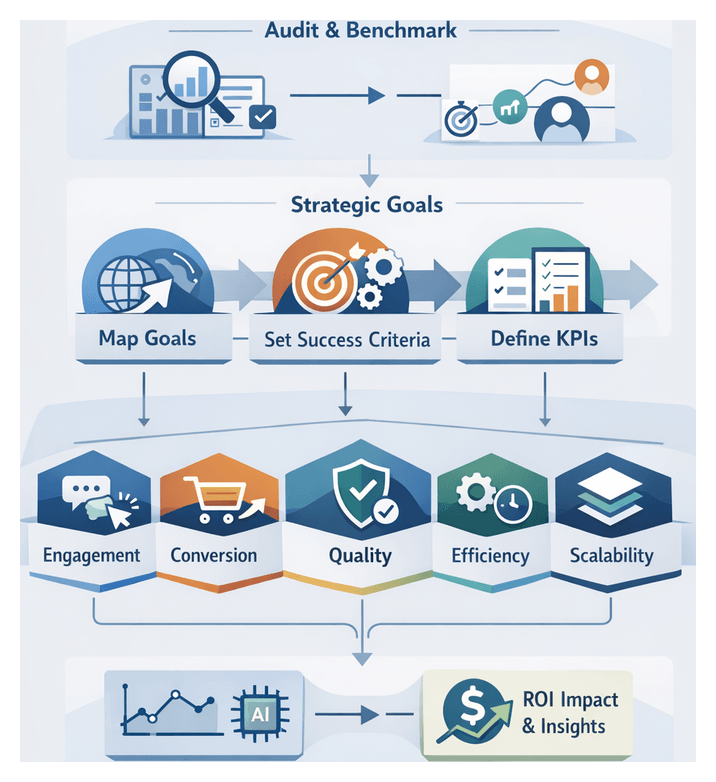
Establishing and Aligning Key Performance Indicators (KPIs)
E-commerce organizations integrating AI-driven tools must begin by auditing historical performance data to establish baseline benchmarks. Analyze metrics such as content production timelines, revision cycles, conversion rates and compliance incidents prior to AI adoption. Define realistic improvement targets—for example, reducing average publish time by 30 percent—and align those targets with strategic business objectives like revenue growth, market expansion, customer retention and brand differentiation.
A three-step process ensures KPI alignment:
- Map strategic goals to content outcomes: Identify how AI-augmented initiatives support objectives. For global expansion, measure localized content throughput and accuracy.
- Define success criteria for AI integration: Set targets for reductions in manual effort, improvements in time-to-market or enhancements in brand consistency across catalogs.
- Translate outcomes into measurable metrics: Convert criteria into clear KPIs. For a 25 percent cost reduction, track “Average Cost per Content Asset” as total spend divided by published assets.
Organize KPIs into six core categories to capture the full scope of AI-augmented content performance:
- Engagement: Click-through rate, time on page, scroll depth and social shares.
- Conversion: Add-to-cart rate, form completion and purchase lift measured via A/B tests.
- Quality: Brand conformity, readability and error rates assessed by tools such as Copy.ai.
- Efficiency: Turnaround time, revision cycles and internal cost savings from AI draft generation with platforms like Jasper.
- Scalability: Volume of assets, languages supported and ratio of AI-generated to human-edited content.
- Compliance: Automated quality-check pass rates, audit-trail completeness and incidents of non-compliance.
Select relevant KPIs via cross-functional workshops that evaluate each candidate metric against three criteria: strategic impact, actionability and data availability. Categorize KPIs into a tiered hierarchy—primary revenue drivers (average order value, conversion rate), secondary engagement signals (CTR, dwell time) and tertiary brand health indicators (net promoter score, social sentiment)—to maintain strategic focus and avoid vanity metrics.
Tracking Engagement: Quantitative and Qualitative Dimensions
Comprehensive engagement tracking combines broad quantitative measures with deep qualitative insights. Quantitative metrics include pageviews, unique visitors, session duration, bounce and exit rates, scroll depth and click-through rates. Experts recommend correlating multiple indicators into composite indices such as engagement rate (engaged sessions to total sessions) or content stickiness (repeat visits above time thresholds).
Qualitative signals uncover user motivations and pain points. Session replay and heatmap platforms like Hotjar and FullStory reveal click maps, scroll behavior and frustration signals. On-page surveys, feedback widgets and guided interviews integrate voice-of-customer data with analytics to explain anomalies such as high bounce rates in complex product categories.
Analytical Frameworks
- Segment-Centric Analysis: Disaggregate by cohorts defined by channel, geography or tenure. Compare profiles to prioritize content investments and personalize delivery.
- Funnel Visualization: Map stages from awareness to transaction using tools like Google Analytics 4, Adobe Analytics and Mixpanel. Identify drop-off points to refine narratives and CTAs.
- HEART Framework: Assess Happiness (satisfaction surveys), Engagement (interaction depth), Adoption (uptake of new formats), Retention (repeat behavior) and Task Success (completion rates). Customize metrics under each category to align with strategic priorities.
Tools and Platforms for Analytics and AI-Driven Insights
- Google Analytics 4 – Event-driven model with predictive churn and revenue forecasts.
- Adobe Analytics – Advanced segmentation, cohort analysis and attribution modeling.
- Mixpanel – Custom event definitions for product analytics and funnel reporting.
- Amplitude – Path analysis and AI recommendations for high-impact features and content.
- Hotjar and FullStory – Qualitative insights through heatmaps, session replays and sentiment surveys.
- Surfer SEO and Copy.ai – Variant deployment and incrementality testing for SEO-driven content.
Integrate multiple tools within a unified data architecture—leveraging Customer Data Platforms and tag management—to ensure consistent event tracking across channels and devices.
Governance, Data Integrity and Best Practices
Maintain a centralized repository of metric definitions, formulas, data sources and update cadences. Assign metric stewards to monitor quality, investigate anomalies and coordinate reporting. Develop role-based dashboards: executives track aggregated ROI, while content managers review asset-level performance and revision statistics. Schedule quarterly reviews to retire outdated metrics, introduce new measures and recalibrate targets.
Implement master data management to ensure consistent customer identifiers, product catalogs and campaign taxonomies. Automate validation rules and anomaly detection to flag bot traffic, outages or misconfigured tags. Use statistical significance testing and confidence intervals to validate A/B and multivariate experiments, guarding against false positives.
Anticipate common challenges:
- Data Silos: Integrate content management, marketing automation and analytics systems to avoid incomplete dashboards.
- Incentive Misalignment: Balance efficiency metrics with quality and compliance to prevent overreliance on AI drafts without human review.
- Model Opacity: Version control of prompts, datasets and iteration logs aids root-cause analysis when outputs shift.
- Sampling Bias: High-volume tiers may sample data. Enterprise plans or self-hosted solutions preserve fidelity.
- Privacy Regulations: Embed consent management and anonymization to comply with GDPR, CCPA and third-party cookie deprecation.
Translating Metrics into ROI and Strategic Impact
Link content performance to economic value by applying attribution frameworks and incrementality analysis. Use multi-touch attribution to distribute credit across AI-generated recommendations and human-crafted narratives. Employ marketing mix modeling to measure lift against seasonality and promotions. Run controlled experiments with platforms like Surfer SEO and Copy.ai to isolate incremental revenue from AI versus human copy.
Embed Customer Lifetime Value (CLV) into ROI by forecasting net present value of future streams. Utilize predictive CLV models—integrating content interaction metrics with transactional data—to identify high-value cohorts. Conduct churn analysis to estimate retention gains from AI personalization and human-driven loyalty programs. Calculate economic contribution margin by subtracting content production costs from incremental revenue tied to CLV improvements.
Allocate costs transparently: distinguish fixed vs variable expenses, account for hybrid models where AI drafts and human editors share workload, and factor in opportunity costs of alternative investments. Combine these into a unified ROI metric to compare AI-only, human-only and hybrid production models.
Recognize qualitative value drivers—brand trust, narrative depth, emotional engagement and creative agility. Measure customer perception shifts via surveys and sentiment analysis following AI rollouts with tools like GPT-4, Jasper and Copy.ai. Quantify time-to-market improvements and monitor employee satisfaction gains when AI relieves repetitive tasks.
Sustainable and Adaptive Measurement Frameworks
Deploy a lifecycle approach: pilot focused KPIs on specific campaigns, scale to additional channels once validity is confirmed, and optimize with predictive modeling and anomaly detection. Build modular scorecards with core metrics for multi-year tracking, intermediate indicators reviewed quarterly and experimental KPIs tested in bounded pilots.
Leverage AI-driven analytics for predictive engagement scoring, real-time anomaly alerts and automated cohort discovery. Maintain human oversight to validate algorithmic recommendations against brand values and qualitative insights.
Strategic Imperatives and Continuous Learning
Foster a culture of measurement literacy by training creative teams in statistical reasoning and forging partnerships between content strategists and data scientists. Embed accountability through defined metric ownership, reporting cadences and escalation protocols. Adopt a balanced portfolio approach: invest in high-certainty, low-variance initiatives like SEO-optimized pages alongside higher-risk, higher-reward experiments such as interactive video or AI-powered personalization.
Continuously test new measurement methodologies, explore advanced attribution models and revisit KPI frameworks to keep pace with evolving AI and analytics technologies. This forward-looking posture ensures sustained competitive advantage and the ability to deliver exceptional customer experiences in the dynamic e-commerce landscape.
Chapter 10: Future Scenarios and Case Studies
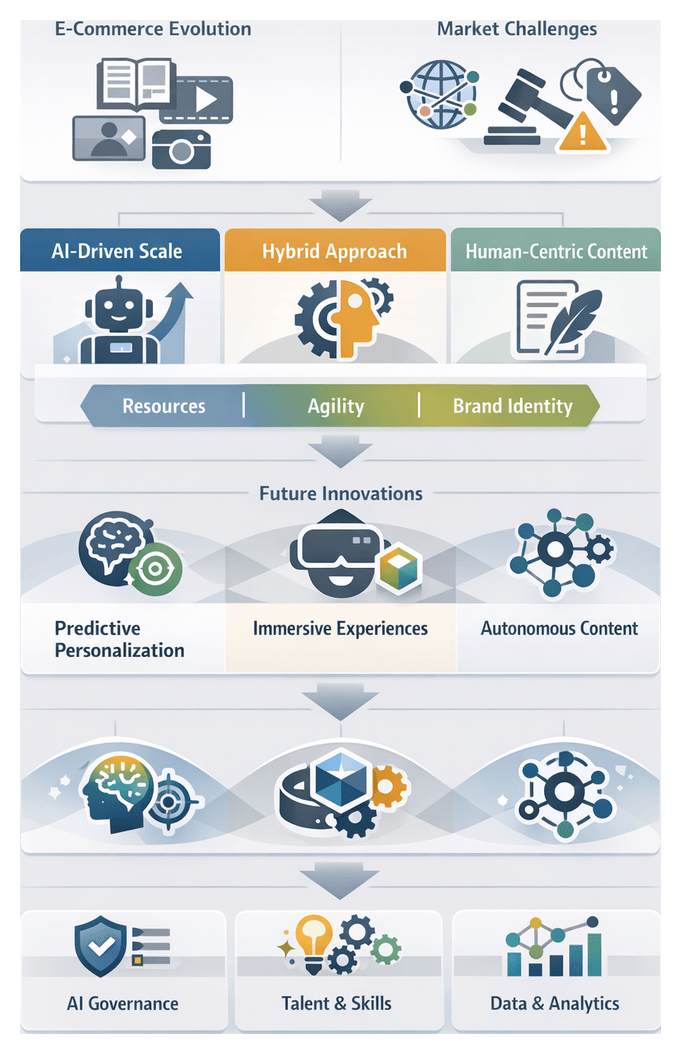
E-Commerce Content Evolution and Market Challenges
Historical Transformation
Over the past quarter century, online retail has progressed from basic text listings and low-resolution images to rich narrative environments that drive conversion and loyalty. Early e-commerce catalogs mirrored print, offering generic descriptions and minimal metadata. With the rise of Web 2.0, merchants embraced high-resolution photography, interactive galleries, and video to approximate in-store experiences. Today, content encompasses product pages, email campaigns, social media, mobile apps, marketplaces, and voice interfaces, each with unique format requirements and audience intents. Consumers now expect immersive experiences, user-generated reviews, and seamless mobile performance, making content strategy a critical differentiator.
Multichannel Complexity and Consumer Dynamics
As touchpoints have multiplied—email, social platforms, third-party marketplaces, and voice assistants—brands face the twin challenges of scalability and consistency. Marketplaces such as Amazon, Alibaba, and Walmart enforce strict formatting and indexing rules, while social commerce on Instagram, TikTok, and Pinterest demands short-form videos and interactive storylines. Voice search introduces natural language requirements and question-and-answer structures. Meanwhile, user-generated content like reviews, unboxing videos, and social posts enhances authenticity but requires moderation and governance. The proliferation of channels amplifies both opportunities for engagement and the risk of message drift, straining traditional content operations.
Competitive pressures and margin compression further intensify the need for efficient content production. Price transparency and global competition force brands to invest in storytelling that highlights craftsmanship, ethical sourcing, and unique value propositions. At the same time, budget constraints and tight timelines push organizations toward automation and hybrid models that balance quality, speed, and cost.
Comparative Case Study Insights
Case Studies Overview
Three real-world implementations illustrate how leading retailers balance AI-driven scale and human creativity according to strategic priorities:
- Volume-Driven AI-First Model: A global e-commerce platform deployed GPT-4 to generate product descriptions at scale. Weekly output rose from 2,000 to 150,000 descriptions, yielding a 25 percent increase in organic traffic and 60 percent more unique assets, with a 35 percent cost reduction versus manual creation. Governance introduced style prompts and audits to address a 12 percent tone deviation.
- Hybrid Workflow for Direct-to-Consumer Brand: A mid-market apparel label used Jasper for first-pass copy, refined by human editors. This approach boosted email open rates from 18 to 24 percent, reduced drafting time by 50 percent, and allowed the team to produce 40 percent more assets without headcount expansion. A governance panel tracked readability, brand compliance, and emotional resonance.
- Human-Centric Artisan Approach: A boutique home goods retailer retained fully human-driven content to preserve narrative authenticity. Despite editorial costs consuming 18 percent of revenue and production bottlenecks delaying launches, the retailer achieved a 12 percent increase in average order value and a 9 percent rise in repeat purchases. Customer surveys rated authenticity at 9.3 out of 10.
Interpretive Frameworks
Analysis of these cases reveals three frameworks guiding model selection:
- Resource-Based View: Leverage existing editorial talent and technology infrastructure to determine if AI, human, or hybrid workflows best exploit core capabilities.
- Dynamic Capabilities: Adopt hybrid models to enhance agility, using AI for rapid content iteration while employing human oversight to ensure quality.
- Brand Identity Priority: Prioritize narrative integrity and emotional engagement, accepting higher costs and slower production to reinforce differentiated positioning.
No single approach dominates universally. Volume-focused retailers gain scale with AI but require governance to manage brand voice. Hybrid adopters balance throughput and creativity, while human-centric brands secure deep emotional resonance at the expense of agility and cost efficiency.
Future Innovations and Emerging Models
Predictive Personalization
Personalization is poised to evolve from static segmentation to predictive, intent-driven engagement. Retailers will deploy deep learning models that analyze behavioral signals, contextual data, and biometric inputs to anticipate needs. Platforms like GPT-4 and Jasper will generate dynamic narratives that adapt in real time as customers navigate purchase journeys. Integrating predictive scoring with first-party data will enable content variants tailored to lifecycle stage, location, and sentiment, elevating relevance and conversion potential.
Immersive and Interactive Experiences
Extended reality and interactive formats will become mainstream. Virtual try-ons, 3D configurators, and shoppable videos will merge generative AI with real-time rendering to create guided brand tours. AI-driven voice assistants within immersive environments will narrate personalized product stories. As interactivity depth replaces traditional metrics like time on page, content leaders must evolve analytic models to capture engagement indices and emotional resonance.
Autonomous Content Ecosystems
Next-generation content supply chains will self-publish, self-optimize, and self-scale via continuous learning loops. Semantic networks will enforce coherence across thousands of SKUs and channels. Early prototypes from Copy.ai and AgentLink.ai demonstrate AI orchestration platforms that update taxonomies, refine content based on performance analytics, and embed customer sentiment feedback. Human roles will shift toward strategic oversight, ethical auditing, and creative direction.
Contextual Omni-Channel Integration
Seamless narrative continuity across desktop, mobile, social, in-store signage, and voice interfaces will distinguish leading brands. AI agents will manage context switching, reformatting a search-optimized storyline from Surfer SEO into a social media narrative or interactive in-app guide. Centralized metadata frameworks and AI-enabled content hubs will minimize friction as consumers traverse touchpoints, preserving brand trust in fragmented attention environments.
Strategic Imperatives for Content Leaders
Balancing Human Creativity and AI Efficiency
Organizations must harness complementary strengths of human writers and automated agents. Use AI platforms such as GPT-4, Jasper, and Copy.ai for rapid bulk generation, consistency, and SEO optimization, while deploying human talent for nuanced storytelling and brand empathy. Key practices include:
- Content Segmentation: Classify content by strategic value and complexity, assigning routine, data-intensive tasks to AI and high-impact narratives to humans.
- Role Definition: Establish boundaries where AI drafts and human writers refine tone, compliance, and brand voice.
- Feedback Loops: Integrate human edits into AI training datasets to incrementally improve output quality.
Governance and Ethical Oversight
Scaling AI requires robust governance to mitigate bias, protect intellectual property, and ensure regulatory compliance. Effective models combine policy, process, and technology controls:
- Policy Foundations: Define guidelines for data sourcing, model fine-tuning, and content attribution to maintain transparency.
- Audit Mechanisms: Conduct third-party evaluations and manual spot checks to detect hallucinations or plagiarism.
- Stakeholder Governance: Form committees with legal, marketing, and IT to review risks and approve AI deployments.
Organizational Readiness and Talent Transformation
Hybrid production demands new skills, workflows, and cultural adaptation. Leaders should:
- Skill Development: Provide training on prompt engineering, model evaluation, and bias mitigation.
- Hybrid Roles: Create positions such as AI Content Strategist and Human-in-the-Loop Editor to bridge technical and creative domains.
- Change Management: Communicate clear objectives and metrics to drive adoption and minimize resistance.
Data and Analytics Integration
Unified data pipelines and SEO tools like Surfer SEO are essential for real-time insight and feedback:
- Unified Data Strategy: Consolidate first- and third-party data to inform personalization algorithms and editorial planning.
- Performance Thresholds: Define KPIs—such as engagement uplift and time-to-publish—that trigger automated scaling or human review.
- Iterative Testing: Embed A/B testing to validate AI-generated variants and refine prompts based on outcomes.
Limitations and Risk Mitigation
Awareness of inherent constraints safeguards brand integrity:
- Model Hallucinations: AI output may contain plausible but inaccurate statements; rigorous fact-checking is essential.
- Brand Dilution: Overuse of generic AI templates can erode unique voice without human oversight.
- Data Privacy: Personalization systems must comply with GDPR, CCPA, and emerging regulations.
- Resource Allocation: Initial investments in AI infrastructure and talent transformation can be substantial; ROI emerges over time.
- Technology Lock-In: Dependence on proprietary platforms may limit flexibility; open architectures can mitigate risks.
Continuous Learning and Adaptation
High-performing teams adopt an experimental mindset, using each campaign to refine AI-human collaboration and governance:
- Quarterly Reviews: Conduct retrospectives that integrate performance data and team insights to iterate on workflows and prompts.
- Cross-Industry Benchmarking: Engage in forums and consortia to stay updated on best practices and regulatory trends.
- Scalability Roadmaps: Develop phased plans to expand hybrid models from pilots to enterprise-wide programs aligned with proven value.
Mastery of hybrid content production is an ongoing journey. By institutionalizing governance, fostering talent agility, and committing to data-driven experimentation, organizations will navigate the evolving e-commerce content ecosystem and deliver differentiated experiences at scale.
Conclusion
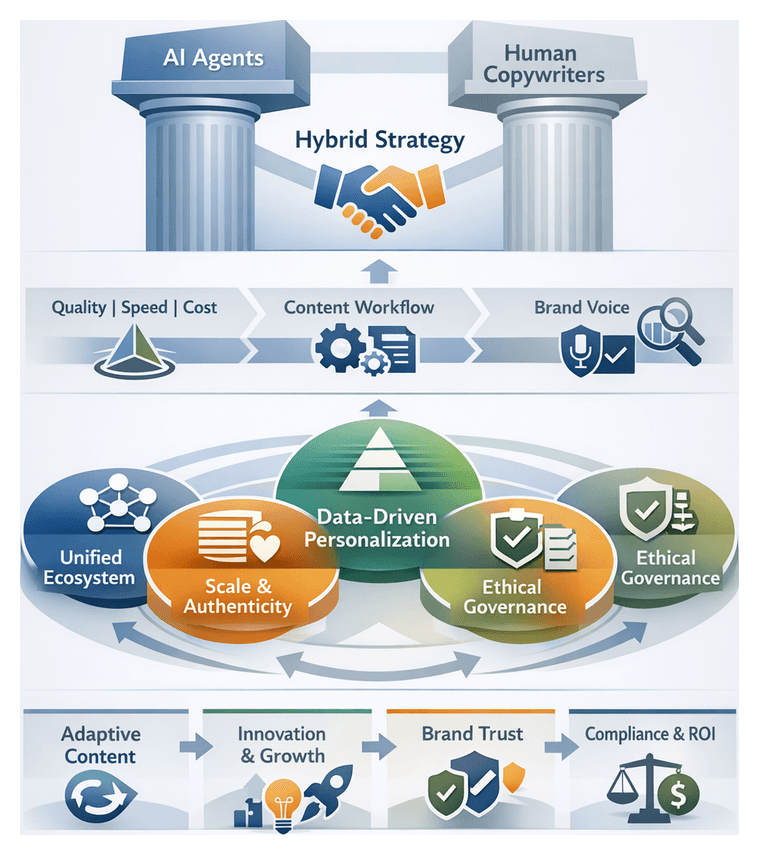
Review of Core Insights
Over the course of this guide, we have traced the evolution of e-commerce content from static templates to dynamic, data-driven experiences shaped by shopper journeys. We examined how product descriptions, promotional emails, landing pages and social content have become personalized at scale, fueled by advances in content management systems, personalization engines and AI platforms. The analysis contrasted the narrative depth and empathy of human copywriters with the scalability, speed and consistency of AI agents powered by models such as GPT-4 and tools like Jasper. We identified urgency drivers—competitive acceleration, operational complexity and rising consumer expectations—that compel organizations to integrate AI while preserving human oversight.
Several analytical models underlie strategic decision-making: the Quality-Speed-Cost Matrix reveals optimal roles for humans and machines; the Content Lifecycle Workflow defines stages from ideation to continuous optimization; the Brand Voice Consistency Grid safeguards tone and style across outputs; the SEO-Personalization-Analytics Triangle aligns search visibility, customization and performance tracking; and the Governance and Ethical AI Model prescribes audit processes, bias mitigation and compliance pathways.
Recurring Strategic Themes
Across siloed channels and unified content hubs, five interrelated patterns shape modern e-commerce content strategy:
- Convergence of Ecosystems: Organizations are unifying product copy, email marketing and social media under shared data models, governance frameworks and AI inference engines. Centralized taxonomies, asset libraries and performance dashboards reduce friction and accelerate iteration.
- Scale Versus Authenticity: AI excels at bulk drafting and iteration but may erode narrative nuance and brand resonance. Hybrid models apply automated pipelines for first drafts, with human teams focusing on voice calibration and narrative enrichment.
- Data-Driven Personalization: Platforms like Copy.ai and Surfer SEO ingest user signals to generate tailored messaging. Interpreting the DIKW pyramid, teams assign human strategists to define segment priorities and guardrails, while AI operationalizes scale and variation.
- Governance and Ethical Oversight: Content strategy now embeds multidisciplinary committees that include marketing, legal and ethics experts. Responsible AI Maturity Models guide bias detection, IP management and regulatory compliance, transforming governance into a strategic asset.
- Evolving Human Roles: Copywriters transition into AI literate strategists, mastering prompt engineering, model auditing and creative direction. New talent frameworks emphasize interdisciplinary collaboration among writers, data scientists, SEO specialists and compliance leads.
These themes reflect an industry coalescing around hybrid paradigms where AI agents and human experts collaborate in continuous maturity journeys. Pilot programs evolve into integrated ecosystems through iterative experimentation, feedback loops and cross-functional alignment, enabling organizations to adapt content strategies as consumer behaviors and technologies shift.
Long-Term Impacts and Organizational Transformation
Looking ahead, the synergy between AI agents and human creativity will redefine content ecosystems, talent dynamics, brand equity and market differentiation.
Adaptive Content Ecosystems
Linear pipelines will give way to modular architectures in which AI tools continuously generate variations and human experts curate and contextualize outputs. Recommendation engines will propose topic and format adjustments based on real-time data. Platforms such as GPT-4 for generative language and Surfer SEO for algorithmic optimization will orchestrate self-adjusting AI components. Continuous feedback loops from analytics and sentiment analysis tools will refine tone, style and subject matter in an accelerating cycle of content maturation.
Talent and Organizational Design
Copywriting teams will evolve into multidisciplinary pods combining AI specialists, data analysts, brand strategists and narrative architects. Many AI-driven tools will coordinate AI agents, while Copy.ai supports rapid prototyping. Senior leaders will prioritize AI governance fluency, data literacy and creative direction when hiring. Training programs will upskill writers in prompt engineering, model evaluation and AI ethics. Career pathways will span annotation and quality assurance for entry-level roles to workflow design and ethics strategy at senior levels. Cross-department councils, led by Chief Content Officers and Chief AI Ethics Officers, will oversee bias mitigation, IP interpretation and data privacy decisions.
Brand Equity and Consumer Trust
Layered brand voice frameworks—machine-readable parameters for tone, lexicon and narrative pillars—will guard consistency as AI generates at scale. Tools that integrate sentiment analysis and cohesion metrics will flag deviations for human intervention. Transparent disclosure of AI’s role in content creation will reinforce consumer trust. Human writers will craft adaptable story arcs for dynamic, personalized experiences across thousands of touchpoints.
Competitive Differentiation and Innovation
Brands that leverage proprietary first-party data to train domain-specific AI agents will establish performance moats. Anticipatory content in interactive or voice-driven formats will create immersive shopping journeys. Collaborations with AI platform providers and research entities will drive co-development of novel content capabilities, accelerating time to market and reinforcing customer experience leadership.
Regulatory and Ethical Landscape
Regulations on data usage, IP, transparency and consumer protection will converge into comprehensive AI content governance frameworks. Voluntary codes of conduct will address bias mitigation, fact-checking and consent. Ethical AI committees will embed moral deliberation in content workflows. Compliance with emerging standards will become a differentiator for consumer and partner trust.
Economic Models and ROI Continuity
Investment in content will be managed as a portfolio. Financial frameworks such as Content Yield Curves will map AI capability investments to performance gains. Flexible consumption models for AI platforms will align costs with usage. Hybrid staffing models will balance in-house experts with freelance talent. Integrated analytics will connect content performance with business metrics—conversion, average order value and lifetime value—enabling lifecycle ROI assessments.
Technology Trajectories
Advances in multimodal generation, real-time translation and knowledge graphs will enable integration of text, imagery, video and interactive elements. Voice interfaces will become mainstream channels managed by AI agents trained on human-defined dialogue trees. Distributed, AI-enabled workspaces will facilitate collaborative creativity across borders, compressing innovation cycles and supporting rapid experimentation with novel formats.
Governance, Measurement and Ethical Considerations
Robust governance and measurement frameworks are essential to mitigate risk and drive continuous improvement.
- Audit Trails and Human-in-the-Loop Validation: Maintain transparent records of AI outputs and enforce checkpoints for review.
- Bias Detection and Remediation: Implement regular assessments of training data and outputs to identify and correct unintended biases.
- Regulatory Compliance: Align with GDPR, emerging AI Acts and industry codes on transparency, data privacy and IP rights.
- Performance Analytics: Track engagement metrics—click-through rates, time on page, scroll depth—and link them to revenue outcomes.
- Attribution Modeling: Use advanced models to isolate content’s contribution across multi-touch journeys and optimize resource allocation.
- Ethical Oversight: Empower AI ethics committees to evaluate social impacts, guide moral deliberation and embed ethical reflection into production.
Key Considerations and Limitations
- Data Quality and Bias Management: Incomplete or skewed datasets can perpetuate bias and erode brand trust.
- Brand Nuance and Cultural Resonance: Automated drafts may require human enrichment for luxury or region-specific narratives.
- Regulatory and Legal Uncertainty: Evolving policies on AI transparency and privacy create compliance complexities.
- Model Hallucinations and Accuracy Risks: Generative models can produce factually incorrect statements requiring vigilant review.
- Organizational Readiness and Skill Gaps: New roles such as prompt engineers and AI auditors are essential but often scarce.
- Measurement Attribution Complexities: Sophisticated analytics are needed to attribute performance across channels.
- Technology Volatility: Rapid AI advancements may render existing tools obsolete, requiring ongoing investment.
- Cost Unpredictability: Expenses for model fine-tuning, API usage and oversight can fluctuate and impact budgets.
Guidance for Strategic Application
To harness the complementary strengths of human copywriters and AI agents, organizations should cultivate an adaptive mindset that values data-driven experimentation and human-centered creativity. Establish cross-disciplinary governance forums, invest in continuous learning programs and adopt modular technology architectures. Define clear KPIs aligned to business goals and integrate analytics platforms to surface real-time performance insights. Map content types to production methods—deploy AI for bulk updates, allocate human talent to high-impact narratives and implement hybrid protocols for omni-channel initiatives. Prioritize transparent disclosure of AI involvement to reinforce consumer trust. By proactively addressing limitations and aligning investments with strategic objectives, e-commerce brands can drive sustainable growth, differentiation and resilience in a competitive landscape.
Appendix
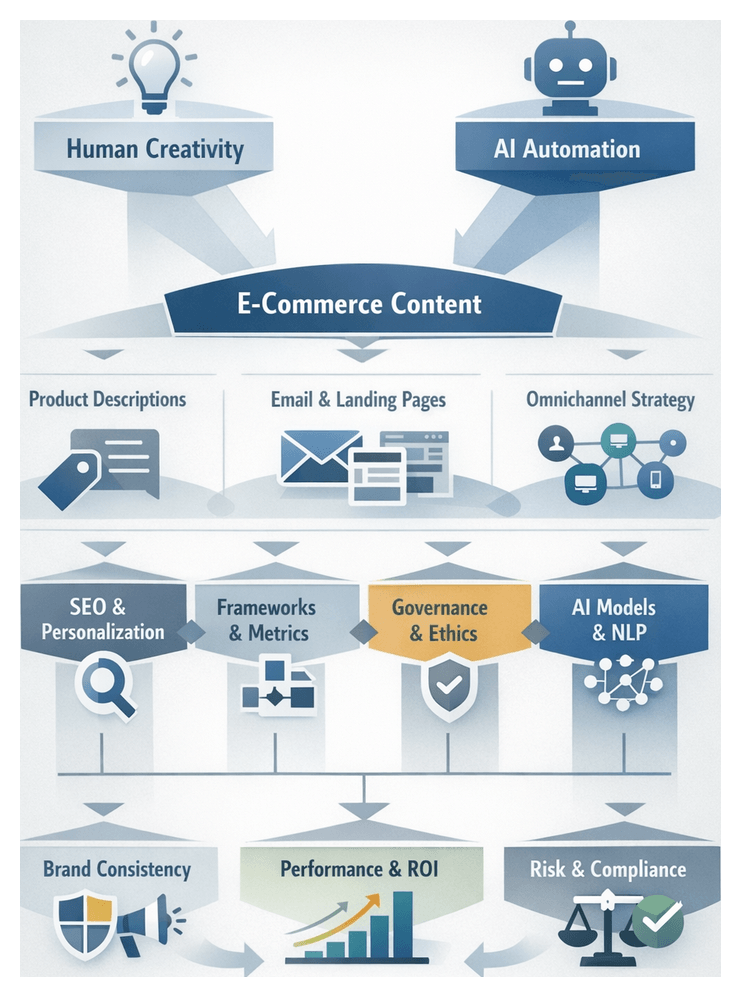
Key Definitions and Terminology
E-Commerce Content
Assets deployed across digital retail channels—including product descriptions, category pages, blog posts, newsletters, social media posts, and landing pages—that inform purchase decisions, enhance brand perception, and support search optimization by aligning with consumer intent.
Product Description
Textual narratives conveying item features, benefits, usage instructions, and brand positioning. Effective descriptions balance technical accuracy with persuasive language and strategic keywords to guide customers from consideration to conversion.
Email Campaign
Targeted messages sent to subscriber segments to promote products, share updates, or reengage customers. Performance is measured by open rates, click-through rates, and conversions, with personalization engines and subject-line testing optimizing relevance.
Landing Page
A standalone web page designed for a specific marketing objective—lead capture, sale promotion, or product introduction. Focused messaging, clear calls to action, fast load times, and brand consistency maximize conversion rates.
Omnichannel Experience
A seamless, integrated journey across websites, mobile apps, marketplaces, social media, and physical stores. Consistent messaging, visual identity, and unified customer data reinforce brand trust throughout the purchasing lifecycle.
Artificial Intelligence (AI)
Computational systems that perform tasks requiring human intelligence—language understanding, pattern recognition, decision making. In e-commerce, AI accelerates draft generation, analyzes performance, and personalizes messaging at scale.
AI Agent
Autonomous software performing content creation or optimization tasks using machine learning models. Agents generate drafts, suggest keywords, and adapt messaging based on data.
Natural Language Processing (NLP)
AI branch enabling computers to interpret, generate, and analyze human language. In content automation, NLP parses product attributes, generates coherent sentences, and applies sentiment or tone controls.
Large Language Model (LLM)
Neural networks trained on massive text corpora to predict and generate human-like language. Examples include GPT-4 and Llama 2, powering advanced content agents for nuanced copy.
Prompt Engineering
The practice of crafting structured inputs to guide AI outputs—specifying context, tone, format, and constraints so models generate content requiring minimal human editing.
Generative AI
Models that create new text, images, or code based on learned patterns. In e-commerce, generative AI drafts product descriptions, social media captions, and email narratives, boosting throughput under governance protocols.
Hybrid Production Model
Combines AI-generated drafts with human editing and oversight to leverage AI scale while preserving creative nuance, brand alignment, and compliance.
Brand Voice
The distinctive tone, style, and personality of all communications. Ensuring consistency across human and AI-generated content requires clear style guides, tone descriptors, and prohibited language lists.
Algorithmic Bias
Systematic disadvantage or misrepresentation in AI outputs due to training data imbalances or model design. Regular audits and bias detection protocols mitigate risks.
Search Engine Optimization (SEO)
Enhancing content and technical factors to improve visibility in search results. Techniques include keyword research, metadata optimization, structured data, and mobile performance. Tools like Surfer SEO assist in aligning copy with ranking factors.
Personalization
Tailoring content to individual preferences, behaviors, and locations—from dynamic name insertion to AI-driven recommendations and segmentation-based messaging—while balancing relevance with privacy.
A/B Testing
Comparing content variants to determine performance differences. Informs human refinements and AI prompt adjustments through empirical evidence.
Governance Framework
Defines policies, roles, processes, and tools overseeing AI and human content workflows to ensure quality, compliance, ethical data use, and strategic alignment.
Intellectual Property (IP) Management
Covers ownership, licensing, and usage rights for generated text and training data. Clear policies prevent infringement and establish protocols for attribution and reuse.
Return on Investment (ROI)
Financial return relative to content investments, encompassing AI automation cost savings, engagement-driven revenue uplift, and impacts on customer lifetime value and brand equity.
Conceptual Frameworks and Models
These models guide strategic decisions on balancing human creativity with AI automation, benchmarking maturity, preserving brand identity, and measuring impact.
Creative and Brand Frameworks
- Creative Continuum Model: Positions workflows from fully manual to fully automated across automation degree, human oversight level, and algorithm sophistication.
- Archetype Alignment Matrix: Maps tone and themes to brand archetypes (Explorer, Hero, Caregiver) for cultural resonance.
- Semantic Consistency Index: Uses NLP to compare new copy against a reference corpus of brand-approved materials.
- Emotional Resonance Model: Combines sentiment analysis and customer surveys to gauge narrative impact.
Maturity, Economic Impact, and Value Assessment
- Gartner Digital Content Maturity: Charts progression from ad hoc operations to data-driven ecosystems based on AI adoption and governance rigor.
- Forrester Total Economic Impact: Quantifies AI augmentation returns versus human workflows, including cost savings and productivity gains.
- Resource-Based View: Treats AI platforms and creative talent as strategic assets, assessing rarity and inimitability.
- Cost-Benefit and Risk-Reward Matrices: Weigh performance gains against licensing fees, infrastructure, oversight labor, IP risk, and bias exposure.
Personalization, Optimization, and Analytics
- Customer Data Maturity Model: From fragmented silos to unified, real-time profiles.
- Journey Orchestration Framework: Aligns content tactics with customer moments—awareness, consideration, purchase, loyalty.
- OODA Loop and Continuous Intelligence: Observe, Orient, Decide, Act cycles with streaming data for automated A/B testing, SEO updates, and personalization.
- Multi-Touch Attribution and Incrementality Testing: Distribute credit across interactions and isolate causal revenue lift via controlled experiments.
Governance, Ethics, and Standards
- Centralized vs. Distributed structures balancing uniform policy enforcement with local autonomy.
- Principles-Based vs. Risk-Based approaches translating ethics into tiered controls.
- NIST AI Risk Management and OECD AI Principles providing transparency and accountability guidelines.
- IEEE P7000 Series and EU AI Act specifying bias mitigation, explainability, and post-market monitoring.
- RACI Model: Clarifies roles—Responsible, Accountable, Consulted, Informed—in AI prompt engineering, editorial review, and compliance.
Strategic Guidelines
Determining the Optimal Human-AI Mix
Map content types to outcomes: use experienced writers for high-stakes narratives and LLMs like GPT-4 or Jasper for high-volume tasks. Pilot human-only, AI-only, and hybrid workflows, measuring speed, cost, quality, and brand alignment. Plot content complexity versus volume to allocate pure human, pure AI, or hybrid production.
Capturing Content Quality Metrics
Combine objective measures—grammar, factual correctness, style compliance—with subjective assessments—narrative coherence, emotional resonance, brand voice fidelity. Use automated validation scripts and human review panels, then compute a composite quality index weighted by strategic priorities.
Measuring ROI Across Workflows
Link direct costs—writer salaries, AI licenses, infrastructure—and indirect costs—governance, review—to revenue attribution via multi-touch models, marketing mix modeling, or incrementality tests. Calculate return on content spend and incremental profit per asset to guide resource allocation.
Choosing Attribution Models
Start with last-click or linear attribution for simplicity, then advance to algorithmic models—Markov chains or Shapley value decomposition—for granular insights. Align model choice with funnel focus and validate regularly to adapt to shifting behaviors.
Maintaining Brand Voice Consistency
Document tone, vocabulary, and style guidelines in a voice framework. Embed guidelines into AI prompts for GPT-4 or Copy.ai. Implement automated brand-voice checks and a multi-stage review combining AI validation with human editing and periodic audits.
Governance for Ethical and Compliance Risks
Establish a cross-functional governance council to define IP, bias mitigation, and privacy policies. Categorize use cases by risk, apply a RACI matrix for decision rights, and deploy bias-detection tools and compliance dashboards.
Data Quality and Privacy in Personalization
Adopt privacy-by-design with explicit consent, data minimization, and anonymization. Enforce data governance—source authority, validation, refresh cadences—and tiered access controls for sensitive data. Collaborate with legal to define allowable AI use cases and customer communications.
Ensuring Scalability and Creative Depth
Develop reusable content modules—feature statements, headlines, benefit badges—generated by AI and assembled by human writers. Run parallel AI and human workflows with integrated version control. Use performance analytics to refine modules and refresh them through creative workshops.
Essential Tools for Hybrid Workflows
- Generative AI platforms: GPT-4, Jasper, Copy.ai.
- SEO tools: Surfer SEO, SEMrush.
- Collaboration suites: enterprise headless CMS with version control and task management.
- Quality and compliance checkers: plagiarism detection, bias scanning, regulatory audits.
- Analytics and experimentation: Google Analytics 4, Optimizely for A/B testing.
Fostering Continuous Learning
Embed retrospectives, internal communities of practice, external benchmarking, and ongoing training on prompt engineering, data ethics, and analytics. This iterative, data-driven approach sustains adaptability and innovation.
AI and Technology Tools
Generative AI Platforms
- GPT-4: Produces coherent, context-sensitive text for product descriptions and marketing copy.
- Jasper: Offers templates and tone controls for blogs, social posts, emails, and descriptions.
- Copy.ai: Generates short- and long-form copy with custom branding and keyword optimization.
- Cohere: Provides NLP services optimized for content generation and semantic search.
- Claude: Focuses on safety and interpretability with bias mitigation guardrails.
- PaLM 2: Google’s model for long-form generation, translation, and summarization via Cloud APIs.
- Llama 2: Open-source model deployable on-premises for data privacy and large-scale generation.
SEO and Content Optimization
- Surfer SEO: Recommends keyword density, headings, and structure based on SERP analysis.
- SEMrush: Offers keyword research, site audits, and rank tracking.
- Optimizely: Automates A/B and multivariate tests integrated with CMS platforms.
- Dynamic Yield: Delivers real-time personalization and on-site recommendations.
Analytics and User Behavior
- Google Analytics 4: Tracks interactions across web and mobile with predictive insights.
- Adobe Analytics: Provides advanced segmentation and customizable attribution.
- Mixpanel: Offers funnel visualization and retention analysis tied to events.
- Amplitude: Enables automated cohort discovery and behavioral modeling.
- Hotjar: Delivers heatmaps, session recordings, and user feedback polls.
- FullStory: Captures session replays and journey insights for UX diagnostics.
Customer Data and Personalization Platforms
- Segment: Unifies event data and feeds real-time profiles to personalization engines.
- Tealium: Provides tag management, data layering, and identity resolution.
- Braze: Orchestrates personalized messages across email, push, and in-app channels.
Enterprise AI Monitoring and Governance
- IBM Watson OpenScale: Monitors model fairness, explainability, and performance drift with bias detection.
- IBM Watson Tone Analyzer: Detects emotional and language tones to align outputs with brand voice.
Supporting Frameworks and References
- EU AI Act: Regulatory framework classifying AI systems by risk and compliance requirements.
- GDPR: European data privacy law governing personal data collection and use.
- CCPA: California law granting privacy rights and data access controls.
- NIST AI Risk Management Framework: Voluntary guidelines for AI risk identification and management.
- OECD AI Principles: International guidelines for trustworthy, human-centered AI.
- IEEE P7000 Series: Technical standards addressing ethical considerations in intelligent systems.
By integrating these definitions, frameworks, strategic guidelines, and tools, content leaders can build scalable, compliant, and high-impact e-commerce content programs where human creativity and AI efficiency reinforce one another.
The AugVation family of websites helps entrepreneurs, professionals, and teams apply AI in practical, real-world ways—through curated tools, proven workflows, and implementation-focused education. Explore the ecosystem below to find the right platform for your goals.
Ecosystem Directory
AugVation — The central hub for AI-enhanced digital products, guides, templates, and implementation toolkits.
Resource Link AI — A curated directory of AI tools, solution workflows, reviews, and practical learning resources.
Agent Link AI — AI agents and intelligent automation: orchestrated workflows, agent frameworks, and operational efficiency systems.
Business Link AI — AI for business strategy and operations: frameworks, use cases, and adoption guidance for leaders.
Content Link AI — AI-powered content creation and SEO: writing, publishing, multimedia, and scalable distribution workflows.
Design Link AI — AI for design and branding: creative tools, visual workflows, UX/UI acceleration, and design automation.
Developer Link AI — AI for builders: dev tools, APIs, frameworks, deployment strategies, and integration best practices.
Marketing Link AI — AI-driven marketing: automation, personalization, analytics, ad optimization, and performance growth.
Productivity Link AI — AI productivity systems: task efficiency, collaboration, knowledge workflows, and smarter daily execution.
Sales Link AI — AI for sales: lead generation, sales intelligence, conversation insights, CRM enhancement, and revenue optimization.
Want the fastest path? Start at AugVation to access the latest resources, then explore the rest of the ecosystem from there.