

The Creative Synergy Harmonizing AI Agents and Human Ingenuity in Content Creation
To download this as a free PDF eBook and explore many others, please visit the AugVation webstore:
Introduction
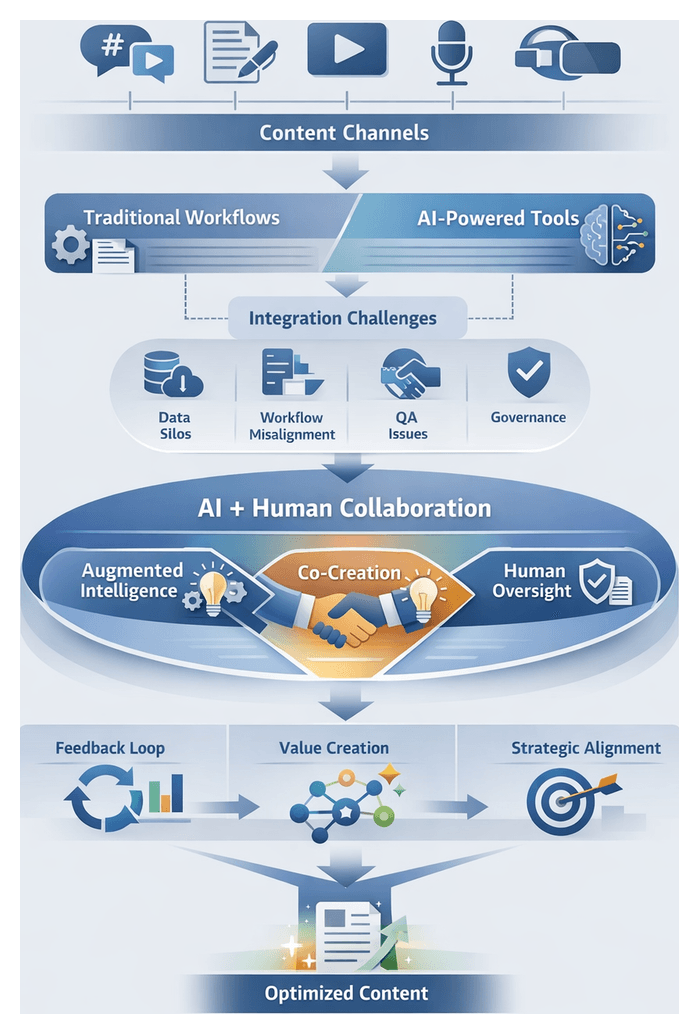
Setting the Stage for the Modern Digital Content Landscape
The creation and distribution of digital content today unfolds amidst a proliferation of channels, formats, and ever-rising audience expectations. Brands must craft narratives for social feeds, blogs, video platforms, podcasts, messaging apps, emails, white papers, interactive tools, and immersive experiences in augmented and virtual reality. Each channel demands unique storytelling approaches, visual assets, metadata strategies, and performance metrics. To sustain relevance and achieve scale, organizations have evolved from manual drafting and desktop publishing to content management systems like WordPress, Drupal and HubSpot, followed by marketing automation suites that enable rule-based personalization and scheduling. More recently, AI-driven platforms such as OpenAI, Copy.ai, Jasper and Grammarly have introduced natural language understanding, generation, and optimization capabilities, promising dramatic productivity gains.
Proliferation of Channels and Formats
- Social media: Short-form visuals, concise captions, interactive polls and stories to drive engagement and shares.
- Blogs and articles: In-depth narratives enriched with data visualizations, infographics, and embedded multimedia for thought leadership.
- Video content: Scripts, storyboards, subtitles and layered audio-visual storytelling optimized for platforms like YouTube and TikTok.
- Podcasts: Structured outlines, show notes and supporting resources to boost discovery, SEO and listener retention.
- Interactive guides: Quizzes, calculators, configurators and immersive modules that adapt to real-time user inputs.
This diversity places immense pressure on content teams to deliver optimized assets rapidly. Legacy editorial calendars and manual hand-offs often become bottlenecks, prompting the adoption of automated engines that can repurpose core messaging, generate localized variants and enforce style guidelines at scale.
Evolution of Content Production Methods
Content workflows have progressed in stages. Early models relied on manual drafting, siloed reviews and desktop publishing. The emergence of CMS platforms streamlined publishing and templating, while marketing automation enabled bulk campaigns and simple personalization rules. Programmatic content further allowed dynamic data insertion—user location, behavior and demographics—into preapproved templates, boosting relevance yet lacking creative nuance. The latest wave introduces AI-driven agents that draft coherent text across topics, optimize headlines for SEO, recommend imagery based on semantic analysis and perform translations for global audiences.
Standalone tools such as Copy.ai and Jasper and integrated modules within enterprise suites now handle first drafts, A/B headline tests and variant creation. Despite these capabilities, many organizations deploy AI in isolated pockets—one team uses an AI for email subject lines, another relies on human editors for press releases—leading to redundant efforts, inconsistent brand voice and quality variances.
Integration Challenges Across Systems and Teams
- Siloed Tool Ecosystems: Disconnected platforms impede seamless asset hand-off and unified reporting.
- Data Fragmentation: Inconsistent metadata and scattered audience profiles limit personalization fidelity.
- Process Misalignment: Manual approval gates stall automated drafts, while unsupervised AI output may stray from brand guidelines.
- Quality Assurance Gaps: AI can generate errors or biased content that require human review for factual accuracy and legal compliance.
- Change Management Resistance: Creative teams may perceive AI as a threat, underutilizing its potential.
- Technical Debt: Legacy systems often lack APIs or plugin architectures needed for real-time AI integration.
Addressing these hurdles demands cross-functional collaboration among IT, marketing, legal and creative departments. Shared objectives, clear governance and continuous feedback loops unite stakeholders around integration milestones, ensuring that automated capabilities amplify rather than fragment brand consistency.
Creative Synergy: Balancing AI and Human Ingenuity
Creative synergy emerges when AI agents and human creators contribute complementary strengths—algorithmic efficiency, data-driven insights and generative power alongside emotional intelligence, cultural context and storytelling craft. Rather than replacing human ingenuity, AI augments human judgment, stimulating ideation, accelerating iteration and handling routine tasks. Humans, in turn, refine AI outputs, inject strategic intent and ensure that narratives resonate authentically with target audiences.
Interpretive Perspectives on Collaboration
- Augmented Intelligence: AI as a cognitive amplifier, surfacing latent patterns, accelerating research and automating repetitive tasks, freeing creatives for strategic thinking.
- Co-Creative Agents: Generative algorithms act as partners, proposing narrative arcs, stylistic variations or visual concepts that humans shape and contextualize.
- Human-in-the-Loop Governance: Embedded checkpoints where human oversight adjudicates AI recommendations, essential in regulated or brand-sensitive contexts to maintain compliance and ethical standards.
Analytical Frameworks for Assessing Synergy
Collaboration Maturity Model
- Ad Hoc Automation: Isolated AI pilots without governance or integration.
- Defined Processes: AI roles codified within workflows, basic performance tracking.
- Managed Collaboration: Continuous feedback loops between AI outputs and human review, supported by collaborative tooling.
- Optimized Co-Creation: Dynamic adaptation of models based on human input, co-design of prompts and parameters.
- Strategic Synergy: Full integration of AI and human workflows within enterprise content strategy, driving continuous innovation.
Value Co-Creation Framework
- Resource Integration: Algorithmic data processing combined with human expertise to yield differentiated content.
- Actor Roles: Clear division—AI handles sentiment analysis, humans craft narratives—ensuring mutual reinforcement.
- Value Propositions: Benefits such as personalized content at scale, interactive storytelling and rapid experimentation.
- Experience Co-Creation: Audience engagement shaped by AI recommendations and human storytelling techniques.
Decision-Action Feedback Loop
- Iteration Velocity: Speed of AI-generated proposals, human review turnaround and AI refinement.
- Decision Accuracy: Rate of AI outputs approved without modification, indicating alignment with human preferences.
- Learning Amplification: Improvement in AI performance through human feedback, measured by reduced revision rates and enhanced output quality.
Managing Interpretive Tensions
- Authenticity vs. Scale: Preserving human voice and emotional resonance while scaling production.
- Control vs. Autonomy: Balancing centralized governance of AI outputs with creative freedom.
- Innovation vs. Consistency: Enabling exploration of generative models without violating brand standards.
- Transparency vs. Efficiency: Disclosing AI involvement can foster trust but may complicate workflows.
Periodic stakeholder reviews and audience testing panels help navigate these tensions, ensuring that hybrid content meets standards for authenticity, creativity and alignment with strategic goals.
Market Imperatives and Emerging Technologies
Enterprises today face relentless market pressures: surging content volumes, demand for hyper-personalization, cost optimization imperatives and algorithmic complexity. Audiences expect timely, contextually relevant communications across every touchpoint. Automated content generation addresses throughput but often lacks the nuance needed for sustained engagement. AI-human synergy offers a strategic path forward, combining real-time data insights with human editorial expertise to craft semantically rich narratives that perform well in search and recommendation algorithms.
Cost and Performance Drivers
Budgets are scrutinized for measurable ROI. AI agents excel at drafting routine updates, generating data-driven headlines and performing keyword analysis, reducing manual effort and cycle times. Human editors and creative directors are indispensable for ensuring messaging aligns with brand strategy, cultural sensibilities and legal requirements. Hybrid models allocate repetitive tasks to AI while reserving complex editorial judgment for specialized talent, optimizing costs without compromising quality.
Key AI-Driven Tools and Platforms
- ChatGPT for conversational ideation, rapid draft iterations and prompt-based refinement.
- Jasper AI for persona-based templates, tone adaptation and variant generation.
- Adobe Firefly for text-to-image generation and design asset creation.
- Canva Magic Write for integrated generative writing in collaborative design workflows.
- Microsoft Copilot for AI assistance across productivity applications and document authoring.
- Google Cloud AI suite for enterprise-grade AI services embedded in content management systems.
Forward-looking organizations integrate these tools into unified creative ecosystems that ensure interoperability, govern version control and preserve asset traceability from ideation through publication.
Competitive Dynamics and Industry Trends
Early adopters of AI-human frameworks accelerate campaign launches by up to 40 percent and demonstrate higher engagement and retention. Agencies and in-house studios face CTOs and CFOs demanding evidence of impact on KPIs such as conversion, time-on-page and brand lift. Cross-functional governance committees align marketing, IT, legal and finance on AI investments, ethical guidelines and resource allocation. Meanwhile, digital-native competitors leverage micro-personalization, voice assistants and social commerce channels to experiment rapidly, compelling legacy brands to upskill teams in prompt engineering, model evaluation and data interpretation.
Strategic Frameworks for Integration, Governance and Future Readiness
Realizing the full potential of AI-human synergy requires structured decision-making tools, robust governance, continuous performance monitoring and a culture of experimentation. Organizations must align technological investments with strategic content objectives, ensure ethical and legal compliance, and equip teams with the skills to co-create effectively with AI.
Analytical Frameworks for Resource Allocation
Value-Chain Mapping
Document the end-to-end content process—from ideation, research and drafting to review, distribution and analytics—to identify stages where AI augmentation delivers maximum efficiency and where human curation is essential.
Capability-Suitability Matrix
Plot AI strengths (speed, scalability, pattern recognition) against human strengths (nuance, originality, audience empathy) to assign tasks to the optimal collaborator.
Governance and Risk Management
- Establish clear policies for authorship attribution, intellectual property and ethical AI usage.
- Implement rigorous review processes to detect bias, factual errors and tone inconsistencies.
- Form cross-functional review boards to oversee brand alignment, regulatory compliance and reputational risk.
Tool Selection and Interoperability
Choose AI platforms that integrate via APIs and plugins with existing content management and analytics systems to avoid workflow disruption. Consider flexible solutions such as ChatGPT for customizable integration and prompt management.
Performance Monitoring and Continuous Learning
- Track real-time engagement, conversion rates and brand lift to evaluate hybrid content effectiveness.
- Refine prompt designs, review workflows and training datasets based on analytics insights.
- Establish experiment labs and knowledge-sharing forums to pilot emerging AI modalities and share best practices.
Key Limitations and Risk Factors
Even advanced AI models can misunderstand context, exhibit cultural insensitivity or surface biased language influenced by training data. Overreliance on AI for novelty risks homogenization, as models recombine existing patterns rather than generate fundamentally original ideas. Robust human oversight, diverse training data and deliberate sessions of human-only brainstorming mitigate these risks.
Future-Focused Considerations
Advances in multimodal AI, adaptive co-authoring interfaces and immersive experiences will continue to reshape content creation. Organizations that maintain a learning mindset, engage proactively with ethical and regulatory developments, and contribute to industry standards will lead in crafting responsible, innovative and impactful storytelling experiences.
Summary of Strategic Insights
- An integrated view of where AI provides scale and where human creativity remains indispensable.
- Analytical tools—value-chain mapping and capability-suitability matrices—to guide task allocation.
- Governance frameworks and risk management processes to ensure quality, compliance and brand integrity.
- Recommendations for capability building, interoperable tool selection and performance monitoring.
- A roadmap for continuous adaptation to evolving AI capabilities and market dynamics.
By synthesizing these insights into clear strategies and governance structures, content leaders can architect adaptive, ethically grounded operations that harness both AI efficiency and human ingenuity for high-impact digital storytelling.
Chapter 1: The Evolution of Content Creation in the Digital Age
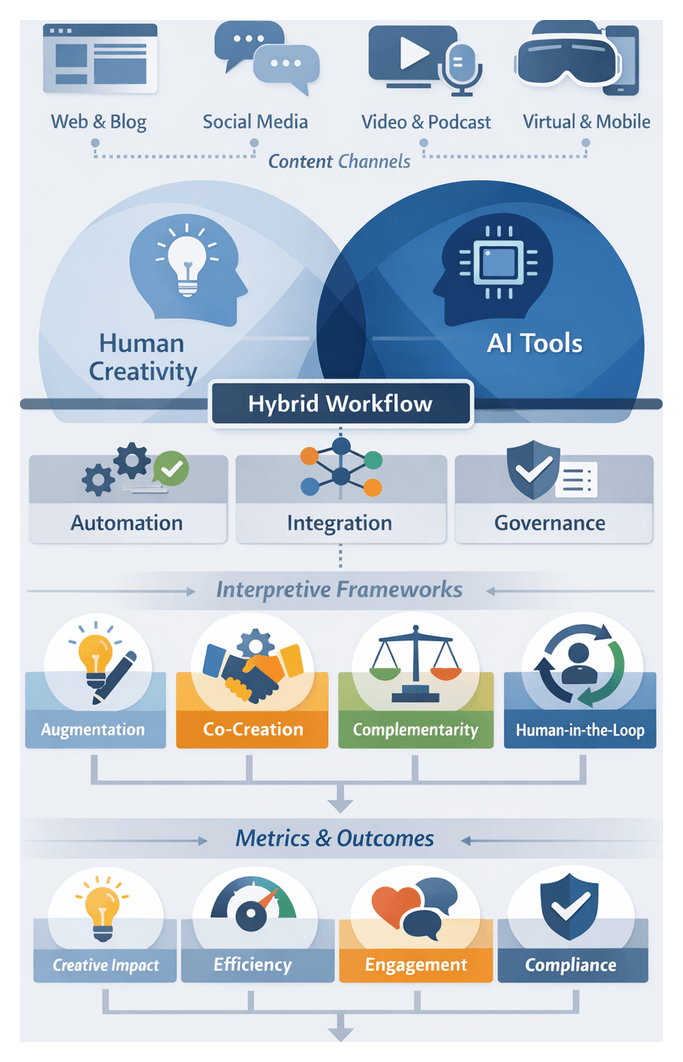
The Evolving Digital Content Ecosystem
Organizations today operate within a hyperconnected environment in which digital content proliferates across diverse platforms—websites, blogs, social media networks, mobile applications, podcasts, video streaming services and immersive virtual events. Audiences expect personalized, on-demand experiences, placing pressure on brands and publishers to generate targeted content at scale. Each channel carries unique technical requirements, audience behaviors and performance metrics. Social networks such as LinkedIn, Facebook, Twitter and emerging platforms demand real-time posting and community engagement. Owned properties host long-form assets—whitepapers, e-books, case studies—designed to capture leads and establish thought leadership. Visual and audio formats, from YouTube videos and live streams to podcast series and short-form TikTok clips, cater to varied consumption preferences. Interactive environments in mobile apps and virtual events further elevate expectations for curated content and user participation.
This diversity of formats, frequencies and responsiveness creates a production environment where traditional manual processes struggle to keep pace. To maintain visibility and audience trust, organizations must balance breadth with depth—ensuring that content resonates in context while scaling volume efficiently.
Automation, AI Tools, and Integration Challenges
To meet escalating demands, enterprises have adopted automation technologies ranging from content management systems (CMS) and marketing automation platforms to advanced AI agents. Early solutions enabled scheduling, distribution and basic personalization. Recent advances in natural language processing and machine learning have produced specialized generative applications capable of:
- Producing initial drafts from outlines or prompts by leveraging models such as GPT-4 and Google’s Gemini;
- Optimizing headlines, meta descriptions and social snippets to improve SEO and engagement;
- Analyzing audience behavior and sentiment across platforms, feeding insights back into topic selection and tone calibration;
- Automating translation and localization workflows for global reach;
- Orchestrating multiple specialized agents for ideation, drafting and optimization;
- Streamlining collaborative review through platforms like Jasper and interactive assistants such as ChatGPT.
By automating routine or data-intensive tasks, these tools free human teams to focus on strategy, creativity and relationship building. Yet integrating these systems with human artistry introduces significant challenges:
- Maintaining Brand Voice and Quality: AI excels at consistent syntax but may lack contextual nuance. Human oversight is essential to preserve tone, values and storytelling conventions.
- Data Silos and Workflow Fragmentation: Disconnected point solutions for SEO, social scheduling or translation can lead to version conflicts and handoff delays.
- Governance and Compliance: Automated models may reproduce biases or sensitive content. Clear audit trails and governance workflows are imperative to manage risk.
- Role Clarity and Skill Gaps: As AI handles keyword research or draft generation, human roles must evolve toward strategic oversight, editorial leadership and prompt engineering.
- Technical Integration and Scalability: Robust APIs, middleware and data governance models are required for seamless collaboration between CMS, analytics platforms, automation engines and AI services.
Addressing these challenges demands a holistic approach: defining end-to-end content lifecycles, aligning stakeholders on quality standards, and establishing integrated operating models.
Models of AI-Human Creative Collaboration
Creative synergy refers to the dynamic collaboration between AI agents and human creators that yields content exceeding what either could achieve alone. Thought leaders increasingly frame AI as a catalyst that amplifies human capacity rather than a replacement. Three industry orientations illustrate this shift:
- Augmentation-First Approach: AI suggestions for headlines, story arcs or visual palettes integrate directly into creative environments. Editorial assistants propose alternative sentence structures and image-generation tools supply mood boards for human refinement.
- Co-Creation Frameworks: AI agents learn from author revisions, engaging in iterative dialogs with writers. Interactive media and game design teams use these frameworks to generate plot variations that evolve with human adjustments.
- Data-Driven Innovation: AI analyzes engagement metrics and sentiment data to inform human brainstorming. Predictive models identify trending topics and optimal publication schedules, while creatives ensure narrative vision and brand consistency.
To guide organizational design, experts propose interpretive frameworks:
- Complementarity Model: Allocates routine, data-intensive processes—keyword research, A/B testing, template copy—to AI, reserving cultural context, emotional resonance and strategic judgment for humans.
- Human-in-the-Loop Paradigm: Treats AI outputs as provisional drafts. Human editors validate, refine or reject suggestions to align content with brand voice and compliance standards.
- Adaptive Learning Cycle: AI models continuously learn from human corrections and style guidelines. Creators periodically recalibrate parameters and introduce new data sources, fostering co-evolution.
- Orchestration Architecture: A central layer routes content briefs to specialized modules—natural language processors, image synthesizers, sentiment analyzers—and aggregates outputs for human review, enabling scale with consistent governance.
Strategic Frameworks and Performance Metrics
Measuring AI-human synergy requires multidimensional metrics combining quantitative and qualitative lenses:
- Creative Impact: Assesses originality, narrative depth and emotional resonance through expert panels or audience scoring systems.
- Operational Efficiency: Tracks time-to-publication, throughput volumes and cost per asset, comparing hybrid workflows to human-only processes.
- Engagement Quality: Goes beyond click metrics to measure dwell time, interaction depth and social sentiment using tools like ChatGPT and Google’s Bard.
- Governance and Compliance: Monitors adherence to editorial, regulatory and ethical standards. Automated auditing tools flag biases, copyright issues and brand-voice deviations.
A dual-axis model helps teams map projects by operational metrics—content velocity, cost, throughput—and qualitative metrics—brand alignment, engagement depth, creative originality. This mapping informs whether tasks should be machine-driven volume or human-led narrative.
Content lifecycles typically span three phases: ideation and research, creation and synthesis, and review and refinement. AI agents excel in the first two phases by aggregating data, suggesting structures and producing draft variants. Human creators dominate the refinement phase—ensuring contextual appropriateness, verifying factual accuracy in regulated contexts, and infusing cultural sensitivity.
Embedding continuous feedback loops connects human edits and audience responses back into AI model fine-tuning and editorial guidelines, fostering an adaptive ecosystem of collective intelligence.
Sector-Specific Applications and Market Dynamics
The convergence of AI agents and human ingenuity has become a strategic imperative across industries. Firms adopting hybrid content models report up to a 40% reduction in production time and a 25% increase in engagement metrics. Recent technological enablers include GPT-4, Google’s Gemini, orchestration platforms like Jasper, and generative imagery tools such as Adobe Firefly.
Sector-specific impacts:
- Digital Media and Publishing: AI generates data briefs, topic synopses and real-time fact-checking, freeing journalists for investigative reporting.
- E-commerce and Retail: Automated product descriptions and dynamic promotional copy scale catalog updates, while human strategists refine messaging for key customer segments.
- B2B Marketing and Thought Leadership: Machine-assisted research aggregation supports whitepaper drafting, with experts injecting domain credibility and strategic framing.
- Financial Services and Insurance: AI ensures regulatory compliance in routine communications, enabling advisors to focus on personalized insights and relationships.
- Education and Training: Intelligent tutoring systems personalize learning pathways, complemented by instructional designers who embed pedagogical nuance.
Competitive differentiation arises from a two-stage model: machine-driven volume followed by human-led refinement. This blend delivers freshness and relevance without sacrificing brand distinction.
Governance, Ethics, and Implementation Considerations
Effective implementation requires proactive governance, ethical safeguards and careful change management:
- Governance Frameworks: Define roles, responsibilities and decision rights across AI agents and human creators. Establish prompt approval protocols, editorial review gates and escalation paths for quality exceptions.
- Ethical Safeguards: Conduct bias audits, enforce data provenance standards and maintain transparency reports. Declare AI-assisted content and document audit trails to uphold audience trust.
- Technical Integration: Ensure interoperability between CMS, analytics platforms and AI engines. Anticipate challenges when connecting tools such as Copy.ai and Jasper, addressing latency, data silos and security vulnerabilities.
- Talent Development: Realign team structures around emerging roles—prompt engineering, data analysis, AI ethics. Offer structured training to bridge skill gaps and foster collaborative mindsets.
- Scalability Roadmaps: Adopt phased rollouts, pilot high-velocity content zones before enterprise-wide deployment. Use dual-track pilots to compare AI integration in social media campaigns versus long-form thought leadership.
- Limitations and Risks: Acknowledge boundary conditions—contextual accuracy in regulated industries, overreliance on automation, QA overhead and the tension between scalability and customization.
By institutionalizing governance mechanisms, embedding continuous feedback loops and fostering a culture of collaborative innovation, organizations can harness AI’s scalability without relinquishing the human spark that drives memorable storytelling.
Chapter 2: Understanding AI Agents and Their Capabilities
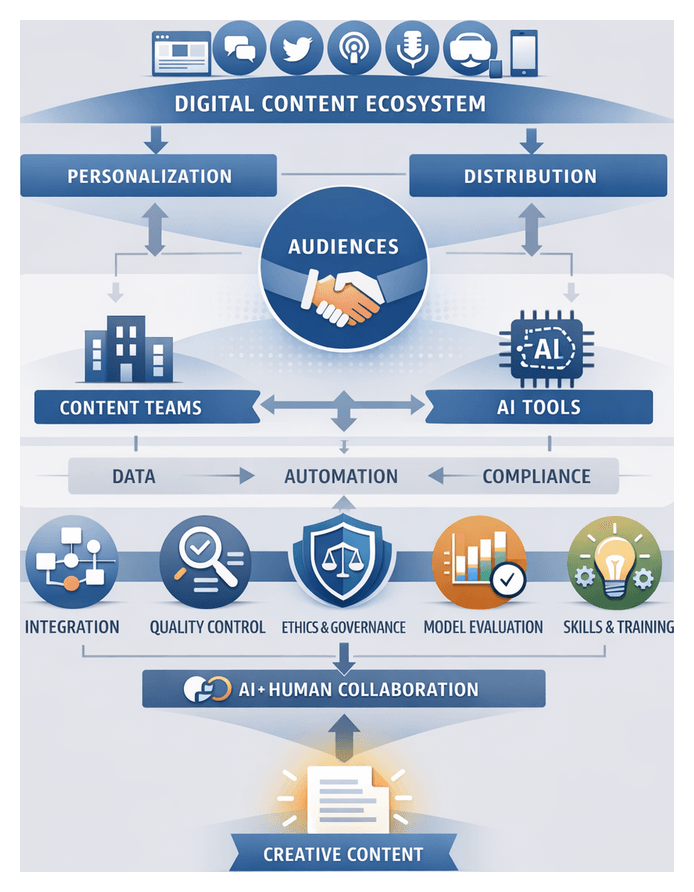
The Modern Digital Content Ecosystem
The volume and variety of digital content have surged as audiences engage across web pages, social media, mobile apps, podcasts, video platforms and emerging immersive environments. Static HTML pages and basic content management systems have given way to dynamic blogs, micro-content streams and multimedia pipelines spanning video, audio, interactive graphics and even augmented reality. With each new device—from smart speakers to wearable displays—content teams juggle distribution, personalization and compliance across an ever-expanding landscape.
Consumers now expect data-driven, personalized messaging delivered at precisely the right moment on their preferred channels. Marketing, editorial and product teams compete to satisfy these expectations while preserving brand voice, quality standards and regulatory compliance. Traditional human-only workflows often buckle under these demands, prompting organizations to adopt automated tools to boost efficiency without sacrificing creativity or authenticity.
AI-Driven Automation: Tools and Integration
Automated systems have moved from experimental pilots to core components of modern content operations. Natural language generation engines power first drafts of blog posts, product descriptions and email campaigns. Machine learning modules analyze performance metrics, suggest topics, and optimize distribution tactics in real time. Automated proofreading and style-checking tools enforce brand guidelines and accelerate review cycles.
Leading platforms such as OpenAI GPT-4 and Adobe Sensei provide APIs and pre-built integrations for popular content management systems. Marketing automation suites embed AI-driven segmentation, personalization and predictive analytics. Yet deploying these services requires careful configuration, training on domain-specific data, and seamless connectors to legacy repositories, editorial calendars, analytics stores and customer profiles.
- Data Silos and Fragmented Systems: Integrating AI across isolated media asset libraries, editorial plans and customer profiles demands both technical glue and organizational alignment.
- Quality Assurance: Automated drafts can contain factual errors or tone mismatches. Robust review frameworks are essential to ensure accuracy and brand consistency.
- Workflow Alignment: Embedding AI tools often requires redefining roles and retraining staff. Change management strategies help overcome resistance and unlock benefits.
- Governance and Compliance: Policies must address intellectual property, data usage, attribution and regulatory requirements for AI-generated content.
- Talent and Skills: New roles such as prompt designers and AI content curators bridge editorial expertise and technical fluency.
- Bias and Ethical Risks: Models trained on unbalanced data can perpetuate stereotypes. Bias audits, dataset diversification and ethical guardrails are critical.
Evaluating and Selecting NLP and ML Solutions
Organizations employ quantitative benchmarks and human-centered evaluations to assess NLP models. Key metrics include:
- Perplexity and Cross-Entropy: Measure a model’s confidence in predicting text sequences. Lower scores indicate greater fluency.
- BLEU and ROUGE: Gauge overlap between machine outputs and human references for translation and summarization tasks.
- Precision, Recall and F1: Evaluate classification and information extraction accuracy.
- Human Evaluation Panels: Expert reviewers assess clarity, tone and cultural appropriateness beyond statistical metrics.
Comparative benchmarks across architectures guide tool selection:
- Transformer-Based Models: GPT-4, T5 excel at coherent generation, conversational agents and creative writing.
- Encoder-Decoder Frameworks: BART, Pegasus specialize in abstractive summarization and translation.
- Contextual Embedding Models: BERT, RoBERTa power classification, sentiment analysis and metadata tagging.
- Retrieval-Augmented Generation: Combines external knowledge bases with generative models to enhance factual accuracy in regulated contexts.
Strategic frameworks align technology with content objectives:
- Capability-Maturity Grid: Plots tools by linguistic fidelity, domain adaptability and production readiness.
- Use-Case Fit Analysis: Matches architectures to tasks such as ideation, drafting, localization or analytics.
- Resource Footprint Assessment: Weighs computational costs, latency and infrastructure requirements. Cloud-native APIs like Hugging Face Transformers and IBM Watson are benchmarked for scalability and ease of integration.
- Governance and Compliance Filters: Ensures model selection aligns with privacy regulations, bias mitigation and auditability needs.
Embedding AI Agents in Creative Workflows
AI agents have become strategic imperatives in creative environments—marketing agencies, newsrooms, e-learning studios and corporate communications. These systems catalyze ideation, amplify human talent and optimize output. Expert frameworks include:
- Creative Augmentation Model: Positions agents on a spectrum from ideation support to near-autonomous generation, defining required human oversight.
- Human-in-the-Loop Paradigm: Embeds continuous feedback loops where human judgment refines AI suggestions to preserve nuance and brand voice.
- Sociotechnical Systems View: Examines the interplay of technology, organizational structure and human behavior.
- Capability Maturity Matrix: Maps stages from template-based drafting to context-aware narrative construction, guiding investment priorities.
Deployment spans sectors:
- Marketing and Advertising: Rapid A/B testing of copy variants, persona development and keyword optimization at scale.
- Media and Publishing: AI summarization and data visualization accelerate news workflows and surface emerging stories.
- E-Commerce and Retail: Personalized product descriptions and campaign messaging trained on consumer behavior data boost conversions.
- Education and E-Learning: Adaptive lesson content, formative assessments and scenario narratives aligned to learner progress.
- Corporate Communications: Automated draft generation for newsletters, executive speeches and stakeholder reports, paired with sentiment analysis.
Managing Risks: Governance, Ethics, and Oversight
AI agents operate within evolving ethical and regulatory frameworks addressing data privacy, intellectual property and disclosure requirements. Effective oversight models balance automation and human control through:
- Governance Structures: Clear decision rights and accountability channels for AI-human collaboration.
- Ethical Guardrails: Policies on data provenance, authorship attribution and transparency to uphold trust.
- Explainability Protocols: Feature-importance analyses, attention visualizations and model cards for auditability.
- Bias Mitigation: Quantitative disparity scores, dataset diversification and diverse focus groups to detect and correct bias.
- Validation Archetypes: Advisory (brainstorming partner), validation (automated reviewer), augmentation (task execution under supervision).
Domain practitioners recognize that AI’s semantic comprehension is statistical, not experiential. Surface-level coherence may mask gaps in contextual understanding, cultural sensitivity and substantive reasoning. Human review—particularly in regulated industries such as finance, healthcare, legal and pharmaceuticals—is therefore indispensable.
Building a Sustainable Hybrid Model
The most effective content strategies combine AI proficiency with human creativity under clear governance. Key strategic considerations include:
- Stakeholder Buy-In: Engage creatives, legal teams and executives in pilot programs to define success criteria and foster collaboration.
- Performance Metrics: Develop KPIs capturing efficiency gains, quality improvements, audience engagement and compliance.
- Change Management: Provide training, knowledge-sharing forums and incentives to encourage experimentation while preserving core creative values.
- Continuous Monitoring: Implement feedback loops to track error rates, user sentiment and model drift, enabling iterative refinement.
- Infrastructure Planning: Balance on-premises clusters with elastic cloud resources. Model quantization and selective offloading optimize cost and latency.
- Knowledge Management: Centralize content libraries, taxonomies and metadata to support cross-functional reuse and ongoing AI training.
By foregrounding analytical rigor, ethical stewardship and collaborative cultures, organizations can harness AI’s transformative potential without ceding creative control. Hybrid workflows unlock scalability, resilience and strategic agility—positioning content operations as a driver of brand value, customer engagement and revenue growth in the digital age.
Chapter 3: The Essence of Human Creativity in Writing
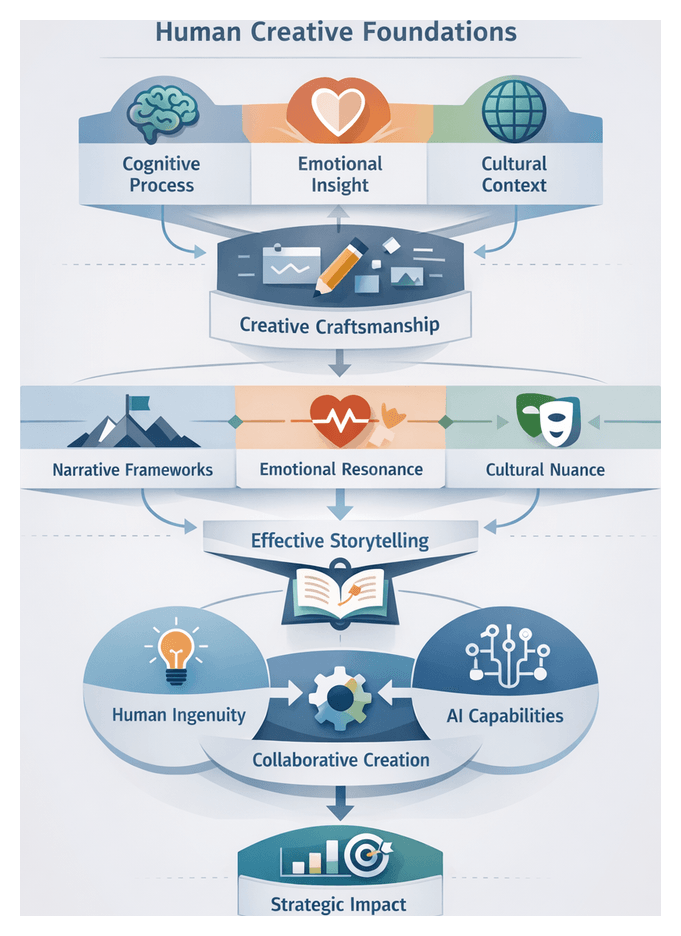
Human Creative Foundations
At the core of compelling content lies a uniquely human capacity to blend cognitive rigor, emotional insight and cultural awareness. This creative foundation extends beyond assembling words or data—human authors exercise judgment, intuition and lived experience to craft narratives that resonate, inspire and endure. Understanding these cognitive and expressive pillars is essential for organizations seeking depth, authenticity and strategic impact in their content.
Cognitive Drivers of Creativity
Human creative thought unfolds through interrelated mental processes that enable ideation, problem solving and narrative construction. Key components include:
- Divergent Thinking: Generating multiple possibilities rather than a single solution, opening pathways for originality.
- Associative Memory: Drawing on past experiences and knowledge to form unexpected connections between ideas.
- Analogical Reasoning: Applying patterns from one domain to enrich concepts in another, fostering layered meaning.
- Metacognition: Reflecting on one’s own thinking to refine ideas, mitigate biases and guide creative choices.
By balancing exploration with critical evaluation, human creators navigate complexity and select concepts that align with strategic goals.
Emotional and Contextual Insight
Emotion infuses content with resonance. Empathy enables writers to inhabit audience perspectives, tailoring tone, pacing and anecdotes to evoke curiosity, trust or urgency. Emotional regulation ensures that passion enhances rather than overwhelms clarity. Equally vital is cultural nuance: human authors adapt language to regional idioms, professional jargon and evolving trends, weaving metaphors and symbols that draw on shared histories and societal norms. This deep contextual attunement nurtures trust and relevance in ways purely algorithmic systems cannot fully replicate.
Iterative Craftsmanship and Authentic Voice
True creativity thrives through cycles of ideation, critique and refinement. Initial concepts evolve through peer review, audience testing and editorial scrutiny. Editors make stylistic choices—word selection, sentence rhythm and narrative voice—that elevate clarity and reinforce brand personality. Personal voice and authenticity emerge when authors integrate their values, experiences and anecdotes, forging a human connection that builds loyalty. Ethical stewardship underpins every creative decision, guiding fairness, representation and transparency to maintain credibility and respect diverse perspectives.
Storytelling and Emotional Nuance
Storytelling is the vehicle through which ideas gain emotional depth and cultural significance. Human authors structure narratives that engage audiences from opening to resolution, employing frameworks and emotional arcs that transcend mere information delivery.
Narrative Architecture
Creators draw on classic and contemporary models to frame content strategically:
- Hero’s Journey: Positioning brands or individuals as protagonists overcoming challenges and driving transformation.
- Problem–Solution Arc: Establishing empathy through shared pain points, then showcasing unique value propositions.
- Anthropological Storytelling: Leveraging cultural metaphors and archetypal motifs to deepen audience resonance.
Selecting and adapting these architectures requires contextual judgment to align narrative structures with organizational goals and audience expectations.
Emotional Resonance
Emotional drivers engage attention, shape memory and motivate action. Content strategists apply insights from Emotional Contagion Theory, Affective Neuroscience and Brand Emotion frameworks to craft subtext, tension and release. While sentiment analysis and A/B tests can validate impact, the initial creation of nuanced emotional beats remains an interpretive art that relies on empathy, cultural literacy and lived experience.
Cultural Context and Interpretive Frameworks
Effective narratives navigate cultural ecosystems where symbols, tropes and conventions carry diverse meanings. Human practitioners use Intercultural Communication theory, Cultural Semiotics and ethnographic Contextual Inquiry to ensure authenticity and avoid misinterpretation. They embed intentional ambiguity, symbolic layering and rhetorical devices that invite audiences to co-construct meaning—an engagement depth beyond current AI capabilities.
Building Trust Through Story
Trust emerges from transparency, consistency and authenticity. Human authors incorporate verifiable data, clear attribution and personal anecdotes as authenticity signals. Editorial review and peer feedback loops validate narrative integrity, while ethical guidelines ensure balanced perspectives and prevent manipulative tactics. This conscientious approach reinforces credibility across channels and strengthens audience relationships.
AI-Human Creative Synergy
Blending human ingenuity with AI-driven tools creates a co-creative model where each party amplifies the other’s strengths. Rather than replacing human insight, AI agents handle routine tasks and data synthesis, freeing creators to focus on narrative strategy, emotional nuance and judgment.
Conceptualizing Synergy
Creative synergy evolves from tool-centric automation to collaborative partnerships. AI accelerates research, draft generation and pattern recognition, while humans contextualize outputs, refine tone and ensure strategic alignment. This reciprocal workflow enhances scalability without sacrificing brand voice or emotional depth.
Industry Frameworks
- Complementary Roles Model: Assigning research, data analysis and rapid iteration to AI, and contextual judgment, narrative design and ethical oversight to human experts.
- Orchestration Framework: Treating AI agents—such as GPT-4—and platforms like Jasper AI as instrumental sections in a creative orchestra, with human strategists conducting overall thematic direction.
- Human-in-the-Loop Continuum: Embedding continuous feedback loops in tools like ChatGPT, where human reviewers guide generative models through iterative prompts and brand-specific adjustments.
- Value-Creation Matrix: Mapping tasks by innovation and repeatability—automating high-volume summaries and reports, while reserving bespoke storytelling for human teams supported by AI-driven research and sentiment analysis.
Measuring Impact
Successful synergy balances efficiency, quality and strategic impact:
- Efficiency Metrics: Cycle time reduction and cost per asset—AI often cuts drafting time by 30–50 percent, allowing human talent to focus on high-value work.
- Quality Metrics: Brand voice consistency and error rates—tools like Grammarly enforce style guidelines, while human editors validate emotional resonance and cohesion.
- Strategic Impact Metrics: Engagement lift, conversion rate and share of voice—hybrid content frequently outperforms fully manual or automated outputs in click-through and social amplification.
A balanced scorecard ensures that efficiency gains do not compromise narrative quality or audience trust.
Governance and Adoption Strategy
Implementing AI–human workflows requires cross-functional collaboration among content operations, data science and legal teams. Defining decision rights, quality standards and compliance thresholds establishes clear handoff points where AI outputs undergo human review and augmentation. Pilot projects yield insights that inform tool selection, scaling strategies and talent development, enabling organizations to evolve alongside advances in generative AI while preserving creative leadership.
Strategic Considerations and Future-Proofing
Maximizing the value of human creativity and AI synergy demands nuanced strategy, continuous evaluation and adaptive organizational design.
Balancing Novelty and Familiarity
Innovative ideas must align with audience expectations and brand coherence. Too much novelty can alienate followers; too little risks blending into a crowded landscape. Creative teams reconcile this by anchoring fresh concepts in recognizable brand signals and audience values, ensuring both differentiation and relevance.
Ethics and Authenticity
Authenticity is an ethical imperative and strategic differentiator. Human teams uphold transparency, consent and accurate attribution, especially when handling personal stories or sensitive topics. Embedding ethical review processes in workflows safeguards reputation and aligns content with corporate values.
Expertise, Scalability and Integration
High-value content often demands deep domain knowledge—legal, medical or financial expertise—that transcends AI’s pattern-based outputs. Organizations must allocate human specialists to tasks requiring interpretive frameworks and scenario analyses, while leveraging AI for routine updates, data summaries and preliminary research. Clear integration points and handoff protocols ensure that AI-generated suggestions are contextualized and refined by domain experts.
Organizational Design and Continuous Evolution
Human creativity flourishes in environments that foster autonomy, cross-functional collaboration and psychological safety. Leaders should assemble teams combining veteran storytellers, data analysts and cultural consultants. Decision matrices guide when to deploy premium creative resources versus AI-assisted workflows. Regularly reviewing performance metrics—engagement depth, sentiment analysis and conversion rates—enables strategic recalibration, ensuring that resource allocation adapts to audience feedback and market dynamics. Investing in training for narrative design, visual storytelling and ethical stewardship equips human talent to lead in an AI-augmented future.
Chapter 4: Comparative Analysis - AI Efficiency Versus Human Ingenuity
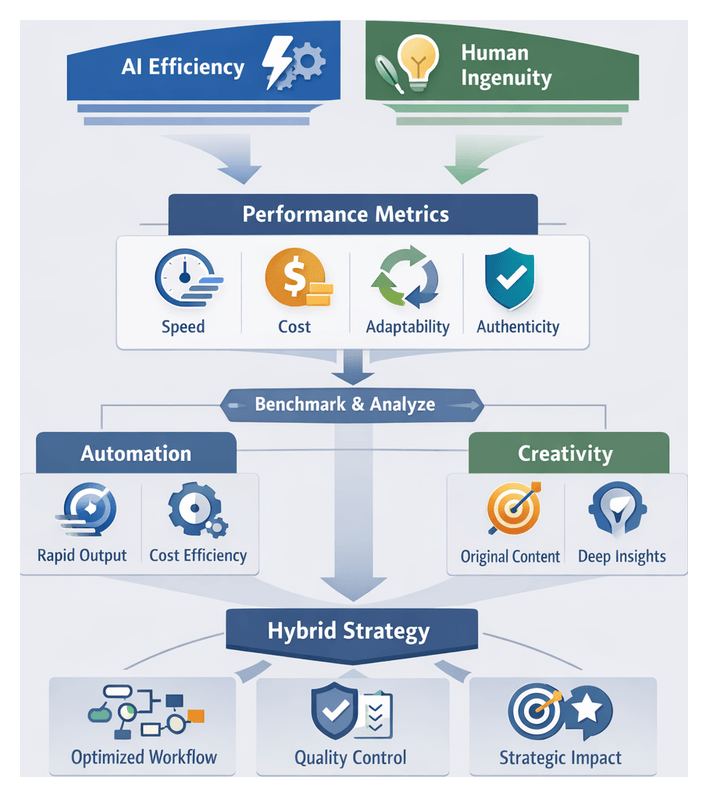
Contextualizing Efficiency and Ingenuity Metrics
Organizations producing digital content must navigate the dual imperatives of operational speed and creative depth. As AI-driven systems such as GPT-4 and Jasper AI automate routine tasks, decision-makers require a clear evaluative framework. Efficiency captures measurable gains in productivity and cost savings, while ingenuity reflects human contributions to narrative originality, emotional resonance, and strategic framing. By defining precise metrics for these dimensions, teams can align investments, optimize workflows, and choose whether to deploy automated agents or human experts for each content initiative.
Defining Core Performance Metrics
A robust framework rests on four primary metric categories that balance operational performance with creative quality:
- Speed: Time from task initiation to published deliverable, including draft generation and revision cycles.
- Cost: Total resource expenditure, spanning subscription fees, compute costs, salaries, and overhead.
- Adaptability: Ease of repurposing content across formats, channels, and audience segments.
- Authenticity: Alignment with brand voice, narrative originality, and emotional impact.
Anchoring analysis in these categories enables balanced assessment of AI’s throughput advantages against the nuanced capabilities of human creativity.
AI Efficiency in Content Workflows
Modern AI agents excel at rapid output and standardized formatting. Platforms like GPT-4 and Jasper AI generate headlines, outlines, and full drafts within seconds, reducing time to first draft by orders of magnitude. Efficiency measurement involves tracking turnaround times for defined tasks, such as metadata creation or SEO-driven paragraphs, and comparing them to human benchmarks.
Cost analysis aggregates subscription and compute expenses, yielding indicators like cost per word and cost per finalized draft. In adaptability, AI systems produce multiple content variants—blog posts, email subject lines, ad copy—from a single prompt. Teams measure the ratio of AI-generated variants that require no manual edits. Authenticity assessment involves brand compliance checks against style guides, where AI outputs often fall short, indicating the necessity of human review for tone consistency and narrative alignment.
Human Ingenuity and Depth of Insight
Human authors contribute domain expertise, cultural awareness, and storytelling finesse that machines cannot replicate. Although the initial drafting process is slower—requiring research, interviews, and iterative editing—these investments yield high-stakes deliverables such as white papers, thought leadership pieces, and brand manifestos.
Cost components include salaries, benefits, and ongoing professional development, varying with specialization and project complexity. Human adaptability is evident in seamless integration of qualitative research and stakeholder feedback. Authenticity metrics, including narrative coherence, voice consistency, and cultural sensitivity, typically favor human authorship.
To quantify ingenuity, organizations deploy:
- Peer review scores on analytical rigor and originality.
- Audience engagement metrics—time on page, social shares, sentiment analysis.
- Qualitative feedback from focus groups and expert panels.
Comparative Benchmarking and Workflow Design
Benchmarking requires side-by-side comparisons of AI and human outputs using uniform criteria. Typical paired tasks might involve generating a 500-word blog post via an AI agent and commissioning an expert writer for an equivalent piece. Key indicators include time to first and final draft, cost per draft, number of revisions, and post-publication performance metrics. Aggregating data across content types produces baseline values to guide hybrid workflow design.
Foundational insights for hybrid workflows include:
- Task segmentation by metric thresholds: Assign high-volume, low-complexity tasks to AI and reserve nuanced narrative development for human teams.
- Quality checkpoints: Implement human review stages for any content where authenticity is critical.
- Iterative prompt calibration: Use performance feedback to refine AI prompt structures and improve alignment with brand standards.
- Skill development: Train writers in prompt engineering and AI oversight to enhance strategic contributions.
Strategic Content Roles and Contextual Suitability
Optimal division of labor depends on content objectives, risk profiles, and resource capabilities. Critical contextual considerations include:
- Market-Driven Volume: In e-commerce, news media, and financial services, high-volume demands favor AI platforms like GPT-4 and Jasper AI for rapid generation of product descriptions, updates, and reports. Human specialists oversee brand storytelling and validate emerging cultural nuances.
- Regulatory Compliance: Sectors such as healthcare, pharmaceuticals, and banking require precise terminology and disclaimers. Tools like Compliance.ai scan documents for non-compliant language, while legal experts interpret policy shifts and retain decision-making authority.
- Creative Branding: Emotional engagement campaigns demand narrative layering, cultural literacy, and symbolic language. AI drafts may offer headline variants or brainstorming prompts, but human teams craft and refine brand ethos through metaphors and allegories.
- Data-Intensive Personalization: Marketing platforms such as Optimizely and Dynamic Yield deliver AI-driven content recommendations and real-time A/B testing. Strategists define segmentation logic, audit outputs for fairness, and balance personalization with data privacy regulations.
- Crisis Communication: In emergencies, AI tools like Crisp monitor social sentiment and draft initial statements. Communication specialists ensure authenticity, ethical sensitivity, and adherence to organizational values in final messaging.
- Interactive Experiences: Conversational platforms such as Dialogflow and Rasa handle routine user interactions, while human agents manage escalations and deliver domain-expert responses.
This mapping aligns task complexity, creative depth, compliance demands, time sensitivity, and ethical risk with the strengths of AI and human contributors.
Governance, Quality Control, and Cost Considerations
Maintaining brand integrity and regulatory compliance requires robust governance frameworks. Key elements include:
- Multi-stage reviews: AI drafts undergo human editing for factual accuracy, tone alignment, and bias mitigation.
- Prompt templates and content filters: Guardrails that constrain AI outputs within approved style and compliance parameters.
- Performance analytics: Dashboards that monitor throughput, engagement, and anomaly detection to inform continuous refinement.
- Transparency policies: Disclosures of AI usage where appropriate to preserve audience trust and meet evolving regulations.
Cost analysis must account for AI subscription fees, integration and fine-tuning expenses, and human resource investments in talent acquisition and training. Hybrid deployments optimize total cost of ownership by automating standardized tasks and directing human expertise toward innovation and brand differentiation.
Limitations, Mitigation, and Continuous Improvement
AI capabilities remain bounded by training data quality and algorithmic design. Common limitations include:
- Bias and outdated information: Unchecked training corpora can perpetuate stereotypes or present obsolete facts.
- Creative boundaries: Machines struggle with truly novel metaphors, cultural subtleties, and emotional depth.
- Over-automation risks: Excessive reliance on AI can erode brand uniqueness and audience trust.
Mitigation strategies encompass:
- Regular model updates: Incorporate sector-specific data and brand lexicons to minimize informational gaps and stylistic drift.
- Bias audits: Apply frameworks such as recommendations from the AI Now Institute to detect and address unintended prejudices.
- Human challenge sessions: Encourage writers to critique AI suggestions, propose original ideas, and inject proprietary research.
- Feedback loops: Capture performance data to refine prompts, model inputs, and editorial processes over time.
Decision Frameworks for Hybrid Deployment
Strategic content allocation benefits from a structured decision matrix. Key steps include:
- Assess Content Complexity: Rate initiatives on a spectrum from formulaic to narrative-rich.
- Evaluate Volume Requirements: Estimate output scale and parallelization needs.
- Determine Risk and Compliance Levels: Identify regulatory or reputational stakes.
- Allocate Resources: Assign routine, high-volume tasks to AI agents and strategic, high-impact projects to human experts.
- Monitor and Iterate: Use speed, adaptability, authenticity, and engagement metrics to refine the hybrid model continuously.
This framework ensures that each content initiative leverages the optimal blend of AI efficiency and human ingenuity.
Strategic Compass for AI-Human Collaboration
By integrating precise efficiency and ingenuity metrics, organizations can craft hybrid workflows that deliver both scale and distinction. AI platforms accelerate repetitive processes and surface data insights, while human talent infuses content with strategic framing, emotional resonance, and ethical judgment. Continuous benchmarking, governance, and iterative calibration enable teams to capitalize on emerging AI capabilities without compromising the authenticity and creative depth that underpin lasting audience engagement and brand equity.
Chapter 5: Striking the Optimal Balance with Hybrid Workflows
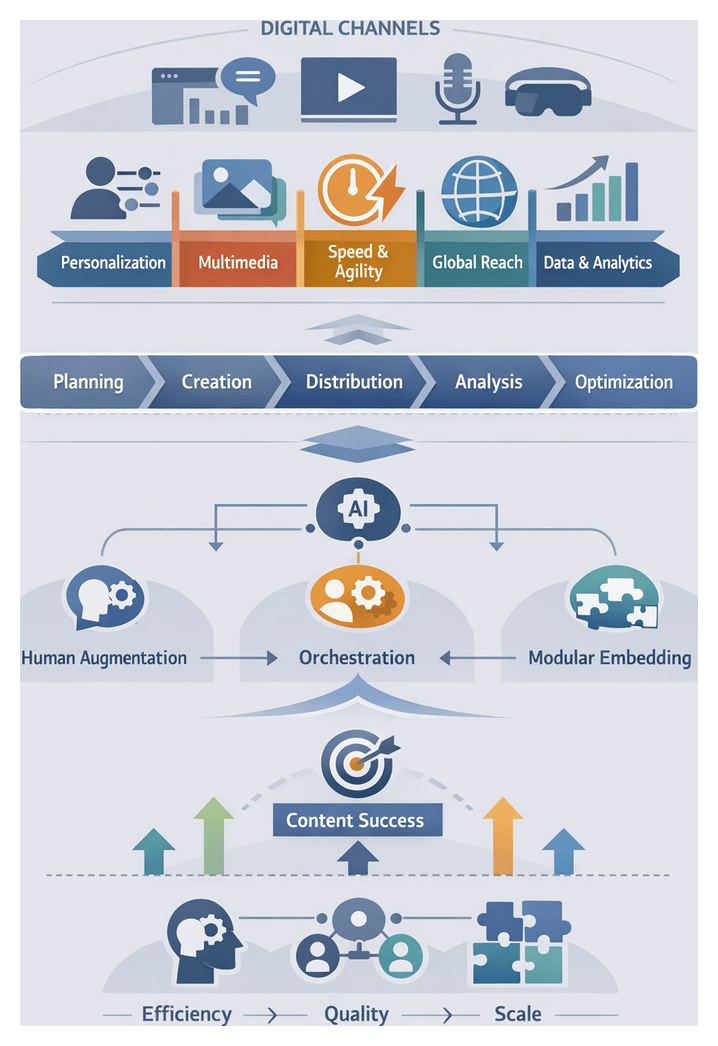
The Evolving Digital Content Landscape
Over the past decade, the proliferation of digital channels has transformed content production into a complex, multi-dimensional ecosystem. Websites, blogs, social media platforms, video services, newsletters, podcasts, interactive applications, and immersive environments now coexist, each with unique formatting requirements, audience behaviors, and performance metrics. Audiences expect seamless experiences across devices, demanding relevance, timeliness, and personalization. In response, content teams navigate a continuous cycle of planning, production, distribution, analysis, and iteration, all under pressure to scale while upholding quality and brand integrity.
Several key trends have intensified both the volume and complexity of content needs:
- Personalization at Scale: Real-time segmentation and AI-driven dynamic content assembly tailor messaging to individuals’ interests, locations, and stages in the customer journey.
- Multimedia Integration: Campaigns often blend text, imagery, video, audio, interactive graphics, and augmented reality, demanding coordinated workflows across disciplines.
- Rapid Turnaround: Real-time marketing and news cycles compress ideation, approval, and publication timelines, heightening demand for automated support.
- Global Reach: Localization and translation workflows multiply the number of content variants to serve diverse markets and languages.
- Data-Driven Optimization: Performance analytics continuously inform creative processes, requiring agile systems that can iterate in response to insights.
Traditional manual processes, even when bolstered by basic content management systems, struggle to keep pace with these demands. To address scale and efficiency challenges, organizations have progressively adopted automated tools ranging from rule-based marketing platforms to advanced AI-driven assistants. Early marketing automation handled email campaigns and lead scoring, while modern solutions powered by natural language processing and machine learning enable automated topic ideation, headline generation, keyword optimization, summarization, and draft article production.
On the design side, template-driven graphic tools and video editing assistants auto-generate visual assets at scale. Emerging AI agents further extend capabilities by autonomously executing end-to-end workflows: researching topics, assembling outlines, drafting copy, suggesting multimedia elements, and optimizing distribution timing. When applied effectively, these solutions accelerate production, reduce costs, and ensure consistency across high-volume initiatives.
Hybrid Creativity: AI and Human Collaboration Models
Maximizing the benefits of automation requires integrating AI-driven tools with human creativity through structured collaboration models. Industry practitioners describe three strategic paradigms:
- Human Augmentation: AI tools operate as intelligent assistants that enhance human capacity without supplanting creative authority. In centaur teams, human writers and editors work in tight feedback loops with models. For example, ChatGPT and GPT-4 generate initial drafts and outlines, while humans refine narrative flow and ensure brand voice.
- Orchestration: An AI conductor dynamically allocates tasks across human and machine agents based on real-time performance metrics. This service-oriented approach adapts workflows in response to shifting priorities, routing research, drafting, and review tasks to the most efficient contributors.
- Modular Embedding: AI capabilities are treated as interchangeable components within existing toolchains. Language models, semantic engines, and analytics modules plug into platforms where they deliver maximum leverage, enabling teams to swap or upgrade components without disrupting core processes.
These paradigms rest on interpretive frameworks that guide the alignment of tools and tasks. The sociotechnical systems perspective examines how AI influences roles, communication patterns, and knowledge flows. The task-technology fit model identifies which content tasks—ideation, drafting, research, optimization—are best suited to specific AI capabilities delivered by platforms such as Jasper and MarketMuse. Participatory design frameworks involve creators in tool selection and customization, preserving tacit knowledge and ensuring solutions reflect day-to-day practices.
Thought leaders emphasize balanced integration strategies. Andrew Ng advises focusing on high-leverage tasks that are scarce, specific, and strategic. Erik Brynjolfsson highlights productivity gains from complementary AI systems that expand human expertise. Ben Shneiderman’s human-centered AI manifesto calls for transparency, control, and accountability within AI-mediated workflows. Case studies illustrate these principles in action: editors at The New York Times use Adobe Sensei to surface data-driven story ideas while retaining final narrative control; startups rely on Jasper for rapid copy testing, applying human curation to select high-impact versions; and teams embed Grammarly as an in-line quality gate to offer real-time style guidance without overriding authorial intent.
Strategic Integration and Organizational Alignment
Successfully harmonizing AI-driven automation with human creativity involves addressing common integration challenges:
- Data and System Silos: Content assets, metadata, analytics, and brand guidelines often reside in disparate tools. Teams spend excessive time exporting, transforming, and reimporting data.
- Inconsistent Tooling and Interfaces: Each platform may employ different user experiences, asset libraries, and governance models, leading to fragmented creative environments.
- Workflow Friction: Rigid approval and handoff processes can negate automation gains. Bottlenecks arise when AI-generated drafts require extensive human revision or compliance checks.
- Skill Gaps and Role Uncertainty: Content professionals may lack expertise in prompt engineering and AI oversight, while AI specialists may be unfamiliar with narrative craft and brand strategy.
- Quality Control and Trust: Without transparent governance and audit trails, stakeholders hesitate to rely on AI-assisted outputs for high-stakes communications.
- Governance and Compliance: Embedding regulatory requirements, brand guidelines, and ethical standards into automated workflows adds complexity to integration projects.
To overcome these obstacles, organizations should establish a governance and operating model that aligns leadership vision, team structures, and cultural mindsets. Key elements of this model include:
- Leadership Sponsorship: Senior executives must champion AI-human collaboration as a core strategic priority, providing visible advocacy, dedicated resources, and integration of hybrid metrics into performance dashboards.
- Cross-Functional Governance: A governance council with representatives from editorial, legal, compliance, IT, and marketing ensures policy consistency, addresses data privacy, and maintains brand integrity.
- Center of Excellence: Establish a CoE or hybrid content lab that defines standards, monitors performance, stewards ethical considerations, and disseminates best practices across the organization.
- Change Management: Adapt frameworks such as Kotter’s eight-step process or ADKAR to guide teams through awareness, desire, knowledge, ability, and reinforcement phases, balancing centralized oversight with local experimentation.
- Talent Development: Invest in upskilling programs covering prompt design, data literacy, AI oversight, and creative synthesis, fostering a culture of continuous learning and collaboration.
- Tool Interoperability: Aim for a composable technology architecture where platforms integrate seamlessly with content management systems and analytics suites, reducing friction and avoiding siloed operations.
Ensuring Quality, Governance, and Continuous Improvement
Maintaining content integrity and driving strategic impact requires robust controls, iterative feedback loops, and forward-looking practices:
Balancing Autonomy and Human Control
Frameworks that define an autonomy spectrum—from advisory modes to full automation—help teams determine the optimal level of machine involvement for each content type. Human-in-the-loop (HITL) models ensure that AI suggestions are vetted by experts, preserving editorial judgment and mitigating risks such as hallucination or bias. Explainable AI (XAI) techniques, available in tools like GPT-4 and MarketMuse, provide transparency into algorithmic reasoning, enabling practitioners to calibrate trust based on confidence scores and attribution data.
Analytical Frameworks and Metrics
To evaluate hybrid workflows, organizations deploy both qualitative and quantitative metrics:
- Throughput and Efficiency—Time-to-publication, revision rates, and cost per piece.
- Quality and Engagement—Audience satisfaction, click-through rates, dwell time, and sentiment analysis.
- Creativity and Innovation—Number of unique concepts generated, brand lift, and perceived emotional resonance.
Four analytical lenses guide decision-making:
- Capability Maturity Models: Assess proficiency across governance, technology infrastructure, talent, and performance, identifying gaps and prioritizing strategic initiatives.
- Cost-Benefit Analysis: Quantify production cost savings, projected revenue uplift, and the value of redeployed human bandwidth for high-impact work.
- Risk-Reward Matrices: Plot initiatives by potential benefit versus operational or reputational risk to allocate human oversight proportionate to stakes.
- Feedback-Driven Optimization Cycles: Employ agile retrospectives, A/B testing, and continuous feedback from analytics dashboards to fine-tune AI models and editorial guidelines.
Mitigation of Limitations and Future-Proofing
Awareness of potential pitfalls enables proactive risk management:
- Quality Variability—Institute multi-stage human reviews to validate tone, accuracy, and brand alignment.
- Algorithmic Bias—Use bias detection tools, diverse training data, and periodic audits to ensure fairness.
- Overreliance on Templates—Encourage human-led ideation sessions to maintain narrative freshness.
- Data Security—Anonymize inputs, enforce access controls, and consider private cloud or on-premises deployments.
- Change Fatigue—Implement phased rollouts, gather stakeholder feedback, and celebrate quick wins to sustain momentum.
Future-proofing hybrid content operations involves continuous model refresh processes, adaptive governance that evolves with technological advances, expansion into multimodal content formats, and establishment of scalable centers of excellence that pilot new AI capabilities. By embedding these practices, organizations position themselves to thrive amidst dynamic market demands and technological breakthroughs, harnessing the synergy of AI agents and human creativity to deliver differentiated content at scale.
Chapter 6: Evaluating Quality, Voice, and Brand Consistency
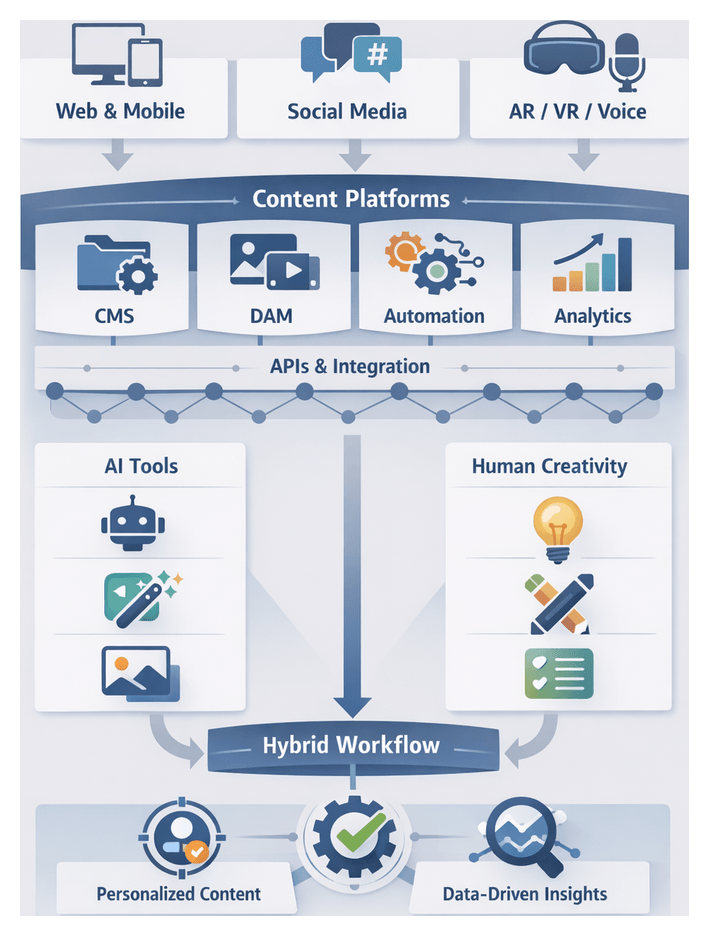
Understanding the Modern Digital Content Ecosystem
In today’s era of rapid technological change, organizations rely on digital content to inform, engage, and differentiate their audiences. Content travels across websites, mobile apps, social media, community forums, voice assistants, and immersive experiences such as AR/VR, each demanding its own format, interaction model, and performance criteria. Smartphones, tablets, wearables, and smart speakers intensify the need for responsive design, adaptive media, and voice-enabled interfaces that ensure accessibility and seamless user experiences across devices.
Underlying this ecosystem is a sophisticated technology stack. Content management systems such as WordPress and HubSpot CMS serve as the backbone for authoring, versioning, and publishing. Digital asset management platforms centralize rich media assets for efficient reuse. Marketing automation and CRM integrations enable segmentation and personalized messaging at scale. Analytics suites measure key performance indicators—page views, click-through rates, dwell time, conversion metrics—and feed insights back into editorial planning.
As organizations pursue headless architectures and API-first designs, they decouple content creation from presentation, allowing developers and marketers to deliver dynamic, context-driven experiences across web, mobile, email, and IoT devices. This flexibility supports rapid innovation but increases complexity in implementation, requiring tighter coordination among IT, marketing, creative, and compliance teams. Maintaining a coherent narrative across disparate channels demands rigorous governance and unified content strategies.
Consumer behavior has shifted toward on-demand information and privacy-preserving personalization under regulations such as GDPR and CCPA. Multi-touch attribution and semantic search optimization compel content teams to integrate SEO best practices, voice search readiness, and accessibility standards. Balancing discoverability, compliance, and audience relevance across search engines, social platforms, and direct interactions is a strategic imperative for modern digital leaders.
Evolving Content Operations and Collaborative Workflows
Traditional linear content production—strategy, drafting, editing, design, development—often led to bottlenecks, version conflicts, and siloed teams. In contrast, agile content operations, or ContentOps, emphasize cross-functional collaboration, modular content, and iterative delivery. Creative sprints borrowed from software development accelerate ideation, prototyping, stakeholder reviews, and optimization based on real-time analytics.
Centralized editorial calendars, metadata taxonomies, and design systems ensure consistency while allowing regional teams to adapt messages for local audiences. As organizations scale globally, AI-driven content tagging and translation workflows reduce manual effort, enabling dynamic page assembly and automated content recommendations grounded in user profiles and behavioral data.
Cloud-based authoring tools such as Google Docs and Microsoft 365 facilitate real-time coauthoring, commenting, and versioning across geographies. Collaborative design platforms like Figma support interactive prototyping and feedback loops between designers, copywriters, and developers. Project management systems—Asana, Trello, Jira—track tasks, deadlines, and dependencies, providing visibility into throughput and resource allocation.
Despite these advances, aligning teams around a unified content vision remains challenging. Localization introduces additional layers—multilingual editorial review, regional regulatory considerations, and nuanced cultural adaptation. Clear communication protocols, robust approval processes, and shared governance frameworks are essential to ensure brand, legal, and quality standards are consistently met.
The Rise of AI-Driven Content Tools
Automated content generation tools have matured from simple templates to sophisticated platforms that leverage large language models and retrieval-augmented generation. OpenAI’s ChatGPT and Jasper offer intuitive interfaces for generating blog posts, social media updates, email sequences, and more, guided by brand-specific training and custom prompts.
Copy.ai and other specialized platforms enable marketers to rapidly prototype headlines, product descriptions, and ad copy. Enterprise solutions integrate internal knowledge bases with AI, ensuring factual accuracy and brand alignment. Prompt engineering techniques refine outputs by specifying tone, context, audience, and desired length.
Visual content creation has been revolutionized by diffusion-based image generators such as Midjourney and DALL·E, which can produce illustrations, concept art, and mockups on demand. For multimedia, Synthesia, Lumen5, and Descript automate video and audio production, offering text-to-video synthesis, automated editing, AI-powered voiceovers, and transcription.
Beyond generation, intelligent assistants such as Grammarly and Hemingway App analyze grammar, style, and readability in real time. SEO tools like Clearscope and Surfer SEO recommend keyword usage, content structure, and metadata enhancements to improve search visibility. Analytics-driven platforms monitor performance data continuously, suggesting subject lines, posting schedules, and visual assets that drive engagement.
Drivers and Challenges of Automation
Multiple factors fuel the adoption of AI-driven content tools:
- Scalability Imperative: Deliver localized, personalized messaging across multiple brands, languages, and markets without proportionally expanding teams.
- Acceleration: Real-time social interactions and news cycles demand swift ideation, drafting, A/B testing, and publishing.
- Cost Efficiency: Automating repetitive or formulaic tasks—metadata generation, product descriptions, data-driven reports—frees creative resources for strategic initiatives.
- Data-Driven Insights: AI systems analyze audience behavior at scale, uncovering content gaps, trending topics, and optimal distribution channels.
- Competitive Pressure: Brands integrating AI into content operations can outpace rivals with higher content velocity and precision.
- Talent Scarcity: The digital skills gap and demand for specialized writers and designers make automation an essential augmentation strategy.
- Continuous Learning: Automated tools enable rapid incorporation of performance feedback, fostering a test-and-learn culture.
Yet organizations face significant hurdles when embedding AI into established workflows:
- Disparate Technology Stacks: Siloed platforms and AI services lacking unified APIs lead to manual integrations and error-prone handoffs.
- Quality Assurance: AI outputs may miss brand voice subtleties, cultural context, or regulatory requirements, necessitating thorough human review.
- Voice and Tone Consistency: Generic training data can yield inconsistent outputs. Expertise in prompt engineering and style modeling is required to maintain brand personality.
- Algorithmic Bias: Models trained on broad data sets can perpetuate prejudices or produce hallucinatory content. Bias audits and provenance documentation are essential.
- Intellectual Property: Uncertainties around rights for AI-generated content require clear policies on licensing, attribution, and reuse.
- Change Management: Without strategic communication, training, and leadership support, AI integration can face resistance from creative professionals.
- Data Privacy and Security: Provisioning proprietary or customer data to third-party AI providers demands encryption, access controls, and contractual safeguards.
- Overreliance on Automation: Excessive dependence on AI can produce formulaic, homogenized content that fails to differentiate the brand.
- Vendor Lock-In: Custom integrations or proprietary platforms may limit future flexibility and increase switching costs.
Hybrid Content Governance and Human-Driven Creativity
Amidst automation, human creativity remains essential for storytelling, emotional resonance, and ethical judgment. Effective hybrid workflows assign AI agents to data-intensive and formulaic tasks—such as metadata tagging, initial draft creation, and keyword optimization—while human experts focus on narrative strategy, brand storytelling, and contextual adaptation.
Key strategic considerations for hybrid workflows include:
- Governance Frameworks: Establish clear policies for AI usage, data governance, prompt design, approval hierarchies, and intellectual property rights.
- Role Definition: Define responsibilities for AI specialists (prompt engineers, data scientists), content creators, and editors. Invest in training programs for AI tool proficiency and ethical considerations.
- Editorial Guidelines: Maintain a centralized style guide informing AI training data and human briefs. Update guidelines to reflect evolving customer insights and regulatory changes.
- Integration and Interoperability: Prioritize platforms with open APIs, prebuilt connectors, and support for standardized data formats (JSON, XML). Centralize planning, asset management, and analytics in a unified dashboard.
- Iterative Feedback Loops: Implement cyclical review processes where human editors refine AI outputs, and learnings inform model fine-tuning and prompt template updates.
- Pilot Programs and Centers of Excellence: Launch small-scale pilots to validate use cases, capture best practices, and build internal expertise. Establish an AI Content Center of Excellence to govern adoption and performance.
- Performance Measurement: Use balanced scorecards to assess operational efficiency, content quality, and business impact. Track metrics like turnaround times, error rates, engagement, and ROI.
- Change Management: Foster a culture of experimentation. Communicate strategic rationale for automation, celebrate early wins, and address concerns through training and open forums.
Frameworks for Brand Voice Alignment
Maintaining a consistent brand voice across AI-generated and human-authored content is vital for credibility and differentiation. Organizations apply a mix of analytical frameworks:
- Rule-Based Systems: Tools like Acrolinx enforce machine-readable style rules, vocabulary controls, and punctuation standards.
- Machine Learning Models: Fine-tuned language models on brand-specific corpora using platforms such as Jasper AI and OpenAI ChatGPT ensure semantic consistency and tone adaptation.
- Hybrid Templates and Prompt Engineering: Modular content blocks—opening statements, value propositions, calls to action—paired with precise prompts guide AI to generate contextually relevant text under human supervision.
- Voice Monitoring and Feedback: Real-time analytics with Brandwatch and Grammarly track sentiment alignment, engagement voice consistency, and flag deviations for review.
Companies often adopt a layered approach, integrating these frameworks into governance processes. Voice alignment maturity models progress from ad hoc manual checks to predictive machine learning systems, culminating in adaptive AI-human loops that self-optimize over time.
Implications for Brand Trust and Audience Engagement
Brand trust is built through consistency, authenticity, and emotional resonance. In hybrid ecosystems where AI generates initial drafts and humans refine nuance, governance frameworks and collaborative protocols ensure brand integrity.
Transparency about AI usage—through disclosure statements like “Drafted with AI Assistance” and published ethical guidelines—reduces audience uncertainty and positions the brand as both innovative and responsible. In sectors like healthcare and finance, AI-assisted chatbots such as IBM Watson Assistant embed sentiment analysis and escalate complex inquiries to human experts, reinforcing trust in sensitive contexts.
Industry context influences trust dynamics. Regulated sectors prioritize factual accuracy and compliance, creative industries emphasize originality and cultural relevance, and B2B marketing demands data-driven insights framed by domain expertise. Regardless of context, blending AI insights with human judgment preserves credibility and fosters long-term loyalty.
Community engagement further enhances trust. Brands use AI to identify trending topics and streamline content calendars but rely on community managers to facilitate discussions, curate user-generated content, and host live events. This hybrid approach combines scalability with genuine human connection, sustaining brand advocacy over time.
Standardizing Brand Voice Ecosystems
Delivering a coherent brand presence across diverse channels and formats requires a unified ecosystem that defines tone, style, and thematic priorities. Key elements include:
- Core Voice Attributes: Define three to five non-negotiable pillars—approachable expertise, narrative warmth, technical precision—that underpin all content.
- Content Archetype Mapping: Assign tailored voice profiles to formats such as blog posts, product pages, social updates, and email campaigns, ensuring both AI agents and human writers share a common reference.
- Voice Reference Library: Maintain an annotated repository of exemplar texts for training human teams and fine-tuning AI models.
- Modular Style Guide: Integrate general grammar rules with channel-specific modules, and embed AI-powered editing via Jasper AI or GPT-4.
- Editorial Checkpoints: Embed style evaluations at outline approval, first draft review, and final edit for both AI-generated and human-authored content.
- AI-Human Governance: Define stewardship roles, review-and-override protocols, and ethical use guidelines to manage AI recommendations and data inputs.
- Quality Assurance Analytics: Apply scorecards, A/B testing, and sentiment/readability analytics using platforms to measure clarity, relevance, and emotional resonance.
- Continuous Calibration: Launch governance dashboards, quarterly calibration workshops, and document lessons learned to refine voice standards and prevent drift over time.
Practitioners must remain vigilant about limitations such as data bias in AI training, the risk of over-standardization suppressing creative variation, resource intensity of governance, and the need to adapt to evolving platform norms. When executed thoughtfully, these strategic guidelines enable organizations to harness the strengths of both AI-driven automation and human creativity, delivering authentic and consistent brand narratives at scale.
Chapter 7: AI-driven Tools and Platforms for Content Professionals
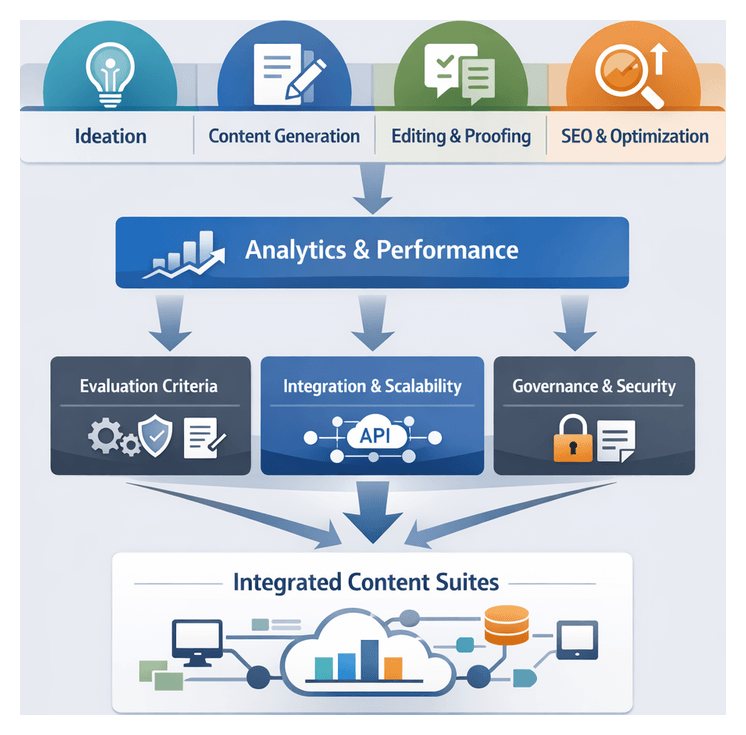
Leading AI Content Platforms Landscape
The modern content ecosystem encompasses a spectrum of AI-driven platforms that streamline ideation, drafting, editing, optimization, performance analytics and full-suite collaboration. Each category addresses distinct stages of the content lifecycle, offering specialized capabilities or integrated workflows designed to accelerate production, ensure brand consistency and deliver data-driven insights.
Ideation and Brainstorming
- ChatGPT Provides an interactive conversational interface powered by GPT-4 for rapid topic exploration, outline generation and research summarization. API integration supports custom ideation workflows.
- Jasper AI Features templates for blog ideas, social media hooks and ad copy, with Tone Adjust and Brand Voice settings to align with organizational style.
- Copy.ai Offers a library of brainstorming modules such as Blog Idea Generator and Content Improver for marketing teams seeking quick, attention-grabbing concepts.
- Writesonic Combines ideation with keyword suggestions and a research assistant that aggregates statistics and facts for SEO-relevant topics.
Drafting and Content Generation
- OpenAI API Exposes GPT series models for custom content generation, fine-tuning on domain-specific data and handling complex, conditional prompts.
- Rytr Delivers cost-effective drafting for emails, ads and blogs, with multilingual support and basic SEO integration.
- Frase Combines research and drafting by generating outlines from top-ranking pages, then auto-writing sections optimized for target keywords.
- CopySmith Specializes in e-commerce product descriptions with bulk generation and CSV import/export for large inventories.
Editing, Proofreading and Style Consistency
- Grammarly Analyzes grammar, spelling, punctuation and clarity, offering tone detection, formality adjustments and plagiarism scanning across browsers, word processors and email clients.
- ProWritingAid Provides comprehensive style reports covering overused words, sentence variation and readability, with desktop and cloud editors for collaborative teams.
- Hemingway Editor Highlights complex sentences, passive voice and readability issues to encourage concise, direct prose.
- Writer.com Enables enterprise governance with custom style guides, terminology management and real-time AI suggestions for multi-user collaboration.
SEO and Content Optimization
- Surfer SEO Offers on-page optimization scoring, keyword research and SERP audits, generating data-driven outlines for word count, headings and keyword density.
- Clearscope Provides topic relevance scores and content grading against top-ranking pages, with integrations for Google Docs and WordPress.
- MarketMuse Identifies content gaps, suggests topic clusters and prioritizes updates with predictive traffic lift estimates and competitive benchmarks.
- Frase Also supports optimization by comparing drafts against competitors and recommending targeted edits.
Analytics and Performance Monitoring
- BuzzSumo Scans social shares and backlinks to identify high-performing themes and predicts virality potential.
- SEMrush Combines keyword tracking, site audits and content performance modules, with AI-powered Topic Research for subtopics and question-based queries.
- Brandwatch Delivers social listening and audience segmentation using natural language understanding to detect trends and sentiment shifts.
- Chartbeat Tracks in-page engagement, scroll depth and attention metrics via AI models that correlate content attributes with reader loyalty.
Integrated Content Suites
- HubSpot Content Hub Offers CRM-integrated content creation, topic cluster management and performance dashboards, with AI features for blog ideas, SEO suggestions and adaptive testing.
- Adobe Experience Manager with Sensei Integrates AI-driven asset tagging, automated layout suggestions and personalization engines across web and mobile channels.
- Acrolinx Provides enterprise-grade language governance, style enforcement and terminology consistency with proprietary AI, connecting to CMS and editor environments.
Evaluation Criteria for AI Content Tools
Selecting the right AI platforms requires a structured framework that aligns with strategic objectives such as efficiency gains, brand integrity and compliance. Common evaluation dimensions include functionality, integration, scalability, user experience, data governance, output quality, ethical considerations, vendor viability and cost.
Core Functionality and Feature Set
- Natural Language Generation—Assess accuracy, fluency, domain-specific tone controls and depth of semantic understanding.
- Research Assistance—Evaluate the ability to retrieve and synthesize data, support for citations and fact-checking workflows.
- Content Structuring—Review templates, modular blocks and adaptive layouts for diverse formats.
- Multilingual Support—Verify target language coverage, cultural nuance tuning and integration with glossaries or translation memories such as DeepL.
- Analytics Integration—Check for built-in metrics, sentiment analysis and predictive indicators that guide editorial strategy.
Integration and Interoperability
- API Robustness—Quality of RESTful or GraphQL endpoints, SDK availability and developer documentation.
- Plugin Ecosystem—Prebuilt connectors for CMS, DAM, marketing automation and collaboration tools such as Slack or Microsoft Teams.
- Data Exchange Standards—Support for JSON-LD, Schema.org or custom metadata ontologies to ensure seamless pipelines.
- Workflow Automation—Compatibility with low-code/no-code platforms and event-driven triggers for content lifecycle orchestration.
Scalability and Performance
- Elastic Compute—Cloud-native auto-scaling and container orchestration for variable workloads.
- Reliability—Service level agreements, uptime history and performance benchmarks under peak load.
- Latency—Average and percentile response times for generation and analytics tasks.
- Deployment Models—Options for multi-tenant, private cloud or on-premise hosting to meet data sovereignty needs.
User Experience and Adoption
- Interface Design—Clarity of menus, dashboards and cognitive load required for core tasks.
- Customization—Ability to tailor workflows, recommendation engines and dashboard layouts.
- Onboarding—Availability of self-service tutorials, workshops and certification programs.
- Community Support—Active forums, best practice libraries and searchable documentation.
Data Governance and Security
- Access Controls—Role-based permissions, single sign-on and granular restriction of sensitive operations.
- Encryption—In-transit and at-rest encryption, key management and customer-controlled keys.
- Audit Trails—Comprehensive logging of user activity, content changes and AI inference events.
- Certifications—Compliance with ISO 27001, SOC 2, GDPR, HIPAA and relevant regulations.
Output Quality and Customization
- Readability and Style—Automated scoring for grammar, tone alignment and brand voice consistency.
- Originality—Plagiarism detection and novelty assessment to ensure unique insights.
- Fine-Tuning—Prompt engineering interfaces and the ability to inject proprietary data or style rules.
- Feedback Loops—Mechanisms for capturing user edits, ratings and integrating corrections into model updates.
Compliance and Ethical Considerations
- Bias Mitigation—Dashboards and tools for surfacing and correcting unwanted biases.
- Explainability—Features revealing suggestion provenance, confidence scores and model rationale.
- IP Safeguards—Clear terms for ownership of generated content and options to opt out of data usage in training.
- Regulatory Alignment—Support for evolving AI governance frameworks and audit requirements.
Vendor Viability and Support
- Financial Health—Funding, revenue growth and strategic partnerships indicating long-term stability.
- Product Roadmap—Frequency of updates, responsiveness to feedback and R&D investments.
- Support Services—Dedicated support teams, escalation procedures and response time commitments.
- Community Ecosystem—Active user groups, third-party integrators and certified consultancies.
Cost and Value Proposition
- Pricing Models—Tiered subscriptions based on seats, credits or feature bundles and predictability of recurring fees.
- Onboarding Costs—Professional services, training investments and internal change management expenses.
- Operational Overhead—Infrastructure costs for private deployments and integration maintenance.
- ROI Metrics—Efficiency gains in labor hours saved, incremental revenue from enhanced quality and brand equity uplift.
Integration Scenarios with Human Teams
AI platforms function as collaborative co-pilots within content workflows, augmenting human creativity and strategic judgment. Key integration contexts demonstrate how teams can leverage AI capabilities while preserving oversight and brand voice.
Editorial Planning and Ideation
- Trend Detection—Tools like MarketMuse analyze search volume, social sentiment and competitor content to surface emerging themes for editorial calendars.
- Topic Clustering—Semantic grouping accelerates the mapping of content pillars, with editors refining clusters into series aligned with brand narratives.
- Gap Analysis—Automated audits highlight underperforming content, enabling editors to prioritize unique angles and resource allocation.
Collaborative Drafting and Feedback
- Live Suggestions—Platforms such as Jasper AI offer in-context rewrites, headline variants and call-to-action prompts that writers review and adapt to maintain voice.
- Adaptive Learning—Acceptance rates of AI suggestions inform confidence thresholds and refine future recommendations.
- Peer Collaboration—Integrated annotations create a shared audit trail of human and AI decisions, enhancing accountability.
SEO-Driven Optimization
- Keyword Prioritization—Tools such as Copy.ai rank target terms by relevance and difficulty, informing outlines that balance SEO with narrative flow.
- Content Grading—Automated scores for readability and semantic richness guide writers to enrich sections without sacrificing authenticity.
- Workflow Checkpoints—AI modules integrated into CMS trigger optimization reviews before publishing, with human gatekeepers validating flagged issues.
Multilingual Production and Localization
- Machine Translation Plus—Services like DeepL produce first-pass translations, with localization experts adapting tone, idioms and references.
- Terminology Management—AI-maintained glossaries ensure consistency, supplemented by subject-matter experts who validate regional usage.
- Cultural Sensitivity—Automated checks flag potential issues for human reviewers to recommend culturally appropriate alternatives.
Social Media Strategies
- Variant Generation—AI tools produce multiple post versions optimized for each platform’s format, refined by social teams to match audience voice.
- Sentiment Analysis—Real-time monitoring of audience response identifies high-engagement themes that inform messaging adjustments.
- Trend Simulation—Prediction models forecast virality potential, guiding strategists on whether to align with or diverge from trends.
Personalization and Marketing Campaigns
- Audience Segmentation—AI clusters user behaviors into micro-segments, with marketers validating definitions against qualitative research.
- Dynamic Content—Modular blocks assembled by AI based on profiles are governed by rules to maintain narrative continuity and brand voice.
- Attribution Analytics—Automated models attribute engagement to content variants, enabling campaign leads to refine strategies and budget allocation.
Thought Leadership and Executive Communications
- Insight Aggregation—AI consolidates industry reports and academic studies; communication teams curate these into cohesive executive narratives.
- Voice Preservation—Human writers integrate personal anecdotes and strategic perspective into AI-drafted outlines.
- Review Protocols—Rigorous human validation ensures accuracy of data and alignment with organizational positions.
Platform Interoperability, Governance and Strategic Insights
Long-term agility depends on the ability of AI platforms to interoperate with existing systems, adhere to governance standards and scale with business needs. Industry best practices emphasize open interfaces, data governance and continuous performance management.
API Consistency and Modular Design
- Adopt platforms with RESTful or GraphQL endpoints and comprehensive documentation to facilitate predictable integrations.
- Ensure conformity with industry data schemas such as JSON-LD and Schema.org for seamless metadata exchange.
- Leverage microservices and event-driven architectures to enable incremental adoption and future upgrades without wholesale replacements.
Data Integration and Workflow Alignment
- Maintain unified repositories for source assets, drafts, edit histories and final copy to preserve version control and context sharing.
- Implement metadata governance protocols for tagging, taxonomy management and semantic enrichment to inform AI recommendations.
- Trigger AI modules via content lifecycle events—such as draft completion or editorial approval—to automate handoffs and reduce manual coordination.
Scalability and Performance Management
- Use container orchestration and auto-scaling to manage inference workloads during demand spikes.
- Balance fine-tuned, dedicated model instances against multi-tenant services to optimize relevance and cost efficiency.
- Define service-level objectives for response times, availability and error rates, and monitor via telemetry dashboards for proactive issue resolution.
Governance, Compliance and Security
- Evaluate data privacy practices, residency controls and regulatory compliance for GDPR, CCPA or industry-specific mandates.
- Clarify intellectual property ownership of AI-generated content and protect proprietary training data to prevent disputes.
- Require detailed audit logs of inference requests, confidence scores and data provenance to support internal governance and external audits.
Limitations and Mitigation
- Mitigate vendor lock-in by selecting platforms with exportable data formats and leveraging open-source components where feasible.
- Prevent quality drift through regular monitoring, periodic re-training on curated corpora and human-in-loop review checkpoints.
- Control technical debt by enforcing modular design principles and engaging a governance council to flag complex integrations early.
- Plan for operational overhead by investing in roles such as ML operations specialists and AI ethicists to manage scaling and compliance.
Key Strategic Insights
- Adopt a Platform-Agnostic Mindset: View AI capabilities as interchangeable services, encouraging experimentation and future-proofing investments.
- Align AI Workflows with Business Objectives: Map integrations to measurable outcomes—reduced time to publish, improved SEO or higher engagement—and track defined KPIs.
- Invest in Governance and Change Management: Establish cross-functional oversight to define integration standards, manage vendors and ensure ethical compliance.
- Balance Customization and Manageability: Use prebuilt connectors and no-code tools for rapid adoption, reserving deep model training for high-value verticals.
- Embed Continuous Learning Loops: Leverage analytics to refine prompts, retrain models and update workflows, fostering an agile, data-driven content culture.
Chapter 8: Ethical Considerations and Creative Ownership
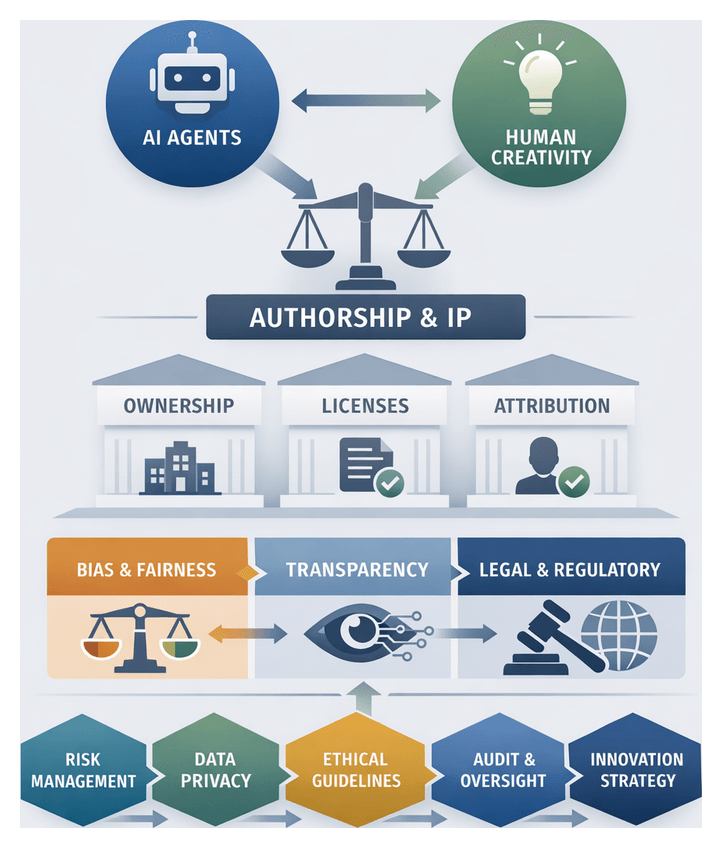
Contextualizing Authorship and Intellectual Property
In an era where artificial intelligence augments creative workflows, organizations confront complex questions about authorship, ownership and intellectual property. Traditional copyright law assumes a natural person as author, conferring moral rights over integrity and reputation and economic rights over reproduction and distribution. Works fixed in a tangible medium gain protection automatically, yet this human-centric framework falters when AI agents such as OpenAI‘s GPT series, Jasper, Copy.ai and Writesonic generate text, images or multimedia without legal personhood.
Emerging authorship models typically attribute creative ownership to the human prompt engineer, to the AI platform provider or treat outputs as public domain. Each approach presents trade-offs in risk tolerance, business objectives and ethical commitments. In the United States, the Copyright Office rejects applications listing AI as sole author, whereas substantial human intervention through prompt selection, output refinement or editorial curation may suffice for protection. In the European Union, the UK Intellectual Property Office allows registration of computer-generated works if human contribution is identifiable, but member states vary in their thresholds for originality and registration requirements.
When AI agents collaborate with human creatives, hybrid works demand clear contractual terms. Key considerations include defining whether primary ownership vests in the organization, the individual author or the AI vendor; securing licenses that cover input data and derived outputs for reproduction, modification and sublicensing; and maintaining data provenance records to address infringement claims arising from third-party materials used during model training. Proactive agreements mitigate disputes over derivative rights and ensure machine contributions are legally recognized.
Despite an AI system’s inability to hold moral rights, human collaborators retain their personal claims. Organizations should establish attribution protocols that credit employees or teams and adopt transparency statements disclosing AI involvement. Such practices build audience trust, align with emerging “right to explanation” regulations for algorithmic content and protect brand authenticity. Comprehensive risk management integrates policy development, training, and audit mechanisms into the content lifecycle, enabling legal, content and technology teams to collaborate on ownership, licensing and compliance issues. Transparent, ethically grounded policies reinforce stakeholder confidence and safeguard creative assets in AI-enhanced ecosystems.
Addressing Bias and Ensuring Transparency
AI-driven content creation introduces the imperative to identify and correct algorithmic bias while providing visibility into model decisions. Bias manifests in three primary domains: dataset bias from unrepresentative training corpora; model bias embedded in inductive algorithmic assumptions; and emergent bias that arises through feedback loops favoring sensational or skewed outputs. Analytical assessment combines quantitative metrics with qualitative review to ensure outputs align with organizational values and societal norms.
Formal fairness frameworks guide evaluation and mitigation:
- Demographic Parity: Ensuring output distributions do not vary by sensitive attributes, even at the cost of overall accuracy.
- Equal Opportunity: Matching true positive rates across demographic groups, critical in content moderation and risk flagging.
- Counterfactual Fairness: Assessing whether altering a sensitive attribute in a counterfactual scenario changes a model’s decision.
Open-source toolkits operationalize these metrics. IBM’s AI Fairness 360 and Microsoft’s Fairlearn library offer functions for bias detection and mitigation. Integrating these into content pipelines produces analytical reports highlighting risk areas and guiding corrective measures.
Transparency encompasses both process and output dimensions. Process transparency demands documentation of model architectures, training data lineage and algorithmic parameters. Output transparency requires explanations for individual generated segments. Explainable AI methodologies enable this clarity:
- LIME (Local Interpretable Model-agnostic Explanations): Approximates complex models locally to reveal which input tokens most influenced an output.
- SHAP (SHapley Additive exPlanations): Allocates importance values to features based on cooperative game theory, illuminating how prompts shape tone and sentiment.
- Model Cards: Structured documents from Google Research summarizing performance across demographic slices, intended uses and limitations.
Enterprises adopt governance frameworks such as Ethics by Design, embedding fairness and transparency requirements in each development phase; Continuous Monitoring dashboards that track drift and anomalous outputs in real time; and Stakeholder Engagement programs soliciting feedback from diverse audiences. Contractual clauses with proprietary model providers—such as OpenAI and Google Cloud AI—should require periodic transparency reports, third-party audits and data usage disclosures, balancing vendor confidentiality with the customer’s obligation to uphold fair content practices.
Navigating Regulatory and Legal Frameworks
Global regulators are updating legal standards to address AI’s role in content creation. The European Union’s proposed AI Act categorizes systems by risk level, mandating conformity assessments, documentation and human oversight for high-risk applications influencing public opinion or financial decisions. The General Data Protection Regulation (GDPR) enshrines data protection and the right to explanation for automated decisions. In the United States, the California Consumer Privacy Act (CCPA) grants residents rights over personal data used in personalized content, while the Digital Millennium Copyright Act (DMCA) governs copyright infringement and safe harbor for online platforms.
Organizations must harmonize these requirements, adhering to the most stringent standard. Legal and compliance teams collaborate with data scientists to craft policies that safeguard personal information, intellectual property and consumer rights without stifling innovation.
Data Privacy and Protection
AI content tools rely on datasets that may contain sensitive personal information. Privacy by design principles require data minimization, secure access controls and robust anonymization or pseudonymization. Techniques such as differential privacy, secure multiparty computation and federated learning reduce re-identification risks while supporting model training. Data Protection Impact Assessments (DPIAs) and detailed audit trails of data usage, transformations and model training activities bolster compliance and accountability.
Intellectual Property and Attribution
To clarify authorship, organizations document human interventions in the creation process—such as prompt engineering, editorial revisions and structural decisions. Licensing agreements with AI vendors, including the terms of service from OpenAI, must specify usage rights, indemnification clauses and attribution requirements. When using open source models like GPT-2 or BERT, compliance with MIT or Apache 2.0 licenses ensures legality of commercial use and derivative works. Embedding provenance metadata in content assets records the tools, datasets and contributors involved, strengthening joint authorship claims.
Transparency and Accountability Mechanisms
Robust disclosure and audit practices reinforce trust. Organizations issue clear notices in user-facing materials indicating AI involvement, publish concise Model Cards describing capabilities and limitations, and maintain immutable audit logs that record session timestamps, user IDs, prompt inputs and model versions. Content watermarking—visible or invisible—further distinguishes AI-derived materials, enabling stakeholders to verify authenticity.
Maintaining Credibility and Trust
Layered quality controls blend automated checks with human review. Editorial protocols mandate fact-checking and style alignment for AI drafts. Plagiarism detection tools such as Copyscape and Turnitin identify unintended replication. User feedback loops capture audience concerns, and performance monitoring of engagement metrics and sentiment analysis flags anomalies. Multidisciplinary governance councils—comprising legal, editorial, data science and IT security representatives—oversee ethical compliance, track bias detection rates, content retraction incidents and trust indices, and conduct regular external audits to ensure alignment with evolving standards.
Driving Strategic Outcomes of AI-Human Collaboration
Integrating AI agents into creative workflows yields transformative gains when aligned with human expertise, governed by clear policies and guided by data-driven insights. The following strategic outcomes crystallize a playbook for sustainable, high-impact content operations.
Aligning Technology with Human Expertise
Successful programs map routine analytical tasks—keyword optimization, data aggregation and template generation—to AI, while strategic narrative design, cultural nuance and brand voice remain under human stewardship. Sociotechnical capability audits match talent profiles to tool functionalities, ensuring AI extends rather than displaces critical human contributions.
Embracing Data-Driven Creativity
AI agents serve as continuous feedback loops, harvesting performance metrics, sentiment patterns and engagement data. Rapid prototyping of AI-assisted drafts, real-time user testing and iterative pivots, guided by design thinking and agile methodologies, balance creative risk-taking with empirical validation. Governance around data dashboards and key performance indicators directs experimental roadmaps.
Establishing Ethical and Governance Frameworks
Cross-functional oversight committees codify guidelines on authorship attribution, bias detection and transparency. Embedding algorithmic accountability reviews and data provenance audits into workflows mitigates reputational risk. Regular policy updates reflect legislative changes and technological advances.
Optimizing Stakeholder Engagement
Co-creative feedback loops leverage AI-driven personalization and predictive analytics to anticipate audience needs. Human curators interpret community values and narrative resonance, tailoring content calendars through customer journey mapping and persona development to drive relevance, engagement and loyalty.
Ensuring Future Resilience and Innovation
Continuous learning practices—scenario planning, technology roadmapping and pilot programs—prepare organizations for disruptive developments such as generative video and immersive interfaces. Cross-training talent and forging partnerships with AI research entities cultivate adaptive capacity and foresight.
Key Limitations and Critical Considerations
- Data Quality Constraints: AI outputs depend on the integrity of training datasets; continuous data governance prevents drift and outdated insights.
- Creative Overreliance: Excessive automation can erode human skills and dilute brand voice; threshold policies should trigger human review for critical content.
- Regulatory Ambiguity: Intellectual property and liability laws evolve rapidly; ongoing legal counsel integration ensures compliance.
- Ethical Blind Spots: Algorithms may perpetuate stereotypes or misinformation; diverse stakeholder input and third-party audits surface unintended biases.
- Scalability Challenges: Infrastructure, talent and change management must co-evolve with AI deployment; phased rollouts align readiness with expansion.
Frameworks for Strategic Implementation
The “Five Cs” model—Context, Capabilities, Content, Compliance and Continuous Improvement—offers a structured roadmap. Contextual analysis defines market dynamics and audience expectations. Capabilities assessment maps human and AI assets. Content strategy specifies genres, tone and formats. Compliance embeds legal and ethical safeguards. Continuous Improvement drives iterative refinement through metrics and stakeholder feedback. Tailoring this framework to organizational culture ensures balanced innovation and risk mitigation.
Chapter 9: Measuring Impact Metrics and ROI in Hybrid Production
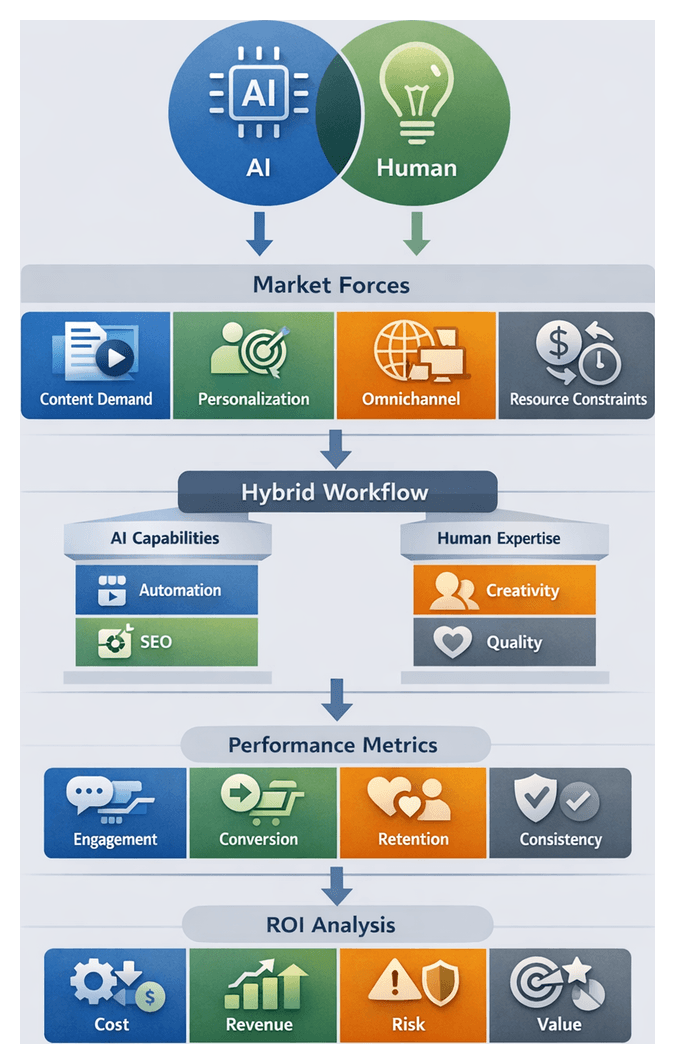
Market Dynamics Driving AI-Human Synergy
Enterprises today face relentless demand for personalized, high-quality content across multiple channels. Social media, blogs, newsletters and interactive platforms require a constant stream of fresh material, straining traditional human-only workflows. Audiences expect tailored messaging aligned with their behaviors and cultural contexts, while search engines reward relevance, depth and timeliness. At the same time, budget pressures and talent shortages compel organizations to seek efficiency gains without sacrificing authenticity. These market forces converge to make AI-human collaboration a strategic imperative.
- Content Volume Explosion – The continuous need for original posts, articles and multimedia assets outpaces manual production capacity.
- Demand for Personalization – AI-driven segmentation and dynamic content assembly enable scale, while human oversight preserves brand voice and emotional resonance.
- Omnichannel Consistency – AI agents distribute message variations across websites, apps, social networks and voice interfaces; human creatives ensure narrative coherence.
- SEO and Discoverability – Generative models identify keyword opportunities and optimize copy, complemented by expert writers who craft strategic storytelling that builds trust.
- Resource Constraints – Automated routines reduce labor on repetitive tasks, freeing human teams for strategic planning, analysis and high-value creative work.
Core Performance Indicators in Hybrid Workflows
Measuring the impact of blended AI and human content production requires a unified measurement framework. Core indicators serve as strategic guardrails, guiding resource allocation and continuous optimization. These indicators span engagement, conversion, retention, quality and brand consistency, transforming raw data into actionable intelligence.
Engagement Metrics
Engagement metrics reveal how audiences interact with content. Pageviews and unique visitors quantify reach, while average session duration and scroll depth indicate depth of interest. AI tools such as ChatGPT and Jasper.ai generate headline variants, personalize intros and suggest refinements based on real-time data. By correlating these enhancements with engagement shifts, teams validate AI contributions. Human editors monitor qualitative signals—user comments, social shares—to ensure resonance beyond clickbait.
Conversion Metrics
Conversion metrics measure the extent to which content drives desired actions: form completions, downloads, purchases or sign-ups. Key indicators include conversion rate, cost per conversion and revenue per conversion. AI agents optimize calls to action and dynamically recommend offers, but isolating their impact demands A/B testing and comparative analysis between AI-generated and human-crafted versions.
Retention and Loyalty Metrics
Retention metrics gauge long-term audience relationships: returning visitor rate, subscription renewals and customer lifetime value. Hybrid workflows leverage AI personalization to tailor follow-up content and human storytellers to deepen emotional bonds. Tracking cohort behavior and lifetime value clarifies whether strategies foster enduring loyalty or only transient engagement.
Quality and Brand Consistency
Quantitative metrics must be balanced with measures of quality and alignment. Automated tools—such as Adobe Analytics readability scores and sentiment analysis—provide initial checks. Platforms manage version control and brand compliance. Human review remains essential for editorial accuracy, brand voice consistency and nuanced judgment.
Baselines, Benchmarks and Attribution
Establishing baseline metrics based on historical performance and external benchmarks from Google Analytics or HubSpot provides context for target setting. Clear attribution frameworks—first-touch, last-touch or multi-touch—ensure each AI and human contribution is credited appropriately. Robust tracking with UTM parameters and event tagging across platforms eliminates data silos and enables holistic evaluation.
Analytical Methods for Evaluating ROI
Beyond basic performance metrics, organizations apply advanced analytical frameworks to quantify the financial and strategic returns of hybrid content production. These methods capture cost savings, revenue uplifts, quality improvements and risk mitigation.
Composite ROI Framework
A composite ROI index integrates multiple value dimensions:
- Cost Reduction – Savings in labor hours, software licensing and infrastructure consolidation.
- Revenue Enhancement – Incremental gains in conversions, subscriptions and upsells from targeted, timely content.
- Quality Uplift – Proxy measures including readability indices, user satisfaction surveys and sentiment scores.
- Time-to-Market Improvements – Faster campaign readiness and reduced cycle times valued at opportunity cost rates.
- Risk Mitigation – Lowered compliance risks and error rates, quantified as avoided costs.
Activity-Based Costing
Time-driven activity-based costing (TDABC) allocates expenses precisely by mapping each content task to time estimates. It distinguishes AI-facilitated processes from manual tasks, applies fully burdened rates for human and AI resources, and assigns total costs to discrete outputs. This granularity identifies bottlenecks and guides optimal investment between automation and human expertise.
Discounted Cash Flow Analysis
Net Present Value (NPV) and Internal Rate of Return (IRR) methods account for upfront implementation costs, ongoing expenses and projected revenue streams. Scenario modeling—optimistic, pessimistic and most likely—assesses sensitivity to key variables such as model accuracy improvements and content volume growth. Discount rates reflect organizational risk profiles and cost of capital.
Attribution Modeling
Multi-touch attribution assigns credit across customer journeys. First-touch, last-touch, linear and time-decay models each offer different insights. Data-driven attribution within tools like Google Analytics leverages machine learning to optimize credit assignment based on observed behaviors.
Balanced Scorecard and Total Economic Impact
Balanced scorecards map ROI across financial, customer, internal process and learning dimensions, capturing both tangible and intangible strategic value. The Forrester Total Economic Impact framework extends this by incorporating cost, benefit, flexibility and risk adjustment factors, delivering vendor-agnostic, rigorous economic assessments.
Predictive Modeling and Benchmarking
Regression analysis, Monte Carlo simulations and machine learning forecasts project future ROI under various scenarios. Leading indicators—draft completion rates, early engagement proxies—feed predictive algorithms. Peer benchmarking from analyst firms such as Gartner and IDC validates expectations on cost per asset, engagement rates and productivity gains.
Qualitative Value Drivers
Surveys, focus groups and internal feedback capture brand consistency, employee experience and innovation culture. While less quantifiable, these drivers influence long-term growth and resilience and must be woven into strategic investment narratives.
Strategic Insights for Data-Driven Content Initiatives
High-performing organizations treat data as integral to creative planning. A balanced metrics portfolio spans four domains:
- Engagement Depth – Time on page, scroll depth, social amplification.
- Conversion Efficiency – Lead generation, revenue per conversion, cost per conversion.
- Creative Consistency – Brand compliance scores, sentiment resonance, editorial quality rates.
- Innovation Velocity – Rate of new format launches, experimentation cycles and A/B test iterations.
Key practices include:
- Embedded Measurement – Define KPIs during ideation, integrate analytics checkpoints into content briefs and calendars.
- Iterative Feedback Loops – Regular cadence meetings align analytics teams with editors and strategists, translating performance trends into actionable adjustments.
- Multi-Touch Attribution Rigor – Employ statistical or ML-based models, audited regularly, to credit AI and human touchpoints accurately.
- Real-Time Experimentation – Leverage event-streaming data for continuous A/B and multivariate tests of headlines, narrative structures and personalization algorithms, ensuring statistical validity.
- Cross-Functional Collaboration – Form integrated Centers of Excellence comprising data engineers, analysts, creative leaders and compliance officers to maintain shared taxonomies and unified dashboards.
- Resource Allocation Intelligence – Apply cost-benefit analyses to determine which assets suit full automation, human enrichment or a blended approach, guiding talent development and technology roadmaps.
Considerations, Limitations and Continuous Improvement
Practitioners must navigate challenges in hybrid measurement:
- Data Quality and Bias – AI analytics can inherit algorithmic biases; regular audits and human review preserve fairness and accuracy.
- Attribution Ambiguity – Multi-touch frameworks improve fidelity but may misallocate credit; transparency about model limits is essential.
- Over-Optimization Risk – Excessive focus on short-term metrics can stifle creative experimentation and weaken brand distinctiveness.
- Privacy and Compliance – Strategies must comply with GDPR, CCPA and emerging AI governance, anonymizing personal data and honoring opt-out rights.
- Model Drift – Rapid evolution of AI algorithms and APIs demands continuous validation to detect performance degradation.
- Human Nuances – Emotional resonance, cultural context and ethics require qualitative assessments—editorial reviews, focus groups and expert panels.
- Scalability vs Customization – Governance must define thresholds for when bespoke narratives justify additional human investment.
Embedding these insights into organizational DNA hinges on a commitment to adaptive governance and continuous improvement. Leaders should:
- Establish a measurement maturity roadmap, evolving from basic dashboards to predictive and prescriptive analytics.
- Invest in cross-training programs that build data literacy among creatives and narrative fluency among analysts.
- Foster an experimentation culture that celebrates data-driven successes and well-documented failures.
- Create feedback loops that integrate customer research and qualitative insights alongside quantitative metrics.
- Review measurement frameworks quarterly to incorporate new technologies, regulatory updates and shifting business priorities.
By uniting AI efficiency with human creativity through rigorous metrics, analytical rigor and collaborative governance, organizations can build a hybrid content engine that delivers measurable ROI without compromising the storytelling that drives audience trust.
Chapter 10: Future Trends, Emerging Technologies, and Creative Collaboration
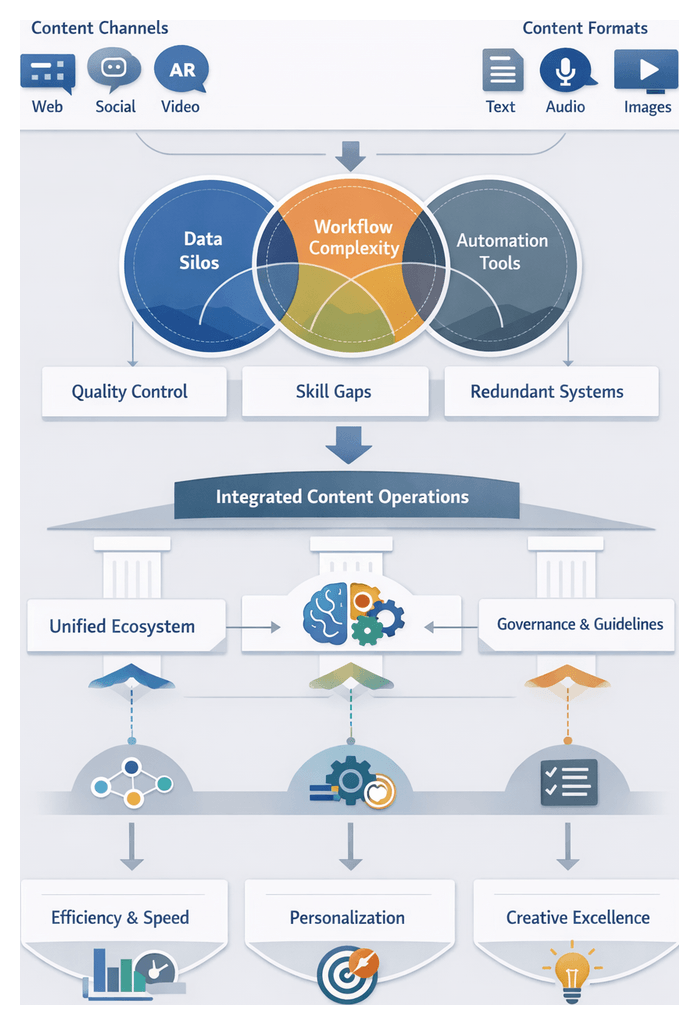
Digital Content Landscape and Integration Challenges
Over the past decade, the proliferation of digital channels—from websites and social media to mobile apps, interactive microsites and immersive experiences—has expanded the content ecosystem dramatically. Each channel demands tailored formats and editorial approaches to engage diverse audiences, creating both opportunities for precise targeting and complexities in production. Content now spans text, images, video, audio, infographics, live streams, social clips, podcasts and emerging augmented reality overlays. Within text alone, formats range from long-form thought leadership to micro-blogs, email campaigns, product descriptions and chat-bot responses. This diversity enriches storytelling but strains traditional teams striving to maintain consistency, quality and speed.
Driven by data analytics and real-time tracking, audiences expect personalized, contextually aware experiences. Meanwhile, competitive pressure demands rapid campaign turnarounds, continuous optimization and rapid iteration. Manual processes struggle to keep pace, leading to bottlenecks, burnout and missed opportunities. To address this, organizations are integrating automated content generation and distribution platforms. Tools such as OpenAI GPT-4 for natural language assistance, Jasper for draft creation and Grammarly for editorial enhancement accelerate workflows by producing draft copy, suggesting headlines, optimizing SEO and generating simple visuals. However, automation can introduce friction: misaligned handoffs, duplicated effort, quality lapses and tool redundancies often emerge when systems and human expertise remain siloed.
Content operations typically rely on a patchwork of specialized applications—content management systems, digital asset libraries, social schedulers, analytics dashboards and collaboration platforms. Isolated systems impede insight sharing: writers may lack performance metrics, designers may miss updated brand guidelines, and editors may struggle to trace version history. As new AI-enabled tools enter the market, overlapping features inflate costs, training demands and user confusion. Rationalizing tool stacks is critical to reduce redundancy and maximize ROI.
Automated systems excel at volume but may struggle with brand voice, tone and nuance. Without rigorous governance—clear style guidelines, embedded voice parameters and regular audits—AI outputs risk inconsistency, inaccuracy or departure from core messaging. Introducing AI also demands new skills: prompt engineering, workflow design, system integration and analytics. Creative professionals often lack exposure to these disciplines, leading to hesitation or resistance. Success requires intentional upskilling, cross-functional collaboration and leadership sponsorship.
Human-AI collaboration reshapes roles. Writers shift from drafting to editing machine-generated content, while strategists focus on data-driven planning. Without clear role definitions and collaborative frameworks, teams can experience confusion, duplicated effort or ownership gaps. Defined workflows that balance autonomy, oversight and experimentation are essential.
- Data Silos and Fragmentation: Isolated platforms impede insight sharing.
- Workflow Complexity: Multiple handoffs slow production.
- Redundant Licenses: Overlapping features inflate costs.
- Quality Governance: Ensuring brand alignment in automated outputs.
- Skill Evolution: Equipping teams to collaborate with AI agents.
Organizations that address these integration challenges unlock efficiency and creativity gains. Seamless automation allows human experts to focus on strategic planning, narrative development and audience engagement. A unified ecosystem enhances data visibility, enabling continuous improvement through performance analytics and real-time optimization. Foundations for hybrid workflows include auditing current tools, mapping processes, articulating brand standards and convening cross-functional teams to co-design pilots. Executive sponsorship and dedicated change-management resources can validate approaches and build momentum.
Analytical Forecasts of Augmented Collaboration
Industry analysts predict a shift from sequential AI-to-human handoffs to a synchronous, interactive co-creation paradigm. In this model, AI agents become active co-authors rather than passive generators. Four key trends underpin this evolution:
- Contextual Intelligence Amplification: AI platforms will ingest real-time audience analytics, creative briefs and enterprise knowledge to tailor suggestions to strategic objectives. Gartner forecasts that by 2028, over 60 percent of leading marketing organizations will use context-aware AI to personalize creative prompts based on performance data.
- Dialogue-Driven Interaction: Natural language interfaces will support multi-turn conversations, enabling creators to interrogate outputs, request variations and refine tone iteratively, reducing prompt-switching friction.
- Integrated Creative Workbenches: Generative modules will be embedded within comprehensive workspaces, allowing teams to draft text, design visuals and produce audio or video in a unified environment—eliminating data silos and preserving version histories.
- Hybrid Task Allocation: Dynamic frameworks will assign subtasks—headline generation, image mockups, data-driven infographics—to AI agents, while humans reserve strategic ideation, narrative structuring and final editorial judgment.
Forrester and McKinsey project sustained growth in investments for AI-enabled creative platforms. Development phases include:
- Short-Term (1-2 Years): Already visible in Adobe Firefly and OpenAI ChatGPT, incremental model updates will refine suggestions, focusing on templates, prompt libraries and brand-voice presets.
- Mid-Term (3-5 Years): Multi-modal synthesis will produce coordinated text, imagery, audio and video from a single prompt. Enhanced style-transfer algorithms will emulate distinctive creative voices. Real-time co-editing and in-context commentary will become standard.
- Long-Term (5-10 Years): Autonomous AI platforms will pilot end-to-end campaigns, selecting formats, channels and messaging based on high-level goals and continuous audience feedback loops.
Adaptive learning systems will leverage closed-loop architectures to refine AI outputs based on performance metrics. Advancements include:
- Feedback-Driven Model Tuning: Engagement rates, dwell time, conversions and sentiment analysis feed retraining pipelines, calibrating tone and creative angles for maximum resonance.
- Segment-Level Personalization: Combining audience segmentation with persona-based KPIs enables hyper-personalized variants at scale without matching labor costs.
- Organizational Memory: Collaboration platforms capture metadata on user–AI interactions, building a repository of style guidelines and decision rationales that improve recommendations over time.
Interpretive frameworks help practitioners navigate these changes:
- Socio-Technical Alignment: Co-design workshops, updated role definitions and training ensure AI enhances culture and workflows rather than disrupts them.
- Adoption Lifecycle Metrics: Pilot completion rates, user satisfaction scores and time-to-value track progress from experimentation to enterprise deployment.
- Knowledge Integration: Codifying tacit creative expertise into AI-supported routines transforms individual know-how into scalable assets.
Experts debate autonomy versus oversight, creativity metrics and ethical governance. Strategic imperatives include cross-disciplinary steering committees, pilots with clear ROI criteria, phased adoption roadmaps and investments in upskilling. This structured approach ensures that AI serves as a partner in innovation while maintaining human ownership of vision and narrative design.
Evolving Roles and Collaborative Architectures
Advanced AI agents are reshaping team architectures and individual roles. Semi-autonomous collaborators prompt organizations to reconsider hierarchies, organizing around concentric skill zones: strategic visioning, content orchestration, AI supervision and human-centric refinement. Hybrid roles such as AI Content Curator, Prompt Engineer and Creative Data Analyst span technical fluency, domain expertise and narrative sensibility. Cross-disciplinary training in computer science, marketing strategy and creative writing underpins this evolution.
Effective collaborative architectures share common traits:
- Decentralized Decision Nodes: Teams make rapid, context-driven decisions on AI outputs.
- Feedback-Loop Mechanisms: Iterative reviews align suggestions with brand guidelines and audience insights.
- Cross-Functional Squads: Data scientists, creative directors and subject-matter experts co-own content verticals end to end.
- Governance Councils: Oversight bodies set ethical standards, bias mitigation protocols and IP guidelines.
Organizational structures are shifting from rigid silos to fluid, matrixed models that support real-time co-creation. Hybrid Centers of Excellence consolidate AI expertise, creative leadership and data analytics. They fulfill three roles:
- Technology Scouting: Evaluating tools such as GPT-4 and Adobe Firefly for strategic fit.
- Capability Building: Designing curricula and mentorship for prompt design, model tuning and ethical AI practices.
- Performance Governance: Establishing KPIs that balance efficiency with originality, brand resonance and audience trust.
In organizations resistant to upheaval, AI advocates within departments serve as liaisons between creatives and technical specialists. Over time, federated models evolve into fully hybrid structures as value is demonstrated.
Competitive pressures in industries like finance, healthcare and retail drive rapid adoption of AI-assisted workflows. Early adopters gain advantages in personalization at scale, operational agility and cost efficiency. To maintain differentiation, organizations must embed AI decision nodes throughout the content value chain—from ideation and validation to distribution analytics and audience feedback integration.
Technological convergence is dissolving boundaries between creation, distribution and measurement. Examples include:
Augmented Reality Interfaces
AR storyboarding tools overlay AI-generated narrative prompts onto physical workspaces, enabling immersive planning that fosters deeper audience empathy.
Voice-Activated Collaboration
Using APIs from providers such as Anthropic, teams can dictate adjustments, request tone refinements and approve AI-sourced fragments without leaving collaborative platforms.
Analytics-Driven Feedback Loops
Integration of analytics dashboards with AI tools enables real-time monitoring of dwell time, sentiment and click-through rates, allowing on-the-fly narrative tuning.
Interoperability standards, open APIs and modular architectures are essential for rapid innovation, enabling the combination of best-in-breed solutions rather than monolithic platforms.
Stakeholders should pursue five strategic imperatives:
- Invest in Human Capital: Develop cross-functional expertise in data literacy, prompt engineering and ethical reasoning.
- Adopt Agile Governance: Balance speed and accountability, with clear policies for bias detection, content provenance and IP management.
- Foster Experimentation: Launch controlled pilots to test emerging AI capabilities, accelerating learning and uncovering novel applications.
- Build Ecosystem Partnerships: Collaborate with technology vendors, research institutions and industry consortia to stay abreast of breakthroughs.
- Align Metrics with Outcomes: Measure brand authenticity, audience resonance and creative diversity alongside efficiency gains.
Key Considerations for Future-Proof Strategies
Preparing for the next wave of technological disruption requires balancing innovation with resilience. Leaders must integrate generative AI, immersive interfaces and real-time analytics into robust governance frameworks, agile talent strategies and ethical guardrails. This multi-dimensional approach ensures adaptability as ecosystems converge and complexity increases.
Anticipating Technological Convergence
Future ecosystems will blend generative agents, augmented and virtual reality and analytics platforms. To manage convergence:
- Monitor Cross-Domain Partnerships: Track collaborations between OpenAI and mixed-reality pioneers for interoperability insights.
- Invest in Modular Architectures: Design systems able to accommodate voice-driven prompts, haptic feedback and other modalities without overhaul.
- Balance Specialization and Integration: Avoid overcommitment to a single platform; preserve flexibility to adopt best-of-breed tools.
Investing in Adaptive Workforce Skills
As AI takes on routine tasks, human roles will shift toward analysis, ethical oversight and strategic decisions. To cultivate an adaptive workforce:
- Develop Cross-Functional Fluencies: Encourage data literacy, model evaluation and familiarity with emerging interfaces.
- Embed Lifelong Learning: Offer micro-credentials in human-AI co-creation, prompt engineering and immersive UX design.
- Foster Creative Resilience: Use rotational assignments, mentorship and proof-of-concept projects to adapt teams to evolving roles.
Ensuring Ethical and Responsible Innovation
Ethical frameworks should be integrated from strategy inception to mitigate reputational risk, bias amplification and legal exposure:
- Model Risk Assessments: Audit training data provenance, bias metrics and fairness impacts before deployment.
- Transparency in Attribution: Clearly disclose machine-assisted content to maintain trust and compliance.
- Ethics Review Boards: Include legal, diversity and domain experts to evaluate initiatives against corporate values.
Maintaining Brand Integrity in Automated Contexts
To prevent drift in voice, tone and messaging as AI volumes increase:
- Algorithmic Style Guides: Translate brand guidelines into machine-readable constraints.
- Dynamic Feedback Loops: Use real-time analytics to detect deviations and trigger human review or retraining.
- Qualitative Audits: Pair performance metrics with periodic brand-voice assessments by creative directors.
Balancing Standardization and Customization
Future strategies must reconcile templated workflows with demands for personalization:
- Tiered Content Models: Use standardized AI templates for routine communications and bespoke authorship for flagship narratives.
- Audience Segmentation Data: Trigger adaptive variations that align with brand parameters and customer preferences.
- Modular Personalization Engines: Assemble content blocks dynamically based on profiles, regulations and briefs.
Navigating Data Privacy and Security
Protecting proprietary information is critical as AI ingests sensitive data:
- Strict Access Controls: Segment model environments by sensitivity and audit pipelines handling confidential data.
- Synthetic Data Alternatives: Use anonymized or synthetic datasets for fine-tuning to reduce exposure.
- Security Testing: Embed adversarial testing to guard against prompt injection and model inversion attacks.
Preparing for Regulatory Evolution
With AI regulations in flux, content operations must be compliance-ready:
- Monitor Global Frameworks: Track the EU’s AI Act, U.S. executive orders and international guidelines.
- Design for Compliance by Default: Build consent mechanisms, data residency options and audit trails into workflows.
- Engage in Policy Dialogue: Participate in industry consortia to influence practical regulations and share best practices.
Leveraging Strategic Partnerships
In-house AI ecosystems can be resource intensive. Strategic alliances accelerate innovation and distribute risk:
- Shared Research Initiatives: Collaborate on model architectures, interaction paradigms and domain-specific datasets.
- Co-Development Opportunities: Secure early access to next-generation capabilities through joint ventures and pilots.
- Innovation Labs: Incubate experimental projects in semi-autonomous units and scale learnings enterprise-wide.
Building Resilience Through Scenario Planning
Given rapid technological change, scenario planning stress-tests strategies under varying conditions:
- Define Critical Uncertainties: Identify variables such as AI compute costs, talent availability and data regulation trajectories.
- Develop Adaptive Playbooks: Outline decision triggers, investment priorities and contingencies for each scenario.
- Regularly Revisit Assumptions: Schedule reviews to validate relevance and integrate new internal and external intelligence.
- Embrace convergence with modularity for extensibility.
- Prioritize workforce adaptability aligned with AI-human collaboration.
- Embed ethics, privacy and compliance throughout strategy.
- Balance efficiency and personalization via tiered frameworks.
- Leverage partnerships and scenario planning to distribute risk and accelerate learning.
Conclusion
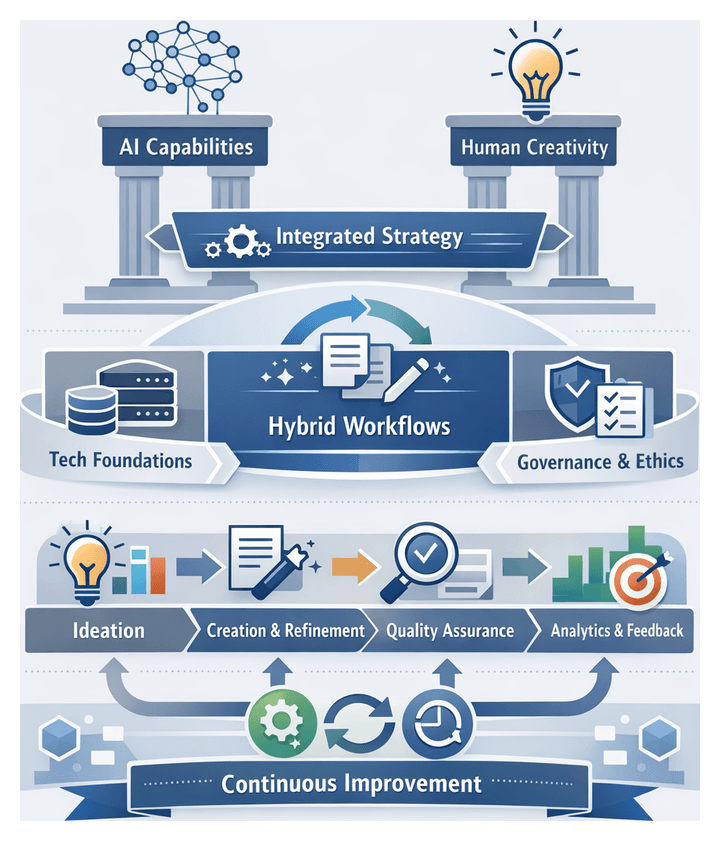
Core Frameworks for Harmonizing AI and Human Creativity
Effective integration of AI agents with human creativity begins with a unified perspective on the modern content landscape. Organizations must navigate a fragmented ecosystem of digital channels, social platforms and interactive experiences. AI-driven tools offer efficiency in tasks such as data-driven ideation, draft generation and multilingual translation, while human authors contribute originality, cultural context and emotional resonance. A coherent strategy aligns these complementary strengths within a holistic content lifecycle, guiding decisions from tool selection to workflow design.
Architectural Foundations
At the technical level, AI agents rely on sophisticated natural language processing models, pretrained embeddings and adaptive feedback loops. Understanding the capabilities and constraints of transformer architectures, reinforcement learning mechanisms and prompt engineering is essential. Human experts enhance AI performance by providing precise prompts, contextual inputs and validation checkpoints. This collaborative approach ensures that generated outputs reflect both data-driven insights and strategic intent.
Hybrid Workflow Models
Hybrid workflows orchestrate sequential, parallel and iterative collaboration paradigms. In sequential models, AI generates initial drafts that human editors refine for tone, brand alignment and factual accuracy. Parallel approaches enable concurrent machine-driven topic suggestions and human narrative development. Iterative loops alternate between AI augmentation—such as automated paraphrasing, sentiment analysis or SEO optimization—and human reviews. Selecting the appropriate model depends on project complexity, regulatory requirements and creative objectives.
Governance and Brand Consistency
Maintaining a coherent brand voice and quality standards demands robust editorial protocols. Organizations codify tone, vocabulary and style rules into machine-readable guidelines and deploy automated quality checks for terminology consistency, readability and legal compliance. Human oversight remains indispensable for nuanced judgments and ethical considerations. Ethical governance frameworks address bias mitigation, intellectual property rights and transparency, ensuring that AI-assisted content upholds brand integrity and audience trust.
Measurement, Feedback and Continuous Improvement
Quantifiable metrics anchor the evaluation of hybrid models across speed, cost, adaptability and authenticity. Key performance indicators include time-to-publish, editing workload reduction, engagement lift and conversion rates. Real-time analytics and A/B testing protocols feed back into prompt refinement, editorial guidelines and resource allocation decisions. This data-driven feedback loop drives iterative enhancements, enabling both AI models and human teams to learn from performance outcomes and maintain a competitive edge.
Future-Proofing Creative Operations
Anticipating emerging interfaces—augmented reality writing environments, real-time co-creative platforms and adaptive learning systems—prepares organizations for the next frontier of content creation. Investing in skills for prompt engineering, model governance and cross-functional collaboration fosters a culture of experimentation. Modular technology stacks and continuous training programs ensure agility, allowing teams to integrate new AI capabilities without disrupting core workflows.
Operational Patterns and Strategic Imperatives
Across multiple case studies and chapters, six synthesized patterns emerge that guide the strategic embedding of AI-human collaboration into content operations:
- Strategic Vision Anchors Design: Organizations with a clearly articulated content vision align AI tool selection, process design and governance structures to brand objectives, preventing fragmented deployments focused solely on efficiency or creative protection.
- Fluid Collaboration Across Stages: Embedding AI at ideation, drafting, review and optimization touchpoints—rather than siloing it—ensures a bi-directional flow of machine suggestions and human narratives, preserving emotional resonance and originality.
- Quality Assurance as a Continuous Cycle: Centralized style frameworks, machine-readable guidelines and analytics dashboards enforce brand consistency. Automated checks surface deviations in voice or metrics that trigger human interventions.
- Ethical Governance and Transparency: Audit logs, bias detection protocols and clear attribution of AI involvement foster trust. Proactive guardrails address intellectual property, fairness and regulatory compliance.
- Data-Driven Feedback Loops: Dynamic audience segmentation, real-time engagement analytics and iterative A/B testing refine AI prompts and editorial guidelines, enabling adaptive content strategies that respond to market dynamics.
- Future-Ready Agility: Modular AI architectures, continuous upskilling programs and strategic pilot projects build an institutional mindset of adaptive learning, positioning organizations to adopt emerging technologies seamlessly.
Organizational Transformation and Talent Evolution
Implementing AI-human synergy extends beyond technology to reshape organizational structures, talent roles and partnership ecosystems. Key strategic impacts include:
- Agile, Cross-Functional Teams: Content pods blend AI specialists with writers, editors and strategists. Roles such as an AI Content Steward oversee model selection, bias monitoring and calibration, working alongside Creative Directors responsible for narrative cohesion.
- Hybrid Skill Sets: Job descriptions now list expertise in GPT-4-powered workflows, prompt engineering and AI ethics, alongside storytelling, brand strategy and audience psychology competencies.
- Strategic Partnerships: Alliances with vendors and research institutions accelerate innovation. Integrations with platforms like Jasper AI for ideation, Grammarly Business for editorial refinement, Microsoft Copilot for workflow automation and GPT-4 for advanced prompt engineering enable rapid experimentation and maintain focus on core differentiation.
- Governance, Compliance and Risk Management: Councils comprising legal, editorial and technical stakeholders establish protocols for data provenance audits, algorithmic transparency and regulatory alignment. Routine red-teaming and documentation of human reviews demonstrate due diligence and protect reputation.
- Performance Metrics and Accountability: Beyond traditional engagement measures, leaders track AI-assisted output ratios, revision cycles and time-to-publish improvements. Performance dashboards inform continuous refinement of both technology and talent investments.
Analytical Frameworks and Actionable Leadership Imperatives
To operationalize AI-human synergy, content leaders employ interpretive lenses and governance models that diagnose readiness, benchmark progress and guide investment decisions:
- Capability Maturity Model: Evaluates proficiency across technology integration, governance, talent and measurement, prioritizing initiatives that accelerate hybrid content production.
- Value Chain Mapping: Identifies bottlenecks and handoff points, revealing where AI can automate tasks such as source aggregation, basic drafting and SEO optimization, while humans focus on high-value creative phases.
- ROI and Impact Modeling: Projects returns on AI investments by quantifying time savings, productivity gains, content throughput and revenue influence, supporting robust business cases and executive sponsorship.
- Brand Voice Alignment Taxonomy: A qualitative rubric assesses AI outputs against tone, vocabulary, readability and emotional resonance dimensions, enabling objective evaluations and iterative refinements.
- Scenario-Based Risk Assessment: Envisions failure modes—such as bias, privacy breaches or content misalignment—and develops safeguards, stress-testing governance protocols and incident-response plans.
- Adaptive Learning Cycle: Treats each campaign as an experiment, integrating A/B testing, user feedback and performance data to refine both human workflows and AI models continuously.
Domain-Specific and Governance Considerations
- Regulated Industries: Incorporate subject-matter expert validations and maintain audit trails for all AI-assisted outputs in healthcare, finance and legal sectors.
- Consumer Brands: Balance personalization at scale with privacy safeguards, avoiding creative uniformity that dilutes brand identity.
- Technical Documentation: Deploy glossaries and style guides to ensure accuracy in user guides, API references and knowledge-base articles.
- Media and Publishing: Preserve journalistic integrity through transparent labeling of AI-co-written content and bias-mitigation protocols in newsrooms.
- Educational Content: Validate pedagogical soundness of adaptive learning paths and assessments, aligning AI outputs with accreditation standards.
- Model Bias and Data Quality: Audit training datasets, apply mitigation techniques and include diverse feedback loops to catch stereotypes or inaccuracies.
- Integration Complexity: Phase rollouts with pilot testing to minimize disruption when integrating platforms with existing content management systems.
- Talent and Culture Shifts: Implement training programs, cross-functional incentives and clear role definitions to align teams with hybrid workflows.
- Regulatory Adaptation: Monitor evolving data privacy, copyright and algorithmic transparency laws, updating policies to maintain compliance and public trust.
Leadership Mindsets for Sustainable Innovation
- Curiosity with Discipline: Encourage prototype exploration with tools such as ChatGPT, custom large language models and analytics platforms, while enforcing structured evaluation and documentation.
- Data-Informed Judgment: Base decisions on both quantitative performance metrics and qualitative stakeholder feedback to balance efficiency with creative integrity.
- Collaborative Authorship: Involve creative professionals in prompt engineering and model fine-tuning to foster co-ownership and drive higher-quality outcomes.
- Continuous Learning Culture: Host upskilling workshops, internal forums and cross-team hackathons that pair technologists with writers, accelerating hybrid workflow adoption.
- Ethical Leadership: Publicly articulate responsible AI guidelines, report bias-mitigation efforts and engage stakeholders in dialogue about the social impact of AI-enabled content.
- Future-Ready Orientation: Stay vigilant to emerging technologies—voice-driven platforms, augmented reality interfaces and adaptive systems—and evaluate their strategic fit to enhance core competencies.
By weaving these frameworks, patterns and strategic insights into operational realities, organizations transform AI-human collaboration from a pilot project into a dynamic capability. Leveraging AI’s computational power to scale routine tasks while safeguarding the irreplaceable qualities of human judgment, empathy, and storytelling enables resilient, innovative, and future-proof content strategies that drive enduring audience engagement.
Appendix
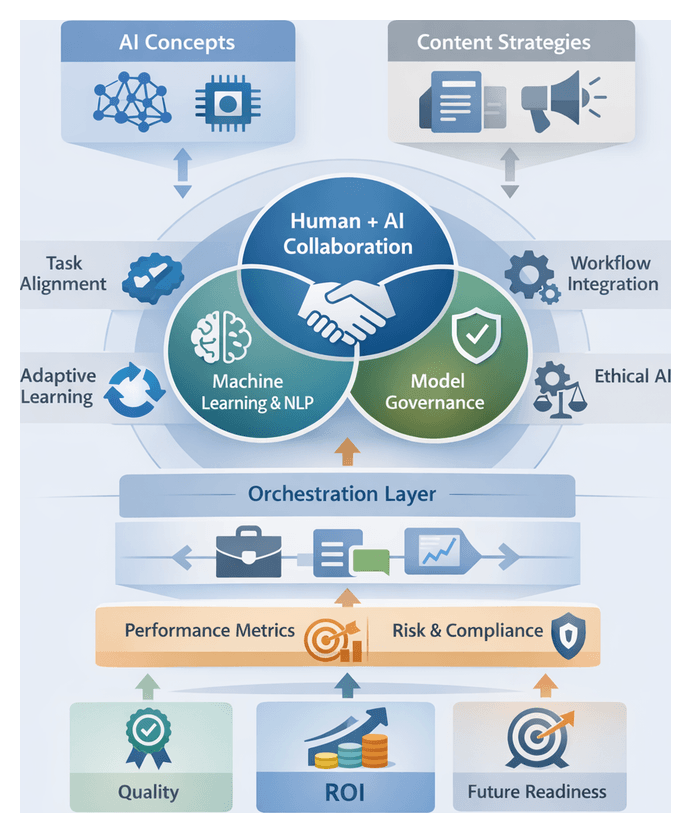
Key Definitions and Terminology
This glossary establishes core terms across AI architectures, content creation, and hybrid workflows. Readers can reference these definitions to ensure a common understanding when applying strategic frameworks and practical guidance.
- Artificial Intelligence (AI): computer systems performing tasks requiring human intelligence, from rule-based logic to advanced machine learning.
- Machine Learning (ML): AI subset where models learn patterns from data without explicit programming.
- Deep Learning: ML branch using multi-layer neural networks, powering language models and image synthesis.
- Natural Language Processing (NLP): techniques enabling interpretation, generation, and analysis of human language.
- Large Language Model (LLM): deep learning model trained on vast text corpora, e.g., GPT-4 and BERT, generating coherent text.
- Prompt Engineering: crafting input instructions to guide AI models toward desired outputs.
- Fine-Tuning: adapting a pre-trained model to a specific domain via additional training.
- Transfer Learning: reusing knowledge from one model or task to accelerate learning in another.
- Inference: execution phase when an AI model processes new inputs to generate outputs.
- Human-in-the-Loop: collaboration where AI outputs are validated and refined by human experts.
- Hallucination: AI-generated plausible but incorrect or fabricated information.
- Model Drift: performance degradation over time due to changing data distributions.
- Explainable AI (XAI): methods that make AI decisions transparent and interpretable.
- Reinforcement Learning: agent learns decision-making by rewards and penalties.
- Content Management System (CMS): platform for creating, editing, organizing, and publishing digital content.
- Content Operations (ContentOps): structured processes and technologies that manage content lifecycle end-to-end.
- Brand Voice: distinctive personality and tone guiding consistent communication.
- Customer Journey: sequence of user interactions with a brand from awareness to advocacy.
- Omni-Channel: coordinated content distribution across multiple platforms for a seamless user experience.
- Micro-Content: brief content fragments designed for quick consumption, such as social updates or chatbot replies.
- Long-Form Content: in-depth narratives like whitepapers and e-books requiring human expertise and editorial rigor.
- SEO: optimizing content for search discoverability via keywords, metadata, and technical performance.
- Call to Action (CTA): prompt encouraging a specific user action, refined through A/B testing.
- Content Personalization: tailoring messages and recommendations to individual user profiles.
- Content Governance: policies and approval processes ensuring integrity, compliance, and brand alignment.
- Thought Leadership: authoritative content demonstrating expertise and shaping industry conversations.
- Modular Content Architecture: reusable content components assembled dynamically for scale and personalization.
- Orchestration Layer: middleware coordinating AI services, human review, CMS, and analytics tools.
- Quality Gate: review step enforcing editorial, stylistic, and compliance standards.
Conceptual Frameworks Overview
Practitioners can apply these structured models to design and evaluate hybrid workflows, align technology selection, ensure governance, and measure impact.
Strategic Collaboration Models
- Complementarity Model: maps tasks by AI strengths in data-intensive, repetitive work and human strengths in strategic judgment and creativity.
- Human-in-the-Loop Paradigm: treats AI outputs as draft proposals refined by human experts for compliance and brand voice alignment.
- Adaptive Learning Cycle: iterative co-creative system where human corrections and feedback train AI models over time.
- Orchestration Architecture: central layer that routes content briefs among NLP, image synthesis, analytics modules, and human checkpoints.
Workflow Integration Frameworks
- Task-Technology Fit: aligns task characteristics (ideation, drafting, editing) with specific AI capabilities for optimal performance.
- Sociotechnical Systems Lens: examines how technology, organizational structures, and human behavior co-evolve in hybrid teams.
- Capability Maturity Matrix: maps AI integration stages from experimentation to fully embedded systems, guiding investment priorities.
Evaluation and Measurement Frameworks
- Efficiency-Ingenuity Model: plots initiatives by operational metrics (velocity, cost) and qualitative metrics (brand alignment, engagement).
- Balanced Scorecard: evaluates content across financial ROI, customer engagement, internal processes, and learning dimensions.
- Multi-Touch Attribution: allocates credit across AI-generated and human-authored touchpoints for accurate ROI insights.
- Forrester TEI: quantifies AI investment value by assessing costs, benefits, flexibility, and risks.
Governance and Ethical Frameworks
- Ethics-by-Design: embeds bias mitigation, transparency, and privacy safeguards into AI tools from inception.
- Bias and Fairness Metrics: applies measures like demographic parity and equal opportunity, supported by audits to prevent algorithmic bias.
- Explainable AI Methods: uses LIME, SHAP, and Model Cards for transparent model decision paths and stakeholder trust.
- Governance Councils and Audit Trails: cross-functional committees define policies and maintain records of prompts, versions, and overrides.
Brand Voice and Quality Assurance
- Rule-Based Style Enforcement: machine-readable style guides flag deviations from approved lexicon and structure.
- Semantic Consistency via Fine-Tuning: models trained on brand corpora internalize tone and style patterns.
- Hybrid Templates and Prompt Engineering: modular content blocks with dynamic prompts guide AI while preserving narrative frameworks.
- Real-Time Voice Monitoring: sentiment dashboards track published content, alerting for tonal drift and prompting calibration.
Technology Selection and Integration
- Multi-Criteria Decision Analysis: assigns weighted scores to functionality, integration ease, scalability, security, and cost for objective tool selection.
- Interoperability and API-First Principles: prioritizes open APIs and standardized formats to prevent vendor lock-in.
- Cloud-Native and Hybrid Deployment: evaluates on-premises, private cloud, and managed services based on security and performance needs.
Future-Proof Strategy Frameworks
- Dynamic Capability Framework: builds routines for sensing, seizing, and reconfiguring hybrid models in response to market shifts.
- Scenario Planning and Stress Testing: develops varied future scenarios to guide flexible strategy roadmaps.
- Strategic Partnership Ecosystems: collaborates with vendors, academia, and consortia to share R&D risk and best practices.
Key Questions for Hybrid Content Production
How should organizations decide which content tasks to automate?
Map tasks by complexity of judgment and volume of output. AI is ideal for low-complexity, high-volume tasks; humans for high-complexity, low-volume; hybrid workflows suit mid-level tasks.
- Low Complexity, High Volume: AI handles metadata generation, product descriptions, initial drafts, keyword optimization, simple social posts.
- High Complexity, Low Volume: Humans produce thought leadership, brand manifestos, investigative journalism, sensitive communications, long-form narratives.
- Mid Complexity, Mid Volume: AI drafts suggestions; humans verify facts, refine voice, and add creative insights.
What steps ensure seamless AI integration into creative workflows?
- Audit existing workflows to identify integration points and dependencies.
- Define clear use cases and pilot AI tools on scoped tasks like headline suggestions.
- Select platforms with open APIs or connectors to CMS, collaboration, and analytics systems.
- Roll out in stages with workshops, guides, and support channels.
- Establish feedback loops to gather input, measure improvements, and iterate on configurations.
How can brands maintain consistent voice and quality in AI-generated content?
- Encode brand guidelines into machine-readable rules covering vocabulary, tone, and style.
- Fine-tune models on proprietary brand content to internalize voice nuances.
- Implement human-in-the-loop checkpoints with subject-matter experts.
- Use automated style-checking tools like Grammarly to flag deviations.
What governance structures ensure ethical AI usage?
- Form a cross-functional AI council including legal, compliance, creative, data science, and IT representatives.
- Conduct regular audits of AI outputs for bias, inaccuracies, and brand misalignment.
- Maintain transparent documentation with model cards and data provenance logs.
- Define escalation protocols for addressing ethical concerns or compliance issues.
Who owns rights to AI-assisted content and how to navigate IP concerns?
- Specify output ownership in vendor contracts, vesting rights in the organization or prompt creator.
- Document human edits and prompts to establish evidence of authorship.
- Ensure training and fine-tuning data are licensed for commercial use.
- Embed attribution guidelines disclosing AI involvement to preserve transparency.
How should organizations measure impact and ROI of hybrid content?
- Track operational efficiency: time saved, labor reduction, throughput increases.
- Analyze quality and engagement: dwell time, shares, sentiment comparisons.
- Use multi-touch attribution to assess hybrid content’s influence on leads and sales.
- Calculate cost savings, including licensing fees and human resource reallocation.
- Estimate risk mitigation benefits from reduced compliance issues and content reworks.
What strategies address bias and transparency in AI content?
- Perform bias audits with tools like AI Fairness 360.
- Apply explainable AI techniques such as LIME and SHAP.
- Publish model cards detailing training data, performance, and limitations.
- Engage diverse reviewers to detect cultural insensitivities.
What skills and roles do content teams need for AI collaboration?
- Prompt Engineer: crafts inputs that guide AI outputs.
- AI Content Curator: evaluates and integrates machine-generated drafts.
- Creative Strategist: aligns AI-assisted content with brand objectives.
- Data Analyst: monitors metrics, runs A/B tests, and directs refinements.
- Ethics Officer: oversees bias audits, transparency, and compliance.
How can organizations scale hybrid content workflows?
- Adopt modular, API-first platforms for incremental AI capability additions.
- Use workflow engines to orchestrate tasks between AI services and human reviewers.
- Maintain a centralized repository for style guides, model cards, and audit logs.
- Implement real-time dashboards for performance tracking and capacity planning.
AI Tools and Resources Directory
- ChatGPT: conversational AI assistant powered by GPT models.
- GPT-4: advanced language model with improved context handling and creativity.
- OpenAI API: programmable interface to access language models for custom integration.
- Jasper: AI writing assistant with templates and Brand Voice settings.
- Copy.ai: platform for rapid marketing copy, blog ideas, and social media posts.
- Rytr: AI writing tool with multilingual support and basic SEO integration.
- Frase: content research and optimization platform generating SEO-optimized outlines.
- CopySmith: bulk generation tool for e-commerce product descriptions.
- ProWritingAid: writing assistant offering grammar, style, and readability analysis.
- Hemingway Editor: tool focusing on sentence structure and readability.
- Writer.com: enterprise platform for custom style guides and real-time AI suggestions.
- Surfer SEO: tool providing content outlines, keyword recommendations, and on-page grading.
- Clearscope: platform for topic relevance scoring and keyword insights.
- MarketMuse: AI-driven content gap analysis and topic cluster suggestions.
- Acrolinx: enterprise language governance enforcing style and terminology consistency.
- Adobe Firefly: generative AI for image synthesis and design asset creation.
- Adobe Sensei: AI framework for automated tagging, layout recommendations, and personalization.
- DeepL: neural machine translation service supporting multiple languages.
- Compliance.ai: platform for monitoring regulatory changes and automating compliance workflows.
- Optimizely: digital experience platform with AI-driven A/B testing and personalization.
- Dynamic Yield: AI personalization delivering individualized recommendations across channels.
- IBM Watson: suite of AI services for NLP, discovery, and conversational agents.
- Hugging Face Transformers: open-source library of pretrained transformer models.
- BERT: Google’s bidirectional transformer model for deep semantic understanding.
- Claude: conversational AI assistant emphasizing safety and reliability.
- Dialogflow: platform for building conversational interfaces and chatbots.
- Rasa: open-source framework for contextual AI assistants and chatbots.
- Midjourney: diffusion-based image generation from text prompts.
- DALL·E: multimodal model generating detailed images from text descriptions.
- Synthesia: AI video platform for avatar-based videos with script-to-speech and translations.
- Lumen5: transforms text into social media videos using AI-driven scene selection.
- Descript: media editing platform offering transcription and AI-powered overdubbing.
- Crisp: messaging platform with AI chatbots and sentiment analysis.
- Grammarly Business: enterprise writing assistant with style guidance and compliance checks.
- Google Bard: conversational AI for creative writing assistance and interactive ideation.
- WordPress: open-source CMS extensible with AI plugins for content generation.
- HubSpot CMS: CRM-integrated platform with AI topic suggestions and SEO recommendations.
- BuzzSumo: social analytics tool identifying high-performing content and influencers.
- SEMrush: marketing platform with AI-powered keyword tracking and site audits.
- Brandwatch: social listening platform surfacing sentiment trends and topics.
- Chartbeat: real-time analytics platform with predictive engagement indicators.
The AugVation family of websites helps entrepreneurs, professionals, and teams apply AI in practical, real-world ways—through curated tools, proven workflows, and implementation-focused education. Explore the ecosystem below to find the right platform for your goals.
Ecosystem Directory
AugVation — The central hub for AI-enhanced digital products, guides, templates, and implementation toolkits.
Resource Link AI — A curated directory of AI tools, solution workflows, reviews, and practical learning resources.
Agent Link AI — AI agents and intelligent automation: orchestrated workflows, agent frameworks, and operational efficiency systems.
Business Link AI — AI for business strategy and operations: frameworks, use cases, and adoption guidance for leaders.
Content Link AI — AI-powered content creation and SEO: writing, publishing, multimedia, and scalable distribution workflows.
Design Link AI — AI for design and branding: creative tools, visual workflows, UX/UI acceleration, and design automation.
Developer Link AI — AI for builders: dev tools, APIs, frameworks, deployment strategies, and integration best practices.
Marketing Link AI — AI-driven marketing: automation, personalization, analytics, ad optimization, and performance growth.
Productivity Link AI — AI productivity systems: task efficiency, collaboration, knowledge workflows, and smarter daily execution.
Sales Link AI — AI for sales: lead generation, sales intelligence, conversation insights, CRM enhancement, and revenue optimization.
Want the fastest path? Start at AugVation to access the latest resources, then explore the rest of the ecosystem from there.