

Personalized Banking Reimagined AI Agents Transforming Customer Experiences
To download this as a free PDF eBook and explore many others, please visit the AugVation webstore:
Introduction
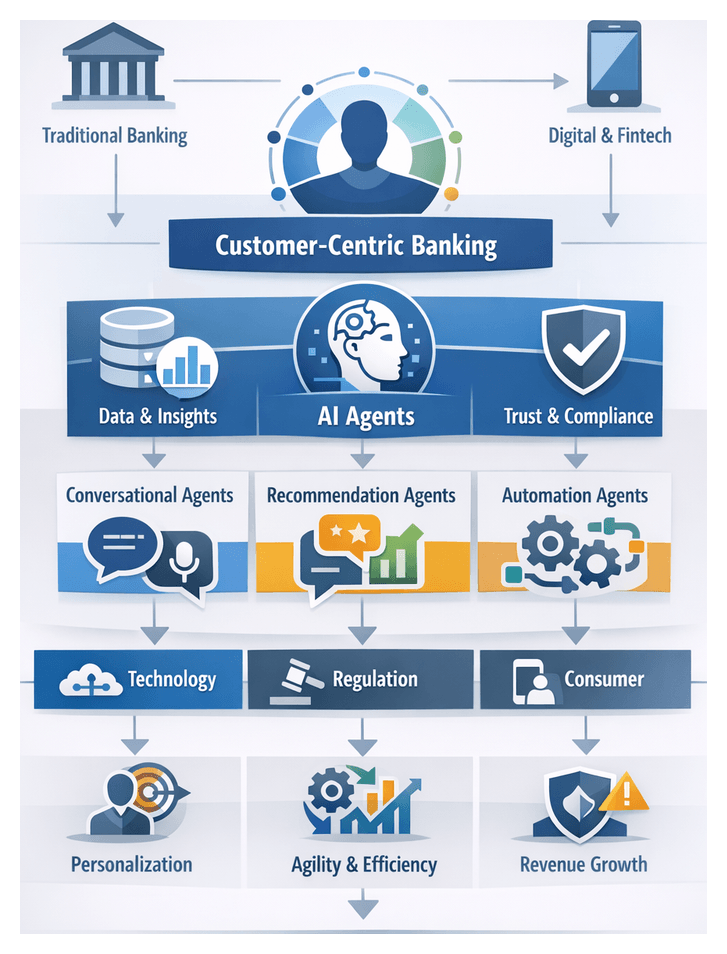
Navigating the Shift to Customer-Centric Banking
The banking industry is undergoing a profound transformation from product-driven models toward a customer-centric paradigm. Traditional institutions, defined for decades by branch networks and standardized offerings, now face relentless competition from digital challengers and neobanks that deliver seamless, hyper-personalized experiences. This evolution is driven by the digitization of everyday life, rising consumer expectations for tailored services, and regulatory initiatives that reshape data ownership and interoperability.
In this new landscape, customers view banking not merely as a transactional utility but as an integrated financial partner providing proactive guidance, real-time insights, and contextually relevant solutions. Financial institutions must break down organizational silos, adopt data-driven decision making, and reengineer processes to support agile engagement across channels. Legacy technology stacks, fragmented data sources, and rigid governance frameworks represent key obstacles to delivering individualized experiences at scale.
To remain competitive, banks need a clear vision, executive commitment, and a robust technological foundation. They must harness vast data assets—transactional records, behavioral signals, demographic profiles—and transform them into actionable insights. Meeting customer demands for personalization while ensuring privacy and regulatory compliance will determine which institutions secure sustainable differentiation in the digital era.
Framing AI Agents in Personalized Finance
AI agents are autonomous software entities that perceive customer intent, draw upon data-driven insights, and execute context-sensitive actions without human intervention. Combining natural language processing, machine learning, and real-time analytics, these agents serve as digital concierges: they interpret requests, anticipate needs, and deliver tailored recommendations or services across channels—chatbots on mobile apps, voice assistants in smart speakers, and proactive notifications via email or messaging platforms.
Core capabilities of AI agents include:
- Natural language understanding and generation for seamless conversational interactions
- Behavioral modeling and predictive analytics to anticipate customer needs
- Autonomous decision making, executing personalized actions with minimal supervision
- Integration with core banking and third-party systems for end-to-end journeys
Industry practitioners classify AI agents into three primary categories: conversational agents that handle customer inquiries and virtual assistant tasks; recommendation agents that deliver personalized product and service offers; and process automation agents that optimize back-office workflows such as trade confirmations or compliance checks. Leading platforms provide reference architectures and maturity assessments to guide deployment. Examples include IBM Watson Assistant, a unified conversational AI platform; and Microsoft Azure Bot Service, an extensible framework for intelligent workflows.
By moving beyond static, segment-based personalization toward dynamic, one-to-one engagement, AI agents enable financial institutions to foster deeper relationships, increase operational efficiency, and unlock new revenue streams.
The Critical Moment for Banking Personalization
Financial institutions stand at a strategic inflection point where technological advances, regulatory shifts, and evolving consumer behavior converge to make AI-driven personalization imperative. Understanding these forces—and their interplay—clarifies why personalization must be central to every bank’s strategy today.
Technological Catalysts
Advances in AI, cloud computing, and data analytics have lowered barriers to deploying scalable personalization. State-of-the-art natural language models, pattern recognition algorithms, and predictive engines now achieve high accuracy in real time. Cloud platforms enable elastic processing of vast data streams, while open APIs and modular architectures facilitate integration of best-of-breed AI components alongside legacy systems.
Regulatory and Competitive Drivers
Open banking initiatives, such as PSD2 in Europe, along with data privacy regulations like GDPR and CCPA, compel banks to establish transparent, consent-based data models. While these frameworks introduce complexity, they also create opportunities for institutions that can leverage customer-authorized data to deliver superior personalization. At the same time, fintechs and technology giants—unencumbered by legacy infrastructures—raise consumer expectations by offering frictionless, relatable experiences in adjacent domains.
The Digitally Empowered Consumer
Ubiquitous mobile access and on-demand services have transformed customer behavior. Modern banking clients demand seamless multichannel interactions, contextual insights delivered at the moment of need, and proactive guidance aligned with their life events—whether saving for a major purchase, navigating a financial emergency, or planning long-term investments. The pandemic further accelerated digital adoption across demographic segments, making personalization a baseline expectation rather than a luxury.
Strategic Imperatives
Banks that embrace AI-driven personalization can achieve four critical benefits:
- Enhanced customer loyalty through tailored recommendations and proactive engagement
- Revenue growth via contextual cross-sell and upsell opportunities powered by predictive analytics
- Operational agility as agents automate routine interactions, freeing experts to focus on high-value work
- Risk mitigation through real-time fraud detection and compliance monitoring
Moreover, personalization strategies vary across banking segments. Retail banks optimize daily financial management with spending insights and savings nudges. Wealth managers deliver bespoke portfolio recommendations and market alerts. Commercial banks offer cash-flow forecasting and tailored lending solutions for small enterprises. Corporate and investment banks leverage scenario analysis and deal-matching engines to enhance strategic advisory services.
Trust, Governance, and Readiness
Hyper-personalization must be underpinned by rigorous governance frameworks that ensure data privacy, model explainability, and ethical use. Institutions should embed compliance checkpoints within development lifecycles, conduct bias audits, and maintain transparent audit trails. Achieving organizational readiness requires securing executive sponsorship, forming cross-functional teams, investing in scalable data platforms, and establishing clear metrics and feedback loops to measure impact and iterate strategies.
Guide Roadmap and Key Learning Outcomes
This guide is organized into four thematic segments, each addressing essential dimensions of AI-driven personalization in banking:
- Segment I: Strategic Imperatives and Foundations—examines the drivers of customer-centric banking, defines AI agent capabilities, and outlines data strategy and governance.
- Segment II: Customer Insights and Interaction Technologies—covers dynamic customer profiling, behavioral segmentation, conversational AI design, and recommendation engines.
- Segment III: Risk, Operations and Performance Measurement—reviews AI-powered fraud detection, compliance, intelligent automation, and ROI frameworks.
- Segment IV: Future Outlook and Resources—explores emerging trends, ethical considerations, open banking, and provides a compendium of tools and frameworks.
Upon completing this guide, readers will be equipped to:
- Articulate the strategic drivers of personalization and its competitive necessity
- Differentiate AI agents from conventional automation and evaluate core capabilities
- Design data governance models that balance innovation with privacy and compliance
- Create frameworks for dynamic customer profiling and continuous personalization
- Assess conversational AI architectures and multichannel integration challenges
- Interpret predictive modeling techniques and recommendation strategies
- Analyze real-time anomaly detection methods for fraud prevention
- Quantify operational efficiencies via intelligent automation
- Define performance metrics to measure AI agent initiatives and drive continuous improvement
- Anticipate emerging ethical and regulatory considerations shaping personalization’s future
- Formulate a balanced roadmap for technology adoption and organizational alignment
- Leverage a curated set of conceptual frameworks and tool references to accelerate planning
Key considerations and limitations include data quality and integration challenges, evolving regulatory constraints, model bias and fairness, transparency requirements, technology maturity, organizational readiness, skill gaps, vendor dependencies, and ethical boundaries. By understanding these factors and following the roadmap, financial services leaders can navigate the complexities of AI-powered personalization and deliver sustainable competitive advantage.
Chapter 1: The Personalization Imperative in Modern Banking
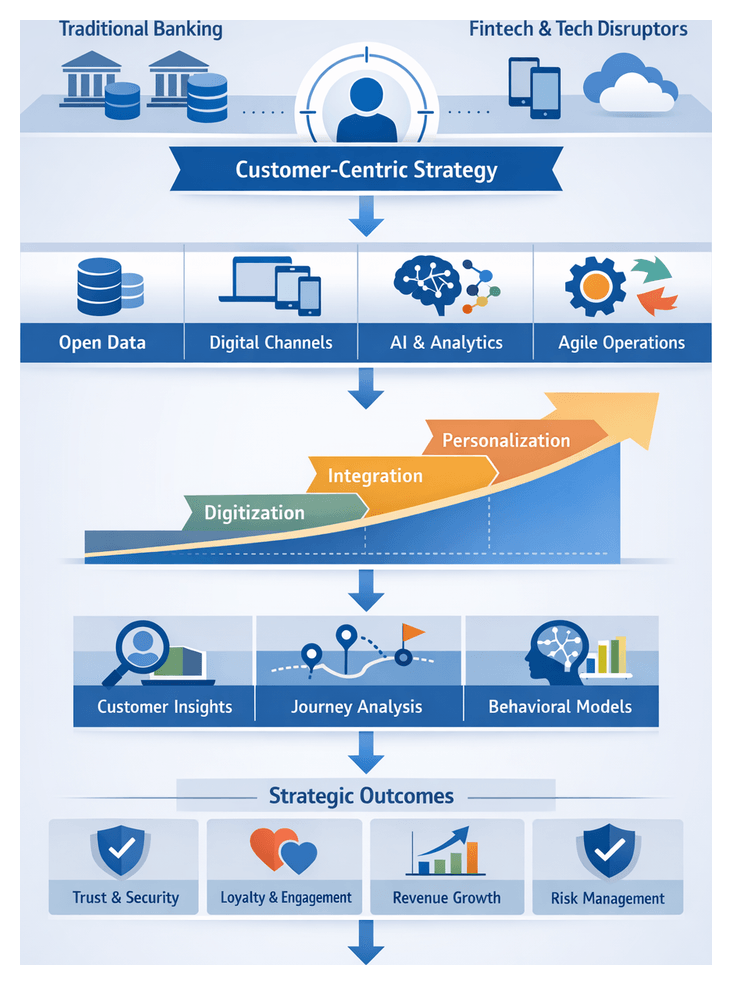
Navigating the Shift to Customer-Centric Banking
The banking industry is undergoing a fundamental transformation from product-centric models toward customer-centric strategies. Traditional institutions, built around standardized services and siloed distribution channels, now face competition from agile fintech challengers and digital-first startups that leverage cloud-native architectures, advanced analytics and seamless user experiences. At the same time, global technology companies are eyeing financial services, capitalizing on vast user bases and sophisticated digital platforms. In this environment, differentiation hinges not on commoditized products but on the ability to create personalized, proactive relationships that anticipate individual needs and life events.
Regulatory reforms, notably open banking mandates and data portability initiatives, have accelerated this shift by empowering customers to share financial data securely with third-party providers. This increased data mobility challenges traditional banks to redefine their roles, focusing on value creation through insights and integrated service ecosystems rather than core transaction processing alone. Moreover, regulatory emphasis on consumer protection, privacy and security elevates trust as a critical competitive asset.
Widespread adoption of digital channels—from mobile apps to web portals—has transformed the customer journey at every stage, enabling continuous engagement and richer behavioral data capture. However, many legacy systems were not designed for real-time personalization, resulting in fragmented data repositories and inconsistent experiences across touchpoints. Overcoming these limitations requires a holistic approach that combines technology modernization, process reengineering and cultural change to support a unified, 360-degree customer view.
Transitioning to customer-centric banking entails reorienting from fixed product silos to modular, journey-based service offerings. Advanced analytics platforms powered by machine learning and AI are essential for extracting predictive and prescriptive insights that drive timely, relevant engagement. Equally important is the development of API-driven technology stacks that facilitate rapid deployment of new services and seamless integration with fintech partners. Organizational agility, underpinned by cross-functional teams and empowered decision-making, enables institutions to iterate on customer journeys and embed personalization into every interaction.
Financial institutions typically progress through four digital maturity stages:
- Digitization: Converting analog processes to digital formats to reduce manual effort and cost.
- Digital Integration: Connecting channels and systems to create unified customer touchpoints.
- Personalization: Deploying analytics to deliver tailored content and offers based on customer data.
- Anticipatory Banking: Leveraging AI to predict needs before they arise, enabling proactive advice and life-event support.
Understanding an institution’s current maturity level and charting a clear path toward anticipatory banking guides resource allocation, ensuring that quick wins in digital enablement are balanced with longer-term architectural investments.
Understanding Customer Expectations and Behaviors
Today’s customers form a complex mosaic defined by digital behaviors, life priorities and financial aspirations rather than simple demographic criteria. Millennials and Generation Z account for the largest share of new account openings, bringing heightened expectations shaped by technology-first experiences in ride-sharing, streaming and e-commerce. These cohorts evaluate banking services on perceived ease of use and usefulness, often judging mobile interfaces as critically important as pricing.
At the same time, older cohorts increasingly adopt digital channels when services demonstrate clear benefits and intuitive designs. Hybrid customer journeys—where initial research on mobile platforms transitions to in-branch consultations or vice versa—require banks to deliver seamless experiences across touchpoints. Any requirement to re-enter information or reconcile conflicting guidance erodes confidence and completion rates.
Customers now expect proactive engagement powered by predictive analytics and AI-driven triggers. Use cases include real-time balance alerts, personalized savings tips after paydays, and contextual investment advice when market conditions shift. By employing jobs-to-be-done frameworks, banks can align recommendations with deeper motivational drivers—such as financial security or life-stage milestones—elevating personalization from transactional to meaningful engagement.
Trust, transparency and control are paramount. Customers demand clear explanations of how their data is used, the benefits of data sharing, and the ability to adjust preferences at any time. Effective trust drivers include:
- Data Stewardship: Secure handling and accurate management of personal information.
- Consent Management: Mechanisms for customers to grant, review and revoke data-sharing permissions.
- Explainability: Clarity around how AI-derived insights and recommendations are generated.
Analytical frameworks aid in interpreting evolving expectations:
- Customer Journey Analytics: Mapping historical behavior to identify pain points and churn drivers.
- Expectation-Confirmation Theory: Comparing perceived performance to initial expectations to pinpoint gaps.
- Behavioral Economics: Applying choice architecture and framing effects to optimize personalization prompts.
- Three-Step Analytical Approach: Benchmarking capabilities against industry, segmenting high-value cohorts, and projecting trends via scenario modeling.
AI-Driven Analytics for Personalization
At the core of personalized banking lies a robust data architecture that integrates and normalizes information from digital interactions, transaction histories and third-party enrichments. Master data management reconciles client identities across channels, while real-time data pipelines support streaming analytics and contextual decisioning. Industry frameworks such as the DAMA Data Management Body of Knowledge guide data stewardship, quality metrics and lineage management.
Advanced analytics platforms, underpinned by machine learning and AI, transform raw data into actionable insights. Descriptive models illuminate past behavior, predictive models forecast future needs, and prescriptive engines recommend optimal next steps. Cohort analysis and uplift modeling quantify the incremental impact of proactive interventions, while stress testing and scenario simulations assess risk under adverse conditions.
Technological scalability is achieved through hybrid, API-first architectures. Cloud-native data lakes, microservices and event-driven processing engines decouple analytics workloads from transactional systems, enabling elastic compute provisioning and rapid iteration on models without disrupting core banking operations. Open API frameworks facilitate secure integration with fintech partners, digital wallets and specialized analytics providers, fostering an adaptable ecosystem that can respond to emerging use cases.
Model governance and explainability frameworks ensure compliance with regulatory requirements and ethical standards. Institutions adopt model risk management principles, including documented development lifecycles, independent validation, bias mitigation protocols and transparent decision explanations to satisfy audit and right-to-explanation mandates.
Strategic Benefits of Deep Individualization
Deep individualization transcends traditional segmentation, embedding customer-specific insights into product design, channel engagement and relationship management. Its strategic impact spans:
- Competitive Differentiation: Tailored value propositions align product attributes, pricing and communication channels with individual goals, elevating perceived value beyond commoditized offerings.
- Customer Loyalty and Lifetime Value: Meaningful personalization fosters emotional resonance, reduces switching propensity and drives cross-sell rates up to 20 percent through predictive propensity scoring.
- Revenue Growth: Dynamic pricing based on individual risk profiles and usage patterns increases net interest margins, while insights into latent needs spawn new features such as round-up savings and micro-investments.
- Risk Management Synergies: Real-time analytics enhance fraud detection, anti-money laundering controls and compliance reporting, strengthening operational integrity.
Strategic decision-making is guided by established frameworks:
- Value Chain Analysis: Identifies which activities yield highest returns when individualized.
- Balanced Scorecard Adaptation: Embeds personalization metrics—such as cohort-specific NPS—into performance management.
- Capability Maturity Models: Assesses readiness across data infrastructure, analytics and change management to prioritize investments.
Organizational realignment is critical. Cross-functional governance committees oversee personalization strategy, while agile squads, organized around customer journeys, iterate rapidly on experiences. Talent acquisition and upskilling in data science, behavioral economics and design thinking ensure that analytical insights translate into compelling offerings.
Key Considerations for Implementing Personalized Banking at Scale
Moving from strategic vision to scalable execution requires careful alignment of people, processes and technology. Leaders must address interdependent factors to optimize investments and mitigate risks.
Strategic Alignment and Governance
Embed personalization goals into enterprise strategy with executive sponsorship and cross-functional steering committees. Governance frameworks should define decision rights, accountability and performance dashboards that tie AI-driven initiatives to KPIs such as digital engagement rates and customer lifetime value.
Data Quality and Integration
Ensure unified data by implementing master data management, standardized taxonomies and real-time pipelines. Robust data governance policies are essential to maintain accuracy, provenance and compliance, preventing model errors and customer distrust.
Technology Infrastructure and Scalability
Adopt API-first, cloud-native architectures that decouple analytics from transactional systems. Leverage microservices and event-driven engines to support real-time decisioning and elastic compute, enabling rapid model deployment and cost optimization.
Organizational Culture and Talent
Foster a culture of experimentation and cross-disciplinary collaboration. Establish centers of excellence that blend data science, engineering, risk management and front-line expertise. Invest in continuous upskilling and partnerships with academic institutions to maintain an innovation mindset.
Risk Management and Compliance
Integrate personalization oversight into existing risk frameworks. Apply model risk management principles to AI agents, including documented development life cycles, independent validation, bias mitigation and transparent explanations to ensure regulatory compliance.
Partner Ecosystems and Vendor Selection
Evaluate third-party solutions against criteria such as domain expertise, interoperability, scalability and compliance track record. A modular vendor approach reduces lock-in risk and enables experimentation with emerging capabilities like generative personalization models.
Ethical AI and Customer Trust
Adopt ethical frameworks to ensure fairness, transparency and privacy preservation. Implement guardrails such as bias audits, explainability tools and secure computation techniques to uphold customer trust and preempt regulatory scrutiny.
Measurement Frameworks and Continuous Improvement
Build attribution models and conduct randomized controlled trials to isolate the incremental impact of personalization. Monitor outcome, engagement and efficiency metrics regularly, and embed feedback loops from customers and front-line teams to refine recommendation logic over time.
By addressing these considerations in concert, financial institutions can harness AI-driven personalization to deliver differentiated experiences, strengthen customer relationships and secure competitive advantage in a dynamic market environment.
Chapter 2: Foundations of AI Agents in Financial Services
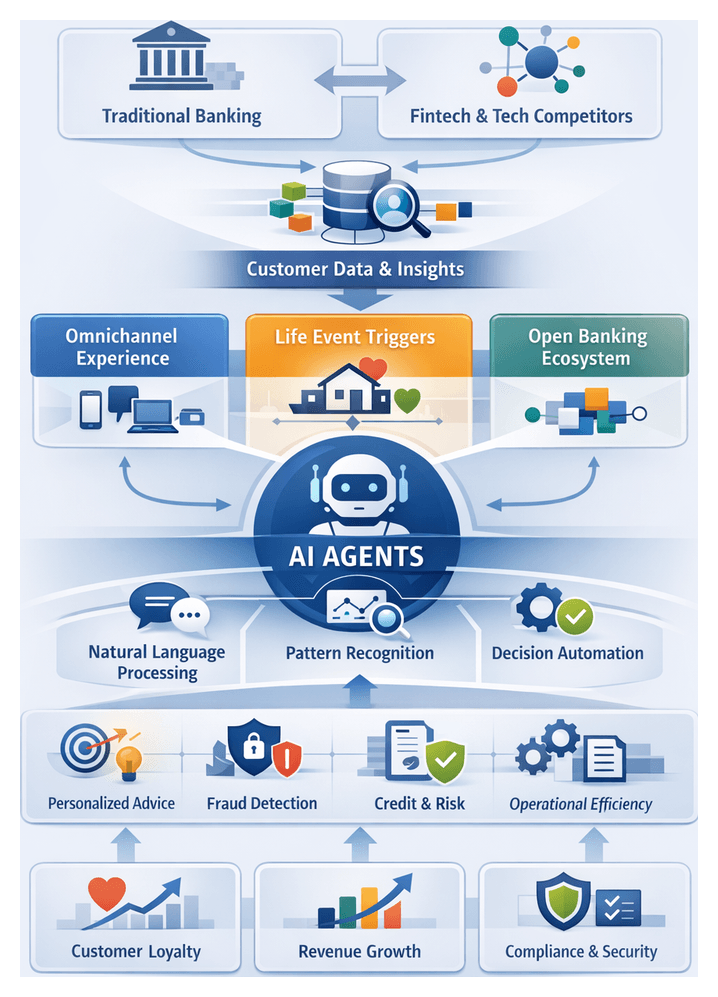
Customer-Centric Transformation in Banking
Over the past decade, financial institutions have shifted from product-centric models toward a focus on the individual customer journey. Traditional banks once measured success by loan volumes and transactional fees, but today they face competition from agile fintechs and technology giants that leverage modern architectures, data science and seamless user experiences. Empowered consumers expect services that anticipate needs, adapt to life events and deliver real-time guidance across mobile, web, branch and contact-center channels. Regulatory initiatives and open banking standards have increased data portability, enabling collaboration between banks and third parties to innovate personalized offerings.
Achieving customer-centricity requires integrating data from multiple sources, orchestrating personalized offers based on real-time context and maintaining consistent experiences across all touchpoints. Banks that master this transformation deepen loyalty, increase wallet share and generate new revenue through tailored recommendations and advisory services. The challenge is to convert legacy processes into agile, data-driven capabilities that put the individual consumer at the center of every decision.
AI Agents as Catalysts for Personalization
Defining AI Agents in Finance
AI agents are autonomous software entities that perform complex tasks with minimal human oversight, combining machine learning, natural language understanding and advanced analytics. They ingest structured and unstructured data—transaction histories, behavioral signals, market indicators and customer preferences—reason over predictive models and decision frameworks, then execute personalized recommendations or transactions. When necessary, they escalate complex issues to human specialists with full context.
In personalized banking, AI agents act as digital assistants, financial advisors and operational workhorses. They detect life events—such as a new home purchase—and proactively propose mortgage or savings solutions. In conversational settings, they interpret natural language queries, resolve routine requests and manage seamless handoffs to human advisors. Embedding AI agents into core processes unlocks hyper-personalization, operational efficiencies and enhanced risk management through real-time monitoring.
Core Capabilities
- Natural Language Understanding: Interprets intent and entities across text and voice channels, adapting to financial terminology and colloquial queries.
- Advanced Pattern Recognition: Detects trends, anomalies and behavioral correlations across transactional, behavioral and external data.
- Autonomous Decision Automation: Executes predefined actions—dynamic offer generation, risk alerts or transaction approvals—while escalating high-risk cases to human reviewers.
Advanced Technical Dimensions
Natural Language Understanding
NLU bridges human communication and machine processing, requiring domain-specific training on financial vocabulary, regulatory references and product jargon. Institutions benchmark solutions on intent classification accuracy, entity recognition and latency under peak loads. Platforms such as Google Dialogflow and IBM Watson Assistant provide intent accuracy metrics that banks compare against internal SLAs to ensure virtual assistants uphold performance during high demand.
NLU maturity progresses from rule-based keyword matching to hybrid models and, ultimately, deep learning architectures leveraging transfer and active learning. Semantic enrichment via domain-specific knowledge graphs improves entity disambiguation, ensuring precise interpretation of terms like “prime rate” or “overdraft limit.” Governance and explainability are integral: audit trails record intent classifications behind financial recommendations, supporting compliance and fairness reviews.
Pattern Recognition and Predictive Analysis
Pattern recognition enables detection of trends, anomalies and customer behaviors that drive proactive services. Leading organizations use platforms like H2O.ai and DataRobot for automated feature engineering and algorithm selection, then apply domain expertise to fine-tune models. Scalable architectures handle both batch and streaming analytics, essential for real-time fraud detection and credit risk monitoring.
Maturity spans descriptive analytics (retrospective insights), diagnostic analysis (anomaly investigation), predictive modeling (forecasting defaults and churn) and prescriptive systems (recommendation of interventions). Ethical frameworks and bias audits—using fairness metrics like disparate impact ratios—ensure models do not discriminate against protected groups. Unsupervised clustering and autoencoders uncover latent segments, enabling detection of emerging fraud typologies and new customer archetypes.
Autonomous Decision Automation
Autonomous decision-making elevates AI agents to execute transactions and manage workflows. Platforms such as FICO Decision Management Suite integrate rule-based and machine learning models to automate credit approvals, dynamic pricing and liquidity management. Decision orchestration frameworks sequence tasks—identity verification, risk scoring and fund transfers—while governance policies define thresholds for human escalation.
Decision maturity ranges from assisted recommendations requiring human signoff to fully autonomous workflows. Metrics such as turnaround time, error rates and regulatory exception counts guide progress. Human-in-the-loop governance embeds feedback loops, enabling agents to learn from corrections and refine policy parameters through techniques like reinforcement learning. Real-time risk scoring and compliance checks serve as guardrails to prevent unintended consequences.
Integrated AI Architectures
True potential emerges when NLU, pattern recognition and autonomous decision-making operate seamlessly. Institutions adopt frameworks like BIAN to align technical capabilities with processes, ensuring interoperability, standardized APIs and end-to-end traceability. A digital advisor can initiate with conversational NLU, apply pattern recognition to portfolio analysis, then execute rebalancing recommendations through decision engines. Maturity evolves from siloed pilots to platform-based integration and, ultimately, embedded enterprise AI driving continuous innovation.
AI-Driven Application Scenarios
Conversational Engagement and Support
AI agents serve as virtual concierges across chat, voice and messaging channels, shifting support from reactive ticket resolution to proactive engagement. They capture conversation state, transaction history and individual preferences to maintain brand tone and compliance. Success is measured by reduced call-center volumes, improved first-contact resolution rates, higher net promoter scores and consistent cross-channel experiences. By handling routine inquiries, agents free human advisors for high-value tasks and ensure round-the-clock service.
Personalized Product Recommendations
AI agents ingest transaction data, web analytics and demographics to craft tailored offers using collaborative filtering, propensity scoring and contextual triggers. Interpretability ensures recommendation rationales can be audited for compliance and bias avoidance. Uplift in conversion rates, average revenue per user and incremental ROI demonstrate the strategic value of AI-driven cross-selling.
Automated Financial Advisory
Modern robo-advisors extend automated allocation to dynamic rebalancing, tax-loss harvesting and scenario modeling powered by continuous market feeds. By integrating ESG scores and alternative data, agents deliver personalized guidance at scale while adhering to fiduciary and regulatory frameworks. Performance is evaluated through return, volatility, drawdown metrics and client satisfaction measures. Automated advisory agents improve operational leverage and generate behavioral insights for product innovation.
Credit Underwriting and Risk Assessment
AI agents streamline credit decisioning by combining bureau scores with alternative data—transaction streams, social signals and device metadata. Interpretable machine learning frameworks, such as gradient boosting with SHAP explanations, balance predictive power and transparency. Metrics like default rate reduction, approval velocity and portfolio diversification quantify impact. By uncovering creditworthy profiles overlooked by legacy models, agents drive inclusive lending and dynamic portfolio risk management.
Fraud Detection and Compliance Monitoring
In fraud and compliance contexts, AI agents perform continuous surveillance, analyzing transaction patterns, network relationships and anomalies in real time. Graph analytics and unsupervised detection flag suspicious clusters and emerging fraud typologies. Performance metrics include detection latency, precision-recall tradeoffs and regulator feedback. Agents accelerate investigation workflows, allowing analysts to focus on strategic policy refinement and complex case adjudication, thus strengthening the risk-control environment.
Back-Office Automation and Operational Efficiency
AI agents interpret unstructured data—documents, invoices and correspondence—and orchestrate workflows across reconciliation, loan origination and payments. A human-in-the-loop model gradually increases autonomy as confidence thresholds are met. Throughput gains, error-rate reductions and lower cost-per-transaction demonstrate value. By automating routine tasks, institutions reallocate talent toward innovation and high-value service enhancements.
Operational, Technical and Governance Considerations
System Integration and Scalability
- Secure, low-latency access to core banking, CRM and data warehouses is essential for accurate, compliant responses.
- Dynamic scaling of compute resources and model inference capabilities ensures performance under variable loads.
- Continuous model monitoring and drift detection frameworks maintain relevance and accuracy of personalized interactions.
- Cross-functional governance structures align compliance, risk, IT and marketing teams around innovation and brand standards.
Data Quality, Privacy and Governance
- High-quality, timely data is foundational; inaccuracies can trigger inappropriate recommendations or risk assessments.
- Privacy-by-design embeds consent management and data minimization throughout data collection and model development.
- Governance frameworks document data lineage, model decisions and exception handling to support audits and regulatory inquiries.
- Third-party risk assessments verify vendor security certifications and contractual safeguards for outsourced AI services.
Organizational and Cultural Readiness
- Visible executive sponsorship secures resources for talent acquisition, training and change management.
- Developing expertise in data science, conversational design and compliance engineering sustains AI initiatives.
- Agile governance enables rapid priority adjustments, model parameter tuning and iterative deployments.
- A customer-centric mindset ensures AI agents address genuine pain points rather than abstract technical challenges.
Ethical and Regulatory Compliance
- Bias mitigation through regular audits and fairness metrics prevents discrimination in recommendations and underwriting.
- Explainability frameworks provide human-interpretable rationales for recommendations, building trust with customers and regulators.
- Early engagement with regulators clarifies acceptable use cases and reporting requirements to minimize enforcement risks.
- Accountability models delineate human and machine roles, ensuring critical decisions can be escalated when necessary.
Measuring Impact and Guiding Continuous Improvement
Performance Metrics and Benchmarking
- Efficacy metrics: intent recognition accuracy, precision, recall and confidence calibration.
- Efficiency metrics: response times, compute costs and scalability under peak loads.
- Business KPIs: customer satisfaction scores, first-contact resolution rates, cost-to-serve reductions and revenue uplifts.
- Ethical metrics: bias detection rates, audit completeness and compliance exception counts.
- External benchmarking: participation in industry surveys to compare performance against peers and identify capability gaps.
Continuous Learning and Strategic Outlook
Continuous monitoring and retraining frameworks detect performance drift and trigger model updates. A/B testing, cohort analyses and feedback loops refine conversational flows, training data and escalation thresholds. Strategic trade-offs balance near-term operational efficiencies against long-term transformative potential. Institutions that orchestrate AI agents across channels will pioneer dynamic financial planning, collaborative hybrid advice and integrated ecosystem partnerships. Sustained success demands robust governance, customer empathy and an adaptive operating model that embraces ethical innovation and evolving regulatory landscapes.
Chapter 3: Data Strategy and Governance for Personalized Experiences
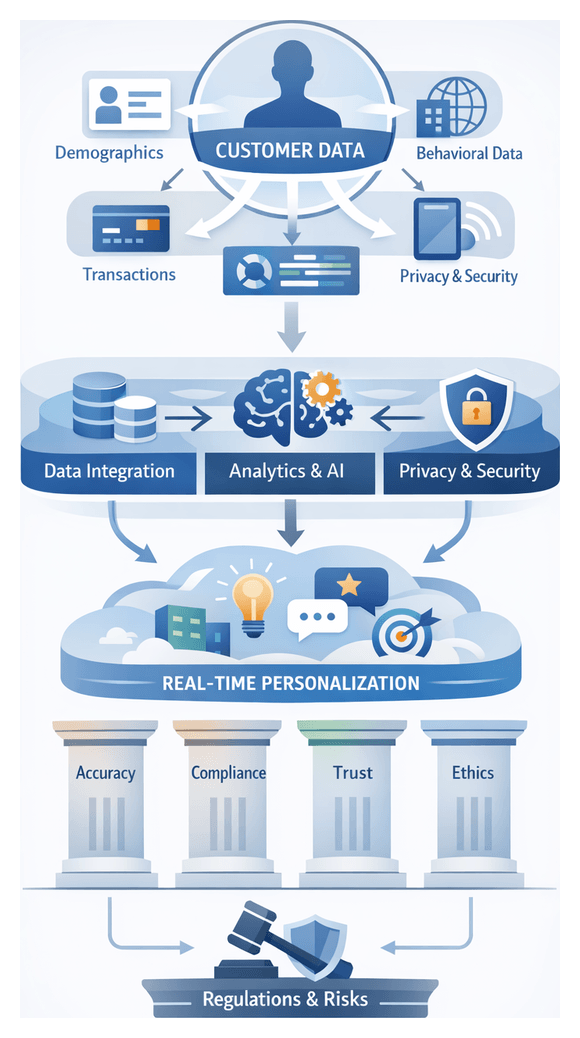
Understanding the Strategic Role of Customer Data
In today’s digital-first banking environment, customer data has become the strategic asset that powers AI-driven personalization. Rather than viewing data as a by-product of transactions, financial institutions must harness every interaction, behavior, and preference to create a dynamic, holistic view of each customer. By continuously capturing and analyzing data from multiple sources, banks can anticipate needs, recommend relevant products, and deliver context-aware experiences in real time, transforming passive product offerings into proactive financial guidance.
Sources and Categories of Customer Data
Effective personalization rests on integrating diverse data types that capture the full spectrum of customer relationships. Four primary categories underpin this approach:
- Demographic and Profile Data: Attributes such as age, income bracket, occupation, marital status, and location provide foundational context but require enrichment for nuanced personalization.
- Transactional Data: Detailed records of deposits, withdrawals, transfers, payments, loan servicing, and investment activity reveal spending patterns, cash flow dynamics, and product usage over time.
- Behavioral and Digital Interaction Data: Signals from online and mobile banking sessions, website navigation, clickstreams, search queries, and content consumption illuminate intent, preferences, and engagement levels.
- Contextual and Third-Party Data: External indicators such as market trends, social media sentiment, credit bureau scores, and geolocation enrich customer profiles and enable more nuanced recommendations.
Data Integration, Analytics, and Real-Time Personalization
Collecting these data sets is only the first step. Breaking down silos and unifying sources into a single platform unlocks the true value of customer data. Modern data architectures—built on cloud data lakes, data warehouses, or customer data platforms—support comprehensive analytics and machine learning at scale. Core capabilities include:
- Data Consolidation – Real-time ingestion pipelines and batch processes that unify structured and unstructured data into a common repository.
- Advanced Analytics and Machine Learning – Predictive modeling, clustering, and pattern recognition transform raw information into actionable insights.
- APIs and Microservices – Modular interfaces provide on-demand access to enriched customer profiles for front-line systems and AI agents.
- Real-Time Processing – Streaming technologies capture events and interactions as they occur, enabling immediate personalization and decisioning.
By integrating data and analytics, banks establish a single source of truth that empowers AI agents to generate hyper-relevant product recommendations, craft personalized messaging, and identify emerging customer needs ahead of the competition.
Foundational Principles for Data Management
To ensure quality, reliability, and compliance, institutions must embed core data management principles into governance frameworks and operational processes:
- Accuracy – Verifying that data accurately reflects customer attributes and behaviors, minimizing errors that could undermine personalization.
- Completeness – Capturing all relevant data points from internal systems, digital channels, and third-party sources.
- Timeliness – Maintaining up-to-date information so AI-driven decisions reflect the latest customer interactions and market conditions.
- Consistency – Establishing standardized definitions, taxonomies, and data models to ensure uniform interpretation across business units.
Adhering to these principles lays the groundwork for scalable, trusted personalization, reducing the risk of decision errors, compliance breaches, and customer dissatisfaction.
Regulatory Landscape and Privacy Compliance
The global regulatory environment for customer data in financial services is increasingly complex. Frameworks such as the European Union’s General Data Protection Regulation (GDPR), the California Consumer Privacy Act (CCPA), and Singapore’s Personal Data Protection Act (PDPA) impose distinct requirements for data collection, consent, purpose limitation, and data subject rights. To navigate overlapping obligations, institutions employ analytical compliance models that map use cases—like personalized recommendations and predictive risk scoring—against specific regulatory touchpoints. This risk-based approach guides the allocation of compliance resources and the design of governance controls.
Data subject rights add operational complexity, as customers may request access, rectification, or erasure of their data. Banks must assess how such requests affect personalization pipelines, balancing compliance imperatives against continuity of customer experience enhancements.
Security Risks in Customer-Centric Architectures
As banks process ever-larger volumes and finer-grained customer data, the attack surface for malicious actors expands. Risks emerge at every stage of the personalization lifecycle—from unencrypted data ingestion into legacy systems to vulnerable model training datasets and supply-chain exposures when integrating third-party sources. Through threat modeling, institutions categorize adversaries and prioritize defenses, guiding investments in firewalls, intrusion detection, and secure enclave technologies. Rigorous third-party risk management, including due diligence of data aggregators and cloud providers, reinforces the security posture and protects sensitive customer attributes.
Balancing Personalization with Privacy
Delivering hyper-personalized experiences while safeguarding individual privacy requires careful calibration. The privacy-value calculus frames how consumers weigh utility against perceived risk. Applying Privacy by Design principles—such as data minimization, purpose specification, and privacy-enhancing technologies—helps institutions embed privacy considerations throughout AI-driven personalization. Transparency and granular consent management strengthen trust, as evidenced by higher engagement among customers who control their data preferences.
Analytical Frameworks for Risk Assessment
Structured frameworks guide the evaluation of privacy and security risks across data lifecycles. The NIST Privacy Framework outlines functions to Identify, Govern, Control, Communicate, and Protect. ISO/IEC 27701 extends information security standards to include privacy–information management requirements. Privacy impact assessments (PIAs) diagnose new personalization projects, evaluating the necessity and proportionality of data processing activities. Security risk assessments—via penetration testing and red-teaming—validate platform resilience against advanced threats and inform continuous improvement roadmaps for security controls.
Emerging Privacy-Enhancing and Security Technologies
- Encryption and Tokenization – Strong algorithms and tokenization schemes secure customer identifiers throughout processing pipelines, governed by advanced key management.
- Differential Privacy and Federated Learning – Differential privacy injects noise into aggregate analytics to preserve anonymity, while federated learning trains models across decentralized data sources to minimize raw data movement.
- Data Loss Prevention Platforms – Google Cloud Data Loss Prevention and Microsoft Azure Purview offer classification, redaction, and anomaly detection to enforce contextual usage policies.
- Consent and Preference Management Systems – Platforms like OneTrust and Privacera centralize consent workflows and track granular customer preferences.
Governance for Privacy and Security in Personalization
Robust governance frameworks are essential for balancing personalization ambitions with privacy and security requirements. Cross-functional committees—comprising legal, compliance, risk management, IT, data science, and marketing—ensure analytic priorities align with regulatory obligations and ethical standards. Data stewards oversee policy implementation, monitor compliance metrics, and coordinate incident response, supported by governance dashboards that detect policy drift and enable prompt corrective actions.
The Critical Moment for Banking Personalization
Financial institutions are at a pivotal juncture where evolving consumer expectations, mature AI technologies, expanded data availability through open banking, stringent privacy regulations, and intensified competition converge to elevate personalization from a differentiator to a survival imperative. Digital-native generations demand mobile-first, proactive guidance, while older cohorts embrace digital channels. Advances in machine learning, natural language processing, and real-time analytics—powered by platforms such as Google Cloud’s AI Platform and IBM Watson—eliminate infrastructure barriers, enabling personalized offers and insights within milliseconds.
Open banking standards like PSD2 unlock transaction histories and spending behaviors, while embedded finance partnerships and wearable payment devices extend the data horizon. At the same time, challengers and tech giants leverage agile data strategies and ecosystem advantages to deliver seamless, tailored experiences. Against this backdrop, banks must reimagine their value propositions—melding domain expertise with AI-driven personalization to deepen customer relationships and defend market share.
Organizational and Technological Readiness
Legacy infrastructure, siloed data, and talent gaps in data science and AI ethics present significant hurdles. Overcoming these challenges requires executive sponsorship, agile cross-functional teams, and iterative pilots that demonstrate early wins. A culture shift is essential: empowering front-line staff with AI-enhanced insights while preserving human oversight to maintain the trust and empathy fundamental to financial services.
Trust, Transparency, and Ethical AI
Trust and transparency are foundational to customer acceptance of AI-driven personalization. Institutions must clearly communicate how personal data fuels tailored experiences, outline consent procedures, and provide mechanisms for customers to adjust preferences. Ethical considerations include preventing discriminatory credit decisions, ensuring algorithmic explainability, and proactively detecting biases in training data. Banks that excel in responsible AI practices differentiate themselves as partners, not mere service providers.
Human-Machine Collaboration and Use Cases
Successful personalization blends automation with the human touch. In wealth management, AI agents deliver portfolio recommendations aligned with individual risk appetites and life goals. In small-business banking, real-time cash-flow analytics and loan proposals adapt to industry norms and seasonal cycles. In retail banking, chatbots orchestrate predictive alerts for bill payments, savings milestones, and fraud notifications. Thoughtful orchestration of AI-generated insights and human empathy ensures that personalization enhances trust-based relationships rather than replacing them.
Key Considerations and Limitations
Practitioners must remain mindful of constraints such as data quality issues, legacy system integration challenges, and evolving regulatory mandates. Algorithmic bias, opaque decision logic, and rapid technological change necessitate proactive governance and modular solution architectures. Organizational readiness—including talent development, change management, and cultural alignment—often determines personalization program success. By anticipating these limitations and designing adaptable frameworks, institutions can harness AI-driven personalization while maintaining compliance, trust, and operational resilience.
Chapter 4: Building Customer Profiles and Behavioral Insights
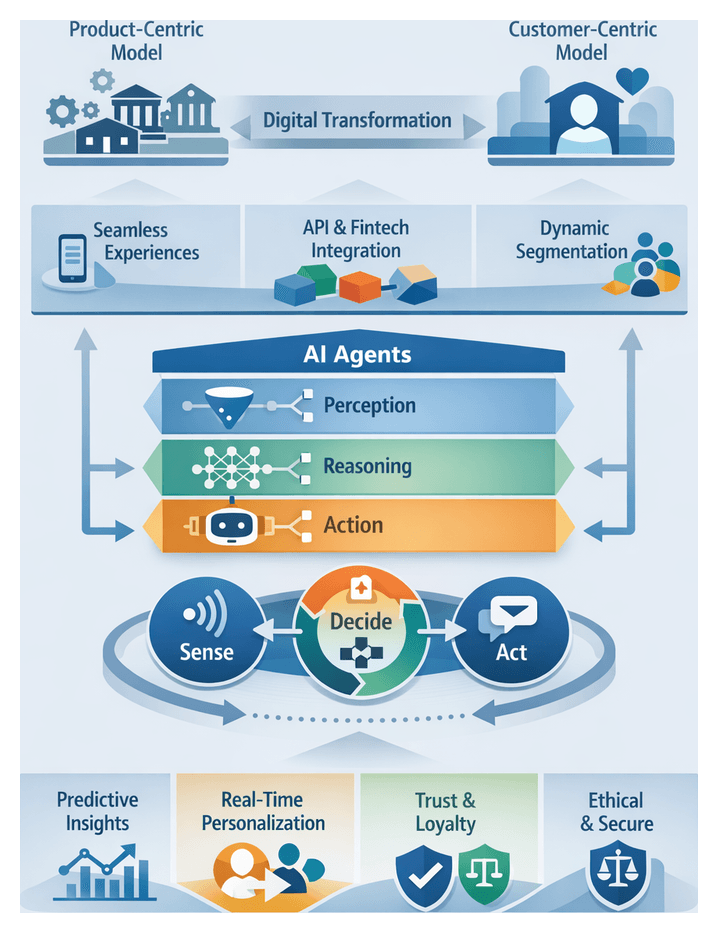
Embracing the Transition to Customer-Centric Banking
The global banking landscape is undergoing a fundamental transformation as institutions face heightened competition from fintech challengers and technology giants, rapidly advancing technologies, and evolving customer expectations. Traditional product-centric models—characterized by standardized offerings, branch expansion, and risk-averse portfolio management—are giving way to a customer-centric paradigm that places individualized journeys at the heart of the value proposition.
Digitally empowered consumers expect seamless, personalized experiences that anticipate their needs and integrate with daily routines. Self-service digital channels, social media integration, and contextual financial guidance have become table stakes. In response, banks must break down internal silos, modernize legacy infrastructures, and adopt modular, API-driven platforms to integrate best-of-breed fintech and technology solutions rapidly.
By reorganizing around end-to-end customer journeys rather than isolated product silos, institutions can deploy agile experimentation cycles, accelerate time to market, and deliver adaptive services. Those that fail to adapt risk elevated churn, reduced share of wallet, and eroded brand relevance. Conversely, banks that embed personalization throughout the customer lifecycle can amplify product adoption, lifetime value, and emotional loyalty, turning each interaction into an opportunity to reaffirm trust and deliver meaningful value.
AI Agents as Enablers of Personalized Finance
AI agents represent a new class of intelligent software capable of autonomously or semi-autonomously orchestrating complex tasks on behalf of customers and enterprises. Combining advanced machine learning, natural language processing, pattern recognition, and decision-making algorithms, these agents learn continuously from data and customer interactions, moving far beyond static, rule-based systems.
A typical AI agent architecture encompasses three core layers:
- Perception Layer: Ingests and normalizes data from internal systems, third-party feeds, device sensors, and user interactions. Techniques such as entity extraction and sentiment analysis convert unstructured inputs into structured behavioral signals.
- Reasoning Layer: Applies machine learning models—classification, clustering, reinforcement learning, graph neural networks—to generate predictive insights and recommendations. Multi-objective optimization balances short-term objectives like fee reduction with long-term goals such as savings growth.
- Action Layer: Executes tailored interactions via conversational interfaces, mobile notifications, or backend system calls. It manages dialogue flows, monitors feedback, and integrates with core banking platforms to deliver seamless experiences.
By embedding AI agents into digital channels, banks can offer situationally relevant guidance—ranging from automated savings plans triggered by income fluctuations to mortgage refinancing suggestions during interest-rate shifts. Solutions provide modular agent frameworks that orchestrate advisory, support, and execution, continuously learning from interactions to refine personalization strategies.
Building Dynamic Customer Profiles and Segmentation
Effective personalization relies on rich, dynamic customer profiles and behavior-driven segmentation. Advanced analytical techniques enable banks to classify customers based on actions, preferences, life events, and attitudinal indicators, moving beyond simple demographic filters.
Predictive Modeling
Supervised learning frameworks—such as logistic regression, decision trees, and gradient boosting machines—forecast high-value behaviors including product uptake, channel migration, or attrition risk. Platforms like IBM Watson Studio and SAS Enterprise Miner provide model development environments with explanatory visualizations to identify key predictors and optimize campaign targeting.
Unsupervised Clustering
When labeled outcomes are unavailable, clustering algorithms uncover natural customer groupings. Techniques such as k-means, hierarchical clustering, and DBSCAN reveal cohorts characterized by transaction patterns, digital engagement, and wealth indicators. Tools like Salesforce Einstein automate clustering pipelines, while open-source Python and R libraries enable customized workflows that translate statistical clusters into actionable customer personas.
RFM Analysis and Hybrid Approaches
The Recency-Frequency-Monetary (RFM) framework segments customers by the timing, frequency, and monetary value of interactions, classifying them into archetypes such as “Champions,” “At-Risk,” and “Dormant.” Leading institutions augment RFM with behavioral and attitudinal attributes—channel preference, product affinity, sustainability scores—to identify high-value yet under-engaged segments.
Life Event and Journey-Based Segmentation
Sequence mining techniques—hidden Markov models and sequential pattern mining—map customer journeys as life-stage transitions and key decision pathways. By detecting triggers such as mortgage inquiries or shifts in credit utilization, banks create segments like “New Home Buyers” or “Debt Refinancers,” orchestrating personalized touchpoints aligned with each life event.
Psychographic Profiling
Incorporating attitudes, values, and lifestyle indicators from surveys, social media signals, and third-party enrichment, psychographic segmentation yields personas reflecting motivational drivers. Multivariate analyses ensure that dimensions such as risk tolerance and sustainability preference contribute unique explanatory power, enabling propositions tailored to profiles like “Conscious Investor.”
Continuous Optimization
Segmentation is an iterative process. Robust evaluation frameworks—A/B testing, uplift modeling, and performance dashboards—measure engagement lift, revenue impact, and churn reduction. Drift detection algorithms and automated retraining ensure segment definitions adapt to evolving behaviors and market conditions. Strategic alignment workshops map segmentation insights to objectives—such as digital wallet adoption or cross-sell targets—using OKRs or Balanced Scorecard methodologies.
Real-Time Insights and Continuous Personalization
Static batch analytics no longer suffice in a world that demands immediacy. Real-time insight capabilities empower banks to sense customer actions, decide contextually, and act within milliseconds, transforming events into personalized experiences at critical decision points.
The Sense-Decide-Act loop underpins continuous personalization:
- Sense: Ingest streaming data from digital channels, card networks, ATM terminals, and external feeds such as social sentiment or market volatility.
- Decide: Evaluate incoming events against real-time analytics models and triggers defined by preferences, risk thresholds, and business rules.
- Act: Deliver tailored interactions—push notifications, chat prompts, next-best-action offers—in the customer’s preferred channel.
Event-driven architectures and low-latency platforms are vital. Organizations deploy Apache Kafka for data ingestion, AWS Kinesis or Microsoft Azure Stream Analytics for managed streaming, and Confluent for enterprise-grade processing.
Trigger Categories
- Behavioral Triggers: Sudden spending shifts or in-app browsing patterns that drive contextual nudges or targeted offers.
- Lifecycle Events: Milestones such as salary credits or mortgage payments prompting advisory services.
- Environmental Signals: External factors like currency fluctuations or weather alerts informing risk mitigation advice.
- Operational Alerts: Overdraft warnings or suspicious login attempts that trigger security or support interactions.
Real-time personalization extends across banking domains: retail customers receive immediate fraud alerts and product suggestions; small and medium enterprises benefit from cash flow monitoring and financing offers; wealth management clients obtain instant market insights and rebalancing recommendations; trade finance processes leverage event tracking for dynamic pricing and settlement options.
Governance, Ethical and Operational Considerations
A comprehensive data strategy and governance framework is essential to balance innovation with security, privacy, and compliance. As analytics shift to the moment, the distinction between operational and analytical systems blurs, requiring unified policies for data quality, lineage, and control.
- Latency and Accuracy: Define acceptable end-to-end latency and implement automated model retraining and drift monitoring to maintain precision.
- Privacy and Compliance: Enforce consent management, data minimization, and real-time compliance checks in accordance with regulations such as GDPR and PSD2.
- Auditability: Capture event provenance and decision rationale to support regulatory reviews and transparency protocols.
- Ethical AI: Conduct fairness audits and explainability analyses to mitigate bias and ensure algorithmic transparency.
- Organizational Readiness: Establish cross-functional governance bodies, define clear ownership of KPIs—engagement lift, churn reduction, fraud detection rates—and embed real-time stewards alongside traditional data roles.
Operationalizing personalization demands a culture of continuous experimentation, data-driven decision-making, and cross-functional collaboration. Institutions that treat real-time initiatives as strategic imperatives report faster time to market and higher customer satisfaction metrics, while isolated pilots often fail to scale.
Future Trajectories in AI-Driven Banking Personalization
Emerging technologies and evolving ecosystems will shape the next phase of personalized finance:
- Federated Learning: Privacy-preserving model training across distributed data silos that enrich real-time decisioning without centralizing sensitive information.
- Adaptive AI Agents: Intelligent agents that refine personalization strategies autonomously through continuous feedback loops.
- Generative AI: Custom creation of financial narratives, dashboards, and visualizations tailored to individual goals and preferences.
- Edge and IoT Integration: Utilization of data from wearables and smart point-of-sale devices for hyper-contextual offers.
- Open Banking and Ecosystems: Expanded partnerships and platform models that integrate third-party services—from insurance to lifestyle applications—under strict consent and compliance frameworks.
- Decentralized Finance and Embedded Finance: AI-driven personalization within digital wallets, commerce platforms, and non-banking ecosystems, enabling invisible yet deeply integrated financial services.
By architecting modular, API-driven infrastructures and governance models that accommodate innovation and regulatory evolution, financial institutions can sustain the momentum of personalization initiatives. Mastery of AI agents, real-time analytics, and robust segmentation frameworks will establish enduring competitive advantage in an increasingly digital and interconnected financial ecosystem.
Chapter 5: Conversational AI and Virtual Assistants in Banking
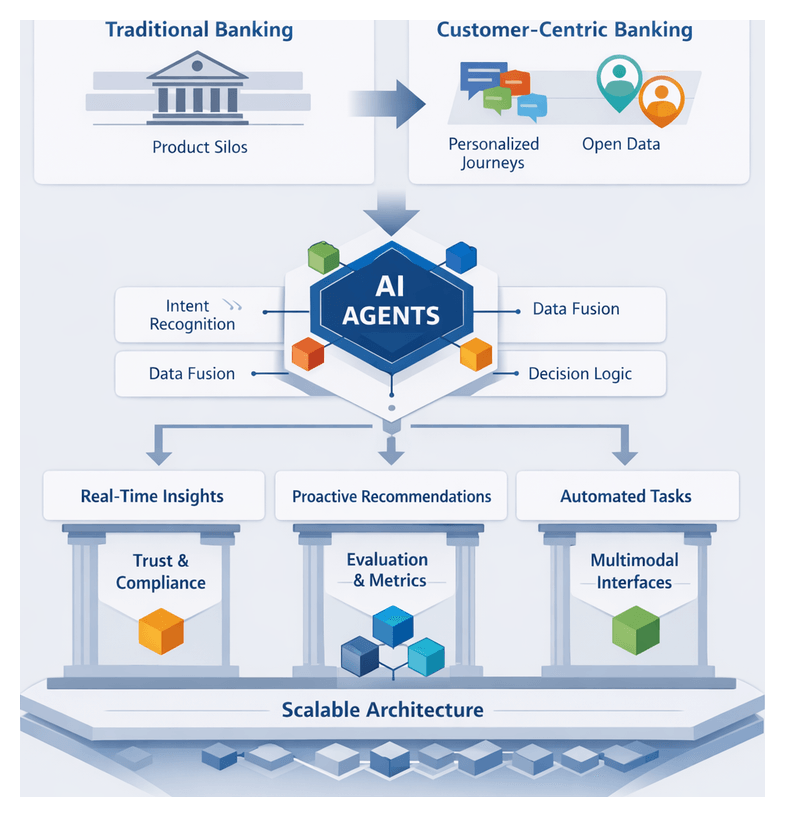
Navigating the Shift to Customer-Centric Banking
Traditional, product-centric banking models are being surpassed by digital challengers that prioritize seamless, on-demand experiences, transparency and individual relevance. As customers migrate toward providers offering highly personalized journeys, incumbent institutions face stagnating growth, eroding margins and waning loyalty. To compete, banks must dismantle legacy silos and adopt agile, scalable architectures that activate intelligence in real time at each customer interaction.
This transformation demands a cultural and organizational commitment to understanding customers’ full spectrum of needs and life moments. By integrating transaction histories, digital footprints and external signals, banks can craft tailored offers and advisory services that resonate personally. At the same time, they must balance innovation with rigorous governance to preserve trust, compliance and operational resilience. Regulatory initiatives such as open banking are further empowering customers to control their data and granting new entrants access to financial information, heightening competitive pressures.
AI Agents in Personalized Financial Services
At the core of customer-centric banking are AI agents: autonomous software entities that perceive intent, reason over complex data and execute tasks with minimal human oversight. Beyond rule-based automation or basic chatbots, these agents leverage natural language understanding, machine learning and decision orchestration to deliver proactive, context-aware guidance. They continuously learn from each interaction, refining recommendations and anticipating evolving needs.
Key agent capabilities include:
- Intent Recognition – Interpreting user queries in natural language or through behavioral cues.
- Data Fusion – Merging structured account data, unstructured text and external market or geolocation signals to build a holistic profile.
- Decision Logic – Applying predictive models and optimization algorithms to select the most relevant recommendation or action.
- Action Orchestration – Executing tasks across banking systems—quoting, payments initiation or advisory follow-ups—while ensuring auditability and compliance.
AI agents surface personalized product offers, deliver real-time risk alerts, simulate portfolio scenarios and autonomously manage routine tasks like bill payments or portfolio rebalances within governance rules. By automating repetitive interactions, they free human advisors to focus on high-value consultative work. Banks are embracing composable architectures that integrate specialized AI services—conversational platforms, recommendation engines and real-time analytics—under a unified agent layer, accelerating time to market and reducing maintenance overhead.
Evaluating Conversational Performance
Effective conversational AI hinges on dialogue design and intent accuracy. Leading institutions deploy multi-layered evaluation strategies combining quantitative metrics, qualitative insights and interpretive frameworks.
Dialogue Design Metrics
- Task Completion Rate: Percentage of sessions achieving intended outcomes without human intervention.
- Fallback Frequency: Rate at which the system resorts to generic error responses, signaling language coverage gaps.
- Average Session Duration and Turn Count: Measures of conversational efficiency, balancing brevity and clarity.
- Response Latency: Delay between user input and system reply, critical for trust and engagement.
- User Satisfaction Scores: Qualitative feedback via embedded surveys or post-interaction ratings.
Dashboards surface these metrics for regular reviews. Statistical process control charts detect drift or performance degradation, triggering model retraining or dialogue redesign.
Intent Classification Metrics
Intent recognition is treated as a multi-class classification problem. Classifier performance is measured by:
- Precision: Correctly predicted intents out of all predictions for a class.
- Recall: True instances of an intent that the system identifies.
- F1 Score: Harmonic mean of precision and recall, balancing false positives and negatives.
- Confusion Matrix Analysis: Identifies commonly confused intents to refine taxonomy and training data.
Institutions often require minimum F1 scores (for example 0.85) before deploying new intents, and continuously monitor for shifts in language patterns driven by promotions, product launches or macroeconomic events.
Conversation and Path Analytics
Conversation analytics tools such as Google Dialogflow and IBM Watson Assistant reveal interaction patterns:
- Path Coverage: Percentage of dialogue branches exercised by users.
- Drop-Off Points: Turns where users abandon conversations or seek human support.
- Recovery Rate: System’s ability to guide users back on track after ambiguity or fallback.
- Entropy of User Responses: Variability in user inputs indicating the need for more structured prompts.
Domain constraints, such as added confirmations for sensitive operations, are calibrated against benchmarks from traditional channels.
Qualitative and Interpretive Reviews
- Heuristic Evaluation: Applying conversational UX heuristics—clarity, brevity, error tolerance and context maintenance.
- Role-Playing Workshops: Cross-disciplinary simulations to explore edge cases and emotional responses.
- Compliance Audits: Checking dialogue content for required disclosures, consent flows and audit trails.
- Accessibility Assessments: Ensuring compliance with standards for users with hearing, cognitive or visual impairments.
Interpretive frameworks from linguistics and human-computer interaction—such as coherence and cohesion analysis and the conversational CHI model—help contextualize metrics within broader experience goals.
Governance and Continuous Improvement
- Establish a central Conversational AI committee for monthly KPI reviews, issue escalation and design approvals.
- Assign clear ownership of intent categories to business stakeholders defining success criteria.
- Integrate feedback loops from support tickets, surveys and social media into priority lists for dialogue enhancements.
- Trigger risk checkpoints when intent accuracy declines for high-risk transactions, reinforcing human review or fallback mechanisms.
Controlled experiments—A/B testing and multi-armed bandits—compare alternative prompts and error-handling strategies, while staged rollouts validate new models with subsets of users. Looking ahead, evaluations will incorporate emotional intelligence measures, real-time sentiment analysis and explainable AI frameworks to meet mounting regulatory scrutiny.
Integrating Multimodal Interfaces
Multimodal interfaces unify voice, text, touch and visual elements to create coherent, contextually aware experiences across mobile apps, web portals, voice assistants and in-branch kiosks. This architectural imperative aligns conversational AI frameworks with transaction engines, risk monitoring tools and compliance workflows, enabling agents to interpret customer requests regardless of modality and to seamlessly invoke back-end processes or human handoffs.
Integration benefits include:
- Customer Experience Consistency: Conversations can transition from voice assistant to mobile app without loss of context.
- Operational Agility: New channels can be introduced quickly via a unified conversational layer.
- Data Unification: Signals from diverse modalities feed into a single customer profile for personalization and risk assessment.
- Accessibility and Inclusion: Alternative interaction modes support customers with differing needs.
Multimodal use cases span retail banking kiosks, wealth management advisory tablets, contact center voice and chat blends, and corporate treasury services. Evaluation lenses include interaction continuity, system interoperability and organizational readiness. APIs must expose consistent functionality, event streaming and data lakes must underpin real-time analytics, and governance policies must extend across voice biometrics, text analytics and video.
Strategic focus on high-impact scenarios—such as combined voice and document upload for loan approvals—delivers early value. Partnerships with platforms like Google Dialogflow, IBM Watson Assistant and Amazon Lex provide prebuilt connectors for messaging channels, speech-to-text and text analytics, reducing integration risk. As virtual assistants and biometric authentication blur digital and physical channels, modality-agnostic intelligence and consistent governance will unlock new levels of personalization and trust.
Design Principles and Scalability
Effective conversational AI design extends beyond keyword matching to adaptive, data-driven dialogue frameworks aligned with customer journeys and personas. Three analytical frameworks guide design:
- Conversational Continuum Mapping: Visualizing the spectrum from simple Q&A to complex advisory dialogues and defining escalation points.
- Intent Fidelity Index: Quantifying alignment between recognized intent and actual user needs to refine NLU models.
- Context Window Analysis: Evaluating the agent’s ability to maintain and recall context across sessions for personalization and compliance.
Scalability requires a modular architecture that decouples dialogue engines from core transaction platforms, ensuring model and policy updates do not disrupt critical operations. Key considerations include system interoperability with payments engines and CRM platforms, predictive load management to preserve low latency, and service orchestration layers that mediate requests among AI services, authentication providers and fraud monitors.
Trust, Transparency and Governance
Trust is the most critical currency in financial services. Conversational AI must provide “explainable dialogue,” signaling when automated reasoning influences advice or actions and maintaining traceable reasoning logs that map each turn to underlying rules or model features. Compliance filters embedded in dialogue flows prevent unauthorized disclosures, while real-time sentiment analysis and feedback loops detect confusion or mistrust early.
Governance pillars include:
- Dynamic Consent Management: Allowing customers to adjust data sharing preferences within conversations, meeting GDPR or CCPA requirements.
- Bias Monitoring Matrices: Statistical audits of dialogue outcomes to identify and correct disparate impacts across demographics.
- Policy-Informed Model Tuning: Embedding legal and ethical constraints into training objectives to automatically filter prohibited advice.
Managing Risks and Constraints
Conversational AI faces limitations such as language ambiguity, data fragmentation and potential operational blind spots. Key risks include model degradation over time without continuous retraining, undetected third-party service failures and ethical ambiguities as agents become more human-like. Banks must integrate risk management into strategic planning, allocate resources for ongoing model governance and regularly update frameworks to ensure safe, sustainable deployment of conversational AI.
Chapter 6: Predictive Analytics and Recommendation Engines
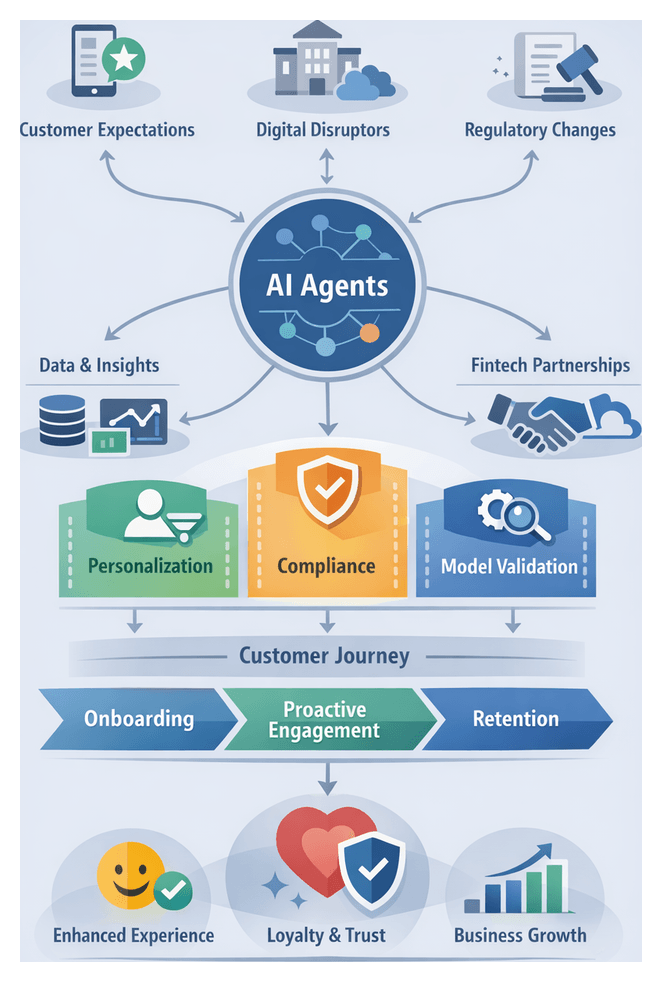
Navigating the Shift to Customer-Centric Banking and AI Agents
The banking industry is undergoing a profound transformation driven by evolving customer expectations, agile digital challengers, and regulatory change. Customers demand seamless, personalized services available twenty-four hours a day through mobile apps, conversational interfaces, or voice-activated assistants. They seek financial advice and product recommendations tailored to their unique goals, life events, and behavior patterns. Traditional banks must move from one-size-fits-all product delivery to a customer-centric model that realigns processes, organizational structures, and technology ecosystems around individual journeys. This shift requires strategic partnerships with fintechs and data providers, as well as a cultural change where every function prioritizes end-user experience to unlock growth, strengthen brand loyalty, and differentiate in a crowded marketplace.
At the heart of next-generation customer engagement are autonomous AI agents capable of understanding context, learning from interactions, and executing tasks on behalf of users. Unlike static chatbots or rule-based recommendation engines, these agents combine natural language understanding, pattern recognition, and decision-making to deliver proactive, highly personalized financial guidance. Use cases include contextual product recommendations based on spending behavior and life events, automated financial health checks, real-time fraud alerts driven by anomaly detection, and intelligent support across channels that manages complex requests without human intervention.
These agents draw on diverse data—from transaction histories and credit profiles to market indicators and social signals—to build dynamic customer models that refine their understanding of preferences and anticipate needs at critical moments, such as suggesting overdraft avoidance strategies or optimized mortgage refinancing plans. Deployments range from embedded assistants within mobile banking applications to voice-enabled advisors on smart speakers.
Several converging factors make this a strategic moment to accelerate AI-driven personalization. Advances in machine learning algorithms and compute power have lowered the cost and complexity of training models on large real-time data sets. Open source frameworks and cloud-based AI services enable rapid experimentation and scaling of pilots into production. Evolving regulatory regimes, such as open banking mandates and enhanced data portability requirements, facilitate collaboration with third parties through secure APIs and aggregate multi-provider financial experiences. Meanwhile, digital-first consumers accustomed to hyper-personalized recommendations in retail and media expect similar relevance in financial services and are quick to switch providers when offerings fall short. New entrants—from digital wallets to challenger banks—are gaining share through agility and superior user experiences. In this environment, AI-driven personalization is no longer optional but a critical strategic imperative to deepen engagement, increase wallet share, and unlock revenue opportunities through tailored advisory and cross-sell strategies.
Ensuring Model Reliability and Regulatory Compliance
Effective personalization relies on predictive models that are reliable, accurate, and compliant with banking regulations. Model validation in financial services extends beyond generic statistical tests to incorporate domain-specific considerations such as regulatory compliance, risk sensitivity, and customer impact. Institutions organize validation efforts around core pillars:
- Data Integrity Assessment: Evaluate input data quality, completeness, and representativeness to ensure models train on accurate historical records.
- Model Assumption Review: Scrutinize theoretical assumptions—distributional forms, independence, and linear relationships—that underpin algorithms.
- Backtesting and Stress Testing: Compare model predictions against historical outcomes and simulate adverse economic conditions to assess robustness.
- Governance and Documentation: Maintain transparent records of design, approval workflows, and version control to satisfy audit requirements.
Performance metrics provide a balanced view of model quality and inform strategic deployment decisions:
- Accuracy and misclassification rate for binary outcomes such as default versus non-default.
- Precision and recall to weigh the costs of false positives and false negatives in targeted recommendations.
- AUC-ROC to quantify discriminative power across classification thresholds.
- MAE and RMSE for continuous value predictions like spending forecasts.
- Lift and gain charts to compare campaign response rates against random baselines.
- Kolmogorov-Smirnov statistic for distribution separation in credit scoring.
To guard against overfitting and account for temporal dynamics, banks employ rigorous evaluation techniques:
- k-Fold Cross-Validation: Partition data into k subsets, iteratively training and validating to detect performance variance across segments.
- Time Series Split (Rolling Window): Train on past windows and validate on subsequent periods to simulate performance under evolving market conditions.
Beyond technical accuracy, ethical and regulatory imperatives demand bias detection, fairness assessment, and transparent governance. A multi-step fairness evaluation typically includes:
- Identifying sensitive attributes such as age, gender, ethnicity, or ZIP code.
- Conducting disparate impact analysis to detect performance discrepancies across demographic groups.
- Applying bias mitigation techniques—pre-processing adjustments, in-processing constraints, or post-processing corrections.
- Monitoring fairness metrics like demographic parity, equalized odds, and predictive equality over time.
Tools such as IBM Watson OpenScale and Google Cloud AI Platform offer built-in capabilities for bias detection and fairness monitoring, enabling banks to integrate assessments into governance workflows.
Regulatory bodies including the Basel Committee on Banking Supervision require models to meet standards for explainability, documentation, and periodic review. Key expectations include:
- Explainability: Produce interpretable outputs or complement black-box algorithms with surrogate models and feature-importance analyses.
- Comprehensive documentation of development data, assumptions, validation results, and change histories.
- Scheduled revalidation intervals—often semiannual or annual—to detect degradation and recalibrate or retire models.
- Inclusion of predictive models in institution-wide stress tests to gauge resilience under hypothetical adverse scenarios.
After deployment, continuous monitoring and maintenance are essential to detect concept drift and maintain predictive validity. Best practices include real-time performance dashboards, automated retraining pipelines triggered by defined thresholds, feedback loops from business units to surface model limitations, and robust version control for audit trails.
Proactive Engagement in the Customer Life Cycle
Predictive analytics and recommendation engines enable banks to move from reactive service delivery to proactive relationship building by anticipating customer needs and initiating timely interventions. Anchored in the customer life cycle—onboarding, growth, maturity, and retention—event-driven outreach leverages predictive signals to deliver relevant experiences aligned with each phase. For example, onboarding analytics can trigger guidance on first transactions or channel adoption, growth phase models may identify readiness for investment products or credit line increases, maturity signals can prompt loyalty offers or wealth management introductions, and churn propensity scores enable targeted incentives to reduce attrition risk.
Effective outreach relies on channel and touchpoint orchestration that matches customer preferences and context. Predictive insights determine the optimal channel—mobile app notification, SMS, email, branch call, or chatbot—for a given interaction. Younger, mobile-native segments might receive in-app alerts about overdraft protection when balances fall below thresholds, while high-net-worth clients may get personalized calls from relationship managers during favorable market conditions. Digital channels such as real-time notifications, chatbots, and personalized website banners powered by Amazon Personalize complement human touchpoints equipped with predictive dashboards, enabling smooth hand-offs for complex inquiries.
Predictive engagement extends to financial health and risk management scenarios. Anomaly detection and credit behavior forecasting can trigger proactive alerts when customers show early signs of overdrawing or falling short of savings goals. Institutions using IBM Watson Studio integrate cash flow models with personalized advice on budgeting, positioning themselves as partners in financial resilience rather than mere risk managers.
At the core of personalized advice frameworks are next-best-action (NBA) recommendation engines that evaluate a customer’s portfolio, life stage, market conditions, and propensity scores to suggest precisely timed actions. Techniques include propensity modeling to estimate response likelihood, uplift modeling to identify where interventions have the greatest impact, and sequential decision processes informed by reinforcement learning to refine strategies over time. Platforms like Google Cloud Vertex AI provide integrated pipelines for training and deploying NBA models, with closed-loop feedback ensuring recommendations evolve with customer behavior and market dynamics.
Deploying proactive engagement and NBA frameworks at scale requires robust governance aligned with ethical standards, privacy regulations, and risk policies. Oversight committees evaluate model fairness, transparency, and compliance with statutes such as GDPR and CCPA. Cross-functional steering groups bring together data science, marketing, compliance, and operations to align strategic priorities, monitor outcomes, and ensure responsible innovation. Interpretive frameworks—customer value assessments, engagement effectiveness models, scenario planning, and attribution analytics—translate predictive outputs into business insights, guiding investment decisions and measuring impact against key performance indicators.
Cultural transformation is equally important. Institutions invest in upskilling teams to interpret predictive insights and craft humanized narratives. Collaboration between data scientists and front-line staff ensures that model outputs result in meaningful, context-aware communications. Leadership fosters a test-and-learn environment, celebrating both successes and instructive failures to build resilience and continuous improvement. Over time, proactive engagement becomes a mindset that permeates every customer interaction.
Building and Optimizing Recommendation Engines
Recommendation engines that anticipate customer needs with precision are built on robust data foundations, scalable architectures, and ethical stewardship. Designing effective systems requires a holistic approach that balances predictive performance, interpretability, operational resilience, and regulatory compliance.
Data Foundations and Quality
High-fidelity customer data underpins relevant recommendations. Key considerations include:
- Data completeness and integration across transactional, behavioral, demographic, and engagement sources.
- Temporal and contextual granularity to capture life cycle phases, seasonal trends, and external events.
- Data cleaning and normalization to correct anomalies, outliers, and duplicates.
- Privacy and consent management to enforce regulations such as GDPR and CCPA.
- Bias detection and mitigation through periodic audits and fairness constraints.
Algorithmic Frameworks and Selection
Recommendation engines can leverage collaborative filtering, content-based methods, hybrid models, and deep learning architectures. Selection criteria include:
- Collaborative filtering for rich behavioral data versus content-based methods for new products or sparse usage contexts.
- Hybrid models that combine peer cohort signals with product attribute similarities to mitigate cold starts.
- Deep learning architectures—recurrent neural networks and transformer-based models—for sequence modeling of interactions.
- Explainability requirements driving the choice of interpretable algorithms, such as tree-based ensembles with SHAP explanations.
- Trade-offs between model complexity and operational scalability to balance accuracy gains against resource costs.
Operational Integration and Scalability
Embedding recommendation logic into live banking systems demands resilient infrastructure and clear governance. Best practices include:
- Modular microservices architectures that decouple recommendation services from core systems.
- Defined latency and throughput targets—sub-100 millisecond inference for real-time personalization, batch scoring for periodic campaigns.
- Automated data pipelines for ingestion, feature engineering, and model training with robust retry mechanisms and lineage tracking.
- Canary releases and shadow deployments for phased rollouts and empirical validation of new model versions.
- Cross-functional alignment among front-office, risk, compliance, and IT teams to establish ownership and incident response protocols.
Ethical, Regulatory and Trust Imperatives
As recommendation engines influence financial decisions, banks must integrate fairness, accountability, and transparency principles to sustain customer trust and minimize risk:
- Fairness and non-discrimination: evaluate outcomes across demographic groups and apply corrective measures.
- Explainable recommendations: provide simplified rationales through feature-importance summaries.
- Regulatory compliance: adhere to guidelines from the Basel Committee and data protection agencies with documented governance processes.
- Consent and control: enable customers to customize personalization preferences and opt out of automated suggestions.
- Continuous ethical review: establish oversight committees to assess evolving risks and emergent use cases.
Performance Measurement and Continuous Optimization
Measuring the impact of recommendation engines involves a multidimensional view beyond accuracy:
- Relevance and precision metrics: track click-through rates, acceptance rates, and lift over control groups by segment and channel.
- Business impact KPIs: measure cross-sell and upsell conversion rates, incremental revenue per user, and contributions to customer lifetime value.
- Customer experience indicators: monitor satisfaction scores, net promoter scores, and support volumes related to automated suggestions.
- Model and data drift monitoring: implement automated alerts for shifts in data distributions and predictive outputs.
- Feedback loop integration: capture explicit ratings and behavioral signals to refine algorithms in closed-loop systems.
- Cost-effectiveness analysis: balance infrastructure and maintenance costs against incremental gains to prioritize high-ROI initiatives.
By adhering to these guidelines, financial institutions can build recommendation engines that not only anticipate customer needs with precision but also foster enduring trust, regulatory alignment, and competitive advantage.
Chapter 7: Risk Management Fraud Detection and Compliance
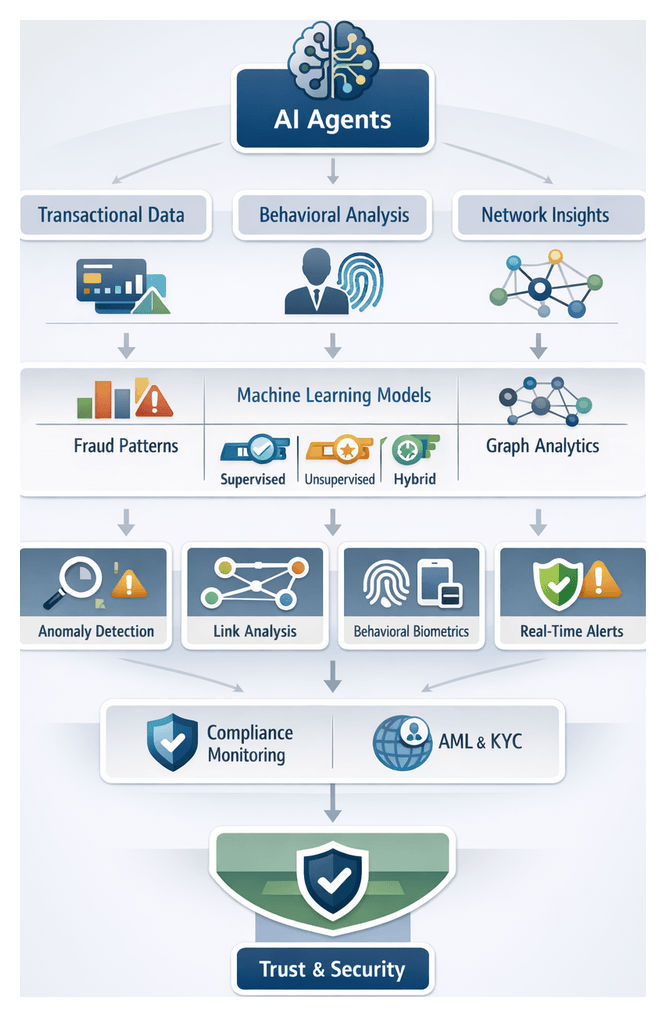
AI-Driven Risk Management and Fraud Detection
As financial services evolve toward customer-centric models, institutions must fortify their risk management and fraud detection frameworks with AI agents that deliver proactive, scalable protection. These agents synthesize transactional, behavioral, and network data in real time, shifting the emphasis from reactive rule enforcement to intelligent identification of emerging threats. By embedding machine learning, graph analytics, and behavioral profiling into enterprise architectures, banks can detect complex fraud schemes, enforce compliance policies, and maintain customer trust in an increasingly digital environment.
Fraud Pattern Identification and Analytical Frameworks
Fraud manifests through dynamic signatures that span multiple dimensions of customer activity. To interpret these patterns efficiently, risk teams employ analytical frameworks that classify anomalies according to their characteristics:
- Volume-based patterns: Rapid spikes in transaction frequency or unusually large transfers relative to historical behavior.
- Behavioral drift: Deviations in channel usage, device fingerprints, or geolocation that diverge from a customer’s typical profile.
- Network clusters: Interconnected accounts and beneficiaries forming suspicious rings indicative of money laundering or mule networks.
- Temporal anomalies: Transactions occurring at atypical times or with irregular spacing when compared to established norms.
- Content-based signals: Uncommon merchant categories, metadata irregularities, or narrative inconsistencies in transaction descriptions.
These categories guide the alignment of detection rules, supervised models, and unsupervised methods with the fraud typologies most relevant to each institution’s customer segments and product lines.
Model-Based Approaches
To capture both known and novel fraud schemes, leading banks integrate multiple machine learning paradigms:
- Supervised learning: Algorithms such as gradient boosting machines, random forests, and neural networks use labeled fraud and legitimate transaction data to optimize classification accuracy. While highly effective against historical patterns, they require continuous retraining to address evolving threats.
- Unsupervised learning: Methods including clustering, isolation forests, and autoencoders establish baselines of normal behavior and flag outliers without prior labels. These techniques excel at surfacing new fraud vectors but depend on layered review processes to distinguish legitimate outliers.
- Hybrid and ensemble methods: By merging supervised and unsupervised outputs—weighting risk probabilities and anomaly scores—institutions achieve a balanced detection strategy that minimizes false positives and captures emergent threats.
Network Analysis and Graph-Based Detection
Graph analytics provides deep visibility into fraud schemes that transcend individual accounts. Entities such as accounts, cards, devices, and beneficiaries are modeled as nodes, with transactions and relationships represented as edges. Key techniques include:
- Community detection to uncover clusters of coordinated actors engaged in laundering or identity theft.
- Path analysis to trace suspicious fund flows across jurisdictions through short or unusual transaction chains.
- Centrality metrics to identify hub nodes—often mule accounts or intermediaries—facilitating multiple illicit interactions.
Behavioral Biometrics and Anomaly Profiling
Augmenting transactional data with behavioral biometrics enhances the precision of fraud detection. AI agents continuously profile user interactions—keystroke dynamics, mouse movements, touchscreen gestures—and session attributes such as device consistency and IP stability. Real-time session risk scores aggregate these signals, triggering alerts when deviations suggest credential misuse or account takeover attempts.
Vendor Platforms and AI-Driven Tools
To accelerate deployment, many institutions partner with specialized vendors that offer integrated fraud detection and analytics modules:
- Palantir leverages graph databases and custom analytics to visualize complex fraud networks.
- FICO Falcon Fraud Manager combines neural network scoring, network analysis, and a flexible rules engine for real-time detection.
- SAS Fraud Management unifies supervised, unsupervised, and interactive graph analytics for enterprise-scale monitoring.
- IBM Safer Payments deploys adaptive analytics and deep learning across multiple payment rails.
- ThetaRay applies unsupervised machine learning and proprietary mathematical models to identify unknown threats without labeled datasets.
- Darktrace integrates behavioral anomaly profiling with AI-driven threat detection for digital channels.
- NICE Actimize embeds machine learning-powered agents in anti-money laundering and transaction monitoring platforms.
- Microsoft Azure AI offers cognitive services and machine learning frameworks for custom fraud analytics.
- IBM Watson provides cognitive agents for natural language understanding and entity resolution in risk applications.
AI Agents in Compliance and Policy Enforcement
Beyond fraud detection, AI agents revolutionize compliance by automating continuous monitoring, adaptive learning, and contextual analysis. Embedded within a holistic risk and compliance architecture, these agents support transaction monitoring, KYC, regulatory reporting, sanctions screening, policy enforcement, and enterprise risk scoring.
Transaction Monitoring and Anti-Money Laundering
AI-driven agents replace static rule engines with behavior-driven models that ingest payment flows, account activities, geolocation, and device data to build customer baselines. Deviations generate probabilistic risk scores, enabling teams to prioritize high-risk alerts. Vendors such as NICE Actimize continuously refine detection algorithms through feedback loops that retrain models on investigator outcomes, measuring effectiveness via precision-recall curves and false positive reduction metrics.
Know Your Customer and Enhanced Due Diligence
Transforming KYC into a continuous intelligence lifecycle, AI agents automate identity verification, real-time data enrichment, and reputational risk assessment. By tapping corporate registries, watchlists, and adverse media feeds, and applying natural language processing, platforms like IBM Watson extract risk indicators from unstructured text. Interpretive frameworks center on entity resolution accuracy, confidence scoring, and the delivery of contextually relevant intelligence to compliance officers.
Regulatory Reporting and Audit Trail Generation
AI agents streamline regulatory reporting by automating data aggregation, normalization, and report drafting while preserving data lineage. An “explainable AI” approach documents decision pathways and transformation logic, ensuring each report item is traceable to its source. Key metrics include report turnaround time, percentage of automated extraction, and volume of human-exception reviews.
Sanctions and Watchlist Screening
To address global watchlist complexity, AI agents employ fuzzy matching, phonetic similarity scoring, and contextual relevance analysis. By layering negative news sentiment analysis, these solutions rank potential matches by risk, reducing false positives and focusing analysts on high-probability cases. Success is measured by reduced alert volumes, faster review times, and screening accuracy against evolving sanctions lists.
Policy Enforcement and Intelligent Alerts
AI agents operationalize policy frameworks—covering insider trading, market conduct, and access controls—by correlating employee communications, transaction authorizations, and system logs. Graph analytics models complex infraction patterns, generating intelligent alerts that flag compound risks. Metrics such as alert precision, mean time to detect, and proportion of automated remediation actions gauge effectiveness.
Enterprise Risk Scoring and Customer Profiling
AI agents integrate financial crime signals, customer behavior, and external intelligence into unified risk scores. Multivariate scorecard models, regularly recalibrated through supervised learning, enable proportionate allocation of compliance resources. Performance is evaluated via back-testing, stress tests under hypothetical scenarios, and monitoring the stability of risk distributions over time.
Regulatory and Model Governance Frameworks
Deploying AI agents for risk and compliance requires alignment with global mandates—from FATF recommendations and the EU’s Anti-Money Laundering Directives to US OCC guidelines. Institutions map AI functionalities to regulatory criteria, establish cross-functional governance bodies, and engage in pilot programs or sandboxes to validate designs before full rollout.
Model Risk Management and Validation
Robust governance covers the AI lifecycle: development, validation, deployment, monitoring, and retirement. Independent validation teams review design assumptions, data sources, and performance metrics, stress-test agents under rare fraud scenarios, and document model logic, data lineage, and validation outcomes. Continuous monitoring with automated alerts for accuracy declines or bias metrics ensures timely recalibration.
- Implement structured MRM frameworks combining qualitative reviews and quantitative validation.
- Define acceptance criteria for false positive and false negative rates aligned with risk appetite.
- Schedule periodic recalibration cycles to address concept drift and model decay.
Data Integrity, Quality, and Bias Mitigation
High-quality data underpin AI efficacy. Data governance processes ensure that profiles, transactions, and watchlists are accurate, current, and reconciled. Bias mitigation techniques—data sampling adjustments, adversarial debiasing, and fairness audits—identify and correct skewed patterns. Immutable audit logs document data corrections and exception handling.
- Enforce data lineage protocols to trace sources and transformations.
- Incorporate bias detection tools into development pipelines.
- Maintain audit logs to support transparency and accountability.
Explainability and Transparency
Regulators and customers demand clarity on AI-driven decisions. Explainable AI techniques—feature importance, local surrogate models, and counterfactual analysis—translate complex outputs into human-readable narratives. Standardized explanation reports and staff training on model rationale foster internal buy-in and regulatory confidence, while access controls protect sensitive model internals from misuse.
- Adopt XAI frameworks for high-impact decision reporting.
- Train frontline staff to interpret and communicate model explanations.
- Implement role-based controls to balance transparency with security.
Operational Resilience and Systemic Risk
AI deployments introduce broader operational risks. Institutions map interdependencies among AI agents, legacy systems, and data providers to identify single points of failure. Resilience testing—load and chaos engineering—validates infrastructure robustness. Clear incident response playbooks, role definitions, and communication protocols ensure coordinated reactions to system anomalies.
- Chart system interdependencies and recovery objectives.
- Conduct resilience and failover testing.
- Maintain incident response plans with defined escalation paths.
Cybersecurity and Privacy Protections
AI agents handling sensitive data require rigorous security and privacy controls. Secure development lifecycles apply encryption, tokenization, and secure APIs. Collaborations with information security teams align designs with ISO 27001 and the NIST Cybersecurity Framework. Privacy impact assessments evaluate data minimization, consent management, and cross-border transfer risks, employing anonymization and differential privacy where feasible.
- Implement role-based access controls and multi-factor authentication.
- Integrate security code reviews and penetration testing into development cycles.
- Perform regular privacy impact assessments to document data flows and controls.
Limitations, Emerging Challenges, and Strategic Reflections
AI agents are powerful but not infallible. Model fragility, adversarial attacks, data scarcity, and talent shortages necessitate continuous oversight and tuning. Geopolitical shifts and new regulations demand frequent updates. Ethical debates over bias, fairness, and AI neutrality in credit decisioning underscore the need for ongoing engagement with academia, industry consortia, and advocacy groups.
- Recognize the requirement for expert oversight and continuous tuning.
- Invest in upskilling to build internal AI governance capacity.
- Monitor emerging best practices on ethical AI, bias mitigation, and auditability.
By integrating AI agents with rigorous governance, interdisciplinary collaboration, adaptive learning practices, and transparent accountability, financial institutions can transform risk management and compliance into competitive differentiators. Strategic stewardship of AI ensures resilient, ethical, and customer-centric services that uphold regulatory standards and foster lasting trust.
Chapter 8: Operational Efficiency through Intelligent Automation
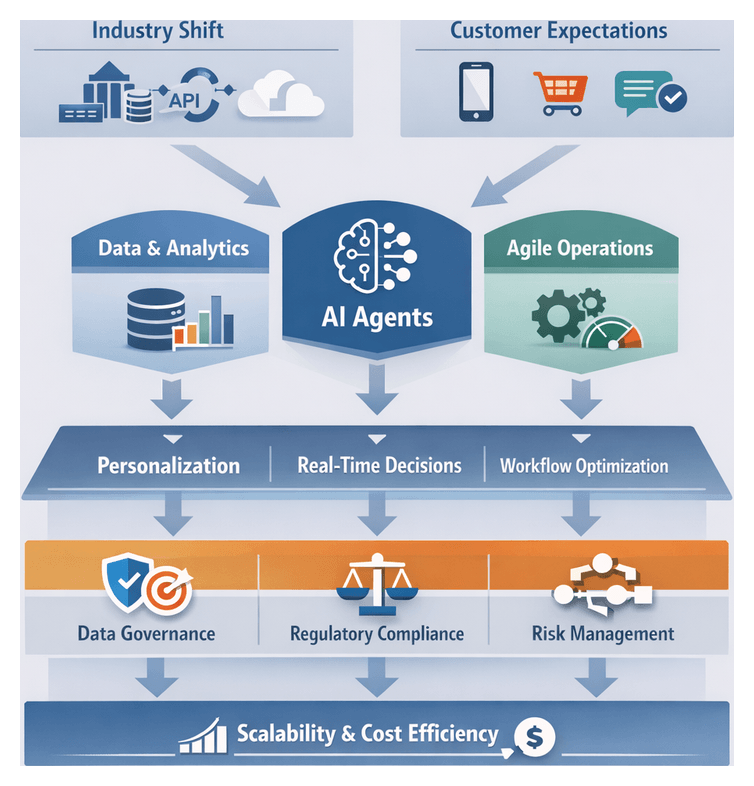
Navigating the Shift to Customer-Centric Banking
Industry Transformation and Customer Expectations
The financial services industry is transitioning from product-driven models to frameworks centered on individual needs, behaviors and aspirations. Agile fintech challengers and technology conglomerates are leveraging APIs, open banking and cloud-native architectures to deliver digital wallets, peer-to-peer lending, robo-advisors and buy-now-pay-later solutions that fragment traditional relationships. In response, incumbent banks must reengineer legacy processes, integrate advanced analytics and adopt real-time decisioning to anticipate customer needs and personalize at scale.
Contemporary consumers expect seamless digital journeys modeled on leading e-commerce, social media and entertainment experiences. Frictionless onboarding, proactive alerts, contextual recommendations and instant query resolution are fundamental requirements. Younger cohorts share data readily in exchange for personalized value, while established segments seek reliability augmented by timely, relevant digital communications. Delivering these experiences demands a robust framework for collecting, integrating and operationalizing behavioral, demographic, psychographic and contextual data.
Relationship Banking and Foundational Challenges
Moving from transactional interactions to continuous relationship banking transforms the ledger-centric model into an ongoing dialogue powered by intelligence. By analyzing spending patterns, AI-driven digital assistants can surface savings milestones, automate allocations and propose mortgage scenarios tailored to risk tolerance and market forecasts. However, legacy IT systems often struggle with real-time data processing, siloed information stores and inconsistent governance. Data quality issues, talent shortages in data science and UX design, and regulatory complexities around GDPR, CCPA and PCI DSS present further hurdles.
Addressing these challenges requires executive sponsorship, cross-functional collaboration and a phased roadmap that prioritizes high-impact use cases. Banks must align technology investments with organizational goals, deliver incremental value, and balance personalization with transparent consent and rigorous security.
Enablers and Leadership Imperatives
Three key enablers underpin the customer-centric model. First, a modern data architecture built on cloud platforms and data lakes provides the flexibility to ingest diverse datasets, scale analytics workloads and support real-time processing. Leading solutions include Google Cloud AI Platform and Azure Cognitive Services. Second, AI agents—powered by natural language understanding, pattern recognition and autonomous decision-making—guide customers through complex processes and execute routine tasks. Platforms such as IBM Watson exemplify continuous, context-aware engagement. Third, adaptive organizational structures that embed data scientists, product managers, compliance specialists and UX designers within agile squads accelerate experimentation and shift from monolithic release cycles to continuous delivery.
Leadership must articulate a clear vision, allocate resources to strategic initiatives and establish governance processes aligned with risk frameworks. Defining KPIs—net promoter score, customer lifetime value and digital adoption rates—ensures accountability. Transparent communication with employees, customers, regulators and shareholders builds trust, while A/B testing and sandbox environments foster a culture of experimentation.
Analytical Frameworks for Workflow Optimization
Identifying Bottlenecks
Workflow optimization begins with mapping end-to-end processes to visualize delays and non-value-added activities. Value stream mapping and process mining tools analyze event logs to reveal hidden dependencies, divergent paths and rare exceptions. Key metrics—process cycle time, work-in-process queue length and hand-off frequency—highlight control points where automation or redesign can unlock significant throughput gains. Capability heat maps score steps by complexity, variance and automation coverage, guiding dynamic prioritization of optimization initiatives.
Modeling Efficiency and Scalability
After bottleneck identification, scenario modeling and cost-benefit analyses estimate efficiency gains. Baseline performance profiles are compared with projections under varying AI-agent deployments, capturing best-case, worst-case and most-likely outcomes. Sensitivity analyses pinpoint variables—such as document classification accuracy—most critical to ROI. Operational resilience and scalability are assessed through queueing theory and discrete event simulations, stress-testing automated workflows under peak loads. Cloud-native architectures offer elasticity metrics that inform autoscaling policies and capacity planning, while failure mode and recovery objectives ensure fallback paths maintain continuity.
Performance Management and Continuous Improvement
Effective optimization relies on a balanced scorecard of KPIs—Process Cycle Efficiency, first-pass yield, exception rates and customer impact indicators like Net Promoter Score and average resolution time. Visual dashboards enable real-time monitoring and correlation analyses, while anomaly detection models flag deviations from expected patterns. Closed-loop feedback systems allow AI agents to gather operational telemetry and refine their decision logic. When novel exception patterns emerge, agents flag cases for human review, learn correct resolutions and apply updated logic. Governance structures that unite data science, operations and risk teams, along with regular model validation sessions, institutionalize continuous improvement.
Scalability, Cost Reduction, and Strategic Value of Automation
Economies of Scale and Flexible Cost Structures
Intelligent automation transforms linear cost growth into a nonlinear model where the marginal expense of an additional transaction approaches zero. Banks evaluate this shift through cost-to-income analyses and scenario-based forecasting, considering:
- Allocation of fixed versus variable costs, shifting from staff salaries to software licensing and cloud compute usage.
- Throughput elasticity, modeling how transaction volumes grow before new capacity investments are required.
- Unit cost benchmarking, comparing per-transaction costs pre- and post-automation to adjust pricing strategies.
Financial frameworks such as Total Cost of Ownership, Return on Automation Capital and Capacity Utilization Curves guide investment decisions, aligning speed, cost, risk and expected returns with strategic objectives.
High-Volume Processing and Market Expansion
Use cases like mortgage origination, card issuance and real-time payments exhibit dramatic volume fluctuations. AI-driven platforms enable instant scaling without overtime or temporary staffing. For example, integrating UiPath robotic process automation with machine learning models ramps up underwriting throughput during peak periods. Banks assess peak-to-average ratios, stress-test process resilience and track service-level improvements in processing times and error rates.
Automation also supports market expansion and micro-segmentation by reducing incremental customer acquisition costs and servicing expenses. Metrics such as CAC, segment profitability, and time-to-market velocity measure the impact of automated onboarding, KYC workflows, and campaign launches.
Risk and Governance Considerations
Balanced adoption requires managing risks related to vendor lock-in, opaque algorithms and potential service disruptions. Mitigation strategies include modular architectures for component replacement, transparency standards that allow audit and explanation of decision logic, and robust fallback mechanisms routing complex cases back to human teams.
Building Sustainable Automation Capabilities
Culture, Talent, and Change Management
Organizational readiness is as critical as technology choice. Visible executive sponsorship, clear strategic goals and cross-departmental steering committees align risk, compliance, IT and business stakeholders. Iterative pilot programs demonstrate rapid value, building momentum for broader deployment. Training initiatives focus on advanced analytics, agile methodologies and governance proficiency, preparing staff to collaborate effectively with AI agents. Strategic partnerships with specialized vendors or consulting firms accelerate knowledge transfer and capability development.
Technology Integration and Data Governance
Interoperability with core banking systems, data warehouses, CRM platforms and external APIs is paramount. Event-driven architectures and microservices decouple automation logic from monolithic back ends. Continuous integration and deployment pipelines ensure AI model updates do not disrupt processes. Hybrid or multi-cloud strategies enhance resilience and cost optimization but demand network segmentation, strong identity-and-access controls and standardized logging. Data governance frameworks enforce lineage, access controls and validation checks. Automated cleansing routines, metadata catalogs and reference data models aligned with regulatory taxonomies maintain data quality and support transparent reporting.
Governance, Risk, and Compliance Frameworks
- Model governance with clear ownership, audit trails and version history.
- Regulatory alignment mapping use cases to AML, GDPR, PSD2 requirements, with policy-enforcing controls.
- Risk management integrating automated risk-scoring and human review of exceptions, alongside periodic stress tests.
- Ethical oversight through committees that assess algorithmic bias and maintain customer recourse mechanisms.
Mitigating Limitations and Strategic Imperatives
To avoid technical debt, institutions enforce code refactoring, documentation standards and centralized version control. Human-in-the-loop checkpoints preserve customer trust and relational engagement. Regular bias audits and fairness metrics address discriminatory patterns, while zero-trust security models, penetration testing and automated threat detection fortify defenses. Ongoing dialogue with regulators and participation in industry forums ensure compliance with evolving AI and data privacy regulations.
High-performing institutions converge on strong governance frameworks, integrated data architectures, a culture of continuous learning and cross-functional collaboration. By defining clear roadmaps, investing in open architectures and institutionalizing best practices, banks can harness intelligent automation as an enterprise-wide capability that drives sustainable growth, operational resilience and competitive differentiation in a rapidly digital marketplace.
Chapter 9: Measuring Impact and Return on Investment
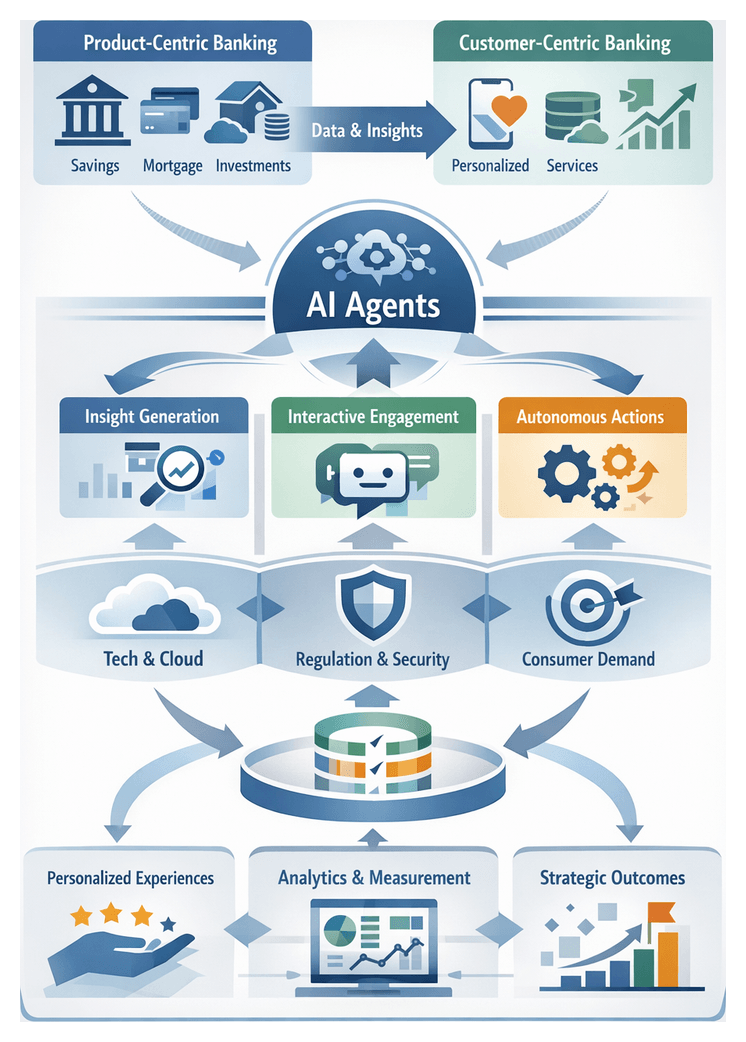
Navigating the Shift to Customer-Centric Banking
The financial services industry is undergoing a profound transformation from product-centric models to individualized, customer-centric experiences. Traditional banks prioritized scale and operational efficiency, offering standardized savings, checking, mortgage, and investment products. Today’s consumers expect seamless mobile interactions, contextual recommendations, and services tailored to their unique financial journeys. Concurrently, digital channels generate vast transaction records, behavioral signals, and contextual data. When harnessed effectively, this data unveils deep insights into individual needs and preferences. Fintech challengers and global tech giants leverage cloud-native architectures and advanced analytics to deliver rapid, personalized services, intensifying the competitive imperative for incumbent institutions.
Transitioning to a customer-centric operating model demands a strategic reorientation of technology, culture, and organizational processes. Financial institutions must place the customer at the center of product design, risk assessment, and service delivery. Only by embracing this shift can banks foster meaningful engagement, build trust, and drive sustainable profitability.
Embracing AI Agents in Personalized Finance
AI agents represent the next frontier in personalized banking. Beyond rule-based automation, these agents use machine learning, natural language understanding, and autonomous decision-making to adapt in real time to each customer’s context. They function as intelligent intermediaries, synthesizing data from transaction histories, demographic attributes, behavioral signals, and external market trends to deliver tailored journeys across channels.
- Insight Generation: AI agents identify customers nearing savings goals, detect early signals of credit risk, and surface cross-sell opportunities by analyzing diverse data sources.
- Interactive Engagement: Through chatbots, voice assistants, and messaging widgets, agents provide contextual guidance—from balance inquiries to holistic financial planning.
- Autonomous Orchestration: Agents can preauthorize personalized loan offers, adjust account settings based on real-time risk assessments, or trigger fraud alerts without manual intervention.
Framed as adaptive partners rather than static tools, AI agents unlock deep individualization at scale, accelerating time to value and delivering measurable business outcomes.
The Inflection Point for Banking Personalization
Recent advances in compute power, cloud infrastructure, and AI algorithms now make enterprise-grade agent deployments feasible. Concurrently, open banking initiatives such as PSD2 and evolving data protection standards have standardized secure data sharing, lowering barriers to integrating third-party data and co-creating personalized experiences.
Key drivers of urgency include:
- Technological Maturation: Deep learning, reinforcement learning, and natural language processing frameworks offer scalable APIs, prebuilt connectors, and governance controls designed for financial services.
- Regulatory Evolution: Open banking mandates enable real-time account data access, fostering partner ecosystems and new revenue streams.
- Consumer Empowerment: Digitally native customers demand hyper-relevant, on-demand services and will migrate to brands that demonstrate clear value exchange and privacy stewardship.
- Competitive Imperative: Fintech disruptors exploit AI-driven personalization to attract and retain customers, pressuring incumbent banks to accelerate intelligent agent adoption.
In this critical moment, banks that strategically invest in AI agent technologies and embed personalization into core operations can redefine their value proposition and secure competitive advantage.
Analytical Frameworks and Performance Measurement
Robust measurement is essential for quantifying the value of AI-driven personalization, benchmarking progress, and aligning initiatives with strategic objectives. Financial institutions should adopt structured frameworks, rigorous statistical methods, and intuitive visualization tools to transform raw data into actionable intelligence.
Frameworks for Measuring AI Agent Impact
- Balanced Scorecard: Extends financial metrics with customer, internal process, and learning perspectives. Tracks customer satisfaction, process efficiency, compliance adherence, and innovation capacity to reveal interdependencies between personalization and long-term goals.
- Benefit Realization Framework: Maps AI capabilities to tangible outcomes—revenue growth, cost reduction, and risk mitigation. Metrics include incremental revenue from personalized offers and cost savings from reduced call center volume.
- AI Analytics Maturity Model: Assesses progression from descriptive reporting to predictive and prescriptive analytics. Key indicators include data accessibility, model sophistication, governance rigor, and cross-functional adoption rates.
Attribution and Incrementality
Accurate attribution isolates the impact of AI agents across multiple touchpoints and ensures that gains are additive rather than a shift of existing value. Common approaches include:
- Last-Touch Attribution: Credits the final interaction, useful for immediate offer response but may overstate single-step effects.
- Multi-Touch Attribution: Distributes credit across the customer journey, offering a nuanced view of AI agent contributions.
- Algorithmic Attribution: Employs machine learning to assign interaction weights dynamically based on historical data.
- Uplift Modeling and Holdout Testing: Uses control groups to measure true incremental lift attributable to personalized interventions.
Statistical Techniques and Experimentation
- A/B and Multivariate Testing: Randomized experiments compare control and treatment groups to isolate the effect of AI-driven personalizations on key metrics.
- Holdout and Control Cohorts: Longitudinal analysis of cohorts that receive or are withheld AI interventions reveals sustained value impacts.
- Bayesian Inference: Updates performance beliefs as new data arrives, handling small samples and sparse contexts.
- Confidence Intervals and Hypothesis Testing: Quantify statistical significance and measurement uncertainty.
- Time-Series Analysis: Models trends, seasonality, and external shocks to separate AI agent effects from broader market dynamics.
Business Intelligence Platforms
Centralizing AI performance data in analytics platforms democratizes insights and enables real-time monitoring and self-service exploration.
- Power BI: Interactive dashboards and natural language queries for business users.
- Tableau: Advanced visualization and data blending to correlate personalization metrics with enterprise indicators.
- Looker: Modeling layer that standardizes metric definitions across departments.
Visualization for Insights
- Time-Series Line Charts: Track KPI trajectories and responses to AI-driven campaigns.
- Cohort Analysis Grids: Compare metrics across customer segments defined by acquisition date or personalization treatment.
- Funnel and Flow Diagrams: Map digital journeys, pinpointing drop-off points and areas where AI agents drive completion.
- Heat Maps and Scatter Plots: Reveal correlations between personalization intensity and outcomes like click-through rates.
- Dashboard Scorecards: Aggregate top-level KPIs—adoption rate, incremental revenue, cost-to-serve—for at-a-glance program health.
Avoiding Analytical Pitfalls
- Correlation versus Causation: Ensure investments target causal drivers of value, not coincidental patterns.
- Data Silos and Inconsistency: Establish unified schemas and metric definitions to avoid fragmented insights.
- Metric Overload: Focus on a balanced set of leading and lagging indicators to maintain clarity.
- Sample Bias: Validate representativeness of test cohorts to ensure generalizable results.
- Overfitting and Model Decay: Monitor model performance over time and trigger retraining to maintain relevance.
Interpreting Insights for Strategic Decisions
Beyond measurement, interpreting performance data within strategic contexts is critical for guiding capital allocation, product development, and customer engagement strategies. Translating metrics into narratives aligns AI initiatives with organizational priorities.
Translating Data into Action
Performance dashboards yield metrics—conversion rates, incremental revenue uplift, engagement scores, cost-to-serve ratios. To convert these into strategic guidance, map results across three dimensions:
- Customer Impact: Satisfaction, loyalty, and lifetime value measures that reflect the end-user experience.
- Operational Efficiency: Process acceleration, error reduction, and cost savings that demonstrate productivity gains.
- Revenue and Growth: Cross-sell uplift, churn reduction, and new customer acquisition attributable to personalized outreach.
Contextualizing Metrics
Anchoring metrics in strategic objectives prevents misleading interpretations. Two key activities support context:
- Alignment Workshops: Cross-functional sessions where analytics teams present findings to business sponsors, discussing how metrics map to goals such as market expansion or margin improvement.
- Scenario Modeling: “What-if” analyses project downstream effects of performance trends, linking digital engagement gains to cost-to-serve reductions and potential reinvestments.
Decision-Making Frameworks
- Value Attribution Matrix: Assigns strategic weights to KPIs, prioritizing metrics like qualified lead conversions over raw interaction volumes.
- Performance Impact Curve: Plots effort versus return, identifying inflection points where additional investment yields diminishing returns.
Balancing Quantitative and Qualitative Feedback
Integrating numerical data with human insights captures the full customer experience:
- Overlay customer survey scores with recommendation engine accuracy to validate relevance against perceptions.
- Analyze chatbot handoff logs to identify friction points, then assess resolution times and satisfaction for escalated cases.
- Include voice-of-customer summaries alongside trend charts in stakeholder reviews, ensuring decisions consider both technical efficiency and human experience.
Aligning Investments
- Marginal Return Analysis: Estimates incremental benefit of additional investment in AI modalities, such as sentiment analysis versus predictive analytics.
- Portfolio Balance: Maintains a mix of core enhancements and exploratory pilots, confining high-risk initiatives to controlled environments.
- Governance and Accountability: Defines decision rights, budget ownership, and clear ownership of ongoing monitoring and optimization.
Sustaining Return on AI-Driven Personalization
Maximizing long-term ROI requires ongoing investment in data quality, governance, collaboration, and infrastructure. Institutions must embed continuous improvement and ethical oversight into their personalization programs.
Data Governance and Model Lifecycle
- Data Quality and Integration: Continuous cleansing, reconciliation, and standardized metadata registries ensure accurate, timely inputs for AI agents.
- Model Governance: Version control, validation protocols, and automated retraining pipelines mitigate drift and preserve performance.
Organizational Collaboration and Change Management
- Cross-Functional Alignment: Regular workshops, shared dashboards, and a central personalization council foster joint accountability across business, data science, compliance, and IT.
- User Adoption: Training programs, clear communication, and phased rollouts drive agent utilization and minimize override rates.
Regulatory, Ethical, and Risk Considerations
- Data Privacy: Architectures supporting fine-grained consent management and anonymization adapt to evolving residency and consent requirements.
- Algorithmic Fairness: Regular audits using tools like IBM Watson fairness modules detect and remediate biases in model outcomes.
- Performance Monitoring: Drift indicators—prediction confidence deviations and feature distribution changes—trigger model review and retraining.
- Integration Resilience: Dependency mappings, change management controls, and rollback procedures prevent cascading outages during system updates.
- Overpersonalization Risk: Balanced tailoring, guided by user feedback and opt-out options, maintains customer trust and privacy perceptions.
- Vendor Independence: Open architectures and interoperable standards reduce lock-in and enhance flexibility in platform selection.
Continuous Improvement and Future Trends
ROI is maximized through successive waves of hypothesis-driven experiments, A/B tests, and pilot programs. Establishing a center of excellence centralizes best practices, accelerates innovation, and diffuses successful approaches enterprise-wide.
Emerging directions include federated analytics for privacy-preserving collaboration, decentralized identity frameworks, tokenized incentive models, and explainable AI modules that enhance transparency and regulatory compliance. By embedding measurement, ethical oversight, and agile execution into their culture, financial institutions can drive cumulative value and secure leadership in customer-centric banking.
Chapter 10: Future Outlook, Challenges, and Ethical Considerations
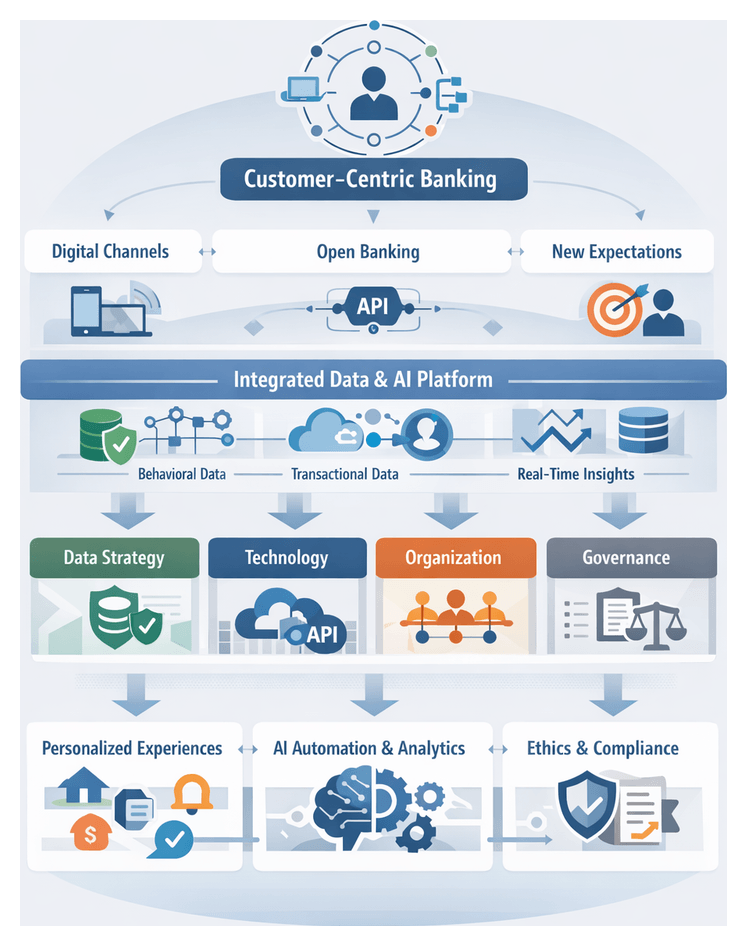
The Shift to Customer-Centric Banking
Over the past decade, banking has evolved from product-centric operations to customer-centric models driven by digital innovation, open banking standards, and empowered consumers. Traditional one-size-fits-all services no longer suffice as customers demand seamless, personalized interactions across channels. Leading institutions are responding by unifying fragmented data sources, modernizing core systems, and reorganizing teams around end-to-end customer journeys.
At the heart of this transformation is the ability to anticipate needs, deliver contextual advice, and orchestrate frictionless experiences. Whether suggesting a mortgage during property searches, initiating savings challenges, or issuing real-time fraud alerts, banks must leverage integrated platforms that capture transactional histories, behavioral signals, and demographic attributes. With over 80 percent of retail interactions now digital, real-time responsiveness and personalization have become critical differentiators.
Key drivers of this shift include:
- Digital adoption: Mobile and online channels as primary engagement points.
- Regulatory change: Open banking mandates and data portability enabling new entrants.
- Demographics: Digitally native cohorts with high expectations for intuitive, self-service experiences.
Despite clear incentives, incumbents face obstacles such as siloed data, inflexible legacy systems, product-centric organizational structures, and risk-averse cultures. Overcoming these barriers requires strategic investment across four dimensions:
- Data strategy: Secure collection, integration, and stewardship of customer data.
- Technology enablement: Event-driven architectures, scalable analytics, and flexible APIs.
- Organizational alignment: Cross-functional teams organized around customer journeys.
- Governance: Policies and controls for responsible data use, compliance, and ethical AI.
Advanced automation and machine intelligence are essential to operationalize customer-centricity. AI agents analyze data in real time to detect patterns, personalize offers, and execute interventions autonomously. Chatbots and virtual assistants deliver 24/7 support, recommendation engines surface relevant offers based on contextual triggers, and embedded AI streamlines underwriting and compliance. These capabilities yield measurable gains in cross-sell, wallet share, operational efficiency, and risk management.
Ethical Challenges and Governance of AI Agents
As banks embed AI agents into personalization frameworks, they must address ethical concerns such as data bias, transparency, accountability, privacy, fairness, and regulatory alignment. A structured approach ensures that AI-driven experiences earn and sustain customer trust.
Data Bias and Fairness
Bias can originate from historical prejudices in training data, uneven sample representation, measurement inconsistencies, or algorithmic errors that disadvantage particular groups. Institutions deploy fairness metrics—demographic parity, equalized odds, disparate impact ratio—to evaluate model outcomes. Mitigation techniques span:
- Pre-processing: Data rebalancing and augmentation.
- In-processing: Fairness-aware modeling.
- Post-processing: Outcome adjustments.
Transparency and Explainability
Regulators and customers demand clear explanations for automated decisions. Tools such as model cards, local interpretable model-agnostic explanations (LIME), and Shapley Additive Explanations (SHAP) quantify feature contributions. Products like IBM Watson Explainability and Microsoft Azure AI Interpret generate narrative insights for stakeholders. Transparency must extend to governance disclosures and customer communications.
Accountability and Governance
Effective frameworks establish clear responsibilities for AI outcomes and define escalation paths for adverse events. Essential elements include:
- Governance committees with cross-functional oversight.
- Model governance policies covering validation, version control, and monitoring.
- Incident management protocols and formal audit trails.
Guidelines from the OECD AI Principles and ISO/IEC TR 24028 emphasize lineage tracking, documentation of assumptions, and rigorous audits to ensure accountability.
Privacy and Data Consent
Personalization relies on rich datasets—transactions, biometrics, behavioral signals—making privacy essential. Best practices include:
- Privacy-by-Design: Data minimization, anonymization, and encryption embedded from the outset.
- Consent management platforms enabling customer control over data use.
- Data provenance tracking to document origins, transformations, and permitted uses.
Differential privacy techniques and Data Protection Impact Assessments under GDPR and CCPA help balance analytical value with customer rights.
Regulatory Alignment
Banks must navigate a complex regulatory environment spanning banking laws, data protection, and emerging AI directives. Regulatory sandboxes offer supervised testing grounds, while proposals such as the European AI Act categorize applications by risk profile. Compliance platforms like Google Cloud AI Policy Library track evolving mandates, map obligations to controls, and generate audit-ready reports.
Building Trust
Principle-based frameworks—fairness, reliability, privacy, transparency, accountability—guide strategy. Implementation checklists translate principles into concrete policies, and stakeholder engagement models incorporate customer advisory panels and ethics committees. Formal Responsible AI programs backed by independent audits signal commitment to ethical innovation and reinforce trust with customers and regulators.
Emerging Innovation Paths for AI in Finance
Beyond current personalization applications, AI agents are poised to enable next-generation services across blockchain, identity, embedded ecosystems, collaborative platforms, and sustainable finance. These innovation paths promise foundational shifts in value creation and customer engagement.
Decentralized Finance and Tokenized Asset Management
AI agents in DeFi contexts act as autonomous portfolio managers, executing tokenized asset strategies across peer-to-peer lending, automated market making, and yield optimization. Maturity models assess on-chain interoperability, oracle reliability, and governance token distribution. Agents monitor liquidity pools, detect arbitrage, and adjust collateral ratios in real time to align with individual risk preferences.
Digital Identity and Trust Frameworks
Robust digital identity systems leverage behavioral biometrics and verifiable credentials. AI agents negotiate data permissions in real time via self-sovereign identity (SSI) models and decentralized identifiers (DIDs), tailoring service delivery and strengthening fraud prevention. This customer-centric trust architecture extends across banking, insurance, healthcare, and public services.
Embedded Finance Ecosystems
Open banking and API-driven collaborations enable financial capabilities within non-bank platforms. AI agents embedded in retail, travel, or healthcare apps initiate payments, dynamic credit facilities, and savings commitments at the point of need. Embedded finance maturity frameworks guide the evolution from basic payments to full-service ecosystems.
Collaborative AI Networks
Multi-agent platforms across banking, insurance, and wealth management facilitate integrated services. Through standardized protocols, agents exchange anonymized insights to co-create composite offerings, such as unified life-cycle financial plans, while preserving privacy. Two-sided market frameworks inform platform governance and network effect strategies.
Digital Twin Models and Personalized Advisory
Digital twins replicate a customer’s financial profile and life goals, enabling AI agents to simulate scenarios, stress-test strategies, and deliver continuous advisory. Scenario-planning and systems-dynamics frameworks assess simulation fidelity, shifting advisory services from periodic reviews to proactive, real-time guidance aligned with life events.
ESG and Sustainable Finance Personalization
AI agents customize ESG-aligned investment portfolios by analyzing corporate disclosures, social impact metrics, and regulatory updates. Materiality matrices and sustainable finance frameworks guide factor selection. Agents may negotiate personalized green loan terms or recommend carbon-offset strategies to support customer sustainability goals.
Regulatory Sandbox Environments
Regulatory sandboxes enable supervised pilots of AI-driven innovations such as tokenized assets, dynamic credit scoring, and cross-border settlement agents. Real-time reporting and principles-based oversight inform policy evolution, while early regulator engagement accelerates responsible scaling.
Cross-Industry Ecosystem Integration
AI agents can synthesize data across sectors—telecom, retail, healthcare—to deliver context-aware financial services. Pay-as-you-drive insurance offers based on telematics and micro-insurance tied to health metrics exemplify cross-industry personalization. Value co-creation maps help identify shared opportunities and governance requirements.
Ethical and Governance Innovation
Future AI agents will incorporate audit-ready decision logs, explainability layers, and collaborative oversight involving customers, regulators, and ethics councils. Moral decision-making frameworks—beneficence, non-maleficence, autonomy, justice—will guide trade-offs between personalization and fairness, making responsible AI a key differentiator.
Strategic Considerations for Innovation Paths
- Value proposition clarity: Defining benefits from enhanced convenience to improved outcomes.
- Partner ecosystem design: Selecting fintech, technology, and non-bank collaborators.
- Regulatory alignment: Anticipating compliance requirements and engaging authorities.
- Operational resilience: Ensuring data architectures and model governance support multi-agent scenarios.
- Ethical guardrails: Embedding transparency, fairness, and user control from the outset.
Roadmap and Key Learning Outcomes
This guide follows a structured roadmap that aligns strategic intent with technical capabilities, data governance, operational design, and ethical safeguards. The progression mirrors the stages of an AI personalization program:
- Market imperatives and competitive drivers.
- Conceptual foundations of AI agents and differentiation from traditional automation.
- Data strategy, governance, and customer profiling.
- Conversational AI, predictive analytics, and recommendation engines.
- Risk management, fraud detection, compliance, and operational automation.
- Impact measurement, ROI tracking, and ethical considerations.
Key learning outcomes include the ability to:
- Articulate strategic drivers for personalized banking and align AI initiatives with customer value.
- Differentiate AI agents from rule-based systems, highlighting capabilities like natural language understanding and autonomous decisioning.
- Design data strategies that balance insights with privacy and compliance under frameworks such as GDPR and CCPA.
- Construct dynamic customer profiles using historical and real-time data streams.
- Evaluate conversational AI architectures and integrate virtual assistants across channels.
- Apply predictive modeling and recommendation design to drive proactive engagement.
- Implement AI-driven risk detection, KYC/AML support, and audit trails.
- Assess automation impact on efficiency, throughput, and cost, and plan for scalability.
- Define KPIs for personalization programs, including satisfaction scores, revenue uplift, and operational savings.
- Navigate ethical considerations, bias mitigation, and transparent AI deployments.
Analytical frameworks such as the DIKW Pyramid, Forrester’s Customer-Obsessed Operating Model, Gartner’s AI Maturity Model, the Three Lines of Defense, and established ethical AI guidelines provide interpretive lenses for decision-making and governance. Practitioners must also recognize considerations and limitations, including data quality, legacy integration challenges, performance and scalability demands, explainability requirements, regulatory ambiguity, ethical trade-offs, organizational readiness, and change management imperatives. Together, these elements equip financial services leaders with a comprehensive, practical blueprint for delivering responsible, customer-centric AI-powered experiences.
Conclusion
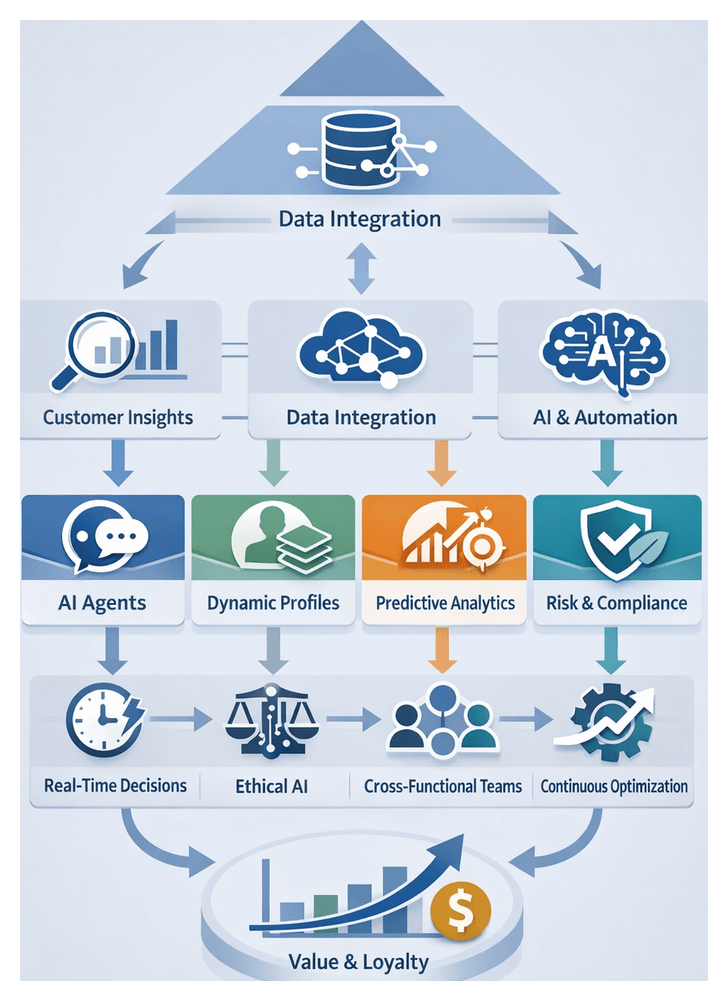
Context and Strategic Imperative
In an era of digitally empowered customers, traditional one-size-fits-all banking no longer suffices. Financial institutions must evolve from product-centric distributors into strategic advisors, anticipating unique life-stage needs and delivering tailored experiences in real time. This shift demands a profound transformation of people, processes and technology. Organizations that embrace AI-driven personalization reposition themselves to deepen customer loyalty, optimize lifetime value and unlock new revenue streams.
Successful personalization rests on continuous insight into individual goals, behavioral patterns and contextual signals. It requires investing in agile data architectures, fostering a culture of experimentation and embedding analytics across every customer touchpoint. As banks overcome legacy constraints and instill data-driven decision-making, they lay the groundwork for sustained competitive differentiation.
Foundational Pillars of Personalized Banking
AI Agents and Conversational Interfaces
Advanced AI agents leverage natural language understanding, pattern recognition and autonomous decision-making to streamline customer interactions and orchestrate complex workflows. In front-office scenarios, virtual assistants guide users through product selection, answer nuanced inquiries and facilitate transactions. Back-office, they monitor behavioral data, detect patterns and trigger proactive outreach. Conversational interfaces extend these capabilities across chat, voice and multimodal channels, delivering human-like dialogues that feel consultative rather than transactional.
Data Strategy and Governance
Data is the lifeblood of AI-driven personalization. Banks must converge structured and unstructured sources—transaction records, digital footprints, social signals and third-party feeds—into unified repositories. A robust governance framework establishes clear ownership, standardized definitions and transparent privacy policies, fostering regulatory compliance and customer trust. Real-time metadata management ensures AI agents access up-to-the-moment insights, enabling contextually relevant recommendations without crossing privacy boundaries.
Dynamic Customer Profiles
Enriched, continuously updated customer profiles power fine-grained segmentation and predictive scoring. By aggregating demographic, transactional, behavioral and attitudinal data, banks build evolving representations of individual needs and risk appetites. Streaming analytics enable AI agents to recognize shifts—such as sudden changes in spending or location—prompting tailored mortgage solutions or wealth-management advice at pivotal moments in the customer journey.
Predictive Analytics and Recommendation Engines
Machine learning models—from regression to deep learning—forecast customer intent and identify at-risk behaviors like credit card churn or refinancing opportunities. Recommendation engines leverage these insights to surface relevant products, financial plans or educational content at the optimal time. Governance controls embedded in these engines prevent bias and ensure ethical targeting, while feedback loops refine suggestions based on user interactions.
Risk Management, Compliance and Ethical Innovation
Personalization at scale must integrate rigorous risk controls and regulatory safeguards. Real-time anomaly detection models flag fraud, money-laundering or policy violations, while AI agents support know-your-customer processes and generate traceable audit trails. Model governance frameworks—covering performance validation, bias assessment and periodic retraining—ensure algorithms operate within defined risk appetites. Ethical oversight mechanisms, such as review boards and transparent disclosures, uphold fairness and reinforce customer trust.
Intelligent Automation and Operational Efficiency
Beyond customer engagement, intelligent automation transforms core processes like loan underwriting, payment reconciliation and dispute resolution. AI agents extract data from unstructured documents, orchestrate end-to-end workflows and route exceptions for human review. This accelerates turnaround times, reduces errors and frees experts to focus on high-value advisory tasks, creating a virtuous cycle of efficiency and personalization.
Measurement and Continuous Improvement
Quantifying the impact of personalization is essential for guiding strategy. Key performance indicators span customer metrics—satisfaction scores, retention rates, share-of-wallet—and operational measures like cycle times and cost-to-serve. Attribution models link AI agent interactions to business outcomes, revealing high-return interventions. Continuous feedback loops enable iterative refinement of algorithms, dialogue flows and segmentation rules, ensuring personalization efforts stay aligned with evolving customer expectations and market dynamics.
Patterns, Frameworks and Strategic Insights
Across leading banks and fintech innovators, four consistent patterns emerge:
- Data Fusion as a Cornerstone: Unified repositories integrate transaction histories, digital footprints and CRM records, underpinning reliable customer profiles and richer contextual inputs.
- Real-Time Decisioning: Streaming analytics platforms paired with predictive models enable proactive engagement exactly when customer intent signals arise.
- Cross-Functional Orchestration: Collaborative teams of product managers, data scientists, risk and compliance experts break down silos, ensuring AI-driven insights flow seamlessly into front-line delivery.
- Ethical and Transparent AI Practices: Embedding bias detection routines, explainability controls and human-in-the-loop governance builds trust and satisfies regulatory expectations.
Strategic implications for financial institutions include:
- Elevate Data Governance: Mature frameworks around quality, lineage and usage empower AI agents to deliver consistent personalization.
- Reconfigure for Agility: Cross-disciplinary pods or embedded analytics teams drive rapid experimentation and faster pivots based on performance insights.
- Balance Innovation with Risk Management: Phased rollouts, robust testing and ongoing audits mitigate model drift and regulatory exposure.
- Leverage Ecosystem Partnerships: Collaborating with fintechs, cloud providers and specialized vendors—such as IBM Watson, Salesforce Einstein and Google Cloud AI—accelerates access to advanced algorithms and domain expertise.
- Embed Continuous Learning: Feedback loops that capture customer responses and operational metrics drive iterative improvements and sustain ROI over time.
Interpretive frameworks guide strategic analysis:
- Value Chain Perspective: Mapping AI agent touchpoints from onboarding through cross-sell quantifies personalization’s impact on revenue and risk metrics.
- Customer Journey Lens: Journey analytics identify moments of truth where AI agents can deliver maximum value.
- Capability Maturity Model: Assessing readiness across data infrastructure, analytics proficiency, governance and culture shapes targeted investment roadmaps.
Industry Implications and Future Directions
AI-driven personalization is reshaping competitive dynamics. New entrants, armed with cloud-native architectures, launch targeted propositions rapidly, while incumbents forge alliances to acquire data science talent and advanced analytics capabilities. As banking converges with wealth management, insurance and payments, integrated digital ecosystems emerge. Open platform strategies expose curated APIs, inviting third-party developers to deliver specialized microservices and transforming banks into ecosystem integrators.
Regulators are shifting from ex post enforcement to ex ante validation, introducing frameworks like the European Union’s Artificial Intelligence Act. Institutions must embed governance by design, ensuring algorithmic accountability, impact assessments for bias and continuous monitoring. Ethical stewardship—anchored in transparent disclosures and bias mitigation—will define sustainable differentiation and reinforce customer trust.
Organizationally, banks are transitioning from centralized analytics hubs to distributed centers of excellence that embed AI specialists within product lines. Collaborative innovation labs and sandbox initiatives accelerate pilot testing, while clear governance structures oversee data sharing, privacy safeguards and compliance checkpoints.
Emerging technology trends promise to expand personalized banking’s scope:
- Explainable AI techniques that generate human-readable justifications for recommendations.
- Privacy-enhancing computation methods, including federated learning and homomorphic encryption, enabling collaborative model training without exposing raw data.
- Advances in natural language models and multimodal interfaces that support voice-activated advisory and immersive digital experiences.
Future application contexts include embedded finance within non-financial platforms, decentralized finance agents negotiating smart contracts on behalf of customers and identity-as-a-service solutions that streamline KYC and fraud prevention in real time.
Next Steps for Implementation
Moving from insight to action requires disciplined execution anchored in strategic intent. Leaders should begin by auditing current capabilities against a personalization maturity model to identify gaps and prioritize investments. Establishing a center of excellence or governance council provides cross-functional oversight to balance innovation speed with compliance rigor. Clear accountability for customer-centric metrics, backed by executive sponsorship, drives alignment across teams.
Recommended initial actions include:
- Scope high-impact pilot use cases aligned with strategic objectives and existing data assets.
- Engage fintech specialists and cloud providers—leveraging toolsets from IBM Watson, Salesforce Einstein and Google Cloud AI—to access advanced analytics and conversational AI capabilities.
- Embed governance checkpoints in the development lifecycle to address privacy, bias and security before deployment.
- Design measurement frameworks linking AI agent interactions to business outcomes and customer satisfaction indices.
- Iterate rapidly based on quantitative metrics and qualitative feedback, refining models, dialogues and personalization rules in each release.
Personalized banking is a continuous journey of capability building. By synthesizing core concepts, leveraging proven patterns and executing disciplined next steps, financial institutions can unlock the transformative potential of AI agents. Bold leadership, cross-disciplinary collaboration and unwavering focus on customer value will define the next generation of banking experiences and secure lasting competitive advantage.
Appendix
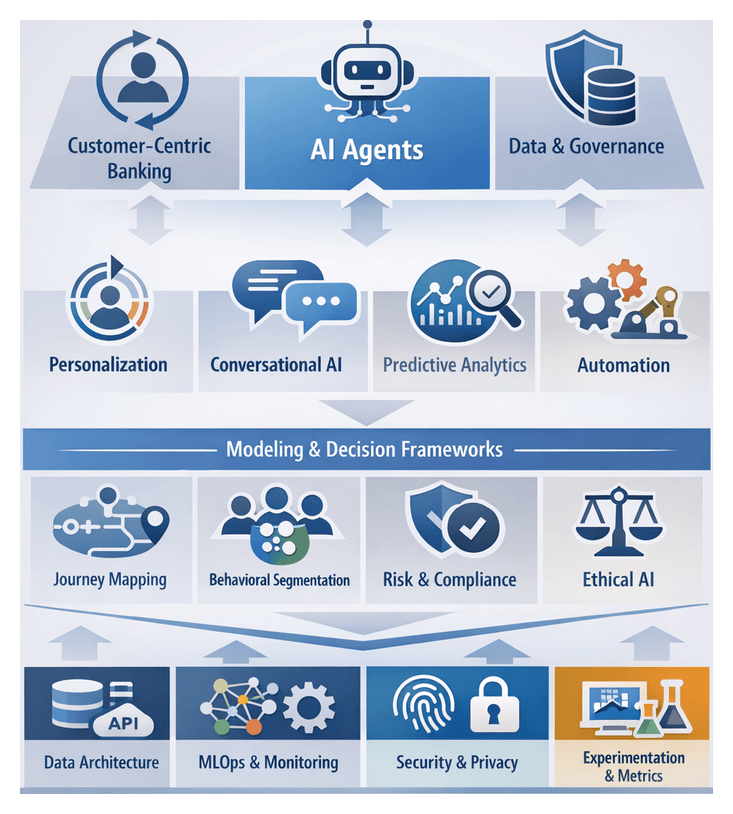
Key Definitions and Terminology
These definitions establish a shared language for customer-centric banking and AI-driven personalization, clarifying core concepts, data architectures, and governance frameworks.
- Customer-Centric Banking: An operating model organized around individual customer journeys, emphasizing personalized interactions, seamless service orchestration, and continuous engagement to anticipate needs and build trust.
- AI Agent: An autonomous or semi-autonomous software entity that processes data inputs, applies machine learning and decision frameworks, and executes actions on behalf of users—powering recommendations, conversational interfaces, and automated workflows.
- Personalization & Deep Individualization: Tailoring products, services, and communications to individual preferences and contexts. Deep individualization embeds real-time customer insights into every interaction, delivering bespoke offerings based on predictive models and life-event triggers.
- Conversational AI & Virtual Assistants: Technologies combining natural language understanding, dialogue management, and generation to facilitate human-like interactions via chatbots, voice assistants, and messaging platforms. Virtual assistants handle inquiries, recommendations, and transactions across channels, escalating complex requests to human agents.
- Predictive & Prescriptive Analytics: Predictive analytics use historical and real-time data to forecast outcomes (e.g., churn risk); prescriptive analytics recommend optimal actions (e.g., next-best offers) based on forecasts and business rules.
- Recommendation Engine: AI-driven systems that rank products or content using collaborative filtering, content-based filtering, and hybrid approaches to maximize relevance and conversion.
- Pattern Recognition: AI capability to identify trends, anomalies, and correlations in structured and unstructured data, supporting fraud detection, segmentation, and risk modeling.
- Autonomous Decision-Making: AI agents’ capacity to assess situations, evaluate risks, and initiate actions without direct human oversight, enabling automated credit approvals, dynamic pricing, and real-time alerts under governance controls.
- Robotic Process Automation (RPA): Software robots automating repetitive, rule-based tasks. When combined with AI agents, RPA extends automation to cognitive tasks like document processing and exception handling.
- Data Governance & Privacy: Policies, procedures, and controls ensuring responsible data management. Privacy-enhancing technologies such as differential privacy, secure multi-party computation, and federated learning protect data while preserving analytical utility.
- Data Architecture: Master Data Management (MDM) establishes authoritative data sources; Customer Data Platforms (CDP) consolidate real-time profiles; data lakes store raw data; data warehouses optimize reporting. APIs, microservices, and event-driven architectures enable integration and real-time personalization flows.
- MLOps & Model Governance: Practices integrating machine learning with IT operations for reproducible pipelines and continuous deployment. Explainable AI techniques (SHAP, LIME) and model risk management frameworks ensure transparency, validation, and regulatory compliance.
- Ethical AI & Regulatory Frameworks: Approaches embedding fairness, transparency, accountability, and privacy by design into AI lifecycles. Risk governance models such as Three Lines of Defense and regulatory sandboxes support experimentation under oversight.
Conceptual Frameworks for AI-Driven Personalization
These frameworks provide analytical lenses for designing, evaluating, and governing personalized banking initiatives.
- Technology Acceptance Model (TAM): Guides design of conversational interfaces by assessing perceived ease of use and usefulness to drive AI feature adoption.
- Customer Journey Mapping & Sense-Decide-Act Loop: Visualizes touchpoints and applies an OODA-inspired loop—observe behavior, orient via analytics, decide next-best action, and act through AI agents—to embed personalization at critical moments.
- Value Chain Analysis: Disaggregates activities to identify where AI agents can create competitive advantage in acquisition, underwriting, advisory, and risk management.
- Balanced Scorecard Adaptation: Aligns AI personalization metrics (conversion rates, agent-driven NPS, efficiency gains, data literacy) with financial, customer, process, and learning perspectives.
- Capability Maturity Models: Assess readiness across data infrastructure, analytics sophistication, and governance. Examples include CMMI for Analytics, Forrester’s AI Maturity Model, and Gartner’s AI Maturity Scale.
- Jobs-To-Be-Done (JTBD): Focuses on customers’ desired outcomes—functional, emotional, social—to shape AI agent recommendations that help achieve specific goals rather than generic product pitches.
- Recency, Frequency, Monetary (RFM) & Behavioral Segmentation: Combines RFM with unsupervised clustering (k-means, hierarchical) and behavioral data to define micro-segments for targeted personalization campaigns.
- Predictive Modeling & Uplift Analysis: Uses statistical and machine learning techniques to forecast outcomes and quantify incremental impact of AI-driven interventions by comparing treatment and control groups.
- Journey-Based Segmentation & Sequence Mining: Applies sequence mining and hidden Markov models to detect life-event sequences and trigger timely AI recommendations aligned with customers’ financial lifecycle.
- Data Management & Privacy Frameworks: DAMA DMBoK for data governance and quality; NIST Privacy Framework and ISO/IEC 27701 for privacy management; Privacy-by-Design principles ensure compliance and trust.
- Model Risk Management (MRM) & Three Lines of Defense: Establish governance over model design, validation, monitoring, and roles across operational teams, risk oversight, and internal audit.
- Usability & Experimentation: Heuristic evaluations for conversational design; A/B testing and multivariate experiments for live personalization strategy comparisons; attribution and incrementality models for revenue and impact measurement.
- Ethical AI Frameworks: IEEE, OECD, and industry guidelines for fairness, transparency, accountability, and human-centered design. Regulatory sandboxes support compliant experimentation and innovation.
Clarifications on AI Personalization Concepts
Addressing common questions and misconceptions ensures alignment on capabilities, requirements, and risk management.
AI Agents versus Traditional Automation
AI agents learn from data, adapt to new patterns, and operate autonomously, whereas rule-based automation follows static scripts.
- Learning Capability: Continuous training versus manual rule updates.
- Adaptability: Dynamic dialogue flows and pattern recognition versus fixed sequences.
- Decision Autonomy: Context-aware recommendations and escalations versus static decision trees.
Human Oversight and Trust
AI agents function best within human-in-the-loop frameworks that define escalation thresholds, expert validation for high-risk decisions, and continuous feedback loops to retrain models and build trust.
Data Usage, Consent, and Privacy
Personalization demands customer data, managed through privacy-by-design, explicit consent mechanisms, granular preference controls, and data minimization to comply with regulations like GDPR and CCPA.
Data Quality and Integration
Reliable personalization depends on unified data strategies featuring master data management, third-party enrichment, and hybrid streaming and batch pipelines to maintain accurate, up-to-date customer profiles.
Model Performance Metrics
Evaluations include technical measures—precision, recall, drift detection—and business impact metrics—lift, uplift, conversion rates, Net Promoter Score—to ensure AI agents remain effective and aligned with objectives.
Real-Time versus Batch Personalization
Batch personalization supports scheduled campaigns, while real-time personalization enables immediate interventions (fraud alerts, in-app recommendations). Hybrid approaches combine deep analysis with low-latency triggers.
Security, Privacy, and Ethical Risks
Layered defenses—encryption, tokenization, role-based access, adversarial testing—safeguard data and models. Bias audits, explainability protocols, and ethics committees embed guardrails to uphold fairness and accountability.
Integration with Legacy Systems
Phased strategies deploy AI agents at the edge, leverage microservices and middleware for decoupling, and validate through sandbox and pilot deployments to minimize disruption to core infrastructures.
Organizational Readiness and Change Management
Success requires cross-functional Centers of Excellence, agile methodologies for rapid prototyping, and talent development in data literacy, AI ethics, and design thinking to foster a customer-centric culture.
Measuring ROI and Sustaining Value
Combine short-term metrics (response rates, conversions, cost-to-serve) with long-term indicators (customer lifetime value, retention, advocacy). Leverage continuous experimentation and feedback loops to optimize personalization logic over time.
Preparing for Future Innovations
Adopt modular, open architectures and engage in regulatory sandboxes to incorporate emerging technologies—decentralized identity, federated learning, embedded finance, and DeFi—and stay ahead of evolving customer expectations.
AI-Driven Tools and Platforms
The following listing organizes the AI products and platforms referenced, enabling practitioners to evaluate solutions aligned with strategic goals and compliance requirements.
Conversational AI Platforms
- Google Dialogflow – Natural language understanding for building chatbots and voice interfaces.
- IBM Watson Assistant – Intent classification and dialogue management for virtual agents.
- Amazon Lex – Speech recognition and intent detection for voice and text interactions.
Machine Learning and Pattern Recognition
- H2O.ai – Automated model building for supervised and unsupervised learning.
- DataRobot – Enterprise AI platform for feature engineering, algorithm selection, and model tuning.
Decision Automation and Orchestration
- FICO Decision Management Suite – Business rules and predictive analytics for credit scoring and personalized offers.
- FICO Falcon Fraud Manager – Real-time fraud detection using neural networks and cognitive analytics.
Robotic Process Automation and Intelligent Automation
- UiPath – RPA platform enhanced with AI for automating back-office tasks.
- Automation Anywhere – Cognitive RPA combining automation with AI analytics.
- Blue Prism – Scalable digital workforce integrating AI services for complex processes.
Data Governance and Privacy Tools
- OneTrust – Privacy management for consent, data subject requests, and regulatory reporting.
- Privacera – Fine-grained access controls and compliance across data platforms.
- Google Cloud Data Loss Prevention – Sensitive data discovery, classification, and redaction.
- Microsoft Azure Purview – Unified data governance with discovery, lineage, and classification.
Fraud Detection and Compliance Platforms
- SAS Fraud Management – Real-time fraud detection with network analytics and machine learning.
- NICE Actimize – Financial crime, risk, and compliance platform for transaction monitoring.
- IBM Safer Payments – Adaptive analytics for global payment fraud prevention.
- Palantir – Graph analytics for anti-money laundering and risk intelligence.
- ThetaRay – Unsupervised anomaly detection in financial transactions.
Customer Data Platforms and Enrichment
- Salesforce Einstein – Predictive scoring and recommendations within Salesforce.
Cloud Platforms and Streaming Analytics
- Apache Kafka – Distributed event streaming for real-time data pipelines.
- AWS Kinesis – Managed streaming data service for collection and analysis.
- Azure Stream Analytics – Real-time analytics on high-volume streams.
- Confluent – Enterprise distribution of Apache Kafka with governance tools.
Predictive Analytics and Recommendation Engines
- Google Cloud AI Platform – Managed services for training and deploying ML models.
- Amazon Personalize – Personalized recommendations using collaborative filtering and deep learning.
- IBM Watson Studio – Environment for building, deploying, and governing AI models.
Business Intelligence and Reporting Tools
- Microsoft Power BI – Interactive dashboards and reporting with real-time data support.
- Tableau – Visual analytics for insights from AI agent performance and customer data.
- Looker – Consistent metric definitions and embedded analytics for personalized applications.
Identity, Authentication, and Consent Management
- Auth0 – Secure authentication and authorization services with single sign-on and MFA.
- Okta – Cloud identity service offering user management and adaptive MFA.
- ForgeRock – Identity and access management with consent orchestration.
Ethical AI and Responsible Innovation Frameworks
- OECD AI Principles – Guidelines for inclusive, transparent, and accountable AI.
- ISO/IEC TR 24028 – Principles for trustworthiness, robustness, and explainability of AI.
- IEEE Ethically Aligned Design – Guidelines for responsible autonomous system development.
Additional Industry Frameworks
- Balanced Scorecard – Strategic planning and performance measurement tool.
- CMMI for Analytics – Process improvement for data and analytics maturity.
- Forrester’s AI Maturity Model – Benchmarking tool for AI capabilities.
- Gartner’s Customer-Obsessed Operating Model – Framework for aligning operations around customer outcomes.
The AugVation family of websites helps entrepreneurs, professionals, and teams apply AI in practical, real-world ways—through curated tools, proven workflows, and implementation-focused education. Explore the ecosystem below to find the right platform for your goals.
Ecosystem Directory
AugVation — The central hub for AI-enhanced digital products, guides, templates, and implementation toolkits.
Resource Link AI — A curated directory of AI tools, solution workflows, reviews, and practical learning resources.
Agent Link AI — AI agents and intelligent automation: orchestrated workflows, agent frameworks, and operational efficiency systems.
Business Link AI — AI for business strategy and operations: frameworks, use cases, and adoption guidance for leaders.
Content Link AI — AI-powered content creation and SEO: writing, publishing, multimedia, and scalable distribution workflows.
Design Link AI — AI for design and branding: creative tools, visual workflows, UX/UI acceleration, and design automation.
Developer Link AI — AI for builders: dev tools, APIs, frameworks, deployment strategies, and integration best practices.
Marketing Link AI — AI-driven marketing: automation, personalization, analytics, ad optimization, and performance growth.
Productivity Link AI — AI productivity systems: task efficiency, collaboration, knowledge workflows, and smarter daily execution.
Sales Link AI — AI for sales: lead generation, sales intelligence, conversation insights, CRM enhancement, and revenue optimization.
Want the fastest path? Start at AugVation to access the latest resources, then explore the rest of the ecosystem from there.