

Optimizing Workplace Productivity Insights and Strategies for AI Agent Implementation
To download this as a free PDF eBook and explore many others, please visit the AugVation webstore:
Introduction
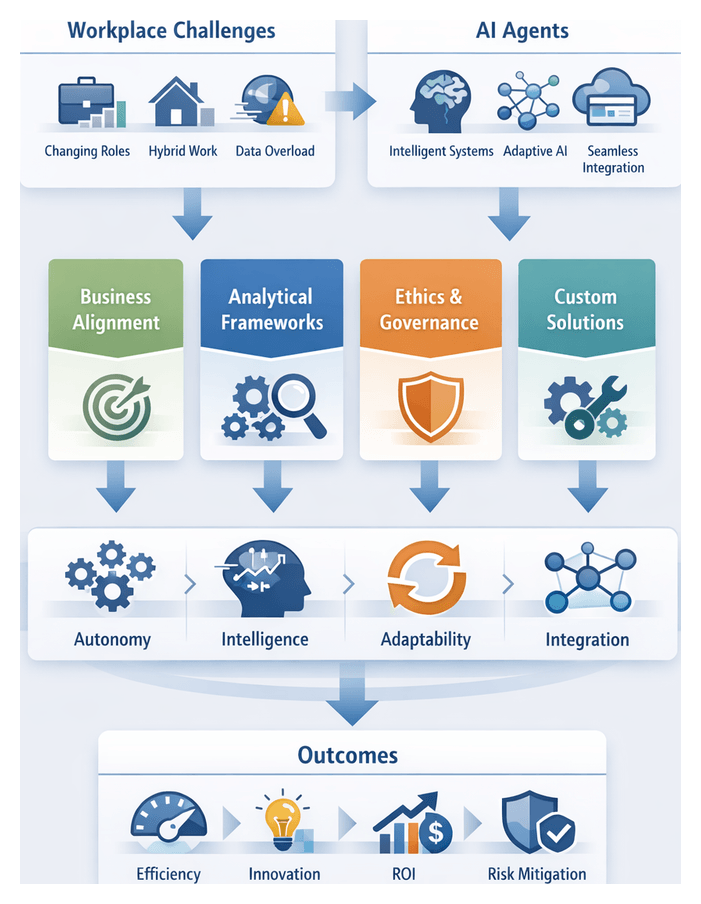
Evolving Productivity Challenges in the Modern Workplace
Shift in Employee Roles and Expectations
Over the past decade, the definition of productivity has transcended traditional metrics of hours worked or basic output. Knowledge workers are now expected to master domain-specific expertise alongside digital literacy, cross-functional collaboration and adaptive problem-solving. As business processes integrate data analytics, customer engagement platforms and automated workflows, employees must balance creative tasks with transactional responsibilities. This heightened complexity blurs the lines between operational duties and strategic decision-making, requiring individuals to dynamically reallocate focus between routine administration and high-value innovation. Concurrently, talent shortages and evolving workforce preferences have intensified expectations around autonomy, continuous development and meaningful work, prompting organizations to redesign workflows that support both business objectives and employee well-being.
Hybrid and Distributed Work Dynamics
The rise of hybrid and remote work has reshaped communication norms and availability expectations. Synchronous meetings now coexist with asynchronous messaging in platforms like Slack and Microsoft Teams, offering flexibility but introducing coordination challenges. Time zone differences and cultural nuances complicate information flow, often resulting in duplicated efforts and delayed decisions. Without clear protocols and shared repositories, teams struggle to maintain alignment and preserve institutional knowledge. Organizations must therefore invest in documented processes, transparent project management and collaboration tools that support both real-time and self-directed work.
Data Overload and Cognitive Strain
Employees now contend with an unprecedented proliferation of digital information. Email threads, chat channels, project dashboards and document libraries generate constant notifications that fracture attention. Studies indicate that knowledge workers may lose up to twenty minutes after an interruption before regaining full focus on complex tasks, extending completion times and increasing error risk. Routine activities—such as data entry, information retrieval and scheduling—consume significant mental bandwidth, leaving little capacity for strategic thinking. Recognizing cognitive load as a critical inhibitor of productivity underscores the need for solutions that reduce fragmentation and enable deeper concentration.
Persistent Operational Bottlenecks
Despite investments in enterprise systems, many organizations still face entrenched sources of friction:
- Information silos that hinder cross-departmental visibility
- High volumes of repetitive administrative tasks such as scheduling and data formatting
- Email overload leading to delayed critical communication and decision-making
- Scheduling conflicts across disparate calendar systems
- Manual data entry and reconciliation with high error rates
- Lengthy approval cycles due to lack of automated routing and validation
These bottlenecks not only slow operations but also erode employee engagement and heighten burnout risk. Organizations that fail to address these low-value tasks demand significant effort to reallocate resources toward higher-order activities, prolonging product development timelines and impeding customer satisfaction.
The Growing Performance Gap
While tools such as ERP systems, collaboration suites and analytics platforms promise streamlined processes, integration challenges and inconsistent usage often limit their impact. Employees revert to workarounds—spreadsheets, personal trackers or ad hoc communication channels—that bypass standardized workflows and obscure data insights. This misalignment between technology investment and actual productivity outcomes reflects a deeper issue: static solutions lack the contextual awareness and adaptability required to manage end-to-end workflow complexity.
Emergence of AI Agents as Cognitive Collaborators
From Static Automation to Dynamic Intelligence
AI agents represent a paradigm shift from rule-based scripts to autonomous systems capable of interpreting natural language, learning from context and adapting over time. Unlike traditional automation, which executes predefined tasks, AI agents employ machine learning and natural language processing to understand user intent and surface relevant information proactively. Use cases range from intelligent scheduling assistants and email triage to strategic decision-support systems that analyze data trends and recommend next steps. By offloading routine work—such as meeting coordination and document drafting—AI agents reduce cognitive burden and free employees to focus on activities that drive innovation.
Technological Maturity and Scalability
Recent advances in large language models and real-time reasoning have propelled AI agents into production-ready offerings. Solutions like ChatGPT, Google Gemini and Microsoft 365 Copilot integrate seamlessly with enterprise applications, offering robust APIs and scalable deployments via cloud and edge infrastructure. Key trends include:
- Model Performance Ceiling – Human-level accuracy on language, image and code benchmarks narrows the gap between manual and automated tasks.
- API-Driven Integration – Frameworks from vendors like AWS AI services enable rapid embedding of agent capabilities into existing workflows.
- Distributed Infrastructure – Elastic compute and edge deployments ensure low-latency, mission-critical performance.
This confluence of technological readiness and vendor support reduces adoption risk and accelerates time to value, marking a transition from isolated pilots to enterprise-scale deployments.
Conceptual and Analytical Frameworks for AI Agent Adoption
To guide strategic investment and governance, organizations employ a suite of analytical lenses:
- Technological Maturity Models – Benchmark agent autonomy, learning proficiency and integration depth, drawing on the Gartner Hype Cycle and Capability Maturity Model Integration.
- Socio-Technical Systems Theory – Examine the interplay between people, processes and technology to optimize adoption and align with organizational culture.
- Value Chain Analysis – Identify high-impact deployment areas across procurement, customer service and product development for competitive differentiation.
- Dynamic Capabilities Framework – Assess how agents enable sensing, seizing and transforming business processes in response to market shifts.
- Ethical and Governance Models – Embed transparency, fairness and accountability through bias audits, data minimization and audit trails.
Enterprises translate these frameworks into actionable assessments by evaluating agents across four key dimensions:
- Autonomy – Percentage of tasks executed end-to-end without human intervention.
- Intelligence – Accuracy of language understanding and predictive analytics, as evidenced by IBM Watson Assistant and Google Dialogflow.
- Adaptability – Speed and effectiveness of model refinement through successive retraining cycles.
- Integration – Seamlessness of connection with CRMs, ERPs and collaboration platforms like Salesforce Einstein.
Weighted scoring matrices enable prioritization of use cases based on strategic objectives—for example, emphasizing integration and intelligence for customer support, or autonomy and adaptability for internal knowledge management.
Overlaying maturity models with ethical and socio-technical considerations helps balance feasibility with user acceptance, guiding investments that adhere to compliance requirements and organizational culture.
Design Principles and Governance Considerations
Embedding AI agents effectively demands a holistic approach combining design thinking, agile practices and robust governance:
- Role Definition – Clarify whether agents function as assistants, collaborators or autonomous operators to shape user interfaces and policy frameworks.
- Trust and Transparency – Incorporate confidence scores, decision trace logs and explainability dashboards to build user trust.
- Human-Agent Collaboration Models – Establish “man-in-the-loop” and “human-on-the-loop” protocols for oversight and feedback.
- Agile Development – Use iterative sprints, rapid prototyping and cross-functional workshops to ensure agents address real pain points.
- Change Management – Deploy training programs, documentation and communication plans to foster cultural readiness and skill development.
- Bias Mitigation and Privacy – Apply diverse sampling, differential privacy and federated learning techniques to prevent discriminatory outputs and maintain compliance.
- Auditability and Accountability – Design traceable workflows and assign oversight roles—such as ethics committees or AI stewardship councils—to monitor agent behavior and governance adherence.
Strategic Imperatives and Competitive Dynamics
As AI agents move from pilot to mainstream, competitive dynamics intensify. Organizations augmenting human teams with agent-driven insights can accelerate decision cycles, optimize costs and elevate customer experiences via responsive chatbots and personalized interfaces. According to Porter’s Five Forces, intelligent agents heighten rivalry and raise barriers for late adopters. Research from McKinsey indicates enterprises implementing AI at scale report 20–30 percent improvements in key performance indicators, setting new benchmarks for operational excellence.
Workforces now expect seamless, intelligent assistants embedded in tools such as Google Bard and mobile scheduling apps. Technology Acceptance Model research confirms that perceived usefulness and ease of use drive rapid adoption and lower burnout rates. Organizations that delay risk strategic disintermediation, talent drain and fragmented point solutions that undermine long-term agility.
Roadmap Overview and Core Strategic Themes
This guide presents a structured path for evaluating, integrating and scaling AI agents, centered on four interdependent themes:
- Alignment with Business Objectives – Map agent capabilities to clear goals using scorecards and value-at-stake analyses to focus on high-impact scenarios.
- Analytical Rigor – Employ performance and trust metrics—throughput, error rates, explainability scores—and ROI calculators incorporating costs for services like AWS AI services, subscription fees for Microsoft 365 Copilot and licensing for Google Bard.
- Domain-Specific Customization – Integrate industry ontologies, proprietary data and bespoke models to address unique workflows across marketing, finance and operations.
- Ethical Stewardship and Governance – Implement bias detection, privacy-preserving architectures and audit frameworks that align with GDPR, CCPA and sector regulations.
Subsequent chapters explore practical applications—from administrative automation with ChatGPT plugins and scheduling via Asana and Trello to collaboration enhancements in Zoom and strategic decision support with IBM Watson. Architectural patterns for ERP, CRM and data warehouse integration, measurement frameworks for ROI and domain-specific customization techniques round out the roadmap.
Key considerations—including data quality, integration complexity and cultural readiness—will be examined in depth to temper expectations with practical risk assessments and ensure sustainable success.
Expected Outcomes and Next Steps
By internalizing the insights, frameworks and case studies presented, readers will develop the capability to:
- Define Targeted AI Agent Strategies – Prioritize use cases using strategic alignment and the Capability Value Matrix.
- Quantify Performance Gains and ROI – Track metrics such as throughput, error reduction and labor cost savings to validate impact.
- Customize Agents for Domain Impact – Leverage industry ontologies and custom data pipelines for deeper integration and higher adoption.
- Govern and Scale Responsibly – Implement ethical oversight, bias mitigation and compliance protocols as agents assume greater autonomy.
- Anticipate Future Trends – Incorporate emerging capabilities—multimodal interfaces, autonomous learning loops and federated architectures—into long-term roadmaps.
A blended approach of executive strategy sessions, technical deep dives, functional workshops and ethics forums will help cross-functional teams translate this guide into actionable pilot initiatives. Regular review cadences, continuous learning programs and governance checkpoints will ensure AI agent deployments deliver sustainable competitive advantage and foster an innovation culture.
Chapter 1: Foundations of AI Agents in the Workplace
Historical Evolution and Business Definition of AI Agents
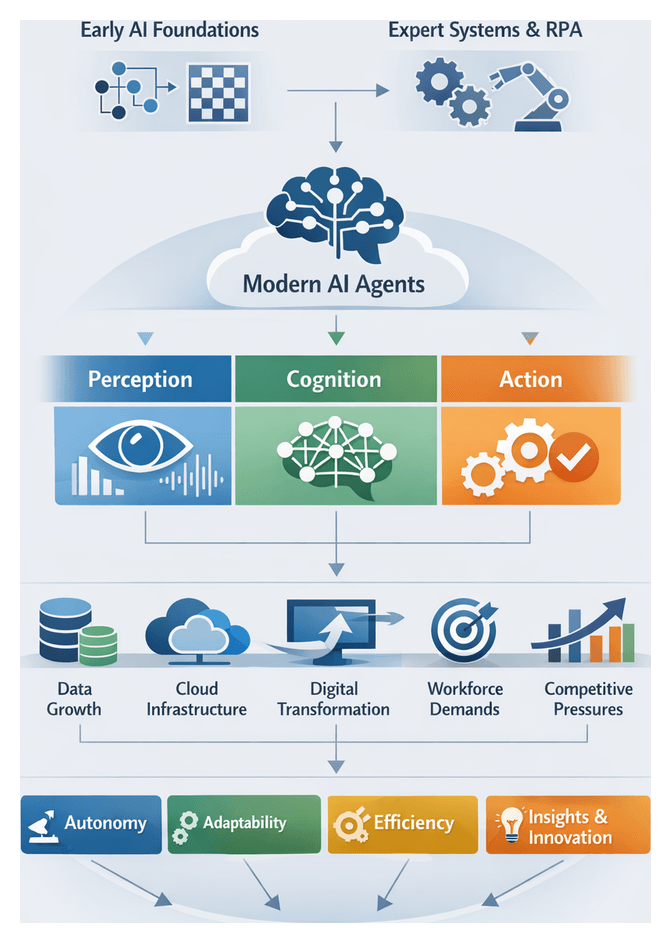
The idea of software entities capable of autonomous reasoning dates back to early computing pioneers such as Alan Turing and John McCarthy, who laid the groundwork for rule-based systems in the 1950s and 1960s. Initial applications focused on constrained problem-solving tasks, exemplified by chess programs and theorem provers. The 1970s and 1980s saw the rise of expert systems—if-then rule engines applied to medical diagnosis and engineering design—though they required extensive knowledge engineering and could not learn from new data.
With the advent of Robotic Process Automation (RPA) in the early 2000s, software bots began automating repetitive back-office tasks by mimicking user interactions, streamlining data entry and invoice processing. In the 2010s, advances in machine learning and natural language processing gave rise to intelligent virtual assistants such as Siri and Alexa, introducing flexible conversational interfaces and probabilistic reasoning.
Today’s AI agents combine deep learning, large language models, cloud computing, and real-time analytics to perceive inputs, reason over information, and take actions toward predefined objectives. In business contexts, an AI agent exhibits:
- Autonomy: Operating with minimal human intervention to initiate tasks and make decisions.
- Adaptability: Learning from data and interactions to refine behavior over time.
- Context Awareness: Interpreting unstructured inputs—natural language or visual data—and adjusting responses to situational nuances.
At their core, AI agents encompass three functional layers: perception (ingesting and interpreting text, speech, or sensor data), cognition (applying machine learning models or business rules to derive insights and plan next steps), and action (executing tasks such as database updates, message dispatch, or workflow triggers).
Core Pillars and Drivers of AI Agent Adoption
AI agent capabilities can be organized into three interconnected pillars:
- Data Perception: Ingesting and normalizing inputs from diverse sources, including emails, documents, APIs, and live data streams.
- Reasoning and Decision Making: Applying analytics, predictive models, and business rules to identify opportunities, risks, or next best actions.
- Task Execution: Interfacing with users, third-party systems, or downstream processes to complete activities and close feedback loops.
Several forces drive enterprise adoption:
- Digital Transformation Imperative: Organizations digitize processes to stay competitive, investing in intelligent automation.
- Data Proliferation: Exponential growth of structured and unstructured data creates demand for AI-driven analysis and decision support.
- Cloud-Native Architectures: Scalable infrastructure lowers barriers to deploying sophisticated AI models at enterprise scale.
- Workforce Expectations: Employees expect seamless digital experiences and self-service tools that enhance productivity.
- Competitive Dynamics: Early AI agent adopters gain efficiency advantages, raising industry benchmarks for productivity.
Strategically, AI agents extend automation into domains requiring judgment, adaptability, and learning, delivering:
- Operational Agility: Reconfiguring workflows in response to market shifts or internal changes.
- Scalability: Replicating trained agents across teams and geographies without proportional headcount increases.
- Innovation Acceleration: Offloading cognitive tasks to agents so human teams focus on creative and strategic work.
- Enhanced Decision Quality: Leveraging data-driven insights to minimize errors in manual parsing.
Industry Perspectives and Capability Frameworks
Analysts categorize AI agents along a continuum from rule-based RPA to cognitive automation with natural language understanding and adaptive learning. Three archetypes emerge:
- Transactional Bots: Automate repetitive data tasks with high reliability and low complexity.
- Conversational Assistants: Engage employees or customers via chat or voice, balancing automated resolution with seamless human hand-off.
- Advisory Agents: Generate strategic insights by analyzing structured and unstructured data, surfacing trends and anomalies.
Industry frameworks for evaluating agent capabilities include:
- Maturity Model Analysis: Stages from basic task automation to fully autonomous, context-aware agents.
- Capability Matrices: Mapping functions like natural language processing, computer vision, and predictive analytics to use cases.
- Value-Risk Assessment: Balancing quantitative ROI projections with qualitative risks—data sensitivity, compliance exposures, and change management.
- Open Architecture Index: Measuring interoperability with enterprise systems, data warehouses, and analytics platforms.
- Human-AI Collaboration Scorecards: Assessing interaction effectiveness, user satisfaction, and hand-off processes.
Key interpretive dimensions span:
- Autonomy and Decision-Making: Calibrating agent authority to risk tolerance and governance mechanisms.
- Learning and Adaptation: Refining models through supervised and reinforcement learning, with feedback loops incorporating user corrections and outcome metrics.
- Integration and Interoperability: Evaluating API readiness, data schema alignment, event-driven flows, and performance benchmarks.
- Explainability and Trust: Exposing decision logic, confidence scores, and audit trails to foster credibility and compliance.
Roles and Domain Applications
AI agents fulfill distinct strategic roles that span operational, tactical, and strategic domains:
- Process Orchestrators: Trigger subprocesses, monitor status, and escalate exceptions to reduce cycle times and costs.
- Engagement Assistants: Interface through chat, voice, or email, scaling support operations and improving satisfaction scores.
- Insight Generators: Analyze data to surface recommendations, measured by prediction accuracy and business impact.
- Compliance Monitors: Continuously review transactions and communications for policy adherence, tracking violation detection and remediation times.
- Knowledge Curators: Index organizational content to provide context-aware answers, gauged by relevance and user engagement.
Administrative Workflows
Automating email triage, scheduling, and document processing reallocates human cognitive resources to higher-value work. AI agents analyze message content, sender reputation, and calendar cues to prioritize emails, auto-draft replies, and suggest meeting slots using solutions such as Microsoft Power Automate. Document-processing agents equipped with OCR and semantic extraction ingest invoices, contracts, and purchase orders. Platforms such as UiPath classify, validate, and route documents, shifting focus from data entry to exception management.
Customer-Facing Operations
In support centers, AI agents triage tickets by topic and urgency, assign them to queues, and predict escalation risk using historical resolution and sentiment analysis. Conversational agents such as IBM Watson Assistant and Amazon Lex provide 24/7 engagement, balancing containment and hand-off metrics, and integrating with CRM systems, knowledge bases, and live chat.
Supply Chain and Logistics
Agents monitor inventory across warehouses, apply predictive analytics to forecast stockouts and surpluses, and trigger replenishment orders via platforms like Blue Yonder Luminate Platform. In the order-to-cash cycle, agents orchestrate billing, shipping, and exception handling, linking order management systems with logistics providers to optimize carrier selection and accelerate cash conversion.
Human Resources and Employee Services
Conversational agents guide new hires through orientation, training modules, and policy acknowledgments, escalating queries to HR partners when needed. Analytics on engagement, time-to-productivity, and satisfaction correlate agent-facilitated onboarding with faster integration and reduced attrition.
IT and Technical Operations
AIOps agents ingest telemetry, detect anomalies, correlate events, and suppress noise using solutions like Moogsoft and Splunk IT Service Intelligence. Coupled with runbook automation, they reduce mean time to detect and respond, shifting from reactive firefighting to proactive system management.
Marketing and Sales Enablement
Agents analyze engagement data to assign lead scores and refine models based on closed-won and closed-lost outcomes through platforms such as Salesforce Einstein. They also generate draft content, optimize channel selection, and adjust timing using multi-touch attribution and marketing mix modeling frameworks, ensuring campaign performance aligns with objectives.
Strategic Foundations for Deployment
Strategic Alignment and Goal Definition
- Articulate business outcomes in quantitative terms—reductions in overhead or cycle times.
- Map agent capabilities to specific process bottlenecks or value levers.
- Establish executive sponsorship and cross-functional governance to align technical teams and business units.
Organizational Readiness and Cultural Considerations
- Leadership commitment and change management capacity.
- Data literacy and technical skills within the workforce.
- Process maturity and standardization.
- Openness to experimentation and iterative learning.
Data Infrastructure and Quality Imperatives
- Real-time data pipelines and cleansing protocols to minimize bias and errors.
- Metadata management for discoverability and lineage tracking.
- Scalable storage and compute architectures for high-volume processing.
Governance, Risk Management, and Ethical Safeguards
- Defined roles for model stewardship spanning data scientists, compliance officers, and business owners.
- Risk assessments for algorithmic bias, privacy breaches, and operational failures.
- Audit trails and documentation standards for input, output, and decision rationale traceability.
- Ethics review panels to validate use cases against corporate values and regulations.
Integration Complexity and Technical Constraints
- API gateways and microservices to encapsulate agent functions.
- Event-driven data flows and message buses for real-time coordination.
- Containerization and orchestration platforms for deployment, scaling, and rollback.
- Security architectures with encryption, authentication, and role-based access control.
Measurement, Evaluation, and Continuous Refinement
- Define KPIs aligned to goals—time saved, accuracy, and user satisfaction.
- Deploy monitoring dashboards for trends, anomalies, and utilization metrics.
- Implement feedback mechanisms for error reporting and improvement suggestions.
- Conduct periodic governance reviews to update models and incorporate new data.
Limitations and Strategic Cautions
- Potential algorithmic bias from incomplete training data.
- Performance degradation in novel scenarios beyond training scope.
- Integration challenges with legacy or poorly documented systems.
- Regulatory uncertainties affecting agent autonomy.
- Workforce tensions without proactive reskilling and role redesign.
By internalizing these strategic, organizational, technical, and governance considerations, enterprises can navigate AI agent deployment with confidence, unlocking sustainable productivity gains and competitive advantage.
Chapter 2: Automating Administrative Tasks for Efficiency
Defining Administrative Automation and Its Impact
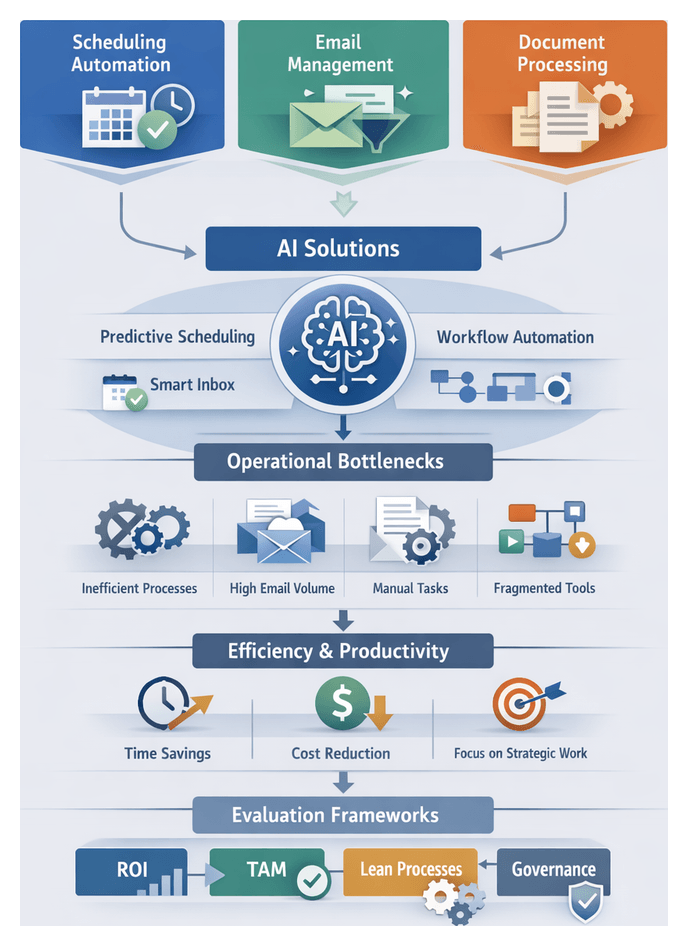
Administrative tasks underpin day-to-day operations, from coordinating complex schedules and managing high volumes of email to processing critical documents. These routine activities can consume up to 30 percent of employee time, diverting focus from strategic initiatives. Traditional workflows rely heavily on manual effort—checking calendars, drafting standard responses and routing documents—creating a burden on staff and driving labor costs upward.
Administrative automation applies intelligent software agents, robotic process automation and natural language processing to streamline or eliminate repetitive tasks. By integrating artificial intelligence and machine learning, organizations reduce time spent on low-value activities and reallocate resources toward strategic, creative and customer-facing work. AI-driven agents deliver predictive scheduling, smart email management and automated document handling, enabling enterprises to scale support functions without proportional headcount increases and to maintain service levels during periods of growth or sudden demand spikes.
Operational Challenges and Bottlenecks
Outdated processes and fragmented technologies create common productivity drains:
- Inefficient scheduling coordination, leading to back-and-forth email threads and missed meetings
- High email volume, resulting in delayed responses and information overload
- Manual document routing and approval cycles, causing process delays and versioning errors
- Disparate tools for travel bookings, expense reports and invoice processing
- Repetitive data entry across multiple systems, increasing the risk of human error
These bottlenecks slow operations, frustrate staff and undermine customer satisfaction. Without real-time visibility into pending tasks and approvals, managers respond reactively rather than planning proactively, eroding competitive advantage in fast-paced industries.
AI-Powered Administrative Solutions
Scheduling Simplification
Coordinating meetings is time-consuming. Intelligent scheduling agents automate core steps:
- Analyze participants’ calendars to identify optimal meeting times
- Generate and send invitations automatically
- Manage rescheduling requests and update all stakeholders
- Integrate with video-conferencing platforms and room booking systems
Tools such as Calendly leverage machine learning to predict availability patterns, reduce negotiation overhead and ensure higher attendance rates through automated reminders and agenda distribution.
Email Management Optimization
AI-enabled email agents enhance inbox efficiency by:
- Filtering and categorizing incoming messages by priority and topic
- Suggesting or auto-generating draft responses using natural language generation
- Scheduling follow-up reminders and tracking unanswered items
- Performing sentiment analysis to flag urgent or sensitive communications
Solutions such as Superhuman, Boomerang and built-in features in Microsoft Outlook and Gmail’s Priority Inbox help users process email strategically, reducing clutter and ensuring critical messages receive timely attention.
Document Handling and Workflow Automation
AI agents transform document processing by:
- Automatically extracting key information from scanned or digital documents
- Classifying and tagging items based on content and metadata
- Routing documents through predefined approval paths with status tracking
- Ensuring compliance with version control and audit requirements
Platforms such as UiPath, Automation Anywhere and Blue Prism integrate optical character recognition and AI-driven classifiers to digitize workflows. Legal teams also leverage agents integrated with DocuSign for automated signature routing and audit trails, freeing counsel to focus on high-value negotiation.
Frameworks and Metrics for Evaluating AI Agents
Analytical Frameworks
To assess AI agent performance, organizations draw on multiple models:
- Technology Acceptance Model (TAM) evaluates perceived usefulness and ease of use, linking factors to adoption rates.
- Return on Investment (ROI) Analysis quantifies cost savings from time reclaimed versus implementation expenses.
- Lean Process Improvement identifies waste and cycle-time reduction opportunities in administrative workflows.
- Employee Experience Frameworks measure impacts on satisfaction, stress levels and work-life balance.
- Governance and Compliance Models ensure data privacy, audit trails and algorithmic transparency.
Key Metrics for Scheduling Agents
- Time-to-Schedule – Average elapsed time from request to calendar confirmation.
- Meeting Fill Rate – Percentage of proposed slots accepted by all participants.
- Reschedule Frequency – Average number of rescheduling events per meeting.
- Participant Satisfaction – Survey scores on ease and responsiveness.
- Calendar Utilization – Percentage of working hours occupied by meetings.
- Administrative Overhead Reduction – FTE hours saved from scheduling tasks.
Vendors like Calendly and x.ai publish benchmarks to guide performance targets and track improvements over time.
Key Metrics for Email Agents
- Processing Throughput – Emails processed per hour, including classification and response generation.
- Classification Accuracy – Percentage of messages correctly categorized by priority or topic.
- Response Quality Score – Evaluations of coherence, relevance and tone of automated replies.
- Inbox Zero Achievement Rate – Percentage of users maintaining an empty inbox at day’s end.
- Engagement and Trust Levels – User surveys on confidence in agent-generated content.
- Risk and Escalation Metrics – Frequency of false positives and negatives in urgent communications.
Solutions such as Superhuman and enterprise features in Outlook and Gmail provide analytics dashboards for continuous model refinement.
Document Automation Metrics
- Cycle Time Reduction – Percentage decrease in document approval times.
- Extraction Accuracy – Rate of correctly captured data fields.
- Exception Rate – Frequency of manual interventions required.
- Compliance Incidents – Number of audit findings or versioning errors.
- Cost Savings – Reduction in headcount and error-related expenses.
Strategic Themes and Implementation Considerations
Successful automation aligns with high-value business priorities and employs a phased, modular approach. Pilot deployments in defined contexts build stakeholder confidence and reduce risk before broader roll-outs. Scalability and interoperability ensure that agents integrate into a cohesive ecosystem rather than functioning as isolated point solutions.
Key considerations include:
- Process Mapping – Document existing workflows and identify rule-based tasks for automation.
- Technology Integration – Ensure seamless connectivity between calendars, email clients and document repositories.
- Data Governance – Establish policies for secure access, privacy compliance and auditability.
- Performance Measurement – Define metrics for time saved, error reduction and user satisfaction.
- Vendor Strategy – Balance proprietary platforms against open-ecosystem tools for flexibility and cost control.
Change Management and Organizational Readiness
End-user trust and skills are critical. Integrated training programs should combine technical onboarding with clear communication about productivity gains. Explainability features in agent interfaces allow users to review decision rationales and override actions. Feedback loops and governance councils ensure performance metrics remain tied to business outcomes and employee satisfaction.
Governance, Compliance and Vendor Ecosystems
Robust governance models embed compliance checkpoints within agent logic, enforce data retention and audit requirements, and monitor algorithmic bias. Procurement teams use multi-criteria decision analysis to compare vendors on features, security, support and total cost of ownership. Automation champions in each department serve as liaisons, identify friction points and drive grassroots adoption.
Future Outlook and Adaptive Strategies
Administrative AI agents will evolve toward hyperautomation, combining robotic process automation with large-language models and computer vision. This convergence will enable interpretation of unstructured data—such as PDF attachments and scanned forms—and execution of complex multi-step transactions. Organizations preparing for this shift adopt modular architectures and plugin frameworks, decoupling agent logic from core applications to allow rapid upgrades of underlying AI models.
Continuous improvement cycles, rigorous A/B testing and cross-functional steering committees will review performance dashboards, surface emerging risks and align roadmaps with corporate objectives. Explainable AI and privacy-enhancing technologies such as differential privacy and federated learning will reduce data exposure while maintaining model fidelity. Training programs will evolve from static tool instruction to dynamic skill development, teaching employees to calibrate, audit and interpret agent outputs. In this future state, administrative AI agents serve not only as efficiency levers but as catalysts for a more adaptable, data-driven workplace ethos.
Chapter 3: Enhancing Time Management with Personal AI Assistants
The Evolving Productivity Landscape
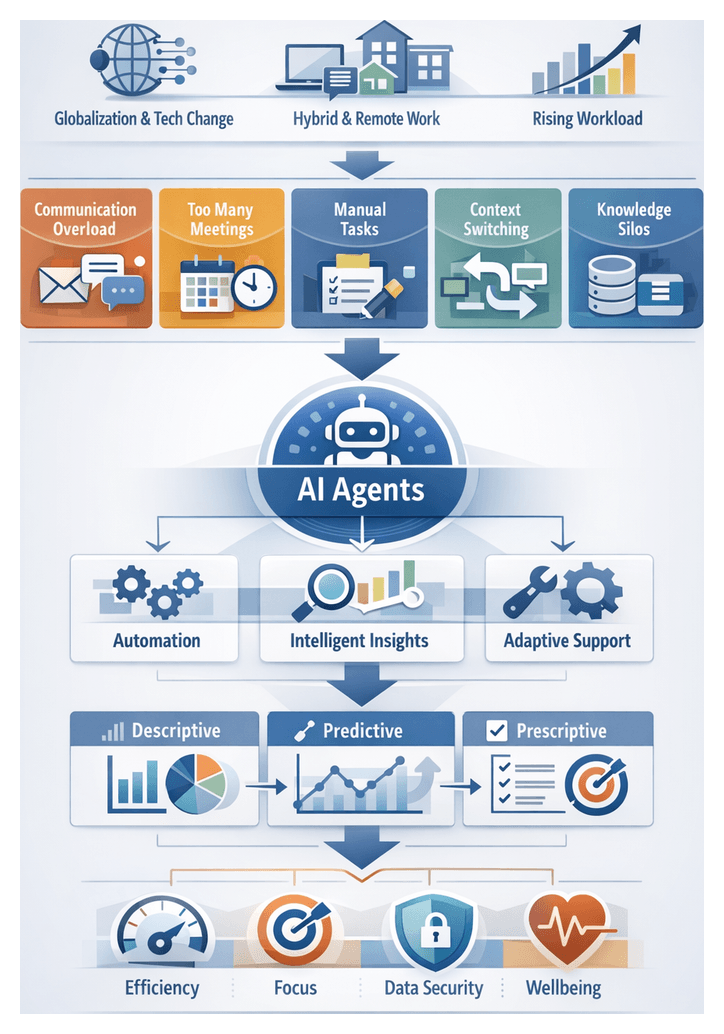
Over the past decade, globalization, rapid technological change and shifting workforce demographics have transformed how work gets done. Hybrid and remote arrangements are now standard, requiring seamless coordination, intelligent automation and adaptive support systems. Incremental process tweaks no longer suffice as task complexity and volume outpace traditional productivity models.
Core operational bottlenecks include:
- Communication Overload: Employees spend up to 30 percent of their time managing emails and messages, delaying decisions and obscuring priorities.
- Meeting Proliferation: Virtual and hybrid meetings often lack clear agendas, consuming unproductive hours and exacerbating decision fatigue.
- Manual Administrative Tasks: Scheduling, data entry and document management remain labor-intensive and error-prone, consuming time that could be better spent.
- Context Switching: Frequent interruptions incur hidden costs, with individuals requiring up to 15 minutes to regain full focus.
- Fragmented Knowledge Access: Information silos and outdated search processes hinder rapid problem solving, leading to redundant work and delayed responses.
Knowledge workers lose an average of 2.5 hours per day to non-core tasks and disruptions, translating into millions in unrealized labor value and contributing to stress, burnout and turnover. Competitive pressures, digital transformation agendas, evolving workforce expectations, hybrid work models and data proliferation are converging to elevate productivity optimization to a strategic imperative.
AI agents—software entities capable of autonomous task execution, contextual assistance and continuous learning—emerge as a powerful response. By managing routine tasks, understanding priorities, integrating with enterprise systems and generating data-driven insights, agents extend human capacity and address the root causes of inefficiency. Advances in natural language processing, machine learning and cloud-native frameworks, coupled with rich organizational data and a growing vendor ecosystem, create a window of opportunity for AI-driven productivity transformation. Vendors like Clara Labs illustrate early success in autonomous scheduling and email triage.
Analytical Frameworks and Time Tracking Tools
Time tracking tools have evolved into sophisticated analytical platforms that translate raw timestamps into actionable insights. Evaluation frameworks focus on metrics such as data accuracy, granularity, user adoption, engagement iterations, insight utility and integration with broader productivity ecosystems.
Interpretive Models and Metrics
Organizations apply three dominant analytical models:
- Descriptive Analysis: Visualizations of time distribution reveal macro-level patterns, such as peak focus periods and context-switch frequency.
- Predictive Modeling: Machine learning algorithms forecast workloads, anticipate bottlenecks and estimate time requirements for recurring tasks.
- Prescriptive Recommendations: AI-driven guidance on schedule optimization, break timing and task batching leverages behavioral science principles.
Expert Considerations
Key factors when selecting a solution include:
- Contextual Accuracy: Distinguishing billable from non-billable work and capturing overhead tasks.
- Behavioral Insights: Identifying collaboration hotspots and focus patterns for targeted interventions.
- Privacy Compliance: Ensuring data protection through anonymization, consent mechanisms and adherence to regulations.
- Scalability: Managing concurrent users, centralized administration and performance at enterprise scale.
Comparative Analysis of Leading Platforms
- RescueTime: Automated categorization of computer activity with AI models assigning productivity scores to websites and applications.
- Toggl Track: Manual and semi-automated time entry with AI-powered idle detection and predictive project forecasting.
- Clockify: Free tier with AI-enhanced time entry suggestions and API support for custom dashboards.
- Time Doctor: Screenshot monitoring, keystroke analytics and prescriptive alerts to address productivity lags.
- Microsoft Viva Insights: Organizational analytics combined with personal well-being recommendations for focus and collaboration balance.
Standard interpretive frameworks such as the Eisenhower Matrix, cognitive load indexes, and collaboration heatmaps anchor analytical outputs in established productivity theories, converting tool outputs into strategic insights on process optimization, resource allocation, and employee well-being.
AI Agents in Individual Workflows
Embedding AI-driven assistants into personal workflows transforms time management from a static plan into a dynamic collaboration. Key capabilities include autonomous task management, context-aware scheduling, notification triage and data-driven recommendations. The following scenarios illustrate how agents amplify individual performance.
Morning Briefings and Agenda Alignment
Agents scan communication channels and data feeds overnight to deliver concise, tailored briefs that align daily agendas with organizational priorities. This reduces time spent gathering dispersed information and enables leaders to focus on strategic decision-making.
Deep Work and Focus Management
Products such as Clockwise use machine learning to identify optimal focus windows, suppress non-urgent notifications and schedule uninterrupted work blocks. Organizations report up to 40 percent increases in focused time for writing, analysis and design tasks.
Adaptive Scheduling in Dynamic Environments
In fast-paced sectors, agents monitor calendar changes and resource commitments in real time, proposing schedule adjustments that preserve high-priority tasks. This reduces manual rescheduling friction and helps professionals maintain resilience amid shifting demands.
Meeting Preparation and Follow-Up
Tools like Otter.ai automate agenda creation, transcribe discussions and extract action items, integrating summaries into task lists. This accelerates readiness and ensures accountability by closing the loop on follow-up.
Interrupt Management and Notification Triage
By assessing sender importance and message urgency, agents prioritize high-value notifications and defer non-critical communications. Integration with platforms like RescueTime helps measure context-switch reductions and their impact on effective working hours.
Contextual Task Sequencing
Agents dynamically reorder to-do lists based on location, energy levels and deadlines, aligning tasks with Eisenhower Matrix principles to optimize effort allocation across varying contexts.
Personalized Break and Recharge Recommendations
By analyzing usage patterns and wearable-derived signals, agents suggest timely breaks and brief wellness activities, supporting sustained focus and reducing burnout risk.
End-of-Day Reflection and Planning
Agents prompt daily reviews, summarizing accomplishments, flagging incomplete items and identifying emerging priorities. Personalized insights on focus versus meeting time foster self-awareness and continuous improvement.
Role-Specific Use Cases
- Sales Professionals: Recommended follow-up windows and personalized outreach templates based on communication analytics.
- Software Developers: Uninterrupted coding intervals aligned with sprint deadlines and task context.
- Researchers and Analysts: Curated literature, data extraction and dedicated research blocks for evidence-based decisions.
- Customer Support Specialists: Prioritized ticket handling by urgency and customer value, with scheduled proactive outreach.
Adoption, Governance, and Continuous Improvement
User Acceptance and Change Dynamics
Adoption success depends on perceived usefulness and ease of use, as described by the Technology Acceptance Model and Rogers’ Diffusion of Innovation. Pilot programs, early adopters and internal champions help refine value propositions and build momentum. Cultural readiness and clear communication are critical to prevent low utilization and user frustration.
Balancing Personalization with Scalability
Mass-customization strategies combine standardized core functionalities with configurable preferences. Segmenting users into personas and offering tiered service levels ensures consistent support while allowing power users to access advanced modules. Governance around customization boundaries preserves enterprise-wide scalability.
Data Privacy, Security, and Compliance
AI assistants process sensitive calendar entries, emails and task lists. Compliance with frameworks such as NIST SP 800-53 and ISO/IEC 27001, as well as regional regulations like GDPR, CCPA and LGPD, requires privacy-by-design principles, minimal data retention, encryption and robust audit trails. Role-based access controls and consent mechanisms protect employee trust.
Ethical Considerations
Transparency, fairness and accountability underpin trustworthy AI, guided by IEEE and European Commission frameworks. Advisory boards and algorithmic impact assessments guard against bias and unintended consequences. Clear feedback channels empower users to report inaccuracies and drive continuous ethical refinement.
Strategic Alignment and Integration
Aligning AI assistant deployments with corporate objectives—such as employee engagement, operational efficiency and innovation—requires defining KPIs like time saved, task backlog reduction and collaboration metrics. Conceptual integration mapping ensures seamless interoperability with email, calendar, project management and communication platforms, accelerating time to value.
Measuring Impact and Continuous Improvement
Balanced scorecards combine utilization rates, task completion time reductions, user satisfaction scores and Net Promoter Scores. Time-series analytics isolate the assistant’s contribution, informing iterative enhancements to algorithms, interfaces and feature sets. This feedback loop aligns with agile practices and fosters a data-driven culture.
- Utilization: Percentage of eligible users actively engaging with the assistant.
- Efficiency Gains: Average reduction in task turnaround times.
- User Satisfaction: Survey ratings and qualitative feedback.
- Accuracy: Rate of correct suggestions versus manual intervention.
- ROI: Cost savings relative to deployment and maintenance expenses.
Change Management and Training
Structured onboarding—self-guided tutorials, live workshops and peer mentoring—accelerates adoption. Change champions demonstrate real-world use cases, and micro-learning modules embedded within assistants provide just-in-time guidance, reducing reliance on traditional training.
Limitations, Risks, and Long-Term Outlook
AI assistants may struggle with complex context, cross-domain tasks and nuanced preferences, risking automation bias and eroded critical thinking. Risk registers should address algorithmic errors, data drift and vendor lock-in. Ongoing investments in model retraining, data quality and feature evolution are essential. Emerging advances in multimodal AI and federated learning promise enhanced context awareness and privacy, but introduce new governance challenges.
Risk Mitigation Strategies
- Establish an AI governance council for policy oversight.
- Implement regular model evaluations to detect drift.
- Maintain transparent documentation of capabilities and limitations.
- Design fallback procedures for unresolved tasks.
- Periodically review vendor agreements to ensure flexibility and portability.
By combining proven analytical frameworks, strategic alignment, ethical stewardship and robust governance, organizations can unlock the full potential of AI-driven time management. Leaders who balance innovation with prudent risk management will capture sustainable productivity gains and drive transformational outcomes.
Chapter 4: AI-Driven Collaboration and Team Dynamics
The Role and Value of AI-Driven Collaboration Agents
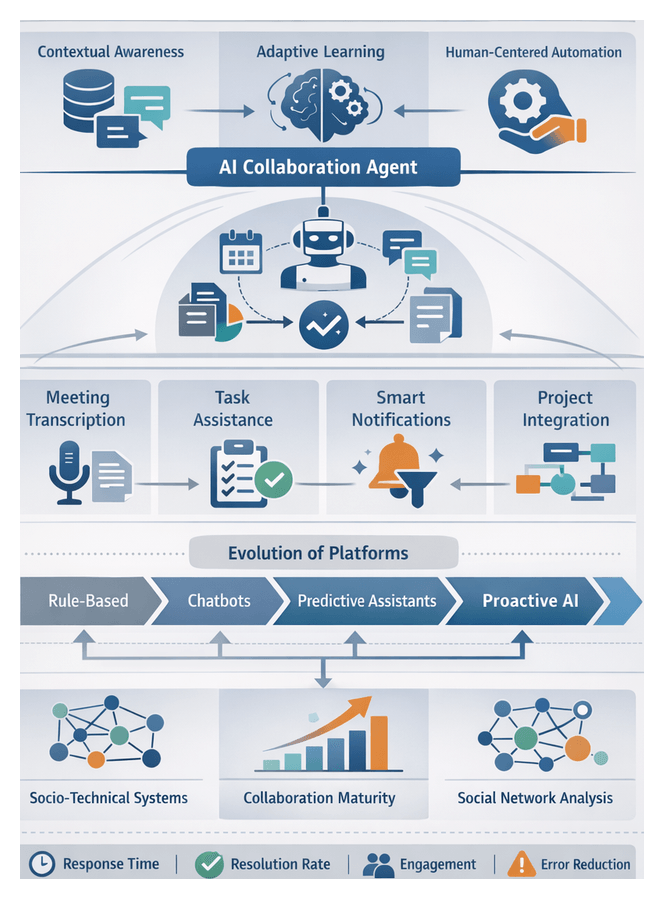
In an era of hybrid and remote work, organizations grapple with dispersed teams, fractured workflows, and information overload that undermine productivity and cohesion. Collaborative AI agents embed intelligence into everyday platforms to automate routine coordination, surface critical insights, and maintain contextual continuity across conversations, documents, and tasks. Unlike rule-based bots, these agents harness natural language processing, machine learning, and predictive analytics to interpret user intent, anticipate next steps, and execute actions autonomously or semi-autonomously. Key capabilities include real-time meeting transcription and summarization, contextual task suggestions, intelligent notification filtering, calendar and project-management integration, and adaptive learning that tailors assistance to team behavior. By reducing administrative burden and ensuring aligned understanding of priorities, AI agents transform collaboration into a strategic asset that accelerates decision cycles, improves accountability, and scales as organizations grow.
Foundational Concepts and Evolution of AI-Augmented Platforms
Effective AI agents rest on three foundational principles. Contextual awareness enables agents to ingest data from communication channels, document repositories, and project systems, constructing holistic models of ongoing work. Adaptive learning continuously refines agent behavior based on interaction patterns, user feedback, and outcome data, ensuring relevant and personalized support. Human-centered automation emphasizes augmentation over replacement, with agents offering suggestions, alerts, and draft content that preserve human judgment and foster trust.
Collaboration platforms have evolved from basic file sharing and centralized chat to integrated ecosystems featuring video conferencing, interactive whiteboards, and holistic project management. AI agents represent the next evolutionary leap: proactively initiating tasks, summarizing complex discussions, and coordinating workflows without explicit prompts. Milestones include:
- Rule-based workflow automation for fixed tasks, such as scheduled reminders
- Conversational chatbots responding to keywords and simple commands
- Predictive assistants that suggest meeting times and auto-categorize content
- Proactive AI agents embedded in communication and productivity suites
Advances in large-scale language models, reinforcement learning, and context modeling have endowed agents with deeper language understanding, reasoning over data, and seamless collaboration alongside human users.
Analytical Frameworks and Performance Metrics for Real-Time Collaboration
Organizations apply structured models to assess how AI agents affect collaboration within socio-technical systems. Leading frameworks include:
- Socio-Technical Systems Model examines alignment of agents with workflows, cultural norms, and communication patterns, evaluating user acceptance and training needs.
- Collaboration Maturity Model tracks progression from siloed communication to integrated, AI-enabled teamwork, using metrics on coordination transparency and adaptive response.
- Social Network Analysis maps team interactions, measuring network density and information flow, enhanced by metadata such as topic tags and sentiment indicators.
Key performance indicators balance quantitative throughput with qualitative user experience. Widely adopted metrics include:
- Response Latency–average time between user queries and AI-augmented replies, with lower latency correlating to faster decision cycles.
- Resolution Rate–proportion of interactions fully handled by agents without human escalation.
- Meeting Efficiency Index–combines meeting duration, agenda adherence, and follow-up completion; solutions such as Microsoft Teams Copilot report 30 to 40 percent reductions in meeting time.
- Collaboration Engagement Score–frequency of AI suggestions adopted, corrections to AI outputs, and user-initiated clarifications, indicating trust and integration into workflows.
- Error Reduction Rate–decline in miscommunications and duplicated work; Slack GPT cites up to a 25 percent drop in coordination errors.
Pilot studies quantify real-world impacts. A consulting firm saw a 20 percent increase in decision throughput and 15 percent fewer follow-up meetings after deploying Zoom IQ for automated transcription. A technology company integrating Otter.ai achieved a 35 percent rise in stakeholder alignment by sharing AI-generated highlights. Financial services managers saved eight hours weekly using chat-based agents and calendar assistants, while knowledge management platforms with embedded AI indexing cut information retrieval time by 40 percent.
Measurement challenges include isolating AI impact from concurrent improvements, unifying analytics across platforms, ensuring user privacy and compliance, and avoiding metric fatigue by focusing on high-impact KPIs. Emerging analytical directions point to predictive collaboration analytics, prescriptive insights for meeting design, sentiment-driven morale indicators, and continuous closed-loop learning that dynamically refines agent behavior.
Enhancing Communication, Coordination, and Decision-Making
AI agents reshape both formal and informal team interactions, improving media richness, boundary spanning, and shared mental models. By capturing meeting transcripts, tagging decisions, and indexing documents, agents reduce information asymmetry. For example, Cisco Webex Assistant generates real-time summaries and action-item lists that circulate instantly, strengthening cross-functional linkages and enabling social network ties based on emergent expertise.
Decision velocity accelerates when agents analyze conversation threads, surface pending questions, and propose relevant data or historical precedents. Slack AI exemplifies in-flow assistance that aligns with Lean Management principles, minimizing delays and cognitive load. Unified workspaces with dynamic ontologies, such as Microsoft Viva, reconcile data from CRM, ERP, and content systems, fostering shared context and overcoming terminology barriers.
Behavioral shifts accompany technological gains. Real-time nudges prompt inclusion of diverse contributors and highlight linguistic biases, cultivating more inclusive dialogues. Yet organizations must guard against overreliance on AI, preserving human critical evaluation through complementary strengths models. In distributed environments, asynchronous summaries, prioritized alerts, multilingual transcription, and AI-driven scheduling optimize global collaboration across time zones and geographies.
Evaluating communication impact combines metrics like reductions in email volume, average response times, and decision latency with user satisfaction surveys. Tracking the adoption rate of AI-generated summaries and auto-indexed documents against project outcomes builds data-driven narratives on collaboration efficacy. Mitigation strategies address alert fatigue with configurable thresholds, foster trust through explainable AI, implement privacy governance in line with standards such as ISO 27001, and drive cultural adoption through stakeholder engagement and pilots.
Strategic Alignment, Governance, and Adoption
Embedding AI agents into organizational strategy requires linking agent capabilities to corporate priorities via Balanced Scorecard or OKR frameworks. Real-time transcription, agenda management, and automated task assignment should map directly to cycle-time reduction, enhanced alignment, and accelerated decision-making. Governance forums that include executives and team leads enable iterative calibration of agent parameters, balancing ROI forecasts with day-to-day usability. Agile governance cycles or staged maturity models guide transitions from pilots to enterprise-wide deployments.
Change management is critical. Applying the ADKAR model (Awareness, Desire, Knowledge, Ability, Reinforcement) and cultivating “AI champions” encourage peer advocacy. Scenario-based workshops using Microsoft Copilot, Slack AI, or Zoom’s AI Companion expose accuracy and attribution concerns in realistic contexts. Tracking engagement rates, task completion times, and sentiment survey results identifies friction early and informs tailored training.
Governance structures must embed ethical oversight. Drawing on IEEE’s Ethically Aligned Design and the European Commission’s Ethics Guidelines for Trustworthy AI, committees define policies for content validation, escalation protocols, and audit trails. RACI matrices assigned to AI-generated deliverables ensure that responsibility and accountability rest with designated human roles, preserving agility while safeguarding decision integrity.
Technical Integration, Security, and Continuous Improvement
Seamless interoperability with communication, project-management, and knowledge systems underpins agent effectiveness. A service-oriented architecture leveraging REST APIs, Webhooks, and identity frameworks such as OAuth 2.0 or SAML ensures secure, real-time data exchange among tools like Jira, Asana, and Zoom’s AI Companion. Semantic alignment through enterprise ontologies and metadata tagging reconciles task identifiers across platforms, while periodic integration audits detect schema drift and performance bottlenecks.
Security and privacy demand end-to-end encryption of audio and transcript data, role-based access controls, and compliance with GDPR, HIPAA, or CCPA requirements. Explicit user consent for recording and data processing, rigorous bias audits using fairness metrics, and human-in-the-loop safeguards in high-risk scenarios uphold ethical standards. Continuous performance monitoring integrates dashboards tracking meeting time saved, transcription accuracy, and follow-up completion rates alongside embedded feedback prompts. Regular retrospective sessions review metrics, share best practices, and prioritize feature enhancements, ensuring that AI agents evolve in alignment with team dynamics and strategic objectives.
Chapter 5: Intelligent Knowledge Management and Decision Support
Foundations of AI-Driven Knowledge and Decision Support
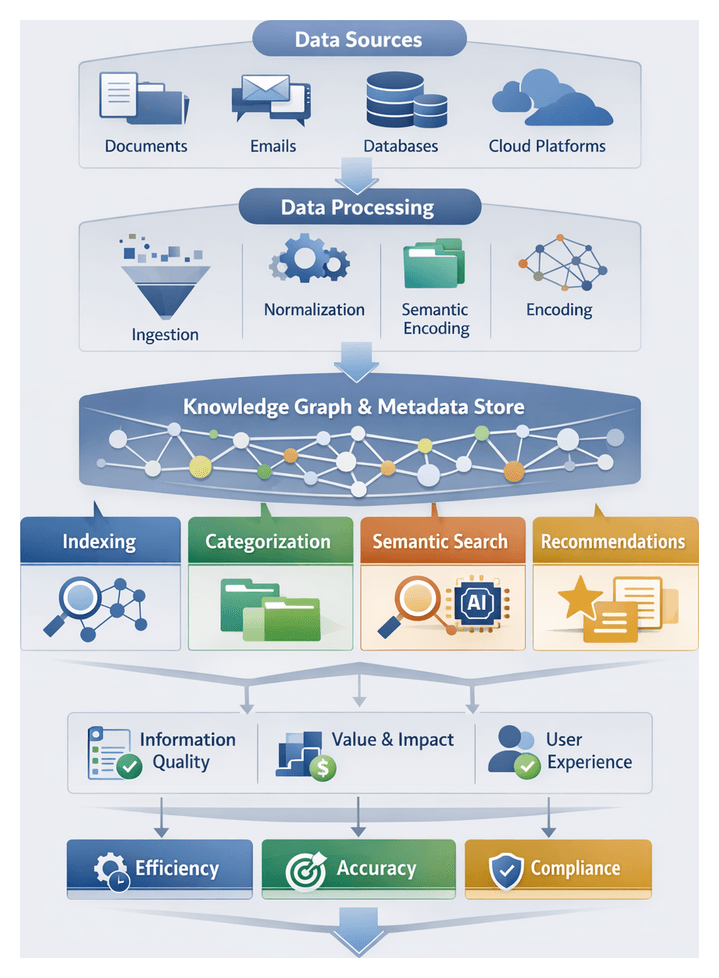
Enterprises generate exponential volumes of structured and unstructured data—from documents and emails to video, code repositories, and collaborative platforms. Traditional keyword search struggles with scale, context and evolving domain vocabularies, leaving knowledge workers spending up to thirty percent of their time hunting for relevant information. AI-powered knowledge management and decision-support agents apply machine learning and natural language processing to transform raw data into semantically rich knowledge graphs and embeddings, delivering precise indexing, categorization, search and recommendations aligned with organizational context.
Core functions of these agents include:
- Indexing: Automated extraction of key terms, entities and relationships to build searchable representations.
- Categorization: Supervised and unsupervised classification of content into topics, domains or project taxonomies.
- Semantic Search: Interpretation of user intent through natural language queries, extending beyond exact keyword matches.
- Recommendation and Discovery: Proactive surfacing of related documents, experts and best practices based on behavior, roles and project context.
- Summarization: Generation of concise abstracts that enable rapid assessment of document relevance.
- Continuous Learning: Feedback loops refine algorithms based on usage patterns, new content ingestion and search success rates.
Architecturally, these systems comprise:
- Data Ingestion: Connectors and pipelines aggregating content from enterprise systems, cloud repositories and collaboration tools.
- Preprocessing and Normalization: Tokenization, language detection and entity extraction to prepare text for deeper analysis.
- Semantic Encoding: Transformer-based embedding models that convert text into dense vector representations capturing meaning and relationships.
- Metadata Store and Knowledge Graph: Graph databases or document stores maintaining entity relationships, annotations and taxonomy mappings.
- Search and Retrieval Engine: Hybrid frameworks combining vector similarity search with inverted indexes for keyword fallback and filters, exemplified by Elastic Enterprise Search and Microsoft Azure Cognitive Search.
- User Interface and APIs: Dashboards, chat interfaces and RESTful endpoints that enable seamless querying and result delivery.
- Feedback and Analytics: Monitoring modules tracking query performance, user satisfaction and content gaps to drive iterative improvements.
Adopting AI-driven retrieval transforms decision quality, operational efficiency and collaboration. Timely access to comprehensive insights reduces reliance on intuition, automates routine discovery tasks and fosters cross-functional teamwork by surfacing expertise profiles and project-specific documents. Automated classification and tagging support compliance and risk mitigation, while continuous learning ensures systems scale with data volumes and evolving vocabularies.
Evaluating AI Decision Support Effectiveness
Structured analytical frameworks guide organizations in assessing AI decision-support systems on multiple dimensions: data integrity, algorithmic robustness, user experience and business impact. The Information Quality Framework examines accuracy, completeness, consistency and timeliness of insights. The Value Realization Framework aligns outputs with strategic objectives, quantifying benefits in terms of revenue uplift, cost avoidance and risk mitigation. McKinsey’s Value-at-Stake model estimates economic impact by mapping improved decision accuracy and speed to financial metrics, while the Technology Acceptance Model links perceived usefulness and ease of use to adoption rates.
Key metrics and methodologies include:
- Algorithmic Metrics: Precision, recall and F1 scores for classification tasks; mean absolute error and root mean squared error for predictive analytics.
- Process Metrics: Time-to-decision and decision throughput measure acceleration of business processes and volume of decisions per unit time.
- User-Centric Metrics: Net Promoter Score (NPS) gauges willingness to recommend the system; Decision Confidence Index tracks acceptance versus override rates of AI suggestions.
- Data Quality Dimensions: Accuracy, completeness, consistency and timeliness of underlying datasets and model outputs.
Interpretive models from decision theory and behavioral economics enrich evaluation. Prospect theory reveals how framing risk-reward trade-offs influences user preferences. Human-AI teaming frameworks assess optimal task allocation between analysts and AI agents, using metrics like cognitive workload reduction and synergy scores. Domain-specific considerations apply tailored requirements:
- Financial Services: Regulatory compliance demands explainability and audit trails. Back-testing against historical outcomes validates predictive power, while SHAP (SHapley Additive exPlanations) and LIME (Local Interpretable Model-agnostic Explanations) serve as critical evaluation tools.
- Healthcare: Diagnostic recommendations require validation against clinical trial data and peer-reviewed literature. Performance extends to patient outcomes—readmission rates, treatment efficacy and adverse event reduction—benchmarking against FDA guidelines for Software as a Medical Device.
- Manufacturing: Predictive maintenance and supply-chain optimization emphasize unplanned downtime reduction, asset utilization and inventory turnover. Systems are evaluated on their ability to forecast equipment failures with sufficient lead time.
Emerging analytical platforms integrate advanced evaluation capabilities. IBM Watson Decision Platform visualizes real-time accuracy metrics and business impact estimations. Microsoft Azure Machine Learning offers automated interpretability reports detailing feature importance and decision pathways. Amazon SageMaker includes Clarify for bias detection and explainability analysis. Google Cloud AI Platform Vertex AI Model Monitoring tracks prediction drift and data skew. DataRobot provides a unified interface for benchmarking models against business metrics under consistent evaluation protocols.
Embedding these frameworks into governance structures ensures continuous alignment of AI agents with strategic goals and regulatory requirements. Cross-functional review committees leverage performance reports to inform model retraining schedules, data augmentation efforts, and user interface enhancements, fostering stakeholder trust and driving sustained improvements in decision quality, operational efficiency, and competitive advantage.
Strategic Applications of AI Research Assistants
AI-powered research assistants extend analytical capabilities across market analysis, risk modeling, competitive intelligence, investment strategy and regulatory compliance. By integrating structured data (sales figures, financial statements) with unstructured inputs (social media, news feeds, customer reviews) and applying natural language processing, sentiment analysis and predictive modeling, these agents surface actionable insights that inform high-level strategy within established frameworks.
Market Analysis and Trend Forecasting
Organizations combine real-time point-of-sale data with social listening analytics to produce adaptive demand forecasts. AI assistants continuously correlate transaction volumes with consumer sentiment signals, enabling product managers to adjust inventory and promotions on a daily cadence. Platforms like DataRobot automate feature engineering, model selection and performance validation, allowing analysts to focus on interpretation. Interpretive models such as Porter’s Five Forces and the Ansoff Matrix translate AI-generated signals into coherent market entry, diversification and positioning strategies.
Scenario Planning and Risk Modeling
AI-driven scenario tools ingest probabilistic distributions of macroeconomic indicators, geopolitical events and industry variables to simulate multiple futures. Monte Carlo simulations quantify probabilities of supply shocks, demand fluctuations and operational interruptions. Features include dynamic parameter adjustment based on leading indicators, automated correlation analysis, sensitivity dashboards and graphical what-if visualizations. Palantir Foundry provides an ontology-driven environment that aligns simulation components with enterprise data definitions, supporting cross-group consistency and enabling validation against historical crises to enhance preparedness.
Competitive Intelligence and Mergers & Acquisitions
Strategic M&A teams employ AI assistants to automate due diligence by scanning patent databases, litigation records, human capital disclosures and media reports. Agents flag targets with rapidly growing patent citation networks and assess leadership continuity risk by analyzing executive profiles. Solutions like Thomson Reuters Eikon AI merge real-time news analytics with entity-level risk scoring, categorizing rumors, probes and executive changes to inform bid strategies, deal structures and regulatory anticipation.
Portfolio Optimization and Investment Strategy
Asset managers integrate quantitative models—mean-variance optimization, risk parity—with qualitative factors such as ESG ratings. AI agents recommend portfolio configurations balancing projected returns, volatility and strategic objectives. IBM Watson Discovery enriches models with insights extracted from regulatory filings, earnings transcripts and ESG disclosures. Portfolio managers apply multi-factor attribution frameworks to interpret AI outputs, ensuring allocations drive risk-adjusted returns and long-term value creation.
Regulatory Compliance and Policy Strategy
AI assistants continuously scan regulatory announcements, public consultations and enforcement actions to map evolving policy landscapes. Agents extract obligations, deadlines and reporting requirements, presenting them in interactive policy registers. Thomson Reuters Regulatory Intelligence classifies developments by jurisdiction, business line and entity type, enabling unified compliance views. Compliance officers apply likelihood-impact matrices to prioritize remediation and align initiatives with strategic risk tolerances.
Cross-cutting analytical viewpoints ensure that AI-generated insights integrate seamlessly into strategic decision making:
- Framework Integration: Embedding insights within Porter’s Five Forces, Balanced Scorecard or resilience models to maintain coherence with strategy.
- Bias Mitigation: Applying audit protocols and data-quality checks to validate representative inputs.
- Human-Augmentation: AI surfaces evidence and recommendations while senior leaders provide context, judgment and ethical oversight.
- Continuous Feedback Loops: Post-decision reviews compare projected outcomes with actual performance to refine models and interpretive criteria.
Alignment, Governance and Integration for Business Impact
To realize measurable returns, organizations must align agent capabilities with high-value objectives such as accelerating time-to-insight, reducing decision cycles and improving collaboration. Key steps include:
- Outcome Definition: Articulate target decisions or processes, setting KPIs like reduced research time or increased forecast accuracy.
- Stakeholder Engagement: Involve executives, domain experts and end users early to validate use cases, prioritize features and secure adoption.
- Value Realization Timeline: Balance rapid prototyping with strategic road-mapping, defining milestones for pilots and phased roll-outs.
- Cost-Benefit Analysis: Compare total cost of ownership—including licensing, integration and maintenance—against anticipated efficiency and decision-quality gains.
Effective data governance underpins agent reliability. Establish metadata standards, taxonomy alignment and continuous stewardship. Key governance components include:
- Metadata Management: Consistent tagging and classification schemas for precise indexing and semantic search.
- Data Lineage and Provenance: Tracking data origin, transformations and usage to support auditability and compliance.
- Quality Controls: Automated validation rules, deduplication and anomaly detection to uphold data accuracy and relevance.
- Access and Security Policies: Role-based permissions and encryption standards to protect sensitive information while enabling collaboration.
Seamless integration with enterprise systems ensures agents embed in daily workflows. Best practices include:
- API Consistency: RESTful or GraphQL interfaces with clear versioning to prevent disruptions.
- Data Synchronization: Near-real-time or batch updates that maintain consistency between source systems and knowledge indices.
- Modular Architecture: Microservices or containerized components that can be deployed and scaled independently.
- Vendor Ecosystem Alignment: Tools supporting standard connectors or prebuilt integrations—such as embedding an intelligent assistant into SharePoint or Slack.
User adoption hinges on change management. Role-based training, champion networks, intuitive user experiences and structured feedback loops foster trust and engagement. Scalability demands elastic compute resources, distributed knowledge graphs and vector databases, comprehensive performance monitoring and caching strategies for high-frequency queries.
Ethical, compliance and security safeguards must be embedded throughout deployment. Conduct regular bias audits, implement privacy controls in compliance with GDPR or CCPA, maintain access logs and audit trails, and enforce end-to-end encryption with robust key management. Continuous improvement relies on usage analytics, periodic model retraining, governance review boards and prioritization frameworks that balance quick wins with long-term enhancements.
Organizations should anticipate limitations—model errors, domain coverage gaps, interpretability challenges and maintenance overhead—and design human-in-the-loop processes to mitigate risks. By aligning AI agents and Microsoft Copilot with strategic goals, enforcing rigorous governance, integrating seamlessly and fostering a culture of continuous learning, enterprises unlock lasting efficiency gains and enhanced decision quality.
Chapter 6: Integrating AI Agents with Enterprise Systems
Architectural Foundation for AI Agent Integration
Modern enterprises often juggle a constellation of legacy systems such as SAP, Oracle and Salesforce alongside cloud platforms and bespoke line-of-business applications. As organizations embrace AI agents to automate tasks, generate insights and enhance decision-making, seamless embedding into this complex ecosystem becomes critical. Absent a structured integration framework, AI agents risk becoming isolated tools that fail to leverage existing data and processes, undermining both efficiency and strategic alignment.
A comprehensive integration architecture delivers multiple benefits:
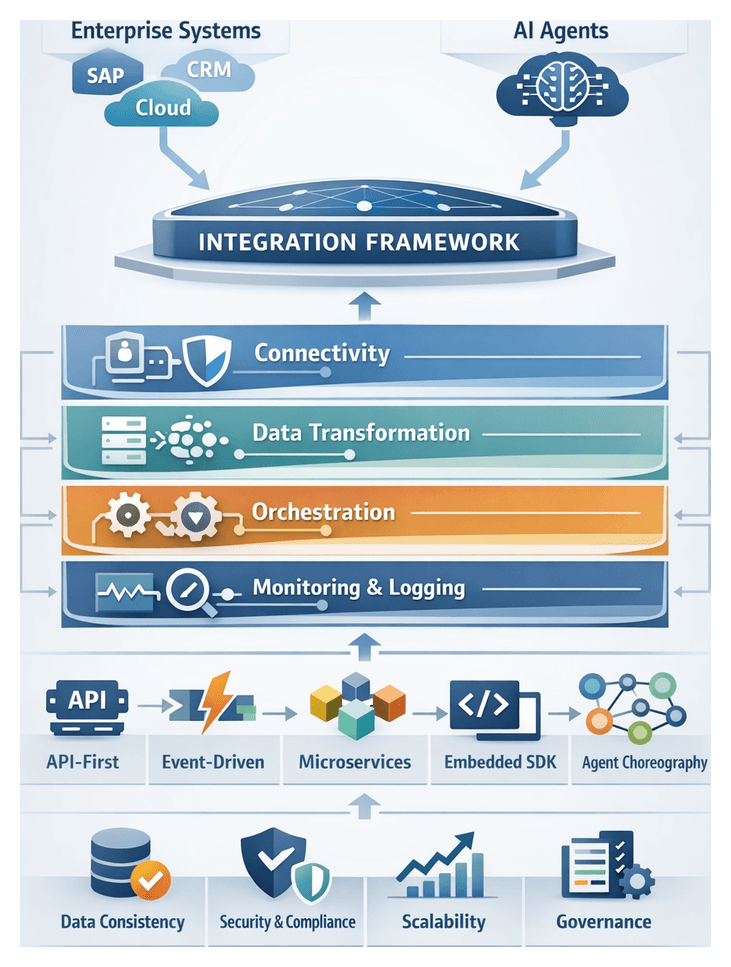
- Ensuring data consistency through unified exchange conventions and schema validations.
- Maintaining security and compliance with standardized authentication, authorization and auditing.
- Promoting scalability via reusable connectors and defined integration patterns that support cross-departmental deployment.
- Facilitating governance by exposing clear service contracts and enabling version control of integration artifacts.
- Reducing time to value through prebuilt templates and low-code connectors that minimize custom development.
The architecture is organized into distinct layers, each addressing a specific concern:
- Connectivity Layer provides secure, authenticated channels between AI agents and enterprise systems. It includes API gateways and message brokers, with platforms such as MuleSoft and Dell Boomi supporting REST, SOAP, JMS and other standards.
- Data Transformation Layer normalizes heterogeneous formats through schema mapping, field validation and enrichment processes. Streaming solutions like Apache Kafka and ETL frameworks handle both real-time and batch transformations.
- Orchestration Layer governs the flow of tasks across agents and services. Workflow engines such as Camunda and Microsoft Power Automate offer model-driven and low-code tooling for designing complex business processes.
- AI Agent Layer embodies domain-specific capabilities—natural language understanding, computer vision, predictive analytics—executing logic based on orchestration inputs and interacting with downstream systems.
- Monitoring and Logging Layer captures observability data, including logs, performance metrics and audit trails. Solutions like Splunk and Elastic Stack aggregate and visualize this information to support troubleshooting and optimization.
Proven Integration Patterns
- API-First Pattern – Agents expose and consume RESTful interfaces, managed by an API gateway that enforces routing, security and rate limits.
- Event-Driven Pattern – Agents subscribe to event streams published on platforms like AWS EventBridge or Apache Kafka, reacting to business events in real time.
- Microservices Pattern – AI capabilities are deployed as independent microservices in container platforms such as Amazon EKS or Google Kubernetes Engine, enabling granular scaling and lifecycle management.
- Embedded SDK Pattern – Integration libraries are embedded directly into existing applications, offering streamlined authentication, data exchange and on-device model execution.
- Agent Orchestration Pattern – Complex processes leverage multi-agent choreography defined through BPMN or custom workflows, coordinating data hand-offs and decision points across specialized agents.
API and Data Interoperability
Rather than treating AI agents as disconnected add-ons, leading enterprises embed them within a connected ecosystem where seamless data exchange, consistent semantic definitions and robust interface governance are strategic imperatives. Interoperability spans two dimensions:
- Interface Interoperability – The protocols, schemas and security mechanisms that permit one system to invoke or be invoked by another. Common protocols include REST, gRPC and GraphQL; payload formats encompass JSON, XML and Apache Avro; authentication standards range from OAuth 2.0 and JWT to mutual TLS.
- Data Interoperability – The shared understanding, mapping and transformation of data elements as they traverse disparate systems. This includes canonical data models, schema harmonization, data lineage and quality enforcement.
Several interpretive frameworks help architects assess interoperability maturity and prioritize investments:
- Connectivity Maturity Models – Define levels from isolated proofs-of-concept to fully orchestrated, event-driven ecosystems that minimize custom code and maximize reuse.
- Semantic Interoperability Grids – Catalog data domains, entity definitions and taxonomies, supported by governance processes to ensure evolving schemas remain aligned.
- Open versus Proprietary API Evaluations – Weigh trade-offs between vendor lock-in and rapid integration benefits, considering open-source gateways and community-driven standards.
When selecting interface technologies, organizations balance technical requirements with strategic implications:
- Developer Productivity – SDK availability, community examples and learning curves associated with new protocols or frameworks.
- Vendor Ecosystem Alignment – Compatibility with integration platforms such as MuleSoft or Dell Boomi and support for hybrid, multi-cloud deployments.
- Operational Resilience – Fault-tolerance patterns like circuit breakers and exponential backoff, and observability through distributed tracing and API analytics.
Data interoperability relies on metadata repositories, data catalogs and master data management. Key domains include:
- Schema Harmonization – Defining canonical models for core entities and mapping proprietary schemas to common formats.
- Data Lineage and Provenance – Tracking origin, transformations and consumption paths to support auditability under regulations such as GDPR and CCPA.
- Quality and Integrity Metrics – Automated validation rules, completeness and accuracy checks, and periodic reconciliations.
To measure interoperability success, enterprises track metrics such as API latency and throughput, error rates and reliability (MTBF, MTTR), data consistency scores and integration velocity (time to onboard new sources and expose agent endpoints). Aligning these indicators with executive dashboards and balanced scorecards enables data-driven decisions on scaling or remediating integration efforts.
Emerging standards shape future interoperability, ensuring vendor-agnostic architectures and contract-first development:
- OpenAPI and AsyncAPI for machine-readable API contracts and code generation.
- GraphQL Federation for unified queries across multiple services, reducing over-fetching or under-fetching of data.
- OData for standardized query capabilities and metadata annotations in enterprise datasets.
Scalability, Performance, and Reliability
Deploying AI agents to support mission-critical processes demands architectures that can elastically scale, withstand failures and deliver consistent performance. Cloud-native environments, orchestrated via containers and microservices, underpin these requirements.
Container Orchestration and Autoscaling harness platforms such as Amazon EKS and Google Kubernetes Engine to dynamically adjust compute resources based on demand. Horizontal Pod Autoscaling rules, resource quotas and custom metrics ensure inference endpoints maintain low latency under fluctuating workloads.
Site Reliability Engineering (SRE) practices bring maturity to operations through readiness and liveness probes, service-level objectives (SLOs), error budgets and chaos engineering exercises. Runbooks codify response procedures, while incident retrospectives drive continuous improvement.
- Observability Stack – Collect metrics with Prometheus, visualize trends in Grafana and trace distributed calls using Jaeger.
- Message Queues – Buffer spikes in request traffic and implement back-pressure mechanisms using Apache Kafka or RabbitMQ.
- Fallback and Circuit Breakers – Implement secondary inference models, cached responses or simplified rule-based agents when primary services degrade.
- API Gateway Controls – Enforce rate limiting, versioning and authentication to protect backend AI services from excessive or malicious traffic.
- Disaster Recovery – Design multi-region deployments, cross-zone replication and backup strategies to minimize downtime during outages.
Governance, Compliance, and Security
AI agent integration extends governance and security requirements across the data lifecycle and operational environment. Robust frameworks align policies, roles and controls with regulatory mandates and ethical standards.
Data Governance and Regulatory Compliance frameworks based on DMBOK, ISO/IEC 38500 or COBIT define ownership, quality metrics and lineage. In regulated sectors—healthcare, finance, energy—HIPAA, GDPR, CCPA and Basel III drive consent management, retention policies and breach reporting. A centralized data catalog managed through platforms such as Collibra, Informatica or Talend documents metadata, taxonomies and business glossaries. Data stewards enforce scorecards, resolve inconsistencies and facilitate automated metadata harvesting by AI agents.
Access Control and Data Protection rely on identity providers like Okta or Auth0 to implement role-based access control, dynamic data masking and the principle of least privilege. Data loss prevention tools monitor egress, flag sensitive content and prevent unauthorized AI processing of personal or proprietary information.
Vendor Management and Ecosystem Strategy involves selecting and supervising external AI platforms, negotiating SLAs, and preserving portability. Abstraction via API gateways such as MuleSoft or TIBCO standardizes interactions and allows providers from OpenAI to Anthropic to be swapped as performance or strategic priorities evolve. Risk assessments evaluate SOC 2 and ISO 27001 certifications, compliance attestation and vendor control maturity.
Security Frameworks and Privacy Controls implement layered defenses in line with NIST SP 800-53, ISO 27001 and CIS Controls. Encryption of data at rest (AES-256) and in transit (TLS 1.2 ) is managed through HashiCorp Vault or cloud key management services. Runtime protection and container security scanning detect vulnerabilities, while Security Information and Event Management platforms—Splunk or Elastic Security—aggregate and correlate events to support rapid incident response.
Privacy-by-design principles enforce data minimization, pseudonymization and purpose limitation. Privacy impact assessments guide high-risk scenarios, and fairness frameworks such as IBM AI Fairness 360 detect and mitigate bias in model outputs, safeguarding ethical and legal compliance.
Organizational Transformation and Change Management
The success of AI agent integration depends as much on people and processes as on technology. Embedding intelligent agents within enterprise systems reshapes organizational structure, role definitions and collaboration models, requiring deliberate change management and talent planning.
Structural Evolution and Governance
Traditional hierarchies give way to federated service hubs and cross-functional teams. AI Centers of Excellence coordinate tool selection, ethical guidelines and best practices, while business units take ownership of domain-specific implementations. Hybrid reporting lines foster alignment between functional leaders and the CoE.
- Joint Governance Councils – Cross-disciplinary committees oversee agent deployments, use case prioritization and risk management, with representation from legal, compliance and cybersecurity.
- Co-Development Workshops – Regular sessions where business analysts and engineers prototype agent workflows, validate logic and refine integration points.
- Unified Performance Dashboards – Shared visibility into key metrics such as resolution rates, system throughput and data quality.
- Service Catalogs – Standardized listings of AI capabilities offered by IT, enabling self-service consumption and reducing redundancy.
Emerging Roles and Skills
As AI agents automate routine tasks, human responsibilities evolve toward oversight, interpretation and strategic guidance.
- AI Supervisors and Ethicists – Monitor agent behavior, ensure compliance with ethical frameworks and validate outputs against policies.
- Process Enhancement Specialists – Analyze augmented workflows and identify continuous improvement opportunities.
- Data Stewards and Curators – Maintain training data quality, refine ontologies and manage data lineage.
- Business-IT Liaisons – Translate business objectives into technical requirements and manage integration priorities.
- Hybrid Talent – Professionals combining domain expertise with data science or software engineering skills for bridging strategy and execution.
Cultural Adaptation and Change Programs
Fostering a culture of experimentation, accountability and continuous learning is essential to mitigate resistance and sustain momentum.
- Champion Networks – Early adopters advocate for agent use cases, share success stories and mentor peers.
- Learning Platforms – Structured training via Coursera for Business, Udacity Enterprise or internal workshops on AI literacy and model governance.
- Feedback Loops – Mechanisms for end users to report issues, suggest enhancements and contribute to iterative refinements.
- Transparent Communication – Regular updates on milestones, risk mitigation and performance outcomes build trust across stakeholder groups.
Change management frameworks such as ADKAR guide stakeholders through Awareness, Desire, Knowledge, Ability and Reinforcement stages, while executive sponsorship and performance incentives align resource allocation with desired outcomes.
Risk Management and Resilience Planning
As AI agents assume critical responsibilities—from customer engagement to compliance monitoring—organizations must bolster resilience through formal protocols and continuous testing.
- Incident Response – Predefined procedures for detecting, containing and remediating agent malfunctions or security incidents.
- Business Continuity – Alternative manual workflows or override mechanisms to sustain operations during system failures.
- Third-Party Oversight – Due diligence and on-site evaluations of external platforms such as ServiceNow Virtual Agent and Microsoft Power Virtual Agents.
- Stress Testing – Simulation exercises to expose weak points in integration pipelines and support processes.
Interoperability and Future-Proofing
To ensure longevity and adaptability, integration architectures must embrace open standards, modular patterns and rigorous contract management. An API-first approach grounded in the OpenAPI Specification defines clear contracts and deprecation cycles, while standard data schemas—JSON-LD for semantic data or Protocol Buffers for binary serialization—promote consistency across services.
- Event-Driven Backbones – Asynchronous messaging on platforms like Apache Kafka decouples producers and consumers, with schema registries ensuring backward and forward compatibility.
- Service Mesh – Frameworks such as Istio inject observability, mutual TLS and policy enforcement at the infrastructure layer without code changes.
- Contract Testing – Tools like Pact and Postman automate verification of consumer-provider agreements, reducing integration errors.
- Modular Architectures – Microservices, function-as-a-service and plugin frameworks allow incremental addition or replacement of AI capabilities such as multimodal interfaces or explainable AI.
- Metadata and Traceability – Capturing model versions, training data references and decision rationale at integration points supports compliance reporting and iterative improvement.
Key Strategic Considerations
- Build a layered integration framework to ensure data consistency, security and scalability.
- Adopt API-first and event-driven patterns to promote loose coupling and real-time responsiveness.
- Implement robust interoperability governance, leveraging OpenAPI, AsyncAPI and semantic models.
- Architect for reliability with cloud-native autoscaling, SRE practices and comprehensive observability.
- Embed data governance, compliance and security controls through platforms like Collibra, Okta and HashiCorp Vault.
- Foster organizational readiness with CoEs, change management frameworks and targeted training programs.
- Leverage abstraction layers and vendor management to maintain strategic flexibility and mitigate lock-in.
- Embrace open standards, contract testing and modular designs to future-proof AI ecosystems.
By integrating these architectural, interoperability, organizational, governance and future-proofing practices, enterprises can harness the transformative potential of AI agents at scale, delivering secure, compliant and resilient automation that aligns with strategic objectives.
Chapter 7: Measuring Productivity Gains and ROI
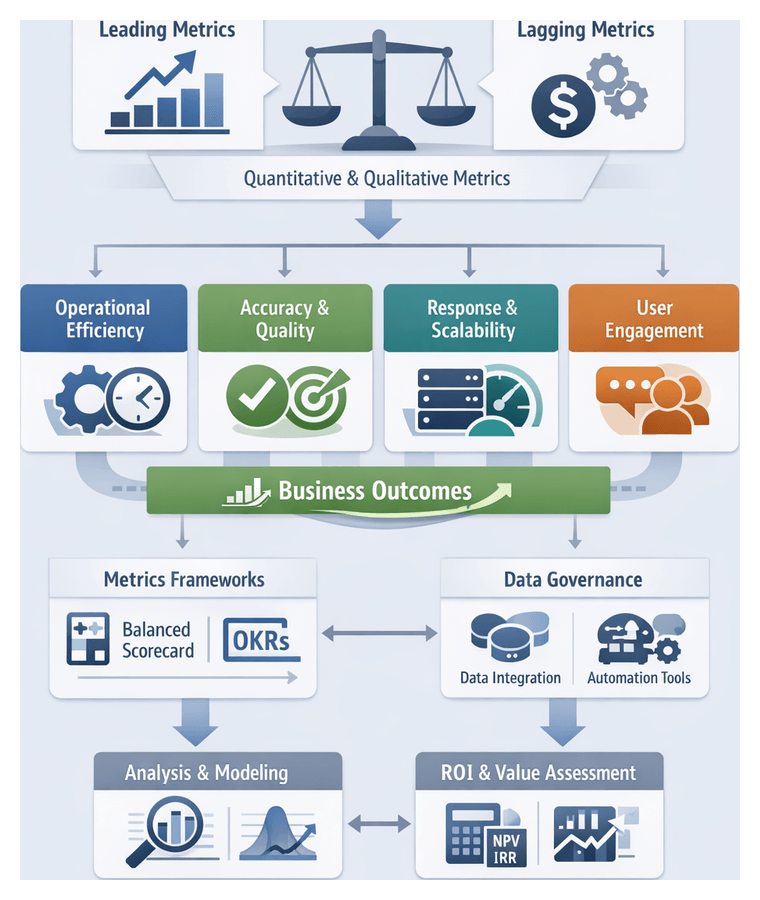
Defining and Selecting Performance Metrics
Evaluating AI agents requires metrics that align with strategic objectives and capture both leading and lagging indicators. Leading metrics—such as early adoption rates and user engagement scores—offer real-time insights into behavioral shifts, while lagging metrics—such as cost savings and throughput gains—reveal realized impact. A balanced metric set integrates quantitative and qualitative measures to ensure comprehensive evaluation without overemphasizing convenience over value creation.
- Operational Efficiency: Task throughput per hour, time saved per task, resource utilization, and idle time reduction quantify direct gains from delegating routine work to agents.
- Accuracy and Quality: Error rates, precision and recall for classification tasks, rework incidence, and consistency scores maintain trust and assess output reliability.
- Response Time and Scalability: Average response time, peak load handling, system uptime, and queue length ensure agents meet service-level expectations under varying demand.
- User Engagement: Adoption rate, interaction frequency, user satisfaction scores, and task handoff rates reflect usability and alignment with workflows.
- Business Outcomes: Cost savings, revenue uplift, payback period, and opportunity cost reduction translate operational improvements into financial value.
Experts recommend mapping these metrics to frameworks such as the Balanced Scorecard or Objectives and Key Results (OKR), ensuring that each measure links to broader goals—whether customer satisfaction, process acceleration, or innovation capacity. Pairing automated performance data with survey feedback uncovers trade-offs between efficiency and user experience, fostering a holistic view of agent impact.
Building a Metrics Framework and Ensuring Data Governance
Crafting a robust metrics framework involves structured planning, alignment with organizational priorities, and integration with enterprise data systems. Metrics must be actionable, comparable over time, and tied to decision-making processes.
- Align with Strategic Goals: Select metrics that map directly to business objectives, such as cost reduction, customer satisfaction, or cycle-time acceleration.
- Define Baselines and Targets: Establish pre-deployment performance levels and realistic improvement goals to measure progress and guide optimization.
- Integrate Data Sources: Leverage system logs, telemetry, ERP and CRM platforms, time-tracking tools, and surveys to gather comprehensive data. For example, AI platforms generate logs accessible via APIs—such as DataRobot—while productivity assistants integrate with Salesforce Einstein. Time-tracking insights may come from Harvest or Toggl.
- Automate Measurement: Deploy dashboards and analytics tools for real-time tracking, alerts on threshold breaches, and automated report generation.
- Review and Refine: Conduct regular audits of metric relevance, adjust targets, retire redundant indicators, and incorporate stakeholder feedback.
Effective data governance underpins metric credibility. Organizations must define clear ownership, establish a single source of truth for each metric, standardize extraction methods, and maintain audit trails documenting calculation logic, data sources, and update frequencies. Governance councils or analytics centers of excellence oversee these processes, ensuring consistency across stakeholder groups and compliance with regulatory requirements.
Analytical Frameworks and Impact Quantification
Quantifying the impact of AI agents combines data collection, statistical modeling, and interpretive frameworks to attribute gains accurately and guide investment decisions.
Business and Performance Management Frameworks
- Balanced Scorecard Adaptations: Extend financial, customer, internal process, and learning perspectives to include AI-specific metrics such as automation coverage and model accuracy.
- Lean Six Sigma Integration: Use DMAIC cycles and control charts to identify waste reduction and process variation improvements driven by AI agents.
- Value Stream Mapping with AI Overlays: Layer agent touchpoints onto workflows to visualize reductions in lead time and manual handoffs.
- Benefit Dependency Networks: Link technical enablers to benefits through causal chains, assigning quantifiable metrics at each stage.
- Capability Maturity Models: Benchmark stages of AI adoption and apply prescribed metrics—such as percentage of tasks automated—to track progress.
Statistical and Econometric Techniques
- Difference-in-Differences Analysis: Compare changes between pilot and control groups to isolate agent effects from external trends.
- Regression Modeling: Use multivariate and fixed-effects models to quantify the influence of agent usage intensity, user experience, and task complexity on outcome metrics.
- Time Series Forecasting: Apply ARIMA or exponential smoothing to compare actual performance against forecasted baselines and attribute deviations to AI deployments.
- Propensity Score Matching: Create comparable groups when pilot participation is voluntary to mitigate selection bias.
- Structural Equation Modeling: Model relationships between latent variables—such as user satisfaction and productivity gains—to examine direct and indirect effects.
Cost-Benefit and Net Present Value Analysis
- Cost Identification: Catalog licensing fees, infrastructure, consulting, support, change management, and training costs. Leverage benchmarks from Tableau Total Economic Impact reports.
- Benefit Quantification: Calculate labor savings, increased capacity, error reduction, and indirect gains such as customer retention and employee satisfaction.
- Time Horizon and Discount Rate: Define evaluation periods (typically three to five years) and select discount rates reflecting organizational cost of capital, conducting sensitivity analyses.
- NPV and IRR: Compute net present value and internal rate of return, ensuring results exceed hurdle rates and highlight payback periods.
- Break-Even Analysis: Identify when cumulative benefits offset initial and recurring costs to inform budgeting decisions.
Benchmarking and Comparative Analysis
- Industry benchmarks from research firms and vendor consortia contextualize performance against sector averages.
- Peer group comparisons within enterprises identify outliers and best practices.
- Historical trend analysis tracks performance across multiple deployment waves to reveal improvement trajectories.
- Cross-technology evaluations compare conversational interfaces, rule-based automation, and other agent platforms.
Implementing ROI Models in Enterprise Settings
In large organizations, ROI models extend beyond simple cost-benefit comparisons to align with strategic goals, financial planning cycles, and enterprise performance metrics.
Defining Costs and Benefits
Direct costs include subscription and licensing fees, cloud infrastructure, integration services, and ongoing maintenance. Indirect costs cover change management, training programs, and governance overhead. Benefits encompass time savings, error reduction, throughput improvements, enhanced decision speed, and qualitative gains in employee engagement and customer satisfaction. Categorize benefits into earnings enhancements, cost avoidance, and strategic enablers for full visibility.
Integration with Financial Frameworks
Embed ROI calculations into capital allocation processes, quarterly forecasts, and continuous monitoring within ERP and business intelligence platforms. Standardize metrics—such as NPV, IRR, and payback period—alongside operational indicators like time-to-market and response latency to ensure AI initiatives compete on equal footing with other transformation projects.
Analytical Approaches and Dashboards
Sensitivity analysis and scenario planning—covering best-case, base-case, and worst-case projections—inform risk-adjusted decisions. Break-even and benefit-cost ratios provide concise efficiency indicators. Advanced analytics platforms such as Microsoft Power BI and Tableau ingest data from agent management consoles to visualize cost-benefit waterfalls, cumulative ROI curves, and rolling payback forecasts. Some enterprises link proprietary calculators directly to project management systems for automated updates as milestones are reached.
Tailoring Models for Business Units
Customize ROI templates to reflect unit-specific KPIs—campaign velocity in marketing, reconciliation cycle times in finance, or compliance risk reduction in legal. Centers of Excellence develop standardized cost categorization while allowing benefit metric customization, ensuring consistency across the enterprise without sacrificing relevance to local objectives.
Capturing Intangible and Strategic Value
Qualitative frameworks—such as the Value Impact Assessment—document improvements in innovation capacity, decision agility, and customer experience that may not translate into immediate revenue but underpin long-term competitiveness.
Governance and Reporting Cadence
Establish cross-functional steering committees to review ROI projections at key decision gates, challenge assumptions, and approve resource commitments. Define reporting schedules—monthly dashboards, quarterly executive summaries, and annual strategic reviews—to maintain accountability and adapt models to shifting priorities, market conditions, and technological advancements.
Reporting, Visualization, and Continuous Improvement
Effective reporting presents metrics within a narrative that resonates with diverse stakeholders. Dashboards should focus on actionable insights, avoid clutter, and employ visual cues—such as color coding and trendlines—to highlight performance against targets. Tailor views for executive, managerial, and operational audiences, ensuring consistency through standardized templates and embedding context with comparative baselines and annotations.
- Define dashboard personas to determine metric access and update frequency.
- Publish metric definitions and calculation methodologies in a shared glossary to foster transparency and common understanding.
- Engage in regular training and documentation updates to reinforce terminology and disclose data source limitations or model biases.
- Implement anomaly detection and validation rules to flag unexpected shifts for manual review.
Pragmatic iteration avoids overengineering. Adopt agile reporting sprints to validate metric relevance, incorporate stakeholder feedback, and introduce new measures as maturity grows. Automate data extraction and transformation pipelines while maintaining governance through periodic quality checks.
Schedule metric retrospectives quarterly or semi-annually to review performance against goals, reassess KPI targets, and determine the need for new metrics. Cultivate data literacy across the organization through training programs and analytics office hours, empowering users to interpret dashboards critically and propose enhancements.
Finally, remain mindful of limitations: attribution complexity, data latency, unintended incentives, benchmark comparability, and privacy concerns. By acknowledging these challenges, embedding ethical safeguards, and continuously refining the framework, organizations can sustain stakeholder trust and drive meaningful, long-term productivity gains from AI agents.
Chapter 8: Customizing AI Solutions for Roles and Industries
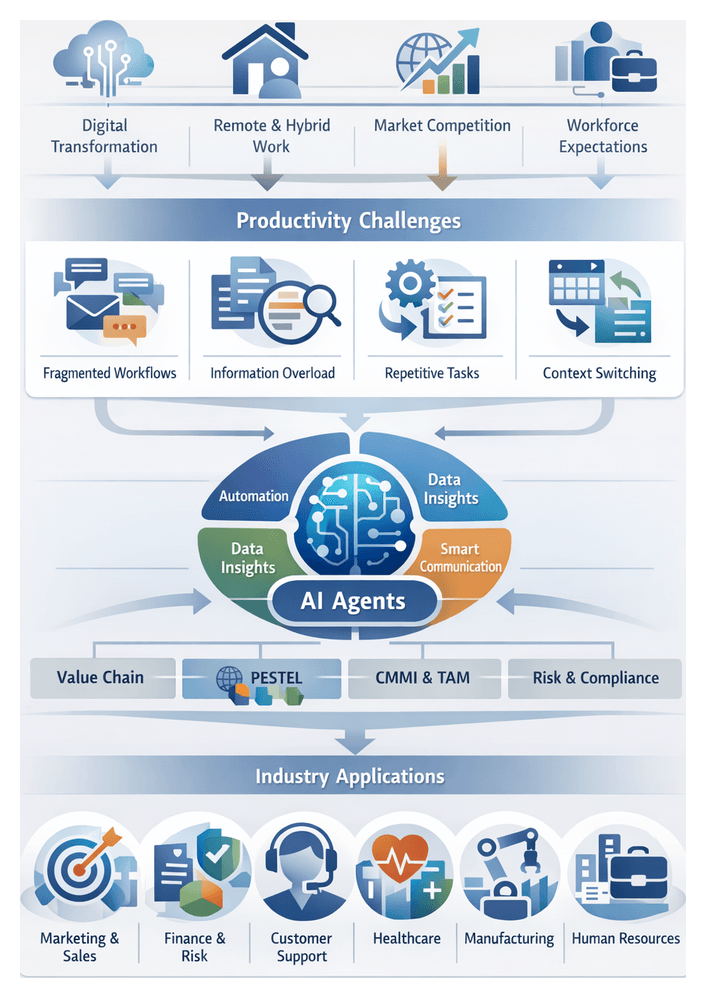
Evolving Productivity Challenges in Modern Workplaces
Over the past decade, work has been redefined by digital transformation, remote and hybrid models, and global competition. Traditional levers such as process tweaks or task delegation no longer suffice to address multi-dimensional efficiency challenges. Fragmented workflows that span email, chat and project management tools undermine end-to-end visibility. Information overload from document repositories and real-time collaboration channels makes locating the right data time-consuming. Constant context switching erodes deep-work intervals while coordination overhead from scheduling meetings and aligning priorities consumes effort with limited direct business value.
Operational bottlenecks often cluster around manual and repetitive tasks—data entry, routine reporting or scheduling coordination—delayed information retrieval due to slow searches or inconsistent metadata, inefficient communication flows with excessive email threads or unstructured chat discussions, and poor task prioritization that obscures high-impact deliverables and disrupts planned work. These constraints divert talent from innovation and customer engagement, threatening sustainable growth and competitive differentiation.
Four key drivers have intensified efficiency pressures. First, organizations pursue digital transformation—cloud migrations, advanced analytics and modern collaboration platforms—creating short-term disruptions. Second, remote and hybrid work expands talent access while complicating coordination, engagement and culture retention. Third, heightened competition and market volatility demand faster decision making, product development and service delivery. Fourth, workforce expectations for autonomy, drudgery reduction and work-life balance require tools that empower employees or risk attrition.
To transcend diminishing returns from incremental improvements, enterprises must rearchitect workflows. Artificial intelligence agents offer a path to automate high-volume tasks, accelerate information synthesis, streamline communication by summarizing discussions and extracting action items, and provide personalized support for prioritization, scheduling and follow-up. Unlike rule-based scripts, agents powered by advanced language models such as ChatGPT continuously learn and generalize across patterns, while solutions like Microsoft Copilot integrate with corporate data to surface contextually relevant insights. Nevertheless, data governance, integration complexity, change management and user adoption must be addressed alongside technical deployment to ensure consistent, reliable value.
Strategic and Analytical Frameworks for AI Agent Deployment
Deploying AI agents effectively requires aligning technological capabilities with domain challenges through strategic and interpretive frameworks. Porter’s Value Chain and PESTEL analysis identify where intelligent automation can reduce costs or enhance differentiation. Digital maturity assessments and the Capability Maturity Model Integration (CMMI) gauge data readiness and process standardization, while the Technology Acceptance Model (TAM) and Innovation Diffusion Theory inform change-management strategies by highlighting perceived usefulness, ease of integration and stakeholder endorsement.
In regulated industries, risk-based frameworks such as Basel III or ISO 27001 guide compliance and model governance. Health Technology Assessment methodologies and Technology Readiness Levels (TRL) assess suitability in healthcare, whereas stress-testing and scenario analysis models underpin financial forecasting and risk committees. Overall Equipment Effectiveness (OEE) benchmarks drive manufacturing optimizations, while service maturity models and customer effort score frameworks shape support deployments.
Data governance and privacy imperatives span sectors, with frameworks like NIST’s Privacy Framework, GDPR, HIPAA and MiFID II informing data classification, access controls and lifecycle management. Practices such as federated learning and synthetic data generation balance innovation with privacy, and continuous monitoring of data quality scores and incident response metrics sustains compliance without impeding performance. These structured approaches enable organizations to design AI agent strategies that align with business objectives, enhance operational resilience and sustain strategic agility.
Functional AI Agent Applications Across Industries
Marketing and Sales
In marketing and sales, AI agents optimize personalization, segmentation and revenue operations. Predictive analytics and clustering algorithms enable audience segmentation, with platforms like Adobe Sensei and HubSpot AI identifying high-value segments and look-alike audiences. Natural language generation and adaptive creative assembly support dynamic content personalization, validated through A/B and multivariate testing. Real-time campaign optimization leverages reinforcement learning to adjust bids and budgets, while causal inference modules on analytics dashboards isolate true performance gains.
Sales operations benefit from revenue intelligence agents that score leads, forecast pipelines and automate outreach. Salesforce Einstein integrates firmographic, behavioral and intent data to guide SDRs and AEs toward high-probability opportunities. Conversation intelligence agents transcribe calls to extract sentiment cues, objection patterns and competitive mentions for continuous coaching. Pipeline forecasting models combine historical deal data with real-time signals to predict close dates and deal size variance, feeding scenario analysis dashboards for revenue officers.
Finance and Risk Management
Finance organizations apply AI agents to planning, forecasting and compliance. Ensemble learning techniques power revenue, expense and cash flow forecasting under multiple macroeconomic scenarios, with solutions such as IBM Watson for Financial Services offering natural language interfaces for dynamic interrogation of forecasts. Anomaly detection agents monitor transaction patterns and market chatter for fraud and compliance breaches, integrating outputs into governance, risk and compliance (GRC) platforms. AI-driven automation streamlines regulatory reporting by aggregating, reconciling and drafting narratives for financial disclosures and tax filings.
Risk committees employ stress-testing methodologies, value-at-risk models and tiered risk-appetite frameworks to interpret agent outputs. Analytical metrics include forecast accuracy, value-at-risk deviation and compliance incident reduction, while interpretive lenses map results to Basel III, IFRS and Sarbanes-Oxley requirements. These capabilities enhance audit readiness and support strategic capital allocation.
Customer Support
Customer support functions deploy AI agents to improve service levels and satisfaction. Natural language understanding agents like Zendesk AI and Intercom Assist triage inquiries across chat, email, voice and social channels, classifying issues by category, urgency and required expertise. Knowledge base optimization agents analyze interactions to identify content gaps and generate article updates based on frequency and impact. Predictive models flag at-risk customers for proactive outreach, measuring success against churn baselines and lifetime value uplift.
Key performance indicators include first-contact resolution, average handle time, CSAT and NPS scores. Sentiment-driven escalation thresholds ensure that high-value or emotionally charged cases receive immediate human intervention, while omnichannel integration frameworks preserve case histories and reduce handoff friction.
Healthcare and Life Sciences
In healthcare, AI agents support clinical decision making and regulatory adherence. Clinical decision support systems must meet sensitivity and specificity standards, with predictive triage agents aligned to FDA guidelines and HIPAA privacy rules. Algorithms are evaluated through Technology Readiness Levels and Health Technology Assessment frameworks, embedding bias detection and transparency within ethical governance models. Outcome metrics such as diagnostic accuracy, readmission rates and treatment adherence inform adoption decisions.
Manufacturing and Supply Chain
Manufacturers leverage AI agents for predictive maintenance and process optimization by integrating IoT sensor data with agent algorithms. Overall Equipment Effectiveness benchmarks guide improvements in availability, performance and quality yield. Demand forecasting agents capture seasonal patterns and supplier lead times, with digital twin simulations and scenario-based supply chain risk mapping validating recommendations. Inventory optimization models balance carrying costs against service levels.
Human Resources and Legal
HR and legal teams adopt AI agents for knowledge work automation and risk mitigation. Resume-screening agents aim to reduce bias and match candidates to roles, while contract-analysis agents extract clauses and flag compliance issues under ISO 37301 standards. Fairness and bias detection frameworks ensure equitable outcomes, and transparent decision logs support audit readiness. Policy management agents track regulatory changes, measuring update latency and coverage completeness.
Cross-Industry Data Governance and Privacy
Across all sectors, AI agent deployments depend on robust data governance. Frameworks such as NIST’s Privacy Framework, ISO 27001 and domain-specific standards guide data classification, access controls, lineage transparency and encryption. Federated learning and synthetic data generation enable innovation while preserving privacy. Continuous monitoring of data quality scores, privacy impact assessments and incident response metrics ensures compliance without sacrificing performance, with periodic audits and external certifications validating readiness.
Tailoring AI Agents for Industry Impact
Customizing AI agents for specific roles and industries demands an analytical, disciplined approach that integrates domain expertise, maintains data integrity and embeds continuous improvement.
Domain Expertise and Integration
- Assemble multidisciplinary teams of data scientists, developers and domain professionals to co-design logic, ontology mappings and decision thresholds.
- Incorporate established frameworks—such as RFM in marketing or the COSO internal control framework in finance—to ground agent reasoning in domain standards.
- Run pilot programs within representative organizational segments to test assumptions, refine knowledge bases and calibrate confidence scores before enterprise rollout.
Data Quality and Curation
- Audit data lineage for completeness, accuracy and timeliness, ensuring traceability in regulated environments.
- Ensure representative datasets that include diverse scenarios, customer segments and edge cases to avoid skewed outcomes.
- Implement continuous data curation pipelines with integrations to enterprise platforms like Snowflake and Salesforce to maintain up-to-date training sets.
Iterative Refinement and Governance
- Embed user feedback channels within the agent interface for rating responses and flagging errors to accelerate retraining cycles.
- Monitor performance via dashboards powered by Power BI or Tableau, tracking accuracy, resolution time and satisfaction metrics.
- Use A/B testing and control groups to compare model variants on key metrics and identify optimal configurations.
- Define processes for version control and approvals, assigning clear roles—model owner, data steward and compliance lead—for accountability.
Compliance, Security and Ethics
- Adopt privacy-preserving techniques—anonymization, differential privacy or federated learning—to protect sensitive data.
- Implement bias detection and mitigation through pre- and post-processing checks, following frameworks from bodies like the Partnership on AI.
- Enforce role-based access controls, encryption of data at rest and in transit, and regular penetration testing aligned with ISO 27001 or SOC 2.
- Map agent behaviors to statutes—GDPR, HIPAA or MiFID II—and maintain documentation for auditors and regulators.
Change Management and Adoption
- Secure executive sponsorship to articulate strategic imperatives and allocate resources for integration and training.
- Communicate clear value propositions around productivity gains, error reduction and customer experience improvements.
- Develop role-based training—online modules, workshops and quick-reference guides—to help users interpret and act on agent outputs.
- Establish governance forums to review performance, prioritize enhancements and address workflow or policy concerns.
Scalability and Lifecycle Management
- Design modular architectures that decouple core AI services—language understanding, knowledge retrieval and business logic—from domain-specific components for reuse and easier upgrades.
- Manage models, schemas and orchestration scripts as code using version control with clear tags, change logs and rollback mechanisms.
- Optimize compute resources through techniques such as model distillation and GPU scheduling to control cloud costs.
- Define criteria for sunsetting outdated agent versions and retraining cycles to prevent security vulnerabilities and compliance gaps.
Metrics and Success Criteria
- Align domain KPIs—lead conversion uplift, forecast accuracy, first-contact resolution rates—to measure operational and strategic impact.
- Monitor user engagement—utilization rates, active user counts and session durations—to identify adoption barriers and confidence levels.
- Conduct cost-benefit analyses comparing investments in data preparation and integration to gains in productivity, error reduction and customer value.
- Benchmark performance periodically against industry standards and peer data using third-party reports or consortium metrics.
By uniting domain expertise with robust data practices, structured feedback and rigorous governance, organizations can transform generic automation into domain-tailored intelligence. This disciplined approach ensures AI agents deliver sustainable productivity gains, maintain stakeholder trust and adapt to evolving industry demands.
Chapter 9: Ethical, Security, and Compliance Considerations
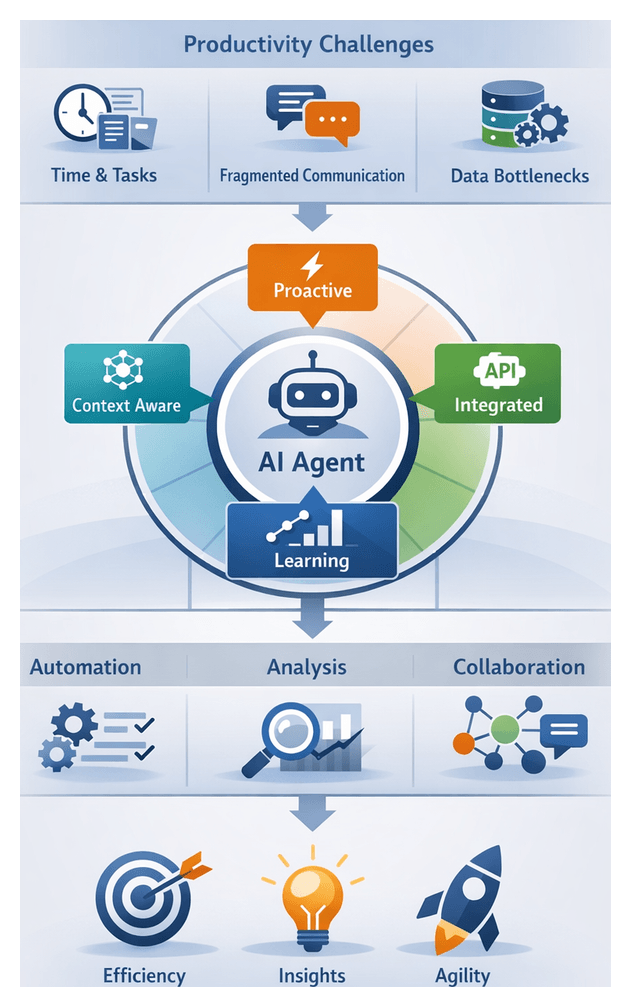
Contextualizing Productivity Challenges and AI Agent Solutions
Modern Productivity Pressures
Organizations across industries face mounting demands for speed, accuracy and scalability in work processes. Advances in digital technology have raised expectations while workforce demographics and flexible work models require adaptable solutions. Remote and hybrid work dynamics amplify coordination challenges, with time zone differences, virtual meeting fatigue and asynchronous communication creating noise-to-signal bottlenecks. Meanwhile, the proliferation of specialized software—project management, CRM, HR, finance and more—forces employees into frequent context switching and manual data reconciliation, eroding efficiency and satisfaction.
Routine administrative tasks such as scheduling, expense reporting and data entry consume 30 to 40 percent of employee time, limiting capacity for strategic assignments. Rapid automation of low-value activities elevates the skill requirements for high-impact work, creating frustration when workers oscillate between repetitive duties and complex analyses without adequate support. Real-time data streams and collaborative platforms promise enhanced decision making, yet constant notifications and multiple dashboards contribute to cognitive overload and burnout.
Operational Bottlenecks and the Need for Intelligence
Common productivity bottlenecks include:
- Manual handoffs and approval loops that delay project timelines.
- Fragmented communication channels leading to misalignment and rework.
- Decision latency caused by data collection, stakeholder alignment and risk assessments.
- Resource allocation inefficiencies due to static planning tools and outdated assumptions.
- Pre-analysis overhead in data-driven operations, as analysts spend hours on data cleaning and reconciliation.
Traditional tools—spreadsheets, static dashboards and rule-based automation—offer limited relief. They struggle with unstructured data, require manual upkeep and cannot adapt to new scenarios. The result is incremental gains overshadowed by persistent friction and lost opportunities in fast-moving markets.
AI Agents as Strategic Enablers
AI agents synthesize data, algorithms and user-centric design to function as digital coworkers. Their core attributes include:
- Context Awareness—understanding roles, tasks and organizational priorities.
- Proactive Assistance—anticipating needs and triggering actions without explicit prompts.
- Natural Language Interaction—engaging via conversational queries.
- Integration Capability—connecting to multiple systems via APIs for seamless data exchange.
- Continuous Learning—refining performance over time based on user behavior and outcomes.
By automating routine interactions, surfacing relevant information proactively and learning patterns of work, AI agents free human capital for higher-order activities, reduce error rates and accelerate decision cycles.
Illustrative AI-Driven Tools
Leading platforms demonstrate the transformative potential of AI agents:
- Microsoft Copilot—integrates with Office workflows to draft emails, summarize meetings and automate data analysis.
- ChatGPT—serves as a versatile conversational agent for brainstorming, research synthesis and code generation.
- IBM Watson OpenScale—provides adversarial evaluation and fairness testing for AI models.
- Google Bard—enables creative ideation and natural language queries across enterprise data.
Analytical Foundations of Security and Bias Risk Assessment
Key Risk Domains
- Data Privacy Vulnerabilities—evaluated through privacy impact assessments and principles of data minimization, aligned with standards such as GDPR and CCPA.
- Algorithmic Bias and Fairness—measured using statistical parity, equalized odds and domain-specific fairness criteria to detect disparate impacts.
- Cybersecurity Threats—assessed via threat modeling, attack surface analysis and adversarial testing to guard against model inversion, data poisoning and unauthorized access.
Risk Identification Methodologies
- Threat Modeling—using STRIDE and PASTA frameworks to map adversaries, attack vectors and system assets across the AI lifecycle.
- Fairness Audits and Bias Testing—running controlled experiments with synthetic and real-world datasets, employing counterfactual analysis and distributional impact assessments.
- Privacy Impact Assessments—tracing data lineage, evaluating consent mechanisms and assessing reidentification risks with guidance from bodies such as the IAPP.
- Adversarial Evaluation—simulating evasion and poisoning attacks to test model robustness, supported by tools like IBM Watson OpenScale.
Evaluation Metrics
- Privacy Leakage Metrics—differential privacy epsilon values balancing exposure risks and utility.
- Bias and Fairness Indicators—statistical parity difference, disparate impact ratio and equal opportunity difference, with thresholds triggering remediation.
- Security Incident Frequencies—mean time to detect, mean time to respond and incident recurrence rates offering dynamic security posture insights.
- Model Robustness Scores—attack success rates and perturbation thresholds guiding hardening and retraining priorities.
Relevant Standards and Frameworks
- ISO/IEC 27001—information security management standard extended with AI-specific controls.
- NIST AI Risk Management Framework—guidelines for privacy, fairness and explainability under https://www.nist.gov/ai.
- EU AI Act—risk-based regulation mandating conformity assessments for high-risk AI systems.
- IEEE Ethically Aligned Design—ethical principles and recommendations for human-centered AI governance.
Regulatory and Governance Imperatives for AI Agents
Regulatory Landscape
AI agent deployment is influenced by a complex mosaic of regulations. In Europe, the EU AI Act introduces risk-based categories and requirements for high-risk systems while GDPR governs data handling, consent and transparency. In the United States, sector-specific rules such as HIPAA and the Fair Credit Reporting Act and state regimes like CCPA impose rights over personal data. Emerging laws—such as New York City’s Automated Decision Systems Law and Singapore’s Model AI Governance Framework—address algorithmic fairness, bias audits and explainability, creating strategic imperatives for compliance and public trust.
Global and Cross-Border Considerations
Multinational organizations navigate differing data sovereignty and consent obligations under laws like China’s PIPL and EU transfer restrictions. To manage these requirements, enterprises implement data segmentation, regional data centers and hybrid compliance frameworks that harmonize local mandates with internal policies. International guidelines such as the OECD AI Principles and G20 AI Principles, though nonbinding, influence policy development and industry norms, guiding global ethical codes and facilitating regulator dialogues.
Governance Models
Enterprises adopt one of three governance architectures:
- Centralized—a dedicated AI or data governance office defines policies, compliance processes and oversight, ensuring consistency but risking slower domain-specific responses.
- Decentralized—business units manage policies and implementations locally, enhancing agility but requiring shared toolkits and audits to maintain alignment.
- Federated—a central council sets strategic principles and risk thresholds while teams retain tactical autonomy, balancing standardization with flexibility.
Organizational Impacts
AI governance transforms structures and processes. Legal and compliance teams serve as AI ethics advisors, information security adapts controls for adversarial risks, and risk management integrates AI risks into enterprise registers. New AI initiatives undergo gated reviews—including ethical impact assessments, bias audits and technical validations—before production deployment. Continuous monitoring platforms automate logging of inputs, model versions and decisions, with dashboards tracking performance, fairness metrics and anomalies. Training programs on algorithmic fairness, privacy risks and explainability foster a culture of shared accountability.
Ethical Stewardship and Accountability
Governance Structures
- Steering committees with representation from ethics, legal, IT and business units guide AI policy formulation.
- Defined approval processes include ethical impact assessments and formal risk sign-offs.
- Dedicated roles—AI ethics officers, data stewards—maintain ongoing accountability for agent behavior and outcomes.
- Documentation of governance decisions ensures transparency and auditability.
Explainability and Transparency
- Model cards and datasheets describe training data, intended use cases and known limitations.
- Explainability techniques—feature attribution, counterfactual analysis—are integrated into workflows for critical decisions.
- Third-party auditors validate explanation methods and identify blind spots.
- End users receive information on limitations and confidence levels to manage expectations.
Stakeholder Engagement
- Workshops and focus groups gather input on ethical priorities and acceptable risk thresholds.
- Transparent channels allow reporting of unintended outcomes and suspected biases.
- Educational materials explain AI agent roles, benefits and safeguards.
- Sentiment and trust metrics are monitored to identify emerging concerns and refine communication.
Auditability and Continuous Monitoring
- Comprehensive logging of inputs, model versions, decisions and user interactions.
- Monitoring dashboards track performance, fairness indicators and operational anomalies.
- Regular internal and external audits validate compliance with ethical policies and regulations.
- Automated tools flag model drift and data distribution changes, triggering review processes.
Data Privacy and Security Safeguards
- Apply data minimization—collect only data necessary for agent functions.
- Adopt privacy-enhancing technologies—differential privacy, federated learning and encryption in transit and at rest.
- Conduct regular security assessments and penetration tests of AI infrastructure.
- Ensure compliance with data subject rights—transparency, access, rectification and erasure.
Bias Identification and Mitigation
- Bias detection pipelines combine quantitative metrics—demographic parity, equalized odds—with qualitative expert reviews.
- Diverse and representative data sets are used during training to reduce exclusion risks.
- Human-in-the-loop checkpoints ensure expert oversight of high-stakes decisions.
- Remediation strategies are documented and version controlled to track effectiveness over time.
Culture, Training and Future-Proofing
- Ethics training modules introduce fairness, accountability and transparency in the context of AI agent use cases.
- Scenario-based workshops allow teams to practice ethical decision-making on real-world dilemmas.
- Recognition and rewards reinforce ethical behavior and organizational commitment to responsible AI.
- Technology monitoring functions and partnerships with academic institutions inform updates to ethical guidelines and controls.
Chapter 10: Scaling and Future Trends in AI Agent Adoption
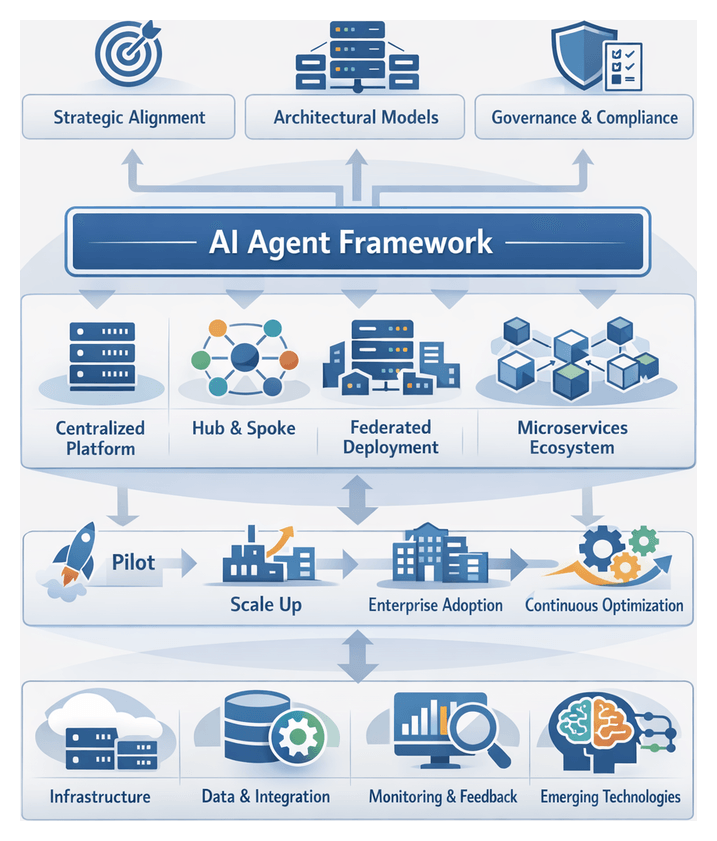
Contextualizing Enterprise-Scale AI Agent Frameworks
As organizations transition from pilot programs to full-scale deployments, establishing a cohesive framework for AI agents becomes imperative. A robust scaling framework prevents fragmented efforts, aligns agent capabilities with strategic objectives, and supports consistent performance across diverse business units and geographies. By laying out structural blueprints for governance, infrastructure and continuous improvement, enterprises ensure sustainable growth and streamlined operations as their AI agent initiatives mature.
Strategic Foundations and Architectural Models
Strategic Alignment and Use Case Prioritization
Scaling AI agents begins with clear linkage to business goals—be it revenue growth, cost reduction, risk mitigation or enhanced customer experience. Cross-functional collaboration between executive sponsors, IT, data science and business stakeholders is essential to define success criteria, establish value metrics tied to organizational KPIs, and secure sustained funding. Prioritizing use cases based on impact and feasibility balances centralized oversight with localized customization, while embedding agility allows the framework to evolve alongside emerging requirements and technologies.
Architectural Models for Scalability
- Centralized Platform Model: A managed environment hosts agents, data repositories and integration services under unified governance. Standardized APIs and security controls drive consistency, though capacity planning is critical to handle peak demand.
- Hub-and-Spoke Pattern: A core “hub” delivers shared services—model repositories, orchestration engines and monitoring dashboards—while “spokes” enable business-unit-specific deployments, balancing governance with domain agility.
- Federated Deployment Approach: Centralized governance coexists with distributed compute and data pipelines near business units, accommodating regulatory constraints and latency requirements within a shared framework.
- Microservices-Based Ecosystem: Decomposed agent functions—intent recognition, data ingestion, action execution—communicate via lightweight APIs. This promotes independent scaling and resilience, at the cost of increased orchestration complexity.
Phased Rollout and Governance for Scalable Adoption
Phased Maturity Stages
- Pilot and Proof of Concept: Validate core capabilities in controlled settings, measure performance against initial metrics and identify integration blockers.
- Minimum Viable Deployment: Introduce agents to a limited production audience, establish basic governance and support structures, and refine behaviors using user feedback.
- Incremental Expansion: Onboard additional units or regions, enhance platform resilience, implement role-based access controls and optimize data pipelines for increased load.
- Enterprise-Wide Adoption: Integrate agents into core workflows, launch self-service developer portals, adopt CI/CD pipelines for agent updates and deploy advanced monitoring for proactive issue resolution.
- Continuous Improvement and Optimization: Maintain feedback loops, data-driven tuning, periodic governance reviews and expand agent capabilities with new AI models and multimodal interfaces.
Governance, Risk and Compliance Considerations
- Policy Definition: Formalize data usage, privacy, retention and access policies across agent interactions.
- Risk Assessment: Conduct audits to detect biases, security gaps and compliance issues in agent decision-making.
- Role-Based Stewardship: Assign responsibilities for administration, model validation, incident response and user support.
- Change Management: Implement structured processes for updates, retraining, version tracking and rollback capabilities.
- Regulatory Alignment: Map agent functions to industry regulations and document compliance evidence for audits.
Infrastructure Foundations for Scalability
- Compute Elasticity: Utilize cloud services such as Microsoft Azure AI, Google Vertex AI or OpenAI API endpoints to auto-scale resources based on workload demands.
- Containerization and Orchestration: Adopt Kubernetes or serverless architectures to manage microservices, ensuring portability and efficient resource utilization.
- Data Architecture: Implement scalable data lakes and warehousing solutions to centralize structured and unstructured data for training, inference and feedback logging.
- Integration Layer: Deploy API gateways or service meshes to route requests between agents, enterprise systems and backend services.
- Monitoring and Observability: Establish end-to-end telemetry for latency, throughput, error rates and decision quality, using dashboards that surface anomalies early.
Continuous Feedback and Improvement Loops
Iterative refinement is foundational to scaling frameworks. Organizations should collect quantitative metrics on accuracy, response times and user engagement, while soliciting qualitative feedback on usability and trust. Integrating monitoring data with automated retraining pipelines addresses model drift, and periodic governance forums prioritize new capabilities and retire outdated agents, ensuring alignment with evolving business needs.
Forecasting Emerging Agent Technologies
Interpretive Frameworks for Technology Forecasting
- Gartner Hype Cycle: Visualizes progression from innovation trigger through inflated expectations to stable productivity, guiding pragmatic adoption.
- Technology Readiness Levels (TRL): Assesses maturity from basic research to proven operational use, facilitating effective R&D resource allocation.
- Diffusion of Innovations: Categorizes adopters from innovators to laggards, helping benchmark momentum and plan rollouts.
Advances in Natural Language Understanding and Generation
- Contextual Depth: Improved multi-turn dialogue coherence reduces semantic drift, benchmarked on complex inquiries and domain-specific corpora.
- Controlled Generation: Retrieval-augmented generation and reinforcement learning from human feedback lower hallucination rates and boost citation reliability.
- Multilingual Fluency: Cross-lingual understanding and translation fidelity preserve tone and intent, supporting global enterprises.
Platforms such as ChatGPT and Google Bard exemplify this trajectory by refining instruction following and integrating real-time web data for accuracy.
Autonomous Learning and Adaptive Agents
- On-Device Adaptation: Federated learning protocols enable local fine-tuning to individual user preferences, enhancing personalization while preserving privacy.
- Reinforcement-Driven Workflows: Agents sample user feedback as reward signals, adjusting task prioritization and communication styles, measured by convergence rates and satisfaction indices.
- Self-Optimization Loops: Meta-learning capabilities allow agents to propose enhancements to their own logic, with complexity measures and guardrails preventing policy drift.
Enterprise implementations such as Anthropic Claude explore safe reinforcement strategies and continuous learning modules that refine process automation over time.
Multimodal Interfaces and Interaction Paradigms
- Vision-to-Action Workflows: Agents interpret images and video streams to extract data and initiate tasks, evaluated on real-world task success rates.
- Conversational UI Expansion: Voice interfaces support hands-free operation in manufacturing, field service and healthcare, measured by recognition accuracy and response latency.
- Augmented Reality Collaboration: Future agents overlay contextual data in AR devices to guide hands-on tasks, with adoption tracked through pilot ROI and training time reductions.
Organizational Strategies and Talent Enablement
Workforce Planning and Talent Management
- Reskilling and Upskilling: Continuous learning platforms equip employees to supervise, co-develop and fine-tune AI agents.
- Role Redesign: Emphasize AI orchestration responsibilities, monitoring biases and interpreting agent insights.
- Agile Talent Networks: Engage AI specialists on demand to rapidly scale projects without permanent headcount increases.
Digital Transformation and Business Models
- Platform Thinking: Transition from product-centric to platform-centric models, composing modular AI services into new offerings.
- Data Monetization: Leverage agent-generated metadata to create advanced analytics and predictive services revenue streams.
- Customer Experience Reinvention: Enable hyper-personalization at scale, shifting from mass to one-to-one engagement strategies.
Cultural Adaptation and Continuous Innovation
- Rapid Prototyping: Validate hypotheses through small-scale pilots with clear metrics before enterprise rollout.
- Feedback Channels: Structured end-user input and incident reporting drive iterative agent refinement.
- Agile Governance: Lightweight approval pathways support incremental enhancements without bureaucratic delays.
- Innovation Incubators: Dedicated labs explore experimental use cases and novel interfaces for future productionization.
Strategic Partnerships and Ecosystems
- Technology Alliances: Collaborate with providers like Microsoft Copilot, ChatGPT and IBM Watson for early access and co-development.
- Academic Collaborations: Partner with universities and think tanks to accelerate advances in multimodal learning and explainable AI.
- Industry Consortiums: Establish shared data standards, interoperability protocols and governance guidelines for responsible scaling.
Ethical Stewardship, Governance Maturity and Risk Oversight
Ethical Governance Structures
- Governance Council: Include legal, compliance, IT and business stakeholders to balance technical and strategic oversight.
- Defined Roles: Assign data stewards, model owners and ethics advisors to clarify decision rights and risk ownership.
- Review Checkpoints: Embed ethical reviews into the agent lifecycle for bias testing and transparent deployment decisions.
- Policy Evolution: Continuously update governance policies to reflect regulations, standards and lessons from incident reviews.
Measuring Success and Addressing Limitations
- Operational KPIs: Track throughput, latency, task completion and error rates for efficiency insights.
- Adoption Metrics: Monitor active users, interaction frequency and satisfaction to gauge acceptance.
- Governance Indicators: Audit model drift, bias reports and compliance incidents to ensure risk controls.
- Value Realization: Link cost savings, revenue gains and risk mitigation to business objectives.
Addressing limitations—data quality, model opacity, regulatory uncertainty and change fatigue—requires rigorous data governance, explainable AI techniques, proactive policy monitoring and empathetic change management.
Cross-Functional Alignment
- Executive Sponsorship: Visible C-level support underscores strategic priority and unlocks resources.
- Steering Committees: Representative bodies meet regularly to review progress, resolve impediments and recalibrate objectives.
- Community of Practice: Central hubs share best practices, reusable components and lessons learned.
- Transparent Roadmaps: Publicly communicate development timelines to set clear expectations and foster trust.
Long-Term Outlook on AI Agent Evolution
- Self-Optimizing Agents: Continuously refine workflows based on performance feedback, reducing manual retraining cycles.
- Multimodal Interaction Models: Seamlessly combine text, voice and visual inputs for broader accessibility and integration.
- Decentralized Architectures: Leverage federated learning and edge computing to enable secure, distributed agent operations.
- Collaborative Agent Networks: Coordinate specialized agents to orchestrate end-to-end processes across organizational boundaries.
Investing in research partnerships, open-source contributions and a culture that embraces transformative shifts positions organizations to harness AI agents as enduring catalysts for ethical, value-driven growth.
Conclusion
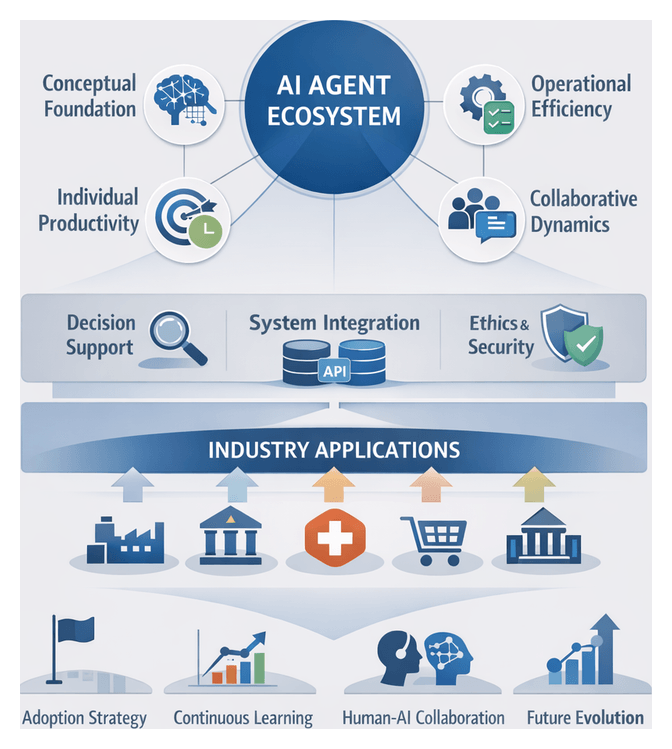
Recap of AI Agent Framework and Strategic Value
AI agents have emerged as adaptive partners that learn, contextualize, and execute workflows ranging from repetitive administrative tasks to strategic decision support. These systems combine artificial intelligence, machine learning, and process automation to interpret natural language, integrate diverse data sources, and evolve through user interaction. By reframing AI agents as modular, interoperable components rather than isolated tools, organizations can build a cohesive productivity ecosystem that delivers sustained performance gains.
- Conceptual Foundation: AI agents leverage large language models, computer vision, and reinforcement learning to perform tasks autonomously or semi-autonomously, adapting to user preferences and evolving business contexts.
- Operational Efficiency: Automating scheduling, email triage, document processing, and other administrative workflows reduces manual overhead, error rates, and cycle times, freeing knowledge workers for higher-value activities.
- Individual Productivity: Personal assistants track work patterns, suggest task prioritization, and enforce focus intervals, resulting in measurable reductions in task-switching time and increases in deep work periods.
- Collaborative Dynamics: Agents embedded in platforms such as Google Workspace and Microsoft Teams facilitate real-time co-authoring, meeting facilitation, and project coordination, accelerating consensus building and accountability.
- Decision Support: Knowledge-management agents index unstructured data, apply semantic search and summarization, and deliver actionable insights for strategic planning, risk analysis, and scenario modeling.
- System Integration: API-first designs, standardized data schemas, and low-code platforms enable seamless embedding of agents into CRM, ERP, HR, and collaboration suites while maintaining data governance and security.
- Performance Measurement: Key performance indicators—throughput, error reduction, time saved, and user satisfaction—link directly to ROI models, guiding investment decisions and continuous optimization.
- Customization and Scalability: Role- and industry-specific tuning, iterative feedback loops, and scalable cloud-native architectures ensure agents maintain relevance, accuracy, and performance as use cases expand.
- Ethics, Security, and Governance: Bias mitigation, end-to-end encryption, transparent decision logic, and alignment with standards such as GDPR and HIPAA build trust and support responsible AI at scale.
Emergent Patterns in AI Agent Deployment
The most transformative implementations view AI agents as an interconnected ecosystem rather than discrete point solutions. Five strategic patterns consistently drive exponential returns:
Integrated Ecosystems
When administrative, personal, collaborative, and knowledge agents share context and data, they amplify each other’s impact. A unifying data strategy and clear process taxonomy enable scheduling agents to inform document preparation, and collaboration agents to feed real-time updates into decision-support models. Platforms such as Microsoft Copilot exemplify multi-agent orchestration and unified governance.
Adaptive Intelligence and Continuous Learning
Leading practices embed feedback loops that refine agent behaviors based on user corrections, performance metrics, and contextual signals. Regular auditing cycles—where stakeholders review outputs, flag errors, and update training data—prevent model drift and sustain trust. Performance dashboards surface learning trends, anomalies, and optimization opportunities, ensuring agents evolve with changing business needs.
Human-AI Collaboration
Agents function most effectively as collaborators. Three archetypes of collaboration drive productivity and innovation:
- Assistive Augmentation: Agents manage routine data processing and pattern recognition, allowing humans to focus on strategy, creativity, and relationship-building.
- Co-creative Workflows: Generative agents draft content, visualizations, or code that human experts review and contextualize, accelerating ideation and delivery.
- Decision Co-piloting: Agents surface scenario analyses, risk assessments, and predictive insights while human decision-makers apply judgment and domain expertise.
Trust hinges on transparent interfaces, confidence scores, and easy override mechanisms, ensuring users retain ultimate control.
Governance and Ethical Maturity
Sustainable, enterprise-wide adoption depends on robust governance frameworks that integrate policy, process, and culture. Key enablers include codified ethical principles, cross-functional oversight bodies, and technical capabilities for auditability and traceability. Metrics such as the proportion of projects undergoing ethical review and frequency of risk assessments benchmark maturity against standards like the OECD AI Principles and ISO/IEC 42001.
Domain-Specific Customization and Agility
Customized agents trained on high-quality, domain-relevant datasets deliver targeted value. Modular architectures and agile feedback channels with subject-matter experts enable rapid iteration. Financial firms, marketing agencies, and customer-support centers exemplify how tuned agents embed proprietary language, workflows, and compliance requirements to create competitive differentiation.
Industry Implications for Sustainable Productivity
AI agents redefine productivity across sectors by optimizing operational efficiency, enhancing strategic agility, and invigorating workforce engagement. While core imperatives are consistent, use cases vary by industry:
- Manufacturing: Predictive maintenance, quality-inspection agents with computer vision, and supply-chain orchestration yield leaner operations and reduced downtime.
- Finance and Risk Management: Underwriting assistants, fraud detection agents, and compliance trackers accelerate loan approvals, enhance security, and automate audit trails.
- Healthcare and Life Sciences: Virtual triage, clinical-decision support, and claims-processing agents streamline patient care, improve outcomes, and contain costs.
- Retail and Consumer Experience: Demand-forecasting, personalized recommendation, and customer-service bots boost conversion rates, loyalty, and operational responsiveness.
- Professional Services: Knowledge-retrieval, proposal-automation, and project-management agents enable rapid research, tailored pitches, and real-time engagement tracking.
- Public Sector: Virtual assistance platforms, regulatory monitoring, and infrastructure-management agents modernize citizen services, improve transparency, and reduce costs.
Success factors include alignment with measurable business goals, robust governance, and continuous adaptation through retraining and performance monitoring. Risk mitigation strategies—layered human review, clear data lineage, and cross-functional oversight—protect organizational integrity and drive resilient productivity improvements.
Long-Term Evolution of AI Agents
Over the next decade, AI agents will transition from point solutions to strategic collaborators embedded across functions. Maturity models guide organizations through stages: experimentation, interdependent workflows, enterprise-wide deployment, and continuous optimization. Key long-term considerations include:
- Workforce and Culture: New roles—agent trainers, ethics stewards, AI workflow architects—will emerge. Upskilling programs in AI literacy, critical thinking, and human-machine collaboration are essential to maintain trust and autonomy.
- Interoperability: Open architectures, standardized data formats, and agent-to-agent communication protocols prevent silos and enable dynamic task delegation within secure governance boundaries.
- Ethics and Regulation: Evolving compliance landscapes for algorithmic accountability, data sovereignty, and explainability demand continuous alignment and proactive bias testing.
- Security and Resilience: Continuous threat intelligence, adversarial-testing simulations, and anomaly detection in agent logs protect against sophisticated attacks targeting autonomous systems.
- Environmental Sustainability: Monitoring compute utilization and carbon metrics drives optimization of training schedules and resource allocation to meet ESG commitments.
- Innovation Ecosystems: Partnerships with academia, startups, and consortia accelerate capability development, ethical frameworks, and external validation of agent models.
- Systemic Risk Management: Scenario-planning and stress tests for multi-agent interactions anticipate emergent behaviors under extreme conditions, guiding contingency planning.
Strategic Roadmap for AI Agent Adoption
To embed AI agents as core productivity enablers, organizations should follow a phased approach:
- Strategic Assessment: Identify high-impact processes, align agent use cases with performance objectives, and define success metrics.
- Pilot and Validation: Deploy agents in controlled environments, measure outcomes against KPIs, gather user feedback, and refine models.
- Scale and Integration: Expand across business units with interoperable frameworks, standardized governance, and secure API ecosystems.
- Continuous Optimization: Leverage performance analytics, retrain agents to address drift, and integrate new use cases through agile feedback loops.
By treating AI agents as dynamic, enterprise-wide systems governed by robust ethics and security frameworks, organizations can unlock enduring efficiency, agility, and innovation. The journey demands sustained commitment to people, processes, technology, and governance, positioning enterprises to thrive in an increasingly autonomous landscape.
Appendix
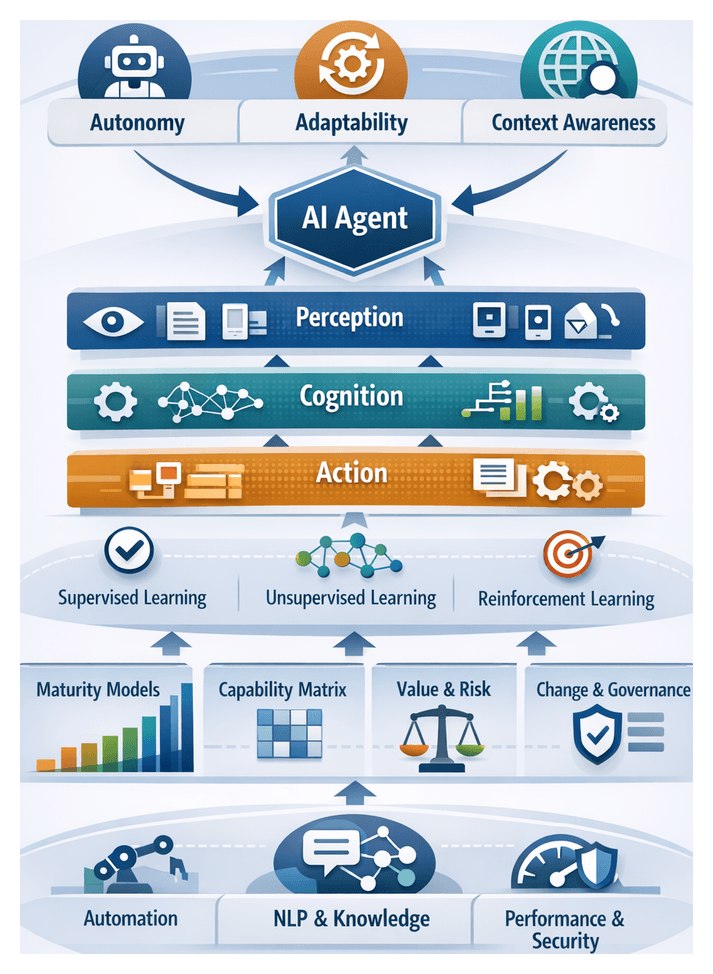
AI Concepts and Terminology
AI Agent, Autonomy, Adaptability and Context Awareness
An AI agent is a software entity that perceives inputs from its environment, reasons over data using machine learning or rule engines, and executes actions toward predefined objectives with minimal human intervention. Autonomy enables agents to initiate tasks and adapt decisions based on goals and evolving patterns, supporting continuous, 24/7 workflows without direct oversight. Adaptability refers to an agent’s capacity to refine behavior through feedback loops or incremental model retraining, ensuring performance improvement over time. Context awareness allows agents to interpret unstructured and structured inputs—such as natural language, calendar events or sensor readings—and tailor responses by considering history, user roles and situational factors.
Architecture Layers
Agent architectures typically comprise three layers:
- Perception Layer: Ingests and preprocesses inputs from emails, documents, APIs or sensors. Techniques include optical character recognition (OCR), language detection and feature extraction to normalize raw data into structured formats.
- Cognition Layer: Applies analytics, business rules and machine learning models—balancing deterministic engines with probabilistic models for tasks like sentiment analysis or demand forecasting—to derive insights and plan sequential actions.
- Action Layer: Executes tasks based on cognitive outputs by interfacing with user interfaces, downstream applications or robotic process automation bots to send notifications, update records or trigger workflows.
Machine Learning Approaches
Common paradigms include:
- Supervised Learning: Models trained on labeled datasets to predict outcomes such as invoice classification or sentiment polarity, evaluated by precision, recall and F-score.
- Unsupervised Learning: Clustering, dimensionality reduction and anomaly detection for customer segmentation, outlier identification and feature extraction without predefined labels.
- Reinforcement Learning: Agents learn policies through environment interactions and feedback signals, suitable for dynamic scheduling or adaptive resource allocation.
Natural Language and Knowledge Representations
Natural language understanding (NLU) pipelines tokenize, tag and parse text to extract intents, entities and sentiment. Natural language generation (NLG) transforms structured data into coherent summaries, email drafts or reports. Large language models (LLMs) such as GPT-4 capture complex linguistic patterns, while prompt engineering refines input specifications to guide outputs and minimize hallucinations—plausible but incorrect model responses. Embeddings encode semantic similarity as dense vectors for semantic search, clustering and context matching. Vector search retrieves items by similarity of embedding vectors, and knowledge graphs store entities and relationships to support context-aware inference and explainability.
Automation and Conversational Interfaces
Robotic process automation (RPA) bots mimic user interactions to automate rule-based, repetitive tasks, while advanced agents integrate perception and cognition for unstructured inputs. Conversational AI platforms combine NLU, NLG and dialogue management to enable chatbots and voice assistants for customer support, employee self-service and virtual personal assistants.
Performance, Scalability and Governance
Key system metrics encompass throughput, which measures tasks processed per unit time; latency, indicating response time; scalability, reflecting the system’s ability to maintain performance under increasing load; and reliability, defined by uptime percentages and recovery rates.
Continuous monitoring is essential for detecting model drift—performance degradation caused by shifting data distributions—prompting timely retraining or updates.
Explainability tools like SHAP values and LIME analyses clarify feature contributions and decision pathways, enhancing transparency. To combat bias, implement diverse training data, fairness-aware algorithms, and rigorous human review, ensuring equitable outcomes.
Governance frameworks establish clear policies, processes, and accountability structures, bolstered by data lineage, metadata management, and principles like privacy by design, differential privacy, and federated learning.
Edge computing facilitates inference near data sources, minimizing latency and adhering to residency requirements, while shadow mode allows for the validation of agents alongside live processes.
Human-in-the-loop checkpoints integrate human judgment with automation, particularly in high-stakes scenarios.
Finally, continuous integration and deployment (CI/CD) pipelines, service-level objectives (SLOs), and comprehensive audit trails guarantee operational rigor and compliance.
Conceptual Models and Frameworks
Maturity Models
Maturity models chart progression from initial experimentation to optimized, enterprise-wide AI adoption. Stages typically range from “ad hoc” to “automated” to “autonomous,” evaluated across governance, technology, data readiness and culture. Self-assessments or external audits—such as CMMI adapted for AI—identify capability gaps and guide investment roadmaps in data infrastructure, skills development and governance.
Capability Matrices and Gap Assessments
Capability matrices map technical functions—natural language processing, computer vision, predictive analytics and task orchestration—against business use cases like administrative automation and decision support. Qualitative or quantitative ratings highlight missing or partially met capabilities, enabling targeted build or buy decisions and risk reduction.
Value-Risk Assessment
Value-risk frameworks balance quantified benefits—time savings, cost reductions, revenue uplift—against potential downsides such as legal exposures, algorithmic bias and data privacy threats. Risk scoring against benefit estimates yields a priority index for transparent go/no-go decisions and phased investments.
Technology Adoption and Change Models
Adoption frameworks guide user behavior strategies:
- Diffusion of Innovation: Segments users into innovators, early adopters, majority and laggards to tailor communication and training.
- Technology Acceptance Model (TAM): Emphasizes perceived usefulness and ease of use to refine interfaces through user surveys.
- Prosci ADKAR: Focuses on Awareness, Desire, Knowledge, Ability and Reinforcement for change-management plans.
Lean and Agile Process Improvement
Lean and Agile techniques ensure user-centric deployments:
- Value stream mapping to identify non-value-added steps for targeted automation.
- Kaizen and PDCA cycles for iterative feature pilots and rapid enhancements.
- Sprint-based delivery for short iterations of development, testing and deployment.
Governance and Compliance
Essential governance structures include IEEE Ethically Aligned Design for fairness, the European AI Act risk classes, the NIST AI Risk Management Framework, and RACI matrices to define roles and oversight for AI agent outputs. Policy-as-code tools and regular audits embed ethical stewardship into operations.
Integration and Interoperability
Architectural patterns for seamless connectivity:
- API-first strategies with REST or GraphQL interfaces and gateways for authentication and rate limiting.
- Event-driven architectures using message streams like Apache Kafka for real-time responses.
- Microservices ecosystems for modular deployments and independent scaling.
- Integration competency centers to define reusable connectors and data schemas.
Continuous Improvement and Strategic Alignment
Feedback loop models orchestrate monitoring, feedback capture, automated retraining pipelines and governance reviews to refine agent behaviors. Strategic frameworks such as Balanced Scorecard adaptations, OKRs and value dependency networks connect AI capabilities to business outcomes, ensuring clear alignment of investments with organizational goals.
Key Considerations and Clarifications
Defining AI Agents Versus Models and Bots
AI agents integrate multiple models, decision logic and interfaces to perceive environments, reason over dynamic information and execute end-to-end workflows. Standalone models perform classification or prediction tasks, and RPA bots follow static scripts without contextual adaptation. Agents combine autonomy, adaptability and context awareness to orchestrate processes such as parsing emails, extracting data, updating CRM records and notifying stakeholders.
Selecting Use Cases and Assessing Data Readiness
Ideal tasks for AI agents are high-volume, rule-based and require contextual judgment, such as email triage with sentiment analysis, invoice processing with semantic extraction and intelligent scheduling. Conduct data readiness assessments—evaluating volume, variety, veracity and governance—to identify gaps. Establish metadata catalogs, lineage tracking and data cleansing pipelines. Where data quality issues persist, implement human-in-the-loop verification to ensure continuous feedback and model refinement.
Measuring ROI and Avoiding Pitfalls
Define clear objectives—time saved per task, error reduction or throughput gains—and establish baselines before deployment. Use control groups or difference-in-differences analysis to isolate agent impact. Track leading indicators (adoption rates, completion times) alongside lagging outcomes (cost savings, satisfaction). Combine operational metrics with financial proxies for a balanced ROI assessment.
Integration with Legacy Systems and Security
Assess API availability, data access protocols and performance under agent workloads. When modern interfaces are absent, use integration middleware or screen-scraping connectors as temporary measures, transitioning to API-driven interoperability over time. Centralize authentication, routing and logging with an API gateway. Enforce role-based access controls, data masking, encryption and zero-trust architectures. Apply privacy-enhancing techniques such as differential privacy or federated learning to protect sensitive data.
Ethical AI, Bias Mitigation and Explainability
Audit training datasets for representativeness and skew. Apply fairness metrics—demographic parity, equalized odds—and mitigation techniques such as data re-sampling, algorithmic reweighting and adversarial debiasing. Embed human review for high-stakes decisions and document processes in transparent model cards. Use SHAP or LIME to generate user-friendly explanations of feature contributions and decision pathways.
Change Management and User Adoption
Communicate the agent’s augmentation role and engage early adopters as champions. Provide role-based training, embedded tutorials and contextual help. Gather feedback through surveys and pilot workshops. Recognize success with metrics sharing and rewards. Open channels for user suggestions foster ownership and accelerate adoption.
Customization Versus Out-of-the-Box Solutions and Vendor Selection
Out-of-the-box agents such as Microsoft Power Automate enable rapid deployment but may lack domain specificity. Custom builds deliver tailored functionality but require greater investment in engineering and data preparation. Conduct gap analyses, evaluate total cost of ownership and leverage vendor ecosystems or partner accelerators to minimize custom code. Assess vendor maturity, integration compatibility, security certifications and support models. Review independent benchmarks and customer references to avoid lock-in.
Human-in-the-Loop and Operational Excellence
Define confidence thresholds and handoff protocols for tasks requiring human oversight. Establish operations centers for performance monitoring, incident response and scheduled retraining. Implement version control for models, define SLOs for latency and accuracy, and conduct post-mortem reviews for incidents. Automated alerts for drift and degradation ensure timely remediation.
Future-Ready Architectures and Scaling
Adopt modular microservices architectures with well-defined APIs to allow substitution of core components such as language models. Use container orchestration platforms like Kubernetes. Decouple business logic from inference engines through abstraction layers. Plan phased expansion with formal milestone gates, wave-based rollouts and resource adjustments to support enterprise-wide scaling.
Skills, Governance and Cross-Functional Structures
Critical roles include data engineers, machine-learning engineers, software developers, domain experts, ethicists and governance specialists. Develop internal upskilling programs and partner with universities or training providers. Establish a federated governance council for strategic oversight and domain working groups for tactical controls. Define mandates, reporting cycles and decision logs to ensure transparency and accountability.
Budgeting, Timelines and Regulatory Compliance
Pilot projects typically span two to four months for data preparation, model configuration and integration proofs of concept. Enterprise rollouts may take six to twelve months. Budget for licensing, infrastructure, professional services and staffing for governance and operations. Adopt phased funding—pilot, minimum viable product, scaled rollout—to align investments with benefits. Implement data residency strategies and context-aware access controls to comply with GDPR, CCPA, PIPL and other regulations. Use policy-as-code tools and centralized compliance frameworks with localized enforcement.
AI Tools Directory
Scheduling and Email Management Agents
- Calendly: A platform for sharing availability links, automating time-slot proposals, reminders and video conferencing integration.
- Clara Labs: A white-glove scheduling service combining human oversight with AI for complex meeting coordination and travel arrangements.
- Superhuman: A premium email client featuring AI-driven inbox triage, priority highlighting and response suggestions.
- Boomerang for Gmail: An email productivity plugin offering message scheduling, follow-up reminders and AI-suggested drafts.
- Microsoft Power Automate: A low-code platform for scheduling and email workflows across Microsoft 365 and third-party services.
Document and Workflow Automation Platforms
- UiPath: An RPA platform that extracts data via OCR and AI, classifies content and routes items through approval workflows.
- Automation Anywhere: An RPA solution combining bot orchestration with AI-powered document processing for finance, HR and procurement.
- Blue Prism: An enterprise-grade RPA platform with AI integrations for document parsing and intelligent decision making.
- DocuSign Agreement Cloud: A suite automating contract drafting, signature collection and compliance monitoring.
- Microsoft Power Automate Desktop: Extends low-code automation to Windows desktops with AI for document extraction and form processing.
Conversational AI and Virtual Assistants
- IBM Watson Assistant: A platform for building chatbots and virtual agents with natural language understanding and enterprise integration.
- Amazon Lex: A service for voice and text conversational interfaces with automatic speech recognition and NLU.
- ServiceNow Virtual Agent: A chatbot framework for automating IT and HR service requests through dialogue and workflow integration.
- Microsoft Power Virtual Agents: Enables business users to create chatbots without coding, integrating with Power Automate and Teams.
- Intercom Assist: An AI customer support agent that answers common inquiries, escalates complex issues and integrates with CRM systems.
- Zendesk AI: AI-powered ticket triage, answer bot suggestions and sentiment analysis for customer support prioritization.
Collaboration and Meeting Facilitation Agents
- Cisco Webex Assistant: A voice-activated meeting assistant that transcribes conversations, highlights action items and generates summaries.
- Zoom IQ Companion: Captures transcripts, identifies topics and surfaces follow-up tasks in Zoom meetings.
- Slack AI: Embeds AI for message summarization, context-aware suggestions and automated reminders in Slack channels.
- Microsoft Teams Copilot: Generates agendas, summarizes discussions and suggests next steps using data from Microsoft 365.
Knowledge Management and Search Platforms
- Elastic Enterprise Search: A unified solution combining keyword and vector search for enterprise-wide discovery.
- Azure Cognitive Search: A managed service using OCR, entity recognition and language understanding for semantic search.
Time Tracking and Personal Productivity Tools
- RescueTime: Tracks computer activity, categorizes time usage and provides focus pattern insights.
- Toggl Track: Offers manual and AI-assisted time entries, project reporting and predictive estimates.
- Clockify: A free time-tracking platform with integration APIs for custom productivity analytics.
- Time Doctor: Monitors application usage, screenshots and activity levels to identify distractions.
- Microsoft Viva Insights: Delivers productivity analytics with focus time suggestions and collaboration balance metrics.
Analytics, Machine Learning and Decision Support
- IBM Watson Discovery: An AI search and analytics engine that uncovers insights from unstructured data.
- DataRobot: An automated ML platform with bias detection, deployment and explainability tools.
- Palantir Foundry: A data integration and analytics platform for collaborative model building and decision support.
- Google Vertex AI: A unified AI platform for model training, deployment, MLOps and explainability.
- Amazon SageMaker: A managed ML service offering training, hosting, feature store and bias detection.
Integration Frameworks and API Management
- MuleSoft Anypoint Platform: Provides API design, management and integration for secure connectivity.
- Dell Boomi: A low-code iPaaS that orchestrates data flows and APIs for scalable integrations.
- Apigee API Platform: Manages API lifecycles with traffic management, security and analytics.
- Istio Service Mesh: Offers traffic management, policy enforcement and telemetry for microservices.
Data Governance, Compliance and Security Tools
- Collibra: A data governance platform for metadata, quality scorecards and stewardship workflows.
- Informatica Axon: Offers data cataloging, governance processes and policy enforcement for compliance.
- Talend Data Fabric: Combines integration, quality and privacy capabilities to prepare and secure data.
- Okta Identity Cloud: Provides authentication, single sign-on and adaptive access policies.
- Auth0: Delivers identity and access management with OAuth and OpenID Connect support.
- HashiCorp Vault: A secrets management solution for encrypting and controlling access to sensitive data.
Business Intelligence and Visualization Platforms
- Tableau: A data visualization platform connecting to multiple sources for interactive dashboards.
- Microsoft Power BI: Offers self-service analytics and reporting integrated with Azure and Microsoft 365.
- Looker: A BI and data platform delivering governed metrics and embedded analytics.
- Google Looker Studio: A free tool connecting to Google Cloud and third-party sources for customizable reports.
The AugVation family of websites helps entrepreneurs, professionals, and teams apply AI in practical, real-world ways—through curated tools, proven workflows, and implementation-focused education. Explore the ecosystem below to find the right platform for your goals.
Ecosystem Directory
AugVation — The central hub for AI-enhanced digital products, guides, templates, and implementation toolkits.
Resource Link AI — A curated directory of AI tools, solution workflows, reviews, and practical learning resources.
Agent Link AI — AI agents and intelligent automation: orchestrated workflows, agent frameworks, and operational efficiency systems.
Business Link AI — AI for business strategy and operations: frameworks, use cases, and adoption guidance for leaders.
Content Link AI — AI-powered content creation and SEO: writing, publishing, multimedia, and scalable distribution workflows.
Design Link AI — AI for design and branding: creative tools, visual workflows, UX/UI acceleration, and design automation.
Developer Link AI — AI for builders: dev tools, APIs, frameworks, deployment strategies, and integration best practices.
Marketing Link AI — AI-driven marketing: automation, personalization, analytics, ad optimization, and performance growth.
Productivity Link AI — AI productivity systems: task efficiency, collaboration, knowledge workflows, and smarter daily execution.
Sales Link AI — AI for sales: lead generation, sales intelligence, conversation insights, CRM enhancement, and revenue optimization.
Want the fastest path? Start at AugVation to access the latest resources, then explore the rest of the ecosystem from there.