

Intelligent Compliance Leveraging AI Agents for Regulatory Excellence in the Utilities Industry
To download this as a free PDF eBook and explore many others, please visit the AugVation webstore:
Introduction
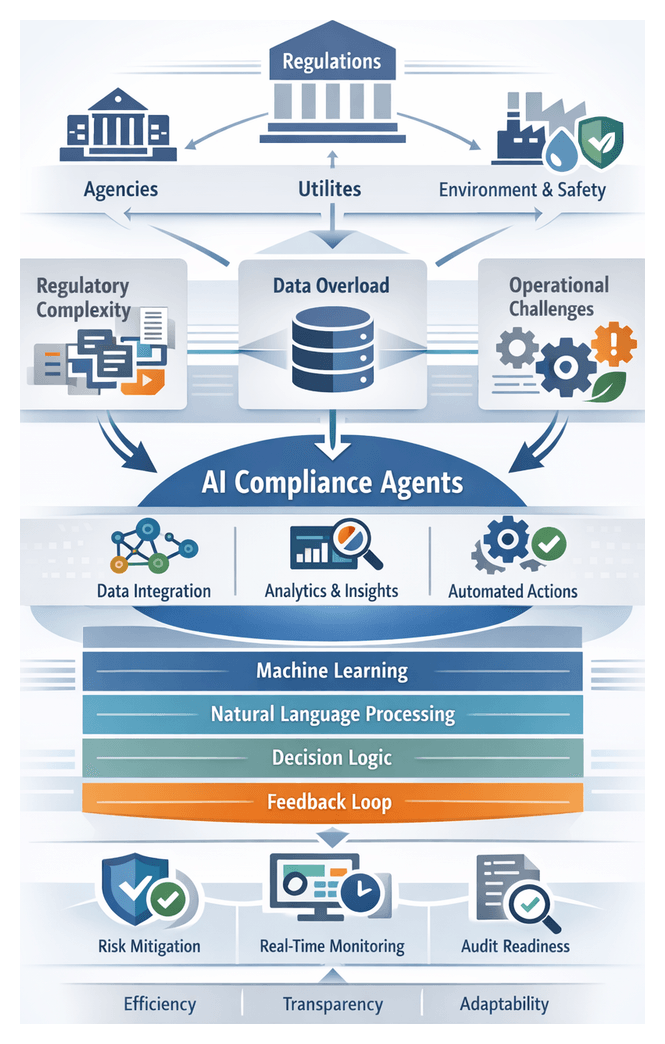
Regulatory Complexity in the Utilities Sector
The utilities industry operates at the nexus of public interest and critical infrastructure, governed by a multifaceted network of statutes, administrative rules, technical standards, and jurisdictional mandates. From electricity generation and distribution to water treatment and natural gas transmission, utility providers must satisfy safety, reliability, environmental stewardship, and fair-pricing obligations. Federal authorities such as the Federal Energy Regulatory Commission (FERC), the Environmental Protection Agency (EPA), and the North American Electric Reliability Corporation (NERC) set baseline requirements, while state public utility commissions, environmental agencies, and emergency management offices layer additional rules. Industry standards bodies, including the Institute of Electrical and Electronics Engineers (IEEE) and the American National Standards Institute (ANSI), further contribute technical guidelines—often incorporated by reference into regulations.
Originally conceived under the principle of natural monopoly oversight, U.S. utility regulation evolved through landmark legislation such as the Federal Power Act and the Public Utility Regulatory Policies Act. Over time, regulators introduced measures addressing grid reliability, environmental impact, cybersecurity, and market competition. States enacted renewable portfolio standards, energy efficiency obligations, and consumer protection rules, resulting in a labyrinth of overlapping requirements. Utilities operating across multiple jurisdictions contend with distinct compliance timetables and enforcement mechanisms, demanding centralized governance and coordinated tracking systems to avoid missed deadlines and inconsistent reporting.
Drivers of Regulatory Proliferation and Data Imperatives
Technological innovation, policy objectives, and stakeholder expectations have accelerated regulatory proliferation. Smart grid deployments, advanced metering infrastructure, and Internet-connected sensors improve operational visibility but introduce data privacy concerns, cybersecurity vulnerabilities, and novel failure modes. Regulators responded with mandates such as NERC Critical Infrastructure Protection (CIP) standards, state-level data breach laws, and smart grid interoperability requirements.
- Environmental regulations governing emissions, water use, and waste management
- Renewable portfolio standards and carbon reduction targets
- Consumer protection rules for billing accuracy and service transparency
- Cybersecurity mandates and data privacy frameworks
Parallel to regulatory tightening, utilities face an explosion of data. Smart meters, supervisory control and data acquisition systems, customer information platforms, and third-party sensors generate terabytes of operational, environmental, and financial data daily. Fragmented across asset management tools, CRM systems, and dedicated monitoring platforms, this data must be harmonized rapidly to meet compressed reporting cycles. Ensuring data veracity and maintaining audit trails challenges legacy manual workflows and spreadsheets, creating voracious demand for analytical frameworks that can ingest diverse data types, reconcile anomalies, and surface compliance insights in near real time.
Operational Challenges and the Case for Intelligent Compliance
Traditional compliance approaches—manual reviews, static checklists, siloed subject-matter expertise—struggle under the weight of expanding regulations and data volumes. Fragmentation leads to inconsistent metrics, version control issues, and labor-intensive reconciliation. Data residing in separate systems impairs end-to-end visibility, obscuring risk exposure until an audit or incident occurs. Non-compliance penalties range from financial fines and operational restrictions to reputational damage and, in extreme cases, license revocations.
Intelligent compliance solutions, powered by artificial intelligence and automation, offer a transformative alternative. By integrating data from disparate sources, applying advanced analytics, and automating routine tasks, utilities can establish continuous monitoring, rapid adaptation to rule changes, and proactive risk management. AI-driven agents ingest regulatory texts, extract obligations, map requirements to internal processes, and generate actionable insights. Real-time dashboards, anomaly detection alerts, and automated submission workflows shift compliance from reactive to proactive, freeing experts to focus on strategic planning.
Automated audit trails, version control, and evidence repositories enhance audit readiness. When regulators request information, teams respond swiftly with accurate documentation. Scenario analysis and impact forecasting enable modeling of proposed regulatory changes, supporting mitigation strategies before rules take effect. In a sector driven by decarbonization goals, digital innovation, and dynamic stakeholder expectations, intelligent compliance agents empower utilities to navigate complexity with agility, reduce costs, and foster a culture of continuous improvement.
Foundations of AI-Driven Compliance Agents
Compliance agents are autonomous or semi-autonomous systems integrating machine learning, natural language processing (NLP), and decision automation. Machine learning models recognize patterns in structured and unstructured data, NLP interprets semantic content of statutes and guidance, and decision engines translate insights into governed actions. Conceptualized as socio-technical systems, agents operate within feedback loops of continuous learning, rule refinement, and audit reporting.
An AI-driven compliance architecture comprises modular layers:
- Data Acquisition and Pre-Processing: Normalization of structured data and NLP tokenization, annotation, and entity extraction from regulatory texts.
- Pattern Recognition and Classification: Machine learning classifiers tag text segments by regulatory category, detect anomalies in time-series data, and predict risk scores.
- Inference and Decision Logic: Business rules, thresholds, and escalation policies trigger workflows, notifications, or report generation.
- Feedback and Continuous Learning: Incorporation of regulator feedback and audit findings into retraining pipelines, refining both statistical models and rule definitions.
Balancing precision and recall in semantic feature extraction is critical to minimize false positives while capturing regulatory nuance. Pattern recognition models require regular retraining to accommodate evolving regulations and operational changes. Decision logic engines must adhere to change-control processes mirroring traditional policy governance to preserve traceability and accountability.
Analytical Frameworks and Industry Perspectives
Practitioners apply interpretive lenses to evaluate compliance agents:
- Governance, Risk, and Compliance (GRC) Model: Assesses the agent’s role in enterprise risk management, control implementation, and continuous monitoring.
- Technology Adoption Maturity Framework: Charts progression from rule-based prototypes to self-learning agents, evaluating people, processes, and technology readiness.
- Socio-Technical Systems Analysis: Examines human-machine interactions, accountability flows, and change management dependencies.
- Regulatory Text Analytics Paradigm: Measures semantic accuracy and agility in translating legal prose into structured policy ontologies.
Leaders in utilities emphasize regulatory complexity mitigation, data-centric intelligence, transparency, and scalability. Vendor platforms such as IBM Watson and Microsoft Azure Cognitive Services demonstrate convergent pipelines that normalize data, apply NLP and machine learning, enforce decision logic, and support continuous learning. Evaluation criteria include model accuracy, semantic coverage, explainability metrics, latency, throughput, and governance features such as audit trails and change histories.
Market Trends and the Evolving Solution Landscape
Escalating regulatory demands, data proliferation, and economic risks have sparked widespread interest in intelligent automation. Industry surveys reveal that most utility providers are piloting or evaluating AI-enabled platforms for compliance management. Key market drivers include:
- Scalability: Automated agents update regulatory mappings across jurisdictions without manual intervention.
- Transparency: Explainable AI and automated audit logs offer regulators clear evidence of decision-making.
- Cost Efficiency: Reduced reliance on external consultants and manual workflows cuts compliance overhead.
Modular, API-driven offerings integrate with enterprise systems, embedding best-practice workflows while allowing customization and governance. Organizations adopting these solutions report accelerated regulatory approvals, improved audit readiness, and the ability to redeploy compliance personnel to strategic projects.
Strategic Outcomes and Guide Objectives
This guide equips executives, compliance officers, and technical leaders to transform compliance from a cost center into a strategic enabler. Core objectives include:
- Contextual Mastery: Align business goals with compliance mandates amid evolving policy landscapes.
- Analytical Frameworks: Apply models such as the Regulatory Complexity Index, Compliance Maturity Continuum, Data Governance Quadrant, and Risk-Return Trade-off Matrix to prioritize initiatives.
- Strategic Perspective: Harness AI agents to shift from reactive reporting to proactive risk management and competitive advantage.
- Critical Insights: Understand trade-offs around interpretability, data integrity, policy uncertainty, and ethical considerations.
- Forward-Looking Guidance: Anticipate emerging regulatory and technological trends to shape adaptable roadmaps.
Engaging with these frameworks enables readers to diagnose compliance challenges, evaluate AI methodologies for asset management, environmental reporting, and billing, align technology and policy strategies, establish governance models that balance autonomy and control, anticipate shifts in regulations and AI innovation, and foster cross-functional collaboration across compliance, IT, operations, and legal teams.
Key Considerations and Limitations
A balanced perspective recognizes that AI agents, while powerful, operate within constraints:
- Regulatory Ambiguity: Broad or evolving language in statutes requires human judgment to resolve gray areas.
- Data Quality and Completeness: Incomplete or inconsistent data can skew analytics, producing false positives or undetected risks.
- Interpretability vs. Performance: Complex models may deliver higher detection rates but challenge auditability and board oversight.
- Integration and Change Overhead: Embedding AI into legacy landscapes demands stakeholder alignment, training, and cultural readiness.
- Policy Evolution: Adaptable architectures are essential to accommodate new rulemakings and guidance updates.
- Ethical and Legal Dimensions: Privacy, algorithmic bias, and liability frameworks must be governed through policy, not just technology.
- Resource Constraints: Smaller utilities may require phased deployments and partnerships to mitigate budget and talent limitations.
By maintaining awareness of these factors, organizations can craft AI compliance strategies that are resilient, aligned with capacity, and capable of evolving alongside regulations and technology. This guide serves as a strategic reference—bridging regulatory imperatives and AI innovation, and empowering industry leaders to navigate complexity with confidence.
Chapter 1: The Evolving Regulatory Landscape in Utilities
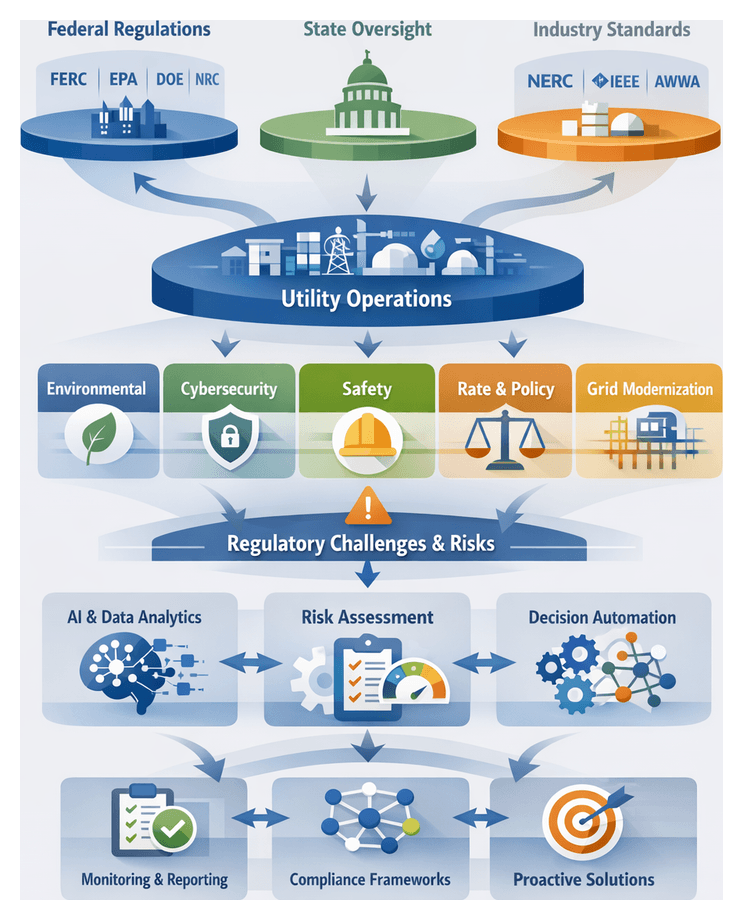
Federal, State, and Industry Oversight
The utilities sector delivers essential services—electricity, natural gas, water and wastewater management—under an intricate web of regulations designed to protect public health, ensure system reliability and guard the environment. At the federal level, authorities such as the Federal Energy Regulatory Commission (FERC), Environmental Protection Agency (EPA), Department of Energy (DOE) and U.S. Nuclear Regulatory Commission (NRC) set standards for interstate transmission, emission limits, energy policy and nuclear safety. Complementing these mandates, state public utility commissions oversee rate cases, integrated resource planning, local safety codes and consumer protections. Utilities operating in multiple jurisdictions must reconcile diverse statutes, commission orders and municipal ordinances, often confronting overlapping or conflicting obligations.
Industry bodies further shape compliance requirements. The North American Electric Reliability Corporation (NERC) enforces Critical Infrastructure Protection (CIP) standards for bulk power security. The Institute of Electrical and Electronics Engineers (IEEE) issues technical and safety specifications. The National Institute of Standards and Technology (NIST) provides cybersecurity frameworks. The American Water Works Association (AWWA) sets water quality and treatment standards. These voluntary and mandatory standards become enforceable when referenced by regulators or auditors, demanding continuous alignment of controls and assets with evolving criteria.
- Decarbonization mandates and renewable portfolio standards drive new planning and reporting obligations.
- Integration of customer-sited solar, storage and electric vehicle charging introduces varied interconnection rules and tariffs.
- Heightened cybersecurity threats prompt stringent NERC CIP requirements and commission-specific audits.
- Grid modernization projects—smart meters, automated outage management—raise data privacy and interoperability challenges.
- Environmental and health regulations—emissions, stormwater, water quality—require sophisticated monitoring and reporting systems.
Utilities must coordinate legal, engineering and operations teams to manage multiple permitting processes, reporting deadlines and audit responses. Centralized compliance calendars and conflict resolution protocols are essential to avoid project delays, enforcement actions and reputational harm. High-fidelity data from SCADA networks, customer information systems, environmental monitors and financial ledgers must be aggregated, validated and documented to satisfy agency audit trails and evolving form requirements.
Risk Frameworks and Emerging Policy Trends
A proactive risk-based approach prioritizes obligations by severity, likelihood and remediation timeframe. Regulatory impact assessments quantify potential fines and the probability of enforcement, while escalation protocols ensure critical issues reach senior leadership swiftly. Looking ahead, utilities face new mandates on transportation electrification, climate risk disclosures, performance-based ratemaking and data privacy. Continuous regulatory intelligence—monitoring rulemaking dockets and stakeholder consultations—combined with scenario planning and stakeholder engagement, transforms compliance into a strategic enabler of innovation and competitive advantage.
Foundations of AI-Driven Compliance Agents
Core Capabilities and Interpretive Frameworks
AI-driven compliance agents leverage machine learning, natural language processing (NLP), knowledge representation and decision automation to ingest regulatory texts, extract obligations and map them to organizational processes. Three dimensions distinguish these solutions:
- Cognitive capability: Depth of semantic understanding needed to identify entities, relationships and conditional obligations in statutes and codes.
- Reasoning and decision logic: Application of learned knowledge and policy rules to evaluate scenarios and generate recommendations.
- Actionability: Integration with reporting pipelines, audit workflows and operational controls for automated or semi-automated remediation.
Interpretive frameworks guide agent design:
- Regulatory knowledge graphs represent statutes, sub-clauses, controls and organizational units as interconnected nodes, enabling impact analysis and dependency visualization.
- Compliance ontologies define formal vocabularies for regulatory concepts, interpretation rules and process mappings, ensuring semantic consistency.
- Risk-based modeling integrates requirements with risk appetite and operational priorities to prioritize alerts and quantify residual risk.
- RegTech taxonomies categorize compliance tasks—monitoring, reporting, auditing—into modular components for gap analysis and tool selection.
Evaluative Criteria and Ethical Governance
Organizations assess AI agents using both technical and governance metrics. Key performance indicators include recall and precision in requirement classification, time-to-insight for new regulations, reduction in manual review hours and percentage of automated remediation actions. Governance teams measure interpretability (transparent rationales for recommendations) and maintainability (ease of updating models and ontologies).
- Semantic accuracy: Correct identification and classification of obligations, exceptions and tasks within regulatory texts.
- Integration depth: Connectivity with enterprise data sources, operational systems and reporting platforms.
- Scalability: Capacity to process high volumes of regulatory changes and data without performance degradation.
- Governance controls: Audit trails, model version control and role-based access management.
- User adoption: Ease of use for compliance analysts and reduction in manual interventions.
Regulatory authorities and industry bodies influence agent design through guidelines on data integrity, auditability and control objectives. FERC and NERC emphasize cybersecurity and reliability standards. European regulators stress transparency and explainability. ISO standards—ISO 27001 for security management and ISO 19600 for compliance systems—provide governance frameworks. Ethical AI principles from IEEE, OECD and the European Commission underscore fairness, transparency, accountability and privacy. Robust governance structures must define human oversight, exception-handling protocols, change-control procedures and audit logging to align AI recommendations with legal and ethical requirements.
Interoperability and Maturity Models
Interoperability hinges on open data standards such as the Common Information Model (CIM) and RESTful APIs, enabling seamless integration between AI agents, SCADA systems, ERP modules and document repositories. Industry consortia like the Open Compliance and Ethics Group (OCEG) promote reference architectures and shared regulatory libraries to reduce vendor lock-in and integration costs.
Maturity frameworks guide adoption stages:
- Baseline: Manual processes supported by static rule engines and spreadsheets.
- Transitional: Partial automation with AI-assisted review and periodic model retraining.
- Advanced: Integrated agents with continuous learning, automated report generation and semi-autonomous control loops.
- Fully autonomous: Self-governing systems that detect, decide and act on compliance issues with real-time audit trails and minimal human oversight.
The Imperative for Intelligent Compliance
Regulatory Tightening as a Catalyst for Innovation
Regulatory bodies have intensified oversight across environmental protection, cybersecurity, data privacy and consumer rights. FERC orders on distributed energy resources, EPA emissions standards under the Clean Air and Clean Water Acts and state wildfire mitigation regulations illustrate this trend. Utilities face expanded reporting mandates, cross-jurisdictional overlaps and data-driven enforcement. Agencies increasingly demand machine-readable filings—XBRL, structured XML—pressuring organizations to automate data extraction and validation.
AI-driven agents transform compliance from reactive to proactive. Natural language processing parses regulatory bulletins, applies semantic tagging and maps new requirements to policies and procedures. For example, AgentLinkAI integrates regulatory feeds with a centralized taxonomy, enabling compliance leads to visualize directive impacts across operations, cybersecurity and environmental management. Living compliance architectures cascade changes automatically through policy libraries, control frameworks and audit checklists, reducing update delays and material risk exposure.
Data Proliferation and Scalable Risk Management
Smart grid technologies, advanced metering and real-time SCADA systems generate petabytes of data annually—from time-series sensor feeds to maintenance logs. This volume and velocity, combined with structural heterogeneity across relational databases, NoSQL stores, flat files and document repositories, complicate unified compliance reporting and traceability.
- Continuous data lineage and governance demand end-to-end traceability of how data informs audit reports and regulatory filings.
- Machine learning–powered data orchestration automates schema mapping, data quality assessment and metadata generation.
- Semantic indexing tools such as IBM Watson Discovery extract entities and context from large document collections, accelerating validation against regulatory requirements.
- Cloud-native catalog services like Microsoft Azure Purview classify data by sensitivity and regulatory attributes, providing a unified view of compliance posture.
Robust data governance—master data management, quality dashboards and defined stewardship roles—ensures reliable inputs to AI models. High-integrity data underpins accurate risk assessments, policy mappings and anomaly detection, creating a cycle of continuous compliance improvement.
Escalating Consequences and Predictive Insights
Non-compliance penalties have grown in magnitude and frequency. EPA and FERC enforcement can impose multi-million dollar fines per violation, often accompanied by remedial orders. Customer trust erodes rapidly after breaches or environmental infractions. Mandatory shutdowns, litigation costs and long-term remediation—environmental cleanup, cybersecurity overhauls, third-party certifications—further burden utilities.
Predictive risk models powered by supervised learning analyze historical incident data against current operational metrics to forecast non-compliance scenarios. Platforms such as Palantir Foundry combine real-time ingestion with customizable risk dashboards, enabling teams to allocate resources to high-priority areas before issues escalate. Case studies highlight the financial stakes: penalties exceeding $30 million after a data breach, remediation costs over $100 million following environmental violations. These outcomes underscore that the cost of inaction far outweighs investments in intelligent compliance solutions.
Strategic Frameworks and Deployment Considerations
Guide Objectives and Anticipated Outcomes
This guide equips executives, compliance leaders and technology architects with strategic frameworks to harness AI agents for regulatory excellence. Readers will be able to:
- Articulate the evolving regulatory architecture, key agencies and policy trends shaping compliance obligations.
- Deconstruct core AI methodologies—machine learning, natural language processing, rule-based engines—and assess their suitability for specific regulatory tasks.
- Compare architectural paradigms—from centralized platforms to federated modules—and evaluate trade-offs in scalability, latency and governance.
- Assess data integration and governance requirements, identifying critical sources, quality thresholds and stewardship models.
- Synthesize best practices for automating reporting workflows, anomaly detection and risk scoring, focusing on accuracy, speed and auditability metrics.
- Anticipate organizational challenges—stakeholder alignment, change management, talent development—and devise mitigation strategies.
- Analyze real-world cases to extract lessons learned, success factors and common pitfalls.
- Project emerging trends—generative models, regulatory sandboxes, data privacy evolutions—and craft a forward-looking innovation agenda.
Key Considerations and Limitations
- Data quality and completeness: Fragmented or siloed data can undermine AI outputs. Invest in integration platforms and stewardship before expecting consistent results.
- Model interpretability: Prioritize transparent frameworks and post-hoc analysis capabilities to satisfy audit requirements.
- Regulatory volatility: Design modular rule libraries and retraining workflows to accommodate shifting policy regimes.
- Governance and accountability: Define human oversight roles, exception-handling protocols and validation checkpoints.
- Integration with legacy systems: Plan for API development, data format harmonization and middleware to bridge SCADA, GIS and ERP platforms.
- Cultural and skills barriers: Foster collaboration between data scientists, regulatory experts and operations personnel; invest in upskilling.
- Vendor ecosystem evaluation: Avoid lock-in by selecting platforms that support open standards, interoperability and extensibility.
- Performance monitoring: Track false positive rates, drift detection and latency; establish periodic retraining and recalibration processes.
- Cost-benefit alignment: Conduct rigorous analyses that account for direct savings and indirect value such as risk reduction and stakeholder trust.
Chapter 2: Key Compliance Challenges and Risks
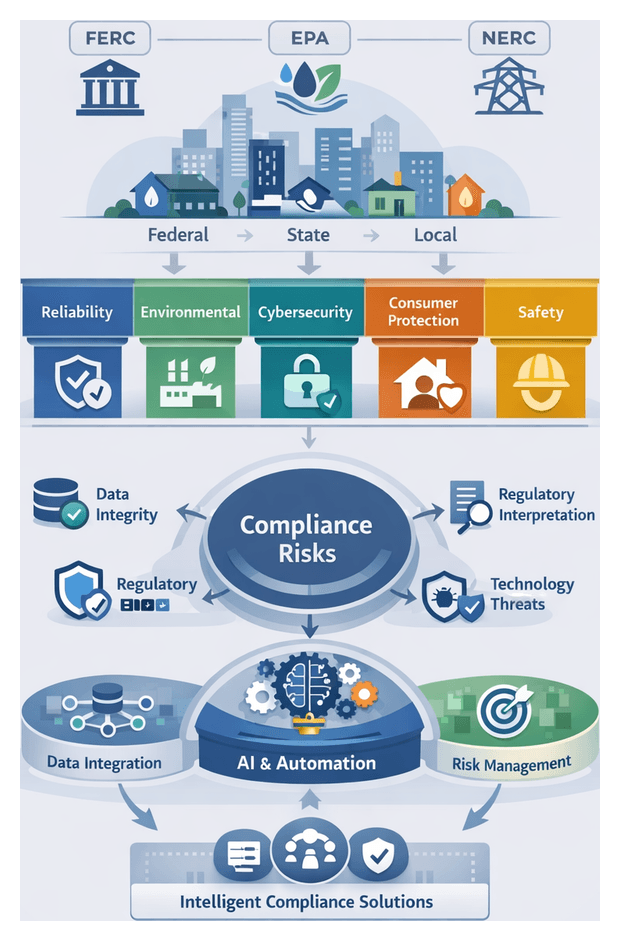
Regulatory Landscape and Compliance Challenges
The utilities industry encompasses generation, transmission and distribution of electricity, natural gas, water and wastewater treatment—all essential services governed by a complex web of federal, state and local regulations. Agencies such as the Federal Energy Regulatory Commission (FERC), the Environmental Protection Agency (EPA) and the North American Electric Reliability Corporation (NERC) establish mandates on market design, emissions limits and grid reliability. State public utility commissions set rate structures, safety requirements and service quality standards, while municipalities impose additional rules on water sourcing, discharge and stormwater control. This multilayered framework often creates overlapping obligations, varied reporting formats and conflicting compliance timelines across jurisdictions.
Regulations in the utilities sector fall into distinct categories:
- Reliability and performance standards, including contingency planning and outage reporting defined by NERC and regional transmission organizations.
- Environmental compliance, covering air emissions, water effluents, waste management and habitat protection enforced by the EPA and state agencies.
- Cybersecurity mandates, such as NERC Critical Infrastructure Protection (CIP) standards, requiring secure operational technology and incident reporting.
- Consumer protection and rate regulation, overseeing pricing, territories, complaint resolution and affordability programs.
- Occupational health and safety rules administered by OSHA and state equivalents, ensuring safe practices for field crews and plant operators.
Traditional compliance approaches reliant on manual data gathering, spreadsheets and periodic audits struggle to keep pace with real-time data feeds from sensors, inspections and external monitoring systems. Disparate data silos force teams to reconcile information across ERP platforms, environmental systems, cybersecurity logs and billing databases, increasing the risk of errors, omissions and delayed submissions. For utilities operating in multiple regions, compliance processes must align governance structures, data schemas and audit trails across different reliability orders, water quality standards and disclosure requirements.
Recent shifts in energy policy—driven by decarbonization targets, renewable portfolio standards and distributed energy resource integration—have further expanded the compliance perimeter. Smart grid deployments and advanced metering infrastructure generate new data streams and security considerations, prompting regulators to tighten disclosure obligations and performance benchmarks. In this evolving landscape, proactive compliance strategies powered by artificial intelligence and automation have emerged as critical capabilities. Leading platforms demonstrate how AI-driven agents can parse regulatory texts, map requirements to operational controls and automate data ingestion, validation and report generation.
Key Risk Dimensions in Utility Compliance
Effective compliance management demands a holistic understanding of risk factors spanning data quality, process integrity, regulatory interpretation, technological vulnerabilities, cultural dynamics and financial exposures. Analytical frameworks—drawing on standards like ISO 31000, COSO ERM, ISO 9001 and ISO 8000—guide organizations in identifying, evaluating and treating compliance risks.
Data Integrity and Process Efficiency
Accurate, complete and timely data underpins every regulatory submission and audit trail. Deficiencies in data governance—such as inconsistent definitions, incomplete lineage and lack of version control—drive misreporting of emissions, energy consumption and safety incidents. Utilities apply data quality scorecards, reconciliation protocols and performance indicators to monitor error rates and correction times. Implementing a single source of truth through metadata registries and robust stewardship models elevates data integrity from a back-office function to a core compliance imperative.
Legacy workflows and manual processes create operational bottlenecks. Manual data entry, paper approvals and siloed reporting tools contribute to delays, human error and gaps in auditability. Process inefficiency is evaluated using metrics such as cycle time variance, error frequency and resource utilization. Lean Six Sigma and BPMN methodologies help map process flows, quantify non-value-added activities and prioritize automation initiatives.
Regulatory Interpretation and Technological Vulnerabilities
Voluminous and technical regulatory texts often contain ambiguous definitions that vary by jurisdiction. Interpretive risk arises when overlapping mandates from FERC, EPA and state commissions lead to divergent compliance approaches. Risk matrices and scenario analyses help quantify the probability of misinterpretation against potential impact, informing internal guidance and reducing subjectivity in compliance judgments.
The convergence of operational technology and information systems expands the cybersecurity attack surface. Smart grids, IoT devices and AI analytics platforms enhance efficiency but require adherence to NERC CIP standards on access management and incident reporting. The NIST Cybersecurity Framework supports asset categorization, threat modeling and control evaluation. Continuous monitoring and dynamic risk scoring align security controls with evolving threats.
Organizational Culture and Financial Exposures
A compliance culture that treats obligations as strategic enablers fosters ownership across engineering, operations, legal and finance teams. Maturity models such as the Compliance Maturity Model and CMMI benchmark governance clarity, training effectiveness and leadership engagement. Surveys and focus groups gauge employee perceptions and guide targeted interventions.
Financial, legal and reputational exposures converge when compliance failures occur. Direct fines, remediation costs, increased insurance premiums and litigation risks can threaten viability. Analytical techniques like Monte Carlo simulation and sensitivity analysis quantify downside scenarios, while risk appetite statements define acceptable loss thresholds. A unified risk register consolidates exposures and supports cross-functional decision making.
Integrated Analytical Frameworks
Combining quantitative and qualitative methodologies ensures a balanced view of compliance risk. ISO 31000 provides principles for risk identification, analysis and treatment, while the COSO ERM framework links risk to strategy and performance. Bowtie analysis visualizes risk pathways, identifies critical controls and allocates resources to barriers. Triangulating insights from multiple frameworks uncovers control weaknesses and their financial implications, guiding strategic investment in mitigation efforts.
Imperative for Intelligent Compliance Solutions
The convergence of tightening regulations, exponential data growth and escalating non-compliance costs has transformed compliance from a periodic obligation into a continuous, data-driven discipline. Traditional manual approaches are no longer sufficient to meet real-time reporting demands and predictive risk mitigation requirements.
Regulatory Tightening and Data Proliferation
Agencies worldwide are introducing more stringent rules on emissions reporting, reliability metrics and data security. NERC CIP standards are evolving to counter emerging cyber threats, while state commissions tie incentives to performance measures such as outage duration and customer service. Utilities must track greenhouse gas outputs with greater granularity and frequency, compress reporting timelines and expand disclosure scopes.
Smart grid technologies and advanced metering infrastructure generate terabytes of data daily. Integrating network management systems, customer information platforms, environmental sensors and third-party feeds challenges legacy ETL processes. Intelligent compliance solutions employ machine learning to classify unstructured documents, natural language processing to extract obligations and anomaly detection to flag deviations, delivering near real-time dashboards for proactive decision making.
Escalating Costs and Competitive Dynamics
Penalties for regulatory breaches can reach millions per infraction, with indirect costs including heightened scrutiny, higher insurance rates and reputational damage affecting credit ratings and financing capacity. Studies show total non-compliance costs—remediation, legal fees and opportunity losses—can be five to ten times the initial penalty. Early detection and corrective action via AI-driven agents reduce this multiplier effect.
Compliance excellence also drives competitive differentiation. Microgrids and energy service companies increasingly compete on reliability, sustainability and transparency. Proactive compliance performance enhances ESG ratings, attracts investors and builds stakeholder trust. Automated disclosures and continuous improvement demonstrated through AI-powered dashboards serve as reputational assets in regulatory hearings and public forums.
Assessing Urgency and Organizational Strategy
Analytical models guide investments in intelligent compliance. The Risk-Opportunity-Control model balances breach probability and impact against operational benefits and existing control strength, signaling where AI investment yields greatest return. Regulatory Change Radars track rulemaking activity, comment periods and enforcement actions, prioritizing automation in high-velocity areas. The Compliance Maturity Curve benchmarks progression from basic reporting to predictive assurance, identifying gaps between current capabilities and future imperatives.
Boards and executives must treat compliance as a cross-functional competency. Capital budgets should allocate funds for AI platforms, data architecture upgrades and change management. Talent strategies must emphasize data literacy, regulatory expertise and analytical skills. Establishing a Regulatory Technology Council ensures executive oversight of tool selection, integration and AI-related risks, embedding compliance innovation within broader corporate objectives.
Application Contexts and Pilot Approaches
Intelligent compliance solutions apply across generation, transmission, distribution and retail. In generation, AI agents monitor emissions, flag permit deviations and automate environmental reporting. In transmission and distribution, they analyze outage data against service standards and prepare reliability filings. Retail operations benefit from tariff compliance checks, data privacy controls and billing accuracy monitoring. Utilities often pilot in one domain to validate ROI, refine data governance and build expertise before scaling enterprise-wide.
Integrated Risk Mitigation and Strategic Considerations
Mitigating compliance risk in utilities requires an integrated approach anchored in data visibility, process automation and governance controls. By embedding analytics and AI-driven workflows within everyday operations, utilities can shift from reactive remediation to proactive risk management.
Pillars of Proactive Risk Management
- Unified Data Visibility: Consolidate SCADA, ERP, environmental monitoring and financial systems into a cohesive analytics layer for cross-cutting analysis of anomalies and compliance thresholds.
- Intelligent Automation: Encode regulatory logic into machine-readable rules, deploy machine learning for anomaly detection and automate report generation, validation and exception handling.
- Governance and Control Architecture: Define roles, responsibilities and escalation paths; implement audit trails for AI-driven decisions; ensure transparency and accountability.
- Cross-Functional Collaboration: Establish integrated governance committees and joint risk assessments with engineering, operations, legal and finance to foster shared risk ownership.
- Adaptive Monitoring and Feedback: Employ real-time analytics and periodic model recalibration to update risk parameters and control thresholds in line with regulatory changes and technological evolution.
Implementation Considerations and Limitations
Strategic planning and execution must address inherent challenges to realize sustainable mitigation benefits:
- Data Quality and Completeness: Invest in data stewardship, standardized schemas and periodic quality audits to prevent false positives and uncover genuine risk signals.
- Model Interpretability: Apply explainable AI techniques and document algorithms to satisfy auditors and regulators on decision criteria and auditability.
- Regulatory Dynamics: Design modular systems capable of rapid rule updates to accommodate new requirements without full redeployment.
- Cultural Readiness: Execute change management strategies—stakeholder education, role redefinitions and governance alignment—to overcome resistance and skill gaps.
- Integration Complexity: Plan for custom connectors, data normalization and phased migrations to integrate legacy systems with AI platforms.
- Human-in-the-Loop Oversight: Balance automation with expert review by defining thresholds for AI alerts and manual intervention.
- Automation Bias: Regularly validate rules and anomaly detection models to detect drift, bias or gaps that could mask non-compliance events.
- Cost-Benefit Alignment: Establish clear metrics—such as reductions in fines, audit findings and manual effort—to measure AI investment ROI and guide resource allocation.
Risk mitigation is an ongoing journey requiring continuous assessment cycles, governance reviews and adaptive roadmaps. By acknowledging data, model and organizational limitations, utilities can sustain regulatory excellence, enhance operational resilience and maintain trust with regulators, investors and customers.
Chapter 3: Fundamentals of Artificial Intelligence in Compliance
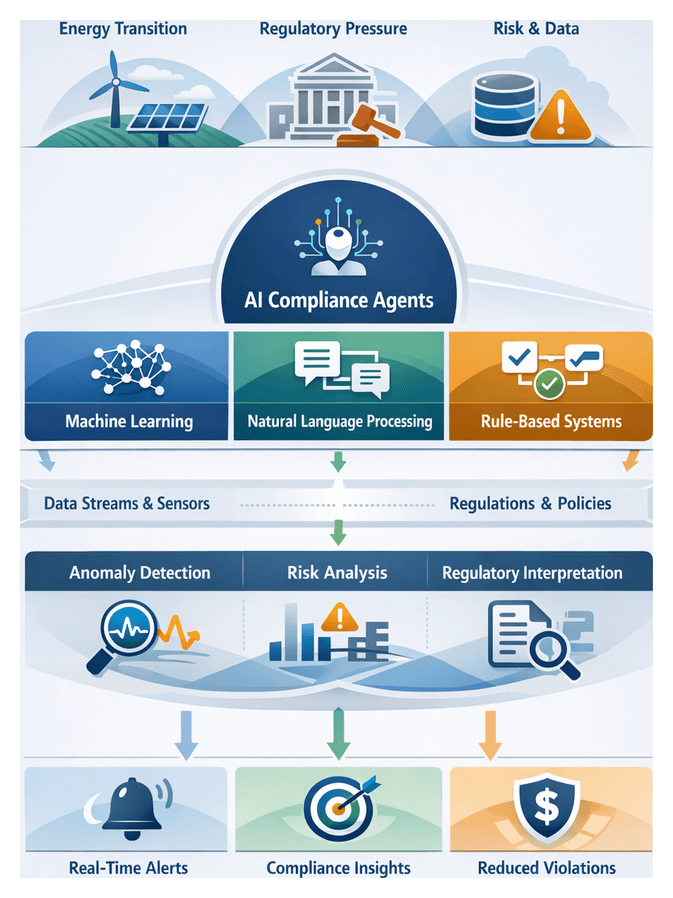
Driving Forces Behind Intelligent Compliance Agents
The utilities sector faces unprecedented pressure from energy transition mandates, decarbonization targets and investor demands for transparent environmental, social and governance disclosures. Simultaneously, regulators are tightening requirements—North American Electric Reliability Corporation’s critical infrastructure protection standards emphasize continuous monitoring, while the U.S. Environmental Protection Agency imposes stricter emission thresholds and accelerated reporting windows. Against this backdrop, legacy manual compliance processes struggle to scale, prompting utilities to adopt AI-driven compliance agents that interpret complex statutes, reconcile multi-jurisdictional rules and deliver actionable insights in real time.
Petabytes of data stream from smart meters, SCADA systems, distributed energy resources and weather sensors, generating compliance-relevant signals such as voltage excursions, emission readings and contingency events. Without intelligent parsing and contextual analysis, critical anomalies either slip through unnoticed or trigger costly false positives. Meanwhile, the financial and reputational cost of non-compliance can reach multi-million-dollar exposures, with major breaches reducing enterprise value by up to five percent. By embedding machine learning and natural language processing into compliance workflows, utilities shift from reactive, labor-intensive review cycles to proactive, pattern-based risk detection and streamlined reporting.
Across environmental, reliability and cybersecurity functions, AI agents continuously monitor operational metrics against regulatory thresholds—automatically generating notifications for emission deviations, analyzing grid event logs against NERC criteria or correlating threat intelligence with access records for intrusion detection. These contextual applications demonstrate how compliance intelligence extends human expertise, integrating domain ontologies, regulatory taxonomies and operational metadata into an end-to-end analytic framework that supports strategic agility and stakeholder trust.
Foundational AI Methodologies
Machine Learning Foundations
Machine learning algorithms learn patterns from historical and real-time data to classify documents, forecast risks and detect anomalies without explicit rule coding. Key categories include:
- Supervised Learning: Trains models on labeled data to predict outcomes such as regulatory category or risk level.
- Unsupervised Learning: Discovers structure in unlabeled data, for example clustering incident reports to reveal emerging compliance issues.
- Semi-supervised Learning: Combines limited expert-tagged records with large unlabeled corpora to extend coverage when manual annotation is costly.
- Reinforcement Learning: Learns optimal sequential decision policies, with potential for dynamic workflow routing in complex reporting processes.
Platforms like Amazon SageMaker and Google Cloud AI Platform enable utilities to build, train and deploy models at scale. Predictive analytics modules leverage diverse datasets—from audit logs to sensor readings—to provide early warning of compliance breaches and support scenario analysis.
Natural Language Processing Techniques
Natural language processing transforms unstructured regulatory text into structured data elements that drive automation. Core techniques include:
- Text Classification: Assigning clauses to categories such as environmental, financial or safety obligations.
- Named Entity Recognition: Extracting references to statutes, agencies, thresholds and technical terms.
- Semantic Parsing: Interpreting legislative intent to map obligations into actionable rules.
- Sentiment and Context Analysis: Evaluating narrative content in reports or stakeholder communications for risk indicators.
Pre-trained services such as IBM Watson Natural Language Understanding, Amazon Comprehend and Google Cloud Natural Language API accelerate requirement extraction. Open-source libraries like spaCy and transformer models from Hugging Face support fine-tuning on utility-specific corpora, improving domain accuracy and minimizing out-of-vocabulary rates.
Rule-Based Systems and Expert Engines
Rule-based engines encode explicit “if-then” logic to enforce deterministic compliance checks. Their attributes include:
- Deterministic Outcomes: Ensures consistent decisions, critical for auditability and regulatory reporting.
- Modular Rule Authoring: Enables subject-matter experts to codify new mandates as discrete rules without deep programming.
- Execution Transparency: Provides traceability from data inputs through rule evaluations to final determinations.
- Scalability: Processes high-volume transactions, such as meter validations or permit renewals, in near real time.
Business rule management systems like Drools and IBM Operational Decision Manager facilitate integration of rule logic with ML and NLP pipelines, achieving both interpretability and adaptability.
Integrative Architectures and Hybrid Approaches
Robust compliance agents orchestrate machine learning, natural language processing and rule-based logic within cohesive pipelines. Common integration patterns include:
- Preprocessing Pipeline: NLP modules extract entities and obligations from new regulations, feeding structured data into ML classifiers for risk scoring.
- Decision Orchestration: Rule engines leverage ML predictions to route cases, with confidence thresholds triggering human review for ambiguous items.
- Continuous Feedback Loop: Audit outcomes and user corrections retrain ML models and refine rule definitions to adapt to policy changes.
Advanced deployments incorporate large language models such as GPT-4 from OpenAI for conversational assistants, automatic drafting of filings and narrative explanations. Interpretive frameworks—regulatory knowledge graphs, compliance ontology layers and human-in-the-loop checkpoints—balance automation throughput with auditability and control.
Rigorous evaluation frameworks employ performance metrics such as precision-recall curves and ROC analysis to optimize trade-offs between false positives and missed obligations. Explainability techniques like SHAP and LIME provide visibility into model decisions, reinforcing interpretability as a core compliance control alongside documented versioning, bias assessments and governance policies.
Strategic Considerations for Responsible AI Adoption
Aligning Strategy, Culture, and Governance
Successful AI initiatives begin with leadership commitment and cross-functional collaboration. Governance bodies comprising compliance, data science, legal and risk representatives define policies for model development, approval workflows and exception handling. Executive sponsorship clarifies how AI supports risk management, operational efficiency and stakeholder trust, securing resources for data stewardship and continuous monitoring.
Ensuring Data Quality and Integration
Data underpins every AI component. Organizations must profile and standardize sources—regulatory archives, sensor feeds, billing records and third-party disclosures—remediating missing values, duplicates and schema inconsistencies. A unified data catalog and documented lineage support audit trail requirements and ensure a single source of truth for compliance agents accessing enterprise systems via modular ingestion layers.
Interpretability, Ethical Oversight, and Risk Management
Transparent decision logic is non-negotiable in regulated environments. Utilities should favor explainable models—rule-based hybrids, decision trees or attention-driven NLP architectures—that allow subject-matter experts to review inferences, annotate rationale and intervene when necessary. Ethics and legal counsel must oversee bias assessments, fairness evaluations and privacy-by-design principles to prevent discriminatory outcomes in applications such as customer usage analysis.
Risk management frameworks correlate AI use cases with potential liabilities, applying heat maps to prioritize oversight. Continuous governance ensures prompt response to deviations from expected performance and aligns with evolving regulatory guidelines on algorithmic transparency and data protection.
Scalability, Performance, and Continuous Monitoring
AI agents must accommodate surges in data volume and processing demands. Cloud-native architectures, containerization with Kubernetes and elastic resource allocation deliver high availability and rapid failover. Performance benchmarks should mirror peak operational conditions and regulatory deadlines to prevent delays that incur penalties.
Continuous monitoring tracks key metrics—false positive rates, processing latency, audit coverage and data distribution shifts. Defined thresholds trigger model retraining, governance reviews or reversion to manual processes, maintaining alignment with regulatory intent and minimizing undetected violations.
Change Management, Metrics, and Vendor Ecosystem
Adoption reshapes workforce roles, augmenting human expertise with AI-driven insights. Training programs in model validation, data interpretation and exception management build analytics literacy across compliance, legal and operations teams. Cross-functional workshops and executive communication plans reinforce desired behaviors.
Quantifiable metrics—reduction in report preparation time, decrease in compliance violations, improved risk scoring accuracy and lower operational costs—demonstrate return on investment. Real-time dashboards enable leadership to monitor progress and refine resource allocation.
Vendor selections should weigh total cost of ownership, integration capabilities with existing IT infrastructure and domain expertise in utilities. Proof-of-concept engagements and case studies inform decisions between proprietary platforms such as Microsoft Azure AI and Google Cloud AI, specialized startups or open-source alternatives.
Phased rollouts of high-impact, well-understood use cases mitigate risks, build institutional knowledge and manage expectations regarding AI capabilities. Transparent communication of model confidence levels and fallback protocols preserves appropriate human vigilance.
By integrating these strategic considerations—from data governance and interpretability to scalability and change management—utilities can deploy AI-driven compliance agents that deliver sustained accuracy, efficiency and regulatory resilience. Those who master these foundational elements will secure a lasting competitive advantage in regulatory excellence.
Chapter 4: AI Agent Architectures and Capabilities
Regulatory Complexity and Drivers
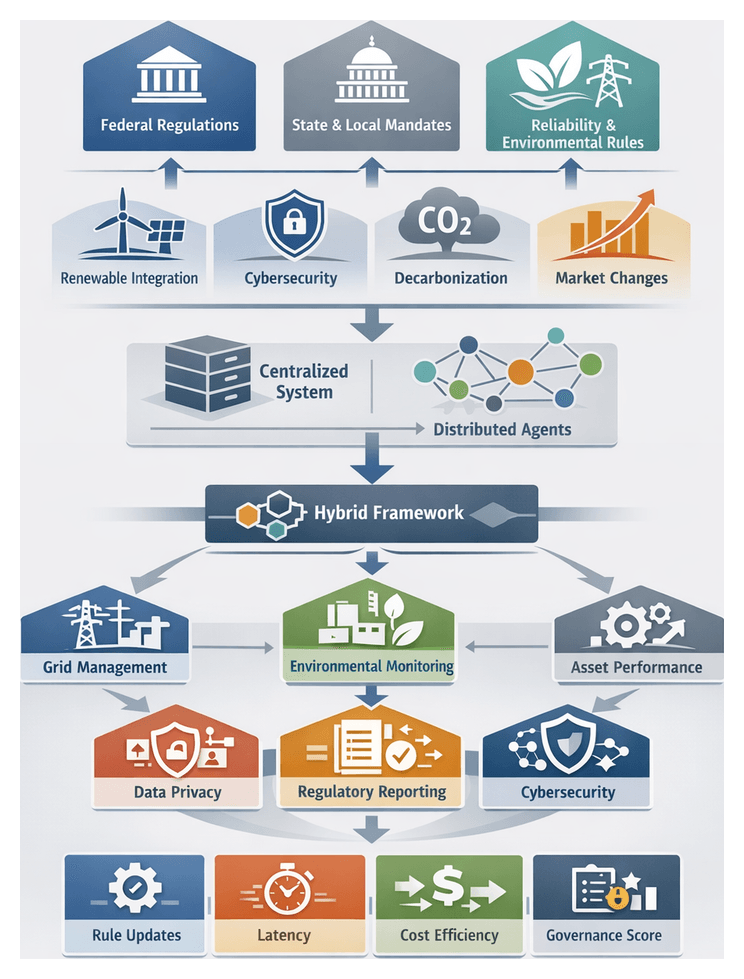
The utilities sector navigates one of the most intricate regulatory landscapes of any industry. Providers of electricity, gas, water and wastewater services must comply with statutes, rules and guidelines issued by federal bodies such as the Federal Energy Regulatory Commission (FERC) and the Environmental Protection Agency (EPA), regional reliability organizations like the North American Electric Reliability Corporation (NERC), state public utility commissions and local authorities. These overlapping mandates address safety, reliability, environmental protection and market conduct, and evolve in response to technological advances, policy shifts and emerging risks.
Regulatory complexity arises not merely from rule volume but from diverse oversight bodies, rapid policy change, technical detail in standards and jurisdictional variations. Drivers such as the integration of renewable and distributed energy resources, smart grid digitalization, cybersecurity threats, decarbonization targets and market restructuring further amplify compliance demands. Utilities must translate legal text into actionable controls, maintain audit readiness and meet service objectives—all within a dynamic, multi-jurisdictional environment.
Historically, utility regulation began in the early 20th century with government-granted monopolies and consumer safeguards. The energy crises of the 1970s led to FERC’s creation, and environmental incidents brought stringent EPA pollution controls. In the late 1990s, mandates for market liberalization and reliability standards spawned NERC and enhanced state-level frameworks. Today’s regulatory landscape reflects converging drivers:
- Integration of renewables and interconnection standards
- Smart grid technology with cybersecurity and data privacy obligations
- Climate policies driving emissions reporting and decarbonization targets
- Complex tariff and billing regulations under market restructuring
- Demand for transparency in governance, reporting and performance metrics
Utilities operating across state lines face jurisdictional overlaps. A single transmission project may require FERC approval, NERC reliability permits, state environmental assessments and local zoning clearances. Within a state, multiple agencies may share authority over aspects such as stormwater discharge, species protection and rate recovery. Variations in interpretation and enforcement mean a requirement considered immaterial in one jurisdiction may trigger penalties in another.
Traditional compliance methods—periodic audits, manual checklists and isolated point solutions—lack holistic visibility and agility. They strain resources, delay rule change identification and fragment data systems, increasing non-compliance risks and diverting skilled professionals from strategic tasks. To overcome these challenges, leading utilities are adopting intelligent compliance solutions powered by artificial intelligence, leveraging machine learning, natural language processing and decision automation to transform reactive compliance into proactive risk management.
AI Compliance Agent Architectures
Modeling Paradigms
AI-driven compliance agents in utilities are designed under two primary paradigms: centralized architectures and distributed frameworks. These models are evaluated for scalability, performance, governance and resilience.
- Centralized Architectures: A single compliance engine ingests regulatory texts, operational telemetry and reporting data, applying a unified rulebase for consistent interpretation. Benefits include a single source of truth, streamlined governance and simpler integration. Challenges include potential performance bottlenecks and increased latency for edge-level anomaly detection.
- Distributed Architectures: Domain-specific agents operate closer to data sources or functional units, each with localized rule sets and data contexts. This model delivers modularity, fault tolerance and faster real-time monitoring. It requires sophisticated orchestration, federated policy management and greater governance overhead to maintain consistency.
Hybrid and Modular Approaches
Many utilities adopt hybrid frameworks, combining centralized oversight with distributed execution. A central policy engine disseminates high-level rules to edge agents, which apply context-specific logic. Modular design allows discrete compliance modules—for document classification, anomaly scoring or report generation—to be orchestrated by central workflows while deployed across distributed infrastructure. This federated model accommodates incremental adoption and balances governance with local agility.
Evaluative Frameworks and Metrics
Architectural selection is guided by strategic priorities, operational contexts and risk profiles. Key dimensions include regulatory volatility, operational latency tolerance and governance maturity. Use-case mapping—such as environmental reporting or cybersecurity anomaly detection—ensures alignment with business objectives. Critical analytical metrics include:
- Time to rule update propagation across agents
- End-to-end decision latency from data ingestion to compliance output
- Model drift detection rate to identify misalignment with current regulations
- Resource cost per compliance transaction
- Governance compliance score aggregating audit findings
Leading practitioners report a trend toward federated compliance platforms to orchestrate distributed services. Fully centralized solutions remain popular for their lower integration complexity and predictable ownership costs, while distributed frameworks excel where sub-second response is critical, such as real-time grid reliability monitoring.
Deployment Contexts in Utilities
AI compliance agents deliver value across diverse operational domains. Each context has unique regulatory pressures, data landscapes and stakeholder demands.
Grid Management and Stability
- Real-time Data Ingestion from SCADA, PMUs and power-flow models
- Anomaly Detection and Alerting using machine learning for voltage and frequency deviations
- Regulatory Reporting Automation with tools like IBM Watson to generate mandatory grid performance submissions
Environmental Compliance and Emissions Monitoring
- Sensor Integration from CEMS, effluent meters and ambient air quality sensors
- Predictive Compliance Forecasting to model emission trends and guide operational adjustments
- Automated Permit Management tracking conditions, deadlines and policy updates
Asset Performance and Reliability
- Condition-Based Monitoring of vibration, oil quality and thermal imaging data
- Maintenance Compliance Tracking against inspection schedules and regulatory intervals
- Risk-Based Decision Support integrating risk scores with compliance priorities
Customer Billing and Data Privacy
- Personal Data Classification via NLP tools to enforce CCPA and GDPR policies
- Billing Accuracy Verification detecting metering errors and unauthorized consumption
- Consent Management automating logging of customer preferences within CRM systems
Regulatory Reporting and Audit Readiness
- Report Generation Automation to format structured and unstructured data into regulatory templates
- Cross-Functional Data Integration unifying finance, operations and legal inputs
- Interactive Audit Portals offering regulators real-time dashboard access for collaborative review
Demand Response and Energy Trading
- Market Rule Interpretation with NLP parsing evolving rulebooks and penalty structures
- Bid Compliance Verification simulating market scenarios against regulatory constraints
- Settlement Exception Monitoring analyzing trading outcomes and flagging discrepancies
Cybersecurity and Critical Infrastructure Protection
- Threat Intelligence Integration ingesting global feeds to contextualize attacks
- Automated Vulnerability Assessments scanning configurations and access logs
- Incident Response Coordination orchestrating evidence collection and notification workflows
Across these domains, key themes emerge. Domain specialization ensures agents understand industry terminology and regulatory hierarchies. Strong data governance supports data integrity, lineage and security. Explainability and auditability remain essential, demanding transparent models and traceable decision pathways. Hybrid models combining AI automation with expert oversight yield balanced compliance strategies that transform regulatory obligations into proactive, efficient operations.
Architectural Trade-offs and Best Practices
Key Trade-offs
- Latency versus Accuracy: Real-time monitoring favors streamlined pipelines, while periodic reporting supports deep inference.
- Autonomy versus Control: Higher agent autonomy accelerates workflows but necessitates human review checkpoints and guardrails.
- Centralization versus Distribution: Centralized models simplify governance; distributed agents enhance resilience and local responsiveness.
- Interpretability versus Performance: Complex models offer superior pattern recognition; rule-based modules maintain transparency.
- Customization versus Standardization: Tailored configurations reflect local regulations; standardized templates support consistency and faster deployment.
Best Practice Recommendations
- Adopt a Layered Governance Model: Centralize policy authoring and distribute runtime inference to local subsystems.
- Implement Transparent Policy Encoding: Use explicable rule engines for core logic and reserve opaque ML for anomaly scoring.
- Leverage Modular Interfaces: Define clear API contracts between ingestion, reasoning and reporting modules.
- Employ Adaptive Thresholds: Calibrate detection parameters based on historical performance and regulatory risk tolerance.
- Prioritize Data Lineage: Capture metadata at each stage to trace data origin, transformations and usage.
- Integrate Human Oversight Loops: Escalate high-impact or ambiguous decisions to expert review.
- Plan Incremental Adoption: Pilot agents in low-risk functions to refine models before enterprise rollout.
- Establish Continuous Validation: Replay historical events to test agent responses and retrain models regularly.
- Maintain an Extensible Framework: Architect for plug-and-play integration of new AI capabilities.
- Foster Cross-Functional Collaboration: Align IT, compliance, data science and operations through shared governance forums.
Considerations and Limitations
- Regulatory Evolution Risk: Architectures must adapt to amendments and jurisdictional divergences.
- Data Quality Dependencies: Efficacy depends on completeness, accuracy and timeliness of inputs.
- Model Degradation: Continuous retraining and drift detection are required to maintain relevance.
- Governance Overhead: Distributed topologies increase synchronization and version control demands.
- Interpretability Challenges: Deep learning models may obscure decision rationales without explainability frameworks.
- Integration Complexity: Legacy silos and proprietary interfaces may require middleware solutions.
- Change Management: Organizational readiness and cultural alignment are critical for adoption.
Chapter 5: Data Integration and Governance for AI-driven Compliance
Understanding the Utilities Data Ecosystem
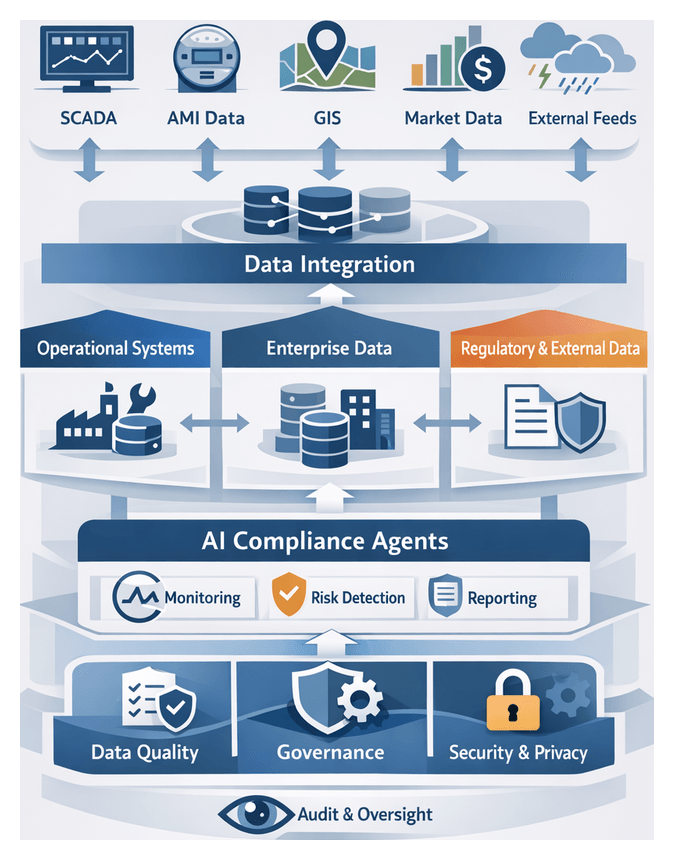
The utilities sector operates on a foundation of diverse, high-volume data streams that span generation, transmission, distribution, customer management and market operations. Real-time outputs from advanced metering infrastructure and SCADA systems coexist with historical trend logs, transactional records and external feeds such as weather forecasts, market prices and cybersecurity intelligence. Geographic information systems map assets and environmental constraints, while customer information systems maintain billing, service and demographic profiles. For AI-driven compliance agents to deliver accurate monitoring, predictive risk detection and automated reporting, stakeholders must first catalog these data domains, identify sources, and map flows end to end.
This multifaceted landscape presents both opportunity and complexity. On one hand, AI models can fuse operational telemetry with external indices to detect regulatory breaches before they occur. On the other hand, siloed repositories, inconsistent schemas and varying latency profiles can undermine analytics and trigger false positives. A comprehensive data inventory establishes the baseline for architecture design, data quality assurance and governance policies that together enable reliable, auditable AI systems.
Integration Strategies and Frameworks
Integrating disparate data sources into a coherent fabric is a prerequisite for any AI-enabled compliance framework. Data may be classified into operational systems (AMI meters, SCADA telemetry, maintenance logs), enterprise platforms (ERP financial modules, CIS databases), geospatial layers (GIS asset maps, environmental zones), regulatory filings (FERC submissions, state reports) and external feeds (weather, market pricing, inspection reports). Key integration challenges include:
- Format Diversity – Relational databases, time-series platforms, document repositories, flat files and IoT streams each require specialized connectors and parsers.
- Access Restrictions – Legacy systems may lack robust APIs, while contractual or regulatory constraints limit third-party data usage.
- Latency Variability – Real-time monitoring demands streaming ingestion, whereas financial and regulatory reports often rely on batch updates.
- Semantic Inconsistencies – Divergent naming conventions, units of measure and metadata definitions across vendors and regions introduce ambiguity.
- Security and Privacy – Sensitive telemetry and customer information require encryption, masking and role-based access controls.
To address these obstacles, utilities are adopting layered architectures such as data fabrics or data meshes that decouple point-to-point integrations and promote governed self-service access. Automated, API-driven pipelines enforce data contracts, while metadata management and cataloging tools provide discoverability and consistency. Core platforms in this space include AWS Lake Formation for secure data lake builds, Microsoft Purview for unified data governance, Informatica for intelligent data quality, IBM Watson Knowledge Catalog for metadata management and Collibra for governance orchestration. Streaming architectures such as Kappa and Lambda inform design choices for real-time versus batch processing, guiding tool selection and operational policies.
Interpretive models like the Data Integration Maturity Model and risk-impact matrices help organizations prioritize initiatives. By ranking data sources according to compliance risk and implementation complexity, teams can align roadmaps with strategic objectives, ensuring that AI agents access the most critical feeds first.
Ensuring Data Quality and Stewardship
The integrity of AI-driven compliance hinges on rigorous data quality metrics. Core dimensions include:
- Accuracy – Validation against calibrated sensors, manual audit checks and external reference datasets.
- Completeness – Ensuring required fields such as meter readings, geographic coordinates and customer attributes are fully populated.
- Consistency – Harmonizing naming conventions, code lists and units of measure across systems.
- Timeliness – Aligning data freshness with use cases, from sub-second grid stability monitoring to monthly financial reconciliations.
- Lineage – Tracking provenance through documented ingestion and transformation pipelines to support audit trails.
Standards such as ISO 8000 for data quality and the Utility Industry Architecture Framework (UIAF) provide templates for governance processes, while DAMA International’s DMBoK and ISO 38500 inform stewardship policies. Embedding these standards into data cataloging platforms—such as Collibra and Microsoft Purview—enables automated profiling, enrichment and policy enforcement.
Effective stewardship requires clearly defined roles:
- Data Owner – Senior leader who specifies requirements, approves policies and resolves conflicting definitions.
- Data Steward – Practitioner responsible for day-to-day quality monitoring, metadata governance and issue resolution.
- Data Custodian – IT professional who manages storage, security controls and pipeline deployments.
- Governance Council – Cross-functional committee overseeing policy creation, dispute resolution and strategic alignment.
- AI Model Owner – Domain expert validating agent outputs, monitoring performance and authorizing model updates.
- Model Risk Officer – Specialist ensuring interpretability, fairness and consistency with regulatory criteria.
- Compliance Auditor – Internal or external reviewer conducting periodic assessments of data processes and model behavior.
Formalizing these roles in a governance charter and leveraging platforms such as Collibra or Microsoft Purview for automated workflow management ensures accountability and transparent audit trails.
Governance Foundations for AI-Driven Compliance
Policy, Standards and Frameworks
A robust governance framework integrates policy definitions, technical controls and organizational structures to safeguard legal, ethical and operational requirements. Key components include data usage policies, privacy thresholds, model transparency criteria and escalation procedures for anomalous outputs. Technical guidelines align with the National Institute of Standards and Technology’s AI Risk Management Framework, while risk and compliance registers catalog regulatory obligations, data sensitivities and model risks.
Technical Controls and Continuous Monitoring
- Access Management – Role-based controls and segregation of duties restrict data and model artifacts to authorized users.
- Encryption and Masking – Encrypt data at rest and in transit, apply anonymization in non-production environments.
- Audit Trails – Immutable logs of data access, pipeline executions and decision outputs support forensic analysis.
- Automated Policy Enforcement – Policy engines block non-conforming data flows or model behaviors in real time.
- Performance and Drift Monitoring – Continuous checks on model accuracy and input distributions trigger governance workflows when metrics deviate.
Regulatory Alignment and Privacy Safeguards
Utilities must map data and model activities to sector-specific statutes—such as FERC, state public utility commissions and NERC CIP—as well as data privacy laws like GDPR and CCPA. Maintaining a regulatory register with retention schedules, data subject rights and impact assessments ensures pre-deployment compliance and supports audit readiness.
Governance Maturity and Improvement
Adopting a maturity model—from Ad Hoc and Repeatable stages to Defined, Managed and Optimized—helps benchmark governance capabilities and prioritize enhancements. Metrics dashboards track effectiveness, while continuous improvement cycles incorporate lessons from audits, regulatory changes and operational incidents.
Limitations and Mitigation Strategies
- Bureaucratic Delays – Implement agile governance processes to balance oversight with innovation velocity.
- Resource Constraints – Leverage cloud-based governance platforms to reduce upfront investment and scale controls.
- Regulatory Ambiguity – Maintain close dialogue with regulators and update frameworks as AI-specific guidance emerges.
- Cultural Resistance – Build executive sponsorship and integrate governance training into professional development.
- Data Fragmentation – Employ data fabrics or meshes to unify visibility and enforce consistent policies across legacy and modern systems.
Strategic Recommendations
- Align Governance with Business Imperatives – Ensure compliance frameworks support reliability, cost efficiency and customer satisfaction goals.
- Prioritize by Risk – Use risk-impact matrices and compliance value stream mapping to focus on high-leverage data domains.
- Automate Controls – Adopt policy-as-code, integrated data catalogs and model governance tools to scale enforcement without proportional headcount increases.
- Foster a Stewardship Culture – Embed governance responsibilities into performance metrics and reward proactive data quality management.
- Iterate Continuously – Regularly review and update policies, tools and roles to reflect regulatory shifts, emerging risks and technological advances.
By integrating diverse data sources through governed architectures, enforcing rigorous quality and stewardship standards, and embedding comprehensive governance foundations, utilities can unlock the full potential of AI-driven compliance agents. This integrated approach transforms compliance from a reactive, manual exercise into a strategic capability—ensuring regulatory adherence, mitigating risk and enabling continuous operational excellence.
Chapter 6: Automating Regulatory Reporting Processes
Regulatory Complexity and the Need for Intelligent Compliance
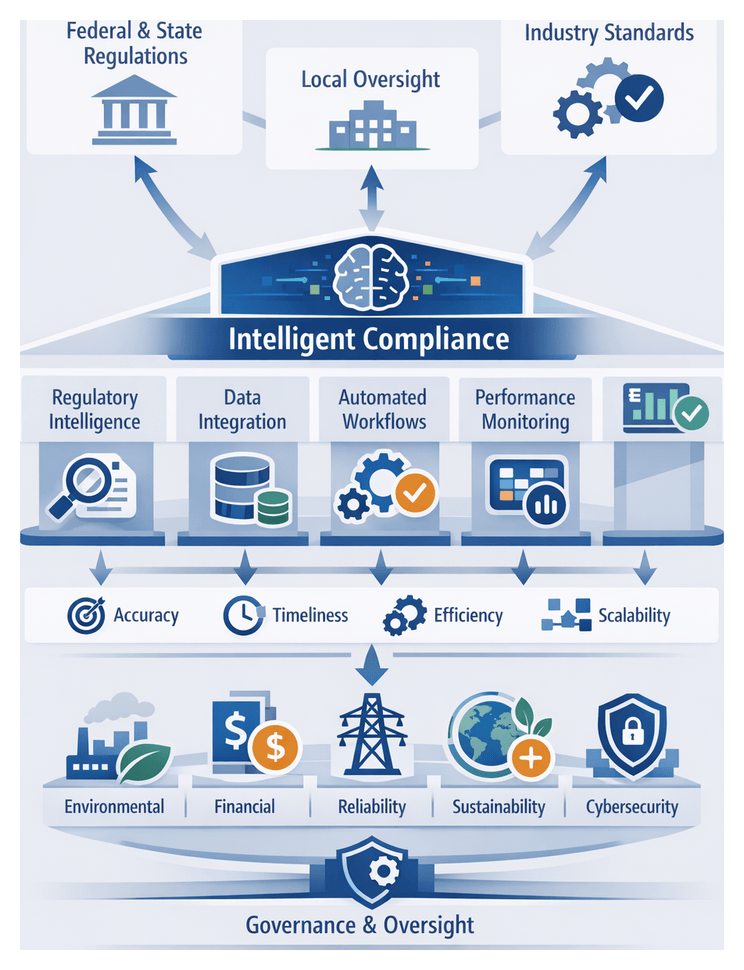
The utilities sector operates under a dense web of federal, state, and local regulations designed to ensure reliable service, protect public health, and meet environmental objectives. Landmark statutes such as the Federal Power Act, the Clean Air Act, and the Safe Drinking Water Act delegate rulemaking to agencies including FERC and the EPA, while state public utilities commissions impose additional requirements on rates, safety, and reporting. Industry standards from NERC, AWWA, and IEEE add further voluntary or semi-mandatory obligations. Utilities must reconcile these overlapping mandates with operational priorities—grid resilience, renewable integration, cybersecurity, and digital transformation—across multiple jurisdictions with distinct reporting formats and approval processes. Emerging policy goals around climate resilience, distributed energy resources, and data privacy continue to expand the regulatory perimeter and intensify compliance demands.
Traditional compliance models relying on manual data gathering, spreadsheets, and periodic audits struggle to keep pace with evolving requirements. Data silos across grid management, water treatment, billing, and asset maintenance hinder unified compliance oversight. Regulators issue dozens of rule modifications, guidance memos, and reporting clarifications each quarter, requiring constant workflow adjustments and resource reallocation. The financial and reputational consequences of non-compliance—fines, operational restrictions, license revocations, and stakeholder distrust—make proactive, strategic compliance management essential.
An intelligent compliance framework addresses these challenges by combining regulatory intelligence, integrated data repositories, automated workflows, and performance dashboards. Natural language processing scans regulatory texts to extract obligations and map them to internal processes. Machine learning models analyze historical filings to predict audit focus areas and recommend data quality improvements. Decision automation triggers review workflows when anomalies or missing submissions are detected. Centralized rule libraries standardize requirements expression, while data lakes consolidate operational metrics for real-time monitoring. Cross-functional governance structures ensure auditability of algorithmic decisions, model interpretability, and secure data pipelines. Change management prepares staff to trust intelligent tools while retaining the expertise needed for nuanced regulatory interpretation.
Analytical Foundations: Accuracy, Timeliness, Efficiency, and Scalability
Deploying AI-driven reporting agents requires rigorous analytical frameworks to measure performance across four dimensions: accuracy, timeliness, operational efficiency, and regulatory adaptability. Decision makers evaluate systems using quantitative metrics, interpretive models, and cost frameworks to ensure that intelligent automation delivers credible, scalable compliance outcomes.
Accuracy Metrics
- Precision and Recall
- Precision: proportion of correctly identified regulatory elements among those flagged, minimizing false positives.
- Recall: proportion of actual requirements captured by the agent, reducing false negatives.
- F1 Score
- Balances precision and recall into a single performance indicator, with minimum thresholds set for regulatory filings.
- Error Distribution Analysis
- Diagnoses systemic biases by examining patterns in false positives and negatives, guiding model retraining and data enrichment.
- Threshold Sensitivity
- Adjusts confidence levels to align with risk tolerance, trading off between capturing subtle compliance signals and avoiding unnecessary reviews.
Timeliness and Workflow Efficiency
- Cycle Time Reduction: AI agents automate repetitive tasks, shortening reporting cycles from weeks to days.
- Parallel Processing: Concurrent handling of multiple reporting streams eliminates sequential bottlenecks and supports last-minute data updates.
- Continuous Reporting: Embedding validation checks into operational systems enables near real-time compliance monitoring and proactive issue resolution.
Platforms such as IBM Watson OpenScale and Microsoft Azure AI provide workflow analytics dashboards that track task durations, exception rates, and throughput. Techniques like value stream mapping and process mining quantify non-value-added activities and highlight opportunities for further automation. In one case, an AI reporting agent reduced human review time by 70 percent, freeing staff for strategic analysis and regulatory strategy planning.
Resource Allocation and Cost Structures
- Labor Redeployment: Compliance personnel shift from manual data validation to exception resolution and policy interpretation.
- Operational Cost Savings: Error reduction and fewer external consultancy fees lower total cost of compliance.
Financial evaluation frameworks such as Total Cost of Ownership and Return on Compliance Investment compare pre- and post-automation expense profiles. A mid-Atlantic utility documented a 25 percent net reduction in compliance operating costs within six months of deploying an AI solution, attributing nearly half the savings to internal teams handling regulatory inquiries using automated insights. Tools from Google Cloud AI support scenario planning to model long-term cost trajectories under changing regulatory regimes.
Scalability and Regulatory Adaptability
- Modular Rule Management: Rapid incorporation of new rule sets into the agent’s knowledge base without major system overhauls.
- Data Throughput Capacity: Maintenance of SLA-compliant processing times under elevated reporting volumes.
- Configurability: User interfaces that enable non-technical staff to adjust mappings, validation logic, and report parameters.
Performance and stress testing simulate multi-jurisdictional filings to ensure sub-second validation workflows. Technology maturity assessments guide organizations in prioritizing enhancements—such as natural language rule ingestion and automated regulatory change detection—to maximize adaptability as policy landscapes evolve.
Context-Specific Reporting Domains
AI-driven reporting agents apply domain-specific interpretive frameworks and data integrations to meet the unique demands of environmental, financial, reliability, sustainability, and cybersecurity compliance.
Environmental and Emissions Reporting
Regulatory frameworks such as the GHG Protocol and ISO 14001 require continuous monitoring of CO2, NOx, SO2, and other pollutants. AI platforms like AgentLinkAI ingest sensor feeds, maintenance logs, and weather data to generate audit-ready emissions reports. Anomaly detection algorithms flag data gaps or sensor drift, while time-series analysis ensures consistency across reporting intervals. Predictive models support scenario analysis of future emissions and carbon pricing impacts, transforming environmental disclosures into strategic risk management tools.
Financial Disclosures and Rate Case Filings
Financial compliance obligations—FERC Form 1, Form 714, EU REMIT, and state rate case submissions—demand rigorous cost allocation, tariff consistency, and audit trails. AI-enabled platforms such as IBM OpenPages use natural language processing to extract requirements from rate orders and map them to financial line items. Automated variance analysis detects unexpected fluctuations, while continuous controls monitoring reduces the risk of restatements and regulatory inquiries.
Reliability Metrics and Incident Reporting
Under NERC standards, metrics like SAIDI, SAIFI, and MAIFI require precise classification of system events, timely filings, and cross-functional collaboration. AI agents integrate SCADA logs, sensor feeds, and maintenance records into a unified data lake. Pattern recognition automates event classification, anomaly detection triggers mandated filings within regulatory deadlines, and narrative generation produces complete submission packages, turning compliance into an enabler of operational improvement.
Sustainability, ESG, and Integrated Reporting
Integrated disclosures combining financial, environmental, social, and governance metrics follow GRI, SASB, and TCFD frameworks. AI solutions from AgentLinkAI collate workforce diversity data, supply chain assessments, and carbon reduction targets. Semantic reconciliation and taxonomy mapping create consistent, auditable datasets. Natural language generation engines craft management commentary that aligns with quantitative evidence, supporting transparent, assurance-ready reports.
Cybersecurity and Critical Infrastructure Reporting
Regulations such as NERC CIP and the EU NIS Directive require documentation of control effectiveness, incident response timelines, and continuous threat monitoring. AI-driven agents ingest security logs, vulnerability scans, and threat intelligence to generate compliance reports mapping controls to requirements. Automated risk scoring prioritizes remediation, while consolidated dashboards provide strategic overviews and technical validation for regulators and executives alike.
Governance, Human Oversight, and Future Trends
Ensuring the integrity of AI-driven reporting demands robust governance, clear human-machine roles, continuous performance interpretation, and strategic foresight into emerging capabilities.
Governance and Quality Control
- Audit Trails and Traceability: Logging data sources, model versions, confidence scores, and transformation logic to satisfy audit requirements.
- Model Versioning and Validation: Routine revalidation against gold-standard datasets, with version control enabling audit-friendly rollbacks.
- Quality Maturity Models: Benchmarking processes using frameworks like CMMI to chart compliance improvement roadmaps.
- Risk Control Self-Assessment: Periodic evaluations of AI-related failure risks to inform targeted controls.
Balancing Automation and Human Oversight
- Exception Handling: AI flags anomalies and low-confidence outputs for human review with clear escalation protocols.
- Expert-in-the-Loop Reviews: Specialists validate critical reports, incorporating policy advisories and one-off regulatory clarifications.
- Collaborative Feedback: Human corrections feed back into training datasets, driving continuous accuracy improvements.
Model Monitoring and Regulatory Change Management
- Drift Detection: Statistical indicators track data distribution shifts to prevent model degradation.
- Periodic Benchmarking: Ongoing comparisons against manual processes or alternative algorithms to sustain accuracy and efficiency gains.
- Regulatory Change Management: Quantifying the impact of new rules on models and orchestrating necessary retraining or rule updates.
Key Considerations and Limitations
- Data Quality Constraints: Strong data governance is essential to avoid garbage-in, garbage-out scenarios.
- Model Explainability: Balancing complex algorithms with transparency requirements for regulators and auditors.
- Regulatory Ambiguity: Retaining human judgment to interpret qualitative requirements and gray areas.
- Scalability versus Customization: Designing solutions that handle standardized workflows while accommodating jurisdictional nuances.
- Organizational Readiness: Cultivating cross-functional collaboration, executive sponsorship, and cultural acceptance of AI.
Forward-Looking Insights
- Explainable AI Enhancements: Tools that trace model decisions to satisfy governance without sacrificing performance.
- Active Learning Frameworks: Selective human feedback on high-uncertainty instances to accelerate model improvement.
- Integration with Predictive Maintenance: Automated disclosures triggered by equipment performance anomalies for real-time risk alerts.
- Regulatory Sandboxes: Controlled environments for piloting AI reporting innovations under reduced penalty risk.
By unifying rigorous analytics, robust governance, and strategic foresight, utilities can architect AI-driven reporting processes that deliver unwavering accuracy, scalable efficiency, and proactive compliance intelligence. This dual focus secures regulatory credibility, drives operational excellence, and positions utilities at the forefront of compliance innovation.
Chapter 7: Proactive Risk Detection and Anomaly Monitoring
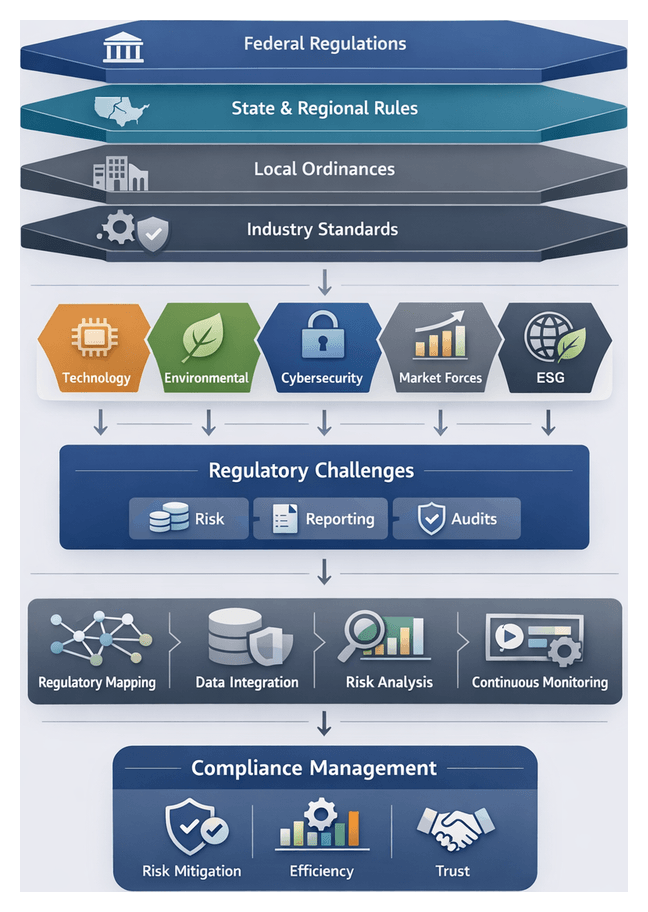
Regulatory Complexity in the Utilities Sector
The utilities industry—including electric power, gas, water and wastewater services—operates within a dense framework of federal statutes, state regulations, regional directives and local ordinances. Historical milestones such as the Federal Power Act of 1935, the Clean Water Act of 1972 and the Energy Policy Act of 2005 have expanded federal oversight, while state public utility commissions continue to set rate and service standards. Industry standards bodies, including the North American Electric Reliability Corporation (NERC) with its Critical Infrastructure Protection (CIP) standards and the International Organization for Standardization’s ISO 9001 and ISO 14001, further broaden compliance obligations. This multi-layered environment introduces overlapping requirements, distinct reporting schedules and complex audit protocols, making systematic compliance approaches essential for risk management, reliability and public trust.
Key layers of regulatory authority include:
- Federal agencies: FERC, EPA, DOE and NRC
- State public utility commissions overseeing rates, reliability and safety
- Regional transmission organizations (RTOs) and independent system operators (ISOs) enforcing market and reliability rules
- Local municipalities and county agencies governing land use, permitting and water quality
Utilities also adhere to voluntary or quasi-mandatory industry standards, such as NERC CIP for cybersecurity, the ISO 55000 series for asset management, North American Transmission Forum guidelines on vegetation management and American Water Works Association protocols for water safety. Regulators often reference these standards in audits and enforcement actions, effectively making them mandatory. As utilities modernize the grid, adopt smart metering and integrate distributed energy resources, new policy directives on data privacy, interoperability and customer protection further escalate technical specifications and reporting complexity.
Drivers of regulatory proliferation include:
- Technological innovation: Advanced metering infrastructure, distributed generation, energy storage and microgrids require data‐exchange protocols, cybersecurity and performance monitoring.
- Environmental and sustainability goals: Renewable portfolio standards, greenhouse gas reduction mandates and water conservation requirements introduce new reporting and operational controls.
- Cybersecurity and resilience: Evolving threat landscapes drive incident reporting mandates and resilience planning requirements.
- Market liberalization: Transparent pricing rules, capacity auctions and customer protection regulations in deregulated markets demand detailed compliance.
- Stakeholder expectations: ESG reporting pressures from investors and rating agencies influence both regulatory developments and voluntary disclosure frameworks.
The implications for utility compliance management are profound:
- Resource allocation: Dedicated legal, technical and regulatory specialists manage filings, reports and permits across jurisdictions.
- Process complexity: Manual data gathering and report compilation are time-consuming and error-prone amidst disparate systems.
- Audit and enforcement risk: Non-compliance can incur fines, reputational harm and mandatory remedial actions as regulators leverage data analytics to target anomalies.
- Strategic uncertainty: Shifting policy priorities—carbon targets, cybersecurity mandates—require flexible compliance strategies.
- Stakeholder coordination: Engaging regulators, legislators and community groups is critical to align operational realities with policy development.
To navigate this complexity, utilities should embrace foundational principles:
- Comprehensive regulatory mapping: Maintain an up-to-date inventory of applicable regulations, standards and reporting obligations linked to internal processes and data sources.
- Risk-based prioritization: Evaluate likelihood and impact of non-compliance, focusing resources on high-risk areas while sustaining baseline controls elsewhere.
- Integrated data management: Consolidate data from asset management, SCADA, metering and financial systems for consistency and traceability.
- Continuous monitoring and reporting: Implement dashboards and alerts for real-time compliance metrics, reducing manual efforts.
- Stakeholder engagement: Develop governance structures that include legal, compliance, operations and IT stakeholders for ongoing alignment.
Organizations that master regulatory complexity can mitigate financial and operational risk, enhance decision-making with timely compliance data, strengthen stakeholder trust and drive efficiency. This sets the stage for intelligent compliance solutions that leverage AI-driven agents to automate processes and deliver real-time risk insights.
Analytical Techniques for Risk Prediction
Predictive analytics in utilities compliance quantifies the likelihood and impact of events such as reporting lapses, permit exceedances, security incidents and tariff miscalculations. By analyzing historical and real-time data—time-series operational metrics, maintenance logs, network performance and external variables like weather—organizations can shift from reactive responses to anticipatory controls.
Statistical and Probabilistic Modeling
- Time Series Analysis: ARIMA and Exponential Smoothing Forecasting project future values of emissions, equipment failures and missed deadlines by assessing seasonality and trends.
- Survival and Hazard Models: Cox Proportional Hazards and related techniques estimate time until a compliance breach or system failure, incorporating covariates such as maintenance frequency.
- Bayesian Networks: Encode probabilistic dependencies to perform scenario analysis and update risk estimates as new data arrives.
- Monte Carlo Simulation: Generate simulated outcomes from input distributions to quantify worst-case compliance scenarios and support stress testing.
Machine Learning and Ensemble Methods
- Decision Tree-Based Models: Random Forests and Gradient Boosting Machines handle nonlinear relationships and large datasets. IBM Watson models classify high-risk tariff adjustments by analyzing billing data, network load and policy changes.
- Support Vector Machines: Effective in high-dimensional spaces for distinguishing normal patterns from compliance precursors in cybersecurity monitoring.
- Neural Networks and Deep Learning: Convolutional and recurrent networks process time-series sensor data and unstructured regulatory documents, capturing complex feature interactions.
- Ensemble Learning: Combining statistical and machine learning models yields composite risk scores with improved consistency across compliance domains.
Natural Language Processing for Regulatory Analysis
- Named Entity Recognition: Identifies statutes, agencies and thresholds in new regulations to update risk parameters dynamically.
- Topic Modeling: Latent Dirichlet Allocation reveals emerging compliance themes, such as grid cybersecurity or carbon offsets.
- Sentiment and Semantic Analysis: Assigns risk weights by assessing tone and intent of regulatory guidance and enforcement bulletins.
Hybrid and Adaptive Frameworks
- Rule-Augmented Models: Embed regulatory constraints within statistical or ML predictions to ensure alignment with legal thresholds.
- Online Learning and Retraining: Integrate audit findings and incident reports into continuous retraining pipelines to address model drift.
- Explainable AI (XAI): Techniques such as SHAP values elucidate how features contribute to risk scores, fostering trust among compliance officers and auditors.
Evaluation and Validation Strategies
- Calibration and Discrimination: Measure alignment of predicted probabilities with outcomes and the model’s ability to separate high- and low-risk instances (AUC-ROC).
- Backtesting and Stress Scenarios: Compare forecasts against historical events and evaluate resilience under extreme conditions.
- Cross-Validation: Partition data to prevent overfitting and ensure generalizability across contexts and time periods.
- Governance Oversight: Risk committees review methodologies, data lineage and validation reports to support internal and external audits.
Integrating Insights into Operations
- Define risk thresholds that trigger actions such as augmented monitoring, pre-emptive maintenance or regulatory notifications.
- Embed risk scores into dashboards and alerting systems for timely, prioritized insights.
- Integrate predictive analytics within enterprise risk management frameworks to link operational, financial and reputational risks.
- Establish feedback loops where incident outcomes refine model inputs for continuous improvement.
Platforms such as SAS Risk Management and Palantir Foundry embed these analytical techniques within compliance workflows, providing governance controls and audit trails that enhance operational resilience and strategic foresight.
Urgency of Intelligent Compliance Solutions
Utilities face converging market pressures, policy mandates and exponential data growth that render manual compliance approaches unsustainable. Key drivers demanding immediate investment in AI-enabled tools include:
- Regulatory tightening: Stricter emissions, data privacy and cybersecurity mandates require proactive monitoring.
- Stakeholder scrutiny: Investors and rating agencies evaluate governance against ESG criteria.
- Competitive differentiation: Demonstrating robust risk control and transparency strengthens market position and customer trust.
Petabytes of data from smart meters, grid sensors and third-party sources overwhelm traditional pipelines. AI-driven compliance agents classify and tag regulatory documents in real time, extract key requirements into controls and correlate incident logs, performance metrics and audit trails to identify emerging gaps. Scalable data architectures are prerequisites for agent efficacy to manage heterogeneous streams and deliver comprehensive compliance insights.
Non-compliance costs extend beyond fines to include remediation expenses, legal fees and reputational damage. A global survey estimated that each compliance event reduces shareholder value by over three percent. AI-driven automation reduces marginal compliance costs, making early adoption economically compelling.
Experts reference frameworks such as COSO and NIST to align AI capabilities with control objectives, while maturity models from Gartner and Forrester’s TEI methodology guide executive decision-making. Solution selection criteria include:
- Accuracy and precision in identifying true positives with minimal false alerts
- Explainability of decision pathways for auditor and regulator confidence
- Scalability to accommodate growing data volumes and evolving rule sets
- Interoperability with asset management, billing and incident management platforms
Anticipated policy shifts—real-time outage reporting, enhanced cybersecurity protocols and stricter emissions monitoring—heighten the strategic value of AI compliance agents. Early adopters gain flexibility to adapt without costly overhauls and secure favorable financing from ESG-focused investors. Pilot programs leveraging IBM Watson for document classification and Palantir Foundry for data integration exemplify how intelligent compliance transforms regulatory adherence into enterprise agility.
Precision and Response Considerations
AI-driven anomaly detection and response protocols must balance precision with orchestrated action. Overly sensitive systems generate false positives that lead to alert fatigue, while overly specific models risk missing critical events. Utilities use receiver operating characteristic (ROC) curves and precision-recall analyses to anchor threshold decisions within risk appetite frameworks endorsed by compliance committees.
Key performance metrics include precision, recall, F1 score and area under the precision-recall curve, especially important for imbalanced anomaly datasets. Mapping these metrics to business impact categories—service continuity, environmental compliance and financial penalties—guides model selection and refinement.
Threshold calibration strategies involve multi-tiered frameworks:
- Tier 1 thresholds for minor deviations prompting automated validation
- Tier 2 thresholds for patterns requiring supervisory review
- Tier 3 thresholds triggering immediate incident management
Adaptive thresholding adjusts alert boundaries based on contextual factors such as weather or maintenance schedules. Contextual scoring further prioritizes anomalies by asset criticality, performance variance and reporting deadlines. Human-in-the-loop interventions at critical decision points ensure expert judgment, regulatory interpretation and cross-functional coordination, all documented to support NERC CIP and other audit requirements.
Quantitative cost-benefit matrices assign monetary values to false positives—diverted personnel hours and investigative costs—and false negatives—equipment damage, outages and fines. This analysis justifies investments in high-fidelity models, enhanced instrumentation and expanded response resources.
Designing Robust Response Playbooks
- Incident classification frameworks: Multi-dimensional schemas considering safety, regulatory impact and operational cost
- Escalation matrices: Clear triggers for advancing issues from frontline teams to engineering, compliance and leadership
- Communication protocols: Standardized methods—email, SMS or messaging systems—based on urgency and stakeholder roles
- Regulatory reporting paths: Response timelines aligned with mandatory disclosure requirements for emissions, reliability and cybersecurity
Governance and Operational Limitations
- Data quality and stewardship: Integrity, completeness and consistency of data streams are essential to avoid bias and blind spots
- Model drift and maintenance: Regular retraining and performance monitoring prevent degradation over time
- Governance and ownership: Clear accountability across data science, IT, compliance and business units with periodic steering committee reviews
- Resource capacity and alert fatigue: Capacity planning for normal and peak alert volumes with surge support provisions
- Integration challenges: Robust APIs and standardized messaging ensure seamless handoffs between detection, incident management and reporting systems
- Explainability and audit readiness: Transparent reasoning paths through explainable AI techniques build trust and support regulatory inquiries
- Regulatory and ethical constraints: Privacy regulations and data sharing agreements shape allowable analyses, while ethical considerations guard against unintended discrimination
Strategic Insights for Industry Leaders
- Phased sensitivity rollout: Begin with conservative thresholds, tightening based on measured performance and feedback
- Cross-functional governance forums: Include risk, operations, data science, IT and compliance representatives to oversee performance and continuous improvement
- Explainable AI practices: Incorporate local surrogate models and feature attribution techniques to document anomaly decisions and support informed action
- Scenario-based playbook validation: Conduct tabletop simulations and live drills to test high-severity response workflows and refine protocols
- Investment in continuous learning: Allocate resources for model retraining, data pipeline enhancements and staff development in analytics and regulatory risk
- Alignment of metrics with business outcomes: Link detection and response capabilities to objectives—reduced outages, improved reporting accuracy and minimized fines—and review these metrics at the executive level
By meticulously calibrating detection thresholds, embedding human expertise, enforcing governance structures and aligning performance metrics with strategic goals, utilities can transform reactive risk management into proactive competitive advantage, safeguarding assets, customers and reputations in an ever-evolving regulatory landscape.
Chapter 8: Implementation Best Practices and Change Management
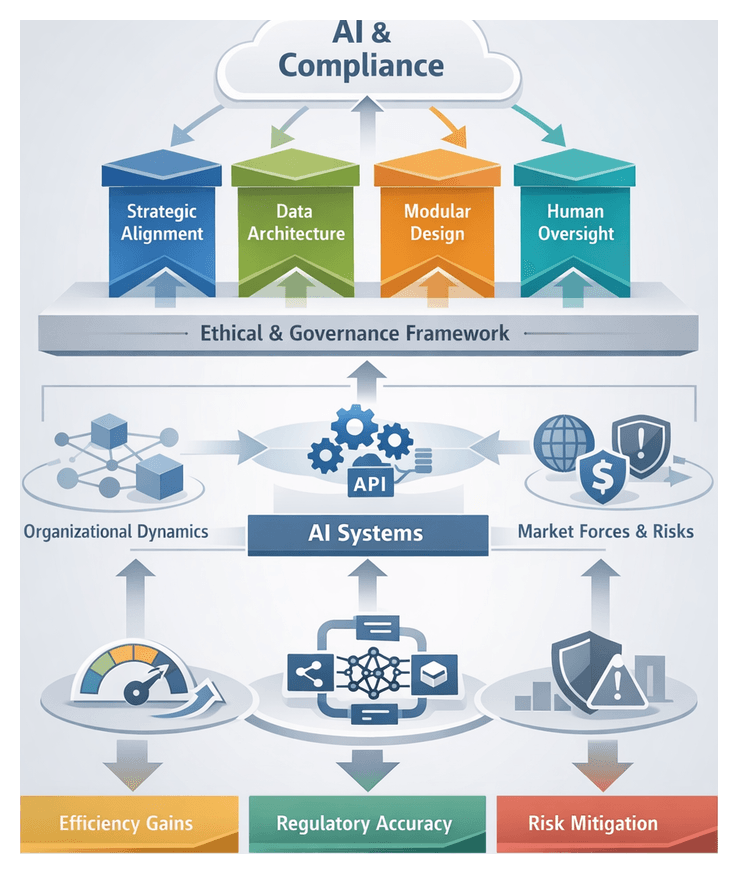
Foundational Principles and System Architecture
Integrating AI into compliance processes requires strategic alignment, robust data governance, modular design, human oversight, and rigorous ethical frameworks. These principles ensure AI agents augment human expertise and deliver measurable improvements in regulatory accuracy and efficiency.
Strategic Alignment
AI initiatives must directly support core business objectives such as grid modernization, customer experience, and cost reduction. Define measurable outcomes—such as reducing report preparation time by 50 percent or achieving real-time regulatory reporting—and link AI capabilities, like natural language processing for policy interpretation, to risk mitigation. Establish executive sponsorship and cross-functional steering committees and develop business cases detailing projected return on investment, total cost of ownership, and risk reduction benefits.
Data-Centric Architecture
A unified data layer consolidates sources—SCADA systems, billing records, environmental monitoring, and external regulation repositories—into a centralized lake or warehouse. Assign data stewardship roles with accountability for accuracy, lineage, and metadata management. Implement automated validation routines to detect anomalies and enforce role-based access controls, encryption, and audit logging. Document versioning processes for source systems and AI training datasets to ensure reproducibility and audit readiness.
Modular and Scalable Design
Adopt a microservices and API-first approach, encapsulating functions such as document ingestion, regulation classification, and anomaly detection into self-contained services. Use containerization to ensure consistent deployment and enable plug-and-play component replacement—such as swapping a rule-based parser for a transformer-based NLP model. Leverage event-driven processing to trigger real-time compliance checks and ensure elastic scalability to handle peak loads and intensive model retraining.
Human-in-the-Loop and Governance
Balance automation with expert oversight through workflows that route AI-flagged anomalies to subject-matter experts. Capture expert feedback to retrain models, refine decision thresholds, and improve accuracy. Conduct change readiness assessments to address culture and skills gaps, and establish governance forums with representation from compliance, IT, legal, and operations. Implement policy frameworks for acceptable use, model validation, explainability, continuous monitoring, and audit readiness, embedding fairness and privacy into AI lifecycles.
Organizational Dynamics and Change Management
Success depends on navigating cultural, structural, and governance factors. Analytical frameworks guide assessments of readiness, stakeholder influence, and adoption patterns.
Culture and Stakeholder Ecosystem
Assess organizational culture using models like the Competing Values Framework to gauge openness to innovation and tolerance for risk. Conduct culture assessments through surveys and interviews to inform change strategies. Map stakeholders—executive leadership, compliance officers, technology teams, and external regulators—using RACI matrices and power-interest grids to align incentives and communication. Secure executive sponsorship from a C-level compliance or technology executive to balance power dynamics and ensure accountability.
Governance Models and Collaboration
Choose between centralized governance, with a Center of Excellence overseeing model deployment and validation, and federated governance, which empowers business units with domain expertise. A hybrid model often offers centralized policy with federated execution and feedback loops. Break down knowledge silos along functional lines—engineering, legal, operations, customer service—using frameworks like the McKinsey 7S model. Encourage cross-functional workshops and rotational assignments to improve collaboration and integrated data usage.
Maturity Frameworks and Adoption Patterns
Evaluate digital maturity through stages—ad hoc, opportunistic, systematic, optimized—and cultural maturity in leadership vision and change receptivity. Use third-party audits or self-assessments to identify gaps in data governance, change management, and analytics capabilities. Apply the ADKAR model to diagnose resistance—Awareness, Desire, Knowledge, Ability, Reinforcement—and tailor interventions such as targeted training or incentive realignment. A phase-gate approach ensures organizational dynamics evolve with AI sophistication.
Market Pressures and Strategic Imperatives
Market competition, regulatory intensification, risk economics, and data proliferation compel utilities to adopt AI-driven compliance solutions.
Market Drivers and Regulatory Intensification
Utilities face fragmented supply chains and outsourced operations that increase compliance touchpoints. Expansion into customer services demands adaptability to privacy requirements. Investors and rating agencies factor ESG performance into credit ratings, amplifying the financial stakes of compliance. Federal agencies like FERC and NERC issue directives on resilience and cybersecurity, while EU regulations such as the Renewable Energy Directive and GDPR impose global compliance complexities.
Risk Economics
Non-compliance costs have risen sharply, with fines, remediation, operational downtime, reputational damage, and insurance premium increases. Risk-based economic models quantify expected losses from breaches and integrate these into budgeting and capital allocation, shifting compliance from reactive tracking to proactive risk management.
Data Complexity and Analytics Limits
Petabytes of data from smart meters, SCADA, outage management, and customer interactions overwhelm rule-based engines. Advanced machine learning and natural language understanding are required for continuous monitoring, real-time alerting, anomaly detection, and semantic regulation mapping.
Strategic Frameworks and Platform Selection
Align AI compliance with COSO’s Enterprise Risk Management and the Three Lines of Defense model by embedding continuous risk assessment in front-line operations and unifying audit trails. Evaluate AI platforms against criteria such as pre-trained regulatory models, out-of-the-box integration with operational data, and transparency features. Compare solutions like those listed on AgentLinkAI, IBM Watson, and Microsoft Azure Cognitive Services to secure competitive advantage through reduced risk exposure and optimized resource allocation.
Communication, Training, and Continuous Improvement
Effective transformation hinges on transparent communication, targeted training, and iterative feedback loops to sustain adoption and performance.
Communication Strategies
Combine formal channels—executive briefings, regulatory reports, compliance reviews—and informal platforms—social forums, lunch-and-learns, communities of practice. Employ sensemaking to help individuals interpret AI’s role to shape that interpretation. Frame messages around risk mitigation, efficiency gains, and auditability. Maintain consistent messaging globally, integrate regulatory updates with project milestones, and enable two-way feedback on false positives and data gaps.
Training and Capacity Building
Develop role-based curricula that blend AI fundamentals—machine learning, natural language processing—with regulatory domain knowledge across jurisdictions. Data stewards learn about lineage and metadata, compliance managers focus on interpreting exception reports, and cross-functional workshops foster mutual understanding. Deploy micro-learning through learning management systems, conduct periodic assessments, and leverage vendor offerings such as IBM Watson and Microsoft Azure Cognitive Services for technical modules. Map competencies to roles using matrices that cover AI literacy, data governance, and regulatory interpretation.
Continuous Improvement and Feedback Loops
Define KPIs—report preparation time, data correction rates, anomaly detection precision—and align them with risk appetites and regulatory tolerance. Convene cross-functional governance committees to review performance, audit findings, and model drift, and to incorporate new regulatory requirements. Use agile sprints for iterative refinement—updating NLP dictionaries, refining decision logic—and capture lessons learned in post-sprint reviews. This Plan-Do-Check-Act cycle ensures compliance agents evolve with regulatory complexity.
Overcoming Resistance and Sustaining Culture
Address concerns about job security, data privacy, and AI transparency by positioning agents as enablers. Engage internal champions—engineers, regulatory specialists, supervisors—in pilot phases and training. Define clear policies on data retention, model explainability, and user overrides. Conduct regular ethics reviews and incorporate cultural readiness assessments to measure shifts in attitudes. Recognize limitations—resource constraints, generic vendor templates, feedback integration gaps, cultural inertia—and allocate resources to governance, tailored messaging, and continuous training to maintain momentum.
Chapter 9: Case Studies AI Agents in Action
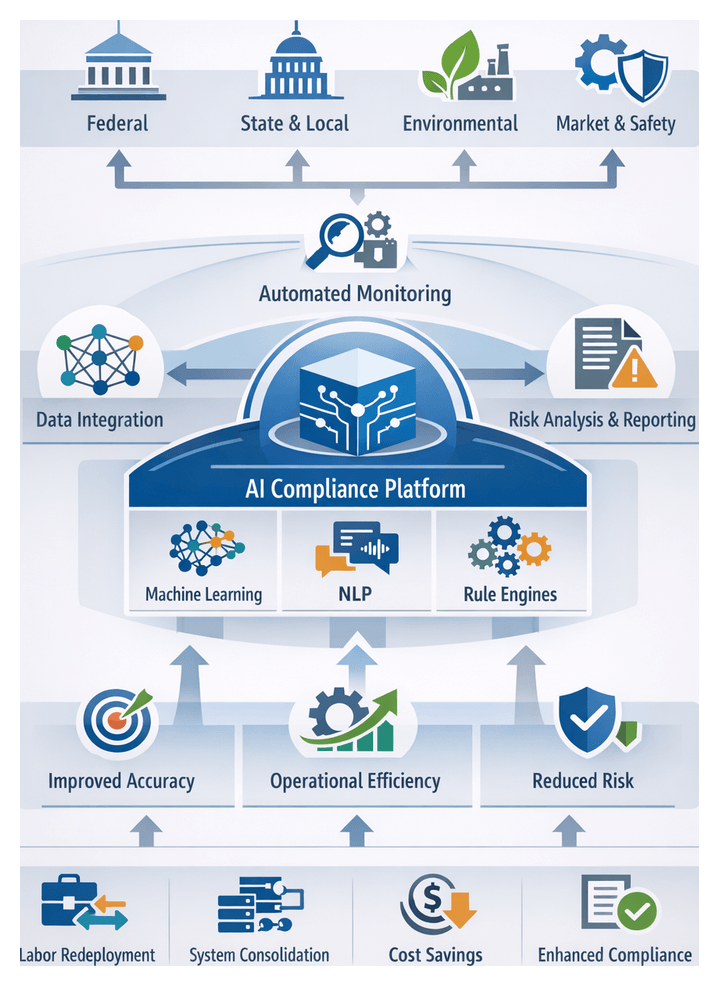
Regulatory Complexity in the Utilities Sector
The utilities sector is governed by a complex web of regulations that encompass essential services like electricity, natural gas, water distribution, and wastewater treatment. This intricate regulatory framework involves multiple layers of oversight from federal, state, local, and international authorities, each imposing overlapping mandates. Utilities face a myriad of requirements, including safety standards, environmental regulations, market oversight, and reliability mandates, each with unique criteria and workflows. The involvement of numerous agencies—such as the Federal Energy Regulatory Commission (FERC) and the Environmental Protection Agency (EPA) in the U.S.—creates a patchwork of directives that differ by region and service type. Jurisdictional conflicts and inconsistent definitions complicate compliance, resulting in manual processes and fragmented data systems. Additionally, the rise of technological innovation, sustainability initiatives, and cybersecurity threats amplifies regulatory demands. These challenges increase resource expenditure, heighten the risk of non-compliance, and reduce operational agility. To navigate this landscape effectively, utilities must adopt an integrated compliance strategy that consolidates obligations, automates reporting, and proactively addresses future regulatory changes.
Intelligent Compliance Solutions
Advanced AI-driven platforms offer a cohesive response to the complexity of utility regulation by automating monitoring, data integration, reporting workflows, risk detection, and audit readiness. Machine learning, natural language processing, and rule-based engines enable organizations to continuously scan regulatory repositories, ingest and normalize data from diverse operational systems, generate and validate reports, and apply predictive analytics to surface potential breaches. Leading products in this space include IBM Watson Regulatory Compliance, and Microsoft Azure Cognitive Services. By shifting from reactive, manual processes to proactive, automated frameworks, utilities can reduce operational risk, enhance compliance transparency, and allocate staff to strategic initiatives such as grid resilience and sustainability.
Performance Evaluation and Compliance Improvement
Evaluating AI-driven compliance agents requires a blend of traditional and advanced metrics that capture both operational performance and governance outcomes. Key performance indicators include accuracy and recall in classifying regulatory requirements, latency and throughput for ingesting and analyzing updates, false positive and negative rates, audit trail integrity, and resource efficiency. Controlled pilots and production monitoring validate these metrics, with some utilities reporting a reduction in report generation time from eight hours to under thirty minutes while maintaining recall rates above ninety-five percent.
Organizations also measure substantive compliance improvements, such as faster integration of regulatory updates, automated exception handling, continuous monitoring, and standardized interpretive decisions. For instance, some utilities have achieved a forty percent reduction in latency between rule issuance and policy revision and a sixty percent decrease in exception backlog. These enhancements translate into fewer non-compliance incidents, stronger regulator relationships, and quantifiable cost savings.
- Labor Redeployment: AI agents take on routine data extraction and report drafting, enabling compliance teams to focus on advisory roles and strategic planning.
- System Consolidation: Consolidating multiple standalone tools reduces software licensing and maintenance costs by up to twenty percent.
- Risk Mitigation Savings: Preventing major infractions can avoid multi-million-dollar penalties, delivering a compelling return on investment within eighteen to twenty-four months for mid-sized utilities.
Industry analysts employ interpretive frameworks—such as the Risk-Adjusted Value Framework, Governance Maturity Model, Operational Agility Index, and Cost-Benefit Continuum—to contextualize these outcomes. Cross-utility comparisons reveal that phased deployments, executive sponsorship, and continuous learning mechanisms are essential to achieving up to a forty-five percent reduction in regulatory exceptions within the first year. At the leadership level, these results inform board oversight, regulatory engagement, vendor partnerships, and workforce evolution strategies, reinforcing the transformative potential of AI compliance agents.
Strategic Lessons and Operational Impacts
Real-world deployments of AI compliance agents yield valuable insights across technology, governance, and organizational dimensions. Measurable outcomes include up to a forty percent reduction in manual review errors and a fifty percent decrease in report preparation time, contingent on robust investments in data integration and model governance. Qualitative benefits, such as enhanced stakeholder trust and process standardization, emerge when AI workflows are transparently documented and rule logic serves as a centralized knowledge repository.
Balancing efficiency with governance requires tiered models that automate low-risk tasks while routing high-risk scenarios for human review. Data quality underpins model performance, necessitating standardized schemas, automated validation, and ongoing model audits. Organizations that schedule quarterly validation cycles and embed feedback loops maintain high accuracy and prevent drift.
AI integration transforms roles: compliance analysts shift from data processing to exception management, while data scientists partner more closely with domain experts. Structured change management—with targeted training, clear role definitions, and cross-functional forums—is critical to adoption. Financially, beyond direct headcount savings, strategic benefits include improved audit readiness, reduced penalties, and enhanced reputational capital. One utility quantified avoided fines and remediation costs at over twenty percent of its AI investment within two years, driven by proactive risk detection.
Success factors include cross-functional collaboration—compliance, IT, data governance, and operations teams working in concert—and integrated governance forums to resolve data access issues and maintain alignment. Strategic implications involve embedding governance from inception, upskilling staff, prioritizing data quality, adopting phased automation, and developing metrics that capture both tangible and intangible benefits over multiple regulatory cycles.
Considerations for Future Deployments
Planning next-generation AI compliance programs requires attention to strategic alignment, architecture, data governance, transparency, change management, monitoring, risk oversight, pilot-based innovation, ecosystem collaboration, and rigorous ROI measurement.
Strategic Alignment with Regulatory Objectives
Map agent capabilities to compliance requirements, risk appetite, and corporate priorities. Engage legal and regulatory affairs teams to interpret emerging mandates and ensure automated decisions reflect current enforcement expectations.
Scalable Architecture and System Integration
- Adopt modular, microservices architectures for ingestion, processing, inference, and reporting.
- Use open data standards and APIs to minimize vendor lock-in.
- Support hybrid cloud and on-premises deployments for data residency and latency needs.
- Implement automated orchestration and version control across agent components.
Robust Data Governance and Quality Assurance
- Embed data lineage, stewardship roles, and quality metrics at each pipeline stage.
- Automate validation routines to detect anomalies in source feeds.
- Manage metadata to document provenance, update frequency, and usage constraints.
- Apply encryption, anonymization, and role-based access controls for data security.
Model Explainability and Regulatory Transparency
- Incorporate interpretability frameworks to generate human-readable explanations of agent recommendations.
- Maintain version control for models, documenting training data, performance metrics, and validation outcomes.
- Provide traceability dashboards that track decision lineage, overrides, and escalations.
Change Management and Skill Development
- Offer structured learning pathways for compliance analysts to interpret model outputs and refine rule sets.
- Deploy communications plans to articulate the benefits and limitations of AI processes to stakeholders.
- Establish continuous improvement forums for user feedback and best practice sharing.
Continuous Monitoring and Feedback Loops
- Monitor key performance indicators—accuracy, latency, exception rates—to detect operational anomalies.
- Automate retraining or rule adjustments when thresholds are breached, with governance approval.
- Support human-in-the-loop interventions during early phases, scaling automation as confidence grows.
Risk Management and Compliance Oversight
- Define risk tolerance levels for AI-generated alerts, aligning escalations with risk policies.
- Integrate agent outputs into centralized governance dashboards for executive visibility.
- Conduct periodic third-party audits of AI systems to validate controls and data integrity.
Innovation Through Iterative Pilots
- Phase 1: Rapid prototyping in a narrow compliance domain to test feasibility and ROI.
- Phase 2: Expand trials with additional data sources and stakeholders to refine workflows.
- Phase 3: Roll out enterprise-wide under governance frameworks with cross-department coordination.
Vendor and Ecosystem Collaboration
- Leverage open-source frameworks to drive innovation and reduce dependence on proprietary platforms.
- Form co-innovation partnerships with vendors to align product roadmaps with domain expertise.
- Participate in industry consortia to define interoperability standards and share lessons learned.
Cost-Benefit Analysis and ROI Measurement
- Establish baseline metrics for manual processes to enable before-and-after comparisons.
- Capture hidden costs—rework, exception handling—to quantify value loss from manual workflows.
- Track long-term gains such as faster regulatory responses, lower insurance premiums, and improved credit ratings linked to a stronger compliance profile.
By integrating these considerations—balancing strategic vision, disciplined execution, and continuous adaptation—utilities can build resilient compliance ecosystems that evolve with regulatory landscapes and deliver sustainable value through intelligent automation.
Chapter 10: Future Trends and Innovation in Regulatory Compliance
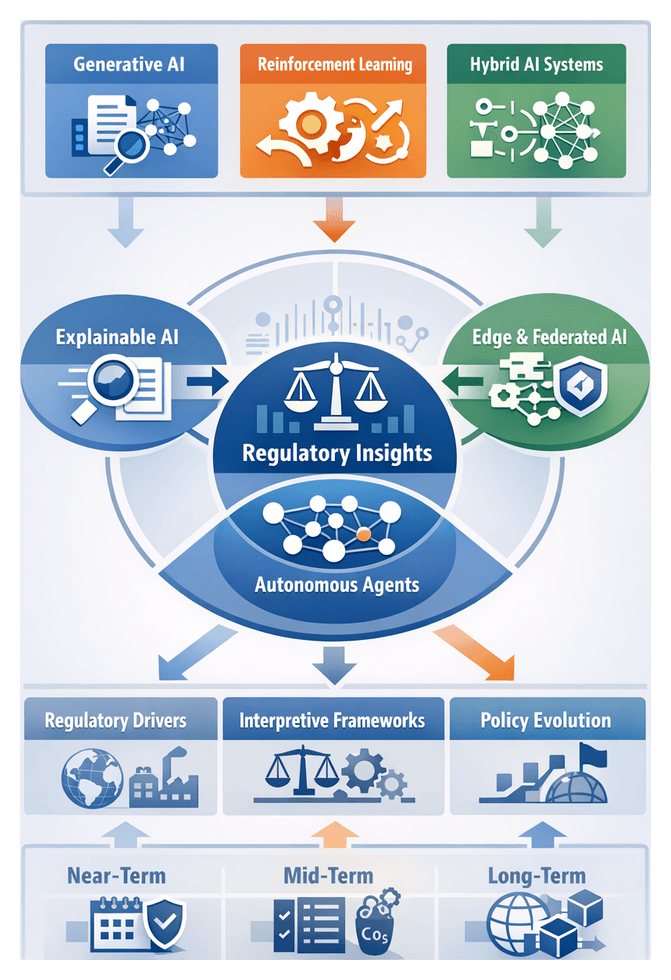
Emerging AI Technologies in Compliance
Regulatory compliance in the utilities sector demands advanced capabilities to manage evolving environmental mandates, data privacy statutes and market oversight requirements. Traditional rule-based systems struggle with high volumes of unstructured data and frequent policy changes. Emerging AI technologies deliver transformative solutions for interpreting regulations, automating processes and adapting to new standards. Key innovations include generative AI for regulatory analysis, reinforcement learning for dynamic policy adaptation, hybrid symbolic–neural architectures, explainable AI, edge AI with federated learning and autonomous multi-agent systems.
Generative AI Models for Regulatory Analysis
Foundation models excel at natural language understanding and content creation, enabling utilities to ingest extensive regulatory documents, extract obligations and generate concise summaries or risk assessments. Leading platforms such as GPT-4, Claude and PaLM API can transform regulatory text into structured compliance checkpoints, simulate hypothetical policy changes and continuously learn from utility-specific data. Early pilots report up to a 60 percent reduction in manual review time for environmental and financial disclosures, illustrating the promise of generative AI in automating filings, updates and audit narratives.
Reinforcement Learning for Adaptive Compliance
Reinforcement learning (RL) agents optimize decisions by interacting with policy environments, receiving rewards for compliance and penalties for violations. Utilities use platforms like Amazon SageMaker RL and custom frameworks on Microsoft Azure to train models that schedule inspections, adjust monitoring frequencies and balance operational costs against regulatory risks. Studies show RL-driven inspection scheduling can reduce non-compliance incidents by up to 30 percent while optimizing resource deployment.
Hybrid Architectures: Symbolic and Neural Integration
Hybrid AI frameworks marry the interpretability of symbolic rule engines with the flexibility of neural networks. Symbolic layers codify explicit standards such as emission thresholds, while neural modules classify unstructured inputs like incident reports. Leading solutions illustrate how grid performance metrics are ingested and anomalies classified by neural models before enforcing corrective actions through symbolic logic—ensuring both agility and auditability.
Explainable AI for Transparent Compliance
Regulators and auditors require visibility into AI-driven decisions. Platforms such as IBM Watson OpenScale provide dashboards that trace outputs to input features, enabling validation of compliance recommendations. Techniques like Local Interpretable Model-agnostic Explanations (LIME), counterfactual analysis and rule extraction increase trust by revealing how data changes influence assessments and by deriving human-readable rules from neural activations.
Edge AI and Federated Learning for Secure Monitoring
Utilities often operate distributed networks in privacy-sensitive or bandwidth-constrained environments. Edge AI delivers inference at field devices, while federated learning enables decentralized model training without centralizing raw data. Open-source frameworks like TensorFlow Federated support data sovereignty and real-time detection of compliance breaches. Early deployments report improved anomaly detection rates, lower network loads and strengthened audit trails.
Autonomous Multi-Agent Systems
Multi-agent systems distribute compliance tasks across specialized AI agents—each responsible for document parsing, data validation or alert management—and leverage reinforcement and negotiation protocols to coordinate end-to-end workflows. These architectures scale reporting across regions, maintain resilience against individual agent failures and dynamically reassign tasks based on regulatory priority shifts. Research prototypes demonstrate a 40 percent reduction in compliance cycle time, pointing toward fully autonomous regulatory operations.
Drivers and Policy Trajectories
Utilities face a shifting regulatory landscape influenced by technological breakthroughs, climate imperatives and evolving market structures. Understanding these drivers and interpretive frameworks is critical for anticipating future compliance obligations and aligning strategic planning with policy trajectories.
Key Drivers of Regulatory Change
- Technological Acceleration: AI, edge computing and IoT introduce new operational risks and transparency requirements.
- Environmental Mandates: Net-zero commitments and renewable portfolio standards reshape asset retirement and clean energy integration rules.
- Market Evolution: Peer-to-peer trading, prosumer models and time-of-use pricing prompt revisions to tariffs and interconnection protocols.
- Stakeholder Advocacy: Emphasis on data privacy and cybersecurity drives policies on data governance, incident reporting and accountability.
Regulatory Interpretive Frameworks
- Principles-Based vs. Rules-Based Regulation: Outcome-focused compliance versus prescriptive technical standards.
- Risk-Based Regulation: Oversight aligned with probabilistic risk assessments and performance metrics.
- Adaptive Governance: Rolling rulemaking cycles, pilot programs and sandboxes foster innovation without stifling progress.
- Outcome-Oriented Models: Incentives tied to reliability, affordability and environmental performance.
Anticipated Policy Developments
Regulatory shifts can be mapped by time horizon:
Near-Term (1–3 years)
- Mandatory AI Transparency and disclosures on algorithmic logic.
- Enhanced Cybersecurity Standards, including stricter incident reporting timelines.
- Data Privacy Directives integrating energy data under state and federal privacy acts.
Mid-Term (3–5 years)
- Algorithmic Accountability Audits of AI models for forecasting and compliance monitoring.
- Standardized Carbon Accounting for scope 2 and 3 emissions reporting.
- Grid Modernization Incentives rewarding digital infrastructure and microgrids.
Long-Term (5 years)
- Dynamic Rate Design with real-time pricing enabled by predictive analytics.
- Self-Regulating Networks on blockchain architectures.
- Global Standards Convergence via bodies like IEC and the NIST AI Risk Management Framework.
Global and Regional Dynamics
North American utilities navigate federal mandates from FERC and state commissions, while the European Union imposes uniform obligations through directives such as the Clean Energy Package and the AI Act. Asia Pacific regulators emphasize energy access and grid stability. These regional distinctions affect cross-border investments, supply chains and compliance strategies.
Emerging Compliance Mandates
- Algorithmic Transparency Requirements: Public registers of AI systems with bias mitigation strategies.
- Automated Reporting Obligations: Continuous disclosure powered by real-time data streams.
- Third-Party Model Certification: Accreditation of AI components for robustness and interpretability.
- Enhanced Data Governance Protocols: Stricter residency, anonymization and consent rules drawn from financial and healthcare frameworks.
Institutional and Foresight Measures
Regulatory bodies are forming dedicated AI units and public–private advisory councils to facilitate rapid feedback and horizon scanning. Utilities employ scenario planning, stress-testing and horizon scanning to explore futures—from centralized digital grids to decentralized peer networks—assessing compliance strategy resilience against legislative, technological and environmental uncertainties.
Innovation Cases in AI-Driven Compliance
Pilot projects across generation, transmission and distribution demonstrate AI’s potential to transform compliance from a cost center into a strategic capability. These innovation cases employ digital twins, blockchain, generative AI, IoT-edge analytics, collaborative ecosystems, geospatial intelligence and advisory agents.
Digital Twin Simulations
Digital twins create virtual replicas of assets and processes, integrating real-time sensor feeds, historical data and rule sets to simulate grid stress events, environmental incidents and emergency responses. In Europe, an offshore wind farm pilot using the Microsoft Azure Cognitive Services platform reduced compliance review cycles by 30 percent by automating impact modeling against marine spatial regulations and optimizing maintenance schedules.
Blockchain-Enabled Audit Trails
Distributed ledger technology provides immutable audit trails for emissions data, equipment certifications and inspection records. A North American consortium pilot with Hyperledger Fabric demonstrated a 40 percent reduction in record-validation time by encoding certificate expirations into smart contracts that trigger compliance alerts. Full adoption requires addressing data privacy, node governance and scalability challenges.
Generative AI for Document Synthesis
Utilities use large language models fine-tuned on regulatory corpora to draft permit applications and incident reports. Success hinges on human-in-the-loop validation, audit trails and continuous model retraining.
IoT-Integrated Edge Analytics
Edge computing embedded in field devices enables real-time detection of compliance breaches. A U.S. water utility pilot integrating IBM Watson IoT services at remote pumping stations reduced response time to water quality deviations by 60 percent. Key evaluation criteria include data governance alignment, security frameworks and scalable device management.
Collaborative AI Ecosystems
Federated learning pilots allow utilities and equipment manufacturers to train shared anomaly detection models without exchanging raw data. A European consortium achieved higher detection accuracy by combining diverse operational profiles, demonstrating how cross-organizational intelligence can strengthen compliance. Governance structures, smart contracts and auditability are critical for consortium success.
Geospatial Analytics with Regulatory Mapping
AI combined with GIS and satellite imagery automates mapping of setback distances and protected areas. In Latin America, a distributor used geospatial AI to flag vegetation encroachments near overhead lines, prioritizing inspections and reducing fire risk. Evaluative factors include spatial accuracy, geodata update frequency and integration with regulatory metadata.
AI-Driven Regulatory Advisory
Cognitive agents monitor policy developments, interpret rule changes and forecast compliance impacts. A North American utility’s pilot reduced research time by 70 percent by synthesizing regulatory dockets and rate filings to predict outcomes and revenue adjustments. Continuous validation against actual decisions and expert feedback loops ensure advisory credibility.
Strategic Foresight for Intelligent Compliance
Strategic foresight applies structured methodologies—scenario planning, horizon scanning and stress-testing—to align AI-driven compliance solutions with both immediate obligations and long-term industry trajectories. This disciplined approach integrates policy signals, stakeholder expectations and technology roadmaps to ensure resilience and adaptability.
Foresight Methodologies
- Scenario Planning: Exploring divergent futures such as intensified decarbonization or expanded privacy regimes.
- Horizon Scanning: Identifying emergent trends in generative AI, geopolitical shifts and standard-setting activities.
- Stress-Testing: Simulating regulatory shocks to reveal vulnerabilities in data governance and AI decision logic.
Multidisciplinary Interpretation and Governance
Effective foresight unites legal analysis, policy scholarship and data science. Natural language processing and knowledge graphs translate draft regulations into quantifiable system rules. Governance frameworks address algorithmic bias, data privacy and accountability, ensuring AI agents operate ethically and transparently.
Organizational Readiness and Ecosystem Engagement
Utilities should establish cross-functional centers of excellence that bridge legal, operations and IT teams. Partnerships with technology vendors, regulators and research institutions—through sandboxes and pilot consortia—accelerate solution co-development and influence policy design.
Risk Modeling and Data Ecosystems
Foresight integrates risk registers with predictive analytics to model scenarios such as cyberattacks or supply chain disruptions. Data governance must anticipate privacy and provenance requirements, while interoperability standards and modular, API-driven architectures preserve agility amid evolving integration protocols.
Adaptability, Monitoring and KPIs
AI-driven compliance agents require online learning, retraining pipelines and version control to incorporate new regulations. Automated policy monitoring—leveraging advanced NLP—compresses the time between rule announcement and compliance planning. Leading KPIs, including regulatory sentiment scores, model drift rates and scenario divergence thresholds, should be visualized in dashboards to trigger timely governance actions.
Alignment and Uncertainty Management
Strategic foresight must align with broader digital transformation, sustainability goals and risk management priorities. Sensitivity analyses and confidence intervals quantify scenario robustness, ensuring realistic expectations and guarding against overconfidence in predictive insights.
Key Considerations for Strategic Foresight in AI-Driven Compliance
- Integrate legal, technical and economic inputs for comprehensive scenario development.
- Maintain modular AI architectures to accommodate future innovations.
- Embed ethical impact assessments to address bias and accountability.
- Develop leading KPIs and dashboards to monitor foresight signals.
- Engage in cross-industry partnerships and regulatory sandboxes.
- Invest in data governance anticipating privacy and provenance mandates.
- Apply stress-testing to validate compliance system resilience.
- Institutionalize continuous learning for AI models and dynamic rule updates.
- Quantify uncertainties through sensitivity analyses and transparent caveats.
- Align foresight outcomes with corporate strategy for enterprise impact.
By integrating these technological innovations, policy insights, pilot experiences and foresight practices, utilities can transform regulatory compliance from a reactive function into a proactive strategic asset—capable of anticipating change, managing risk and delivering competitive advantage.
Conclusion
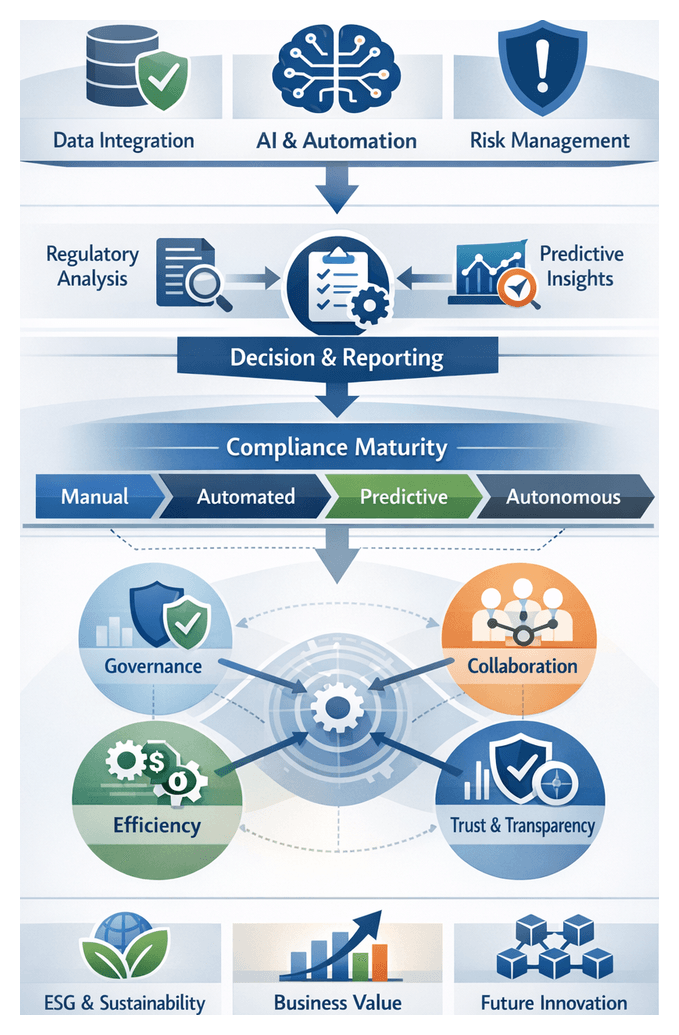
Core Themes in AI-Driven Compliance
The utilities sector navigates a complex landscape of rapidly evolving federal, state, and local regulations, compounded by industry standards. Manual workflows falter under the weight of data silos, cumbersome reporting processes, and the severe consequences of non-compliance. Advanced AI techniques such as machine learning, natural language processing, and rule-based reasoning enable compliance agents to dissect regulatory language, extract essential requirements, and automate decision-making within flexible frameworks that prioritize both scalability and governance. Effective data integration and stewardship ensure that agents rely on accurate inputs from SCADA systems, asset management tools, and environmental sensors. Automated reporting pipelines streamline the process by applying standardized templates, validating data, and submitting filings efficiently. Anomaly detection and predictive analytics transform compliance from a reactive approach into a proactive risk management strategy. Successful implementations hinge on strong executive sponsorship, cross-functional collaboration, and a commitment to continuous improvement, resulting in significant enhancements in efficiency, audit readiness, and stakeholder trust. Innovations in generative AI, reinforcement learning, and distributed ledger technologies are set to redefine compliance, aligning regulatory requirements with business goals and positioning compliance as a strategic asset for resilience and competitive advantage.
Patterns and Analytical Frameworks
Across numerous implementations, several recurring patterns inform successful AI compliance strategies:
- Data Integration and Governance: Unified architectures with clear ownership, quality metrics and secure access underpin reliable AI outputs.
- Risk-Based Prioritization: Frameworks such as ISO 31000 and COSO guide resource allocation to high-impact tasks like emissions reporting and safety audits.
- Compliance Maturity Continuum: Organizations advance from manual processes to rule-based automation, predictive analytics and ultimately fully autonomous agent orchestration.
- Model Governance and Explainability: Standards from the European Commission’s Ethics Guidelines for Trustworthy AI and NIST’s AI Risk Management Framework ensure transparency and accountability.
- Adaptive Architectures: Continuous learning pipelines ingest regulatory updates, audit outcomes and user feedback to recalibrate models.
- Cross-Functional Collaboration: RACI matrices and change frameworks like ADKAR align regulatory affairs, IT, operations, risk and legal teams.
- Pilot-to-Scale Deployment: Incremental proofs-of-concept mitigate risk and build stakeholder trust before broad scaling.
- Sector Comparisons: Utilities adapt anomaly detection from finance and NLP mapping from healthcare to their unique regulatory contexts.
- Policy-Technology Co-Evolution: As AI agents improve compliance, regulators may introduce algorithmic reporting requirements and explainability standards.
- Human Oversight: AI augments decision-making with risk scoring and alerts, while ultimate accountability remains with human leadership.
Strategic Implications for the Utilities Sector
AI-driven compliance agents reshape core aspects of utility operations:
Business Model Transformation
Compliance intelligence shifts compliance from cost center to strategic asset. Utilities leverage AI to identify regulatory arbitrage in performance-based rate-making, develop value-added services such as dynamic pricing, and integrate compliance metrics into investment decisions to optimize project portfolios against policy risks.
Elevated Risk Management and Resilience
AI agents support a risk intelligence lifecycle:
- Identification: Automated parsing of regulations and operational data surfaces emerging obligations and threats.
- Assessment: Predictive models quantify breach probability and impact using historical and policy forecast data.
- Mitigation: Agent-driven insights adjust controls and workflows proactively.
- Monitoring: Real-time dashboards track key indicators and trigger alerts for rapid response.
Strengthening Stakeholder Trust
Transparent compliance builds credibility with regulators, investors and communities through:
- Immutable audit trails of data processing and decision logic.
- Automated generation of compliance summaries for board reports and public disclosures.
- Integrated communication channels among operations, legal and regulatory teams.
Platforms and services from Microsoft Azure AI and IBM Watson position utilities as proactive partners in regulatory dialogues.
Operational Efficiency and Cost Optimization
AI agents reduce manual effort in rule interpretation and report generation, yielding:
- Cost avoidance through fewer fines and audits.
- Reinvestment of labor savings into grid modernization and digital services.
- Scalability to handle growing data volumes without proportional headcount growth.
ESG Reporting and Sustainability Integration
Converging regulatory and voluntary mandates require unified architectures that:
- Harmonize data from emissions monitors, supply chains and community impact metrics.
- Map requirements to frameworks like TCFD and CDP via NLP and rule-based matching.
- Benchmark ESG performance against peers and investor expectations.
Workforce and Governance Dynamics
Effective AI adoption depends on:
- Reskilling compliance professionals into oversight and exception-management roles.
- Embedding AI literacy across legal, regulatory, operations and IT functions.
- Establishing steering committees and ethics boards to govern agent behavior and data privacy.
Ecosystem and Partnering Models
Utilities assemble ecosystems combining hyperscale AI platforms, specialized compliance modules and systems integrators to balance control, innovation speed and total cost of ownership.
Active Policy Engagement
Leading utilities use AI-derived insights to inform regulator consultations, advocating for streamlined, outcomes-based standards and shaping the future regulatory landscape.
Forward-Looking Strategic Roadmap
Strategic Imperatives Beyond Compliance
Align AI-powered compliance with carbon reduction targets, digital service innovation and customer-centric models. Integrate regulatory intelligence into executive dashboards via balanced scorecard and value-chain analysis to enable proactive capital allocation and risk management.
Building an Adaptive Culture
Cultivate interdisciplinary teams and a growth mindset. Empower “compliance champions” and apply organizational ambidexterity to balance process exploitation with exploration of novel AI applications. Treat validation failures as learning opportunities to accelerate scalable innovation.
Technology and Data Priorities
- Data interoperability and quality: Unify SCADA, customer and external feeds into high-fidelity inputs.
- Model transparency and explainability: Choose architectures that provide clear audit trails.
- Infrastructure resilience: Ensure compute and storage handle peak analytics without reliability loss.
- Vendor ecosystem management: Vet third-party AI components for security, procurement compliance and integration ease.
- Evolving standards: Anticipate shifts in data formats and interoperability protocols to prevent obsolescence.
Governance and Ethical Considerations
- Talent acquisition and upskilling in data science, regulatory expertise and AI ethics.
- Robust governance frameworks with policies for model validation, change control and stakeholder accountability.
- Clear role definitions for data stewardship, development and post-deployment monitoring.
- Ethical AI practices and bias mitigation through regular audits of agent outputs.
- Accountability mechanisms like oversight committees including compliance, legal and operational leadership.
Limitations and Cautionary Notes
- Regulatory uncertainty may outpace AI innovations, creating ambiguous obligations.
- Data privacy and security risks demand rigorous cybersecurity and impact assessments.
- Overreliance on automation without human oversight risks model drift and overlooked anomalies.
- Integration complexity can yield brittle architectures if modularity is neglected.
- Vendor lock-in may constrain flexibility and escalate long-term costs.
Phased Roadmap for Action
- Assess current state: Audit regulatory processes, data repositories and existing automation.
- Define strategic objectives: Tie compliance goals to net-zero targets, customer metrics and efficiency benchmarks.
- Prioritize use cases: Focus on high-value, low-risk scenarios for initial AI agent investments.
- Build cross-functional teams: Combine regulatory, technical and operational expertise to pilot agents.
- Iterate and scale: Use agile methods to deploy, evaluate and expand agent capabilities.
- Embed continuous improvement: Establish feedback loops with monitoring, stakeholder input and regulatory engagement.
Intelligent compliance agents offer a transformative opportunity for utilities. By integrating AI-driven insights into decision-making, industry leaders can transcend traditional compliance, achieving regulatory excellence, operational resilience and lasting stakeholder trust.
Appendix
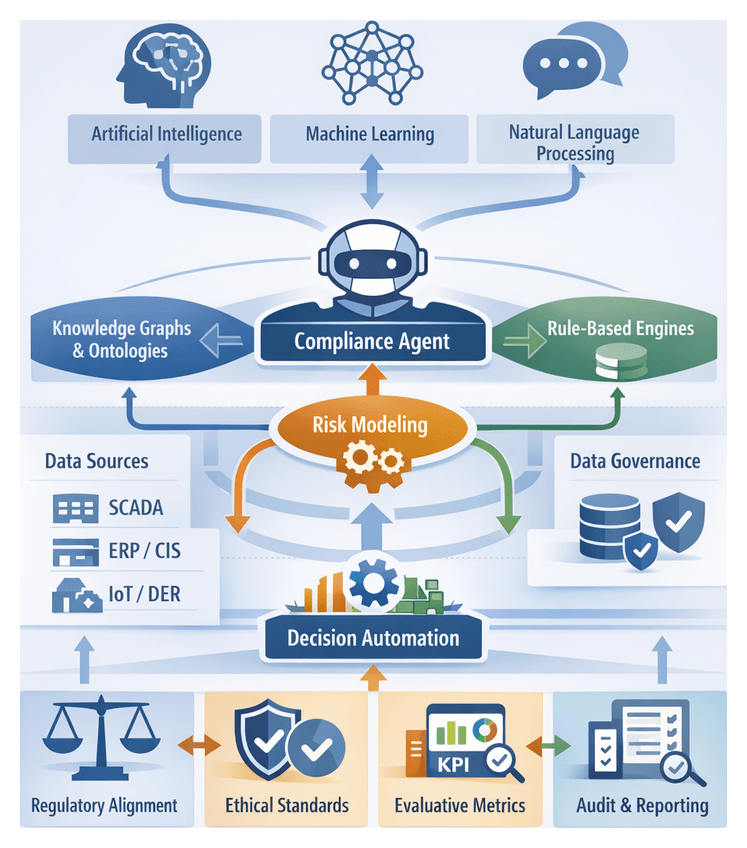
Key Definitions and Terminology
Understanding the foundational concepts of AI-driven compliance is essential for utilities aiming to automate regulatory workflows. The terms below describe the core components and data sources that underpin intelligent compliance architectures.
- Artificial Intelligence (AI): Systems capable of tasks requiring human-like reasoning, including machine learning, natural language processing, and decision automation for interpreting regulations and recommending compliance actions.
- Machine Learning (ML): Statistical techniques that enable systems to improve with experience. Utilities use ML for document classification, risk forecasting, anomaly detection, and predictive compliance monitoring.
- Natural Language Processing (NLP): Algorithms that parse and generate human language to extract clauses, obligations, and exceptions from regulatory texts, converting unstructured legal language into structured data.
- Compliance Agent: An AI-driven software entity that ingests regulatory updates, maps obligations to processes, and automates tasks such as report generation, control adjustments, and exception handling.
- Regulatory Knowledge Graph: A semantic network representing statutes, clauses, agencies, and controls as interconnected nodes. It supports impact analysis, dependency visualization, and “what-if” queries when rules change.
- Compliance Ontology: A formal vocabulary and relationship schema that standardizes regulatory concepts, risk categories, and control activities across systems, ensuring consistent interpretation and integration.
- Rule-Based Engine: A component executing explicit “if-then” logic defined by experts. Rule engines handle deterministic checks and complement ML by enforcing well-defined regulatory requirements.
- Decision Automation: The orchestration of AI models and rule engines to automate approvals, remediation workflows, and report submissions, preserving audit trails and reducing manual intervention.
- Data Lineage: Traceability documentation of data origins, transformations, and flows within the compliance ecosystem, supporting audit readiness and data integrity verification.
- Data Governance: Policies, roles, and controls ensuring data accuracy, security, and consistency. Effective governance underpins AI-driven compliance by enforcing stewardship and quality metrics.
- SCADA: Supervisory Control and Data Acquisition systems that feed real-time sensor data into compliance agents for monitoring reliability and safety standards.
- CIS: Customer Information Systems managing billing and accounts; their data supports checks on tariff compliance, billing accuracy, and privacy regulations.
- ERP: Enterprise Resource Planning suites providing financial, procurement, and asset management data necessary for regulatory reporting and audit evidence.
- Distributed Energy Resources (DER): Small-scale generation and storage systems introducing new interconnection, metering, and tariff requirements managed by AI agents.
- Environmental, Social, and Governance (ESG): Criteria for sustainability performance. AI compliance agents aggregate emissions, water usage, and social impact data for ESG reporting.
- Key Performance Indicator (KPI): Metrics such as report timeliness and anomaly detection rates. AI dashboards track KPIs in real time for proactive governance.
- Audit Trail: An immutable chronological record of all data inputs, model versions, rule changes, and compliance actions taken by AI agents.
- Anomaly Detection: Techniques using statistical models and ML to identify deviations in operational data that may signal compliance breaches.
- Risk Scoring: Quantifying the likelihood and impact of compliance events by combining regulatory obligations, data quality, and historical incidents.
- Model Interpretability: The transparency of AI models’ reasoning, essential for auditors and regulators to validate and justify AI-driven decisions.
- Governance, Risk, and Compliance (GRC): An integrated approach that aligns governance structures, risk management, and compliance activities, enhanced by AI agents.
- Regulatory Intelligence: Continuous monitoring and analysis of rulemakings, guidance, and enforcement actions to inform compliance strategy.
- Operational Technology (OT): Systems that monitor and control industrial processes, providing essential data for grid reliability and cybersecurity compliance.
- Internet of Things (IoT): Networks of sensors that deliver high-frequency data for proactive compliance monitoring of voltage levels, emissions, and equipment health.
- Digital Twin: Virtual representations of physical assets enabling scenario modeling to assess regulatory impacts before operational changes.
Conceptual Frameworks for AI-Driven Compliance
Effective compliance architectures integrate multiple conceptual frameworks—knowledge graphs, ontologies, risk modeling, RegTech taxonomies, evaluative metrics, regulatory alignment, ethical governance, maturity modeling, and interoperability standards—to create transparent, scalable, and resilient systems.
Knowledge Graphs and Ontologies
Regulatory knowledge graphs represent entities such as regulations, controls, and processes as nodes linked by semantic relationships. They enable:
- Entity Representation: Mapping regulations, agencies, business units, and controls as distinct, queryable entities.
- Relationship Mapping: Capturing causal and hierarchical links between clauses and operational processes.
- Impact Analysis: Automated “what-if” scenarios when regulations change, pinpointing affected controls and workflows.
Complementary compliance ontologies define formal vocabularies and taxonomies:
- Concept Hierarchies: Organizing terms by domain (environmental, cybersecurity, reliability).
- Attribute Definitions: Specifying thresholds, measurement units, and frequencies for precise rule application.
- Process Mappings: Linking regulatory concepts to internal data sources and workflows for automated reporting.
Risk-Based Compliance Modeling
Integrating regulatory requirements with organizational risk appetite, risk-based models use AI to:
- Score Obligations: Evaluating severity, likelihood, and potential impact of breaches.
- Prioritize Monitoring: Elevating high-risk items for real-time oversight and human review.
- Allocate Resources: Focusing teams on controls mitigating the greatest risks.
RegTech Frameworks and Performance Metrics
RegTech taxonomies classify compliance tasks—monitoring, reporting, auditing, advisory—into modules for gap analysis and solution integration. Evaluative criteria ensure AI solutions meet organizational needs:
- Precision and Recall: Accuracy of requirement classification and anomaly detection.
- Processing Latency: Time from data ingestion to compliance recommendation.
- Scalability: Ability to process growing volumes of regulatory and operational data.
- Governance Controls: Completeness of audit trails, version control, and access management.
- User Adoption: Reduction in manual interventions and user satisfaction.
Regulatory Alignment and Ethical Governance
Compliance architectures align with guidance from:
- NERC CIP Standards for cybersecurity monitoring.
- FERC rules on transparency, data lineage, and auditability.
- EPA regulations for precise emissions monitoring.
- ISO 19600 and ISO 31000 for compliance and risk management frameworks.
Ethical AI frameworks from IEEE, OECD, and the European Commission govern agent behavior to ensure:
- Fairness: Avoiding biased anomaly detection across regions or demographics.
- Transparency: Providing explainable decision pathways.
- Accountability: Human oversight and escalation protocols.
- Privacy: Data protection controls in line with GDPR and CCPA.
Maturity Models and Interoperability Standards
Adoption pathways guide utilities from manual processes to fully autonomous compliance:
- Baseline: Spreadsheets and static rule engines.
- Transitional: AI-assisted reviews with periodic retraining.
- Advanced: Continuous learning agents with semi-autonomous remediation.
- Fully Autonomous: Self-governing systems with real-time audit trails.
Interoperability relies on open data standards and APIs:
- Common Information Model (CIM) for power system data exchange.
- RESTful APIs and messaging protocols for SCADA, ERP, and document management integration.
- Metadata schemas to harmonize regulatory tagging.
- Industry consortia such as OCEG for reference architectures.
Implementation Questions and Clarifications
Scope, Outcomes and Data Integration
AI-driven compliance agents extend beyond rule-based systems by applying ML and NLP to unstructured regulatory texts and high-volume data streams. Organizations can expect:
- Automated detection and semantic tagging of regulatory changes.
- End-to-end visibility into compliance status across agencies.
- Predictive risk insights to forecast potential breaches.
- Audit-ready documentation with detailed decision trails.
Essential data sources include statutes, guidance memos, sensor logs, meter readings, asset records, financial ledgers, and customer information. Effective data governance requires:
- Centralized data catalogs with lineage tracking.
- Automated checks for completeness and consistency.
- Role-based access controls and encryption.
- Regular data quality audits and correction workflows.
Model Development, Validation and Oversight
Maintaining model accuracy as regulations evolve involves continuous monitoring of metrics such as precision and recall, detection of data and regulatory drift, and scheduled retraining cycles. Version control of models, training data, and rule sets ensures auditability. A human-in-the-loop framework balances automation with expert review of exceptions and complex interpretations.
Interpretability, Auditability and Governance
To satisfy transparency requirements, compliance agents should embed explainable AI techniques—such as SHAP feature-attribution—log decision paths with model versions and confidence scores, and provide interactive dashboards for audit traceability. An audit-ready package includes complete data lineage, model training logs, rule library versions, and human review annotations.
A governance framework must define policies for data usage, model retraining, and exception management; assign roles for data owners, stewards, and model risk officers; implement technical controls for access and encryption; and maintain monitoring dashboards for model drift and compliance KPIs.
Deployment Models and Integration
Centralized architectures offer unified governance and simplified updates, while distributed or hybrid models reduce latency by deploying agents at edge locations with federated governance. Integration with SCADA, CIS, and ERP platforms relies on RESTful APIs, message queues, and middleware for protocol bridging. Phased integration—starting with non-critical sources—reduces disruption and validates end-to-end workflows.
Regulatory Engagement and Pilot Programs
Securing regulator confidence involves early engagement, sharing pilot performance metrics, participating in sandboxes, and documenting governance controls. Successful pilots focus on narrowly defined scopes, representative data, stakeholder alignment, and measurable KPIs, forming the basis for scaling and regulatory submissions.
Ethical, Privacy and Future-Proofing Strategies
Privacy-by-design strategies include anonymization, consent management, access controls, and privacy impact assessments. Bias and fairness are managed through training data audits, fairness-aware algorithms, and human review of high-stakes decisions. Future-proofing requires modular rule libraries, automated change detection, continuous learning pipelines, and adherence to open data standards and APIs.
AI Platforms and Tools
The following AI platforms and tools are commonly used to build, deploy, and govern compliance agents in utilities. Hyperlinks lead to vendor sites or project pages.
- IBM Watson Natural Language Understanding: Extracts entities, sentiment, and semantic relationships from unstructured text.
- IBM OpenPages: GRC platform integrating AI analytics with policy management.
- IBM Watson OpenScale: Model governance and monitoring with explainability and bias detection.
- Amazon SageMaker: Managed ML service for building, training, and deploying models at scale.
- Amazon Comprehend: NLP service for clause classification and entity extraction.
- Google Cloud AI Platform: Unified ML development environment for custom model training and serving.
- Google Cloud Natural Language API: Pre-trained NLP models for legislative parsing and requirement tagging.
- Microsoft Azure Machine Learning: Cloud ML service for experiment tracking and operationalizing models.
- Azure Compliance Manager: Workflow-based risk assessment for cloud service controls.
- Azure Purview: Data governance solution for cataloging, classification, and lineage tracking.
- spaCy: Open-source NLP library for entity recognition and knowledge graph construction.
- Hugging Face: Repository of transformer models for regulatory text summarization and classification.
- Drools: Open-source business rule management system for explicit compliance logic.
- Palantir Foundry: Data integration and analytics platform for compliance dashboards and risk modeling.
- Talend: Data integration suite for ETL workflows, data quality, and metadata management.
- Collibra: Data governance platform automating stewardship, policy enforcement, and workflows.
- Informatica: Intelligent data management services for quality, cataloging, and master data management.
- Azure Data Factory: Cloud ETL service for orchestrating AI compliance data pipelines.
- TensorFlow Federated: Framework for federated learning across distributed data silos.
- Splunk: Operational intelligence platform integrating AI for cybersecurity compliance and anomaly monitoring.
- Hyperledger Fabric: Permissioned blockchain for immutable audit trails and verification.
Additional Context and Resources
Regulatory bodies, standards organizations, and industry groups provide essential frameworks, guidelines, and reference architectures that inform compliance design and evaluation.
- FERC: Regulates interstate electricity, gas, and oil transmission, issuing rulemakings that define compliance obligations.
- EPA: Enforces environmental statutes, setting emissions limits, monitoring protocols, and reporting requirements.
- NERC CIP Standards: Mandatory cybersecurity and reliability standards for bulk power operators.
- NIST Cybersecurity Framework: Best practices and guidelines for managing OT and IT risk.
- ISO 31000 Risk Management: Principles and guidelines for risk identification, assessment, and treatment.
- ISO 19600 Compliance Management: Guidance on developing and improving compliance management systems.
- OCEG: Reference architectures and best practices for integrated GRC.
- IEEE: Technical standards for equipment performance, safety, and interoperability.
- AWWA: Standards for water quality, treatment, and distribution management.
- GRI: Framework for sustainability reporting and stakeholder disclosures.
- SASB: Industry-specific sustainability accounting standards for ESG disclosures.
- TCFD: Voluntary climate-related financial risk disclosure recommendations.
- ISO 55000 Asset Management: Principles for establishing and improving asset management systems.
- NIST AI Risk Management Framework: Guidance on responsible AI governance and risk management.
- IEC: Standards for electrical technology and the Common Information Model for interoperability.
- Regulatory Sandboxes: Programs enabling supervised testing of AI compliance tools with regulators.
The AugVation family of websites helps entrepreneurs, professionals, and teams apply AI in practical, real-world ways—through curated tools, proven workflows, and implementation-focused education. Explore the ecosystem below to find the right platform for your goals.
Ecosystem Directory
AugVation — The central hub for AI-enhanced digital products, guides, templates, and implementation toolkits.
Resource Link AI — A curated directory of AI tools, solution workflows, reviews, and practical learning resources.
Agent Link AI — AI agents and intelligent automation: orchestrated workflows, agent frameworks, and operational efficiency systems.
Business Link AI — AI for business strategy and operations: frameworks, use cases, and adoption guidance for leaders.
Content Link AI — AI-powered content creation and SEO: writing, publishing, multimedia, and scalable distribution workflows.
Design Link AI — AI for design and branding: creative tools, visual workflows, UX/UI acceleration, and design automation.
Developer Link AI — AI for builders: dev tools, APIs, frameworks, deployment strategies, and integration best practices.
Marketing Link AI — AI-driven marketing: automation, personalization, analytics, ad optimization, and performance growth.
Productivity Link AI — AI productivity systems: task efficiency, collaboration, knowledge workflows, and smarter daily execution.
Sales Link AI — AI for sales: lead generation, sales intelligence, conversation insights, CRM enhancement, and revenue optimization.
Want the fastest path? Start at AugVation to access the latest resources, then explore the rest of the ecosystem from there.