

Empowering Customer Engagement with AI Agents Insights for Industry Leaders
To download this as a free PDF eBook and explore many others, please visit the AugVation webstore:
Introduction
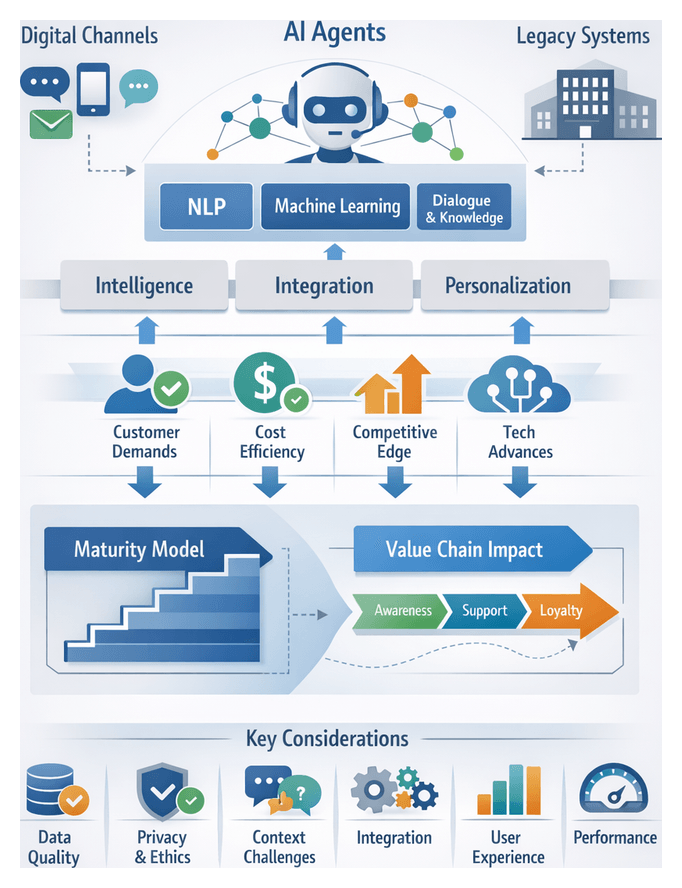
Current Landscape of Digital Customer Engagement
Organizations across industries are navigating a profound shift in customer service models driven by rapid digital transformation and evolving consumer expectations. Traditional channels such as voice calls, email inquiries, and in-person service desks are giving way to a diverse ecosystem of web chat, mobile applications, social media messaging, and self-service portals. Recent studies indicate that over seventy percent of consumers now prefer digital channels for support, with mobile messaging and in-app chat emerging as dominant touchpoints.
Leading enterprises orchestrate multichannel engagement through platforms such as Zendesk and Salesforce Einstein, while technology-first challengers build native bots on Microsoft Azure Bot Service and Google Dialogflow. Investments in these solutions reflect a recognition that legacy systems alone cannot deliver the real-time, personalized experiences modern customers demand.
However, the proliferation of channels introduces complexity: disparate technologies, fragmented customer histories, and varied service models challenge organizations to maintain consistency, scalability, and cost efficiency. In response, many are adopting AI-driven interactions to unify engagement across touchpoints, reduce response times, and deliver tailored experiences at scale. This landscape sets the stage for understanding the pivotal role AI agents now play in transforming customer service.
Defining AI Agents in Customer Experience
AI agents—also known as conversational agents or virtual assistants—represent an evolution beyond rule-based chatbots. They leverage natural language processing (NLP), dialogue management, machine learning, and continuous learning to interpret user intent, maintain contextual awareness, and generate human-like responses. Unlike rigid decision trees, AI agents adapt to new inputs, learn from interactions, and handle complex, multi-turn conversations.
- Natural Language Understanding modules parse user queries, identify entities, and determine intent.
- Dialogue Management frameworks orchestrate conversation flow, manage state, and select appropriate responses.
- Knowledge and Data Integration layers connect to CRM systems, knowledge bases, and external APIs for real-time information.
- Machine Learning and Continuous Learning capabilities refine language models and improve intent classification over time.
By combining these components, AI agents deliver sophisticated, autonomous interactions that guide users through troubleshooting, process transactions, personalize recommendations, and detect sentiment without direct human intervention.
Drivers Accelerating AI Adoption in Service
The transition to AI-powered service is propelled by converging market, customer, technological, financial, and regulatory forces:
- Rising Customer Expectations: Modern consumers demand fast, accurate, and personalized support across any channel. AI agents deliver near-instant responses and tailor interactions based on user history and preferences.
- Cost Optimization and Scalability: AI agents scale horizontally at a fraction of the cost of expanding live teams, automating routine inquiries and freeing human agents for complex tasks.
- Competitive Differentiation: Early adopters gain a strategic edge through seamless digital experiences. Organizations that lag risk diminished customer satisfaction and retention.
- Technological Maturity: Advances in transformer-based language models, cloud computing, and integration frameworks—offered by platforms such as IBM Watson Assistant, Amazon Lex, ServiceNow, and Microsoft Dynamics 365 Virtual Agent—have lowered barriers to entry.
- Data-Driven Insights: AI interactions generate rich datasets on customer behavior and sentiment trends, informing product development, marketing strategies, and operational improvements.
- Regulatory and Ethical Imperatives: Privacy-by-design and explainable AI frameworks build trust, ensure compliance with GDPR, CCPA, and emerging regulations, and mitigate bias risks.
Analytical Dimensions and Maturity Frameworks
Evaluating AI agent solutions requires a multidimensional approach that bridges technical performance and strategic impact:
- Intelligence and Comprehension: Measures NLU accuracy, intent classification, context retention, and the ability to handle domain-specific dialogues.
- Integration and Orchestration: Assesses API connectivity, data synchronization latency, and seamless interaction with CRM, ticketing systems, and personalization engines.
- Personalization and Contextualization: Evaluates tailoring of responses using user profiles, historical interactions, and session context, including recommendation precision.
- Operational Resilience and Scalability: Reviews infrastructure elasticity, load balancing, failover capabilities, and cost models supporting variable volumes.
To translate these dimensions into actionable roadmaps, organizations employ maturity models and value-chain frameworks:
- AI Agent Maturity Model: Stages progress from basic rule-based bots to predictive, autonomous agents. Each stage defines success criteria—resolution rates, handle time reductions, and customer satisfaction benchmarks.
- Value Chain Impact Framework: Maps agent capabilities onto the customer journey—awareness, consideration, resolution, loyalty—to visualize revenue uplift, cost avoidance, and retention acceleration.
Key Considerations and Limitations
While the strategic case for AI agents is strong, organizations must address inherent challenges to set realistic expectations and mitigate risks:
- Data Quality and Coverage: Incomplete or biased datasets degrade NLU performance, leading to misinterpretations and frustration.
- Contextual Continuity: Maintaining state across channels and sessions remains complex, particularly for long-tail interactions or abrupt topic shifts.
- Integration Complexity: Legacy IT landscapes often require custom connectors to ensure seamless access to CRM, knowledge bases, and transaction engines.
- Ethical and Privacy Concerns: Use of personal data for personalization and sentiment analysis demands embedded compliance with data protection regulations.
- User Experience Risks: Overreliance on automation can backfire if agents fail to handle nuanced requests; hybrid models and clear escalation paths are essential.
- Maintenance and Continuous Improvement: AI agents require ongoing monitoring, retraining, and dialogue optimization to sustain performance gains.
Strategic Imperatives for Sustainable AI Agent Programs
Deploying AI agents successfully requires treating them as strategic, long-term initiatives rather than isolated projects. Industry best practices emphasize:
- Cross-Functional Governance: Steering committees with representatives from IT, customer support, legal, compliance, and data science ensure balanced decision-making and ethical oversight.
- Scalable, Modular Architecture: API-driven platforms and microservices facilitate rapid integration with new channels, data sources, and third-party services as needs evolve.
- Talent and Skill Development: Building in-house expertise in conversational AI design, analytics, and model governance accelerates innovation and reduces vendor dependence.
- Continuous Learning Culture: Agile methodologies, iterative enhancement cycles, and performance dashboards enable rapid adaptation to changing customer behaviors.
- Balanced Automation Strategy: Clear policies for hybrid support ensure human agents handle complex or high-stakes interactions while AI addresses routine tasks.
Guiding Principles for Ethical and Trustworthy AI
Trust underpins customer engagement. Leading frameworks recommend adherence to four core principles:
- Explainability: Provide clear, user-friendly explanations of how AI agents arrive at decisions, especially for sensitive queries.
- Bias Mitigation: Implement rigorous testing to detect and correct model biases, ensuring equitable treatment across demographics and languages.
- Data Privacy by Design: Embed privacy safeguards in data collection, storage, and processing, in alignment with global regulations and customer expectations.
- Ethical Oversight: Maintain an ethics advisory panel to review use cases, monitor social impact risks, and uphold accountability.
Measuring AI Agent Impact
Assessing AI agents requires expanding beyond traditional service KPIs. A comprehensive measurement framework includes:
- Efficiency Metrics: Containment rate, first-contact resolution, and average handling time gauge operational improvements and cost savings.
- Experience Metrics: Customer satisfaction scores (CSAT), Net Promoter Scores (NPS), and sentiment analysis reveal qualitative impact on brand perception.
- Adoption and Engagement: Usage rates, session durations, and feature utilization patterns indicate how effectively agents meet user needs.
- Continuous Feedback Loops: Post-interaction surveys and rating prompts feed data into retraining pipelines to refine NLU models and dialogue flows.
- Governance Indicators: Audit logs, privacy incident counts, and bias detection reports ensure compliance with ethical and regulatory standards.
By integrating this analytical rigor with adaptive architectures and ethical stewardship, organizations can harness AI agents as strategic assets that drive customer satisfaction, operational agility, and sustainable competitive advantage.
Chapter 1: The Evolution of Customer Interaction in the Digital Age
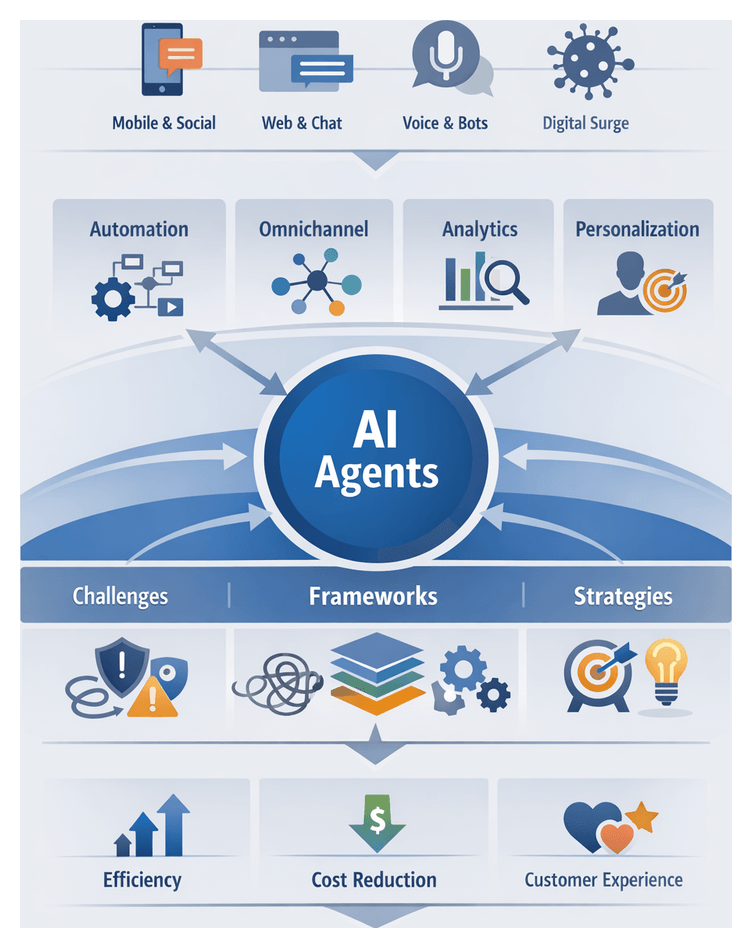
Current Landscape of Digital Customer Engagement
Over the past decade, customer engagement has shifted from traditional voice and email channels to a multifaceted digital ecosystem. Cloud platforms, widespread mobile connectivity and social media have raised expectations for instant, personalized support available on demand. Consumers now navigate seamlessly between website chat, messaging apps, social media direct messages and voice assistants, expecting consistent brand experiences and rapid resolution regardless of channel.
Digital adoption accelerated further during the COVID-19 pandemic, as organizations faced unprecedented inquiry volumes and migrated customer support online. Self-service portals and virtual assistants handled millions of routine interactions, driving adoption rates two to three years ahead of projections. Today, more than 60 percent of basic support requests are managed digitally before human involvement.
This channel proliferation has intensified the complexity of customer journeys. Without unified data and context continuity, fragmented experiences frustrate users and erode loyalty. In response, service leaders are transitioning from monolithic contact-center platforms to modular ecosystems that integrate analytics, workflow engines and AI services. Investments focus on reducing handle times, improving first-contact resolution and driving self-service adoption, yet many organizations struggle to align strategy with return on investment.
The evolving landscape presents both challenges and opportunities. Rising customer expectations and channel complexity increase operational risks, while emerging artificial intelligence technologies offer paths to scalable, cost-effective and personalized engagement. Understanding this context is vital for assessing how AI agents can deliver a sustainable competitive advantage.
Defining AI Agents in Customer Engagement
AI agents are virtual representatives capable of interpreting natural language, reasoning over knowledge bases and executing tasks autonomously. Unlike rule-based chatbots, they leverage machine learning, natural language understanding and conversational design to adapt dynamically and manage complex inquiries. Core components include:
- Natural Language Understanding engines that parse intent, extract entities and detect sentiment.
- Dialogue Management modules that maintain context across turns and determine response strategies.
- Knowledge Management systems that store product information, policies and historical interactions.
- Machine Learning models that learn continuously from interaction transcripts and user feedback.
- Integration frameworks that connect AI services to CRM, order management and billing systems.
By combining these elements, AI agents can answer FAQs, guide self-service workflows and even complete transactions without human intervention. Integrations with product catalogs enable personalized recommendations and seamless order placement, reducing friction and freeing human agents for high-value tasks.
Leading platforms illustrate this paradigm. Google Dialogflow enables enterprises to build multilingual conversational interfaces across web, mobile and voice channels. IBM Watson Assistant delivers advanced intent recognition and legacy system integration. Microsoft Azure Bot Services offers cognitive services that can be orchestrated into sophisticated virtual agents. Generative models such as ChatGPT enhance AI agents with fluid, context-rich responses across diverse domains.
Distinguishing AI agents from conventional automation is their capacity for continuous refinement. Through supervised learning, reinforcement learning and human-in-the-loop feedback, agents evolve in accuracy and coverage. Over time they can predict customer needs, surface relevant content proactively and initiate outreach based on usage anomalies, shifting the service model from reactive to proactive engagement.
Drivers Accelerating AI Adoption in Service
- Escalating Customer Expectations—Demand for immediate, accurate and personalized responses on preferred channels has never been higher. AI agents deliver 24/7 availability, contextual empathy and dynamic recommendations that foster trust and retention.
- Operational Scalability—Peak inquiry volumes strain traditional staffing models. AI agents absorb high-frequency, low-complexity requests at scale, reducing wait times and labor costs.
- Cost Optimization—Macro-economic pressures drive the pursuit of efficiency gains. Deploying AI agents can yield up to 50 percent reductions in service costs and improve average handle times.
- Omnichannel Complexity—AI agents serve as a unifying layer, orchestrating seamless conversations across web chat, messaging, social media and voice interfaces while preserving context.
- Data-Driven Personalization—Advances in analytics and user profiling enable AI agents to leverage behavioral signals, transaction history and real-time context for hyper-relevant interactions.
- Regulatory Compliance—Sectors such as finance and healthcare impose stringent data-protection requirements. AI platforms support auditability, traceability and privacy safeguards to mitigate compliance risk.
- Talent Constraints—Workforce shortages and high attrition compel automation of routine tasks, allowing human agents to focus on complex or emotionally sensitive engagements.
- Competitive Differentiation—Organizations that harness AI for proactive, seamless experiences gain an edge where service quality is a key brand differentiator.
Early adopters report measurable gains in customer satisfaction, net promoter scores and operational efficiency. However, success demands strategic alignment, change management, data governance and continuous performance monitoring.
Analytical Frameworks for AI Agent Initiatives
Frameworks and maturity models provide analytical lenses for benchmarking and prioritizing AI investments. Key approaches include:
- Channel Integration Maturity—Assesses the coherence of omnichannel experiences by evaluating data cohesion, context continuity and cross‐channel handoffs.
- Capability Matrix—Maps language understanding, emotional insight, task orchestration and integration agility to vendor offerings and internal development priorities.
- Customer Journey Analysis—Identifies moments where AI-driven automation can enhance onboarding, troubleshooting or purchase support, aligning agent capabilities to customer intents at each stage.
- Value-Complexity Matrix—Ranks use cases by anticipated benefit and implementation effort to target quick wins and manage risk.
- Governance Model—Defines decision rights, accountability structures and escalation paths to oversee performance, compliance and ethical considerations.
- Logic-Model Framework—Links inputs (data, technology, talent) to activities (model training, integration), outputs (deployed agents, deflected interactions) and outcomes (satisfaction, cost savings).
Scenario planning and comparative simulations help stakeholders evaluate phased rollouts, pilot scopes and resource allocation. Organizations adopt continuous improvement loops to monitor model drift, retrain agents and update dialogue flows based on real-world performance metrics.
Strategic Imperatives for Industry Leaders
Transforming AI-driven engagement from a tactical project into a strategic differentiator requires clear objectives and cross-functional alignment. Leaders should:
- Align with Business Outcomes—Define metrics tied to retention, revenue or cost reduction to guide investments and measure success.
- Develop Capabilities—Invest in data science, conversational design and change management. Build teams that integrate marketing, IT, support and legal expertise.
- Enable Agile Governance—Establish frameworks for rapid experimentation, risk control and data stewardship. Assign ownership for AI agent performance and compliance.
- Embed Continuous Innovation—Implement feedback loops capturing user sentiment, operational metrics and agent behavior to drive iterative enhancements.
- Foster Customer-Centric Design—Map pain points, prioritize seamless resolutions and ensure that AI interactions enhance rather than hinder the customer journey.
Operational and Technological Considerations
- Data Integrity and Integration—Unify customer profiles by reconciling transactional records, behavioral signals and CRM entries. Enforce data governance to maintain accuracy and timeliness.
- Scalability Versus Complexity—Adopt modular architectures, microservices and standardized APIs to scale AI models across multi-intent, multilingual and cross-channel scenarios.
- Security and Compliance—Implement encryption, role-based access controls and audit trails. Embed compliance checks into AI workflows to meet regulatory mandates.
- Interoperability—Leverage open standards and middleware to integrate AI agents with order management, knowledge bases and third-party services, reducing vendor lock-in.
- User Experience and Accessibility—Design conversational flows with clear prompts, error recovery and compatibility with assistive technologies to serve diverse preferences.
- Escalation Patterns—Define thresholds for handoffs to human agents based on sentiment analysis, repeated misunderstandings or compliance requirements to preserve service quality.
Challenges and Limitations to Anticipate
- Overreliance on Automation—Excessive self-service may alienate customers seeking empathetic human interaction.
- Model Drift—Language patterns and product offerings evolve, requiring systematic monitoring and retraining to prevent performance decay.
- Data Privacy—Aggressive personalization risks regulatory scrutiny and customer backlash absent transparent consent mechanisms.
- Integration Overhead—Legacy systems and data silos can delay deployments; phased API adoption and prebuilt connectors mitigate bottlenecks.
- Cultural Resistance—Employees may view AI as a threat; proactive stakeholder engagement, transparent communication and training foster collaboration.
- Resource Constraints—Advanced conversational platforms demand specialized skills; plan for talent acquisition, training and external partnerships.
Guiding Principles for Successful Digital Engagement Evolution
- Start with Outcomes—Anchor technology choices in clear customer and business objectives; each new capability should demonstrably enhance value.
- Design for Flexibility—Embrace API-centric, modular architectures that support emerging channels, languages and interaction models.
- Iterate and Experiment—Pilot programs and A/B tests validate conversational designs; use performance data to guide refinements.
- Prioritize Human-Centered AI—Ensure AI complements human expertise through clear escalation pathways and feedback loops.
- Embed Ethical Safeguards—Adopt principles for fairness, transparency and user control; regularly audit AI behaviors for bias and compliance.
- Measure Continuously—Track resolution time, sentiment scores and containment rates to assess effectiveness and drive optimization.
- Foster Organizational Alignment—Secure leadership sponsorship, cross-departmental collaboration and shared accountability for digital engagement outcomes.
Chapter 2: Foundations of AI Agents Concepts and Architectures
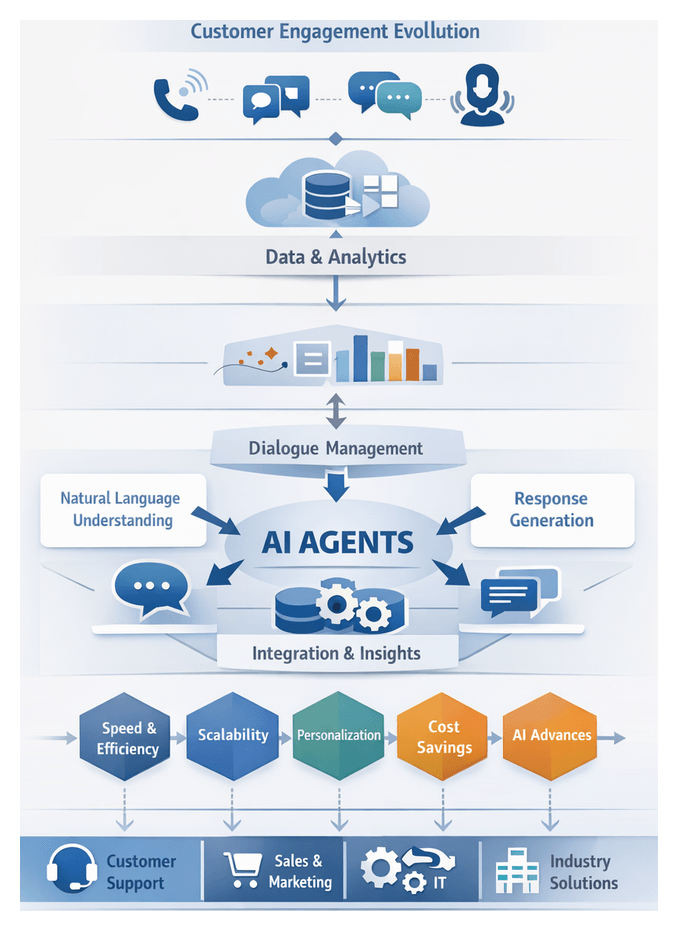
The Evolving Customer Engagement Landscape
Over the past decade, customer engagement has shifted from traditional hotlines and email desks to a network of digital touchpoints—social media, chat applications, voice assistants, and self-service portals. Consumers now expect instantaneous, personalized interactions that span channels without friction. Organizations that cannot deliver seamless, context-aware service risk eroded loyalty, diminished brand perception, and lost revenue. At the same time, advances in cloud computing and analytics enable businesses to collect and interpret vast volumes of interaction data—clickstreams, sentiment signals, and behavioral patterns—to refine service strategies. Yet many legacy CRM systems struggle to unify data across silos, forcing enterprises to balance preservation of existing workflows with the pursuit of cutting-edge innovation. In this environment, AI-driven automation has emerged as a strategic imperative, laying the groundwork for a new generation of digital agents that power scalable, consistent, and personalized customer experiences.
Defining AI Agents and Key Adoption Drivers
AI agents are software entities that simulate human-like conversations using natural language understanding (NLU), contextual memory, and adaptive learning. Unlike rigid decision trees, they interpret user intent, manage multi-turn dialogues, generate contextually relevant responses, and escalate complex issues to human representatives when needed. Core components include:
- Natural Language Understanding: Parses text or speech to extract intents and entities.
- Dialogue Management: Determines next actions—answering queries, requesting clarification, or invoking backend services.
- Response Generation: Employs templated replies or generative language models to craft answers.
- Integration Layer: Connects to order databases, knowledge bases, CRM systems, and customer profiles.
- Analytics and Feedback Loops: Captures interaction metrics, user ratings, and conversation logs to drive continuous improvement.
Leading platforms illustrate the strategic value of embedded intelligence: IBM Watson Assistant blends rule-based logic with scalable machine learning; Google Dialogflow offers developer-friendly tools and robust integrations; Amazon Lex leverages the same deep learning behind Alexa; and OpenAI’s ChatGPT demonstrates the power of large language models to generate human-quality responses across domains.
Several market forces accelerate AI agent adoption:
- Customer Demand for Instant Gratification: Consumers expect answers within minutes. AI agents deliver 24/7 support across time zones without human fatigue.
- Cost Pressures and Efficiency Goals: Automating routine inquiries reduces labor expenses, allowing skilled agents to focus on complex high-value interactions.
- Scalability Requirements: AI agents scale elastically to accommodate traffic peaks during product launches or seasonal spikes without compromising service levels.
- Competitive Differentiation: Faster resolutions, personalized outreach, and proactive engagement become key brand differentiators in saturated markets.
- Advances in AI Technology: Breakthroughs in NLP, sentiment analysis, and pre-trained models accelerate accuracy and reduce time to value.
Enterprises that deploy AI agents report improvements in first-contact resolution, reduced handling times, and higher customer satisfaction. C-level executives view these systems as strategic levers for digital transformation—enabling proactive, data-driven, and resilient service operations.
Conversational Architectures: Frameworks and Evaluation
Conversational architectures define how AI agents interpret input, manage dialogue state, and generate responses. Three main paradigms emerge:
- Modular Pipeline Architectures: Separates NLU, dialogue management, and natural language generation (NLG) into distinct components. Organizations value the transparency and targeted optimization this affords. Metrics such as intent recognition accuracy, dialogue coherence, and response fluency guide independent benchmarking.
- End-to-End Neural Architectures: Employs deep learning models—often transformer-based—to jointly learn interpretation and generation from large conversational datasets. This paradigm excels in adaptive learning and emergent behavior but raises interpretability concerns. Explainability toolkits extract attention weights or saliency maps to illuminate decision pathways.
- Hybrid Architectures: Combines rule-based intent classification or fallback engines with machine learning-driven dialogue management. Performance is measured by fallback frequency, unhandled intent rates, and the balance between templated and generative responses.
Analytical evaluations consider multiple dimensions:
- Scalability: Pipeline modules scale horizontally; end-to-end models require retraining and heavier data pipelines. Metrics include training cost per domain, inference latency under concurrency, and performance degradation curves.
- Maintainability: Modular designs support isolated updates with lower regression risk; end-to-end systems necessitate full-model retraining for new intents, challenging version control and continuous delivery.
- Interpretability: Pipelines offer traceable decision paths, aiding compliance audits. Neural systems rely on explainable AI metrics to assess explanation fidelity and bias attribution.
- Data Quality: Pipeline models benefit from heavily annotated corpora; end-to-end architectures demand diverse conversation transcripts. Indicators include annotation inter-rater agreement, vocabulary coverage, and dialogue act distributions.
- Context Management: Pipelines use explicit state machines; end-to-end systems embed context in hidden state vectors. Coherence scores and context retention rates quantify effectiveness.
- Cost of Ownership: Total cost of ownership analyzes licensing, data annotation, compute usage, and maintenance. Open-source pipelines offer granular cost control; hosted end-to-end solutions lower upfront effort but may incur rising compute charges.
- Security and Privacy: Modular designs allow encrypted data handling at each interface; end-to-end pipelines require comprehensive encryption-at-rest and in-transit protections. Security audits map data flows and assess encryption protocols.
- User Experience: Post-interaction surveys and sentiment analysis correlate UX metrics—satisfaction, perceived naturalness, trust—with architectural attributes.
Use Cases and Strategic Applications
AI agents deliver value across diverse organizational functions. Key use contexts include:
- High-Volume Customer Service: Agents handle thousands of simultaneous requests, ensuring consistent brand voice and 24/7 availability. Success metrics include deflection rate, handle time reduction, and customer satisfaction.
- Complex Technical Support: Integrating with error logs and knowledge bases, agents guide multi-step diagnostics, maintain contextual memory, and escalate when necessary. Benefits include faster resolutions, lower error rates, and improved self-service documentation.
- Sales Enablement and Lead Generation: By monitoring browsing behavior and cart abandonment, agents initiate outreach, qualify prospects through structured dialogues, and integrate with marketing automation to accelerate conversion.
- Marketing Engagement: Agents deliver interactive brand experiences—product demos, surveys, and event registrations—using rich media and personalized messaging. Analytics capture preference data for segmentation and campaign optimization.
- Internal Operations and IT Service Management: Digital employees automate onboarding, incident triage, and procurement workflows. Integrated with ITSM platforms, agents classify tickets, suggest self-help resources, and orchestrate approvals.
- Domain-Specific Applications: In healthcare, agents handle scheduling, symptom triage, and patient education while complying with privacy regulations. In finance, they manage account inquiries and fraud detection. Retail applications include styling advice and inventory checks; telecommunications agents support provisioning and outage notifications.
- Proactive and Predictive Engagement: Leveraging machine learning for at-risk customer identification and usage alerts, mixed-initiative dialogues enable timely outreach, replenishment reminders, and lifecycle campaigns.
- Omnichannel Integration: Agents maintain unified customer profiles, adapt dialogue flows to channel constraints, and provide seamless handoffs with full conversation transcripts and analytics for human agents.
Enterprise frameworks recommend a phased rollout: assess opportunity value, map maturity levels, define governance structures, and iterate based on ROI and user acceptance. Strategic alignment ensures that AI agent deployments evolve from pilot experiments into sustainable, differentiated experience programs.
Architectural Design Principles and Considerations
Designing effective AI agents requires careful attention to architectural trade-offs and future-proofing strategies. Key considerations include:
- Modularity versus Performance: Decoupling components improves maintainability and innovation velocity but introduces inter-process latency and resource duplication. Hybrid approaches co-locate latency-sensitive modules in-process while hosting specialized services remotely.
- Integration Complexity: An API-first strategy ensures consistent data schemas, secure identity and access management, and reliable transaction orchestration. Well-defined REST or event-driven interfaces prevent vendor lock-in and simplify testing.
- Scalability, Latency, and Resilience: Autoscaling policies must balance cost and performance, with regional deployments reducing latency and satisfying data residency. Graceful degradation—fallback to simpler rule-based responses—maintains service continuity under failure.
- Data Governance: Centralized data lineage tracking, privacy-by-design practices, bias detection cycles, and retention policies align technical implementations with regulations such as GDPR and CCPA.
- Security and Ethical Compliance: Embed explainability modules to expose decision rationales, enforce role-based access controls, conduct bias audits using third-party frameworks, and establish incident response protocols for security or ethical breaches.
- Design Limitations and Future-Proofing: Acknowledge context drift, out-of-domain gaps, and rapid model obsolescence. Mitigate risks through modular, open interfaces, continuous research partnerships, and an adaptive engineering culture that embraces emerging paradigms such as multimodal understanding and autonomous decision making.
By integrating these architectural insights, organizations can align AI agent initiatives with business objectives, manage technological constraints, and uphold evolving customer expectations. A structured, metric-driven approach to design and governance ensures that AI agents deliver transformative value responsibly and sustainably.
Chapter 3: Natural Language Understanding and Conversational Design
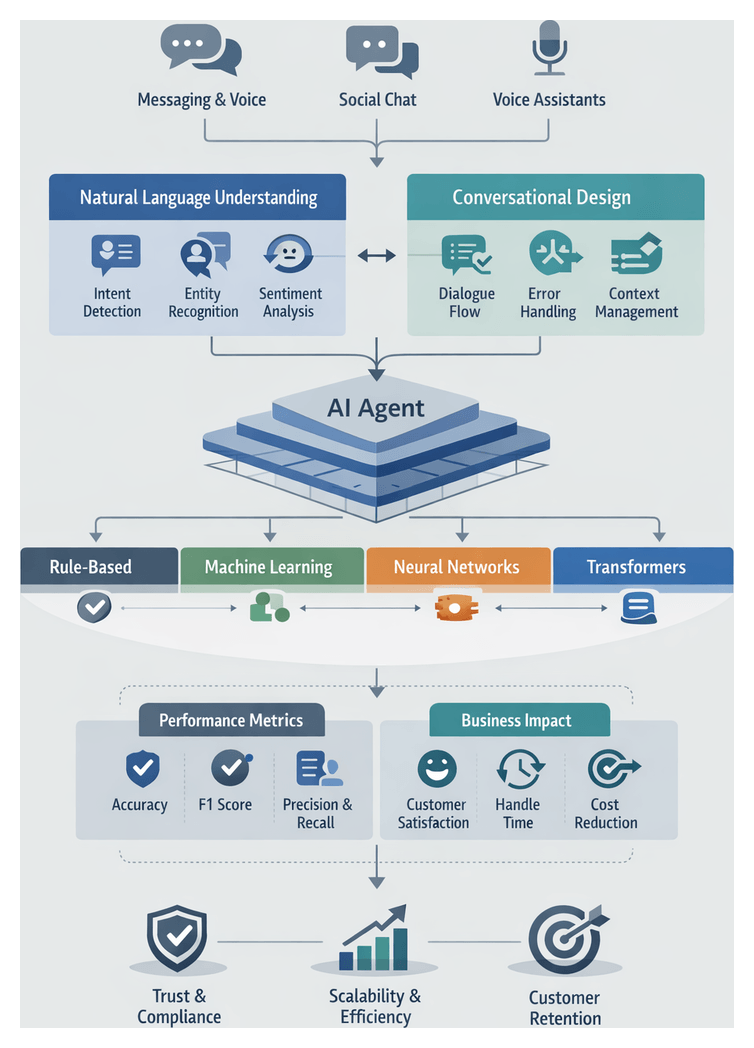
The Emergence of Language-Centric Customer Engagement
Modern customers expect interactions that mirror human conversation, moving beyond static menus and rigid decision trees. The proliferation of mobile messaging, social media chat, and voice assistants underscores language as the primary digital interface. To meet these expectations, organizations must employ Natural Language Understanding and conversational design, integrating systems capable of parsing intent, recognizing entities, and generating responses that reflect brand tone and context. Failure to achieve this sophistication risks customer frustration, attrition, and reputational harm in a competitive market.
Natural Language Understanding (NLU) provides the analytical engine that translates unstructured text or speech into structured data—detecting intents like “order status” or “technical support,” extracting entities such as dates or product codes, gauging sentiment, and managing context across turns. Conversational design defines dialogue architecture, persona guidelines, error handling strategies, and memory mechanisms to ensure that interactions are fluid, coherent, and aligned with user needs. Together, these disciplines form the foundation of AI-driven customer engagement strategies that scale and adapt across channels.
Natural Language Understanding Techniques
Organizations evaluate NLU approaches through lenses of accuracy, scalability, interpretability, and maintainability. Leading techniques include:
Rule-Based and Keyword Matching
Early NLU solutions relied on handcrafted rules and pattern matching. They offer high interpretability and low data requirements, enabling rapid debugging by tracing errors to individual rules. However, they suffer from brittleness under linguistic variability, limited scalability, and high maintenance overhead as rule sets grow. These frameworks remain in use for constrained vocabularies in finance compliance checks or guided troubleshooting.
Statistical and Feature-Based Models
Statistical methods such as maximum entropy classifiers and conditional random fields improved adaptability by learning from examples. They reduce reliance on manual patterns but require extensive feature engineering and struggle with domain shifts. Organizations with mature annotation pipelines often leveraged these models before the deep learning era.
Neural Network Architectures
Recurrent and convolutional networks—particularly LSTM and GRU models—automatically extract hierarchical linguistic features, boosting performance across languages. Development cycles lengthen due to data volume needs and hyperparameter optimization, yet many enterprises conduct A/B tests to quantify user impact before full-scale adoption.
Transformer-Based Models
Pretrained frameworks like BERT and GPT variants revolutionized NLU by learning rich contextual embeddings. Organizations assess these models on F1-score benchmarks, transfer learning effectiveness, and inference latency. While offering state-of-the-art accuracy, transformers demand heavy compute resources and careful fine-tuning. Enterprises frequently leverage resources from Hugging Face Transformers to access pretrained models and evaluation scripts.
Hybrid and Ensemble Strategies
To balance precision and flexibility, many deploy hybrids that combine rule-based fallbacks with machine learning outputs or ensembles of classifiers. While enhancing coverage and mitigating individual model weaknesses, these strategies introduce orchestration complexity and debugging challenges. Sectors like financial services and healthcare often adopt hybrid NLU to satisfy compliance and performance objectives.
Evaluating NLU Performance
Robust evaluation frameworks align technical metrics with business outcomes. Experts differentiate between intrinsic and extrinsic assessments.
Intrinsic Metrics
- Accuracy: Correct classification of intents and entities.
- Precision and Recall: Measures of prediction correctness and completeness.
- F1-Score: Harmonic mean of precision and recall.
- Perplexity: Uncertainty measure in generative language models.
Extrinsic Metrics
- First Contact Resolution improvement (FCR).
- Average Handle Time (AHT) reduction.
- Customer Satisfaction (CSAT) and Net Promoter Score (NPS) correlations.
- Operational cost savings from inquiry deflection.
Continuous monitoring of production interactions reveals gaps in intent coverage and context handling. Tools such as MLflow track experiments, manage model lifecycles, and enforce reproducibility. Closed-loop feedback drives iterative retraining and design refinements, ensuring NLU capabilities evolve with user behavior.
Conversational Design Principles
Conversational design blends user experience, cognitive psychology, and linguistics to create dialogues that feel natural. Core considerations include:
- User-Centric Framing: Scenario mapping and persona development anticipate goals, context switches, and emotions.
- Modular Dialogue Architecture: Reusable components for greeting, clarification, resolution, and handoff enable consistent experiences across channels.
- Error and Exception Handling: Layered fallback paths escalate from rephrasing prompts to human intervention when confidence thresholds drop.
- Channel Adaptation: Tailoring pacing, vocabulary, and multimedia integration for web chat, social media, and voice assistants.
Platforms such as Google Dialogflow, Microsoft Azure Bot Service, IBM Watson Assistant and Amazon Lex offer visual flow designers and built-in NLU modules. Yet successful deployments demand user research, iterative prototyping, and performance testing to validate dialogue effectiveness.
Adaptive Dialogue Flow and Context Management
Maintaining conversational momentum and contextual continuity transforms AI agents from transactional tools into empathetic service agents. Key dimensions include:
Dialogue Dynamics and Conversational Momentum
Adaptive flows guide conversations based on real-time cues, mirroring how human agents clarify hesitations and anticipate follow-ups. Metrics such as engagement retention, perceived intelligence, and efficiency gains demonstrate the strategic value of smooth topic transitions. Conceptual models like the Conversational State Chart map dialogue states, transitions, and fallback routes to uncover momentum breaks.
Contextual Continuity and Session Memory
Effective context management involves slot persistence, anaphora resolution, and session history integration. Session-scoped memory addresses single interactions, while long-term memory captures user preferences across sessions via CRM integrations. Open-source frameworks such as Rasa implement slot trackers and form actions, and platforms like Dialogflow and Watson Assistant provide context scopes and lifespan controls. Governance policies must balance context richness against privacy regulations like GDPR and industry standards such as ISO 27701.
Cross-Domain and Long-Term Context
Omnichannel environments require AI agents that recognize domain shifts, maintain context signatures, and orchestrate multi-stage journeys. Contextual Turn Graphs model topic transitions across billing, product consultation, and technical support. Retail and e-commerce use cases blend product discovery with order tracking and post-purchase support in a single dialogue. Mature deployments report higher first contact resolution and reduced abandonment as AI handles domain transitions with minimal manual intervention.
Architectural and Operational Integration
Integrating NLU and conversational design demands modular architectures combining perception, dialogue management, and response generation. Enterprises often deploy microservices, container orchestration, and auto-scaling to maintain low latency under peak loads. Logging and analytics pipelines capture metrics on understanding accuracy, user satisfaction, and escalation rates, enabling data-driven optimization. Hybrid models leverage pretrained generative engines with rule-based safeguards and business logic layers to balance creativity with control.
Cross-functional alignment among IT, customer service, legal, and marketing teams is essential. Governance frameworks should define ownership of training data, design standards, brand guidelines, and compliance protocols. Centers of excellence centralize expertise and promote reuse of intents, dialogue components, and data assets.
Strategic and Governance Considerations
Successful AI agent initiatives rest on talent, ethics, and measurable outcomes. Specialists in NLU, UX design, data science, and DevOps are critical, often augmented by partnerships or consultancies. Data privacy regulations such as GDPR and CCPA mandate transparent disclosures, opt-in mechanisms, and robust encryption. Bias mitigation through diverse datasets, fairness metrics, and regular audits ensures equitable treatment across demographics.
Return on investment is assessed via quantitative metrics—cost savings from automation, handle time reductions—and qualitative indicators such as sentiment trends and Net Promoter Scores. Dashboards combining these metrics empower leaders to justify investments and align AI programs with broader business objectives.
Limitations and Emerging Frontiers
Despite significant advances, conversational AI faces challenges of ambiguity, hallucination, and resource intensity. Neural models may generate plausible but incorrect responses, compromising trust in mission-critical contexts. Large transformer deployments entail high computational costs and environmental impact. Cultural and linguistic biases require explicit mitigation, and privacy considerations demand rigorous governance.
Looking ahead, industry leaders must invest in explainability, iterative data-driven refinement, omnichannel consistency, ethical guardrails, and balanced automation with human oversight. Emerging analytical frontiers include real-time sentiment adaptation, integrated knowledge graphs, and collaborative dialogues where AI and human experts co-resolve complex inquiries. Establishing robust governance, cultivating interdisciplinary talent, and sustaining an agile mindset will enable organizations to harness the full potential of NLU and conversational design for transformative customer engagement.
Chapter 4: Personalization and Contextual Intelligence
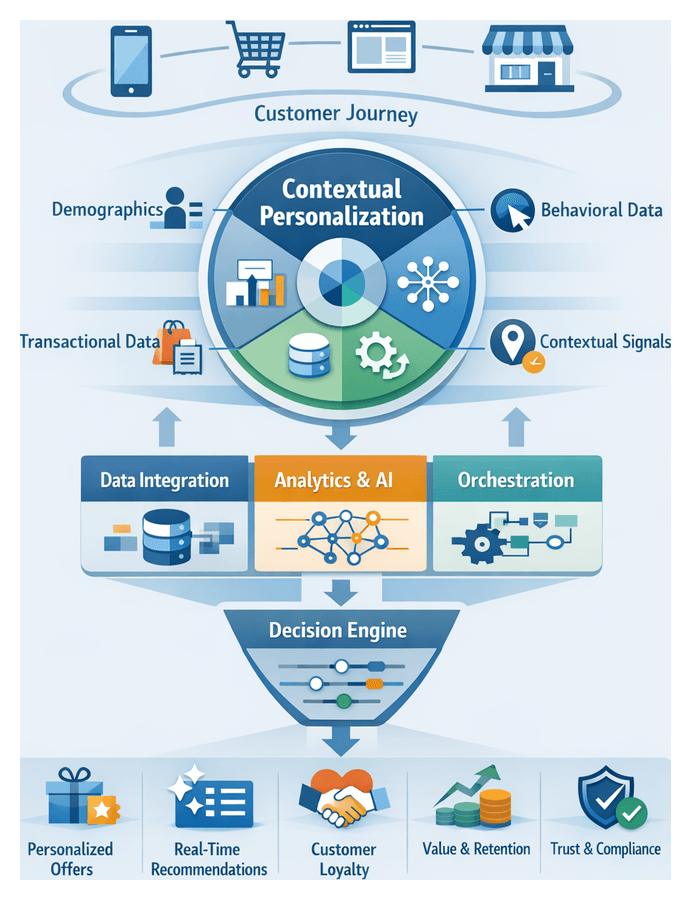
Contextual Personalization and the Modern Customer Journey
The contemporary customer journey spans mobile apps, social channels, web portals and in-store experiences. Customers now expect interactions that anticipate their needs and adapt instantly. Contextual personalization meets this demand by unifying demographic, behavioral, transactional and situational data into real-time decisioning engines. This approach elevates static segmentation to dynamic engagement, enabling brands to deliver the right message, offer or action at each touchpoint. As organizations pursue loyalty, revenue growth and market differentiation, mastering contextual intelligence becomes a strategic necessity.
At its core, personalization tailors content and recommendations based on user attributes and history. Contextual intelligence extends this by capturing external signals—time of day, device type, location and environmental factors—to inform decision logic. Three pillars underpin this discipline:
- Data integration: Consolidating disparate sources into a unified customer profile.
- Advanced analytics: Applying machine learning to detect patterns and predict needs.
- Orchestration: Coordinating insights to deliver consistent, timely interactions across channels.
When operationalized effectively, these capabilities transform one-size-fits-all campaigns into experiences that resonate, driving satisfaction, loyalty and competitive advantage in an overcrowded digital marketplace.
Data Foundations for Real-Time Personalization
Robust personalization relies on a scalable data architecture that ingests, processes and activates diverse data streams. Key categories include:
- Demographic and firmographic attributes: Age, gender, industry and company size.
- Transactional history: Purchases, order values and service interactions.
- Behavioral signals: Clickstreams, page views, search queries and in-app events.
- Contextual metadata: Time stamps, geolocation, device type and environmental factors such as weather.
These datasets converge in platforms like a customer data platform or data lake. Real-time ingestion pipelines feed streaming events into analytics engines, while historical data warehouses support batch training of machine learning models. Together, they create a holistic, dynamic customer profile that powers split-second personalization decisions.
Analytical Models and Decisioning Frameworks
Translating customer profiles and context into personalized actions requires sophisticated modeling. Industry practitioners evaluate these models on statistical rigor, interpretability and business impact.
Collaborative, Content-Based and Hybrid Approaches
Collaborative filtering leverages user co-behavior to surface popular items among peers. Content-based filtering matches user attributes to item features. Hybrid frameworks combine both to address cold-start challenges and improve coverage. Interpretability is key: executives and compliance teams demand transparency on why a recommendation appears, driving adoption of explainable algorithms.
Latent Factor Models and Matrix Decomposition
Latent factor methods such as singular value decomposition reduce high-dimensional interaction matrices into compact representations of hidden preferences. Evaluation criteria include overfitting risk, scalability and depth of personalization. These latent dimensions—concepts like “trend driven” or “budget conscious”—inform curation strategies and promotional targeting.
Contextual Bandits and Reinforcement Learning
To incorporate dynamic context—session variables, device type or location—many organizations adopt contextual bandit algorithms and reinforcement learning. Key considerations include:
- Exploration vs. exploitation trade-offs, managed via policies such as epsilon-greedy or Thompson sampling.
- Cumulative reward metrics that measure long-term value uplift and retention.
- Off-policy evaluation using causal inference and counterfactual estimators to test new strategies on historical data.
Graph-Based and Knowledge-Infused Models
Graph representations capture relationships among users, items and contextual entities. Knowledge graphs infuse curated taxonomies—product hierarchies or thematic clusters—into embeddings. Benefits include clearer entity relationships, contextual propagation of emerging trends and explainable recommendation paths that enhance user trust.
Decisioning and Inference Engines
Once models are trained, an inference layer interfaces with applications or AI agents. When a customer engages, the engine evaluates live context and retrieves ranked recommendations. Feedback loops capture engagement metrics—click-through, dwell time and conversions—to iteratively refine models. Managed services such as Amazon Personalize, Google Recommendations AI and Microsoft Azure Personalizer simplify deployment, offering APIs for real-time personalization without extensive infrastructure overhead.
Evaluative Metrics and Benchmarking
A multidimensional evaluation framework ensures balanced performance assessment:
- Accuracy: Precision, recall and nDCG for baseline model validation.
- User experience: Session duration, scroll depth and interaction diversity.
- Business impact: Revenue uplift, average order value and churn reduction.
- Fairness: Bias audits and subgroup performance analyses to enforce equitable treatment.
Unified dashboards align data science, product, marketing and compliance stakeholders on performance targets and risk thresholds. Iterative benchmarking against industry standards and open datasets further sharpens strategic focus.
Impact on Customer Relationships
Personalization powered by contextual intelligence shifts engagement from transactional to relational. By anticipating needs, recalling past interactions and adapting tone, AI agents foster emotional connections that drive satisfaction and loyalty.
- Emotional Connection: AI agents that reference prior issues or customer milestones trigger recognition. Spotify uses listening history to curate playlists, reinforcing user affinity.
- Perceived Value: Relevant offers reduce friction. Capital One’s Eno delivers real-time spending alerts, positioning the bank as a proactive advisor.
- Loyalty and Retention: Personalized service ladder models show progression from satisfaction to advocacy. Telecom providers adjust plans via conversational AI, embedding themselves in daily use patterns and lowering churn.
- Customer Lifetime Value: Tailored recommendations increase order values and subscription tenure. Netflix sustains engagement by surfacing new titles based on viewing history.
- Relationship Risks: Overly intrusive personalization can cross the “creepiness threshold.” Healthcare reminders must balance relevance with privacy under regulations such as GDPR.
Expert frameworks evaluate these impacts through metrics like Net Promoter Score, customer effort score and emotional response mapping. Contextual variables—industry type, market maturity and cultural norms—influence outcomes and guide personalization strategies.
Governance, Strategy and Implementation Considerations
Delivering personalization at scale requires alignment with business objectives, compliance and operational readiness. Key elements include:
- Data Governance and Privacy: Define clear policies for data collection, consent management and retention. End-to-end encryption and anonymization foster trust and comply with GDPR and CCPA.
- Bias and Fairness: Regular audits using tools like IBM’s AI Fairness 360 and Microsoft Fairlearn detect and mitigate model disparities.
- Explainability and Transparency: Offer users insights into why recommendations appear, from simple “because you viewed X” messages to interactive personalization controls.
- Cross-Functional Collaboration: Establish centers of excellence or agile squads involving data engineers, scientists, UX designers and legal to accelerate decision-making and align on KPIs.
- Legacy System Integration: Modernize middleware or adopt SaaS platforms like Salesforce Einstein to bridge real-time data pipelines and CRM systems.
- Operational Scalability: Evaluate on-premise versus cloud inference, apply model compression and leverage auto-scaling policies. Managed services and global CDNs help maintain low latency at scale.
- Continuous Learning and Optimization: Implement A/B testing, offline evaluation and real-time monitoring. Platforms like Adobe Target enable systematic experimentation.
Strategic Imperatives and Mitigation Strategies
- Data Quality and Availability: Enforce validation, automated cleansing and master data management. Use synthetic data enrichment or partner integrations to fill gaps.
- Talent and Resource Constraints: Leverage partner ecosystems, managed services or low-code AI platforms to address skill shortages in engineering, modeling and UX design.
- Regulatory Evolution: Monitor legislative changes and design data architectures with modular consent controls. Maintain an audit-ready posture for agility.
- Cost Management: Conduct total cost of ownership analyses for infrastructure investments. Balance managed versus self-hosted solutions and explore hybrid models.
- Cross-Channel Consistency: Harmonize identity resolution and standardize APIs to deliver seamless personalization across web, mobile, voice and in-store.
- Personalization Fatigue: Monitor sentiment and engagement decay. Introduce controlled serendipity and neutral content highlights to prevent over-targeting.
- Attribution Challenges: Employ robust experimental designs, multi-touch attribution and uplift modeling to isolate personalization ROI.
Final Reflections
Contextual personalization is a transformative capability that extends beyond technical implementation. It demands robust data foundations, advanced analytical models, governance for fairness and privacy, and organizational readiness. By integrating these elements thoughtfully, leaders can deliver dynamic dialogues that adapt to customer context, deepen emotional connections, drive loyalty and uphold trust. The journey requires continuous learning, cross-functional collaboration and ethical stewardship, but the commercial and relational rewards are profound.
Chapter 5: Emotional Insight and Sentiment Analysis
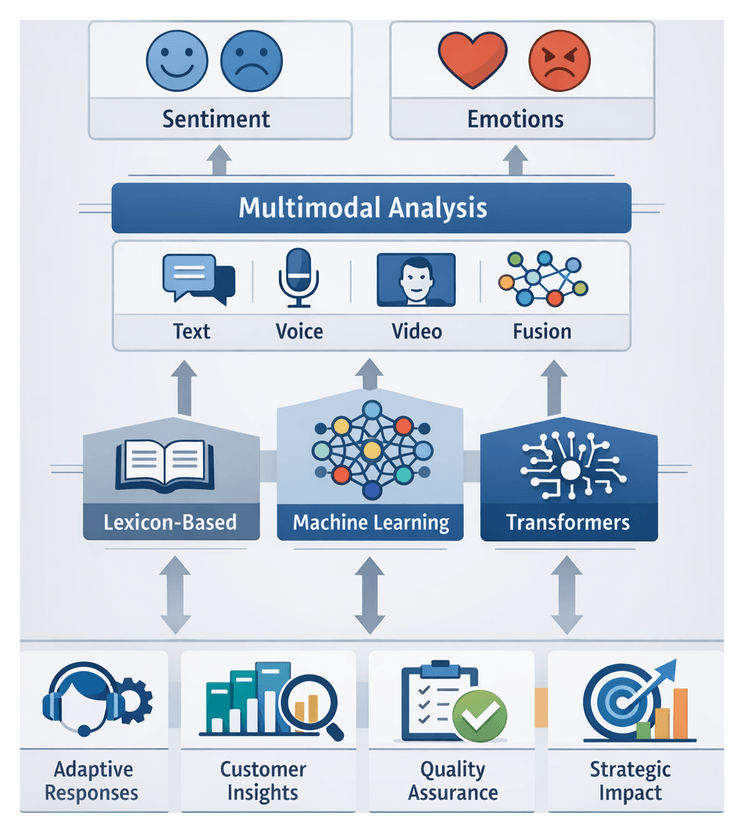
Core Principles of Sentiment and Emotion Detection
Distinguishing Sentiment and Emotion
Understanding customer affect in digital interactions has become a strategic imperative. Sentiment analysis classifies broad polarity—positive, negative, or neutral—while emotion detection identifies discrete states such as joy, frustration, anger, or empathy. This distinction matters: knowing that a customer is “disappointed” rather than simply “negative” enables tailored response strategies, guiding AI agents to adapt tone, escalate urgent issues, or seamlessly transfer to human specialists when appropriate.
Multimodal Modalities of Insight
Modern engagement platforms harness multiple communication channels to extract affective signals:
- Textual analysis employs lexical resources and transformer models to interpret sentiment in chat, email, social media, and reviews.
- Voice emotion detection analyzes acoustic features—tone, pitch, speech rate—to infer stress or confidence.
- Visual recognition uses computer vision to detect facial expressions and micro-expressions in video interactions.
- Multimodal fusion correlates inputs across text, voice, and video for a holistic view of customer affect.
By combining these streams, organizations achieve higher detection fidelity, enabling AI agents to maintain empathetic engagement across channels.
Analytical Approaches to Detection
Three primary frameworks underpin emotion detection:
- Lexicon-based methods rely on curated dictionaries of sentiment-bearing terms. They offer interpretability but may struggle with context, sarcasm, and evolving language.
- Machine learning models use supervised classifiers—ranging from support vector machines to deep neural networks—trained on labeled data to capture nuanced emotional states.
- Transformer-based architectures such as BERT, RoBERTa, and GPT derivatives fine-tuned for sentiment tasks deliver superior contextual understanding. Hybrid systems may combine lexicons with neural networks to balance transparency and performance.
Selecting the right approach entails trade-offs among accuracy, inference latency, computational resources, and ease of model updating.
Strategic and Operational Impact
Embedding sentiment and emotion detection into AI-driven engagement platforms yields both immediate efficiencies and long-term strategic gains:
- Enhanced first-contact resolution as agents prioritize high-anxiety issues and adapt responses to mood shifts.
- Reduced escalations and handle times through tone-adjusted dialog that fosters trust and clarity.
- Data-driven quality assurance by surfacing interaction patterns that guide training for human agents.
- Personalized customer journeys informed by emotion profiles, enabling dynamic orchestration that resonates on an emotional level.
By advancing from reactive problem solving to proactive engagement, organizations strengthen brand loyalty and differentiate on service excellence.
Leading Solutions and Tools
A spectrum of AI-driven platforms supports sentiment and emotion detection:
- IBM Watson Tone Analyzer applies linguistic analysis to detect emotional and language tones in text for dynamic response strategies.
- Microsoft Azure Text Analytics delivers sentiment polarity scores, key phrase extraction, and real-time insights via REST APIs.
- Google Cloud Natural Language API offers multilingual sentiment analysis and entity sentiment detection.
- Lexalytics Salience provides sentiment and intent analysis tailored for enterprise privacy requirements and industry-specific taxonomies.
- Amazon Comprehend accelerates deployment of standard sentiment models with options for custom classification.
- Salesforce Einstein integrates sentiment detection into CRM workflows to drive personalized customer engagement.
- IBM Watson Assistant delivers sub-second response times and continuous learning cycles in conversational AI deployments.
Analytical Frameworks for Evaluating AI Agents
Industry Maturity Models
Analysts assess AI agents through structured maturity frameworks that quantify personalization, integration, and autonomy. The Gartner Digital Experience Maturity Model positions AI agents at the “optimizing” and “leading” stages, emphasizing real-time adaptability and cross-channel consistency. Forrester’s Wave for Conversational AI scores vendors on natural language processing accuracy, dialog customization, and analytics integration, guiding procurement decisions with objective benchmarks. IDC and Everest Group further dissect AI agent value chains, examining model training architectures, data governance, and ecosystem partnerships to inform internal scorecards and improvement roadmaps.
Service Quality and Satisfaction Paradigms
Classic service frameworks are repurposed to evaluate AI interactions:
- SERVQUAL dimensions—reliability, responsiveness, empathy, assurance, tangibles—map to agent uptime, response fidelity, sentiment adaptation, knowledge accuracy, and interface design.
- The Kano Model classifies expectations into basic, performance, and delight factors, guiding prioritization of features from accurate FAQ handling to proactive, empathy-driven recommendations.
- Customer satisfaction metrics such as Net Promoter Score (NPS), Customer Effort Score (CES), and Customer Satisfaction Score (CSAT) are correlated with AI self-service uptake to refine conversational flows.
Strategic and Financial Perspectives
C-level executives apply total cost of ownership analyses to compare AI-driven support models against traditional contact center operations. Cost factors include platform licensing, implementation expenses, ongoing model training, and labor redeployment value. Balanced scorecards integrate financial performance, customer satisfaction, operational processes, and innovation, embedding AI agent KPIs into strategic dashboards for traceable outcomes against corporate goals. Risk and compliance lenses ensure alignment with regulations such as GDPR and CCPA, weighing data governance responsibilities alongside the value of conversational insights.
Benchmarking and Advanced Metrics
Robust performance measurement converts interaction logs and user feedback into strategic intelligence. Dashboards track average handle time, escalation rate, and satisfaction against targets. Advanced analytics—cohort analysis, regression modeling, sentiment trajectory mapping—reveal correlations between response latency and escalation likelihood or satisfaction trends over time. Quarterly maturity assessments of model drift, adoption curves, and knowledge base expansion sustain a culture of continuous improvement, ensuring AI agents evolve with customer expectations and service objectives.
Integrating Emotional Intelligence into Automated Workflows
Empathy in High-Emotion Scenarios
Emotionally intelligent AI agents elevate engagement in contexts marked by heightened customer stress or conflict. By detecting frustration or disappointment, agents can frame apologies, validate feelings, and present clear remediation steps. Key scenarios include:
- Complaint resolution: Swift expressions of regret followed by tailored solution pathways restore customer confidence.
- Billing and financial inquiries: Transparent explanations of next steps alleviate anxiety.
- Healthcare support: Compassionate language and privacy reassurances enhance patient trust.
- Technical escalations: Empathy combined with clear escalation paths reduces tension and improves resolution rates.
Building Trust and Rapport
Beyond crisis management, emotionally aware automation fosters positive engagement. Agents that recognize satisfaction can invite customers to loyalty programs, feedback channels, or community forums. Mirroring positive tone—celebrating milestones or thanking users for patience—reinforces brand affinity and encourages genuine repeat interactions. This two-way emotional dialogue approximates human rapport, transforming routine exchanges into memorable experiences.
Impact on Key Performance Indicators
Organizations adopting sentiment-aware AI report measurable improvements in:
- Customer Satisfaction (CSAT): Tone-adapted responses boost satisfaction scores.
- Net Promoter Score (NPS): Memorable empathetic interactions drive advocacy.
- First Contact Resolution (FCR): Emotional modulation reduces misunderstandings and accelerates closure.
- Churn Reduction: Tailored empathetic outreach during critical moments lowers attrition.
Cultural and Contextual Adaptation
Emotional expression varies across cultures and languages. Effective deployment requires calibrating models to regional linguistic patterns, social norms, and indirect sentiment cues. Localization efforts—retraining on region-specific corpora and adjusting emotion taxonomies—ensure sensitivity to cultural nuances and prevent misinterpretation, reinforcing the authenticity of empathetic engagement.
Strategic, Ethical, and Practical Considerations
Implementation Foundations
Realizing the value of sentiment and emotion detection demands attention to foundational elements:
- Data quality and labeling: Industry-specific, high-quality annotated datasets underpin model accuracy.
- Integration architecture: Seamless API connectivity, low-latency inference, and coherent state management embed detection engines within conversational platforms.
- Continuous monitoring: Performance tracking and retraining mitigate model drift and accommodate evolving language.
- Cross-functional collaboration: Marketing, customer support, legal, and data science teams align on use cases, compliance, and performance objectives.
Data Governance and Privacy
Sentiment analysis often processes sensitive personal data. Privacy officers and security architects must enforce anonymization techniques, obtain explicit consent, and ensure compliance with GDPR, CCPA, and other regulations. Emerging privacy-enhancing methods such as federated learning and differential privacy balance personalization ambitions with confidentiality safeguards.
Customization versus Standardization
Off-the-shelf solutions accelerate time to market, while bespoke models tuned to industry jargon and customer personas deliver higher relevance and trust. A phased approach—initial deployment of standard offerings followed by iterative customization—balances speed and precision, allowing organizations to refine emotion detection models as they gather operational insights.
User Experience Design and Transparency
Conversation designers craft dialogue flows to convey empathy naturally, avoiding forced or manipulative language. Transparent AI disclosures—informing users when they interact with automated agents—foster trust while maintaining seamless experiences. Placement of sentiment-driven prompts and tone-adjusted responses must align with brand voice and user expectations to prevent the “uncanny valley” of artificial empathy.
Limitations and Cautions
Despite advances, emotional AI systems face inherent challenges. No automated model achieves perfect accuracy in detecting nuances such as sarcasm, idioms, or mixed sentiments. Organizations must account for:
- Cultural and linguistic variance: Models require localization to avoid bias.
- Mixed sentiment ambiguity: Confidence thresholds and rule-based overrides manage uncertain cases.
- Data quality dependence: Representative datasets are critical to avoid skewed predictions.
- Explainability challenges: Deep learning models may lack transparency, complicating trust and compliance.
- Ethical risks: Emotion-driven nudges designed to prolong engagement or influence decisions raise moral concerns without user awareness.
Guiding Frameworks for Responsible Emotional AI
Adopting structured frameworks helps balance innovation with responsibility. A four-pillar model—accuracy, transparency, fairness, and accountability—ensures rigorous evaluation:
- Validation against diverse benchmark datasets reflecting linguistic and emotional diversity.
- Documentation of decision criteria to trace sentiment label assignments.
- Bias audits to detect and correct disparate performance across demographic groups.
- Governance reviews that define ownership of emotional AI outputs and protocols for human intervention when critical sentiment thresholds are met.
Continuous feedback loops—combining voice-of-customer surveys, agent feedback, and sentiment drift reports—drive iterative refinements. Treating emotional AI as an evolving capability sustains trust and aligns deployments with shifting customer expectations.
Forward Outlook
Sentiment and emotion detection constitute foundational capabilities for AI agents that aim to deliver truly empathetic, human-centric experiences. By integrating multimodal insights, rigorous analytical frameworks, and responsible governance, organizations can transform routine interactions into rapport-building opportunities. As AI agents continue to mature, their capacity to interpret and respond to emotional cues will redefine customer service benchmarks, fostering loyalty and competitive differentiation in an increasingly experience-driven marketplace.
Chapter 6: Omnichannel Integration and Seamless Experiences
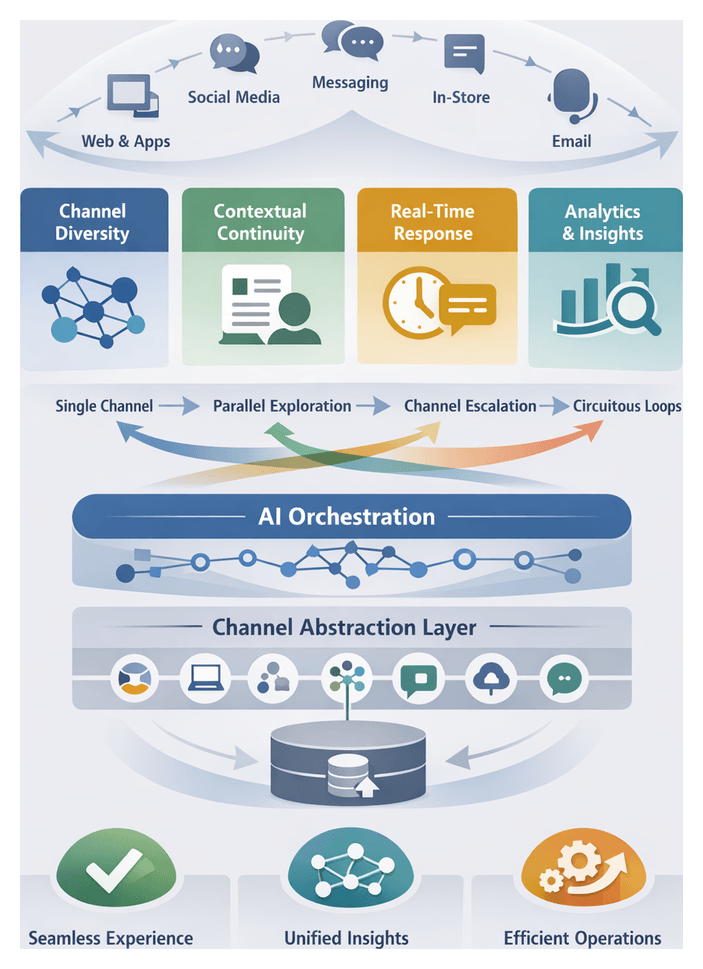
Landscape of Multichannel Customer Journeys
Customers today navigate a vast network of digital and physical touchpoints—web portals, mobile apps, social media, messaging services, voice assistants, email, and in-store locations—creating non-linear, dynamic journeys. This proliferation of channels raises expectations for immediacy, relevance, and seamless transitions; over 70 percent of consumers expect to move between channels without repeating information. Fragmented systems risk context loss, customer frustration, and operational inefficiencies. Delivering cohesive experiences demands an integrated architecture underpinned by AI-driven orchestration to capture and convey context in real time.
Key dimensions of this landscape include:
- Channel diversity: A growing roster of touchpoints, each with unique interaction models and technical requirements.
- Contextual continuity: Preserving user data—purchase history, preferences, prior dialogues—across transitions.
- Real-time responsiveness: Instant or near-instant replies on social, chat, and voice platforms.
- Channel switching behavior: Customers often begin on one channel and complete on another, driven by convenience or shifting needs.
- Visibility and analytics: Unified metrics across channels to guide service performance and strategic decisions.
Organizations observe four archetypal multichannel patterns:
- Single-Channel Focus: Engagement via one preferred channel, such as live chat, prioritizing speed over flexibility.
- Parallel Exploration: Comparing options across channels—browsing online before querying via social messaging.
- Channel Escalation: Transitioning from automated self-service to human agents when complexity rises.
- Circuitous Loops: Repeated toggling among channels for high-value or complex inquiries, exposing context retention gaps.
To address these patterns, three foundational capabilities are essential:
- Centralized Data Repository: A unified customer profile store aggregating history, transactions, and preferences in real time.
- Channel Abstraction Layer: Middleware or integration platforms that decouple conversational logic from individual touchpoints.
- AI-Driven Orchestration: Intelligent routing, context mapping, and dialogue management powered by natural language understanding.
Implementing these capabilities enables seamless context handoffs. For example, when a customer moves from an in-app chatbot to a voice call, the system retrieves intent, entities, and dialogue state, providing agents with concise summaries. AI agents can also personalize recommendations by drawing on unified data sources, whether collected via email campaigns or purchase records.
Leading conversational platforms with extensible APIs and prebuilt connectors include IBM Watson Assistant, Google Dialogflow, Amazon Lex, and the Microsoft Bot Framework. These solutions help organizations orchestrate unified experiences across chat, voice, social, and proprietary applications.
Architectural Integration Strategies
Omnichannel integration is both a technical challenge and a strategic imperative. Organizations evaluate architectural patterns by contrasting monolithic suites with composable ecosystems, and API-first designs with middleware-centric models. Decisions hinge on factors such as time to market, total cost of ownership, vendor lock-in risk, and the ability to evolve incrementally.
Monolithic Suites versus Composable Ecosystems
Monolithic platforms like Microsoft Dynamics 365 Customer Service and Salesforce Service Cloud bundle routing, knowledge management, analytics, and workflow. They simplify initial deployment but may limit flexibility and scale. Composable ecosystems combine best-of-breed services—such as Twilio Flex for programmable channels, MuleSoft Anypoint Platform for API orchestration, and a Customer Data Platform for unified profiles—offering rapid innovation at the cost of increased governance and integration complexity.
API-First and Headless Architectures
API-first designs expose every capability—intent recognition, session state, analytics—via RESTful or GraphQL interfaces. Headless services, as provided by IBM Watson Assistant and Google Contact Center AI, decouple business logic from presentation, allowing custom front-ends, mobile apps, voice assistants, or AR interfaces to consume core conversational services securely under robust governance frameworks.
Event-Driven versus Request-Driven Integration
Event-driven architectures use asynchronous message streams—implemented with platforms like Apache Kafka or Amazon EventBridge—to propagate context changes and trigger real-time conversational logic. Request-driven models rely on synchronous API calls for predictable transactions. Best practice combines both: event flows for state changes and analytics, with direct requests for transactional operations requiring immediate confirmation.
Middleware and iPaaS
Integration Platform as a Service (iPaaS) offerings, such as MuleSoft Anypoint Platform and Dell Boomi, provide prebuilt connectors and visual orchestration. Traditional enterprise service buses deliver mediation and transformation but risk becoming fragile under scale. Effective architectures employ rigorous governance, version control, and dependency mapping to maintain resilience.
Evaluative Criteria and Maturity Models
Architectural fitness is assessed against:
- Scalability and performance: Elastic handling of traffic spikes and low latency for AI inference.
- Flexibility and extensibility: Adding new channels, languages, or models without major refactoring.
- Data consistency and synchronization: Real-time coherence of profiles, session states, and histories.
- Security and compliance: Data protection, role-based access, and audit trails for GDPR, CCPA, PCI DSS.
- Operational governance and observability: End-to-end monitoring, logging, and alerts for service-level objectives.
Frameworks such as the Forrester Wave, Gartner’s Integration Maturity Model, and Omdia’s FFT define stages—from siloed channel deployments to fully orchestrated, context-driven experiences—guiding roadmaps for channel unification, messaging fabric implementation, contextual orchestration, and autonomous experience delivery.
Consistency and User Experience
Omnichannel excellence depends on consistent, context-rich interactions that preserve brand voice, minimize friction, and foster trust. AI agents must adapt across chat, voice, email, social, and mobile while maintaining continuity of conversation and relevance of content.
Analytical Frameworks for Consistency
- Service Quality Continuum: Evaluates reliability, responsiveness, empathy, and assurance to measure AI agent impact on NPS and CES.
- Customer Journey Equivalence: Compares task completion time, accuracy, and emotional tone across channel switches to minimize drop-off.
Ensuring Contextual Continuity
- Session persistence: Maintaining dialogue state across abrupt channel changes.
- Profile synchronization: Real-time updates to unified customer profiles.
- Context transfer protocols: Secure APIs for sharing session metadata.
Preserving Brand Voice and Tone
- Voice consistency metrics: Lexical similarity and sentiment alignment analytics.
- Tonal variation allowances: Defined empathy and formality boundaries per context.
- Persona fidelity scores: Matching AI utterances to brand persona profiles.
Tools like Ada and Intercom enable style enforcement and real-time monitoring of tone deviations.
Sustaining Personalization Across Touchpoints
- Relevance retention: Accuracy of personalized content after channel transitions.
- Data cohesion index: Seamlessness of preference integration across platforms.
- Recommendation consistency: Alignment of suggestions in chat, app, and voice interfaces.
Measuring Consistency Impact
- Cross-channel NPS variation.
- Task success rate across platforms.
- Resolution time disparity.
- Channel hopping abandonment rate.
Psychological and Contextual Considerations
- Flow state facilitation: Sustaining momentum and relevance to minimize perceived effort.
- Cognitive load reduction: Avoiding redundant queries and handoffs to lower mental burden.
- Emotional satisfaction drivers: Monitoring sentiment with solutions like those listed on AgentLinkAI.
- Latency sensitivity, modal constraints, and privacy expectations vary by channel and inform tailored guidelines.
Strategic Benefits
- Higher retention through predictable, reliable interactions.
- Operational efficiency via unified AI frameworks and reduced asset duplication.
- Brand differentiation in markets where fragmented experiences prevail.
- Data synergy that improves analytics and personalization accuracy.
Strategic Insights Across the AI Agent Lifecycle
AI agents thrive within a broader digital ecosystem that spans design, data preparation, deployment, monitoring, and iterative enhancement. Effective strategies balance rule-based predictability with learning-based adaptability, leveraging hybrid models for high-volume tasks and nuanced, data-driven personalization.
Core Lifecycle Considerations
- Personalization and contextual intelligence: Real-time behavioral signals and historical context unlock tailored experiences, reliant on rigorous data governance and privacy stewardship.
- Emotional insight and sentiment analysis: Adjusting tone and pace fosters trust, mindful of cultural nuances and authenticity risks.
- Omnichannel orchestration: Centralized layers mediate across touchpoints to preserve brand voice and dialogue continuity.
- Automation strategy: Target repetitive inquiries for self-service, design clear human escalation pathways, and use process mining to identify bottlenecks.
- Continuous performance improvement: Close the feedback loop with interaction logs and metrics feeding model refinements and intent taxonomy updates under cross-functional governance.
- Trust, privacy, and ethics: Embed transparent design, explainability frameworks, and bias audits at every stage.
- Future readiness: Architect for modularity, open APIs, and model versioning to accommodate emerging generative and autonomous agent capabilities.
Interpretive Frameworks
- Customer journey mapping to identify high-impact AI intervention points.
- Technology stack trade-off analyses comparing suites against best-of-breed and open frameworks like Rasa or OpenAI GPT services.
- Data governance maturity models assessing quality, lineage, and readiness for advanced analytics.
- Ethical risk assessments—privacy impact and bias detection protocols.
- Performance dashboards tracking containment rates, resolution times, and effort scores.
Cross-Cutting Limitations and Industry Context
- Data quality constraints and silo elimination are prerequisites for accurate intent recognition and personalization.
- Bias and fairness risks demand continuous audits, representative sampling, and synthetic augmentation.
- Integration complexity requires phased strategies, prioritizing high-impact connectors and leveraging iPaaS.
- Change management must include training, role redefinition, and stakeholder engagement.
- Regulatory compliance—GDPR, HIPAA, PCI DSS—necessitates embedded checkpoints.
- Explainability versus complexity: Combine transparent and black-box models to balance performance and interpretability.
- Scalability challenges addressed with cloud-native, auto-scaling, and model distillation methods.
- Context drift and model staleness mitigated by scheduled retraining and drift detection.
Industry Applications:
- Financial services: Emphasize encryption, audit trails, and human escalation for high-value transactions.
- Healthcare: Enforce HIPAA compliance, conservative language models, and clinical validation.
- Retail: Integrate inventory APIs and manage real-time promotions during seasonal peaks.
- Telecommunications: Combine network diagnostics, usage analytics, and advanced routing for complex support.
- Travel and hospitality: Use generative recommendations for dynamic itineraries and loyalty-based personalization.
Core Strategic Takeaways
- Adopt a customer-centric stance, aligning AI capabilities with high-value journey moments.
- Invest in data readiness—integration, cleansing, and governance—as the foundation for advanced AI.
- Balance automation with human touch through clear escalation pathways.
- Embed ethical and compliance guardrails in design, development, and deployment.
- Measure holistically with efficiency, effectiveness, and experience metrics.
- Embrace continuous evolution via closed-loop feedback and iterative optimization.
- Future-proof architectures through modularity and open APIs to incorporate emerging AI innovations.
By establishing centers of excellence, nurturing cross-functional collaboration, and fostering an experimental mindset, organizations can build sustainable AI agent programs that deliver operational efficiency, superior customer experiences, and lasting competitive advantage.
Chapter 7: Automation Strategies and Workflow Optimization
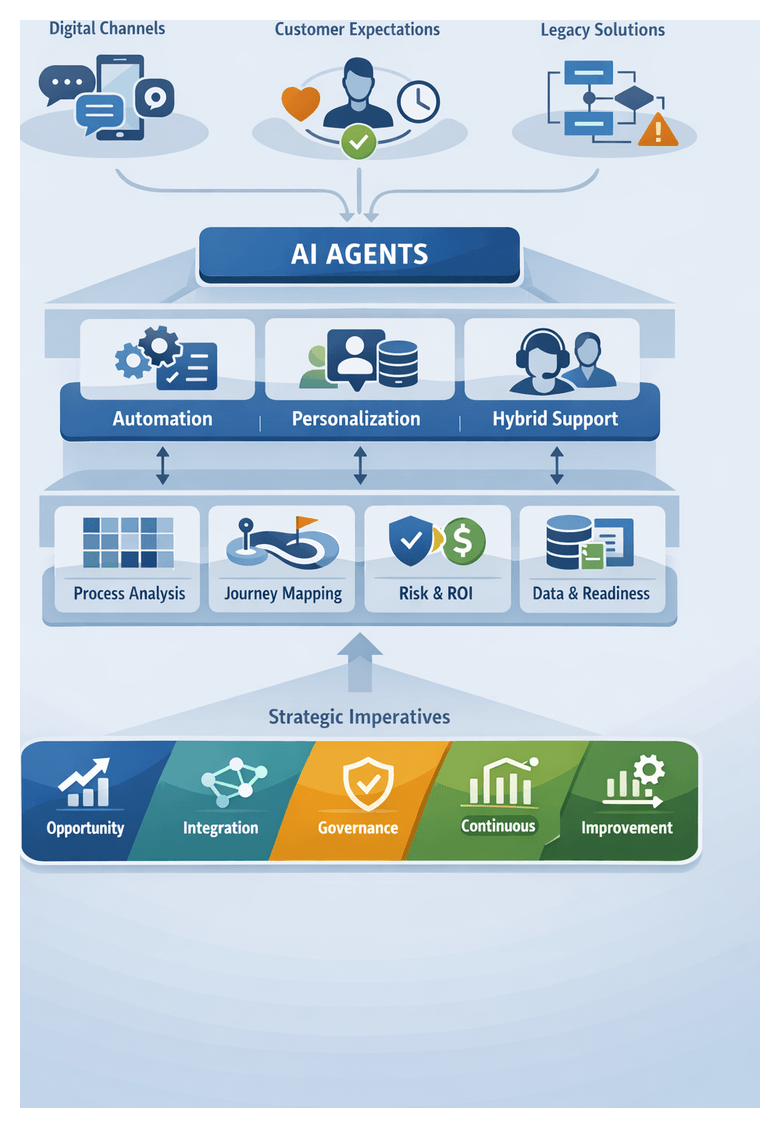
Current Landscape of Digital Customer Engagement
Over the past decade, customer engagement has undergone a profound transformation as digital channels—live chat, messaging apps, social media, self-service portals, and mobile experiences—supplement and increasingly supplant traditional voice calls and email tickets. Consumers now expect immediate acknowledgments, context-aware responses, and personalized interactions that build on purchase history, sentiment, and real-time behavior. This shift has elevated three imperatives for service organizations: accessibility across preferred channels, consistency in experience regardless of touchpoint, and personalization grounded in customer data and history.
While basic automation tools such as rule-based chatbots, static knowledge bases, and FAQ pages have alleviated agent workloads, they often falter with complex, unpredictable inquiries. Legacy solutions suffer from rigid dialogue paths, limited natural language understanding, and fragmented data integration, leading to impersonal responses and manual escalation. In response, a new generation of AI-driven agents powered by machine learning, advanced natural language understanding, and contextual analytics has emerged. These agents interpret intent, manage multi-turn conversations, and adapt to evolving contexts, proactively surfacing relevant information and escalating to human agents when necessary.
By automating routine tasks—order status checks, password resets, and account inquiries—AI agents enable organizations to scale self-service, deflect contacts, and reduce cost per interaction. They also support continuous learning: conversation transcripts, resolution outcomes, and customer feedback refine language models, expand knowledge repositories, and optimize dialogue flows. This data-driven feedback loop uncovers trends in inquiries, addresses knowledge gaps, and measures impact on key performance indicators such as resolution time, customer satisfaction, and operational costs.
Understanding this digital landscape and the capabilities of AI agents lays the groundwork for strategic planning, prioritizing high-impact automation use cases, and designing hybrid support models that balance self-service with human expertise.
Analytical Frameworks for Workflow Assessment
Rigorous analysis is essential before deploying AI agents. Structured frameworks help organizations evaluate the complexity, impact, and feasibility of automating specific workflows, prioritize investments, and align initiatives with business objectives. The most widely adopted frameworks include:
Process Complexity and Transaction Volume Matrix
This model maps tasks along two axes—decision logic complexity and interaction frequency. Four quadrants emerge:
- Routine and Frequent: Ideal for full automation by AI agents.
- Routine and Rare: Low-frequency tasks where automation may not justify investment.
- Complex and Frequent: Candidates for semi-automated workflows with human oversight.
- Complex and Rare: Specialist-driven or expert-escalated support.
Mapping processes to these quadrants clarifies where automation delivers the greatest efficiency and where human expertise remains indispensable.
Value Stream Mapping and Lean Analysis
Adapted from lean manufacturing, value stream mapping visualizes end-to-end customer journeys, revealing non-value-adding steps and bottlenecks. Cross-functional teams chart current and future states incorporating AI agents to identify redundant handoffs, quantify cycle and wait times, and model performance improvements aligned with customer satisfaction and cost reduction targets.
Task Taxonomy and Classification
Building a detailed taxonomy of service tasks—information retrieval, troubleshooting, transactions, or emotional support—allows analysts to assign attributes such as decision complexity, context requirements, and escalation probability. Weighted scoring generates an automation readiness index that ranks tasks by implementation ease, impact potential, and risk exposure.
Customer Journey Mapping and Experience Analysis
Journey mapping captures emotional states, pain points, and moments of truth across channels. Overlaying interaction data—call logs, chat transcripts, session analytics—reveals where customers experience friction, information gaps, or context loss when switching channels. Prioritizing automation solutions at these junctures enhances both operational efficiency and the quality of customer experience.
Cost-Benefit and Return on Investment Modeling
Financial models compare baseline operational costs with automation implementation and maintenance expenses, quantifying benefits such as labor savings, deflected contacts, and reduced handle times. Sensitivity analyses test assumptions around adoption rates, deflection percentages, and volume growth. Key metrics include payback period, net present value, and return on investment, guiding budget allocation and initiative prioritization.
Risk and Criticality Assessment
Risk frameworks evaluate potential downsides of automation—compliance breaches, data privacy implications, and customer dissatisfaction. Practices include regulatory mapping, failure mode analysis, and customer impact scoring to establish guardrails that ensure automation delivers net-positive outcomes without compromising service integrity or legal compliance.
Maturity and Readiness Models
Adapting maturity models such as Capability Maturity Model Integration (CMMI), organizations assess dimensions like data infrastructure, governance, talent, and change management. Readiness assessments identify capability gaps and sequence investments—strengthening data quality controls before scaling AI deployments, for example—to optimize resource use and minimize risk.
Data Availability and Quality Assessment
AI-driven automation requires historical interaction logs, knowledge base content, and performance metrics. Data audits assess volume, diversity, and content health, uncovering gaps that must be addressed through enrichment or metadata tagging to ensure reliable, contextually appropriate responses from day one.
Strategic Alignment and Business Impact Mapping
Impact mapping links automation use cases to strategic objectives—customer retention, revenue growth, or brand differentiation—by defining outcome hypotheses, tracing causal chains to key performance indicators, and establishing leading indicators and guardrails for early success detection. Embedding strategic alignment ensures that AI agents support long-term goals and inform scaling decisions.
Balancing Self-Service and Human Escalation
Automated self-service and human support must coexist in a complementary hybrid model. AI agents handle high-volume, predictable tasks, while human agents address complex, high-value, or emotionally sensitive interactions. Effective integration of these channels preserves operational efficiency, customer satisfaction, and brand trust.
Conceptual Foundations of Hybrid Support
- Customer Journey Continuity: Ensuring seamless transitions with preserved context, tone consistency, and minimal friction when escalating from chatbot to live agent.
- Operational Efficiency: Evaluating volume thresholds and handle-time differentials to determine when human intervention yields sufficient additional value.
- Customer Experience Triad: Balancing accuracy, emotional engagement, and response speed—leveraging AI for consistency and speed, and human agents for empathy and complex problem solving.
Contexts Driving Escalation
- Complex Technical Support: Multi-layered troubleshooting often demands human expertise. Customers leveraging IBM Watson Assistant report faster resolutions when complex issues are swiftly routed to specialists.
- Regulated Transactions: Financial services and healthcare require human oversight for compliance-sensitive actions such as loan approvals or prescription adjustments.
- High-Value Customer Segments: Premium and enterprise accounts benefit from tailored escalation to dedicated account managers after initial AI-driven triage.
- Emotional or Crisis Situations: Sentiment analysis by platforms like Ada can trigger real-time escalation when frustration or distress signals exceed defined thresholds.
Analytical Frameworks for Escalation Thresholds
- Complexity-Volatility Matrix: Plots inquiry complexity against customer emotional volatility to identify when AI must escalate high-volatility or high-complexity cases.
- Value-at-Risk Assessment: Evaluates potential negative outcomes—data loss, regulatory breach—to trigger human intervention on high-risk tasks.
- Customer Effort Score Monitoring: Tracks effort signals—rephrasing, inactivity, sentiment decline—and escalates when thresholds predict rising frustration or abandonment risk.
Strategic Implications
- Resource Allocation: Optimal deflection rates reduce headcount pressure, but excessive automation can inflate repeat contacts and hidden costs.
- Brand Trust: Seamless escalation reinforces reliability, measured through Net Promoter Score and Customer Satisfaction metrics.
- Scalability: AI absorbs demand spikes—product launches or outages—while escalating priority cases to human agents to maintain service levels.
- Continuous Improvement: Interaction analytics drive refinement of AI models, content, and rules, gradually shifting thresholds toward greater automation without degrading experience.
Practitioner Perspectives on Escalation Design
- Embedded Prompts: Allowing inputs such as “agent” empowers customers to control escalation, reducing perceived entrapment in automated loops.
- Contextual Triggers: Advanced systems route sensitive cases—unresolved payment disputes—to specialized teams based on conversation context, not just keywords.
- Tiered Architectures: Level-one virtual specialists handle expanded scenarios, while level-two escalations reach senior agents or subject-matter experts.
- SLA Alignment: Escalation policies tied to service-level agreements trigger human intervention within guaranteed timeframes for urgent requests.
Emerging Trends
- Augmented Agent Experiences: Platforms such as Salesforce Einstein provide real-time AI suggestions to human agents, blending automation with expert judgment.
- Proactive Escalation: Predictive analytics identify at-risk customers preemptively, initiating human outreach before issues escalate.
- Context Preservation: Omnichannel integration carries transcripts, sentiment scores, and prior resolutions into live sessions to accelerate problem resolution.
- Dynamic Thresholds: AI systems adjust escalation rules in real time based on performance metrics and seasonal demand patterns.
Strategic Imperatives for Sustainable Automation
Sustainable AI-driven automation requires an ecosystem perspective that spans technology, processes, people, and governance. Key strategic imperatives include:
Opportunity Prioritization
Automation should be sequenced from high-volume, low-variability tasks to more complex processes. Using a transaction-volume versus process-variability matrix, organizations can pilot and scale use cases to build internal expertise, mitigate risk, and maintain customer trust.
Change Management and Cultural Readiness
Transparent communication, reskilling programs, and co-creation with frontline employees foster acceptance. Demonstrating how AI agents alleviate mundane work and amplify human expertise cultivates a culture of innovation and continuous learning.
Technical Integration and Architecture
A modular, microservices-based architecture with open APIs and event-driven design ensures interoperability between AI agents, CRM systems, knowledge bases, and analytics platforms. Rigorous integration testing and performance monitoring safeguard response quality and system availability at scale.
Data Governance and Privacy
Stewardship roles, metadata management, and lineage tracking uphold data accuracy, consistency, and compliance with regulations such as GDPR and CCPA. Transparent consent mechanisms and anonymization strategies reinforce customer trust and ethical use of data.
Performance Monitoring and Continuous Improvement
Embedding analytics into every stage establishes closed-loop feedback. Dashboards track containment rates, resolution times, customer satisfaction scores, and revenue impact. Regular reviews and model retraining address data drift, refine dialogues, and align AI agent capabilities with evolving customer needs.
Scalability, Reliability, and Security
Leveraging cloud-native infrastructure with elastic compute resources and container orchestration accommodates variable loads. Fault-tolerance patterns—circuit breakers and fallback workflows—preserve continuity during disruptions. Encryption, role-based access controls, and vulnerability assessments protect data and maintain system integrity.
Ethical Compliance and Trust
Ethical frameworks guide AI behavior to prevent bias and manipulation. Transparency and explainability of automated decisions foster regulatory alignment and customer confidence, ensuring that AI agents uphold brand values and legal requirements.
Human and Experience Design
Human skills remain indispensable for complex problem solving, empathy, and relationship building. Designing intuitive, transparent AI interactions with clear fallback options and responsive error handling encourages adoption by both customers and employees. Soliciting feedback through surveys and usability testing drives iterative refinements grounded in human-centered design principles.
Limitations, Risks, and Mitigation
Recognizing limitations—ambiguous queries, domain-specific jargon, data drift, and organizational silos—enables resilient planning. Mitigation strategies include phased rollouts, robust fallback pathways, governance committees overseeing data quality and ethics, continuous training for AI literacy, and feedback loops with stakeholders to capture real-time insights.
Future Outlook
The convergence of generative AI, advanced analytics, and hyper-personalization will broaden automation into decision-intensive domains. Autonomous agents will complement human specialists in knowledge-rich contexts, while transparency and ethical conduct will shape governance. Organizations fostering adaptive learning systems, resilient architectures, and a culture of experimentation will lead the next wave of innovation in customer engagement.
Chapter 8: Data Analytics and Continuous Performance Improvement
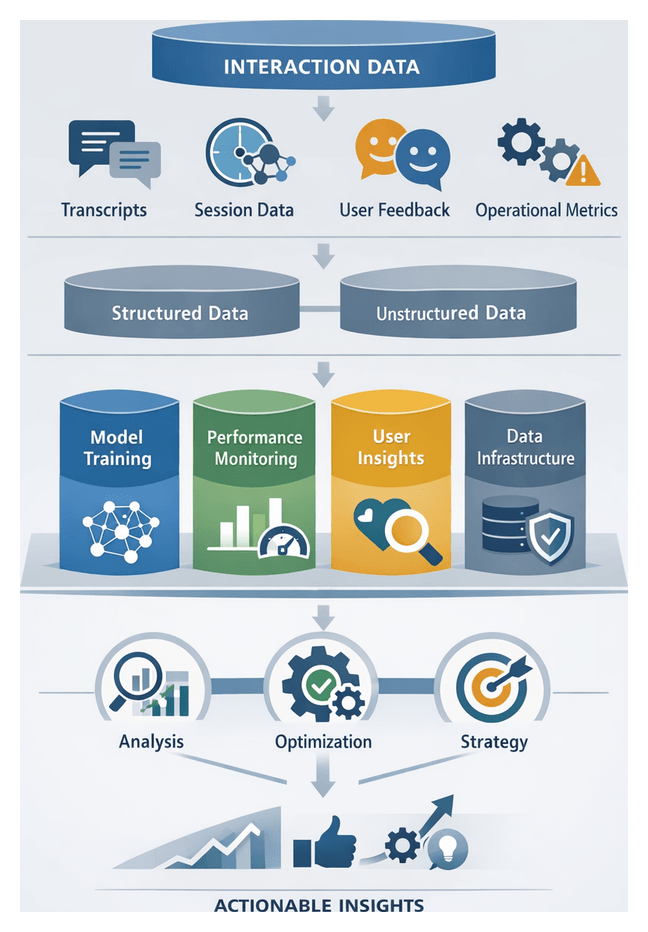
Defining Interaction Data as the Foundation for AI Agent Insights
Interaction data comprises every digital trace generated when customers engage with AI agents across channels. This includes conversation transcripts from chat, email or SMS; voice call recordings transcribed into text; system metadata such as timestamps, session identifiers and clickstream events; user feedback like satisfaction ratings, survey responses and Net Promoter Scores; and operational metrics such as average handle time, resolution rates and escalation flags.
These elements fall into structured data—numerical ratings, timestamps and categorical labels—and unstructured data—free-form text, speech and multimedia. Structured fields enable quantitative performance tracking, while unstructured records supply the linguistic context necessary for natural language understanding, intent classification and sentiment analysis.
Categories of Interaction Data and Their Roles
Organizations align each data category with distinct analytical purposes to avoid siloed insights and misaligned metrics:
- Transcribed Conversations: Core inputs for training dialogue models, evaluating intent accuracy and identifying common language patterns.
- Session Metadata: End-to-end interaction markers—timestamps, channel IDs and journey events—critical for reconstructing flows and measuring latency.
- User Feedback: Explicit satisfaction scores and free-text comments, offering direct indicators of experience quality and uncovering empathy or accuracy gaps.
- Operational Logs: Backend events, API call records and escalation triggers used for root-cause analysis, workflow effectiveness and handoff assessment.
- External Data Feeds: CRM records, knowledge bases and product databases that enrich responses with personalized context and domain accuracy.
By mapping data types to model training, performance monitoring, personalization or root-cause analysis, teams ensure each pipeline stage delivers targeted value.
Ensuring High-Quality Interaction Data
The predictive power of AI agents hinges on data quality, defined by accuracy, completeness, consistency, timeliness and bias mitigation. Accurate transcripts require speech-to-text engines tuned for domain vocabulary; missing chat messages or metadata distort analytical results; uniform schemas across channels facilitate reliable aggregation; near real-time ingestion enables rapid feedback loops; and diverse sampling safeguards against skewed model behavior.
Implement validation rules and automated cleansing routines early in the pipeline. Regular audits and review of annotation guidelines help prevent drift in intent tagging and sentiment labeling. Proactive bias detection—by monitoring performance across demographic segments—further strengthens model reliability.
Data Infrastructure and Governance
Robust infrastructure underpins scalable, secure interaction data management. Core components include:
- Ingestion and Streaming: Capture live interactions across chat, voice and social channels via platforms such as Apache Kafka or cloud-native event streams to maintain low-latency data flow.
- Unified Storage: Store structured tables and unstructured documents in a data lake or warehouse. Combine Amazon S3 with AWS Glue or use Google BigQuery to simplify integration and querying.
- Processing and Enrichment: Execute ETL/ELT workflows to normalize, tokenize and enrich raw data. Integrate NLU pipelines, entity extraction and sentiment analysis using platforms like Dialogflow, IBM Watson Assistant or Microsoft Azure Bot Service.
- Data Catalog and Lineage: Track definitions, ownership and transformation histories in a catalog to support governance and regulatory compliance with GDPR and CCPA.
- Access Controls and Security: Enforce role-based permissions and encryption in transit and at rest. Implement anonymization and redaction for sensitive fields to maintain customer trust.
Formalize stewardship roles, SLAs for data quality and policies for data usage to prevent silos and uphold compliance as data volumes grow.
From Interaction Data to Strategic Insights
Converting raw data into actionable guidance involves a multi-stage workflow:
- Data Preparation: Cleanse transcripts, unify metadata schemas and annotate sample sets for supervised training.
- Exploratory Analysis: Generate descriptive statistics and visualizations to spot common intents, peak volumes and failure hotspots.
- Model Evaluation: Apply metrics such as accuracy, precision and recall to assess NLU components and refine training corpora based on confusion matrices.
- Performance Dashboards: Build real-time interfaces tracking resolution rate, response time and user satisfaction trends.
- Root-Cause Analysis: Drill into escalations and low-rated interactions to identify knowledge base gaps, dialogue flaws or UX deficiencies.
- Insight Synthesis: Translate findings into recommendations for retraining, script redesign or infrastructure enhancements.
- Feedback Loop Integration: Automate data routing back into NLU pipelines and schedule regular performance reviews.
This disciplined, data-centric journey transforms reactive fixes into continuous performance improvement, driving more accurate, efficient and personalized customer experiences.
Performance Measurement Frameworks
Leading organizations adopt holistic frameworks to align AI agent metrics with strategic objectives. Common approaches include:
- Balanced Scorecard: Adapted to conversational AI, it categorizes metrics into customer (CSAT, NPS), financial (cost per contact), internal process (average handle time) and learning and growth (pipeline agility).
- Outcome-Driver-Input Model: Links high-level outcomes (retention rate) to drivers (first-contact resolution) and input metrics (intent accuracy, handle time).
- North Star Metric: Focuses on a single primary indicator—such as successful self-service rate—supported by a balanced set of leading and lagging metrics.
- Experience Value Chain: Maps metrics across capture, resolution and follow-up stages to pinpoint drop-off and improvement opportunities.
A balance of leading indicators—deflection rate, response latency—and lagging indicators—CSAT, NPS and cost per contact—is crucial. Complement quantitative logs with qualitative insights from text analytics, transcript reviews and post-interaction surveys to surface sentiment trends and conversational friction points.
Organizations also leverage maturity-based roadmaps, advancing from out-of-the-box dashboards in Tableau and Microsoft Power BI to custom ETL pipelines and, at the highest tiers, AI-driven platforms like Splunk and DataRobot for predictive root-cause analysis and prescriptive recommendations.
Experimental methodologies—A/B testing, uplift modeling and control cohorts—enable causal inference about dialogue changes and model versions. This hypothesis-driven approach demands robust sampling, clear control conditions and careful interpretation of confidence intervals.
Feedback Loops and Iterative Enhancement
Closed-loop learning systems keep AI agents aligned with evolving objectives. A feedback loop comprises three pillars:
- Data Capture and Quality Assurance: Reliable collection of logs, metrics and feedback, coupled with validation and annotation protocols.
- Analytical Insight: Statistical models, visualizations and domain expertise to extract actionable patterns.
- Governance and Strategic Alignment: Protocols for prioritizing enhancements, version management and aligning changes with business goals.
Interpretive frameworks such as the Balanced Scorecard, Customer Journey Analytics and Double Loop Learning guide iterative refinement. In simple transactional use cases—order tracking or password resets—feedback cycles focus on intent classification and fallback reduction. Complex domains—technical support or insurance claims—require multidisciplinary reviews, ontology updates and more extended feedback horizons.
Omnichannel consistency demands holistic frameworks correlating channel-specific metrics—response times, satisfaction and escalation rates—to ensure seamless experiences. Proactive engagement and predictive outreach use feedback on conversion outcomes and loyalty impact to fine-tune engagement algorithms and escalation logic.
Embedding feedback loops within cross-functional workflows fosters a culture of experimentation. Steering committees of customer service, data science, compliance and operations guide prioritization, ensuring iterative changes reinforce strategic objectives and maintain stability in live environments.
Challenges, Limitations and Best Practices
Enterprises face obstacles in capturing and leveraging interaction data effectively. Key considerations include:
- Cross-Channel Integration: Standardize APIs and data contracts to consolidate siloed platforms.
- Volume and Velocity: Architect scalable pipelines and partitioned storage to handle high throughput.
- Data Privacy and Compliance: Automate redaction, consent tracking and anonymization to meet GDPR and CCPA requirements.
- Annotation and Labeling: Deploy expert annotators and active learning to accelerate supervised training while ensuring quality.
- Evolution of Language: Monitor new slang, idioms and domain jargon to prevent intent drift.
- Governance Overhead: Balance formal stewardship frameworks—guided by the DAMA Data Management Body of Knowledge—with organizational resources.
- Correlation versus Causation: Complement metric correlations with controlled experiments to validate performance drivers.
- Metric Fixation: Maintain balanced scorecards to avoid optimizing one indicator at the expense of customer satisfaction or conversational quality.
- Time to Value: Set realistic timelines for data pipeline deployment, model retraining and feedback loop stabilization.
- Ethical and Trust Considerations: Uphold transparency with customers about data usage and maintain user trust through ethical frameworks.
Adhering to these best practices—dedicated data engineering teams, CI/CD for pipelines, regular audits and cross-functional governance—ensures interaction data serves as a reliable engine for continuous performance improvement rather than a source of noise. By integrating rigorous measurement frameworks, structured feedback loops and strategic oversight, organizations unlock the full potential of AI-driven service automation, delivering efficient, empathetic and personalized customer experiences.
Chapter 9: Ensuring Trust Privacy and Ethical Compliance
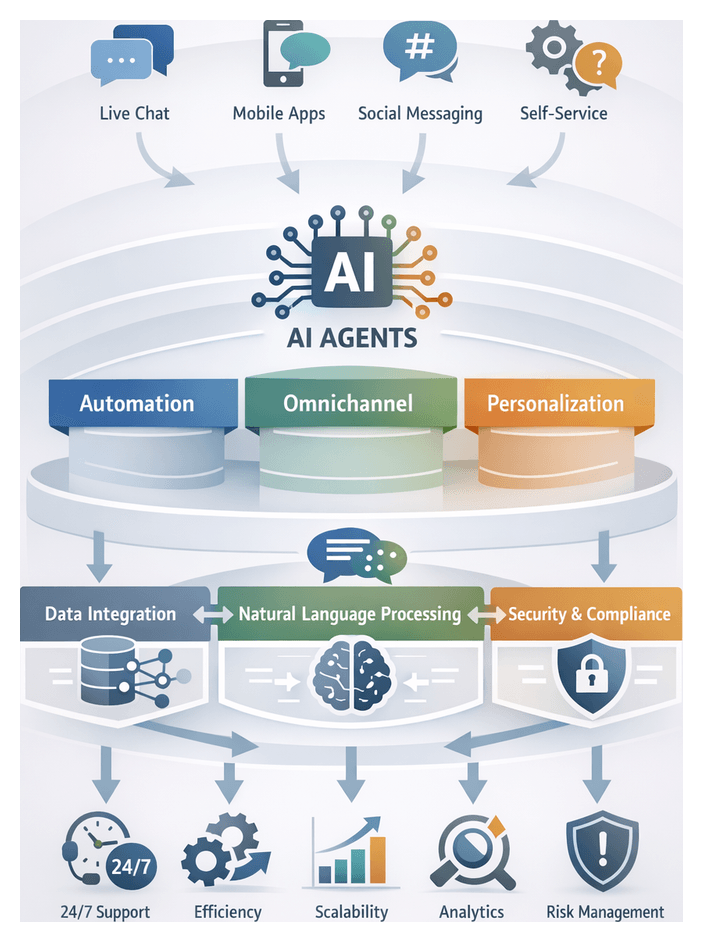
Current Digital Engagement Landscape and AI Agents
Over the past decade organizations have transformed customer engagement from telephone call centers and email to a multi-channel digital ecosystem. Live chat, social media messaging, mobile apps and self-service portals respond to consumer demand for immediate, convenient interactions. The proliferation of smartphones and messaging platforms has accelerated expectations for seamless digital experiences. Surveys reveal that a majority of consumers prefer chat or messaging apps over phone calls for routine inquiries, driven by shorter wait times and convenience. As services across banking, healthcare and retail migrate online, support volumes surge, putting legacy architectures—built on manual processes and siloed data—under pressure to deliver quality at scale without overwhelming agents.
Digital self-service via knowledge bases, interactive FAQs and guided workflows handles many routine tasks but often lacks the contextual intelligence to address complex inquiries or recognize when to escalate. Fragmented experiences and dead-end automation loops frustrate customers. In response, organizations are adopting AI-driven interfaces—AI agents—that combine natural language understanding, conversational design and backend system integration to interpret intent, retrieve relevant information and generate appropriate responses in real time.
AI agents are software entities that autonomously engage with customers, classify message intent, extract entities such as order numbers or dates, manage dialog flows and generate responses. Unlike rule-based chatbots, modern AI agents leverage transformer-based language models, reinforcement learning for adaptive dialog policies and integration frameworks to connect with CRM systems, knowledge repositories and workflows. Examples include ChatGPT, Google Dialogflow, IBM Watson Assistant and Microsoft Azure Bot Service. AI agents maintain conversation context across multiple turns, enable proactive outreach, scale elastically during peak demand and support omnichannel deployment to deliver consistent, personalized experiences at scale.
Adoption Drivers and Strategic Imperatives
Organizations are accelerating AI agent adoption in customer engagement driven by market, operational and customer-centric factors. Key drivers include:
- Rising customer expectations for 24/7 availability, rapid response and personalized service across digital channels.
- Operational efficiency pressures to automate repetitive inquiries and reallocate skilled agents to high-value tasks.
- Omnichannel consistency requirements to preserve context across chat, voice, social and mobile interactions.
- Data-driven personalization leveraging behavioral signals for targeted recommendations.
- Scalability to handle volume spikes without recruiting and training new staff.
- Compliance and risk mitigation through automated audit trails, conversation logging and explainable decisions.
- Competitive differentiation via distinctive high-quality service that enhances brand reputation and loyalty.
By automating order status checks, password resets and basic troubleshooting with AI agents, organizations report improvements in first-contact resolution, reductions in average handling time and uplift in customer satisfaction scores. Centralized intelligence unifies disparate channels, preserving context and avoiding redundant questioning. Integrated analytics support proactive engagement—anticipating needs, notifying customers of status updates and recommending relevant products—while maintaining consistent brand voice across all touchpoints.
Privacy, Security, and Compliance Foundations
As AI agents handle sensitive customer data, privacy and security become strategic assets rather than compliance checkboxes. Leading organizations align with regulations such as the General Data Protection Regulation (GDPR), the California Consumer Privacy Act (CCPA), ISO27001 and NIST frameworks to build comprehensive governance. Data governance encompasses classification by sensitivity, retention schedules, lineage tracking and secure disposal, ensuring conversational logs and profiles are retained only as long as necessary.
Privacy-enhancing technologies such as anonymization, pseudonymization and differential privacy reduce identifiability while preserving analytical utility. End-to-end encryption with Transport Layer Security for data in transit and AES-256 for data at rest protects information, while hardware security modules safeguard cryptographic keys. API gateways, OAuth 2.0 identity and access management, and real-time anomaly detection monitor for suspicious behavior.
Risk-oriented teams employ threat modeling frameworks like STRIDE and DREAD to identify attack vectors—model inversion, data poisoning and adversarial inputs—and assign likelihood and impact scores. Security risk registers integrate these findings with business impact analyses, guiding investment in controls and monitoring. Continuous monitoring solutions ingest telemetry from AI interactions, infrastructure logs and network traffic to detect anomalies. Adaptive controls enable real-time policy adjustments: automated session throttling, dynamic key rotation and context-aware authentication for high-risk requests.
Third-party and cloud providers are assessed through procurement risk evaluations of certifications such as ISO27017 for cloud security, SOC 2 Type II for data processing and PCI DSS for payment data. Teams delineate responsibilities under shared responsibility models and validate assurances with penetration tests and compliance audits. Analytical scorecards aggregate vendor performance on encryption, access controls and incident response, informing procurement decisions.
Embedding privacy-by-design and security-by-design into AI agent development ensures proactive data protection and threat mitigation. Cross-functional model architecture reviews assess feature sets for potential privacy leakage. Automated security scans in continuous integration pipelines uncover vulnerabilities before deployment. Governance committees track metrics such as encryption coverage, mean time to detect threats and average time to fulfill data subject access requests to ensure design principles translate into measurable outcomes.
Trust, Ethics, and Brand Equity in AI Engagement
Customer trust is an intangible asset that shapes perceptions of reliability, integrity and competence. AI-driven interactions risk opacity if customers cannot understand how decisions are made or personal information is processed. Organizations employ explainability features—providing clear rationales for responses and embedding audit trails—to demonstrate commitment to ethical engagement. Transparency fosters confidence in data practices, increasing willingness to share personal insights and enabling deeper personalization.
Privacy compliance varies by industry. Healthcare providers align AI agent data flows with HIPAA, financial institutions with the Gramm-Leach-Bliley Act and PSD2, and retailers with GDPR, CCPA and emerging APAC and Latin American laws. Telecommunications firms ensure location data privacy and lawful intercept compliance while supporting voice and messaging channels. In emerging markets, voluntary codes and sector guidelines inform local best practices. Analytical tools like privacy impact assessments and data protection maturity models guide context-aware governance.
Ethical standards extend beyond privacy to fairness, accountability and human dignity. Frameworks such as the IEEE Ethically Aligned Design guidelines and the European Commission’s Ethics Guidelines for Trustworthy AI define non-discrimination, respect for autonomy and prevention of harm. Organizations conduct bias audits on training data, assess differential performance across demographic segments and apply fairness metrics. Open-source libraries like IBM Watson’s AI Fairness 360 quantify and mitigate disparate impacts. Governance bodies—ethics review boards or AI councils—oversee model development through stage-gate processes to ensure alignment with ethical commitments.
Conceptual models translate ethical principles into governance mechanisms. The FAIR framework (Fairness, Accountability, Interpretability, Reliability) guides evaluation of model outputs, implementation of audit logs, deployment of explainable AI toolkits and establishment of fail-safe protocols. The Data Ethics Canvas supports cross-functional teams in mapping data provenance, stakeholder impacts and mitigation strategies, fostering shared understanding of AI agent risks and enabling informed executive decision making.
Governance, Accountability, and Future Considerations
Robust governance structures are a hallmark of mature AI programs. Cross-functional steering committees define ethical guidelines, compliance checkpoints and escalation procedures. Frameworks such as the EU AI Act and the UK’s AI Governance Principles inform model risk assessments, impact analyses and approval workflows. Organizations with formal governance report faster incident response, clearer audit trails and enhanced stakeholder confidence.
Continuous ethical assurance demands iterative review cycles and feedback loops. Automated CI/CD pipeline checks validate fairness and privacy metrics, while monitoring dashboards track performance in real time. User feedback mechanisms and complaint log analysis inform policy updates and model retraining, ensuring alignment with evolving regulations and stakeholder expectations. An AI Ethics Maturity Model helps organizations assess capabilities from ad hoc practices to optimized continuous improvement systems.
Key considerations and limitations include the complexity of a global regulatory landscape, balancing transparency with proprietary protection, interpretability-accuracy trade-offs, data bias and representation gaps, and the resource intensity of continuous auditing. Dependence on third-party components and emerging adversarial threats require supply chain risk management and red-teaming exercises. Cultural variations in trust constructs necessitate localized ethical guidelines and messaging strategies.
Future directions in privacy and security analytics include federated learning to decentralize model training without sharing raw data, homomorphic encryption for analytic computations on encrypted information, and standardized privacy engineering patterns for AI workflows. Edge AI agents on personal devices introduce new governance challenges around user control and decentralized oversight. Organizations that integrate trust, privacy and ethics into their strategic DNA—investing in talent, external validation services and industry consortiums—will achieve resilience and competitive differentiation in an AI-driven future.
Chapter 10: Future Outlook and Strategic Roadmaps for AI Agents
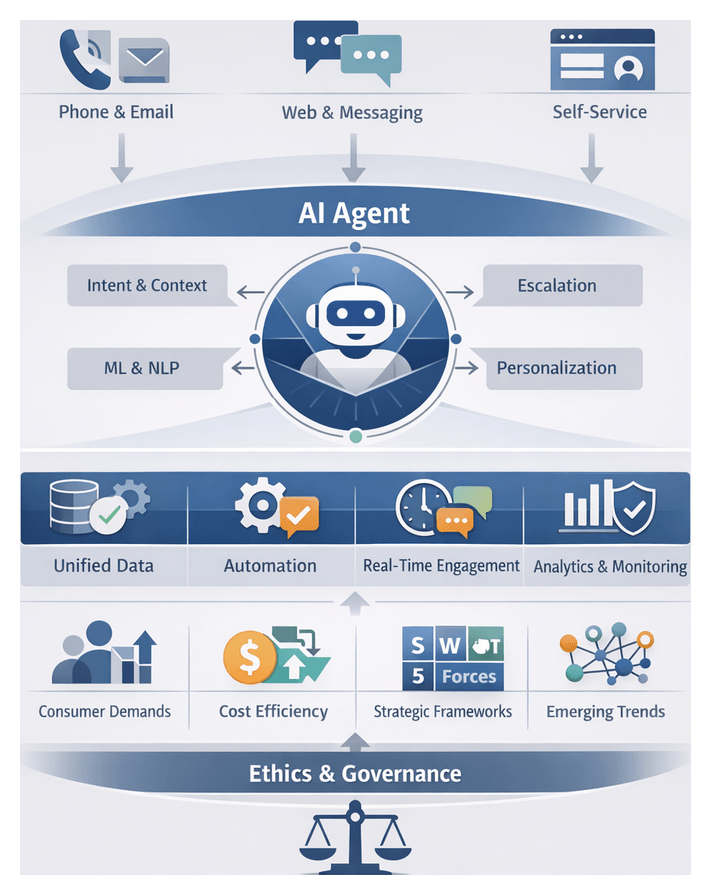
Digital Customer Engagement Landscape
Organizations today are redefining customer engagement through digital channels. While phone and email remain foundational, modern service strategies rely heavily on web chat, social messaging apps, and self-service portals to meet consumer demands for real-time, consistent support around the clock. This shift has elevated the need for unified data, dialogue, and context across disparate platforms to prevent fragmentation, knowledge silos, and inconsistent handoffs.
Legacy support systems often struggle to integrate conversational data with customer profiles or to route complex issues seamlessly between automated and human agents. As digital channels now account for the majority of first-contact interactions—messaging apps alone handle billions of inquiries monthly—organizations are investing in AI-driven solutions that offer scalable, context-aware engagement without sacrificing empathy or personalization.
AI Agents: Definition and Evolution
An AI agent is a software entity capable of interacting with users through natural language, leveraging machine learning, natural language understanding, and dialogue management to interpret intent, track context, and generate responses in real time. Core components include intent classification models, entity recognition engines, context trackers, and response generation modules powered by probabilistic or neural architectures.
Unlike rule-based chatbots that follow predefined scripts, AI agents continuously learn from interaction data, refining their intent models and improving accuracy with minimal manual intervention. They can handle routine inquiries—such as order status updates or password resets—surface personalized recommendations by integrating with customer data platforms, and escalate complex issues to live agents when needed. Advanced agents can also analyze sentiment and adjust tone dynamically.
Leading platforms exemplifying this evolution include IBM Watson Assistant, Google Dialogflow, and Amazon Lex, all of which demonstrate how AI agents are transitioning from simple rule sets to sophisticated conversational partners.
Drivers Accelerating AI Adoption
Several strategic imperatives are fueling rapid adoption of AI agents in service operations:
- Consumer Expectations: Digitally native customers demand instant, personalized support and view long wait times as unacceptable.
- Cost Pressures: Automating repetitive tasks with AI agents frees human talent to focus on high-value issues and scales support without linear headcount increases.
- Data-Driven Personalization: AI agents operationalize personalization at scale by harnessing conversational data to tailor offers, anticipate needs, and deliver proactive assistance.
- Emerging Technologies: Generative language models and advanced orchestration tools lower barriers to entry, enabling mid-market organizations to pilot AI agents within weeks.
Emerging Trends in Generative and Autonomous Agents
Advances in large-scale generative models, multimodal reasoning, and self-learning architectures are reshaping the capabilities of AI agents. Organizations are moving beyond reactive chatbots to proactive, context-aware assistants that anticipate user needs, initiate interactions based on predictive signals, and orchestrate workflows across back-end systems.
Key developments include:
- Fine-Tuning and Retrieval-Augmented Generation: Techniques that enhance coherence, relevance, and domain adaptation for specialized service scenarios.
- Multimodal Agents: Systems capable of interpreting and responding through text, voice, image, and video. Vision-enabled agents, for example, diagnose product defects or guide equipment maintenance via real-time video analysis.
- Agent Ecosystems: Collaborative networks of specialized agents—such as conversational, pricing optimization, and risk assessment agents—that jointly manage complex customer journeys through standardized protocols and orchestrators.
As generative pre-trained transformers improve and self-supervision methods mature, AI agents are poised to evolve into adaptable collaborators that extend far beyond basic question-and-answer exchanges.
Strategic Analytical Frameworks for AI Initiatives
Deploying AI agents at scale requires rigorous analytical frameworks to align technology capabilities with business objectives, manage risk, and prioritize investments.
SWOT Analysis
Evaluating the internal strengths and weaknesses alongside external opportunities and threats provides a structured view of AI agent initiatives. Strengths include 24/7 availability and personalization at scale; weaknesses may arise from data governance gaps and model interpretability challenges. Opportunities stem from rising expectations for contextual support and the democratization of development tools, while threats include evolving privacy regulations and competitive disruption by open-source solutions.
Porter’s Five Forces
This framework assesses competitive dynamics in the AI agent ecosystem:
- Threat of New Entrants: Balancing high development costs for advanced models against open-source lowering barriers.
- Bargaining Power of Suppliers: Dependence on hyperscale cloud providers and their pricing, compliance, and feature roadmaps.
- Bargaining Power of Buyers: Flexibility to switch between platforms such as Microsoft Azure Cognitive Services and private cloud deployments.
- Threat of Substitutes: Alternatives like peer community forums or concierge human support for sensitive or complex issues.
- Rivalry Among Competitors: Differentiation through vertical expertise, proprietary data enrichment, and unique model architectures.
Technology Adoption Lifecycle and Gartner Hype Cycle
Combining these models helps identify the maturation stage of AI agent technologies and time investments appropriately. Early innovators focus on narrow pilots, early majority on scaled deployments, and late majority on turnkey solutions. Anticipating the peak of inflated expectations and subsequent trough of disillusionment enables planners to allocate resources for support and incremental improvements as technologies reach productivity.
Balanced Scorecard and Capability Maturity Models
Adapting the Balanced Scorecard frames performance across financial, customer, internal process, and learning dimensions, tracking metrics such as cost per interaction, CSAT, automation ratio, and model retraining cadence. Customized Capability Maturity Models chart progress from isolated pilots (Level 1) to optimizing, self-learning agents (Level 5), guiding investments in CI/CD pipelines and governance protocols.
McKinsey 7S and Dynamic Capabilities
Cross-functional alignment through the McKinsey 7S Framework ensures strategy, structure, systems, shared values, style, staff, and skills cohere around AI agent initiatives. A dynamic capabilities view emphasizes sensing market shifts, seizing opportunities through prioritized projects, and transforming processes and talent models to maintain resilience and adaptability.
Financial Appraisal and Vendor Evaluation
Robust ROI models quantify labor cost reductions and revenue uplifts from personalized offers, while Total Cost of Ownership analyses account for licensing fees—such as Amazon Lex or Microsoft Azure Cognitive Services—cloud compute costs, and governance expenses. Vendor matrices compare NLU accuracy, integration connectors, security certifications, innovation roadmaps, and cost structures. Proof-of-concepts and reference checks validate real-world performance against vendor claims.
Risk Assessment and Governance
Effective planning incorporates risk categories—model drift, operational outages, ethical and regulatory compliance—and defines governance bodies, steering committees, and audit processes. This oversight balances innovation with accountability, ensuring model fairness, security, and transparency.
Design Thinking and Real Options
Human-centered design methodologies, such as ideation sprints and rapid prototyping with representative user groups, align AI agent capabilities with genuine customer needs. Real options analysis treats technology investments as stageable options, enabling organizations to defer decisions, stage expenditures, and optimize risk-adjusted returns in fast-evolving AI landscapes.
Aligning AI Agents for Long-Term Business Impact
AI agent initiatives must be integrated into corporate vision, strategic planning cycles, and capital allocation to deliver sustained value. Roadmaps aligned with mission statements and KPIs—such as net promoter score, customer lifetime value, and digital revenue share—ensure that conversational AI serves defined business imperatives rather than operating as siloed projects.
Embedding AI agents into organizational capabilities involves establishing centers of excellence, digital innovation labs, or governance councils to oversee data stewardship, AI ethics, and change management. Capability maturity assessments guide the evolution from proof-of-concepts to fully integrated systems that anticipate needs and deliver predictive insights.
Robust governance frameworks define policies, risk and compliance mappings, audit mechanisms, and steering committees. By weaving governance into every stage of development and deployment, organizations reduce regulatory and reputational risks and reinforce accountability.
Measuring strategic impact requires frameworks that capture qualitative and quantitative dimensions, including sentiment shifts, revenue uplift, operational efficiency, innovation velocity, and risk mitigation. Board-level dashboards translate these metrics into actionable insights that guide investment decisions and capability enhancements.
Fostering a culture of continuous adaptation is critical. Leadership advocacy, cross-functional collaboration, skill development, feedback loops, and recognition programs transform AI agents into evolving capabilities aligned with market shifts and regulatory changes.
Strategic partnerships with technology vendors, research institutions, and industry consortia accelerate access to cutting-edge models, domain-specific data sets, and best practices. Co-innovation and participation in regulatory alliances shape standards for data sharing, transparency, and ethical AI use.
Scenario planning and future-proofing involve envisioning alternative regulatory, technological, and customer behavior landscapes to stress-test assumptions and prioritize resilient investments. Integrating AI agents into the enterprise architecture—through microservice blueprints, API-driven integrations, and scalable data platforms—ensures that systems can adapt as volumes and channels evolve.
Finally, embracing ethical and social responsibility imperatives—guided by frameworks such as the OECD AI Principles and IEEE Ethically Aligned Design—ensures that AI agents contribute positively to society, mitigate workforce displacement risks, and uphold human dignity.
Scalable and Sustainable Deployment
Scaling AI agent initiatives from pilots to enterprise-wide deployments entails architectural, operational, and organizational considerations:
- Modular Microservice Architecture: Decoupled components for NLU, dialogue management, analytics, and integrations can be scaled and updated independently, supported by container orchestration for continuous delivery.
- MLOps Pipelines: Automated workflows for data ingestion, feature engineering, model training, validation, and deployment ensure rapid adaptation to evolving user behaviors and product lines, with monitoring frameworks to detect performance drift and compliance deviations.
- Unified Data Fabric: Consolidating structured and unstructured sources across CRM, transaction systems, and external feeds provides a golden customer record, enabling contextual intelligence and consistent insights while governance controls safeguard data lineage and quality.
- Pragmatic Budgeting: Balancing one-time implementation costs with recurring expenses for retraining, licensing, and support, while reserving funds for experimentation and preventing cost overruns through disciplined vendor management.
- Change Management: Transparent communication of AI agent capabilities and limitations, training programs for internal teams, and frontline involvement in feedback loops drive cohesive hybrid service models and accelerate user adoption.
Key Considerations and Limitations
- Data Privacy and Compliance: Navigating jurisdictional regulations for data residency, consent frameworks, and consumer rights.
- Bias and Fairness: Continuous monitoring and diverse training data are necessary to mitigate unintended algorithmic biases.
- Interpretability and Trust: Balancing complex models with the need for transparency through integrated explainability tools.
- Integration Complexity: Careful planning for middleware, APIs, and data synchronization to bridge legacy systems and fragmented architectures.
- Talent and Skill Gaps: Investing in upskilling programs and academic partnerships to recruit and retain multidisciplinary expertise.
- Cost and ROI Uncertainty: Modeling assumptions about adoption rates, efficiency gains, and customer behavior to ground investment forecasts.
- Ethical and Reputational Risk: Establishing ethical frameworks and incident response plans to prevent misaligned behaviors or privacy breaches.
- Scalability Constraints: Ensuring sufficient architectural design and resource allocation to support model retraining and inference at scale.
- Change Management Resistance: Mitigating internal and customer resistance through clear benefit communication and success stories.
- Regulatory Evolution: Maintaining agility to adapt AI agent strategies to emerging compliance and liability frameworks.
- Environmental Impact: Considering carbon footprint of large-scale model training and inference, and exploring green data center options.
- Intellectual Property: Addressing legal considerations around content ownership, licensing, and infringement risks.
- Cross-Cultural Nuances: Customizing models to account for language subtleties, cultural contexts, and regional sensitivities.
- Operational Resilience: Implementing redundancy and disaster recovery protocols to mitigate single points of failure in cloud services and APIs.
- Cognitive Safety: Establishing ethical guard rails and adversarial testing to prevent harmful or unsafe agent behaviors.
By synthesizing these strategic, technological, and operational insights, organizations can chart a pragmatic path to leverage AI agents as a sustainable, accountable, and transformative element of digital customer engagement.
Conclusion
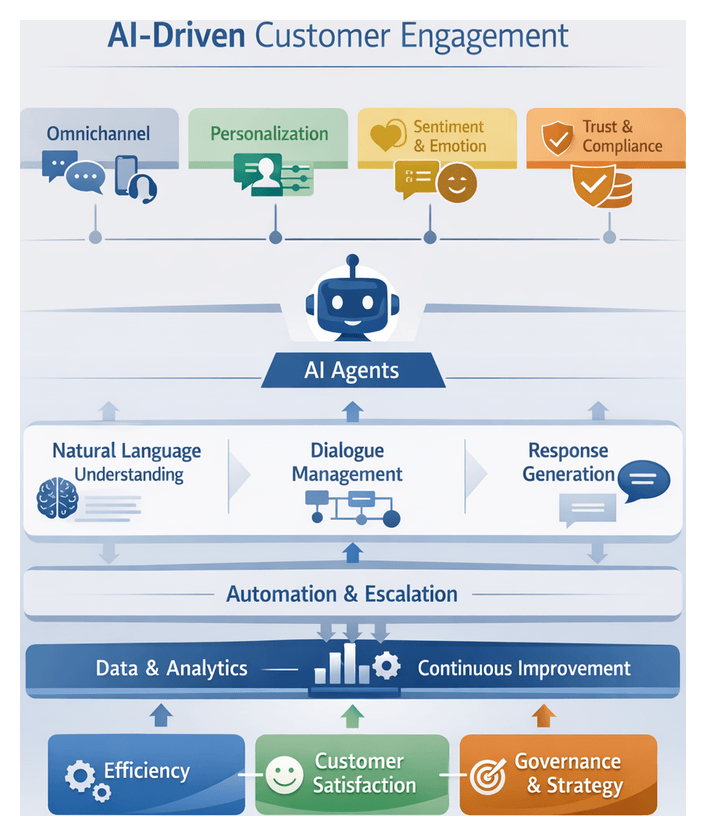
Synthesis of Core Customer Engagement Concepts
The evolution of customer engagement has accelerated from legacy voice and email channels to a multifaceted digital ecosystem of chat, messaging apps, social media, and voice assistants. Today’s consumers demand immediacy, personalization, and seamless continuity across touchpoints. Artificial intelligence agents lie at the heart of this transformation, serving as intelligent intermediaries that combine natural language understanding, machine learning, and contextual memory to conduct coherent, human-like dialogues. Unlike rule-based chatbots, these agents continuously manage routine inquiries, guide transactions, and escalate complex issues to human specialists when required, reframing service workflows to reduce friction and deliver scalable value.
A robust conversational architecture underpins these AI-driven experiences. Natural language understanding modules interpret user intent, dialogue managers maintain context across interactions, and response generators craft accurate replies. Platforms such as Google Dialogflow and IBM Watson Assistant exemplify this layered approach, enabling agents to ask clarifying questions, handle interruptions, and preserve a consistent brand voice. When integrated with recommendation engines or personalization frameworks—found in solutions like Amazon Lex and Azure Bot Service—agents leverage demographic data, transaction histories, browsing behavior, and real-time signals to tailor responses dynamically and anticipate customer needs.
Emotional insight and sentiment analysis further humanize the customer experience. By interpreting linguistic cues and tone variations, AI agents detect emotional states and adjust dialogue flows to defuse frustration or reinforce positive sentiment. Integrating sentiment scores into decision logic enables proactive escalations and fosters trust through empathetic engagement.
An omnichannel strategy ensures that these intelligent interactions remain seamless across web chat, mobile apps, social media, and voice interfaces. Unified data models, shared context stores, and standardized APIs prevent redundant inquiries and preserve conversational continuity, reinforcing brand coherence and elevating customer satisfaction.
Automation and workflow optimization unlock operational efficiency at scale. AI agents handle high volumes of routine tasks—such as password resets or order modifications—freeing human specialists to address complex or high-value cases. By mapping end-to-end customer journeys, organizations identify repetitive patterns and deploy automation where it yields maximum impact, balancing self-service with human escalation to minimize customer effort and optimize resource allocation.
Data analytics and continuous performance improvement close the loop on agent effectiveness. Conversation logs, resolution metrics, and user feedback feed into analytics pipelines that reveal dialog inefficiencies and emerging needs. Organizations embed closed-loop feedback processes to iterate language models, expand ontologies, and refine dialogue scripts, cultivating a culture of data-driven refinement that sustains high accuracy and relevance.
Trust, privacy, and ethical compliance form the foundation of responsible AI deployment. Transparent disclosures about data usage, options for human escalation, and explainable decision-making reinforce customer confidence. Adherence to regulations such as GDPR or CCPA, together with encryption best practices and bias-monitoring frameworks, ensures AI agents operate within ethical boundaries and protect organizational reputation.
Strategic alignment and governance ensure that AI agent initiatives support broader business objectives. Cross-functional steering committees unite business stakeholders, technical teams, legal advisors, and customer experience professionals around shared KPIs—such as customer satisfaction, lifetime value, and operational efficiency. This governance layer prioritizes high-value use cases, defines clear roles, and phases deployments to align with regulatory requirements and market trends.
Patterns and Strategic Insights
Industry benchmarks reveal several recurring patterns that accelerate AI agent adoption and drive measurable value:
- Governance-driven time-to-value: Establishing clear data quality and model performance thresholds through governance frameworks aligns stakeholders and accelerates deployment.
- Continuous learning cycles: Feeding conversational logs into retraining pipelines yields sustained improvements in intent recognition and resolution rates compared to one-off upgrades.
- Phased rollouts: Starting with high-volume, low-complexity interactions validates assumptions about user behavior and technology performance, mitigates risk, and builds internal advocacy.
- Centers of excellence: Cross-functional hubs that bridge technology, design, compliance, and operations foster a shared language for interpreting performance dashboards and calibrating empathy models.
- Qualitative health checks: Tracking friction density and sentiment drift alongside quantitative metrics such as first-contact resolution and average handling time uncovers latent deficiencies in dialogue scripts or channel choreography.
By weaving these patterns into a unified strategy, organizations achieve a multiplicative effect on satisfaction metrics and cost efficiencies, rather than reproducing legacy silos under a new technical façade.
Industry Implications and Future Directions
AI agents are shifting service models from reactive support to continuous, anticipatory experiences that extend across functions. In insurance, conversational interfaces initiate risk assessments during policy renewals. In healthcare, agents guide patients through pre-surgical preparations. In manufacturing, they enable real-time supply-chain visibility. These expanded roles underscore AI agents’ evolution from chat widgets into embedded decision-support partners.
The convergence of conversational AI with generative models—such as ChatGPT—and robotic process automation platforms transforms agents into autonomous orchestrators capable of dynamic content creation, automated summarization, and end-to-end task execution. Strategic partnerships among cloud providers, AI platform vendors, and industry integrators deliver turnkey packages of pre-trained models, domain ontologies, and compliance toolkits, democratizing access to advanced engagement capabilities.
Regulatory and ethical considerations are gaining prominence as agents handle sensitive data and assume greater autonomy. Organizations in banking, healthcare, and energy embed transparent audit trails, bias-detection protocols, and informed consent mechanisms into agent designs. Proactive engagement with regulators and industry consortia shapes policy environments that balance innovation with public trust.
The workforce is also transforming. As routine inquiries shift to automated systems, human roles evolve toward complex problem-solving, relationship management, and strategic oversight of AI performance. Reskilling initiatives in data literacy, model interpretation, and conversational design prepare employees for collaborative mindsets where AI agents serve as teammates.
Looking forward, several macro-trends will shape agent capabilities:
- Edge computing and 5G connectivity will enable ultra-low latency interactions and multimodal experiences—such as real-time video assistance and augmented reality overlays.
- Ethical AI frameworks will mature toward proactive value alignment, standardizing fairness-aware training, causal analysis, and stakeholder-driven policy definitions.
- Advances in emotional intelligence—combining sentiment analysis, psycholinguistic profiling, and physiological sensing—will deepen agents’ capacity to navigate complex social contexts in high-stakes environments.
- The democratization of AI development tools will lower barriers for small and medium enterprises through pre-trained industry models, low-code integration frameworks, and turnkey conversational templates.
- Mature measurement frameworks will extend beyond service metrics to track proactivity, lifetime value uplift, and customer effort scores, linking agent interactions to revenue growth and churn reduction.
Successful AI agent programs require a balanced perspective on potential constraints:
- Data Governance and Privacy — Policies for classification, consent management, anonymization, and encryption must align with GDPR, CCPA, and emerging AI regulations.
- Bias and Fairness — Rigorous bias detection frameworks, diverse audit datasets, and fairness metrics are essential to prevent discriminatory interactions.
- Omnichannel Complexity — Unified data models, shared context stores, and standardized APIs are needed to overcome legacy system silos and preserve conversational continuity.
- Technical Maturity and Scalability — Capacity planning, performance testing, and an understanding of NLU maturity curves ensure reliable service under high concurrency.
- User Acceptance and Trust — Clear disclosure of AI involvement and seamless human escalation paths build confidence among customers with varying comfort levels.
- Operational Alignment — Cross-functional governance involving legal, compliance, IT, and marketing stakeholders aligns objectives and mitigates adoption risks.
- Ethical and Social Implications — Oversight bodies or ethics committees help avoid exploitative persuasive design and protect user autonomy.
- Cost-Benefit and ROI Measurement — Establishing baseline metrics and attributing outcomes accurately is critical to quantifying value and justifying ongoing investments.
- Regulatory and Compliance Risks — Staying abreast of frameworks such as the EU AI Act ensures compliant deployment and avoids penalties.
- Model Drift — Continuous monitoring of intent accuracy, sentiment detection, and user satisfaction with automated alerting and retraining pipelines prevents performance degradation.
Final Perspective for Continuous Innovation
AI agents are not static solutions but evolving platforms driven by real-world usage signals. Establishing multidisciplinary innovation councils armed with analytics dashboards and customer feedback loops enables rapid hypothesis testing and targeted experimentation. Over time, a portfolio of micro-innovations—from personalized proactive notifications to intelligent virtual brand ambassadors—collectively elevates the customer engagement ecosystem.
The fusion of generative AI with specialized knowledge graphs will unlock richer, more authentic interactions capable of creative content generation, nuanced negotiation, and empathetic narrative construction. To harness these advances responsibly, organizations must reinforce ethical guardrails, refine bias-mitigation protocols, and align agent behaviors with evolving social norms and regulatory standards.
In this dynamic landscape, sustained success hinges on a three-pronged approach: rigorous governance, relentless iteration, and a culture that prizes both analytical rigor and customer-centric experimentation. By investing in integrated architectures, fostering cross-functional collaboration, and embedding continuous learning practices, industry leaders ensure that AI agents deliver not only operational efficiencies but also enduring customer trust and loyalty.
Appendix
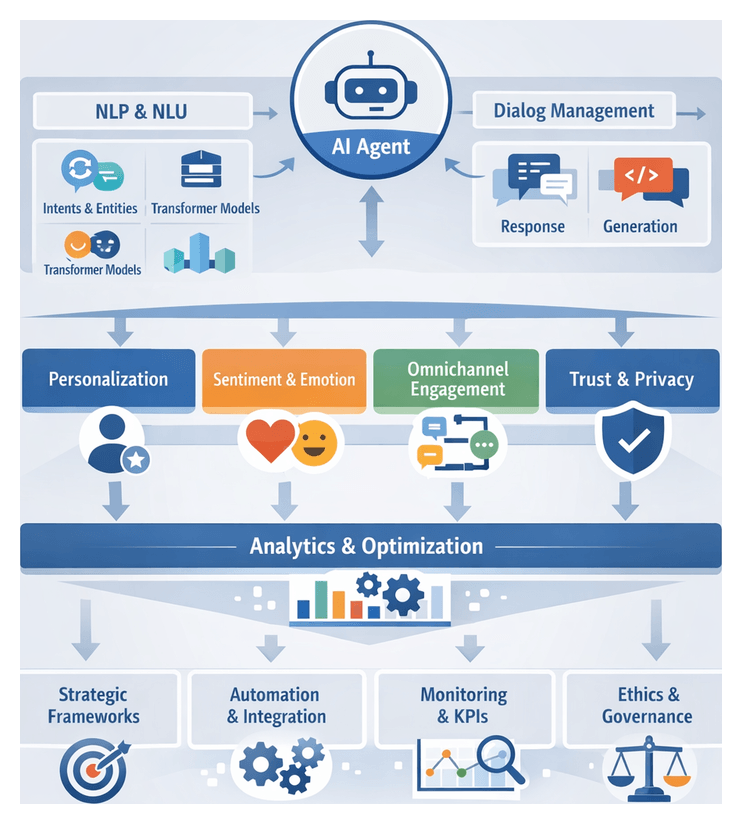
Core AI Agent Concepts
An AI agent is a software entity that engages users through natural language, interprets intent, manages dialogue context and executes tasks autonomously or with human collaboration. Conversational AI combines natural language understanding, dialog management and response generation to support context-aware, multi-turn interactions across text and voice channels. Core components include:
- Natural Language Understanding (NLU): Parses and derives structured meaning from unstructured text or speech. Modules classify intents, extract entities and detect sentiment.
- Dialog Management: Controls conversation flow, maintains context across turns and determines whether to answer, clarify or escalate.
- Response Generation: Crafts replies via templates or generative models such as ChatGPT, producing dynamic, context-rich outputs.
- Transformer Models: Deep learning architectures using attention mechanisms to process sequences, underpinning modern NLU and generative systems.
- Intents and Entities: Intents represent user goals; entities are data points—dates, names, identifiers—extracted for task parameters.
- Context: Accumulated user profile, conversation history and external signals that inform personalized decision making.
Natural Language Understanding and Conversational Design
NLU techniques balance precision, adaptability and interpretability:
- Rule-Based NLU: Handcrafted grammars and pattern matching offer control but struggle with language variability.
- Statistical NLU: Machine learning classifiers (SVMs, CRFs) learn from annotated data; require feature engineering and labeled corpora.
- Neural NLU: Deep models (LSTM, GRU, transformers) automatically learn language features, delivering state-of-the-art accuracy at scale.
- Hybrid NLU: Combines rules for high-precision intents with neural models for open-ended queries.
Effective conversational design adheres to principles that enhance usability and brand alignment:
- Conversation Flow: Maps happy paths, fallback routes and escalation points to minimize friction.
- Turn-Taking: Ensures smooth alternation between user inputs and agent responses to reduce cognitive load.
- Persona and Tone: Defines agent character and voice in line with brand values for consistent style and emotional expressiveness.
- Error Handling and Recovery: Uses clarifications, reprompts and seamless human handoffs when confidence thresholds are low.
Personalization and Contextual Intelligence
AI agents leverage dynamic user profiles and real-time behavioral signals to deliver tailored experiences:
- User Profile: Aggregates demographics, purchase history and prior interactions for personalization.
- Behavioral Signals: Clickstream events, search queries and session data inform context.
- Next-Best-Action (NBA): Recommends content or offers using collaborative filtering, content-based methods and reinforcement learning, often via services such as Amazon Personalize or Microsoft Azure Personalizer.
Sentiment Analysis and Emotional Intelligence
Detecting tone and emotions enables empathetic interactions:
- Sentiment Analysis: Classifies inputs as positive, negative or neutral with services like Amazon Comprehend and Google Cloud Natural Language API.
- Emotion Detection: Identifies states such as joy or frustration, using hybrid lexicon and deep learning models.
- Multimodal Sentiment: Integrates text, voice and visual cues for richer emotional profiling, supported by engines such as Lexalytics Salience and IBM Watson Tone Analyzer.
Omnichannel Engagement and Integration
Delivering seamless experiences across web chat, mobile, social messaging, email and voice requires unified context and flexible architecture:
- Omnichannel Strategy: Ensures consistent context and brand voice via a unified data repository decoupled from channel specifics.
- Integration Layer: Connects agents to CRM, order management and knowledge bases through middleware or iPaaS platforms such as MuleSoft Anypoint Platform.
- Event-Driven Frameworks: Use Amazon EventBridge or message buses like Apache Kafka to orchestrate real-time data flows.
- Contact Center Integration: Unifies channels via programmable platforms like Twilio Flex.
Automation, Analytics and Continuous Improvement
Optimizing workflows and measuring performance underpin automation ROI:
- Self-Service Deflection: The share of inquiries resolved without human intervention.
- Human Escalation: Seamless transfer to live agents when complexity or low confidence demands.
- Business Process Orchestration: Automates end-to-end workflows like order processing through coordinated service calls.
- Interaction Logs and KPIs: Track metrics such as average handle time, first-contact resolution, containment rate, CSAT and NPS for performance analysis.
- Feedback Loop: Captures logs, user feedback and sentiment data to retrain NLU models and refine dialogs.
- Analytics Platforms: Visualize and explore data with tools such as Tableau, Microsoft Power BI and Splunk, while managing ML lifecycles with MLflow.
Trust, Privacy and Ethical Compliance
Responsible AI deployment requires transparency, governance and robust safeguards:
- Transparency and Explainability: Use Explainable AI techniques (attention maps, feature importance) and provide rationale for recommendations.
- Data Governance: Enforce policies for quality, lineage and security in line with GDPR, CCPA and ISO 27001.
- Privacy-By-Design: Implement consent management, data minimization, anonymization and retention controls.
- Bias and Fairness: Conduct audits with open-source toolkits like IBM AI Fairness 360 and Microsoft Fairlearn, apply reweighting or adversarial debiasing.
- Security Controls: Protect data with encryption, role-based access and anomaly detection; use federated learning and differential privacy to enhance protection.
- Ethics Governance: Adopt frameworks such as the NIST AI Risk Management Framework and IEEE Ethically Aligned Design, and maintain audit trails via a Data Ethics Canvas.
Conceptual Frameworks for Strategy and Planning
A suite of analytical models guides evaluation, design and scaling of AI agent initiatives:
- SWOT Analysis: Assesses strengths, weaknesses, opportunities and threats to align initiatives with market realities.
- Porter’s Five Forces: Evaluates competitive dynamics across rivalry, supplier and buyer power, threat of entrants and substitutes.
- Balanced Scorecard: Tracks financial, customer, internal process and learning metrics to ensure balanced performance.
- Technology Adoption Lifecycle & Gartner Hype Cycle: Informs timing of investments and expectation management.
- Process Complexity vs Transaction Volume Matrix: Prioritizes use cases by mapping task complexity against frequency.
- Value Stream Mapping & Lean Analysis: Exposes waste and bottlenecks in end-to-end journeys.
- Capability Maturity Model for Conversational AI: Guides progression from ad hoc pilots to optimizing, self-learning deployments.
- Customer Journey Mapping & Experience Value Chain: Pinpoints high-impact touchpoints and links stages to value metrics.
- SERVQUAL & Kano Model: Frames quality dimensions and categorizes features as basic needs, performance drivers or delighters.
- Data Governance & Privacy Frameworks: Embeds compliance from design through operation.
- Risk Management & Ethics Governance: Applies threat modeling (STRIDE), impact scoring (DREAD) and ethical review protocols.
- Feedback Loops & Continuous Improvement: Leverages A/B testing, cohort studies and sentiment analysis for iterative enhancement.
- Analytics & Performance Measurement: Combines leading indicators (deflection rate, response latency) with lagging outcomes (CSAT, NPS) for comprehensive oversight.
Operationalizing AI Agents
Effective deployment spans scoping, integration, measurement and ongoing governance:
- Scope and Role Definition: Position AI agents beyond scripted chatbots by leveraging machine learning and contextual reasoning for autonomous task execution and seamless human escalation.
- Integration and Architecture: Adopt microservices with RESTful APIs, secure data pipelines (OAuth 2.0, JWT) and customer data platforms for unified profiles. Leverage event buses like Amazon EventBridge and middleware such as MuleSoft to connect CRM, order management and billing systems.
- Privacy and Data Protection: Enforce consent mechanisms, role-based access, encryption and tokenization. In regulated sectors, incorporate human-in-the-loop oversight.
- Measuring Success: Monitor operational efficiency (deflection rate, handle time), experience (CSAT, CES, sentiment) and business impact (NPS uplift, revenue lift). Correlate metrics with financial models to forecast ROI and payback periods.
- Implementation Timelines: Plan a rapid six- to eight-week pilot for narrow use cases, a three- to four-month expansion phase and enterprise-wide adoption over nine to twelve months. Key enablers include data readiness, integration points and change-management readiness.
- Model Drift and Continuous Learning: Track fallback rates, classification accuracy and sentiment shifts. Use automated retraining pipelines and human reviews to address drift, validating updates via A/B tests.
- Balancing Automation and Human Touch: Apply the Complexity-Volume Matrix and sentiment thresholds to calibrate escalation. Use NLU confidence scores to trigger clarifications or handoffs.
- Bias Mitigation and Ethical Oversight: Enforce diverse data sampling, fairness audits with IBM AI Fairness 360 and Microsoft Fairlearn, and embed bias testing in pre-production gates.
- Transparency and Trust: Disclose AI use, offer opt-out or human agent options, and surface decision rationale through explainable AI techniques.
- Personalization with Privacy: Use anonymized behavioral signals and edge computation or federated learning to protect raw data while delivering tailored responses.
- Omnichannel Consistency: Maintain a unified context store, channel-aware dialog abstractions and centralized analytics dashboards to monitor cross-channel performance.
- Cost Management: Balance licensing, cloud compute, integration and governance expenses. Leverage open-source frameworks judiciously and adopt pay-as-you-go pricing models with vigilant monitoring.
- Future-Proofing and Scalability: Build an API-first, modular architecture with container orchestration and MLOps pipelines. Engage with research consortia to anticipate advances in multimodal AI and privacy regulations.
AI-driven Tools and Resources
- ChatGPT
- Google Dialogflow
- IBM Watson Assistant
- Microsoft Azure Bot Services
- Amazon Lex
- Rasa
- Hugging Face Transformers
- Amazon Personalize
- Microsoft Azure Personalizer
- Amazon Comprehend
- Google Cloud Natural Language API
- Lexalytics Salience
- IBM Watson Tone Analyzer
- Google Recommendations AI
- Tableau
- Microsoft Power BI
- MLflow
- Amazon EventBridge
- Twilio Flex
- MuleSoft Anypoint Platform
- Salesforce Einstein
- DataRobot
- Splunk
The AugVation family of websites helps entrepreneurs, professionals, and teams apply AI in practical, real-world ways—through curated tools, proven workflows, and implementation-focused education. Explore the ecosystem below to find the right platform for your goals.
Ecosystem Directory
AugVation — The central hub for AI-enhanced digital products, guides, templates, and implementation toolkits.
Resource Link AI — A curated directory of AI tools, solution workflows, reviews, and practical learning resources.
Agent Link AI — AI agents and intelligent automation: orchestrated workflows, agent frameworks, and operational efficiency systems.
Business Link AI — AI for business strategy and operations: frameworks, use cases, and adoption guidance for leaders.
Content Link AI — AI-powered content creation and SEO: writing, publishing, multimedia, and scalable distribution workflows.
Design Link AI — AI for design and branding: creative tools, visual workflows, UX/UI acceleration, and design automation.
Developer Link AI — AI for builders: dev tools, APIs, frameworks, deployment strategies, and integration best practices.
Marketing Link AI — AI-driven marketing: automation, personalization, analytics, ad optimization, and performance growth.
Productivity Link AI — AI productivity systems: task efficiency, collaboration, knowledge workflows, and smarter daily execution.
Sales Link AI — AI for sales: lead generation, sales intelligence, conversation insights, CRM enhancement, and revenue optimization.
Want the fastest path? Start at AugVation to access the latest resources, then explore the rest of the ecosystem from there.