

AI Driven Automation in Compliance and Risk Management An Industry Insights Guide
To download this as a free PDF eBook and explore many others, please visit the AugVation webstore:
Introduction
Current Compliance and Risk Management Challenges
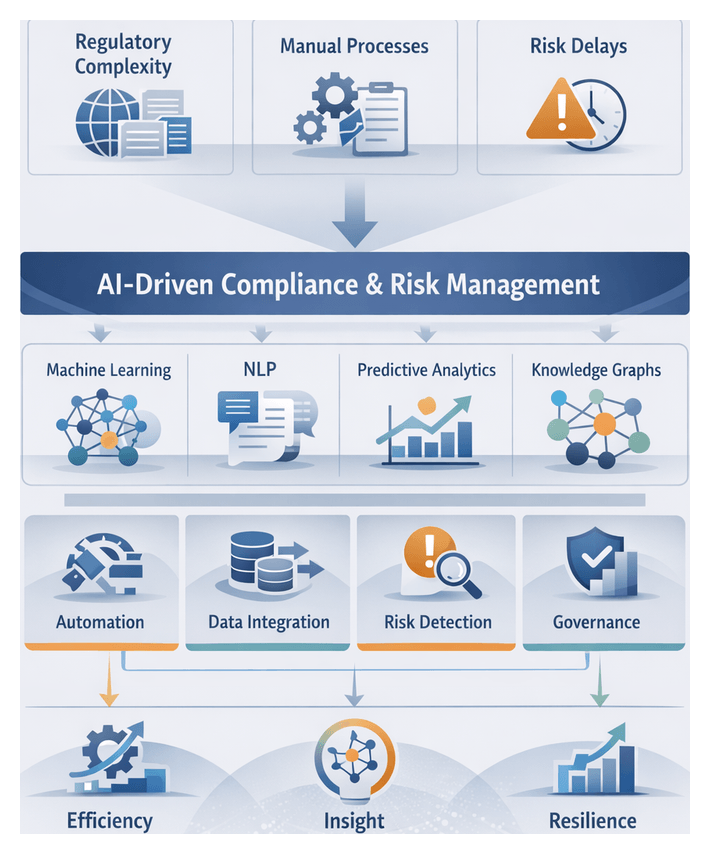
Organizations today face an unprecedented convergence of regulatory complexity, operational inefficiency, and heightened risk exposure. Global standards—Basel III, the European Union’s Anti-Money Laundering Directives, Sarbanes-Oxley, GDPR—and dozens of other mandates impose extensive documentation, reporting deadlines, and validation checkpoints. Compliance teams often allocate more than ten percent of annual budgets to manual review, data aggregation, and exception handling, producing error rates of 5–20 percent and delaying risk detection by days or weeks. Legacy controls rely on spreadsheet reconciliations, static rule engines, and siloed data across disparate systems, undermining visibility and responsiveness.
Meanwhile, regulators are shifting toward continuous supervision, real-time reporting, and proactive risk management. Institutions must integrate scenario analysis, stress testing, and transparent audit trails on demand. Without an automated, analytics-driven technology foundation, many firms struggle to adapt new rules, harness rich data assets, and maintain control effectiveness. The result is a triad of challenges:
- Rising complexity from overlapping, rapidly changing regulations.
- Operational inefficiency due to fragmented, manual processes.
- Heightened risk exposure from detection and response delays.
Addressing these challenges requires moving beyond traditional compliance operating models toward solutions that transform compliance from a cost center into a strategic enabler of resilience and growth.
Conceptual Framing for AI-Driven Automation
AI-driven automation applies machine learning, natural language processing (NLP), predictive analytics, and knowledge graphs to compliance and risk workflows. Unlike rule-based engines, AI models learn from historical data, adapt to new patterns, and detect complex relationships that manual processes miss. In practice, organizations use AI to classify regulatory documents, extract clauses, score transaction patterns, forecast exposures, and link entities and regulations into unified views for rapid impact analysis.
By shifting from reactive verification to proactive insight, AI enhances control efficacy, operational resilience, and insight generation. Machine learning algorithms flag anomalous behavior in real time; NLP engines parse policy updates across jurisdictions; clustering techniques group correlated events for deeper investigation. Knowledge graphs map entities, transactions, and controls in a dynamic, end-to-end compliance architecture supporting continuous monitoring and rapid adaptation.
Strategic implementation approaches include establishing a Compliance Center of Excellence; defining use-case roadmaps with measurable objectives; adopting agile development cycles; and integrating with enterprise data platforms such as Palantir Foundry or in-house lakes. Early pilots with IBM Watson for document review or Microsoft Azure Cognitive Services for text analytics validate value and build stakeholder confidence. Model risk management frameworks oversee development, validation, and monitoring in line with supervisory guidance.
Interpretive frameworks guide AI investments:
- Maturity Models: Phases from pilot to optimization define governance needs and resource allocations.
- Risk-Reward Matrices: Balance anticipated risk reduction against implementation complexity.
- Control Taxonomies: Map AI capabilities to preventive, detective, and corrective controls for uplift estimation.
- Ethical and Governance Benchmarks: Shape requirements for transparency, fairness, and accountability.
Evaluative criteria encompass model accuracy (precision, recall, false positive rates), explainability, data governance alignment, operational integration, scalability, and compliance and ethics risk. Embedding human-in-the-loop controls, upskilling teams in data literacy and model interpretation, and positioning AI as an augmentation of human expertise ensure balanced, sustainable adoption.
Relevance of AI Adoption in Today’s Environment
Four converging forces make AI adoption in compliance and risk management a strategic imperative:
- Data Proliferation and Complexity: Organizations manage structured transactions and unstructured content—emails, social media, legal agreements—at volumes beyond manual frameworks. AI techniques such as NLP and pattern recognition synthesize these streams, prioritize high-risk cases, and provide explanatory insights. Financial firms apply real-time anomaly detection to payment patterns; life sciences companies use NLP to analyze regulatory submissions and scientific literature for labeling compliance.
- Shifting Regulatory Demands: Supervisory bodies worldwide now require explainability, transparency, and ethical controls for automated systems. Jurisdictions in the EU, Singapore, and U.S. states are publishing AI risk-management principles. Institutions that implement retrainable models can adjust to rule changes in days rather than months, reducing reporting errors and enforcement risks. Governance frameworks aligned with COSO or ISO 31000 ensure version control, validation protocols, and documentation standards.
- Technological Maturity: Cloud computing, containerization, and MLOps platforms underpin scalable model training and monitoring. Open-source ecosystems—TensorFlow, PyTorch, scikit-learn—alongside enterprise solutions from SAS and many others accelerate experimentation and production performance. Prebuilt models for text classification, anomaly detection, and predictive analytics now include built-in governance and bias detection tools.
- Economic and Competitive Pressures: Early adopters report 20–30 percent cost reductions in reporting and monitoring, faster remediation of control gaps, and enhanced audit readiness. AI-driven insights extend beyond compliance to credit risk, operational resilience, and ESG, creating unified risk platforms. Firms that delay face escalating burdens and lose market agility.
In this landscape, AI is not an optional upgrade but a cornerstone of agile, insight-driven compliance that supports strategic objectives, optimizes resource allocation, and anticipates emerging threats.
Strategic Roadmap and Key Considerations
Roadmap and Key Learning Objectives
This guide progresses from foundational concepts to advanced applications, providing strategic insights and practical considerations for AI-driven compliance:
- Foundations of Compliance and Risk Management: Traditional frameworks and the limits of manual controls.
- The Regulatory Landscape in the AI Era: Mapping AI-related requirements and supervisory guidelines.
- Core AI Techniques: Pattern recognition, NLP, supervised learning, and their compliance applications.
- Data Governance and Quality: Stewardship, lineage, and validation best practices.
- AI for Risk Detection and Predictive Analytics: Anomaly detection and proactive mitigation.
- Automating Reporting and Filings: Intelligent architectures for document classification and audit readiness.
- Enhancing AML and Fraud Prevention: Behavioral analytics and adaptive detection frameworks.
- Integrating AI into Enterprise Risk Frameworks: Governance models and stakeholder engagement.
- Assessing Performance and ROI: Metrics, cost-benefit analysis, and continuous improvement loops.
- Future Trends and Ethics: Generative models, real-time decision engines, and responsible AI governance.
Critical Considerations for Effective Adoption
- Cultural Transformation: Secure executive sponsorship, foster cross-functional collaboration, and cultivate a data-driven mindset across risk, compliance, and technology teams.
- Skills and Competencies: Invest in upskilling compliance professionals, data scientists, and IT staff in analytical literacy, model governance, and domain knowledge.
- Data Quality and Integration: Harmonize data sources, enforce consistent taxonomies, and implement rigorous validation to safeguard model accuracy and regulatory trust.
- Regulatory Alignment and Model Risk: Adopt formal model risk frameworks, including documentation, version control, and change-control procedures, to meet supervisory expectations.
- Bias Mitigation and Explainability: Employ interpretable architectures and post hoc explainers to detect and correct bias, ensuring transparency for internal governance and external audits.
- Vendor and Technology Evaluation: Conduct due diligence on platforms and providers, evaluating technical capabilities, compliance certifications, and data security protocols.
- Scalability and Performance: Design modular architectures and leverage elastic compute resources to maintain consistent performance under peak demand.
- Continuous Governance: Establish AI steering committees or risk councils for ongoing oversight, performance reviews, and alignment with evolving objectives and regulations.
Limitations and Cautions
- Dependence on Historical Data: Models trained on past patterns may mispredict novel risk behaviors or unprecedented regulatory changes.
- Over-Reliance on Automation: Excessive trust in algorithmic outputs can erode professional judgment; human oversight is essential for edge cases and context interpretation.
- Regulatory Ambiguity: Divergent AI guidelines across jurisdictions require agility to adapt and avoid compliance gaps.
- Bias and Fairness Risks: Even well-governed models can perpetuate historical biases; continuous monitoring and corrective measures are mandatory.
- Integration Complexity: Interoperability with legacy systems may extend implementation timelines; phased strategies minimize disruption.
- Maintenance and Model Drift: Without retraining protocols and monitoring, performance can degrade as data distributions shift.
- Cost of Ownership: Licensing, infrastructure, and governance costs contribute to total ownership; holistic cost-benefit analyses should account for long-term maintenance and scalability.
Pathways for Ongoing Evolution
- Iterative Pilots and Proofs of Concept: Target high-impact areas—transaction monitoring, report generation—to validate assumptions and refine governance before scaling.
- Cross-Industry Collaboration: Participate in consortia, standards bodies, and regulatory sandboxes to accelerate best practices and inform supervisory dialogues.
- Advanced Analytics Exploration: Investigate generative AI for scenario simulation, graph analytics for network risk, and real-time decision engines for proactive controls.
- Responsible AI Frameworks: Embed ethical guidelines, impact assessments, and transparency protocols to uphold evolving norms and regulatory expectations.
- Integrated Risk Intelligence Platforms: Develop unified systems combining compliance data, risk indicators, and AI analytics for holistic visibility and faster decision-making.
- Continuous Skills Development: Maintain training programs, certifications, and talent pipelines to sustain capability and foster innovation in compliance analytics.
Chapter 1: Foundations of Compliance and Risk Management
Complex Challenges in Compliance and Risk Management
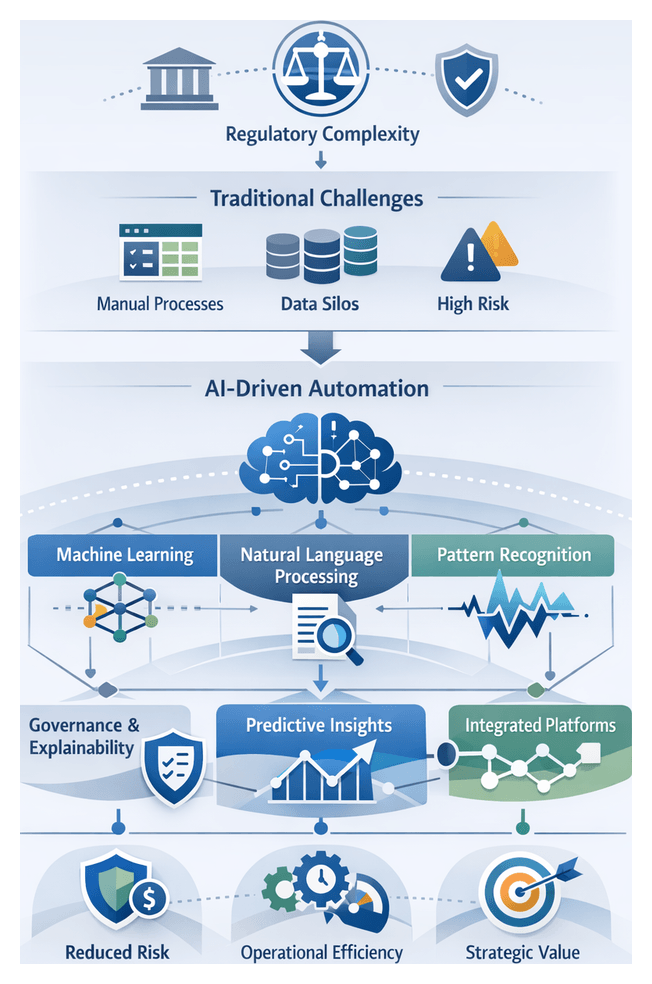
Organizations today navigate a labyrinth of regulatory demands from bodies such as the Basel Committee, the European Securities and Markets Authority and the Financial Action Task Force. Jurisdictional fragmentation, sector specialization and rapid policy updates force compliance teams to interpret evolving guidelines, maintain extensive documentation and demonstrate adherence across diverse business lines. Manual processes—spreadsheets for filings, checklist-based control execution and human-driven risk assessments—are increasingly strained by data silos and volumes that far outstrip human capacity.
Reliance on manual controls introduces high error rates, latency in issue detection and opaque audit trails. When critical data resides in departmental silos, consolidating and reconciling inputs can consume vast resources. Industry surveys show that up to 60 percent of compliance professionals spend the majority of their time on data aggregation rather than on strategic analysis. This focus on routine work limits organizational agility, delays response to regulatory change and increases exposure to financial loss, reputational damage and supervisory scrutiny.
Traditional risk models struggle with the velocity and variety of modern data. Digital transaction volumes have surged, new instruments such as cryptocurrencies pose novel threats, and unstructured sources—customer communications, social media and news feeds—contain hidden risk signals. Rule-based engines collapse under scale, while static controls lose predictive power. Simultaneously, regulatory texts, internal policies and contractual agreements number in the thousands, requiring meticulous tagging, version control and cross-referencing. Without a unified taxonomy or semantic indexing, retrieval and audit readiness become laborious.
These operational challenges quickly cascade into strategic risks. Executive boards lack real-time visibility into compliance posture, hindering critical decision-making. In sectors such as financial services and healthcare, even brief compliance lapses can lead to injunctions, customer attrition and long-term reputational harm. Faced with budget constraints, many organizations divert resources from innovation to maintain manual processes, eroding their competitive edge.
Against this backdrop, interest in advanced solutions has surged. Boards demand faster reporting cycles and transparent dashboards. Chief risk officers seek tools that automate routine tasks, reduce false positives and deliver deeper insights into emerging risk patterns. Compliance teams aim to streamline investigation workflows and redeploy experts toward high-value advisory roles. These pressures set the stage for artificial intelligence as a transformative force in compliance and risk management.
Conceptual Foundations of AI-Driven Automation
From Rules-Based to Learning-Based Systems
AI-driven automation transcends traditional rule-based technologies by incorporating adaptive learning capabilities. Whereas robotic process automation automates scripted tasks against structured inputs, AI systems such as machine learning models and natural language processing engines learn from historical data, detect evolving patterns and generalize to novel scenarios. Common AI techniques include:
- Supervised learning for transaction monitoring, training on labeled examples of suspicious activity to assign risk scores.
- Unsupervised learning for anomaly detection, uncovering outliers without predefined labels.
- Reinforcement learning to optimize decision workflows through continuous feedback loops.
- Natural language processing (NLP) for entity recognition, semantic parsing and sentiment analysis across regulatory texts, contracts and communications.
- Pattern recognition and statistical methods for real-time deviation alerts against established behavior baselines.
These techniques enable proactive, intelligence-driven risk management. Use cases span automated document classification, policy mapping, regulatory reporting and continuous control validation. By augmenting human judgment with data-driven insights, organizations shift from reactive compliance to predictive and prescriptive frameworks.
Governance, Explainability and Maturity Models
Robust governance structures are essential for defensible AI deployment. Regulatory bodies emphasize explainability, auditability and accountability for algorithmic decisions. Leading practices include:
- Explainability frameworks such as SHAP and LIME to align model outputs with control objectives.
- Audit trails documenting data lineage, training processes and parameter changes.
- Governance committees—model risk management forums and AI ethics boards—with clear escalation paths.
To assess organizational readiness, many enterprises adopt AI maturity models. A common five-stage framework spans:
- Ad hoc experimentation with isolated pilots.
- Repeatable AI integration into existing workflows.
- Deployment of predictive models for risk scoring.
- Implementation of prescriptive recommendations for control optimization.
- Transition to self-learning systems with minimal human intervention.
By situating initiatives within such models, firms can prioritize investments, identify capability gaps and measure incremental value. A hybrid approach—overlaying machine-learning predictions with rule-based validations—ensures both adaptability and auditability.
Practitioner perspectives emphasize augmentation over replacement. AI excels at pattern recognition and high-volume tasks, but expert oversight remains crucial for interpreting ambiguous regulations, managing model bias and fulfilling ethical obligations. Commercial platforms accelerate adoption—for example UiPath integrates RPA and AI, IBM Watson powers natural language understanding, and Automation Anywhere orchestrates end-to-end automation workflows. These tools demonstrate how AI augments human expertise in real-world compliance environments.
Strategic Considerations for Modernizing Compliance Foundations
Dynamic Governance and Data as a Strategic Asset
Compliance frameworks must evolve from static rulebooks to adaptive socio-technical systems. Dynamic governance constructs—control assurance cycles, model risk committees and AI ethics boards—establish decision rights, escalation paths and continuous feedback loops. Policies, control objectives and risk indicators are mapped to real-time data feeds, enabling rapid calibration of procedures.
High-quality data underpins every AI-driven solution. A holistic data lifecycle approach encompasses stewardship, lineage tracking and integrity controls. Analytical frameworks such as the Data Management Maturity Model guide institutions through capability levels in metadata standards, version control and data quality monitoring. Platforms like those listed on AgentLink AI offer modular connectors for ingesting regulatory updates and transaction data, facilitating seamless integration with existing systems.
Cultural Alignment, Risk Tolerance and Technology Convergence
Successful AI adoption hinges on cross-functional collaboration and talent alignment. Compliance teams, data scientists, IT architects and legal experts must co-design use cases, pilot solutions and scale validated models. Learning programs that build data literacy and AI proficiency within compliance functions foster a culture of continuous improvement and experimentation.
As AI assumes greater roles in monitoring and decision-making, risk appetites and tolerance thresholds require recalibration. Traditional qualitative risk matrices should be augmented with quantitative models that reflect behavioral indicators and stress-testing scenarios. This disciplined approach ensures automated controls operate within acceptable boundaries while maximizing detection efficacy.
Architectural convergence is equally critical. Open architectures, API-driven data exchanges and metadata registries reduce silos and lower total cost of ownership. Integrated platforms unify AI engines, case management tools and enterprise risk systems, enabling scalable, auditable workflows and end-to-end traceability.
Ethical, Regulatory and Operational Resilience
AI offers transformative potential but must be deployed with awareness of ethical and regulatory constraints. Variability in supervisory guidelines for model governance and algorithmic accountability demands pragmatic alignment strategies. Organizations should adopt explainable AI standards and fairness metrics to detect bias and maintain stakeholder trust.
Hybrid human-machine models strike an optimal balance between efficiency and oversight. Automated engines surface anomalies and generate recommendations, while experts validate context, refine policies and address novel regulatory interpretations. This human-in-the-loop paradigm preserves resilience, ensures ethical use and mitigates the risk of model failures.
Investment decisions in AI-driven compliance should rest on rigorous cost-benefit analyses. Frameworks for return on investment encompass direct savings in labor and remediation, as well as qualitative gains in audit readiness, regulatory relationships and competitive differentiation. Scenario-based financial modeling helps executives prioritize initiatives that deliver the greatest strategic value.
By integrating dynamic governance, data excellence, cultural transformation and disciplined risk calibration, organizations can modernize compliance foundations and harness AI-driven automation at scale. These strategic considerations provide the groundwork for detailed exploration of technology selection, implementation methodologies and continuous performance measurement in the chapters that follow.
Chapter 2: The Regulatory Landscape in the AI Era
Traditional Compliance and Risk Management Challenges
Organizations today contend with an unprecedented volume and complexity of regulatory requirements spanning multiple jurisdictions, each with distinct reporting formats, timelines and risk thresholds. Financial institutions, healthcare providers, energy companies and technology firms struggle to translate evolving data privacy, cybersecurity, environmental and anti-fraud directives into operational processes. Manual approaches—where policy analysts track updates in legal portals, control owners maintain spreadsheets and audit teams perform periodic reviews—introduce high error rates, limited scalability, latency between rule issuance and implementation, siloed information flows and resource-intensive operations. As cyber threats adapt in real time, supply chain exposures multiply and reputational risks escalate via social media, reliance on point-in-time assessments and rigid rule engines leaves critical warning signs undetected. In this dynamic environment, continuous monitoring, rapid anomaly detection and predictive insight become imperative.
AI-Driven Automation: Conceptual Foundations and Strategic Value
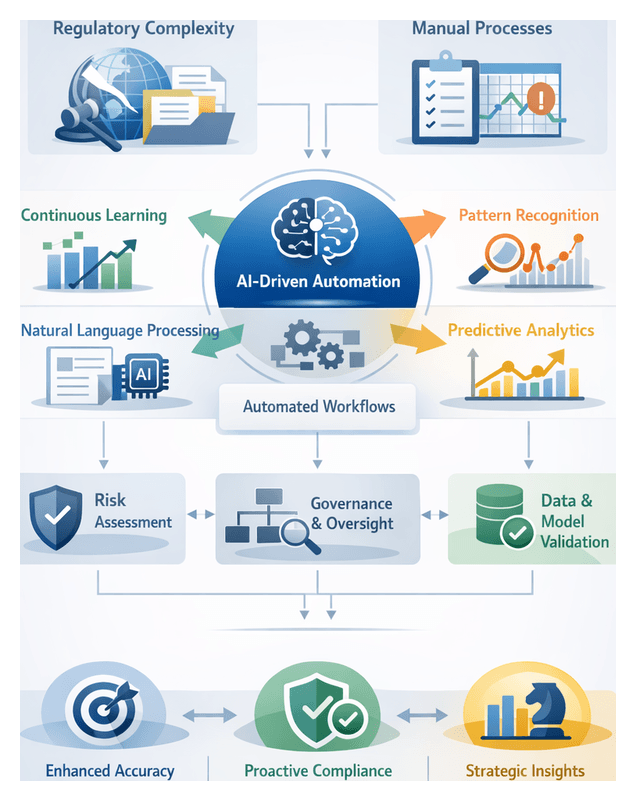
AI-driven automation transforms static, manual processes into adaptive, data-centric systems that learn from historical patterns and evolve in real time. By applying machine learning, natural language processing and advanced analytics to vast structured and unstructured datasets, organizations can uncover latent relationships, extract regulatory obligations and forecast risk trajectories. This capability shifts compliance from reactive remediation to proactive mitigation, amplifying the expertise of compliance professionals and enabling focus on policy interpretation, stakeholder engagement and strategic risk planning.
- Continuous Learning: Models refine their accuracy over time by training on historical compliance events, transaction records and regulatory interpretations.
- Pattern Recognition: Advanced algorithms detect unusual transaction clusters, deviations in contract language and emerging risk clusters.
- Natural Language Understanding: AI systems parse legislation, guidance and internal policies to extract definitions, obligations and control requirements.
- Predictive Analytics: Forward-looking risk scoring and trajectory forecasting enable resource allocation ahead of emerging threats.
- Automated Workflows: Integration with enterprise systems triggers alerts, case creation and remediation assignments automatically.
In boardrooms, AI is positioned not merely as a back-office efficiency tool but as a strategic enabler of predictive compliance. Early adopters gain enhanced risk visibility, accelerated decision cycles and the agility to meet stringent regulatory timelines. By infusing intelligence into core processes, organizations can transform compliance from a cost center into a capability that delivers operational resilience and competitive differentiation.
Analytical and Interpretive Frameworks for AI Integration
To guide evaluation and deployment of AI-driven initiatives, organizations leverage structured frameworks and analytical criteria that align technology with risk governance and investment priorities.
- Capability Maturity Models assess progress from ad hoc processes to fully integrated AI-enabled risk management, defining stages such as pilot deployment, enterprise scaling and continuous improvement.
- Risk-Based Governance Structures realign control activities based on risk severity and likelihood, replacing uniform process flows with adaptive risk scoring and exception-driven workflows.
- Technology Adoption Curves identify early adopters, pragmatists and the early majority, informing engagement and change strategies.
Key analytical considerations include:
- Data Quality and Representativeness: Training datasets must reflect the operational environment and risk universe to prevent model bias.
- Model Validation and Stress Testing: Rigorous back-testing and rare event simulations assess stability and resilience.
- Governance and Oversight Protocols: Clear ownership, escalation pathways and audit trails are essential across model development, deployment and monitoring.
- Transparency and Explainability: Techniques such as SHAP values or LIME analysis support interpretability and regulatory transparency.
- Scalability and Performance Metrics: Throughput, latency and resource utilization must align with real-time or batch processing requirements.
- Change Management and Cultural Adoption: Training, communication and stakeholder collaboration drive acceptance and minimize resistance.
Emerging analytical trends include hybrid intelligence models that combine rule-based engines with machine learning, continuous feedback loops that retrain models based on human analyst decisions, explainability as a compliance enabler and risk-adjusted automation roadmaps aligned with organizational maturity and appetite.
Evolving Regulatory Drivers and System Design Implications
Regulatory frameworks such as the European Union’s AI Act and guidance from the U.S. Office of the Comptroller of the Currency emphasize transparency, accountability and robust model governance. Automated risk management platforms must embed compliance by design, incorporating version control, audit trails and explainability layers into their architecture. System design now demands a dual focus on analytical performance metrics and demonstrable adherence to evolving standards.
Model Governance and Interpretability
Governance frameworks establish clear ownership, documented decision rights and standardized validation processes. Organizations select algorithms that balance predictive power with interpretability and often apply principles from the Basel Committee’s guidelines on effective risk data aggregation and reporting to ensure auditability across the model lifecycle.
Data Privacy and Ethical Considerations
The ingestion of sensitive data under GDPR, the California Consumer Privacy Act and HIPAA mandates data minimization, pseudonymization and secure lineage tracking. Privacy by design ensures analytical processes respect user rights while maintaining model accuracy.
Auditability and Documentation
Comprehensive logs of data inputs, model versions, parameter settings and output explanations support internal and external audits. In regulated sectors like financial services, the ability to trace every automated decision back to documented governance processes is non-negotiable.
Integration, Deployment and Operational Governance
Automated solutions must integrate seamlessly with heterogeneous technology stacks, spanning legacy databases, on-premise applications and third-party platforms. Robust extract, transform and load processes preserve data integrity and lineage, while APIs enforce authentication, encryption and role-based access. Integrations with platforms such as IBM Watson and Palantir often inform vendor selection and deployment strategies.
Modular Architecture and Scalability
Microservices and containerization support isolated updates to components like anomaly detection engines or reporting interfaces without disrupting the entire system. Cloud-native deployments with elastic compute resources accommodate peak processing loads and simplify the incorporation of new data feeds and rule sets.
Operational Monitoring and Escalation
Automated risk management systems generate real-time alerts when performance thresholds degrade or anomalies occur. Escalation workflows route these alerts through predefined channels to compliance officers, risk managers and audit teams, ensuring timely human intervention. Dashboards and case management tools streamline the tracking, investigation and resolution of incidents.
Analytical Frameworks for Risk Prioritization
Clustering algorithms and predictive analytics group related risk events and assign severity, likelihood and impact scores. Decision trees and scoring models translate raw anomaly data into prioritized action items, aligning with standards such as ISO 31000 and the COSO ERM framework.
Vendor Strategies and Cross-Industry Contexts
Vendors differentiate their automated risk platforms with configurable rule engines, audit log management and regulatory content libraries that address use cases from transaction monitoring in banking to claims analysis in healthcare. Roadmaps emphasize interoperability with broader governance, risk and compliance suites and prioritize features that support continuous learning and regulatory change management.
Across industries, AI-driven compliance solutions address common themes: financial services deploy them for anti-money laundering and credit risk; healthcare providers detect billing anomalies and fraud; manufacturers monitor supply chain risks; energy companies anticipate equipment failures with reporting implications. Despite varied data domains, the core challenge remains aligning advanced analytics with sector-specific compliance mandates.
Continuous Calibration, Validation and Ethical Oversight
Model performance degrades as data patterns shift and regulatory expectations evolve. Systems incorporate calibration processes that compare predicted risk against actual outcomes and validation frameworks—such as the Federal Reserve’s SR 11-7 guidance—for back-testing and sensitivity analysis. Ethical considerations, including bias detection and mitigation, ensure equitable treatment across customer segments and uphold reputational integrity.
Feedback loops involving compliance officers, data scientists and business stakeholders drive iterative refinements. Regular review cycles assess alert quality, investigation outcomes and user experience, fostering a learning culture that enhances system performance and regulatory alignment over time.
Core Strategic Imperatives, Limitations and Future Outlook
Successful AI-driven compliance initiatives rest on several cross-cutting imperatives:
- Governance Alignment: Clarify oversight responsibilities, decision rights and escalation pathways across AI and risk governance frameworks.
- Data Integrity: Elevate data quality, lineage and stewardship to core control objectives, ensuring model reliability and auditability.
- Cross-Functional Collaboration: Engage legal, compliance, risk, IT and business stakeholders to foster shared ownership and break down silos.
- Model Governance and Validation: Institute independent validation, continuous monitoring and documentation to guard against drift and bias.
- Scalable Architecture: Adopt modular, interoperable platforms—such as Microsoft Azure AI or Google Cloud AI—to facilitate integration and growth.
- Measurement and Value Realization: Define key performance indicators (accuracy, timeliness, cost savings) and link them to business outcomes.
Organizations must also navigate inherent limitations and risks:
- Regulatory Ambiguity: Divergent supervisory expectations across jurisdictions can create uncertainty around acceptable AI practices.
- Data Bias: Historical biases in training data can propagate discriminatory outcomes without ongoing mitigation strategies.
- Model Explainability: Complex algorithms may lack transparency, challenging stakeholder trust and regulatory justification.
- Cultural Resistance: Insufficient change management can impede adoption as workflows and decision rights evolve.
- Skill Constraints: Talent shortages in data science, IT architecture and regulatory expertise can slow implementation.
- Vendor Lock-In: Dependence on proprietary platforms without exit strategies may limit flexibility and escalate costs.
- Security and Privacy: Large-scale processing of sensitive data demands robust cybersecurity controls and strict access management.
Framework for Evaluating AI-Driven Compliance Initiatives
A structured evaluation framework helps organizations maximize success:
- Strategic Readiness Assessment: Benchmark maturity in data governance, technology infrastructure and risk culture, identifying capability gaps and leadership sponsorship needs.
- Regulatory and Ethical Alignment: Map AI use cases against applicable regulations and ethical standards, embedding transparency, accountability and bias mitigation by design.
- Technology Fit and Scalability: Evaluate platforms for interoperability, modularity and support for continuous learning, favoring open architectures to avoid vendor lock-in.
- Operational Integration: Define process flows, roles and responsibilities for data inputs, model execution, exception handling and escalation, and plan robust training and communication.
- Performance Measurement: Establish dashboards for real-time monitoring of key metrics such as false positive rates, investigation cycle times and cost avoidance.
- Continuous Improvement: Embed feedback loops that feed production data back into model retraining, periodic validation and governance forums to detect drift and emergent biases.
Actionable Next Steps for Responsible AI Adoption
To harness AI’s full potential in compliance and risk management, organizations should:
- Prioritize data governance to ensure the integrity, traceability and quality of inputs driving AI models.
- Embed ethical and human-centric safeguards—such as transparency, human-in-the-loop oversight and bias detection—throughout the model lifecycle.
- Align AI initiatives with enterprise risk frameworks and strategic objectives for seamless oversight and value capture.
- Adopt modular, scalable platforms that support interoperability, continuous learning and vendor neutrality.
- Establish robust measurement systems and feedback loops to drive ongoing refinement and responsiveness to emerging risks.
- Invest in culture change and capability building to embed data-driven insights into compliance decision-making.
By following a structured, analytical and ethical approach, organizations can transform compliance and risk management from a cost center into a strategic enabler, achieving operational resilience and sustained competitive advantage in a rapidly evolving regulatory landscape.
Chapter 3: Essential Concepts of Artificial Intelligence and Machine Learning
Evolving Compliance and Risk Management Challenges
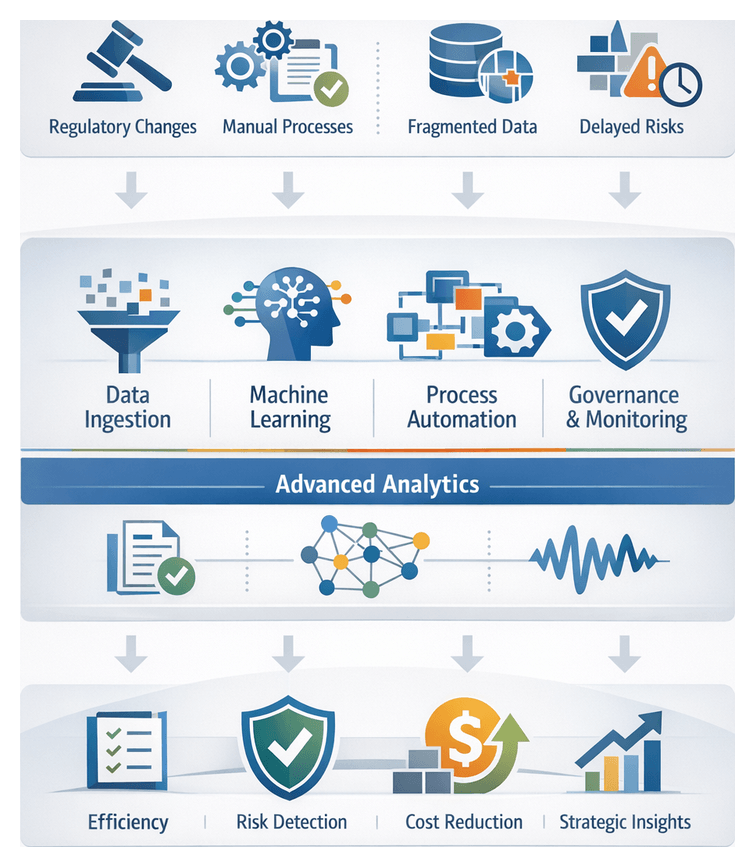
Organizations operating in regulated industries face a rapidly shifting landscape of requirements and expectations. Regulatory bodies continually update rules addressing financial misconduct, data privacy, and environmental, social, and governance standards—often with compressed timelines and ambiguous guidance. Compliance teams must interpret, operationalize, and monitor controls without disrupting business activities. Traditional approaches, reliant on manual processes, fragmented data, and periodic reviews, introduce latency in risk detection, elevate error rates, and obscure audit trails.
Multiple business units frequently maintain inconsistent taxonomies, leading to misaligned reporting and data quality issues such as missing fields, duplicate records, and varied formatting. When regulators request evidence of adherence, teams scramble to reconcile disparate sources, extend remediation timelines, and increase headcount—amplifying costs and detracting from strategic risk management. Meanwhile, digital transformation accelerates data generation across structured and unstructured sources—social media, logs, third-party feeds—creating blind spots that legacy systems cannot integrate or analyze effectively.
- Escalating regulatory volume and pace of change
- Heavy reliance on manual, error-prone processes
- Fragmented data sources and inconsistent taxonomies
- Latent risk detection and delayed remediation
- High operational costs and reactive scaling
- Limited integration of structured and unstructured data
AI-Driven Automation Framework for Compliance
Artificial intelligence offers a new paradigm by embedding compliance into business-as-usual operations through continuous, adaptive automation. Four strategic components underpin this framework:
- Data Ingestion and Normalization: Pipelines that collect and harmonize information from internal systems, external feeds, and unstructured sources such as emails, documents, and audio transcripts.
- Machine Learning and Pattern Recognition: Models that detect anomalies, classify regulatory content, and predict risk events using supervised learning, unsupervised clustering, and deep learning techniques.
- Process Orchestration: Intelligent workflows that assign alerts, route review queues, and trigger controls to minimize manual intervention.
- Governance and Monitoring: Layers that ensure transparency, auditability, continuous model validation, and alignment with regulatory expectations.
Early pilots—such as document classification or transaction monitoring—evolve into integrated platforms spanning risk assessment, control testing, reporting, and remediation. Leading solutions include IBM Watson, Microsoft Azure AI, Google Cloud AI, Amazon SageMaker, and specialized offerings like those on AgentLinkAI. Robotic process automation, such as UiPath bots, further orchestrates data flows and model inferences at scale.
Advanced Analytics: NLP, Pattern Recognition, and Data Proliferation
Compliance and risk management confront vast volumes of structured and unstructured data—transaction records, policy documents, communications, and multimedia content. Natural language processing (NLP) and pattern recognition decode policy texts, extract risk signals, and detect anomalies in transactional data, transforming data proliferation from a burden into an enabler of deeper risk visibility.
Statistical approaches, symbolic rule-based systems, and neural architectures each offer trade-offs in interpretability, precision, and adaptability. Hybrid strategies blend controlled vocabularies with probabilistic models to balance coverage and accuracy. Deep learning models—such as BERT and GPT-based embeddings—capture semantic nuances across document corpora, supporting tasks like policy cross-referencing, regulatory change detection, and sentiment analysis.
Organizations invest in robust preprocessing—tokenization, lemmatization, part-of-speech tagging—and overlay custom glossaries to prevent critical misclassification. Feature engineering extracts regulatory risk indicators from sentiment intensity, policy deviation counts, and semantic similarity measures, improving model precision. When labeled data are scarce, domain adaptation and transfer learning fine-tune pretrained models on smaller, regulatory-specific datasets.
Multimodal pattern recognition extends analysis to time series, network graphs, and multimedia. Sequence analysis and community detection algorithms reveal anomalous transaction flows and hidden relationships in entity networks. Pattern libraries codify suspicious transaction typologies, enabling automated triage and alert prioritization. Throughout, quantitative metrics—precision, recall, F1 score, and cost-weighted evaluations—guide threshold calibration to balance risk of false negatives against investigative resource consumption.
Regulatory interpretability standards, such as GDPR’s right to explanation and supervisory expectations from the Office of the Comptroller of the Currency, mandate transparent AI systems. Explainability frameworks like LIME and SHAP generate both global and local explanations, while model cards and AI fact sheets document intended use cases, performance characteristics, and limitations to support audits and regulatory reviews.
Accelerators of AI Adoption: Regulatory Evolution, Technology Maturity, and Economics
Converging forces have turned AI-driven compliance automation from a strategic option into an operational imperative:
- Regulatory Evolution: New mandates—real-time transaction monitoring, forward-looking provisions under CECL and IFRS 17, data privacy standards—expand compliance scope and granularity. Supervisory expectations for AI explainability and data ethics in jurisdictions such as Singapore and Hong Kong further drive interest.
- Technology Maturity: Cloud computing, open-source frameworks, and pretrained models provide on-demand scalability and modular deployment. Managed services like IBM Watson, Microsoft Azure AI, and Google Cloud AI minimize entry barriers, while TensorFlow and PyTorch empower custom model development.
- Economic Pressures: Rising operational costs, resource constraints, and the need for cost containment position AI as both a cost-avoidance and value-creation lever. Machine learning-driven transaction monitoring can reduce investigation volumes by up to 70 percent, and AI-powered document classification accelerates underwriting and claims adjudication.
- Competitive Differentiation: AI-augmented compliance offers proactive intelligence—market microstructure anomaly detection in trading, counterparty screening in supply chains, and predictive modeling in insurance. Platforms such as Palantir Foundry and DataRobot enable unified analytics and automated ML pipelines, delivering operational insights and regulatory confidence.
Organizations across financial services, healthcare, manufacturing, and beyond tailor AI strategies to domain-specific risk taxonomies, data governance requirements, and regulatory enforcement intensities. Industry consortia—FS-ISAC, HIMSS—facilitate best practice exchange on AI governance and model risk management.
Strategic Integration: Governance, Explainability, and Continuous Improvement
Successful AI adoption in compliance necessitates integration into enterprise risk and control frameworks, governed by clear policies and supported by cross-functional collaboration:
- Alignment with Control Objectives: Map AI techniques to risk categories—supervised models for transaction classification, unsupervised methods for anomaly detection, NLP for policy interpretation—to ensure measurable control outcomes.
- Multi-Layered Governance: Structure evaluation across data integrity, analytical logic, and oversight layers. Incorporate model risk management protocols—inventory, validation, monitoring, change-control—aligned with guidance such as SR 11-7.
- Explainability and Transparency: Use Shapley value analysis, attention visualization, and rule-extraction to provide global and local explanations. Maintain metadata logs and lineage tracking to document training data provenance and decision thresholds.
- Data Quality and Bias Mitigation: Implement continuous monitoring of feature drift, missing data, and bias metrics. Embed fairness assessment tools and remediation processes to uphold ethical standards.
- Human-in-the-Loop and Role Clarity: Define escalation points for manual review in high-risk scenarios. Ensure clear demarcation of responsibilities among data scientists, compliance officers, and audit functions.
- Continuous Learning Cycles: Establish feedback loops capturing false positives, audit findings, and changing risk patterns to retrain models and refine feature sets for resiliency.
- Documentation and Audit Readiness: Produce model cards, AI fact sheets, and technical notes detailing assumptions, limitations, performance benchmarks, and governance controls to support regulatory examinations.
- Strategic Roadmapping: Employ AI maturity models to sequence capability development—data readiness, model sophistication, governance maturity, cultural adoption—and align investments with long-term objectives.
By integrating AI techniques within disciplined governance structures and embedding transparent, ethical practices, organizations can transform compliance from a reactive burden into a proactive, strategic asset. This positions risk management to deliver enhanced visibility, operational efficiency, and regulatory resilience in an increasingly complex environment.
Chapter 4: Data Governance and Quality for Automated Compliance
Current Challenges in Compliance and Risk Management
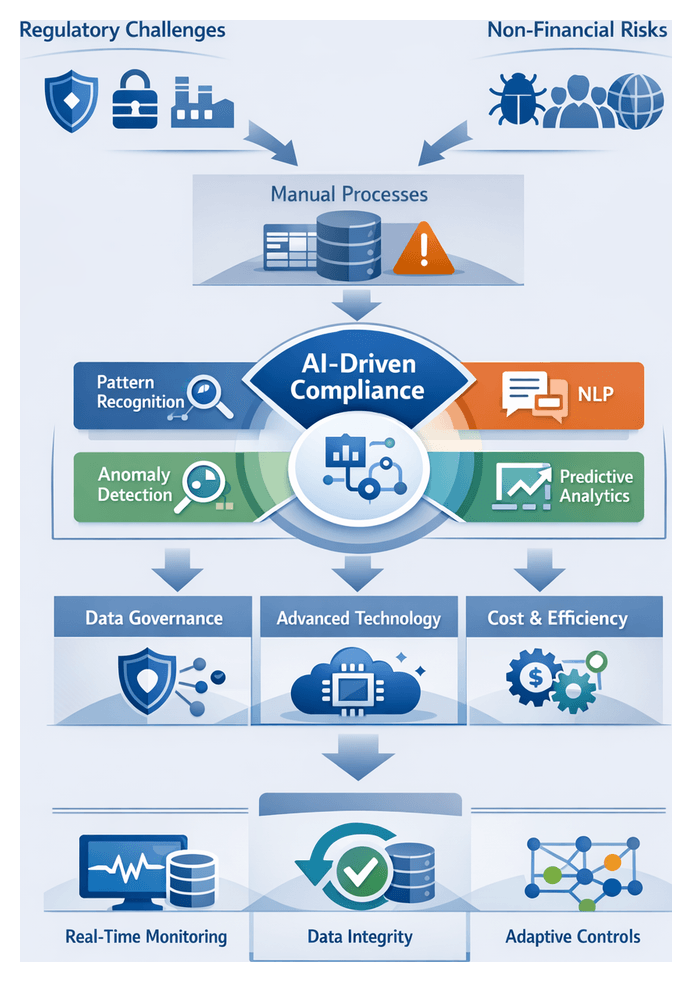
Organizations face a dynamic regulatory landscape with overlapping standards in data privacy, financial integrity, cybersecurity and environmental resilience. Traditional compliance relies on manual controls, spreadsheet tracking and siloed systems that hamper timely issue identification. Risk teams spend excessive time reconciling disparate data sources rather than analyzing emerging threats, resulting in inconsistent assessments and rising costs. At the same time, exposure to nonfinancial risks such as cyber incidents, third-party failures and reputational events materializes rapidly and can cascade across global operations. Manual processes introduce latency in detection and remediation, increasing vulnerability to fines, legal actions and brand damage. Compliance functions must therefore evolve to demonstrate real-time risk awareness, maintain comprehensive audit trails and adapt to changing regulations without proportionally growing headcount.
AI-Driven Paradigm for Automated Compliance
Artificial intelligence transforms compliance from static rule enforcement to dynamic, data-driven insights. Key capabilities include:
- Pattern Recognition: Machine learning uncovers risk indicators and relationships that manual reviews may miss.
- Natural Language Processing: Automated text analysis interprets policies, contracts and guidance.
- Anomaly Detection: Unsupervised algorithms surface outliers without exhaustive rule sets.
- Predictive Analytics: Forecasting models anticipate risks, enabling proactive remediation.
Implementing AI-driven automation requires a human-in-the-loop approach, combining domain expertise with algorithmic efficiency. Models should be designed for explainability, ethical alignment and regulatory compliance. By treating automation as a strategic enabler of an adaptive control environment, organizations can scale controls as operations grow and regulations evolve.
Enablers for AI Adoption in Compliance
Several converging factors make AI adoption in compliance timely and impactful:
- Data Proliferation: Terabytes of structured and unstructured data—from customer transactions to third-party feeds—demand scalable analytics.
- Regulatory Evolution: Supervisory bodies favor principles-based regimes and real-time monitoring capabilities.
- Technological Maturity: Cloud platforms and pre-built AI services reduce deployment barriers. Leading solutions such as IBM Watson, Microsoft Azure AI and Google Cloud AI provide ready-to-use models and tools.
- Cost Pressures: Automating repetitive tasks frees talent for strategic risk management and stakeholder engagement.
- Competitive Differentiation: AI-enabled compliance supports faster product launches, broader market access and stronger governance reputations.
By shifting from periodic, backward-looking reporting to continuous, forward-looking insights, firms can align compliance with broader digital finance and data-driven decision-making initiatives.
Data Governance: Integrity, Lineage and Stewardship
Robust data governance underpins all AI-driven compliance efforts. Three interdependent dimensions are critical:
- Stewardship: Clear data ownership and accountability ensure policies are enforced across business, risk and technology functions.
- Integrity: Controls such as versioning, validation checks and reconciliation preserve data accuracy, completeness and consistency over time.
- Lineage: Mapping data flows from source to model input provides the audit trails necessary for regulatory confidence.
Industry frameworks guide these practices. ISO 8000 defines data quality principles, BCBS 239 emphasizes traceability for risk aggregation, and DAMA DMBoK outlines metadata management and stewardship roles. Regulations like GDPR implicitly mandate provenance and integrity for personal data. Organizations that align internal controls with these standards can articulate a coherent data quality posture to auditors and supervisors.
Architectural Lenses for Lineage Visibility
Comprehensive lineage analysis requires multiple viewpoints:
- Logical Lineage: Business-level data flows across functional domains without technical detail.
- Physical Lineage: Technical artifacts such as database tables, ETL scripts and cloud services trace transformations at a granular level.
- Operational Lineage: Runtime factors including data latency, job schedules and system dependencies reveal processing bottlenecks.
Integrating these lenses delivers the transparency needed for model validation, forensic audits and regulatory inquiries.
Automated Techniques for Lineage Discovery
To reduce manual burdens and improve accuracy, organizations leverage automation powered by AI and advanced metadata tools. Techniques include:
- Metadata Harvesting Engines: Systems that scan pipelines, query logs and configurations to infer lineage without manual input.
- Natural Language Metadata Extraction: NLP analyzes code comments and documentation to enrich lineage repositories.
- Graph-Based Lineage Models: Property graphs allow complex impact analysis and interactive visualization of dependencies.
These tools accelerate the establishment of lineage repositories and support continuous updates as data ecosystems evolve. Governance frameworks must validate machine-generated lineage and contextualize it for stakeholders.
Data Validation in Compliance Use Cases
Rigorous data validation ensures downstream analytics and reports are built on reliable inputs. Key use cases include:
Transaction Monitoring and Suspicious Activity Reporting
Validation checks for completeness, format consistency and reconciliation against master data guard against false positives and blind spots. Risk-based rules prioritize high-risk transactions and enforce temporal checks to detect missing or duplicate entries.
Regulatory Reporting and Disclosure Filings
Schema validation ensures required fields conform to templates. Automated reconciliation aligns internal balances with regulatory aggregates, while exception workflows manage out-of-tolerance variances.
Risk Assessment Models
Statistical consistency checks, outlier detection and cross-validation against independent sources embed quality controls within model governance lifecycles.
Vendor and Third-Party Data Integration
Automated checks align taxonomies, verify currency conversions and flag missing fields in external data feeds to prevent sanctions screening errors and misclassifications.
Sanctions and Watchlist Screening
Probabilistic matching algorithms require clean inputs to minimize false positives. Iterative validation loops reconcile screening hits against known good records, combining automation with human adjudication.
Enterprise Risk Dashboards
Tiered validation—from source system checks to dashboard-level sanity assessments—ensures aggregated metrics accurately reflect underlying exposures.
Model Risk Management
Validation checkpoints at normalization, feature engineering and enrichment stages document data provenance and transformation logic as part of the audit trail.
Organizations embed these validation frameworks within governance platforms such as Collibra or Microsoft Azure Purview to monitor quality metrics, manage exceptions and update rules through feedback loops.
Strategic Principles for Trustworthy Data Practices
A strategic governance framework for AI-driven compliance integrates the following principles:
- Explicit Policy Definition: Codify enterprise-level data standards and usage rules referencing industry benchmarks.
- Role-Based Stewardship: Assign data ownership across cross-functional teams to foster accountability.
- Metadata and Lineage Automation: Deploy cataloging tools and lineage solutions for rapid impact analysis and audit readiness.
- Risk-Aligned Prioritization: Focus on high-value datasets supporting risk models, transaction monitoring and regulatory reports.
- Continuous Monitoring: Implement automated health checks and alerts to detect schema changes, drift and anomalies in near real time.
Leaders must anticipate limitations—such as fragmented repositories, legacy constraints and evolving regulatory guidance—and adopt phased implementation strategies. Emerging considerations include streaming governance architectures, data drift detection, privacy-preserving techniques and integration with DevOps and MLOps workflows.
Measuring Data Governance and Performance Interplay
Measuring maturity and performance fosters continuous improvement. Key indicators include coverage metrics for lineage across logical, physical and operational layers; quality scores for metadata completeness and transformation accuracy; remediation backlogs; and audit findings. By linking governance KPIs to reduced regulatory issues and faster issue resolution, organizations demonstrate tangible value. High governance maturity accelerates model development by reducing data uncertainty, while reliable AI outcomes reinforce investment in stewardship. A balanced approach that marries agility with rigorous controls enables enterprises to realize strategic benefits in compliance and risk management.
Chapter 5: Leveraging AI for Risk Detection and Predictive Analytics
Current Compliance and Risk Management Challenges
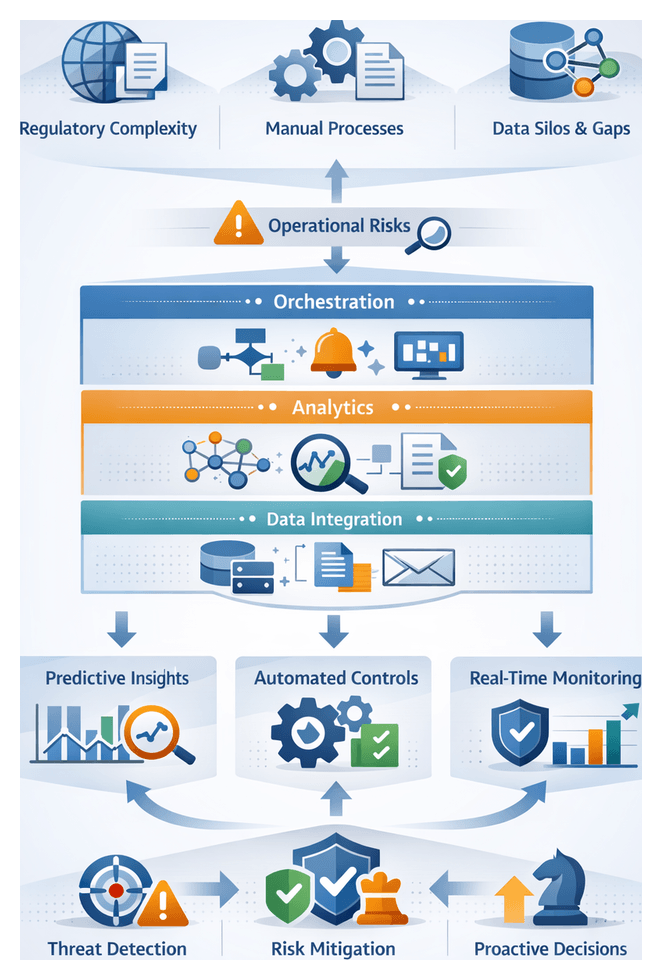
Organizations today face unprecedented regulatory complexity as global markets expand and cross-border activities multiply. Each jurisdiction imposes unique rulemaking authorities, reporting requirements, and supervisory expectations, while frequent policy updates demand continuous protocol revisions. Manual processes and legacy systems struggle to adapt, creating data silos, fragmented workflows, and paper-based review cycles that introduce delays, gaps in oversight, and heightened operational risk.
Financial institutions and regulated entities are under intense pressure to demonstrate timely, accurate, and fully auditable controls. Error rates in manual transaction monitoring and document review can trigger material regulatory findings and costly remediation. Audit trails may lack the granularity examiners require, leading to repeat inquiries and fines. Clients and investors also demand transparent, data-driven insights into risk governance, expecting organizations to identify emerging threats before they materialize into compliance failures or financial losses.
Despite these pressures, many risk and compliance teams remain overburdened by spreadsheets, disjointed reporting systems, and manual reconciliations. Routine tasks—policy interpretation, regulatory gap analysis, exception investigation—consume significant headcount. As transaction volumes grow and new data sources emerge, traditional approaches become unsustainable, leaving organizations exposed to oversight lapses and strategic blind spots.
Leaders recognize the need to modernize controls, enhance data integrity, and accelerate decision cycles. They seek solutions that augment human expertise with algorithmic precision, freeing compliance professionals to focus on high-value activities. Understanding the scope of these challenges is the critical first step toward transformation in compliance and risk management.
AI-Driven Automation Framework
Artificial intelligence presents a fundamentally different approach to compliance and risk management. Rather than relying on static rule-based engines and manual review, AI-driven automation leverages machine learning, natural language processing, and pattern recognition to analyze large, complex datasets and generate insights at scale. This paradigm reframes compliance controls as dynamic, continuously learning systems.
The framework comprises three interconnected layers:
- Data layer: Ingests structured and unstructured information from transaction feeds, document repositories, communication logs, and external sources. Advanced preprocessing—entity resolution, data normalization—ensures a unified, high-quality dataset.
- Analytics layer: Applies supervised and unsupervised machine learning to detect anomalies, classify documents, and predict risk trajectories. Natural language processing automates extraction of obligations from regulatory texts and internal policies, reducing manual interpretation time.
- Orchestration layer: Integrates analytic outputs into workflows and decision frameworks. Automated alerts, risk scores, and evidence packages feed into case management systems for rapid assignment, investigation, and escalation. Dashboards provide real-time visibility for risk committees and audit functions.
Adoption of AI is driven by several converging forces. The volume, velocity, and variety of data have grown exponentially, overwhelming traditional systems. Regulatory expectations now emphasize model risk management, data lineage, and explainable decisions. Technological maturity—cloud platforms, distributed computing, open-source frameworks—lowers barriers to deployment. Economic pressures and competitive dynamics demand efficiency gains, while proactive risk management is increasingly viewed as a source of market differentiation.
Organizations often pursue a phased approach: initial proofs of concept in high-volume, high-pain areas such as transaction monitoring or regulatory change management. Rapid prototyping and iterative refinement build confidence, while cross-functional governance ensures alignment with risk appetite. A center of excellence can eventually steward broader deployment, codifying best practices and ensuring consistent controls across business lines.
Comparative Predictive Modeling Approaches
Predictive modeling has become a cornerstone for anticipating threats and allocating resources efficiently. Organizations evaluate methodologies—classical statistical techniques to advanced machine learning—by analytic rigor, interpretability, and operational resilience. A multifaceted strategy harnesses the strengths of various approaches.
Regression Analysis and Statistical Modeling
Linear and logistic regression, along with generalized linear models (GLMs), quantify relationships between variables—transaction volume, client risk scores, policy change frequency—and compliance outcomes such as suspicious activity alerts or breach probabilities. Regression is prized for transparency: coefficients offer direct measures of variable impact, simplifying model governance and explanations to regulators. Regularization techniques (L1, L2) and stepwise selection mitigate overfitting, though strict linearity assumptions may understate complex interactions.
Time Series Forecasting Methods
For risk metrics tracked over time—daily compliance case volumes, fraud loss estimates, sanction screening hits—time series forecasting (ARIMA, exponential smoothing, state-space models) models seasonality, trend components, and residual patterns. These methods support early detection of anomalies relative to expected baselines. Hybrid frameworks incorporating external regressors or multivariate extensions (VAR, dynamic factor models) address interrelated series and exogenous events, balancing complexity with governance requirements for validation and interpretability.
Ensemble Learning and Hybrid Techniques
Ensemble methods—random forests, gradient boosting machines, stacking algorithms—offer superior predictive accuracy and noise resilience by combining multiple base learners. They excel in heterogeneous data environments where linear models fall short. However, interpretability challenges arise. Post-hoc tools like SHAP and LIME provide feature contributions, but regulators often demand intrinsically interpretable models. Organizations therefore deploy ensembles for high-volume screening, then apply simpler rule-based or regression models for decision justification.
Ensemble platforms such as IBM SPSS Statistics and Microsoft Azure Machine Learning services illustrate the trade-off between analytic power and governance overhead, requiring scalable infrastructure, robust feature pipelines, and specialized talent.
- Transparency versus performance: Regression and time series offer clarity; ensembles deliver accuracy at the cost of opacity.
- Scalability and resources: Classical methods are computationally efficient; advanced algorithms demand scalable infrastructure and expertise.
- Adaptability: Time series and ensembles adapt to concept drift; static regression models risk staleness without frequent updates.
A structured selection framework considers data characteristics, risk appetite, and governance maturity. Stress testing under extreme scenarios evaluates model resilience to regime shifts, sudden fraud tactics, or policy overhauls. Embedding domain knowledge—regulatory guidance nuances, illicit behavior typologies, jurisdictional risk differentials—through hybrid rule-based and machine learning approaches enhances detection rates while preserving interpretability.
Proactive Threat Mitigation
Integrating predictive analytics transforms organizations from reactive responders to anticipatory risk stewards. Rather than waiting for incidents or inquiries, leaders can forecast emerging threats, model scenarios, and deploy controls before issues escalate. This shift reshapes risk culture, decision-making, and strategic planning.
Anticipatory Risk Management
Predictive models inform strategic and operational decisions. Time series forecasting, ensemble learning, and scenario simulations identify patterns preceding compliance breaches or unusual behaviors. Risk committees and executives access probability-weighted forecasts of non-compliance incidents, enabling them to adjust risk appetites, refine controls, and align resource commitments to forecasted signals. Embedding predictive indicators into governance forums ensures that analytics directly influence policy updates, budget allocations, and audit planning.
Strategic Resource Allocation
Predictive risk scoring quantifies the likelihood and potential impact of future incidents across regions, product lines, or customer segments. Organizations shift from broad-brush allocations to targeted investments in high-risk areas. Financial institutions may redeploy monitoring personnel to transaction corridors flagged for elevated risk. Manufacturers might forecast supplier non-performance by blending external market indicators with procurement data, enabling preemptive engagement of alternative vendors or contractual safeguards.
Early Warning Systems
Enhanced early warning systems combine anomaly detection, clustering algorithms, and rule-based triggers to generate near-real-time alerts. Predictive models calibrate thresholds to balance false positives and sensitivity to subtle shifts. Key applications include:
- Regulatory reporting: Automated monitoring of filing deadlines and content anomalies weeks before submission windows close.
- Transaction surveillance: Pattern recognition uncovers evolving money-laundering typologies by identifying transaction clusters that deviate from customer profiles.
- Operational risk: Sensor data analysis in manufacturing and energy sectors anticipates equipment failures, reducing environmental incidents and compliance violations.
- Third-party risk: Social media sentiment analysis and external news monitoring surface reputational threats associated with suppliers or partners.
Organizational Resilience and Culture
Adoption of predictive analytics fosters a mindset of continuous vigilance. Cross-functional collaboration among risk, compliance, IT, and business units becomes essential for data sharing and refining analytic assumptions. Change management challenges include establishing clear accountability for model interpretation, defining escalation pathways for alerts, and communicating model limitations. Workshops, simulation exercises, and executive briefings reinforce how predictive signals translate into preemptive actions, cultivating trust and a culture of anticipatory stewardship.
Strategic Considerations for Predictive Risk Solutions
Effective deployment of AI-driven predictive risk solutions requires a holistic approach that spans methodology selection, data stewardship, interpretability, governance, and continuous improvement. The following principles guide risk leaders in harnessing predictive capabilities while managing associated risks.
First, predictive models function as components of a dynamic ecosystem rather than standalone tools. A portfolio approach—combining supervised, unsupervised, and ensemble techniques—captures diverse risk signals and balances analytic power with interpretability.
Second, data quality and governance are non-negotiable. Documented provenance, lineage tracking, and continuous validation safeguard against misleading signals and regulatory censure.
Third, interpretability and transparency enable stakeholder trust and regulatory compliance. Explainable AI methods—feature importance, surrogate models, rule extraction—translate algorithmic decisions into human-readable rationales.
Fourth, threshold calibration demands iterative alignment with operational realities. Pilot deployments, feedback loops, and dashboards comparing predicted scores to actual outcomes converge on optimal settings that balance detection rates and investigation costs.
Fifth, cross-functional governance ensures that predictive outputs integrate with policy frameworks, workflows, and strategic risk appetites. A multidisciplinary steering committee clarifies decision rights and streamlines issue escalation.
Sixth, the evolving regulatory environment mandates comprehensive documentation and audit trails—recording data inputs, feature engineering steps, model versions, and performance metrics—to align with supervisory expectations.
Seventh, vigilance against model drift and changing risk landscapes is essential. Automated monitoring for statistical drift, scheduled retraining cycles, and complementary detection mechanisms preserve model relevance and reliability.
Eighth, ethical considerations and bias mitigation must be embedded throughout the model lifecycle. Fairness assessments—disparate impact ratios, unawareness techniques—identify and correct unintended biases.
Ninth, investment in change management and upskilling ensures that risk professionals develop data literacy, statistical reasoning, and model interpretation skills, fostering effective collaboration between technologists and domain experts.
Finally, treat predictive models as evolving assets subject to continuous improvement. Benchmark against industry innovations, pilot emerging techniques such as graph-based risk networks or reinforcement learning, and refine governance frameworks to stay ahead of threat actors and regulatory changes.
- Adopt a portfolio of modeling techniques to capture diverse risk signals.
- Embed rigorous data governance throughout the model lifecycle.
- Pursue explainability by integrating explainable AI methods.
- Calibrate detection thresholds through iterative feedback loops.
- Align predictive outputs with cross-functional governance structures.
- Document data and model artifacts comprehensively for audit readiness.
- Monitor for drift and schedule regular model retraining.
- Assess and mitigate bias to ensure ethical outcomes.
- Invest in upskilling to bridge data science and domain expertise.
- View predictive solutions as living systems, continuously evolving.
By embracing these strategic imperatives, organizations can construct a resilient and responsible framework for anticipating risks, optimizing resource allocation, and maintaining regulatory alignment. AI-driven predictive analytics thus transforms compliance and risk management from cost centers into strategic enablers of resilience and sustainable growth.
Chapter 6: Automating Reporting and Regulatory Filings with Intelligent Systems
Current Compliance and Risk Management Challenges
Organizations in regulated industries confront a complex and dynamic environment of rules, expectations and enforcement actions. Geopolitical shifts, financial crises and cross-border market integration have accelerated regulatory change across finance, healthcare, energy and manufacturing sectors. Financial firms face anti-money laundering directives, consumer protection standards and capital adequacy rules. Healthcare providers must navigate patient privacy mandates, reimbursement frameworks and quality reporting requirements. Energy and manufacturing companies comply with variable environmental, health and safety regulations. Overlapping mandates in data protection, ethics and risk governance further amplify complexity.
This complexity strains traditional compliance frameworks. Manual controls, spreadsheets and legacy workflow systems are ill-equipped to reconcile disparate data sources at the necessary scale and speed. Compliance teams devote vast hours to gathering documentation, cross-referencing policies and validating exceptions. Risk officers rely on human review to detect emerging threats, increasing the probability of oversight and error. As a result, organizations face elevated exposure to fines, reputational harm and strategic disruptions.
Simultaneously, volumes of structured and unstructured data—from transaction records and communications archives to third-party assessments and regulatory updates—have grown exponentially. Conventional processes lack the scalability to manage this data deluge. Key risk indicators either emerge too late or remain buried in isolated silos, leaving organizations vulnerable to material losses when latent threats go undetected.
Manual frameworks also impede agility. When new rules arrive, teams must update control matrices, retrain staff and reconfigure checklists under tight deadlines. Audit cycles extend to accommodate documentation backfills, and strategic initiatives stall as resources shift to close compliance gaps. This misalignment between regulatory demands and operational capabilities forces compliance functions into reactive mode, turning processes into friction points rather than sources of assurance.
AI-Driven Transformation: Core Concepts
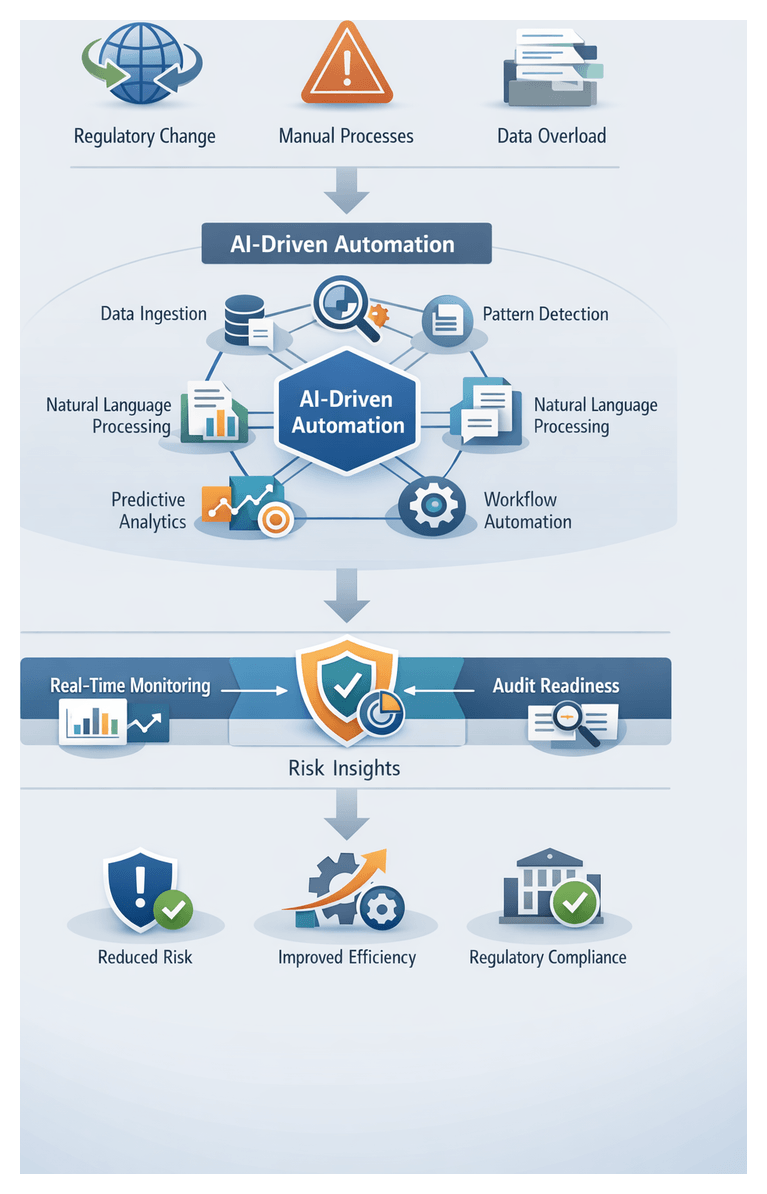
Artificial intelligence introduces a paradigm shift in compliance and risk management, moving from retrospective review to proactive intelligence. AI-driven automation augments human expertise by applying machine learning algorithms and natural language processing to high-volume data ingestion, pattern identification and decision support. Compliance practitioners focus on complex judgments, while AI handles routine analysis and monitoring.
- Data Ingestion and Harmonization—Automated pipelines process structured feeds alongside unstructured sources such as contracts, emails and regulatory bulletins, normalizing inputs into a unified risk data repository.
- Pattern Recognition and Anomaly Detection—Unsupervised learning models continuously scan data for deviations from norms, surfacing unusual transaction patterns, policy exceptions or control breakdowns for human review.
- Natural Language Understanding—Advanced NLP techniques extract entities, obligations and risk indicators from voluminous text, making compliance documents, guidance and third-party reports searchable and analyzable at scale.
- Predictive Analytics—Supervised learning models forecast emerging risk exposures by identifying precursors in historical data, enabling teams to calibrate controls before issues escalate.
- Workflow Orchestration—Intelligent automation coordinates task assignment, escalation and documentation, ensuring consistent rule application and preserving audit trails.
Integrated, these capabilities enable high-frequency monitoring, real-time exception handling and continuous dashboards. Compliance teams gain speed, precision and resilience, aligning operations with evolving regulatory expectations.
Converging trends make AI adoption imperative. Data volumes have outstripped human processing capacity. Regulators emphasize model risk management, transparency and data lineage. Cloud-based machine learning services, pre-trained language models and low-code tools enable pilots in weeks. Competitive pressures reposition compliance from cost center to strategic enabler, and multinational enterprises require scalable, consistent approaches across jurisdictions. Early adopters realize measurable benefits in cost reduction, risk mitigation and strategic agility.
Analytical Foundations of Document Classification
Document classification lies at the heart of automated reporting and regulatory filings. Organizations must interpret vast volumes of unstructured text—compliance manuals, regulatory notices and financial disclosures—and assign each document to appropriate reporting categories. Classification methods fall into four analytical approaches, each with distinct advantages and trade-offs:
- Rule-Based Systems—Rely on handcrafted patterns and ontologies. They offer transparent decision logic and low data requirements but demand continuous maintenance as regulations evolve.
- Classical Machine Learning—Techniques such as support vector machines, naïve Bayes classifiers and decision trees transform text into numeric features. They excel with structured, well-labeled data and allow transparent error analysis but struggle with semantic nuances.
- Deep Learning—Architectures like convolutional neural networks and transformer models automate feature extraction. Models such as BERT leverage contextual embeddings for superior semantic capture but require substantial computational resources and specialized expertise.
- Hybrid Frameworks—Combine rule filters with machine learning classifiers. For example, initial rule-based tagging pre-filters documents into broad categories, followed by transformer-based fine-grained classification for precision, controlling computational overhead.
Model performance evaluation extends beyond accuracy, precision, recall and F1 score. In compliance contexts, false negatives carry significant risk while false positives waste review resources. Organizations prioritize recall for high-risk categories and precision for low-tolerance environments. Receiver operating characteristic curves and area under the curve analyses inform threshold selection, while confusion matrices reveal inter-category misclassification patterns. Multi-label classification expands metrics to micro and macro averaging, balancing performance across frequent and rare classes.
Benchmarking against shared tasks—such as the LegalEval benchmarks or Financial Document Classification challenges—provides external validation. Cross-validation and out-of-sample testing guard against overfitting, while periodic re-evaluation aligns models with new regulations.
Regulatory taxonomies like XBRL tagging for financial disclosures or the EU sustainability taxonomy impose standardized labels and hierarchies. Ontology mapping aligns text to defined concepts, while knowledge graph embeddings capture semantic relationships for context-aware classification. Unsupervised clustering uncovers latent categories, enabling taxonomy evolution to address emergent regulatory topics.
Unstructured text environments introduce additional challenges. Documents in varied formats—PDFs, Word files and HTML notices—deploy OCR for extraction, risking errors and inconsistent metadata. Multilingual content demands language detection and translation pipelines. Domain adaptation via transfer learning with pre-trained models—for example using IBM Watson Natural Language Classifier or Amazon Comprehend—mitigates data scarcity but requires vigilant error analysis and recalibration to address domain drift.
Bias and fairness concerns arise if models prioritize common categories at the expense of minority classes. Structured audits, stakeholder reviews and continuous performance monitoring ensure balanced recall across all classes.
Strategically, document classification models triage incoming filings, route submissions to specialized teams and flag urgent regulatory changes. Explainability and auditability—supported by tools like Microsoft Azure Text Analytics—are vital. Decision logs capturing feature influences enable transparent reporting to regulators and internal auditors. Governance frameworks integrate classification metrics into risk dashboards, triggering review when performance falls below thresholds and engaging cross-functional committees to manage taxonomy updates.
Practical Impacts on Audit Readiness and Transparency
Intelligent reporting systems built on AI reshape audit readiness and transparency by embedding continuous assurance into the reporting lifecycle. Machine learning, NLP and knowledge graphs ingest structured and unstructured data, classify information and generate standardized submissions. These systems produce an immutable digital record—from initial data capture through classification to final delivery—serving as a comprehensive audit trail. Instead of reconstructing timelines under audit pressure, organizations maintain verifiable evidence of data lineage, algorithmic decisions and exception handling.
In regulated industries—financial services, pharmaceuticals, energy and telecommunications—auditors and regulators demand transparency of process and proof of control effectiveness. Traditional manual workflows introduce fragmentation, version-control risks and undocumented workarounds. Intelligent reporting unifies these elements in a governed environment. Automated classification engines flag taxonomy changes, policy updates and conflicting data entries at ingestion, enabling pre-emptive remediation and a coherent narrative of compliance activities with inspectable metadata.
AI shifts assurance from retrospective to continuous. Platforms monitor data and control outcomes in real time, surfacing anomalies and compliance gaps as they occur. This model aligns with guidance from bodies such as ESMA and the SEC, which stress near-real-time visibility into material errors. Real-time dashboards powered by NLP and anomaly detection engines—like those in IBM Watson or Microsoft Azure AI—enable teams to trigger governance mechanisms long before formal audit cycles.
Transparency extends internally—to executives and board members—and externally—to regulators, investors and rating agencies. AI-generated data and logs feed executive dashboards with color-coded risk indicators and drill-down capabilities. Externally, machine-readable reports adhering to standards like XBRL, supported by classification and extraction tools from UiPath and ABBYY, ensure consistency and reduce filing anomalies.
Common use cases illustrate these impacts:
- Regulatory Filings and Disclosure Schedules—Automated extraction and aggregation of metrics accelerate preparation of filings. Pre-built models flag deviations from expected ranges for early investigation.
- Internal Audit and Control Testing—Continuous data validation routines generate evidence of control performance, reducing sampling and manual testing efforts.
- External Audit Coordination—Unified portals present complete audit trails to external auditors, shortening cycles, lowering support costs and speeding query resolution.
- Regulator Inquiries and Ad Hoc Reporting—Teams can re-run classification models on historical data to produce narrative explanations and visualizations for supervisory letters and on-site examinations.
Beyond efficiency, AI-driven reporting strengthens resilience. Automated root-cause analysis and natural language generation capabilities produce human-readable summaries explaining data adjustments and algorithmic judgments. This capacity for explainability aligns with regulatory emphasis on transparency and model interpretability.
AI fosters cross-functional collaboration by creating a single source of truth. Knowledge graphs and semantic layers link data elements to obligations, objectives and risk appetite statements, building shared context across compliance, finance, IT and risk teams. Boards shift from crisis responders to strategic orchestrators, focusing on AI oversight, model governance and data stewardship rather than firefighting audit requests.
Key Considerations for Scalable Reporting Automation
Strategic Alignment and Business Impact
Scaling reporting automation requires clear alignment with corporate objectives. Initiatives must tie efficiency gains to risk appetite, cost containment and executive insight. Enterprise risk committees view automation as a means to shift resources to strategic analysis. Finance and audit seek consistent, transparent report generation with measurable cycle-time reductions and error mitigation. Operational leaders value bandwidth freed for exception management and scenario planning. A robust business case quantifies impact—reduction in manual review hours, accelerated submissions and fewer restatements—to secure executive sponsorship and funding.
Governance and Oversight Mechanisms
Multidisciplinary oversight bodies monitor model performance, data lineage and policy compliance. Key practices include:
- Clear ownership of AI components—data scientists, compliance officers, IT architects and business stakeholders each accountable for development, validation and change control.
- Model risk management protocols, drawing on guidance such as the Federal Reserve’s SR letters and the European Banking Authority’s recommendations.
- Comprehensive audit trails capturing version histories, parameter adjustments and decision thresholds for internal and external reviews. Platforms like IBM Watson Discovery and Azure Form Recognizer support centralized model metadata repositories.
Data and System Integration
Successful scaling relies on seamless integration of data sources and legacy applications. Integration imperatives include:
- Standardized data schemas and common models to harmonize inputs from transaction systems, document repositories and external feeds.
- Real-time or near-real-time data availability via event-driven pipelines or change data capture to minimize report latency.
- Robust transformation and validation layers that detect anomalies at ingestion, supported by tools such as Google Document AI or open-source ETL frameworks.
API-first and microservices architectures decouple reporting engines from core systems, enabling independent scaling of classification, extraction and validation services.
Performance, Scalability and Architecture
As volumes and complexity grow, organizations employ architectural strategies for scalable throughput:
- Horizontal scaling of compute resources with container orchestration platforms like Kubernetes to allocate capacity dynamically.
- Batch versus stream processing trade-offs—batch for periodic filings, real-time triggers for alerts and dashboards.
- Caching strategies for frequently accessed reference data to reduce computational overhead.
- Distributed storage solutions enabling parallel reads and writes, preventing bottlenecks with large document corpora.
Rigorous performance testing under simulated load conditions and well-defined service-level objectives for throughput and latency allow proactive scaling.
User Experience, Change Management and Adoption
Automation delivers maximal value when embraced by analysts, compliance officers and auditors. Critical human factors include:
- Intuitive interfaces and dashboards to reduce reliance on legacy spreadsheets.
- Role-based access and configurable workflows to foster user ownership.
- Targeted training on model outputs, confidence scores and required interventions.
- Feedback channels for users to flag misclassifications and data gaps, driving continuous model refinement.
Involving power users in pilot phases and showcasing quick wins—such as rapid filing assembly or shortened review cycles—builds momentum for enterprise-wide adoption.
Regulatory Compliance and Audit Readiness
Regulators and auditors expect demonstrable controls over AI outputs. Compliance measures include:
- Documentation of algorithmic logic and decision rules in plain language for examinations.
- Regular reconciliation of automated outputs against manual benchmarks to validate accuracy and detect drift.
- Exception workflows routing ambiguous or high-risk items to human experts.
- Secure, tamper-evident records of submissions, using cryptographic checksums or blockchain-inspired ledgers.
Continuous Improvement and Long-Term Sustainability
Reporting automation is an evolving capability. Best practices encompass:
- Monitoring model health with metrics such as precision, recall and processing times, triggering retraining based on threshold breaches.
- Periodic review of templates, taxonomies and classification rules to reflect new regulations and standards.
- Post-implementation feedback loops incorporating audit findings and user suggestions.
- Establishing an AI Center of Excellence or shared services team to uphold standards, governance and technical expertise.
Key Limitations and Risk Factors
Organizations must address inherent challenges:
- Model bias and drift, requiring vigilant retraining to sustain accuracy.
- Data quality variability across units, risking misinterpretations in automated outputs.
- Regulatory ambiguity that necessitates rapid logic adjustments.
- Technical debt from rapid prototyping that can create brittle integrations.
- Change fatigue if tools and processes shift too frequently, risking user resistance.
Emerging Considerations and Future Outlook
Looking ahead, organizations should prepare to leverage advances such as generative AI for narrative generation, cross-jurisdictional reporting engines that reconcile local taxonomies with global standards, real-time policy tracking platforms for instantaneous updates to reporting logic, and federated learning frameworks that share model improvements across consortia without exposing sensitive data. By anticipating these developments, enterprises can maintain leadership in intelligent reporting and drive agile responses to an ever-changing regulatory landscape.
Chapter 7: Enhancing Anti-Money Laundering and Fraud Prevention
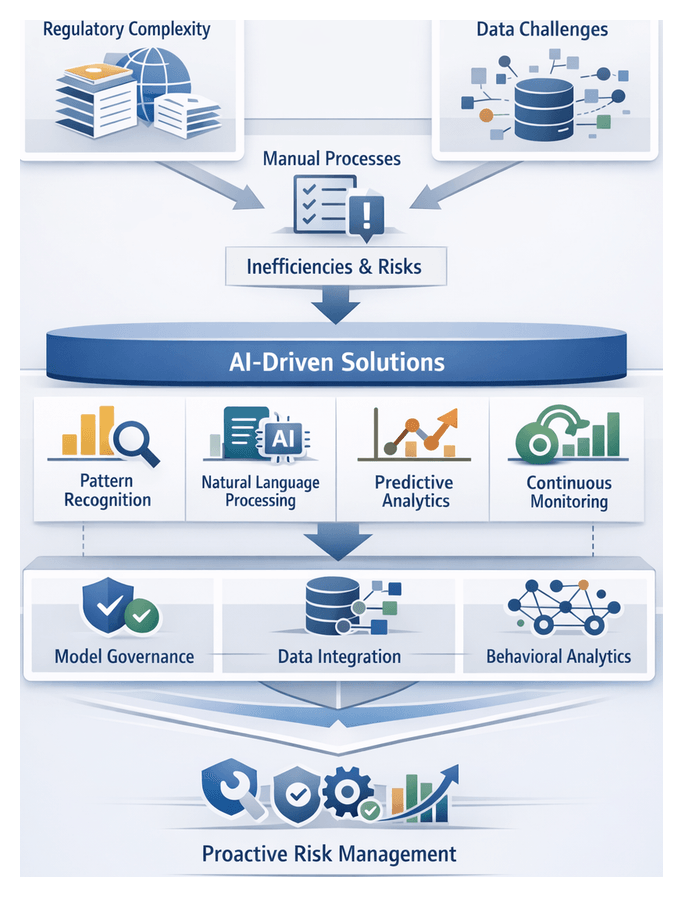
Current Compliance and Risk Management Challenges
Organizations today contend with a rapidly evolving regulatory landscape marked by global proliferation of rules, frequent policy shifts, and sector-specific standards. Compliance functions must interpret and apply a mosaic of requirements across multiple jurisdictions, while risk teams identify emerging threats, quantify exposure, and report insights under compressed timelines. Manual control frameworks—reliant on spreadsheets, checklists, and point-in-time audits—struggle to scale, leading to operational inefficiencies, elevated error rates, and gaps in coverage.
- Regulatory Proliferation: Hundreds of new rules and guidance documents increase review burdens and oversight risks.
- Jurisdictional Divergence: Overlapping or conflicting mandates demand extensive coordination to maintain consistent controls.
- Data Volume and Complexity: Vast quantities of structured and unstructured data—from transaction logs to policy documents—overwhelm manual processes.
- Control Limitations: Point-in-time audits lack real-time visibility, delaying threat detection and remediation.
- Resource Constraints: Lean teams face high turnover and must balance daily monitoring with strategic initiatives, constraining proactive risk management.
As regulators intensify scrutiny and impose larger fines, organizations must adopt innovative approaches that reduce manual burdens, strengthen oversight, and deliver real-time assurance across compliance and risk domains.
AI-Driven Automation: Concepts and Capabilities
Artificial intelligence transforms compliance from a reactive, manual exercise into a continuous, intelligence-led discipline. By leveraging machine learning, natural language processing, and advanced analytics, AI systems interpret vast data sources, detect anomalies, and recommend corrective actions with unprecedented speed and precision.
- Pattern Recognition: Machine learning models analyze historical transaction data and audit findings to surface anomalous behaviors more accurately than rule-based checks.
- Natural Language Processing (NLP): NLP algorithms parse unstructured text—such as regulatory guidance, policy documents, and communications—to extract relevant requirements and map them to internal controls.
- Predictive Analytics: Forecasting models anticipate emerging risks by analyzing trends, correlations, and external indicators, enabling proactive resource allocation.
- Continuous Monitoring: Real-time processing of streaming data offers dynamic risk scoring and immediate alerts, replacing periodic sampling and reducing blind spots.
- Automation Orchestration: Integration with workflow platforms automates remediation tasks—such as exception investigations and policy updates—freeing experts to focus on high-value analysis.
Strategic pillars for enterprise-scale AI deployment include:
- Model-Driven Control Architecture: Embedding AI decision points within control frameworks to minimize manual handoffs.
- Data-Centric Governance: Establishing robust pipelines and stewardship practices to ensure high-quality inputs for AI models.
- Iterative Improvement: Implementing continuous learning cycles that refine algorithms based on feedback loops and evolving regulatory expectations.
Advanced Behavioral Analytics Techniques
Behavioral analytics is central to modern anti-money laundering (AML) and fraud prevention, continuously profiling entity actions—customers, accounts, devices, and transactions—to identify deviations from established norms. Two complementary paradigms drive detection:
- Supervised Classification: Models trained on labeled examples of illicit behavior deliver high accuracy for known typologies.
- Unsupervised Anomaly Detection: Algorithms flag outliers without relying on predefined labels, uncovering novel threat patterns.
Compliance functions align these techniques with risk-based frameworks such as the Financial Action Task Force recommendations, calibrating sensitivity thresholds to match customer risk segments and optimize resource allocation. Supervisory expectations—embodied in BCBS 239 principles and the U.S. OCC AI risk management guidelines—emphasize explainability, performance monitoring, and rigorous back-testing.
- Detection Performance: Precision, recall, false positive rate, and ROC curve metrics guide model selection and tuning.
- Model Robustness: Resistance to concept drift, adversarial manipulation, and data quality issues ensures sustained efficacy.
- Scalability: High-velocity transaction streams and expanding customer bases require scalable architectures.
- Explainability: Human-readable rationale for flagged behaviors supports regulatory transparency.
- Integration: Compatibility with AML case management and investigative workflows accelerates operational adoption.
Graph analytics—illustrated by network‐based modules from NICE Actimize—maps customers, accounts, and transactions as nodes and edges to expose hidden money‐movement structures and fraud rings. Sequence analysis and temporal pattern mining employ clustering and Markov chain models to detect slow-moving laundering schemes, while expert feature engineering creates derived variables—velocity metrics, time-of-day patterns, and device attributes—that capture nuanced behavioral signatures.
Cost-benefit frameworks quantify the economic impact of analytics investments, measuring cost per alert, average case handling time, and loss avoidance to build a compelling business case. Ethical and privacy considerations—driven by GDPR requirements and European Banking Authority guidelines—demand bias impact assessments and adherence to Fair, Accountable, and Transparent AI principles. Continuous improvement protocols establish investigator feedback loops, performance dashboards, and governance reviews to recalibrate and retrain models as risk landscapes evolve.
Relevance of AI Adoption and Strategic Imperatives
The convergence of massive data growth, rapid regulatory evolution, and technological maturity makes AI adoption a strategic imperative. Machine learning’s ability to ingest structured and unstructured data—transaction logs to email correspondence—reveals risk signals that evade rule-based systems, enabling organizations to “see the forest and the trees” simultaneously.
Regulators increasingly require evidence of predictive risk assessments, auditability of algorithmic systems, and comprehensive data lineage. By deploying AI-driven controls, organizations satisfy supervisory mandates—such as the EBA model risk guidelines and the Monetary Authority of Singapore’s AI verification framework—demonstrating proactive risk management and real-time reporting.
Cloud-based platforms and managed services from IBM Watson, Microsoft Azure AI, and Google Cloud AI provide pre-built models, development frameworks, and end-to-end workflows that accelerate deployment. Containerization, Kubernetes orchestration, and API-driven microservices enable seamless integration into existing compliance ecosystems, reducing implementation risk and supporting scalable, enterprise-wide solutions.
Competitive pressures amplify the case for AI. Early adopters report faster decision cycles, lower false positive rates, and reduced cost of compliance per transaction. Domain-specific applications—predictive fraud models for insurers, NLP‐powered chart reviews for healthcare, and anomaly detection for environmental compliance in energy firms—illustrate the “AI arbitrage” effect, where machine intelligence delivers compounding cost and risk reduction advantages.
Timing is critical. Incremental AI investments today yield compounding returns through cumulative learning and data accumulation. Early adoption also fosters cultural transformation, embedding AI fluency into governance practices, training programs, and cross-functional collaboration models, smoothing the path for future innovations in fraud detection, automated reporting, and predictive analytics.
Implementing AI in AML and Fraud Prevention
Operationalizing AI in AML programs requires a holistic approach encompassing governance, validation, integration, collaboration, ethics, and agility.
Governance and Oversight Structures
Robust governance aligns with three lines of defense:
- First line: Business units and operations teams manage daily monitoring and model outputs.
- Second line: Independent compliance and risk functions set policies, validate models, and review alerts.
- Third line: Internal audit provides objective assurance on AI controls and governance adherence.
Regulatory guidance under SR 11-7 and Basel Committee protocols mandates board-level visibility into AI strategy, validation outcomes, and escalation processes. Multidisciplinary AI governance committees—comprising data scientists, compliance officers, and legal experts—anchor oversight and mitigate algorithmic blind spots.
Model Validation and Performance Monitoring
Independent validation units employ:
- Backtesting against historical suspicious activity reports to assess hit rates and calibration.
- Stress testing under hypothetical scenarios and evolving typologies.
- Drift detection to identify data distribution changes that may degrade performance.
Continuous monitoring dashboards track false positive ratios, case processing times, and alert volumes. Standardized validation documentation—aligned with Federal Reserve and OCC frameworks—ensures audit readiness and regulatory compliance.
Integration with Existing Control Processes
Embedding AI outputs into established AML workflows prevents siloed investigations and fragmented interfaces. Key integration considerations include:
- Data interoperability standards to maintain unified customer risk views.
- Seamless handoff between automated detection and human investigation with preserved audit trails.
- Scalable architectures supporting cross-jurisdictional deployments and local privacy regulations.
Industry solutions—such as SAS AML and FICO TONBELLER—offer integrated case management platforms that streamline alert triage and investigative workflows.
Stakeholder Collaboration and Change Management
Successful AI deployments involve early, sustained engagement across compliance, legal, IT, operations, and business units. Cross-functional working groups should:
- Define risk appetite and model objectives in business terms to ensure actionable outputs.
- Co-create validation criteria and performance thresholds to foster shared ownership.
- Develop training programs for investigators to interpret algorithmic scores and manage exceptions.
Change management frameworks—based on Prosci or Kotter—support phased rollouts, targeted communication, and executive sponsorship to reinforce adoption.
Ethical Considerations and Limitations
AI systems must be designed and governed to mitigate ethical risks:
- Algorithmic Bias: Auditing for fairness to prevent discriminatory outcomes.
- Explainability: Ensuring transparency of complex model architectures under EU regulations and the proposed AI Act.
- Data Sufficiency: Applying conservative thresholds and human oversight where transactional data are sparse or biased.
Privacy-enhancing technologies and adherence to Fair, Accountable, and Transparent AI principles protect data confidentiality and uphold regulatory standards.
Scalability and Continuous Improvement
Scalable AI operations require integrated feedback loops that capture investigator adjudications, false positive rationales, and emerging typologies. Adopting DevSecOps or MLOps practices accelerates model iteration while maintaining version control, testing protocols, and change governance. This agile operating model balances speed with discipline, enabling rapid adaptation to evolving laundering schemes without compromising control standards.
Key Considerations for Operationalizing AI in AML Programs
- Alignment with Risk Appetite: Calibrate thresholds and alert volumes to match investigation capacity and tolerance for risk.
- Regulatory Engagement: Proactively collaborate with supervisors to validate methodologies and share evidence.
- Data Quality Management: Invest in governance frameworks that ensure completeness, accuracy, and lineage of transaction data.
- Resource Allocation: Balance investments in technology, skills, and process enhancements to sustain AI operations.
- Performance Metrics: Embed leading and lagging indicators—alert efficiency, investigation outcomes, regulatory feedback—into governance dashboards.
By anchoring AI deployments in sound governance, rigorous validation, and cross-functional collaboration, organizations can harness intelligent automation to achieve resilient AML and fraud prevention frameworks that satisfy regulatory expectations and drive operational excellence.
Chapter 8: Integrating AI Solutions into Enterprise Risk Frameworks
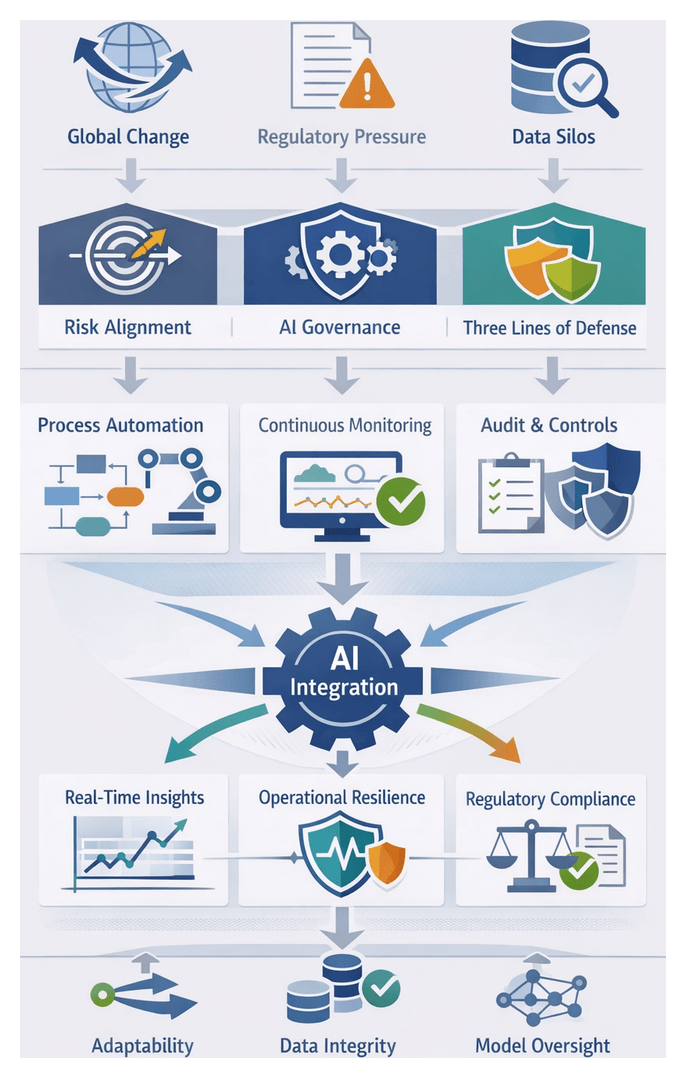
Context and Challenges
Organizations today face escalating pressures in compliance and risk management driven by globalization, rapid regulatory change, data proliferation, and evolving stakeholder expectations. Traditional manual processes—spreadsheets, interviews, surveys—struggle to deliver the real-time insights and end-to-end auditability demanded by regulators and boards. Siloed data sources obscure interdependencies, creating coverage gaps that compromise visibility into emerging threats. As regulators raise standards for transparency, accountability, and model governance, firms must demonstrate consistent control effectiveness across dynamic conditions. At the same time, talent shortages and cost constraints limit the capacity of compliance teams to scale operations while preserving deep expertise.
These pressures expose the limits of rule-based controls and point-in-time reviews. Manual workflows are error-prone, time-consuming, and ill-equipped to detect novel risk scenarios. Organizations that have adopted isolated AI pilots frequently encounter governance burdens—model documentation, bias testing, version control—that further strain resources when unsupported by integrated frameworks. Meanwhile, boards and executive committees view compliance as a strategic enabler, expecting forward-looking risk intelligence and continuous assurance capabilities. The urgency of operational resilience, underscored by recent global disruptions, has catalyzed interest in AI-driven automation as a vehicle for scalable, adaptive controls.
Strategic Alignment with Risk Appetite and Objectives
Effective AI integration begins with clear alignment to an organization’s risk appetite and strategic objectives. Rather than treating AI as a stand-alone project, enterprises should map each capability—anomaly detection, predictive scoring, automated reporting—against defined risk thresholds and desired control outcomes. Engaging senior leadership and cross-functional stakeholders ensures that model parameters, decision thresholds, and output conventions reflect tolerance for false positives, escalation protocols, and resilience goals.
The Three Lines of Defense model guides this alignment. First-line business units partner with AI architects to set risk thresholds; second-line risk and compliance functions validate those thresholds and monitor performance; third-line audit provides independent assurance. This layered oversight ensures that AI-driven insights support strategic objectives without introducing unforeseen exposures, thereby embedding automation within established governance frameworks.
Governance and Stakeholder Engagement
Robust governance structures and clear accountability play a pivotal role in sustaining AI adoption for risk management. Establishing an AI governance council with representatives from risk, compliance, technology, data governance, and business units creates a forum to define policies for model development, validation, deployment, and retirement. Decision rights should be codified through RACI matrices, delineating who is Responsible for data stewardship, Accountable for model validation, Consulted on policy alignment, and Informed of performance outcomes.
Continuous oversight mechanisms extend beyond periodic audits to real-time monitoring of model performance, data integrity, and ethical compliance. Key elements include scorecards tracking accuracy, false-positive rates, and bias metrics; structured escalation pathways for significant deviations; and regular independent reviews by internal audit or external experts. Centralized governance offices promote policy consistency, while hybrid models—combining central standards with decentralized execution—balance responsiveness with uniformity.
Engagement should also encompass external stakeholders. Proactive dialogue with regulators, external auditors, and industry consortia clarifies expectations around model explainability, data privacy, and ethical guardrails. Industry forums such as the Global Partnership on AI offer best practices for collaborative oversight. Organizations with documented regulatory engagement logs and a history of constructive dialogue typically experience fewer enforcement actions and more predictable supervisory outcomes.
Embedding AI into Organizational Processes
Process Redesign and Workflow Orchestration
Embedding AI demands a fundamental reimagination of end-to-end process architectures. By leveraging tools such as Business Process Model and Notation (BPMN) and Value Chain Analysis, organizations can identify opportunities to insert automation and decision intelligence at critical junctions. Robotic process automation (RPA) bots augmented with machine learning handle high-volume, low-risk tasks—such as document classification—while confidence thresholds trigger human review for uncertain predictions. Feedback loops feed review outcomes back into training data, enabling continuous model refinement.
Platforms such as Palantir Foundry facilitate integration between AI outputs and case management tools, ensuring that flagged events automatically generate investigation workflows with pre-populated data fields. Process mining techniques reveal bottlenecks and optimize resource allocation, while orchestration layers support parallelized workflows, reducing cycle times and increasing throughput.
Change Management and Cultural Adaptation
Successful AI deployment hinges on cultural readiness and structured change management. Drawing on Lewin’s Change Model and Rogers’ Diffusion of Innovation Theory, organizations should articulate a clear vision that emphasizes augmentation over replacement. Pilot programs and early adopter cohorts provide tangible proof points—demonstrating, for example, a 60 percent reduction in manual data entry through an AI-powered extraction tool. Interactive workshops, focus groups, and digital suggestion platforms capture user feedback, while cross-functional change agents advocate adoption within business units.
In the final stage, new behaviors are institutionalized through updated policies, revised job descriptions incorporating AI competencies, and performance metrics aligned with automation outcomes. The Technology Acceptance Model underscores the importance of perceived usefulness and ease of use; intuitive interfaces and embedded contextual guidance accelerate adoption among compliance professionals.
Control Environments and Auditability
AI-enabled processes introduce new control points that require robust audit capabilities. Continuous auditing methodologies, leveraging real-time analytics, track key risk indicators, detect model drift, and monitor data quality. A resilient control environment incorporates end-to-end audit trails capturing model versions, feature sets, configurations, and decision outcomes. Version control systems record code, training data snapshots, and hyperparameters to ensure reproducibility and regulatory inspection readiness.
Stress-testing and backtesting frameworks evaluate model performance against historical events and extreme scenarios. Clear segregation between development and production environments prevents unauthorized changes. Platforms such as IBM Watson and Google Cloud AI Platform support metadata management and lineage tracking, enabling compliance teams to demonstrate auditability during on-site reviews.
Continuous Learning and Model Evolution
Risk environments evolve continuously, necessitating an MLOps approach to manage model lifecycles. Continuous monitoring identifies data drift and performance degradation, while scheduled retraining with fresh labeled data maintains accuracy. Feedback loops—drawing on incident investigations, auditor observations, and user inputs—inform periodic revalidation. This cyclical process embeds a culture of proactive improvement, ensuring AI solutions remain attuned to shifting data distributions, fraud tactics, and regulatory standards.
Technology Integration and Scalability
Scalable AI architectures rely on modular, API-based pipelines that integrate seamlessly with legacy systems, data lakes, and third-party risk feeds. Best-of-breed solutions enable flexibility: enterprises may deploy IBM Watson for natural language understanding of regulatory texts, leverage DataRobot for automated model selection and governance, and incorporate third-party data streams for enhanced context. Open standards prevent vendor lock-in and accelerate deployment across geographies and business units.
Risk Considerations and Strategic Imperatives
Embedding AI introduces new risk categories—algorithmic bias, model opacity, adversarial manipulation, and data privacy concerns under regimes like GDPR. Mitigation strategies include bias detection and fairness monitoring tools, human-in-the-loop checkpoints for high-impact decisions, and periodic data audits for representativeness and consent compliance. Cybersecurity measures—model watermarking, secure enclaves, intrusion detection—fortify AI systems against adversarial threats. Vendor due diligence should assess governance practices, data handling protocols, and incident response capabilities, ensuring contractual rights to audits and data portability.
- Secure senior leadership sponsorship by linking AI outcomes to enterprise risk and compliance KPIs
- Establish cross-functional governance with clear roles, accountability, and escalation workflows
- Invest in data quality, lineage, and metadata management for reliable model inputs
- Foster a culture of continuous improvement through structured feedback loops and retraining
- Adopt open, scalable architectures to facilitate integration and centralized oversight
- Maintain transparency and explainability to uphold regulatory trust and ethical standards
By aligning AI capabilities with risk appetite, embedding governance structures, redesigning processes, and reinforcing control environments, organizations can transform compliance from a cost center into a strategic enabler. Continuous learning, cultural adaptation, and scalable technology architectures underpin sustainable adoption, delivering real-time risk intelligence, operational resilience, and competitive advantage in an increasingly complex regulatory landscape.
Chapter 9: Assessing Performance, Return on Investment, and Continuous Improvement
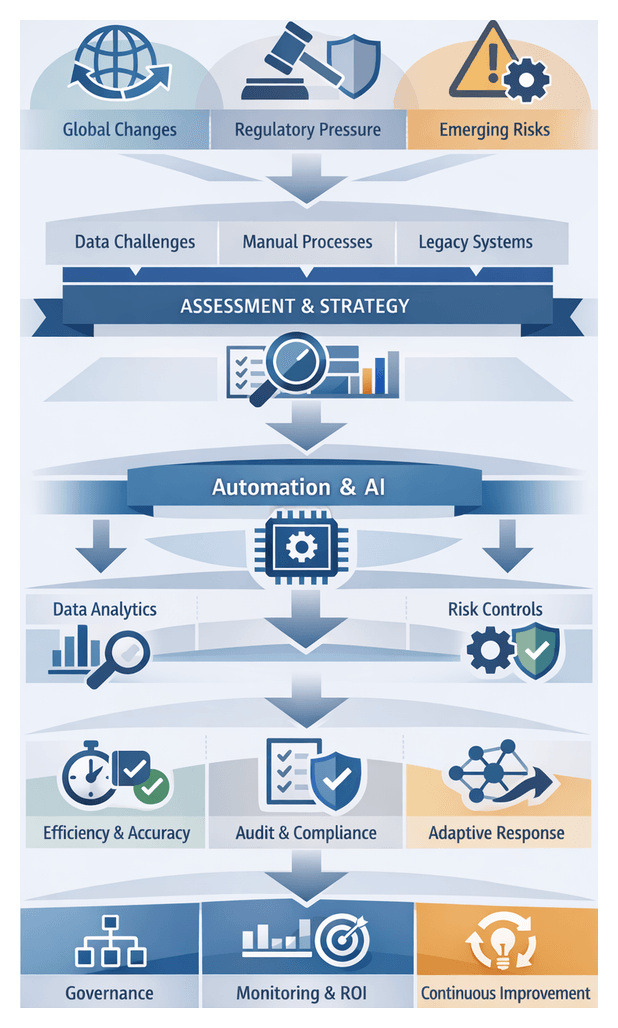
Evolving Compliance and Risk Management Landscape
Organizations today face an intricate web of regulatory requirements, geopolitical shifts and rapidly evolving risk profiles. As global markets expand and digital transformation accelerates, compliance teams must interpret guidance from securities regulators, data protection authorities and financial oversight bodies, while risk managers identify emerging threats driven by technological innovation and economic volatility. Legacy approaches—spreadsheets, shared drives and email workflows—strain under transactional spikes and cross-border nuances, introducing latency, errors and blind spots that compromise both efficiency and agility.
Common operational pain points include fragmented data sources that impede a unified view of risk, time-intensive policy interpretation, high data entry error rates, difficulty scaling manual workflows and challenges maintaining traceability and audit trails for historical reviews. The cumulative effect is rising compliance costs, slower regulatory responses, reputational damage and talent drain as practitioners spend disproportionate time on routine tasks.
Emerging vectors—digital payments, blockchain, open banking, AI-powered cyber threats and ESG considerations—further strain static risk frameworks. Principles-based regulatory regimes introduce ambiguity, requiring sophisticated methodologies to translate high-level standards into operational controls. At the same time, investors, rating agencies and customers demand transparent governance and evidence of proactive risk mitigation.
These dynamics have prompted organizations to conduct comprehensive needs assessments that catalog regulatory requirements against business processes, evaluate control efficiency, analyze data flows, measure cycle times and assess team capabilities. By establishing a clear baseline, firms can prioritize high-volume, repetitive tasks for automation and advanced analytics, reserving nuanced decision-making for targeted process redesign.
Artificial intelligence and machine learning platforms can process vast volumes of structured and unstructured data—transaction records, regulatory updates and customer communications—to detect patterns and anomalies impractical for manual review. Automated workflows execute routine tasks with consistent accuracy and maintain auditable logs, freeing practitioners to focus on exceptions, root cause analysis and strategic planning. Continuous learning capabilities enable models to adapt to evolving threat tactics and regulatory shifts, addressing the obsolescence of static rule sets. However, realizing sustainable value requires alignment of strategy, data governance and change management, grounded in a clear understanding of current challenges.
Measuring Return on Investment and Effectiveness
Investments in AI-driven compliance solutions demand rigorous ROI and effectiveness measurement to validate value and guide ongoing priorities. A disciplined approach balances quantitative metrics with qualitative benefits, aligning KPIs with strategic objectives and stakeholder expectations.
Defining Scope and Benefit Categories
Clarity on initiative objectives—whether reducing false positives in transaction monitoring, accelerating regulatory reporting or enhancing risk scoring—guides selection of cost elements, benefit categories and time horizons. Direct quantitative gains include cost reduction (staff expenses, external fees), efficiency improvements (reduced manual reviews, faster processing), error reduction (false positives, data entry mistakes), regulatory avoidance (fines and remediation costs averted) and scalability benefits. Intangible advantages—improved reputation, stakeholder trust and customer retention—can be proxied through surveys, governance ratings and third-party evaluations.
Analytical Frameworks
- Net Present Value and Discounted Cash Flow: forecasts multi-year savings and benefits against implementation and operating costs.
- Payback Period Analysis: estimates time to recoup initial investment, suited for pilot projects.
- Cost-Benefit Ratio: aggregates total benefits relative to costs, with risk-adjusted factors to account for uncertainty.
- Balanced Scorecard: integrates financial and non-financial metrics across operations, risk, compliance quality and stakeholder satisfaction.
- Logic Models and Theory of Change: maps inputs, activities, outputs and outcomes to illustrate causal pathways and qualitative impact.
Baseline Metrics and Core KPIs
Reliable pre-implementation data on case processing times, alert volumes, investigation costs and remediation expenses form the foundation for comparative analysis. Core performance indicators include accuracy metrics (precision, recall, F1 scores, false positive/negative counts), operational efficiency (manual review hours saved, backlog reduction, detection timeliness), cost metrics (headcount changes, outsourcing expenses, cost per alert), regulatory outcomes (audit findings, fines avoided, submission speed) and user adoption (stakeholder satisfaction, system reliability).
Benchmarking, Attribution and Governance
Benchmarking against industry peers and published studies contextualizes performance—such as average false positive rates in banking or investigation turnaround times in insurance. Attribution techniques—controlled rollouts, time-series and regression analyses, triangulation with qualitative feedback—ensure improvements reflect AI interventions rather than external factors. Embedding measurement within governance structures—executive sponsorship, cross-functional steering committees, data governance policies and communication plans—enhances accountability and aligns ROI tracking with strategic priorities.
Continuous Monitoring and Tools
ROI measurement is an ongoing process. Feedback loops identify changes in data quality, regulatory requirements, user feedback and AI market developments. Analytics and visualization platforms such as Tableau and Microsoft Power BI enable interactive dashboards that integrate operational, financial and risk data. Advanced environments like IBM Watson Studio and open-source libraries support custom statistical analyses for attribution studies. Selecting tools with strong integration, data governance and collaborative review capabilities streamlines measurement and reporting.
Embedding Feedback Loops for Model Refinement
Structured feedback loops are essential to maintain model accuracy, relevance and alignment with evolving requirements. These loops capture performance metrics, domain expert evaluations and regulatory inputs, feeding them back into training, calibration and governance frameworks.
Regulatory Reporting and Model Updates
When audit findings or supervisory objections arise, observations inform targeted model refinements. Annotated case outcomes adjust classification thresholds and entity recognition rules, reducing false positives and improving reporting timeliness. Knowledge repositories link specific audit comments to model parameters, demonstrating continuous improvement.
Transaction Monitoring and Signal Calibration
Alerts dispositioned by analysts—confirmed illicit, low-risk or legitimate—become training labels that tune anomaly detection and scoring models. Contextual metadata (event type, time frame) differentiates transient anomalies from structural shifts, enabling calibrated thresholds without sacrificing sensitivity to novel threats.
Incident Response and Cross-Functional Insights
Post-incident reviews capture root causes and model shortcomings, translating them into sequence analysis and pattern recognition enhancements. Cross-functional forums—model governance boards and AI oversight committees—integrate legal, audit, operations and data science perspectives, balancing precision, interpretability and efficiency. Inputs on explainability gaps lead to improved feature importance dashboards and documentation.
Policy Evolution and Data Governance
Updates to internal policies and regulatory frameworks are structured into feedback loops that convert narrative guidance into rule overlays and validation criteria. Annotated historical data reflects changes in reportable thresholds or control objectives, allowing models to apply corrected parameters retrospectively and prospectively.
Iterative Improvement Frameworks
Methodologies such as Plan-Do-Check-Act and CRISP-DM provide systematic stages—planning refinements, retraining, evaluating outcomes and standardizing successful changes. Performance dashboards monitor drift metrics, false positive rates and audit exceptions. Automated alerts trigger reviews when thresholds are breached, ensuring evidence-based decision making.
Data Quality and Provenance Feedback
Data stewards monitor anomalies flagged by model validation checks, collaborating with source system teams to remediate upstream issues. Corrected data pipelines enable reprocessing of historical datasets and retraining of models, reinforcing the symbiosis between data governance and model performance.
Performance Monitoring and Automation
Continuous monitoring platforms track throughput, latency and prediction distributions. Automated retraining pipelines, orchestrated with tools like IBM Watson and MLflow, ingest labeled data and redeploy updated models through governance gates. Service-level objectives for performance metrics embed continuous improvement as an operational principle.
Sustaining Continuous Improvement and Strategic Value
Long-term success requires disciplined governance, vigilant monitoring and a culture that embraces adaptation. Organizations must balance innovation with operational stability, allocate resources strategically and address ethical considerations to preserve trust and resilience.
Strategic Governance and Oversight
- Maintain an executive steering committee to review performance metrics and emerging risks.
- Define clear roles across risk, compliance, data science and IT to prevent silos.
- Establish independent audit functions for periodic assessments of model effectiveness and data integrity.
- Integrate AI compliance governance within enterprise risk management frameworks.
Balancing Innovation and Stability
- Use a tiered experimentation approach, piloting novel algorithms in low-risk domains.
- Evaluate pilots for strategic fit, performance benefits and operational impact.
- Monitor downstream effects on audit workflows and reporting processes.
- Retire outdated models or features that no longer deliver value.
Monitoring Model Drift
- Implement statistical control charts for input features and output distributions.
- Define drift thresholds aligned with risk tolerances to trigger recalibration.
- Maintain a versioned model registry with performance metrics and configuration details.
- Deploy dashboards and alerts for early detection of drift indicators.
Ensuring Data Quality
- Regularly audit data pipelines for anomalies, missing values and schema changes.
- Update data lineage documentation to reflect new systems and integrations.
- Use data quality scorecards to measure completeness, accuracy, timeliness and consistency.
- Prioritize remediation efforts via feedback between compliance analysts and data engineers.
Resource Planning and Financial Forecasting
- Budget for licensing, maintenance and cloud infrastructure costs.
- Allocate dedicated staffing for model monitoring, data stewardship and analytics.
- Invest in training and upskilling on AI methodologies and regulatory changes.
- Maintain contingency funds for audits, model rework or technology upgrades.
Organizational Culture and Ethics
- Foster cross-functional collaboration through governance forums and joint training.
- Embed AI literacy into compliance curricula to demystify algorithms.
- Encourage data-driven inquiry and recognition of continuous improvement contributions.
- Implement ethical frameworks to monitor bias, ensure transparency and maintain human oversight.
Continuous Improvement Cycles and Limitations
Frameworks like Plan-Do-Check-Act and DMAIC structure enhancement efforts: planning objectives, implementing updates, measuring impact and institutionalizing successful changes. Practitioners must also mitigate limitations—data scarcity in emerging domains through synthetic data, technology obsolescence with modular architectures, regulatory uncertainty via early engagement and skill gaps through multidisciplinary training.
By integrating robust governance, advanced analytics, feedback mechanisms and a culture of continuous learning, organizations can sustain the strategic value of AI-driven compliance and risk management, meeting today’s demands and anticipating tomorrow’s challenges.
Chapter 10: Future Trends and Ethical Considerations in AI-Driven Compliance
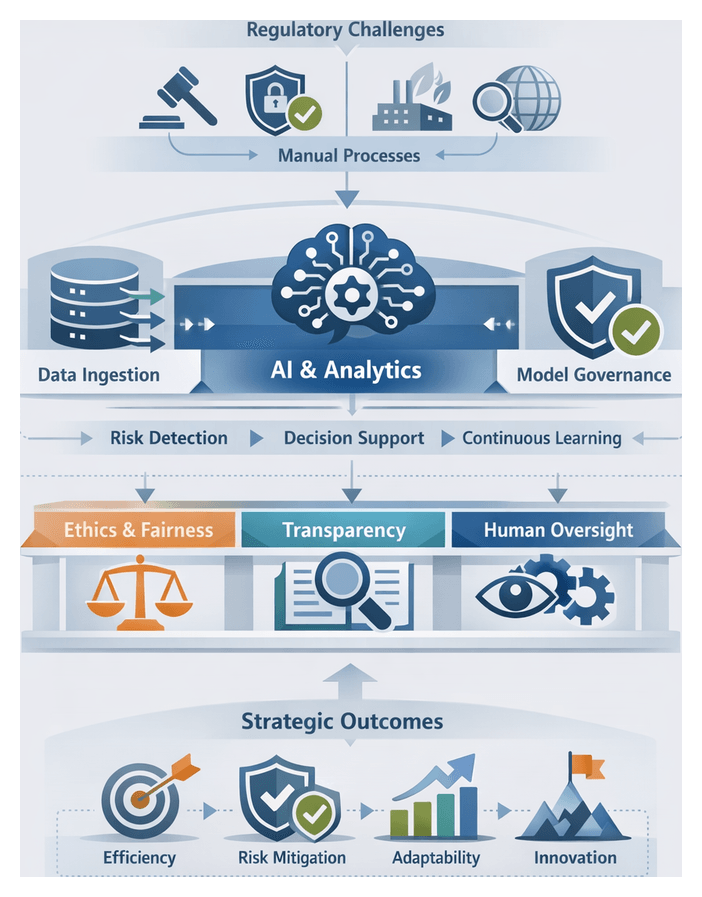
Current Compliance and Risk Management Landscape
Organizations in regulated industries face a complex, ever-changing environment of rules and standards. Financial institutions, healthcare providers, manufacturers and utilities must comply with transparency mandates, data protection requirements, accurate reporting and ethical conduct, while navigating new regulations addressing cybersecurity and environmental risks. Traditional manual approaches—centered on playbooks, checklists and spreadsheets—struggle with high data volumes and rapid regulatory updates, resulting in:
- Lack of real-time visibility across geographies, product lines and channels
- High error rates from manual data entry, delaying risk identification
- Resource constraints that slow investigations, approvals and reporting
- Disparate systems and data silos that impede end-to-end traceability
- Difficulty responding promptly to auditor or regulator inquiries
This burden forces compliance teams to focus on administrative tasks, leaving limited capacity for strategic risk management. Escalating fines, reputational damage and operational disruption underscore the need to move beyond time-consuming manual processes.
AI-Driven Automation Framework
Artificial intelligence transforms compliance and risk management through machine learning, natural language processing and statistical algorithms that scale, adapt and improve precision. AI-driven automation comprises three core components:
- Data Ingestion and Normalization: Automated pipelines harvest structured and unstructured data from internal systems, third-party feeds and regulatory sources. AI reconciles formats, resolves entity identities and enriches records with contextual metadata.
- Intelligent Analysis and Decision Support: Models trained on historical compliance events and policy texts generate risk scores, classify documents and highlight anomalies. Natural language processing interprets regulations, while anomaly detection flags deviations from expected patterns.
- Continuous Learning and Model Governance: User feedback, audit results and regulatory changes feed retraining loops to refine decision thresholds and maintain alignment with control objectives. Governance frameworks oversee validation, versioning and performance monitoring.
This approach offers scalability—processing millions of transactions in near real time—agility in interpreting new rules and precision through combined analytic techniques. By automating routine tasks, compliance functions can focus on strategic oversight, resource optimization and proactive risk mitigation.
Key drivers for AI adoption include:
- Data Complexity and Volume: Daily interactions and transactions generate massive datasets. AI techniques such as natural language processing and anomaly detection extract insights from unstructured text and detect subtle risk indicators.
- Regulatory Velocity: Regulators rapidly issue new guidelines on financial crime, data privacy and third-party accountability. AI systems can ingest regulatory updates, extract relevant clauses and recommend workflow adjustments.
- Cost Pressures and Efficiency Imperatives: Large teams of analysts and auditors are costly and hard to scale. AI automation reallocates human effort to exception handling and strategic tasks, reducing overhead and cycle times.
- Competitive Differentiation: AI-enabled compliance capabilities accelerate product launches, streamline onboarding and demonstrate superior governance, strengthening brand trust and opening growth opportunities.
- Technological Ecosystem: Cloud computing, open-source libraries and pre-trained language models make AI accessible. Platforms can streamline model training, data integration and governance for compliance use cases.
Ethical and Governance Considerations
As AI becomes central to compliance, organizations must address fairness, accountability, transparency and privacy. A mature governance approach balances abstract principles with practical controls.
Bias and Fairness
Bias in AI creates legal and reputational risks. Practitioners distinguish between data, algorithmic and outcome bias, evaluating fairness through metrics such as demographic parity, equalized odds and predictive parity. Mitigation techniques include:
- Oversampling underrepresented classes, synthetic data generation and adversarial debiasing
- Fairness dashboards and toolkits for visualizing disparate impacts
- Continuous auditing of outputs against fairness thresholds to detect drift
Transparency and Explainability
Regulators demand clarity on AI decision-making. Transparency refers to system visibility; explainability to interpretable reasons for outcomes. Best practices involve:
- Documenting model architecture, training data provenance and performance metrics
- Applying post-hoc methods such as SHAP and LIME to trace feature contributions
- Providing interfaces for compliance officers to interrogate outputs
Accountability and Model Governance
Cross-functional model governance committees—incorporating compliance, legal, IT and business—define policies, risk appetites and decision rights. Framework elements include:
- Model risk assessments aligned with standards such as SR 11-7 or ISO 38000
- Independent reviews by internal audit or external parties
- Escalation processes for high-risk or novel AI use cases
Privacy and Data Protection
Automated systems process sensitive data under regulations such as GDPR and CCPA. Privacy by design principles require data minimization, purpose limitation and secure storage. Key measures:
- Data anonymization and pseudonymization in model training
- Consent management platforms to enforce permissible uses
- Regular privacy impact assessments for new AI applications
Ethical Frameworks and Interpretive Guidance
Organizations map high-level principles from the OECD AI Principles, IEEE guidelines and the UN Global Compact into operational policies. Harmonization of frameworks avoids policy fragmentation. Trade-off analysis—employing multi-criteria decision analysis—helps balance conflicting objectives such as accuracy, fairness and transparency. Jurisdictional comparisons follow mapping, gap analysis and regulatory engagement.
Third-Party and Supply Chain Governance
Vendor risk assessments examine adherence to ethical standards, transparency around data sources and model lifecycles, and incident response mechanisms. Contracts grant audit rights and remediation enforcement. Robust oversight prevents hidden risks from black-box solutions.
Operationalizing Ethical Governance
Embedding ethics into operations requires:
- Ethics impact assessments at development gates
- Regular ethics audits reviewing biases and remediation actions
- Training programs on ethical AI for data scientists and compliance officers
Continuous feedback loops capture production issues—bias drift or explainability gaps—and feed policy refinement and model retraining, aligning ethical governance with dynamic risk management.
Human Oversight and Responsible AI
Human oversight is essential for responsible AI governance, integrating automation with transparency, accountability and trust. Leading frameworks embed oversight across the three lines of defense:
- First line: Data scientists and business managers implement tools and monitor outputs.
- Second line: Risk and legal teams set policies, conduct model assessments and ensure regulatory alignment.
- Third line: Internal audit and ethics committees perform periodic reviews of AI performance and governance adherence.
Decision-making involves a human-in-the-loop continuum, with oversight scaled to risk impact. Low-risk tasks rely on automated monitoring with periodic audits, moderate-risk scenarios require human review of flagged cases, and high-risk decisions mandate human approval of AI recommendations.
Regulators worldwide—under the EU’s AI Act and US model risk management guidance—require documented review processes and clear accountability. Organizations adopt centralized policies that satisfy the most stringent regimes and ensure consistent global oversight.
Embedding oversight reshapes workforce capabilities and culture. Cross-disciplinary training and scenario-based exercises equip compliance professionals and data scientists to collaborate effectively. Performance management should recognize oversight contributions, reinforcing its strategic value.
Oversight spans the model lifecycle: from requirements definition and development, through deployment monitoring and anomaly detection, to periodic revalidation and retirement. Continuous oversight mitigates performance degradation and maintains regulatory alignment.
Effective human oversight delivers competitive advantages through regulatory engagement, stakeholder trust and accelerated innovation. Insights from oversight—emerging bias patterns or new risk indicators—inform model refinement and drive continuous improvement.
Next-Generation Compliance Trends
The convergence of generative models, advanced natural language understanding and real-time decision engines promises proactive risk management. These capabilities can automate policy interpretation, simulate regulatory scenarios and adapt dynamically to threats, provided they remain grounded in robust governance and control objectives.
Ethical stewardship and human intervention remain central. Organizations must sustain transparency in model design, maintain accountability for automated decisions and evolve bias mitigation strategies in step with algorithmic complexity. Layered oversight ensures critical review of AI outputs and cultivates expertise for responsible technology stewardship.
Strategic alignment requires board-level articulation of AI risk appetite and coordination between risk, compliance and technology teams. Data governance underpins next-generation AI, demanding rigorous stewardship of lineage, integrity and provenance to prevent error amplification.
Continuous learning and adaptive improvement are success factors. Feedback loops monitoring drift and user insights transform compliance automation into an evolving ecosystem. Proactive regulatory engagement—through sandboxes and standards development—shapes guidelines that accommodate advanced AI, accelerating approval of innovative approaches.
A phased pilot approach in controlled environments helps assess performance, refine controls and address unintended consequences before enterprise-wide scaling. Building interdisciplinary expertise through centers of excellence and targeted training prepares teams to harness advanced capabilities and maintain competitive compliance innovation.
Cross-vendor ecosystems require rigorous due diligence, standardized interfaces and data security mandates to ensure interoperability, auditability and resilience. Transparency and explainability techniques must scale with complexity to justify decisions and preserve stakeholder confidence.
Continuous monitoring of fairness, cross-functional bias review boards and scenario analysis uncover latent inequities and guard against discriminatory outcomes. Modular architectures with stress-testing and failover strategies ensure scalability and resilience under peak loads or adverse conditions.
Strategic Imperatives
- Governance Maturity: Elevate oversight to match AI complexity and ensure cross-functional accountability
- Data Excellence: Institutionalize data governance that underpins reliable analytics and regulatory trust
- Ethical Guardrails: Embed bias mitigation and transparency throughout the AI lifecycle
- Human–Machine Partnership: Define clear roles for human review, exception handling and intervention
- Adaptive Learning: Operationalize continuous feedback loops for model and process refinement
By integrating advanced AI tools with responsible governance and human judgment, organizations can build resilient, transparent and adaptive compliance programs that thrive in an evolving regulatory landscape.
Conclusion
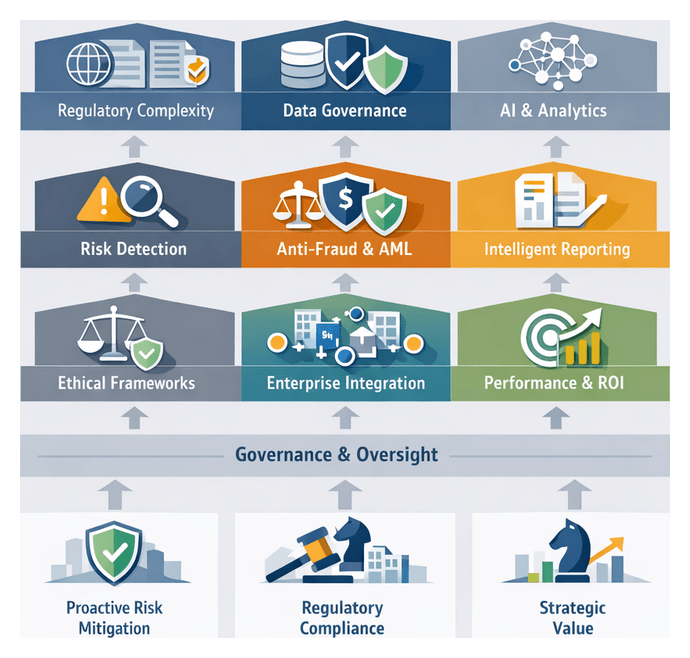
Recap of Core Concepts and Strategic Value
The evolution from manual, rule‐based controls to AI‐driven compliance and risk management frameworks addresses the mounting challenges of regulatory complexity, data scale, and rapid change. Traditional compliance functions, constrained by prescriptive checklists and siloed processes, struggle to deliver agility and insight at enterprise scale. Artificial intelligence introduces automation and contextual intelligence, shifting the paradigm from reactive enforcement to proactive monitoring and adaptive risk mitigation.
We distill the guide’s core concepts into ten interrelated pillars that form the architecture for AI‐enabled compliance:
- Regulatory Complexity and the Need for Automation – As global markets expand and policies evolve, manual controls fail to keep pace. AI‐powered automation is essential for maintaining compliance integrity and operational resilience.
- Foundations of Traditional Frameworks – Historical control taxonomies and accountability structures provide the governance backbone upon which intelligent systems build.
- Data Governance, Integrity, and Lineage – Stewardship models, provenance tracking, and validation protocols ensure the trustworthiness of data that fuels AI models.
- AI Techniques and Machine Learning Fundamentals – Supervised learning, unsupervised clustering, anomaly detection, and natural language processing equip professionals to select and deploy the right analytic methods.
- Risk Detection and Predictive Analytics – Outlier identification, pattern recognition, and forecasting models enable early warning systems that inform resource allocation.
- Intelligent Reporting and Regulatory Filings – Automated document classification, entity extraction, and disclosure generation streamline submission workflows and enhance audit readiness.
- Anti‐Money Laundering and Fraud Prevention – Behavioral analytics, network detection algorithms, and adaptive scoring calibrate sensitivity to novel illicit schemes.
- Integration into Enterprise Risk Governance – Embedding AI tools within existing oversight structures aligns automation with policy intent and decision rights.
- Performance Measurement, ROI, and Continuous Improvement – Key performance indicators, economic analyses, and feedback loops sustain optimization and justify ongoing investment.
- Ethical Considerations and Future Trends – Bias mitigation, explainability frameworks, and human‐in‐the‐loop controls safeguard against unintended consequences and support responsible innovation.
Together, these pillars form a strategic blueprint. Organizations that align AI capabilities with robust governance, data stewardship, and performance metrics can reduce risk exposure, enhance regulatory transparency, and convert compliance from a cost center into a competitive differentiator.
Cross‐Cutting Patterns and Insights
Seven recurring themes link data governance, model development, regulatory alignment, and organizational change. These patterns offer a coherent framework for designing and implementing AI‐driven compliance initiatives.
- Data Integrity as the Cornerstone of Trust – Consistent emphasis on quality, lineage tracking, and alignment with supervisory expectations underpins model reliability and auditability.
- Governance and Oversight as Enablers – Federated governance structures, risk‐based validation models, and transparent accountability transform oversight into a strategic asset rather than a barrier.
- Analytics Maturity and Model Diversity – Layered approaches combine unsupervised, supervised, predictive, and generative techniques. Standardized benchmarking and adaptive learning loops ensure resilience against shifting risk landscapes.
- Regulatory Agility and Ecosystem Alignment – Modular compliance architectures, proactive regulator engagement, and harmonized control taxonomies facilitate rapid adaptation to evolving rules.
- Stakeholder Collaboration and Cultural Integration – Cross‐functional partnerships, change management programs, and executive sponsorship foster a data‐driven culture that embraces experimentation and continuous learning.
- Iterative Improvement and Value Realization – Agile deployment cycles, embedded measurement frameworks, and balanced economic and qualitative metrics drive sustainable ROI and ongoing optimization.
- Ethical Safeguards and Responsible Design – Bias audits, explainable AI tools, human‐in‐the‐loop checkpoints, and alignment with corporate values reinforce accountability and stakeholder confidence.
By internalizing these patterns, organizations can avoid piecemeal investments and build resilient, scalable compliance ecosystems. The interplay among data quality, governance, analytic diversity, regulatory foresight, collaboration, continuous improvement, and ethics constitutes a holistic blueprint for AI‐driven risk management.
Industry Implications for Adoption and Evolution
AI‐driven compliance is reshaping enterprise risk functions across regulated industries. While sector‐specific dynamics influence deployment contexts, several cross‐industry implications emerge:
- Sector‐Specific Regulatory Pressures – Financial services, healthcare, energy, manufacturing, and retail each face unique compliance regimes. Adaptable architectures and jurisdictional logic enable rapid response to diverse requirements.
- Vendor Landscape and Ecosystem Consolidation – Specialized providers and incumbent technology platforms are converging toward modular, end‐to‐end compliance suites that integrate data ingestion, model governance, and reporting capabilities.
- Resource and Skills Imperatives – Interdisciplinary talent—combining data science, domain expertise, and compliance acumen—is critical. Upskilling programs and cross‐training bolster AI literacy and ethical awareness.
- Competitive Differentiation Through Insight – Early adopters leverage deep analytics for nuanced risk segmentation, faster regulatory responses, and differentiated services, transforming compliance into a strategic advantage.
- Collaborative Models with Regulators – Industry consortia, sandbox programs, and proactive engagement accelerate alignment with emerging standards and provide fora for shaping guidance.
- Evolutionary vs. Revolutionary Implementation – A hybrid approach balances incremental enhancements of existing controls with transformational projects, ensuring operational stability while driving innovation.
Anticipated trajectories include the standardization of AI risk taxonomies, expansion of regulatory sandboxes, integration of ethics and sustainability metrics into ESG frameworks, and convergence of compliance with cybersecurity and resilience efforts. A phased adoption strategy—starting with high‐value pilots and expanding through centers of excellence—enables organizations to scale AI capabilities while refining governance and technical foundations.
Actionable Next Steps
To translate strategic insights into measurable progress, organizations should adopt a structured, iterative approach that balances vision with execution:
- Establish Robust Data Foundations – Conduct a data maturity assessment, implement stewardship roles, lineage tracking, and quality metrics to underwrite model trust.
- Define Governance and Ethical Frameworks – Develop policies for model development, validation, deployment, and bias mitigation. Form oversight committees with representation from compliance, legal, IT, and risk.
- Prioritize High‐Impact Use Cases – Identify areas such as transaction monitoring, regulatory reporting, or AML controls where AI can deliver rapid returns. Design pilot programs with clear success criteria.
- Engage Stakeholders Across Functions – Foster cross‐functional collaboration among data scientists, compliance officers, business leaders, and external partners. Communicate strategic objectives and change management plans.
- Implement Iterative Feedback Mechanisms – Establish processes for continuous performance monitoring, error analysis, and model retraining. Use feedback loops to refine algorithms and align with regulatory expectations.
- Measure and Communicate ROI – Track quantitative metrics such as cost savings, processing time reductions, and false positive rates alongside qualitative benefits like audit readiness and stakeholder trust. Report results to executives and regulators.
- Scale Using Modular Architectures – Adopt platforms that enable incremental integration of new models and data sources. Ensure interoperability and design for future regulatory changes.
- Invest in Skills and Cultural Change – Launch training programs to build AI literacy and ethical awareness within compliance teams. Cultivate a culture of experimentation, data‐driven decision‐making, and responsible innovation.
By following these steps, organizations can evolve from exploratory AI pilots to enterprise‐wide, governed automation that enhances compliance, mitigates risk, and unlocks strategic insights. Continuous learning, proactive regulatory engagement, and disciplined governance will ensure that AI‐driven compliance adapts effectively to emerging challenges and opportunities.
Appendix
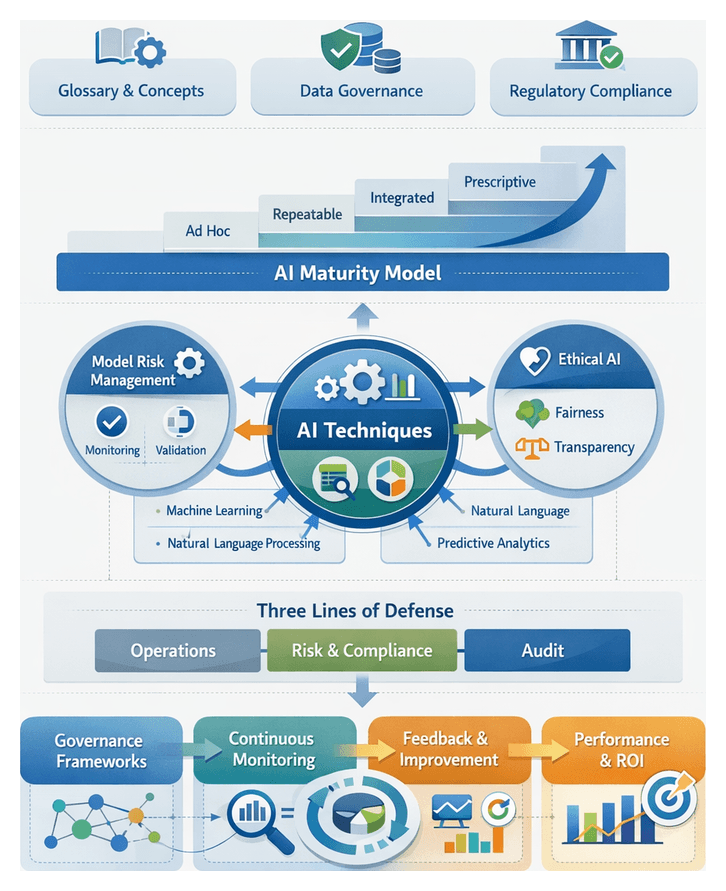
Glossary of Key Terms
Technical Terms
- Artificial Intelligence (AI): Systems capable of tasks requiring human intelligence, including learning, reasoning, and language understanding.
- Machine Learning (ML): Subset of AI where systems improve performance through data exposure without explicit programming.
- Natural Language Processing (NLP): Techniques enabling machines to interpret and generate human language.
- Anomaly Detection: Methods to uncover data points or patterns deviating from norms for fraud or error identification.
- Predictive Analytics: Use of historical data and ML to forecast future events or behaviors.
- Generative AI: Models that create new content—text, images, or code—based on learned patterns from datasets.
- Neural Networks and Deep Learning: Layered model architectures inspired by the brain, excelling at processing unstructured data.
- Model Explainability: Techniques clarifying how AI models arrive at predictions, essential for transparency and compliance.
- Model Drift: Performance degradation over time due to data distribution changes, requiring retraining or recalibration.
- Feature Engineering: Creation and transformation of input variables to enhance model accuracy with domain insights.
Data Governance Terms
- Data Governance: Framework of policies and processes ensuring data availability, integrity, and security.
- Data Stewardship: Responsibility assignment for maintaining data quality, lineage, and access controls.
- Data Lineage and Provenance: Documentation of data origins, transformations, and movements for auditability.
- Data Quality: Measure of data’s fitness for use, assessed by accuracy, completeness, consistency, and timeliness.
- Data Privacy and Anonymization: Techniques to protect personal information, including masking or removal of identifiers.
- Metadata: Descriptive information about data elements supporting discovery and governance.
Regulatory and Compliance Terms
- Anti-Money Laundering (AML): Measures to detect and prevent illicit financial activities.
- Know Your Customer (KYC): Procedures to verify customer identity and assess risk.
- Model Risk Management (MRM): Discipline overseeing risks from quantitative models, covering development, validation, and monitoring.
- Compliance Framework: Structured set of policies and controls ensuring legal and regulatory adherence.
- Regulatory Reporting: Submission of required information—financial statements, risk disclosures—to authorities.
- Basel Committee Principles (BCBS 239): Guidelines for risk data aggregation and reporting in banking institutions.
- COSO ERM Framework: Principles for enterprise risk management and internal control.
AI Techniques and Methodologies
- Transaction Monitoring: Real-time analysis of financial transactions to detect suspicious patterns.
- Behavioral Analytics: Statistical and ML techniques modeling user behavior to identify deviations.
- Document Classification and Entity Extraction: NLP methods for categorizing text and extracting specific data points.
- Robotic Process Automation (RPA): Software robots automating repetitive tasks, often integrated with AI for decisions.
- Feedback Loop: Mechanism feeding model outputs and performance metrics back into training datasets.
- Continuous Monitoring: Ongoing oversight of controls and risk indicators through AI and analytics.
- Governance, Risk, and Compliance (GRC): Integrated capabilities aligning IT, policies, and processes for risk management.
Governance Frameworks and Models
Organizations advance AI-driven compliance through structured models, clear governance layers, and continuous improvement.
AI Capability Maturity Model
- Stage 1 — Ad Hoc Exploration: Isolated pilots without governance or clear metrics.
- Stage 2 — Repeatable Use Cases: AI techniques deployed for specific pain points with basic data pipelines.
- Stage 3 — Integrated Analytics: Predictive models embedded in workflows with oversight and performance tracking.
- Stage 4 — Prescriptive Insights: AI-driven recommendations guide control optimization.
- Stage 5 — Autonomous Controls: Self-learning systems monitor risks and trigger controls with minimal human intervention.
Three Lines of Defense
- First Line: Operational teams deploy AI solutions.
- Second Line: Risk, compliance, and model risk functions set policies and validate models.
- Third Line: Internal audit provides independent assurance on governance and data integrity.
Model Risk Management Principles
- Inventory and Classification: Catalog models by complexity and impact.
- Development and Validation: Document data selection, algorithm choice, and performance testing.
- Governance and Oversight: Assign ownership and define escalation procedures.
- Performance Monitoring: Track accuracy, drift, and exceptions.
- Documentation and Audit Trails: Maintain records of model logic, training data, and validations.
Data Governance and Quality Frameworks
- Stewardship: Define roles for data asset accountability.
- Lineage and Provenance: Track data origins and transformations.
- Integrity and Validation: Automated checks for completeness and consistency.
- Privacy and Security: Anonymization, access controls, and encryption.
Ethical AI Guidelines
- Fairness: Prevent discriminatory outcomes using bias detection and mitigation.
- Transparency: Employ SHAP or LIME for explainability.
- Accountability: Establish human oversight and governance structures.
- Privacy: Apply privacy-by-design and conduct impact assessments.
Continuous Improvement and Feedback Loops
- Case Outcomes: Use analyst validations to retrain models.
- Regulatory Findings: Incorporate audit observations into policy and threshold updates.
- Performance Metrics: Leverage drift detection and accuracy dashboards for recalibration.
- User Feedback: Address false positives and new risk typologies.
Change Management and Adoption
- Executive Sponsorship: Secure leadership support.
- Cross-Functional Collaboration: Engage compliance, risk, IT, and business stakeholders.
- Training and Enablement: Promote data literacy and analytical skills.
- Communication: Maintain transparent dialogue on progress and challenges.
Performance Measurement and ROI
- Cost-Benefit Analysis: Compare automation savings against technology costs.
- Key Performance Indicators: Measure false positive reduction, cycle time compression, and accuracy improvements.
- Balanced Scorecards: Include efficiency, risk reduction, user satisfaction, and regulatory confidence.
- Attribution Models: Use experiments or time-series analysis to isolate AI impact.
Integrated Risk Management Architectures
- Modularity: Deploy AI components as microservices with standardized APIs.
- Interoperability: Enable seamless data exchange with core systems.
- Scalability: Leverage cloud-native infrastructures for elastic workloads.
- Security and Resilience: Implement zero-trust, encryption, and disaster recovery.
Future Outlook
- Generative AI for Policy Drafting: Use large language models to synthesize regulations.
- Real-Time Decision Engines: Integrate streaming analytics for instant interventions.
- Federated Learning: Collaborate across institutions without sharing raw data.
- Advanced Explainability: Adopt new interpretability frameworks for regulatory clarity.
Clarifications on Common Questions
1. Does AI replace human oversight?
AI automates routine tasks but human judgment remains essential for ambiguous cases and strategic analysis.
2. Can AI supplant manual controls?
Use a phased approach: automate high-volume, rules-based activities and preserve manual assessments for qualitative judgments.
3. How to satisfy explainability requirements?
Select interpretable algorithms or apply SHAP and LIME, maintain model cards, and integrate explanation modules in user interfaces.
4. What data governance practices are required?
Establish stewardship roles, automated validation rules, metadata catalogs, and lineage tools to ensure data integrity and traceability.
5. How to integrate with legacy systems?
Adopt API-driven microservices, containerize models, and automate pipelines to normalize legacy data for AI platforms.
6. What ethical considerations arise?
Conduct bias assessments, apply fairness metrics, form ethics committees, and document mitigation actions.
7. Does AI adoption reduce costs?
Assess both direct savings and investments in infrastructure, governance, and change management through cost-benefit analyses.
8. How to measure ROI and effectiveness?
Align KPIs with objectives, track false positives, processing times, and accuracy, and use NPV or balanced scorecards.
9. How to maintain data privacy and security?
Implement privacy-by-design, encryption, role-based access, federated learning, and align with GDPR or HIPAA.
10. What are best practices for model risk management?
Follow SR 11-7: maintain an inventory, classify models, conduct independent validation, monitor performance, and manage changes.
11. How to avoid overreliance on AI?
Embed human approval for high-impact decisions and design interfaces showing confidence scores and explanations.
12. How to manage third-party vendor risk?
Assess vendor governance, require audit rights, review security certifications, and integrate vendor oversight into MRM.
AI Tools
- OpenAI Provider of advanced large language models, including the GPT series, enabling natural language understanding and text generation for policy interpretation and automated report drafting.
- IBM Watson Enterprise AI platform offering a range of services—natural language processing, visual recognition, and anomaly detection—for regulatory text analysis and compliance monitoring.
- UiPath Robotic process automation solution with integrated AI capabilities to automate structured and unstructured data extraction, workflow orchestration, and end-to-end compliance processes.
- Automation Anywhere RPA platform combining robotic process automation with AI and cognitive services to streamline document review, transaction monitoring, and exception management at scale.
- Microsoft Azure Cognitive Services Collection of AI services and APIs for vision, speech, language, and decision support, enabling automated entity extraction, text classification, and sentiment analysis in compliance workflows.
- Google Cloud AI Suite of machine learning products—including AutoML and natural language APIs—designed to accelerate custom model development and deployment for regulatory analytics.
- Amazon SageMaker Managed machine learning platform for building, training, and deploying models at cloud scale, supporting compliance use cases like transaction anomaly detection and fraud prediction.
- DataRobot Automated machine learning platform that simplifies model selection, feature engineering, and deployment, enabling compliance teams to develop predictive analytics without deep coding expertise.
- Palantir Foundry Data integration and analytics platform that unifies disparate sources and delivers a governed environment for building and operationalizing AI-driven compliance solutions.
- Collibra Enterprise data governance and catalog solution that supports metadata management, data lineage, and stewardship, forming a foundational component of trustworthy AI initiatives.
- Microsoft Azure Purview Unified data governance service that automates discovery, classification, and lineage mapping, ensuring transparency and auditability of data feeding compliance models.
- SAS Anti-Money Laundering Integrated AI and analytics suite for transaction monitoring, customer due diligence, and regulatory reporting, offering advanced pattern detection and model governance features.
- FICO TONBELLER Comprehensive compliance and risk management platform with embedded AI for AML, fraud detection, and regulatory reporting, featuring a configurable rules engine and analytics modules.
- IBM SPSS Statistics Advanced statistical analysis software used for regression, time series forecasting, and predictive modeling in compliance risk assessments and scenario analysis.
- ABBYY FlexiCapture Intelligent document processing platform that leverages OCR and machine learning to extract, classify, and validate information from a wide range of document formats.
- NICE Actimize AI-powered financial crime, risk, and compliance platform delivering transaction surveillance, case management, and analytics for banking and capital markets.
- MLflow Open-source platform for managing the end-to-end machine learning lifecycle, including experiment tracking, model versioning, and deployment, supporting reproducibility and governance.
- Kubeflow Cloud-native MLOps toolkit that orchestrates machine learning workflows on Kubernetes, facilitating scalable training, serving, and continuous integration of compliance models.
- SHAP (SHapley Additive exPlanations) Model-agnostic interpretability framework that quantifies feature contributions to individual predictions, supporting explainability requirements in regulated environments.
- LIME (Local Interpretable Model-agnostic Explanations) Tool for generating local surrogate models to explain black-box model predictions, enabling compliance teams to audit and validate AI-driven decisions.
- IBM Watson Discovery Cognitive document search and content analytics service that extracts insights from regulations, policies, and unstructured text to inform control alignment.
- Azure Form Recognizer Azure Cognitive Service for automated extraction of key-value pairs and tables from forms and documents, reducing manual data entry and validation effort.
- UiPath AI Center Extension of the UiPath RPA platform that enables integration of custom and pretrained machine learning models within end-to-end automation workflows.
- Snowflake Cloud data platform that consolidates data warehouses and enables secure, scalable data sharing, forming the foundation for unified compliance analytics.
- Databricks Unified data analytics platform powered by Apache Spark, supporting data engineering, collaborative notebooks, and MLOps for compliance model development.
- Fluentd Open-source data collector for unified logging, enabling structured ingestion of streaming data from applications, devices, and third-party feeds into compliance pipelines.
Additional Context and Resources
- BCBS 239: Principles for Effective Risk Data Aggregation and Risk Reporting Basel Committee guidelines on data governance, accuracy, completeness, and control effectiveness in risk reporting for banking institutions.
- COSO ERM Framework Committee of Sponsoring Organizations framework for identifying, assessing, and managing enterprise risks in a structured and integrated manner.
- ISO 31000: Risk Management International standard providing principles, framework, and processes for managing risks across public and private sectors.
- DAMA-DMBOK: Data Management Body of Knowledge Comprehensive guide on data governance, stewardship, quality, architecture, and metadata management to support AI and analytics.
- GDPR: General Data Protection Regulation European Union regulation on personal data protection, privacy by design, and data subject rights, critical for AI data handling,
- NIST Cybersecurity Framework Voluntary framework of standards and best practices for managing cybersecurity risk and protecting critical infrastructure.
- FATF Recommendations Global standards on anti-money laundering and counter-terrorist financing, laying out risk-based compliance measures.
- SR 11-7: Model Risk Management Guidance U.S. Federal Reserve guidance on governance, validation, and ongoing monitoring of models in regulated financial institutions.
- EU Ethics Guidelines for Trustworthy AI High-level principles and assessment lists from the European Commission’s expert group to ensure reliable and human-centred AI.
- IEEE Ethically Aligned Design Standards and recommendations addressing transparency, accountability, and human well-being in the design of autonomous and intelligent systems.
- FICO Model Governance Best Practices Guidance on model development, validation, deployment, and monitoring, with emphasis on credit scoring and risk analytics.
- McKinsey & Company Risk Insights Research and thought leadership on risk management, compliance automation, and AI adoption from McKinsey’s Risk and Resilience practice.
- Deloitte AI Maturity Model Framework for assessing organizational readiness across strategy, technology, and talent dimensions to scale AI in compliance functions.
- Harvard Business Review: AI in Compliance Article series offering case studies and strategic perspectives on integrating AI into risk and compliance operations.
- ISACA AI and Governance Resources White papers, frameworks, and toolkits on IT governance, risk management, and ethical AI practices.
- PwC: AI for Fraud Detection Industry report examining AI applications in fraud prevention and compliance monitoring.
- OECD AI Principles International guidelines promoting inclusive growth, sustainable development, and human-centred values in AI deployment.
- World Bank Financial Sector Insights Reports on financial regulation, digital transformation, and AI adoption in emerging markets.
- IBM Institute for Business Value Research on technology trends, risk management innovation, and AI ethics published by IBM’s research arm.
- Deloitte Digital Compliance Insights Guides and case studies on building digital compliance capabilities and embedding analytics in risk functions.
- Bain & Company Insights Articles and research on leveraging AI for operational effectiveness, regulatory change management, and risk intelligence.
- Finextra Compliance Blog Analyst commentary and practical advice on AI adoption, regulatory technology, and compliance process automation.
- Gartner Risk Practice Research reports, maturity models, and best practices on AI risk management, regulatory compliance, and emerging technology trends.
- Reference Global Compliance Institute Open-access repository of regulatory citations, compliance frameworks, and training materials for global regulatory regimes.
The AugVation family of websites helps entrepreneurs, professionals, and teams apply AI in practical, real-world ways—through curated tools, proven workflows, and implementation-focused education. Explore the ecosystem below to find the right platform for your goals.
Ecosystem Directory
AugVation — The central hub for AI-enhanced digital products, guides, templates, and implementation toolkits.
Resource Link AI — A curated directory of AI tools, solution workflows, reviews, and practical learning resources.
Agent Link AI — AI agents and intelligent automation: orchestrated workflows, agent frameworks, and operational efficiency systems.
Business Link AI — AI for business strategy and operations: frameworks, use cases, and adoption guidance for leaders.
Content Link AI — AI-powered content creation and SEO: writing, publishing, multimedia, and scalable distribution workflows.
Design Link AI — AI for design and branding: creative tools, visual workflows, UX/UI acceleration, and design automation.
Developer Link AI — AI for builders: dev tools, APIs, frameworks, deployment strategies, and integration best practices.
Marketing Link AI — AI-driven marketing: automation, personalization, analytics, ad optimization, and performance growth.
Productivity Link AI — AI productivity systems: task efficiency, collaboration, knowledge workflows, and smarter daily execution.
Sales Link AI — AI for sales: lead generation, sales intelligence, conversation insights, CRM enhancement, and revenue optimization.
Want the fastest path? Start at AugVation to access the latest resources, then explore the rest of the ecosystem from there.