

AI Agents Unlocked Insights into Automation and Strategic Impact
To download this as a free PDF eBook and explore many others, please visit the AugVation webstore:
Introduction
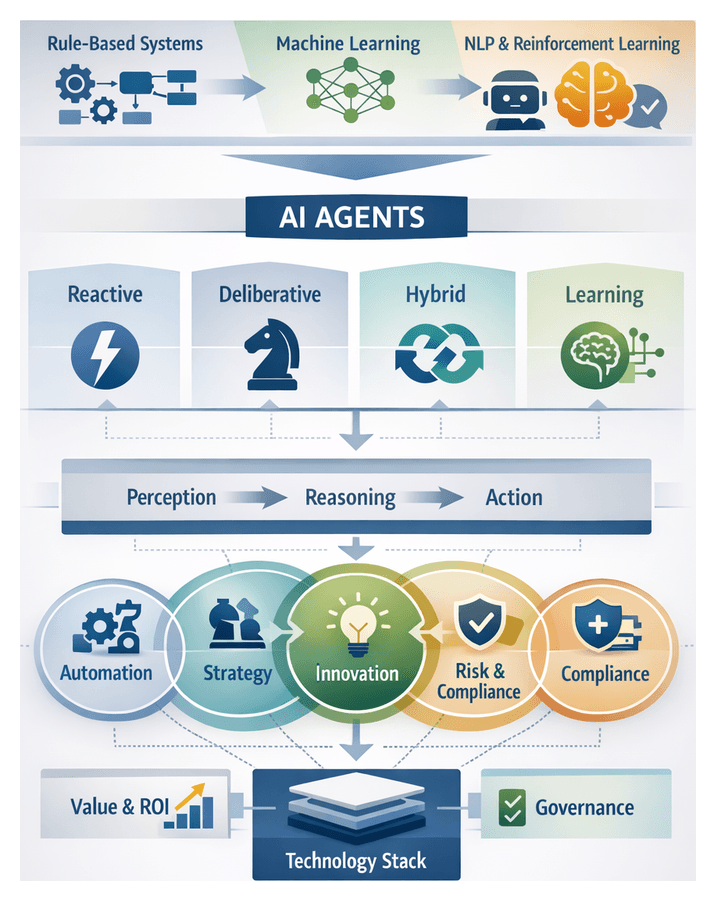
Evolution of Autonomous AI Agents
Autonomous AI agents have evolved through successive waves of innovation, each expanding the capabilities of systems to perceive, decide, and act with minimal human oversight. In the 1960s through the 1980s, early automation centered on rule-based “expert systems” that encoded domain knowledge into deterministic logic engines. Projects such as DENDRAL at Stanford and MYCIN demonstrated that chemical analysis and medical treatment protocols could be captured in rule libraries, while commercial deployments like XCON automated computer order configurations. Although these systems offered transparent decision paths and clear audit trails, they struggled to scale as business contexts shifted and rule bases ballooned.
In the 1990s, the advent of statistical machine learning ushered in a new paradigm. Algorithms such as decision trees, support vector machines, and ensemble methods like random forests became practical through increased compute power and the proliferation of digital data. Open source libraries, notably scikit-learn, standardized model development and evaluation, while enterprise analytics vendors embedded predictive modules into dashboard tools. IBM’s Watson platform famously combined multiple learning methods to answer complex queries, illustrating how data-driven models could adapt without explicit rule authoring.
The 2010s saw rapid advances in natural language processing and conversational interfaces. Deep learning architectures—first recurrent neural networks and later transformers—revolutionized text understanding and generation. Google’s BERT introduced contextual embeddings, and OpenAI’s GPT series reached unprecedented fluency with GPT-4. Cloud services such as Amazon Lex, Microsoft LUIS and Google Dialogflow democratized chatbot deployment, enabling organizations to automate customer support, HR help desks, and knowledge management workflows.
Deep reinforcement learning integrated deep neural networks with trial-and-error policy optimization, marking another milestone. DeepMind’s AlphaGo and OpenAI Five showcased superhuman performance in complex games, while industry applications emerged in warehouse robotics, autonomous driving simulations, and dynamic supply chain planning. These agents learned continuously from simulated environments, refining strategies without manual intervention.
Together, these waves—rule-based systems, statistical learning, NLP-driven interfaces, and deep reinforcement learning—have converged under market pressures demanding speed, adaptability, and resilience. Understanding this evolution equips leaders to recognize the foundations upon which next-generation autonomous agents are built.
Defining Autonomy and Agency
Autonomy denotes a system’s capacity to perceive its environment, make decisions based on that perception, and execute actions without direct human control. Agency extends this concept by emphasizing goal-directed behavior and adaptive strategy formation. Rather than viewing autonomy as a binary trait, industry practitioners interpret it along a spectrum—from reactive systems that trigger predefined workflows to deliberative architectures capable of planning, learning, and self-optimization.
Core interpretive models guide solution design:
- Reactive Architectures: Real-time responses to stimuli, ideal for domains like network security monitoring.
- Deliberative Architectures: Internal simulation and planning layers, suited for strategic decision support.
- Hybrid Architectures: Integration of reactive modules with deliberative planners to balance speed and long-term optimization.
- Learning-Driven Architectures: Continuous retraining with operational data, underpinning personalization engines and adaptive assistants.
These models inform the selection of frameworks such as OpenAI’s GPT-based agents or Google Bard for natural language reasoning, versus platforms like IBM Watson Assistant when auditability and compliance are critical.
Evaluative dimensions extend beyond performance metrics to include capability scope, adaptability, transparency, compliance readiness, integration flexibility, and risk profile. By applying these lenses, stakeholders align on the level of agency required to meet functional objectives and strategic goals.
Market Forces and Strategic Imperatives
Competitive differentiation increasingly hinges on autonomous capabilities. Organizations that deploy AI agents to automate complex workflows, personalize customer interactions, and generate real-time insights capture market share through faster time to decision and 24/7 service availability. Gartner’s PACE Layered Application Strategy positions AI agents as the agile layer interfacing with legacy back ends, enabling rapid responsiveness to evolving requirements.
Efficiency remains a top priority as digital scale amplifies labor costs and process complexity. Autonomous agents reduce manual effort in customer service triage, data reconciliation, and workflow orchestration, freeing professionals to focus on strategic and creative work. Consulting firms report typical operational cost reductions of 20–40 percent over two years, driven by labor efficiency, process reliability, and continuous learning loops that refine agent behavior over time.
Innovation itself is a strategic imperative. AI agents serve as experimental platforms for prototyping new products and business models at minimal cost. Agents can simulate user interactions, gather real-time feedback, and adapt features on the fly—accelerating design sprints in industries from insurance underwriting to pharmaceutical trial management.
Resilience and risk mitigation have risen in importance amid global uncertainties. Agents enforce compliance policies, flag deviations in real time, and generate audit trails, bolstering accountability in regulated sectors. Financial institutions leverage agents for anti-money laundering checks by correlating transaction patterns across disparate sources, while clinical research uses trial-monitoring agents to ensure protocol adherence.
Workforce transformation accompanies agent adoption. Human-in-the-loop models pair agent-driven analysis with human validation, optimizing talent deployment and enhancing job satisfaction. In recruitment, AI agents screen resumes and schedule interviews, improving time to hire and candidate quality.
Industry-specific drivers illustrate these forces in context. In retail, agents power dynamic pricing, predictive inventory replenishment, and conversational shopping assistants. Manufacturing relies on digital twins and predictive maintenance, while logistics employs routing agents to optimize delivery networks. Healthcare and utilities deploy clinical decision support agents and grid management systems that balance renewable integration and demand.
Learning Objectives and Analytical Frameworks
This eBook equips leaders with a structured approach to autonomous AI agents through clear learning objectives and cross-cutting frameworks.
- Contextualize historical and market forces shaping agent technologies.
- Define and categorize autonomous agents to assess applicability across business challenges.
- Build a business case that addresses competitive, operational, and strategic imperatives.
- Understand core technologies—machine learning, NLP, knowledge graphs, and planning algorithms.
- Apply architectural principles—modularity, orchestration, and integration patterns—for scalable and resilient systems.
- Evaluate domain-specific impacts in IT operations, marketing, finance, HR, and compliance.
- Measure impact and establish continuous feedback loops for sustainable value.
- Implement governance and ethical safeguards aligned with emerging regulations.
To support these goals, the following frameworks guide strategic decision-making:
- Evolutionary Lens: A timeline of agent milestones showing how each technological advance addressed market needs.
- Capability-Autonomy Taxonomy: Categorization of agents by autonomy level and task complexity for clear solution comparisons.
- Technology Stack Decomposition: Analysis of perception, reasoning, and action layers to illustrate interoperability of learning, NLP, and planning components.
- Architecture and Orchestration Patterns: Trade-offs among monolithic, microservice, event-driven, and hybrid designs for agility and scalability.
- Domain Impact Matrices: Mapping of agent use cases to operational and strategic outcomes across functions.
- Value Realization and ROI Models: Quantitative and qualitative approaches for estimating cost avoidance, revenue enhancement, and user satisfaction.
- Governance and Ethical Safeguards: Principles and control points for transparency, fairness, and accountability.
Key Challenges and Considerations
Successful agent adoption requires navigating technical, organizational, and governance hurdles. Key considerations include:
- Data Quality and Availability: Incomplete, siloed, or poorly annotated data undermines learning processes and can embed biases.
- Integration Complexity: Legacy systems and human workflows demand extensive API development and refactoring.
- Organizational Readiness: Cultural resistance, skill gaps, and change management often pose greater risks than technical obstacles.
- Scalability Constraints: Proof-of-concepts may not scale without sufficient compute resources, maintenance processes, and retraining capabilities.
- Governance and Ethical Risks: Autonomous decisions require transparent explainability, bias detection, and ethical guardrails to maintain trust.
- Regulatory Uncertainty: Evolving data privacy and algorithmic accountability mandates necessitate ongoing compliance monitoring.
- Vendor Lock-In: Proprietary platforms without open standards can restrict future innovation; assess extensibility and community support.
- Cost-Benefit Trade-Offs: Align expectations around ROI, balancing quick wins with strategic long-term investments.
Keeping these challenges in view ensures that agent initiatives deliver sustainable competitive advantage while balancing ambition with pragmatism.
Chapter 1: Foundations of Autonomous AI Agents
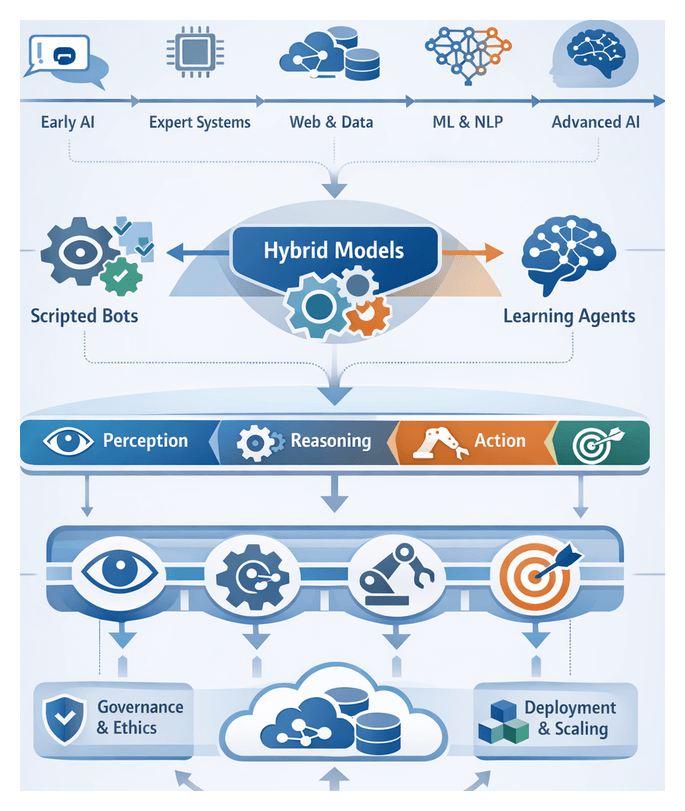
Evolution of Autonomous Agent Technologies
Over six decades, intelligent software agents have evolved from academic curiosities to strategic enablers across industries. Early prototypes such as ELIZA demonstrated scripted conversational patterns in the 1960s, paving the way for 1980s expert systems that embedded domain expertise in knowledge bases and inference engines to support medical diagnosis and financial analysis. The emergence of the internet and distributed computing in the 1990s spurred demand for automated solutions capable of processing data at scale and coordinating workflows across networks. Breakthroughs in statistical machine learning and natural language processing in the early 2000s enabled agents to learn from data and handle unstructured language inputs. In the 2010s, advances in deep neural networks, cloud infrastructure, and GPU acceleration accelerated capabilities. Frameworks such as Rasa and Microsoft Bot Framework introduced ecosystems for building conversational assistants, while research into reinforcement learning and cognitive architectures produced agents capable of trial-and-error adaptation. Today, autonomous AI agents leverage large language models such as OpenAI’s GPT-4, hybrid planning algorithms, and integrated perception, reasoning, and action modules to execute multi-step workflows with minimal human oversight. Key milestones include the shift from rule-based systems to statistical learning, integration of unstructured data processing, and orchestration of autonomous workflows.
Defining Autonomous AI Agents
An autonomous AI agent is a software entity with four core properties: perception, reasoning, action, and goal orientation. The perception layer interprets inputs from structured data streams, text, and sensors using techniques such as natural language processing, vision modules, and anomaly detection. The reasoning component applies algorithms—including knowledge representations, ontologies, and automated planning—to evaluate options, infer context, and prioritize objectives. Action modules execute decisions by invoking APIs, generating communications, or modifying data. A goal-driven architecture ensures that the agent adapts its plan dynamically in response to new information, optimizing strategies to achieve defined outcomes. Framed within disciplines such as artificial intelligence, decision theory, and human–computer interaction, this definition provides a conceptual baseline for assessing readiness across data quality, algorithmic maturity, integration flexibility, and governance structures.
Scripted Bots Versus Learning Agents
Conceptual Distinctions
Scripted bots and learning agents represent two ends of an automation spectrum. Scripted bots follow predetermined workflows and conditional rules, excelling in stable environments with deterministic requirements. Learning agents leverage machine learning and reinforcement learning to infer patterns, adapt to novel inputs, and optimize decisions over time. In scripted solutions, intelligence resides in comprehensive rule sets; in learning agents, intelligence emerges through data-driven model refinement. Hybrid approaches combine rule-based scaffolding with adaptive learning to balance predictability and flexibility.
Industry Perspectives on Scripted Bots
Scripted bots are widely used in finance, human resources, customer service, and IT support to automate high-volume tasks such as invoice processing, identity verification, and incident resolution. They offer transparent behavior, ease of compliance, and rapid deployment within weeks using existing process documentation. Key evaluation metrics include throughput, accuracy, and failure rates under controlled inputs. Limitations arise when processes involve dynamic data, unstructured inputs, or evolving rules, leading to “rule fatigue” and brittle automations. A maturity model assessing process stability, exception frequency, and rule complexity helps identify candidates best suited for scripted automation.
Analytical Frameworks for Learning Agents
Learning agents are categorized by autonomy and capability maturity. Foundational agents use supervised learning for classification, entity extraction, and recommendation tasks. Intermediate agents apply reinforcement learning and unsupervised methods for policy optimization, anomaly detection, and clustering. Advanced agents synthesize information across domains, negotiate outcomes, and self-improve via continuous feedback loops. Organizations should pilot learning agents in low-risk contexts—such as support ticket routing based on sentiment analysis—before scaling to critical decision support or resource allocation roles. Governance frameworks emphasize explainability, bias detection, and traceable decision provenance to build trust and meet regulatory requirements.
Comparative Evaluation Criteria
- Adaptability Versus Predictability: Scripted bots deliver consistent outcomes; learning agents offer adaptability with potential unpredictability.
- Scalability of Intelligence: Rule scaling incurs linear complexity; learning agents leverage model retraining and transfer learning for broader generalization.
- Governance Overhead: Rule-based systems favor auditability; learning agents require robust model governance, bias monitoring, and explainability mechanisms.
- Development Lifecycle: Scripted bots follow traditional software lifecycles; learning agents follow data-centric lifecycles of collection, training, validation, and continuous improvement.
- Operational Maintenance: Script modifications demand manual updates; learning agents depend on automated retraining pipelines and monitoring for concept drift.
Hybrid Architectures and Transitional Models
Many enterprises adopt hybrid models that integrate rule-based scaffolding with learning-driven enhancements. For instance, a support workflow may begin with a scripted decision tree and escalate complex queries to a learning agent trained on historical resolutions. Fraud detection systems often layer deterministic rules over anomaly detection models, combining known signature filters with machine learning to identify novel threats. The “automation continuum” framework maps this journey, illustrating how optimal balances between scripted and learning components evolve as data maturity, governance frameworks, and organizational capabilities advance.
Strategic Alignment and Governance
Organizational Alignment
Shared foundational definitions of autonomous agents enable senior leaders, architects, and business units to prioritize initiatives that deliver competitive advantage. Clarity around autonomy levels, learning requirements, and integration points informs project selection, budget allocations, and governance structures. By anchoring strategic discussions in a unified agent taxonomy, organizations reduce misalignment risks, foster cross-functional collaboration, and sequence investments in data infrastructure, security controls, and model lifecycle management to match maturity.
Risk Management and Governance Contexts
Defining agent autonomy—from deterministic rule enforcement to adaptive learning—allows governance teams to tailor control frameworks to specific risk profiles. Classification schemas inform approval workflows and testing protocols: recommendation agents may require periodic bias assessments and human-in-the-loop validation, while routine extraction agents need standard security reviews. Embedding these definitions into risk and compliance matrices creates nuanced policies that balance innovation velocity with regulatory requirements and ethical considerations.
Investment and Resource Prioritization
Executives evaluate autonomous agent investments against defined benchmarks such as self-learning rates, interpretability, and integration flexibility. A phased development taxonomy—prototype, pilot, scale, and continuous improvement—guides resource allocation for infrastructure, talent, and data operations. Clear demarcation of development phases enables accurate budgeting for model retraining, security assessments, and governance activities, reducing overruns and improving stakeholder confidence in agent roadmaps.
Analytical Frameworks for Foundational Assessment
Consulting and practitioner frameworks assess agent foundations through maturity models, value chain analyses, and risk–benefit matrices. Capability maturity models chart progression from scripted workflows to fully autonomous agents, ensuring conceptual clarity at each stage. Value chain analyses map agent use cases to competitive differentiation points, while risk–benefit matrices juxtapose autonomy levels with operational resilience and reputational impact. These frameworks surface dependencies—data governance, integration standards—and identify areas for foundational refinement before scaling.
Industry-Specific Application Scenarios
Foundational requirements vary by sector. Financial services demand auditability and explainability for trading and credit scoring agents. Manufacturing prioritizes integration with IIoT networks, low latency, and resilience for adaptive control. Healthcare emphasizes patient safety, privacy, and clinical validation, necessitating human-in-the-loop approvals. Retail focuses on personalization and real-time inventory management, orienting foundations toward customer data orchestration and omnichannel elasticity. Tailoring foundational definitions to sector imperatives ensures relevance and compliance.
Core Attributes of Autonomous Agents
Autonomous agents combine eight functional characteristics:
- Perception and Contextual Awareness: Ingest and interpret data from sensors, applications, and text using NLP and vision modules to establish situational models.
- Autonomy and Proactiveness: Plan and execute actions aligned with goals, from reactive responses to self-directed, adaptive behaviors.
- Adaptive Learning: Employ supervised classifiers, reinforcement learning, and continuous pipelines to refine models and improve decision accuracy.
- Interoperability: Integrate with legacy systems and third-party platforms via standardized APIs and middleware.
- Explainability: Apply feature attribution and policy visualization to audit decisions and ensure compliance.
- Security and Privacy: Enforce access controls, encryption, and privacy principles to protect data and meet regulations such as GDPR and CCPA.
- Scalability and Resilience: Use microservices, containers, and event-driven orchestration to support variable workloads and recover from failures.
- Ethical and Governance Alignment: Embed bias mitigation, fairness metrics, and human oversight within lifecycle management.
Evaluating and Prioritizing Agent Initiatives
Decision makers should map agent capabilities to business objectives, maturity, and risk appetite across eight lenses:
- Business Alignment: Prioritize use cases with measurable KPIs, such as reduced mean time to resolution or increased conversion rates.
- Data Readiness: Assess completeness, consistency, and governance of data sources for reliable model training and inference.
- Organizational Adoption: Evaluate change management capacity, talent availability, and collaboration frameworks across AI governance teams, data stewards, and domain experts.
- Technology Maturity: Examine platforms for machine learning, knowledge graphs, and orchestration, balancing turnkey solutions with open-source flexibility.
- Integration Complexity: Identify dependencies, transformation requirements, and bottlenecks, leveraging ESBs and API gateways for streamlined connectivity.
- Governance and Compliance: Define processes for model validation, ethical reviews, and audit trails to satisfy internal policies and external regulations.
- Total Cost of Ownership: Estimate costs for development, infrastructure, maintenance, model retraining, and governance oversight, including data labeling and security testing.
- Time to Value: Adopt phased deployments that deliver early wins and enable incremental scaling based on lessons learned.
Managing Risks and Limitations
Autonomous agents introduce novel risks that require proactive mitigation:
- Model Opacity and Bias: Conduct regular audits to detect unintended correlations and ensure fairness.
- Data Drift: Monitor performance degradation, trigger retraining pipelines, and validate alignment with current contexts.
- Overreliance and Deskilling: Maintain human oversight, escalation protocols, and training to preserve expertise and critical thinking.
- Regulatory Uncertainty: Track AI legislation, engage in industry consortia, and update governance frameworks as standards evolve.
- Security Vulnerabilities: Integrate threat modeling, penetration testing, and runtime anomaly detection to protect against adversarial manipulation.
- Integration Technical Debt: Favor modular architectures and review dependencies to avoid brittle solutions and upgrade roadblocks.
Roadmapping for Sustainable Deployment
Organizations should translate insights into actionable roadmaps through six practices:
- Cross-Functional Governance: Establish a steering committee with representatives from business, IT, data science, legal, and compliance to oversee use case prioritization, standards, and ethics.
- Modular Reference Architecture: Define service contracts for perception, reasoning, learning, and actuation layers. Use containerization and orchestration to decouple components and streamline updates.
- Phased Adoption Roadmap: Sequence pilot initiatives, scaling criteria, and impact milestones. Begin with low-risk, high-value scenarios to build momentum and expand as governance and capabilities mature.
- Data and Talent Ecosystem: Develop robust pipelines for continuous training and invest in upskilling teams on MLOps, AI ethics, and domain knowledge.
- Continuous Feedback Loops: Embed performance metrics, user feedback channels, and automated monitoring to refine algorithms, governance policies, and strategic priorities.
- Culture of Responsible Innovation: Encourage experimentation within guardrails, recognize teams that achieve ethical compliance and business impact, and disseminate learnings to foster a community of practice.
Chapter 2: Enabling Technologies Behind AI Agents
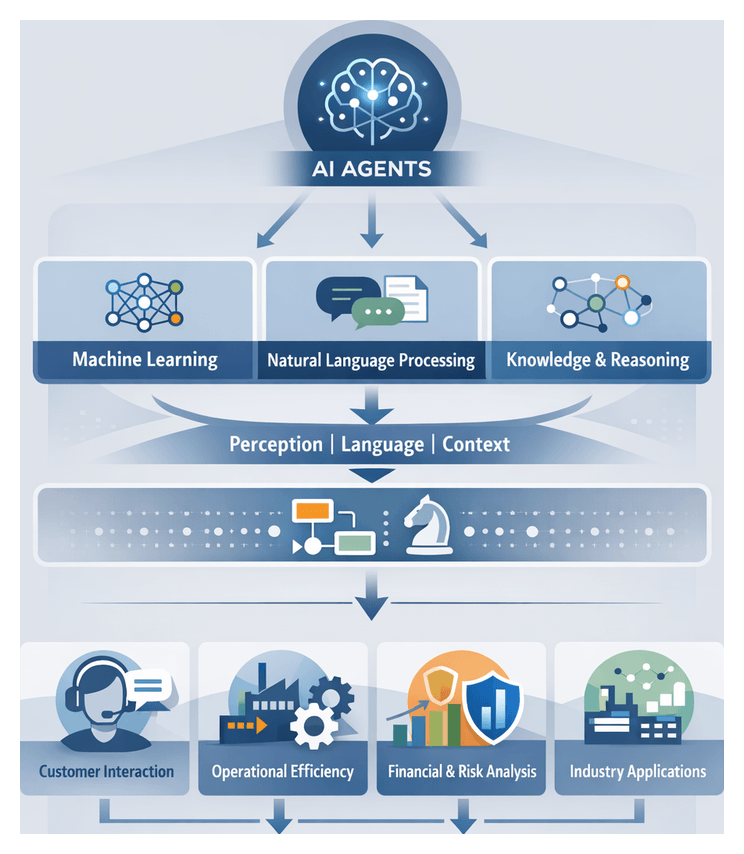
Core Technologies Powering Autonomous Agents
Autonomous AI agents leverage a layered technology stack—machine learning, natural language processing, knowledge representation and planning algorithms—to perceive environments, reason over data and execute actions with minimal human intervention. Recent advances in these domains have converged to enable use cases ranging from intelligent customer engagement to real-time operational management. Understanding the capabilities, dependencies and representative tools in each layer is essential for organizations seeking to architect robust agent solutions.
Machine Learning Foundations
Machine learning equips agents with predictive and adaptive capabilities. Key paradigms include supervised learning for classification and regression, unsupervised techniques for clustering and anomaly detection, reinforcement learning for sequential decision making, and deep learning architectures—such as convolutional neural networks and recurrent networks—for high-dimensional data modeling. Production-ready frameworks like TensorFlow and PyTorch support distributed training, hardware acceleration and integration with data pipelines, enabling agents to ingest sensor streams, user interactions and log data at scale.
Natural Language Processing and Understanding
Natural language processing allows agents to interpret, generate and interact via human language. Core components include tokenization, syntactic parsing, embedding representations, named entity recognition, intent classification and dialogue management. Transformer-based models such as BERT and generative systems like GPT-4 underpin modern language understanding and generation. Open-source libraries—spaCy and Hugging Face Transformers—and managed services like Google Cloud Natural Language accelerate development of conversational interfaces, sentiment analysis pipelines and text summarization modules.
Knowledge Representation and Reasoning
Knowledge frameworks supply the structured context needed for inference and decision making. Knowledge graphs and ontologies encode entities, relationships and business rules in machine-readable formats, enabling semantic search, rule evaluation and data integration across heterogeneous sources. Graph databases such as Neo4j and managed services like Amazon Neptune deliver scalable storage, query performance and ontology management. Standards like RDF and OWL ensure interoperability, while vector stores capture semantic proximities for similarity search and memory augmentation.
Planning, Orchestration and Decision Algorithms
Planning algorithms enable agents to sequence actions, allocate resources and adapt to dynamic conditions. Classical search methods (A\*, plan graphs), hierarchical task networks, dynamic programming and Monte Carlo tree search drive strategic and operational decision making. Workflow orchestration tools—such as OpenAI Gym for simulation, Apache Airflow for pipeline management and Kubernetes operators for service coordination—support both experimentation and production deployment of multi-stage processes.
Together, these core technologies form an interlocking ecosystem. Machine learning and NLP confer perception and language capabilities; knowledge graphs supply contextual depth; and planning frameworks drive purposeful action. Recognizing their interdependencies is the first step toward designing autonomous agents that reliably deliver business value.
Analytical Frameworks for Technology Integration
Evaluating and integrating AI technologies requires structured frameworks that align technical maturity with strategic objectives. Organizations employ technology maturity matrices, risk registers and composite scorecards to benchmark capabilities, anticipate challenges and guide investments across predictive intelligence, language understanding and knowledge integration dimensions.
Assessing Machine Learning Maturity
Machine learning initiatives move from ad hoc experimentation to governed, enterprise-scale deployment. Key evaluation criteria include data quality scorecards, bias-variance trade-off analyses, model robustness under data drift and explainability measures. Tools such as IBM Watson OpenScale and DataRobot trace feature contributions, monitor model performance and support regulatory reporting. Reinforcement learning projects leverage simulation environments to evaluate convergence speed, reward stability and transferability to real-world contexts.
Evaluating NLP Pipelines
NLP evaluation spans intrinsic metrics—perplexity, cross-entropy and benchmark scores on GLUE/SuperGLUE—to extrinsic measures like end-to-end task success and user satisfaction. Fine-tuning strategies are assessed for training convergence, catastrophic forgetting and inference latency. Open-source toolkits (spaCy, Hugging Face models) facilitate rapid prototyping, while dialogue systems employ metrics on fallback rates, average turn length and escalation frequency to refine conversational policies.
Benchmarking Knowledge Structures
Knowledge graphs are evaluated on connectivity measures, average path lengths and cluster coefficients to gauge navigability and expressiveness. Ontology assessments consider coverage breadth, hierarchical depth and axiomatic soundness. Temporal knowledge graphs introduce metrics for consistency across time-stamped snapshots. Governance frameworks track schema versioning, access controls and update lineage to ensure reliability and compliance in regulated industries.
Strategic Fusion and Risk Management
At advanced maturity stages, organizations integrate NLP interfaces to capture user intent, ML models to infer probabilities and knowledge graphs to constrain decision pathways. Composite scorecards combine performance, cost and risk metrics to prioritize initiatives, while risk registers assign ownership and mitigation controls for bias, data inconsistency and model drift. This strategic fusion supports complex scenarios such as regulatory risk assessment, personalized financial advice and adaptive supply chain orchestration.
Emerging Industry Use Cases
Converging AI technologies have given rise to high-impact applications across sectors. Below are representative use cases that illustrate how autonomous agents deliver strategic and operational value.
- Customer Service and Conversational Interfaces: NLP and dialogue management underpin agents that handle inquiries, perform triage and execute transactions. Platforms like IBM Watson Assistant and OpenAI ChatGPT API are assessed on first-contact resolution, customer effort score and cost-to-serve metrics.
- Manufacturing and Predictive Maintenance: ML models trained on sensor data predict equipment failures; rule-based planners schedule maintenance. Industrial IoT platforms—GE Predix, Siemens MindSphere—use knowledge graphs to capture asset hierarchies and failure modes, enhancing MTBF and reducing unplanned downtime.
- Financial Forecasting and Risk Management: Supervised and unsupervised learning models forecast markets and detect anomalies. Knowledge graphs map exposures and instrument hierarchies. Solutions such as Bloomberg Quant Platform integrate ML outputs into portfolio optimization, stress testing and regulatory reporting.
- Healthcare Diagnostics and Clinical Decision Support: ML on imaging and EHR data, combined with NLP extraction and knowledge graphs, recommend care protocols. Services like Google Cloud Healthcare API and IBM Watson Health measure diagnostic accuracy, time-to-diagnosis and clinician adoption rates.
- Supply Chain and Logistics Optimization: Demand-forecasting models, planning algorithms and NLP‐driven risk analysis optimize inventory and routing. Platforms such as SAP Integrated Business Planning enable scenario planning, reducing working capital and improving service levels.
- Marketing Personalization and Recommendation Engines: Collaborative filtering, content-based and hybrid models drive real-time personalization. Salesforce Einstein illustrates how knowledge graphs and sentiment analysis enhance offer sequencing and dynamic pricing.
- HR Analytics and Talent Management: NLP resume parsing, ML scoring and knowledge graphs mapping competencies enable workforce planning. LinkedIn Talent Insights supports diversity metrics, succession modeling and retention forecasting.
- Legal Research and Compliance Monitoring: NLP review of contracts, knowledge graph encoding of regulations and automated workflows reduce review cycles. Solutions like Thomson Reuters Westlaw track false positive rates, audit readiness and human-in-the-loop checkpoints.
- Research and Knowledge Discovery: Knowledge graphs connect scientific findings; topic modeling surfaces trends; semantic search powers exploration. Semantic Scholar accelerates hypothesis generation and cross-disciplinary insights.
- Energy Management and Smart Grid: Load forecasting, dispatch planning and knowledge graphs model grid dependencies. IoT and digital twin frameworks—Schneider Electric EcoStruxure—measure load balance, demand response and renewable integration.
Across domains, leaders emphasize data quality, lineage and governance, value chain analysis and risk-reward evaluation to transition from proofs-of-concept to sustainable, scalable deployments.
Governance, Scalability and Integration Imperatives
Deploying autonomous agents at scale requires addressing technological maturity, data and model governance, performance constraints, security, ethics, interoperability and total cost of ownership. A phased, evidence-based approach aligns initiatives with strategic objectives and risk management frameworks.
- Technology Maturity Assessments: Evaluate readiness of ML models, NLP modules and knowledge graph infrastructures through pilot programs and performance benchmarks. Avoid premature integration of prototypes that may introduce instability or maintenance burdens.
- Data Quality and Model Governance: Implement provenance tracking, schema versioning and continuous validation. Use platforms such as TensorFlow Extended and Hugging Face Accelerated Inference to embed governance checkpoints, detect drift and enforce compliance.
- Scalability and Performance: Balance horizontal and vertical scaling strategies. Leverage containerization, microservices and observability tools for capacity planning, real-time monitoring and latency management to meet service-level objectives.
- Security and Compliance: Adopt end-to-end encryption, role-based access controls and audit trails. Integrate security-by-design principles, regular penetration testing and threat modeling to protect sensitive data and automated actions under regulations such as GDPR and HIPAA.
- Ethical and Bias Risk Mitigation: Establish bias detection algorithms, fairness constraints, ethics committees and impact assessments. Ensure transparent explainability of decision pathways and involve multidisciplinary teams in scenario planning.
- Vendor Lock-In and Interoperability: Favor open standards and container-agnostic architectures. Use formats like ONNX (Open Neural Network Exchange) and industry-standard messaging protocols to preserve portability and flexibility.
- Total Cost of Ownership and ROI Validation: Account for infrastructure, retraining, monitoring and talent acquisition costs. Develop financial frameworks that map cost drivers to measurable outcomes, with ongoing reassessments and feedback loops.
By critically addressing these imperatives, organizations can mitigate risks, govern autonomous behaviors and unlock the strategic advantages of AI agents across enterprise functions.
Chapter 3: Architecture and Design Principles
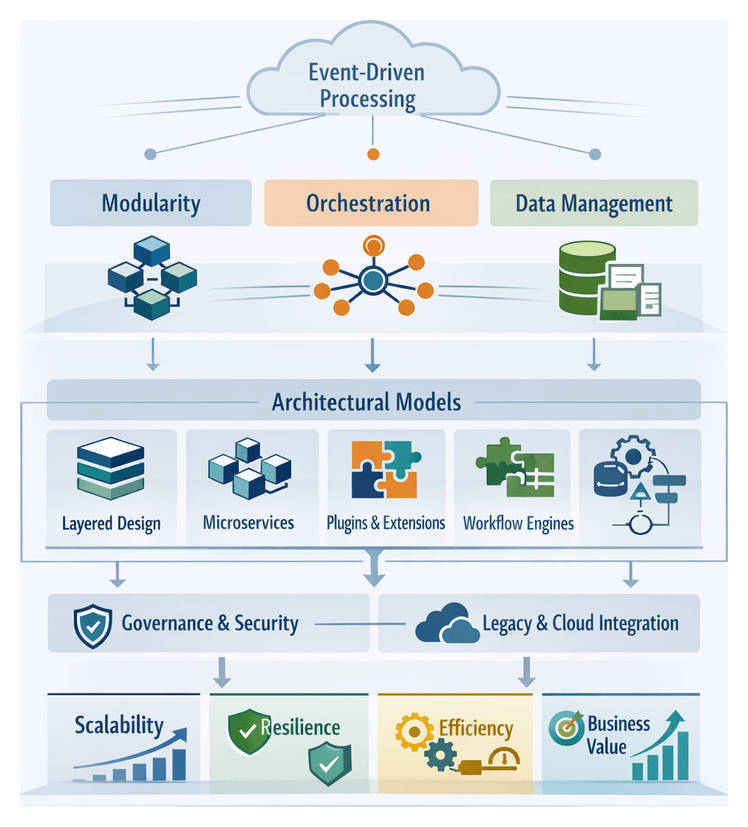
Framing Autonomous Agent Architecture
Autonomous AI agents have evolved from experimental prototypes into mission-critical components that drive strategic outcomes in modern enterprises. Establishing a coherent architecture is essential to balance rapid feature delivery with security, compliance, and operational resilience. A well-structured framework decomposes complex capabilities into modular building blocks, aligns cross-functional teams, and manages risk across cloud platforms, legacy systems, and real-time data streams.
By treating architecture as a strategic asset rather than a technical afterthought, organizations unlock advantages in scalability, resilience, maintainability, governance, and interoperability. Clear separation of concerns and robust orchestration layers ensure that expanding workloads, fault tolerance, policy enforcement, and seamless integration with enterprise applications occur without unmanageable technical debt.
Core Concepts in Agent Design
Every architectural decision for autonomous agents rests on foundational concepts that guide design and evaluation:
- Modularity: Decompose agent responsibilities into cohesive modules—perception, reasoning, planning, execution—that can be developed, tested, and scaled independently.
- Orchestration: Implement supervisory layers to coordinate task assignment, state synchronization, and inter-module communication, supporting complex, multi-step workflows.
- Event-Driven Processing: Favor asynchronous, message-centric interactions to enhance throughput and responsiveness under variable loads.
- Data Management: Define clear data contracts, transformation pipelines, and semantic enrichment processes for knowledge retrieval, analytics, and reporting.
- Extensibility: Design plugin-style interfaces or microservices that permit new skills, integrations, and learning capabilities to be added without disrupting operations.
- Observability: Embed logging, metrics, and tracing at module boundaries to enable real-time health checks, root-cause analysis, and continuous improvement.
These guiding principles establish a shared vocabulary for architects, engineers, and business stakeholders to communicate requirements, trade-offs, and quality attributes throughout the design lifecycle.
Foundational Architectural Models
Several established models serve as blueprints for scaling autonomous agents. Organizations often adopt hybrid patterns to satisfy performance, governance, and resilience requirements:
- Layered Architecture: Components are organized into hierarchical tiers—presentation, orchestration, data—promoting decoupling and reuse when agents interface with diverse channels and data stores.
- Microservices Architecture: Functionality is decomposed into independently deployable services communicating via lightweight APIs or event streams. This model excels in fault isolation and team autonomy.
- Plugin or Agent-as-a-Service: Core capabilities are hosted centrally while domain-specific extensions load dynamically, accelerating customization and specialized skill updates.
- Orchestrated Workflow Engines: A central engine, often rules-driven or state-machine based, choreographs multi-step processes across agents and external systems. It suits complex tasks requiring human-in-the-loop interventions.
Hybrid approaches frequently combine layered and microservices patterns with event-driven orchestration to align agility with governance objectives.
Modularity and Orchestration: Analytical Insights
From an analytical perspective, modularity and orchestration are interdependent facets that determine an organization’s capacity to adapt autonomous agents to changing business, compliance, and performance demands.
Conceptualizing Modularity: Modularity entails logical separation, performance isolation, and interface clarity. Metrics for coupling and cohesion gauge the quality of decomposition. High cohesion and low coupling enable parallel development, targeted testing, and incremental upgrades.
Frameworks such as Domain-Driven Design partition functionality into bounded contexts aligned with business domains—customer engagement, compliance monitoring, predictive analytics—achieving traceability between technical modules and strategic objectives.
Interpreting Orchestration Models: Orchestration governs module interactions, exception flows, and policy enforcement. Centralized orchestration offers predictability and auditability, while event-driven choreography enhances resilience and scalability. Evaluations consider visibility into runtime behavior, policy enforcement granularity, and support for dynamic workflow adjustments.
Balancing Flexibility and Control: Modularity fosters flexibility but can challenge governance when many services require consistent policy application. Orchestration embeds organizational policies—data access rules, security protocols, quality thresholds—into execution fabric, counterbalancing modular autonomy.
Analysts employ dual-axis maturity frameworks plotting modular depth against orchestration intelligence. Organizations with deep modular hierarchies and AI-enhanced rule engines achieve rapid innovation and resilient operations.
Metrics for Architecture Health
Quantitative metrics underpin continuous assessment of modularity and orchestration effectiveness. Key indicators include:
- Change Lead Time: Time from code change initiation to successful deployment. Shorter lead times reflect high modularity.
- Incident Isolation Rate: Proportion of faults confined to a single module, signaling effective failure containment.
- Policy Compliance Score: Percentage of workflows that automatically enforce governance rules, indicating orchestration rigor.
- Inter-Module Latency: Average response time between service calls, measuring performance impact of decomposition.
Integrating these metrics into dashboards allows decision-makers to correlate architectural adjustments with outcomes such as reliability, user satisfaction, and regulatory adherence.
Aligning Architecture with Business Objectives
Architecture ultimately serves strategic goals. Early engagement with stakeholders ensures design decisions map directly to desired outcomes:
- Stakeholder Workshops: Define success criteria, risk tolerances, and compliance requirements with business analysts, security leads, and operations teams.
- Use Case Prioritization: Sequence agent capabilities based on strategic impact, cost savings, and integration complexity.
- Value Stream Mapping: Visualize end-to-end workflows to pinpoint where agent autonomy yields maximal efficiency and risk reduction.
- Architectural Roadmapping: Plan phased deliveries that balance quick wins with incremental rollout of advanced features—continuous learning loops, multi-agent coordination.
Grounding architecture in business drivers secures executive support, optimizes resource allocation, and enables adaptation as priorities evolve without sacrificing stability.
The Strategic Imperative for Adoption
Competitive pressures, operational demands, and innovation imperatives have made autonomous AI agents a strategic necessity across industries:
- Market Dynamics: Digital-native entrants use agents for personalized experiences, real-time supply chain optimization, and accelerated service development, raising the bar for incumbents.
- Operational Efficiency: Agents automate repetitive tasks—data extraction, incident triage, customer inquiries—reducing toil, minimizing errors, and reallocating human effort to high-value work.
- Innovation Acceleration: Continuous insights, automated experimentation, and co-creation with human teams drive rapid hypothesis testing and solution refinement.
- Workforce Transformation: Agents augment human capabilities, prompting reskilling, role evolution, and talent attraction focused on AI oversight and strategic collaboration.
Delayed or partial adoption exposes organizations to market share loss, diminished data leverage, increased technical debt, and compliance vulnerabilities.
Interpretive Frameworks for Decision Makers
Leaders employ analytical lenses to guide agent initiatives:
- Agency Spectrum Analysis: Position agents along a continuum from passive executors to fully autonomous self-optimizers.
- Perception-Reason-Action Loop: Decompose functionality into sensory inputs, inferential processes, and operational outputs to identify performance bottlenecks.
- Task Decomposition Frameworks: Translate high-level objectives into discrete, agent-executable tasks to enable modular orchestration.
- Value Chain Integration: Assess where agents can augment or replace human effort across procurement, production, distribution, and customer engagement.
- Risk-Reward Quadrants: Balance efficiency gains against risks of accuracy, bias, and system fragility.
These frameworks provide common terminology for cross-functional teams and support scenario-based architectural reviews that stress-test modular and orchestration capabilities against future workloads and regulatory changes.
Key Considerations and Limitations
Successful agent deployments require addressing inherent constraints:
- Data Quality and Availability: Incomplete or biased data undermines agent reliability and risks amplifying errors.
- Integration Complexity: Legacy systems and siloed data stores can impede seamless orchestration and interoperability.
- Governance Overhead: Monitoring tools, policy enforcement mechanisms, and audit trails demand investment to mitigate operational risks.
- Ethical and Regulatory Risks: Domains such as finance and healthcare impose stringent compliance, fairness, and explainability requirements.
- Talent and Skill Gaps: Shortages of practitioners versed in AI technologies and domain workflows can delay adoption and compromise quality.
- Change Management: Cultural inertia and process realignment require structured communication and leadership commitment.
- Security and Privacy: Exposed APIs, third-party models, and insufficient access controls create vulnerabilities to breaches and adversarial manipulation.
By acknowledging these limitations up front, organizations can establish realistic timelines, allocate resources effectively, and prioritize remediation strategies.
Bridging Strategy to Implementation
Embedding autonomous AI agents within enterprise roadmaps demands a disciplined approach that unites architecture, metrics, governance, and change management. Organizations should:
- Incorporate modular and orchestration maturity assessments into governance forums.
- Align investment in containerization, workflow engines, and monitoring platforms with strategic business cases.
- Define clear key performance indicators—cycle time reduction, compliance adherence, user satisfaction—to measure agent impact.
- Establish continuous learning and upskilling programs to prepare teams for evolving roles.
- Implement scenario-based stress tests to uncover architectural debt and guide roadmap adjustments.
Through iterative delivery, rigorous measurement, and stakeholder alignment, enterprises can transform autonomous AI agents from isolated experiments into integrated, resilient capabilities that deliver sustainable competitive advantage.
Chapter 4: Automating Operations and IT Management
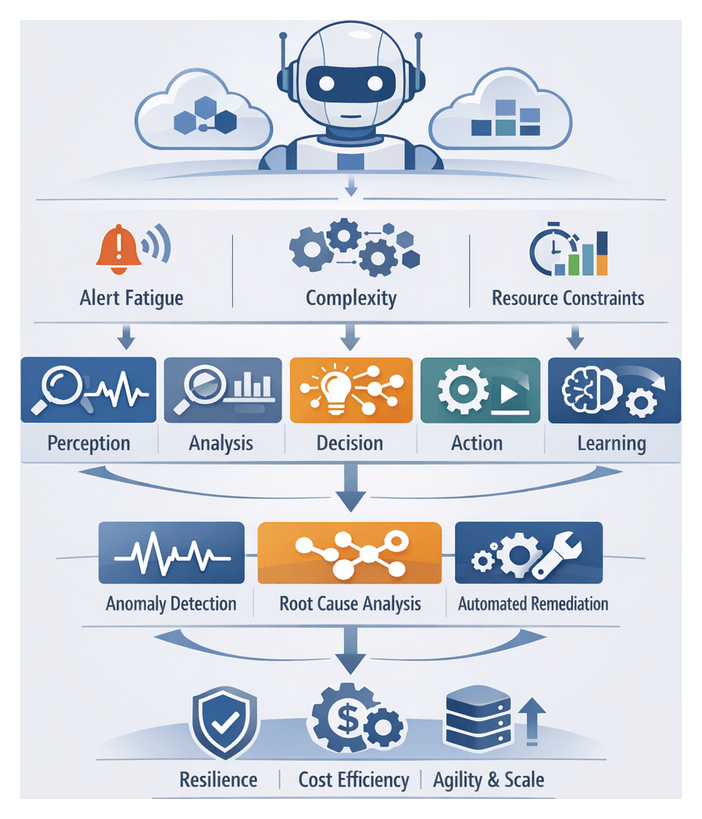
The Rise of Autonomous AI Agents in IT Operations
Autonomous AI agents have emerged as a critical enabler for modern IT operations, shifting routine monitoring, incident response and system maintenance from manual processes to intelligent automation. Faced with distributed cloud environments, microservices architectures and relentless demands for uptime and responsiveness, traditional operational models struggle to maintain agility and reliability.
Organizations confront a host of operational challenges that elevate risk and consume valuable capacity:
- Alert fatigue from high volumes of notifications across diverse monitoring tools
- Root cause complexity due to interconnected services and dynamic dependencies
- Resource constraints as skilled personnel are tied up in repetitive tasks
- Rapid scale and velocity of containers, serverless functions and ephemeral workloads
- Stringent reliability expectations driven by service-level objectives and regulatory demands
Autonomous AI agents address these pressures by continuously ingesting telemetry, detecting anomalies, diagnosing issues, executing remediation playbooks and learning from outcomes. Unlike static scripts or rule-based workflows, they adapt over time through feedback loops, refining thresholds and optimizing actions to accelerate incident resolution and reduce operational toil.
Defining Autonomous AI Agents
- Perception: Continuous ingestion and contextualization of logs, metrics and traces
- Analysis: Anomaly detection algorithms and correlation engines to identify emerging incidents
- Decision-making: Probabilistic models and causal inference to select remediation strategies
- Action: Automated execution of workflows such as scaling resources, restarting services or invoking diagnostics
- Learning: Feedback loops that refine detection thresholds and response tactics based on past results
Historical Evolution
Automation in IT operations has advanced through distinct phases. Early monitoring tools generated alerts when static thresholds were crossed. Integration frameworks then enabled simple orchestration scripts for routine tasks. The advent of AIOps platforms introduced machine learning–driven anomaly detection and alert correlation, reducing noise and clustering related events. Solutions such as IBM Watson AIOps and Dynatrace pioneered dynamic baselining and root cause analysis. Today’s autonomous agents represent a third phase, weaving detection, diagnosis and remediation into a single, adaptive layer of intelligence that scales across dynamic environments.
Strategic Imperatives for Adoption
- Operational resilience: Early anomaly detection and standardized remediation minimize downtime and maintain service continuity
- Cost efficiency: Automation of repetitive tasks lowers total cost of ownership and frees teams for strategic reliability projects
- Agility and scalability: Real-time orchestration aligns with containerized and serverless infrastructures, eliminating manual bottlenecks
Core Capabilities and Strategic Benefits
To deliver transformative value, autonomous agents integrate multiple capabilities into a unified framework:
- Anomaly Detection: Advanced statistical and unsupervised learning models for time series outlier identification
- Event Correlation: Graph-based and probabilistic algorithms to group related alerts into coherent incidents
- Root Cause Analysis: Causal inference and dependency mapping to pinpoint underlying triggers
- Automated Remediation: Executable playbooks that modify system state, scale resources or invoke external services
- Knowledge Retention: Continuous learning mechanisms that capture incident histories and best practices for future refinement
These core functions translate into three primary benefits:
- Operational resilience: Predictable reliability through proactive fault detection and self-healing actions
- Cost efficiency: Reduction of manual toil and reallocation of human expertise to high-value engineering tasks
- Agility and scalability: Programmatic interfaces for dynamic scaling, patching and configuration management
Measuring Impact: Reliability, Toil Reduction and ROI
Core Metrics for Reliability
Organizations track established Site Reliability Engineering indicators to quantify agent impact:
- Service Level Objectives (SLOs) for uptime and latency targets
- Error budgets defining acceptable margins of failure
- Mean Time to Detect (MTTD) and Mean Time to Acknowledge (MTTA)
- Mean Time to Resolve (MTTR) and change failure rates
Agents optimized for continuous anomaly detection and automated remediation can drive statistically significant improvements in these metrics, enabling near-real-time alerting and faster recovery.
Quantifying Toil Reduction
Toil encompasses repetitive, manual operational tasks that scale with service growth. To measure toil reduction, organizations analyze workload categories such as alert triage, log analysis, patch application and incident documentation. Key evaluation criteria include:
- Task coverage: Percentage of manual tasks fully or partially automated
- Time saved: Aggregate human hours reclaimed per period
- Quality of execution: Accuracy and consistency compared to manual processes
- Impact on staff utilization: Shift of workforce allocation toward strategic projects
High-impact deployments often achieve over a 50 percent reduction in manual alert triage within the first quarter, with continued gains as agents mature.
Analytical Frameworks and Interpretive Models
- Reliability ROI Model: Correlates downtime costs, preventable incidents, MTTR reduction and salary savings to forecast payback period and net present value. Sensitivity analyses account for learning curves and diminishing returns.
- Operational Risk Index: Quantifies service risk exposure by weighting incident severity, failure frequency and automated remediation percentage. Guides prioritization of agent deployment to high-risk domains.
Case Illustrations
- E-commerce platform: A log-analysis agent reduced high-severity database incidents by 35 percent, cut manual health checks by 45 percent and saved $120,000 monthly in operational costs.
- Financial services firm: An autonomous remediation agent accelerated critical patch application by 80 percent, reduced unpatched vulnerabilities by 60 percent and improved compliance audit scores.
- Telecommunications provider: An anomaly detection agent improved MTTD from 20 minutes to under five, reduced traffic-anomaly incidents by 30 percent and freed 40 percent of field engineering time for network optimization.
Balancing Automation Benefits and New Failure Modes
To avoid unintended consequences, organizations establish guardrails around agent actions:
- Monitor false positive and false negative rates to prevent alert fatigue or undetected incidents
- Maintain detailed logs of agent decisions for audit and post-incident review
- Integrate automated actions with change management pipelines and approval workflows
- Ensure agents scale reliably during major outages or traffic spikes
Continuous Refinement
- Comparative A/B testing of agent-augmented versus manual workflows
- Error budget tracking to monitor impact on service-level agreements
- Inclusion of agent contributions in post-mortem analyses for ongoing improvement
- Monitoring machine learning performance metrics such as precision, recall and latency
Strategic Insights for Decision Makers
- Prioritize high-impact domains with significant incident costs and toil intensity for early adoption
- Invest in robust observability platforms that unify logs, metrics and traces
- Define governance frameworks for agent authority, escalation criteria and human oversight
- Foster cross-functional collaboration among reliability, development, security and business teams
- Plan for scalable evaluation templates to maintain consistency as adoption expands
Deployment Scenarios and Organizational Readiness
Autonomous agents derive strategic value when aligned with specific operational contexts. Leaders must interpret agent capabilities through domain-specific lenses and match deployment scenarios to organizational objectives and risk profiles.
Enterprise IT Environments
- Proactive capacity management across mainframes, virtual clusters and legacy systems
- Automated incident triage integrated with enterprise service management platforms
- Predictive fault detection and automated failover coordination for mission-critical services
Cloud and Hybrid Architectures
- Predictive autoscaling based on traffic forecasts rather than reactive thresholds
- Cost governance by identifying underutilized assets and recommending rightsizing actions
- Hybrid synchronization of on-premises and cloud resources to minimize service disruptions
DevOps and Continuous Delivery Pipelines
- Pipeline health monitoring to detect flaky tests, code quality regressions and configuration drifts
- Release approval orchestration by collating security, performance and stakeholder inputs
- Rollback intelligence recommending targeted rollbacks based on root cause analysis
Site Reliability Engineering and Incident Management
- Alert correlation to cluster related events and reduce on-call burnout
- Automated runbook triggers for predefined remediation actions under human oversight
- Preliminary incident report generation synthesizing timeline events and impact estimates
Network and Security Operations
- Threat hunting automation correlating intrusion detection events with user behavior analytics
- Policy enforcement by automatically remediating deviations from network segmentation rules
- Vulnerability response prioritizing patches based on exploit likelihood and asset criticality
Edge Computing and IoT Operations
- Predictive maintenance through local analysis of sensor streams and just-in-time interventions
- Local orchestration of firmware updates and configuration changes without continuous connectivity
- Data triage at the edge to filter and enrich streams before central transmission
Regulated Industries
- Comprehensive logging of agent actions to satisfy audit and compliance requirements
- Strict data handling policies to protect sensitive customer or patient information
- Alignment of automated changes with formal change advisory board processes
Adoption Models and Maturity
- Pilot initiatives in low-risk environments to validate efficacy and ROI assumptions
- Centers of Excellence to define standards, share best practices and govern expansion
- Phased rollouts aligned with operational priorities and capacity for change absorption
Assessing Readiness and Risk
- Risk–reward matrices to balance operational gains against skill gaps and data quality challenges
- Governance alignment through steering committees spanning IT, security, compliance and business stakeholders
- Skill development programs for data science, AI strategy and agent oversight capabilities
- Change management communication plans to cultivate trust and address concerns early
Best Practices and Key Caveats
Strategic Alignment
- Link agent KPIs to business outcomes such as MTTR, service availability and cost per ticket
- Embed automation roadmaps within IT service management and reliability maturity models
- Periodically revalidate objectives to prevent mission drift and retire outdated agents
Data Quality and Observability
- Unify logs, metrics and traces into a single context layer
- Enforce data governance policies for schema evolution, retention and access controls
- Use adapters or middleware to instrument legacy systems and translate proprietary formats
Incremental Deployment
- Begin with low-risk, high-volume tasks to tune policies and escalation criteria
- Define success metrics, feedback loops and rollback procedures for pilot programs
- Roll out agents progressively across development, staging and production environments
Cross-Functional Collaboration
- Include operations, development and security teams in automation design discussions
- Maintain transparent decision logs for audit and stakeholder review
- Convene regular sessions combining quantitative data with qualitative feedback
Continuous Monitoring and Adaptive Tuning
- Implement adaptive algorithms that adjust sensitivity based on performance metrics
- Monitor agent-generated alert fatigue indices to detect excessive false positives
- Establish cadences for model retraining, rule updates and playbook refinements
Key Caveats to Address
- Overautomation and Alert Fatigue: Excessive low-value alerts can desensitize operators and obscure genuine incidents.
- Platform Maturity Dependency: Early-stage observability frameworks may lack robust APIs, limiting integration scope.
- Shadow Automation: Decentralized scripts can lead to redundancy, conflicts and maintenance overhead.
- Security and Compliance Risks: Privileged agents must use secure credentials and generate audit trails for regulatory adherence.
- Opaque Decision Models: Black-box behavior can erode trust; explainability frameworks are essential.
- Hidden Total Cost of Ownership: Ongoing investments in retraining, playbook updates and topology tracking can exceed initial estimates.
- Scalability Constraints: Agents tuned for specific workloads may struggle in hybrid or multi-cloud environments with diverse configurations.
Governance Frameworks
- Maturity Model Assessment: Plot current and target states across detection accuracy, response sophistication and governance rigor to guide investment roadmaps.
- Risk-Benefit Analysis Matrix: Categorize use cases by impact severity and frequency to determine autonomy levels and human oversight requirements.
Autonomous AI agents represent a paradigm shift in IT operations. Their promise of reduced manual toil, accelerated incident resolution and enhanced system reliability can be realized only through disciplined alignment with strategic objectives, robust data foundations, phased deployments, cross-functional collaboration and vigilant governance. By embracing these best practices and addressing key caveats, organizations can harness the transformative potential of operational automation while preserving resilience, compliance and human-centered oversight.
Chapter 5: AI Agents in Sales, Marketing and Customer Engagement
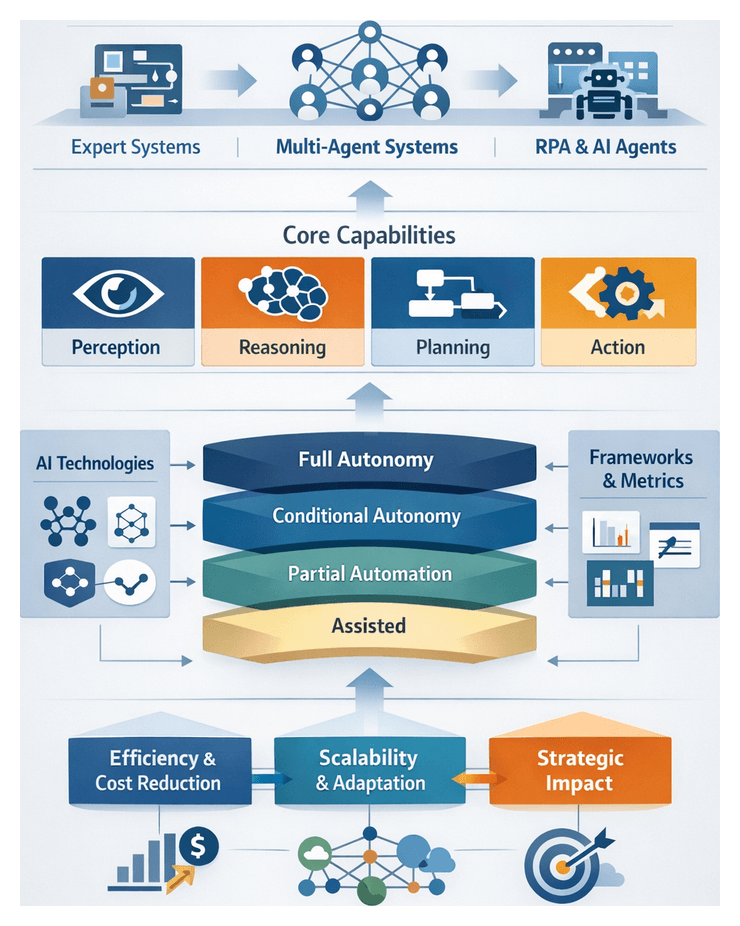
Evolution of Autonomous Agent Technologies
Over the past four decades, the landscape of intelligent systems has undergone a series of paradigm shifts. In the 1980s and 1990s, expert systems attempted to encapsulate human expertise in rule-based engines for domains such as medical diagnosis and financial planning. Although these early systems laid the foundation for automated decision-making, they were constrained by brittle rule sets and an inability to handle unanticipated scenarios.
By the late 1990s and early 2000s, research in multi-agent systems introduced software entities capable of cooperating, negotiating and coordinating to achieve complex objectives. Academic frameworks such as JADE and coordination models like TSpaces illustrated how agents could form dynamic coalitions and distribute computation across networked environments. Despite their promise, integration challenges and a lack of standardized protocols limited enterprise adoption.
The 2010s witnessed the rise of robotic process automation with platforms such as UiPath, Automation Anywhere and Blue Prism. These tools enabled organizations to script repetitive user-interface interactions at scale, reducing manual effort and error rates. However, their deterministic workflows lacked the cognitive agility needed to interpret unstructured data or adapt to evolving business rules.
The emergence of large-scale machine learning and natural language processing has given rise to a new class of autonomous AI agents that perceive context, reason over diverse data sources and execute multi-step workflows. Solutions such as ChatGPT, Microsoft Copilot, Watson Assistant and Dialogflow demonstrate the ability to generate human-like responses, extract key entities and integrate with downstream systems via APIs. These agents can handle customer inquiries, perform predictive maintenance checks and orchestrate complex service operations with minimal human intervention.
Concurrently, enterprises face talent shortages in areas such as data science and IT support, escalating customer expectations for personalized experiences and an explosion of structured and unstructured data sources. This confluence of market forces has accelerated the imperative to adopt intelligent automation systems that learn continuously, make decisions in real time and adapt orchestration across siloed applications. The current challenge is to harness these autonomous AI agents to build resilient, scalable and contextually aware business processes.
At the enterprise level, organizations are combining knowledge graphs and semantic ontologies with API-driven architectures to model domain entities and relationships. This integration supports real-time context sharing across distributed agents and legacy systems, enabling more nuanced reasoning and coordination in complex workflows.
Conceptualizing Autonomous AI Agents
At their core, autonomous AI agents are software constructs endowed with four interrelated capabilities: perception, reasoning, planning and action. Unlike traditional bots that execute predefined scripts, these agents interpret new inputs, update internal state and adjust their strategies dynamically.
- Perception: Ingesting structured and unstructured data streams such as transactional records, sensor feeds and natural language inputs.
- Reasoning: Modeling knowledge, evaluating potential actions and weighing outcomes against objectives and constraints.
- Planning and Decision Making: Generating multi-step workflows or dialogue protocols that progress from current states to desired goals.
- Action and Adaptation: Executing plans via system integrations or user interfaces and refining behavior through feedback loops.
Autonomy exists on a continuum rather than as a binary attribute. Organizations commonly map agent use cases to discrete levels of oversight and sophistication:
- Assisted Agents: Offer alerts or suggestions with final human approval.
- Partial Automation Agents: Execute routine tasks under defined conditions, invoking human oversight for exceptions. An example is Amazon Lex-powered conversational flows with scripted branching.
- Conditional Autonomy Agents: Adapt behavior within policy constraints, escalating or learning when encountering novel scenarios.
- Full Autonomy Agents: Assume end-to-end responsibility, self-monitor performance and continuously update policies through learning pipelines.
Mapping specific business scenarios—such as conversational assistants, forecasting tools or supply-chain orchestrators—to these autonomy levels guides architectural decisions and governance models. For instance, an IT incident response agent in assisted mode may only suggest remediation steps, while a full autonomy deployment could identify anomalies, predict root causes and implement corrective actions without human approval.
Interpretive Frameworks
To evaluate and prioritize agent initiatives, decision makers use analytical lenses such as the Capability-Outcome Matrix, which cross-references functional competencies—natural language understanding, predictive analytics and robotic process automation—with desired strategic outcomes like cost reduction, revenue growth and compliance assurance. By plotting capabilities against objectives, organizations identify portfolio gaps and investment priorities.
The Socio-Technical Integration Model emphasizes the interplay between agent autonomy and human workflows, examining trust calibration, role redefinition and change management. Recognizing that agents operate within organizational cultures, this model underscores the need for aligned processes and governance structures to enable seamless human-agent collaboration.
Theoretical Perspectives and Metrics
Cognitive architectures such as Soar and ACT-R propose layered modules for perception, working memory and decision control, while robotics paradigms adopt sense-plan-act loops to continuously refine an agent’s internal model of its environment. Industry reference architectures adapt these concepts into modular systems comprising knowledge graphs, decision orchestration engines and machine learning pipelines for supervised, unsupervised and reinforcement learning.
Analysts quantify autonomy through metrics that capture responsiveness, proficiency, adaptability and compliance. Decision latency measures the time from event perception to action execution, while success rate tracks completed tasks without human correction. Adaptation index evaluates performance improvement when agents encounter novel data, and compliance adherence gauges alignment with policy constraints. Benchmarking against pilot studies or industry reports enables organizations to calibrate maturity levels and set performance targets.
Strategic Implications and Roadmapping
The way an enterprise frames its autonomy ambitions shapes its strategic roadmap. A full autonomy-first framing can drive ambitious research and rapid proof-of-concept initiatives but may introduce governance risks and unintended behaviors. Conversely, a phased approach that begins with assisted modes can build user trust and deliver quick wins, laying the foundation for more advanced deployments.
Leaders adopt a hypothesis-driven methodology, launching pilot programs to validate theoretical assumptions, measuring outcomes against frameworks like the Capability-Outcome Matrix and iterating on architectural designs informed by cognitive models. This calibrated framing ensures that investments in autonomous agents yield sustainable value while maintaining organizational readiness for increasingly sophisticated autonomy levels.
Common challenges in agent deployments include data quality issues, integration complexity and establishing user trust through transparent decision explanations. Enterprises address these through master data management practices, standardized APIs and human-in-the-loop checkpoints that refine agent reasoning and build stakeholder confidence.
Key Chapter Objectives
- Trace the evolution of agent technologies from rule-based systems to cognitive, self-directed agents.
- Define core concepts and autonomy taxonomies to align stakeholder expectations and guide architecture.
- Assess market drivers and strategic urgency for agent adoption across business functions.
- Identify enabling technologies—machine learning, natural language processing and planning algorithms—underpinning agent capabilities.
- Apply interpretive frameworks to prioritize use cases and measure performance metrics.
- Anticipate governance, ethical and operational considerations essential for responsible integration.
- Develop a phased roadmap for iterative adoption, continuous improvement and enterprise-scale deployment.
Transforming Go-To-Market with Autonomous Agents
In sales and marketing, autonomous AI agents redefine the go-to-market model as a dynamic marketplace ecosystem. Agents collaborate with human teams, channel partners and systems to deliver synchronized, personalized experiences across the customer journey, replacing rigid, campaign-centric approaches.
Strategic shifts include:
- Value Proposition Evolution: Agents experiment with micro-variations of offers, bundles and messaging in real time, leveraging A/B testing frameworks to refine propositions based on live customer feedback rather than fixed quarterly cycles.
- Adaptive Pricing Mechanisms: Through integration with pricing engines and competitive intelligence feeds, agents adjust price tiers, discounts and promotional offers dynamically, optimizing for individual propensity scores and market conditions.
- Continuous Lifecycle Management: The linear funnel transforms into an always-on loop where agents monitor engagement signals, detect churn risks, re-engage lapsed accounts and recommend upsell or cross-sell opportunities without manual triggers.
- Collaborative Channel Networks: Autonomous agents coordinate messaging and handoffs across digital, field and partner channels, ensuring consistent brand voice while adapting execution to channel-specific dynamics.
Real-Time Personalization and Segmentation
Living segmentation allows agents to refine audience clusters continuously. By ingesting streaming transactional data, behavioral analytics and third-party feeds, agents can detect emergent micro-segments—niches of high-propensity customers responding to novel triggers. Frameworks guiding investment include:
- Contextual Relevance Framework: Aligns content and offers with real-time variables such as location, device and recency of interactions.
- Predictive Segment Dynamics: Prioritizes segments based on forecasted conversion velocity and lifetime value to allocate engagement resources effectively.
- Feedback Loop Integration: Feeds performance metrics from agent interactions back into segmentation models, automating model retraining and driving continuous refinement.
Channel Orchestration and Attribution
Agents operating across email, chat, social media, digital advertising and field platforms require a unified orchestration layer to manage both sequential and parallel engagements:
- Sequential Coordination: Agents negotiate handoffs between channels, escalating from bot-driven interactions to human sales reps when intent thresholds or risk criteria are met.
- Parallel Engagement: Multiple agents support a single customer concurrently, delivering personalized content recommendations while other agents manage transactional inquiries or technical support.
Attribution analytics must evolve from last-click and last-touch models to causal inference frameworks that leverage dwell times, sentiment shifts and micro-conversion events captured by agents. This granular attribution clarifies the true drivers of pipeline acceleration and informs budget allocation, channel investment and ongoing optimization of agent behaviors.
Organizational Structures and Talent Shifts
As agents assume routine tasks—lead qualification, follow-up scheduling and basic personalization—human roles shift toward strategic oversight, creative problem solving and relationship management. Emerging roles include:
- Agent Strategists: Define decision logic, engagement rules and performance metrics that steer agent behavior.
- Data Interpreters: Translate agent-generated insights—such as micro-segment discoveries and sentiment trends—into actionable business strategies.
- Experience Curators: Design human-agent collaboration points, ensuring seamless handoffs and preserving brand authenticity.
Matrixed “fusion teams” co-locating data scientists, marketing technologists and sales leaders enable rapid iteration of agent strategies and align accountability for outcomes. Without these structural and talent shifts, organizations risk underutilizing agent capabilities or encountering cultural resistance that slows adoption.
Governance, Compliance and ROI Considerations
Scaling autonomous agents in regulated or consumer-facing markets requires robust governance frameworks. Policy domains include data privacy and security under regulations such as GDPR and CCPA, message approval workflows, escalation protocols for high-risk interactions and auditability of decision logs. Transparent disclosures of AI involvement and consent management enhance customer trust and reinforce brand integrity.
Strategic investment models must account for the continuous nature of agent programs, including data pipeline maintenance, model retraining and orchestration tuning. Organizations measure success using a balanced scorecard:
- Cost Avoidance Metrics: Reduced manual follow-up time, shorter sales cycles and lower content production costs.
- Revenue Acceleration Indicators: Uplifts in deal velocity, win rates and incremental revenue from agent-sourced opportunities.
- Customer Equity Enhancements: Improvements in lifetime value, retention rates and referral volumes driven by elevated engagement quality.
- Strategic Agility Scores: Speed of campaign launches and new segment entry enabled by agent workflows.
Early adopters report engagement rate uplifts of 15 to 30 percent and reductions in sales cycle length by up to 25 percent, illustrating the measurable impact of agent-driven go-to-market strategies on top-line growth and operational efficiency.
Strategic and Operational Takeaways for Engagement Automation
The deployment of autonomous AI agents in customer engagement requires a holistic approach that marries strategic vision with operational rigor. The following distillations draw on the analytical, technical and organizational dimensions discussed earlier.
Strategic Insights
Autonomous agents redefine competitive advantage by shifting the focus from cost efficiency to the orchestration of personalized, context-aware experiences. Success depends on aligning agent objectives with enterprise goals, embedding experimentation into workflows and leveraging agents as compounding sources of strategic insight.
- Personalization at scale drives higher engagement and deeper relationships.
- Integration of agent KPIs with business targets ensures measurable impact.
- Hypothesis-driven A/B testing and multivariate analysis accelerate learning.
- Cross-channel orchestration reinforces brand consistency and maximizes reach.
- Agents uncover latent segments and behavioral patterns to inform strategy.
- Governance and transparency reinforce customer trust and brand integrity.
Operational Imperatives
Effective engagement automation hinges on clear governance structures, interdisciplinary collaboration and investment in specialized talent. Processes must define decision rights, oversee exception handling and maintain comprehensive documentation for audit and compliance purposes.
- Governance models detail accountability, escalation protocols and human-in-the-loop checkpoints.
- Fusion teams align domain expertise from marketing, sales, customer success and IT.
- New roles such as AI engagement architects and data ethicists bridge strategy and development.
- Change management and training prepare teams to collaborate with autonomous systems.
- Documented decision logic supports transparency and regulatory compliance.
Analytical Reflections
Beyond open rates and conversion metrics, organizations should integrate behavioral and sentiment analytics, leveraging agent telemetry to trace decision pathways and identify optimization opportunities.
- Combine traditional metrics with sentiment and behavioral indicators for deeper insight.
- Use agent telemetry data to link internal decisions to customer outcomes.
- Implement real-time dashboards to surface anomalies in agent behavior.
- Incorporate qualitative feedback to validate reasoning and tone appropriateness.
Technology Integration and Scalability
A robust engagement automation architecture employs API-first integration patterns, modular microservices and scalable infrastructure to maintain context flow and support peak campaign demands.
- Adopt standardized APIs for seamless data exchange with CRM and marketing platforms.
- Decompose agent functionality into microservices for targeted scaling.
- Ensure infrastructure supports burst capacity and robust data quality pipelines.
Ethical and Compliance Considerations
Responsible automation demands privacy-by-design, disclosure of AI involvement and regular fairness audits to mitigate bias and uphold customer rights.
- Embed consent management and transparency disclosures in agent workflows.
- Minimize data retention and exposure through privacy-by-design practices.
- Conduct bias detection and fairness assessments on recommendation models.
- Retain human oversight for high-risk or regulated interactions.
Future-Proofing Strategies
Preparing for the next generation of engagement agents involves investing in MLOps capabilities, exploring hybrid human-agent architectures and monitoring advances in generative and multimodal AI.
- Implement MLOps frameworks for model versioning, monitoring and drift detection.
- Design hybrid workflows that combine autonomous outreach with human negotiation support.
- Track developments in generative AI for enhanced language and multimodal interactions.
- Assess the integration potential of voice, video and text agents.
Limitations and Risks
Organizations must guard against data governance gaps, over-automation and resource constraints that can undermine customer experience and brand authenticity.
- Inadequate data governance compromises personalization accuracy and trust.
- Excessive automation may erode the human touch central to premium experiences.
- Off-the-shelf solutions may lack the flexibility for specific market nuances.
- Rapid regulatory or sentiment shifts necessitate agile governance and iteration.
- Advanced AI capabilities can strain budgets and technical resources.
- Maintaining consistent experiences across channels remains an ongoing challenge.
Leading financial services firms deploy agents for customer support and fraud detection, while e-commerce retailers leverage them for product recommendations and dynamic pricing. Such real-world implementations demonstrate how autonomous agents can deliver operational efficiency and elevated customer satisfaction simultaneously.
By integrating autonomous AI agents into a comprehensive framework encompassing technology, metrics, governance and talent, organizations can unlock the strategic potential of engagement automation. A balanced approach guided by continuous experimentation, ethical safeguards and aligned business objectives will ensure sustainable value creation in an increasingly competitive marketplace.
Chapter 6: Data Analytics and Decision Support Agents
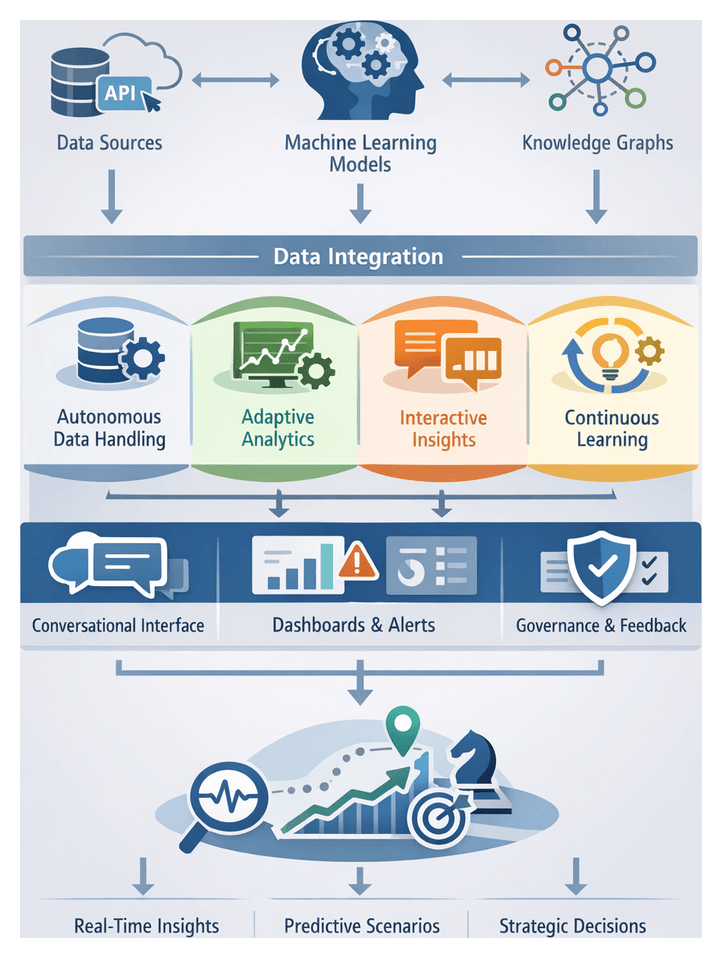
Background and Context
In an era of digital transformation and data proliferation, organizations face unprecedented volumes of information ranging from real-time operational metrics to unstructured text, images and sensor readings. The challenge extends beyond collection to transforming raw data into strategic insights. Traditional business intelligence platforms enabled static reporting and dashboards but required manual intervention to uncover emerging patterns. As enterprises scale and data complexity intensifies, the need for automated, intelligent systems that can extract, analyze and communicate insights without specialized engineering grows acute.
Advances in machine learning, natural language processing and knowledge graph technology have converged to produce autonomous analytics agents. These agents ingest diverse data sources, apply sophisticated models and deliver context-rich recommendations through conversational or narrative interfaces. The shift from reactive reporting to proactive, autonomous decision support transforms how leaders interact with data. Instead of waiting for weekly or monthly reports, teams collaborate with persistent assistants that surface anomalies in real time, anticipate trends and simulate “what-if” scenarios. This section examines the strategic rationale for integrating these agents into enterprise workflows and planning processes.
Emergence of Autonomous Analytics Agents
The evolution of decision support agents traces back to expert systems and rule-based automation, which operated on predefined rules and narrow problem sets. Machine learning introduced statistical models capable of pattern recognition but lacked autonomy to manage data pipelines or translate outputs into actionable guidance. Recent breakthroughs in distributed computing, memory-augmented language models and real-time processing have catalyzed a new generation of agents.
- Databricks unified analytics platform streamlines data preparation and model training at scale.
- Tableau and Microsoft Power BI incorporate AI-driven features such as automated data exploration, anomaly detection and narrative explanations.
- Open-source frameworks enable integration of language models from OpenAI or IBM Watson with custom analytic pipelines.
These technologies represent a qualitative leap: agents that learn from interaction, refine their analytical strategies and guide users through complex scenarios without explicit human scripting. Commercial offerings range from specialized decision support platforms to vendor-agnostic toolkits empowering data teams to build bespoke solutions aligned with enterprise requirements.
Core Characteristics and Framework
Autonomous data analytics agents exhibit four defining attributes:
- Autonomous Data Handling: Connecting to heterogeneous data sources and performing extraction, transformation and loading without manual triggers.
- Adaptive Analytical Reasoning: Selecting, configuring and executing predictive or prescriptive models based on context, user prompts and performance feedback.
- Interactive Insight Delivery: Communicating findings via conversational interfaces, narrative summaries and visualizations.
- Continuous Learning Loop: Monitoring outcomes and user feedback to iteratively refine analytic approaches and recommendation accuracy.
To analyze agent capabilities and implementation challenges, we apply a four-layer framework:
- Data Integration Layer: Connectivity to databases, data lakes and APIs with data quality validation.
- Analytic Processing Layer: Machine learning models, statistical engines and knowledge graphs deriving patterns and predictions.
- Interaction Layer: User-facing components such as conversational interfaces, dashboards and alerts for collaborative exploration.
- Governance and Feedback Layer: Monitoring performance, capturing user feedback and enforcing security, compliance and audit requirements.
This modular view underscores the interdependence of reliable data pipelines, robust modeling, user engagement and governance. It forms the foundation for evaluating both vendor solutions and custom architectures against enterprise needs.
Predictive Modeling Agents
Definitions and Use Cases
Predictive modeling agents autonomously apply machine learning algorithms to historical and real-time data to generate forecasts, risk assessments and scenario analyses. They automate feature engineering, model training, evaluation and deployment, enabling proactive strategies in domains such as demand forecasting, credit risk assessment, preventive maintenance and customer retention.
Performance Metrics and Evaluation
Evaluation of predictive agents involves both technical and business metrics:
- Accuracy and Error Rates: Mean absolute error, root mean squared error and classification accuracy measure predictive precision.
- Calibration and Reliability: Calibration curves and reliability diagrams ensure predicted probabilities correspond to observed frequencies.
- Robustness and Stability: Stress tests against data perturbations, outliers and distribution shifts evaluate resilience.
- Throughput and Latency: Processing speed and response time support real-time alerts and high-velocity pipelines.
- Business Impact Metrics: Revenue uplift, cost reduction and operational efficiency quantify strategic returns.
A balanced scorecard combining these dimensions aligns agent selection with strategic priorities rather than purely statistical benchmarks.
Organizational Adoption and Governance
Enterprises adopt predictive agents through center of excellence models, with platforms such as DataRobot and H2O.ai standardizing best practices across business units. Cloud offerings like IBM Watson Studio and Amazon SageMaker provide connectors, governance controls and lifecycle management. Risk management teams enforce compliance through model documentation, data lineage tracking and audit trails. For example, implementations using Azure OpenAI Service log each interaction, supporting regulatory transparency and accountability.
Interpretability and Ethical Considerations
Trust in predictive agents hinges on interpretability and ethical safeguards. Common techniques include:
- Global Explanations: Feature importance, partial dependence plots and surrogate models.
- Local Explanations: SHAP and LIME for case-by-case insights.
- Model Cards and Fact Sheets: Structured documentation of intended use, performance across cohorts and limitations.
- Bias and Fairness Audits: Statistical tests for demographic parity and adversarial debiasing methods.
Embedding these mechanisms ensures transparent, responsible decision support aligned with governance standards.
Strategic Alignment and Maturity
Maximizing agent value requires tight alignment with corporate objectives. A staged approach includes:
- Identifying High-Value Domains: Demand forecasting, credit risk or preventive maintenance.
- Defining Success Metrics: Reductions in stockouts, lift in conversion rates or cost savings.
- Collaborating with Domain Experts: Embedding agent outputs into workflows and validating contextual relevance.
- Embedding Feedback Loops: Monitoring production performance and retraining models for concept drift.
- Scaling Gradually: Piloting, validating ROI and expanding use cases via CoE governance.
Organizations self-assess maturity along stages from descriptive to autonomous analytics, informing investment priorities in infrastructure, talent and governance.
Challenges and Mitigation
- Data Quality and Availability: Establish data governance, cleansing procedures and lineage tracking.
- Concept Drift and Model Decay: Automate monitoring and retraining to maintain accuracy.
- Resource Constraints: Optimize pipeline orchestration and leverage cloud elasticity.
- User Adoption and Trust: Provide transparency, training and stakeholder engagement.
Cross-functional collaboration among data engineers, scientists, domain experts and governance professionals is essential to ensure agents deliver accurate, reliable and actionable insights.
Strategic Decision-Making Implications
Decision support agents reshape strategic decision architectures by expanding the set of alternatives, mitigating cognitive biases and enabling evidence-based management. By transforming raw data into structured insights, they elevate discussions from interpreting static figures to interrogating model logic and exploring scenario sensitivity.
Decision Alignment and Organizational Strategy
Agents provide a shared analytical foundation, reducing interpretive friction and accelerating consensus building. Dynamic mapping of strategic objectives to operational metrics automates traceability of key performance indicators to corporate goals. For example, integrating an agent-driven forecasting solution across merchandising, logistics and finance synchronizes promotion calendars with supply constraints, bridging high-level vision and operational execution.
Governance and Accountability
Autonomous recommendations prompt new governance structures and roles such as model stewards and data ethicists. Audit trails capturing inputs, reasoning steps and outputs become critical for compliance. Enterprises deploying Azure OpenAI Service or IBM Watson establish automated logging frameworks to support retrospective analysis and reinforce accountability.
Risk Management and Proactive Mitigation
Agents operationalize continuous risk analysis by ingesting market data, supply chain metrics and news feeds to deliver stress tests, value-at-risk and Monte Carlo simulations as live services. A global insurer, for instance, updated regional underwriting risk scores in real time by combining weather forecasts with claims history, enabling preemptive policy adjustments.
Cultural and Talent Transformation
Automation of routine analysis shifts talent demand toward roles that interpret agent outputs, challenge assumptions and craft strategic narratives. Data translators, decision analysts and strategic integrators emerge as critical complements to AI specialists. Cultivating data literacy and structured peer review forums ensures balanced trust and skepticism in agent-driven insights.
Competitive Agility
Real-time analysis compresses the strategic cycle from sensing to execution. A telecommunications provider using an agent to monitor network performance, customer sentiment and competitor pricing launched targeted campaigns within hours, securing first-mover advantages in key segments.
Long-Term Foresight and Scenario Planning
Advanced simulation techniques and data fusion enable continuous scenario analysis. Energy companies, for example, model dozens of futures by combining renewable adoption, policy trajectories and commodity forecasts, guiding capital deployment across a spectrum of market conditions. Agents thus transform strategic foresight into an adaptive, ongoing capability.
Key Value Propositions and Considerations
Decision support agents deliver four interrelated value propositions:
- Speed: Automated pipelines reduce time-to-insight from weeks to minutes.
- Precision: Continuous retraining and advanced algorithms enhance predictive accuracy.
- Accessibility: Natural language interfaces and dashboards democratize analytics.
- Scalability: Support for thousands of users with consistent performance.
Realizing these benefits depends on addressing key considerations:
- Data Quality and Governance: Implement validation, cleansing and lineage controls to ensure integrity.
- Interpretability and Trust: Integrate explainable AI techniques such as SHAP and LIME to demystify model outputs.
- Organizational Readiness: Deploy change management, role redefinition and capability-building programs to drive adoption.
- Strategic Alignment: Establish clear use cases, performance metrics and continuous improvement cycles to maintain relevance as business contexts evolve.
By proactively aligning autonomous analytics agents with enterprise objectives, governance frameworks and cultural readiness, organizations can harness their transformative potential. The convergence of human judgment and machine intelligence fosters resilient, data-informed decision ecosystems capable of sustaining competitive advantage in dynamic markets.
Chapter 7: Specialized Agents for Finance, HR and Compliance
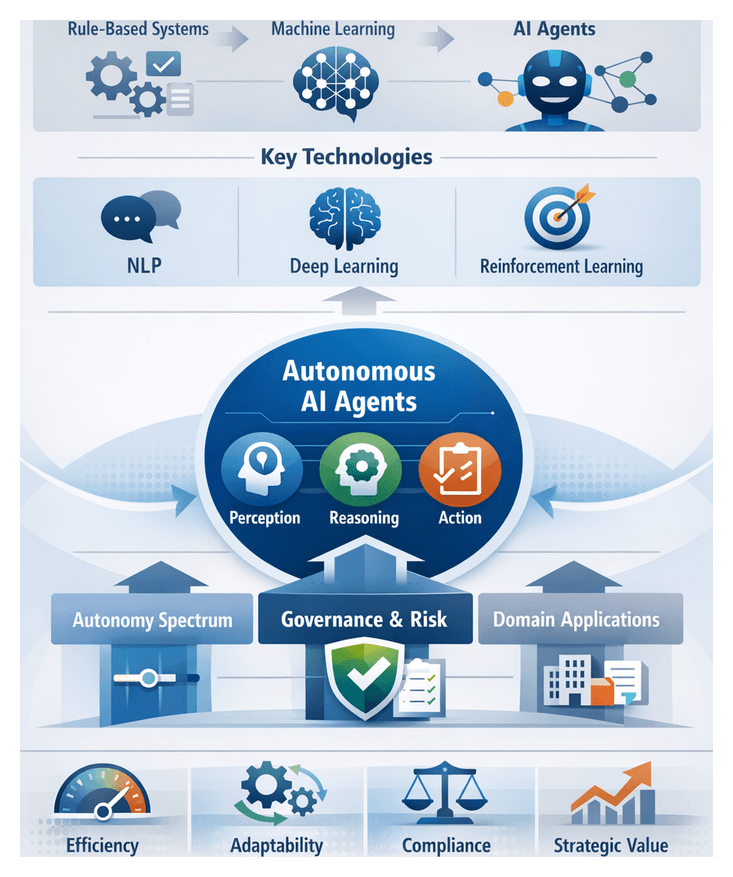
Evolution of Autonomous Agent Technologies and Strategic Imperative
Over the past forty years, software systems have evolved from static rule-based programs to dynamic, context-aware agents capable of autonomous decision-making. Early expert systems codified human expertise in narrow domains such as medical diagnosis and financial analysis but lacked adaptability. Scripted bots in the 1990s automated repetitive tasks like form filling and data retrieval but depended on predefined instructions. The advent of machine learning brought statistical models, support vector machines and decision trees that offered more flexible decision boundaries. Natural language processing advanced from keyword matching to probabilistic models that understood context and sentiment. Cloud computing unlocked scalable resources, accelerating experimentation and deployment.
Recent breakthroughs in deep learning and transformer architectures have ushered in large language models such as those from OpenAI and Google’s Vertex AI, enabling agents to process and generate human-quality language. Reinforcement learning innovations power agents that optimize complex workflows through trial and error, from supply chain scheduling to energy grid management. This convergence of perception, reasoning and action has crystallized the concept of fully autonomous AI agents.
Market forces intensify the urgency of adoption. Companies that leverage autonomous agents for real-time customer engagement, personalized recommendations and supply chain optimization gain measurable advantages. Labor shortages and rising labor costs create bottlenecks in functions ranging from IT incident management to regulatory reporting. Autonomous agents relieve workforce pressure by handling routine tasks and reducing manual errors. Early adopters report up to sixty percent reductions in cycle times and significant improvements in accuracy.
Digital transformation initiatives demand automation solutions that learn, adapt and collaborate across departments. As data volume, velocity and variety grow, autonomous agents offer a strategic response capable of absorbing context, coordinating with other systems and optimizing processes in real time. Regulatory and ethical frameworks are maturing, making robust governance essential to ensure sustainable and trustworthy deployment.
Architecting Autonomous Agents: Concepts and Spectrum
An autonomous AI agent is a software entity that perceives its environment, reasons about objectives and takes actions to achieve goals with minimal human intervention. Unlike traditional applications with rigid workflows, autonomous agents maintain an internal state representing knowledge, preferences and situational awareness. They employ perception modules to ingest data from sensors, applications or user inputs; reasoning engines to evaluate alternatives; and execution components to perform operations or orchestrate external services.
The belief-desire-intention (BDI) model underpins many agent architectures. In this framework, beliefs represent an agent’s world view, desires encode objectives and intentions specify committed actions. Cognitive architectures extend BDI by integrating memory structures, learning mechanisms and planning algorithms that range from rule invocation to multi-stage optimization routines. Autonomy exists on a spectrum: semi-autonomous assistants require explicit human approvals for critical decisions, while fully autonomous agents continuously monitor conditions and execute strategies without oversight. Most enterprise deployments occupy an intermediate zone, leveraging human-in-the-loop oversight for high-risk operations and automating routine tasks end to end.
Understanding this continuum is essential for defining deployment strategies, regulatory compliance and governance frameworks. A clear conceptual model helps organizations identify where autonomy adds value, which tasks to delegate and where to enforce human checkpoints. It also informs interface design for transparency, auditability and exception handling, ensuring agents operate within ethical and performance boundaries.
Governance Frameworks and Risk Controls for Autonomous Agents
In regulated domains such as finance, human resources and compliance, deploying autonomous agents raises complex questions around risk management, oversight and corporate governance. Organizations must navigate evolving regulations while balancing innovation with stringent controls. Effective governance integrates risk controls into agent design and operations, aligning with organizational risk appetite and regulatory requirements.
Governance Standards and Interpretive Models
- NIST Artificial Intelligence Risk Management Framework: Structured approach to identify, measure and manage AI-related risks across a system’s lifecycle.
- ISO 38500 for IT governance: Emphasizes accountability, strategic alignment and performance measurement adapted for AI pipelines.
- COBIT 2019: Provides governance and management objectives model that maps control activities to value streams.
Risk Control Domains
- Operational Risk Controls: Guard against system failures, unintended behaviors and service interruptions.
- Regulatory and Compliance Controls: Enforce adherence to financial reporting standards, labor laws and regulations such as Sarbanes-Oxley and GDPR.
- Data Privacy and Security Controls: Include encryption, access management and data anonymization to protect sensitive information.
- Ethical and Fairness Controls: Prevent bias, discrimination and adverse impacts on protected groups.
- Audit and Reporting Controls: Logging, monitoring and reporting capabilities that support internal audits and regulatory inquiries.
Auditability, Transparency and Explainability Mechanisms
Immutable audit trails are central to governance. Many organizations integrate distributed ledger technology to ensure logs cannot be altered, providing a clear chain of custody for sensitive transactions. Accountability roles—such as AI risk officers or compliance stewards—review exception reports, investigate anomalies and certify that agent performance remains within risk tolerances. Transparency and explainability are enforced through global and local interpretability techniques like SHAP and LIME. Platforms such as IBM Watson OpenScale offer integrated monitoring of model drift, fairness metrics and explainability dashboards, generating transparency reports for internal and external audits.
Balancing Autonomy and Control
Greater autonomy can drive strategic value but elevates operational and regulatory risk. A risk-based approach calibrates control intensity according to use-case criticality. Low-impact tasks such as routine data aggregation may proceed with minimal oversight under standard monitoring. High-stakes scenarios—like regulatory reporting or payroll disbursement—require human-in-the-loop approvals and exception-handling protocols. Dynamic calibration of autonomy and control maximizes efficiency gains without compromising compliance or exposing organizations to liability.
Lifecycle Integration of Governance
Governance must be embedded throughout the agent development lifecycle. In the design phase, risk assessments identify privacy, security and fairness considerations, guiding data sourcing and model selection. During build, automated tests for performance, bias and robustness are integrated into pipelines. Pre-deployment governance gates require sign-offs from risk and compliance teams. Post-deployment, continuous monitoring dashboards surface real-time indicators of agent health, risk exposure and control performance, enabling rapid response to emerging threats or regulatory changes.
Domain-Specific Deployment Considerations
Deployment success depends on understanding domain-specific factors such as organizational maturity, data sensitivity, regulatory context, system integration, stakeholder alignment and cultural dynamics. These factors influence both feasibility and strategic value of AI agents in finance, human resources and compliance.
Organizational Maturity and Context
Organizations with advanced digital infrastructures and standardized data models in finance can rapidly deploy forecasting and reconciliation agents. Smaller firms face challenges around data quality, interoperability and change management. In HR, enterprises with formalized talent lifecycle stages map agent capabilities to recruitment, onboarding and performance workflows more easily than decentralized organizations. Compliance functions in highly regulated sectors demand continuous model validation and governance, while less regulated fields may opt for lighter oversight.
Data Sensitivity and Security Requirements
All specialized agents access sensitive datasets—transaction records in finance, personal employee information in HR, regulatory documents in compliance. A layered security model is essential, encompassing strong identity and access management, encryption in transit and at rest, and transparent audit logging. Financial services must align with ISO 27001 and PCI DSS; HR processes must comply with GDPR and CCPA consent and data minimization mandates.
Regulatory Environments
Regulations shape agent design. Finance agents must incorporate Basel III, Sarbanes-Oxley and MiFID II rule sets and adapt to amendments in real time, necessitating configurable rule engines and traceable decision logs. HR agents screening resumes implement fairness metrics and bias detection routines to comply with labor laws and equal opportunity provisions. Compliance agents monitor policy adherence and generate defensible outputs for external audits.
System Integration and Scalability
Enterprises operate heterogeneous IT landscapes. Successful deployments leverage API connectivity, message bus integration and data orchestration layers. Agents extract inputs from legacy databases, transform them into actionable insights and route recommendations back into operational dashboards. Architectural flexibility—through containerization, serverless functions or hybrid cloud models—ensures cost efficiency and performance stability, enabling continuous learning and adaptive behavior.
Stakeholder Alignment and Change Management
Effective adoption requires cross-functional collaboration among finance, risk, IT, legal, HR and compliance teams. A formal governance committee or center of excellence oversees agent performance, risk tolerances and escalation protocols. Regular reviews of agent outputs, coupled with human-in-the-loop validation, build confidence and drive iterative refinement. Clear communication of strategic rationale and limitations reduces resistance and fosters a data-driven culture.
Cultural and Ethical Considerations
Cultural dynamics influence acceptance. Risk-averse finance cultures may slow experimentation, while growth-focused teams may prioritize innovation. HR stakeholders weigh efficiency gains against concerns over surveillance and loss of human touch. Ethical frameworks emphasize transparency, explainability and user empowerment, ensuring agents augment human expertise rather than replace it. Defined escalation pathways and AI literacy training help demystify behaviors and reinforce accountability.
Performance Measurement and Continuous Optimization
Measuring the impact of specialized agents requires a multifaceted framework combining efficiency, accuracy, user satisfaction, financial and learning metrics. Leading practitioners adopt a balanced scorecard approach to capture holistic performance.
- Operational Efficiency Metrics: Cycle times for processes such as financial close reconciliation, payroll and compliance exception handling, compared against historical baselines.
- Accuracy and Control Effectiveness: Prediction accuracy, anomaly detection rates and false positive/false negative measures, with regular recalibration and rule refinement.
- User Satisfaction and Trust: Feedback from finance analysts, HR managers and compliance officers measured through surveys and usage analytics.
- Return on Investment Analysis: Total cost of ownership versus labor savings, risk avoidance and compliance fines averted, with attribution models linking agent performance to bottom-line impact.
- Continuous Improvement Loops: Feedback mechanisms that capture exceptions, manual overrides and system alerts to drive iterative updates to logic and data pipelines.
Strategic Insights and Future Challenges
Organizations that embed specialized agents as integral components of broader governance, risk and compliance architectures achieve higher transparency, consistency and control while reducing manual effort and error. Key strategic insights include:
- Domain-Embedded Intelligence: Agents trained on frameworks such as COSO, COBIT and ISO standards extend organizational policy into automated workflows.
- Governance as Design Principle: Embedding controls, transparent rule engines and immutable audit logs into decision pipelines ensures regulatory and audit readiness.
- Cross-Functional Collaboration: A governance council comprising legal, risk, technology and business stakeholders oversees lifecycle management, policy updates and performance reviews.
- Modular, Scalable Architecture: Decoupled components for data ingestion, rule evaluation, anomaly detection and human escalation enable incremental expansion to new processes and jurisdictions.
Despite their potential, specialized agents face limitations that require proactive mitigation. Data integration complexity and quality issues often consume the majority of project effort. Regulatory uncertainty and interpretation gaps necessitate human oversight during legal updates. Model drift demands robust detection and retraining workflows to prevent performance degradation. Cultural resistance and ethical accountability questions must be addressed through executive sponsorship, training programs and clear escalation paths. Emerging trends such as federated learning enable collaborative model training without exposing raw data, while RegTech platforms and direct-to-regulator APIs are streamlining regulatory monitoring and filings. The convergence of domain-specific agents with digital process automation is creating adaptive workflows that trigger real-time responses based on risk assessments.
By anticipating these challenges and embedding governance, measurement and continuous improvement into their AI agent strategies, organizations can harness autonomous agents as catalysts for efficient, resilient and innovative operations.
Chapter 8: Multi-Agent Collaboration and Orchestration
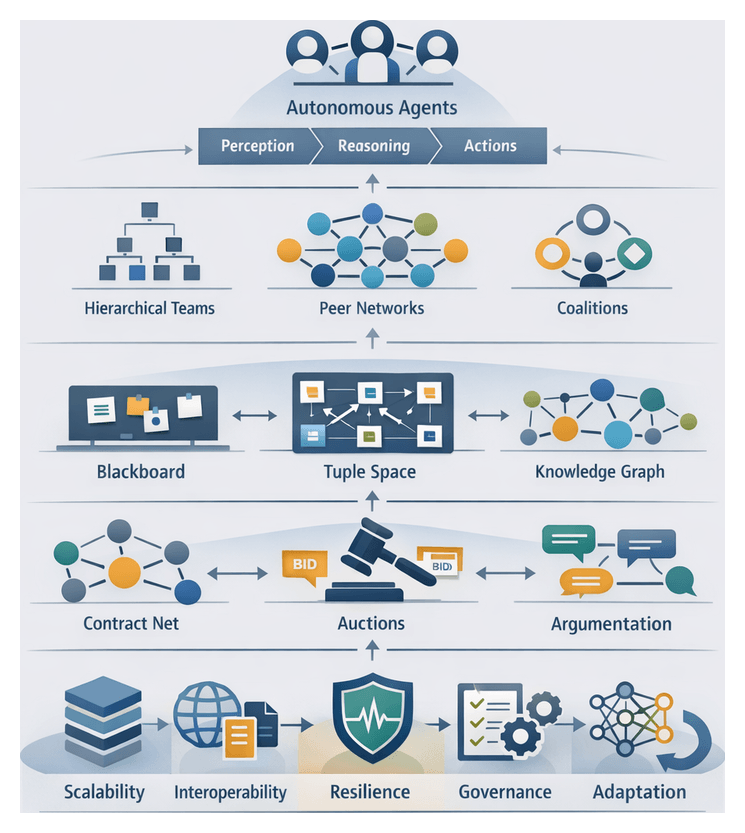
Fundamentals of Multi-Agent Systems and Collaboration
Multi-agent systems distribute decision making across autonomous entities that communicate, coordinate and cooperate to achieve individual and shared goals. Each agent perceives its environment, reasons about objectives and executes actions that influence both the shared context and other agents. This decentralized model addresses the complexity of modern enterprises, where workflows span departments, geographies and technology stacks.
Key properties of agents include autonomy, social ability, reactivity, proactiveness and adaptability. At the system level, multi-agent architectures exhibit decentralization, scalability, modularity, coordination and robustness. Common organizational templates guide design:
- Hierarchical Teams: Layered control with supervisors delegating to subordinates.
- Peer-to-Peer Networks: Flat topology with dynamic role negotiation.
- Coalition Formation: Temporary alliances for task-specific collaboration.
- Market-Based Coordination: Auctions and pricing mechanisms for resource allocation.
Standards from the Foundation for Intelligent Physical Agents and frameworks like JADE support interoperability, message transport and lifecycle management. Analytical foundations in distributed artificial intelligence, game theory and organizational science inform negotiation protocols and incentive mechanisms. Practical architectural considerations include reliable communication layers, shared ontologies, coordination services, monitoring and governance, plus learning and adaptation loops to evolve agent strategies over time.
Knowledge Sharing and Negotiation Frameworks
Effective collaboration depends on substrates for information exchange and protocols for role negotiation. Three principal knowledge sharing architectures are prevalent:
- Blackboard Systems: Centralized workspaces where producers, analyzers and controllers post observations and hypotheses. This model simplifies integration but introduces potential bottlenecks and single points of failure.
- Tuple Spaces: Distributed repositories inspired by Linda, where agents deposit and retrieve data tuples. Logistics providers use tuple spaces for real-time fleet telemetry, enhancing fault tolerance at the cost of eventual consistency requirements.
- Federated Knowledge Graphs: Unified semantic views over heterogeneous schemas. Agents query endpoints via SPARQL or graph APIs to infer relationships, as seen in financial institutions consolidating customer profiles and risk models.
Negotiation protocols allocate tasks and resolve conflicts. Core patterns include:
- Contract Net Protocol: Structured calls for proposals where manager agents solicit bids from contractors, then award tasks based on capability and cost.
- Auction Models: Variants such as sealed-bid, Dutch and Vickrey auctions. Platforms like IBM Watson Orchestrate leverage auctions for microservice resource bidding.
- Argumentation Frameworks: Exchange of structured arguments and counter-arguments, enabling transparent negotiation over preferences and constraints—especially in legal tech applications.
Organizations assess these mechanisms against throughput, latency, scalability, fault tolerance, compliance, interoperability with standards such as FIPA, and security. Case studies illustrate blended models:
- Financial Services: Peer-to-peer negotiation agents share market signals via distributed ledgers, using combinatorial auctions for complex allocations.
- Logistics and Supply Chain: Hybrid blackboard–tuple-space architectures exchange shipment intents, capacity offers and routing bids across carriers and ports.
- IT Incident Management: Ray orchestrates agents that share alert contexts and negotiate remediation tasks, managing service-level commitments dynamically.
Workflow Orchestration and Strategic Implications
Orchestrating complex workflows of autonomous agents transforms linear, rule-based processes into adaptive networks of composable services. Five strategic dimensions emerge:
- Architectural Agility: Agents become plug-and-play modules that can be injected, replaced or upgraded at runtime without halting end-to-end workflows.
- Semantic Interoperability: Unified knowledge graphs and industry ontologies (ISO 15926, HL7 FHIR) ensure that agents understand each other’s data and commands deeply.
- Risk and Resilience: Resilience frameworks—circuit breakers, sandboxing and anomaly detectors—prevent cascading failures and control emergent behaviors. Simulation platforms, including IBM Watson Orchestrate, enable stress-testing of orchestration designs.
- Governance and Auditability: Layered audit trails capture tamper-resistant logs, decision metadata and human-readable summaries. Platforms like UiPath and Automation Anywhere embed governance services across agents.
- Organizational Transformation: Process-centric teams oversee clusters of agent interactions. A dual operating model maintains core legacy operations while innovation enclaves pilot multi-agent initiatives.
Context matters: in trading, sub-second coordination with transparent logs is vital; in healthcare, fail-safe scheduling and triage demand rigorous guarantees; in manufacturing, edge-cloud hybrids must tolerate intermittent connectivity. Leaders must balance agility with compliance, embedding governance as an orchestration service rather than an afterthought.
Principles and Governance for Resilient Orchestration
Building robust orchestration frameworks requires modular, scalable and redundant architectures guided by key principles:
- Modular Workflow Decomposition: Break processes into discrete stages—ingestion, processing, decisioning, execution—each managed by specialized agents for parallelism and rapid iteration.
- Asynchronous Communication: Employ event-driven patterns and message queues. Tools like Apache Airflow and Kubernetes illustrate non-blocking orchestration with automatic retries and dependency management.
- Fallback and Compensation: Define alternative agents or manual escalations for exceptions. Compensation patterns prevent partial failures from cascading.
- Policy-Driven Configuration: Use policy engines to automate governance, access controls and compliance rules, enabling business stakeholders to update policies without code changes.
- Elastic Scalability: Leverage containerization and serverless platforms. Solutions such as Microsoft Power Automate and IBM Watson Orchestrate scale orchestration components dynamically.
Governance extends across the agent ecosystem:
- Unified Control Plane: Central dashboards integrate with Splunk, Datadog or Celonis for real-time visibility into agent metrics and compliance status.
- Role-Based Access and Approval: Enforce multi-level approvals for deploying or updating workflows, ensuring business review and risk validation.
- Continuous Compliance: Embed agents to validate data handling, privacy and audit requirements at each stage, with regular rule updates for evolving regulations.
- Ethical Oversight: Convene review boards to assess high-impact scenarios—credit scoring, healthcare triage—for bias, fairness and societal impact.
- Feedback Loops: Capture user reports of unexpected outcomes, feeding corrections into orchestration policies and model retraining pipelines.
Aware of limitations—complexity overhead, latency, data consistency challenges, vendor lock-in and expanded attack surfaces—organizations apply domain-driven design, asynchronous patterns, event sourcing, open standards and zero-trust security to mitigate risks.
Aligning Orchestration with Organizational Context
Effective orchestration reflects each organization’s industry, maturity and culture:
- Industry Workflows: Design flows that respect sector conventions—batch settlements in banking or just-in-time production in manufacturing.
- Digital Maturity: Early adopters may favor low-code, human-in-the-loop orchestration; mature enterprises can pursue fully automated, self-learning pipelines.
- Change Management: Include business users in design sprints, using proofs-of-concept to validate alignment with real workflows.
- Measurement and Incentives: Define KPIs—cycle times, error rates, cost savings—and align incentives across IT, operations and business units.
- Global Scaling: Support regional data sovereignty, localization and compliance variations with configurable rules for each geography.
Emerging Trends in Multi-Agent Orchestration
- Self-optimizing Orchestration: Real-time workflow reconfiguration driven by performance telemetry and business objectives.
- Explainable Coordination: Human-readable rationales for agent decisions to enhance transparency and regulatory compliance.
- Cross-Organizational Ecosystems: Secure collaboration via federated governance models, enabling end-to-end supply chain automation.
- Integration with Learning Pipelines: Orchestration policies that evolve alongside agent learning and model updates.
- Edge-to-Cloud Continuum: Distributed orchestration spanning centralized clouds and edge devices for low-latency, local autonomy.
By uniting these principles—foundational agent theory, flexible knowledge sharing, strategic orchestration design, resilient governance and contextual alignment—organizations can unlock adaptive, trustworthy and efficient multi-agent workflows that drive sustained innovation and competitive advantage.
Chapter 9: Measuring Impact and Return on Investment
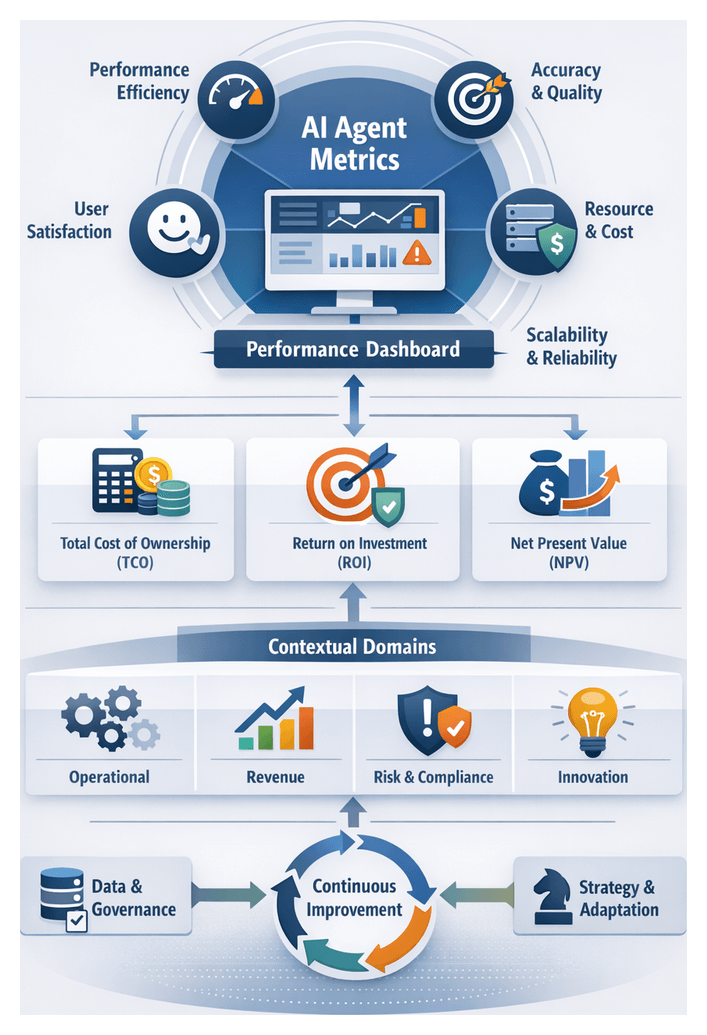
Defining Performance Metrics for Autonomous Agents
Measuring the effectiveness of autonomous AI agents requires a structured framework that translates dynamic behaviors into actionable insights. Five core metric categories capture the dimensions of technical performance, user impact and operational cost:
- Performance Efficiency: Task Completion Rate, Average Response Time, Throughput and Workflow Cycle Time reveal how quickly and reliably agents process requests and orchestrate multi-step processes.
- Accuracy and Quality: Error Rate, Precision and Recall, Confidence Calibration and Defect Density quantify correctness, decision confidence and the density of anomalies, ensuring agents meet stringent reliability thresholds.
- User Experience and Satisfaction: Customer Satisfaction Score, Net Promoter Score, First Contact Resolution and Behavioral Engagement Metrics such as session duration and feature adoption gauge stakeholder perceptions and interaction effectiveness.
- Resource Utilization and Cost: Compute Utilization, Storage Footprint, Cost per Task and Human Oversight Hours track infrastructure consumption and manual intervention, supporting transparent cost-benefit analysis.
- Scalability and Reliability: System Uptime, Load-Handling Capacity, Fault Tolerance and Elasticity assess availability, resilience under peak loads and the agility of resource scaling.
Integrating these indicators into a unified performance dashboard empowers leaders to correlate technical metrics with business outcomes. A robust dashboard implementation involves selecting representative metrics, defining data pipelines, establishing baselines and alerts, and tailoring views for data scientists, operators and executives. Regular governance reviews of dashboard analytics drive continuous optimization, enabling organizations to evaluate return on investment, prioritize enhancements and scale deployments with confidence.
Analytical Models to Quantify Business Value
Translating agent performance into financial and strategic terms relies on a portfolio of quantitative and qualitative models. No single framework suffices; instead, practitioners combine approaches to capture cost, benefit, risk and strategic alignment.
Total Cost of Ownership (TCO)
TCO aggregates all expenses associated with agent lifecycles—from licensing and infrastructure to integration, monitoring and support. Key considerations include infrastructure amortization, development and customization costs, operational overhead and opportunity costs. Sensitivity analysis refines TCO by varying compute pricing and labor rates, enabling risk-adjusted comparisons across deployment options.
Return on Automation Investment (ROAI)
ROAI focuses on the incremental gains from automation by comparing net benefits—labor savings, error reduction and risk avoidance—to total automation expenditure. Granular definition of benefit streams, such as splitting direct savings from cost avoidance, uncovers strategic value in compliance and resilience that may not immediately appear in profit and loss statements.
Payback Period and Break-Even Analysis
By tracking cumulative net benefits against initial investments over time, payback analysis identifies when agents become self-funding. Shorter payback horizons appeal to executives, but should be complemented by longer-term assessments to capture sustained benefits such as improved customer loyalty or enhanced brand reputation.
Net Present Value (NPV) and Discounted Cash Flow (DCF)
NPV and DCF account for the time value of money by discounting projected cash inflows—cost savings, revenue uplift and risk avoidance—at an appropriate rate reflecting organizational capital costs. Scenario planning, with varying benefit realization rates and cost escalations, provides a probabilistic view of project viability and informs governance triggers for performance reviews.
Balanced Scorecard and Strategic Value Mapping
The Balanced Scorecard links agent outcomes to strategic objectives across financial, customer, internal process and learning and growth perspectives. This multidimensional view prevents metric myopia by balancing cost reduction, revenue growth, user satisfaction, process efficiency and organizational capability development.
Sensitivity Analysis and Scenario Modeling
Monte Carlo simulation tools and spreadsheet models test the robustness of value projections by varying key assumptions—error reduction rates, labor cost inflation and discount rates. Defining base, optimistic and pessimistic scenarios, documenting assumption rationales and incorporating qualitative risk ratings ensure transparent and resilient analyses.
Governance Integration
Embedding analytical models within governance structures ensures continuous validation of projected value. Clear ownership of metrics across finance, operations and IT, defined cadences for performance reviews, integrated dashboards and feedback mechanisms to recalibrate agent models sustain alignment between projected and realized benefits.
Contextualizing ROI Across Domains and Deployment Terrains
The significance of metrics and models varies by industry, adoption maturity and deployment scope. Financial services emphasize fraud detection accuracy and forecasting speed; manufacturing targets predictive maintenance and throughput optimization; retail focuses on personalized recommendations, dynamic pricing and inventory reduction; healthcare measures patient outcomes and compliance efficiency.
Within these domains, four contextual dimensions guide ROI expectations:
- Operational: Process automation, error elimination and resource optimization metrics such as cost per transaction or average handle time.
- Revenue: Sales conversion rates, incremental revenue per customer and cross-sell/up-sell performance.
- Risk and Compliance: Audit trail completeness, policy adherence and anomaly detection rates.
- Innovation: Time to market for new offerings, prototyping efficiency and strategic differentiation indices.
Deployment terrains further shape measurement approaches:
- Enterprise-Wide Platforms: Long-horizon ROI with cross-functional gains and unified governance.
- Departmental Solutions: Rapid payback on targeted use cases, with clear accountability but potential data silos.
- Project-Bound Initiatives: Tightly scoped metrics aligned to milestones, requiring deliberate transition planning for sustained benefit.
- Customer-Facing Services: External visibility demands high reliability, with metrics such as Net Promoter Score, self-service rate and retention impact.
Articulating domain, scope and maturity stage of agent initiatives ensures that ROI measures reflect strategic imperatives rather than generic benchmarks.
Embedding Continuous Feedback Loops
Static ROI snapshots fail to capture evolving performance, learning curves and shifting business environments. A continuous feedback loop comprises:
- Data Collection: Automated logging of interactions, decision outcomes, exceptions and user feedback to provide high-fidelity visibility.
- Performance Analytics: Benchmark comparisons, trend analysis and anomaly detection using statistical methods and visualization.
- Stakeholder Engagement: Regular forums where domain experts, data scientists, operations managers and executives review results and surface qualitative insights.
- Model Refinement: Iterative adjustment of training data, decision thresholds and knowledge representations to address performance gaps.
- Reassessment: Measurement of post-refinement impact to confirm realized improvements or identify needs for deeper architectural changes.
When aligned with strategic objectives, these loops transform ROI measurement into an ongoing governance practice that keeps agents adaptive and aligned with organizational goals.
Data and Governance Considerations
Reliable measurement depends on disciplined data and governance frameworks. Key challenges and practices include:
- Data Integration: Breaking down silos by implementing enterprise data warehouses or integration platforms to unify schemas.
- Data Quality: Automated validation pipelines and metadata management to prevent incomplete or erroneous feeds from skewing metrics.
- Privacy and Compliance: Anonymization or pseudonymization of personal data and maintenance of audit trails to satisfy GDPR, CCPA and other regulations.
- Version Control: Model registries and change logs that trace performance fluctuations to specific model versions and training data.
Defining roles for data stewards, compliance officers and analytics teams, and codifying measurement governance policies, ensures accountability and auditability throughout the measurement lifecycle.
Organizational and Cultural Enablers
Successful continuous improvement of AI agents demands cultural as well as technical change. Critical dynamics include:
- Stakeholder Alignment: Cross-functional steering committees that harmonize objectives among business units, IT and data science.
- Change Management: Transparent communication and upskilling initiatives that address user resistance and build trust in agent-driven processes.
- Resource Allocation: Dedicated budget and skilled personnel within a center of excellence for data analysis, model refinement and performance audits.
- Leadership Sponsorship: Visible executive support that reinforces transparent reporting of successes and setbacks to cultivate a learning culture.
Embedding measurement and iteration as integral phases within project lifecycles, with predefined improvement budgets and timelines, elevates continuous improvement to a core organizational competency.
Iterative Improvement Frameworks
Structured, phased approaches institutionalize learning and iteration:
- Plan-Do-Check-Act (PDCA): Define improvement hypotheses, implement changes, measure outcomes and standardize successful adjustments.
- ModelOps and MLOps Pipelines: Automate retraining, validation and deployment workflows, with continuous monitoring of model and data drift triggering retraining.
- Value Stream Mapping: Visualize end-to-end processes to identify bottlenecks and target high-value segments for enhancement.
- Agile Sprints and Retrospectives: Short, iterative cycles that surface insights on measurement efficacy and process impediments.
Blending these frameworks to suit organizational maturity, regulatory requirements and risk tolerance, with clear feedback triggers and accountable owners, ensures disciplined and transparent improvement cycles.
Strategic Caveats and Forward Outlook
While comprehensive metrics and models offer clarity, organizations must remain vigilant to biases and limitations:
- Attribution Bias: Avoid crediting agents exclusively for gains without counterfactual analysis or control groups.
- Short-Termism: Balance immediate efficiency gains with long-term benefits such as brand reputation and strategic agility.
- Metric Myopia: Prevent tunnel vision on easy-to-track indicators by maintaining a balanced scorecard.
- Algorithmic Uncertainty: Acknowledge the probabilistic nature of models and guard against over-tuning to historical data.
- Evolving Requirements: Remain flexible to accommodate market shifts, regulatory changes and strategic pivots.
- Oversight Fatigue: Balance automated monitoring with strategic sampling to sustain team capacity and prevent burnout.
- Ethical and Transparency Risks: Conduct periodic ethical audits and transparency reports to maintain regulator and user trust.
The future of agent performance measurement lies in integrating explainable AI techniques, real-time monitoring dashboards and unified analytics platforms. Ultimately, strategic value hinges on an organization’s ability to embed disciplined measurement, foster a culture of learning and navigate the inherent uncertainties of AI-driven decision making.
Chapter 10: Future Trends and Ethical Considerations
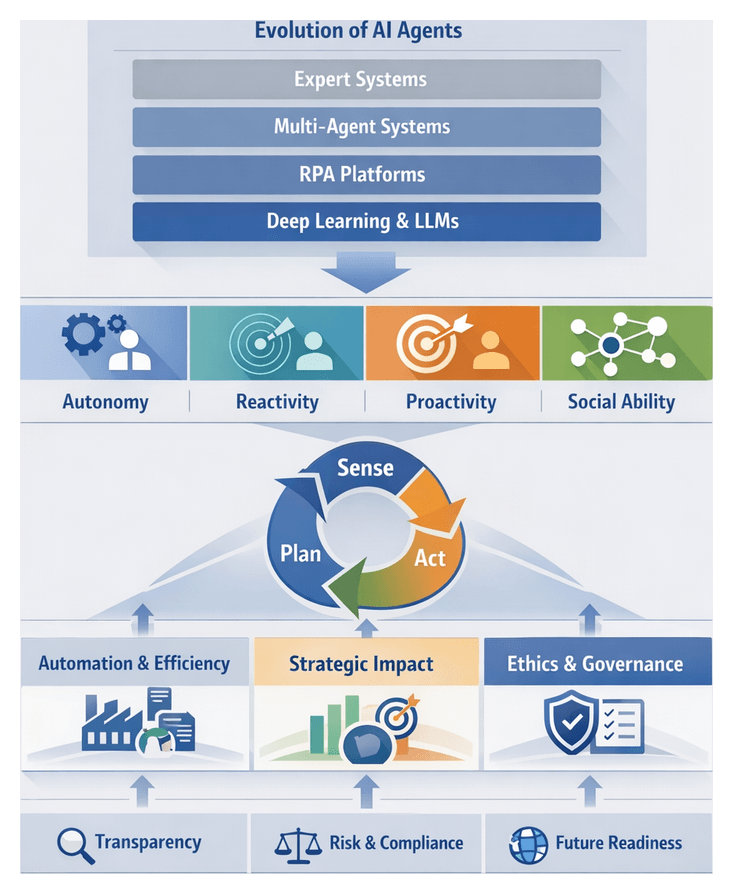
Evolution and Foundations of Autonomous AI Agents
Historical Progression
Autonomous AI agents have advanced from early expert systems in the 1970s—where rule‐based engines supported medical diagnosis and industrial control—to multi‐agent research in the 1990s that demonstrated cooperative negotiation and resource allocation. In the early 2000s, robotic process automation platforms automated repetitive back‐office tasks with deterministic workflows. The introduction of deep learning and large‐scale language models in the 2010s enabled agents to perceive complex inputs, generate contextually appropriate responses, and refine behavior through reinforcement learning. Cloud computing and modular AI services further reduced infrastructure barriers, allowing cohesive sense‐plan‐act pipelines to handle unstructured data, plan multi‐step operations, and collaborate with human stakeholders across manufacturing, healthcare, supply chain optimization, and customer engagement.
Conceptual Dimensions
An autonomous AI agent senses its environment, reasons about objectives, plans a course of action, and executes decisions with minimal human intervention. Four defining attributes distinguish these agents from static automation:
- Autonomy – governs actions without explicit orchestration at every step.
- Reactivity – perceives and responds promptly to dynamic conditions.
- Proactivity – initiates goal‐oriented actions and anticipates future states.
- Social ability – communicates and collaborates with other agents or humans.
The sense‐plan‐act cycle provides a generic architecture: sensing through APIs, sensors or natural language; planning via machine learning or rule‐based reasoning; and acting to execute operations and update internal state. The Belief‐Desire‐Intention framework and knowledge representation techniques—ontologies, knowledge graphs, probabilistic models—manage uncertainty and contextual nuance, guiding deployments to align with organizational requirements.
Strategic Imperatives for Adoption
Organizations face rising data volumes, cost pressures, and customer expectations that demand continuous, adaptive systems. Autonomous agents automate data ingestion and analysis, reducing error rates and accelerating throughput while redeploying human talent to strategic tasks. Early adopters gain competitive differentiation through predictive maintenance, personalized customer experiences, and agile supply chains. In regulated industries, agents enforce governance policies, monitor anomalies, generate audit trails, and support resilience during workforce constraints or global disruptions. Integrating agents into core workflows drives superior agility, responsiveness, and strategic insight.
Ethical Frameworks and Transparency Pillars
Ethical Foundations
Responsible deployment of autonomous agents rests on deontological, consequentialist, and virtue ethics approaches. Deontological models emphasize rule adherence and regulatory compliance. Consequentialist perspectives weigh efficiency gains against harms such as bias or privacy infringement. Virtue ethics focus on developer intentions, transparency, accountability, and respect for human dignity. Leading guidelines include the IEEE Ethically Aligned Design, the European Commission’s Ethics Guidelines for Trustworthy AI, and the United Nations Roadmap on Digital Cooperation, which help practitioners evaluate whether agent decision processes respect rights, minimize harm, and ensure equitable access.
Transparency and Explainability
Transparency fosters trust by clarifying data sources, model architectures, training procedures, decision outcomes, and agent intent. Frameworks such as the European Union AI Act and the NIST AI Risk Management Framework mandate documentation, logging, and public disclosure for high‐impact systems. Audits, model cards, and transparency reports enable stakeholders to interrogate agent behavior. Explainability tools—SHAP, LIME—generate feature importance scores and sensitivity analyses, while platforms like IBM Explainable AI guide best practices for interpretable models.
Interpretive Frameworks
Layered governance models divide responsibilities among policy governance, risk management, and technical oversight. Ethical impact assessments—akin to environmental impact studies—structure analysis of privacy risks, fairness concerns, and societal effects before deployment. Financial services firms conduct workshops to evaluate credit‐scoring agents for disparate impact, while healthcare organizations engage clinical ethics committees to review diagnostic agents for patient safety.
Balancing Opacity and Explainability
Deep neural networks offer high accuracy but limited interpretability. Hybrid architectures use transparent surrogate models to approximate complex cores, evaluated through fidelity scores and sensitivity analyses. Practitioners integrate explainability metrics into pipelines to balance performance and transparency, ensuring that agents remain accountable and understandable.
Stakeholder Roles and Accountability
Effective governance requires clear role definitions: boards set risk appetites; chief AI or ethics officers operationalize policies; interdisciplinary review boards oversee high‐risk projects; risk registers and AI lineage logs provide traceability; whistleblower channels and third‐party audits enable external scrutiny. These layered mechanisms enforce accountability and reinforce stakeholder confidence.
Measuring Ethical and Transparency Performance
- Bias detection rates across demographic groups
- Explanation coverage for decision rationales
- Audit trail completeness and integrity
- User trust scores from surveys and feedback
- Regulatory compliance indices across jurisdictions
Emerging Ethical Challenges
Self‐improving learning pipelines introduce dynamic behavior changes that challenge static assessments. Cross‐border deployments face diverse legal regimes and cultural expectations. The fusion of generative AI with autonomous agents heightens concerns about fabricated content and deepfakes, prompting standards bodies like the OECD and the Global Partnership on AI to propose adaptive transparency requirements and federated governance protocols.
Governance Models and Organizational Integration
Lifecycle Governance
Governance must span conception, design, development, deployment, and monitoring. Early criteria cover data sourcing, model selection, and ethical review. During development, protocols address testing, bias assessments, and validation metrics. Post‐deployment governance oversees performance audits, incident response, and model updates, creating feedback loops that surface risks and enforce accountability continuously.
Industry Frameworks and Regulatory Context
Financial services follow Basel Committee and Financial Conduct Authority guidelines on model risk and explainability. Healthcare adheres to FDA validation and transparency requirements for diagnostic agents. The European Union AI Act categorizes AI by risk level, imposing obligations from data governance to human oversight. Organizations interpret these principles into documentation of data provenance, audit logs, and grievance mechanisms to avoid sanctions and reputational harm.
Stakeholder Responsibilities
- Executive Leadership – sets strategic AI vision, allocates governance resources, and champions ethical accountability.
- Risk and Compliance Teams – translate regulations into policies, conduct audits, and report on governance metrics.
- Data Scientists and Engineers – implement controls, document design decisions, and ensure data traceability.
- Legal and Ethics Committees – review use cases for legal exposure and ethical risk, advising mitigation strategies.
- Operations and Security – monitor agent behavior for anomalies, enforce access controls, and manage incident response.
Risk and Compliance Analytics
- Model Risk Assessment – evaluates failure likelihood and bias amplification using metrics like false positive rates and demographic parity differentials.
- Regulatory Readiness Scorecards – map regulatory requirements to internal controls, rating maturity from ad hoc to fully integrated.
- Audit Trail Completeness – measures integrity of logs by checking for missing entries or unauthorized modifications.
- Incident Response Metrics – tracks mean time to detect and remediate governance breaches to gauge operational resilience.
Transparency, Accountability, Trust
- Human‐in‐the‐Loop Oversight – critical agent decisions in high‐risk domains require human validation.
- Explainable AI Tools – platforms generate understandable explanations through feature importance or natural language summaries.
- Feedback Channels – structured processes for reporting unexpected or harmful outcomes and initiating corrective action.
- Governance Dashboards – visualize policy compliance, audit findings, and incident trends for executive oversight.
Strategic Alignment and Differentiation
Embedding governance as a strategic asset yields market differentiation, partnership opportunities, and accelerated innovation. Transparent, accountable practices attract collaborators who value risk alignment and support sustainable growth.
Global Deployment Considerations
- Localization of Policies – adapt high‐level principles to local laws on privacy, discrimination, and consumer protection.
- Cross‐Border Data Controls – enforce technical and contractual measures for data transfers under frameworks like GDPR.
- Ethical Pluralism – reconcile diverse norms through stakeholder engagement and localized impact assessments.
- Regulatory Monitoring – maintain a watch function to update policies and controls proactively.
Emerging Governance Trends
- Automated Compliance Checking – AI monitors agent outputs against policy rules in real time.
- Decentralized Governance – blockchain registries record governance artifacts immutably for auditability.
- Adaptive Policy Frameworks – modular policies dynamically adjust to new risks or regulatory changes.
- Ethics as Code – encode ethical constraints directly into agent behavior specifications.
Cultural and Talent Implications
- Ethical AI Training – workshops and certifications on governance principles and practical application.
- Cross‐Functional Secondments – rotations between technical and compliance teams to build shared language and respect.
- Governance Champions – designated advocates in each business unit to promote responsible AI practices.
Strategic Foresight and Ethical Integration
Monitoring Emerging Agent Trends
- Self‐optimizing Learning Pipelines – continuous data feedback loops and automated retraining frameworks enable dynamic adaptation.
- Cross‐Domain Agent Orchestration – ecosystems where specialized agents collaborate across marketing, finance, and supply chain.
- Human‐Agent Empowerment Models – agents augment human judgment, fostering trust and shared accountability.
- Decentralized Autonomous Coordination – networked architectures using distributed ledgers for secure peer‐to‐peer interactions and provenance tracking.
- Regulatory Technology Integration – agents embed compliance checks, real‐time audit trails, and adaptive governance controls.
Scenario Planning
Organizations use scenario analysis to explore agent evolution—from incremental language reasoning improvements to quantum‐augmented decision frameworks—stress‐testing strategies, identifying investment tipping points, and defining trigger events for roadmap pivots. Multi‐stakeholder perspectives ensure balance between technological possibilities and ethical, legal, and customer expectations.
Investment Priorities and Risk Balance
- Building a Robust Data Foundation – curate high‐quality, diverse data sets to train agents responsibly and mitigate bias.
- Developing Modular Agent Platforms – prioritize architectures that support incremental upgrades and interoperability with legacy systems.
- Operationalizing Ethical Guardrails – embed ethics committees and review boards into governance structures.
- Scaling Incrementally – phase rollouts from pilots to enterprise scale with rigorous performance and compliance validation.
- Monitoring External Disruptors – track regulatory shifts, competitive innovations, and socio‐political dynamics.
Embedding Ethics Throughout Lifecycles
Ethics‐By‐Design methodologies treat fairness, accountability, and user autonomy as core requirements from requirements gathering through post‐deployment monitoring. Cross‐functional teams translate abstract principles into measurable metrics such as bias detection thresholds and transparency benchmarks.
Foundational Transparency and Explainability
Agents should generate human‐interpretable rationales, backed by transparent logging mechanisms and visualization dashboards. In regulated industries, explainable agents support compliance with mandates like the EU AI Act, requiring documentation of system behavior and demonstrable mitigation of discriminatory outcomes.
Governance and Accountability Mechanisms
- Independent Ethics Advisory Boards – internal and external experts review designs, assess risks, and guide contentious use cases.
- Automated Compliance Monitoring – real‐time surveillance of agent activities against regulatory and policy rules.
- Versioned Audit Trails – immutable records of data sets, model parameters, and decision logs for forensic analysis.
- User Feedback Loops – channels for stakeholders to flag anomalous outcomes, ensuring continuous ethical alignment.
Limitations and Considerations
- Contextual Ambiguity – ethical norms vary across cultures, industries, and regulations, requiring localized adaptation.
- Transparency Trade‐Offs – interpretable models may sacrifice performance or expose logic to adversaries.
- Dynamic Risk Profiles – emergent domains generate novel ethical challenges beyond static guidelines.
- Resource Constraints – ethical integration demands expertise and investment that may strain budgets.
- Accountability Diffusion – distributed development teams and third‐party vendors complicate responsibility assignment.
By synthesizing strategic foresight with robust ethical integration, organizations can navigate the complex landscape of autonomous AI agents confidently. Anticipating future capabilities, aligning investments with risk tolerances, and embedding moral considerations into every phase of agent lifecycles are essential for unlocking long-term value while safeguarding trust and accountability.
Conclusion
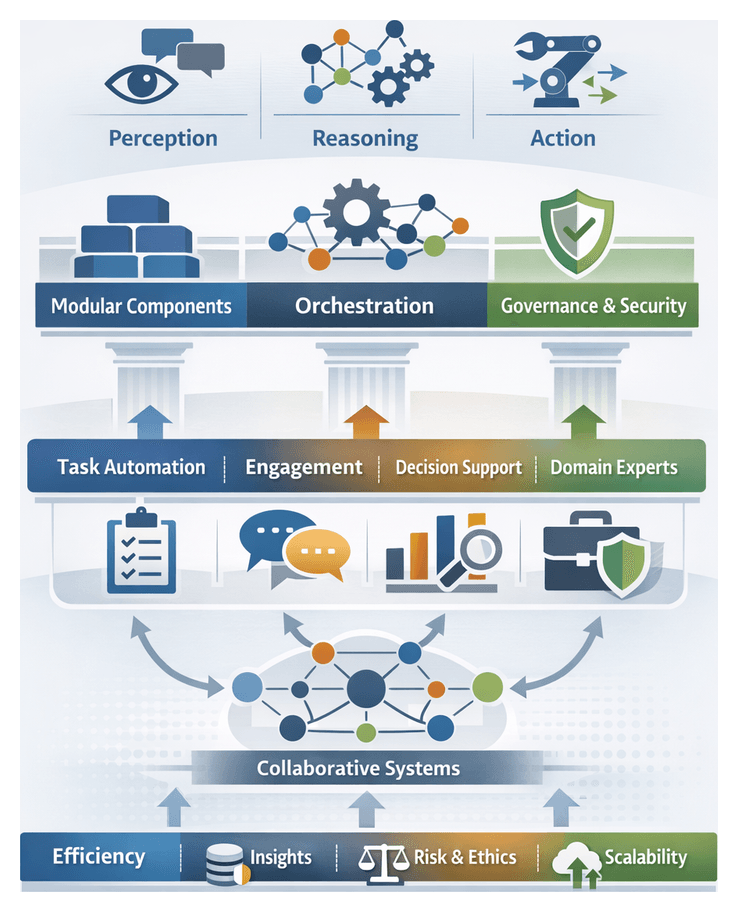
Core Principles of Autonomous AI Agents
Autonomous AI agents combine perception, reasoning, and action to operate with minimal human oversight, adapt through continuous learning, and remain aligned with organizational goals. Perception modules—ranging from natural language processing engines to computer vision networks—ingest data streams. Knowledge structures such as knowledge graphs and symbolically encoded rules provide internal world models. Decision engines, from rule-based systems to deep reinforcement learning pipelines, translate insights into coordinated actions.
This triad establishes a universal blueprint for agent design, while a clear taxonomy helps align capabilities with business needs. Agents span reactive designs that map events to responses, to deliberative architectures that construct multi-step plans. Autonomy levels extend from assisted agents requiring human approval, to fully autonomous systems that negotiate objectives and execute end-to-end workflows.
- Task Automation Agents optimize high-volume, low-variance processes such as incident ticket resolution.
- Engagement Agents deliver conversational interfaces and personalized outreach for sales and marketing.
- Decision Support Agents aggregate data, run predictive analytics, and offer strategic recommendations.
- Domain-Specialist Agents embed risk controls and audit trails for regulated sectors like finance and compliance.
- Collaborative Multi-Agent Systems negotiate responsibilities and share stateful context to orchestrate complex workflows.
Underpinning these deployments are four architectural pillars: modular componentization, orchestration layers, integration fabric, and governance frameworks. Modular design enables independent development and targeted upgrades. Orchestration layers manage state and inter-agent communication. Integration fabrics connect to enterprise systems, data stores, and APIs. Governance frameworks enforce security, compliance, and ethical guardrails through role-based access, transparent decision logs, and continuous monitoring.
Across domains—from IT operations and conversational commerce to finance and human resources—agents drive efficiency gains by reducing manual toil, enhance reliability through proactive monitoring and remediation, support elastic scaling with cloud-native architectures, accelerate innovation via rapid prototyping, and embed risk management through audit trails and guardrails.
Cross-Cutting Strategic Patterns
Analysis across foundational concepts, enabling technologies, architectures, applications, collaboration models, measurement approaches, and ethical considerations reveals recurring strategic patterns. Recognizing these patterns guides organizations toward sustainable, high-impact agent initiatives.
Converging Technological Foundations
- Machine learning models, natural language processing, knowledge graphs, and planning algorithms form a standardized stack, reducing fragmentation and integration complexity.
- Standardized data schemas and ontologies facilitate reuse of reasoning across agents.
- Unified ML platforms support version control, governance, and model lifecycle management.
Modular Architecture and Orchestrated Workflows
- Separation of perception, reasoning, planning, and execution layers enables rapid experimentation and selective scaling.
- Plug-and-play connectors minimize disruption when integrating with legacy systems.
- Orchestration engines handle dynamic routing, error recovery, and workload balancing across agent clusters.
Data-Centric Decision Frameworks
- Data lakes, governed repositories, and unified metadata management ensure agents operate on high-quality, contextually relevant inputs.
- Feature stores and data meshes support real-time enrichment and lineage tracking.
- Federated learning and differential privacy techniques balance performance with confidentiality.
Governance, Risk, and Ethical Imperatives
- Risk taxonomies, fairness assessments, and explainability matrices identify potential harms before production deployment.
- Automated compliance agents scan decision logs and trigger remediation workflows.
- Transparency dashboards provide real-time visibility into agent decisions and underlying rationales.
Scalable Collaboration Ecosystems
- Agent-based modeling and negotiation protocols underpin resilient ecosystems that adapt to dynamic conditions.
- Knowledge federation layers aggregate insights from specialized agents for enterprise-level decision making.
- Human-in-the-loop orchestration ensures oversight, conflict resolution, and alignment with strategic intent.
Performance and Value Measurement
- Composite dashboards integrate metrics such as efficiency gains, error reductions, and user satisfaction.
- Pre-deployment pilots establish baselines to inform roll-out strategies.
- Continuous feedback loops guard against performance drift and guide adaptive threshold settings.
Continuous Learning and Adaptation
- Closed-loop feedback pipelines collect outcome data, retrain models, and redeploy updated policies without manual intervention.
- Shadowing modes and canary deployments validate updates in controlled environments.
- Drift detection and automated retraining workflows maintain model relevance amid changing conditions.
Strategic Alignment and Organizational Readiness
- Capability maturity assessments and readiness surveys identify gaps in strategy, governance, and data literacy.
- Cross-functional working groups bridge technical, legal, and business domains.
- Training programs and Centers of Excellence cultivate skills in AI ethics, data science, and system orchestration.
Industry Drivers, Ecosystem Dynamics, and Adoption Patterns
Several forces catalyze enterprise adoption of autonomous agents and shape how organizations capture value across sectors, ecosystems, and regulatory landscapes.
- Operational Efficiency and Cost Optimization: Agents automate routine workflows—data aggregation, incident diagnosis, customer triage—freeing human resources for strategic tasks and driving measurable cost savings.
- Digital Transformation Imperatives: Agents bridge legacy systems and cloud-native architectures, accelerating critical application migration and end-to-end process automation.
- Demand for Agility and Resilience: Real-time data ingestion and adaptive decision support enable rapid response to market volatility, regulatory shifts, and supply shocks.
- Customer Experience Differentiation: Sentiment analysis, dynamic content generation, and proactive outreach deliver personalized engagement at scale.
- Data Proliferation and Analytics Integration: NLP, predictive modeling, and knowledge graphs transform raw data into actionable insights embedded within workflows.
- Competitive Pressure and Innovation Imperatives: Early adopters gain strategic advantage by reimagining process design; competitors must evaluate agent-driven transformation or risk obsolescence.
Sector-Specific Impacts
- Financial Services and Insurance: Advisory agents recommend portfolios; claim-processing agents expedite underwriting and fraud detection.
- Healthcare and Life Sciences: Clinical decision support analyzes records and research; administrative agents streamline scheduling and billing.
- Manufacturing and Supply Chain: Production planning integrates IoT data; logistics agents coordinate routing and warehouse operations.
- Retail and E-Commerce: Virtual shopping assistants, dynamic pricing engines, and automated customer service deliver frictionless journeys.
- Telecommunications and Utilities: Network-monitoring agents detect anomalies and self-heal; conversational agents manage provisioning and support tickets.
- Government and Public Sector: Regulatory agents track policy changes; citizen engagement agents guide online service portals.
Ecosystem Dynamics
- Platform Providers and Developer Communities: Cloud AI platforms with agent frameworks and connectors become ecosystem hubs, supported by reusable modules and orchestration templates.
- System Integrators and Consultants: Partners align agent capabilities with business objectives, design governance structures, and manage change strategies.
- Independent Software Vendors: Sector-focused solutions in compliance, virtual care, and specialized domains offer deep regulatory and domain expertise.
- Open Source and Standards Bodies: Collaborative initiatives around agent architectures, data protocols, and evaluation benchmarks reduce vendor lock-in and foster interoperability.
Macro-Economic and Ethical Considerations
- Labor Market Transformation: Automation of knowledge work prompts reskilling initiatives and human-centered workforce models.
- Regulatory Oversight and Compliance: Jurisdictions codify AI accountability and transparency standards, requiring audit trails and explainability for critical decisions.
- Data Sovereignty and Privacy: Cross-border data flows and consent frameworks shape agent architectures in regulated industries.
- Ethical Use and Social Impact: Governance frameworks ensure agent behaviors align with societal values and mitigate bias and unintended harms.
- Economic Competitiveness and National Strategy: Public-private partnerships and national funding accelerate R&D, positioning nations to lead in AI-driven markets.
Emerging Adoption Patterns
- Pilot-to-Platform Evolution: Centralized platforms govern agent lifecycles for consistent policy enforcement and shared analytics.
- Center of Excellence Models: Cross-functional hubs define best practices, curate reusable components, and manage training resources.
- Composable Architectures: Libraries of interoperable services—language modules, planning engines, knowledge bases—replace monolithic implementations.
- Strategic Ecosystem Alliances: Partnerships with technology providers, academia, and industry consortia facilitate co-innovation and standards development.
- Continuous Learning and Governance Integration: Feedback loops link monitoring, performance assessment, and retraining to maintain alignment with goals and compliance.
Strategic Imperatives and Future Outlook
To sustain competitive advantage and responsible growth, organizations must embed agent initiatives within broader strategy, governance, and culture.
Aligning Initiatives with Strategic Objectives
- Map agent use cases to key performance indicators—time-to-resolution, cost reduction, revenue growth, or customer satisfaction.
- Establish cross-functional governance with IT, operations, legal, and business units to maintain alignment.
- Use frameworks such as Balanced Scorecard or OKRs to track contributions against enterprise goals.
Balancing Innovation and Risk
- Apply risk assessment models to agent workflows, evaluating impact and failure likelihood.
- Implement staged rollouts and canary deployments to validate performance in controlled environments.
- Engage legal and compliance teams to review data usage, privacy, and regulatory requirements.
Cultivating a Data-Driven and Ethical Culture
- Institute data governance policies to ensure accuracy, completeness, and lineage of training datasets.
- Promote explainability through documented decision pathways and human-in-the-loop validation for high-stakes actions.
- Educate stakeholders on fairness, accountability, and transparency to build trust.
Advancing Organizational and Technological Maturity
- Assess maturity across strategy, technology, data, talent, and governance to identify gaps and guide investments.
- Develop phased roadmaps that evolve from pilots to Centers of Excellence and enterprise-wide agent ecosystems.
- Invest in talent development and partnerships to bridge skill gaps in AI engineering, data science, and change management.
Future-Proofing the Agent Strategy
- Monitor advancements in large language models, reinforcement learning, and knowledge graph embeddings to inform roadmaps.
- Engage with industry consortia and standards bodies to anticipate regulatory changes.
- Architect flexible platforms that integrate emerging tools in hybrid cloud or on-premises environments.
By anchoring agent initiatives in strategic objectives, balancing innovation with risk, nurturing an ethical data culture, advancing maturity, and future-proofing architectures, organizations can harness autonomous AI agents as dynamic capabilities. This transformation reshapes how work is conceived and executed, ultimately fostering human-machine collaboration and sustained value creation in an era defined by intelligent autonomy.
Appendix
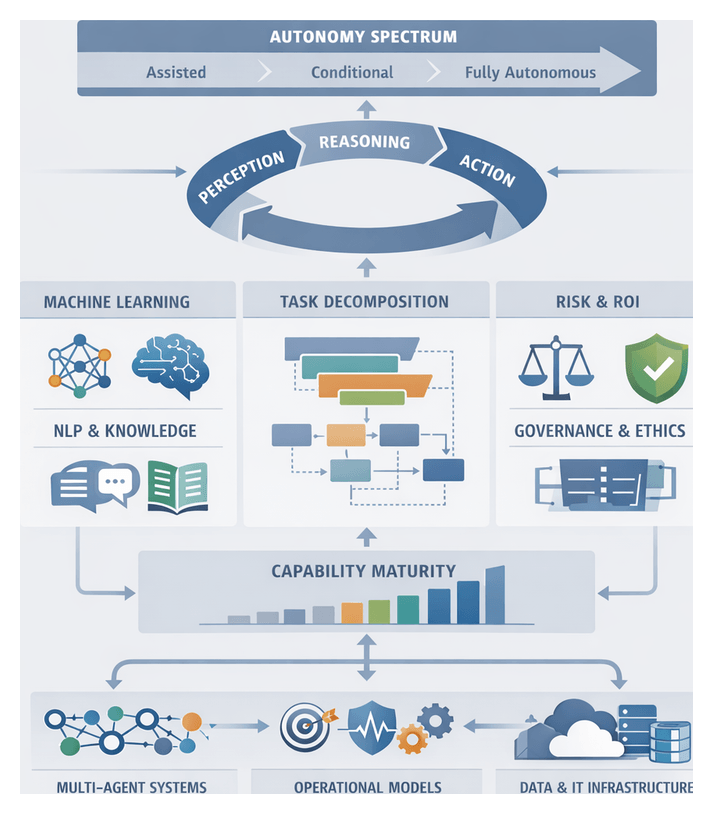
Key Definitions and Terminology
This glossary establishes a shared vocabulary for autonomous AI agents in enterprise settings, defining core concepts that underpin strategic, architectural and governance discussions.
- Autonomous AI Agent – A software entity that perceives its environment, reasons over data, plans actions to achieve goals and adapts through feedback loops.
- Machine Learning – Techniques enabling systems to learn patterns from data and improve over time without explicit rule programming.
- Deep Learning – A subset of machine learning using multi-layer neural networks to model complex data relationships.
- Natural Language Processing – Technologies for interpreting, generating and analyzing human language inputs and outputs.
- Knowledge Representation – Formalization of entities, relationships and rules, often via ontologies and knowledge graphs.
- Reinforcement Learning – A paradigm where agents learn optimal behaviors by interacting with an environment and receiving rewards or penalties.
- Robotic Process Automation (RPA) – Tools that automate repetitive, rule-based tasks by simulating user interactions.
- Explainable AI (XAI) – Techniques providing human-understandable insights into model decisions.
- Bias and Fairness – Concepts and metrics to detect and mitigate discriminatory patterns in data and models.
- Data Governance – Policies and processes ensuring data quality, security and compliance.
- Model Governance – Controls for model versioning, validation, monitoring and risk management.
- MLOps – Practices combining ML, DevOps and data engineering for model lifecycle management.
- AIOps – AI-driven automation of IT operations tasks like anomaly detection and incident remediation.
- Event-Driven Architecture – A pattern where components produce and consume events, supporting asynchronous workflows.
- Service-Level Objective (SLO) – Defined performance targets for availability or response times.
- Multi-Agent System – A network of autonomous agents collaborating to solve complex tasks.
- Agent Orchestration – Frameworks that manage coordination and communication among multiple agents.
- Human-in-the-Loop – Design ensuring human oversight at critical decision points.
- Zero-Trust Security – Continuous authentication and authorization for all interactions.
- Microservices – Architectural style of small, independent services communicating over lightweight protocols.
- Container Orchestration – Tools like Kubernetes that automate deployment and scaling of containerized services.
- Serverless Architecture – Model where code runs in stateless containers managed by a provider, enabling elastic scaling.
Conceptual Frameworks
Agency Autonomy Spectrum
This spectrum ranges from assisted agents requiring human approval, through conditional automation with exception escalation, to fully autonomous systems that self-learn and execute multi-step workflows without intervention.
Perception–Reasoning–Action Loop
Agents ingest data via perception modules, evaluate options with reasoning engines using knowledge representations or predictive models, and execute actions through APIs, refining decisions through continuous feedback.
Task Decomposition and Value Chain Integration
Strategic objectives decompose into discrete tasks for specialized agents, overlaying these on business processes to identify high-impact automation opportunities and manage dependencies between agents, humans and legacy systems.
Capability Maturity Models
This model charts progress from isolated rule-based automations to integrated, self-optimizing agent ecosystems supported by continuous training pipelines and robust governance frameworks.
Risk–Reward and Reliability ROI Models
Risk–reward quadrants align use cases by expected benefit and inherent risk, while reliability ROI correlates uptime improvements with financial outcomes to prioritize monitoring, anomaly detection and self-healing agents.
Operational Risk Index
A weighted measure of incident severity, frequency and recovery resilience, where autonomous agents reduce risk by early anomaly detection, standardized remediation and audit logging.
CRISP-DM and OODA Loops
Integrating agents into the CRISP-DM analytics lifecycle automates data preparation, modeling and monitoring phases, while the Observe-Orient-Decide-Act loop enables rapid, adaptive decision cycles in dynamic environments.
Balanced Scorecard for Agents
This framework maps agent outcomes to financial, customer, internal process and learning perspectives, ensuring alignment of automation initiatives with strategic objectives.
ML–NLP–Knowledge Integration Maturity Matrix
The matrix assesses predictive intelligence, language understanding and knowledge representation maturity, guiding investments in platforms, data and talent for cohesive agent deployments.
Explainable AI Maturity Model
Stages range from black-box deployments to full transparency with feature attributions, policy visualizations and narrative summaries, supported by tools like SHAP and LIME.
Multi-Agent Coordination Patterns
Architectures such as hierarchical teams, peer-to-peer networks and market-based protocols (contract net, auction) offer trade-offs in control, scalability and resilience for complex workflows.
AI Governance and Ethical Frameworks
Lifecycle models embed policy definitions, risk assessments and audit checkpoints across design, development, deployment and monitoring, while ethical frameworks operationalize fairness, accountability and transparency using model cards, ethics checklists and impact assessments.
Continuous Improvement and Change Management
PDCA cycles and agile retrospectives drive iterative agent refinement, complemented by stakeholder engagement models like ADKAR to align cultural readiness and talent capabilities with technological advances.
Clarifications on Common Questions
Spectrum of Agent Autonomy
Agents range from assisted mode with human approval, through conditional automation with confidence-based execution, to fully autonomous operation in low-risk, high-volume contexts.
Data Requirements and Quality
- Volume: Deep learning frameworks such as TensorFlow or PyTorch often require tens of thousands of labeled examples.
- Variety: Unified inputs from structured data, text, images and sensors via knowledge graphs on platforms like Neo4j enhance contextual awareness.
- Veracity: Data governance processes—schema validation, anomaly detection and lineage tracking—prevent bias and errors.
Human-in-the-Loop Versus Full Automation
- Human-in-the-Loop: Critical decisions retain human veto authority.
- Hybrid Models: Routine tasks automated with escalations for exceptions.
- Fully Autonomous: Low-variability tasks execute without intervention once reliability thresholds are met.
Measuring Performance and ROI
- Technical Metrics: Accuracy, task completion rate, latency and error rates.
- Business Metrics: Cost savings, revenue uplift, CSAT and NPS.
- Analytical Frameworks: TCO, Return on Automation Investment and NPV methods.
Governance, Compliance and Auditability
- Centralized logging of inputs, decisions and outputs, supported by platforms like IBM Watson OpenScale.
- Role-based access control to manage permissions.
- Policy-driven engines to enforce regulatory rules.
- Periodic automated and human audits.
Integration with Enterprise Architectures
- API-first approach with REST or gRPC interfaces.
- Event-driven integration via brokers such as Apache Kafka.
- Containerization and orchestration with Kubernetes.
- Middleware like ESBs or iPaaS for protocol and format mapping.
Explainability and Transparency
- Surrogate models such as decision trees for interpreting black boxes.
- Feature attribution with tools like SHAP or LIME.
- Model cards documenting provenance, performance and limitations.
- Interactive interfaces visualizing decision pathways and confidence levels.
Security and Privacy Safeguards
- Encryption at rest and in transit (TLS, AES-256).
- Zero trust architecture enforcing authentication and authorization.
- Privacy by design with data minimization and anonymization.
- Adversarial testing and penetration assessments.
Continuous Learning and Maintenance
- Automated drift monitoring to detect data and concept shifts.
- Scheduled retraining cadences based on performance objectives.
- Version control and experiment tracking with platforms like MLflow or Databricks.
- A/B testing in controlled environments before full deployment.
Multi-Agent Coordination and Orchestration
- Centralized orchestration engines versus peer choreography.
- Standards such as FIPA ACL and Apache Kafka for messaging.
- Contract net and auction protocols for dynamic task allocation.
- Semantic ontologies for shared vocabularies and reduced miscommunication.
Scalability, Reliability and Resilience
- Auto-scaling with Kubernetes.
- Health checks and circuit breakers to reroute workloads.
- Disaster recovery plans for state stores and knowledge bases.
- Load and stress testing to validate performance under peak demand.
Mitigating Vendor Lock-In
- Open formats like ONNX for model portability.
- Container-agnostic deployments without platform-specific dependencies.
- API abstraction layers to decouple consumers from back-end engines.
- Centralized repositories for governance rules and policies.
Total Cost of Ownership and Budgeting
- Initial costs: data preparation, proof-of-concept and integration.
- Recurring expenses: licensing, cloud compute, storage and networking.
- Operations: monitoring, incident response, model maintenance and governance.
- Change management: training, cultural readiness and process reengineering.
Future-Proofing and Evolution
- Modular design for easy integration of new capabilities.
- Federated learning and edge coordination for distributed intelligence.
- Adaptive governance to incorporate emerging regulations and ethical standards.
- Roadmaps for multimodal agents and self-supervised learning pipelines.
AI Tools and Platforms
- OpenAI’s GPT-4 – A large language model for generating human-like text across applications.
- OpenAI ChatGPT API – API for integrating conversational AI into applications.
- TensorFlow – Open-source ML framework for scalable model building and deployment.
- PyTorch – Deep learning library with dynamic computation graphs for research and production.
- spaCy – Industrial-strength NLP library offering tokenization and entity recognition.
- Hugging Face Transformers – Pre-trained transformer models for text generation and analysis.
- Google Cloud Natural Language – API for sentiment analysis and entity extraction on unstructured text.
- Neo4j – Graph database for modeling and querying complex relationships.
- Amazon Neptune – Managed graph database service supporting RDF and property graphs.
- OpenAI Gym – Toolkit for reinforcement learning algorithm development and evaluation.
- Apache Airflow – Workflow orchestration platform for scheduling DAGs.
- Kubernetes – Container orchestration system for automating deployment and scaling.
- IBM Watson OpenScale – Platform for monitoring AI performance, bias detection and explainability.
- DataRobot – Enterprise AI platform automating the end-to-end ML lifecycle.
- UiPath – RPA suite for designing and managing software bots.
- Automation Anywhere – RPA platform for automating high-volume, rule-based tasks.
- Blue Prism – Digital workforce platform with enterprise-grade RPA capabilities.
- Microsoft Bot Framework – Framework for building conversational bots across channels.
- IBM Watson Assistant – Conversational agent platform with NLU and dialog management.
- Google Dialogflow – Platform for creating conversational experiences across multiple channels.
- GE Predix – Industrial analytics and predictive maintenance platform.
- Siemens MindSphere – IoT operating system for industrial asset connectivity and analytics.
- Bloomberg Quant Platform – Tools for quantitative analysis and risk modeling in financial markets.
- Google Cloud Healthcare API – API for compliant healthcare data management and analysis.
- IBM Watson Health – AI solutions for clinical decision support and patient engagement.
- Schneider Electric EcoStruxure – IoT-enabled architecture for energy management and automation.
- Salesforce Einstein – AI insights and recommendations within Salesforce for sales and marketing.
- LinkedIn Talent Insights – Analytics tool for talent pool and skill trend insights.
- Thomson Reuters Westlaw – AI-powered legal research and compliance monitoring platform.
- Semantic Scholar – AI-driven academic search engine for research discovery.
- ONNX – Open standard for ML model interoperability.
- TensorFlow Extended – Toolkit for production ML pipelines with data validation and deployment.
- Hugging Face Accelerated Inference – Managed service for low-latency transformer model inference.
- Ray – Distributed execution framework for scalable AI applications.
- Celonis – Process mining platform for workflow visualization and optimization.
- Amazon Lex – Service for building conversational interfaces with ASR and NLU.
- Microsoft Copilot – AI assistant integrated into Microsoft 365 for context-aware suggestions.
Additional Context and Resources
These resources support deeper exploration of autonomous AI agent strategies, frameworks and best practices.
- Referenced Conceptual Frameworks Overview – Summary of models like BDI, Capability Maturity, OODA and CRISP-DM.
- NIST AI Risk Management Framework – Best practices for identifying and managing AI risks.
- IEEE Ethically Aligned Design – Ethics guidelines for responsible AI development.
- European Commission AI Act Draft – Proposed regulations classifying AI systems by risk level.
- OECD AI Principles – Recommendations promoting human-centered AI governance.
- UN Roadmap on Digital Cooperation – Initiative for inclusive digital technology governance.
- Center for Data Ethics and Innovation – UK advisory on ethical AI practices and public engagement.
- AI Governance Life Cycle Templates – Practical templates for embedding governance controls in AI workflows.
The AugVation family of websites helps entrepreneurs, professionals, and teams apply AI in practical, real-world ways—through curated tools, proven workflows, and implementation-focused education. Explore the ecosystem below to find the right platform for your goals.
Ecosystem Directory
AugVation — The central hub for AI-enhanced digital products, guides, templates, and implementation toolkits.
Resource Link AI — A curated directory of AI tools, solution workflows, reviews, and practical learning resources.
Agent Link AI — AI agents and intelligent automation: orchestrated workflows, agent frameworks, and operational efficiency systems.
Business Link AI — AI for business strategy and operations: frameworks, use cases, and adoption guidance for leaders.
Content Link AI — AI-powered content creation and SEO: writing, publishing, multimedia, and scalable distribution workflows.
Design Link AI — AI for design and branding: creative tools, visual workflows, UX/UI acceleration, and design automation.
Developer Link AI — AI for builders: dev tools, APIs, frameworks, deployment strategies, and integration best practices.
Marketing Link AI — AI-driven marketing: automation, personalization, analytics, ad optimization, and performance growth.
Productivity Link AI — AI productivity systems: task efficiency, collaboration, knowledge workflows, and smarter daily execution.
Sales Link AI — AI for sales: lead generation, sales intelligence, conversation insights, CRM enhancement, and revenue optimization.
Want the fastest path? Start at AugVation to access the latest resources, then explore the rest of the ecosystem from there.