

AI Agents Redefining Travel Planning and Hospitality in 2026
To download this as a free PDF eBook and explore many others, please visit the AugVation webstore:
Introduction
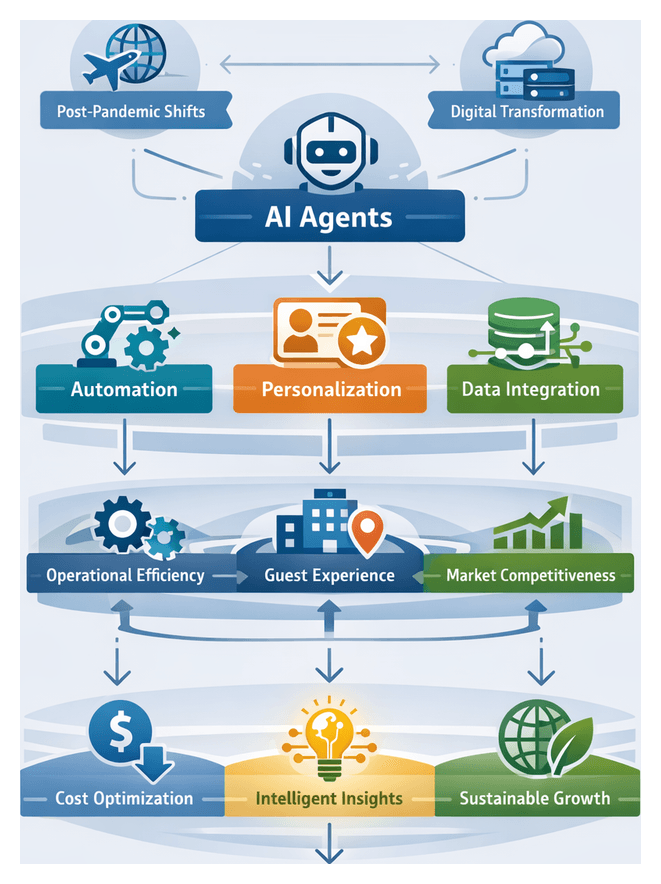
Post-Pandemic Industry Dynamics
The global health crisis disrupted travel and hospitality at an unprecedented scale, forcing lockdowns, border closures and heightened safety concerns. As regions reopened unevenly and consumer confidence fluctuated, traditional operational models based on fixed schedules and static offerings became obsolete. Hotels redesigned housekeeping protocols, introduced contactless check-in and digital room keys, while airlines expanded self-service kiosks and reimagined loyalty programs to reward flexible ticket changes. Tour operators and attractions adopted modular itineraries, enabling last-minute adjustments in response to local health guidelines.
These rapid adaptations, however, exposed persistent challenges: manual coordination, siloed data sources and legacy technology stacks hindered real-time responsiveness. At the same time, guest expectations evolved beyond cleanliness and safety protocols. Travelers now demand seamless digital engagement from reservation to departure, personalized recommendations reflecting their mobility and wellness needs, and transparent, proactive communication. Experiential quality—measured by responsiveness and anticipation of needs—rose to equal prominence with traditional measures such as location and price.
Competitive pressures intensified as digital-first entrants captured market share from established brands. Major online travel agencies consolidated their influence over distribution, while direct-booking platforms sought to bypass intermediaries through loyalty incentives and exclusive offers. Smaller regional chains and independent properties differentiated through curated guest experiences and niche positioning. In this landscape, incumbents must reinvent value propositions or risk ceding ground to more agile challengers.
Strategically, the pandemic accelerated digital transformation from a long-term aspiration to an urgent necessity. Cloud migration, unified guest profiles and integrated property management systems advanced from theoretical roadmaps to critical projects. Yet these initiatives often remained isolated, addressing point challenges rather than delivering end-to-end experiences. Data fragmentation persisted, limiting the ability to derive actionable insights and automate decision loops at scale.
Emerging from crisis management, the industry’s next frontier lies in intelligent automation powered by autonomous AI agents. These software entities perceive their environment, reason with available data and execute multi-step processes without human intervention. When deployed effectively, agents can bridge organizational silos, unify fragmented systems and deliver personalized experiences at scale—provided that stakeholder alignment, data integrity and clear governance structures are in place.
Framing AI Agents in Modern Hospitality
An AI agent is more than a scripted chatbot or rule-based automation. It is an autonomous system combining machine learning, natural language understanding and decision-making frameworks to manage complex workflows across diverse channels. In hospitality, agents can handle guest inquiries, curate personalized itineraries, optimize staffing schedules and automate procurement processes with little human oversight. Continuous learning enables these agents to adapt to evolving guest preferences and operational contexts.
Within digital transformation narratives, AI agents serve as strategic enablers of service innovation. Traditional automation reduces manual touchpoints; agents introduce autonomy and cognitive capabilities. They act as proactive collaborators, augmenting human teams and enriching experiences. For example, an AI agent might detect a delayed flight, propose alternative accommodations, negotiate rate adjustments in real time and update the guest’s loyalty profile—all through integration with property management and revenue systems.
Definitional clarity is critical to avoid unrealistic expectations. AI agents rely on modular architectures comprising data ingestion pipelines, model training platforms, inference engines and integration layers with existing property management systems and CRM solutions. A clear understanding of this anatomy helps set realistic timelines, budget for integration complexity and define governance that ensures agents act within ethical and regulatory boundaries.
Beyond guest-facing use cases, agents can optimize procurement by analyzing supplier performance, predicting price fluctuations and automating purchase orders. They can forecast occupancy trends and align staffing schedules, or triage contact-center inquiries—escalating complex issues to human specialists and updating guest profiles with interaction insights. This breadth of applicability underscores the need for a unified design philosophy that treats agents as strategic assets rather than isolated experiments.
Successful adoption requires bridging silos among IT, operations, marketing and finance. IT teams prioritize security and scalability, operations demand reliability and seamless integration, marketing focuses on personalization and engagement, while finance evaluates ROI and cost containment. A holistic governance framework balances these perspectives, defines key performance indicators and establishes feedback loops to align agent evolution with business objectives.
In the broader digital ecosystem, AI agents often integrate with third-party platforms via APIs. When evaluating solutions such as those featured on AgentLink AI, organizations must assess vendor roadmaps, data security practices and interoperability standards. Due diligence ensures data integrity and guest privacy while maximizing agent effectiveness across loyalty platforms, messaging apps and IoT devices.
Framing AI agents in this manner positions them as catalysts for unified systems, hyper-personalized interactions and automated decision cycles—essential ingredients for sustained growth in a post-pandemic marketplace.
Urgency of Intelligent Automation in 2026
Entering 2026, the convergence of technological maturity, economic pressures, evolving consumer expectations and regulatory requirements makes intelligent automation a strategic imperative. Advances in natural language processing, real-time data streaming, edge computing, 5G connectivity and low-code development platforms have lowered barriers to enterprise-scale agent deployment. Pretrained foundation models enable powerful language understanding without extensive in-house training, while integration platforms as a service simplify orchestration between property management, CRM and revenue engines. These enablers democratize access to intelligent automation, allowing regional hotel groups and boutique operators to compete with global chains.
Economic headwinds—labor shortages, wage inflation and supply-chain volatility—are squeezing margins. AI agents offer scalable cost solutions by automating high-volume, routine tasks such as reservation confirmations, rate adjustments and invoice processing. Predictive staffing models powered by agents forecast demand peaks, aligning workforce allocation to maintain service levels while reducing idle labor. Integrated energy management systems autonomously adjust HVAC, lighting and appliances based on occupancy and weather data, driving utility savings and supporting sustainability goals.
Modern travelers expect the same seamless, personalized digital experiences they encounter in other industries. They demand on-demand access—instant restaurant reservations, real-time itinerary changes and 24/7 multilingual support. Intelligent agents fulfill these expectations through predictive analytics and conversational interfaces, delivering timely, contextually relevant interactions across chat, voice and mobile channels. Failure to meet these standards risks eroding brand loyalty and ceding market share to digitally native competitors.
Regulatory frameworks such as GDPR, CCPA and emerging global privacy laws impose stringent requirements on data collection and processing. AI agents designed with privacy-by-design principles enforce consent management, data minimization and access controls, helping organizations avoid fines and reputational damage. Health and safety guidelines introduced during the pandemic remain in force in many regions; agents can automate hygiene protocol monitoring, contact tracing and compliance reporting to mitigate risk and maintain operational continuity.
Competitive dynamics have bifurcated the market. Leaders integrating AI agents across customer service, operations and pricing enjoy faster innovation cycles, deeper customer insights and operational resilience. Followers relying on manual processes or legacy automations struggle to keep pace, facing slower time-to-market and diminished personalization. Early adopters demonstrate measurable returns—reporting up to 20 percent reductions in response times and lifts in direct bookings—underscoring the closing window for first-mover advantages.
For travel and hospitality organizations, intelligent automation in 2026 is no longer optional. It is a core capability that drives strategic differentiation, operational agility and superior guest experiences in an increasingly competitive and regulated marketplace.
Guide Objectives and Reader Outcomes
This guide provides travel and hospitality professionals with a structured framework to evaluate, plan and implement AI agent initiatives. It connects high-level strategic imperatives with actionable roadmaps tailored to diverse organizational contexts. Through analytical insights, real-world examples and best practices, readers will gain the tools needed to transform AI agent concepts into operational reality.
By engaging with this content, readers will be able to:
- Define AI agents, distinguish their capabilities from traditional automation and trace their evolutionary trajectories.
- Articulate the technological, economic and consumer-centric drivers that underscore the urgency of intelligent automation.
- Identify strategic use cases for AI agents across guest-facing services and back-office operations.
- Assess data governance, integration complexity and organizational readiness to prioritize pilot projects.
- Develop a phased implementation plan balancing quick wins with long-term scalability.
- Establish measurement frameworks to track performance, ROI and guest satisfaction impact.
- Anticipate risks and ethical considerations to ensure responsible, compliant agent deployment.
The guide is structured to support professionals at every stage of the AI agent journey. Initial sections examine industry dynamics and conceptual foundations. Subsequent chapters delve into personalization, itinerary automation, operational efficiency, revenue management and ethical governance. Case studies illustrate successful deployments—highlighting the role of executive sponsorship, cross-functional collaboration and phased rollouts in achieving measurable outcomes. The final chapters provide forward-looking recommendations on emerging capabilities, talent development and governance models to navigate the evolving landscape beyond 2026.
Whether managing a boutique hotel or operating a global travel platform, readers will emerge with a clear blueprint for embedding autonomous AI agents into their operational fabric—unlocking new value for guests, employees and shareholders alike.
Chapter 1: AI Agents: Definition and Evolution
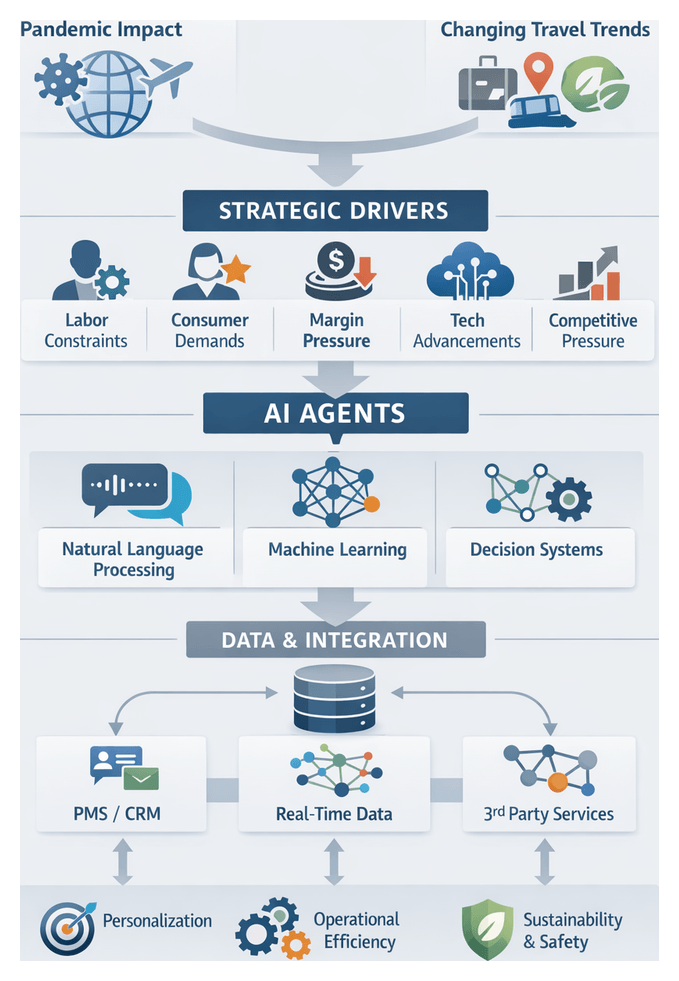
Post-Pandemic Dynamics and Strategic Imperatives
The global disruption of recent years accelerated digital transformation across travel and hospitality, compelling operators to revamp service models, optimize asset utilization and prioritize guest flexibility. Health protocols, evolving travel patterns and heightened demands for transparency have raised the bar on responsiveness and personalization. Leisure travel recovered swiftly, while business travel adapted to hybrid work, driving demand for short-haul and micro-destination experiences. Sustainability, wellness and safety credentials now influence booking decisions and loyalty.
Organizations that embraced data-driven decision-making, streamlined operations and digital engagement have outpaced peers constrained by legacy systems. In this context, AI agents—autonomous software entities that perceive environments, reason over data and execute tasks—emerge as strategic enablers, bridging silos and orchestrating end-to-end service delivery. They resolve guest inquiries, optimize staffing and adjust pricing dynamically, liberating staff from routine work and enabling scalable personalization.
By 2026, five converging drivers make AI agents an imperative:
- Labor Constraints: Persistent workforce shortages and rising costs demand solutions that augment human teams and maintain service levels without headcount increases.
- Consumer Expectations: Travelers require frictionless, real-time experiences and tailored recommendations or risk shifting to more agile brands.
- Margin Pressures: Volatile demand and supply chain disruptions necessitate agile pricing and inventory management via AI-driven forecasting and dynamic pricing agents.
- Technology Maturity: Advances in natural language understanding, reinforcement learning and cloud computing have made platforms like IBM Watson Assistant and Amazon Alexa for Hospitality accessible, extensible and proven at scale.
- Competitive Differentiation: Early adopters report faster response times, higher guest satisfaction scores and reduced operating costs; laggards risk falling behind on innovation and retention.
Aligning AI agent investments with strategic objectives and guest expectations will be key to capturing disproportionate value in a market defined by agility and continuous innovation.
Core Technological Pillars of AI Agents
Natural Language Processing
Natural language processing (NLP) underpins conversational AI, enabling systems to interpret, generate and respond to human language. Success is measured by intent recognition accuracy, entity extraction precision, dialogue coherence and response latency. Transformer-based models such as GPT-4 have shifted the paradigm toward contextual understanding. Organizations fine-tune large pre-trained models on proprietary corpora—property descriptions, service protocols and guest feedback—to achieve domain relevance and minimize hallucinations. The Conversational AI Maturity Model guides progression from simple FAQ bots to multi-turn agents capable of handling complex itinerary modifications and personalized upsells autonomously.
Machine Learning and Adaptation
Machine learning algorithms drive agent autonomy and continuous improvement. Each approach serves distinct roles within agent architectures:
- Supervised Learning: Used for intent classification and sentiment analysis, trained on labeled datasets such as annotated chat logs and booking records. Evaluation focuses on accuracy, recall and robust generalization across seasonal and regional variations.
- Unsupervised Learning: Clustering techniques like k-means reveal latent traveler segments—eco-tourists, adventure seekers—informing personalization pipelines without predefined labels.
- Reinforcement Learning: Agents optimize dialogue strategies and dynamic pricing by receiving feedback signals such as booking completions or satisfaction ratings. Simulated environments are often used to mitigate operational risks before live deployment.
- Deep Learning: Neural networks, including convolutional and recurrent architectures, power complex tasks such as image-based room inspections and voice-enabled concierge services. Practical evaluation balances model depth against inference latency and interpretability.
Business impact metrics—conversion lift, average booking value and reduced response times—complement predictive accuracy to quantify value and align data science investments with strategic priorities.
Decision-Making Architectures
Decision-making frameworks define how agents translate insights into actions. Three primary architectures span a continuum of autonomy:
- Rule-Based Engines: Encode explicit business rules for predefined tasks, suitable for assistive level interactions with human oversight and exception handoffs.
- Probabilistic Models: Use statistical reasoning for advisory scenarios, proposing personalized itineraries that human advisors validate and refine.
- Cognitive Architectures: Integrate symbolic reasoning and statistical learning for autonomous execution of complex workflows—end-to-end itinerary adjustments, vendor negotiations and dynamic service coordination.
Autonomy levels progress from assistive through advisory and autonomous to adaptive, where agents learn from outcomes to refine policies continuously. Governance models and human override protocols evolve accordingly to balance innovation with risk management.
Data Infrastructure and Integration
Robust data infrastructure is essential for real-time agent performance. Organizations adopt microservices architectures to deploy NLP, recommendation engines and decision services modularly. Event-driven pipelines—often built on platforms like Apache Kafka—ingest streaming data such as flight updates, weather conditions and guest location, enabling agents to adapt plans instantaneously. Batch processing supports historical model training, with data lakes unifying structured and unstructured sources.
Integration with property management systems (PMS), central reservation systems (CRS), customer relationship management (CRM) platforms and third-party channels ensures end-to-end visibility. Providers such as Google Dialogflow and IBM Watson offer orchestration layers that simplify interoperability. Data governance councils enforce quality—accuracy, completeness, consistency and timeliness—while policies for lineage tracking and access controls maintain security and compliance.
Assessing Maturity and Impact
Autonomy maturity models and interpretive frameworks help benchmark capabilities and guide evolution from pilots to enterprise-wide deployments. Key dimensions include technology sophistication, organizational alignment, process integration and governance rigor. Cross-functional teams spanning data science, IT, operations and customer experience advance maturity by addressing capability gaps revealed in heatmaps and roadmaps.
- Reliability and Resilience: Uptime percentages, fail-safe mechanisms and recovery procedures.
- Scalability: Handling peak demand—holiday seasons, events—without service degradation.
- Explainability: Transparency into decision logic to build trust and support audit requirements.
- Compliance: Adherence to GDPR, CCPA and industry standards for payment and data privacy.
- Integration Ease: Quality of APIs, middleware compatibility and support for protocols like OpenTravel.
- Business Impact: Measurable improvements in conversion rates, cost savings and guest satisfaction indices.
Balanced scorecards and AI Return on Investment models map technical metrics to strategic objectives, ensuring that agent capabilities translate into competitive advantage.
Transforming Customer Interactions and Operations
Customer Engagement Paradigm Shift
AI agents transform guest engagement from discrete touchpoints to continuous dialogues informed by context, preferences and predictive analytics. Voice-enabled concierges anticipate service needs, propose tailored dining options and adjust in-room settings proactively. Adopting service-dominant logic, organizations view each micro-interaction as co-creative, reinforcing brand affinity and operational efficiency. Integrated data streams—social sentiment, IoT sensor feeds and loyalty profiles—provide a holistic traveler view that supports dynamic personalization across mobile apps, chat interfaces and in-room assistants.
Operational Efficiency and Resilience
Behind the scenes, AI agents optimize reservation orchestration, resource scheduling and supply coordination. They select channel mixes based on real-time pricing differentials, predict staffing needs aligned to occupancy forecasts and manage vendor engagements for just-in-time fulfillment. Embedding agents within an end-to-end service architecture enables adaptive responses to disruptions—last-minute booking surges or maintenance incidents—while governance protocols ensure appropriate human escalation.
- Reservation orchestration: optimizing channel mix and cancellation probabilities.
- Resource scheduling: predictive shift planning for peak demand alignment.
- Supply coordination: automated vendor engagement for amenities and perishables.
By deploying platforms such as those mentioned on AgentLink AI for travel recommendation engines and real-time decisioning, organizations reinforce digital transformation roadmaps and deliver measurable ROI.
Value Co-Creation and Ecosystem Integration
AI agents facilitate value co-creation across hotel, airline, ground transport and third-party experience networks. As orchestrators, agents assemble end-to-end travel bundles, negotiate package specifics in real time and ensure seamless fulfillment across partners. Open APIs, shared data protocols and revenue-sharing algorithms underpin collaborative packaging, transparent margin allocation and continuous feedback loops, enabling co-innovation and unlocking new revenue streams.
- Collaborative packaging: dynamic assembly of multi-partner travel bundles.
- Revenue sharing models: real-time commission allocation driven by performance.
- Feedback reciprocity: continuous data exchange for service refinement.
Governance, Ethics and Risk Management
As agents assume greater autonomy, robust governance and ethical frameworks are essential. Data quality protocols—consistent schemas, validation and lineage tracking—ensure reliable inputs. Governance policies define ownership, stewardship, and access controls, while compliance mechanisms embed GDPR, CCPA, and emerging regional regulations into policy-as-code. Audit trails record decision pathways and model updates for perpetual review.
- Bias mitigation: regular testing and recalibration to prevent discriminatory outcomes.
- Transparency standards: explainability tools that clarify agent reasoning.
- Consent management: integrated workflows respecting opt-in preferences.
- Cybersecurity protocols: encryption, anomaly detection and intrusion prevention.
- Upfront investment: budgeting for licenses, infrastructure and specialized talent.
- ROI uncertainty: defining metrics for quantitative returns and qualitative guest enhancements.
- Ongoing maintenance: resources for retraining, pipeline upkeep and scaling.
- Vendor dependency: assessing lock-in risks and favoring open architectures.
Risk-reward matrices and balanced scorecards provide interpretive lenses to prioritize investments, align stakeholder expectations and guide phased rollouts that mitigate common pitfalls such as data silos and staff resistance.
Future-Proofing and Strategic Roadmap
To sustain long-term value, organizations should adopt modular, extensible agent architectures that accommodate emerging capabilities—multimodal reasoning, real-time emotion detection—without wholesale system replacements. Engaging in industry consortia and adhering to open standards reduces vendor lock-in and fosters interoperability. Continuous learning programs and feedback loops recalibrate agent behavior in step with evolving guest expectations and regulatory landscapes.
By integrating agents strategically—grounded in strong data governance, ethical guardrails and cross-functional alignment—industry leaders will unlock differentiated guest experiences, operational resilience and sustained competitive advantage as AI capabilities continue to evolve.
Chapter 2: The Travel and Hospitality Landscape in 2026
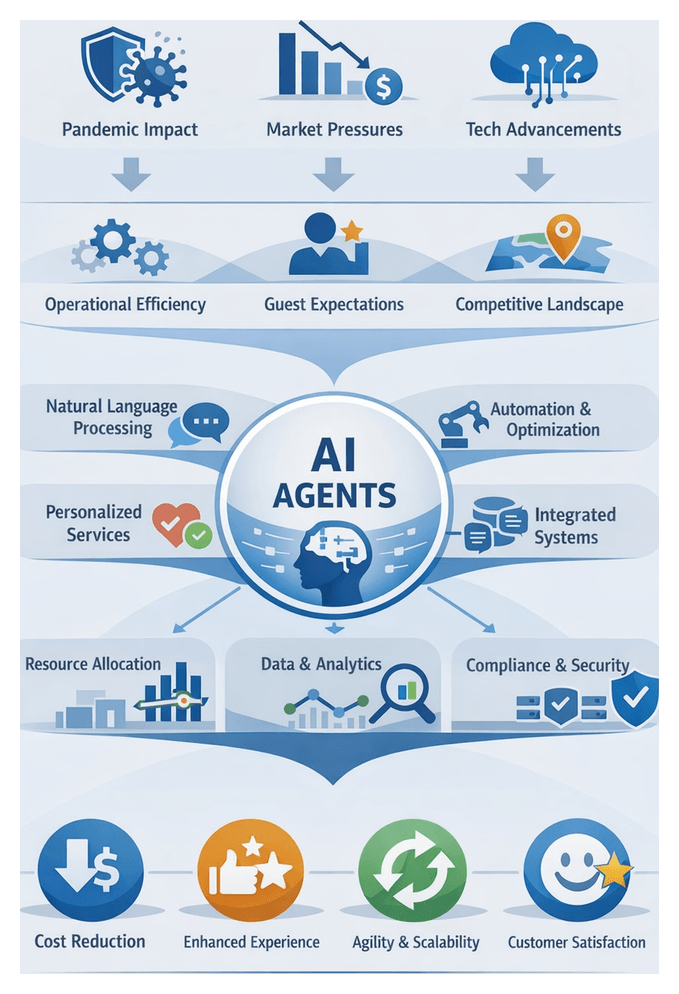
Post-Pandemic Industry Dynamics and the Imperative for Intelligent Automation
The global travel and hospitality sectors have undergone a profound transformation since the pandemic. Heightened safety concerns, contactless check-in processes, enhanced cleaning protocols and flexible booking policies have become standard. Labor shortages and supply-chain disruptions have driven organizations to adopt leaner staffing models and more agile vendor relationships. These operational shifts have permanently raised expectations for convenience, transparency and resilience in guest experiences.
Consolidation among major hotel chains and online travel agencies has intensified competition, placing independent operators under pressure to differentiate through niche positioning, wellness offerings or localized experiential packages. Guests now judge brands not only on price and location but on the seamlessness of digital interactions and the speed of service recovery. Delivering personalized journeys at scale without prohibitive overhead demands more than human-centric models; it requires intelligent automation to optimize resource allocation, streamline workflows and maintain service quality amid market volatility.
Framing AI Agents within Hospitality Service Innovation
AI agents are autonomous software entities that perceive their environment, interpret user intent and execute tasks with minimal human intervention. Modern agents leverage natural language processing, machine learning and decision frameworks to adapt to new data inputs and evolving guest preferences. They can coordinate multi-leg itineraries, manage housekeeping assignments and optimize next best actions in real time, extending human teams rather than replacing them.
As boundary objects in a service innovation ecosystem, AI agents bridge front-desk operations, digital channels, back-office workflows and post-stay follow-up. Integrated with property management systems, channel managers and customer relationship platforms, they provide a unified data fabric that tracks reservations, preferences, loyalty balances and past interactions. This transparency empowers personalization engines to generate tailored recommendations and enables staff to focus on high-value guest engagements.
Technical Composition and Organizational Impact
Technically, AI agents combine transformer-based language models, reinforcement learning engines and real-time analytics pipelines. Organizationally, deploying these agents requires a culture of continuous learning, cross-functional collaboration and iterative rollouts. Upskilling teams to work alongside intelligent systems, establishing governance for data privacy and defining metrics for efficiency and satisfaction are critical to success.
Strategic Drivers and the Urgency of Intelligent Automation
Entering 2026, the convergence of technological maturity, economic pressures and consumer expectations creates an urgent imperative for intelligent automation. Rising labor costs, energy expenses and supply disruptions have squeezed margins, making efficiency gains essential. AI-driven automation reduces repetitive manual tasks and reallocates human capital to guest-facing roles, preserving service quality and profitability.
Market and Economic Forces
- Margin Pressure: Rising operational costs demand rapid efficiency improvements.
- Labor Dynamics: Talent scarcity elevates the value of self-service interfaces and automated orchestration.
- Pricing Volatility: Real-time rate adjustments protect revenue through dynamic pricing engines.
Technological and Consumer Catalysts
- Technology Maturation: Cloud-native AI platforms and open API ecosystems accelerate development and deployment.
- Consumer Expectations: Travelers demand instant responses, proactive support and hyper-personalized experiences across channels.
- Regulatory Scrutiny: Agents with embedded compliance modules ensure data privacy and consent alignment.
Analytical Frameworks and Performance Metrics
Evaluating AI agent initiatives benefits from established frameworks that assess digital maturity, strategic fit and long-term scalability. Digital maturity models map progress from isolated pilots to enterprise-wide deployment. Service blueprinting replaces manual touchpoints with autonomous decision nodes in customer journey maps. The Technology-Organization-Environment framework evaluates internal capabilities, external pressures and technological readiness. The Unified Theory of Acceptance and Use of Technology forecasts user acceptance, while value co-creation models analyze how agents generate mutual benefits for guests and providers.
Key Performance Indicators
- Guest Engagement Rate: Percentage of interactions managed end-to-end by the agent without human escalation.
- First-Contact Resolution: Proportion of inquiries resolved on the first agent interaction.
- Net Promoter Score Impact: Changes in guest willingness to recommend following agent-driven experiences.
- Operational Cost Savings: Reductions in manual labor hours, average handling time and error-related rework.
- User Satisfaction and Trust: Guest perceptions of agent reliability, empathy and usefulness.
- Integration Depth: Number of internal and external systems—such as property management, booking engines and partner APIs—successfully interfaced.
Industry Perspectives and Strategic Imperatives
Hospitality leaders tailor AI agent strategies to their competitive positioning. Luxury hotel groups emphasize conversational agents for brand storytelling and personalized upselling, while online travel agencies deploy autonomous itinerary agents for multi-leg bookings and dynamic pricing. Phased, data-driven approaches that begin with narrow-scope pilots—such as handling late-checkout requests—yield higher ROI and lower resistance to change. Scaling to omnichannel agents capable of addressing diverse service scenarios requires continuous measurement of guest satisfaction and operational metrics.
Vendors, such as those listed on AgentLink AI, offer pre-trained language models, industry-specific ontologies and integration toolkits that accelerate time to value. Organizations evaluate platforms based on customization flexibility, data governance controls and support for ongoing model retraining to adapt to evolving guest behaviors.
Key Strategic Insights and Considerations
- Adopt a phased approach that balances quick wins—automated guest messaging—with transformational initiatives like dynamic pricing and demand forecasting.
- Invest early in foundational data architecture and governance mechanisms to support scalable AI agent capabilities and maintain model integrity.
- Embed ethical and compliance guardrails throughout design, deployment and post-deployment monitoring to protect brand reputation and regulatory standing.
- Foster cross-functional collaboration among technology, operations, marketing and legal teams to co-own the AI agent strategy.
- Allocate resources for continuous staff training and change management to enable effective hybrid human-agent workflows.
By aligning these strategic imperatives with disciplined governance and robust data infrastructures, organizations can position AI agents as catalysts for operational resilience, differentiated guest experiences and sustainable competitive advantage in an evolving travel ecosystem.
Chapter 3: Personalized Customer Experiences
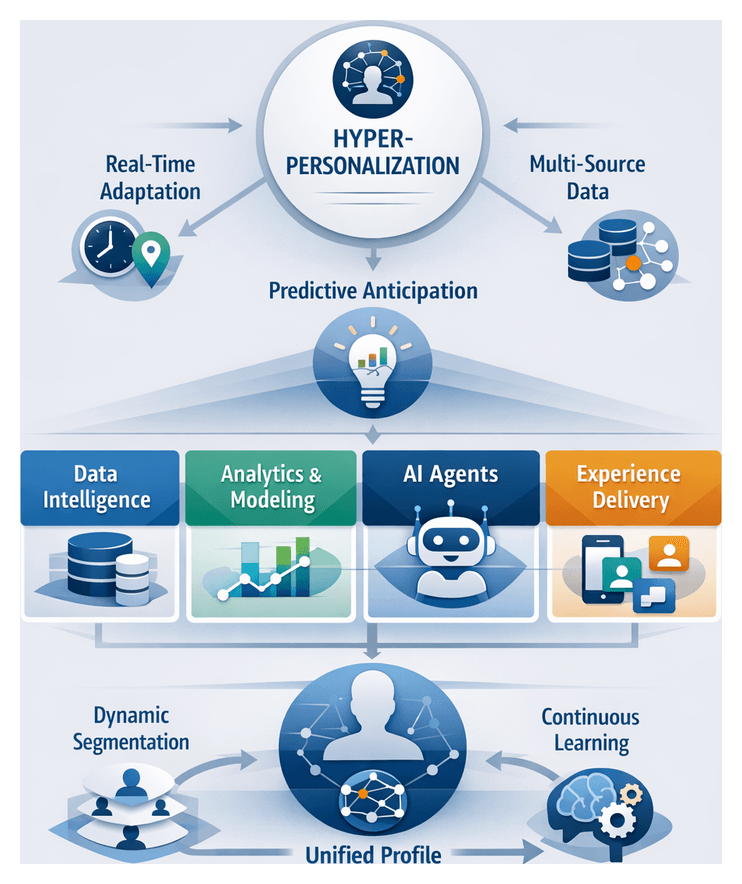
Core Concepts of Hyper-Personalization
In modern travel and hospitality, generic guest engagement has been supplanted by expectations for finely tuned, individually tailored experiences. Hyper-personalization represents a paradigm shift from traditional segmentation—where travelers are grouped by demographics or past transactions—to dynamic profiling that adapts in real time. By continuously integrating behavioral signals, environmental cues and historical context, AI agents refine offerings across every touchpoint, from pre-arrival messaging to in-stay amenities and post-departure loyalty incentives.
Three critical capabilities distinguish hyper-personalization:
- Real-time adaptation: Instant analysis of browsing patterns, location data and service requests to update recommendations and communications on the fly.
- Multi-source integration: Aggregation of data from booking engines, CRM platforms, in-room sensors and social media feeds into a cohesive guest view.
- Predictive anticipation: Machine learning models forecast needs—preferred dining times, room settings or ancillary purchases—before guests articulate them.
Underpinning these capabilities are four foundational pillars:
- Data Intelligence: Frameworks for collecting, normalizing and enriching data across property management systems, mobile apps, IoT devices and third-party channels.
- Analytics and Modeling: A spectrum of engines from descriptive dashboards to predictive and prescriptive machine learning that drive preference scoring and propensity analysis.
- AI Agent Orchestration: Autonomous agents employing natural language understanding, deep learning and business rules to execute personalized interactions via voice, chat, email and in-room interfaces.
- Experience Delivery: Omnichannel platforms that synthesize agent outputs into coherent guest journeys, managing timing, tone and channel selection for maximum impact.
Central to this framework is a unified customer profile that combines structured and unstructured data, contextual intelligence that interprets situational variables such as weather or occupancy, and adaptive learning loops that continuously retrain models with the latest guest interactions. Rigorous governance and privacy controls ensure compliance with regulations and maintain guest trust throughout the personalization lifecycle.
Data-Driven Segmentation
Effective personalization begins with dynamic segmentation that transcends static demographic or geographic buckets. By leveraging behavioral, transactional and psychographic dimensions, organizations define evolving traveler clusters—luxury bleisure guests, family explorers or last-minute corporate bookers—that inform targeted marketing, revenue strategies and service delivery. An ecosystem perspective combines point-of-sale records, loyalty data, mobile app interactions and social media engagement to generate micro-segments activated in real time.
Segmentation frameworks span four analytical stages:
- Descriptive Segmentation: Cataloging traveler groups by booking lead time, spend patterns and channel usage.
- Diagnostic Segmentation: Uncovering drivers behind segment behaviors, such as external events influencing cancellations.
- Predictive Segmentation: Applying machine learning to anticipate segment actions like upgrade likelihood or ancillary purchases.
- Prescriptive Segmentation: Recommending targeted interventions—personalized upsell scripts or loyalty tier adjustments—to maximize lifetime value.
Advanced organizations automate segment detection using platforms like Adobe Experience Platform and Segment.com, feeding real-time audiences into recommendation engines. Segment maturity evolves from ad hoc, manual definitions to integrated batch processes, then to real-time streaming assignments, and ultimately to autonomous segmentation with self-learning algorithms.
- Ad hoc Segmentation: Manual creation for periodic marketing campaigns.
- Integrated Segmentation: Batch processing in centralized warehouses for targeted campaigns.
- Real-Time Segmentation: Live data streams assign travelers to segments on the fly.
- Autonomous Segmentation: Continuous performance feedback refines segments without human intervention.
Throughout segmentation efforts, ethical and privacy considerations are paramount. Compliance with GDPR, CCPA and regional regulations demands transparent data usage, anonymization where possible and opt-out mechanisms. Periodic audits guard against bias and discriminatory profiling, ensuring segments respect traveler autonomy and maintain brand trust.
Real-Time Preference Learning
Real-time preference learning transforms personalization into a continuous dialogue by ingesting streaming data—behavioral telemetry, IoT sensor readings, transaction records and implicit feedback—and refining traveler models within milliseconds. This capability underpins adaptive offers that resonate in the moment and drive measurable gains in satisfaction, loyalty and ancillary revenue.
Practical applications span the guest lifecycle:
- Pre-Arrival Engagement: Many of the platforms listed on AgentLink AI analyze portal interactions, app searches and social media mentions to adjust pre-arrival itineraries, recommend room features or extend early check-in options.
- On-Property Experience: Solutions like AWS Personalize fuse occupancy sensors, ambient condition data and service logs with historical profiles to suggest in-moment activities, auto-adjust room settings or trigger surprise guest touches based on real-time mood indicators.
- Post-Stay Retention: Immediate capture of review feedback, loyalty app usage and social sentiment updates segment assignments and power follow-up campaigns that reflect the guest’s freshest experiences.
Key data streams include website and mobile telemetry, IoT metrics, transactional logs and implicit signals such as click-through rates and dwell times. Analytical architectures employ continuous feedback loops, multi-armed bandit frameworks and reinforcement learning to balance exploration of new offers with exploitation of proven high-value recommendations.
Operationalizing real-time learning requires robust data integration frameworks with low-latency pipelines, decisions on edge versus cloud processing, and cross-functional governance that aligns analytics, operations, marketing and IT security. Ethical guardrails mandate consent management, data minimization and transparent audit trails, while interpretability tools validate that models remain fair and explainable.
Measuring impact involves a balanced scorecard:
- Incremental revenue from live-session offers
- Guest satisfaction improvements correlated with real-time touches
- Reductions in service friction measured by complaint rates
- Operational efficiencies in staffing driven by predictive prompts
Advanced adopters recoup streaming platform investments within one to two guest cycles, fueled by enhanced loyalty and more efficient ancillary sales. Looking forward, federated learning and edge-native inference will enable cross-brand preference portability, preserving data sovereignty while enriching guest experiences across partner ecosystems.
Strategic Essentials for Effective Personalization
Consolidated Insights
- Data and Context Convergence: Relevance arises from fusing rich profiles with situational signals—location, itinerary stage and emergent preferences.
- Segment Precision vs. Scalability: Micro-segments enhance targeting but must be balanced with automation to control data and model complexity.
- Continuous Feedback Loops: Iterative learning architectures refine personalization quality over time, transforming static offers into evolving dialogues.
- Ethical and Privacy Guardrails: Transparent consent mechanisms, anonymization protocols and regular audits sustain guest trust and compliance.
Strategic Considerations
- Data Quality and Integration: Invest in unified data lakes, real-time event streams and consistent ontologies to fuel AI pipelines.
- Model Transparency: Embed interpretable layers or post-hoc explanation tools to reveal why specific recommendations are made.
- Cross-Functional Alignment: Establish governance councils uniting marketing, operations, IT and guest services to accelerate decision cycles.
- Scalability and Performance: Architect elastic, cloud-native services and containerized workloads to handle variable query volumes and maintain responsiveness.
- Partner Ecosystem: Evaluate vendors on data security, API compatibility and hospitality track records to enable iterative co-innovation.
- Change Management: Proactively reskill staff, clarify new roles and communicate the vision for human–machine collaboration in service delivery.
Key Limitations and Risk Factors
- Data Bias: Continuous auditing and bias-detection protocols are essential to ensure equitable guest treatment.
- Over-Personalization Fatigue: Balance surprise with familiarity through A/B testing and qualitative research to avoid intrusiveness.
- Regulatory Complexity: Integrate legal teams early to navigate GDPR, CCPA and emerging data privacy laws across regions.
- Integration Latency: Low-latency access to CRM, booking engines and loyalty systems is critical to prevent service inconsistencies.
- ROI Clarity: Align measurement frameworks to tie personalization investments directly to revenue uplift, retention and lifetime value.
- Security and Fraud: Implement strong authentication and anomaly detection to protect personalized offers and loyalty rewards.
Frameworks for Ongoing Evaluation
- Performance Metrics: Track precision, click-through and conversion rates, segmenting by channel and journey stage.
- User Satisfaction: Employ surveys, Net Promoter Score benchmarking and sentiment analysis to capture qualitative insights.
- Operational Efficiency: Measure reductions in manual support tickets and back-office processing costs.
- Ethical Audits: Conduct regular reviews of data practices, model explanations and consent mechanisms.
- Innovation Velocity: Monitor the cadence of model updates, feature rollouts and integration of new data sources.
By integrating these strategic essentials, travel and hospitality organizations can harness AI-driven personalization to deliver experiences that feel both intuitively tailored and consistently reliable, establishing new benchmarks for guest engagement and operational excellence.
Chapter 4: Automated Itinerary Generation and Dynamic Planning
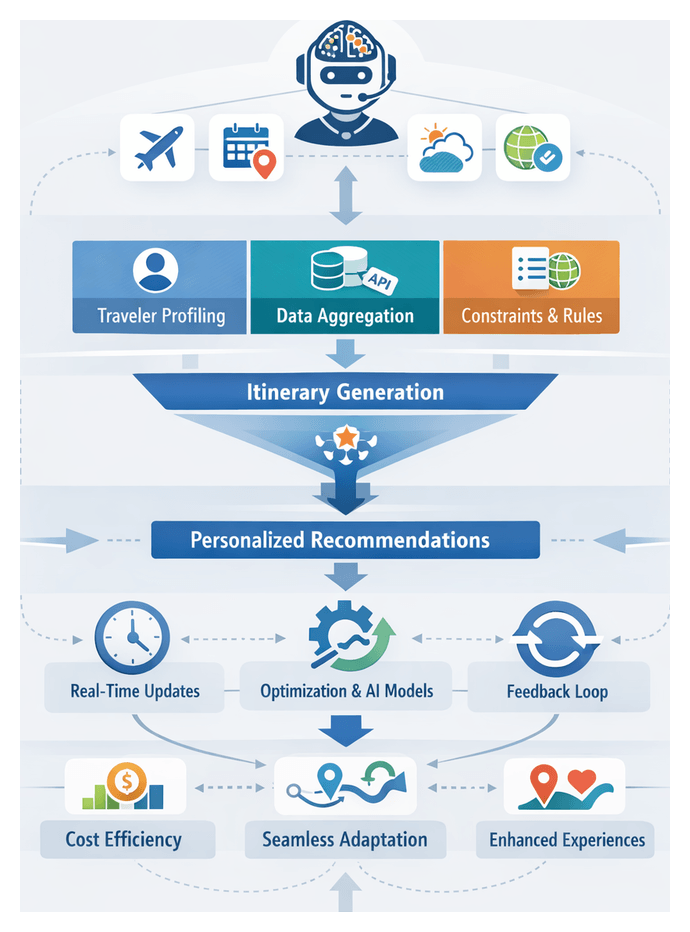
AI-Powered Itinerary Design in Travel and Hospitality
In an era of abundant travel choices, shifting market dynamics and heightened guest expectations, AI-powered itinerary design transforms how journeys are planned, optimized and delivered. Intelligent agents analyze traveler profiles, real-time pricing, transportation schedules, local events, weather forecasts and supplier availability to generate personalized proposals. Unlike static templates or manual curation, these automated systems continuously adapt recommendations as inputs evolve, producing flexible, end-to-end itineraries tailored for cost, convenience and experiential value.
By reducing planning cycles from days to seconds, AI-driven itinerary design frees advisors, hospitality teams and travelers to focus on decision–making and experience rather than data aggregation. In a post-pandemic landscape—marked by health protocols, border restrictions and uneven regional recoveries—travelers demand seamless adjustments to cancellations, entry requirements and safety concerns. AI agents monitor regulatory updates, supplier inventories and disruption alerts in real time, recalibrating plans to maintain feasibility and uncover alternative routing, accommodations and activities. This agility and resilience enable service providers to deliver consistent quality at scale, differentiating through authentic local experiences sourced from social media, event listings and local reviews.
Core Components and Technological Foundations
Automated itinerary generation relies on a modular workflow that orchestrates multi-element travel plans. Each component can be enhanced independently, supporting continuous innovation and integration with emerging AI technologies.
Traveler Profiling and Preference Capture
- Collection of guest data: past trips, stated preferences (budget range, accommodation style, activity interests) and real-time inputs (search behavior, session feedback).
- Creation of multi-dimensional traveler personas to inform recommendation logic.
Data Aggregation and Normalization
- Ingestion of structured feeds: global distribution systems, hotel and airline APIs, local supplier inventories.
- Interpretation of unstructured sources: guest messages, online reviews, event descriptions via Natural Language Processing.
- Normalization into a unified schema for rapid evaluation.
Constraint Modeling and Optimization
- Encoding of hard constraints: visa requirements, travel windows, connection times.
- Definition of soft constraints: preferred departure times, maximum daily travel duration, sustainability goals.
- Application of linear programming, mixed-integer programming and heuristic search to identify optimal itineraries.
Personalized Recommendation Engine
- Machine learning models employ collaborative and content-based filtering.
- Ranking of itinerary options by relevance to individual traveler profiles and broader segment behavior.
Iterative Refinement and Feedback Loop
- Real-time updates as travelers accept, reject or modify suggestions.
- Continuous learning to converge on itineraries aligned with evolving preferences.
Multichannel Delivery and Integration
- Distribution via mobile apps, messaging platforms, email or integrated portals.
- One-click booking, seamless adjustments and consistent cross-channel experiences.
Technological Pillars
- Natural Language Processing: Extracts entities and sentiment from free-form text.
- Machine Learning and Predictive Analytics: Forecasts demand, pricing volatility and traveler needs.
- Constraint Solvers: Ensures compliance with complex rules and preferences.
- Real-Time Data Streaming: Subscribes to live feeds—flight statuses, weather alerts, health advisories—for low-latency responsiveness.
- APIs and Microservices: Facilitates integration with third-party systems such as global distribution systems and property management platforms.
- Data Governance: Maintains lineage, validation rules and privacy safeguards for accuracy and compliance.
Scenario Modeling and Prescriptive Optimization
Scenario modeling serves as the analytical backbone of AI-driven itinerary planning. By anticipating a variety of travel outcomes—seasonal demand shifts, disruption events, regulatory updates—organizations align automated proposals with both corporate objectives and traveler expectations.
Analytical Frameworks
- Risk-Based Scenario Analysis: Assigns probabilities and impacts to unpredictable events, enabling contingency-weighted plans.
- Multi-Objective Trade-Off Analysis: Balances cost efficiency, guest satisfaction and operational feasibility via Pareto-optimal solutions.
- Sensitivity and Stress Testing: Perturbs inputs—travel times, availability—to measure itinerary robustness and refine algorithms.
Modeling Approaches
- Stochastic Simulation: Uses Monte Carlo methods to quantify uncertainty across flight delays, connection reliability and service availability.
- Constraint-Based Optimization: Solves for optimal paths under defined hard and soft constraints.
- Heuristic and Metaheuristic Algorithms: Applies genetic algorithms, simulated annealing and ant colony optimization for near-optimal solutions with reduced compute time.
- Machine Learning–Driven Models: Learns reward functions from historical booking and feedback data; requires care in explainability.
- Hybrid Systems: Combines solvers and neural networks for robust, adaptive performance in real time.
Performance Metrics
- Solution Optimality: Minimization of cost or maximization of value attributes.
- Computation Time: Latency from query to proposal.
- Robustness Score: Sensitivity to simulated disruptions.
- Guest Satisfaction Index: Post-trip ratings linked to model recommendations.
- Operational Impact: Improvements in conversion rates and service efficiency.
Interpretive Perspectives
- Contextual Calibration: Tailoring models to niche operators or global chains using domain-specific data.
- Iterative Validation: Continuous back-testing with live bookings to mitigate model drift.
- Explainability and Trust: Employing SHAP values or scenario walkthroughs to clarify recommendation logic.
- Cross-Functional Collaboration: Engaging data scientists, operations and CX teams to align technical capabilities with strategic goals.
Challenges and Governance
- Data Quality and Completeness: Noisy or missing data can skew outputs.
- Computational Scalability: Handling peak volumes and detailed simulations requires robust infrastructure.
- Dynamic Constraint Management: Adapting to sudden regulatory changes without manual reconfiguration.
- Privacy and Ethical Concerns: Balancing analytical depth with user consent and compliance.
- Integration Complexity: Ensuring interoperability with booking engines, CRM and revenue management systems.
Emerging Trends
- Digital Twin Environments: Virtual replicas of travel ecosystems for high-fidelity testing.
- Generative Adversarial Techniques: GAN frameworks to expand scenario diversity.
- Real-Time Data Fusion: IoT sensors and social media feeds for enriched inputs.
- Explainable AI Advances: Improved interpretability for regulatory compliance and stakeholder trust.
- Collaborative Modeling Ecosystems: Consortium platforms for shared anonymized scenario data.
Model Selection and Governance Principles
- Align models with business objectives—revenue goals, loyalty metrics and operational targets.
- Adopt modular architectures for plug-and-play algorithm updates.
- Implement robust validation protocols: scheduled back-testing and synthetic stress tests.
- Embed ethical oversight via cross-functional committees to ensure privacy compliance and non-discriminatory outcomes.
- Foster a data-driven culture with training and change management for analytical literacy.
Real-Time Adaptation and “Living Itineraries”
Contemporary travelers expect itineraries to evolve continuously. The “living itinerary” paradigm treats planning as an ongoing dialogue between AI agents, live data feeds and human stakeholders. This adaptive model is vital in contexts from peak-season congestion to emergency rerouting.
Conceptual Frameworks
- Dynamic Capability Theory: AI agents sense, seize and transform resources in response to volatility.
- Systems Thinking: Travel planning as an interconnected network of suppliers and touchpoints.
- Resilience Engineering: Proactive measures that anticipate disruptions and maintain continuity.
- Service-Dominant Logic: Co-creation of travel experiences through iterative agent–traveler interactions.
Application Contexts
- Disruption Management: Automated rerouting via live feeds from distribution systems and news alerts.
- Personalized In-Drive Experiences: Integration of biometric and IoT data for real-time activity recommendations.
- Dynamic Pricing Alignment: Recalibration of plans when seat inventory or room rates shift.
- Event-Driven Upselling: Telemetry-triggered ancillary offers during conferences or tours.
- Last-Mile Coordination: Seamless synchronization of ride-hailing and shuttle services with arrival updates.
Customer Experience and Differentiation
- Elevated Confidence: Proactive disruption handling boosts trust in a provider’s competence.
- Contextual Relevance: Micro-personalization anchored in real-time traveler context.
- Seamless Continuity: Consistent journey flows across booking interfaces and in-destination apps.
Organizational and Governance Implications
- Cross-Functional Collaboration: Shared protocols for decision thresholds and escalation pathways.
- Governance Frameworks: Policies ensuring agent-driven changes align with brand, regulatory and quality standards.
- Skill Augmentation: Roles shift from manual coordination to exception management and AI oversight.
- Partnership Ecosystems: API integrations with airlines, ground transport, event platforms and weather services.
Data and Platform Architecture
- Event-Driven Pipelines: Message streaming platforms to ingest and distribute live updates.
- Modular Microservices: Decoupled services for planning, recommendations and alerting.
- Shared Context Stores: Centralized state repositories for holistic traveler views.
- Audit Trails: Immutable logs of agent decisions, data sources and timing for accountability.
Strategic Lenses
- Agility–Resilience Continuum: Balancing rapid responsiveness with system stability.
- Value Co-Creation Spectrum: Traveler agency in the feedback loop—from passive recipient to active collaborator.
- Experience Flow Analysis: Identifying junctures—pre-departure, in-transit, pre-arrival—where real-time adjustments yield maximum impact.
Strategic Value and Business Implications
AI-powered itinerary design yields measurable benefits across revenue, efficiency and customer experience dimensions. Personalized, dynamically priced packages drive higher conversion and upsell rates. Automated disruption management reduces manual interventions, lowers customer service loads and protects brand reputation. By reallocating staff from routine tasks to strategic initiatives, organizations optimize labor productivity and reduce overhead. Rich data insights inform market segmentation, product development and targeted marketing, enabling continuous refinement of offerings. Scalable AI agents handle exponential demand without linear headcount increases, supporting market expansion and new service models such as subscription-based planning and on-demand concierge services.
From a strategic perspective, travel companies must build proprietary data ecosystems—merging first-party traveler insights, partner inventory and contextual signals—to fuel unique recommendation engines. Alliances with airlines, hospitality brands and local experience providers transform itineraries into networked offerings, where competitive advantage arises from superior orchestration rather than pricing alone. Embedding automation initiatives within broader digital transformation roadmaps—guided by the Dynamic Capabilities framework—ensures continuous learning, agile experimentation and rapid scaling in response to traveler behavior shifts.
Key Considerations, Limitations and Future Directions
- Data Quality and Governance: Unified master data management and rigorous validation prevent fragmented or outdated feeds from undermining accuracy.
- Algorithmic Transparency and Trust: Explainable AI initiatives and clear communication of decision criteria mitigate black-box skepticism.
- Integration Complexity: Standardized API frameworks and robust error handling are essential for seamless orchestration with airlines, hotels and ride-share services.
- Scalability and Performance: Cloud-native architectures, container orchestration and event-driven designs maintain responsiveness under peak loads.
- Regulatory Compliance and Privacy: GDPR and other evolving laws require embedded compliance frameworks governing traveler profiling and data transfers.
- Human Oversight and Ethical Boundaries: Human-in-the-loop controls and escalation protocols ensure autonomous changes respect user preferences and risk tolerances.
Looking ahead, next-generation AI planning agents will integrate multimodal reasoning—combining text, voice, image and sensor data—to anticipate needs with greater nuance. Emerging standards for data interoperability, such as federated learning and decentralized identity frameworks, promise collaborative innovation while safeguarding privacy. Interpretive lenses like Service Systems Theory suggest future itineraries will dynamically reconfigure resource allocations across entire destination ecosystems. Yet challenges persist—model drift, supply chain volatility and algorithmic bias demand vigilant governance, continuous performance auditing and human-centered design. By embedding transparency, accountability and cross-functional collaboration at every layer, travel and hospitality organizations can harness AI itinerary agents to deliver resilient, personalized experiences that redefine journey planning.
Chapter 5: Operational Efficiency and Workforce Augmentation
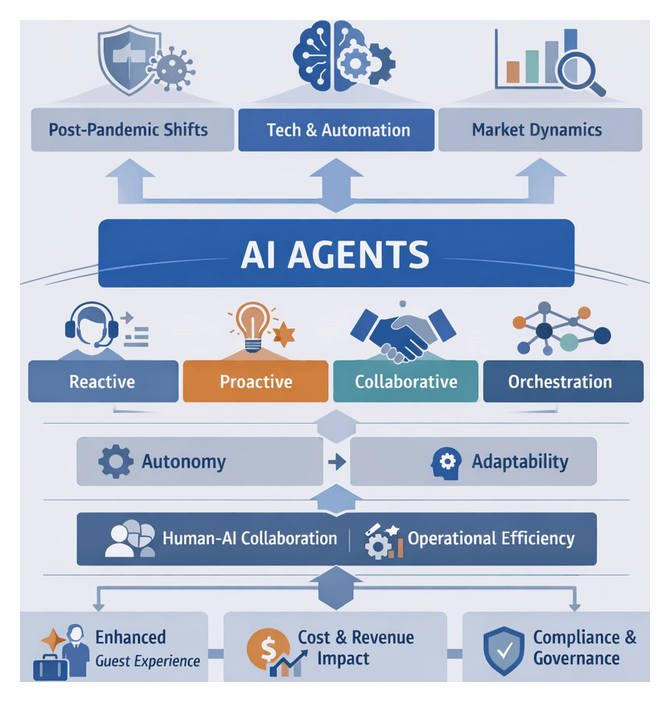
Industry Transformation in the Post-Pandemic Era
The global health crisis accelerated profound change across travel and hospitality. What began as emergency sanitation protocols and contactless interactions quickly evolved into permanent guest expectations for rigorous hygiene standards and digital self-service. Travelers now prioritize flexibility, transparent cancellation policies and real-time communication over simple price and convenience. Mobile check-in/out, adaptive itineraries and personalized pre-arrival engagement have become table stakes.
Operational vulnerabilities surfaced as labor shortages intensified and margins tightened. Routine back-office functions—reservation processing, guest communications, revenue management—emerged as prime candidates for intelligent automation. Meanwhile, online travel agencies and digital platforms consolidated distribution channels while niche, experience-driven startups disrupted legacy brands. Against this backdrop, advanced technologies—especially artificial intelligence and autonomous agents—shifted from differentiators to strategic imperatives for resilience and growth.
Defining AI Agents and Their Roles
AI agents are autonomous software entities that perceive environments, interpret natural-language inputs, make decisions and execute actions toward defined goals. They differ from traditional chatbots and fixed-rule engines by leveraging machine learning, contextual awareness and adaptive feedback loops. Two key dimensions capture their capabilities:
- Autonomy: The ability to execute multi-step processes—booking confirmations, room reassignment or dynamic pricing adjustments—without human intervention.
- Adaptability: The capacity to learn from guest feedback, operational metrics and external signals, refining decision models over time.
Four archetypes guide strategic deployment:
- Reactive agents that fulfill direct requests—room service orders or amenity inquiries.
- Proactive agents that anticipate needs—sending personalized recommendations before a guest asks.
- Collaborative agents that support human staff—coordinating preparation, follow-up and team workflows.
- Orchestration agents that manage end-to-end processes—complex itineraries, real-time resource allocation and pricing optimization.
Workforce Augmentation and Human-AI Collaboration
Workforce augmentation frames AI agents as complementary partners to service professionals, combining rapid data synthesis and predictive analytics with human empathy and contextual judgment. This symbiotic model shifts human roles from transactional tasks toward oversight, strategic decision-making and high-value guest engagement.
Interpretive frameworks inform deployment decisions:
- Task Complexity vs. Cognitive Load: Automate low-complexity, high-volume tasks (reservation confirmations, status inquiries) while retaining human judgment for emotionally nuanced interactions (conflict resolution, bespoke itinerary curation).
- Dynamic Capabilities: Treat augmentation as a capability to integrate, reconfigure and adapt service models in real time, leveraging continuous insights to update protocols and training.
- Collaborative Intelligence: Evaluate human-AI teams on throughput, error rates, guest sentiment and employee satisfaction, comparing hybrid workflows against manual and fully automated baselines.
Organizational perspectives shape augmentation strategies:
- Executive Leadership: Sees AI agents as levers for scalability and service consistency, commissioning pilots to quantify throughput gains and guest loyalty impact.
- Operations Management: Focuses on capacity planning and load-balancing across inquiry channels to manage peak demand without sacrificing quality.
- Human Resources: Prioritizes reskilling programs in data interpretation, exception management and digital literacy to empower staff for hybrid workflows.
- Guest Experience and Brand Strategy: Maps the guest journey to identify friction points—automated room-ready notifications, virtual concierge touchpoints—while preserving human engagement at critical moments.
Evaluative models combine quantitative and qualitative metrics:
- Service Throughput Improvement: Reduction in average handling time for routine inquiries.
- Guest Satisfaction Delta: Changes in Net Promoter Scores for automated versus human-assisted interactions.
- Employee Productivity Indices: Shift in staff time toward strategic tasks.
- Error Rate Analysis: Comparative accuracy of AI-processed transactions.
- Return on Investment: Cost savings from reduced overtime and error remediation against licensing and training costs.
Alignment with regulatory standards and equitable labor practices is essential. Gig-economy reforms and AI governance guidelines require transparency, consent management and clear accountability when agents interact directly with guests or influence pricing and service delivery. Framing augmentation as a pathway to higher-value work supports employee engagement and mitigates resistance.
Technological and Economic Imperatives for 2026
Rapid advances in natural language processing, reinforcement learning and real-time decision engines have moved AI from experimental to production-grade. Platforms can offer turnkey solutions that integrate conversational interfaces, predictive analytics and orchestration layers, lowering barriers to entry.
Economic pressures—rising labor costs, supply-chain volatility and margin compression—demand operational resilience. Financial models from leading consultancies show that a 10 to 20 percent improvement in process efficiency can yield single-digit margin expansion when applied to high-volume functions like reservation management and vendor communications. Intelligent automation reallocates human capital to creative problem-solving while stabilizing wage inflation.
Consumer expectations continue to mirror best-in-class digital experiences. Surveys by Skift and Phocuswright report that over 70 percent of travelers value AI-assisted planning for speed and convenience, with two-thirds willing to share personal data for personalization. AI agents capable of interpreting in-room sensor data, mobile app signals and social sentiment orchestrate seamless journeys—adjusting itineraries for weather changes or recommending events aligned with past interests.
Competitive pressures intensify as major hotel chains, online travel agencies and niche operators race to deploy agents. Early adopters report 5 to 8 percent year-over-year revenue gains through upsell conversions and reduced churn. Late entrants risk eroding margins and weakening brand perception.
Strategic frameworks guide urgency assessment. Use-case prioritization across value potential, implementation complexity and risk exposure directs pilot initiatives toward high-value, low-complexity scenarios. Stage-gate reviews evaluate data maturity, technology infrastructure, organizational alignment and change management capacity. Cross-functional governance councils ensure balanced prioritization, while scenario planning quantifies opportunity costs of delayed adoption.
Compliance, Governance and Strategic Frameworks
Data privacy laws such as GDPR and regional mandates require robust governance. AI agents can embed policy controls directly into workflows—logging recommendations, managing consent and providing explainability. Platforms like IBM Watson and Microsoft Azure Bot Service include compliance toolkits that streamline adherence to global regulations.
Effective governance demands:
- AI audit trails and consent management modules.
- Transparent decision-making protocols and escalation pathways.
- Ethical guidelines defining acceptable agent autonomy.
- Regular audits to ensure privacy, security and fairness.
Investment strategies allocate 20 to 30 percent of digital transformation budgets to AI agent initiatives, integrating capital and operating expenditures for continuous innovation, model retraining and cross-platform integration. Board-level roadmaps tie agent performance to RevPAR, Net Promoter Scores and revenue metrics, supported by talent strategies that blend data science and hospitality domain expertise.
Key Implementation Considerations
Successful AI agent adoption hinges on a balanced approach across technical, organizational and ethical dimensions.
- Data Quality and Governance: Ensure clean, well-structured data across legacy systems, third-party platforms and real-time streams.
- Integration Complexity: Achieve seamless interoperability with property management, CRM and revenue management tools such as UiPath and Automation Anywhere.
- Organizational Readiness: Secure leadership sponsorship and cultural alignment, communicating the shift from task automation to cognitive augmentation.
- Change Management and Training: Design reskilling programs with hands-on workshops, simulations and continuous learning for staff to trust and collaborate with agents.
- Governance and Accountability: Establish committees to define autonomy levels, monitor performance metrics and audit material decisions.
- Vendor Selection: Evaluate platforms on domain expertise, integration support and product roadmaps to ensure long-term alignment.
- Scalability and Flexibility: Architect for seasonal surges and geographic expansion from the outset.
- Cost-Benefit Analysis: Model ROI timelines—typically 6 to 18 months—balancing software, infrastructure and training investments.
- Security and Privacy Compliance: Implement encryption, access controls and regular audits to protect sensitive guest data under GDPR, CCPA and industry standards.
- Ethical Considerations: Address algorithmic bias, decision transparency and risks of over-automation that could erode human connection.
Limitations and Cautions
- Contextual Misinterpretation: Ambiguous language can lead AI agents to misunderstand guest requests without human review protocols.
- Overreliance on Automation: Excessive task offloading may reduce staff engagement and situational awareness; maintain human-in-the-loop for critical decisions.
- Technical Debt: Rapid deployment of disparate AI solutions without unified data models and integration standards can create fragile architectures.
- Bias and Fairness: Historical data-driven algorithms risk perpetuating unfair treatment unless fairness auditing is embedded.
- Regulatory Uncertainty: Evolving AI governance and data protection laws may require system redesigns to maintain compliance.
- Change Fatigue: Continuous rollouts without adequate support can overwhelm staff; adopt a paced approach with clear milestones.
- Metrics Overemphasis: Focusing narrowly on efficiency KPIs can overlook qualitative dimensions of guest satisfaction and employee well-being.
- Scalability Bottlenecks: Pilot success does not guarantee enterprise-scale performance; stress-test under realistic peak loads.
- Vendor Lock-In: Proprietary platforms may constrain future flexibility; prioritize open standards and data portability.
- Cultural Impact: The perception of surveillance by AI can erode trust; communicate transparently about agent roles and safeguards.
Chapter Objectives and Reader Outcomes
This chapter equips senior leaders and technology strategists in travel and hospitality to:
- Understand how post-pandemic dynamics reshape operational imperatives and guest expectations.
- Frame AI agents through a clear taxonomy of archetypes and core capabilities.
- Assess workforce augmentation models that balance efficiency with human-centric service qualities.
- Analyze technological, economic and competitive drivers that elevate intelligent automation to a strategic imperative.
- Implement governance, compliance and investment frameworks to deploy AI agents responsibly and at scale.
By following the guidance in this chapter, readers will develop a structured roadmap for embedding AI agents into existing ecosystems, aligning performance metrics with strategic objectives, and realizing sustained value in guest experiences and operational efficiency.
Chapter 6: Revenue Management and Pricing Optimization
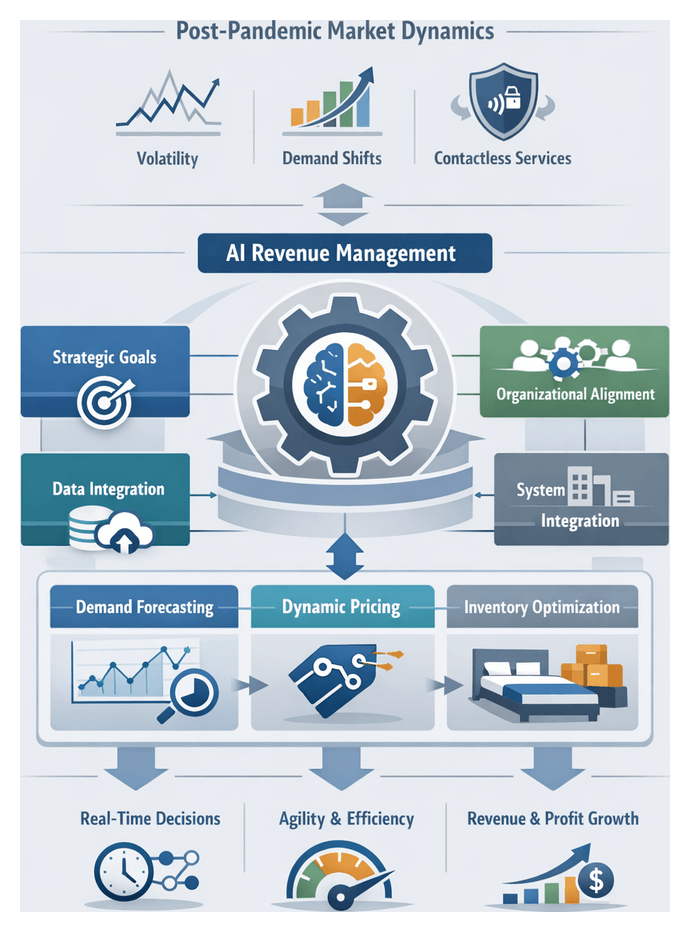
Post-Pandemic Revenue Management Dynamics
The travel and hospitality industry emerged from the 2020–2022 pandemic with fragmented demand patterns, heightened customer expectations, and unprecedented market volatility. Operators shifted toward flexible cancellation policies, restructured labor models and accelerated investments in contactless services. As occupancy recovered unevenly and ancillary revenue streams such as food and beverage or premium upgrades grew in importance, traditional static pricing models proved insufficient. Seasonal patterns blurred, channel mix migrated toward online travel agencies and direct digital sales, and historical booking curves lost predictive power.
In this context, revenue management must evolve from retrospective analysis to real-time, autonomous decision-making. Advances in cloud computing, connected customer touchpoints and surging data availability enable the deployment of AI agents—autonomous software entities that perceive market signals, forecast demand and execute pricing adjustments within predefined guardrails. Unlike rule-based engines, these agents leverage natural language processing to interpret unstructured data such as guest reviews and social media sentiment, while deep learning algorithms continuously refine forecasts and elasticity estimates.
Successful AI agent adoption requires alignment across four dimensions. First, strategic objectives—whether maximizing RevPAR, optimizing channel profitability or preserving brand positioning—must guide agent parameters. Second, a mature data ecosystem must integrate real-time booking data, competitor rates and macroeconomic indicators. Third, seamless integration with property management systems, central reservation platforms and distribution interfaces ensures that agent recommendations translate into actionable rate updates. Finally, organizational readiness—including cross-functional collaboration among revenue analysts, IT architects and operational teams—is critical for governance, performance monitoring and interpretation of model outputs.
As 2026 approaches, three converging forces underscore the urgency of intelligent automation: escalating market volatility driven by geopolitical events and economic fluctuations; rising operational complexity from proliferating channels and ancillary offerings; and intensifying competitive pressures as early AI adopters report double-digit improvements in RevPAR and channel profitability. Prebuilt models, standardized APIs and modular toolkits enable rapid deployment, while governance features such as audit trails and compliance controls address regulatory demands for explainable automation. Vendors can offer turn-key dynamic pricing modules tailored to the unique needs of hotels, airlines and cruise operators, enabling organizations to secure sustained advantages in efficiency, agility and profitability.
AI-Driven Demand Forecasting Models
Demand forecasting constitutes the analytical backbone of dynamic pricing and inventory management. While classical time-series estimators such as ARIMA, SARIMA and Holt-Winters remain valued for interpretability and diagnostic clarity, they can struggle with non-stationary shocks. To address volatility, many organizations augment statistical models with external regressors—holidays, events or macroeconomic indicators—and judgmental overlays.
Machine learning techniques complement these methods by capturing non-linear interactions and ingesting high-dimensional data. Tree-based ensembles like random forests and gradient boosting machines automatically detect complex dependencies across price, channel mix and lead time. Neural network architectures—from multilayer perceptrons to recurrent networks—are facilitated by platforms such as Prophet, which offers flexible trend modeling and multiple seasonality. Vendors like Revionics apply ensemble forecasting to segment-level demand curves, while Duetto leverages reinforcement learning for real-time adaptation.
Beyond point estimates, scenario and sensitivity analysis generate probabilistic demand distributions under alternative assumptions. Monte Carlo simulations sample economic indicators, competitor pricing and cancellation behaviors to produce confidence intervals, while what-if stress tests evaluate responses to border closures or currency swings. Causal impact models quantify the incremental effect of marketing campaigns or distribution changes, guiding investment trade-offs.
Validation frameworks extend beyond accuracy metrics (MAPE, RMSE, mean directional accuracy) to include economic impact measures such as revenue uplift and opportunity cost of forecast error. Governance standards—data lineage audits, feature drift monitoring and periodic recalibration—ensure forecasts remain aligned to evolving conditions. By integrating demand projections into a layered optimization strategy—base price bands, rate fences informed by scenario likelihoods and micro-price adjustments—organizations achieve a balance between revenue objectives and brand integrity.
Inventory and Yield Management with AI Agents
AI-driven pricing agents have transformed inventory and yield management from static allocation to dynamic, data-informed processes. Continuous analysis of market demand, competitor actions and operational constraints enables real-time adjustments to room blocks, seat inventories and ancillary bundles. Inventory becomes a fluid asset, reallocated across segments, channels and time horizons to maximize expected revenue while respecting risk tolerance and brand positioning.
Channel distribution strategies evolve as agents align rate recommendations with commission structures, demand elasticity and promotional commitments. By dynamically managing allotments on direct channels, OTAs and GDS based on cost differentials and acquisition benchmarks, organizations capture high-value bookings on low-cost channels without sacrificing parity or brand consistency.
Overbooking strategies benefit from machine learning-enhanced no-show predictions that incorporate booking velocity, cancellation patterns and external signals such as weather or local events. This probabilistic approach reduces involuntary denials, optimizes buffer allocations and triggers proactive alerts for threshold breaches. During high-volatility periods—major conventions or seasonal peaks—scenario analysis guides safe overbooking levels and preserves guest satisfaction.
Segment-level yield optimization leverages micro-segmentation to define price floors and ceilings for discrete cohorts, evaluate cross-sell and up-sell opportunities, and time-targeted promotions. Continuous learning refines segment boundaries and yield rules, aligning inventory allocation with evolving willingness to pay and service preferences.
- Real-world applications include airlines using AI Agents for fare family optimization, hotel chains adjusting room blocks by loyalty tier, vacation rental platforms reopening units during event-driven spikes and car rental operators reallocating fleet across stations.
- AI agents unify forecasting and inventory decisions by translating probabilistic demand outputs into allocation rules, creating feedback loops that refine both forecasts and recommendations.
- Governance guardrails—rate floors, exception alerts and audit trails—maintain strategic oversight and compliance, balancing agility with control.
Embedding AI agents reshapes organizational roles: revenue managers transition from manual rate setters to strategic overseers, focusing on rule design, exception handling and performance interpretation. Cross-functional collaboration and analytic fluency become essential as teams align on data inputs, policies and agent parameters. Future enhancements—multi-objective optimization including loyalty and sustainability metrics, IoT integration for real-time occupancy data and blockchain-enabled distribution—will further elevate AI-driven inventory management.
Critical Considerations for Dynamic Pricing Strategies
Deploying AI agents for dynamic pricing extends beyond algorithmic prowess. Sustainable value demands rigorous attention to market volatility, data governance, ethics, compliance, technology, organizational alignment, transparency and continuous adaptation.
- Market and Demand Volatility: Calibrate agents to distinguish transient anomalies from structural shifts. Employ scenario stress tests to set guardrails that avoid inappropriate price spikes or excess discounts in fragmented markets.
- Data Quality and Governance: Establish ownership, standardize definitions and automate cleansing. Integrate PMS, GDS and CRM pipelines with anomaly detection and maintain metadata catalogs for auditability.
- Ethical Implications and Customer Perception: Define fairness constraints to prevent discriminatory pricing. Limit personalization thresholds and avoid leveraging sensitive attributes. Engage ethics and customer advocacy teams in model design.
- Regulatory and Compliance Environment: Track local and regional rules on price discrimination and transparency. Embed compliance checkpoints and reporting procedures to support audits and consumer notifications.
- Technological Infrastructure and Integration: Validate microservices architectures, event processing platforms and latency performance. Use open standards, RESTful APIs, version control and feature flags for controlled experimentation and rollback.
- Organizational Alignment and Skills: Form cross-functional governance bodies to define pricing policies, risk tolerances and metrics. Develop machine learning literacy, interpretability and data ethics programs for revenue teams.
- Transparency and Communication: Provide interpretable dashboards and external materials that explain dynamic pricing benefits. Use FAQs and scenario illustrations to build trust with partners and customers.
- Continuous Monitoring and Adaptation: Monitor KPIs—revenue lift, forecast accuracy, rate acceptance and satisfaction. Implement retraining cycles and retrospective analyses after major events to sustain continuous improvement.
By addressing these dimensions thoughtfully, travel and hospitality organizations can harness AI-driven pricing agents with confidence, mitigating risks, protecting brand reputation and capturing the full strategic advantage of intelligent pricing automation in a rapidly evolving marketplace.
Chapter 7: Data Privacy, Security, and Ethical Considerations
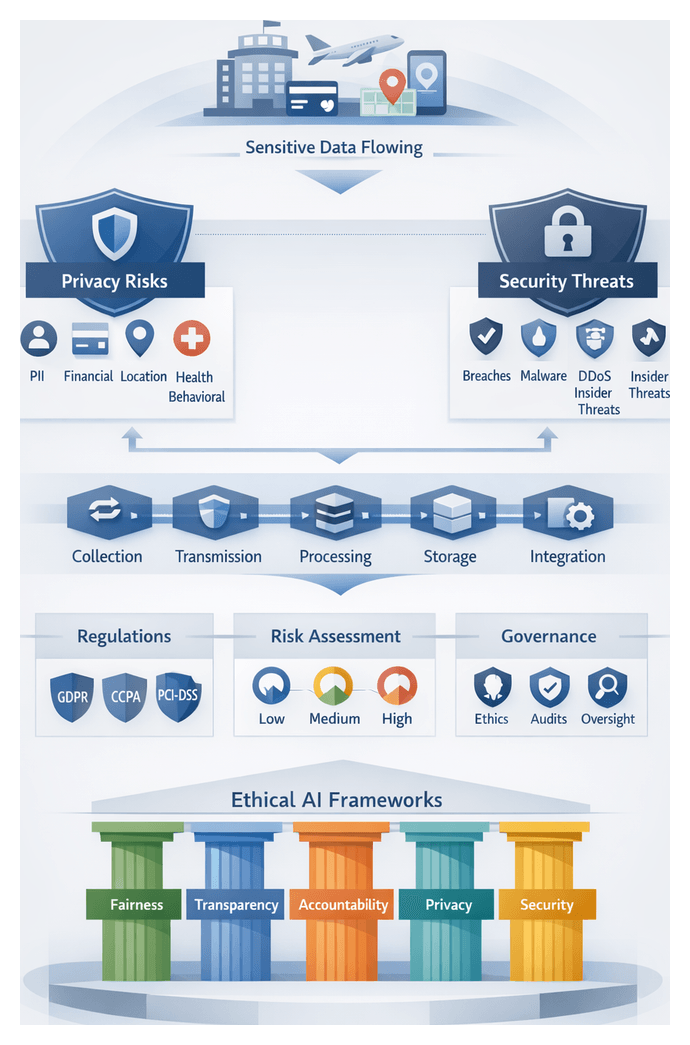
Contextualizing Privacy and Security Risks
Data has become the connective tissue between guest expectations, operational efficiency, and revenue growth in travel and hospitality. As organizations deploy AI agents to streamline booking processes, personalize experiences, and automate back-office functions, they generate and process vast volumes of sensitive information. Contactless check-in systems, mobile concierge applications, and AI-driven recommendation engines rely on continuous data exchange: personal identifiers, payment details, location signals, health declarations, and behavioral profiles. This convergence of advanced analytics and autonomous decision-making with high-value data creates a complex risk environment.
Privacy risk refers to the potential for unauthorized collection, use, disclosure, or retention of personal information. In travel and hospitality, this includes:
- Personally identifiable information (PII): names, dates of birth, passport numbers
- Financial credentials: credit card numbers, billing addresses, transaction histories
- Location and itinerary data: real-time movements, stay durations, flight segments
- Health records: vaccination status, testing results, medical declarations
- Behavioral profiles: search histories, in-room preferences, loyalty interactions
Security risk addresses the integrity, confidentiality, and availability of systems and data assets, encompassing:
- Data breaches and cyber intrusions
- Supply-chain vulnerabilities in third-party platforms and cloud services
- Insider threats ranging from configuration errors to malicious exfiltration
- Adversarial attacks on AI models—poisoning, evasion, model inversion
- Distributed denial-of-service (DDoS) attacks on booking engines and digital touchpoints
A granular view of the data lifecycle—collection, transmission, processing, storage, integration—reveals potential vulnerabilities at every phase:
- Collection: Unsecured endpoints and overly broad data capture expand the attack surface.
- Transmission: Lack of encryption or improper certificate management exposes data in transit.
- Processing: Inadequate access controls and weak audit trails enable unauthorized model queries.
- Storage: Misconfigured cloud buckets and insufficient encryption at rest risk large repositories.
- Integration: Breaches in third-party APIs can cascade across application layers.
The regulatory environment adds further complexity. Global data protection laws—such as the European Union’s General Data Protection Regulation (GDPR) and the California Consumer Privacy Act (CCPA)—and sector-specific requirements like the Payment Card Industry Data Security Standard (PCI-DSS) and IATA passenger name record (PNR) rules impose obligations around data residency, consent mechanisms, and breach notifications. Noncompliance can trigger fines, lawsuits, and reputational damage.
Rising consumer expectations amplify these pressures. A 2024 survey found that over 70 percent of travelers would abandon a booking process if they suspected their data was mishandled or shared without clear consent. To deliver on personalization and convenience, organizations must embed principles by design:
- Data minimization: Collect only what is necessary and retain it no longer than required.
- Security by design: Integrate encryption, authentication, and access controls from project inception.
- Accountability and transparency: Document data flows, model logic, and consent records for auditability.
- Continuous monitoring: Employ real-time threat detection, anomaly identification, and regular vulnerability assessments.
- Vendor governance: Enforce third-party due diligence, contractual security requirements, and ongoing reviews.
In a post-pandemic recovery landscape, legacy systems and distributed workforces introduce additional challenges. Zero-trust architectures, endpoint detection and response, and micro-segmentation are critical defenses. Ethical imperatives—transparent consent mechanisms, explainable model outputs, and redress processes—must converge with technical safeguards to uphold guest trust and operational resiliency.
Analytical Frameworks for Ethical AI Deployment
Ethical considerations in AI deployment have evolved from abstract ideals to concrete imperatives. Organizations apply diverse frameworks to evaluate fairness, transparency, accountability, privacy, and robustness in autonomous systems. These analytical lenses guide decision-makers in assessing risks and opportunities associated with AI agents in guest services, operations, and data handling.
Normative Ethical Principles
- Fairness – Prevent systematic disadvantage in pricing, promotions, or recommendations.
- Transparency – Offer clear insights into decision pathways and enable contestation.
- Accountability – Assign responsibility for agent behavior from design through monitoring.
- Privacy – Uphold data minimization, secure handling, and respect for user consent.
- Robustness and Safety – Ensure reliable performance and prevent harm from unexpected behavior.
Risk-Based Assessment
- Low risk: chatbots handling routine queries without sensitive data access.
- Medium risk: dynamic pricing engines with potential for discriminatory outcomes.
- High risk: automated visa or credit evaluation tools influencing eligibility.
Rights-Based and Human-Centric Frameworks
- Stakeholder mapping: business vs. leisure guests, frequent vs. occasional travelers.
- Bias identification in historical data to prevent exclusionary outcomes.
- Consent workflows that preserve autonomy without degrading core services.
Governance and Oversight Structures
- Ethics Committees of data scientists, legal counsel, guest experience specialists, and external ethicists.
- Ethical Liaisons in each business unit to ensure consistent policy interpretation.
- Third-Party Auditors for independent reviews of fairness, security, and data handling.
Quantitative and Qualitative Evaluation Techniques
- Fairness Metrics – demographic parity, equal opportunity difference, disparate impact ratio.
- Explainability Scores from post-hoc tools that quantify decision traceability.
- Privacy Leakage Tests to measure re-identification risk from aggregated data.
- Scenario-Based Workshops where multidisciplinary teams role-play guest interactions.
- Guest Sentiment Analysis via surveys and social media to surface perceived inequities.
Domain Adaptations and Continuous Governance
- Sensitivity tiers for guest data dictating processing and retention policies.
- Contextual fairness criteria distinguishing legitimate price differentiation from discrimination.
- Consent management embedded in booking and check-in workflows.
- Adaptive governance cycle with quarterly impact reviews, real-time monitoring dashboards, and policy updates.
Framework Limitations
- Quantifying subjective values like trust across cultures.
- Governance fatigue that can slow innovation.
- Conflicting frameworks without clear priority guidance.
- Redundant compliance assessments that undermine streamlined decision-making.
Regulatory and Compliance Considerations
AI agents in travel and hospitality operate within an evolving mosaic of data protection statutes, digital governance policies, and voluntary standards. Organizations must reconcile innovation with legal obligations to safeguard consumer rights, data privacy, and system security.
Privacy and Sector-Specific Regulations
- GDPR: consent, data subject rights, cross-border transfers
- CCPA/CPRA: consumer access, deletion rights, non-discrimination
- PCI-DSS: encryption, access logging, vulnerability management for payment data
- IATA PNR Standards: secure sharing of passenger information
Jurisdictional Variation and Cross-Border Flows
Local statutes—Brazil’s LGPD, Singapore’s PDPA, Japan’s APPI—introduce distinct consent models and breach notification requirements. Mechanisms like Standard Contractual Clauses, Binding Corporate Rules, and adequacy decisions enable lawful transfers but demand rigorous contractual oversight. Adaptive compliance frameworks adjust data handling based on user location and prevailing legal requirements.
Industry Standards and Certifications
- ISO/IEC 27001 for information security management
- SOC 2 reports for service organization controls
- PCI-DSS certification for payment environments
- Privacy impact assessments (PIAs) and data protection impact assessments (DPIAs)
Governance and Risk Management
Cross-functional committees—legal, compliance, IT security, data science, business leadership—define policies for data retention, access privileges, model validation, and incident response. Risk management methods such as FMEA, COBIT, and NIST’s Risk Management Framework quantify compliance gaps and guide remediation. Roles like Chief Data Protection Officer, AI Ethics Officer, and Model Risk Manager ensure accountability through audits, regulatory engagement, and AI workflow inventories.
Implications for AI Agent Deployment
Compliance shapes vendor selection, contracts, and lifecycle monitoring. Agreements must include data processing addenda, audit rights, and security certifications. Sandboxed environments with synthetic or anonymized datasets support pre-production validation of privacy controls, bias monitoring, and output accuracy. Continuous compliance monitoring via automated scans and audit logs ensures alignment with evolving regulations and breach notification mandates. Documented certifications and transparent governance frameworks become strategic differentiators in enterprise travel programs and franchise agreements.
Strategic Considerations
- Regulatory foresight through horizon scanning of emerging privacy laws and AI regulations.
- Integrated compliance architectures uniting privacy, security, and ethical controls across AI lifecycles.
- Stakeholder collaboration with industry associations, standards bodies, and regulatory sandboxes.
- Transparency and accountability via published AI policies, ethics guidelines, and reporting.
- Continuous learning loops with legal counsel, compliance teams, and privacy advocates.
Critical Ethical Takeaways for AI Agents
Transparency and Explainability
Transparent AI agents foster trust and regulatory compliance. Organizations should adopt layered explanations aligned with the OECD AI Principles and the NIST AI Risk Management Framework. Offer high-level summaries for guests, technical audit trails for compliance officers, and interactive interfaces for on-demand reasoning queries.
Accountability and Governance
Clear ownership of AI behavior at each lifecycle stage is essential. Ethics committees operationalize accountability through escalation protocols, periodic ethical audits, and impact assessments. Global regulatory fragmentation requires robust internal policies and cross-border agreements to mitigate compliance gaps.
Fairness and Bias Mitigation
- Data provenance audits to correct demographic imbalances in training sets.
- Algorithmic impact assessments measuring disparate outcomes.
- Cross-functional review panels combining legal, social science, and customer service expertise.
Privacy and Data Minimization
- Privacy-by-design classification of data sensitivity and retention parameters.
- Tiered consent mechanisms allowing selective personalization opt-ins.
- Pseudonymization and secure anonymization for third-party data sharing.
Security and Robustness
AI agents are potential attack surfaces requiring threat modeling and defensive measures in line with ISO/IEC 27001. Implement input validation, anomaly detection, red teaming exercises, and layered encryption for data at rest and in transit. Maintain AI-specific incident response plans and comply with breach notification timelines.
Human-Centric Design and Oversight
- Define human intervention thresholds based on confidence scores.
- Design seamless handoff protocols between AI systems and human agents.
- Train frontline staff on AI capabilities and limitations for realistic expectation management.
Ethical Culture and Stakeholder Engagement
- Inclusive stakeholder mapping encompassing guests, suppliers, community groups, and advocacy organizations.
- Public disclosures of AI policies, challenge mechanisms, and performance metrics.
- Participation in cross-industry consortia to share best practices and co-develop open-source ethical auditing tools.
Future-Proofing and Continuous Evaluation
- Deploy monitoring dashboards that surface emerging ethical indicators alongside business metrics.
- Allocate resources for horizon scanning of academic research, regulatory proposals, and societal debates.
- Adopt adaptive policy frameworks that can be updated dynamically rather than relying on static rulebooks.
Limitations and Strategic Trade-Offs
- Regulatory fragmentation necessitating complex compliance mosaics.
- Resource intensity of comprehensive ethical governance for smaller operators.
- Trade-off management between transparency, privacy, personalization, and agility.
- Technical maturity gaps in scaling bias mitigation, adversarial defense, and explainability without performance impacts.
By internalizing these takeaways and confronting challenges directly, travel and hospitality organizations can harness AI agents to enhance efficiency and guest experiences while building resilient, ethically grounded enterprises that thrive in a dynamic marketplace.
Chapter 8: Integration with Emerging Technologies
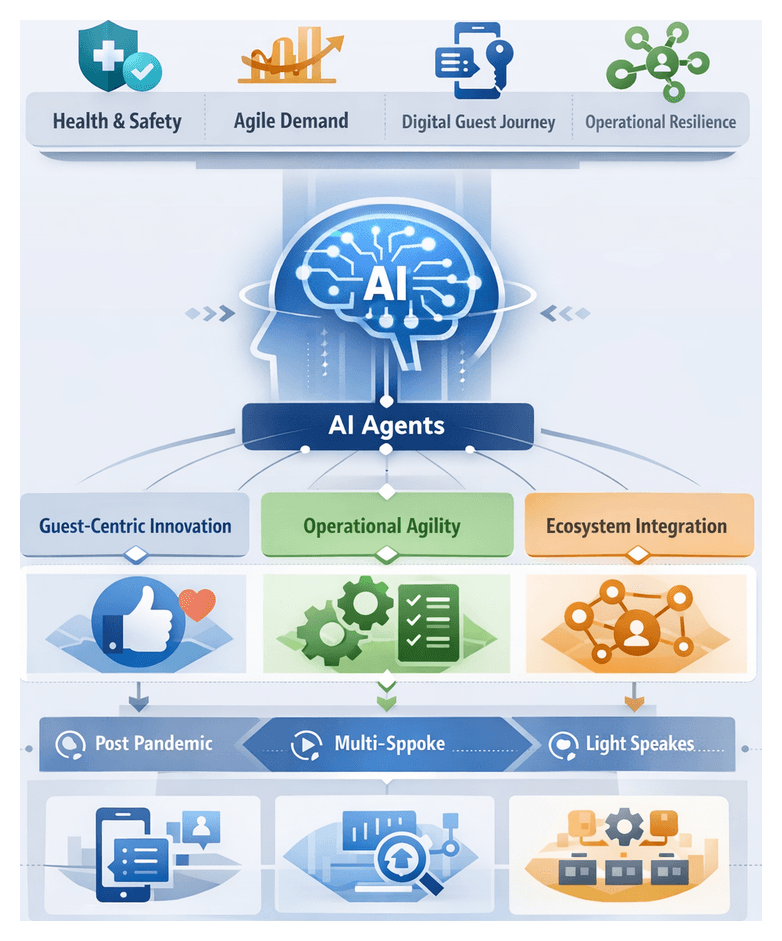
Post-Pandemic Shifts and the Imperative for Intelligent Automation
The global pandemic accelerated a fundamental recalibration of travel and hospitality. Health security, flexibility, and digital engagement replaced traditional volume-driven models. Operators deployed contactless check-in, real-time communication channels, and remote service delivery to reassure guests and adjust to volatile demand. Fragile supply chains and unpredictable border policies exposed the limitations of manual processes and static tools. As a result, four dominant trends define the new normal:
- Health and Safety as a Differentiator: Enhanced cleaning protocols and digital health credentials have become baseline expectations.
- Agile Demand Management: Flexible pricing and cancellation policies accommodate unpredictable booking patterns.
- Digital-First Guest Journeys: Virtual property tours, mobile room keys, and seamless app-based interactions span the guest lifecycle.
- Operational Resilience: Diversified vendor networks, workforce reskilling, and restructured supply chains bolster shock absorption.
By 2026, the convergence of technological maturity, empowered consumers, and economic imperatives makes intelligent automation an existential priority. Advances in transformer-based language models, computer vision, and reinforcement learning yield agents with near-human fluency. Mobile-first behaviors and expectations for instant gratification require AI-powered concierge services that anticipate needs. Tight margins and unpredictable demand cycles demand automated yield management and predictive staffing models, delivering measurable ROI within months. In this context, delaying AI integration risks revenue leakage and brand erosion.
AI Agents as Connective Tissue
AI agents transcend traditional chatbots and rule-based systems by combining natural language processing, machine learning, and autonomous decisioning across voice, text, and mobile channels. They unlock three strategic dimensions:
- Guest-Centric Innovation: Agents decode preferences from past stays, social media, and loyalty profiles, evolving recommendations with each interaction.
- Operational Agility: Automation of reservation confirmations, upsells, and incident resolution frees staff for high-value, human-centered engagements.
- Ecosystem Integration: Agents knit together property management, sales channels, revenue platforms, and third-party services to ensure real-time data flow and consistent experiences.
Leading platforms such as those featured on AgentLink AI exemplify this convergence, offering pre-trained models and modular APIs to accelerate pilot-to-production timelines and drive revenue capture, guest satisfaction, and brand differentiation.
Frameworks for Cross-Technology Convergence
Analytical Models
- Capability Maturity Frameworks: Benchmark AI and IoT integration across data governance, interoperability, UX design, and security, guiding incremental investments.
- Value Chain Analysis: Map AI, IoT, AR/VR touchpoints along the travel lifecycle to identify differentiation and efficiency gains.
- Ecosystem Mapping: Chart technology providers, standards bodies, and partnerships to surface dependencies and guide alliances.
Data Integration and Interoperability
A unified “digital nervous system” feeds AI agents in real time from IoT endpoints—smart thermostats, occupancy sensors, beacons—and from AR/VR repositories. Two focal points are:
- Data Schema Alignment: Reconciling sensor telemetry and spatial metadata via standardized ontologies or semantic layers to ensure coherent agent consumption.
- API and Protocol Convergence: Evaluating support for RESTful interfaces, MQTT or WebXR to orchestrate synchronous experiences, such as AR wayfinding coupled with dynamic room controls.
Maturity Roadmaps and ROI Metrics
Four phases guide convergence from pilot to enterprise grade:
- Exploratory: Proof-of-concept pilots validate feasibility, such as chatbots guiding AR brochures.
- Integration: Scale cross-platform data flows, assess system reliability, and conduct preliminary ROI analysis.
- Optimization: Deploy converged solutions informed by live telemetry and AR/VR personalization, tracking satisfaction scores and revenue uplift.
- Transformational: Achieve predictive autonomy—agents anticipate needs, orchestrate end-to-end multimodal experiences, and enable new service paradigms.
To quantify strategic value, organizations develop composite indices covering operational efficiency gains, revenue enhancement, guest engagement and retention, and risk mitigation. Balanced scorecards and scenario-based forecasting offer a holistic, risk-adjusted view of convergence ROI.
Convergent Use Cases
Immersive Experience Enablers
- AR-Powered Facility Navigation: AI agents overlay wayfinding cues onto live camera feeds, guiding guests through complex layouts in real time.
- Virtual Previews and Room Customization: VR simulations driven by agent recommendations help travelers select furniture arrangements and amenity placements pre-arrival.
- Contextual In-Room AR Overlays: Devices display layered information about artworks, local history, and services, curated to guest interests.
- Immersive Concierge Interfaces: 3D avatars in VR or mixed-reality respond to complex queries, replicating empathetic human hosts at scale.
Intelligent Personalization Touchpoints
- Sensor-Driven Comfort Calibration: Agents adjust HVAC, lighting, and entertainment based on real-time temperature, humidity, and luminance readings.
- Adaptive Meal Planning: Integration with smart kitchens and inventory systems automates scheduling and sourcing aligned to guest dietary preferences.
- Real-Time Language Translation: Wearable AR or mobile apps deliver instant translation of spoken and textual content for international guests.
- Dynamic Loyalty Engagement: In-app dashboards refine tiered incentives in real time, deepening brand affiliation and driving ancillary revenue.
Transparent Sustainability Solutions
- Blockchain-Backed Supply Chain Tracking: Agents verify farm-to-table provenance via distributed ledgers and present carbon-impact summaries.
- Real-Time Energy Usage Dashboards: Guests monitor in-room consumption and opt into low-carbon packages through interactive portals.
- Verified Product Certifications: AI agents authenticate RFID or QR-tagged eco-certified products, ensuring marketing claims match third-party audits.
- Collaborative Waste Reduction: Integration with smart sorting stations tracks recycling participation and rewards guests with loyalty points.
Key Integration Considerations
- Strategic Alignment: Ground pilots in clear business objectives and validate hypotheses through stage-gate processes.
- Interoperability and Standards: Adhere to open frameworks and common data models to reduce vendor lock-in and enable seamless data exchange.
- Data Governance and Privacy: Define ownership, consent, anonymization, and retention policies to comply with GDPR, CCPA, and emerging standards.
- Security Architecture: Employ zero-trust models, encryption, and continuous monitoring to protect sensors, AR interfaces, and agent interactions.
- Scalability and Performance: Design for horizontal scaling with microservices and edge/container deployments, and conduct load testing under peak scenarios.
- Vendor and Ecosystem Management: Establish governance for partnerships, align roadmaps through joint innovation, and pursue consortium-style collaboration.
- User Experience and Adoption: Apply progressive disclosure in UX design, pilot in operational settings, and iterate based on value perception and ease of use.
- Organizational Capability: Invest in cross-functional training, centers of excellence, and change management to build a culture of experimentation.
- Cost-Benefit and TCO Analysis: Model hardware, software, data, and training costs alongside labor savings, revenue gains, and loyalty metrics.
- Ethical and Regulatory Compliance: Follow frameworks on fairness, accountability, and transparency, and secure legal and ethical counsel for biometric and location-based services.
- Resilience and Edge Strategies: Deploy edge computing nodes for critical decisioning, ensure redundancy in power and network, and enable automated failover.
- Future-Proofing and Extensibility: Prioritize modular architectures, clear API contracts, and semantic metadata layers to support evolving sensor types and interaction modalities.
Reader Outcomes and Strategic Roadmap
By integrating these insights, industry leaders will gain:
- Strategic Clarity: Alignment of AI agents with post-pandemic imperatives, from personalized guest journeys to operational resilience.
- Technical Foundations: Understanding of natural language processing, machine learning pipelines, decision engines, and data architectures.
- Operational Blueprints: Guidelines for system integration, data flow mapping, pilot design, and success metrics.
- Ethical and Compliance Frameworks: Tools for data privacy, security, and responsible AI deployment.
- Future-Proof Roadmaps: Foresight into emerging multimodal interfaces, IoT convergence, and immersive platforms beyond 2026.
Armed with this roadmap, readers can define, deploy, and govern AI agents as transformative catalysts, ensuring competitiveness, enhanced guest loyalty, and sustainable value creation in the evolving travel and hospitality landscape.
Chapter 9: Case Studies of AI Agent Implementation
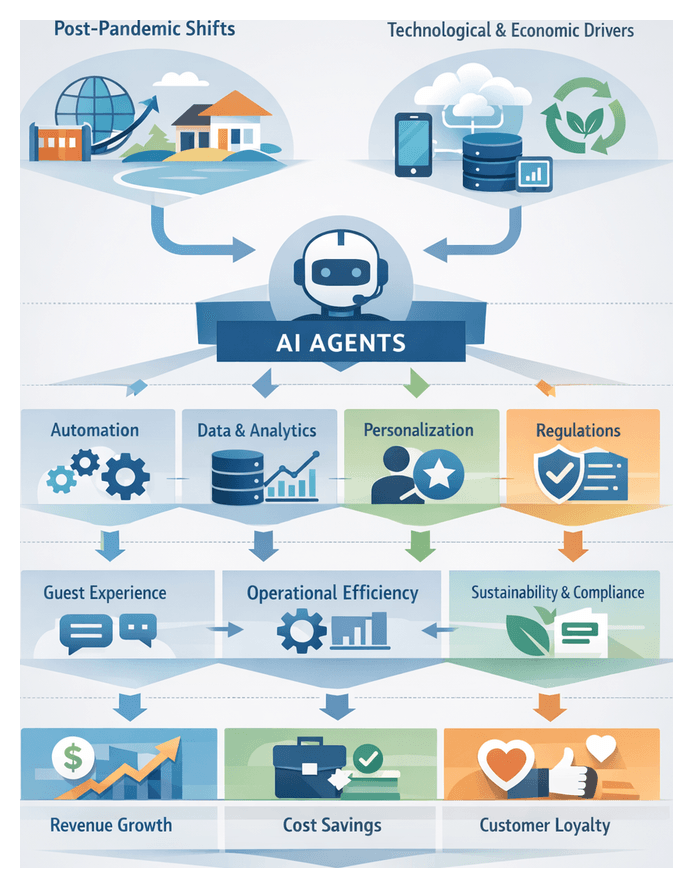
Post-Pandemic Dynamics and the Rise of Intelligent Automation
The global pandemic upended travel and hospitality, forcing organisations to reinvent operating models, customer engagement and strategic priorities. Border closures, capacity limits and evolving health protocols triggered steep revenue declines and shifted consumer sentiment toward local leisure trips. As domestic staycations surged and international travel lagged, businesses recognised that operational resilience—driven by digital health passports, contactless check-in and flexible cancellation policies—was essential to restoring confidence.
Enter intelligent automation. Organisations accelerated cloud migrations, mobile apps and data analytics investments, pivoting from pilot AI projects to enterprise-level initiatives. Sustainability also rose on the agenda as travellers demanded responsible experiences and regulators enforced environmental standards. In this volatile recovery landscape, AI agents have emerged as strategic imperatives, enabling proactive pricing, unified guest interactions and scalable service delivery to fuel faster recovery and higher loyalty.
- Technological Maturity: Transformer-based language models, multimodal analytics platforms and cloud-native deployments have reduced barriers to intelligent agent implementations.
- Economic Pressures: Rising labor costs, inflationary supply-chain pressures and margin compression demand automation of routine tasks without sacrificing service quality.
- Consumer Expectations: Post-pandemic guests seek on-demand, 24/7 support, instant confirmations and dynamic itinerary updates across channels.
- Competitive Differentiation: Early adopters of AI agents set new benchmarks for personalization and speed, compelling peers to integrate proactive, automated service models.
- Regulatory Mandates: Health, safety and environmental regulations require rapid data collection and reporting, achievable through automated compliance workflows.
Defining AI Agents and Strategic Integration
An AI agent is an autonomous software entity that perceives its environment, interprets user intent and executes tasks with minimal human intervention. Leveraging natural language processing, machine learning and decision-making architectures, these agents adapt to new scenarios, manage end-to-end guest interactions and refine their behavior via continuous feedback loops.
By unifying disparate systems—property management, reservation engines and CRM—AI agents enable a seamless guest experience. Conversational interfaces integrate with back-office workflows to orchestrate itinerary adjustments, real-time price optimization and loyalty engagements without manual handoffs. Use cases range from multilingual self-service kiosks to virtual concierges delivering context-aware recommendations and automated operations hubs forecasting staffing needs.
Measuring Impact: Metrics, Financial Returns and Satisfaction
Evaluating AI agent performance requires a balanced set of quantitative and qualitative metrics across customer engagement, operational efficiency and financial returns.
Performance Metrics
- Response Time Reduction: Average latency in handling customer inquiries falls by 40–60% when AI concierges manage routine queries.
- Task Completion Rate: Automated tasks—for booking modifications or loyalty inquiries—often exceed 85% completion without human intervention.
- Error Rate: Model refinement through ongoing training and feedback loops reduces incorrect or incomplete responses over time.
- Adoption Rate: Usage of AI channels relative to traditional contact points indicates user acceptance and interface usability.
- Utilization Metrics: Agent activity hours and transaction volumes reveal scalability and throughput under varying demand profiles.
Financial Impact
- Payback Period: Many deployments recoup costs within 12–18 months via labor savings and incremental upsell revenue.
- Incremental Revenue Uplift: Personalized recommendations drive 8–15% higher ancillary sales by suggesting room upgrades, dining and experiences at optimal moments.
- Cost Avoidance: Automated handling of peak inquiries reduces temporary staffing and overtime expenses, saving up to 20% during seasonal surges.
- Long-Term Value: Continuous-learning agents contribute cumulative savings and revenue growth beyond initial deployment horizons.
Guest Satisfaction
- Net Promoter Score Improvement: Deployments often yield NPS lifts of 5–12 points as guests value 24/7 responsiveness and personalization.
- Sentiment Shift: Automated sentiment analysis shows a higher ratio of positive comments when AI agents handle routine tasks versus human channels.
- User Retention: Repeat engagement rates exceed 70% when recommendations are accurate and contextually relevant.
- Perceived Human-Like Qualities: Agents with advanced natural language understanding score higher for empathy and clarity.
One resort group reported an 8.6/10 satisfaction rating for guests using its AI concierge compared to 7.9 for human-only channels. A business travel portal reduced booking error complaints by 25% after deploying intelligent itinerary validation agents.
Operational and Strategic Outcomes
- Process Standardization: AI agents enforce consistent service protocols, enhancing brand uniformity across properties.
- Scalability: Automated systems handle spikes in demand without contingent staffing plans.
- Data-Driven Insights: Interaction logs fuel analytics to uncover customer trends, service bottlenecks and upsell opportunities.
- Strategic Differentiation: Early adopters position themselves as innovation leaders, attracting tech-savvy segments.
An international airline’s baggage inquiry agent reduced handling time by 70% and revealed route-specific luggage issues, informing operational improvements. A luxury hotel chain used data from its voice-activated in-room agent to optimize housekeeping schedules and amenity provisioning.
Best-Practice Frameworks for AI Agent Deployment
Successful AI agent initiatives rest on structured frameworks that align technology with organisational strategy, governance, stakeholder collaboration and continuous improvement.
Strategic Alignment
Frameworks must map AI agent capabilities to business outcomes such as revenue growth, loyalty enhancement and cost reductions. Executive sponsorship and cross-functional roadmaps embed agent objectives into enterprise planning, capital allocation and competitive analyses, ensuring initiatives reinforce core strategic pillars.
Contextual Adaptation and Scalability
Deployments across diverse regions require modular architectures, locality-specific data models and multi-language support. Tiered frameworks combine universal guiding principles with customizable modules for regulatory compliance, service variations and customer segment nuances. Phased rollouts—from pilot sites to enterprise scale—preserve performance integrity as volume and complexity grow.
Governance and Ethical Guardrails
Data governance and ethics form foundational pillars. Frameworks draw on models such as the NIST AI Risk Management Framework and the EU AI Act to prescribe risk-based data collection, labeling, storage and retention. Principles of transparency, consent and fairness guide ethical impact assessments, ensuring that pricing algorithms and recommendations avoid bias and uphold brand reputation.
Multi-Stakeholder Integration
Cross-functional governance forums with representatives from guest services, IT, revenue management, marketing and compliance co-define requirements, risk thresholds and success metrics. Role charters, decision hierarchies and escalation protocols institutionalise accountability—ensuring dynamic pricing agents adhere to privacy and trust standards.
Technology Ecosystem and Interoperability
No single vendor covers all agent requirements. Frameworks prescribe an ecosystem approach with interoperability standards, API governance and vendor-neutral integration layers. Criteria for platform selection include extensibility, compliance certifications and community support. Case studies of integrations with Salesforce Einstein, IBM Watson and Amadeus illustrate best practices for real-time data sharing with property management and distribution channels.
Change Management and Readiness
Frameworks incorporate readiness assessments, training curricula and communication strategies based on models such as Kotter’s eight-step process and ADKAR. Role-based learning paths, competency benchmarks and pulse surveys equip frontline staff and managers to co-design workflows, supervise agents and champion human-machine collaboration.
Performance Metrics and Continuous Improvement
Iterative evaluation through Plan-Do-Check-Act cycles is essential. Common metrics—recommendation relevance scores, conversion uplifts and handling time reductions—are tracked via automated dashboards with anomaly detection. Frameworks integrate maturity models and root-cause analysis protocols, guiding algorithm refinements, data pipeline updates and governance rule adjustments in response to market shifts and user feedback.
Modular Design and Future-Proofing
Modularity enables frameworks to absorb emerging capabilities—multimodal interfaces, predictive autonomy engines and new AI models—without wholesale redesign. Discrete domains for data governance, vendor management and performance analytics facilitate incremental updates, ensuring frameworks evolve as technology and business models change.
Key Strategic Considerations and Lessons Learned
- Executive Sponsorship: Align AI initiatives with measurable outcomes—revenue uplift, cost reduction or NPS improvement—and secure top-down support to mobilise resources and sustain momentum.
- Data Governance: Define stewardship roles, quality metrics and privacy-by-design principles. Deploy bias detection tools and maintain audit logs to ensure transparent, fair agent decisions.
- Technical Integration: Prioritise RESTful APIs, microservices and containerised architectures for elasticity. Balance turnkey integrations with exit options to avoid vendor lock-in.
- Workforce Readiness: Pair agent deployments with change management—workshops, hybrid oversight teams and certification paths—to empower employees and foster human-machine synergy.
- Impact Measurement: Implement CI/CD pipelines for models, synthetic data testing and balanced scorecards combining operational, financial and experiential metrics for continuous optimisation.
- Human Touch: Map guest journeys to delineate automated tasks versus human escalation. Embed triggers and collaboration channels to preserve service quality and emotional connection.
- Vendor Management: Negotiate flexible contracts, establish steering committees and evaluate open-source alternatives to manage dependencies and foster innovation.
- Risk Mitigation: Maintain incident response plans, fallback processes and third-party audits. Conduct scenario planning for data breaches, model bias and compliance changes to protect brand and guest trust.
By adopting structured frameworks and strategic lessons, travel and hospitality organisations can transform AI agent pilots into scalable, value-creating programmes. Balancing ambition with governance, and innovation with pragmatism, will define industry leaders in the era of intelligent hospitality.
Chapter 10: Future Trends and Strategic Recommendations
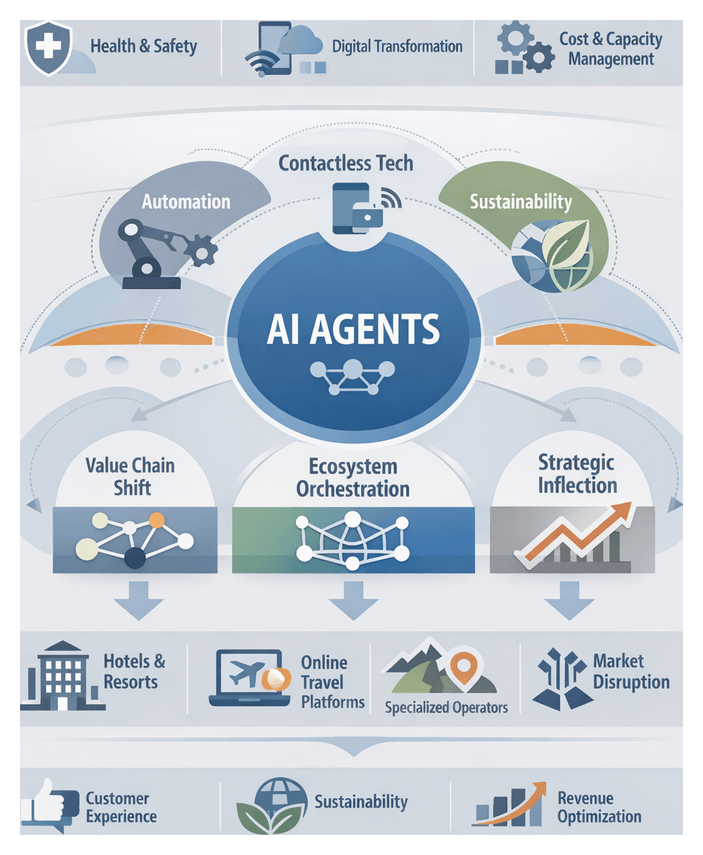
Post-Pandemic Industry Dynamics and the Role of AI
In the aftermath of a global health emergency that brought travel and hospitality operations to a near halt, organizations have redesigned service delivery and restructured cost models to address new realities. Heightened health and safety expectations accelerated digital transformation, and intensified cost and capacity management now underpin strategic priorities.
Visitors demand visible cleaning certifications, contactless interactions, and real-time safety updates. Operators have deployed ultraviolet sanitization, advanced air filtration, and antimicrobial surfaces while integrating touchless check-in, mobile room controls, and digital dashboards for transparent reporting. Workforce practices have evolved, with staff trained in enhanced hygiene protocols and supported by rotational staffing patterns to ensure resilience.
Digital solutions advanced from optional enhancements to operational imperatives. Mobile apps now serve as comprehensive platforms for booking, check-in, service requests, and loyalty management, while property management systems and online travel channels incorporate chatbots, self-service kiosks, and automated messaging. Machine learning algorithms underpin dynamic pricing, predictive demand forecasting, and inventory optimization. Autonomous scheduling systems adjust housekeeping rotations based on occupancy and health guidelines, freeing staff to focus on high-touch interactions that differentiate brands.
Cost pressures have driven automation of front-desk operations, redeployment of remote agents in virtual contact centers, and menu reengineering in food and beverage venues to minimize waste. Partnerships with local experience providers enable cost-effective modular offerings. Flexible cancellation policies and micro-segmented rate structures balance consumer demand for transparency and adaptability with revenue optimization. Consolidation among global portfolios coexists with niche operators emphasizing authenticity, wellness, and eco-tourism, while digital-native entrants target remote itineraries and specialized segments. The new winners combine standardized excellence with rapid customization, supported by continuous data intelligence and AI-driven insights.
Consumer behaviors have also shifted. Health and safety now rank alongside price and convenience, fueling demand for outdoor and nature-based experiences, smaller group sizes, and bleisure travel blending work and leisure. Mobile-first interactions, social media, and online reviews influence booking decisions, making reputation management and responsive digital engagement vital. Sustainability and social responsibility have moved into the mainstream, with travelers seeking carbon-neutral programs, community-based tourism, and transparent eco-certifications. AI agents can optimize routing for minimal environmental impact, recommend responsible options, and track sustainability metrics in real time, delivering both operational efficiency and brand credibility.
Anticipating AI-Driven Market Disruptions
AI agents represent a disruptive force capable of reconfiguring value chains, redefining distribution, and orchestrating multi-party ecosystems. Following disruption theory, autonomous planning tools and intelligent intermediaries will first serve niche or price-sensitive segments before scaling into mainstream channels. Organizations use complementary frameworks to interpret these shifts.
- Value-Chain Reconfiguration—AI agents collapse distribution layers, enabling direct supplier-to-user connections and capturing margin through software-mediated services.
- Ecosystem Orchestration—Platform owners and legacy operators reconceive roles as integrators of multi-party networks where agents automate search, booking, and in-destination services.
- Strategic Inflection Points—Monitoring AI maturity curves reveals when autonomous systems advance from pilot deployments to indispensable operational assets.
Key signals of impending disruption include platform consolidation around intelligent interfaces, an experience economy that prioritizes seamless end-to-end journeys, sustainability mandates driving AI-powered optimization, regulatory evolution shaping data practices, and technological convergence in 5G, edge computing, IoT, and blockchain. Forward-looking organizations apply horizon scanning, PESTEL analysis, Porter’s Five Forces, scenario planning, and S-Curve adoption models to balance quantitative indicators—such as agent usage and API integration rates—with qualitative insights from customer sentiment and policy developments.
Industry perspectives vary:
- Global Hotel Chains view AI agents as engines for personalized loyalty and ancillary revenue, assessing disruption by agents’ ability to scale customization without diluting brand identity.
- Online Travel Agencies see a dual threat and opportunity: agents risk eroding commission models but enable embedded itinerary assistants that strengthen customer lock-in.
- Specialized Tour Operators regard AI as a means for hyper-customization, weighing margin compression against experiential premiumization when choosing between in-house development or white-label partnerships.
- Technology Providers focus on open APIs, SDKs, and marketplace models to accelerate partner adoption and define interoperability standards.
Critical inflection points include standardization of agent interoperability protocols, breakthroughs in real-time multimodal reasoning, shifts in consumer trust toward AI autonomy, and the emergence of dominant agent aggregates or regionally fragmented networks. Organizations that align their build-buy-partner strategies, maintain portfolios of pilot and scaled initiatives, and engage proactively in regulatory dialogues will be best positioned to shape favorable outcomes and convert disruption into competitive advantage.
Strategic Positioning with AI Agents
AI agents now transcend cost and efficiency metrics to influence market differentiation, customer loyalty, and sustainable growth. Competitive positioning rests on three interrelated dimensions: capability leadership, ecosystem orchestration, and adaptive branding.
Capability Leadership
From a resource-based perspective, superior AI agents derive from proprietary data, custom algorithms, and domain expertise. Organizations with comprehensive loyalty histories, in-room sensor feeds, and third-party review sentiment train agents for precise personalization. Beyond off-the-shelf models, leaders invest in hierarchical reinforcement learning and graph-based recommendation engines, erecting barriers to imitation. Cross-functional squads of data scientists, UX designers, and hospitality experts drive continuous improvement through agile sprints and scenario planning.
Ecosystem Orchestration
No single firm controls the travel value chain. Platform economics positions AI agents as catalysts linking supply-side assets with traveler endpoints. Key approaches include strategic alliances, co-innovation, and standards participation:
- Alliances with AI Platforms—Integrating with some of the platforms listed on AgentLink AI and major cloud providers accelerates the deployment of translation modules, automated check-in bots, and dynamic pricing engines.
- Co-Innovation with Specialists—Partnering with local experience providers for personalized tour scripting and real-time assistance enhances experiential value beyond commodity pricing.
- Interoperability Standards—Participation in consortiums ensures agent-to-agent communication, secure data exchange, and identity verification protocols align across platforms.
Adaptive Branding
AI introduces a technological trust dimension to brand equity. Adoption of the Technology Acceptance Model guides agent interface design for perceived usefulness and ease of use. Embedding empathy through affective computing cues and reflective listening humanizes automated interactions. Transparency around data policies, optional human override features, and published governance frameworks calibrates trust and preserves brand integrity. Agent personas must reflect core brand values—luxury properties favor concierge-style dialogues, budget carriers emphasize swift self-service convenience.
Regulatory and Ethical Navigation
Compliance with evolving AI, privacy, and antitrust regulations shapes agent design. Proactive compliance—through privacy-by-design and ISO/IEC 27001 alignment—becomes a market differentiator, especially in corporate travel. Adoption of IEEE Ethically Aligned Design and the European Commission’s Ethics Guidelines for Trustworthy AI signals commitment to fairness. Engagement in policy forums enables organizations to influence standards around autonomy, data sovereignty, and accountability.
Segment-Specific Strategies and Roadmaps
Strategic implications vary by market segment. Global chains leverage scale for centralized data lakes and standardized agent frameworks; boutique operators emphasize hyper-local narratives. OTAs focus on cross-product recommendations and commission optimization, while direct channels deepen loyalty through personalized agent-driven offers. Business travel platforms prioritize policy compliance, expense integration, and duty-of-care notifications; leisure services highlight experience discovery, social sharing, and dynamic bundling.
Long-term roadmaps follow dynamic capabilities theory with phased capacity building, governance structures, and performance metrics. Early stages deploy chatbots and basic automation; later phases introduce autonomous negotiation, predictive anticipation, and emotional intelligence features. Cross-business steering committees oversee alignment with enterprise risk management, IT architecture, and brand governance. Innovation labs and academic partnerships pilot next-generation capabilities. Performance tracking extends beyond response times to net promoter scores, incremental revenue per guest, and operational cost offsets, ensuring agent contributions align with strategic objectives.
Recommendations for Strategic Planning
To harness AI agents for sustained value, organizations should adopt a structured roadmap aligning technology, data, people, and governance.
Technology Architecture
Invest in modular, cloud-native AI architectures with containerized microservices. Core engines should support natural language processing, machine learning pipelines, and federated learning protocols. Orchestration layers manage workflows and decision logic, while analytics dashboards surface agent performance and user insights for continuous refinement.
Data Governance and Interoperability
Define clear policies for data lineage, consent management, and retention in line with GDPR and CCPA. Adopt open schemas for traveler profiles, itinerary metadata, and transactions using secure interchange formats such as JSON-LD or OpenAPI. Federated learning enables cross-organization collaboration without sharing raw data, reducing vendor lock-in and mitigating silo risks.
Workforce Evolution
Reskill employees in data literacy, human–AI collaboration, and ethical decision-making. Establish cross-functional “AI collaboratoriums” for co-designing agent workflows. Create certification pathways in AI governance and interpretability, and implement incentive programs tied to agent performance metrics such as user satisfaction and efficiency gains.
Ethics and Regulatory Alignment
Form governance boards with ethics officers, legal counsel, and external advisors to oversee AI deployments. Conduct pre-deployment impact assessments to identify biases and privacy risks. Implement transparent auditing of agent decisions and collaborate with industry groups to shape emerging regulations and best practices.
Partnerships and Innovation
Pursue alliances with technology vendors, academic institutions, and start-ups through innovation labs, joint ventures, and consortium hackathons. Focus on use cases in sustainability, accessibility, and loyalty enhancement. Shared risk and knowledge accelerate time-to-market and drive collective learning.
Performance Monitoring and Risk Planning
Deploy real-time dashboards tracking user engagement, operational KPIs, and ethical compliance indicators. Conduct quarterly reviews for iterative improvements. Implement scenario-based risk tests for pricing algorithms, agent failover protocols, and cross-training for critical roles. Embed drills into business continuity planning to ensure resilience.
Investment Management
Use a stage-gate model for AI agent investments: phase-one pilots with defined success criteria, phase-two rollouts in select markets, and phase-three enterprise-wide deployments with SLAs and benchmarks. This approach validates hypotheses, controls capital exposure, and scales only those agent functions that deliver measurable impact.
- Data quality underpins agent effectiveness; invest in data hygiene and augmentation.
- Address integration complexity in legacy systems through API standardization.
- Develop talent pipelines to counter scarcity of AI and data science professionals.
- Maintain vigilant governance to address ethical ambiguities and evolving privacy concerns.
- Balance automation with human touch to meet evolving consumer expectations.
By embedding AI agents into every layer of the enterprise—from boardroom deliberations to guest-facing interactions—travel and hospitality organizations can navigate uncertainty, capture emerging opportunities, and deliver differentiated, trustworthy experiences in an increasingly autonomous world.
Conclusion
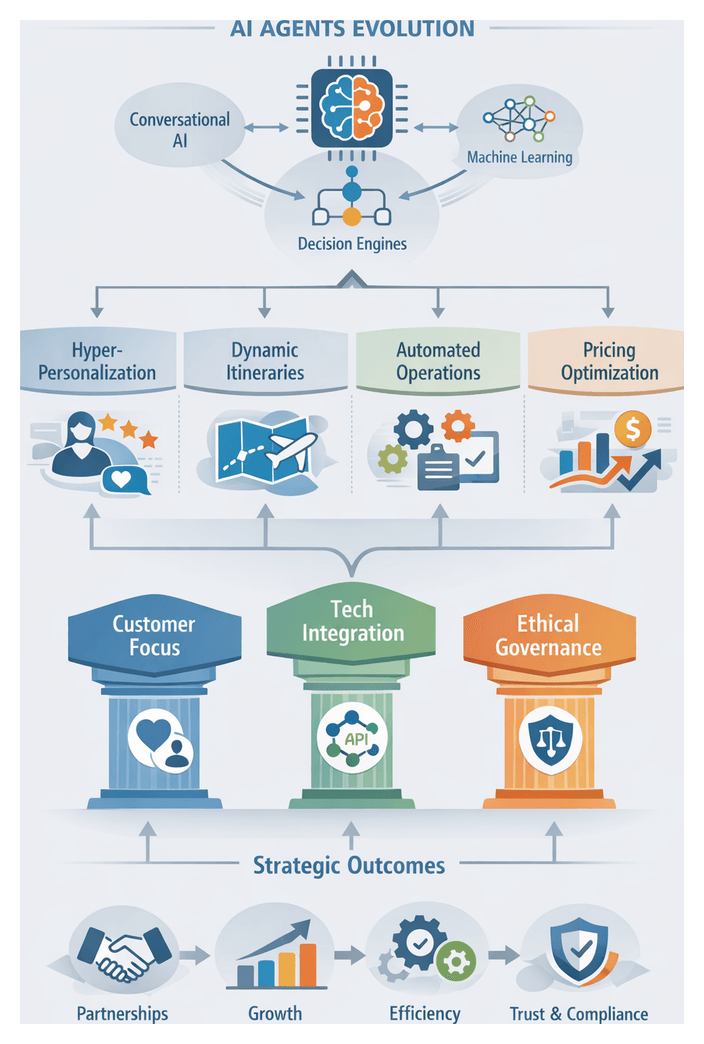
Recap of AI Agent Transformations
Over recent years, AI agents have evolved from static, rule-based scripts into autonomous collaborators that combine advanced natural language processing, sophisticated machine learning algorithms and decision-making architectures to perform complex tasks with minimal human intervention. At their core, these agents perceive environments through integrated data inputs, reason with predictive models and execute actions to achieve defined objectives. This evolution has enabled four major transformations in travel and hospitality:
- Hyper-personalization: Agents leverage real-time behavioral signals, historical preferences and contextual data—such as weather patterns or event schedules—to deliver tailored recommendations and anticipate guest needs.
- Dynamic itinerary generation: By modeling variables like flight schedules, accommodation availability and local transit options, agents create and adapt coherent travel plans in seconds, responding instantly to delays or cancellations.
- Streamlined operations: Intelligent automation of reservation updates, inquiry triage, billing reconciliation and inventory tracking reduces manual workloads, enabling staff to focus on high-value interactions and creative problem solving.
- Data-driven pricing optimization: Real-time dynamic pricing agents ingest internal booking data, competitor rates and external indicators—seasonal trends, macroeconomic signals—to balance occupancy and revenue targets through probabilistic forecasting and scenario analysis.
Underpinning these capabilities are three technological pillars: advanced conversational engines for natural language understanding and response generation; a spectrum of machine learning techniques, from gradient-boosted decision trees to transformer-based neural networks; and decision-making frameworks—including Markov decision processes and multi-agent coordination—that orchestrate actions across distributed systems. When combined with robust governance models addressing data privacy, ethical fairness and regulatory compliance, AI agents unlock new service models powered by continuous learning and real-time adaptability. Emerging integrations with Internet of Things, augmented reality and blockchain further expand operational visibility and guest engagement through smart-room controls, contextual AR guides and transparent provenance tracking.
Thematic Patterns and Strategic Insights
Analysis of multiple deployment case studies and chapters reveals consistent themes, interpretive frameworks and metrics that guide strategic decisions:
Customer-Centricity and Personalization
- Seamless Experiences: Agents must integrate with booking platforms, CRM systems and third-party data feeds to maintain unified guest profiles and deliver context-aware interactions.
- Balance of Depth and Autonomy: Organizations calibrate personalization layers—from demographic segmentation to situational signals—and autonomy thresholds by defining pre-approved actions, escalation protocols and human-in-the-loop checkpoints.
Scalability, Interoperability and Ecosystem Integration
- Modular Architectures and Open Standards: Use of APIs and industry standards for data exchange ensures agents amplify existing workflows without disruptive lock-in.
- Cross-Technology Synthesis: Evaluating agent value includes metrics such as integration latency, data throughput and user adoption across IoT, AR/VR and blockchain platforms.
Ethical and Regulatory Governance
- Responsible AI Principles: Fairness, accountability and explainability guide model development, with bias audits and data lineage analyses embedded in the lifecycle.
- Compliance Frameworks: Adoption of GDPR, CCPA and reference architectures—such as the NIST AI Risk Management Framework and the EU AI Act—ensures transparent consent flows and audit trails.
Quantitative and Qualitative Metrics
- Guest Satisfaction: Net Promoter Score and Customer Effort Score track effectiveness of guest-facing agents.
- Operational Efficiency: Average handling time, error rates in reservation processing and cost per transaction measure back-office automation impact.
- Revenue Performance: Revenue per available room uplift, price elasticity coefficients and forecast error rate benchmark dynamic pricing models.
- Security and Compliance: Incidents per million transactions and audit-coverage ratios quantify risk exposure.
Interpretive Frameworks and Methodological Best Practices
- Value Chain and Decision Matrix Analyses: Map agent impact across front-office and back-office processes and compare solutions using criteria such as accuracy, latency and user satisfaction.
- Maturity Models: Adaptations of Capability Maturity Model Integration frameworks assess organizational readiness to develop, deploy and scale agent technologies.
- Mixed-Methods Evaluation: Combine performance dashboards with qualitative user feedback and longitudinal studies capturing seasonal variability.
- Iterative Pilot Programs: Employ phased rollouts with risk-adjusted metrics to validate success before enterprise-scale adoption.
Emerging Divergences and Convergences
- Segment-Specific Priorities: Luxury resorts invest in immersive personalization and in-room IoT, while budget operators prioritize cost reduction and throughput.
- Channel Variations: Online travel agencies focus on aggregator-level forecasting, whereas boutique providers emphasize bespoke concierge-like planning.
- Convergent Imperatives: High data quality, seamless integration, governance structures and a culture of experimentation are universal success factors.
Industry Implications for Travel and Hospitality
Reimagining the Customer Value Chain
AI agents collapse traditional silos—distribution, reservation, check-in, guest services and post-stay engagement—into a continuous service continuum governed by adaptive logic. This shift transforms episodic transactions into ongoing, context-aware relationships, elevating customer lifetime value through proactive amenity adjustments and sustained emotional engagement.
Competitive Dynamics and Market Positioning
Intelligence-led differentiation supersedes asset-based competition. Organizations that integrate advanced agent capabilities gain first-mover advantages in responsiveness, operational resilience and ancillary revenue. In mature markets, AI-driven upsell and real-time customization can deliver up to 15 percent more ancillary income compared to manual approaches. Data sophistication becomes a new threshold for competitiveness, enabling smaller operators to leverage third-party platforms and larger brands to optimize proprietary models.
Transformation of Workforce Roles
Routine tasks migrate to agent workflows, requiring a redefinition of job roles, skill sets and performance metrics. Successful transformations blend AI-driven automation with human expertise in exception management and creative service delivery. Reskilling and “agent-human partnership” frameworks—clarifying decision rights, escalation paths and co-innovation processes—maintain employee engagement and enhance model performance.
Ethical, Regulatory and Trust Frameworks
Autonomous agents handling sensitive guest data necessitate transparent governance models. Public-facing charters, explainability mechanisms and consent management processes reinforce brand trust and ensure compliance with evolving regulations. Embedding ethical commitments into service design protects against bias, privacy breaches and reputational risk.
Strategic Ecosystem Partnerships
Agents thrive within integrated ecosystems of property management systems, loyalty platforms, payment gateways and third-party content providers. Platform strategies must balance proprietary infrastructure with partnerships to enrich data feeds and expand service offerings. Ecosystem mapping exercises identify high-value integration points and align agent initiatives with broader corporate objectives.
Long-Term Strategic Considerations
Enduring advantage requires diversified data portfolios that combine proprietary booking records with real-time social, location and environmental signals. Federated learning approaches preserve privacy while enabling collective model improvements across brands. As agent autonomy grows, organizations must realign decision-rights, liability frameworks and emergency intervention protocols. Cultivating a culture of data-driven decision-making, cross-functional collaboration and agile governance embeds agent capabilities into the strategic DNA.
Strategic Imperatives and Forward-Looking Considerations
To realize the transformative potential of AI agents, travel and hospitality organizations should pursue the following imperatives:
- Invest in Scalable Data Infrastructure: Build unified data lakes with quality controls, lineage tracking and real-time streaming to power personalization, forecasting and decision engines.
- Drive Workforce Transformation: Implement upskilling programs in AI oversight, data literacy and cross-functional collaboration, and involve employees in agent design and training to foster ownership.
- Forge Strategic Partnerships: Collaborate with specialized AI vendors, industry consortia and academic institutions to access cutting-edge models and domain-specific datasets under clear governance agreements.
- Elevate Risk Management: Integrate scenario planning for data breaches, model biases and regulatory shifts with robust incident response and transparent reporting to safeguard trust and brand equity.
- Embrace Agile Innovation: Deploy minimum-viable-agent pilots, iterate based on mixed-methods evaluations and maintain an innovation portfolio that balances incremental improvements with research into adaptive autonomy and emergent reasoning.
- Shape Industry Standards: Actively participate in working groups to define protocols for agent interoperability, performance benchmarks, security and ethical compliance.
Looking ahead, advancements in multimodal understanding, edge computing and federated learning will redefine expectations for seamless, personalized experiences. Organizations that maintain analytical rigor, cross-disciplinary expertise and a culture of continuous learning will navigate integration complexities, ethical dilemmas and evolving market demands to capture disproportionate value. By aligning data strategy, workforce readiness, governance frameworks and partnerships, stakeholders can embed AI agents as catalysts for enduring resilience and service excellence.
Appendix
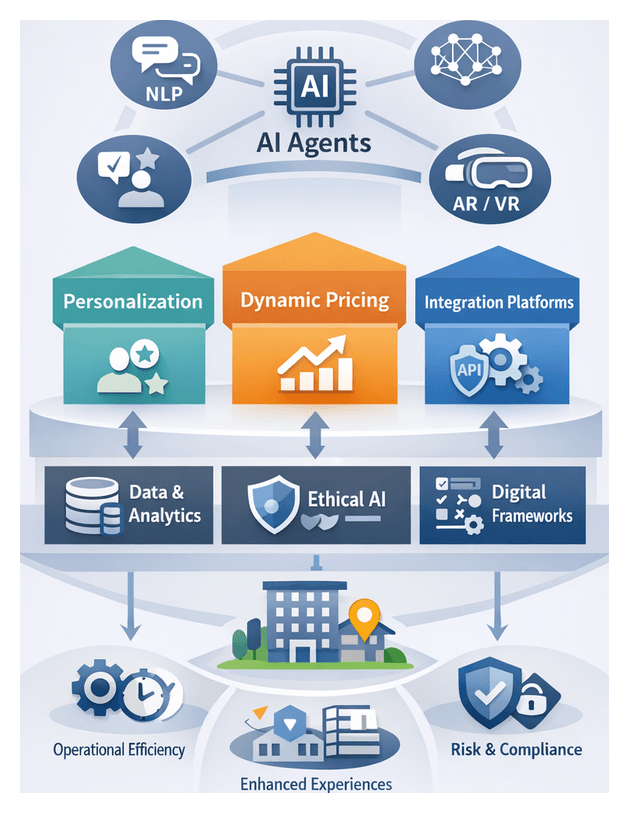
Core Definitions and Terminology
Artificial Intelligence Agent
An artificial intelligence agent is a software entity that perceives its environment through data inputs, reasons using algorithms, and acts to achieve objectives with minimal human intervention. In travel and hospitality, AI agents automate guest inquiries, dynamic pricing, itinerary generation and operational workflows.
Natural Language Processing
Natural language processing enables machines to understand, interpret and generate human language. In hospitality, NLP powers chatbots and voice assistants by performing intent recognition, entity extraction, sentiment analysis and dialogue management, reducing response latency and supporting multilingual interactions.
Machine Learning
Machine learning uses algorithms and statistical models to improve performance through experience. In travel and hospitality, ML powers demand forecasting, recommendation engines, dynamic pricing and operational predictions. Techniques include supervised learning for booking predictions, unsupervised learning for behavioral segmentation and reinforcement learning for real-time decision optimization.
Internet of Things
Internet of Things devices—sensors, actuators and beacons—collect real-time data on occupancy, environmental conditions and guest movements. Integrated with AI agents, IoT enables predictive maintenance, energy management and personalized in-room adjustments based on guest preferences.
Augmented Reality and Virtual Reality
Augmented reality overlays digital information onto the real world, while virtual reality immerses users in a digital environment. In hospitality, AR/VR enhance guest engagement through virtual tours, interactive wayfinding and immersive previews, often guided by AI concierges for personalized recommendations.
Dynamic Pricing
Dynamic pricing adjusts rates in real time based on supply and demand signals, competitive benchmarks and booking patterns. AI-driven pricing agents analyze historic and live data streams to optimize revenue per available unit while balancing occupancy and yield objectives.
Personalization and Hyper-Personalization
Personalization tailors recommendations based on guest data; hyper-personalization leverages real-time behavioral signals, contextual variables and predictive analytics for anticipatory experiences. AI agents continuously update guest profiles and predict next-best actions to deepen engagement and loyalty.
Microservices Architecture
Microservices architecture breaks applications into independent services communicating via APIs. Each service—such as NLP, recommendation logic or payment processing—can be developed, deployed and scaled independently, enabling modular AI agent ecosystems and continuous delivery.
Property Management and Reservation Systems
Property Management Systems manage front-desk operations, billing and housekeeping, while Central Reservation Systems consolidate inventory and pricing across channels. AI agent integration with PMS and CRS enables end-to-end automation of guest interactions, booking confirmations and dynamic rate updates.
Customer Relationship Management and OTAs
Customer Relationship Management platforms aggregate guest data—contact details, booking history, loyalty status—and support personalized marketing and service campaigns. Online Travel Agencies provide third-party booking channels. AI agents embedded in CRMs and OTAs assist with itinerary suggestions, fare alerts and dynamic bundling.
APIs and Decision-Making Architectures
Application Programming Interfaces enable communication between agent modules, databases and external services. Decision-making architectures—including rule-based engines, probabilistic frameworks and cognitive systems—determine how agents evaluate options and select actions, impacting autonomy and interpretability.
Digital Transformation and Service Innovation
Digital transformation integrates digital technologies into all aspects of an organization, driving scalable personalization and process automation. Service innovation uses AI agents to deliver proactive, context-aware interactions and continuous feedback loops that refine guest experiences in real time.
Operational Resilience, Data Governance and Ethical AI
Operational resilience is the ability to anticipate, withstand and recover from disruptions. Robust data governance ensures quality, privacy and compliance. Ethical AI frameworks uphold fairness, transparency and accountability, guiding responsible use of guest data and explainable model decisions.
Strategic and Maturity Frameworks
Digital Maturity and Autonomy Models
Digital maturity models assess progress in technology integration, data architecture and organizational readiness. The Autonomy Maturity Model defines levels of agent independence—from assistive support to full autonomy and adaptive learning—helping organizations sequence investments and governance protocols.
Service-Dominant Logic and Value Co-Creation
Service-dominant logic reframes value as co-created between providers and customers. AI agents participate in continuous interactions, anticipating needs and adapting recommendations to transform transactions into integrated experiences, fostering loyalty through relational engagement.
Technology-Organization-Environment and UTAUT Frameworks
The TOE framework evaluates adoption readiness across technological capabilities, organizational culture and environmental drivers. The Unified Theory of Acceptance and Use of Technology identifies factors—performance expectancy, effort expectancy, social influence and facilitating conditions—that influence end-user acceptance of AI agents.
Balanced Scorecard and ROI
The balanced scorecard aligns agent initiatives with strategic objectives across financial, customer, internal process and learning perspectives. An AI Return on Investment Model quantifies direct cost savings, revenue uplifts, productivity gains and intangible benefits against total cost of ownership to support data-driven business cases.
Adoption Life Cycle, Scenario Planning and Risk-Reward Analysis
Mapping AI agent projects onto the technology adoption life cycle guides pilot scope and scaling strategies. Scenario planning stress-tests agent initiatives under varied futures, while risk-reward matrices prioritize use cases that balance benefit against implementation complexity and regulatory exposure.
Conversational AI and Data Quality Frameworks
Conversational AI maturity models benchmark dialogue systems on intent accuracy, multi-turn coherence and context retention. Data quality frameworks define criteria for accuracy, completeness and consistency, ensuring reliable inputs for training and inference in AI agent deployments.
Ethical AI and Digital Capability Frameworks
Privacy impact assessments and ethical AI frameworks—such as those from IEEE or the EU AI Act—provide principles for fairness, accountability and transparency. Digital Capability Frameworks assess organizational proficiency across strategy, infrastructure, process optimization and talent readiness.
Implementation Guidance
Distinguishing AI Agents from Traditional Automation
- Autonomy: AI agents make data-driven decisions and adapt policies, whereas traditional scripts follow fixed rules.
- Learning: Agents improve through feedback loops; RPA tools require manual rule updates.
- Contextual Understanding: NLP enables multi-turn dialogues and intent recognition, beyond keyword matching.
- Integration Scope: AI agents orchestrate across PMS, booking engines and IoT networks for end-to-end workflows.
Prerequisites for Deployment
- Data Infrastructure: Unified platforms for guest profiles, booking records and sensor feeds with real-time streaming.
- Technology Stack: Scalable compute, microservices architectures and API gateways for low-latency interactions.
- Governance: Policies for data quality, privacy compliance and ethical oversight with defined stewardship roles.
- Organizational Alignment: Executive sponsorship and cross-functional governance bodies to guide strategy and change management.
- Skills and Culture: AI literacy, conversational design training and a culture that embraces experimentation and continuous improvement.
Measuring ROI
- Financial Impact: Revenue uplifts from upsells, dynamic pricing and cost avoidance.
- Operational Efficiency: Reduction in handling time, automation rates and service recovery incidents.
- Guest Satisfaction: Net Promoter Score changes and repeat engagement rates.
- Employee Productivity: Shift toward high-value tasks and reduced training time.
- Compliance and Risk: Fewer manual errors and audit findings related to data controls.
Privacy, Ethics and Oversight
- Privacy by Design: Embed data minimization, consent management and anonymization from inception.
- Transparent Policies: Clear notices and consent mechanisms for guest data use.
- Ethical Committees: Review agent behaviors against fairness and accountability principles.
- Audit Trails: Immutable logs for forensic analysis and regulatory compliance.
- Regular Assessments: Privacy impact assessments and bias detection at defined intervals.
Balancing Autonomy with Human Oversight
- Autonomy Levels: Classify tasks as assistive, advisory or fully autonomous with corresponding review protocols.
- Escalation Triggers: Route low-confidence or complex cases to human operators automatically.
- Periodic Audits: Review agent decisions and overrides to refine policies.
- Sandbox Testing: Simulate edge cases before production deployment.
- Feedback Integration: Incorporate human interventions into learning pipelines to reduce future escalations.
Legacy System Integration
- API Facades: Use gateways to abstract legacy interfaces and expose standardized endpoints.
- Data Normalization: Apply canonical models and transformations to reconcile disparate schemas.
- Phased Rollout: Prioritize high-value integration points before extending to complex functions.
- Event-Driven Architecture: Employ message queues for real-time streaming of booking and operational events.
- Dual-Write Strategies: Synchronize data during cutover to ensure continuity and rollback capability.
Change Management and Readiness
- Stakeholder Engagement: Involve users early to co-define use cases and success metrics.
- Role Redefinition: Clarify shifts from manual tasks to exception management and strategic oversight.
- Training Programs: Offer workshops, e-learning and certifications tailored to proficiency levels.
- Communication Plans: Provide transparent updates on milestones and performance results.
- Change Champions: Identify ambassadors to advocate for agent adoption and peer support.
Scaling AI Agents
- Multi-Tenant Cloud: Deploy on platforms supporting isolation, automated scaling and global availability.
- Configuration Management: Centralize policies with overrides for regional or property-specific variations.
- Performance Monitoring: Real-time dashboards tracking latency, error rates and resource utilization.
- Continuous Delivery: Automate build, test and deployment pipelines for seamless updates.
- Data Synchronization: Ensure unified guest context across booking, profile and feedback systems.
Common Pitfalls and Mitigations
- Overambitious Scope: Start with narrow, high-impact use cases and expand iteratively.
- Neglecting UX: Involve specialists and conduct user testing to refine conversational flows.
- Underestimating Data Quality: Implement validation, cleansing and governance before training.
- Ignoring Change Management: Apply structured frameworks and dedicate resources to readiness.
- Lack of Ethical Oversight: Establish ethics committees and deploy fairness monitoring tools.
Future Evolution of AI Agents
- Multimodal Reasoning: Combine text, voice, gesture and spatial inputs for richer interactions.
- Predictive Autonomy: Use reinforcement learning and causal inference to anticipate and adjust in real time.
- Affective Computing: Detect guest emotions and adapt communication style and services accordingly.
- Federated Learning: Enable cross-brand portability of guest profiles while preserving privacy.
- Decentralized Architectures: Leverage edge computing and blockchain for offline capabilities and secure data exchange.
AI Tools and Supplementary Resources
AI-Driven Platforms
- AgentLink AI: Pre-trained AI agents for travel planning, guest interactions and real-time itinerary adjustments.
- GPT-4: Advanced large language model powering conversational AI and generative capabilities.
- Google Dialogflow: Platform for building voice and text agents with intent recognition and integration with Google Cloud.
- IBM Watson Assistant: Enterprise-grade virtual concierge services with natural language understanding and dialog management.
- Amazon Alexa for Hospitality: Voice-enabled guest room assistants integrated with property management systems.
- AWS Personalize: Managed ML service for real-time personalization and recommendations.
- Ada: Multilingual chatbot platform for automated guest support and ticketing workflows.
- ServiceBot: Conversational automation for guest communications, reservations and notifications.
- UiPath: Robotic Process Automation for back-office tasks such as reservations management and billing reconciliation.
- Automation Anywhere: RPA platform combining attended and unattended bots for operational workflows.
- Dynamic Yield: Personalization engine using A/B testing and ML to optimize content and offers.
- Segment: Customer data infrastructure for unified guest profiles and hyper-personalization.
- Revionics: AI-driven pricing optimization and demand forecasting for revenue management.
- Duetto: Cloud-native revenue strategy platform with real-time demand forecasting and open pricing.
- Prophet: Open-source forecasting library for time-series data with seasonality and holiday modeling.
Standards and References
- ISO/IEC 27001: Information security management standard.
- ISO/IEC 42001: AI management systems standard in development.
- IEEE Ethics of Autonomous and Intelligent Systems: Frameworks for ethical AI design.
- EU AI Act: Regulatory proposal categorizing AI risk levels.
- NIST AI Risk Management Framework: Guidelines for managing AI risks.
- GDPR: European data protection and privacy regulation.
- CCPA/CPRA: California consumer privacy statutes.
- PCI DSS: Payment card data security standard.
- McKinsey Digital Insights: Research on digital transformation and AI adoption.
- Gartner AI Insights: Analyst research on AI agent maturity and best practices.
- OECD AI Principles: Guiding values for responsible AI.
- Digital Capability Framework: Model for assessing organizational readiness.
- Service-Dominant Logic: Framework on value co-creation through service exchanges.
- Dynamic Capabilities Theory: Theory on reconfiguring resources in changing environments.
- PESTEL Analysis: Framework for evaluating macro-environmental factors.
- ADKAR Model: Change management methodology for sustaining technology adoption.
The AugVation family of websites helps entrepreneurs, professionals, and teams apply AI in practical, real-world ways—through curated tools, proven workflows, and implementation-focused education. Explore the ecosystem below to find the right platform for your goals.
Ecosystem Directory
AugVation — The central hub for AI-enhanced digital products, guides, templates, and implementation toolkits.
Resource Link AI — A curated directory of AI tools, solution workflows, reviews, and practical learning resources.
Agent Link AI — AI agents and intelligent automation: orchestrated workflows, agent frameworks, and operational efficiency systems.
Business Link AI — AI for business strategy and operations: frameworks, use cases, and adoption guidance for leaders.
Content Link AI — AI-powered content creation and SEO: writing, publishing, multimedia, and scalable distribution workflows.
Design Link AI — AI for design and branding: creative tools, visual workflows, UX/UI acceleration, and design automation.
Developer Link AI — AI for builders: dev tools, APIs, frameworks, deployment strategies, and integration best practices.
Marketing Link AI — AI-driven marketing: automation, personalization, analytics, ad optimization, and performance growth.
Productivity Link AI — AI productivity systems: task efficiency, collaboration, knowledge workflows, and smarter daily execution.
Sales Link AI — AI for sales: lead generation, sales intelligence, conversation insights, CRM enhancement, and revenue optimization.
Want the fastest path? Start at AugVation to access the latest resources, then explore the rest of the ecosystem from there.