

Mastering AI Agents in Real Estate Marketing Strategies for Success
To download this as a free PDF eBook and explore many others, please visit the AugVation webstore:
Introduction
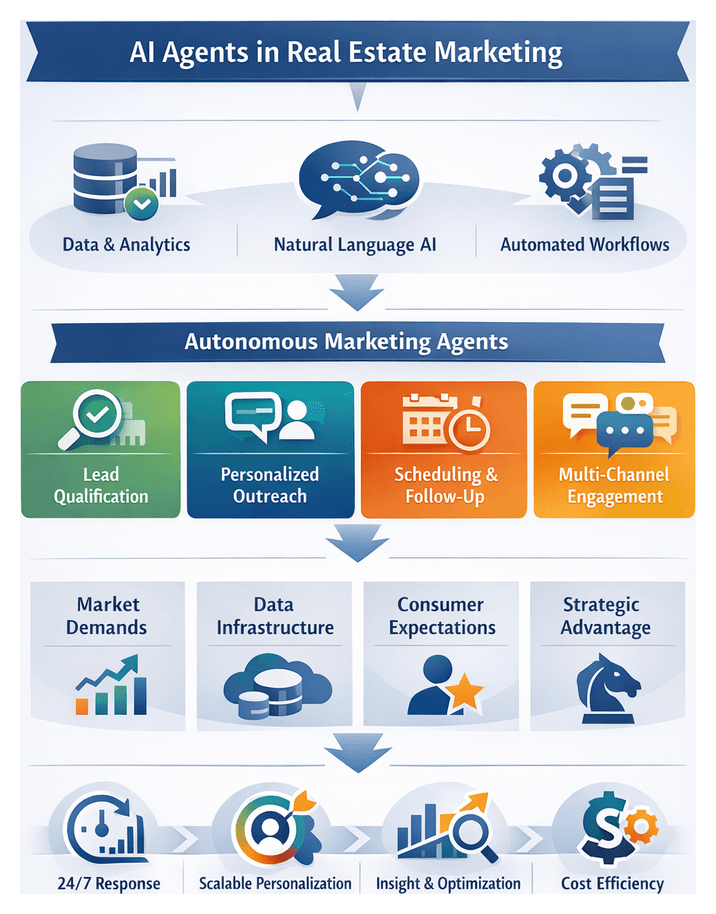
Emergence of Autonomous Marketing Agents
Real estate marketing has shifted from manual outreach and static advertising to AI-powered systems that research prospects, craft personalized messages, and follow up at optimal times. Autonomous marketing agents—intelligent applications combining machine learning, natural language processing, and workflow automation—now handle lead qualification, appointment scheduling, and content distribution with minimal human intervention. This evolution allows agents and brokerages to focus on strategic decision-making and relationship-building, while software ensures no opportunity is overlooked in fast-moving markets.
Key factors driving this transformation include abundant data availability, scalable cloud infrastructure, and the imperative to stand out in crowded markets. Property seekers expect instant, personalized responses across email, text, voice assistants, and social media. Traditional CRMs and rule-based marketing platforms addressed parts of this need but required extensive manual configuration. Autonomous agents, in contrast, learn from interactions and continuously refine their approach, delivering scalable personalization, 24/7 availability, and adaptive decision-making that distinguishes forward-thinking organizations.
- Volume and velocity of inquiries exceeding human capacity
- Demand for real-time, personalized engagement
- Diverse communication channels complicating follow-up
- Rising costs of manual outreach and media placements
Core Capabilities of AI-Driven Agents
Autonomous marketing agents converge three foundational capabilities to surpass traditional automation tools:
- Data Ingestion and Analysis: Connecting to CRMs, listing databases, social media feeds, and third-party datasets, agents apply algorithms to surface insights about prospects and market conditions.
- Natural Language Understanding and Generation: Using advanced NLP, agents interpret intent, detect sentiment, and generate human-like responses that align with brand voice and compliance standards.
- Autonomous Workflow Execution: Agents initiate outreach, schedule viewings, update lead statuses, assign tasks, and escalate complex issues to human specialists as needed.
This triad enables continuous learning, adaptive communication styles, and optimized workflow sequences over time. For example, integrating platforms like those listed on AgentLink AI empowers teams to deploy conversational agents that answer property and financing questions, recommend listings based on buyer profiles, and seamlessly hand off high-value leads to human agents.
Strategic Imperatives for AI-Powered Outreach
Adopting AI agents has become a strategic necessity in real estate marketing. Four interrelated dimensions underscore this urgency:
- Market Pressures: Rapid inventory cycles and fluctuating financing conditions demand instant, accurate responses. AI agents continuously monitor listings and touchpoints to capture high-intent inquiries before competitors.
- Data and Infrastructure Readiness: Mature CRMs, multiple listing services, and digital advertising ecosystems have generated rich data sources. Unified customer profiles and API-driven feeds enable agents to deliver timely, contextually relevant outreach.
- Evolving Consumer Expectations: Prospects expect personalized, immediate interactions across preferred channels. AI agents interpret intent, tailor messages to each stage of the buyer journey, and maintain brand consistency on email, SMS, social media, or chat widgets.
- Strategic Differentiation: In markets with low switching costs, service quality becomes a key differentiator. AI agents provide scalable personalization, continuous optimization through built-in analytics, and aggregated insights that inform broader marketing strategies.
Distinctive Value Propositions
- Enhanced Responsiveness: 24/7 engagement reduces lead drop-off and accelerates qualification timelines.
- Scalable Personalization: Behavioral and demographic data power tailored messaging at scale, surpassing one-size-fits-all campaigns.
- Data-Driven Insights: Continuous analysis of interaction data refines marketing strategies and resource allocation in real time.
- Cost Efficiency: Automating repetitive tasks frees human agents to focus on high-value negotiations and complex client needs.
Unlike traditional automation platforms that follow predefined scripts and static criteria, autonomous agents adapt decision logic based on real-time input and historical patterns. They proactively initiate outreach when predictive signals indicate high intent, leverage conversational AI for fluid interactions, and employ closed-loop feedback to evaluate and recalibrate their own actions.
Interpretive Frameworks and Evaluation Models
Organizations use established frameworks to assess AI agent initiatives, ensuring strategic fit and risk management:
- Extended Technology Acceptance Model: Incorporates trustworthiness, transparency, and regulatory alignment alongside ease of use and perceived usefulness.
- AI Maturity Models: Classify firms from ad hoc experimentation to enterprise-wide AI orchestration, guiding investments in governance, data infrastructure, and cross-functional collaboration.
- Gartner Hype Cycle: Sets realistic expectations by recognizing phases from peak enthusiasm to plateau of productivity, encouraging iterative refinements over perfection.
- Value Chain Mapping: Adapts the McKinsey AI value chain to pinpoint where agents add incremental value—from lead scoring and property recommendations to ad spend optimization.
Organizational Considerations
Successful integration requires attention to people, processes, and platforms:
Change Management and Culture
Structured programs address concerns about job displacement and skill requirements. Executive sponsorship, transparent pilot results, and co-creation workshops with frontline staff foster a culture of experimentation and continuous learning.
Governance and Risk
Cross-functional committees establish policies for data privacy, algorithmic fairness, and fallback protocols. Regular audits of agent behavior, data usage, and escalation logs maintain accountability.
Vendor Ecosystem and Integration Strategy
Practitioners balance specialized solutions like those offered on AgentLink AI with broader platforms such as Salesforce Einstein. API maturity, data model compatibility, and support for standards like RESO Web API guide integration choices. Combining conversational agents with general-purpose analytics engines often yields flexible, resilient architectures.
Data and Infrastructure Readiness
- Unified Customer Profiles: Integrating AI agents with modern CRMs ensures outreach references recent property views and communication preferences.
- Real-Time Market Indicators: API-driven feeds on pricing trends, neighborhood analytics, and mortgage rates enable timely prospect notifications.
- Interoperability Standards: Solutions like Structurely and kvCORE illustrate seamless ingestion of CRM data and automated campaign orchestration without extensive custom development.
Consumer Engagement and Differentiation
- Instantaneous Responsiveness: AI agents reply to inquiries at any hour, fostering trust and professionalism.
- Contextual Intelligence: NLP capabilities distinguish browsing inquiries from high-intent requests, aligning responses with buyer-journey stages.
- Channel Agnosticism: Agents maintain brand voice across email, SMS, Facebook Messenger, WhatsApp, or proprietary chat widgets.
- Continuous Optimization: Built-in analytics and A/B testing refine subject lines, calls to action, and timing to maximize engagement metrics.
- Strategic Insights: Aggregated outreach data uncovers macro trends—such as surges in inquiries for specific property types—informing marketing investments and portfolio adjustments.
Implications for Real Estate Stakeholders
- Brokerage Leadership: Improved outreach efficiency enhances profitability per agent and enables reallocation of budgets to high-impact, AI-enabled campaigns.
- Marketing Professionals: Automation of repetitive tasks frees teams for brand building and cross-channel creative work, while AI-generated insights support data-driven decision making.
- Real Estate Agents: Pre-qualified leads and AI-curated prospect intelligence reduce time on low-intent inquiries, allowing focus on relationship building and closings.
- Prospective Buyers and Renters: Relevant, timely interactions aligned with preferences foster trust, loyalty, and a superior customer experience.
- Technology Providers: Vendors delivering scalable, interoperable AI agent solutions position themselves as strategic allies, accelerating adoption through CRM and MLS integrations.
Guide Roadmap and Reader Outcomes
This eBook provides a comprehensive blueprint for mastering autonomous AI agents in real estate marketing. Across ten analytical chapters, readers will explore:
- Strategic Context Market forces and digital evolution driving AI agent adoption
- Core Concepts Defining agent capabilities from autonomous decision making to NLP
- Analytical Frameworks Models to assess ROI, conversion impact, and trade-offs
- Use-Case Perspectives Real-world scenarios from lead qualification to investment forecasting
- Key Considerations and Limitations Data requirements, integration challenges, governance, and ethics
By the end of this guide, practitioners will be able to assess the strategic value of AI agents, select and evaluate tools, design customer engagement strategies with seamless human handoffs, implement data-driven prospecting frameworks, develop scalable personalization approaches, integrate agents into existing platforms, navigate ethical and regulatory considerations, and anticipate emerging innovations such as generative AI for immersive property tours and voice-activated interfaces.
Key limitations to consider include data quality and bias, integration complexity, ethical and regulatory constraints, maintaining human–AI collaboration, and allocating resources for training and change management. With these insights, readers will emerge with actionable strategies to integrate AI agents responsibly and effectively, securing sustained competitive advantage in an evolving real estate landscape.
Chapter 1: The Evolution of Real Estate Marketing in the Digital Era
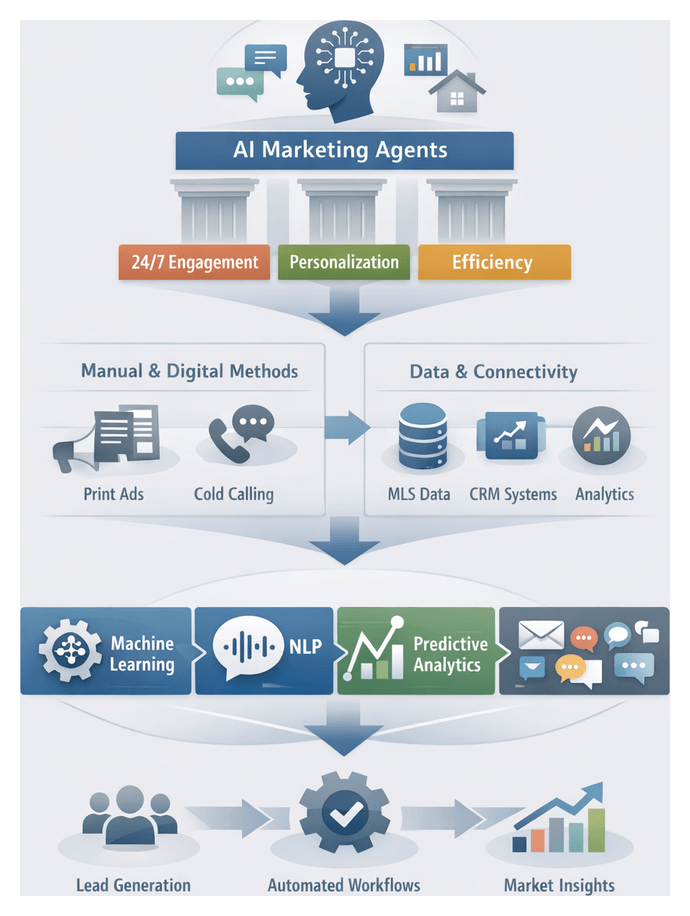
Emergence of Autonomous Marketing Agents
Over the past decade, real estate marketing has evolved from labor-intensive outreach to intelligent, AI-powered automation. Autonomous marketing agents—software entities leveraging machine learning, natural language processing and predictive analytics—now engage prospects, qualify leads and automate multichannel workflows with minimal human intervention. These agents scale personalized outreach, optimize resources and respond instantly to market changes, transforming both residential and commercial real estate operations.
Traditional methods such as face-to-face interactions, print advertisements and cold calling laid the groundwork for relationship-driven sales but were limited in scale. The rise of online portals and social media introduced digital channels, yet early digital efforts still relied heavily on manual follow-up and rule-based CRM workflows from vendors like Salesforce and HubSpot. As consumer expectations shifted toward immediate, personalized interactions, the need for autonomous agents emerged as a strategic imperative.
Unlike conventional automation tools operating on fixed rules or scheduled triggers, autonomous agents learn from interactions and make decisions in real time. For instance, an AI agent embedded in a brokerage’s chat feature can greet visitors, qualify budget and location preferences, schedule appointments and send tailored listings automatically. It refines its conversational strategy based on engagement metrics, unlike static chatbots that require manual updates.
Prominent solutions illustrate the breadth of capabilities available:
- AgentLinkAI featured solutions that integrate with multiple listing services and CRM platforms to deliver round-the-clock engagement.
- Google Dialogflow provides advanced intent recognition for conversational agents.
- IBM Watson Assistant supports multi-channel deployments with deep analytics on user intents and sentiment.
The strategic value of autonomous agents stems from three critical drivers:
- Scale and Availability: AI agents engage leads 24/7, ensuring no inquiry is missed and accelerating first contact.
- Personalized Engagement: Agents process individual data—search history, demographics, past interactions—to tailor messaging and property recommendations at scale.
- Operational Efficiency: By automating lead qualification, follow-up reminders and scheduling, AI frees human agents to focus on negotiation, relationship building and strategic tasks.
Evolution from Manual Outreach to Digital and AI-Driven Workflows
Real estate marketing has undergone a two-stage transformation. First, the shift from print media—newspaper classifieds, magazine spreads, direct mail and signage—to digital channels revolutionized data generation and consumer engagement. Online portals enabled interactive search, virtual tours and real-time communication, introducing metrics such as page views, bounce rates and click-through rates as indicators of interest. Platforms aggregated listings, creating network effects that rewarded early adopters and institutionalized data-driven marketing operations.
Second, the limitations of rule-based automation—static email templates, manual spreadsheets and scheduled call lists—became apparent as transaction volumes grew and consumer expectations for instant, personalized engagement intensified. Autonomous marketing agents emerged to bridge this gap, leveraging existing digital infrastructures to deliver dynamic, context-aware interactions across email, SMS, social media and chat.
Key technological and market factors underpinning this evolution include:
- Broadband and Mobile Computing: Widespread smartphone adoption enabled on-the-go property searches, driving demand for instant responses and real-time recommendations.
- Cloud Architectures and APIs: Scalable hosting and standardized interfaces let agents access updated listing data and customer interactions without extensive reengineering.
- Platform Economics: Network effects on major portals created high barriers to entry, emphasizing the importance of ecosystem alignment when deploying AI agents.
- Regulatory Compliance: Digital audit trails and reporting mechanisms supported fair housing and advertising standards, establishing a trusted foundation for automated outreach.
Digital Foundations Enabling AI Integration
The effectiveness of autonomous marketing agents depends on mature digital foundations—coherent data ecosystems, standardized listing data, analytical maturity and unified engagement platforms. These prerequisites ensure AI initiatives achieve their full potential.
Data Ecosystems and Connectivity
Centralized repositories integrate MLS feeds, CRM records, website analytics and marketing automation tools into a unified environment. High-quality, consolidated data enhances predictive accuracy for lead scoring and market forecasts.
- API-Driven Access: Agents such as Salesforce Einstein and HubSpot AI rely on APIs to enrich recommendation engines and conversational workflows.
- Data Governance: Policies on ownership, quality control and privacy compliance guard against biased training sets and ensure responsible AI usage.
Standardization of Listing Data
Uniform representation of property attributes—location, size, pricing, features—via industry schemas such as RETS or RESO data models enables AI agents to interpret and compare listings accurately across markets.
- Semantic Consistency: Standard field definitions and metadata hierarchies remove ambiguity in property data.
- Data Normalization: Automated unit conversion, address parsing and feature categorization prepare feeds for analytic processing.
Analytical Maturity and AI Readiness
Organizations with advanced analytics capabilities—cohort analysis, attribution modeling and predictive dashboards—are better equipped to operationalize AI insights. A culture of test-and-learn, supported by cross-functional collaboration, accelerates agent performance optimization.
Omnichannel Engagement Platforms
Consolidating interactions from websites, mobile apps, social media, messaging platforms and email into a unified customer view provides AI agents with the contextual awareness needed for relevant outreach.
- Dynamic Personalization: Integration with content platforms tailors recommendations in real time based on behavioral signals.
- Feedback Loops: Closed-loop reporting measures AI-driven engagement impact across channels, informing continuous refinement.
Strategic Insights for AI-Driven Marketing Transformation
Embedding autonomous agents into real estate marketing requires strategic clarity across data, technology and organizational dimensions. The following insights guide a successful transformation:
- Embrace Data as a Strategic Asset: Treat unified repositories of listing performance, engagement metrics and market indicators as core to decision making. Implement analytical frameworks—cohort analysis, propensity modeling—and foster a test-and-learn culture to validate hypotheses.
- Balance Automation with Human Oversight: Deploy AI for initial outreach, lead qualification and content personalization. Establish clear escalation protocols for complex negotiations and high-value interactions to preserve trust and ensure empathy.
- Prioritize Transparency and Governance: Define metrics—engagement lift, lead quality improvement, conversion velocity—and maintain dashboards for monitoring. Implement bias audits, privacy policies and transparent disclosures to comply with regulations and uphold ethical standards.
- Adopt Agile Experimentation: Use controlled pilots and A/B or multivariate testing to compare conversational flows, scoring algorithms and personalization strategies. Correlate outcomes with market context to avoid spurious conclusions and accelerate high-impact learnings.
- Align Technology with Brand Differentiation: Embed proprietary data integrations, branded conversational styles and specialized recommendation engines to reinforce market positioning and amplify competitive advantage.
- Enable Change Management and Scalability: Secure executive sponsorship, provide cross-functional training and implement phased rollouts. Celebrate early wins, establish feedback loops and support upskilling to sustain momentum and mitigate change fatigue.
By grounding AI agent adoption in robust digital foundations, strategic governance and a culture of continuous improvement, real estate organizations can transform marketing operations, enhance customer experiences and secure a sustainable competitive edge in an increasingly dynamic market.
Chapter 2: Defining AI Agents and Their Core Capabilities
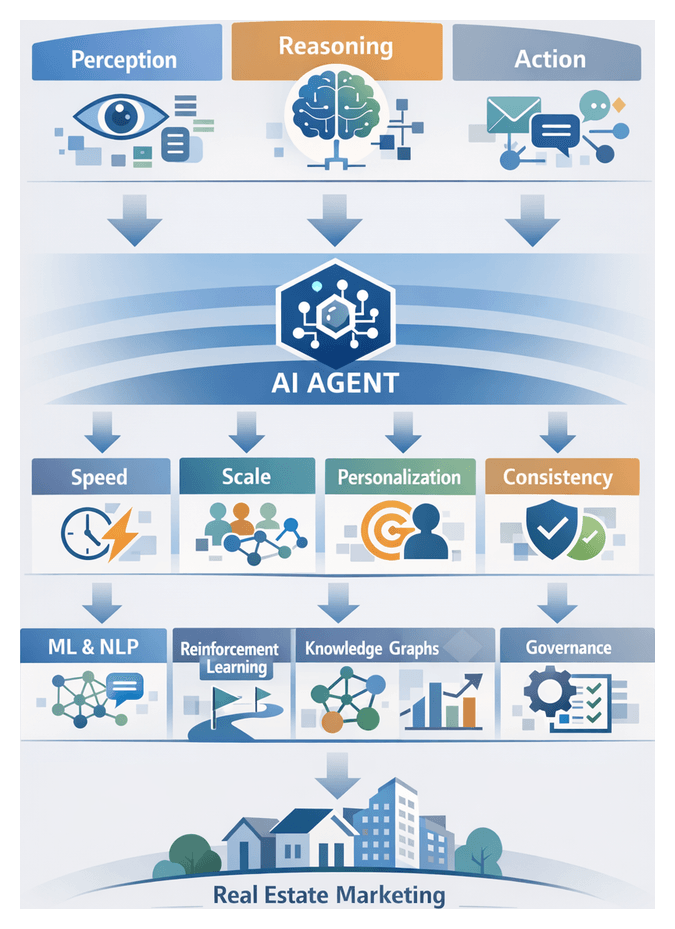
Autonomous Decision Making in Real Estate Marketing
Autonomous decision making enables AI agents to assess information, evaluate options and execute actions without step-by-step human input. Unlike traditional rule-based automation, these agents dynamically interpret data—customer inquiries, market reports and social signals—and adapt their strategies to achieve marketing objectives. By learning from outcomes, they refine prospect engagement through personalized emails, virtual tour proposals or live agent escalations at scale.
Three core components drive this autonomy:
- Perception: Ingests structured and unstructured data, using natural language processing to extract intent and data pipelines to aggregate CRM metrics.
- Reasoning: Applies probabilistic models, decision trees or reinforcement learning to predict outcomes and assign utility scores to possible actions.
- Action: Executes tasks via email, chatbots, SMS or CRM updates and feeds performance data back for continuous learning.
By transitioning from reactive drip campaigns to proactive outreach, autonomous agents deliver:
- Speed: Immediate lead qualification and routing capitalize on peak interest.
- Scale: Personalized conversations with thousands of prospects without headcount increases.
- Personalization: Real-time data synthesis crafts messages aligned to individual preferences.
- Consistency: Machine-learned models maintain brand and compliance standards.
Advanced AI platforms abstract implementation complexity, embedding autonomy into existing marketing stacks. Key technical enablers include:
- Machine Learning Frameworks: TensorFlow and PyTorch support training of lead-scoring and outreach optimization models.
- Reinforcement Learning: Treats each engagement as an environment, refining policies to maximize bookings or replies.
- Natural Language Understanding: Engines like Dialogflow and ChatGPT interpret freeform text and generate contextual responses.
- Knowledge Graphs: Capture relations among property features, neighborhoods and buyer personas for accurate inference.
- Real-Time Analytics: Stream processing detects website traffic spikes and adjusts outreach flows instantly.
Natural Language and Learning Pillars
Natural language capabilities and robust learning frameworks are strategic imperatives. AI agents must parse nuanced real estate queries, classify intent and maintain brand voice. Organizations evaluate language engines through industry-specific benchmarks:
- Intent classification accuracy for queries like “best neighborhoods under $500k.”
- Entity recognition precision for features such as “hardwood floors.”
- Sentiment analysis alignment to adjust tone in buyer or seller communications.
Two primary model approaches prevail:
- Pre-Trained Transformers: Models like OpenAI GPT-4 and offerings from Hugging Face provide broad fluency and require minimal fine-tuning.
- Fine-Tuned Domain Models: Trained on proprietary transcripts and listings, they deliver precision on industry jargon and compliance nuances.
Comprehensive evaluation frameworks merge linguistic, business and operational metrics:
- Linguistic Quality: Perplexity for confidence in generation; ROUGE and BLEU for comparing against ground-truth listings.
- Business Impact: Lift in lead conversion from AI chat versus human-only outreach; improvements in handling time and response latency.
- Operational Reliability: System uptime; error rates; model drift detection through periodic audits.
Governance demands transparency and accountability. Firms use explainable AI toolkits such as LIME and SHAP to reveal decision drivers, maintain audit trails of model versions and assign risk scores to different use cases.
Data stewardship underpins reliable language capabilities. Best practices include diverse sourcing of transcripts and listings, ongoing annotation to capture evolving vernacular, and bias audits to prevent skewed lead qualification.
Continuous learning emerges from human-in-the-loop reviews, performance monitoring dashboards and blue-green rollouts for incremental model updates. Emerging trends include multimodal integration of property images with chat interfaces, few-shot learning for niche segments and emotion-aware agents under exploration by platforms like IBM Watson. Specialized compliance modules scan outputs for regulatory flags in real time.
AI Agent Roles in Marketing Workflows
Autonomous agents augment human expertise across the customer journey, assuming specialized roles that drive efficiency and insight:
- Lead Qualification and Triage: Predictive scoring analyzes inquiries and call transcripts, reducing response times by up to 70 percent. Solutions like Salesforce Einstein integrate with CRM to route high-value leads and trigger nurturing for others.
- Lifecycle Nurturing: Data-driven sequences adapt to behavioral signals, increasing funnel progression by 30 to 40 percent compared to static drip campaigns.
- Content Personalization: Collaborative filtering and NLP match property listings to prospect profiles. Users of HubSpot CRM report 25 percent higher click-through rates on AI-recommended listings.
- Multi-Channel Orchestration: Seamless coordination of email, SMS, social media and chat maintains consistent brand narratives and improves attribution accuracy by up to 50 percent.
- Pricing Strategy: Time-series forecasting and comparative market analysis generate dynamic valuation ranges, aiding investment clients in optimizing listing windows.
- Analytics and Insights: Real-time dashboards consolidate data streams, detect anomalies and forecast market shifts. Balanced Scorecard frameworks align AI insights with organizational KPIs.
- Human-Agent Augmentation: AI co-pilots draft communications, market briefs and cross-sell recommendations. Collaborative competency frameworks assess trust and role clarity.
Strategic and Organizational Considerations
Effective AI adoption balances autonomy with governance and human oversight. Key trade-offs include:
- Control vs. Autonomy: Greater agent freedom accelerates responsiveness but requires robust brand and compliance rules.
- Investment vs. ROI: High-end platforms demand upfront costs that must be weighed against efficiency gains and revenue uplift.
- Speed vs. Customization: Off-the-shelf solutions enable rapid deployment but may lack niche market calibration.
- Complexity vs. Coverage: Multi-channel architectures deliver broad impact but introduce operational overhead.
Organizational readiness hinges on data fluency, change management practices, governance councils and cross-functional collaboration. Training frontline staff on agent behavior and escalation protocols fosters trust and shared ownership.
Cultural, Technical, Ethical and Risk Boundaries
Integration challenges span legacy platforms, data silos and rigid APIs. Essential technical considerations include data synchronization across CRM and listing services, API compatibility, scalable infrastructure and vendor interoperability grounded in open standards. Regular technical audits and version management protocols safeguard against integration failures.
Ethical and compliance frameworks guard consumer trust. Agents must adhere to GDPR, CCPA and Fair Housing regulations, ensure explicit consent for data usage and secure personal information. Regular bias assessments, transparency measures such as explainable AI reports and clear disclosures of AI involvement underpin responsible engagement. Human review checkpoints and third-party audits reinforce accountability.
Limitations and Future-Proofing
Current AI agents excel at scale and pattern recognition but may falter on contextual nuance, creative messaging, emotional intelligence and rapidly shifting market dynamics. Edge cases—unique property features or complex family negotiations—often require human intervention. Architecting escalation paths maintains service quality.
Future-proofing strategies include:
- Establishing governance frameworks with multi-stakeholder oversight.
- Implementing continuous evaluation of lead conversion, satisfaction scores and compliance events.
- Adopting modular, microservice-based architectures and open APIs for incremental upgrades.
- Building partnerships with research labs, vendors and academia to co-innovate on next-generation features.
- Investing in talent development for data scientists, product managers and marketing professionals to interpret AI outputs and guide strategic direction.
By aligning advanced autonomy with oversight, upskilling teams and embracing iterative innovation, real estate organizations can sustain competitive advantage as AI agents evolve.
Chapter 3: Enhancing Customer Engagement with Conversational AI
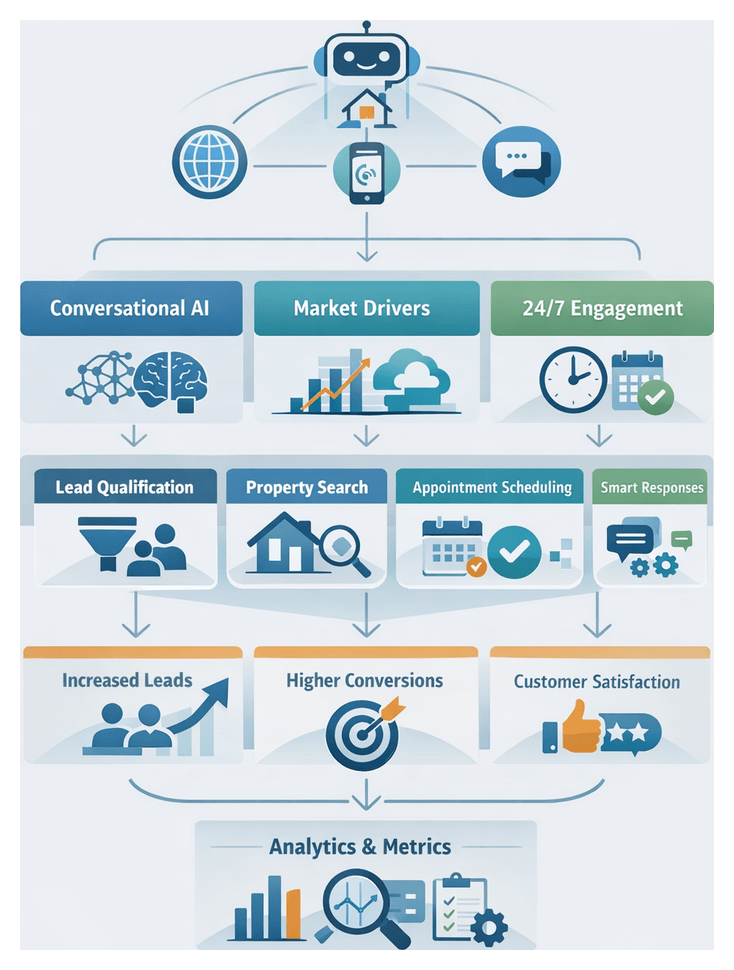
Emergence of Real-Time Virtual Assistance in Real Estate Marketing
The real estate industry is experiencing a fundamental shift as traditional marketing tactics—print materials, scheduled open houses, cold calling—give way to AI-driven virtual assistance. Prospects now expect instantaneous, personalized interactions at any hour. Real-time virtual assistants, powered by conversational artificial intelligence, fulfill this demand by interpreting natural language, accessing property databases and CRM systems, and delivering relevant responses without human intervention. Operating across websites, mobile apps, messaging platforms, and voice interfaces, these AI agents extend an agency’s lead-capture and nurturing capabilities well beyond typical office hours.
For real estate professionals, adopting real-time virtual assistance is no longer optional. It accelerates lead qualification, reduces response latency, and ensures consistent service aligned with modern consumer expectations. This section examines the technological foundations, market drivers, core capabilities, measurement frameworks, deployment scenarios, and best practices that collectively define a strategic approach to AI-driven engagement in real estate.
Foundations of Conversational AI
Conversational AI enables machines to understand and generate human language, grounded in two key technologies: natural language processing (NLP) and machine learning. NLP parses user inputs to identify intent and extract entities—such as desired budget or location—while machine learning models refine this understanding through exposure to historical dialog data. Real estate virtual assistants integrate these AI capabilities with domain-specific data sources, including MLS feeds, CRM platforms, and property management systems, to support queries like “Show three-bedroom homes under $300,000 in downtown.”
Dialog management frameworks guide conversations along predefined workflows—scheduling showings, answering financing questions, or gathering qualification details. When complexity exceeds the bot’s scope, seamless handoff protocols transfer the dialogue to human agents. This orchestration between automated agents and live support balances efficiency with the flexibility required for nuanced or sensitive inquiries.
Drivers of Adoption
Consumer behavior has evolved: homebuyers now research properties online, compare dozens of listings, and expect personalized, immediate replies via chat or voice. Agencies that meet these expectations gain a competitive edge, while others risk losing leads to early AI adopters. Real-time virtual assistants play a decisive role in tight markets, particularly during peak seasons, by ensuring every inquiry receives prompt attention.
On the technology side, advances in cloud computing, pre-trained language models, and low-code conversational design platforms have democratized access to AI. Scalable infrastructure handles traffic spikes without performance degradation. Low- and no-code tools empower marketing professionals to define and refine dialog flows without deep engineering support. As a result, real-time virtual assistance has become both technically feasible and strategically imperative across real estate businesses of all sizes.
Core Functionalities and Business Benefits
Modern virtual assistants offer transformative capabilities far beyond basic chat scripts. These include:
- Natural Language Understanding and Generation: Supporting typed and spoken interactions with conversational fluency.
- 24/7 Availability: Addressing inquiries at any time, ensuring no lead goes unattended.
- Automated Lead Qualification: Scoring prospects based on predefined criteria to prioritize human follow-up.
- Appointment Scheduling: Integrating with calendars to automate property viewing bookings.
- Dynamic Content Delivery: Providing personalized recommendations, photos, virtual tours, and floor plans.
- Seamless Escalation: Transferring complex conversations to human agents with full context.
These functionalities yield measurable benefits:
- Increased Lead Capture: Immediate engagement reduces bounce rates and maximizes qualified contacts.
- Higher Conversion Rates: Personalized interactions guide prospects efficiently through the decision funnel.
- Improved Customer Satisfaction: Fast, accurate responses foster trust and reinforce professionalism.
- Operational Scalability: AI agents absorb incremental volume without proportional increases in headcount.
Analytical Frameworks for Measuring Impact
Evaluating conversational AI goes beyond simple lead counts. Key analytical dimensions include engagement depth, response efficiency, lead qualification quality, and downstream conversion behavior. Industry-standard metrics and benchmarks help contextualize performance:
- Conversion Rate Lift: Increase in qualified leads compared to control groups.
- Cost per Lead (CPL): Marketing spend divided by leads generated through AI channels.
- Average Response Time: Time between user query and agent reply.
- Session Completion Rate: Percentage of conversations that complete a full qualification script.
- Lead Quality Score: Composite index of demographic fit, intent, and purchase readiness.
Real estate firms often report conversion lifts of 15–30 percent and CPL reductions of 10–25 percent after deploying 24/7 assistants. Attribution and funnel analysis refine these insights by weighing AI interactions within multi-touch customer journeys. Techniques such as A/B testing, regression analysis, survival analysis, propensity score matching, and lift modeling enable teams to isolate AI’s causal impact, predict future performance, and optimize engagement thresholds. Qualitative measures—customer satisfaction scores (CSAT) and Net Promoter Scores (NPS)—capture softer benefits like brand differentiation and accelerated sales cycles.
Robust evaluation requires attention to data quality: session integrity, consistent lead attribution tagging, and mitigation of sample biases. Balanced scorecards combining leading and lagging indicators, aligned timeframes, and cross-functional governance ensure reliable insights and sustainable growth.
Deployment Scenarios and Use Cases
Real estate organizations deploy conversational AI across diverse touchpoints, mapping use cases to customer journeys, brand positioning, and technical maturity. Key scenarios include:
Omnichannel Engagement
- Channel Convergence: Synchronizing website chatbots with messaging apps and voice interfaces.
- Contextual Handover: Escalating complex queries to human agents when needed.
- Data Continuity: Sharing user profiles, conversation history, and lead scores across systems.
Website Chatbots for Initial Inquiry
- Inquiry Triage: Qualifying casual browsers vs. serious buyers.
- Content Enrichment: Surfacing video tours, brochures, and market analyses.
- Lead Attribution: Tracing conversion paths to specific conversational interactions.
Social Media and Messaging Platforms
Using solutions like ManyChat and Intercom, agents engage prospects asynchronously on Facebook Messenger, Instagram Direct, and WhatsApp. Features include geo-targeted outreach, rich media delivery, and adherence to opt-in and privacy regulations.
SMS and Mobile App Assistants
Platforms such as Twilio Autopilot enable time-sensitive alerts—price changes, tour reminders—and post-transaction surveys via SMS. Custom mobile apps deliver push notifications and in-app chat, with careful cadence management to avoid opt-outs.
Voice-Driven Interfaces
Tools like Amazon Lex and Google Dialogflow power hands-free property searches and support. Common use cases include status updates on offers, new listing queries, smart home integrations, and AI-augmented IVR pre-qualification.
Event-Based and In-Person Agents
- QR-Triggered Chats: Capturing visitor preferences at open houses or expos.
- Hybrid Tours: 360° virtual walkthroughs augmented with interactive prompts.
- Lead Capture Gamification: AI-driven quizzes to enhance engagement.
Use Case Variations by Segment
- First-Time Homebuyers: Educational queries, mortgage calculators, neighborhood comparisons.
- Investors: Portfolio dashboards, rental income models, zoning references.
- Renters: Availability searches, lease explanations, move-in coordination.
- Commercial Clients: Lease negotiation support, amenity data, ROI forecasting.
- Luxury Market: Concierge-style engagement, private showings, high-resolution media.
Best Practices and Implementation Considerations
Successful chatbot adoption demands rigorous design, operational safeguards, and continuous oversight. Key best practices include:
Designing for Authentic Engagement
- Persona Consistency: Defining brand-aligned voice and personality for the chatbot.
- Context Awareness: Referencing prior interactions and user preferences for coherent multi-session dialogues.
- Adaptive Dialogue Flows: Modular conversation paths for routine and exploratory inquiries.
- Emotional Intelligence: Sentiment-sensitive triggers and escalation to human support as needed.
Managing Fallbacks and Escalations
- Multi-Tiered Fallbacks: From clarification prompts to knowledge base references and human handoff.
- Seamless Transfers: Using platforms like Intercom and Drift to route unresolved conversations without data loss.
- Context Preservation: Pre-populating CRM fields with chatbot transcripts and metadata.
- Latency Thresholds: Automated triggers to redirect surging queries during peak periods.
Integrating with Human Teams
- Unified Communication: Aligning chatbot alerts with agent collaboration tools.
- Clear Roles: Defining bot vs. human responsibilities, for instance reserving complex financing discussions for licensed agents.
- Collaborative Training: Involving sales teams in intent modeling and script design.
- Feedback Loops: Enabling agents to flag gaps and feed insights into AI updates.
Prioritizing Privacy and Compliance
- Consent-Driven Engagement: Disclosing data practices and obtaining explicit user consent.
- Minimal Retention: Purging raw transcripts beyond necessary retention periods.
- Bias Monitoring: Auditing AI decisions to ensure fair housing compliance.
- Regulatory Alignment: Adhering to GDPR, CCPA, and industry-specific guidelines.
Continuous Monitoring and Refinement
- Engagement Metrics: Conversation completion rates, average dialog length, escalation volume.
- Conversion Attribution: Mapping chats to outcomes—bookings, viewings, campaign responses.
- Sentiment Analysis: Highlighting friction points for script optimization.
- Model Retraining Cadence: Regular updates to intent classifiers, entities, and fallback responses.
Recognizing Limitations and Risks
- Contextual Blind Spots: Difficulty with highly specialized or multi-layered queries.
- Overpromising Capabilities: Managing expectations with clear scope and escalation paths.
- Resource Overhead: Ongoing investment in data annotation, design, and maintenance.
- User Adoption Barriers: Offering parallel human channels for personas that resist bots.
- Vendor Dependencies: Mitigating risks associated with third-party platform outages or cost changes.
By combining user-centric design, robust escalation protocols, seamless human integration, stringent privacy measures, disciplined performance monitoring, and realistic expectations, real estate organizations can leverage conversational AI to deliver differentiated, scalable, and compliant customer experiences that drive sustainable competitive advantage.
Chapter 4: Leveraging Data Analytics for Precise Lead Generation
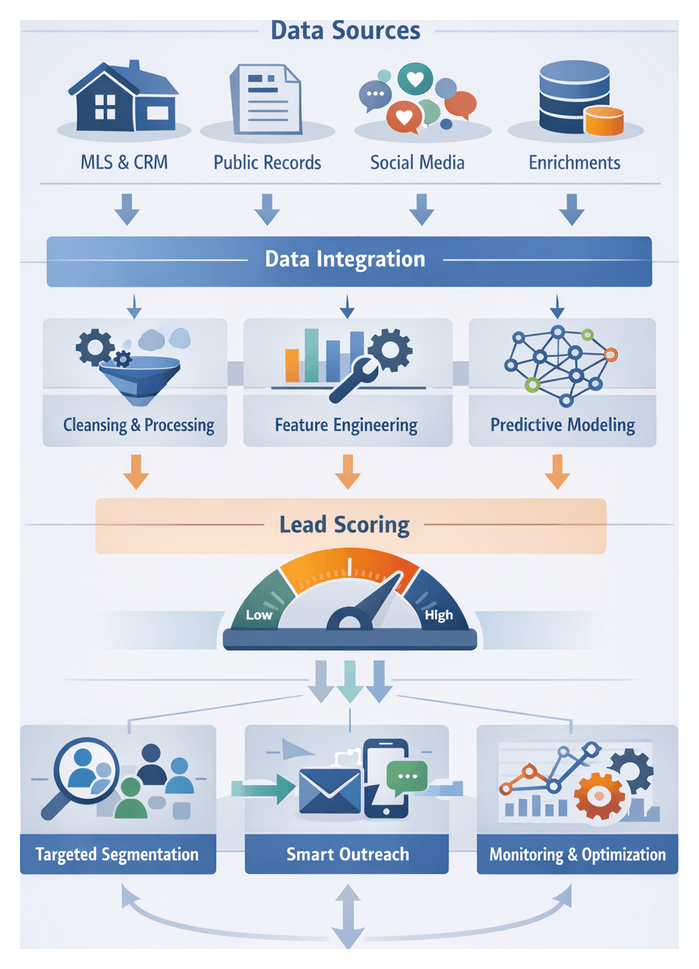
Data-Driven Prospecting Foundations
In today’s competitive real estate landscape, identifying high-value leads requires more than gut instinct or broad demographic filters. Data-driven prospecting employs autonomous AI agents to aggregate and analyze vast, diverse data streams—from MLS transaction feeds and CRM interactions to public records, digital footprints, and third-party enrichments. By integrating structured and unstructured sources through robust APIs and streaming connectors, firms break down silos and create a unified repository for real-time signal detection. This centralized data layer enables continuous monitoring of emerging behaviors, such as repeated listing views or neighborhood searches, which feed instantly into analytic pipelines.
Core to this approach are the following phases:
- Data Ingestion and Integration: AI agents connect to MLS systems, CRM platforms, social media APIs and proprietary data providers, ensuring new listings, lead interactions and demographic shifts update predictive workflows without manual intervention.
- Data Cleansing and Normalization: Automated routines resolve duplicates, standardize formats and enrich records with missing attributes—such as ownership history or credit indicators—to maintain a consistent, high-quality dataset.
- Feature Engineering: Proprietary algorithms transform raw inputs into model-ready variables. Examples include time-on-market trends, price elasticity measures, click-through rates and social sentiment indices, capturing both static property characteristics and dynamic behavioral signals.
- Predictive Modeling: Machine learning frameworks—ranging from logistic regression and decision tree ensembles to hybrid stacked models and deep neural networks—estimate lead propensity scores. The choice of architecture balances predictive performance with interpretability and computational efficiency.
- Continuous Learning and Calibration: Feedback loops ingest outcome data—email opens, appointment bookings and closed transactions—back into training sets. Automated retraining schedules and human-in-the-loop reviews mitigate concept drift and refine weighting to align scores with evolving market realities.
End-to-end AI platforms such as Salesforce Einstein and HubSpot’s AI CRM features provide prebuilt connectors and model management tools. These solutions streamline setup while offering customization hooks for unique business rules and compliance requirements.
Predictive Lead Scoring: Models and Governance
Predictive lead scoring transforms behavioral, demographic and transactional data into actionable rankings of buyer intent and lifetime value potential. Rather than generating static lists, AI-driven systems produce dynamic scores that guide resource allocation for marketing budgets, staffing and outreach prioritization.
Model Selection and Architecture
- Linear Models: Logistic regression and generalized linear models offer simplicity and explainability, favorable in regulated contexts or initial proofs of concept.
- Tree-Based Ensembles: Random forests and gradient boosted machines excel at capturing non-linear interactions across heterogeneous features but may require interpretability tools to elucidate decision drivers.
- Deep Learning: Feed-forward and recurrent networks ingest unstructured inputs—images, text and event sequences—to uncover complex patterns, demanding robust data volumes and rigorous governance to prevent overfitting.
- Hybrid Ensembles: Stacked or blended models combine diverse algorithmic strengths, smoothing score distributions and improving robustness across market segments.
Performance Metrics and Monitoring
Model evaluation spans statistical, business and operational dimensions:
- Statistical Accuracy: ROC-AUC and precision-recall curves assess ranking ability, particularly important when high-value leads represent a small fraction of all prospects.
- Business Impact: Lift charts, gain analyses and uplift modeling quantify incremental conversion improvements attributable to score-driven outreach versus baseline approaches.
- Calibration: Brier scores and calibration curves ensure predicted probabilities align with observed conversion rates, critical for setting automated campaign thresholds.
- Operational Metrics: Inference latency, computational costs and data refresh cadence determine suitability for real-time lead routing or overnight batch scoring.
Interpretability and Transparency
Trust in predictive scores depends on illuminating how inputs influence outputs. Leading practices include:
- Global Explainability: Feature importance rankings and partial dependence analyses validate that key drivers—such as search frequency or neighborhood price trends—align with domain expertise.
- Local Explainability: Post-hoc tools like SHAP and LIME break down individual lead scores, empowering sales managers to understand why specific prospects receive high or low priority.
Access controls typically restrict granular explanation logs to compliance and data governance teams, while summary dashboards guide marketing and sales stakeholders.
Validation, Monitoring and Governance
- Offline Validation: Backtesting against holdout sets and stress tests under simulated shifts—such as interest rate changes—reveal performance stability.
- Real-Time Monitoring: Automated alerts detect distribution drift, decile conversion anomalies and feature covariance shifts, triggering retraining or investigative reviews.
- Governance and Auditability: Documentation of data provenance, feature selection rationale and model update logs supports compliance with evolving privacy regulations and internal ethics policies.
Cross-functional governance committees—comprising marketing leaders, legal counsel and data scientists—ensure that predictive scoring aligns with strategic objectives, maintains fairness and adapts to new data sources responsibly.
Targeted Outreach Strategies
Advanced analytics elevates outreach from batch communications to precision engagement. AI agents inform micro-segmentation, channel mix optimization, timing algorithms and contextual content selection, orchestrating messages that resonate with each prospect’s unique journey.
Segmentation by Value and Intent
Beyond simple geographic or price filters, segmentation frameworks combine recency, frequency and monetary metrics with behavioral indicators—search patterns, listing views and social engagement. AI-driven clustering and propensity scoring dynamically refine cohort definitions, distinguishing high-net-worth investors from first-time buyers seeking urban condominiums. Enrichments such as demographic overlays, social media sentiment and foot-traffic data uncover latent microsegments, enabling tailored outreach profiles that manual methods cannot replicate.
Channel Selection and Mix
AI-powered attribution models evaluate channel performance across email, SMS, social media, direct mail, voice and in-app notifications. Multi-touch attribution and incrementality testing isolate each channel’s causal impact, guiding budget allocation based on cost-efficiency and conversion quality. For example, high-net-worth segments may respond best to personalized newsletters and phone outreach, while millennial buyers favor SMS alerts and retargeted social ads. Channel attribution matrices incorporate cost, response latency and lead quality to optimize an omnichannel mix that balances reach with ROI.
Strategic Timing and Cadence
Timing is critical. Time-series analytics identify optimal contact windows—weekend afternoons for family home seekers, post-market report moments for investors. Adaptive scheduling algorithms adjust outreach based on individual engagement feedback, shifting from email to SMS or weekend prompts to prevent fatigue. This attention-economics approach ensures messages arrive when prospects are most receptive, maximizing open and response rates.
Contextual Content Relevance
AI agents align message elements—property highlights, financing options and neighborhood insights—with prospect motivations. Situational relevance combines macro factors like market supply-demand dynamics with micro triggers—mortgage pre-approval dates, school enrollment periods or employment changes—to deliver timely, consultative communications. This predictive advisory model transforms outreach into a value-added service rather than a mere promotional tactic.
Cross-Channel Orchestration
Maintaining a unified customer profile across disparate systems is essential. AI platforms consolidate email opens, portal behavior and in-person interactions under a single prospect identifier. Cross-channel orchestration sequences messages—for instance, social media impressions followed by a virtual tour email and an SMS reminder—while contribution analysis measures how each touchpoint advances prospects along the funnel.
Market-Context Modulation
Outreach strategies must adapt to local market conditions and macroeconomic indicators. AI-driven market analytics ingest inventory levels, interest-rate forecasts and consumer confidence indices to adjust message tone, frequency and urgency. In a seller’s market, communications may emphasize scarcity and exclusive access; in a buyer’s market, they highlight negotiation flexibility and value. Aligning micro messaging with macro trends enhances credibility and authority.
Organizational Readiness and Governance
Realizing the potential of AI-driven prospecting demands cultural transformation, clear data governance and cross-functional collaboration. Key enablers include:
- Data Governance Policies: Define standards for data quality, privacy compliance and ethical use, supported by a centralized platform that enforces ownership and lineage tracking.
- Cross-Functional Teams: Align data scientists, marketing professionals, sales agents and legal counsel in governance committees that oversee model development, bias mitigation and campaign deployment.
- Analytical Literacy and Training: Equip stakeholders with the skills to interpret AI insights, cultivate trust in automated recommendations and integrate findings into strategic planning.
- Human-Agent Synergy: Establish feedback loops where human observations refine model parameters and AI suggestions free professionals to focus on relationship building and complex negotiations.
- Change Management: Communicate strategic objectives, success metrics and process changes effectively, fostering a data-driven culture that values continuous learning and adaptation.
Strategic Frameworks and Interpretive Lenses
To translate AI outputs into measurable outcomes, practitioners apply interpretive frameworks that bridge technical insights and business strategy:
- Intent-Behavior-Fit: Align stated prospect intent with predicted engagement trajectories to tailor outreach sequences and content relevance.
- Attention-Conversion-Retention: Map the buyer journey stages—awareness, consideration and post-transaction engagement—ensuring messages serve strategic objectives at each phase.
- Cohort-Cluster-Trajectory: Group prospects by time-bound cohorts, cluster them by shared characteristics and map their progression through the pipeline, guiding cadence and channel choices.
By embedding these lenses into campaign planning and performance reviews, real estate organizations ensure that AI-driven prospecting remains a strategic asset—driving sustainable growth, optimized resource allocation and exceptional customer experiences.
Chapter 5: Personalizing the Buyer Journey at Scale
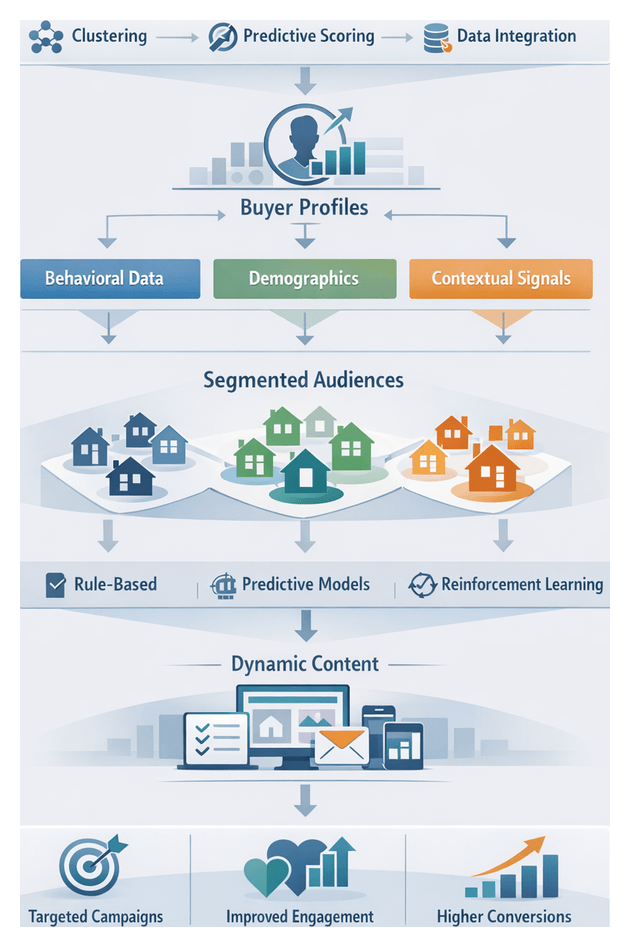
Understanding AI-Driven Market Segmentation
In the modern real estate landscape, traditional methods of grouping prospective buyers have been eclipsed by AI-driven segmentation, which leverages machine learning and advanced analytics to uncover meaningful cohorts based on behavior, preferences and demographic attributes. Rather than applying manual, rule-based filters, unsupervised clustering techniques such as K-means, hierarchical clustering and DBSCAN reveal natural groupings within vast datasets. Supervised predictive models then assign conversion propensity scores, enabling agents and brokers to prioritize outreach to the most promising prospects.
AI-driven segmentation transforms diverse data sources—website interactions, social media engagement, open-house visits, transaction history and external contextual indicators such as market trends or interest-rate movements—into unified buyer profiles. Customer data platforms facilitate the ingestion, cleansing, deduplication and feature engineering required to maintain high-quality inputs. Continuous learning frameworks ensure segment definitions evolve with new data, while explainability layers provide interpretable insights for oversight and compliance.
Effective segmentation enables precision targeting of clusters such as first-time homebuyers, luxury investors or downsizers. By mapping each AI-identified segment to well-defined buyer personas—including goals, decision drivers and preferred channels—marketing and sales teams can deploy modular content templates and journey maps tailored to each group. This strategic alignment bridges algorithmic outputs and operational execution, yielding enhanced customer experiences, optimized resource allocation and improved conversion paths.
Successful deployment demands robust data governance, cross-functional collaboration and change management. Clear ownership of data assets, periodic model validation and training programs for front-line agents ensure ethical usage, privacy compliance and widespread adoption. Proactive mitigation of common challenges—data silos, over-segmentation, algorithmic bias and interpretability gaps—lays the groundwork for sustainable segmentation practices that inform subsequent personalization at scale.
Frameworks and Models for Dynamic Content Personalization
Dynamic content sits at the apex of personalization maturity models such as Gartner’s framework and the McKinsey Personalization Model, which distinguish between templated rule-based personalization, predictive personalization and fully prescriptive AI-driven recommendations. Evaluating an organization’s current capabilities against these tiers helps marketing leaders prioritize investments in technology, data infrastructure and talent.
Three core approaches drive data-driven personalization:
- Rule-Based Engines: Explicit business logic dictates content selection—e.g., serving email templates with three-bedroom listings when a prospect repeatedly views that floor plan. While easy to implement, rule-based systems lack adaptability when user behavior deviates from expected patterns.
- Predictive Scoring Models: Machine learning classifiers and regressors score content variants or property recommendations by their likelihood of engagement. Platforms such as Salesforce Einstein and HubSpot incorporate predictive modules that guide subject-line selection, imagery and call-to-action decisions.
- Reinforcement Learning and Bandit Algorithms: Multi-armed bandit frameworks and reinforcement learning continuously balance exploration of new content variants with exploitation of proven winners. Tools like Adobe Target and Dynamic Yield offer live optimization for personalized web pages and email journeys.
Rigorous evaluation demands multi-metric analysis. Key performance indicators include open rates, click-through rates, session duration, conversion lift, revenue per lead and retention signals. Attribution models—first-touch, last-touch or data-driven—help assign credit to dynamic content initiatives. Controlled experiments, holdout samples and multivariate tests validate lift and guard against measurement noise.
Vendor selection hinges on integration capabilities, real-time adaptation, rule-builder usability and model interpretability. Real estate-specific platforms such as RealScout, BoomTown and kvCORE embed personalization engines directly into listing feeds and CRM workflows, while generalist solutions excel at omnichannel web and mobile optimization. Transparency features and bias-detection protocols ensure compliance with internal audit requirements and regulatory standards.
Industry theories such as the Fogg Behavior Model, the Elaboration Likelihood Model and the SOSTAC planning framework offer interpretive lenses that link dynamic content tactics to behavioral triggers, persuasive routes and continuous control cycles. By mapping personalization efforts onto these frameworks, marketers gain both strategic clarity and creative direction.
Implications for Buyer Engagement and Measurement
AI-driven personalization transforms passive property browsing into active, trust-building engagement. Psychological drivers such as perceived relevance and cognitive fluency accelerate decision-making, while consistent, context-aware messaging enhances brand credibility. Trust established through personalized touchpoints translates into faster conversion velocity and higher lifetime value.
Applying the AIDA model across attention, interest, desire and action phases reveals how AI interventions optimize each stage:
- Attention: Segment-specific ad creative and subject lines increase recall and site visits.
- Interest: Collaborative filtering and look-alike modeling drive deeper exploration of curated listings.
- Desire: Customized virtual tour prompts and financial calculators foster emotional connection and feasibility.
- Action: Timely follow-up emails or SMS reminders, informed by real-time engagement data, reduce drop-off.
Channel dynamics vary: website widgets update in real time as search filters change, mobile apps use behavior-triggered push notifications, and social platforms leverage AI-powered audience look-back models. A unified omnichannel orchestration model ensures consistent identity resolution and coherent narrative across touchpoints.
Engagement measurement combines quantitative metrics—conversion uplift, session depth, repeat visit frequency—and qualitative feedback such as Net Promoter Scores and sentiment analysis of chat transcripts. Path-to-purchase analysis and cohort studies isolate personalization impact across demographic and behavioral segments.
Operationalizing personalization requires organizational alignment among marketing, sales, IT and legal. Data governance policies, ethical oversight committees and training programs equip teams to interpret AI dashboards, refine model parameters and ensure compliance with privacy regulations. Risks such as over-personalization, stale data, algorithmic bias and channel fatigue are mitigated through relevance thresholds, data audits, bias-detection frameworks, frequency capping and user-centric opt-out controls.
Strategic takeaways include defining clear engagement objectives—whether lead generation, conversion acceleration or retention—adopting phased rollouts, investing in data unification, maintaining human oversight and continuously refining models via A/B testing and feedback loops. This adaptive, data-driven approach fosters meaningful engagement and sustained competitive advantage.
Key Strategic Considerations for Scaling Personalization
Scaling AI-driven personalization from pilots to enterprise hinges on balancing analytical rigor, operational discipline and ethical stewardship. Segmentation models require periodic retraining and validation to remain aligned with market shifts and seasonal cycles. Dynamic content engines must adhere to a centralized governance framework that defines style guidelines, review protocols and performance thresholds to maintain brand voice at scale.
- Data Quality and Governance: Unified, accurate buyer profiles across CRM, MLS and marketing platforms are essential. Standardized validation rules, remediation workflows and clear data ownership ensure reliability and compliance with GDPR, CCPA and fair housing laws.
- Model Validation and Performance Monitoring: Establish KPIs such as segment purity, engagement lift and attribution accuracy. Institutionalize regular health checks to detect data drift, bias and performance degradation.
- Balancing Depth and Feasibility: Hyper-personalization drives relevance but increases complexity. Decision frameworks should weigh expected uplift against content creation overhead and integration effort to determine optimal customization levels.
- Resource Allocation and Cost Management: Budget for AI tooling, data engineering, creative assets and skilled personnel. Tie outcomes—lead conversion improvements and reduced time-to-sale—to incremental spend to justify continued investment.
- Technology Integration: API-based architectures, modular workflows and standardized data schemas enable seamless interoperability between AI engines, CRM systems, email platforms and content management solutions.
- Ethical and Privacy Constraints: Embed privacy-by-design principles, consent management frameworks and algorithmic bias assessments into personalization lifecycles to build consumer trust and ensure regulatory compliance.
- Organizational Alignment and Change Management: Executive sponsorship, clear governance structures and multidisciplinary collaboration accelerate adoption. Training programs equip agents and marketers to leverage AI insights effectively.
- Measurement Frameworks and Attribution: Use controlled experiments, lift studies and sequential attribution models to isolate the impact of segment-specific campaigns, dynamic content and automated workflows on key metrics.
- Avoiding Personalization Fatigue: Implement cadence controls, suppression rules and fatigue detection algorithms to prevent prospect overwhelm and maintain brand affinity.
Recognizing limitations—such as low-data markets, repetitive generative content or rapid market disruptions—practitioners adopt an agile, iterative approach. By launching pilots in high-potential regions or segments, teams validate hypotheses, refine models and optimize content frameworks before broader rollouts. Cross-functional feedback loops, informed by agent insights from the field, calibrate AI outputs against real-world buyer interactions and surface blind spots.
Ultimately, harmonizing technological capabilities with human expertise and ethical responsibility enables sustainable personalization at scale. Organizations that embed transparent decision frameworks, continuous improvement practices and rigorous governance into their AI-driven marketing programs will deliver differentiated buyer journeys and forge deeper, more trusting relationships with prospective clients.
Chapter 6: Automated Content Creation and Property Marketing
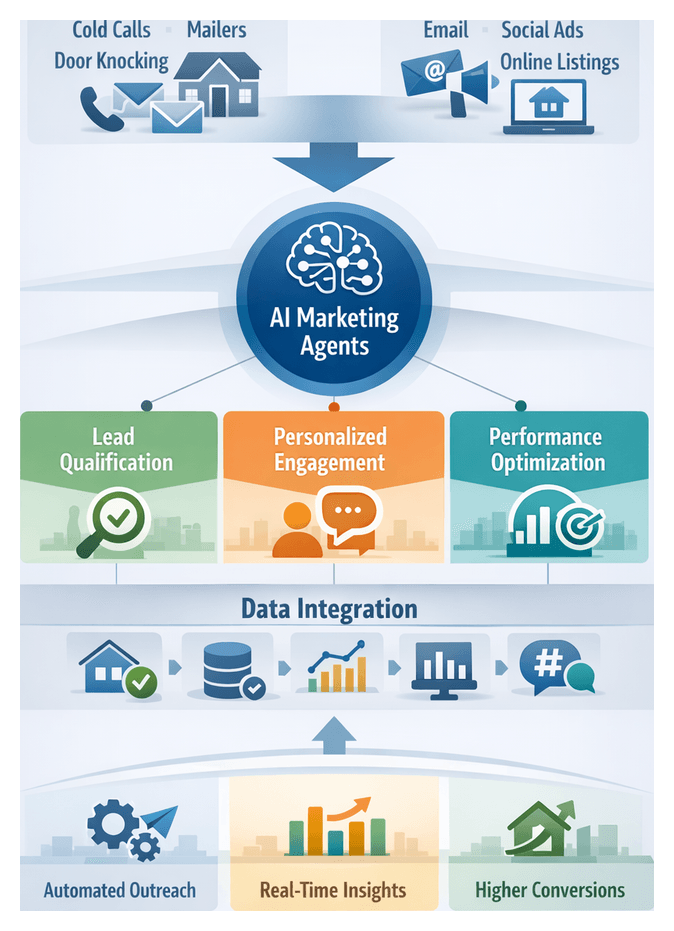
Autonomous Marketing Agents in Real Estate
The real estate industry has evolved from labor-intensive outreach methods—cold calling, door-knocking and printed mailers—to sophisticated, AI-powered engagement models. Traditional tactics required significant human effort and delivered limited scalability and personalization. Digital platforms introduced email campaigns, online listings and social media advertising, yet these channels still relied heavily on manual oversight. As buyer expectations shifted toward immediacy and relevancy, real estate professionals faced fragmented data sources, elongated response times and diminishing returns on conventional marketing efforts.
In response, autonomous marketing agents have emerged to automate routine tasks, scale personalized outreach and deliver measurable performance improvements. These intelligent software entities leverage machine learning, natural language processing and advanced analytics to qualify leads, tailor communications and optimize follow-up cadences in real time. Agents can interpret prospect behavior across multiple channels, craft messages that resonate with individual preferences and adjust strategies based on performance metrics—all with minimal human intervention. This transformation allows marketing teams to focus on strategic planning, relationship-building and high-impact negotiations, while agents handle operational workflows.
These agents ingest structured and unstructured data from MLS databases, website analytics, social listening platforms and CRM systems, creating unified prospect profiles. This multi-channel orchestration enables agents to anticipate buyer preferences, schedule targeted property suggestions and deliver timely follow-ups without manual data consolidation. In practice, agents can monitor new listings, price adjustments and market signals continuously, adapting outreach to reflect inventory changes and local trends.
At the core of AI agent integration lies autonomous decision-making, distinguishing these systems from rule-based automation. Three strategic roles exemplify their value:
- Lead Qualification and Prioritization: Agents analyze prospect demographics, online engagement and search histories to assign quality scores. High-value leads receive immediate, tailored outreach, while lower-probability contacts are nurtured through automated education sequences over time.
- Personalized Engagement: Leveraging natural language generation and sentiment analysis, agents craft bespoke communications—emails, chat responses and SMS notifications—that reflect individual interests, whether highlighting neighborhood amenities, financing options or virtual tour availability.
- Performance Optimization: Through continuous A/B testing, predictive analytics and real-time feedback loops, agents refine messaging tactics, channel allocations and follow-up timing to maximize conversion rates and marketing ROI.
Integrating these agents into existing marketing ecosystems requires a strategic framework encompassing data governance, user experience design and change management. Marketing leaders must define clear objectives—lead volume targets, engagement benchmarks and brand compliance standards—and align agent capabilities accordingly. Cross-functional collaboration between marketing, IT and operations teams is essential to establish secure data pipelines, API integrations and rigorous quality assurance protocols. When treated as extensions of the marketing organization rather than standalone tools, AI agents enhance agility, preserve brand integrity and accelerate time to value.
Market Drivers for AI Agent Adoption
Several interrelated market and technological factors have converged to make AI-driven engagement both feasible and essential for real estate organizations:
- Competitive Pressures: Prospective buyers compare dozens of listings across multiple platforms before initiating contact. Agents who fail to engage prospects promptly risk losing leads to competitors with more responsive outreach capabilities. Autonomous agents operate continuously, ensuring instant, relevant engagement that sets early adopters apart.
- Rising Consumer Expectations: Modern homebuyers expect personalized experiences akin to those delivered by leading e-commerce and fintech platforms. Immediate responses, tailored recommendations and transparent guidance throughout the buying journey are now table stakes. AI agents deliver the speed and relevancy required to meet these elevated service standards at scale.
- Technological Readiness: Advances in large language models, cloud computing and real-time data processing have lowered barriers to intelligent agent deployment. Platforms such as OpenAI offer turnkey solutions that integrate seamlessly with CRM systems, listing services and marketing automation tools. Even mid-sized brokerages can adopt AI agents without prohibitive upfront investment.
- Regulatory Alignment: Privacy regulations and data protection standards now provide clear guidelines for responsible AI use. Consent frameworks, data retention policies and transparency requirements enable agents to operate within compliant boundaries, mitigating legal risks associated with automated engagement.
Together, these competitive, consumer, technological and regulatory forces make autonomous marketing agents not merely advantageous but essential for organizations seeking to maintain or strengthen their market position. Early adopters will secure leadership in customer experience, operational efficiency and marketing ROI, while those who delay risk ceding ground to more agile peers.
Ensuring Quality and Brand Consistency
As AI-driven content creation becomes integral to real estate marketing, maintaining high standards of quality and a coherent brand voice is paramount. Without rigorous evaluation frameworks and governance processes, generative models can produce outputs that drift from organizational guidelines, introduce factual errors or violate regulatory requirements. A holistic approach combines computational metrics, human expertise and structured workflows.
Defining Quality in AI-Generated Copy
AI content quality encompasses traditional editorial dimensions—accuracy, clarity, engagement and style adherence—augmented by model-specific factors:
- Semantic Relevance: Ensuring generated text accurately reflects property details—bedroom count, neighborhood features and pricing—while avoiding fabricated or contradictory statements.
- Readability and Engagement: Measuring average sentence length, readability indices and sentiment analysis scores to predict reader comprehension and interaction.
- Stylistic Alignment: Adhering to brand voice guidelines—tone descriptors such as luxury, approachable or technical—and approved vocabulary lists.
- Originality and Plagiarism Avoidance: Detecting duplicated or overly generic phrasing via plagiarism detection APIs integrated into content platforms.
- Compliance and Legal Accuracy: Verifying inclusion of required fair housing statements, regional disclosures and adherence to advertising statutes.
Analytical Voice Modeling for Brand Consistency
Quantitative voice profiling enables organizations to benchmark AI outputs against a statistical model of brand-approved language. Key interpretive tools include:
- Word Embedding Analysis: Using vector representations from AI platforms such as OpenAI to measure semantic distance between generated text and curated brand materials, ensuring thematic coherence.
- Tone and Emotion Scoring: Employing sentiment analysis APIs to confirm that messaging consistently evokes intended emotional responses—confidence, excitement or exclusivity.
- Lexical Diversity Metrics: Monitoring adjective and verb variety to prevent repetitive language and preserve narrative freshness.
- Compliance Tagging: Automated flags for missing disclaimers or potential regulatory breaches, enabling proactive remediation before publication.
Quality Assurance Workflows
Robust review pipelines integrate automated evaluation with human oversight and legal verification:
- Initial Draft Generation: AI models produce first drafts from structured prompts, property data and tone parameters.
- Automated Pre-Check: Integrated APIs assess readability, sentiment, keyword presence and compliance flags.
- Human Editorial Review: Marketing professionals refine phrasing, correct factual errors and ensure narrative cohesion.
- Compliance Verification: Legal teams confirm inclusion of mandatory disclosures and adherence to fair housing regulations.
- Final Approval and Deployment: Quality thresholds must be met before scheduling content for web, email and social distribution.
Tool Selection and Model Evaluation
Evaluating AI content platforms involves assessing customizability, transparency, governance and integration capabilities:
- Fine-Tuning Support: Ability to refine models with proprietary brand assets, custom style guides or on-premise datasets.
- Governance Features: Built-in workflows, role-based permissions and audit logs to support compliance and oversight.
- Integration Capabilities: Seamless connectivity with CRM systems, content management platforms and legal review tools.
- Transparency and Documentation: Clear disclosure of model training data sources and insights into prompt-to-output mapping.
Platforms such as Jasper and Copy.ai exemplify these criteria, offering brand voice templates, approval workflows and compliance plug-ins. Analytics teams often conduct blind scoring experiments to benchmark outputs across multiple providers using consistent rubrics.
Performance Metrics and Feedback Loops
Real-world performance metrics drive continuous improvement:
- Engagement Rates: Click-through rates on listings, email opens and social interactions compared to human-written benchmarks.
- Conversion Metrics: Lead submissions, qualified lead counts and closed deals attributed to AI-driven campaigns.
- Customer Satisfaction: Surveys and sentiment analysis of buyer feedback following AI-crafted communications.
- Brand Health Indicators: Periodic studies tracking awareness, perceived authenticity and trust levels.
These metrics feed iterative refinement of AI prompts, style guidelines and editorial workflows, aligning with Total Quality Management principles and fostering data-driven governance.
Regulatory and Ethical Oversight
Quality frameworks in real estate must embed legal and ethical checks:
- Fair Housing Compliance: Automated scans detect discriminatory language and enforce equal opportunity statements.
- Regional Disclosures: State-specific warnings—lead-based paint, dual agency notices—triggered by property metadata.
- Truth in Advertising: Cross-verification of property claims with official records to prevent misleading statements.
- Data Privacy Safeguards: Ensuring personalized content does not expose sensitive consumer data or violate GDPR and CCPA regulations.
Senior marketing and compliance leaders convene cross-functional committees to review performance dashboards, quality score trends and incident logs. These oversight councils define escalation protocols, adjust editorial guidelines and prioritize model refinement, ensuring strategic alignment and risk mitigation at every stage of the AI content lifecycle.
AI-Driven Content Across Marketing Channels
Generative AI reshapes narrative architecture across owned, shared, paid and earned media, enabling rapid iteration and cohesive storytelling throughout the buyer journey. Applying the PESO model—Paid, Earned, Shared, Owned—ensures each content asset supports overall brand strategy and drives measurable outcomes at every touchpoint.
Owned Media
Owned media platforms—corporate websites, email newsletters and proprietary apps—are central to thought leadership and direct engagement. Generative AI enhances these channels by:
- Website Property Descriptions: SEO-optimized listings that combine location insights, architectural details and lifestyle narratives. Tools like Jasper leverage market data to tailor copy for search patterns, boosting organic visibility. Descriptions can dynamically update with new listings and price adjustments, ensuring accuracy and timeliness.
- Blog and Resource Articles: AI agents synthesize local market trends, statistical insights and regulatory updates into cohesive articles. Rapid content generation maintains frequent posting schedules, while editorial oversight ensures factual accuracy. AI can also generate interactive maps and data visualizations to enrich thought leadership pieces.
- Email Campaign Templates: Personalized subject lines and body copy generated by platforms such as Copy.ai integrate CRM segmentation data to target buyer personas—first-time homebuyers, luxury investors or downsizing retirees. Tailored messaging improves open rates, click-through rates and overall campaign effectiveness.
In owned media contexts, scalability and responsiveness are paramount. Dynamic content templates adapt to market fluctuations—inventory changes, regulatory updates and seasonal trends—without manual intervention, positioning agencies as authoritative, up-to-date information sources.
Shared Media
Shared media—social networks and community-driven platforms—demand rapid responsiveness, authentic voice and cultural sensitivity. AI-driven applications include:
- Social Post Generation: Tailored drafts for Facebook, LinkedIn and Instagram optimized for character limits, hashtag strategies and audience sentiment. AI agents can produce multiple variations for A/B testing, identifying the most resonant tone and messaging. Predictive algorithms optimize timing and frequency based on peak engagement windows.
- Interactive Chatbot Prompts: Embedded chat functions powered by natural language models guide conversational flows on social channels or websites, delivering property details, virtual tour links and scheduling options in real time. Chatbots ensure 24/7 availability and consistent brand voice.
- Community Listening and Response: AI tools analyze comment streams, direct messages and reviews, suggesting branded, compliant replies to maintain consistent engagement and reduce manual moderation efforts.
While generative models enable speed, organizations must enforce brand guidelines and cultural sensitivity through human review. This hybrid approach preserves authenticity and mitigates risks associated with formulaic or insensitive content.
Paid Media
Paid channels—search engine marketing, programmatic display and sponsored social ads—benefit from continuously optimized messaging and creative variations. Generative AI supports paid media by:
- Search Ad Copy: AI analyzes keyword performance and Quality Score factors to craft headlines and descriptions that drive higher click-through and conversion rates. Continuous optimization adjusts language based on real-time auction data and competitor activity.
- Programmatic Advertising: Dynamic creative optimization (DCO) platforms use generative models to assemble modular copy elements—taglines, calls to action and property highlights—tailored to user profiles. Personalized ads enhance engagement and reduce creative fatigue.
- Retargeting Campaigns: AI-generated ad variations support multi-touch attribution strategies by presenting refreshed messaging at different funnel stages. Initial impressions may highlight neighborhood features, while follow-up ads emphasize financing options or virtual tour invitations.
- Automated Budget Optimization: Generative AI integrates with bidding algorithms to reallocate spend based on real-time performance thresholds, reducing manual campaign management burdens and improving cost-efficiency.
By integrating generative outputs with A/B testing frameworks and predictive bidding models, marketing teams can forecast engagement lift and cost per acquisition, enabling precise budget allocation and more effective media planning.
Earned Media
Earned media—public relations, influencer partnerships and organic reviews—remains largely outside direct control, but AI-generated content can streamline advisory and preparatory workflows:
- Press Release Drafts: Generative models consolidate market data, transaction milestones and executive quotes into preliminary drafts that comply with AP style guidelines. Accelerated PR workflows ensure timely distribution and consistent messaging.
- Influencer Collaboration Briefs: AI agents curate influencer profiles, suggest pitch language, outline content themes and recommend compensation models and posting schedules based on engagement forecasts. This enhances alignment between influencers and agency branding objectives.
- Review and Testimonial Summaries: AI tools aggregate client feedback across review platforms, producing executive summaries that identify sentiment trends and surface standout testimonials for use in marketing collateral and investor reports.
Generative outputs in earned media serve as starting points for human experts, who refine narratives to preserve authenticity and credibility while increasing efficiency in PR and partnership initiatives.
Channel Evaluation Frameworks
To ensure cohesive and impactful content across all channels, organizations apply interpretive frameworks that align generative outputs with strategic objectives:
- Channel Contribution Analysis: Mapping each channel’s role in the awareness, consideration and decision stages of the buyer journey, then aligning content formats, messaging goals and KPIs to those stages.
- Brand Voice Consistency Matrix: Defining core brand attributes—tone, vocabulary and narrative style—and assessing how generative outputs embody these traits across owned, shared, paid and earned media.
- Performance Attribution Framework: Integrating analytics platforms with generative tools to capture real-time data on engagement, conversion pathways and revenue impact, enabling iterative refinement of content templates based on empirical insights.
These frameworks, combined with governance structures and human oversight, transform autonomous content creation into a disciplined strategic function that safeguards brand integrity, ensures regulatory compliance and delivers measurable business value.
Strategic Insights and Critical Considerations
Drawing from industry practice and analytical frameworks, five strategic insights guide the effective deployment of generative AI in real estate marketing, alongside five critical considerations to mitigate risks.
- Balance Efficiency with Brand Authenticity: Define clear editorial guidelines, tone parameters and brand persona models that generative AI must adhere to. For example, a luxury brokerage may require a formal tone and emphasis on exclusivity, while a community-focused agency opts for a warm, conversational voice.
- Data-Driven Optimization of Content Variants: Use AI to generate dozens of copy variants for large-scale A/B and multivariate testing. Apply predictive scoring models to headline options, imagery cues and calls to action. Redirect promotional budgets toward messages that deliver the highest engagement lift.
- Embedded Integration in End-to-End Workflows: Treat autonomous agents as integral components of the technology stack by connecting them directly to CRM, CMS and marketing automation platforms. This seamless integration reduces manual handoffs, shortens campaign cycle times and improves data accuracy.
- Editorial Oversight as Governance Mechanism: Combine automated compliance checks—legal disclosures, fair housing language and brand guidelines—with human editors who validate factual accuracy, tone and narrative cohesion. This dual-layer review process upholds professional standards and mitigates regulatory risk.
- Measure ROI Beyond Production Cost Savings: Focus on downstream impact metrics such as lead quality, conversion velocity, closed deals and customer satisfaction scores. Correlate AI-driven content effectiveness with revenue outcomes to justify continued investment in model refinement and data enrichment.
- Model Hallucinations and Fact Checking: Generative models can fabricate plausible yet inaccurate information. Implement automated fact-checking pipelines that cross-reference AI outputs with trusted sources—multiple listing services, public records and tax databases—to prevent misinformation and protect reputation.
- Bias Propagation in Descriptive Language: AI training data may contain latent biases related to demographics and cultural norms. Conduct regular audits of generated content for biased language—such as disproportionate emphasis on certain neighborhood descriptors—and apply mitigation techniques like rebalancing training datasets and bias filters to ensure inclusive messaging.
- Avoid Overreliance on Template-Driven Narratives: While templates ensure consistency and speed, excessive use can yield formulaic copy that fails to capture each property’s unique story. Maintain a library of modular copy elements and dynamic placeholders to inject personalized details—architectural influences, design provenance and seller anecdotes—preserving authenticity and emotional appeal.
- Compliance and Legal Accountability: Embed compliance checklists directly into the AI pipeline to ensure every piece of content includes required fair housing disclosures, state-specific notices and data privacy statements. Regularly update the regulatory repository and integrate it with automated compliance engines to prevent legal exposure.
- Change Management and Skill Development: AI tools transform team roles—content strategists become prompt engineers and model trainers, designers focus on visual asset alignment with generative narratives. Invest in comprehensive training programs covering prompt engineering, AI governance, performance analytics and ethical AI use, fostering a culture of experimentation, accountability and continuous learning.
By synthesizing these strategic insights and critical considerations within a robust governance framework, real estate organizations can harness the transformative power of autonomous marketing agents and generative AI. This balanced approach drives operational efficiency, elevates customer engagement and maintains brand integrity, while proactively mitigating the risks inherent to automated content creation.
Chapter 7: Predictive Market Analysis and Investment Insights
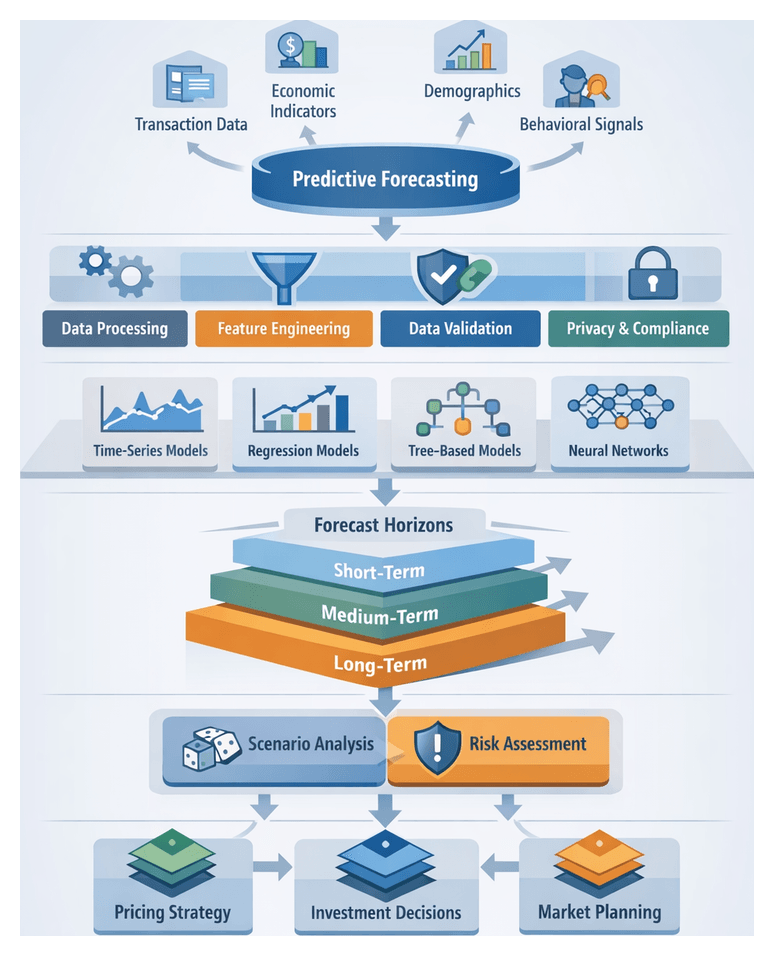
Predictive Forecasting Fundamentals
Forecasting models in real estate drive strategic decision making by estimating future price trajectories, absorption rates, and investment yields. Leveraging historical transaction records, economic indicators, demographic data, and behavioral signals, these tools enable agents, brokers, and investors to optimize pricing, refine outreach, and mitigate financial risk. Robust forecasts depend on a resilient data infrastructure that supports continuous ingestion, standardization, and governance. High-quality inputs include:
- Transaction Data: historical sales prices, rental agreements, days on market
- Economic Indicators: interest rates, employment figures, inflation metrics
- Demographic Trends: population growth, income distribution, migration patterns
- Geospatial Information: neighborhood boundaries, zoning regulations, walkability scores
- Behavioral Signals: online search volumes, social media sentiment, website engagement
Data pipelines must enforce validation rules for missing values, outlier detection, and consistency. Version tracking tools such as MLflow help document dataset revisions and enable reproducibility. Privacy compliance—through anonymization or pseudonymization—ensures adherence to regulations like GDPR and CCPA.
Core Modeling Approaches
Real estate forecasting draws on a spectrum of methodologies. Classical time-series techniques such as ARIMA and exponential smoothing capture trends and seasonality but may miss nonlinear interactions. Regression models offer interpretability by correlating property values with explanatory variables. Tree-based ensembles like random forests and gradient boosting machines enhance accuracy by adapting to complex feature interdependencies. Advanced architectures including LSTM networks and temporal convolutional networks learn intricate temporal dependencies, while ensemble stacking and reinforcement learning simulate market dynamics under policy scenarios.
Feature Engineering and Preprocessing
Effective modeling hinges on transforming raw data into predictive features. Common preprocessing tasks include imputing missing values, normalizing numeric attributes, encoding categorical variables, and generating lagged variables for temporal analysis. Geospatial joins encode distance to transit hubs or school ratings, and spatial clustering highlights neighborhood similarities. Domain expertise informs feature selection, improving both interpretability and performance.
Forecast Horizons and Scenario Planning
Forecasts operate across distinct horizons with tailored objectives. Short-term projections (weeks to months) guide dynamic pricing and inventory management. Medium-term forecasts (quarters to a year) inform marketing budgets, staffing plans, and campaign schedules. Long-term scenarios (multiple years) underpin capital allocation, development planning, and portfolio diversification. Scenario techniques—such as Monte Carlo simulation and stress testing—evaluate outcomes under varying economic or regulatory conditions, ensuring model outputs align with decision cycles.
Model Selection, Validation, and Integration
Balancing predictive performance, interpretability, and operational complexity is critical when selecting models. Cross-validation methods like rolling-window evaluation guard against overfitting, while metrics including MAE, RMSE, and MAPE quantify accuracy. Directional accuracy measures capture the model’s ability to predict market ups and downs. Robust validation involves out-of-sample testing and backtesting against historical shocks.
Embedding forecasts into business workflows amplifies their strategic value. Integrations with CRM platforms and multiple listing services enable automated data updates and report generation. Visualization dashboards distill complex outputs into actionable insights. Governance frameworks defining version control, alert thresholds, and model ownership ensure accountability and continuous improvement.
Strategic Value and Limitations
Accurate forecasts give listing agents the confidence to time and position properties, empower marketing teams to allocate ad spend effectively, guide investors in balancing risk and return, and help developers plan construction or pre-sale targets. Yet models face challenges: data quality issues, market shocks, and overreliance on algorithmic outputs without human oversight can undermine reliability. Ethical considerations—such as bias in demographic features—require transparency in feature selection, bias testing, and documentation. Regulatory compliance with fair housing and data protection laws imposes further constraints.
Integrating Autonomous AI Agents
Autonomous AI agents extend predictive analytics by executing tasks and decisions across marketing workflows. Autonomy is categorized into rule-based automation, assisted decision making, collaborative autonomy, and full autonomy. Rule-based systems schedule email campaigns, while assisted agents suggest optimal send times or audience segments. Collaborative agents negotiate property recommendations in real time, and fully autonomous agents manage end-to-end workflows—from lead qualification to follow-up communication—without human intervention.
Interpretive Frameworks
Industry models such as the Technology Acceptance Model (TAM) and the Unified Theory of Acceptance and Use of Technology (UTAUT) explain adoption dynamics by assessing perceived usefulness, ease of use, social influence, and facilitating conditions. The resource-based view positions AI agents as capabilities that deliver sustained advantage when they are rare, inimitable, and integrated with firm assets. Digital maturity frameworks chart progression from reactive to predictive and prescriptive marketing, with AI agents accelerating advancement. Governance models embed explainability, bias mitigation, and privacy safeguards from the outset.
Stakeholder Perspectives and Evaluative Criteria
Different stakeholders prioritize distinct outcomes. Marketing leaders seek growth metrics and brand consistency, sales teams focus on lead quality and conversion efficiency, and IT professionals emphasize interoperability with platforms such as Salesforce Einstein or HubSpot AI. Investors and boards assess risk-return trade-offs, balancing efficiency gains against governance costs. Key evaluation criteria include:
- Strategic Alignment: agent capabilities supporting business goals
- Performance Metrics: improvements in lead conversion, engagement, ROI
- Scalability: handling growing interaction volumes across channels
- Integration Quality: seamless data exchange and low latency
- Governance and Compliance: ethical safeguards and audit logs
- User Adoption: confidence and trust among teams
Integration Challenges and Governance
Legacy systems lacking standardized APIs complicate real-time integration. Data quality issues—such as incomplete listings or inconsistent tagging—impair learning algorithms. Skill gaps and change management can stall deployments. Organizations must define human-in-the-loop roles, establish feedback mechanisms, and maintain a risk register for continuous compliance monitoring. Embedding policy rules programmatically—for example, limiting autonomous price negotiations—upholds brand integrity.
Methodological Perspectives and Best Practices
System theory views the marketing ecosystem as interconnected agents and feedback loops, while socio-technical approaches emphasize the co-evolution of technology and culture. Best practices include:
- Cross-Functional Collaboration: involve marketing, sales, IT, legal, and compliance teams from the outset
- Pilot-Scale-Expand: validate agent capabilities in small pilots before broader rollouts
- Continuous Analytics and Feedback: real-time dashboards paired with qualitative user surveys
- Governance by Design: embed ethical and compliance checks into development cycles
- Iterative Model Oversight: formal review cycles for retraining, bias assessment, and performance validation
Applications for Agents and Investors
Pricing Strategy Optimization
AI-driven pricing models serve as dynamic indicators that suggest price bands or confidence intervals rather than fixed values. Streaming data—transaction records, economic reports, online search volumes—enables continuous calibration. Platforms such as HouseCanary overlay location-specific risk factors onto price estimates. Industry best practices involve:
- Confidence Assessment: adjusting listing aggressiveness based on uncertainty bands
- Comparative Overlay: cross-checking outputs with local intelligence and seasonal patterns
- Behavioral Calibration: refining model parameters through buyer response feedback
Strategic Portfolio Construction
Investors use AI forecasts to balance growth, income, and risk via:
- Risk-Return Heat Maps: ranking assets by projected yield versus volatility
- Correlation Matrices: identifying diversification benefits across markets
- Stress-Test Scenarios: simulating shocks like interest rate hikes
Platforms such as Redfin Analytics and Mashvisor aggregate predictive indicators. Key steps include benchmark alignment, defining rebalancing thresholds, and embedding AI insights into investment committee workflows.
Market Timing and Risk Assessment
Predictive analytics enhance timing by identifying inflection points through real options theory and leading-indicator composites—building permits, mortgage applications, vacancy rates—augmented by sentiment overlays. Decision thresholds trigger accelerated acquisitions or staged divestments. Risk frameworks incorporate Value at Risk simulations, Monte Carlo analyses of cap rate distributions, and geospatial risk mapping for climate or regulatory exposure. Interpretive steps include parameter stress testing, expert override protocols, and continuous performance monitoring against forecasts.
Client Advisory and Competitive Positioning
Agents differentiate by integrating AI forecasts into market briefs and presentations. Advisory frameworks include:
- Comparative Horizon Analysis: five-year forward projections alongside current valuations
- Opportunity Scoring: composite indices blending yield, vacancy risk, and liquidity
- Personalized Insights: tailoring forecasts to conservative, balanced, or growth-oriented profiles
At the organizational level, brokerages apply cluster analysis to identify emerging submarkets, perform competitive benchmarking of supply-demand dynamics, and use strategic mapping to guide land acquisition or joint ventures. Leadership teams translate these insights into resource allocation, marketing investments, and talent deployment decisions.
Considerations for Strategic Adoption
Data Sourcing and Quality Management
Ensure source diversity by combining proprietary listings with public records, third-party reports, and syndicated datasets. Align data refresh cadences—daily for pricing signals, monthly for demographics—and automate ingestion pipelines. Employ validation rules for missing values and outliers, and use MLflow to track dataset versions. Maintain privacy compliance through anonymization techniques.
Model Governance and Oversight
Define roles for data scientists, compliance officers, and business analysts using a RACI matrix. Document model parameters, training data sources, and performance benchmarks in a registry such as DataRobot. Monitor metrics beyond accuracy—fairness, stability, business impact—and schedule regular back-tests. Implement tiered approval workflows for pilot and production releases.
Risk Management and Ethical Safeguards
Conduct bias assessments using statistical tests to detect disparate impacts. Leverage model-agnostic explainability tools to justify recommendations. Perform scenario analyses under extreme conditions and formalize ethical guidelines to prevent unintended uses. Embed checkpoints into the development lifecycle to uphold AI integrity.
Organizational Readiness and Scalability
Secure executive sponsorship to embed analytics into strategic planning and overcome resistance. Foster cross-functional collaboration through workshops and shared objectives. Invest in AI literacy programs to enhance model understanding among agents. Adopt phased rollouts with defined pilots, gather feedback, and scale incrementally. Design a modular architecture to swap data ingestion, feature engineering, model training, and deployment components. Use automated monitoring dashboards for drift metrics and latency, and integrate qualitative feedback into retraining cycles. Balance on-premises and cloud resources, leveraging services like Amazon SageMaker for scalable training and inference.
Limitations and Final Reflections
Predictive systems are not infallible. Data gaps in off-market listings or private transactions create blind spots. Overly complex models risk overfitting noise. Regulatory changes—zoning reforms, tax incentives—and unpredictable events like natural disasters can undermine forecasts. Complement quantitative outputs with expert judgment and scenario planning. Continuous improvement, disciplined governance, and ethical safeguards are essential. When aligned with clear business objectives and supported by a culture of accountability and adaptability, AI-driven forecasting becomes a powerful lever for competitive differentiation in real estate marketing.
Chapter 8: Integrating AI Agents into Real Estate Technology Stacks
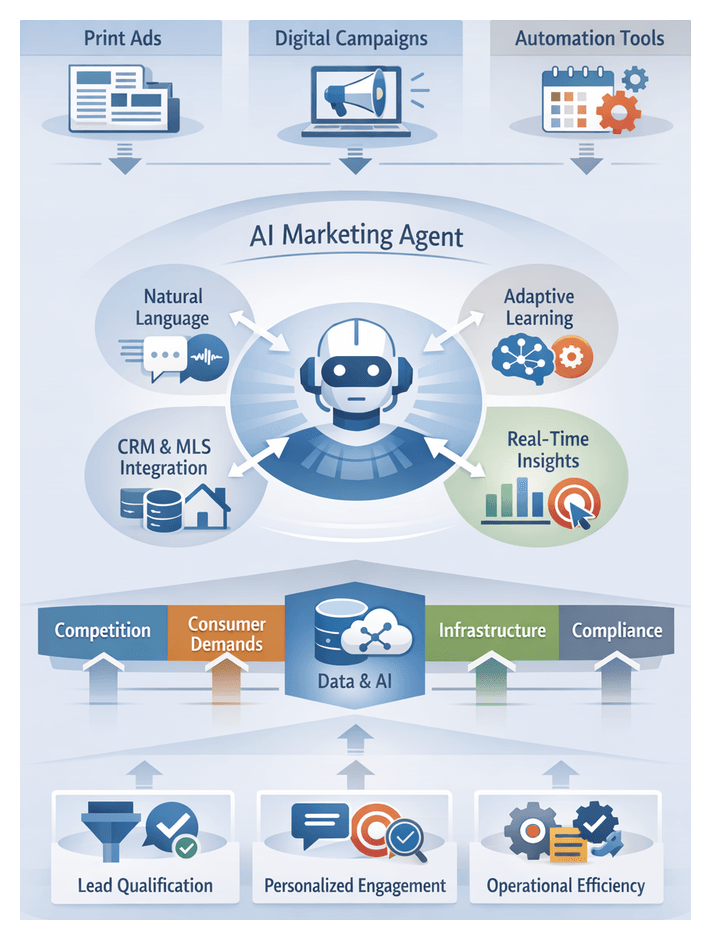
Emergence of Autonomous Marketing Agents
The real estate marketing landscape has evolved from print classifieds and open-house flyers to a complex digital ecosystem of online listings, omnichannel campaigns, and data-driven outreach. The rise of autonomous marketing agents—AI systems capable of qualifying leads, personalizing communications, and executing workflows with minimal human intervention—marks the latest transformational shift. These agents extend beyond rule-based automation by leveraging natural language understanding, adaptive decision making, continuous learning, and seamless interoperability with CRM, MLS, and advertising platforms.
Historically, agents relied on newspaper ads, brochure distribution, and face-to-face interactions to establish rapport. The internet introduced email newsletters and pay-per-click ads, improving reach but often yielding generic messaging. Legacy automation tools addressed repetitive tasks such as bulk emailing and appointment scheduling but lacked the intelligence to adjust strategies in real time. Today’s prospects demand instant, personalized responses across chat, email, voice, and mobile interfaces. Autonomous agents bridge the gaps created by manual handoffs and scripted chatbots, delivering dynamic engagement at scale.
Key drivers propelling adoption include:
- Competitive Pressure: Digital disruptors challenge legacy brokerages to differentiate through faster, more tailored engagement.
- Elevated Consumer Expectations: Prospects expect 24/7 availability and customized recommendations drawn from real-time data.
- Data Abundance and Complexity: Autonomous agents excel at aggregating MLS listings, CRM interactions, and behavioral signals to surface high-intent leads.
- Advances in AI and Cloud Infrastructure: Platforms such as Salesforce Einstein and Amazon Lex deliver turnkey agent capabilities.
- Operational Efficiency: Automating lead qualification and follow-up reallocates human resources to strategic activities like deal closing and relationship building.
Organizations must address several considerations to ensure successful integration:
- Integration Complexity—Aligning data schemas, APIs, and real-time synchronization across CRM, MLS, and marketing platforms.
- Data Quality and Governance—Maintaining accurate, up-to-date listings and customer profiles to support informed agent decisions.
- Change Management—Defining escalation rules, handoff protocols, and training programs for human-AI collaboration.
- Compliance and Privacy—Implementing consent management, recordkeeping, and data protection measures to satisfy regulatory requirements.
- Brand Voice Consistency—Ensuring AI-generated communications adhere to style guidelines and corporate tone.
A structured adoption approach includes assessing current workflows, defining use cases such as lead qualification or open-house scheduling, selecting technology partners, establishing data foundations, designing human-AI collaboration models, and iterating based on performance metrics. By following these strategic imperatives, organizations can harness autonomous agents to deliver personalized, efficient, and scalable marketing engagements.
Data Synchronization for AI Agents
Reliable data synchronization underpins the intelligence and trustworthiness of autonomous agents. Real estate operations involve diverse data streams—from MLS listings and CRM records to campaign metrics and external market indicators. Aligning these sources demands careful selection of consistency models, integration architectures, and governance frameworks.
Consistency Models and Architectural Trade-Offs
Applying CAP theorem and ACID versus BASE frameworks helps organizations balance availability, latency, and data integrity. Strong consistency suits transaction-critical tasks such as contract execution and payment processing. Eventual consistency, aligned with BASE principles, supports lead scoring, content recommendations, and dynamic outreach where minimal data drift is acceptable. Hybrid architectures employ dual data stores: a strongly consistent database for core records and an eventually consistent data lake for analytical workloads.
Real-Time Integration and Event-Driven Frameworks
Meeting consumer expectations for instant responses requires shifting from batch updates to event-driven architectures. Change data capture and message streaming platforms such as Apache Kafka and AWS Kinesis propagate MLS changes, CRM entries, and web engagement events without delay. Integration Platform as a Service offerings like MuleSoft and Workato provide prebuilt connectors, schema mapping, and orchestration capabilities. Key criteria include throughput and latency metrics, schema evolution support, failure recovery strategies, and operational visibility through logging and dashboards.
Semantic Alignment and Master Data Management
Semantic mismatches across taxonomies for property types, amenities, or client personas can lead to flawed agent behaviors. Master Data Management solutions such as Informatica MDM and Profisee enforce a single source of truth by defining canonical entities, automating duplicate detection, validating address formats, and enriching data with geocodes. Governance councils comprising IT, marketing, and compliance stakeholders refine data models and maintain pipeline resilience.
API Management and Ecosystem Dynamics
Autonomous agents rely on third-party APIs for listing data, customer histories, and marketing services. API gateways such as Apigee and Kong provide uniform access controls, caching, and monitoring. Evaluation criteria include rate limiting policies, versioning strategies, security features like OAuth2 and encryption, and resiliency patterns such as circuit breakers and retry mechanisms to handle vendor outages gracefully.
Monitoring Data Quality and Model Integrity
Semantic drift and data anomalies can degrade AI performance over time. Data profiling tools like Talend Data Quality and Ataccama quantify schema conformance and detect anomalies. Automated alerts for attribute distribution shifts, data lineage tracking, and metadata management ensure that AI agents operate on accurate, consistent, and timely inputs. Feedback loops between model performance metrics and data quality thresholds trigger retraining or adjustments when necessary.
Pipeline Scalability and Operational Overhead
Enterprises must scale synchronization pipelines without incurring prohibitive complexity. Modern ELT frameworks such as dbt and Airflow delegate transformations to database engines, improving performance while requiring governance to avoid ad-hoc script proliferation. Designing modular connectors, implementing end-to-end monitoring, and balancing compute and storage costs—especially when using cloud warehouses like Snowflake—enable cost-effective scaling.
Operational and Organizational Implications
Deploying autonomous agents transforms IT architecture, operational workflows, and organizational skill requirements. Success depends on selecting appropriate integration patterns, provisioning scalable infrastructure, enforcing data governance, and fostering cross-functional collaboration.
Integration Patterns and Architecture
Organizations choose between embedded, federated, or hybrid integration approaches:
- Embedded Integration embeds AI capabilities directly into core platforms, reducing latency but increasing customization demands.
- Federated Integration treats AI agents as standalone services, preserving modularity but requiring robust API management.
- Hybrid Integration combines embedded modules and external microservices for balanced flexibility and performance.
Infrastructure Scalability and Performance Management
AI agents impose variable loads when executing ML models, LLM-powered conversations, or high-volume streaming analysis. Leveraging container orchestration or serverless functions supports dynamic resource provisioning. Edge computing or dedicated inference clusters ensure real-time responsiveness. Cost optimization involves balancing performance requirements against cloud instance, storage, and egress charges—especially when using services like Salesforce CRM and Microsoft Advertising. Centralized monitoring of response times, inference latency, and utilization rates guides capacity planning.
Data Governance and Quality Assurance
Operational teams must elevate data stewardship to a strategic priority. Master data management across CRM, MLS, marketing automation, and AI platforms prevents inconsistencies. Metadata catalogs and change-tracking mechanisms ensure auditability. Routine validation and cleansing processes—duplicate detection, schema validation, outlier analysis—maintain the integrity of model inputs.
Operational Workflows and Collaboration
Integrating AI agents reshapes end-to-end processes such as lead management. Inbound leads are qualified via conversational interfaces or predictive scoring. High-value prospects feed into CRM for human follow-up, with context summaries and recommended actions. Feedback loops capture outcomes like appointments or closed deals, retraining models to refine future scoring. Clear SLAs, role definitions, and alignment sessions among marketing, sales, IT, and analytics teams ensure that AI outputs are treated as collaborative inputs.
Skill Sets and Organizational Readiness
Operations teams require expertise in cloud architecture, API management, ML ops, and change management. Upskilling programs should cover model evaluation metrics, AI troubleshooting, and integration best practices. New roles such as AI operations lead and data quality engineer oversee agent lifecycles. Evaluating maturity with frameworks like the AI Capability Maturity Model helps sequence investments and pilot initiatives, building confidence while avoiding resource strain.
Monitoring, Maintenance, and Continuous Improvement
AI agents evolve through data drift and shifting business needs. Real-time dashboards track intent classification accuracy, conversion uplift, and user satisfaction. Alerting thresholds for quality drops or error spikes trigger incident response. Defining retraining cadences, validation protocols, and version control ensures smooth model updates. Quantitative metrics combined with qualitative feedback from agents and prospects drive iterative enhancements.
Risk Management and Security
AI deployments introduce unique risks including data breaches, model manipulation, and compliance violations. Security-by-design practices, threat modeling, and secure coding protect APIs, authentication layers, and data stores. Privacy controls enforce consent frameworks, retention policies, and audit logging to satisfy GDPR, CCPA, and industry mandates. Bias and fairness monitoring—using tools like IBM AI Fairness 360—detect discriminatory patterns, ensuring equitable agent behaviors.
Key Success Factors and Common Pitfalls
The interplay of governance, technology selection, organizational alignment, and continuous optimization determines the success of AI agent initiatives. Key success factors include:
- Robust governance aligned to enterprise frameworks (COBIT, ITIL) and AI ethics guidelines.
- Vendor evaluations prioritizing interoperability, future flexibility, and total cost of ownership.
- Change management that fosters human-AI collaboration through clear roles, training, and communication.
- API-first architectures and open standards (RESTful APIs, RESO Web API) to prevent vendor lock-in.
- Master data management and event-driven synchronization for real-time, consistent insights.
- Balanced automation where AI handles routine tasks and humans manage complex, relationship-driven interactions.
- Scalable deployments validated under peak-load conditions, with monitoring of latency, throughput, and costs.
- Embedded privacy-by-design, consent management, and bias mitigation practices.
- Continuous feedback loops, retrospectives, and innovation labs to drive ongoing enhancement.
Avoiding common pitfalls—vendor lock-in, integration silos, data inconsistencies, performance lapses, and ethical oversights—requires strategic clarity, rigorous planning, and cross-functional commitment. By synthesizing these success factors, real estate organizations can orchestrate AI agent integrations that deliver transformational value while maintaining compliance, trust, and operational resilience.
Chapter 9: Navigating Ethical Privacy and Regulatory Considerations
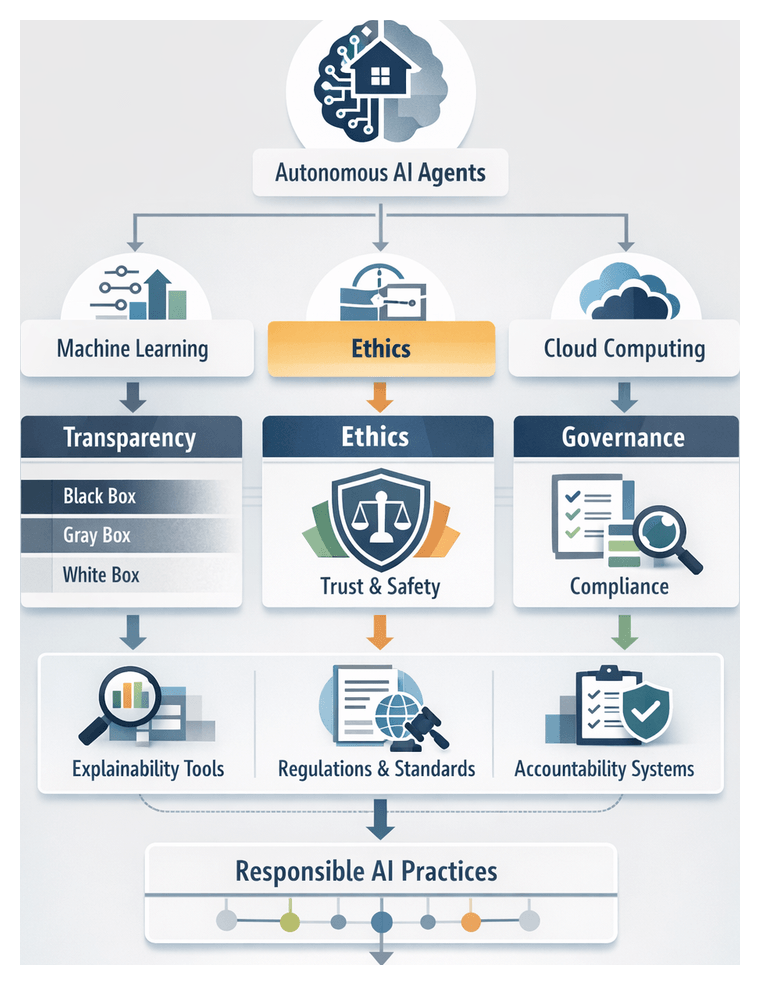
Autonomous Agents and the Imperative of Trust
Autonomous marketing agents, powered by advances in machine learning, natural language processing, and cloud computing, have revolutionized real estate outreach. By evaluating intent signals, personalizing messaging, and coordinating multichannel engagement without direct human intervention, these agents drive higher conversion rates and operational efficiency. Yet as they assume increasing decision-making authority—scoring leads, recommending pricing, and guiding buyers—organizations must embed robust transparency, privacy, and ethical governance frameworks to maintain consumer trust, ensure compliance, and mitigate unintended harms.
The Transparency Spectrum
Algorithmic transparency exists on a continuum from opaque, “black-box” systems whose internal logic is inscrutable, to fully “white-box” models that disclose decision pathways in detail. Between these extremes lie “gray-box” approaches offering high-level explanations with selective technical insight. No single point on this spectrum is universally optimal. Instead, transparency levels should be matched to the risk profile of each application—greater visibility for high-stakes functions like mortgage eligibility scoring, and calibrated opacity where real-time personalization demands performance trade-offs.
Explainability Techniques
Practical methods for illuminating model behavior include:
- Model-agnostic toolkits such as LIME (Local Interpretable Model-agnostic Explanations) and SHAP (SHapley Additive exPlanations), which generate local feature attributions for individual predictions.
- Platform-integrated solutions like IBM Watson OpenScale, offering continuous monitoring of drift, bias, and explanation dashboards.
- Interactive interfaces such as Google’s What-If Tool, enabling exploration of counterfactual scenarios and visualization of decision boundaries.
Organizations are adopting layered explanation frameworks that pair simple natural-language summaries for business users and consumers with technical appendices for data scientists and auditors. This multi-tiered approach ensures stakeholders receive the appropriate level of insight without being overwhelmed or misled.
Regulatory Landscape and Standards
- OECD AI Principles: Emphasize traceability and explainability as foundational for responsible innovation.
- NIST AI Risk Management Framework: Embeds transparency within broader governance processes, including model documentation and impact assessments.
- General Data Protection Regulation (GDPR): Grants data subjects a “right to explanation” for automated decisions, requiring businesses operating in EU markets to demonstrate fair and transparent processing.
- EU AI Act (draft): Introduces a risk-based classification, mandating rigorous transparency and accountability for high-risk AI systems, including those influencing lending and property valuation.
By mapping real estate use cases to these regulatory tiers, firms can prioritize investments in explainability, documentation, and compliance, transforming abstract requirements into concrete project milestones.
Organizational Accountability Mechanisms
- Model Cards: Standardized summaries of intended use, performance metrics, and known limitations, facilitating informed stakeholder review.
- Data Sheets for Datasets: Records of dataset provenance, collection methods, and identified biases, promoting dataset transparency.
- Audit Trails: Comprehensive logs capturing feature transformations, model versions, and decision outputs to support post-hoc analysis.
- Impact Assessments: Periodic evaluations quantifying potential harms, differential impacts across demographic groups, and compliance gaps.
- Governance Committees: Cross-functional bodies uniting legal, technical, and business leaders to oversee AI deployments.
- Third-Party Audits: Independent assessments by certification bodies to validate adherence to transparency and security standards.
Embedding these mechanisms from project inception ensures transparency and accountability become design imperatives rather than afterthoughts, bolstering stakeholder confidence and regulatory readiness.
Responsible Adoption in Real Estate Marketing
Responsible AI deployment requires analyzing each use context to balance innovation with ethical and legal obligations. Key dimensions include user consent, data sharing, personalization boundaries, and risk-tiered governance.
- User Consent and Preference Management: Agents sourcing contact data from public or third-party sources must capture documented opt-in choices, manage subscription statuses, and honor do-not-contact requests. Platforms like HubSpot CRM and Salesforce Einstein offer consent modules, but workflows should be tailored to comply with state privacy laws and real estate board regulations.
- Data Sharing and Third-Party Integrations: Integrations with multiple listing services, demographic providers, and credit bureaus enrich lead profiles but introduce compliance considerations around data ownership and permissible use. Due diligence on vendors such as Zillow Premier Agent is essential to ensure transparent data handling and contractual restrictions on downstream sharing.
- Contextual Personalization versus Privacy: While dynamic property recommendations and tailored messaging boost engagement, overly granular profiling—such as health or financial hardship inferences—can trigger fair housing or anti-discrimination scrutiny. Organizations should map profiling features to permissible use cases and maintain justification records for each personalized attribute.
- High-Stakes Decision Scenarios: Applications like automated pricing recommendations, investment advice, and mortgage eligibility assessments carry elevated risk. Best practices include human-in-the-loop oversight, clear disclaimers about the advisory nature of AI outputs, and continuous performance monitoring aligned with risk management provisions of the EU AI Act.
- Scale Variations: Small Agencies versus Enterprises: Smaller brokerages may rely on turnkey conversational platforms like Drift but lack dedicated compliance teams; they should leverage vendor audit logs and certificate assurances. Large franchises require formal governance structures, cross-functional ethics committees, and periodic third-party audits to manage jurisdictional complexities.
- Geographic and Regulatory Diversity: Cross-border deployments must navigate the California Consumer Privacy Act, GDPR, and other regional regulations. Data transfers may demand standard contractual clauses or binding corporate rules. Mapping each jurisdiction’s obligations to use case design prevents compliance gaps.
Ethical Safeguards and Risk Mitigation
- Bias Detection and Fairness Constraints: Regular bias audits and calibration of scoring thresholds prevent inequitable treatment of demographic groups or neighborhoods historically underserved by investment.
- Auditability and Incident Response: Logging frameworks should record agent interactions, model versions, and data lineage. Defined thresholds for human intervention and escalation protocols ensure timely response to anomalies or stakeholder inquiries.
- Vendor Evaluation Criteria: When selecting AI agent providers, compare customization options, data residency controls, and privacy features. Evaluate offerings such as OpenAI’s ChatGPT API, IBM Watson OpenScale, and Microsoft Azure Cognitive Services for security certifications, third-party audit reports, and alignment with standards like ISO 27001.
By integrating transparency practices, regulatory alignment, and ethical safeguards into every stage of AI agent deployment—from vendor selection to ongoing monitoring—real estate organizations can leverage autonomous marketing agents to scale personalized outreach while preserving consumer trust and legal compliance. This balanced approach positions firms to harness the full potential of AI-driven marketing in an evolving regulatory and competitive landscape.
Chapter 10: Future Trends and Emerging Innovations in AI Driven Marketing
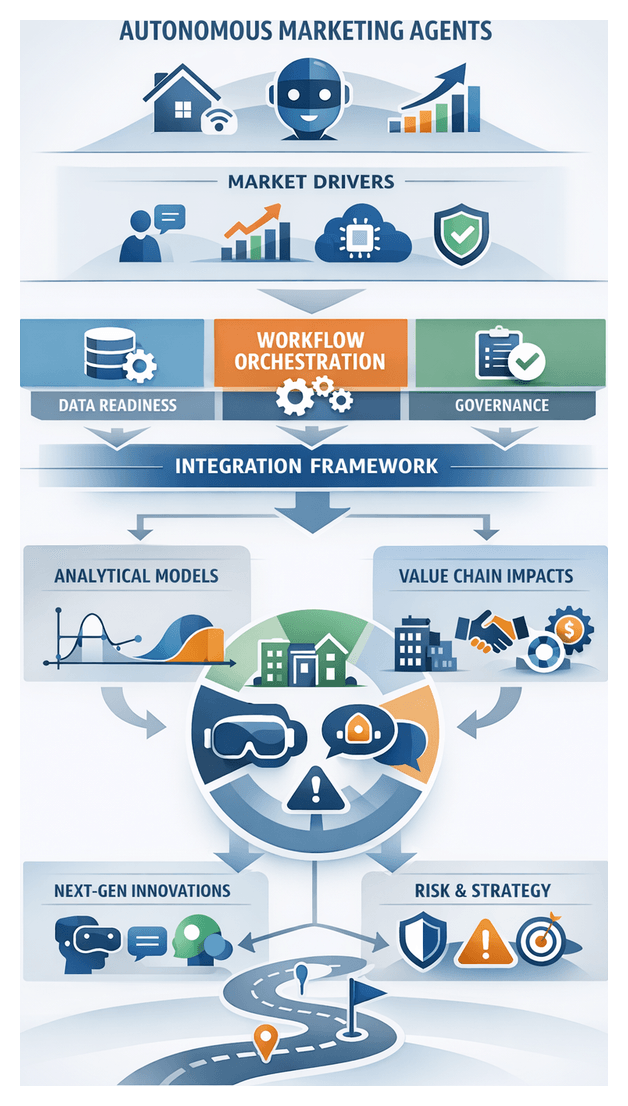
Emergence of Autonomous Marketing Agents and Industry Drivers
The real estate sector is experiencing a shift from manual marketing workflows to intelligent automation as data volumes grow and consumer demands for immediate, personalized interactions intensify. Autonomous marketing agents powered by artificial intelligence transcend rule-based systems by learning from engagements, adapting to evolving patterns, and making decisions with minimal human intervention. These agents now handle tasks ranging from lead qualification and content generation to campaign optimization and strategic planning. Early adopters report higher efficiency, improved conversion rates, and greater return on marketing investment. By automating repetitive processes, AI agents free real estate professionals to devote more attention to relationship building, complex negotiations, and high-value advisory roles.
Understanding this technological inflection point requires examining the forces driving adoption and the core capabilities that differentiate autonomous agents from legacy marketing tools. This context sets the stage for a structured exploration of integration frameworks, market dynamics, analytical outlooks, value chain impacts, next-generation innovations, risk considerations, and actionable deployment strategies.
Integration Framework: Data Readiness, Workflow Orchestration, and Governance
Successful deployment of autonomous agents rests on three foundational pillars: data readiness, workflow orchestration, and governance. Each pillar addresses critical enablers for agents to deliver consistent, compliant, and contextually relevant interactions.
- Data Readiness: Establish processes for collecting, cleaning, enriching, and securing customer and property data. High-quality inputs fuel machine learning, natural language understanding, and predictive modelling.
- Workflow Orchestration: Map end-to-end marketing processes to identify tasks suitable for automation. Design seamless handoffs between human experts and AI agents, embedding feedback loops and performance metrics such as open rates, engagement levels, and conversion rates.
- Governance: Define policies for data privacy, compliance with regulations such as CCPA and GDPR, and alignment with brand voice. Assign clear roles, escalation paths, and audit mechanisms to maintain algorithmic accountability and ethical standards.
A phased integration approach—beginning with pilot programs for automated listing descriptions or lead triage—allows teams to validate performance, build trust, and scale successful agents across broader marketing functions. Change management practices, including training, stakeholder engagement, and clear success criteria, ensure that AI agents become collaborative assets rather than isolated experiments.
Market Dynamics Accelerating AI Adoption
Several converging factors have propelled autonomous marketing agents from theoretical possibilities to essential tools for real estate professionals:
- Consumer Expectations: Homebuyers demand instant, personalized responses and curated property recommendations across devices and channels. Failing to meet these expectations leads to lost leads and weakened brand reputation.
- Competitive Pressures: Disruptive entrants leverage technology to streamline brokerage models. Established firms must match or exceed these capabilities to maintain market share and optimize advertising spend.
- Technological Readiness: Advances in natural language processing, reinforcement learning, and cloud infrastructure lower barriers to entry. Hosted platforms and partner ecosystems enable organizations to deploy sophisticated AI agents without in-house ML expertise.
- Regulatory Clarity: Evolving frameworks for data privacy and consumer protection provide guidance for responsible AI usage. Robust governance enables compliant personalization and predictive analytics.
In this environment, autonomous agents offer scalable outreach, real-time adaptation, and data-driven insights essential for maintaining competitive advantage in a rapidly evolving landscape.
Analytical Models for Technology Adoption
To navigate emerging marketing innovations, industry leaders apply established frameworks that assess maturity, adoption patterns, and integration challenges.
Gartner Hype Cycle
- Innovation Trigger: Breakthroughs in generative AI, led by ChatGPT, ignite proof-of-concept pilots.
- Peak of Inflated Expectations: Virtual staging with Midjourney and automated copy creation via Jasper gain rapid traction before quality constraints emerge.
- Trough of Disillusionment: Augmented reality tours powered by Matterport experience slow adoption due to hardware costs and content bottlenecks.
- Slope of Enlightenment: Voice interfaces leveraging Amazon Polly and Google Dialogflow advance through targeted use cases like property FAQs and tenant onboarding.
- Plateau of Productivity: Predictive analytics platforms for pricing forecasts deliver consistent ROI, prompting widespread acceptance.
Diffusion of Innovations
- Innovators: Tech-driven brokerages experimenting with AR tours and early chatbots.
- Early Adopters: Agencies deploying generative AI for dynamic listing narratives and multilingual outreach.
- Early Majority: National brands integrating voice search optimization and predictive scoring into CRMs.
- Late Majority: Traditional firms digitizing print materials and adding basic chat features.
- Laggards: Organizations relying solely on manual methods without AI enhancements.
Technology Readiness Levels
- TRL 4–5 (Proof of Concept): Small-scale AI chatbot pilots measuring engagement and lead qualification lift.
- TRL 6–7 (Prototype Validation): Generative content integrated into live campaigns, assessing brand consistency.
- TRL 8 (System Demonstration): AR tours deployed in production with benchmarks on session duration and conversion.
- TRL 9 (Full Deployment): Predictive analytics solutions delivering repeatable forecasting models across markets.
Integration Challenges and Evaluation
Systemic constraints—data silos, skill gaps, regulatory frictions, and cost uncertainties—must be addressed through phased rollouts and strategic partnerships. Robust evaluation frameworks include:
- Structured Pilots: Define clear success metrics such as cost-per-lead reduction and time-to-first-contact.
- Benchmarking Against Baselines: Compare AI-augmented initiatives to legacy performance.
- Continuous Feedback Loops: Gather quantitative metrics and qualitative insights for model refinement.
- Scalability Stress Tests: Ensure conversational bots and AR experiences remain responsive under peak loads.
Scenario Analysis and Forecasting
- Best-, Base-, and Worst-Case Modeling: Project ROI ranges based on adoption rates, regulatory shifts, and cost trajectories.
- Sensitivity Analysis: Identify variables that most influence marketing outcomes, such as consumer uptake of virtual tours.
- Competitive Benchmarking: Monitor peer adoption timelines and vendor roadmaps.
- Risk Mapping: Anticipate privacy law changes and synthetic media detection breakthroughs to inform mitigation plans.
Impacts on the Real Estate Value Chain
Autonomous AI agents are set to transform every phase of the value chain, from development and marketing to transaction execution and asset management. Applying Porter’s Value Chain and Resource-Based View frameworks reveals opportunities for efficiency gains, precision, and new business models.
Redefinition of Core Activities
- Market Intelligence and Site Selection: AI agents integrate geospatial data, demographics, and behavioral signals to guide development decisions based on real-time demand and neighborhood sentiment.
- Construction and Project Management: Predictive scheduling and risk models optimize materials procurement and labor allocation, reducing bottlenecks.
- Marketing and Lead Generation: Personalization at scale accelerates funnel progression, lowers acquisition costs, and elevates the importance of data governance.
- Transaction Facilitation: Advanced natural language processing agents negotiate offers, generate disclosure statements, and support compliance workflows, freeing human advisors for strategic tasks.
- Asset Management and After-Sales Service: Continuous monitoring of occupancy, maintenance, and tenant sentiment enables proactive interventions, boosting retention and portfolio performance.
Shifts in Competitive Structures
- Platformization and Ecosystem Leadership: Firms that aggregate data across stakeholders and orchestrate networks will capture outsized value through network effects.
- Data as a Strategic Asset: Proprietary data partnerships and stringent governance frameworks enhance bargaining power and exclusive access to AI-generated insights.
- Service Bundling and Outcome Models: Integrated offerings, subscription services, and success-fee arrangements blur lines between marketing, brokerage, and management.
Talent, Trust, and Regulatory Dynamics
- Strategic Advisors: With routine tasks automated, human roles will emphasize emotional intelligence, regulatory interpretation, and complex negotiation.
- Cross-Functional Expertise: Teams combining real estate domain knowledge with data science and model governance are essential for transparency and trust.
- Risk and Resilience: Governance mechanisms addressing algorithmic accountability, bias audits, consent frameworks, and system redundancy ensure operational continuity and compliance.
Strategic Partnerships and Ecosystem Alliances
- Joint Innovation Labs: Collaborative development of specialized agents, such as urban analytics or sustainability advisors, accelerates time to market and shares costs.
- Standardization Consortia: Industry working groups define data schemas, APIs, and ethical guidelines to ensure interoperability and collective trust.
- Embedded Financial Services: Alliances with lenders and insurers enable AI agents to pre-qualify financing, align insurance, and streamline closings.
Next-Generation Innovations and Ecosystem Interoperability
Four emerging trends are redefining the future of AI-driven marketing:
- Generative Intelligence and Creative Automation: Large language models and multimodal systems automate storytelling, dynamic visuals, and localized messaging in real time at scale.
- Immersive Engagement: Context-aware AR tours and virtual staging adapt scenes to user preferences, integrating live data streams to personalize exploration.
- Voice and Conversational Interfaces: Smart assistants embedded in speakers, vehicles, and mobile apps become primary entry points for property search and guidance, seamlessly switching between modalities.
- Interoperable Ecosystems: Open architectures, shared data standards, and modular agent frameworks enable composable solutions across CRM, listing services, analytics, and specialized AI vendors.
These innovations converge to form cohesive intelligence networks in which multiple agents learn from cross-channel interactions and continuously optimize outreach, content delivery, and conversion strategies.
Strategic Considerations and Risk Management
Deploying advanced AI agents requires careful navigation of inherent limitations and risks:
- Data Integrity and Bias: Diverse data sources must undergo rigorous curation to prevent reinforcement of biases or spurious correlations.
- Privacy, Security, and Compliance: Immersive and voice interfaces generate sensitive data; organizations must implement encryption, anonymization, consent management, and privacy impact assessments in line with GDPR, CCPA, and emerging AI policies.
- Integration Complexity and Technical Debt: API governance, real-time pipelines, and version control are critical to avoid brittle architectures and high maintenance overhead.
- Talent and Change Management: Cross-disciplinary expertise in data science, UX design, DevOps, and real estate domains is essential. Upskilling and a culture of experimentation foster responsible innovation.
- Cost Versus Value Uncertainty: High-fidelity models and immersive platforms incur significant expenses. Transparent ROI metrics encompassing lead conversion, time-to-offer, brand sentiment, and user satisfaction guide phased investments.
- Ethical and Transparency Imperatives: Clear disclosures about AI interactions, explainability protocols, and published governance policies are non-negotiable for maintaining trust.
- Market Readiness and Competitive Dynamics: Adoption timelines vary by region and firm size. Competitive benchmarking and stakeholder insights help calibrate strategic pacing and differentiation.
Actionable Imperatives for Strategic Deployment
- Define a Clear Vision: Align AI agent use cases with business objectives such as accelerating conversion cycles, enriching customer experiences, or enabling data-driven advisory services.
- Establish Cross-Functional Governance: Form an AI steering committee spanning marketing, operations, legal, IT, and finance to oversee vendor selection, ethics guidelines, and performance metrics.
- Invest in Data Foundations: Prioritize master data management, metadata cataloging, and data quality initiatives to underpin reliable agent decision-making.
- Pilot, Measure, and Iterate: Launch controlled experiments—such as generative content automation, AR/VR tours, or voice assistants—and refine workflows based on quantitative and qualitative feedback.
- Scale Through Modular Architectures: Adopt interchangeable components, well-defined APIs, and event-driven triggers to facilitate rapid experimentation and minimize reengineering.
- Embed Ethical Safeguards: Integrate explainability toolkits, bias audits, and transparent user communications as core requirements, and update policies as best practices evolve.
- Foster a Learning Culture: Encourage participation in AI research forums, internal knowledge sharing, and recognition of responsible innovation successes.
- Monitor Ecosystem Evolution: Track advancements from leading AI providers, open-source communities, and industry consortia, and be prepared to integrate emerging capabilities when they mature.
By integrating these imperatives with a robust understanding of market forces, analytical frameworks, and value chain impacts, real estate organizations can harness the transformative potential of autonomous marketing agents while mitigating risks and achieving sustainable competitive advantage.
Conclusion
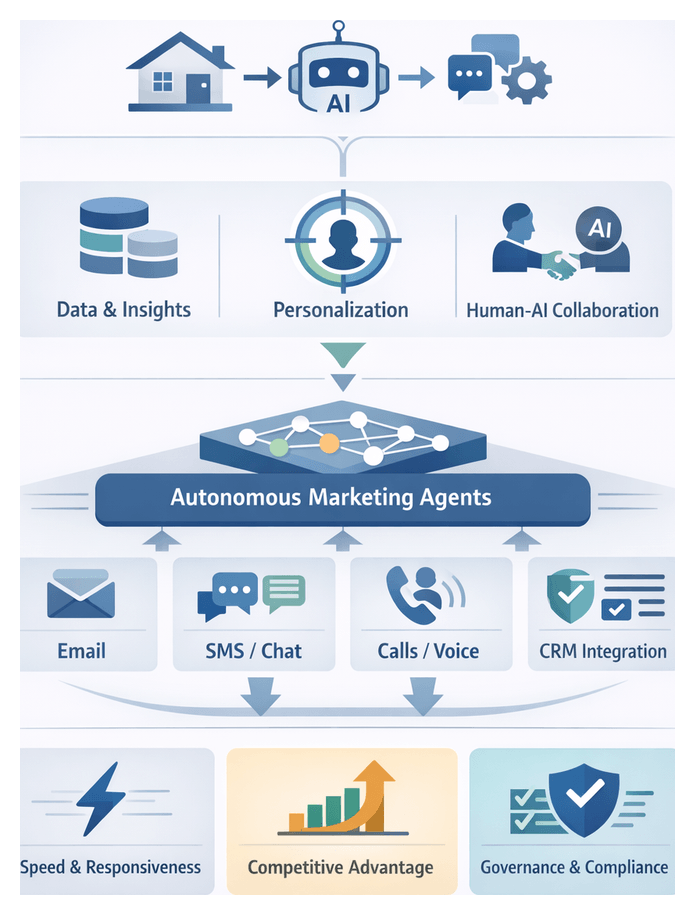
Emergence of Autonomous Marketing Agents
The real estate industry is undergoing a fundamental shift from manual outreach methods—door-knocking, cold calls and print mailers—to AI-driven, autonomous marketing agents that deliver personalized, data-driven engagement at scale. These software entities combine machine learning, natural language processing and decision-making frameworks to execute tasks with minimal human intervention. Unlike traditional rule-based automation, autonomous agents adapt strategies in real time, tailoring messaging, channel mix and cadence based on prospect behavior signals such as click patterns, browsing activity and sentiment analysis.
Rapid growth in available data—from public records and MLS updates to social media signals and demographic trends—overwhelms manual processes. Autonomous agents ingest and analyze these inputs continuously, surfacing high-value leads and triggering outreach precisely when prospects demonstrate intent. By responding within seconds, they meet modern consumer expectations for immediate, personalized communication across email, SMS, chat or voice interfaces.
This transformation addresses three key challenges: the volume and velocity of data, heightened buyer expectations for instant, tailored service, and intensifying competition from national brokerages and tech-enabled platforms. Industry surveys show that reducing response times from hours to seconds can boost conversion rates by up to 30 percent. Autonomous agents free human teams to focus on strategic negotiation and relationship building, while AI handles routine qualification and preliminary nurturing.
Advances in cloud infrastructure and natural language understanding have democratized access to these capabilities. Small brokerages can now deploy predictive lead scoring models and conversational interfaces without heavy investment in on-premises hardware. Leading platforms such as those listed on AgentLink AI offer end-to-end solutions, integrating MLS feeds, CRM systems and multichannel conversational workflows.
Successful deployment requires robust data pipelines, integration with existing systems and governance to ensure compliance with privacy regulations. Organizations must mitigate bias in predictive models, maintain transparency in AI-driven communications and establish feedback loops for continuous performance monitoring and model retraining.
Cross-Chapter Patterns and Strategic Insights
Analysis across digital transformation, decision automation, conversational interfaces, predictive analytics, content generation and governance reveals a set of strategic patterns:
- Data as the Foundation: High-quality, unified data—combining CRM records, transaction logs, web analytics and social sentiment—is essential for accurate predictive scoring, segmentation and forecasting.
- Personalization at Scale: AI agents move prospects from generic outreach to tailored experiences by leveraging intent scores, profile data and real-time engagement metrics to customize messaging, offers and content sequencing.
- Human-AI Collaboration: While agents excel at scale, human oversight remains critical for editorial review of AI-generated copy, strategic calibration of conversational flows and judgment calls on complex negotiations.
- Interoperability and Modularity: Seamless integration with CRMs, MLS services and marketing platforms through open APIs enables incremental adoption and minimizes operational friction.
- Iterative Optimization: Deployment is cyclical—measure engagement metrics, conversion rates and customer satisfaction, then refine models and workflows to sustain performance gains.
- Governance and Accountability: Clear policies for data privacy, algorithmic transparency and compliance checkpoints ensure responsible AI use. Roles for model monitoring, bias assessment and audit reporting must be defined.
Industry Impacts and Future Outlook
The rise of autonomous agents shifts competition from product-centric models to experience differentiation. Early adopters leverage conversational AI, predictive analytics and dynamic personalization to accelerate transaction velocity and foster deeper buyer engagement. Organizations that fail to embed AI agents risk commoditization as prospects gravitate toward seamless, data-informed experiences.
Rather than replacing human expertise, AI agents liberate professionals to focus on high-value advisory roles. Brokers and agents evolve into consultative partners, using AI-driven insights to inform pricing strategies, investment advice and community guidance. Marketing teams develop new competencies in AI governance, interpretability and data ethics to oversee automated workflows and maintain transparency.
The vendor landscape is fragmenting between established real estate platforms integrating AI modules and pure-play startups specializing in hyper-local forecasting, immersive virtual tours or generative content engines. Interoperability, open APIs and data portability become critical selection criteria to avoid vendor lock-in and preserve flexibility.
Regulatory frameworks around privacy, fairness and transparency are evolving. Compliance with GDPR, CCPA and emerging consumer protection laws demands consent management, data minimization and explainability for algorithmic decisions. Industry bodies are issuing ethical guidelines that emphasize bias audits, audit logs and redress mechanisms.
Emerging technologies promise further disruption. Generative models trained on multimodal property data will enable on-demand virtual staging, customized video tours and augmented reality overlays of market insights. Voice-activated agents embedded in smart home ecosystems will let prospects schedule viewings conversationally. Blockchain and smart contracts may automate lease agreements or purchase contracts, though legal and technical infrastructures remain nascent.
Scenario-based planning helps firms allocate resources and anticipate shifts. A baseline scenario foresees incremental integration of conversational and predictive agents. A disruptive scenario imagines AI-driven marketplaces challenging traditional brokerages. A visionary scenario envisions federated AI networks and blockchain-enabled reputation systems transforming how buyers interact with property listings.
Key Considerations and Limitations
Despite the promise of autonomous agents, practitioners must address inherent challenges:
- Data Bias and Representativeness: Historical transaction data can perpetuate systemic biases. Regular audits and inclusive sourcing mitigate skewed predictions.
- Model Explainability: Complex neural networks may lack transparency. Interpretable models or explainability layers are necessary for high-stakes decisions and regulatory compliance.
- Privacy and Compliance: Adherence to jurisdictional laws, consent requirements and licensing regulations demands robust data governance and minimization strategies.
- Integration Complexity: Legacy systems with rigid schemas and limited APIs may require extensive middleware development and change-management efforts.
- ROI Attribution: Multi-touch journeys complicate impact measurement. Clear attribution models and rigorous analytics are required to validate investments.
- Human Capital Shifts: Automation alters roles and skill requirements. Investment in data literacy, AI oversight and strategic interpretation is essential.
- Scalability Constraints: High-volume deployments can strain resources and budgets. Capacity planning and cost governance help avoid overruns.
Empowering Practitioners for Strategic Action
Organizations can accelerate value realization by following a structured approach:
- Assess Readiness: Audit data infrastructure, technology stack and team expertise. Identify quick-win use cases such as lead scoring or conversational pilots.
- Define Governance Frameworks: Establish policies for ethics, model monitoring and compliance. Assign accountability and integrate audits into operations.
- Pilot Incrementally: Launch small-scale trials in controlled segments. Evaluate performance against clear KPIs before scaling broadly.
- Foster Collaborative Teams: Create cross-functional squads of data scientists, marketers, domain experts and IT specialists for shared ownership and rapid iteration.
- Invest in Continuous Learning: Maintain awareness of emerging AI trends—from generative architectures to voice interfaces—and incorporate experimental roadmaps.
- Measure and Iterate: Implement a robust analytics framework to track agent performance, customer feedback and business outcomes. Use insights to refine models and workflows continuously.
Forward-Looking Observations
The pace of AI innovation in real estate marketing will accelerate as adaptable model architectures and AI-native platforms proliferate. We expect the convergence of conversational agents with immersive technologies—augmented reality home tours, multimodal interfaces and voice-activated searches—to become mainstream. Open ecosystems and standardized data protocols may lower barriers for smaller firms to access sophisticated capabilities.
Sustained competitive advantage will depend on strategic agility: a culture of experimentation, rigorous governance and alignment of AI initiatives with evolving market dynamics. By grounding adoption in clear business objectives and ethical standards, real estate professionals can harness autonomous marketing agents to deliver differentiated, transparent and customer-centric experiences.
Appendix
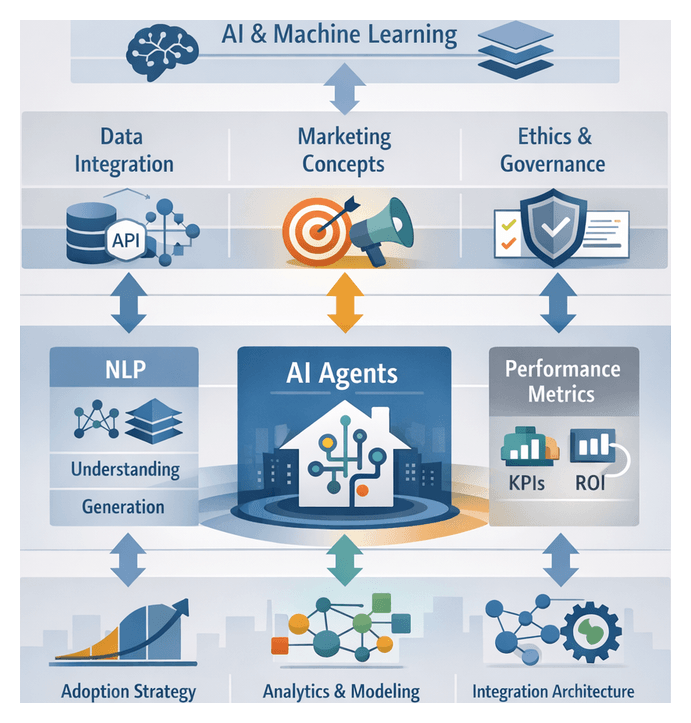
Foundational Concepts and Terminology
This section establishes the core vocabulary for understanding AI-driven marketing agents in real estate, covering fundamental technologies, data and integration terms, marketing concepts, ethical considerations, and performance metrics.
- Artificial Intelligence: Systems that perform tasks requiring human cognitive functions such as learning, reasoning, and problem solving.
- Machine Learning: Algorithms that improve performance by identifying patterns in data without explicit programming.
- Deep Learning: Multi-layered neural networks modeling complex patterns for tasks like image recognition and language understanding.
- Autonomous Agent: Software that independently makes decisions and executes actions using programmed logic and learned models.
- AI Agent: An autonomous agent enhanced with AI techniques—machine learning and NLP—to perform tasks such as lead qualification and personalized outreach.
- Natural Language Processing (NLP): Methods enabling machines to interpret, analyze, and generate human language.
- Natural Language Understanding: The extraction of intent and context from text or speech.
- Natural Language Generation: The production of coherent, context-appropriate text by AI systems.
- Supervised Learning: Model training on labeled data to predict outcomes based on examples.
- Unsupervised Learning: Techniques that detect patterns and groupings in unlabeled data for clustering and segmentation.
- Reinforcement Learning: Agents learn optimal actions through feedback as rewards or penalties over time.
- Predictive Analytics: Forecasting future outcomes—such as lead conversion likelihood—using statistical and machine learning models.
- Generative AI: Systems that produce novel content—text, images, multimedia—by learning patterns from training data.
- Inference: Real-time application of a trained model to new inputs to generate predictions or decisions.
- Training Data: Collections of labeled or unlabeled examples used to teach machine learning models.
- Customer Relationship Management (CRM): Platforms for centralizing client interactions, contact records, and sales opportunities.
- Multiple Listing Service (MLS): Databases sharing property listings, transaction details, and market data among brokerages.
- Application Programming Interface (API): Protocols enabling software applications to communicate and exchange data.
- Data Pipeline: Processes for ingesting, cleansing, transforming, and storing data to support analytics and AI models.
- Data Governance: Policies ensuring data quality, privacy, consistency, and compliance throughout its lifecycle.
- Master Data Management: Creating a single, authoritative source of key business data such as client profiles.
- Real-Time Processing: Ingesting and analyzing data as it’s generated to enable instantaneous AI decisions.
- Event-Driven Architecture: Systems that detect and react to events—like new listings or inquiries—to trigger automated workflows.
- Integration Platform as a Service (iPaaS): Cloud solutions providing connectors and tools to integrate applications, data, and processes.
- Lead Qualification: Evaluating prospects’ readiness and suitability for targeted marketing using AI-generated predictive scores.
- Lead Scoring: Assigning numerical values to prospects based on demographics, behavior, and engagement to prioritize outreach.
- Segmentation: Dividing audiences into groups with similar characteristics or behaviors for targeted marketing.
- Personalization: Tailoring content, recommendations, and communications to individual profiles to increase relevance.
- Dynamic Content: Materials that adapt text, images, or calls to action automatically based on user data.
- Omnichannel Marketing: Coordinated engagement across email, SMS, chat, social, and voice for a consistent customer experience.
- A/B Testing: Comparing two versions of an asset to determine which performs better against defined metrics.
- Conversion Rate: The percentage of prospects completing a desired action out of total interactions.
- Return on Investment (ROI): The ratio of net gains to the cost of investment, measuring efficiency.
- Algorithmic Bias: Unfair discrimination in AI outputs due to biases in data or model design.
- Explainability: The extent to which AI model decisions can be interpreted by humans.
- Transparency: Clear disclosure of how AI systems make decisions and what data they use.
- Privacy by Design: Embedding privacy protections into AI architectures from the outset.
- Consent Management: Processes for obtaining, recording, and respecting user data permissions.
- Fair Housing Compliance: Ensuring AI agents adhere to laws prohibiting discriminatory practices in housing.
- Audit Trail: Chronological records of data changes, model versions, and agent interactions for accountability.
- Key Performance Indicator (KPI): Measurable values used to evaluate AI agent success against objectives.
- Drift Detection: Techniques identifying changes in data distributions or model performance over time.
- Uplift Modeling: Estimating the incremental impact of interventions on desired outcomes.
- Total Cost of Ownership (TCO): Estimating direct and indirect costs of deploying and maintaining AI agents.
- Service Level Agreement (SLA): Contracts specifying performance standards like uptime and response latency.
- Human-in-the-Loop: Collaborations where human experts oversee AI workflows, handle edge cases, and provide feedback.
- Continuous Monitoring: Ongoing observation of AI operations, data inputs, and outputs to ensure reliability and compliance.
Conceptual and Strategic Frameworks
Technology Adoption and Diffusion
Frameworks guide the timing and approach to deploying new AI capabilities.
- Rogers’ Diffusion of Innovations: Segments adopters into innovators, early adopters, early majority, late majority, and laggards, informing tailored engagement strategies.
- Gartner Hype Cycle: Tracks technologies through five phases—innovation trigger, peak of inflated expectations, trough of disillusionment, slope of enlightenment, plateau of productivity—to balance risk and opportunity.
Strategic Planning and Performance
Models ensure AI agent initiatives align with organizational goals and deliver measurable value.
- Balanced Scorecard: Expands metrics beyond financials to include customer engagement, internal processes, and learning and growth, applied to AI agents by measuring lead conversion lift, response time improvements, and data literacy.
- KPI Maturity Model: Assesses capabilities from basic data collection to predictive and prescriptive analytics, identifying gaps in infrastructure, governance, and cross-functional alignment.
Decision Science and Customer Engagement
Foundational theories inform AI agent behavior to optimize outreach and personalization.
- Jobs-to-Be-Done Theory: Focuses on customer needs—such as finding a home in a desired district—to drive qualification questions and content alignment.
- Attention Economy Principles: Treats attention as scarce, optimizing timing, channel selection, and content relevance with metrics like interaction depth and response latency.
- Elaboration Likelihood Model: Differentiates central (data-rich arguments) and peripheral (endorsements, imagery) persuasion routes, guiding message strategies based on segment attributes.
Data Analytics and AI Modeling
Robust analytical lifecycles and evaluation methods underpin reliable, evolving AI agents.
- Predictive Modeling Lifecycle: Encompasses data acquisition, feature engineering, model training, validation, deployment, and monitoring, ensuring governance and quality standards.
- Attribution and Funnel Analysis: Uses multi-touch attribution and cohort comparisons to quantify the incremental impact of AI-driven interactions on conversions.
- Cluster Analysis: Employs unsupervised learning—K-means, hierarchical clustering—to segment prospects by behavior, preferences, and demographics for personalization rules.
Integration and Interoperability
Patterns for connecting AI agents with enterprise systems ensure scalability and maintainability.
- Embedded Integration: Natively building agents within CRM or marketing platforms reduces latency and simplifies user workflows.
- Federated Microservices: Standalone services communicate via APIs and message brokers, promoting modularity and vendor independence.
- Event-Driven Architecture: Change data capture and message streaming trigger real-time agent responses to new listings, inquiries, and campaign events.
Ethics, Privacy, and Governance
Responsible AI adoption demands fairness, transparency, and compliance measures.
- Explainable AI Toolkits: Libraries such as LIME and SHAP generate interpretable explanations for model decisions.
- Fairness and Bias Assessment: Disparate impact analysis and equal opportunity difference tests quantify demographic disparities and guide mitigation.
- Privacy-by-Design Principles: Data minimization, encryption, consent management, and transparent AI disclosures ensure compliance with regulations like GDPR and CCPA.
- Governance Committees and Audit Trails: Cross-functional councils oversee policies, review model updates, and maintain logs of agent decisions for audit readiness.
Continuous Improvement and Roadmapping
Iterative models and feedback loops drive scalable, aligned AI agent programs.
- Pilot-Scale-Expand: Start with proofs of concept, measure results, refine workflows, and scale enterprise-wide.
- Agile Experimentation: Use A/B tests, multivariate experiments, and rapid iterations to optimize scripts, scoring, and personalization rules.
- Performance Dashboards: Monitor lead conversion uplift, response time reduction, customer satisfaction, and automate alerts for model drift.
- Cross-Functional Feedback: Incorporate insights from marketing, sales, and support into retraining datasets to align AI behaviors with domain expertise.
Common Questions and Clarifications
- How does an autonomous marketing agent differ from a traditional chatbot?: Traditional chatbots follow scripted rules, while autonomous agents use machine learning and NLU to interpret intent, adapt dynamically, learn from interactions, prioritize leads with predictive models, and orchestrate multi-step campaigns without manual scripting.
- What distinguishes AI agents from standard marketing automation?: Marketing automation executes preset workflows at fixed times. AI agents make real-time decisions based on data signals—engagement metrics, demographics, market trends—to personalize outreach at scale and optimize parameters autonomously.
- How should consumer data be handled for privacy compliance?: Collect only necessary data, secure explicit consent, provide opt-out mechanisms, apply anonymization or pseudonymization, maintain audit trails, and ensure third-party integrations uphold equivalent privacy standards under GDPR and CCPA.
- What measures prevent bias in lead scoring?: Use diverse, representative training data, conduct regular bias audits with fairness metrics, apply sampling or reweighting strategies, and inspect individual predictions with explainability tools to mitigate systematic discrimination.
- Which integration patterns support seamless deployment?: Embedded integration within CRMs offers simplicity and low latency. Federated microservices via APIs ensure modularity. Hybrid approaches combine both, with API gateways for authentication, rate limiting, and protocol translation, and event-driven architectures for real-time synchronization.
- How should ROI for AI-driven campaigns be attributed?: Employ multi-touch attribution, uplift studies with control groups, and track engagement metrics—response times, session length, qualification rates—and financial outcomes—cost per acquisition, revenue per lead—to calculate true ROI.
- What governance practices ensure ethical AI usage?: Form an AI ethics committee, define policies for fairness and transparency, conduct periodic bias audits and impact assessments, maintain Model Cards and Data Sheets, and provide clear human escalation options and disclosures about automated interactions.
- When is fine-tuning pre-trained language models advisable?: Fine-tune when you have sufficient proprietary data—listing descriptions, chat transcripts, marketing emails—to capture unique terminology and tone. Otherwise, apply prompt engineering on generic models like OpenAI ChatGPT and enforce human-in-the-loop reviews until brand guidelines are consistently met.
AI-Driven Tools and Platforms
Conversational AI Platforms
- Dialogflow – Google Cloud conversational AI for intent recognition, entity extraction, and telephony integration.
- IBM Watson Assistant – Multi-channel virtual agent platform with intent and sentiment analytics.
- Amazon Lex – AWS conversational interface service using Alexa technology, supporting speech and text with Lambda integration.
AI-Enhanced CRM and Marketing Platforms
- Salesforce Einstein – Predictive lead scoring, opportunity insights, and conversational bots integrated with Salesforce CRM.
- HubSpot AI – Predictive contact scoring, email subject-line optimization, and website chatbots within HubSpot CRM.
- ManyChat – Facebook Messenger and Instagram Direct bot builder with automated flows and campaign analytics.
- Intercom – AI-assisted chatbots, outbound messaging, and shared inbox with intent detection and routing.
- Drift – Conversational marketing with AI chatbots that qualify leads and book meetings.
- Twilio Autopilot – Voice and messaging AI bot builder integrated with telephony workflows.
Generative Content and Copywriting Tools
- Jasper – Copywriting assistant for marketing copy, blog posts, and social content with brand voice templates.
- Copy.ai – Generative tool for headlines, descriptions, and email sequences with plagiarism checks.
- OpenAI ChatGPT – Large language model for freeform text generation, prompting, and fine-tuning.
Data Analytics and Forecasting Platforms
- HouseCanary – Predictive analytics for home valuations, market forecasts, and risk assessments.
- Redfin Analytics – Regional housing trend forecasts, price projections, and inventory analysis.
- Mashvisor – Rental property analytics estimating occupancy, income, and ROI.
Property Marketing and CRM Integration Tools
- RealScout – Search and CRM platform with AI-driven listing recommendations and client matchmaking.
- BoomTown – Lead generation and CRM with predictive scoring and automated nurturing.
- kvCORE – Real estate operating system with AI lead qualification, smart campaigns, and IDX integration.
Immersive and Visualization Tools
- Matterport – 3D capture and virtual tour platform with AI-generated floor plans and interactive views.
- Midjourney – AI image generation for virtual staging mockups and conceptual property renderings.
Integration and Data Management Tools
- Zapier – Workflow automation connecting apps through prebuilt triggers and actions.
- MuleSoft – iPaaS for building APIs, connectors, and data pipelines across systems.
- Apache Kafka – Distributed event streaming for real-time data ingestion and processing.
- AWS Kinesis – Real-time data streaming for capturing user interactions at scale.
- Apigee – API management for securing and scaling integrations.
- Kong – Open-source API gateway offering authentication and rate limiting.
- Talend Data Quality – Suite for data profiling, cleansing, and enrichment.
- Ataccama – AI-based data management for metadata, cataloging, and quality monitoring.
- dbt – Data transformation tool for building and documenting SQL-based data models.
- Apache Airflow – Workflow orchestration for scheduling and monitoring data pipelines.
- MLflow – Platform for managing the end-to-end machine learning lifecycle.
- DataRobot – Enterprise AI platform automating model building, validation, and monitoring.
Natural Language Processing Frameworks
- Hugging Face – Library of transformer models for classification, question answering, and text generation.
- Apache OpenNLP – Tools for tokenization, sentence detection, and named entity recognition.
AI Governance and Explainability Resources
- IBM AI Fairness 360 – Toolkit for evaluating and mitigating bias in models.
- LIME – Library for generating local explanations of individual predictions.
- SHAP – Framework for interpreting model outputs using Shapley values.
- Model Cards – Standardized summaries of model performance, use cases, and limitations.
- Data Sheets for Datasets – Documentation format for dataset provenance and collection methods.
- NIST AI Risk Management Framework – Guidelines for managing AI risk through principles and best practices.
- OECD AI Principles – International guidelines for trustworthy AI emphasizing human rights, fairness, and transparency.
Standards and Industry Resources
- Real Estate Standards Organization (RESO) – Data standards and APIs for consistent MLS data exchange.
- Partnership on AI – Consortium publishing research on AI ethics, governance, and social impact.
- IEEE Standards Association – Technical standards for AI and autonomous systems.
- National Association of Realtors (NAR) – Codes of ethics and best practices for real estate marketing technology.
- NIST – Frameworks for AI risk management, cybersecurity, and interoperability.
Learning and Community Resources
- Coursera and edX – Online courses on machine learning, data analytics, and ethical AI.
- arXiv – Open-access repository of research papers in NLP, computer vision, and reinforcement learning.
- GitHub – Platform for sharing open-source AI projects and community-driven tools.
- AI and Real Estate Meetups – Groups facilitating networking and knowledge exchange among practitioners.
- Industry Conferences – Events such as INTECH, RealWorld, and CES showcasing innovations in property marketing and autonomous systems.
This appendix compiles essential definitions, conceptual frameworks, common clarifications, AI-driven tools, platforms, standards, and community resources to support the development, deployment, and governance of autonomous marketing agents in real estate. By leveraging these resources, practitioners can accelerate adoption, ensure responsible innovation, and achieve strategic objectives in an increasingly data-driven market.
The AugVation family of websites helps entrepreneurs, professionals, and teams apply AI in practical, real-world ways—through curated tools, proven workflows, and implementation-focused education. Explore the ecosystem below to find the right platform for your goals.
Ecosystem Directory
AugVation — The central hub for AI-enhanced digital products, guides, templates, and implementation toolkits.
Resource Link AI — A curated directory of AI tools, solution workflows, reviews, and practical learning resources.
Agent Link AI — AI agents and intelligent automation: orchestrated workflows, agent frameworks, and operational efficiency systems.
Business Link AI — AI for business strategy and operations: frameworks, use cases, and adoption guidance for leaders.
Content Link AI — AI-powered content creation and SEO: writing, publishing, multimedia, and scalable distribution workflows.
Design Link AI — AI for design and branding: creative tools, visual workflows, UX/UI acceleration, and design automation.
Developer Link AI — AI for builders: dev tools, APIs, frameworks, deployment strategies, and integration best practices.
Marketing Link AI — AI-driven marketing: automation, personalization, analytics, ad optimization, and performance growth.
Productivity Link AI — AI productivity systems: task efficiency, collaboration, knowledge workflows, and smarter daily execution.
Sales Link AI — AI for sales: lead generation, sales intelligence, conversation insights, CRM enhancement, and revenue optimization.
Want the fastest path? Start at AugVation to access the latest resources, then explore the rest of the ecosystem from there.