

Harnessing AI Agents for Business Insights A Strategic Guide to Data Driven Decision Making
To download this as a free PDF eBook and explore many others, please visit the AugVation webstore:
Introduction
The Evolution of Business Analytics
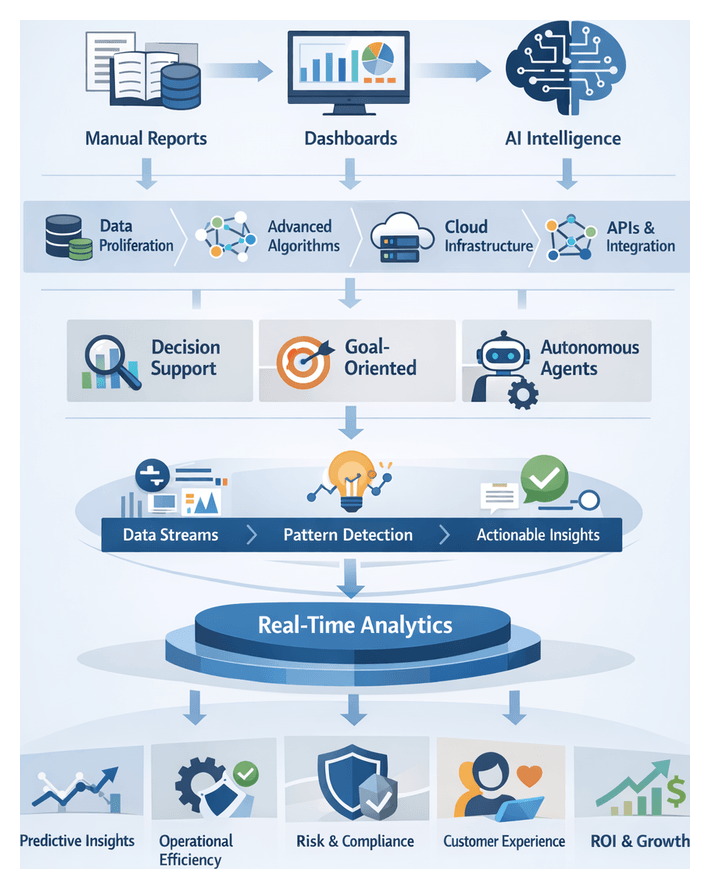
Over the past several decades, business intelligence has advanced from manual ledgers and overnight batch reports to self-service dashboards and, more recently, to autonomous intelligence platforms powered by AI.
In the 1980s and 1990s, organizations centralized data in warehouses and relied on IT-driven reporting. The early 2000s introduced self-service tools that empowered analysts and line-of-business managers to query data directly. Despite these gains, rising data volumes, complexity, and accelerated decision cycles revealed the limitations of static dashboards and delayed insights.
Today’s enterprises ingest streams of structured and unstructured data from CRM systems, IoT sensors, web logs, social media, and external marketplaces. Traditional BI workflows struggle to keep pace as analysts devote most of their time to cleaning and integrating data rather than extracting insights.
Autonomous intelligence shifts the paradigm from retrospective reporting to proactive, prescriptive analytics. AI agents continuously ingest and normalize multi-modal data, detect patterns, forecast trends, and recommend actions with minimal human intervention. This transition aligns decision support with the tempo of modern business, reducing latency between data arrival and strategic action.
Several factors have converged to drive this evolution:
- Data Proliferation—Rapid growth in data sources and formats demands automated ingestion and synthesis.
- Computational Advances—Deep learning, reinforcement learning, and natural language processing enable adaptive models that refine themselves over time.
- Cloud Infrastructure—Scalable storage and distributed compute lower barriers to enterprise-grade analytics.
- API-Driven Ecosystems—Seamless integration with operational systems embeds intelligence into workflows.
- Demand for Agility—Competitive pressures require fast, contextually relevant recommendations on demand.
By embedding AI agents within decision workflows, organizations transition from nightly ETL and static dashboards to continuous insight delivery. This real-time orientation not only accelerates responses to anomalies—from supply chain disruptions to shifts in customer sentiment—but also enriches strategic depth through holistic analyses that integrate predictive modeling, simulation, anomaly detection, and optimization.
Defining Autonomous AI Agents and Architecture
Autonomous AI agents represent a spectrum of capabilities, from rule-driven alerts to fully self-optimizing systems. Industry maturity models typically describe progression through:
- Decision Support—Agents surface insights based on predefined criteria.
- Goal Orientation—Agents execute tasks within boundaries and refine performance via feedback.
- Autonomous Decisioning—Agents negotiate constraints, reallocate resources, and learn new objectives without human directives.
Architectural paradigms for autonomous agents include:
- Reactive Agents—Respond to stimuli with simple inference engines, suited for structured environments.
- Deliberative Agents—Incorporate planning and knowledge representation for multi-step reasoning.
- Hybrid Cognitive Agents—Combine symbolic rules with statistical learning and leverage large language models for natural language interfaces.
To assess readiness, organizations employ evaluative frameworks that map analytics maturity from descriptive and diagnostic through predictive and prescriptive stages to autonomous decisioning. Performance metrics span both technical and business dimensions:
- Accuracy and Precision—Alignment of predictions with actual outcomes.
- Timeliness—Latency in generating decisions at required data velocities.
- Adaptability—Speed of learning new patterns and handling concept drift.
- Resource Efficiency—Computational cost and scalability under load.
- Business Impact—Improvements in revenue, cost savings, risk mitigation, and customer satisfaction.
As autonomy increases, explainability, trust, and governance become critical. Effective oversight requires:
- Explainable Decisions—Agents provide rationales via feature importance, counterfactuals, or human-readable rules.
- Governance Controls—Policies for approval, escalation, and model revision maintain risk boundaries.
- Continuous Monitoring—Automated detection of drift, bias, and performance degradation ensures reliability.
Domain-specific requirements shape agent design. Financial services emphasize stress testing and compliance; manufacturing prioritizes real-time production scheduling and predictive maintenance; healthcare demands patient data privacy and transparent diagnostic reasoning; retail focuses on segmentation and sentiment analysis. Balancing fully autonomous operation with human-in-the-loop review ensures that routine decisions are automated while high-stakes scenarios escalate to experts under structured protocols.
The Imperative for AI-Driven Insights
In a landscape defined by rapid change and intensified competition, continuous, adaptive insights have become essential. Market leaders and nimble startups alike leverage AI agents to personalize experiences, optimize operations, and accelerate innovation. The inability to harness real-time analytics risks operational inefficiencies, lost market share, and suboptimal strategic decisions.
Data Velocity and Complexity
Enterprises process vast volumes of streaming and static data—IoT telemetry, transaction logs, unstructured text, and social signals. Autonomous AI agents automate data curation, anomaly detection, and trend identification, delivering holistic insights instead of outdated snapshots.
Real-Time Agility
Agents deliver decision-ready recommendations on demand. In logistics, they optimize routes in response to live traffic and weather data. In energy grids, they balance supply and demand instantaneously. Embedding real-time analytics transforms decision making into a continuous practice, enabling rapid pivots and risk mitigation.
Scalability and Resource Optimization
By automating routine analytical tasks—data cleansing, correlation analysis, alert generation—agents free specialized teams to focus on strategic interpretation. Marketing strategists, for example, rely on sentiment analysis agents to process millions of social posts, while cybersecurity teams triage alerts flagged by threat detection agents.
Regulatory and Ethical Compliance
Compliance with GDPR, CCPA, and industry mandates demands traceability, transparency, and bias mitigation. Autonomous agents must incorporate governance frameworks that document data lineage, justify analytical logic, and safeguard sensitive information.
Human-AI Collaboration
The greatest value emerges when AI agents augment, not replace, human judgment. Collaborative models pair machine-driven scenario projections with expert contextual insights. Feedback loops between users and agents drive continuous learning and alignment with evolving business priorities.
Measuring Value and ROI
Effective ROI frameworks integrate operational KPIs—decision latency reduction, forecast accuracy—with business outcomes—revenue growth, cost savings, customer retention. Insurance carriers, for instance, track improvements in claims cycle times and customer satisfaction. Supply chain leaders measure reductions in stock-outs and working capital requirements.
Application Domains
- Customer experience management through dynamic personalization and sentiment monitoring.
- Supply chain resilience via predictive demand forecasting and risk forecasting.
- Financial planning with continuous budgeting, scenario modeling, and anomaly detection.
- Product innovation through trend analysis, competitive benchmarking, and market gap identification.
- Risk management and compliance via automated monitoring of regulatory changes and audit preparedness.
Synthesizing Principles and Forward Outlook
Across maturity models and industry case studies, several themes unite autonomous intelligence implementations:
- Converged Analytics and Conversation—Natural language interfaces translate data into narratives aligned with strategic priorities.
- Interoperability—Seamless integration across legacy systems, cloud services, and external APIs underpins scalability.
- Automation with Oversight—Balanced human-in-the-loop governance refines agent behavior and manages risk.
- Ethics and Trust—Explainability, bias mitigation, and continuous monitoring build stakeholder confidence.
- Domain-Driven Design—Tailored agents yield higher adoption and more actionable outputs than one-size-fits-all solutions.
- Continuous Learning—Agents that learn from feedback and evolving data deliver increasingly precise recommendations.
Embedding these principles transforms operating models: decision cycles accelerate as real-time insights replace batch reporting; departments gain democratized access to consistent intelligence; skilled professionals shift toward scenario planning and creative problem solving; and automated monitoring agents detect anomalies before they escalate.
Despite these benefits, organizations must address key considerations:
- Data Quality and Governance—Accurate, consistent data and clear lineage are foundational.
- Bias and Fairness—Regular assessments prevent inherited training biases from distorting outcomes.
- Explainability Versus Complexity—Balancing model performance with transparent reasoning is critical in regulated sectors.
- Integration Challenges—Clear architectural patterns are needed to avoid fragmented deployments.
- Governance and Accountability—Defined ownership, audit trails, and remediation processes safeguard trust.
- Skill Gaps—Upskilling, role redefinition, and cultural change require sustained leadership support.
- Cost-Benefit Tradeoffs—Comprehensive TCO analyses ensure investments deliver projected value.
Looking ahead, mature organizations will establish centers of excellence to standardize best practices, share reusable components, and curate dynamic catalogs of agent capabilities. The most transformative agents will blend analytical rigor with expansive research and document parsing by converging tools such as ChatExcel, Raycast, Consensus, Perplexity, Humata, and AskYourPDF. These integrated agents will anticipate strategic inflection points, recommend portfolio adjustments, and propose policy changes in real time.
Realizing this vision requires investment in scalable infrastructure, robust governance frameworks, and talent development that bridges data science, domain expertise, and ethical stewardship. Organizations that embed autonomous agents as core components of an intelligent enterprise will sustain competitive advantage in an era defined by data velocity and complexity.
Chapter 1: The Evolution of AI Agents in Business Insights
Emergence of Autonomous Intelligence in Business
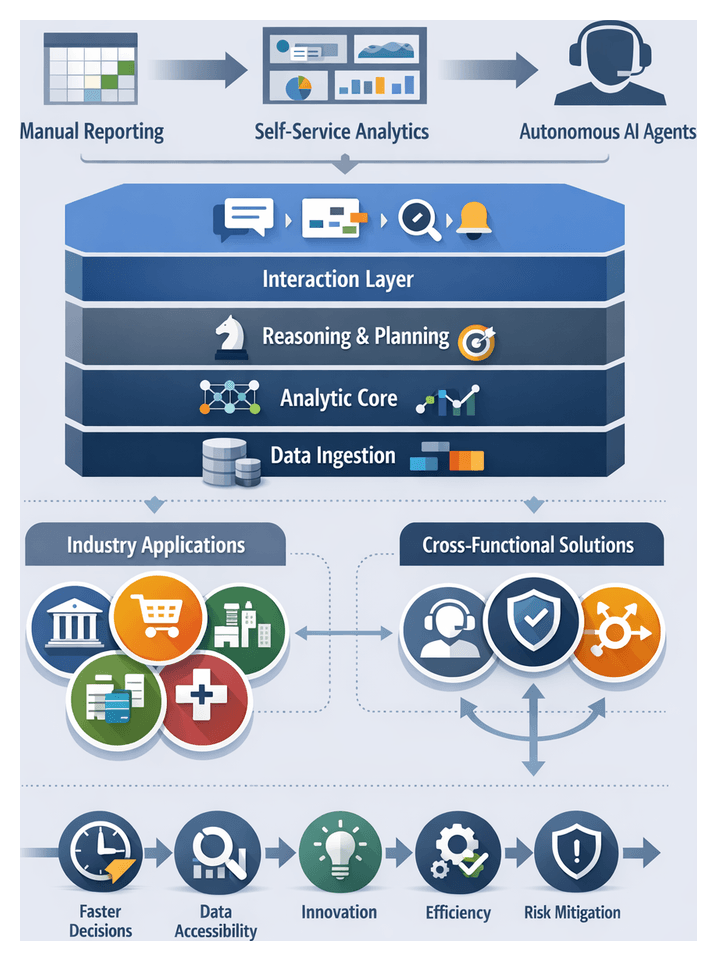
Organizations have progressed from manual reporting in the 1990s to intelligent agents that continuously monitor data, detect patterns, and recommend actions with minimal human intervention. Early BI efforts relied on static spreadsheets and scheduled reports. The advent of OLAP enabled interactive, multidimensional analysis but still required expert query designers. In the 2010s, self-service analytics democratized data exploration but left users overwhelmed by dashboards and alerts. The rise of streaming sources, IoT, and unstructured inputs demanded a new generation of autonomous AI agents capable of end-to-end ingestion, analysis, and proactive guidance.
An autonomous AI agent integrates four core components:
- Data Ingestion Layer: Collects and normalizes data from databases, document repositories, streaming feeds, and APIs.
- Analytic Core: Applies machine learning, natural language processing, and statistical models to detect anomalies, classify information, and forecast outcomes.
- Reasoning and Planning Module: Evaluates scenarios using business rules and optimization routines, prioritizing actions to achieve high-level objectives.
- Interaction Layer: Delivers insights through conversational interfaces, automated workflows, and embedded alerts.
Distinctive capabilities include context awareness, adaptive learning, goal-oriented planning, and explainable reasoning. These features enable continuous monitoring of sales performance, supply chain dynamics, and customer sentiment, transforming disparate inputs into strategic guidance and elevating decision making from reactive to anticipatory.
The Transition to Conversational Analytics
Conversational AI interfaces replace menu-driven dashboards with natural language dialogue, lowering barriers for nontechnical users. Successful implementations translate colloquial queries into precise database operations, maintain context across multiple turns, and integrate insights seamlessly into workflows.
Evaluative Criteria
Adoption frameworks extend models such as the Technology Acceptance Model to include metrics for linguistic fluency, intent recognition reliability, and domain terminology handling. Key dimensions include usability, context retention, and governance:
- Usability and Cognitive Load—Evaluators assess clarity of system prompts, support for follow-up questions, error recovery, and feedback mechanisms that build trust.
- Context Retention and Dialogue Management—Agents must preserve semantic memory, ask clarifying questions, and maintain session continuity to support complex, multi-turn inquiries.
- Analytical Accuracy and Data Governance—Compliance with access controls, exposure of lineage metadata, and audit logging are critical in regulated environments.
Vendor Platforms
- Power BI Q&A provides deep integration with Azure services and semantic modeling for interactive Q&A.
- Tableau Ask Data offers an intuitive question builder and seamless transition to visualizations.
- ThoughtSpot specializes in AI-driven search analytics that scale across large data lakes.
Enterprise Adoption Scenarios and Strategic Impact
Autonomous AI agents now move beyond pilots to strategic deployments across functions and industries. Illustrative use cases reveal common patterns in value creation:
Industry-Specific Scenarios
- Financial Services—Real-time fraud detection and risk scoring streamline investigations and strengthen compliance readiness.
- Retail and E-Commerce—Demand forecasting, dynamic pricing, and personalized promotions drive margin uplift and customer loyalty.
- Manufacturing and Supply Chain—Predictive maintenance and rerouting simulations reduce downtime and inventory costs.
- Healthcare and Life Sciences—Clinical decision support and drug discovery agents accelerate diagnoses and research cycles.
- Energy and Utilities—Grid balancing forecasts and anomaly detection enhance resilience and environmental compliance.
Cross-Functional Deployments
- Customer Experience Management—Agents analyze omnichannel interactions and sentiment to personalize engagement and pre-empt issues.
- Risk, Compliance, and Audit—Continuous policy monitoring and automated audit reporting reinforce governance frameworks.
- Strategic Planning and Corporate Development—Competitive intelligence agents recommend M&A targets and market entry strategies.
- Talent Management and HR—Recruitment and upskilling agents match candidates, forecast workforce needs, and curate training pathways.
- Accelerated Decision Cycles—Weeks of analysis condense to minutes, enabling rapid responses to emerging trends.
- Data-Driven Culture—Natural language access empowers nontechnical stakeholders to interrogate data directly.
- Innovation Acceleration—Agents surface novel correlations and scenario projections, inspiring new offerings.
- Resource Optimization—Predictive insights guide targeted allocation of inventory, R&D budgets, and workforce deployment.
- Risk Mitigation—Continuous alerts preempt compliance and security incidents.
Interpretive Frameworks and Prerequisites
Leaders assess deployments through maturity models, value chain mapping, strategic alignment models, and Return on Analytics (ROA) analyses. Successful scaling depends on foundational capabilities:
- Data Readiness—Governed, accessible data pipelines ensure agent reliability.
- Leadership Sponsorship—Executive buy-in secures resources and cross-functional collaboration.
- Governance and Ethics—Policies for privacy, fairness, and transparency maintain stakeholder trust.
- Skill Development—AI literacy programs and cross-disciplinary teams foster effective adoption.
- Change Management—Pilots, feedback loops, and clear communication ease transitions to AI-augmented workflows.
Key Strategic Lessons for AI Agent Deployment
The journey from manual BI to autonomous agents offers critical lessons to guide future initiatives:
- Balance Automation and Expertise—Delegate data ingestion and routine analysis to agents, while retaining expert oversight for contextual judgment and ethical considerations.
- Ensure Data Integrity—Invest in data cataloging, lineage tracking, and anomaly detection to protect against error propagation and maintain trust.
- Design for Interpretability—Embed explainable components, visualize key drivers, and provide confidence metrics to foster transparency and accountability.
- Integrate Technologically and Culturally—Establish cross-functional governance, pilot programs, and training to align stakeholders and reduce resistance.
- Align with Strategic Objectives—Define clear performance indicators, prioritize high-ROI use cases, and tie agent features to business goals.
- Navigating Regulatory and Ethical Standards—Embed compliance checks, data minimization, and fairness constraints within agent workflows.
- Embrace Iterative Improvement—Leverage feedback loops and performance monitoring to refine models, adapt to new data, and sustain relevance.
- Plan for Scalability—Adopt modular architectures that balance complex strategic analytics with lightweight microservices for real-time queries.
- Mitigate Bias and Ensure Equity—Conduct bias audits, enforce fairness during training, and monitor outcomes across demographic dimensions.
- Foster Cross-Disciplinary Collaboration—Combine domain experts, data scientists, and engineers in co-located teams to align technical solutions with business needs.
- Recognize Autonomy Limits—Implement hybrid models where ambiguous or high-risk decisions escalate to human experts.
- Conduct Economic Analysis—Include data engineering, integration, change management, and support costs in total cost of ownership assessments.
- Develop a Roadmap for Next-Generation Agents—Plan for advanced capabilities such as multimodal processing and agent-to-agent collaboration, anchored by iterative value delivery and governance.
By internalizing these lessons, organizations can navigate the complexities of autonomous intelligence, harness its transformative potential, and maintain a competitive edge in an evolving data-driven landscape.
Chapter 2: Underlying Technologies Powering AI Agents
Technological Foundations of Autonomous AI Agents
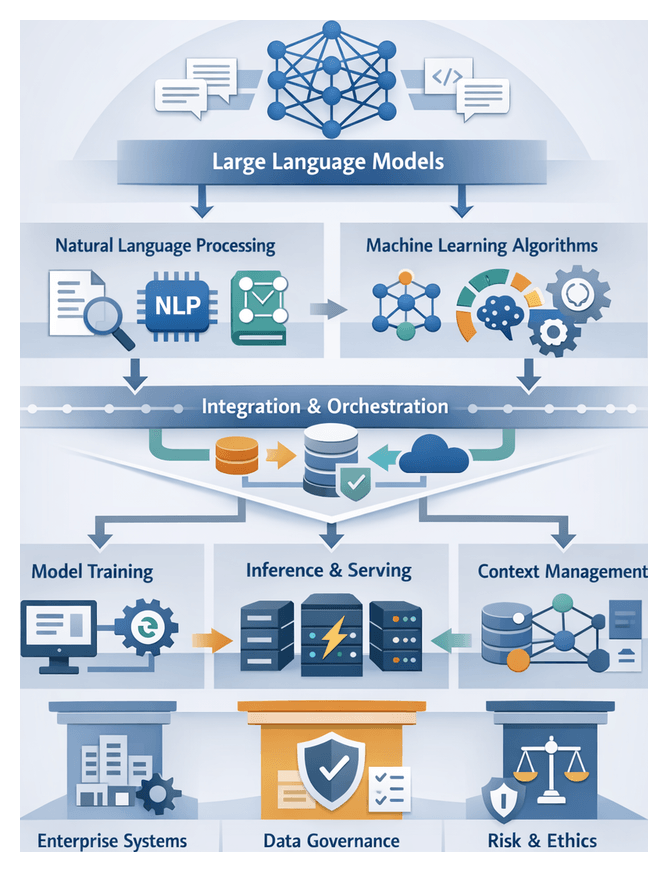
Large Language Models as Cognitive Engines
Large language models power autonomous agents by interpreting, generating, and reasoning over human language. Based on transformer architectures and self-attention mechanisms, these models learn contextual relationships across vast text corpora during pretraining. OpenAI’s GPT series and Hugging Face Transformers serve as prime examples of high-capacity models that can be fine-tuned for domain-specific tasks such as financial analysis or legal contract interpretation. Enterprises often deploy these models in secure enclaves or private clouds to protect sensitive data while leveraging continuous community enhancements.
Natural Language Processing and Semantic Understanding
Specialized NLP engines refine raw text into structured representations. Core components include tokenization, part-of-speech tagging, named entity recognition, dependency parsing, and semantic role labeling. Tokenizers handle subword units to accommodate rare or domain-specific terms. Entity recognition modules extract company names, dates, and monetary amounts. Dependency parsers and semantic role labelers resolve grammar, intent, and “who did what to whom.” Frameworks such as spaCy and adapters within Hugging Face Transformers integrate large language models with task-specific pipelines, ensuring high-throughput, accurate semantic processing.
Machine Learning Beyond Language Models
Beyond language tasks, autonomous agents rely on a variety of machine learning algorithms. Supervised techniques like gradient boosting trees, convolutional neural networks, and recurrent architectures enable predictive analytics and classification. Unsupervised methods such as k-means clustering and autoencoders support customer segmentation and anomaly detection. Reinforcement learning optimizes decision policies through sequential interactions, applicable to dynamic pricing or workflow orchestration. Implementation ecosystems like TensorFlow and PyTorch facilitate distributed training, GPU acceleration, and model serialization, while explainability tools such as SHAP and LIME provide transparency for compliance and stakeholder trust.
Data Orchestration for Scalable Workflows
Robust data infrastructure underpins autonomous intelligence, coordinating ingestion, cleansing, transformation, and feature engineering. Streaming platforms like Apache Kafka and NATS handle low-latency message brokering, while workflow managers such as Apache Airflow and Prefect orchestrate batch pipelines. Cloud-native services like AWS Glue and Google Cloud Dataflow offer managed, serverless alternatives with built-in connectors. Metadata management via data catalogs and lineage tracking ensures auditability, while feature stores such as Feast and Tecton centralize definitions to maintain consistency across training and inference.
Integrating Data, Models, and Infrastructure
Data Pipelines and Orchestration Frameworks
Effective AI agents treat pipelines, models, and infrastructure as an ecosystem rather than isolated layers. Data engineers build ETL and event-streaming processes to handle transactional databases, IoT feeds, and third-party APIs. Apache Kafka and cloud-native event buses supply real-time data streams. Batch processing on Databricks and Snowflake supports large-scale transformations. Integration metrics—end-to-end latency, error rates, and throughput—guide tool selection. Monitoring, alerting, and automated remediation uphold data integrity, driving resilience in AI deployments.
Model Training and Continuous Learning
MLOps platforms and experiment-tracking tools enable reproducible research and production-grade pipelines. Solutions like Kubeflow and MLflow integrate version control, hyperparameter tuning, and CI/CD for model retraining. Retraining triggers—time-based or performance-driven—balance data freshness with operational risk. Distributed training on GPU clusters, spot instances, or serverless environments optimizes resource utilization. This continuous learning approach ensures agents adapt to evolving customer behaviors and market shifts.
Inference Workflows and Real-Time Serving
Deployment strategies vary from batch inference to online serving. TensorFlow Serving, TorchServe, and NVIDIA Triton Inference Server provide scalable endpoints for model inference. Key considerations include latency guarantees, autoscaling, and fault tolerance with circuit breakers and canary deployments. Performance monitoring—P99 latency, throughput under load, and cost per inference—informs infrastructure tuning. A mature serving layer integrates A/B testing and fallback mechanisms to maintain availability of critical AI services.
Context Management and State Handling
Stateful context management is essential for coherent agent interactions. Vector databases such as Pinecone and Weaviate index embeddings, support namespace isolation, and perform similarity searches. Session tracking and retrieval-augmented generation frameworks preserve conversation histories and decision contexts. Balancing in-memory caches and persistent stores optimizes speed and durability. Rigorous privacy controls safeguard sensitive identifiers and personal preferences, meeting data protection standards.
Enterprise Integration and Governance
Interoperability and Architectural Alignment
Seamless integration with legacy systems and modern services depends on API-first strategies, event-driven architectures, and domain-driven design. Standardized interfaces reduce friction, enabling AI agents powered by OpenAI or Microsoft Copilot to plug into existing workflows. Microservices and containerization facilitate modular upgrades, supporting evolving model versions and context services without disrupting enterprise operations.
Data Governance, Quality, and Compliance
Embedding AI agents amplifies the need for robust governance. Frameworks like the Data Management Maturity Model guide capabilities in metadata management, lineage tracking, and policy enforcement. Detailed catalogs document data sources, transformation logic, and feature vectors. Access controls enforce role-based permissions and encryption protocols. Quality assurance rules and statistical monitors detect anomalies or bias, ensuring that autonomous agents produce reliable, auditable outputs aligned with regulatory requirements.
Organizational Roles and Change Management
Successful integration reshapes organizational structures. A Center of Excellence coordinates best practices and governance for AI agent lifecycles. Hybrid teams of data engineers, AI specialists, and business analysts align technical feasibility with domain relevance. Change management programs prepare staff through transparent communication and training, framing agents as collaborative tools. Performance metrics span technical KPIs—latency and throughput—and strategic impact measures such as decision cycle time and cost savings.
Risk, Ethics, and Explainability
Scaling AI agents raises risk, ethical, and compliance considerations. Methodologies like OCTAVE Allegro assess threats and prioritize mitigations. Privacy impact assessments guard against regulatory penalties. Bias and fairness audits leverage SHAP and LIME for interpretable analytics. Zero-trust security models protect endpoints and data stores. Transparent explainability satisfies regulators and fosters stakeholder trust, balancing the power of deep neural networks with the need for interpretability in regulated industries.
Balancing Trade-Offs for Scalable, Sustainable AI
Model Scale, Performance, and Cost
High-capacity LLMs such as GPT-4 excel in broad reasoning but impose computational and latency costs. Smaller domain-tuned models offer faster responses at lower expense. A dual-tier architecture leverages a general model for complex queries and lightweight models for routine tasks, optimizing resource utilization while maintaining analytical depth.
Deployment Paradigms and Vendor Ecosystems
On-premise environments grant control over data governance and latency but demand capital investment and operational expertise. Public cloud platforms provide elasticity and managed services for AI workloads. A hybrid approach balances regulatory compliance with agility. Proprietary solutions often include optimized performance and support SLAs, while open-source frameworks such as Hugging Face Transformers promote transparency and avoid lock-in. Enterprises commonly adopt blended strategies, standardizing on open standards and selectively integrating proprietary modules for specialized functions.
Processing Paradigms and Real-Time Constraints
Batch workflows on Databricks and Snowflake suit large-scale transformations but incur latency. Streaming architectures with Apache Kafka or cloud event buses enable low-latency insights for customer sentiment monitoring or fraud detection. High-frequency decision environments may deploy quantized models at the edge to meet millisecond constraints, accepting modest accuracy trade-offs. Analysts align processing paradigms with service-level objectives and query patterns to meet business needs.
Limitations and Operational Considerations
- Data privacy and governance require anonymization, lineage tracking, and strict access controls to meet GDPR, CCPA, and industry-specific mandates.
- Talent shortages in data engineering, machine learning, and DevOps necessitate ongoing training, partnerships, and upskilling programs.
- Vendor lock-in and interoperability challenges can be mitigated with abstraction layers, open standards, and containerized deployments.
- Total cost of ownership includes compute resources, model retraining, infrastructure maintenance, and staffing overhead, demanding rigorous cost governance.
- Change management and cultural readiness hinge on transparent communication, stakeholder involvement, and incremental rollouts that demonstrate value.
- Algorithmic bias and ethical implications require regular audits, fairness metrics, and integration of bias detection methodologies into development pipelines.
- Scalability boundaries must be addressed through elastic provisioning, distributed inference, and capacity planning to accommodate peak demand.
- Continuous monitoring of model drift, latency trends, and usage patterns, coupled with automated retraining and remediation, secures ongoing agent reliability.
Chapter 3: Data Analysis and Visualization with AI Agents
Autonomous AI-Driven Data Interpretation Agents
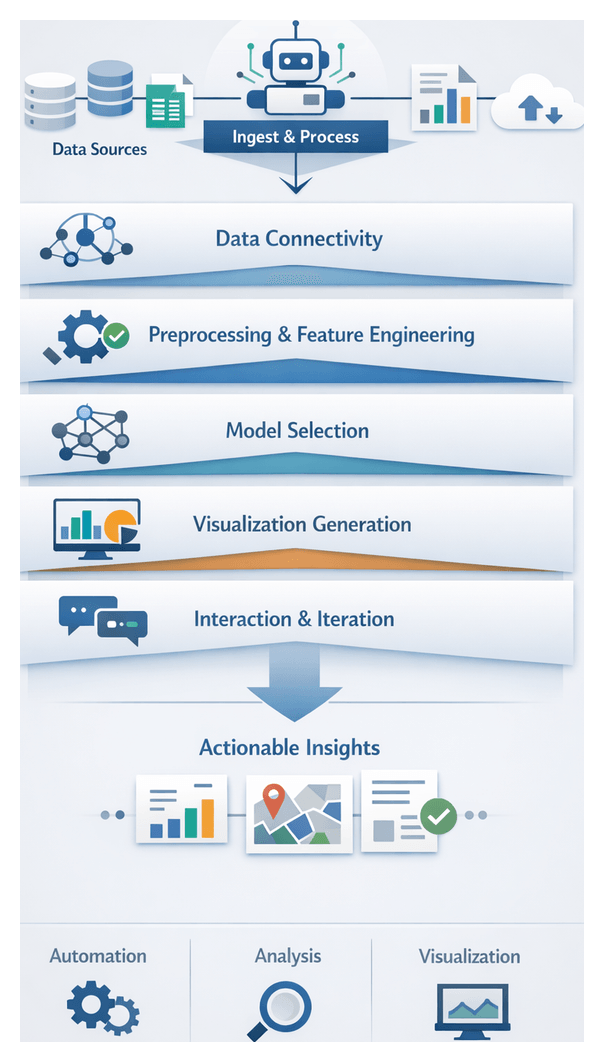
In an era defined by rapidly expanding data volumes and complexity, autonomous AI-driven agents transform raw information into actionable insights without manual intervention. These systems ingest structured and unstructured sources—relational databases, spreadsheets, logs, documents and streaming feeds—perform automated cleansing, normalization and feature engineering, apply statistical tests or machine learning models, and generate context-aware visualizations and narrative summaries in real time. By automating connectivity to on-premises and cloud data platforms, handling schema variations and missing values, and selecting optimal analytical methods, they accelerate the analytics lifecycle and free decision makers to focus on strategy rather than data mechanics.
At the heart of these agents lies an end-to-end workflow comprising five stages:
- Data Connectivity: Securely establishing connections to diverse sources and reconciling authentication protocols.
- Preprocessing and Feature Engineering: Cleansing raw inputs, detecting outliers, imputing missing values and deriving new features.
- Analytical Model Selection: Automatically choosing and tuning statistical or machine learning algorithms based on metadata and objectives.
- Visualization Generation: Mapping results to charts, heat maps, geospatial plots or dashboards, annotating key patterns and enabling interactivity.
- Interaction and Iteration: Supporting conversational queries and GUI controls that allow users to refine analyses and drill into specific segments.
By embedding logging, versioning and audit trails at each stage, autonomous agents also uphold governance, compliance and reproducibility standards essential for regulatory frameworks such as SOX, GDPR and HIPAA. They democratize analytics through intuitive interfaces, natural language querying and presentation-ready graphics, empowering business analysts, marketing managers and operational leaders to derive insights without relying on scarce data science resources.
Evaluating Visualization Agents
Selecting the right visualization agent requires systematic evaluation across strategic dimensions. Two leading solutions—ChatExcel and Raycast—exemplify distinct approaches tailored to different user personas and workflows. Decision makers should assess capabilities in data input handling, natural language understanding, visualization variety, interaction workflows, integration flexibility, customization, performance and governance.
Data Input Handling and Preprocessing
ChatExcel interfaces directly with spreadsheets, parsing cell ranges, formulas and pivot tables via automated heuristics that detect headers, dates and categorical variables. This hands-off approach suits teams working with moderately sized tabular data. Raycast relies on API-based ingestion of JSON or CSV streams from back-end services. Its explicit data mapping offers flexibility for high-velocity pipelines but demands careful configuration to meet governance and accuracy requirements.
Natural Language Understanding and Prompt Engineering
ChatExcel leverages transformer-based models to interpret free-form queries—”Show quarterly revenue growth by region”—and maintain context for follow-up prompts. Its conversational paradigm supports exploratory analysis akin to dialoguing with a data analyst. Raycast employs AI-assisted command palettes where shorthand keywords map to predefined scripts. This controlled lexicon reduces misinterpretation but limits open-ended inquiry for nontechnical users.
Visualization Variety and Fidelity
ChatExcel generates bar, line, scatter, heatmap and pie charts with configurable axes, color palettes and annotations, producing high-resolution images suitable for executive presentations. It also exports to BI platforms such as Tableau or Power BI. Raycast delivers lightweight inline charts and widgets optimized for rapid prototyping within developer UIs. Its minimalistic style accelerates ad hoc checks but lacks the polish required for stakeholder-facing reports.
User Interaction and Iteration Workflows
Through its chat interface, ChatExcel enables iterative refinement of filters, parameters and drill-downs. Users may encounter session drift over prolonged dialogs, requiring context resets. Raycast’s command chaining facilitates efficient, script-driven transformations but can disrupt the exploratory flow for unstructured analyses. Organizations often maintain shared script repositories to standardize workflows and democratize knowledge across teams.
Integration with Existing Systems
ChatExcel offers native connectors to cloud spreadsheet services, single sign-on and data synchronization across teams. It supplements BI ecosystems via export functions. Raycast features a marketplace of community-contributed extensions for GitHub, Datadog and SQL databases. While the open ecosystem accelerates customization, it also demands rigorous security vetting and governance processes to manage extension provenance and mitigate risks.
Customization and Extensibility
Organizations can extend ChatExcel’s template library through JSON configurations to align with corporate branding and proprietary metrics. Raycast’s JavaScript-based scripts afford maximal flexibility for bespoke transformations and visual logic, but place maintenance burdens on engineering teams. Governance frameworks for script lifecycle management are vital to prevent technical debt.
Performance, Scalability and Cost Efficiency
ChatExcel scales reliably for spreadsheets under several hundred megabytes, though inference latency and licensing costs can rise with larger deployments. Raycast executes commands locally, minimizing cloud latency and consumption fees, but may require hybrid architectures to balance speed with centralized governance. A thorough total cost of ownership analysis should account for inference costs, infrastructure provisioning and support overhead.
Governance, Security and Compliance
ChatExcel provides data encryption at rest and in transit, granular access controls and detailed audit logs. Raycast’s open extension model necessitates zero-trust principles, role-based access controls and network segmentation to secure script execution. Organizations with mature engineering security practices can leverage Raycast effectively, provided periodic penetration testing and sandbox environments are in place.
Actionable Data Storytelling in Practice
Autonomous agents excel when they frame analytical outputs as narratives that guide stakeholders from context through insights to recommendations. The following case studies demonstrate how ChatExcel and Raycast elevate charts into strategic stories.
Retail Demand Forecasting and Inventory Optimization
A national retailer integrated ChatExcel into its BI platform to forecast SKU-level demand across 350 stores. By synthesizing point-of-sale data, promotional calendars and weather feeds, the agent overlaid confidence bands on historical trends, flagged high-variance locations for daily review and embedded collaborative annotations from sales, supply chain and finance teams. This narrative approach reduced lost sales by 15 percent and excess inventory by 12 percent within three quarters.
Healthcare Operational Efficiency and Patient Flow Analysis
A regional hospital network deployed Raycast to visualize patient flow across emergency, surgical and inpatient units. Interactive heat maps narrated bottlenecks by time of day and care pathway, contextualized against staffing levels and case complexity. Sequential storyboards were reviewed in operational huddles, driving a 20 percent improvement in operating room efficiency and a 25 percent reduction in emergency department boarding times.
Financial Services Risk Monitoring and Compliance
An investment bank’s risk division adopted an AI visualization agent to narrate Value-at-Risk movements, portfolio concentrations and stress-test outcomes. The dashboard framed VaR changes as a story, identifying currency and credit drivers, visualizing compliance guardrails with sentiment-based alerts and linking insights to hedging strategies. Daily risk sign-off time fell by 30 percent, and senior interventions became timelier during market volatility.
Manufacturing Predictive Maintenance and Trend Insights
A global manufacturer used an autonomous agent to combine sensor telemetry, maintenance logs and failure histories into interactive trend narratives. Anomaly annotations highlighted inflection points, lifecycle chapters guided inspection cadences and narrative dashboards synchronized predictive insights with shift schedules. Unplanned downtime fell by 40 percent and maintenance costs by 22 percent over six months.
Marketing Campaign Performance and Attribution Modeling
A consumer goods firm deployed an agent to ingest multi-channel spend, clickstream data and sales lift metrics. Layered bar charts and annotated time-series plots walked marketers through channel contributions, lift context and budget reallocation scenarios. This narrative-driven attribution modeling delivered a 12 percent uplift in marketing ROI and boosted confidence in investment decisions across regions.
Best Practices and Strategic Considerations
Maximizing value from AI visualization agents requires rigorous accuracy protocols, proactive mitigation of limitations and alignment with organizational strategy.
- Ensure Data Provenance and Governance: Track lineage, enforce access controls and maintain audit logs to detect biases and comply with regulations.
- Validate Model Outputs: Define domain-specific benchmarks, perform spot-checks with subject-matter experts and monitor error rates, confidence intervals and model drift.
- Mitigate Common Limitations: Retrain agents regularly to prevent overfitting, embed rule-based heuristics to maintain business relevance, adopt standardized visualization guidelines and pair black-box models with explainability modules.
- Embed Governance Frameworks: Establish policies for data access, model updates and user permissions, ensuring accountability and consistency.
- Foster Interdisciplinary Collaboration: Align data scientists, analysts and executives through joint workshops and shared roadmaps that connect technical capabilities with strategic objectives.
- Implement Change Management: Provide training, documentation and knowledge sharing to build AI fluency and accelerate adoption among end users.
- Adopt Iterative Evaluation: Treat deployments as continuous improvement cycles by tracking usage metrics, soliciting feedback and refining agent parameters over time.
- Integrate with BI Ecosystems: Ensure seamless interoperability through well-designed APIs, minimizing duplication and preserving historical reporting contexts.
Emerging Trends and Future Directions
- Multimodal Insight Generation: Fusion of tabular data, text, images and streaming media will yield richer narratives, demanding robust context management.
- Adaptive Visualization Agents: Systems will learn user preferences to personalize styles while maintaining transparency of customization algorithms.
- Ethical Visualization Practices: Frameworks will guide decisions on highlighting or obscuring sensitive information, ensuring privacy and avoiding manipulative representations.
- Democratization of Data Storytelling: Low-code interfaces will empower nontechnical users, with guardrails to prevent misinterpretation or misuse of insights.
- Real-Time Collaborative Analytics: Distributed teams will co-author dashboards and narrative reports in real time, requiring synchronization protocols and conflict-resolution strategies.
By integrating these practices, organizations can harness autonomous AI-driven interpretation and visualization agents as strategic assets, translating raw data into a sustainable competitive advantage.
Chapter 4: Knowledge Discovery and Research with AI Agents
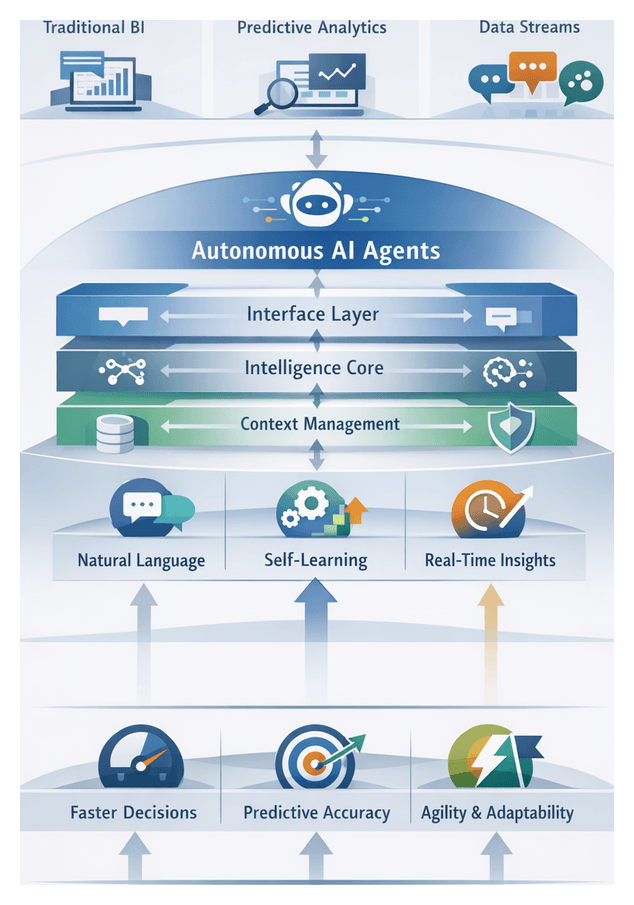
The Evolution and Imperative of Autonomous AI in Enterprise Analytics
Over the past three decades, business intelligence has transformed from static, IT-generated reports into dynamic, self-service environments accessible to line-of-business users. Advances in data storage and computing power spawned interactive dashboards that visualized key performance indicators in near real time, yet these platforms still relied on specialized skills to construct queries and interpret results. As data volumes, velocities, and varieties grew—spanning social media sentiment, sensor feeds, and external market intelligence—traditional BI architectures struggled to integrate and analyze information with the agility required for competitive decision making.
Predictive analytics and machine learning models extended analytics into forecasting and pattern detection, but these efforts often operated in isolated silos, demanded expert data science resources, and delivered insights with latency that limited impact. Autonomous AI agents represent the next frontier in enterprise analytics: systems that proactively ingest diverse data sources, apply advanced reasoning algorithms, and surface actionable recommendations in conversational or programmatic form. By embedding domain context, continuous learning, and real-time data streams, these agents elevate BI from descriptive and diagnostic disciplines to prescriptive, self-optimizing systems.
Today’s markets shift in seconds, customer preferences evolve across channels, and risks emerge without warning. Autonomous AI agents continuously scan complex data landscapes, detect anomalies and emerging trends, and engage decision makers with scenario analyses and execution workflows. This level of responsiveness and contextual understanding was unattainable a decade ago, making autonomous intelligence a strategic imperative for organizations seeking accelerated decision cycles, improved forecast accuracy, and enhanced agility.
Architecting Autonomous AI Agents for Strategic Decision Making
An autonomous AI agent is a system designed to perceive its environment, make decisions, and execute actions with minimal human intervention. In enterprise settings, agents ingest raw data from structured databases, streaming feeds, documents, and knowledge bases; apply statistical methods, machine learning algorithms, and large language models; and generate recommendations or trigger tasks that drive outcomes.
A typical architecture comprises four interconnected layers:
- Data Ingestion: Unifies disparate sources into a consistent format for downstream processing.
- Context Management: Maintains session state, organizational rules, and domain ontologies to ensure policy alignment.
- Intelligence Core: Applies natural language processing, predictive analytics, reinforcement learning, and reasoning to interpret inputs and evaluate actions.
- Interface Layer: Delivers insights via conversational chatbots, API endpoints, or embedded dashboard plugins and orchestrates follow-up workflows.
Key capabilities distinguish autonomous agents:
- Natural Language Understanding: Enables users to pose questions in everyday language.
- Memory and Context Retention: Supports multi-step dialogues, refines analyses based on feedback, and recalls prior interactions.
- Self-Learning Mechanisms: Continuously adapt model parameters and update knowledge bases as new data and outcomes emerge.
In practice, an AI agent might monitor sales and inventory data, detect a regional stock shortage, generate replenishment scenarios, simulate cost and delivery impacts via a messaging interface, and trigger purchase orders once a decision is reached. This integration of data processing, strategic reasoning, and automated execution transforms raw information into tangible business value.
Measuring and Optimizing Information Retrieval Efficiency
In knowledge discovery and research, measuring retrieval efficiency is critical to ensure AI-driven platforms surface relevant, high-quality insights. Evaluation spans technical metrics tied to algorithms and business-oriented indicators that reflect user satisfaction and strategic impact.
Indexing and Query Processing
Efficient retrieval begins with content representation. Traditional inverted indexes map terms to document locations for fast keyword lookups. Modern platforms integrate vector embeddings from transformer-based models to capture semantic relationships, enabling retrieval of conceptually similar passages even without exact keyword matches. Key evaluation criteria include index size, update latency, and retrieval speed for both keyword and semantic queries.
Ranking and Relevance Scoring
After candidate passages are retrieved, relevance scoring orders results. Statistical models like BM25 rely on term frequency and inverse document frequency for interpretability and scale. Neural ranking models fine-tune transformer architectures on click-through data or explicit relevance judgments to deliver richer semantic understanding at higher computational cost. Composite frameworks blend signals such as semantic similarity, lexical relevance, content freshness, and source authority. Platforms like Perplexity weight these signals dynamically based on query context and user preferences.
- Normalized Discounted Cumulative Gain (nDCG): Measures alignment with graded relevance judgments.
- Mean Reciprocal Rank (MRR): Reports the average position of the first relevant result.
- Click-Through Rate Lift: Indicates user engagement improvements after deploying new scoring models.
Precision, Recall, and Trade-Offs
Precision reflects the proportion of retrieved items that are relevant, while recall measures the proportion of relevant items that are retrieved. High-recall settings—such as regulatory analysis or systematic literature reviews—prioritize exhaustive retrieval through aggressive query expansion and lower scoring thresholds, accepting increased noise. High-precision contexts—where executives need concise, decision-ready answers—tighten ranking thresholds and emphasize authoritative sources to minimize review burden.
- Precision@K: Proportion of relevant items among top K results.
- Recall@K: Proportion of all relevant items retrieved within top K results.
- F1 Score: Harmonic mean of precision and recall for balanced evaluation.
User-Centric Metrics and Benchmarking
Beyond algorithmic measures, user-centric metrics capture the real-world experience of analysts and decision makers. Time to Insight quantifies the interval from initial query to identification of a decision-informing finding. Query Success Rate measures the share of sessions yielding actionable answers without external tools. Session abandonment rate, user satisfaction scores, and assisted query reduction further illuminate adoption and productivity gains.
Benchmarking frameworks—leveraging public datasets such as TREC and custom, domain-specific test collections—enable comparative analysis across systems and over time. Continuous monitoring and A/B testing assess indexing strategies, ranking adjustments, and interface changes against production baselines. Visual dashboards, statistical significance analyses, and cost-benefit evaluations ensure that technical improvements translate into tangible business outcomes.
Deployment Scenarios for Competitive Intelligence
AI-enabled research agents automate the aggregation and analysis of news feeds, patent filings, financial disclosures, and social media streams, transforming competitive intelligence into a continuous capability. By embedding real-time data inputs and probabilistic trend forecasts into established frameworks—SWOT analysis, Porter’s Five Forces, and PESTLE—organizations convert raw signals into strategic narratives that guide planning, innovation, and risk mitigation.
- Strategic Planning and Scenario Analysis
- Product Development and Innovation Pipeline
- Mergers, Acquisitions, and Partnership Due Diligence
- Regulatory Monitoring and Compliance Forecasting
- Market Entry and Expansion Decisions
- Pricing Strategy and Revenue Optimization
- Benchmarking and Performance Tracking
Product strategists leverage platforms like Consensus and Perplexity to distill research abstracts into prioritized feature lists and technology readiness levels. M&A teams accelerate due diligence by extracting patterns from filings, mapping executive networks, and gauging social sentiment. Regulatory teams scan global rulings and draft regulations, correlating approval timelines with competitor pipelines. Expansion initiatives assess regional dynamics through local reports, price lists, and consumer sentiment. Pricing strategists ingest competitor offers and inventory data to forecast optimal price points. Benchmarking units track public financial metrics, patent counts, web traffic, and social engagement to situate performance relative to peers.
Implementing these scenarios transforms competitive intelligence units into continuous insight centers. AI agents handle data acquisition and preliminary analysis, enabling human experts to focus on interpretation, hypothesis validation, and strategic recommendation. Cross-functional integration via open APIs and standardized schemas embeds insights into dashboards, ERP systems, and collaboration platforms, ensuring real-time guidance within everyday processes. Governance protocols—combining automated quality checks with human review—maintain data integrity and ethical usage. Continuous improvement loops compare decision outcomes against AI forecasts, recalibrating agent performance in alignment with evolving market conditions and organizational strategies.
Evaluating Research Accuracy and Insight Depth
Deploying AI agents for knowledge discovery requires rigorous evaluation of both accuracy—alignment of assertions with verifiable facts—and insight depth—the capacity to situate those facts within broader conceptual frameworks. A layered validation approach combines automated metrics and expert review. Precision, recall, and F1 score establish a quantitative baseline, while subject matter specialists assess contextual interpretation, thematic coverage, and synthesis quality.
Assessing Depth through Concept Mapping
Concept mapping techniques evaluate how effectively an agent connects discrete data points into coherent idea networks. Metrics such as coverage ratio (proportion of core concepts captured) and coherence score (logical relationships among concepts) guide depth assessments. Domain-specific ontologies and taxonomies further tailor these measures to organizational priorities.
Source Reliability and Bias Mitigation
AI agents draw on heterogeneous repositories with varying credibility. Source weighting schemas assign reliability scores based on peer review status, author credentials, publication date, and publisher reputation. Periodic bias audits address algorithmic, recency, and topical biases by analyzing output distributions and enforcing guardrails that preserve historical context alongside emerging research.
Operationalizing Balanced Scorecards
Balanced scorecards integrate retrieval effectiveness, synthesis quality, source reliability, and operational efficiency into a unified evaluation framework. Target thresholds align with risk appetite and strategic goals. Regular reviews and stakeholder alignment sessions drive iterative improvements and ensure that AI-driven insights meet performance expectations.
Governance and Continuous Model Stewardship
Governance protocols combine automated quality checks—such as citation verification and contradiction detection—with human oversight to mitigate hallucinations and contextual errors. Drift detection algorithms and scheduled retraining maintain alignment with evolving knowledge landscapes. Feedback loops compare actual decision outcomes against AI forecasts, enabling agents to recalibrate weighting schemes and improve relevance over time.
By uniting technical rigor, human judgment, and robust governance, organizations can scale AI-driven research workflows without compromising on accuracy, depth, or ethical standards. The orchestration of autonomous AI outputs within human-led strategic processes delivers sustainable competitive advantage in an era defined by complexity and rapid change.
Chapter 5: Document Comprehension and Q&A Agents for Enterprises
Core Mechanisms of Document Analysis Agents
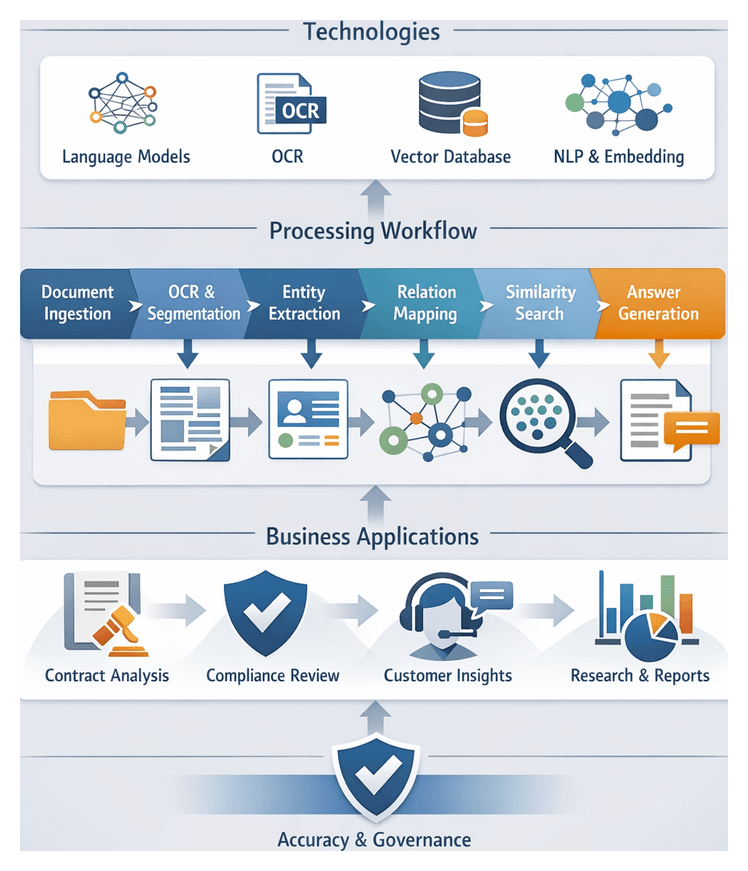
Document analysis agents leverage advanced natural language processing and machine learning to convert unstructured text into structured insights. These autonomous systems support enterprises in interpreting legal contracts, technical manuals, customer correspondence, and regulatory filings by automating parsing, semantic indexing, and contextual understanding. Key capabilities include optical character recognition for scanned files, text segmentation to detect chapters and tables, entity recognition for names, dates, and monetary values, relation extraction to map connections between clauses, semantic embedding for similarity search, and natural language generation for summaries and query responses.
Fundamental Technologies
- Transformer-Based Language Models such as BERT, RoBERTa, and GPT, fine-tuned on domain-specific corpora to capture semantic nuance.
- OCR Engines that preserve document layout while converting images and PDFs into machine-readable text.
- Embedding Frameworks like Sentence-BERT that generate high-dimensional vectors for sentences and paragraphs.
- Vector Databases including Pinecone and Milvus for rapid similarity search over millions of embeddings.
- Hybrid Information Retrieval Pipelines combining inverted-index search with neural re-ranking to balance speed and relevance.
- Natural Language Generation Modules that produce coherent extractive or abstractive summaries tailored to user queries.
Operational Workflow
- Document Ingestion: Automated transfer from content management systems, cloud storage, email servers, or network drives.
- Preprocessing and OCR: Layout analysis and text cleaning for scanned or image-based content.
- Segmentation and Annotation: Division into logical units annotated with metadata (author, date, type).
- Embedding Generation: Conversion of each unit into vector representations.
- Indexing and Storage: Storage of embeddings in vector databases alongside traditional search indexes.
- Query Processing: Natural language queries embedded and matched against the index to retrieve relevant passages.
- Answer Generation: Generative models synthesize retrieved content into concise, context-aware responses.
- Delivery and Feedback: Results delivered via UI or API, with user feedback captured to refine models.
Enterprise Use Cases
- Contract Review and Management: AI agents such as Humata identify termination rights, indemnities, and renewal terms to accelerate due diligence.
- Regulatory Compliance: Automated analysis of policy updates and audit reports to pinpoint obligations in finance, healthcare, and manufacturing.
- Customer Support Knowledge Bases: Conversational agents powered by AskYourPDF answer complex inquiries with document-backed responses.
- Research and Competitive Intelligence: Real-time summarization of white papers, market studies, and news releases.
- Internal Knowledge Discovery: Consolidation of siloed repositories to surface historical decisions and expertise across teams.
- Policy Analysis in Healthcare and Finance: Extraction of reimbursement guidelines and reporting standards to identify compliance gaps.
Accuracy Assessment in Legal and Regulatory Review
Reviewing legal and regulatory documents demands precision to avoid penalties and operational risk. AI-driven comprehension agents must be evaluated through rigorous frameworks that address the complexities of legal language, benchmark performance, and ensure governance and auditability.
Complexities of Legal Language
Legal texts feature specialized jargon, multi-party clauses, cross-references to statutes or schedules, and context-dependent definitions. Effective agents employ domain-adapted tokenization, specialized entity recognition, and custom ontologies to preserve semantic fidelity. Accuracy assessment extends beyond word-level matching to verifying that obligations, rights, and conditions are correctly mapped and contextualized.
Key Evaluation Metrics
- Precision, Recall, and F1-Score for extracted entities and clauses.
- Clause Detection Rate: Proportion of relevant clauses identified versus a human-annotated gold standard.
- Obligation Extraction Accuracy: Correct capture and labeling of duties, rights, and prohibitions.
- Cross-Reference Resolution Score: Ability to link in-text references to statutes, schedules, or prior clauses.
- Context Preservation Index: Degree to which extracted segments retain interpretive context.
Benchmarking and Interpretive Frameworks
Benchmarking leverages validated datasets such as the Contract Understanding Atticus Dataset (CUAD) and proprietary, annotated corpora focused on risk clauses and indemnity provisions. Beyond metrics, interpretive frameworks from legal hermeneutics and discourse analysis diagnose systematic errors:
- Hermeneutic Circle: Iterative contextual review refining clause interpretation and overall document purpose.
- Rhetorical Structure Theory: Verification that functional roles of clauses (elaboration, justification, condition) are preserved.
- Ontological Alignment: Mapping entities and relationships to a formal legal ontology for consistency.
- Pragmatic Context Evaluation: Recognition of situational cues such as jurisdictional scope or industry regulations.
Human-in-the-Loop Auditing
- First-Pass Extraction Review: Legal professionals annotate false positives and omissions.
- Semantic Consistency Check: Experts verify obligations, rights, and definitions in context.
- Regulatory Compliance Validation: Compliance officers confirm alignment with current statutes.
- Continuous Feedback Loop: Annotated corrections refine model performance over time.
Platforms like Humata and AskYourPDF support collaborative auditing by enabling trackable annotations and side-by-side comparisons of source text and AI summaries.
Confidence Calibration and Governance
- Aggressive thresholds for low-risk documents and conservative thresholds, with mandatory human review for high-risk contracts.
- Adaptive thresholding based on document type, clause complexity, and stakeholder risk tolerance.
- Versioned model deployment, explainability logs, and access controls to maintain audit trails.
- Dashboards tracking false-positive and false-negative rates for continuous refinement.
Interactive Question-and-Answer Applications
Interactive Q&A agents transform static document repositories into conversational partners. By engaging in dialogue, users obtain context-aware insights that accelerate decision cycles, reduce cognitive load, and democratize organizational knowledge.
Contract Negotiation and Due Diligence
AI assistants parse clause hierarchies, compare deviations from standard templates, and flag risk exposures. Teams can query “Which contracts expose us to termination fees over one million dollars?” or “Where do indemnification obligations cover third-party conduct?” Real-time analysis of nested references and cross-document relationships expedites negotiations and drives consistency.
Regulatory Compliance and Policy Interpretation
Compliance officers query policy documents against regulatory texts to surface divergences and generate tailored summaries. Questions such as “Which internal policies require updates for the new data privacy regulation?” yield pinpointed clauses, recommended revisions, and comparative tables between legacy and updated language.
Customer Support and Service Intelligence
Support teams use agents like Humata and AskYourPDF to translate technical manuals and service logs into step-by-step guidance. Queries such as “How do I reset the network module on the X500 router?” produce coherent solutions drawn from manuals and past support cases, reducing resolution times and improving customer satisfaction.
Knowledge Sharing and Onboarding
Centralized Q&A interfaces unify training materials, project archives, and best practice guides. New hires ask “What were the key milestones in Project Orion?” or “Which templates does finance use for quarterly forecasts?” The agent retrieves project plans, meeting minutes, and reporting frameworks, accelerating ramp-up and fostering continuous learning.
Executive Briefing and Strategic Decision Support
Leaders pose high-level queries such as “What are the top regulatory risks in Europe?” or “How does our roadmap compare to competitors?” Agents synthesize multiple strategic documents into concise, evidence-based insights, enhancing agility and focus at the executive level.
- Interactive Q&A agents convert repositories into conversational partners, improving speed and precision.
- Contract analysis benefits from real-time clause comparison and risk identification.
- Compliance teams gain proactive policy interpretation and streamlined audit readiness.
- Support functions deliver faster, document-backed solutions.
- Onboarding leverages centralized access to institutional memory.
- Executives extract high-level summaries without manual report review.
Security, Governance, and Operational Resilience
Secure and reliable deployment of document AI requires multi-layered safeguards, transparent governance, and robust operational practices to mitigate risks and maintain trust.
Security and Privacy Architecture
- End-to-end encryption with enterprise key management systems.
- Zero-trust network principles to isolate AI resources and reduce lateral movement.
- Data loss prevention policies to block unauthorized exfiltration of sensitive content.
- Secure enclaves or homomorphic encryption for inference on encrypted data.
- Sanitization, tokenization, and redaction applied before invoking services such as Google Document AI or Azure Form Recognizer.
Explainability and Transparency
- Evidence tracing by logging source passages alongside AI responses.
- Presentation of confidence scores and probability distributions for key extractions.
- User feedback loops capturing corrections to refine model outputs.
- Model registry tracking versions, training snapshots, and fine-tuning parameters for auditability.
Governance and Compliance
- Data classification aligned with regulatory and organizational risk profiles.
- Approval gates for data ingestion, model fine-tuning, and production rollout.
- Standard operating procedures for incident response when outputs contravene policy.
- Comprehensive audit trails of data access, model interactions, and user overrides.
- Cross-border data transfer controls and rights to explanation under privacy statutes.
- Automated validation suites comparing AI outputs against expert-validated benchmarks.
- Monitoring for model drift, data drift, and service latency with alerting mechanisms.
- Disaster recovery plans with fallback to human review or legacy parsing systems.
- Capacity planning and load testing to maintain performance during peak demand.
Key Considerations and Limitations
- Data Sensitivity: Anonymization and on-premises hosting for highly regulated content.
- Model Hallucinations: Human-in-the-loop review for high-stakes documents to intercept fabricated outputs.
- Domain Specificity: Fine-tuning on curated corpora to improve handling of specialized jargon.
- Regulatory Complexity: Ongoing adaptation to evolving requirements across jurisdictions and sectors.
- Explainability Constraints: Partial visibility into transformer decision logic necessitates thorough testing.
- Integration Trade-Offs: Middleware and API orchestration to connect AI agents with legacy systems.
- Resource Intensity: Substantial compute and storage demands that impact total cost of ownership.
- Human Oversight Balance: Defined thresholds for automation versus manual validation to sustain quality control.
A holistic approach combining advanced technology, rigorous evaluation, collaborative governance, and continuous monitoring enables enterprises to unlock the full potential of AI-driven document intelligence while managing associated risks.
Chapter 6: Competitive Intelligence and Market Analysis Agents
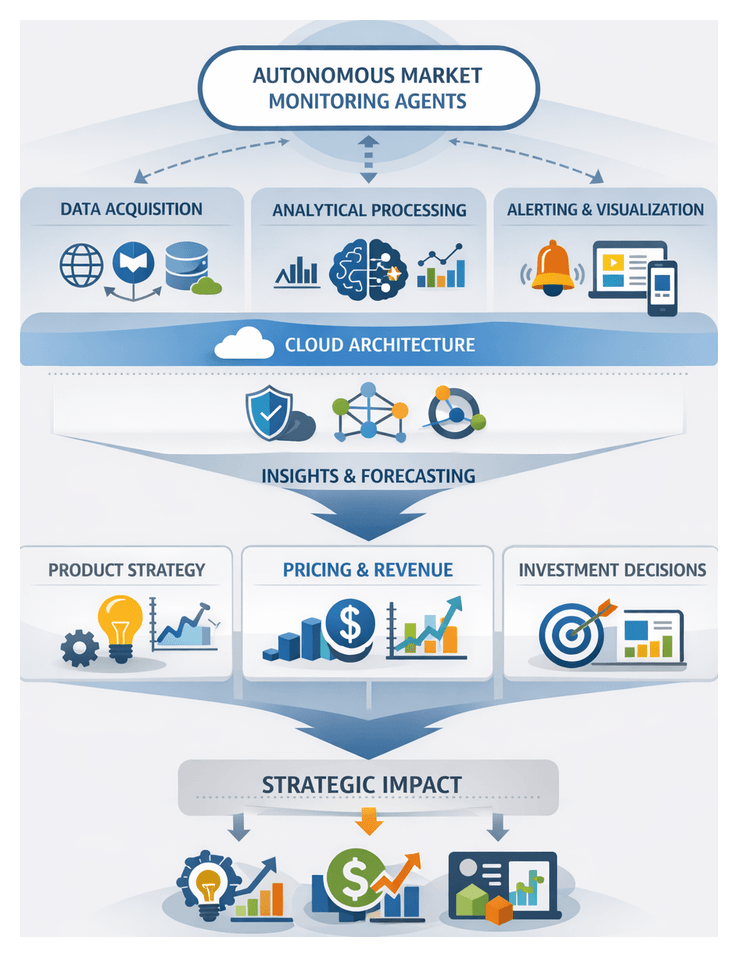
Strategic Foundations of Autonomous Market Monitoring Agents
In an environment defined by accelerating digital footprints and intensifying competitive pressures, autonomous market monitoring agents have emerged as essential tools for continuous competitive intelligence. These software entities ingest structured and unstructured data—from news feeds, social media, regulatory filings, competitor websites and internal systems—then apply natural language processing, machine learning and predictive analytics to detect trends, anomalies and strategic signals in real time. Unlike periodic reports or static dashboards, these agents operate 24/7, delivering actionable insights that inform product development, pricing, investment decisions and risk mitigation.
At their core, market monitoring agents integrate three capabilities:
- Data Acquisition: Continuous web scraping, API ingestion and connector-based integration with CRM, ERP and regulatory databases to maintain broad coverage and up-to-date information.
- Analytical Processing: Modular libraries of statistical classifiers, topic models, sentiment analyzers and time-series forecasters that classify, cluster and predict market variables.
- Intelligent Alerting and Visualization: Customizable rule engines and natural-language summarization that deliver insights via dashboards, mobile alerts and conversational interfaces.
These components rest on a cloud-native architecture that ensures elastic compute, modular workflows and secure governance. Semantic enrichment through knowledge graphs and domain ontologies adds industry-specific context, while logging, version control and access management uphold compliance and auditability. Together, they support a closed-loop intelligence cycle in which data is ingested, insights are generated and recommendations are delivered to decision makers.
Historically, market intelligence relied on manually assembled reports that lagged behind real-time events. Early automation—rule-based scrapers and keyword alerts—reduced manual effort but lacked scalability and adaptability. The integration of machine learning and large language models in the 2010s enabled automated classification, entity extraction and sentiment scoring. Today’s agents incorporate reinforcement learning for adaptive thresholds and deep semantic understanding, elevating competitive intelligence from a periodic function to an embedded, strategic capability.
Strategic implications are far-reaching. In product development, agents surface feature gaps and emerging customer needs. Pricing teams leverage competitor price movements and elasticity models for dynamic revenue management. Corporate development uses opportunity scoring and patent analysis for M&A screening. Risk management gains early warnings of compliance violations or supply-chain disruptions. By embedding autonomous monitoring across organizational workflows, enterprises shift from reactive responses to proactive strategies.
Methodologies for Trend Forecasting
Selecting the right forecasting methodology is critical to translating data streams into reliable projections. Competitive intelligence teams balance model interpretability, computational requirements and adaptability to evolving market conditions. Key approaches include:
- Statistical Time-Series Models — Techniques such as ARIMA, Holt-Winters exponential smoothing and structural time-series analysis offer transparent decomposition into trend, seasonal and irregular components. Evaluative criteria include metrics like AIC, BIC and Ljung-Box tests to assess fit and residual autocorrelation.
- Machine Learning and AI-Driven Techniques — Algorithms such as Random Forests, XGBoost, Support Vector Regression and neural architectures like LSTM networks capture nonlinear behaviors and complex interactions. Platforms such as DataRobot and H2O.ai provide automated model selection, hyperparameter tuning and explainability modules using SHAP values and partial dependence plots.
- Pattern Recognition and Signal Detection — Clustering (K-Means, DBSCAN) and anomaly detection (Isolation Forest, One-Class SVM) frameworks identify emergent behaviors and regime shifts. Event-based signals from platforms like PredictHQ augment historical trends to surface early warning indicators.
- Ensemble and Hybrid Strategies — Stacking, blending or weighted averaging of statistical and AI models leverages complementary strengths. Analysts assess diversity metrics, out-of-sample robustness and resilience to concept drift through back-testing and Monte Carlo simulations.
- Real-Time and Streaming Forecasting — Online learning algorithms in libraries such as River and incremental stochastic gradient descent enable continuous model updates. Streaming architectures powered by KX or Apache Kafka balance latency and accuracy through sliding-window recalibration and anomaly thresholds.
- Agent-Based Simulations and Scenario Forecasting — Monte Carlo simulations and multi-agent interactions generate a spectrum of plausible futures. Resources like those listed on AgentLink AI illustrate how simulated outputs integrate with SWOT or OODA frameworks to anticipate competitor moves and regulatory shifts.
When comparing methodologies, organizations use multi-criteria decision frameworks that consider data characteristics (volume, granularity, stationarity), model complexity (compute needs, expertise), interpretability (transparency, diagnostics), scalability (across markets and product lines), resilience (to drift and disruptions) and integration (with existing BI platforms and data pipelines). Interpretive frameworks such as Predict-Prepare-Perform or Balanced Scorecards ensure that forecasts map to readiness indicators and strategic objectives, transforming raw projections into actionable guidance.
Embedding Insights into Strategic Planning
Integrating agent-generated intelligence into strategic planning elevates static annual roadmaps to dynamic, adaptive frameworks. Cross-functional synthesis of signal interpretation and hypothesis testing ensures that market signals become core inputs to product, pricing and investment decisions.
Aligning Intelligence with Product Roadmaps
- Trend Extrapolation: Agents detect shifts in keyword usage across developer forums, social media and patent filings, informing quantitative forecasts of feature demand.
- Gap Analysis: Automated benchmarking against competitor feature launches and customer sentiment highlights white-space opportunities.
- Risk Scenario Calibration: Monitoring supply-chain disruptions or regulatory developments enables contingency planning within roadmap governance.
These insights feed into iterative feedback loops within product governance forums, allowing teams to adjust feature sequencing and resource allocation as market signals evolve.
Informing Pricing and Revenue Strategies
- Competitive Benchmark Monitoring: Continuous scraping of listed prices, discounts and bundling practices feeds into dynamic pricing engines.
- Elasticity Modeling: Agent-driven simulations incorporating historical sales data and macroeconomic indicators support real-time adjustments.
- Promotion Effectiveness Evaluation: Immediate attribution of campaign performance enables iterative refinement of discount levels and timing.
By embedding these streams into value-based pricing models and customer lifetime value analyses, organizations sustain margins while responding swiftly to competitive moves.
Guiding Investment and Portfolio Decisions
- Market Attractiveness Scoring: AI agents assess growth rates, competitive intensity and regulatory risks, informing net present value and risk-adjusted return analyses.
- Portfolio Diversification Analysis: Comparative intelligence on adjacent markets identifies mitigation strategies for concentration risks.
- M&A Target Screening: Automated profiling of potential acquisition candidates based on innovation signals, patent activity and partnership announcements.
Standardized decision gates map intelligence outputs to predefined criteria, ensuring alignment with corporate risk appetite and long-term value creation targets.
Cross-Functional Integration and Governance
Enterprises establish intelligence councils or centers of excellence that define interpretation protocols, data quality standards and escalation pathways. Cross-functional representation from strategy, finance, product, marketing and legal harmonizes perspectives on conflicting signals. Balanced Scorecards incorporate agent-derived metrics across financial performance, customer satisfaction, internal processes and learning and growth. Scenario planning workshops leverage agent simulations to stress-test strategic assumptions, embedding clear accountability and feedback loops that refine both AI models and human interpretation.
Measuring Strategic Impact
Effectiveness is gauged through leading indicators—such as time from insight to action and the percentage of revenue influenced by agent-informed decisions—and lagging measures like market share changes and ROI on strategic initiatives. Economic Value Added (EVA) analyses isolate incremental value from intelligence-driven projects, while risk reduction metrics quantify avoided losses. A comprehensive impact dashboard triangulates these metrics, providing executives with visibility into how autonomous insights translate into tangible outcomes.
Interpretive Frameworks
AI outputs gain strategic meaning when anchored in established models. Porter’s Five Forces benefits from empirical signals on competitor actions, supplier dynamics and customer bargaining power. PESTEL analyses draw on real-time geopolitical and regulatory intelligence, while SWOT assessments integrate trend data to validate strengths and expose threats. Technology adoption lifecycle models forecast diffusion curves using early adopter sentiment and channel readiness. By weaving AI insights into these frameworks, organizations ensure decisions rest on both robust data and time-tested conceptual structures.
Key Considerations for Adoption and Governance
- Data Quality and Coverage: Evaluate data vendors and public feeds for completeness, timeliness and bias, balancing proprietary subscriptions with open‐source sources.
- Analytical Framework Alignment: Map AI-driven intelligence to strategic models—such as Porter’s Five Forces or PESTEL—to enhance interpretability and executive buy-in.
- Systems Integration: Ensure seamless connections to CRM, ERP, planning tools and BI platforms, embedding trend dashboards within Microsoft Power BI or Salesforce via APIs.
- Governance and Oversight: Define policies for model retraining, data retention and access control. Cross-functional governance teams should monitor performance metrics, audit logs and ethical risk indicators.
- Change Management and Skill Development: Invest in training and rotational programs to cultivate hybrid analysts skilled in data engineering, model validation and strategic interpretation.
- Scalability and Performance Trade-Offs: Balance real-time processing needs against compute costs. High-frequency monitoring may demand streaming architectures, while strategic forecasting can leverage batch workflows.
Limitations and Risk Management
- Model Bias and Signal Noise: Historical data may embed past biases. Conduct regular bias audits and sensitivity analyses to identify skewed inputs or spurious correlations.
- Overfitting to Recent Events: Avoid false alarms by combining scenario-based stress testing with ensemble forecasting techniques that guard against excessive focus on short-term shocks.
- Interpretability Challenges: Ensemble and deep-learning architectures can be opaque. Employ explainable AI methods such as SHAP or LIME to enhance transparency and stakeholder trust.
- Data Privacy and Compliance Constraints: In regulated industries, vet data sources and model outputs against legal frameworks to ensure adherence to privacy and intellectual property requirements.
- Vendor Dependence: Monitor roadmaps and exit strategies of third-party platforms—such as AlphaSense, Crayon and CB Insights—to mitigate risks associated with service discontinuation or feature changes.
Forward-Looking Perspectives
As market dynamics accelerate, autonomous agents will evolve from monitoring and forecasting to prescriptive strategy generation and adaptive planning. Early adopters will pilot self-optimizing agents that not only surface insights but also propose countermeasures, resource reallocations and competitor engagement tactics. To prepare, organizations must cultivate data maturity through robust governance, cloud-native architectures and interdisciplinary teams. Regular scenario workshops will calibrate agent outputs against changing business objectives, regulatory landscapes and technology disruptions. By viewing AI-driven intelligence as a continuous strategic capability—underpinned by ethical guardrails and human-centered oversight—enterprises can navigate complexity, seize emergent opportunities and sustain competitive advantage.
Chapter 7: Customer Insights and Sentiment Analysis Agents
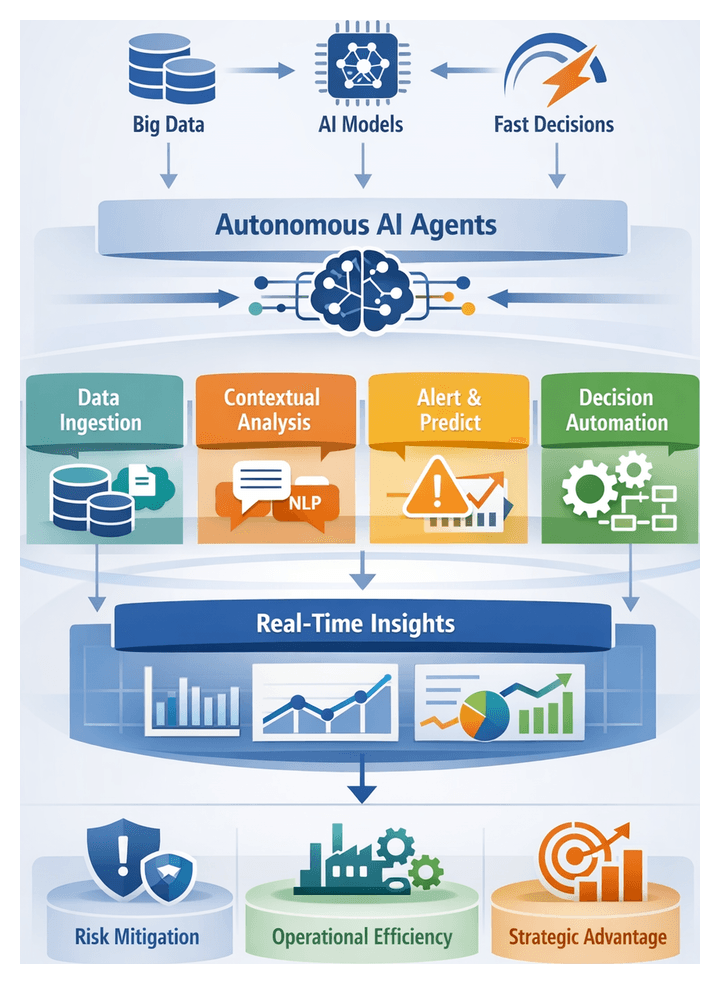
The Evolution of Autonomous Intelligence in Business
Over the past decade, enterprises have confronted unprecedented volumes, varieties, and velocities of data. Traditional business intelligence—reliant on manual reporting and static dashboards—struggles to deliver the real-time insights needed for agile decision making. Autonomous intelligence represents a transformative response, shifting from on-demand mining of static data to continuous, end-to-end analysis, interpretation, and recommendation by software agents. These agents ingest structured and unstructured sources—ERP and CRM systems, IoT telemetry, social media feeds, market reports—and apply machine learning, natural language processing, and automated orchestration to generate context-aware guidance without manual intervention. By reframing data as a dynamic resource rather than a passive asset, autonomous intelligence empowers leaders with predictive foresight and situational awareness, closing the gap between raw data collection and strategic action.
Three converging factors drive this new era of business intelligence: the exponential growth of enterprise data, the maturation of AI models capable of handling complexity at scale, and the imperative for speed and responsiveness in competitive markets. Organizations that embed autonomous AI agents at the core of their operations gain a decisive edge, reducing labor costs, minimizing human error, and surfacing insights to mitigate risks and seize opportunities ahead of peers.
Architecting Autonomous AI Agents
An autonomous AI agent is a software entity that orchestrates complete analytical workflows—from data ingestion to recommendation—operating with minimal human oversight. Key characteristics include:
- Continuous Learning: Models and knowledge bases update as new data arrives, refining predictions over time.
- Contextual Understanding: Natural language processing and semantic analysis enable interpretation of domain-specific terminology and relationships.
- Proactive Alerting: Agents monitor metrics and patterns, issuing real-time alerts when anomalies or opportunities emerge.
- Adaptive Decision Support: Outputs are tailored to user roles, offering high-level summaries for executives and detailed drill-downs for analysts.
- Integration and Orchestration: Seamless connectivity to enterprise systems, APIs, and third-party feeds automates data pipelines end to end.
Typical architecture comprises data connectors, preprocessing engines, inference components, a decision logic layer, and interactive interfaces or APIs. Connectors ingest information from databases, file repositories, streaming platforms, and web services. Preprocessing engines clean, normalize, and enrich data, handling tasks such as entity recognition and feature extraction. Inference modules apply predictive and prescriptive algorithms to uncover patterns, forecast trends, and simulate scenarios. The decision layer orchestrates these insights into coherent recommendations, while user interfaces allow natural-language queries and integration into downstream workflows. This design elevates human participants from routine data work to strategic oversight and ethical decision making, leveraging machine scale and precision while preserving human judgment where it matters most.
The Imperative for AI-Driven Insights
Competitive pressures and rising customer expectations for personalization, speed, and reliability have made autonomous AI agents mission-critical. In sectors from retail and finance to manufacturing and healthcare, information flows now include real-time telemetry from IoT devices, live customer interactions, and dynamic market indicators that require continuous monitoring and rapid interpretation. Autonomous agents excel at processing streaming data to drive immediate actions—from optimizing supply-chain routes to adjusting pricing strategies or responding to emergent consumer sentiment.
Modern enterprises face growing complexity: distributed organizational structures, heterogeneous data environments, and stringent regulatory frameworks. Autonomous AI agents unify silos, enforce governance policies, and deliver consistent, auditable insights. Financially, they reduce labor costs, minimize human error, and surface predictive signals that mitigate risks—such as supply shortages or compliance violations—while personalizing customer experiences to boost loyalty and drive revenue growth. Organizations delaying integration of autonomous intelligence risk strategic blind spots and eroding competitiveness, whereas early adopters secure a sustainable advantage by embedding AI-driven decision support at every level.
Evaluating Sentiment Analysis Models
Sentiment analysis is central to understanding customer attitudes across social media, surveys, reviews, and support interactions. Solutions fall into four categories:
- Lexicon-Based Models: Rely on predefined dictionaries assigning sentiment scores to words. They offer transparency and simplicity but struggle with context, sarcasm, and domain-specific vocabulary.
- Machine Learning Classifiers: Use supervised techniques—such as support vector machines or logistic regression—trained on labeled datasets. Their performance hinges on feature engineering quality and training data representativeness.
- Deep Learning and Transformer-Based Models: Employ architectures like bidirectional LSTM networks or pre-trained transformers (for example, BERT). These models capture semantic nuances and informal language more effectively but demand substantial computational resources.
- Hybrid Approaches: Combine lexicon heuristics with machine learning or deep learning to balance interpretability and accuracy, leveraging dictionary precision alongside contextual embeddings.
Experts interpret model outputs using three analytical frameworks:
- Continuous Sentiment Spectrum: Scores text along a negative-to-positive axis for granular trend analysis, particularly useful for streaming social feeds.
- Categorical Classification: Assigns discrete labels—positive, negative, neutral—simplifying survey reporting but potentially obscuring nuance.
- Aspect-Based Sentiment Analysis: Decomposes text into topics or features, linking sentiment scores to each aspect to inform product development and customer experience interventions.
Rigorous evaluation combines statistical metrics and domain benchmarks:
- Precision, Recall, and F1 Score for classification tasks.
- Accuracy and AUC-ROC for assessing discriminative capability across probability thresholds.
- Correlation with Net Promoter Score (NPS), Customer Satisfaction (CSAT), or churn rates to validate sentiment as a proxy for broader metrics.
- Human Annotation and Inter-Annotator Agreement (for example, Cohen’s kappa) to establish ground truth and address subjective nuances.
- Cross-Validation and Holdout Testing to ensure stability and prevent overfitting, with continuous monitoring for model drift.
- Benchmarking against public datasets such as SemEval, Twitter Sentiment Corpora, and customer review collections.
Real-world challenges include handling textual noise, sarcasm, rapid topic shifts, multilingual code-mixing, and bot or spam content. Effective pipelines incorporate bot-detection filters and retraining triggers to maintain relevance. For survey data—characterized by longer, context-rich responses and consistent prompts—models must capture paragraph-level coherence and align sentiment scores with Likert-scale distributions, while ensuring equitable performance across demographic segments.
Leaders balance key trade-offs in model selection:
- Interpretability versus Predictive Power: Transformer-based systems like those built on Hugging Face deliver accuracy at the cost of explainability, prompting investments in explainable AI techniques.
- Speed versus Depth of Analysis: Shallow lexicon or ML methods enable real-time monitoring; deep architectures offer nuanced insights but incur higher latency.
- Generalizability versus Domain Specificity: Pre-trained models excel across contexts but may underperform on industry jargon without fine-tuning.
- Cost of Ownership: Commercial APIs such as Google Cloud Natural Language and IBM Watson Tone Analyzer provide managed services with subscription fees, while open-source frameworks require in-house deployment expertise.
Ongoing governance ensures sustained performance:
- Drift Detection Mechanisms trigger retraining when distributions shift beyond thresholds.
- Performance Dashboards track accuracy, F1, and annotation agreement across sources and segments.
- Annotation Refresh Cycles sustain ground truth relevance, especially during market or product changes.
- Bias and Fairness Audits reveal disparate errors across subgroups, guiding corrective measures.
- Cross-Functional Review engages marketing, customer support, and product teams to align technical outputs with strategic goals.
Applying Customer Sentiment Across the Enterprise
Customer sentiment fuels strategic planning, product innovation, marketing, and customer experience. Senior leaders map sentiment trends to frameworks such as the Balanced Scorecard or Objectives and Key Results (OKRs), linking qualitative feedback to pillars like innovation, operational excellence, and customer intimacy. Cross-functional collaboration ensures that sentiment analytics inform quarterly business reviews and annual roadmaps, transforming descriptive insights into strategic accelerants.
For product development, two interpretive frameworks predominate:
- Voice-of-Customer Matrix: Cross-references sentiment intensity with mention frequency to pinpoint high-impact features for enhancement or new product launches.
- Sentiment Trend Lifecycle: Monitors trajectories over time to guide prototype prioritization, iterative improvements, or sunsetting decisions in alignment with agile delivery cycles.
Marketing and brand positioning benefit from three lenses:
- Competitive Sentiment Benchmarking: Compares brand sentiment against competitors to identify differentiation opportunities.
- Sentiment Moment Map: Aligns peaks and troughs with campaigns, launches, or events to assess impact.
- Emotion-Driven Content Framework: Uses sentiment taxonomy—joy, trust, anger, surprise—to craft narratives that evoke desired emotional responses.
Customer experience teams deploy the Sentiment-Infused Customer Journey Model, overlaying sentiment scores onto each lifecycle stage—from awareness through renewal—to detect friction points and inform targeted remedies. In subscription-based industries, sentiment trajectories integrated with NPS metrics improve churn prediction and enable proactive retention playbooks.
Harmonizing multichannel feedback—social media, review sites, live chat, email surveys, forums—requires the Cross-Channel Sentiment Continuum. By normalizing scales and weighting channels based on volume, influence, and demographic representation, organizations derive a unified sentiment landscape. Channel Sentiment Correlation Analysis reveals alignment or divergence across touchpoints, guiding balanced interpretation and cohesive strategy.
Embedding sentiment into formal decision frameworks—such as the Sentiment-Governance Matrix, which categorizes decisions by impact horizon and sentiment sensitivity—ensures clear accountability and action flows. Operational triggers dispatch support resources for medium-sensitivity alerts, while strategic pivots on high-sensitivity signals convene cross-functional steering committees. Integrating sentiment dashboards into executive agendas and performance management systems fosters customer-centric accountability and drives continuous improvement.
Ensuring Validity and Actionability of Insights
Trustworthy sentiment analysis rests on two pillars: validity, ensuring that metrics reflect genuine customer attitudes, and actionability, translating insights into prioritized initiatives. Four best practices guide robust sentiment projects:
- Observability and Interpretive Clarity: Surface confidence intervals and feature contributions behind sentiment scores. Metadata—such as intensity ranges, negation markers, and keyword weights—reveals drivers of each classification, enabling targeted refinements.
- Data Triangulation: Fuse social, survey, transactional, support, and call-center data to construct a holistic view. Align quantitative metrics—NPS, customer effort scores—with qualitative signals from NLP to detect leading indicators and isolate campaign impacts.
- Bias Mitigation and Representativeness: Conduct bias audits at ingestion, annotation, and post-modeling stages. Assess demographic coverage, employ diverse annotator cohorts, and use fairness metrics to prevent skewed interpretations across segments.
- Contextual Calibration: Adapt lexicons and embeddings for local dialects, industry terminology, and evolving slang through periodic annotation refresh cycles and manual review of high-impact outputs.
Actionability demands seamless integration into strategic processes. Embed sentiment themes into product backlogs, marketing plans, and executive dashboards rather than treating them as standalone reports. Map specific complaints—such as onboarding friction—to development tickets. Use narrative clusters to guide content strategies and emotion trends to refine messaging tone. Clear governance structures must assign ownership, define escalation protocols, and ensure resource allocation for follow-through.
- Model Confidence Monitoring: Continuously track confidence scores and feature attributions to detect drift and maintain stakeholder trust.
- Cross-Validation of Trends: Validate sentiment signals across multiple data modalities to reduce reliance on any single stream.
- Governance and Sponsorship: Establish executive sponsorship and cross-functional governance to secure timely action on sentiment-driven insights.
By combining transparent modeling, multi-source triangulation, bias mitigation, and contextual sensitivity, organizations can elevate the credibility of their sentiment intelligence. Embedding validated insights into routine decision forums ensures that the voice of the customer drives measurable strategic impact, while governance frameworks sustain long-term viability amid evolving market dynamics and regulatory constraints.
Chapter 8: Integrating AI Agents into Enterprise Workflows
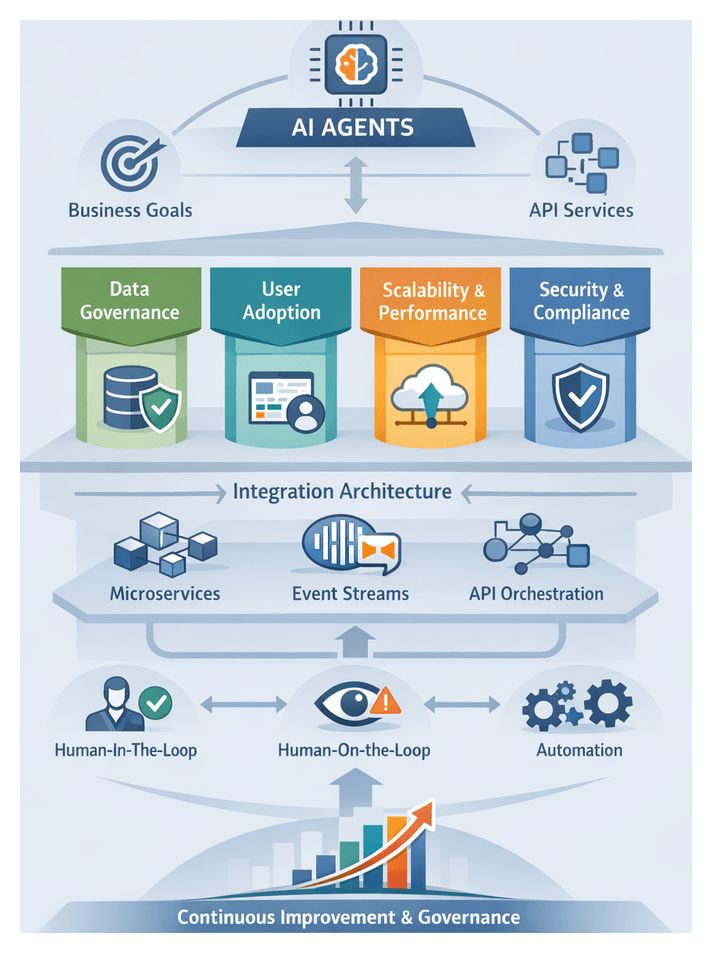
Embedding AI Agents within Business Workflows
Integrating autonomous AI agents into established business processes requires a strategic framework that aligns technological capabilities with organizational objectives. By embedding agents as modular, API-first services, enterprises can achieve continuous, context-aware analysis and automate routine decisions without disrupting existing systems. The following principles guide successful deployments, ensuring scalability, trust, and value realization.
Alignment with Strategic Objectives
AI agents must serve clearly defined business goals. Begin by identifying decision points or workflow stages—such as supply chain anomaly detection, intelligent lead scoring, or HR query resolution—where agents can improve speed, accuracy, or consistency. Quantify expected impact through metrics like processing time reduction, error rate improvements, or revenue gains. Prioritize use cases that balance high value with integration feasibility to secure early wins and stakeholder buy-in.
Modular and API-First Architecture
Service abstraction enables flexible integration. Package capabilities—natural language understanding, predictive scoring, or contextual recommendations—as discrete microservices. Expose these via RESTful or gRPC endpoints with standardized authentication, error handling, and versioning. Leverage messaging infrastructures such as Apache Kafka for event-driven triggers, decoupling producers and consumers and enabling real-time responsiveness with minimal changes to legacy platforms.
Data Integrity and Governance
Reliable agent outputs depend on high-quality data. Implement automated validation checks for schema consistency, anomaly detection, and lineage tracking. Enforce role-based permissions and encryption standards for data in transit and at rest. Maintain detailed audit trails of inputs, outputs, and decision rationale to support troubleshooting, performance tuning, and regulatory reporting.
User-Centered Design and Adoption
User acceptance hinges on intuitive interfaces, transparent behavior, and clear value demonstrations. Integrate chatbots into collaboration platforms or embed recommendation panels within existing applications to minimize learning curves. Present recommendations alongside confidence scores and key influencing factors. Roll out incrementally—pilot with power users to refine performance and gather feedback before scaling organization-wide.
Scalability and Performance
Design for fluctuating workloads and data volumes. Deploy agents on cloud platforms or container orchestration systems such as Kubernetes, leveraging auto-scaling policies that adjust compute capacity in real time. Optimize inference pipelines with techniques like quantization or batching. Monitor throughput, latency, and resource utilization through performance dashboards and automated alerts to ensure consistent service levels.
Security and Compliance
AI agents introduce new attack surfaces and must adhere to enterprise security standards. Implement input sanitization, anomaly detection, and adversarial testing to harden models. Apply differential privacy or anonymization methods where required. Define incident response plans with automated isolation of compromised components and robust forensic logging to meet compliance mandates such as GDPR or CCPA.
Continuous Improvement and Governance
Embedding AI agents is an ongoing journey. Form a cross-functional governance council—including IT, data science, legal, and business stakeholders—to review performance, approve updates, and monitor compliance. Schedule regular audits for model drift, accuracy, and user satisfaction. Automate retraining pipelines and maintain version control for model artifacts and integration code. Document change management processes to communicate updates and provide training for new features.
Integration Patterns and API Orchestration
Selecting appropriate integration approaches and orchestration frameworks is critical to embedding AI agents effectively. Architects must balance agility, scalability, security, and resilience by combining integration patterns, middleware platforms, and governance practices.
Integration Patterns and Architectural Models
- Point-to-Point Integrations: Direct connections between agents and target systems offer simplicity but risk tight coupling and interface sprawl.
- Enterprise Service Bus (ESB): Centralized middleware routes, transforms, and orchestrates messages but may introduce latency and single-point-of-failure risks without clustering.
- Microservices and API-First Models: Expose agent functions as composable services with versioned API contracts. This supports autonomous teams and scalable deployment, though service discovery and transaction management become more complex.
- Event-Driven and Streaming Architectures: Agents subscribe to event brokers for real-time inference and publish insights as events. This decoupled model supports high throughput but requires robust event schema design and back-pressure handling.
Middleware and Orchestration Solutions
- MuleSoft Anypoint Platform offers connectors for data sources, applications, and messaging systems, enabling visual API and event flow choreography with governance features and prebuilt templates.
- Apigee provides API management with policy enforcement, analytics dashboards, and version control to monitor AI agent endpoints and identify bottlenecks.
- Kong is an open-source API gateway with plugin-based authentication, observability, and traffic transformation. Kong Mesh adds mutual TLS and fine-grained service-to-service policies in microservices environments.
- Azure API Management delivers a unified gateway for serverless functions, containers, and legacy systems, integrating with Event Grid and Logic Apps to orchestrate event-driven AI workflows.
API Management and Governance
APIs define the contract between AI agents and their consumers. Effective governance covers versioning strategies, security protocols (OAuth2, mTLS, JSON Web Tokens, rate limiting), and interactive documentation via developer portals. Policy enforcement for data residency and payload inspection ensures compliance with regulations like HIPAA or industry standards. Usage dashboards and alerts help maintain consistent logging, error handling, and audit trails.
Scalability and Performance Considerations
- Latency Sensitivity: For sub-second response times in chatbots or recommendation engines, minimize network hops and offload model execution to edge or GPU-accelerated environments.
- Throughput and Concurrency: Autoscale AI agent instances and API gateways to handle high traffic from IoT sensors or mobile clients. Tune container orchestration and load balancing for elasticity.
- Data Volume Management: Stage bulk inference workloads in distributed file systems or data lakes to improve efficiency, with robust ingestion pipelines and back-pressure control.
- Resilience and Failover: Use circuit breakers, retries with exponential backoff, and fallback to human-in-the-loop processes to maintain continuity when services become unavailable.
API Orchestration and Composite Services
- Choreography vs Orchestration: Choreography leverages decentralized event handling for loose coupling; orchestration employs a central coordinator for clear control flow and error handling.
- Declarative Workflows: Define pipelines in YAML or JSON using Kubernetes Operators or serverless workflow engines to manage AI-driven processes as infrastructure code.
- Error Propagation and Compensation: Map failure modes in multi-step pipelines to design rollback logic or partial retries informed by SLA-driven compensating transactions.
- Observability and Telemetry: Trace API calls and message flows with distributed tracing and integrate with APM platforms for end-to-end visibility of latency, success rates, and resource usage.
Balancing Automation and Human Oversight
Defining the boundary between automated execution and human intervention shapes organizational trust and accountability. Enterprises view human supervision as a continuum—human-in-the-loop, human-on-the-loop, and human-out-of-the-loop—each suited to different risk profiles.
Supervision Continuum
- Human-in-the-Loop: Agents generate recommendations requiring human approval before action, ideal for high-risk scenarios such as financial trading or clinical decisions.
- Human-on-the-Loop: Agents execute autonomously under human monitoring, with intervention triggered by anomaly detection or alert thresholds.
- Human-out-of-the-Loop: Agents operate independently with periodic audits, suitable for high-volume, low-risk tasks like bulk data categorization.
Risk and Accountability Frameworks
- Risk Identification: Map agent functions to potential failure modes, including bias, model drift, and unintended outcomes.
- Responsibility Assignment: Establish a RACI matrix defining oversight roles for data scientists, analysts, and end users.
- Escalation Paths: Set trigger conditions—confidence thresholds or performance anomalies—for human review.
- Audit Trails and Explainability: Log recommendations, decisions, and interventions to support compliance and stakeholder trust.
- Performance Monitoring: Continuously evaluate metrics for drift, decision quality, and alignment with objectives.
Contextual Application and Cognitive Load
Industry context dictates the appropriate oversight model. In regulated sectors like healthcare or finance, stringent human-in-the-loop controls and explainability are mandatory. In retail or customer service, platforms such as those mentioned on AgentLinkAI enable smooth transitions between automated chatbots and human representatives, balancing efficiency with nuanced judgment. Profiling tasks by complexity and risk ensures human expertise is focused where it adds maximum value, preventing cognitive overload and preserving decision quality.
Organizational Design for Oversight
- Governance Committees: Cross-functional bodies define oversight policies, review critical decisions, and ensure alignment with values and regulations.
- Hybrid Teams: Blended squads of data scientists, domain experts, and operations personnel co-design and refine agent behaviors, fostering shared ownership.
- Continuous Learning Programs: Training initiatives equip employees to interpret AI outputs, challenge assumptions, and contribute to iterative improvements.
Sustainable Deployment and Governance
Sustainable AI agent adoption depends on robust governance, organizational readiness, and continuous improvement. The following considerations ensure long-term resilience and value delivery.
Governance and Policy Development
Establish a governance committee with representatives from legal, security, IT, and business units. Define policies addressing data stewardship, compliance with GDPR, CCPA, or HIPAA, ethical guidelines on fairness, and approval workflows for model updates and architectural changes.
Change Management and Organizational Readiness
Engage stakeholders early by mapping champions and skeptics, and communicate strategic rationale, benefits, and role impacts. Implement training programs for AI literacy and human-agent collaboration. Collect feedback through workshops and pilot retrospectives to refine deployment approaches.
Continuous Learning and Improvement
Monitor agent performance via dashboards tracking accuracy, latency, and user satisfaction. Conduct periodic audits for drift and emerging biases. Maintain version control for models, integration code, and configurations. Establish retraining cadences triggered by data volume thresholds or process changes.
Interoperability and Scalability
Ensure modular integration patterns that decouple agents from specific systems. Implement API gateways for secure, standardized interfaces and version management. Utilize microservices and containerization for elastic scaling. Model infrastructure costs for compute, storage, and networking to optimize total cost of ownership.
Risk Management and Ethical Safeguards
Apply risk frameworks such as FAIR or NIST AI Risk Management to identify and mitigate threats. Conduct data privacy impact assessments, implement fairness metrics and counterfactual analyses to detect bias, and enforce encryption and incident response protocols. Engage ethics review boards for high-stake use cases.
Performance Measurement and Value Realization
Define KPIs covering efficiency gains, error reduction, and revenue impact. Use balanced scorecards that include qualitative indicators like user satisfaction and adoption rates. Employ A/B testing or control groups to isolate agent-driven improvements. Integrate performance dashboards into executive reporting to guide resource allocation.
Addressing Common Challenges
- Data Quality Constraints: Inconsistent or outdated data compromises outputs and trust.
- Legacy System Dependencies: Monolithic applications often require custom connectors, increasing maintenance.
- Organizational Silos: Cross-functional collaboration is essential but hampered by misaligned incentives.
- Regulatory Barriers: Approval delays and strict audit standards can impede deployment.
- Talent Gaps: A shortage of data scientists and change managers can slow innovation.
- Ethical and Bias Concerns: Unchecked biases or opaque logic risks reputational damage.
- Scalability Trade-Offs: Balancing performance costs with latency requirements demands careful design.
By systematically applying these principles, integration patterns, oversight frameworks, and governance practices, organizations can embed AI agents into workflows in a controlled, scalable, and value-driven manner. Sustainable deployment emerges from the interplay of strategic alignment, robust architecture, and a culture of continuous learning, enabling AI agents to become catalysts for innovation and competitive advantage in a data-driven world.
Chapter 9: Governance Ethical and Risk Considerations for AI Agents
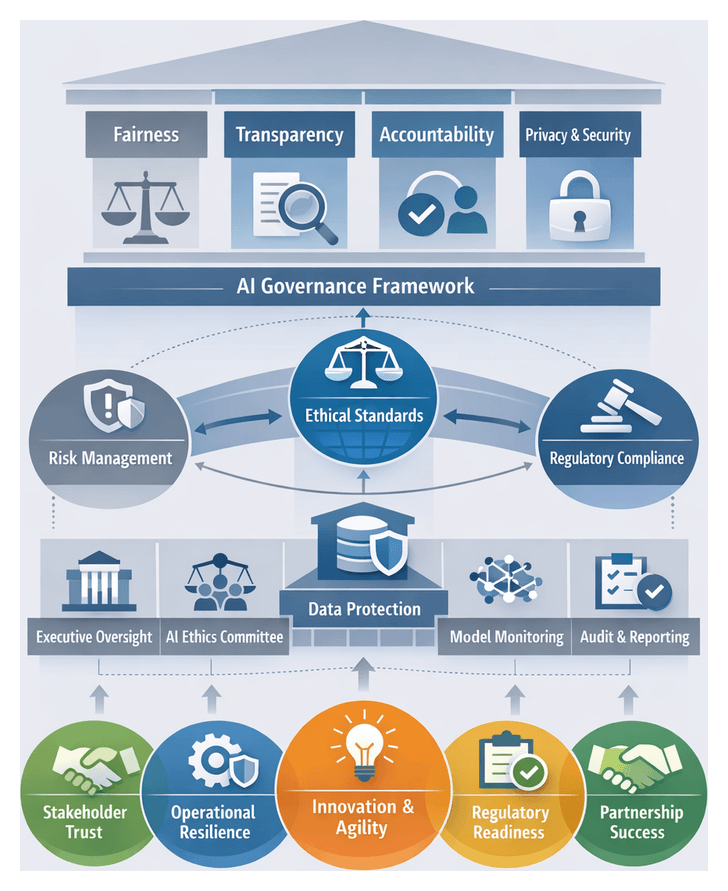
Establishing AI Governance and Ethical Foundations
As enterprises embed autonomous AI agents into strategic workflows, a robust governance framework is vital to ensure alignment with organizational values, regulatory mandates and ethical norms. Unlike traditional software, AI agents learn, adapt and make decisions that can affect stakeholders, legal standing and brand reputation. A comprehensive governance model defines policies, roles and processes that manage risk, enforce accountability and foster transparency throughout the AI lifecycle.
Core ethical principles translate abstract values into operational guardrails:
- Fairness: Mitigate bias through active interventions during data collection, model training and validation to prevent discriminatory outcomes.
- Transparency: Provide explainable decision logic and document data sources to support stakeholder understanding and trust.
- Accountability: Assign ownership for model performance, incident response and remediation to ensure clear responsibility.
- Privacy: Implement data minimization, anonymization and access controls in compliance with regulations such as GDPR and CCPA.
- Safety and Security: Design resilience against adversarial attacks, system failures and unintended actions to protect assets and individuals.
Organizations should adapt these principles to their industry context and risk appetite, embedding them into procurement, development and operational processes to drive ethical AI outcomes.
Established frameworks and standards accelerate governance adoption by aligning practices with global benchmarks. Key references include:
- ISO/IEC 42001 (in development) for AI management systems.
- ISO/IEC TR 24028 on trustworthiness dimensions and continuous assurance.
- IEEE Ethically Aligned Design guidelines.
- NIST AI Risk Management Framework for identifying and managing AI risks.
- OECD Principles on Artificial Intelligence.
- EU Ethics Guidelines for Trustworthy AI and the proposed EU AI Act.
Tailoring these frameworks requires gap assessments to map organizational policies to standard requirements, streamlining compliance and enhancing credibility with regulators and partners.
Defining clear roles and responsibilities embeds governance into organizational culture. Essential functions include:
- Executive Sponsor: Champions AI governance at the board level and secures resources.
- AI Ethics Committee: Reviews high-level policies and adjudicates complex ethical dilemmas.
- Data Protection Officer: Ensures data privacy compliance and conducts impact assessments.
- Risk Management Lead: Identifies and tracks AI-related risks and mitigation plans.
- AI Development Team: Implements governance controls in model design, documentation and testing.
- Internal Audit and Compliance: Verifies adherence to governance policies and reports findings.
Embedding governance across these roles balances innovation speed with the discipline needed for responsible AI operations.
Business imperatives for ethical AI extend beyond compliance, delivering tangible value:
- Stakeholder Trust: Ethical AI fosters customer loyalty and investor confidence.
- Regulatory Agility: Proactive governance reduces fines and accelerates market entry.
- Operational Resilience: Risk management strengthens robustness against threats and failures.
- Innovation Enablement: Clear guardrails guide experimentation, accelerating time to value.
- Partnership Readiness: Governance maturity is a criterion for collaborations and funding.
Organizations can embark on governance implementation through a phased approach:
- Define Vision and Scope: Set objectives, prioritize use cases and determine the framework’s reach.
- Conduct Readiness Assessment: Evaluate current policies, processes and capabilities against ethical and compliance criteria.
- Develop Governance Policies: Draft actionable policies for data privacy, bias mitigation, model validation and incident response.
- Establish Oversight Bodies: Form committees, assign roles and schedule regular policy reviews.
- Design Operational Controls: Integrate checklists for data quality, explainability and performance monitoring into the AI lifecycle.
- Implement Training and Awareness: Educate executives, developers and stakeholders on governance responsibilities.
- Monitor and Audit: Deploy monitoring tools and conduct audits to validate policy compliance.
- Continuous Improvement: Update policies and controls based on audit findings, incidents and regulatory changes.
Risk Assessment, Bias Mitigation and Monitoring
Effective governance demands structured risk assessment and bias mitigation strategies that encompass the full AI lifecycle. Risk in AI agent environments spans multiple dimensions:
- Data Risk: Issues in data quality, provenance and consent that can lead to inaccurate or unlawful data use.
- Model Risk: Performance degradation, overfitting or unintended behaviors outside training conditions.
- Fairness Risk: Systematic disparities in outcomes due to historical biases in training data.
- Security Risk: Vulnerabilities to adversarial attacks, model extraction and data poisoning.
- Operational Risk: Failures in integration, monitoring or rollback mechanisms disrupting business processes.
Analytical frameworks guide systematic risk identification. Standards such as the NIST AI Risk Management Framework and ISO/IEC TR 24028 outline iterative phases: mapping objectives, enumerating threat scenarios, assessing likelihood and impact, prioritizing controls and reviewing outcomes. This evidence-based approach establishes a common language across cross-functional teams and supports audit readiness.
Quantitative fairness metrics enable precise evaluation of bias. Prominent measures include demographic parity difference, equalized odds, disparate impact ratio and calibration error. Trade-offs between accuracy and fairness can be visualized on fairness-accuracy frontiers, facilitating informed decisions aligned with ethical and business priorities. Open-source toolkits such as IBM AI Fairness 360 and Microsoft Fairlearn automate metric calculation, visualization and mitigation algorithm deployment.
Comparative analysis of tool ecosystems helps match solutions to organizational needs:
- IBM Watson OpenScale offers automated bias detection, real-time monitoring dashboards and integration with enterprise MLOps pipelines (best in IBM Cloud ecosystem).
- Microsoft Fairlearn provides in-processing and post-processing mitigation methods, interactive visualizations and open-source flexibility (requires manual pipeline instrumentation).
- Google What-If Tool delivers a no-code, browser-based interface for exploratory fairness testing of TensorFlow models.
- Aequitas produces policy-oriented fairness reports and classification outcome audits (post-hoc analysis only).
Risk assessment is strengthened by combining algorithmic audits with domain expertise. Best practices include model cards and datasheets, ethics review boards for use-case approval and red team exercises to simulate adversarial or bias scenarios prior to deployment.
Bias mitigation strategies fall into three categories:
- Preprocessing: Reweighting, resampling and data augmentation to balance datasets and remove sensitive attributes.
- In-Processing: Integrating fairness constraints or adversarial debiasing objectives into model training.
- Post-Processing: Adjusting model outputs through threshold optimization or output smoothing to satisfy fairness criteria.
Continuous monitoring and model stewardship sustain governance over time. Protocols include:
- Fairness drift detection to flag deviations across protected groups.
- Performance degradation alerts when accuracy falls below thresholds.
- Scheduled revalidation audits following major data or system changes.
- Stakeholder reporting dashboards for real-time visibility into compliance metrics.
Regulatory Compliance and Auditability
AI agents operate in a dynamic regulatory landscape that spans global and sector-specific requirements. Compliance now extends beyond data privacy to include obligations for algorithmic transparency, human oversight and risk mitigation. Key regulations and guidelines include the EU AI Act, GDPR, CCPA, UK AI White Paper recommendations, HIPAA and the Fair Credit Reporting Act.
Analytical frameworks such as the NIST AI Risk Management Framework help map these requirements to internal controls, enabling organizations to maintain strategic agility while ensuring conformity. Auditability mechanisms provide the transparency needed for both internal governance and external scrutiny. Critical elements include:
- Data Lineage: Tracking data origin, transformations and usage.
- Model Versioning: Archiving model iterations, training configurations and performance benchmarks.
- Decision Logs: Recording input-output pairs to support retrospective analysis.
- Bias and Fairness Reports: Documenting disparate impact assessments and error rates.
- Change Management Records: Logging updates to models, policies and security controls.
Platforms such as IBM Watson OpenScale and Microsoft Purview integrate monitoring, documentation and data lineage to create immutable audit trails that demonstrate compliance readiness.
Accountability frameworks rely on cross-functional collaboration among executive sponsors, data governance councils, legal and compliance teams, data scientists, risk officers and internal auditors. Clear role definitions and RACI matrices ensure that each stakeholder group contributes to governance activities, from model conceptualization through production monitoring.
Sector-specific compliance contexts demand tailored protocols. In financial services, requirements include independent model validation, stress testing and rationale documentation. Healthcare mandates robust controls for protected health information, adherence to Good Machine Learning Practice guidelines and demonstrable patient safety. Public sector uses face transparency obligations under freedom of information laws, while manufacturing and critical infrastructure systems require resilience testing and continuity assurances under standards like ISO 31000.
Measuring compliance readiness through metrics and indicators turns abstract principles into actionable insights. Common measures include governance maturity levels, incident response times, audit findings resolution rates, bias detection frequency, documentation coverage and third-party certification status. Continuous monitoring, self-assessments and periodic audits ensure that governance controls evolve with organizational growth, technological advances and regulatory changes.
Building Trustworthy AI Frameworks and Continuous Improvement
Trustworthy AI frameworks integrate ethical design principles, technical safeguards and adaptive policies into a cohesive governance ecosystem. Foundational elements include:
- Transparency and Explainability: Publish model documentation, expose uncertainties and provide interpretable outputs such as feature attributions or counterfactual explanations.
- Fairness: Apply appropriate bias definitions and metrics, such as the four-fifths rule or equal opportunity difference, aligned with domain tolerance and regulatory context.
- Privacy and Data Protection: Use differential privacy, secure multi-party computation and privacy-enhancing technologies throughout the lifecycle.
- Robustness and Safety: Test against adversarial attacks, distributional shifts and system failures, enabling automated fallbacks and human intervention.
- Accountability: Assign ownership for each stage of the AI lifecycle and establish oversight bodies such as ethics boards or executive sponsors.
- Human-Centred Design: Embed human-in-the-loop checkpoints for high-impact decisions.
- Sustainability: Optimize model complexity to minimize environmental and computational costs.
Organizations should harmonize multiple frameworks to build tailored governance structures. Notable sources include:
- Google Responsible AI Practices.
- Microsoft Responsible AI and the Aether Committee’s oversight model.
- OECD Principles on Artificial Intelligence.
- EU Ethics Guidelines for Trustworthy AI and the proposed AI Act.
- NIST AI Risk Management Framework.
- ISO/IEC TR 24028 and ISO/IEC 42001.
- IEEE Ethically Aligned Design.
- IBM AI Fairness 360.
Analytical models support strategic trade-offs and continuous improvement:
- Capability Maturity Models: Benchmark processes from ad hoc to optimized governance.
- Stakeholder Trust Mapping: Identify trust drivers, pain points and targeted interventions.
- Ethical Impact Assessments: Evaluate societal, environmental and reputational implications of AI deployments.
- Risk Taxonomy Frameworks: Align AI risks with organizational risk registers and compliance reports.
Implementing governance faces challenges such as centralized versus federated oversight, cross-functional collaboration, talent scarcity, legacy technical debt, regulatory divergence and cultural change. Mature programs recognize common limitations: policy-practice gaps, model drift, adversarial vulnerabilities, resource bottlenecks, stakeholder conflicts and tooling fragmentation.
Mitigation strategies drive resilience and agility:
- Conduct iterative audits and red team exercises to uncover control weaknesses.
- Engage third-party validators, certification bodies and academic partners for independent assessments.
- Establish stakeholder feedback loops to capture real-world concerns and refine policies.
- Automate governance pipelines for data lineage, bias detection, explainability and audit logging.
- Invest in continuous education through workshops, scenario drills and cross-disciplinary training.
- Implement policy-technology feedback loops to translate technical learnings into governance updates.
- Adopt modular governance designs with baseline controls and optional high-risk modules.
- Harmonize external standards into unified internal policies with living repositories and automated review triggers.
By embedding continuous improvement into governance ecosystems, organizations can sustain AI initiatives that deliver strategic insights, comply with evolving regulations and maintain stakeholder confidence. Trustworthy AI is an ongoing endeavor anchored in responsible innovation, transparent stewardship and collaborative oversight.
Chapter 10: Future Trends and Innovations in AI-Driven Business Insights
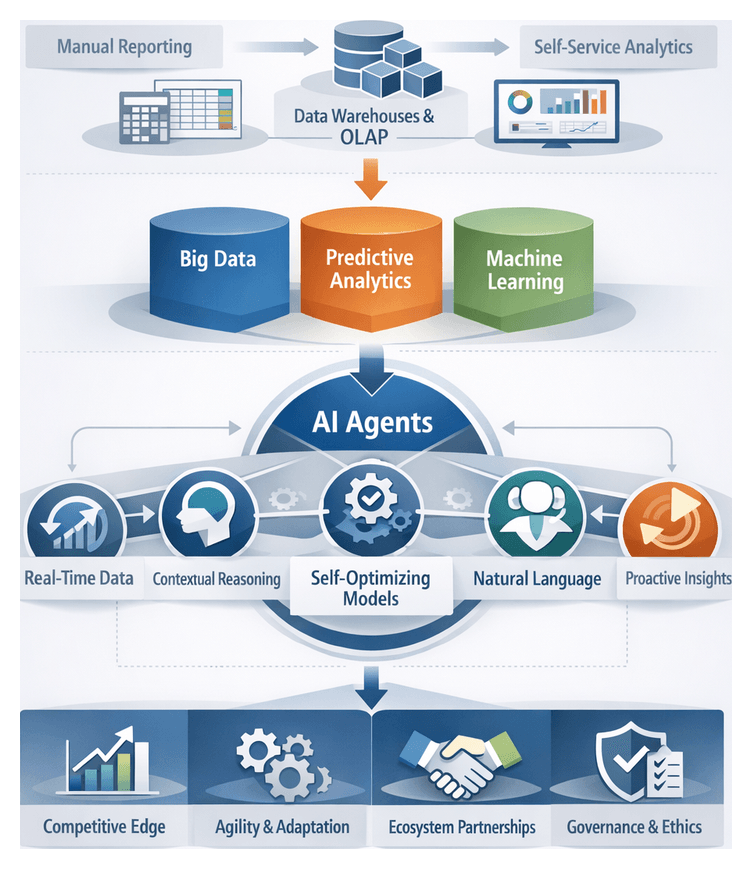
The Evolution of Business Intelligence
The origins of business intelligence trace back to manual reporting cycles in which analysts extracted metrics from heterogeneous systems, assembled spreadsheets, and delivered periodic summaries to leadership. This labor-intensive approach introduced time lags and inconsistencies, yet represented a significant improvement over anecdotal decision making. The democratization of analysis began with spreadsheet software such as Lotus 1-2-3 and Microsoft Excel, enabling users to perform pivots, chart trends, and model scenarios. However, as datasets ballooned, spreadsheets encountered practical limitations in performance, collaboration, error control, and governance.
To address these challenges, organizations invested in data warehousing and online analytical processing architectures in the late 1990s and early 2000s. Extract-transform-load pipelines aggregated transactional records into central repositories, and OLAP cubes provided multidimensional views. While these systems enhanced scalability and consistency, they often required specialized skills and reinforced a divide between IT teams and business stakeholders. The emergence of self-service analytics platforms sought to bridge this gap by offering intuitive drag-and-drop interfaces for dashboard creation, ad hoc query building, and data visualization. Despite these advances, predefined data models and manual configuration limited flexibility, and users grappled with stale data and integration hurdles.
The explosion of big data in the 2010s—driven by IoT sensors, social media feeds, clickstream logs, and multimedia content—amplified volume, variety, and velocity. Traditional relational databases and batch processing frameworks struggled to ingest, process, and analyze these streams in real time. Data lakes and distributed computing architectures provided raw storage capacity, yet translating vast repositories into strategic intelligence remained elusive without continuous, automated analytics. Advances in natural language processing and computer vision began unlocking unstructured data channels, yet end-to-end integration across modalities was fragmented.
Against this backdrop, predictive analytics and early machine learning models offered forward-looking insights, enabling demand forecasting, anomaly detection, and supply chain optimization. These models, however, were static: retraining and feature engineering occurred on scheduled cadences, slowing response to emergent patterns. Organizations recognized that by the time models adapted, market conditions might have shifted, underscoring the need for systems that learn continuously, adjust parameters autonomously, and align recommendations with evolving objectives.
Autonomous intelligence emerges as the next paradigm, leveraging AI-driven agents with five core capabilities: continuous data ingestion and analysis of live streams; contextual reasoning that applies business rules and domain knowledge; self-optimizing models that retrain based on feedback loops; natural language interfaces for conversational engagement; and proactive alerting that surfaces insights and recommendations without explicit prompts. These agents transform passive reporting into proactive discovery, democratize strategic analysis, and accelerate decision cycles from days to minutes.
Enterprises deploying autonomous agents gain strategic advantages in competitiveness and compliance. In finance, healthcare, and manufacturing, AI agents equipped with semantic understanding parse regulatory texts, detect compliance anomalies, and generate audit-ready documentation, reducing risk and freeing experts to focus on innovation. Competitive pressure further motivates adoption: organizations that harness autonomous intelligence achieve superior market foresight, rapid resource allocation, and a cycle of continuous improvement that reinforces agility and resilience.
Successful operationalization demands alignment of technology, people, and processes. Robust data governance ensures quality and lineage tracking. Change management prepares teams for collaborative interactions with AI agents, while skill development initiatives equip professionals to interpret outputs and challenge recommendations. Clear accountability structures, feedback mechanisms, and leadership endorsement foster trust and cultural readiness, ensuring that autonomous intelligence evolves from a technological novelty into a core strategic asset.
Forecasting the Trajectory of Autonomous Intelligence
Strategic investment in AI-driven intelligence requires disciplined forecasting practices that blend qualitative frameworks with quantitative models. Technology life-cycle S-curves visualize performance improvements over successive AI generations, while the Gartner Hype Cycle highlights stages of inflated expectations and eventual productivity. Christensen’s disruptive innovation model defines strategic inflection points when emerging technologies shift from niche to mainstream. By mapping breakthroughs—such as advances in multimodal learning or inference speed—onto these curves, organizations set realistic expectations for capability maturation and adoption rates.
Monitoring lead indicators provides early warning of market readiness. Key signals include:
- Research publishing trends in multimodal learning and autonomous agents
- Venture capital flows into next-generation AI architectures and inference engines
- Open-source contributions to foundational models and tooling
- Standards and regulatory developments in data privacy, transparency, and safety
- Strategic partnerships between enterprise software vendors and research labs
Interpretive lenses categorize innovations into three tiers: incremental changes that enhance existing workflows, modular additions that introduce plug-and-play components like conversational decision agents, and architectural transformations that redefine business models through fully autonomous orchestration. Analysts evaluate each innovation’s disruptive potential against organizational readiness, disintermediation risks, and value creation across the enterprise.
Scenario planning constructs narratives around divergent trajectories—for example, rapid edge computing integration enabling privacy-preserving, decentralized insights versus prolonged reliance on centralized infrastructure emphasizing cost optimization. Each narrative includes strategic roadmaps specifying investment triggers—such as inference latency thresholds or regulatory milestones—ensuring adaptive resource allocation.
Quantitative forecasting models apply time-series analysis to metrics like compute cost per FLOP, model parameter growth rates, and data throughput volumes. Diffusion-of-innovation curves project adoption lifecycles, while network analysis of open-source activity uncovers collaborative dynamics. Text mining of patents and conference proceedings surfaces nascent research themes. Ensemble models integrate these projections, assigning probabilistic confidence levels to different scenarios.
Expert networks and structured elicitation techniques like the Delphi method capture tacit knowledge from AI researchers, data scientists, business leaders, and consultants. Anonymous feedback loops refine forecasts, surface hidden assumptions, and mitigate overconfidence. This collective intelligence supplements quantitative models and informs strategic decision making.
Translating forecasts into executable strategy demands cross-functional alignment. Product teams map capability milestones to release plans. Finance integrates scenario-based projections into capital expenditure and risk models. Talent management addresses skill gaps in reinforcement learning, federated governance, and ethical AI. Governance processes track forecast accuracy, comparing predictions to outcomes and recalibrating models. A balanced portfolio approach aligns high-confidence near-term initiatives with exploratory bets on disruptive innovation.
Strategic Scenarios for Early Adoption
Organizations that embrace autonomous AI agents ahead of the mainstream accelerate innovation, refine competitive positioning, and influence emerging standards. Four strategic scenarios illustrate how early adopters translate AI agent capabilities into measurable business value:
Pioneering Competitive Differentiation
In highly competitive markets, autonomous agents become instruments of dynamic market sensing and personalized engagement. By integrating real-time data streams and AI reasoning, organizations differentiate through superior customer experiences and agility.
- Contextual personalization: Retailers leverage a GPT-4-powered recommendation engine to analyze transactions, social sentiment, and inventory levels, adjusting offers to match emerging preferences and boosting conversion rates
- Proactive service delivery: Financial institutions deploy agents to continuously monitor portfolios and market signals, surfacing risk alerts and preemptive restructuring proposals to enhance loyalty and advisory revenue
- Adaptive pricing strategies: Technology firms use agents to track global competitor pricing and demand fluctuations, dynamically recommending adjustments to maintain margins and respond swiftly to promotions
This scenario emphasizes revenue enhancement and customer retention as primary success metrics, requiring low-latency inference, seamless integration with front-end channels, and robust feedback loops.
Embedding Agility Across Functions
Early adopters deploy autonomous agents across procurement, marketing, and HR to build an agile operating model capable of rapid reconfiguration in response to external shocks.
- Procurement optimization: Agents synthesize supplier performance metrics, geopolitical developments, and commodity indexes. By incorporating insights from Google Bard and enterprise resource planning systems, they recommend sourcing strategies that balance cost, risk, and sustainability
- Marketing orchestration: AI agents coordinate multi-channel campaigns by interpreting customer segmentation data and live engagement metrics, refining targeting, creative selection, and budget allocations to maximize return on ad spend
- Talent management insights: HR uses agents to analyze engagement surveys, performance reviews, and labor market trends, informing workforce planning, identifying skill gaps, and recommending retention initiatives
This scenario applies an organizational agility lens, assessing how cross-functional agent deployments interact to enhance resilience and accelerate decision cycles.
Co-Innovation Through Ecosystem Partnerships
Collaborative innovation with technology vendors, startups, and academic institutions accelerates development of domain-specific agents and shapes industry standards.
- Co-development consortia: Manufacturers partner with AI research labs to optimize production line efficiency, fine-tuning models on proprietary sensor data and codifying quality control best practices
- Industry accelerator programs: Healthcare organizations work with digital health startups to apply agents for patient outcome analysis, clinical trial optimization, and regulatory alignment through shared validation protocols
- Standards working groups: Financial institutions contribute to data schemas, governance norms, and interoperability standards for autonomous agents, reducing integration friction across jurisdictions
Viewed through an ecosystem strategy lens, success depends on extensible architectures, shared governance frameworks, and the ability to establish first-mover standards that raise entry barriers.
Balancing Risk and Reward
While the promise of autonomous agents is compelling, early deployments must incorporate robust governance and ethical frameworks to manage operational and regulatory risks.
- Governance protocols: Define decision rights, escalation pathways, and oversight mechanisms for high-impact recommendations, with risk committees reviewing outputs in domains like credit underwriting or clinical trials
- Bias detection and mitigation: Implement continuous monitoring to detect model drift and unintended biases, maintain audit trails for data provenance, feature importance, and corrective actions
- Regulatory alignment: Engage regulators early through sandbox programs in industries such as insurance and pharmaceuticals, co-developing frameworks that balance innovation speed with safety and compliance
This dynamic governance scenario frames policies as evolving constructs that adapt alongside agent capabilities and external regulatory landscapes.
Architecting Autonomous AI Agents
At the core of autonomous intelligence lies a modular, scalable architecture that orchestrates diverse AI components. Large language models serve as the reasoning engine, interpreting natural language queries and generating insights. NLP pipelines preprocess text, extract entities, and manage contextual embeddings. Machine learning workflows handle feature engineering, model training, evaluation, and continuous retraining informed by performance metrics and user feedback. Data orchestration layers automate ingestion from databases, streams, and third-party APIs, ensuring agents operate on reliable, up-to-date information.
Key architectural principles include:
- Decoupled components: Separate modules for language understanding, inference, data ingestion, and orchestration enable phased integration and independent scaling
- API-driven integration: Well-defined endpoints facilitate embedding agents into applications while enforcing security and governance policies
- Feedback loops: Closed-loop architectures capture user interactions, recommendation outcomes, and performance metrics to continuously retrain models
- Semantic understanding: Knowledge graphs and domain ontologies enrich reasoning by encoding business rules, regulatory constraints, and organizational hierarchies
- Governance and auditability: Metadata tracking, lineage documentation, and version control ensure transparency, support compliance audits, and maintain stakeholder trust
Implementation requires collaboration among data engineers, AI researchers, product managers, and business stakeholders. Clear accountability structures, rigorous testing environments, and robust change management practices mitigate integration risk and support incremental deployment alongside legacy analytics investments.
Domain-Specific Applications
Autonomous agents are transforming how enterprises interact with data across key domains by embedding specialized tools into workflows to accelerate insight generation.
- Data visualization: ChatExcel and Raycast automate the conversion of raw datasets into interactive dashboards and visual narratives, empowering non-technical users
- Knowledge discovery: Consensus and Perplexity streamline literature reviews and competitive intelligence by surfacing synthesized insights from academic papers, market reports, and social media
- Document comprehension: Humata and AskYourPDF parse contracts, regulatory filings, and policy documents, extract key clauses, and support interactive Q&A, significantly reducing review time
Beyond these examples, agents enhance fraud detection and risk modeling in finance, talent analytics in HR, and real-time supply chain orchestration in operations. Fine-tuning pretrained foundations with industry-specific vocabularies and data boosts relevance and accuracy.
Key Strategic Insights and Considerations
- Transformational Speed: Agents compress analysis cycles from days to minutes, enabling rapid strategy formulation and execution
- Modular Architecture: Decoupled components support phased adoption, scalability, and independent optimization
- Conversational Access: Natural language interfaces democratize data exploration and reduce reliance on specialists
- Domain Adaptation: Fine-tuning foundation models with sector-specific data enhances relevance and trust
- Integrated Governance: Embedded audit trails, lineage tracking, and ethical guardrails ensure transparency and compliance
- Collaborative Workflows: Clear role delineation between human expertise and agent automation maximizes value and preserves accountability
- Scalability and Interoperability: API-driven integration and open standards facilitate connectivity with legacy and emerging platforms
- Future Readiness: Investments in adaptive learning, multimodal intelligence, and real-time scenario simulation position organizations for continuous innovation
Critical considerations accompany these opportunities:
- Data Integrity: Rigorous governance, metadata management, and continuous validation ensure high-quality inputs
- Model Reliability: Layered validation, human-in-the-loop reviews, and monitoring detect hallucinations, drift, and inaccuracies
- Integration Risk: Clear API governance, architectural blueprints, and testing protocols prevent scope creep and overruns
- Ethical Guardrails: Bias detection, security controls, and compliance audits uphold responsible AI use
- Skill Gaps: Upskilling programs and cross-functional training align staff capabilities with evolving agent functions
- Cost Management: Lifecycle budgeting for licensing, development, retraining, and maintenance ensures sustainable total cost of ownership
- Vendor Strategy: Evaluating interoperability, portability, and open standards mitigates lock-in and preserves flexibility
- Change Management: Executive sponsorship, transparent communication, and stakeholder engagement drive adoption and trust
Realizing autonomous intelligence as a strategic asset requires a holistic approach that integrates technology, governance, talent, and culture. By iterating rapidly, learning continuously, and balancing automation with human expertise, organizations transform how they derive and act on insights, securing a sustainable competitive advantage in the era of continuous intelligence.
Conclusion
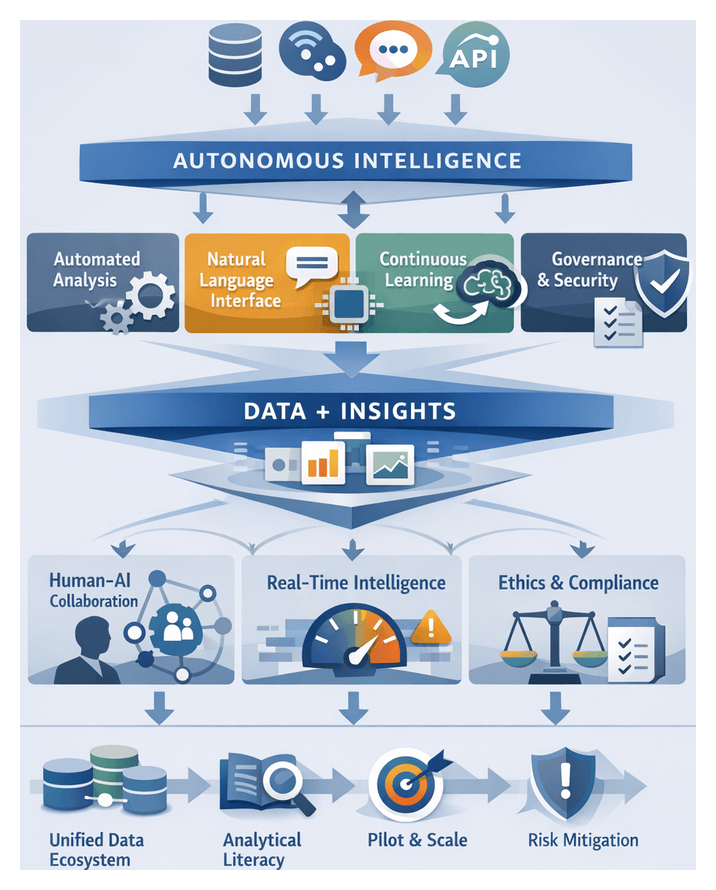
Emergence of Autonomous Intelligence in Business
Over the past decade, business intelligence has transformed from periodic manual reporting into a continuous, self-driving analytical ecosystem. Early practices centered on spreadsheets, static dashboards and batch processing, offering retrospective views of performance. Today, autonomous intelligence platforms ingest diverse data in real time—from transactional records and sensor telemetry to social media and external APIs—and apply advanced machine learning, natural language processing and orchestration frameworks to generate proactive recommendations and trigger actions with minimal human intervention. This evolution addresses the limitations of fixed-schedule reporting, pre-defined rule engines and manual data wrangling, ensuring that insights anticipate emerging patterns, accelerate response times and align with strategic priorities.
Core Characteristics and Principles of Autonomous Agents
Autonomous intelligence systems converge multiple technologies into unified capabilities that redefine decision support. Key principles include:
- Delegation of Routine Analysis: Agents automate data preparation, anomaly detection and forecasting, freeing analysts and engineers to focus on interpretation, strategic framing and value capture.
- Natural Language Accessibility: Conversational interfaces and natural language understanding democratize access to insights, enabling frontline workers and nontechnical stakeholders to pose complex questions and receive narrative summaries, visualizations or alerts.
- Continuous Learning and Adaptation: Feedback loops monitor outcomes, detect shifts in data distributions or business context and recalibrate models to maintain accuracy and relevance.
- Self-Provisioning and Scalability: Platforms automatically allocate compute and storage resources in response to workload demands, supporting elastic growth and reducing operational overhead.
- Multimodal Data Fusion: By combining structured and unstructured inputs—transactional records, text documents, images, audio and time-series signals—agents construct a holistic view of business environments and deliver richer analyses.
- Integrated Governance and Security: Built-in audit trails, bias detection tools and compliance controls ensure transparency, traceability and adherence to regulatory requirements.
Cross-Cutting Themes in AI-Driven Business Intelligence
A review of diverse applications—from data visualization and research workflows to market monitoring and enterprise integration—reveals seven emergent trends that guide strategic investment and deployment:
- Democratization of Data and Insights: Low-code and no-code interfaces, Q&A agents and self-service dashboards empower a wider range of roles to access and act on analytical outputs, accelerating decision cycles and fostering a data-driven culture.
- Convergence of Analytics and Autonomous Agents: Unified workflows integrate machine learning pipelines, inference engines and orchestration layers, minimizing context-switching and latency while supporting real-time, adaptive insights.
- Human-AI Collaboration: AI agents augment rather than replace human expertise, reallocating routine tasks so professionals can concentrate on strategic judgement, anomaly interpretation and ethical oversight.
- Ethical and Governance Imperatives: Transparency, fairness and accountability are embedded from design through deployment, supported by frameworks such as model documentation, audit logs and bias mitigation protocols.
- Real-Time Predictive and Prescriptive Intelligence: Streaming analytics, anomaly detection and scenario simulation enable early warning systems and proactive interventions across supply chain, risk management and customer engagement.
- Modular and Scalable Architectures: Microservices, containerization and API orchestration facilitate incremental adoption, hybrid cloud deployments and seamless integration with legacy systems, optimizing total cost of ownership.
- Multimodal and Contextual Reasoning: Agents process text, visuals, audio and structured data in concert, applying contextual intelligence to tailor recommendations that align with market dynamics, regulatory constraints and organizational objectives.
Strategic Roadmap for AI-Driven Transformation
To harness autonomous intelligence as a sustainable competitive advantage, organizations should advance through four interrelated imperatives:
- Cultivate Unified Data Ecosystems: Establish interoperable platforms that integrate enterprise resource planning, CRM, IoT, social media and external data sources under coherent governance policies. High-quality, timely inputs ensure robust agent performance.
- Foster Analytical Literacy: Develop programs to elevate data fluency across functional teams. Training on agent capabilities, prompt engineering and interpretation of automated outputs enhances user adoption and feedback quality.
- Embed Governance by Design: Integrate ethical guidelines, compliance checks and explainability protocols into the development lifecycle. Model validation, lineage tracking and review boards safeguard trust and regulatory alignment.
- Iterate Through Pilots and Scale: Launch targeted pilot projects—such as conversational analytics for sales forecasting or predictive maintenance agents in manufacturing—to refine integration patterns, demonstrate value and build executive sponsorship before enterprise-wide rollout.
Addressing Critical Challenges and Ensuring Trust
Autonomous agents offer transformative potential but also introduce risks that must be proactively managed to maintain credibility and performance:
- Data Quality and Bias: Incomplete or unrepresentative datasets can skew model outputs. Rigorous data validation, augmentation and bias detection practices are essential.
- Model Interpretability: As architectures become more complex, obscurity in decision rationale can hinder auditability and stakeholder confidence. Explainable AI tools and transparent documentation mitigate this challenge.
- Integration Complexity: Embedding agents into legacy systems often encounters API mismatches and data silos. A modular, service-oriented approach reduces technical debt and streamlines deployment.
- Governance and Ethical Oversight: Without clear policy frameworks, agents may operate beyond intended use cases or reinforce systemic biases. Continuous monitoring and escalation protocols ensure responsible behavior.
- Change Management: Transitioning to autonomous workflows demands shifts in culture, skills and organizational structure. Sustained executive sponsorship, clear communication and role redefinition support adoption.
- Vendor Lock-In: Proprietary platforms can limit flexibility. Prioritizing open standards and interoperable architectures preserves choice and facilitates future innovation.
- Model Drift and Maintenance: Performance degradation over time requires disciplined monitoring, retraining and validation to sustain accuracy and relevance.
Looking Ahead: Future Directions for Autonomous Intelligence
The trajectory of AI suggests that autonomous agents will evolve into even more sophisticated partners, capable of adaptive scenario simulation, self-optimizing decision engines and advanced multimodal reasoning. To stay ahead, organizations should:
- Foster a culture of experimentation by allocating resources to pilot emerging modalities such as multimodal video analysis, sensor-based insights and adaptive simulation engines.
- Maintain strategic collaborations with research institutions and vendor communities to gain early access to breakthroughs in model architectures, governance frameworks and deployment patterns.
- Embed foresight practices—including scenario planning, red-teaming and stress testing—to anticipate unintended consequences, resilience requirements and ethical considerations.
- Prioritize transparency by communicating both successes and limitations of agent deployments to build stakeholder trust and manage expectations.
- Align AI initiatives with broader digital transformation roadmaps, ensuring seamless interoperability across cloud platforms, data lakes and edge computing environments.
By integrating these guiding actions into strategic planning, enterprises will transform raw data into continuous streams of actionable intelligence, securing sustained competitive advantage while upholding ethical and governance standards.
Appendix
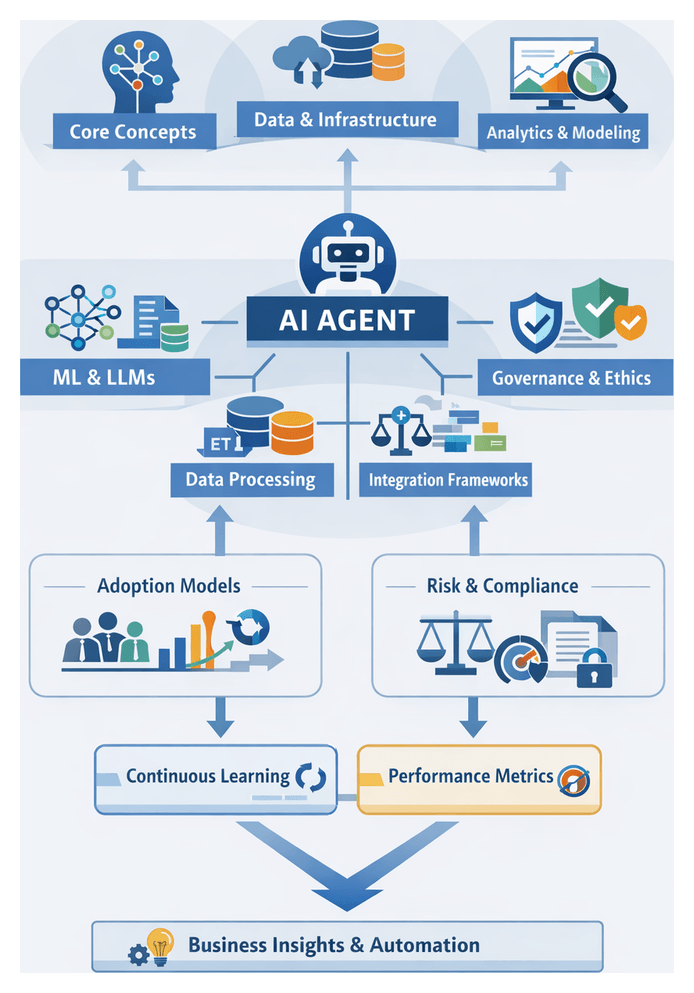
Key Definitions and Terminology
Consistent terminology supports collaboration between technical and business stakeholders when deploying autonomous AI agents. The following definitions provide a shared vocabulary for core concepts, data infrastructure, analytics methodologies, governance practices, and advanced capabilities.
Core AI and Agent Concepts
- Autonomous AI Agent: A software entity that continuously ingests data, analyzes information, reasons over context, and generates recommendations or actions with minimal human intervention.
- Large Language Model (LLM): A neural network pretrained on extensive text corpora to perform tasks such as generation, translation, and summarization (for example, OpenAI’s GPT series).
- Machine Learning (ML) and Neural Networks: Algorithms and architectures that learn patterns from data via supervised, unsupervised, or reinforcement learning methods.
- Natural Language Processing (NLP): Techniques for interpreting and generating human language, including tokenization, entity recognition, and sentiment analysis.
- Prompt Engineering and Fine-Tuning: The design of input instructions to LLMs and the process of adapting pretrained models to specific domains using labeled datasets.
- Embeddings: Numeric vector representations that capture semantic relationships for efficient similarity search and retrieval.
Data and Infrastructure Terminology
- Data Ingestion Layer: Connects to databases, document stores, streaming platforms, and external APIs to collect and normalize inputs.
- ETL (Extract, Transform, Load): Processes that cleanse, aggregate, and load data into target systems or feature stores.
- Feature Store: A centralized repository managing definitions and retrieval of features for consistent model training and inference.
- Data Lake vs. Data Warehouse: Scalable storage for raw and varied data formats versus structured repositories optimized for query performance.
- Streaming Data and Batch Processing: Real-time pipelines (for example, Apache Kafka) versus scheduled bulk analytics.
- API Orchestration: Middleware patterns coordinating service calls, data transformations, and business logic to integrate agents with enterprise systems.
Analytics and Modeling Terms
- Supervised and Unsupervised Learning: Training models on labeled or unlabeled data for tasks such as classification, regression, clustering, and dimensionality reduction.
- Time-Series Analysis and Anomaly Detection: Identifying trends, seasonality, and outliers in temporally indexed data.
- Predictive and Prescriptive Analytics: Forecasting future outcomes and recommending actions based on optimization routines.
- Model Drift: Degradation of performance over time as data distributions evolve, requiring monitoring and retraining.
Governance and Ethics Terms
- Explainability and Interpretability: Methods such as feature-importance scores, attention visualization, and post-hoc tools (for example, LIME, SHAP) that reveal decision-making processes.
- Bias and Fairness Metrics: Quantitative measures (demographic parity, equalized odds) and mitigation techniques to ensure equitable outcomes.
- Privacy by Design and Zero-Trust Architecture: Embedding data protection and strict identity verification across all services.
- Human-in-the-Loop / Human-on-the-Loop: Oversight models ranging from pre-execution approvals to monitoring of autonomous actions.
- Audit Trail and Model Lifecycle Management: Comprehensive logging of data transformations, training runs, and inference events to support compliance and governance.
Advanced Technical and Strategic Terms
- Retrieval-Augmented Generation (RAG): Combining semantic search with generative models to ground outputs in authoritative sources.
- Knowledge Graph and Vector Database: Structured entity-relationship stores and specialized systems (for example, Pinecone, Weaviate) for semantic retrieval at scale.
- Multimodal Intelligence and Digital Twin: Integrating text, image, audio, and sensor data alongside virtual replicas for simulation and forecasting.
- Self-Optimizing Agent: Systems that adapt policies and workflows autonomously based on feedback and changing objectives.
Conceptual Frameworks for Adoption and Integration
Frameworks guide both the evaluation of user acceptance and the architectural integration of autonomous agents into enterprise ecosystems.
- Technology Acceptance Model (TAM): Focuses on perceived usefulness and ease of use to drive adoption, informing interface design and training programs.
- Diffusion of Innovations: Categorizes adopters from innovators to laggards, highlighting the influence of social networks and change agents.
- Service-Oriented and Microservices Architecture: Modularizes agent functions—data ingestion, inference, context management—via standardized APIs.
- Data-Model-Infrastructure Triangle: Balances investments in data quality, model performance, and compute resources for sustainable deployments.
- Event-Driven and Streaming Integrations: Enables low-latency pipelines using platforms such as Apache Kafka and messaging systems like NATS.
- API Orchestration Frameworks: Leverages enterprise service buses, gateways, and workflow engines (for example, Apache Airflow, Prefect) for complex process coordination.
- Feedback Loop and AI Maturity Models: Iteratively improves agents by incorporating real-world outcomes, monitoring drift, and benchmarking across maturity stages.
- Strategic Planning Tools: Employs S-Curves, Gartner Hype Cycle, scenario planning, Porter’s Five Forces, PESTEL, Balanced Scorecard, and OKRs to align AI initiatives with business goals.
Scope, Capabilities, and Distinctions of Autonomous AI Agents
Autonomous agents differ from traditional BI tools and conversational interfaces through continuous operation, proactive insights, and end-to-end automation.
Scope and Continuous Operation
Agents monitor multiple data streams, apply ML and LLMs, and surface timely recommendations without explicit prompts, executing tasks such as trend forecasting, anomaly detection, and workflow orchestration.
Conversational AI vs. Autonomous Agents
While conversational AI focuses on dialogue management and query translation, autonomous agents integrate reasoning engines, adaptive learning, and action execution, anticipating needs and initiating tasks such as alerts, report generation, and forecast updates.
Model Hallucinations and Mitigation
LLMs may produce syntactically correct but semantically inaccurate outputs. Mitigation strategies include fine-tuning on enterprise data, employing RAG to ground responses, real-time fact-checking via structured pipelines, confidence thresholding, and human-in-the-loop review for high-risk content.
Explainability and Interpretability Clarified
Explainability illuminates the reasoning behind predictions, using feature-importance scores, attention maps, and example-based explanations. Interpretability measures how readily a human can understand a model’s internal workings, often through simpler sub-modules or post-hoc tools such as SHAP and LIME.
Technical and Deployment Considerations
Performance and Accuracy Metrics
- Classification: accuracy, precision, recall, F1 score
- Forecasting: mean absolute error, root mean squared error
- Retrieval: precision, recall, nDCG, mean reciprocal rank
- Operational: latency, throughput, decision latency reduction
Data Preparation and Feature Engineering
Data cleansing, normalization, enrichment, and transformation underpin reliable outputs. Feature engineering may include time lags, aggregated statistics, and domain-specific indicators stored in feature stores for consistency.
Model Drift and Continuous Learning
Detect drift via statistical tests and performance monitoring. Trigger retraining pipelines or apply incremental learning to update models efficiently. Maintain versioned deployments, automated validation, and rollback mechanisms.
Integration Patterns for Scalability
Adopt API-first, microservices architectures with inference endpoints, event-driven pipelines using Apache Kafka, and workflow orchestration platforms such as Apache Airflow and Prefect. Use RESTful or gRPC interfaces, containerization, and Kubernetes for elastic scaling.
Balancing Automation and Human Oversight
- Human-out-of-the-Loop: Low-risk tasks with periodic audits.
- Human-on-the-Loop: Agents act autonomously with supervisors intervening on anomalies.
- Human-in-the-Loop: High-risk tasks requiring pre-execution approvals.
Governance, Compliance, and Ethics
Robust governance combines policies, processes, and technical controls to ensure ethical, compliant, and resilient agent operations.
- Risk Management: NIST AI Risk Management Framework (AI RMF) and structured risk assessments.
- Regulatory Compliance: GDPR (GDPR), CCPA (CCPA), the proposed EU AI Act, HIPAA, and sector-specific mandates.
- Bias and Fairness: Quantitative audits using toolkits like Fairlearn and IBM AI Fairness 360.
- Privacy and Security: Differential privacy, encryption, zero-trust architecture, and alignment with NIST SP 800-53 controls.
- Transparency: Model cards (Model Cards), datasheets, and audit trails documenting lineage and decision rationale.
- Ethical Oversight: Ethics committees, bias mitigation protocols, and policy enforcement guided by IEEE Ethically Aligned Design and OECD AI Principles.
Operational and Organizational Considerations
Costs and Total Cost of Ownership
Include licensing or development fees, compute (GPU/TPU) and storage expenses, integration investments, ongoing maintenance, governance overhead, and personnel costs. Use scenario-based budgeting to compare cloud-native and on-premises deployments.
Cultural Adoption and Change Management
Foster data literacy through stakeholder workshops, role-based training, pilot programs, and champion networks. Communicate strategic vision, clarify human-agent responsibilities, and provide continuous support.
Future Innovations and Readiness
Prepare for multimodal agents, self-optimizing workflows, and digital twins by investing in flexible data architectures, modular deployment platforms, and robust governance frameworks. Engage in horizon scanning, research collaborations, and standards bodies.
Common Misconceptions and Best Practices
- Agents require domain-specific customization; off-the-shelf solutions rarely suffice.
- Human judgment remains essential for nuanced or high-stakes decisions.
- AI adoption demands investments in data preparation, integration, and governance.
- Continuous improvement relies on iterative feedback loops, user feedback, A/B testing, and periodic governance reviews.
Tool Directory and Further Reading
- ChatExcel: An AI-driven spreadsheet assistant that generates charts and insights from spreadsheet data through natural language queries.
- Raycast: A developer-focused productivity tool featuring AI-driven shortcuts and inline data visualization integrations.
- Consensus: A research platform utilizing AI to automate evidence-based question answering across scientific literature.
- Perplexity: An AI-powered answer engine that synthesizes web-based information into concise responses for research and knowledge discovery.
- Humata: An AI assistant for interactive document analysis, contract review, and semantic search within PDF and text documents.
- AskYourPDF: A tool that enables conversational Q&A interactions with PDF documents using AI for document comprehension.
- Power BI Q&A: A feature of Microsoft Power BI that uses natural language queries to generate visualizations and dashboards.
- Tableau Ask Data: An AI-powered conversational interface within Tableau for querying data and creating visualizations through natural language.
- ThoughtSpot: An enterprise search and analytics platform offering AI-driven search analytics and personalized data discovery.
- OpenAI GPT Series: Generative pre-trained transformer models capable of advanced language understanding and generation tasks.
- Hugging Face Transformers: An open-source library providing pretrained transformer models and tools for fine-tuning and deployment.
- spaCy: An industrial-strength natural language processing library with efficient pipelines for tokenization, entity recognition, and parsing.
- TensorFlow: An open-source machine learning framework for building and training neural networks at scale.
- PyTorch: A dynamic deep learning platform for flexible model development and research experimentation.
- Apache Kafka: A distributed event streaming platform for building real-time data pipelines and streaming applications.
- NATS: A lightweight, high-performance messaging system for cloud-native applications and microservices.
- Apache Airflow: A workflow orchestration platform for authoring, scheduling, and monitoring complex data pipelines.
- Prefect: A modern workflow management tool for building data pipelines with robust scheduling, monitoring, and failure handling.
- AWS Glue: A fully managed, serverless data integration service for discovering, preparing, and combining data for analytics.
- Google Cloud Dataflow: A fully managed service for executing Apache Beam pipelines with unified batch and streaming data processing.
- Feast: An open-source feature store for managing and serving machine learning features in production environments.
- Tecton: A platform to build, deploy, and manage feature stores as part of machine learning operations.
- Pinecone: A fully managed vector database for similarity search and real-time retrieval of embedding-based data.
- Weaviate: An open-source vector search engine and knowledge graph for high-performance semantic search.
- Google Document AI: A cloud service for automated document processing using specialized OCR and natural language understanding.
- Azure Form Recognizer: An AI service for extracting text and data from forms and documents with quick start models.
- Microsoft Copilot: AI assistant integrated into Microsoft 365 applications for context-aware productivity enhancements.
- Google Bard: Google’s experimental conversational AI service for expansive knowledge retrieval and creative assistance.
- AlphaSense: An AI-powered market intelligence platform for searching and analyzing financial documents, transcripts, and filings.
- Crayon: A competitive intelligence platform that tracks market changes and competitor activities in real time.
- CB Insights: A data-driven platform for tracking venture capital, startup activity, and technology trends.
- DataRobot: An enterprise AI platform for automated machine learning, model deployment, and MLOps management.
- H2O.ai: A pioneer in open-source and enterprise AI platforms for scalable machine learning and AutoML.
- PredictHQ: A demand intelligence platform that aggregates global event data to enhance forecasting models.
- MuleSoft Anypoint Platform: A unified integration platform for building, managing, and governing APIs and integrations.
- Apigee: Google Cloud’s API management solution for securing, scaling, and monitoring API traffic.
- Kong: An open-source API gateway and microservices management layer with plugin architecture.
- Azure API Management: A fully managed service to publish, secure, transform, and analyze APIs across hybrid and multi-cloud environments.
Additional Context and Resources
- ISO/IEC TR 24028: A technical report outlining trustworthiness dimensions for AI systems, covering risk management, robustness, and transparency.
- ISO/IEC 42001 (in development): An upcoming standard for AI management systems, defining governance requirements and organizational processes.
- IEEE Ethically Aligned Design: Principles and guidelines for ethical development and deployment of autonomous and intelligent systems.
- OECD Principles on AI: International policy guidelines focusing on innovation and trust in AI.
- EU AI Act Proposal: Legislative proposal establishing risk-based requirements for AI systems operating within the European Union.
- GDPR: The European Union regulation governing data protection and privacy, including rights related to automated decision-making.
- CCPA: California Consumer Privacy Act granting consumers rights over personal data and automated profiling.
- NIST AI Risk Management Framework: A voluntary guidance document for managing risks throughout the AI lifecycle.
- Gartner Hype Cycle: An analytical model for evaluating the maturity and adoption stages of emerging technologies.
- Technology Adoption Lifecycle: Everett Rogers’ model describing the diffusion of innovations through adopter categories.
- Fairlearn: An open-source toolkit for assessing and mitigating fairness issues in machine learning.
- IBM AI Fairness 360: A library of metrics and algorithms to help detect and mitigate bias in AI models.
- Model Cards and Datasheets: Documentation frameworks for transparent communication of model details, intended use, and performance metrics.
- NIST SP 800-53: Security and privacy controls for federal information systems and organizations, adaptable for AI agent security governance.
- AI Ethics (Springer): Scholarly publications such as the Journal of Artificial Intelligence Research and AI Ethics provide peer-reviewed research and case studies. https://jair.org and
- World Economic Forum AI Governance Playbooks: Industry consortium publications such as the World Economic Forum AI Governance Framework outline practical implementation guidance.
- AgentLink AI Insights Directory: A curated catalog of AI agent applications across business domains.
- Forrester Wave and Gartner Magic Quadrant: Analyst reports comparing leading AI platforms and integration solutions, available through industry research subscriptions.
The AugVation family of websites helps entrepreneurs, professionals, and teams apply AI in practical, real-world ways—through curated tools, proven workflows, and implementation-focused education. Explore the ecosystem below to find the right platform for your goals.
Ecosystem Directory
AugVation — The central hub for AI-enhanced digital products, guides, templates, and implementation toolkits.
Resource Link AI — A curated directory of AI tools, solution workflows, reviews, and practical learning resources.
Agent Link AI — AI agents and intelligent automation: orchestrated workflows, agent frameworks, and operational efficiency systems.
Business Link AI — AI for business strategy and operations: frameworks, use cases, and adoption guidance for leaders.
Content Link AI — AI-powered content creation and SEO: writing, publishing, multimedia, and scalable distribution workflows.
Design Link AI — AI for design and branding: creative tools, visual workflows, UX/UI acceleration, and design automation.
Developer Link AI — AI for builders: dev tools, APIs, frameworks, deployment strategies, and integration best practices.
Marketing Link AI — AI-driven marketing: automation, personalization, analytics, ad optimization, and performance growth.
Productivity Link AI — AI productivity systems: task efficiency, collaboration, knowledge workflows, and smarter daily execution.
Sales Link AI — AI for sales: lead generation, sales intelligence, conversation insights, CRM enhancement, and revenue optimization.
Want the fastest path? Start at AugVation to access the latest resources, then explore the rest of the ecosystem from there.