

Design Intelligence AI Agents as Creative Partners in the Age of Automation
To download this as a free PDF eBook and explore many others, please visit the AugVation webstore:
Introduction
Transforming the Creative Landscape with AI Automation
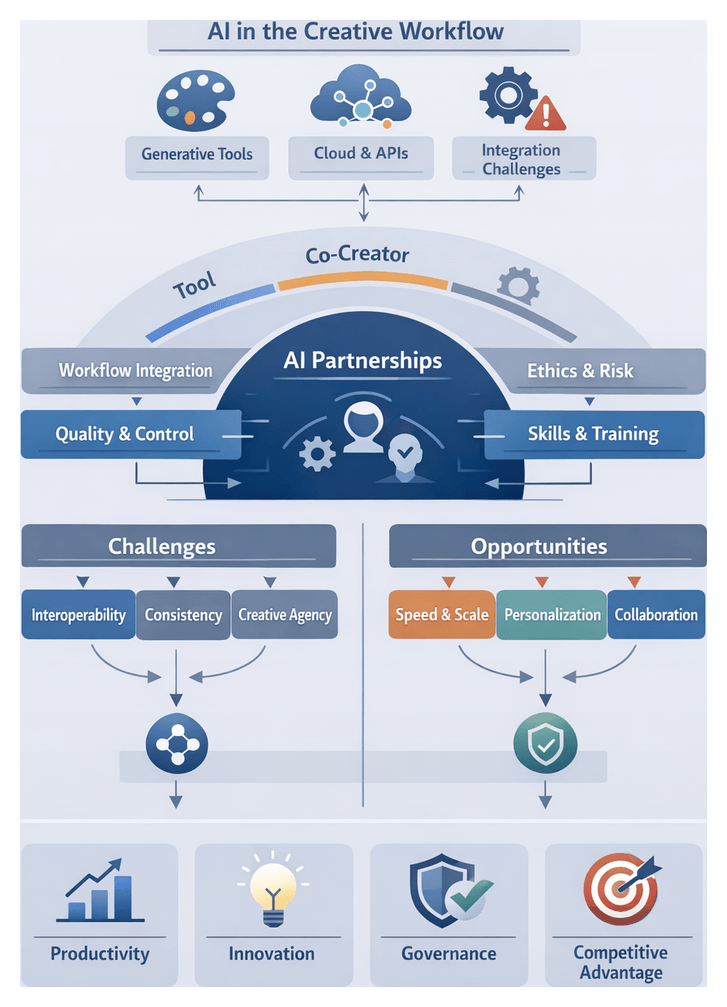
Across marketing agencies, design studios, publishing houses and in-house teams, advances in artificial intelligence, machine learning and cloud compute are reshaping every stage of the creative workflow. Breakthroughs in deep learning, the democratization of GPUs and AI accelerators, and the availability of open datasets and pre-trained models have lowered the barrier to entry for powerful generative and analytic tools. Leading engines such as DALL·E 3, Midjourney and Adobe Firefly produce complex visuals from simple prompts. Platforms like Runway ML enable real-time video and image manipulation, while Canva’s Magic Write and various Figma plugins offer AI-driven copy generation, layout suggestions and responsive design tweaks. These systems move beyond repetitive tasks, entering realms of ideation, style exploration and brand-consistent adaptation.
Faced with competitive pressures for faster turnaround, higher content volume and personalized experiences, creative teams see AI as a path to speed, scale and variation. Yet pilot projects often stall at integration points, quality control and governance concerns. Designers worry about preserving creative agency, while technical teams navigate custom integrations with legacy systems. These frictions define a problem space of unfulfilled potential, organizational resistance and the risk of unintended outcomes.
Challenges and Opportunities at Scale
As organizations explore creative automation, they encounter systemic challenges that must be addressed to realize AI’s promise:
- Workflow Integration and Interoperability: Disparate AI tools and cloud APIs require custom connectors or manual handoffs, leading to bottlenecks and version conflicts.
- Quality Control and Consistency: Generative outputs can vary widely in style and brand alignment, demanding review processes that may erode efficiency gains.
- Maintaining Creative Agency: When AI becomes a primary source of ideas, designers risk being relegated to curators rather than authors, impacting engagement and job satisfaction.
- Skill Gaps and Training Needs: Effective AI use requires prompt engineering, model assessment and data literacy—skills many creatives must now acquire.
- Data Privacy, Bias and IP: Models trained on large uncurated datasets can reproduce stereotypes or infringe on rights; emerging legal frameworks around AI-generated content add complexity.
Despite these hurdles, AI opens transformative possibilities:
- Accelerated Productivity: Automating background removal, color palette generation and text layout frees teams to focus on high-value concept work.
- Expanded Creative Exploration: Generative models surface novel visual directions and copy variations, reducing creative blocks.
- Hyper-Personalization: Real-time analysis of user data enables tailored visuals and messaging at scale.
- Real-Time Collaboration: Cloud-based AI fosters synchronous co-creation, with instant alternatives and performance predictions.
- New Business Models: On-demand design services, dynamic advertising networks and subscription platforms adapt content automatically to performance data.
- Democratization of Design: User-friendly AI interfaces empower non-designers to produce professional assets with minimal training.
Reframing AI Agents as Co-Creative Partners
Moving beyond the tool paradigm, autonomous AI agents can be viewed as active collaborators that learn, adapt and contribute original ideas. Collaboration spans a continuum of agency—from reactive assistants executing predefined tasks to co-creators generating divergent concepts and engaging in iterative dialogue. Practitioners classify these modes by autonomy, contextual understanding and adaptive feedback loops powered by models such as GPT-4.
Two complementary frameworks guide this reframing:
- Agency Continuum Model: Ranges from rule-based Tool stage to high-autonomy Co-creator stage, enabling organizations to assess maturity and define integration targets.
- Mixed-Initiative Interaction Framework: Distinguishes between human-led, AI-led and shared-initiative modes, informing interface design and feedback mechanisms.
In branding, tools like Adobe Firefly batch-generate logo concepts that specialists curate. In digital product design, integrated modules of DALL·E 2 and Midjourney suggest iconography and illustrative assets aligned to brand assets. In architectural workflows, generative layout agents evaluate constraints and propose spatial configurations for human adaptation. Across domains, challenges of attribution, bias reinforcement, trust calibration and evolving skill sets invite robust governance and interpretive clarity.
The Strategic Imperative to Adopt AI in Design
The shift from “if” to “how fast” reflects AI’s transition from experimental novelty to strategic necessity. Early adopters capture first-mover advantages in talent, service offerings and market perception. Lagging teams risk falling behind in speed to market, cost efficiency and personalized experiences. Four interrelated forces drive this urgency:
- Market Competition and Customer Expectations: Brands leveraging AI for dynamic storytelling and targeted content outperform those relying on manual processes.
- Accelerated Innovation Cycles: AI-driven rapid prototyping and real-time iteration compress design timelines.
- Data-Driven Decision Making: AI systems surface insights from user behavior at scale, informing creative variants for segmented audiences.
- Resource Constraints and Efficiency Demands: Lean teams and tight budgets benefit from automating routine tasks, reallocating human effort to strategic work.
Forward-thinking organizations embed AI competency within design maturity frameworks that span technical fluency, strategic alignment and cultural readiness. Cross-functional Center of Excellence models coordinate pilots, share learnings and govern tool portfolios. Design curricula increasingly mandate AI literacy, ensuring new graduates can direct, critique and co-create with agents. Ethical stewardship—guardrails for bias, transparency and data privacy—becomes a core dimension of AI readiness.
A phased rollout—from low-risk pilots like automated asset resizing to advanced generative collaborations—builds confidence, refines protocols and informs governance before scaling to mission-critical initiatives. Quantitative metrics (time savings, campaign performance) paired with qualitative assessments (creative diversity, brand alignment) track both efficiency and differentiation. This dual lens enables design leaders to navigate adoption with strategic clarity.
Navigational Overview of the Guide
This guide offers a structured exploration of AI agents in design practice, blending historical context, conceptual definitions and practical insights. Key chapters include:
- Evolution of AI in Design: From rule-based systems to adaptive, generative agents.
- Defining AI Agents: Autonomy, learning, adaptation and generative capabilities.
- Integrating AI Agents: Human-AI partnership models and workflow optimization.
- Ideation and Concept Generation: Generative prompting, divergent thinking and expanded creative horizons.
- AI-Assisted Prototyping: Real-time feedback, iteration speed and quality trade-offs.
- Personalization and User-Centered Design: Data-driven customization for engagement.
- Human-AI Co-Design Dynamics: Social, cognitive and organizational dimensions of co-creativity.
- Ethical and Responsible Use: Frameworks for bias mitigation, transparency and governance.
- Measuring Impact and ROI: Quantitative and qualitative metrics for stakeholder value.
- Future Trends and Innovations: Next-generation architectures, multimodal tools and immersive creativity environments.
Throughout, interpretive lenses such as Sociotechnical Systems Theory, Human-Machine Teaming Models, Co-Creativity and Affordance Theory, Data-Driven Decision Frameworks and Ethical AI Governance illuminate strategic choices. Key takeaways include:
- The shift from automation to collaboration positions AI agents as partners that augment creativity through adaptive learning.
- Effective integration relies on strategic entry points in existing workflows and mixed-initiative interfaces balancing autonomy and oversight.
- Generative prompting and iterative feedback loops enhance ideation, but require calibration to prevent bias and stagnation.
- Real-time prototyping accelerates cycles but demands rigorous UX frameworks to preserve intent.
- Hyper-personalization unlocks engagement but involves trade-offs in privacy, consent and fairness.
- Designer roles evolve toward facilitation and curation, fostering trust and collaboration.
- Metrics for AI impact should combine efficiency gains with measures of innovation, satisfaction and creative diversity.
- Emerging multimodal and immersive tools will redefine creative boundaries, calling for ongoing skill development.
Practitioners must remain mindful of limitations—data bias, transparency challenges, overreliance risks, organizational readiness, regulatory compliance, ROI measurement and evolving model maturity. By synthesizing these insights, frameworks and caveats, design professionals can chart a strategic path to integrate AI agents, harness creative potential and navigate the complexities of real-world adoption.
Chapter 1: The Evolution of AI in Design
Creative Automation Landscape and Challenges
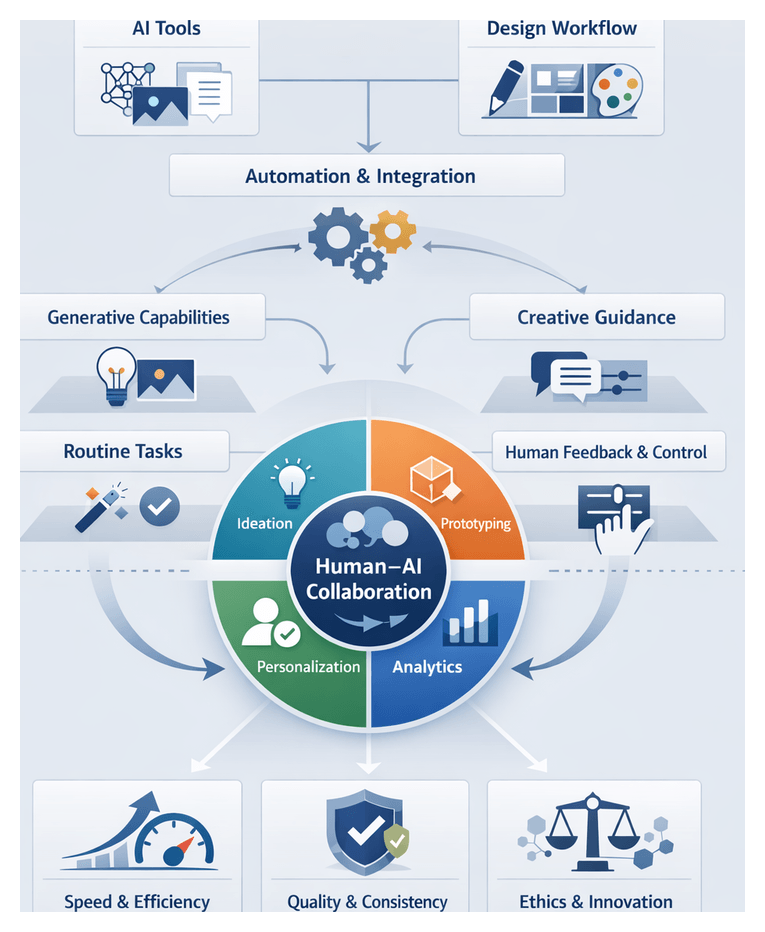
The integration of automation technologies has reshaped traditional design workflows, moving from manual sketching and iterative mock-ups to AI-driven systems that generate concepts, color palettes, and complete layouts with minimal human intervention. Platforms like DALL·E, Midjourney, Adobe Firefly, and RunwayML leverage large neural networks trained on extensive visual and textual datasets to produce novel imagery and style treatments in seconds. Writing assistants such as Jasper and automated layout engines embedded in leading graphic applications streamline content generation for blogs, marketing materials, and interactive experiences. Repetitive tasks—background removal, style transfer, template assembly—can now be executed with unprecedented speed and consistency.
However, many organizations struggle to integrate disparate tools into cohesive workflows, leading to fragmentation and quality variability. Designers often spend significant time on post-processing and curation to ensure outputs meet standards. Intensified turnaround demands create tension between speed and conceptual depth, challenging teams to balance exploratory experimentation with efficiency. Without a clear framework, businesses risk diluting brand consistency, undermining creative integrity, and missing opportunities for innovation. At the same time, AI-driven systems offer the potential to offload routine tasks, freeing designers for strategic visioning, user research, and cross-disciplinary collaboration. Generative tools can surface unexpected visual combinations, inspire fresh narratives, accelerate prototyping, and enable personalization at scale while maintaining quality and consistency standards.
AI Agents as Collaborative Partners
Moving beyond static utilities, AI agents function as adaptive collaborators that learn from interactions and refine outputs over time. Unlike macros or plugins, these agents possess autonomy, contextual understanding, and multimodal interaction capabilities. By framing them as partners, design teams engage in a bidirectional dialogue where agents propose variations, offer data-driven insights, or simulate user journeys, and designers provide evaluative feedback to guide subsequent recommendations. This iterative exchange fosters synergies that transcend traditional brainstorming sessions.
- Contextual Understanding: Parsing briefs, design system constraints, and brand guidelines to generate relevant suggestions.
- Generative Capacity: Producing novel visual or textual artifacts, from mood boards to interactive prototypes.
- Adaptive Learning: Refining outputs based on explicit feedback and implicit usage patterns.
- Multimodal Interaction: Engaging seamlessly across text, imagery, and code for cross-disciplinary workflows.
By positioning agents as co-creators, organizations unlock a spectrum of creative possibilities. Junior designers leverage agent suggestions to bridge skill gaps, while senior practitioners focus on high-impact decisions and mentorship. This model democratizes advanced capabilities, cultivates diverse perspectives, and fosters inclusive ecosystems where human insight and machine fluency combine to generate innovative outcomes.
The Imperative for AI Adoption
Accelerating breakthroughs in transformer architectures, self-supervised learning, and cloud compute have made sophisticated generative models accessible to studios of all sizes. Competitive pressures and evolving consumer expectations demand faster ideation, higher personalization, and data-backed creative decisions. Remote and distributed teams require collaborative platforms that maintain creative momentum across geographic divides. Economic constraints drive organizations to maximize talent productivity by delegating routine tasks to AI.
Early adopters of AI-augmented workflows iterate more rapidly, respond to market feedback with agility, and build a culture of experimentation. Cloud-based services and pre-trained models lower barriers to entry, enabling small agencies and in-house teams to deploy advanced agents without extensive infrastructure investment. This democratization intensifies competitive pressure: integration is now an imperative rather than an option.
Design leaders must develop clear roadmaps, governance frameworks, and skill-building initiatives to guide human-agent collaboration. Those who master AI-driven creativity will define the next era of design excellence; laggards risk inefficiency, stagnation, and brand irrelevance. Embedding agents across ideation, prototyping, personalization, and user testing transforms AI from a tactical enhancement into a strategic asset.
Analytical Frameworks and Collaboration Models
Establishing a shared vocabulary for human-AI collaboration is essential. The Collaboration Spectrum maps interactions along initiative (human-led to agent-led) and autonomy (low to high), allowing teams to position applications such as Adobe Sensei‘s generative fill or Autodesk Generative Design within a coherent taxonomy. The MATE model (Mediator-Agent-Tool-Environment) highlights roles agents can play: orchestrating resources, generating content, serving as specialized tools, or acting within a broader ecosystem.
Industry standards propose autonomy tiers from Level 1 (algorithmic suggestion) to Level 5 (self-driven generation with human oversight). A Level 2 moodboard system might curate imagery for designer selection, while a Level 4 agent could propose layouts, simulate user interactions, and refine designs independently. These gradations enable organizations to set achievable goals, monitor progress, and benchmark maturity against peers.
The human-in-the-loop paradigm remains central. Interactive machine learning methodologies, exemplified by RunwayML, allow real-time steering and validation of generative models through visual interfaces. Continuous feedback cycles embed human judgment at critical junctures, preserving authorship, ethical oversight, and brand authenticity.
To assess collaborative effectiveness, firms augment traditional KPIs—task completion time, error rates, resource utilization—with measures of novelty, serendipity, and design diversity. Quantitative sentiment analysis and diversity indices gauge the breadth of AI-mediated ideation, while A/B testing compares user engagement of agent-augmented prototypes against control designs. These metrics demonstrate not only efficiency gains but also enhanced creative impact.
Core Strategic Insights
- Reframing Automation as Collaboration: Shifting from task execution to a dialogue where agents contribute context-aware perspectives enriches creative dialogues and fosters divergent exploration.
- Market and Technology Drivers Create Urgency: Rapid advances in neural architectures and intensifying demands for novel user experiences make timely AI integration essential to maintain competitive relevance.
- Human-Centered Agent Frameworks: Emphasizing shared mental models, transparent feedback loops, and mixed-initiative control safeguards creative agency and aligns outputs with human intent.
- Modular Integration Pathways: Introducing agents incrementally across ideation, prototyping, and personalization reduces friction and demonstrates measurable value at each stage.
- Ethical Stewardship as Differentiator: Addressing bias, transparency, and accountability cultivates trust and protects brand integrity in an environment sensitive to algorithmic fairness.
- Multimodal and Immersive Horizons: Investing in vision, language, and spatial computing will redefine creative expression in AR/VR and beyond, positioning early adopters for leadership.
Guiding Principles for Responsible Implementation
- Iterative Pilots with Measurable Outcomes: Launch small-scale experiments targeting specific creative tasks. Define success metrics—ideation velocity, user satisfaction, error reduction—and refine agent configurations based on performance data.
- User-Defined Boundaries: Empower designers to set guardrails for agent behavior. Configurable prompts, adjustable autonomy levels, and manual override mechanisms ensure human judgment remains central.
- Cross-Functional Collaboration: Form multidisciplinary teams—data science, user research, legal, ethics—to align technical capabilities with brand values, regulatory requirements, and user needs.
- Transparent Communication: Document agent workflows, data sources, and decision logic. Sharing this knowledge fosters trust, accelerates adoption, and facilitates continuous learning.
- Continuous Learning Culture: Capture lessons from each integration cycle. Conduct post-mortems to surface technical, organizational, and ethical challenges, iterating on process improvements.
- Ethics by Design: Embed bias mitigation, accessibility checks, and privacy considerations throughout the design lifecycle. Formalize guidelines and conduct periodic audits to maintain accountability.
Considerations and Future Directions
While AI-driven creativity offers significant promise, practitioners must navigate data quality constraints, domain biases, and interpretability trade-offs. Roles will evolve toward strategic oversight, facilitation, and curation, requiring targeted upskilling. Tool proliferation risks workflow fragmentation without clear integration standards and API governance. Intellectual property, attribution, and cultural sensitivities demand proactive policies to safeguard assets and promote inclusive outcomes.
Looking ahead, advances in self-supervised and continual learning will yield more adaptive agents, while the convergence of AI with AR/VR platforms will transform spatial storytelling. Emerging regulatory frameworks and industry standards for responsible AI will shape transparent and accountable agent use. New metrics—diversity of concept space, emotional resonance, human-AI synergy indices—will better capture the qualitative impact of co-creative processes. Participation in open ecosystem collaborations and research consortia can accelerate innovation and interoperability.
By integrating strategic insights, ethical guardrails, and practical adoption principles, design organizations can harness the full potential of AI agents. This balanced approach ensures that intelligent automation amplifies human ingenuity, delivering transformative creative outcomes in an era defined by rapid technological change.
Chapter 2: Defining AI Agents and Their Creative Potential
Creative Automation and the Generative Shift
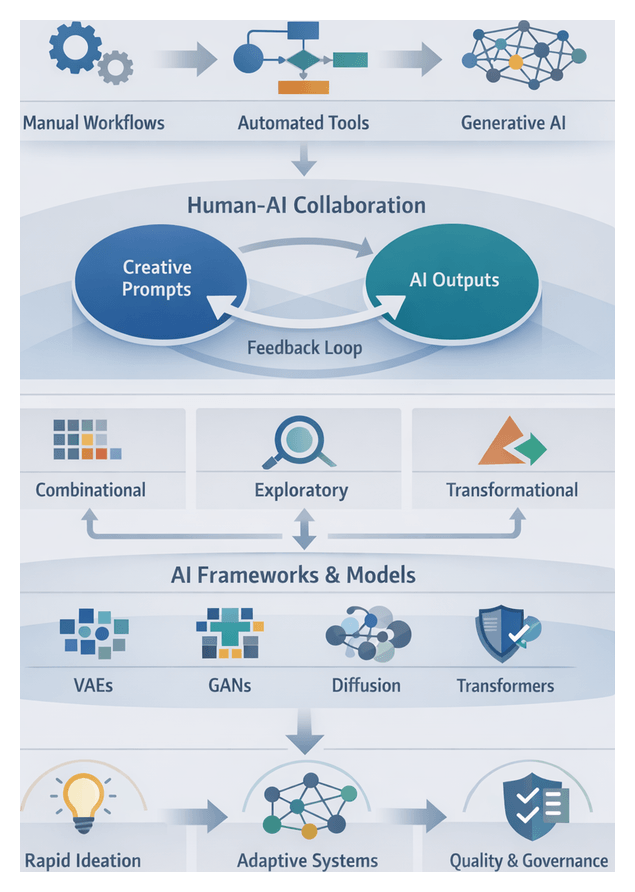
The creative industries have evolved from fully manual workflows to rule-based automation and now to data-driven generative systems. Early scripting engines and parametric tools accelerated tasks like layout adjustments and batch asset generation, yet they remained brittle and required extensive oversight. Today, platforms such as Adobe Sensei and Midjourney leverage deep learning to analyze vast image and text corpora, infer stylistic patterns, and generate novel design proposals at scale. These capabilities unlock rapid concept exploration and personalized content, but also introduce challenges: fragmented handoffs between AI suggestions and human judgment, overwhelming volumes of options, and inconsistent output quality that can erode trust in machine-generated ideas.
Integrating generative engines into coherent workflows is now a central problem. Creative teams must balance machine throughput with human aesthetic oversight, ensuring that AI enhances rather than disrupts momentum. Brands that master this integration gain competitive advantage through accelerated ideation, richer visual languages, and scalable personalization.
AI Agents as Collaborative Design Partners
Moving beyond isolated features, autonomous AI agents embody continuous, goal-oriented processes that perceive context, learn from interactions, and refine outputs without human initiation at every step. An agent combines analytical pattern recognition with generative modeling: it ingests a designer’s brief, translates qualitative goals into parametric specifications, and proposes color palettes, typography treatments or initial mockups aligned with brand guidelines and user preferences.
Adopting AI agents requires a mindset shift from “tool invocation” to “collaboration engagement.” Designers craft prompts, review ranked alternatives, and supply feedback that the agent internalizes. Over iterative loops, human creativity co-evolves with machine speed and scalability, reducing effort spent filtering irrelevant suggestions and ensuring consistency across deliverables.
Technical Foundations of Generative Creativity
Computational Creativity Frameworks
Industry practitioners draw on academic models, notably Margaret Boden’s tripartite framework—combinational, exploratory, and transformational creativity—to assess agent capabilities. Combinational systems remix existing assets, while exploratory engines search defined concept spaces and transformational models redefine constraints to generate entirely new visual grammars. Julia Wiggins’ generative indices—novelty, typicality and quality—help quantify output characteristics and align AI proposals with brand standards and user expectations.
Machine Learning Architectures
Generative agents rely on diverse architectures. Variational Autoencoders (VAEs) pioneered probabilistic sampling, Generative Adversarial Networks (GANs) enhanced realism through adversarial training, and diffusion models—employed by platforms like RunwayML—incrementally refine noise into coherent images. Transformer-based models now enable multimodal synthesis of text, image and audio, with parameter count and attention layers influencing conceptual breadth. Reinforcement learning introduces goal-oriented adaptation, where reward functions tied to user engagement steer creativity, though poorly defined rewards can lead to repetitive outputs. Modular pipelines that decouple perception, reasoning and generation support interpretability, a crucial factor in regulated industries.
Data, Embeddings and Governance
Agents’ creative potential hinges on curated datasets that reflect brand aesthetics, functional requirements and cultural contexts. Supervised learning offers control through labeled inputs, while unsupervised methods uncover latent patterns in unstructured data. Self-supervised paradigms enable large-scale pretraining without extensive annotation. Embedding spaces drive latent exploration: for example, Adobe Sensei integrates learned embeddings into design applications, letting practitioners adjust semantic directions—”increase warmth” or “abstract geometry”—via intuitive interfaces. Data governance frameworks, such as the Data Ethics Canvas, ensure provenance tracking, bias auditing and regulatory compliance in sectors like healthcare and finance.
Adaptive Learning and Emergence
Online learning methods allow agents to update their models based on real-time designer feedback, refining style recommendations as users select preferred variants. Meta-reinforcement learning introduces emergent behaviors that expand design boundaries through iterative critique loops. Federated learning enables decentralized adaptation, letting regional teams fine-tune shared models on local aesthetics without centralizing sensitive data. These adaptive paradigms drive co-creative evolution but necessitate guardrails—constraint programming and manual curation—to maintain predictability and brand consistency.
Evaluation and Quality Assessment
Assessing AI creativity combines quantitative metrics with qualitative human judgment. Metrics such as Fréchet Inception Distance (FID) gauge visual fidelity, while bespoke indices evaluate form complexity or harmonic consistency. Human evaluation remains the gold standard: A/B testing and blind studies by design juries and user panels rate outputs for novelty, relevance and emotional resonance. Interactive evaluation tools embedded in suites like Figma or Sketch track variant exploration, feed usage data back to models and monitor human trust. Explainable AI techniques—saliency maps and decision-path visualizations—offer transparency, critical for compliance and stakeholder confidence.
Use Cases Across Design Domains
Branding and Campaign Development
Agencies and in-house teams use adaptive agents to iterate visual identities and campaign assets. Adobe Firefly dynamically adapts color palettes and typography to market data, while brand semiotics frameworks ensure narrative coherence. Agents act as “creative accelerators,” surfacing unexpected alternatives that spark storytelling innovation and reduce multi-channel time-to-market.
User Experience and Interaction Design
UX teams integrate lightweight agents into platforms like Figma to suggest adaptive layouts based on behavior analytics. Co-design workshops and human-centered design frameworks validate that interaction proposals align with user journeys and accessibility standards, ensuring automation enriches empathy-driven strategy.
Product, Industrial and Architectural Design
Industrial designers employ Autodesk Generative Design to explore form-finding, weight distribution and sustainability constraints, accelerating prototyping cycles. Architects use RunwayML plugins in BIM platforms to simulate solar exposure, pedestrian flow and structural efficiency. Performance-based design frameworks evaluate energy performance and occupant comfort, grounding agent innovation in cost, quality and environmental targets.
Entertainment, Media and Fashion
Studios leverage Midjourney and DALL·E to prototype storyboards, character concepts and narrative scenes. Storytelling models like the hero’s journey guide selection and adaptation of machine-generated visuals. In fashion, agents analyze trend data and material metrics to propose patterns and colorways, with forecasting frameworks ensuring commercial viability and sustainability alignment.
Analytical Frameworks for Contextual Application
- Human-Agent Co-Creative Loop: Iterative feedback between designer intent and machine suggestions.
- Contextual Integrity Assessment: Cultural, ethical and regulatory considerations for outputs.
- Value-Driven Design Metrics: Alignment of generative exploration with strategic KPIs.
- Multimodal Synthesis Evaluation: Integration analysis of visual, auditory and spatial dimensions.
Strategic Insights and Responsible Integration
Transformational Strengths
- Scalable Generative Output: Vast design spaces explored with minimal resource scaling.
- Advanced Pattern Recognition: Detection of latent relationships across multimodal inputs.
- Data-Driven Adaptation: Continuous refinement based on feedback and performance metrics.
- Diversification of Ideation: Controlled randomness breaks cognitive biases and entrenched patterns.
- Multimodal Synthesis: Unified text, image, audio and 3D concept presentations.
Limitations and Challenges
- Contextual Nuance: Cultural, symbolic and brand-specific subtleties require human validation.
- Opacity and Explainability: Complex model internals resist straightforward interpretation.
- Bias Propagation: Training datasets may perpetuate stereotypes without rigorous mitigation.
- Dependence on Data Quality: Diversity and currency of data directly affect creativity and accuracy.
- Overreliance and Skill Atrophy: Excessive automation risks erosion of human design intuition.
- Resource Constraints: High-performance models demand substantial compute and energy investments.
Guiding Principles for Adoption
- Purpose-Driven Alignment: Define specific creative roles for agents—ideation, prototyping or personalization.
- Human-Centric Oversight: Curate outputs to validate ethics, brand integrity and design quality.
- Iterative Feedback Loops: Embed prompt engineering and annotation tools for rapid adaptation.
- Transparency and Explainability: Document model provenance, training data and decision logic.
- Bias Detection and Mitigation: Screen datasets and outputs with quantitative fairness metrics.
- Ethical Data Practices: Ensure consent, anonymization and compliance with data protection laws.
- Scalable Infrastructure: Balance on-premises and cloud resources for peak workloads.
- Continuous Skill Development: Invest in training for prompt design, data analytics and AI literacy.
Evaluating Agent Impact
- Output Quality Metrics: Objective alignment with guidelines and subjective expert reviews.
- Efficiency Measurements: Time savings, reduced revisions and resource reallocations.
- User Engagement Indicators: Performance lifts in click-through rates, dwell time and conversions.
- Innovation Index: Tracking breakthrough concepts and cross-domain integrations.
- Ethical and Compliance Audits: Regular checks against accessibility, brand ethics and regulations.
Future-Proofing Design Practices
- Modular Adoption Pathways: Phase in agents for discrete tasks before end-to-end workflows.
- Interoperability Standards: Open APIs and shared schemas to avoid vendor lock-in.
- Cross-Disciplinary Collaboration: Governance bodies spanning design, data science, ethics and strategy.
- Ongoing Monitoring: Dashboards and risk indicators to track performance, bias and satisfaction.
- Exploration of Emerging Modalities: Early experiments in immersive AI, generative audio and experiential interfaces.
By combining strategic frameworks, technical insights and responsible practices, design organizations can harness AI agents to amplify creativity, drive innovation and maintain ethical rigor. This balanced approach ensures that agents serve as authentic collaborators—extending human ingenuity rather than replacing it—and position teams to lead the next era of design excellence.
Chapter 3: Integrating AI Agents into the Design Workflow
The Evolution of Design Workflows with AI Agents
Design practices have continually advanced alongside innovations in technology. From manual sketching and physical mock-ups to digital canvases and cloud-based collaboration, each toolset has reshaped how ideas are conceived, refined and delivered. Today, autonomous AI agents—software entities capable of learning from data, adapting to context and generating original outputs—are redefining creative workflows. Rather than executing preset commands, these agents collaborate by proposing alternatives, automating repetitive tasks and learning from feedback.
Early applications of machine learning in design appeared as intelligent features within established platforms. Adobe Sensei introduced content-aware fill, auto-tagging and style transfer, while Autodesk Generative Design enabled engineers to specify constraints and explore optimized structures automatically. More recent tools such as Runway ML and Canva Magic Write democratize generative design with intuitive interfaces, moving from passive automation toward active collaboration.
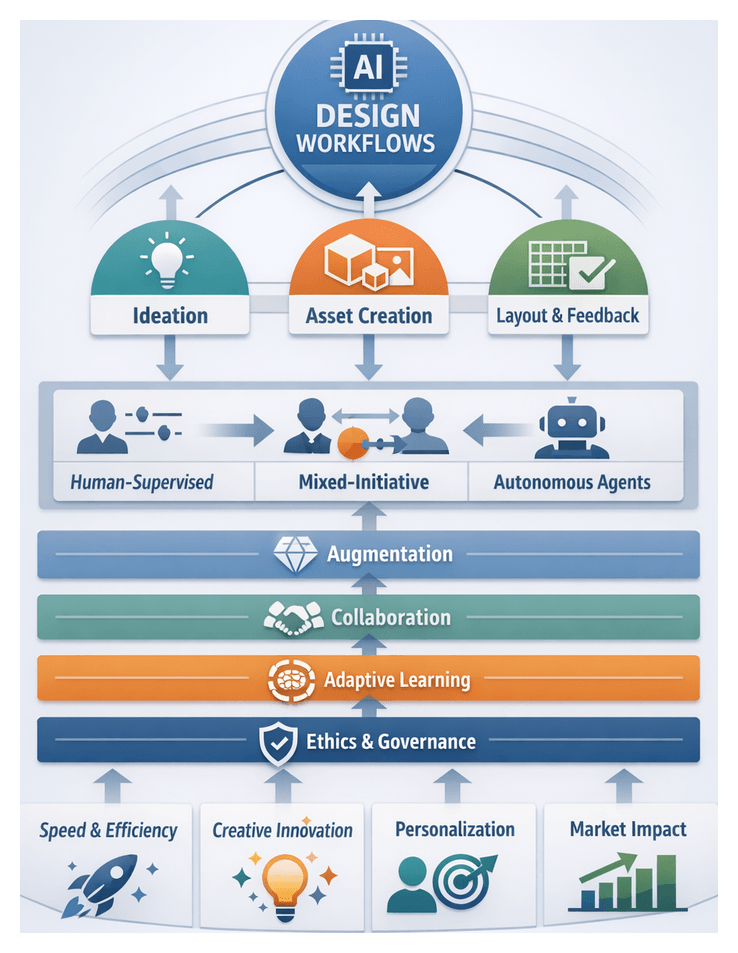
Embedding AI agents effectively requires identifying workflow entry points where automation augments human creativity without disrupting focus. Common integration points include:
- Ideation Support—Analyzing mood boards, branding guidelines and market trends to generate initial sketches or concept palettes.
- Asset Generation—Producing icon libraries, 3D models and style-consistent elements that reduce manual creation effort.
- Layout and Composition—Applying typographic hierarchies, grid systems and responsive design rules to automate page and screen arrangements.
- Real-Time Feedback—Monitoring progress to flag accessibility issues, enforce brand consistency and suggest refinements to color contrast or spacing.
- Personalization Engines—Adapting components dynamically based on user behavior or preference data for hyper-targeted experiences.
Underlying these integrations are core principles designed to preserve human agency and foster trust:
- Unobtrusive Augmentation—Integrate agents within familiar tools to minimize workflow disruption.
- Human-Centered Collaboration—Establish bidirectional feedback loops that let designers guide objectives and agents propose data-backed insights.
- Adaptive Learning—Enable continuous refinement based on project history, user feedback and performance outcomes.
- Transparency and Explainability—Surface rationales behind suggestions through annotations or interactive visualizations.
- Scalable Governance—Implement frameworks to manage brand compliance, ethical standards and oversight of automated processes.
Strategic Drivers of AI Adoption in Design
Design organizations face a convergence of market pressures and internal imperatives that make AI integration urgent. Accelerated time to market, enhanced creative capacity and data-driven decision making have become prerequisites for competitive differentiation.
- Accelerated Time to Market—Agents automate repetitive tasks, generate multiple concept variations and provide instant feedback, shortening iteration cycles and enabling faster launches.
- Enhanced Creative Capacity—Delegating routine adjustments to AI frees designers to focus on strategic vision and nuanced aesthetic decisions.
- Data-Driven Decisions—Agents ingest analytics, A/B test results and behavioral data to inform design elements and predict user preferences.
- Personalization at Scale—Autonomous variant generation supports hyper-targeted campaigns and dynamic content that would overwhelm manual workflows.
- Resource Optimization—Automating asset creation and layout planning minimizes errors, reduces manual labor and improves collaboration across distributed teams.
External factors reinforce these strategic drivers:
- Market and Competitive Urgency—Globalized demand and digital transformation reward organizations that iterate concepts in days rather than weeks.
- Technological Accessibility—Cloud-based APIs and plug-and-play services make generative image platforms, automated layout engines and intelligent content assistants widely available.
- Client Expectations—Stakeholders demand personalized, data-backed experiences with rapid validation and omnichannel consistency.
- Talent Dynamics—Designers versed in AI tools are in high demand; organizations must upskill teams to avoid widening skill gaps.
- ROI Imperatives—Leaders must justify AI investments with pilot KPIs such as reduced concept cycles, asset reuse rates and improved engagement metrics.
- Regulatory and Ethical Contexts—Evolving standards on algorithmic bias, data privacy and content authenticity require proactive governance frameworks.
Collaboration Paradigms and Role Allocation
Choosing a collaboration model and role allocation strategy is critical for balancing creative control with efficiency gains. Three predominant paradigms have emerged:
Human-Supervised Models
Designers set objectives, guide agents with detailed instructions and review outputs before approval. This “low autonomy, high control” approach maintains predictability, preserves brand integrity and builds trust during early AI adoption.
- Benefits: Direct creative control, adherence to guidelines, iterative learning of agent capabilities.
- Limitations: Slower turnaround, designer fatigue from oversight, underutilization of generative potential.
Autonomous Agent Models
Agents generate concepts, select visual elements and propose layouts with minimal human input. Known as “high autonomy, low control,” this model accelerates prototyping and supports large-scale exploration.
- Benefits: Rapid concept generation, reduced manual workload, exploration of unconventional styles.
- Limitations: Risk of misaligned outputs, poor interpretability of decisions, potential loss of human nuance.
Mixed-Initiative Models
Designers and agents engage in dynamic exchanges: humans seed high-level ideas, agents generate proposals, and subsequent refinements alternate until goals are met. This co-creative synergy leverages complementary strengths.
- Benefits: Combines human intuition with machine augmentation, fosters iterative refinement, balances control and innovation.
- Limitations: Requires advanced UX for interaction management, potential cognitive overhead, complex governance to resolve conflicts.
Role allocation frameworks guide task distribution between humans and agents:
- Capabilities-Risk Matrix—Maps task complexity against risk. Low-risk, low-complexity tasks (e.g., background pattern generation) go to agents; high-risk, high-complexity tasks (e.g., brand identity) remain human-led; mid-range tasks use mixed-initiative.
- Value-Chain Partitioning—Decomposes the design process from research to delivery, assigning data analysis and rapid prototyping to agents while retaining narrative crafting and stakeholder alignment for human teams.
Emerging frameworks emphasize adaptability:
- Dynamic Autonomy Spectrum—Agents adjust their initiative based on real-time performance assessments and thresholds set by design teams.
- Trust Calibration Metrics—Quantify confidence in agent recommendations to inform oversight levels.
- Hybrid Creative Intelligence—Multi-agent ecosystems collaborate among themselves and with humans to produce composite designs.
Organizational and Tactical Considerations for Integration
AI integration is as much a strategic transformation as a technical deployment. Key organizational factors include:
- Leadership Vision—Articulate how AI supports business objectives such as acceleration, differentiation and cost savings.
- Cultural Readiness—Foster a data-driven, experimental mindset and address concerns about creative autonomy through transparent communication.
- Skill Development—Provide training in prompt engineering, agent interaction paradigms and ethical guardrails.
- Governance Frameworks—Establish policies for data usage, version control, intellectual property and compliance with emerging regulations.
- Cross-Functional Teams—Embed AI expertise within squads of UX researchers, data scientists and creative leads to accelerate experimentation and optimization.
- Pilot Initiatives—Define measurable KPIs for small-scale projects to demonstrate ROI and build stakeholder support.
Ethical, Technical, and Operational Constraints
Maximizing AI benefits requires navigating inherent limitations and ethical considerations:
- Data Quality and Bias—Agents trained on narrow or biased datasets may perpetuate stereotypes. Implement data governance and bias-detection checkpoints.
- Opacity of Generative Processes—Complex models often operate as black boxes. Provide provenance metadata and rationale for suggestions to maintain trust.
- Infrastructure and Latency—High-performance compute or cloud inference incurs costs and may introduce delays in real-time workflows.
- Integration Overhead—Custom APIs, prompt libraries and version compatibility demand specialized technical support, straining small teams.
- Scalability Challenges—As output volumes grow, manual review can become a bottleneck. Balance automation with quality-assurance processes.
- Intellectual Property and Attribution—Clarify ownership of agent-generated assets and honor licensing requirements for third-party content.
- User Privacy—Adhere to data protection regulations and opt-in policies when leveraging behavioral data for personalization.
- Accountability—Define responsibility for final design decisions, especially in regulated or brand-sensitive contexts.
Best Practices for Sustainable Adoption
- Embrace a Partnership Model—Treat AI agents as co-creators. Leverage their generative capabilities to expand ideation while preserving human oversight.
- Start with High-Impact Use Cases—Prioritize concept diversification, rapid iteration and data-driven personalization where agents deliver clear efficiency gains.
- Invest in Data and Infrastructure—Curate representative design assets and establish scalable computing environments to support agent performance.
- Cultivate Ethical Oversight—Implement bias detection, transparency requirements and clear attribution policies to maintain creative integrity and user trust.
- Foster Continuous Learning—Iterate on collaboration models, monitor performance metrics and adapt governance as agent capabilities evolve.
By aligning strategic vision, collaboration models and governance frameworks, design organizations can harness AI agents not as mere tools but as strategic enablers of sustained creative innovation, operational agility and competitive advantage.
Chapter 4: Enhancing Ideation and Concept Generation
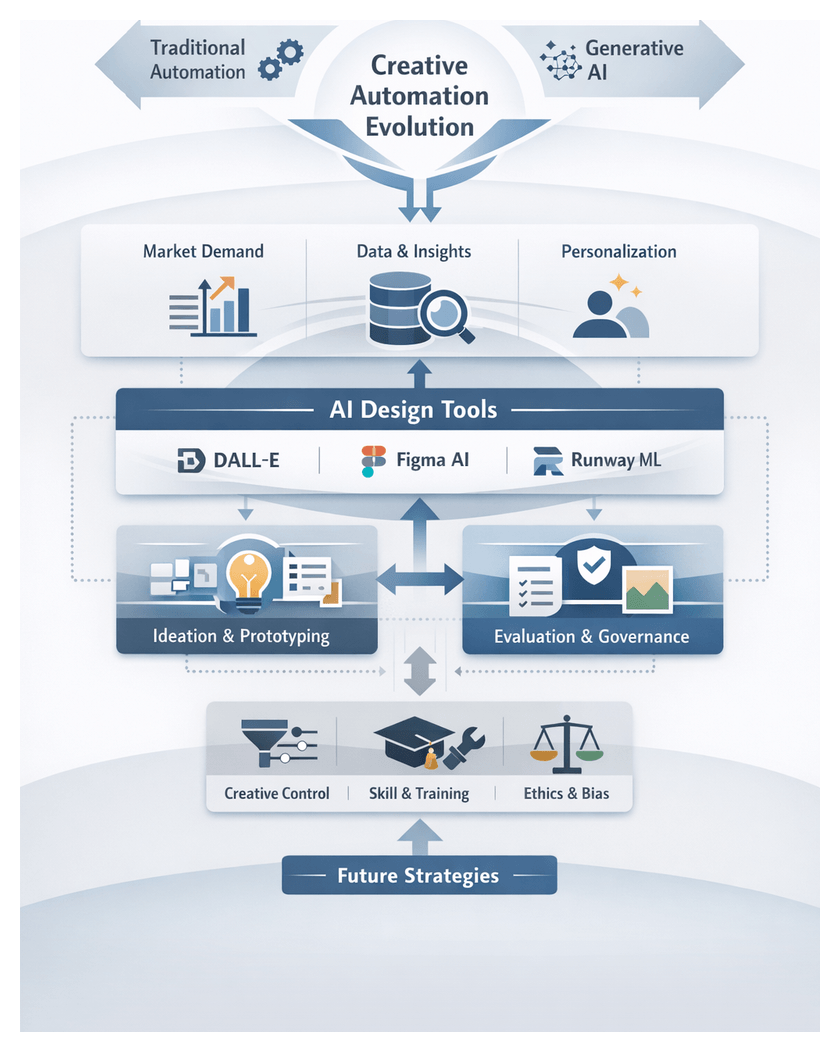
Creative Automation Landscape and Evolution
The convergence of creativity and automation has evolved from simple rule-based scripts to sophisticated generative systems that redefine design practice. Early automation relied on macros and heuristics to manage repetitive tasks—batch resizing, color correction and basic layout suggestions. Advances in machine learning and deep neural networks have given rise to platforms such as Adobe Sensei, DALL·E and Runway ML, which analyze vast design repositories to extract stylistic parameters and synthesize novel visual concepts from textual prompts or existing assets.
Simultaneously, AI democratization embeds generative capabilities within familiar environments. Designers using Figma’s AI features can auto-generate icons, refine illustrations or convert sketches into vectors without leaving their workspace. This integration accelerates iteration, fosters experimentation and reduces time to market.
Key drivers accelerate automation adoption:
- Market Pressure: Brands demand continuous content—social media graphics, personalized campaigns and responsive interfaces—at scale and pace that manual workflows cannot sustain.
- Data-Driven Insights: Analytics, A/B tests and engagement metrics provide rich context. Automation tools process this data to identify effective visual patterns, informing generative outputs with empirical grounding.
- Hyper-Personalization: Consumers expect customized experiences. Automation platforms generate variant-rich collateral—from localized ads to adaptive packaging—without manual overhead for each permutation.
Challenges accompany opportunity:
- Creative Control: Preserving brand coherence and nuanced aesthetics demands careful calibration of model parameters and human oversight.
- Skill Gaps: Designers must acquire competencies in prompt engineering, data interpretation and model evaluation.
- Data Quality and Bias: Generative systems risk reflecting historical biases or limited stylistic diversity, requiring rigorous dataset curation and inclusive design frameworks.
Thoughtfully implemented, automation transforms the design lifecycle. Rapid concept exploration generates dozens of proposals in minutes, fostering divergent thinking. Structured inputs allow non-design stakeholders to contribute to ideation, enhancing cross-functional collaboration. Emergent styles surfaced by generative tools inspire innovation, positioning organizations as trendsetters rather than followers.
Addressing automation’s complexity requires a framework that spans technical, organizational and ethical dimensions. Technical considerations include agent architectures, interoperability and performance benchmarks. Organizational factors involve role realignment, training and change management. Ethical dimensions cover transparency, bias mitigation and intellectual property. This holistic approach positions AI agents as collaborative partners that amplify human creativity within resilient, adaptable design ecosystems.
Analytical Framework for Generative Prompting
Generative prompting has become central to guiding AI agents toward meaningful outputs. Prompts function as interpretive instruments, shaping how systems balance creativity with constraints. Experts evaluate prompts through structured frameworks, employ quantitative and qualitative metrics, and institute governance to ensure consistency and accountability.
Generative Prompting as Interpretive Exchange
- Contextual Anchoring – Embedding domain terminology, brand guidelines and project objectives situates generative responses within defined boundaries, reducing off-brand or incoherent outputs.
- Constraint Layering – Specifying color palettes, aspect ratios and typographic hierarchies alongside higher-level directives balances creative freedom with feasibility.
- Iterative Reflection – Treating prompts as living documents supports feedback loops where AI proposals are reviewed, critiqued and reformulated into refined prompts, cultivating emergent ideas beyond single-pass generation.
Prompt Taxonomies and Archetypes
- Exploratory Prompts – Early-stage ideation: “Imagine a brand identity inspired by…” prioritizes novelty and uncovers unforeseen design territories.
- Directional Prompts – Mid-project guidance: “Generate three logo concepts using geometric sans-serif typography and warm gradients” balances openness with specificity.
- Refinement Prompts – Optimization stage: “Enhance visual hierarchy and improve legibility” focuses on iterative improvements.
- Constraint-Driven Prompts – Challenge models: “Blend Art Deco and brutalist aesthetics within a single packaging form” supports innovative risk-taking and stress-tests algorithmic flexibility.
Evaluation Metrics and Methodologies
- Quantitative Metrics – Diversity, relevance and novelty measured via feature-space clustering, semantic similarity scores using embeddings from models like GPT-4, and deviation from historical archives.
- Qualitative Evaluations – Structured design reviews rate outputs on aesthetic appeal, brand alignment and user empathy with Likert scales or semantic differential scales.
- A/B Testing and User Studies – Prototypes tested with target audiences using platforms like Optimizely and Lyssna, measuring task completion time and preference rankings.
- Iterative Scoring Systems – Composite scores reflect prompt clarity, output coherence and alignment with objectives, evolving as teams learn prompt–output correlations.
Governance Mechanisms
- Prompt Libraries – Centralized repositories of approved templates categorized by use case and design phase streamline kickoffs and enforce brand compliance.
- Prompt Auditing and Version Control – Tracking prompt iterations maintains audit trails for retrospection and accountability.
- Cross-Functional Review Boards – Designers, strategists and data scientists vet prompt strategies against ethical standards, brand values and technical feasibility.
- Educational Initiatives – Workshops, certification programs and mentorship networks democratize prompt expertise.
Interpretive Challenges
- Model Opacity – Subtle prompt phrasing or parameter shifts can cause output divergence, complicating root-cause analysis.
- Bias Amplification – Without careful design, prompts may reinforce stereotypes; bias audits and de-risking techniques are essential.
- Semantic Drift – Over feedback loops, agents may shift interpretations; continuous calibration and revalidation protocols detect drift early.
- Scalability of Expertise – Reliance on expert prompt engineers creates bottlenecks; low-code tools and in-platform guidance help scale capabilities.
Drivers of Urgency in Design Practice
AI integration is no longer optional but a strategic imperative. Machine learning–driven workflows accelerate ideation, enable data-informed decisions and deliver hyper-personalized experiences. As generative systems mature, they transition from novelties to indispensable collaborators, reshaping competitive dynamics across industries.
Market and Competitive Pressures
Globalization and digital transformation intensify competition. AI agents that autonomously generate mockups, variant assets for A/B tests or sentiment-driven visuals empower first movers to capture market share and command premium positioning.
Technological Advancements
Innovations in GANs and multimodal models power platforms like DALL·E, Midjourney and Adobe Firefly, synthesizing high-fidelity imagery, typographic treatments and style remixes in real time. As latency decreases and context awareness deepens, delayed adoption risks manual processes falling behind generative speed and scale.
Evolving Consumer Expectations
Personalization has shifted from broad demographic targeting to one-to-one design responsiveness. AI analyzes interaction logs and psychographic profiles to recommend elements that heighten engagement in e-commerce, streaming and mobile apps.
Organizational Imperatives
Budget and bandwidth constraints drive automation of repetitive tasks—layout variants, testing simulations and accessibility checks—freeing designers for strategic problem solving. AI agents become catalysts for lean operations and rapid iteration.
Implications for the Profession
- Skill Evolution: Mastery of vector editors is complemented by prompt engineering, data literacy and model evaluation.
- Strategic Differentiation: Firms offer AI-driven services—faster concept generation and data-backed design rationales—as competitive advantages.
- Risk Management: New vectors of IP ambiguity, bias and regulatory compliance necessitate governance frameworks.
- Ethical Responsibility: Practitioners must ensure outputs reflect inclusive values, avoid stereotypes and maintain transparency.
Contexts of Application
- Brand and Marketing Agencies: AI generates multi-variant social graphics, video storyboards and copy suggestions for dynamic pitches.
- Product and UX Teams: Systems inform wireframes, simulate flows and propose micro-interactions to optimize funnels and accessibility.
- Industrial and Architectural Design: Generative design evaluates materials, sustainability and ergonomics for prototype configurations.
- Content Creation and Publishing: Media outlets use AI for image editing, video clipping and headline generation under tight content cycles.
- Open Source and Community Ventures: Collaborations on platforms like Hugging Face refine model checkpoints, curate biases and share best practices.
Strategic Frameworks for Readiness
- Diffusion of Innovations: Mapping stakeholders from innovators to laggards identifies champions and anticipates resistance.
- Gartner Hype Cycle: Tracking technologies along hype and productivity phases sets realistic timelines for adoption.
- Design Thinking Integration: Embedding AI exploration within empathize, define, ideate, prototype and test phases preserves human empathy alongside algorithmic efficiency.
Balancing Speed with Foresight
Urgency must be tempered with governance. Clear objectives, success metrics and ethical guardrails enable controlled experimentation. Documented outcomes and iterative scaling transform urgency into disciplined innovation that delivers sustainable value rather than transient novelty.
Strategic Pillars and Actionable Takeaways
The following thematic pillars synthesize essential insights for integrating AI agents as creative collaborators. Each pillar highlights strategic opportunities, potential limitations and practical considerations.
- Evolutionary Foundations: Understand the shift from rule-based scripts to collaborative intelligence. View AI agents as dynamic participants in feedback loops, not static tools.
- Defining Agent Capabilities: Assess autonomy, adaptability, contextual awareness and generative fluency through probabilistic models, reinforcement learning and transformer architectures. Balance innovation with oversight via guardrails and validation criteria.
- Integration and Workflows: Compare supervised, mixed-initiative and autonomous collaboration frameworks. Design entry points—prompt checkpoints, peer reviews, sandbox environments—and invest in change management, knowledge repositories and transparent communication.
- Ideation and Concept Generation: Employ layered prompting frameworks for divergent exploration and targeted refinement. Structure review sessions treating outputs as provocations. Guard against semantic drift with diverse data and periodic taxonomy reevaluation.
- Prototyping and Iteration: Leverage interactive style transfer and correction engines for rapid mockup cycles. Implement versioning, anomaly detection and human-in-the-loop validation to maintain quality control.
- Personalization and User-Centered Design: Integrate clustering, recommendation systems and behavioral models for hyper-personalized variations. Uphold ethical data practices—transparent collection, consent and bias audits—and monitor engagement metrics to refine parameters.
- Human-AI Co-Design Dynamics: Foster shared mental models via dialogue protocols, annotations and interpretability layers. Position designers as curators and ethical stewards, while agents handle pattern discovery and trial generation. Build trust with performance baselines and error-reporting mechanisms.
- Ethical Considerations: Mitigate biases through representative sampling, corrective algorithms and third-party audits. Ensure transparency with provenance tracking and usage logs. Establish governance defining acceptable use cases, escalation paths and review boards.
- Measuring Impact and ROI: Combine quantitative KPIs—time savings, error reduction and throughput gains—with qualitative indicators like creative satisfaction and stakeholder buy-in. Use case studies and before-after comparisons. Revisit metrics as business objectives and agent functionalities evolve.
- Future Trends and Roadmapping: Monitor self-supervised learning, multimodal synthesis and distributed intelligence. Explore AI in AR/VR/MR environments for immersive ideation. Design modular architectures for emerging APIs, model updates and interoperable data schemas.
Key Considerations and Limitations
- Outputs depend on data quality; invest in curation and validation.
- Over-reliance on templates risks homogenized outcomes; inject human novelty.
- Navigating IP, licensing and privacy requires legal collaboration.
- AI literacy gaps and cultural resistance demand targeted education and leadership alignment.
- Attribution of AI contribution can be challenging; refine evaluation frameworks.
- Legacy systems and data silos may require phased pilots and infrastructure upgrades.
- Rapid technology shifts necessitate continuous scanning of new platforms and models.
By embracing these strategic pillars with analytical rigor and organizational foresight, design teams can transform AI into a genuine creative partner. This framework empowers practitioners to harness generative capabilities, maintain human-centered excellence and drive sustainable innovation in a rapidly evolving landscape.
Chapter 5: AI-Assisted Prototyping and Iteration
Evolution and Drivers of AI-Powered Prototyping
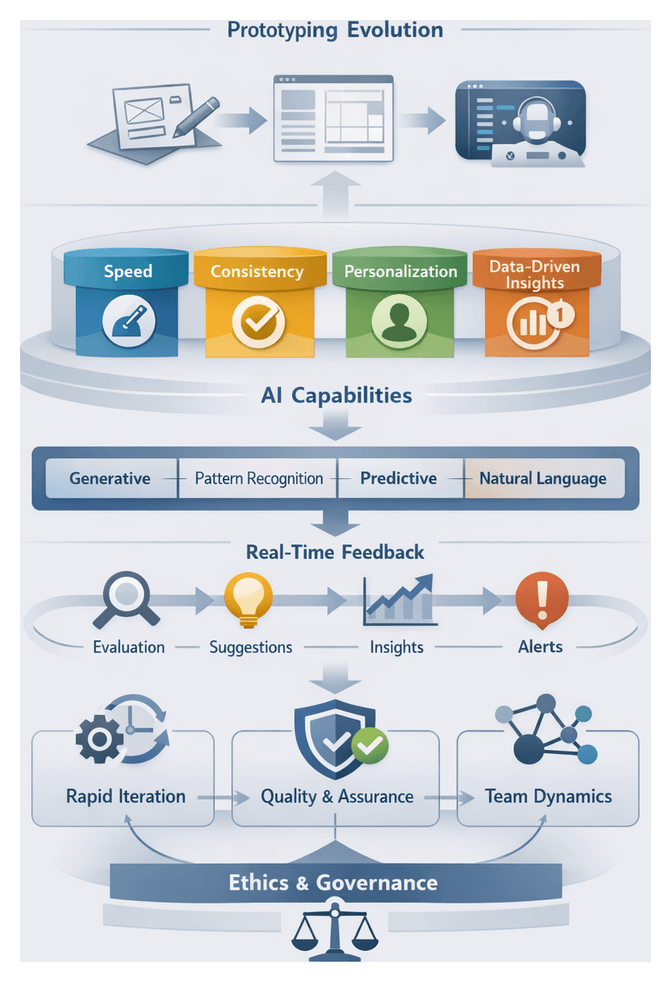
Prototyping has evolved from paper sketches and foam mock-ups to digital wireframes and interactive simulations, serving as the critical bridge between abstract ideas and tangible outcomes. Recent advances in artificial intelligence have ushered in a paradigm shift, transforming prototyping from a manual exercise into an intelligent, data-driven activity. Platforms like Uizard convert hand-drawn sketches into functional interfaces, while Framer employs intelligent layout engines to suggest responsive designs tailored to content and user behavior. Creative studios integrate tools such as Runway ML to generate dynamic visual assets in real time, accelerating iteration and enabling rapid experimentation.
Design teams adopt AI-assisted prototyping in response to multiple strategic pressures: compressed time-to-market, rising customer expectations for polished interactive experiences, increasing product complexity, and the need for seamless coordination across design, engineering, and data science disciplines. AI integration addresses these challenges by:
- Increasing velocity: Automated asset creation and intelligent layouts enable same-day prototype revisions.
- Enhancing consistency: Machine learning enforces brand guidelines and design-system rules, reducing visual drift.
- Improving confidence: Data-driven feedback on usability and performance informs adjustments with empirical evidence.
- Scaling personalization: Dynamic content and adaptive interfaces cater to diverse user segments without manual rework.
By automating routine tasks and shortening feedback cycles, AI-powered prototyping lets designers focus on strategic, high-order creative decisions.
Fundamental AI Capabilities
AI-driven prototyping leverages four core technical functions that reshape how interfaces are generated and refined:
- Generative modeling: Architectures such as generative adversarial networks and variational autoencoders synthesize novel visual assets, layout variations, and interaction patterns based on learned distributions from design datasets.
- Pattern recognition: Convolutional neural networks and clustering algorithms detect recurring design motifs and component relationships, enabling automated grouping and reuse.
- Predictive adaptation: Reinforcement learning agents anticipate user behaviors and environmental contexts, proposing adjustments—such as resizing buttons or repositioning navigation—to optimize engagement and accessibility.
- Natural language understanding: Transformer-based models interpret textual prompts, design briefs, or stakeholder feedback to generate content suggestions, annotations, and iteration directives within prototypes.
Combined, these capabilities enable AI agents to evolve from passive assistants into active collaborators, shaping design solutions based on learned patterns and real-time user data.
Real-Time Feedback and Interpretation Frameworks
Real-time feedback capabilities represent a major advancement in AI-assisted prototyping, allowing teams to assess and refine concepts without traditional handoff delays. Feedback types include:
- Evaluative feedback: Agents assess elements against heuristics or best practices, highlighting contrast issues per WCAG or typographic inconsistencies based on trained corpora.
- Generative suggestions: Tools such as Adobe Sensei propose alternative layouts, color palettes, and asset variations aligned with brand identity.
- Predictive insights: Platforms like Framer forecast engagement metrics and flag usability risks before user testing.
- Contextual alerts: Agents monitor design activity and notify teams of scope deviations or style-guide conflicts, as seen in Uizard.
Practitioners interpret agent feedback through established frameworks:
- Human-in-the-Loop theory: Emphasizes continuous collaboration where feedback becomes a conversational exchange, fostering shared mental models and trust.
- Distributed cognition: Positions AI agents as external cognitive artifacts, distributing pattern recognition and error detection across tools and collaborators.
- Feedback loop optimization: Focuses on minimizing latency between designer action and agent response to preserve momentum and maximize creative output.
Effectiveness is measured by metrics such as accuracy rate, response latency, adoption rate, designer satisfaction, and iteration velocity. Explainable AI frameworks—like heatmaps indicating which interface areas influenced contrast-check recommendations—enhance trust and allow designers to validate or override suggestions. To manage cognitive load, teams implement threshold-based alerting, delivering high-confidence critiques immediately while batching lower-priority insights for review during reflection phases.
Emerging challenges include adaptive learning overhead, cross-modal feedback for AR/VR and voice interfaces, conflict resolution when multiple agents produce divergent suggestions, and securing project data in compliance with privacy regulations.
Implications for Iteration Speed, Quality, and Team Dynamics
AI-driven agents compress feedback cycles and reallocate human effort. Continuous monitoring and suggestions allow designers to iterate through dozens of variations in the time previously required for a single mockup. Key impacts include:
- Resource efficiency: AI amortizes routine refinements across many permutations, reducing per-iteration cost and freeing senior talent for strategic work.
- Exploration vs. refinement: Adaptive variation thresholds, constraint-driven generation, and tiered review processes balance creative divergence with convergent quality checks.
- Quality assurance: Automated and human-centric layers flag accessibility violations, brand inconsistencies, and performance issues, ensuring only high-fidelity prototypes reach user testing.
- Team evolution: Roles shift toward curator-strategists who direct AI agents and synthesize outputs. Cross-disciplinary collaboration intensifies as DesignOps coordinates human-agent workflows.
- Timeline compression: Organizations report 30–50 percent reductions in project durations but must realign milestone definitions and manage elevated delivery expectations.
- Risk management: Innovation sandboxes, decision matrices weighing AI suggestions against qualitative criteria, and iterative risk assessments maintain innovation bandwidth while preventing premature convergence on suboptimal solutions.
Successful integration views AI agents not merely as speed tools but as partners in structured, purposeful creative exploration.
Key Considerations for Responsible Deployment
Maximizing AI-driven prototyping requires balancing efficiency gains with strategic oversight and ethical governance. Critical considerations include:
- Balancing innovation velocity and creative agency: Set clear objectives and constraints before generative runs to ensure prototypes remain purposeful.
- Data quality and representativeness: Audit training datasets for bias, apply fairness metrics, and validate outputs against inclusive design principles, especially when using Uizard or Adobe Sensei.
- Transparency and interpretability: Embed explainable AI layers so designers understand why agents suggest specific refinements.
- Governance and ethics: Form cross-functional committees to review privacy, bias, and accessibility compliance during prototyping.
- Curating outputs: Adopt a two-stage process where AI exploration is followed by expert refinement, ensuring domain expertise shapes final designs.
- Hybrid team structures: Invest in training for prompt engineering, model evaluation, and data ethics. Leverage DesignOps to orchestrate human-agent collaboration.
- Technical and resource constraints: Evaluate total cost of ownership for cloud services versus on-premises deployments. Conduct proofs of concept to align prototyping ambitions with IT capacity.
- Integration with design toolchains: Use plugins and APIs—such as the Figma AI Plugin—to surface AI suggestions within Figma, Sketch, or Adobe XD with minimal context switching.
- Preserving brand consistency: Embed design-system tokens for color palettes, typography scales, and component libraries into generative models to prevent deviations.
- Accessibility and inclusive design: Enforce semantic markup, contrast checks, and keyboard navigability by default, especially when exploring parametric layouts with Autodesk Dreamcatcher.
- Measuring impact: Combine quantitative KPIs—such as iteration count and defect reduction—with qualitative feedback from designers and users via surveys and workshops.
- Iterative calibration: Document temperature settings, prompt templates, and style embeddings to align agent behavior with project goals and accelerate future prototyping.
- Intellectual property and ownership: Review vendor agreements for derivative work clauses. Define clear policies on asset provenance and licensing.
- Culture of experimentation: Create sandbox environments, internal hackathons, and show-and-tell sessions to encourage low-stakes trials and knowledge sharing.
- Long-term model evolution: Maintain modular pipelines and partnerships with research labs to integrate emerging techniques without disrupting workflows.
- Alignment with business objectives: Ensure prototyping metrics map to strategic goals—whether reducing time-to-market, improving engagement, or lowering development costs—and review ROI regularly.
By embedding these considerations into AI-driven prototyping initiatives, organizations can harness the full potential of autonomous agents while safeguarding creative agency, ethical standards, and design integrity.
Chapter 6: Personalization and User-Centered Design
The Evolution of Creative Automation and Design Intelligence
Over the past decade, design practice has undergone a paradigm shift driven by the maturation of automation and machine learning technologies. Early desktop publishing tools automated layout calculations and alignment rules, but today’s AI-driven platforms extend far beyond rule-based logic. Systems such as Adobe Sensei and Canva Magic Write integrate predictive text, image suggestion, and style adaptation directly into design workflows. Specialized generative imagery engines like DALL·E 3, Midjourney, and Stable Diffusion convert text prompts into high-fidelity visuals, enabling rapid exploration of aesthetic possibilities. Meanwhile, branding engines such as Looka and Tailor Brands generate logos and color palettes by analyzing industry trends and user inputs, and video platforms like RunwayML offer real-time editing and style transfer powered by cinematic datasets.
As these capabilities proliferate, the definition of design work expands to include the orchestration of AI agents alongside traditional creative methods, allowing human professionals to focus on strategic direction, narrative development, and creative curation.
Data-Driven Personalization in Design
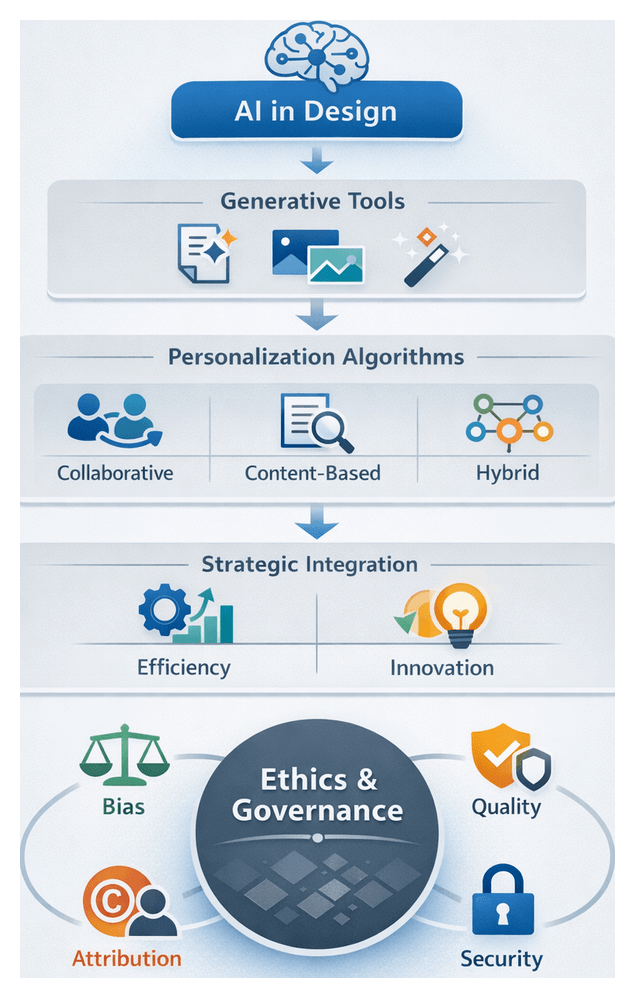
Data-driven customization has become fundamental for delivering personalized experiences at scale. Rather than relying on static personas, organizations now transform behavioral signals—clickstreams, browsing patterns, purchase histories—into tailored interfaces and multimedia content. Three core algorithmic approaches underpin modern personalization:
- Collaborative Filtering: User-based and item-based methods infer preferences by examining similar users’ behaviors, with diversity constraints and temporal decay factors mitigating cold-start and echo chamber effects.
- Content-Based Filtering: Metadata and feature analysis—textual embeddings, visual descriptors, semantic tags—drive recommendations with high interpretability, essential in regulated industries.
- Hybrid Models: Ensembles or cascade architectures blend collaborative and content-based outputs, optimizing precision, recall, and serendipity through weighted re-ranking and contextual signals.
Advanced personalization incorporates real-time adaptation and predictive modeling. Session-based recommendations adjust content dynamically, predictive user segmentation identifies transient states, and reinforcement learning agents optimize long-term engagement policies. Platforms like Adobe Sensei, Dynamic Yield, and Optimizely provide cloud-native APIs and microservices architectures for scalable deployment, with performance evaluated on latency, responsiveness, and prediction stability. Ethical transparency is maintained through explainability tools such as LIME and SHAP, ensuring clear audit trails for recommendation logic.
Strategic Imperatives and Adoption Drivers
The convergence of powerful GPUs, specialized AI accelerators, and accessible frameworks like TensorFlow and PyTorch has lowered barriers to entry for AI-powered design. Cloud services, including Adobe Sensei and RunwayML, enable studios of all sizes to integrate generative functions without deep in-house expertise. Concurrently, competitive pressures demand novel, personalized experiences and faster time to market. Agencies report that AI agents halve the effort spent on asset variations, allowing teams to focus on storytelling and brand differentiation. Tools like Adobe Firefly and Figma’s AI-assisted plugins support rapid prototyping and iterative feedback loops within collaboration platforms such as Figma and Sketch.
Strategically, organizations must view AI integration as a dynamic capability—sensing opportunities, seizing them through experimentation, and reconfiguring resources to sustain competitive advantage. This requires ambidextrous leadership that balances exploratory AI initiatives with the exploitation of existing creative strengths, aligning investments with clear KPIs tied to efficiency, quality, and innovation.
Challenges, Ethical Considerations, and Governance
Despite its promise, creative automation introduces challenges that demand rigorous oversight:
- Quality Control and Consistency: Automated outputs vary in fidelity. Ensuring brand alignment and project relevance often requires manual refinement and strict governance frameworks.
- Bias and Representation: Training data may encode cultural or socioeconomic biases. Regular audits, diverse training sets, and fairness evaluation protocols are essential to mitigate representational risks.
- Creative Agency and Attribution: Generative artifacts raise authorship and intellectual property questions. Clear licensing and attribution practices preserve human creative identity while respecting contributor rights.
- Skill Gaps and Change Management: Effective collaboration with AI agents necessitates new literacies in prompt engineering, model evaluation, and data interpretation. Structured upskilling and cultural incentives foster adoption.
- Integration Complexity: Embedding AI within existing toolchains—whether Adobe Creative Cloud or the OpenAI API—requires technical orchestration, security vetting, and cross-functional coordination.
- Governance and Accountability: Delegating creative decisions to autonomous systems challenges traditional hierarchies. Defined escalation paths, audit trails, and ethical impact matrices ensure transparency and legal compliance.
- Cost Structure: AI adoption adds compute infrastructure, data acquisition, and maintenance expenses. Financial planning must balance these costs against projected efficiency gains and strategic value.
- Generalization versus Specialization: Foundation models offer breadth but may lack domain nuance, while specialized models deliver precision at higher development cost. Selecting the right model mix is critical.
Analytical Frameworks and Organizational Best Practices
Design leaders leverage a variety of interpretive lenses to navigate AI integration:
- Human-Agent Symbiosis Model: Views designers and AI agents as co-evolving partners, emphasizing iterative dialogues rather than static prompts.
- Capability Maturity Framework: Maps AI adoption from experimental proof-of-concept to strategic alignment and business model innovation.
- Personalization Maturity Model: Stages progress from rule-based targeting to autonomous, multi-channel personalization, guiding investment roadmaps.
- Value-Ethics Triangle: Balances user relevance, business gains, and ethical integrity to illuminate trade-offs in personalization aggressiveness.
- Ethical Impact Matrix: Cross-references agent capabilities with bias vectors and accountability mechanisms, prioritizing risk mitigation.
- Value Realization Taxonomy: Distinguishes direct efficiency gains from strategic value creation, aiding stakeholder alignment on ROI narratives.
- Co-Design Cognitive Schema: Examines shared mental models, interaction protocols, and the externalization of creative intent in human-AI collaboration.
Best practices include establishing cross-functional governance teams that unite design leadership, data science, legal counsel, and ethics officers. Continuous experimentation through A/B testing, multivariate analysis, and holdout cohorts validates value propositions while preventing false positives. Robust data governance ensures representative and compliant datasets. Explainability tools such as LIME and SHAP foster trust, particularly in regulated sectors. Cloud-native architectures and microservices support scalable deployment, and phased pilot programs with clear KPIs enable organizations to validate benefits before scaling.
Key Takeaways for Practitioners
- Position AI agents as collaborators that amplify human insight rather than replace creative expertise.
- Adopt a phased integration strategy, starting with small-scale experiments to validate value before enterprise-wide rollout.
- Invest in interdisciplinary governance structures that unify design, data science, ethics, and legal domains.
- Commit to ongoing skill development in prompt engineering, model interpretation, and AI literacy.
- Prioritize data integrity and bias mitigation as foundational elements of generative design initiatives.
- Balance efficiency gains with creative diversity by maintaining open-ended exploration alongside structured prompts.
- Plan for the full cost lifecycle of AI agents, including infrastructure, integration, licensing, and maintenance.
- Ensure transparency around AI contributions in stakeholder communications to uphold credibility and informed collaboration.
- Monitor emerging trends—edge personalization, multimodal synthesis, federated learning—to anticipate how next-generation AI will reshape design practice.
Chapter 7: Human-AI Co-Design Dynamics
The Evolution and Current Landscape of Creative Automation
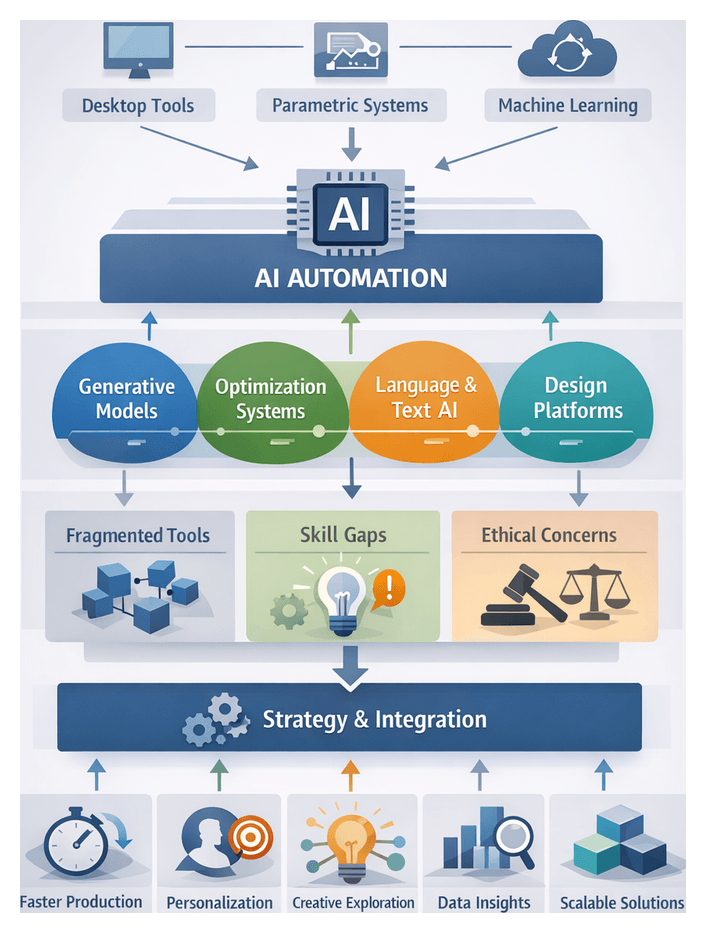
The creative industries are experiencing a profound transformation as automation and artificial intelligence reshape traditional design workflows. Originating with desktop publishing tools that automated pagination and basic formatting, the field has progressed through scripting interfaces in vector drawing applications and rule-based parametric systems in manufacturing and architecture. Over the past decade, machine learning has accelerated this evolution. Data-driven inference now enables generative systems to recognize patterns, propose compositions, and produce original assets from vast image, layout, and text datasets. Creative outputs have shifted from the product of predefined scripts to emergent artifacts informed by statistical models and large-scale training data.
Today’s market offers a spectrum of AI-driven design assistants. Generative adversarial networks create photorealistic textures and characters, reinforcement learning optimizes interface usability, and natural language models draft headlines, product descriptions, and narratives. Platforms such as Adobe Sensei integrate automated asset tagging and style transfer. Canva proposes brand-consistent templates, while Autodesk Generative Design evolves structural components via simulation data. Specialized tools like Runway ML and Midjourney enable rapid visual concept prototyping. Together, these applications illustrate both the promise of accelerated creativity and the complexity introduced by an expanding ecosystem of AI capabilities.
Several forces drive adoption of creative automation. Businesses demand faster time-to-market for campaigns, product launches, and digital experiences. Consumer expectations for personalized content at scale continue to rise. Competition for talent and budget pressures compels organizations to streamline workflows. Meanwhile, access to cloud-based AI services democratizes advanced capabilities for small studios and independent creators. Rapid improvements in compute resources and open-source machine learning frameworks lower the barrier to innovation. As a result, both legacy agencies and in-house teams are under pressure to evaluate AI solutions, integrate them into existing pipelines, and measure their impact on quality and efficiency.
Challenges and Strategic Considerations
Despite clear benefits, integrating AI into creative operations presents significant challenges. Addressing these issues requires strategic alignment, robust governance, and continuous learning.
Fragmented Tool Ecosystems
Designers often juggle specialized platforms for illustration, typography, layout, and prototyping—each with distinct automation features and data formats. Manual export/import steps or custom integrations are necessary to bridge these silos. Without seamless interoperability, AI-generated assets risk being stranded, undermining workflow continuity and team collaboration.
Skill Gaps and Resource Constraints
Effective use of AI tools demands competencies in data literacy, prompt engineering, model evaluation, and basic programming. Many creative professionals lack formal training in these areas, leading to underutilization of advanced features or reliance on external specialists. Budget limitations may further restrict access to training and machine learning expertise.
Creative Homogenization Risk
When multiple organizations rely on the same pretrained models and public datasets, outputs can exhibit similar stylistic traits, eroding brand uniqueness. Overreliance on default AI suggestions may steer designs toward generic patterns, diminishing creative diversity and differentiation.
Workflow Disruption and Change Management
Embedding AI agents into established processes requires careful change management and clear governance policies. Resistance may arise from teams accustomed to manual exploration. Without defined roles and transparent decision protocols, AI recommendations can be perceived as intrusive or threatening to creative autonomy.
Quality Assurance and Reliability
AI systems may produce unpredictable results, from visual artifacts to semantic inconsistencies in copy. Rigorous quality control—validation protocols, style checks, and human review checkpoints—is essential to prevent flawed outputs from reaching stakeholders or end users.
Ethical and Legal Considerations
Generative models trained on copyrighted or biased data pose ethical risks. Unintended bias in image or text generation can harm marginalized groups. Intellectual property concerns arise when AI replicates protected designs. Navigating this complex regulatory landscape demands ethical frameworks, bias audits, and transparent documentation.
Strategic Foundations
To unlock AI’s full potential, organizations must establish clear objectives for integration, align on performance metrics, and define decision-making protocols that balance automated recommendations with human judgment. Transparent feedback loops—where designers critique AI outputs, refine prompts, and iteratively guide the system—are critical. Equally important is investing in upskilling programs that equip creative teams with the frameworks and language to engage meaningfully with AI agents. Only through strategic alignment and a culture of continuous learning can teams harness the transformative power of creative automation.
Opportunities Unlocked by AI
- Accelerated Productivity and Throughput: Automation handles repetitive tasks—batch resizing, asset variants, layout adjustments—freeing designers for strategic, high-value work. What once took weeks can now be prototyped in hours.
- Hyper-Personalization at Scale: AI tailors content to individual profiles in real time, adapting imagery, messaging, and interactions to drive deeper engagement across channels.
- Democratization of Design Expertise: Template recommendations, style guidelines, and guided prompts empower non-designers to produce professional-grade assets, enabling small teams to maintain brand consistency without dedicated staff.
- Accelerated Innovation and Exploration: Generative models produce diverse visual and textual proposals from simple prompts. Designers can evaluate dozens of variations rapidly, uncovering unexpected directions beyond manual sketching.
- Data-Driven Creative Insights: Machine learning analyzes historical performance, user behavior, and market trends to inform design decisions. AI surfaces patterns that guide effective visual hierarchies, color palettes, and messaging strategies.
- Cost Efficiency and Scalability: Automating routine tasks reduces reliance on large teams or external agencies. Organizations can scale creative output dynamically, aligning resources with business needs.
Collaboration and Communication Strategies
Effective human-AI co-design hinges on interaction frameworks, shared mental models, transparent mechanisms, and robust feedback loops.
Interaction Frameworks
- Supervised Interaction: Designers issue prompts and approve outputs; agents execute transformations or generate variations under tight constraints.
- Mixed-Initiative Cooperation: Initiative shifts dynamically; agents propose alternatives and surface latent patterns while designers refine and redirect suggestions. Plugins in Figma illustrate this model by combining automated prompt generation with human oversight.
- Autonomous Collaboration: Agents undertake substantial ideation or prototyping guided by high-level objectives; human oversight focuses on strategic evaluation and curatorial judgment.
Shared Mental Models and Transparency
- Data Transparency: Visibility into data sources, biases, and transformations.
- Process Transparency: Access to intermediate reasoning or feature activations.
- Outcome Transparency: Traceability of how suggestions were derived, enabling assessment of relevancy and trustworthiness.
Tools like the DALL·E 3 API expose prompt-to-output mappings, allowing inspection of token influences. Governance frameworks ensure decision pathways are logged, supporting audits and reinforcing trust.
Iterative Feedback Loops
- Prompt Calibration: Adjusting input constraints or style guides based on initial outputs.
- Real-Time Validation: Agents incorporate user corrections on the fly, updating generative models to reflect preferences and conventions.
- Progressive Formalization: Explorations start loose and exploratory, converging into formalized artifacts as dialogue matures. Platforms such as Adobe Firefly enable live iteration by modifying feature sliders and observing adaptive generative suggestions.
Multimodal Channels
- Textual Prompts: Precise semantic control but risk constraining creative breadth.
- Sketch-Based Inputs: Designers convey composition and style visually; generative vision models translate sketches into structured proposals.
- Voice and Conversational Interfaces: Natural dialogue flow leveraging speech recognition and context-aware language models.
- Haptic and Spatial Controls: Emerging in VR and AR, where physical interactions guide three-dimensional forms and scene compositions.
Power Dynamics and Agency Allocation
- Designer-Centric Control: Designers retain final veto power, which can stifle agent-led innovation.
- Agent-Augmented Autonomy: Agents explore variations within boundaries, shifting designers toward evaluation and refinement.
- Collaborative Equilibrium: Decision authority oscillates based on confidence measures and triggers, enabling each party to lead when suited.
Evaluative Metrics
- Interaction Efficiency: Exchange cycles needed to reach satisfactory design.
- Creativity Enhancement: Novelty or diversity compared to human-only baselines.
- Trust and Transparency Scores: Designer perceptions of reliability and clarity.
- Alignment Accuracy: Extent to which outputs meet requirements, evaluated via semantic similarity metrics and task completion rates.
Redefining Designer Roles and Facilitation
AI agents are transforming the designer’s role from maker to orchestrator, curator, and ethical steward within complex socio-technical ecosystems.
Shift from Maker to Orchestrator
Designers now define high-level objectives, articulate constraints, and guide generative processes through prompts, data inputs, and feedback. They configure agent parameters, curate datasets, and deploy targeted questioning to steer AI toward desired concepts. This strategic oversight balances generative creativity with human judgment to achieve outcomes that neither party could realize alone.
Emergence of Curatorial Expertise
With AI generating large volumes of proposals, designers assume curatorial roles—evaluating outputs for usability, accessibility, and emotional impact; synthesizing fragments into cohesive narratives; and contextualizing selections to resonate within intended environments, whether digital interfaces, physical installations, or multimedia campaigns.
Strategic and Systems Thinking
Designers adopt strategic and systems thinking, viewing AI as part of a broader ecosystem. They anticipate how agent outputs influence user behavior, brand perception, and organizational objectives. Using frameworks such as value network mapping and service blueprinting, practitioners visualize interactions among stakeholders, machines, and end users, embedding mechanisms for feedback, monitoring, and continuous improvement.
Facilitation and Collaboration
Designers act as facilitators of human-AI dialogue, moderating workshops that bring together stakeholders, data scientists, and AI specialists. Through exercises like generative prompt clinics and interactive reviews, they build shared mental models of agent capabilities. By structuring asynchronous workflows, setting transparent feedback protocols, and integrating diverse perspectives, designers maintain alignment around project goals and foster a culture of trust.
Ethical Stewardship and Value Alignment
Designers interrogate data sources for bias, embed ethical guardrails—such as fairness audits and value impact assessments—and monitor outputs for unintended consequences. They translate organizational ethics, regulatory requirements, and cultural norms into prompts and evaluation criteria, ensuring AI contributions reflect stakeholder values and preserve human agency.
Continuous Learning and Adaptation
Given rapid AI advancements, designers embrace lifelong learning through peer communities, conferences, and research partnerships. They develop in-house knowledge bases of prompts, failure cases, and best practices. Teams adopt agile protocols for experimenting with new tools, measuring impact, and refining workflows, fostering an environment where experimentation and knowledge sharing are encouraged.
Contextual Frameworks
- Design Thinking Revisited: AI augments each phase—from empathy through testing—while preserving a human-centric ethos.
- Socio-Technical Systems Perspective: Design outcomes emerge from interactions among people, machines, and social structures, emphasizing agency and accountability.
- Value-Sensitive Design: Participatory methods engage stakeholders in defining value criteria and embedding accountability throughout the co-design lifecycle.
Industry Perspectives
- Creative Agencies: Train designers to curate generative portfolios, run innovation labs, and pilot platforms.
- In-House Teams: Form cross-functional groups where designers co-author design systems with AI engineers, formalize bias-audit rituals, and develop AI literacy curricula.
- Consultancies: Position designers as translators between business objectives and technical implementation, leading workshops on AI capabilities, ethics, and KPIs for creative impact.
Key Reflections and Path Forward
The integration of AI agents into creative workflows demands careful balancing of automation with human judgment, rigorous trust-building measures, and ongoing ethical stewardship. Organizations that succeed will treat human-AI collaboration as a dynamic ecosystem, continuously adapting strategies, skills, and infrastructure to the evolving frontier of co-design.
- Prioritize human oversight at critical decision points to preserve creative intent and accountability.
- Implement transparency measures, such as model explanation tools, to foster interpretability and designer control.
- Invest in skill development for designers to master prompt engineering, model evaluation, and ethical judgment.
- Embed ethical guardrails through bias detection, fairness audits, and equity-centered design standards.
- Foster a supportive culture with clear leadership vision, change management practices, and cross-functional governance.
- Scale thoughtfully by aligning technical maturity, governance processes, and infrastructure readiness.
- Engage in continuous learning to stay abreast of advances in co-design methodologies and agent capabilities.
By embracing these principles, creative organizations can navigate the complexities of human-AI co-design, unlock new avenues of innovation, and maintain strategic agility in a rapidly evolving technological landscape.
Chapter 8: Ethical Considerations and Responsible Use
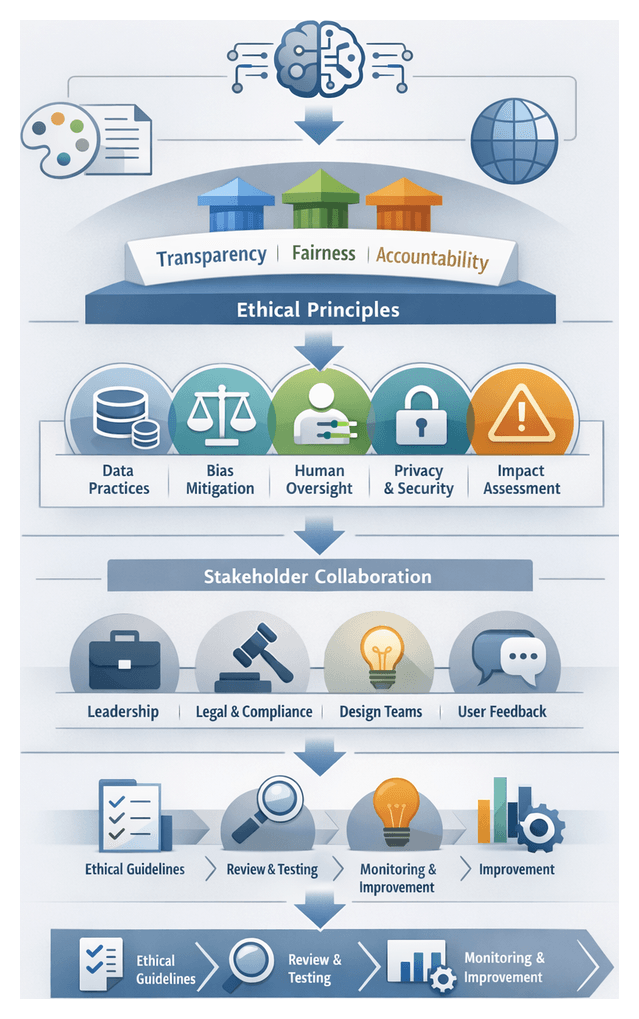
Ethical Imperatives in AI-Driven Design
As artificial intelligence systems such as Adobe Sensei, OpenAI’s DALL·E and Midjourney become integral to creative workflows, ethical reflection has shifted from a theoretical concern to a practical necessity. These generative agents not only automate routine tasks but also propose concepts, adapt styles and draft promotional materials. Without a clear ethical framework, design organizations risk producing content that inadvertently reinforces harmful stereotypes, violates intellectual property rights or undermines user trust. Furthermore, rapidly evolving regulations—such as the European Union’s AI Act and data protection laws like GDPR and CCPA—demand transparent, accountable practices when deploying AI-driven tools in sectors ranging from advertising to publishing.
Ethical inquiry in AI-assisted design encompasses several dimensions: ensuring the integrity of creative processes, mitigating algorithmic bias, providing transparency into decision pathways and establishing accountability for AI-related outcomes. Early adopters have already faced challenges, including misattribution of source material, opaque generative logic and unintended cultural insensitivity. Addressing these issues proactively lays the groundwork for responsible collaboration between human designers and AI agents.
Foundational Principles for Responsible Creative Automation
- Transparency and Explainability: Document how data inputs, model architectures and training processes shape AI suggestions. Clear explanations enable designers to understand why certain color palettes, compositions or layout options are proposed, fostering trust and facilitating informed critique.
- Fairness and Bias Mitigation: Actively audit training datasets and algorithmic behaviors to uncover skewed representations. Use techniques such as diverse dataset sampling, adversarial testing and fairness metrics—demographic parity, equal opportunity—to ensure AI-generated designs reflect multiple cultural perspectives and demographic groups.
- Accountability and Governance: Define roles and decision rights for every phase of AI deployment. Whether through an AI ethics board or integration within existing design committees, establish escalation paths for ethical concerns and periodic audits to verify compliance with internal policies and external regulations.
- Privacy and Data Protection: Align data collection, storage and processing with relevant statutes. Implement anonymization, consent management and secure handling protocols, recognizing that personalization and model training often rely on sensitive user information.
- Human Oversight and Control: Maintain a human-in-the-loop model in which designers retain final creative authority. Mixed-initiative frameworks should allow practitioners to intervene, adjust agent autonomy levels and override outputs that conflict with creative intent or ethical standards.
Stakeholder Roles and Collaborative Responsibilities
Embedding ethical principles in AI-driven design demands coordinated action across multiple stakeholder groups. Executive leaders must champion ethical AI, allocating funding for governance structures, training programs and compliance audits. Legal and compliance teams interpret evolving regulations, crafting contractual safeguards when licensing AI platforms or collaborating with external vendors. Data scientists and engineers design, validate and document generative models, implementing bias detection methods and model lineage tracking. Designers and creative directors curate AI-generated proposals, applying domain expertise to assess aesthetic quality and cultural sensitivity. Finally, end users and audiences provide essential feedback through testing, surveys and community engagement, revealing latent biases or unintended interpretations and informing subsequent model refinements.
Integrating Ethical Checkpoints into Creative Workflows
- Define Ethical Criteria at Project Inception: Incorporate goals for fairness, transparency and privacy into project briefs and technical specifications.
- Conduct Impact Assessments: Evaluate risks related to dataset selection, cultural contexts and potential harms. Identify vulnerable user segments requiring additional safeguards.
- Iterative Review and Validation: Host multidisciplinary reviews of AI outputs, tracing decisions to specific model versions and data inputs via audit trails.
- User Testing and Feedback Loops: Engage diverse audience segments to validate cultural resonance, ethical acceptability and design effectiveness. Integrate insights into model retraining cycles.
- Document and Share Learnings: Maintain transparent records of challenges and mitigation strategies. Disseminate case studies internally and across the design community to accelerate best practices.
Challenges of Bias, Transparency and Accountability
Bias and transparency remain central analytical concerns in AI-assisted design, directly influencing stakeholder trust and regulatory compliance. Algorithmic bias can skew visual suggestions or UX personalization, while opaque decision pathways erode confidence and hinder accountability. Addressing these challenges requires both technical rigor and social awareness.
Sources of Algorithmic Bias
- Data Bias: Inadequate representation within training datasets—such as overreliance on Western advertising imagery—may lead AI agents to propose designs that lack cultural relevance elsewhere.
- Model Bias: Optimization objectives favoring engagement or click rates can prioritize mainstream design elements, inadvertently sidelining minority perspectives.
- Interaction Bias: Feedback loops created by user selections reinforce popular themes, reducing diversity in future outputs and entrenching existing patterns.
Dimensions of Transparency
- Model Interpretability: The ability of designers and stakeholders to understand internal decision pathways of complex neural architectures, including how feature activation influences style choices and image composition.
- Process Visibility: Disclosure of data sources, training methodologies and parameter settings. Providing model cards and data sheets enhances stakeholder confidence by revealing provenance and known limitations.
Analytical Frameworks and Industry Standards
Design organizations apply a range of interpretive frameworks to assess bias and transparency. Fairness metrics quantify output distributions across demographic segments, while sociotechnical analysis examines how cultural narratives and power dynamics shape generative workflows. Explainable AI (XAI) techniques—feature attribution, attention visualization and surrogate modeling—translate complex generative processes into human-readable explanations. Ethical audit protocols from bodies such as the IEEE Ethically Aligned Design initiative and the National Institute of Standards and Technology’s AI Risk Management Framework prescribe systematic steps for bias detection, risk categorization and mitigation planning.
Global standards further reinforce these practices. ISO/IEC JTC 1/SC 42 defines requirements for trustworthy AI, including fairness and explainability. The European Commission’s AI Act mandates documentation of training data and human oversight mechanisms for high-risk systems. Professional associations like AIGA and RGD publish guidelines on transparent disclosure of AI-generated content and equitable representation in design outputs.
Practical Strategies for Ethical Assurance
- Implement “datasheets” detailing dataset collection methods, demographic breakdowns and known biases.
- Create “model cards” describing intended use cases, performance metrics across user segments and failure modes.
- Form cross-functional review panels—including ethicists and user representatives—to evaluate outputs prior to deployment.
- Integrate explainability checkpoints where designers query agent reasoning about style choices, feature importance and alternative suggestions.
- Deploy continuous monitoring systems to track real-world usage data and flag deviations or emergent biases for rapid remediation.
Drivers and Urgency for AI Adoption
Recent advances in machine learning architectures—transformer-based networks, diffusion models and reinforcement learning—have propelled generative AI from research laboratories into mainstream design practice. These technologies enable systems to interpret visual semantics, replicate artistic styles and produce novel compositions at a level of sophistication once limited to expert practitioners. Off-the-shelf libraries and cloud-based inference APIs democratize access to capabilities such as image synthesis, style transfer and contextual pattern recognition. Tools like Adobe Firefly, DALL·E, Adobe Sensei and Midjourney illustrate seamless integration into digital design platforms, enabling rapid concept exploration and accelerated iteration.
Market and Competitive Pressures
Brands across consumer goods, fashion, automotive and entertainment sectors leverage AI to reduce concept-to-delivery timelines by up to 50 percent, optimize production costs and unlock personalized creative experiences. First-mover advantages translate into more frequent product updates, agile marketing campaigns and heightened consumer engagement. Organizations that delay AI adoption risk ceding market share to competitors who harness autonomous agents for scalable, data-driven design solutions.
Data-Driven Creativity
The proliferation of user interaction data—clickstreams, engagement metrics and social sentiment—provides a foundation for empirically grounded creative decisions. AI agents excel at synthesizing these disparate data sources, unveiling latent patterns that guide color palettes, typographic treatments and imagery selection. Data-driven creativity shifts design from subjective artistry to dynamic experimentation informed by real-time performance metrics, enabling targeted, audience-specific visual narratives.
Organizational and Talent Considerations
- Talent Augmentation: AI agents empower designers to focus on strategic vision and user empathy, automating repetitive tasks while preserving human creativity.
- Skill Development: Continuous learning in prompt engineering, model evaluation and ethical AI practices equips teams to leverage generative tools effectively.
- Leadership Alignment: Executive sponsorship and cross-functional governance ensure AI initiatives align with broader business objectives and creative standards.
Ethical and Regulatory Imperatives
Accelerated AI adoption heightens the risk of unintentional bias propagation, opaque provenance and unauthorized use of copyrighted material. Emerging regulations mandate clear labeling of AI-generated content, robust data privacy safeguards and human oversight for high-stakes applications. Proactively embedding explainability, bias mitigation and mixed-initiative controls within design workflows positions organizations to meet regulatory requirements and maintain public trust.
Strategic Positioning for Future Resilience
Forward-looking design leaders treat AI integration as a strategic inflection point, aligning creative roadmaps with innovation objectives. Establishing cross-disciplinary innovation labs, partnering with AI research entities and investing in modular platforms that accommodate evolving agent capabilities foster adaptability. Scenario planning exercises help anticipate shifts in consumer expectations and regulatory landscapes, ensuring AI initiatives remain responsive to emerging challenges. By embedding AI literacy into leadership development and encouraging experimentation with cutting-edge models, organizations secure a sustainable advantage in a rapidly evolving design ecosystem.
Guidelines for Responsible AI Governance in Design
The following guidelines synthesize expert frameworks—IEEE Ethically Aligned Design, ISO/IEC 42001 and the European Commission’s Ethics Guidelines for Trustworthy AI—to balance innovation with responsibility in human-AI co-creative processes.
- Establish Clear Governance and Accountability: Define roles for data stewardship, model evaluation and user impact assessments. Adopt recognized frameworks such as IEEE 7000 and ISO/IEC 42001. Institute regular audits to verify adherence to ethical standards and legal requirements.
- Ensure Transparency and Explainability: Publish model fact sheets detailing performance, limitations and governance processes. Integrate interactive explanation interfaces—LIME, counterfactual reasoning—to surface agent rationale. Balance transparency with protection of proprietary data and IP.
- Prioritize Bias Detection and Mitigation: Employ statistical fairness measures, conduct qualitative reviews with diverse user groups and implement governance checkpoints for model retraining and remediation.
- Uphold Data Privacy and Security: Embed privacy-by-design principles, audit data pipelines for regulatory compliance and communicate data handling practices clearly to stakeholders.
- Embed Human Oversight and Control: Define escalation protocols for agent errors, enable adjustable autonomy parameters and log human–agent interactions to maintain accountability.
- Foster Interdisciplinary Ethical Review: Convene ethics boards with social scientists, legal experts and user advocates. Document deliberations and balance comprehensive review with agile decision-making.
- Commit to Continuous Monitoring and Evaluation: Use automated dashboards for fairness, accuracy and user satisfaction metrics. Schedule periodic retraining and impact assessments based on performance data. Ensure monitoring tools remain transparent and are audited for blind spots.
- Document Design Decisions and Data Lineage: Maintain versioned logs of data transformations, model iterations and outcome evaluations. Use standardized templates for model cards and data sheets to streamline reporting. Ensure records are searchable and audit-ready.
- Promote Ethical Literacy and Skills Development: Develop role-specific ethics training modules, integrate ethical reviews into performance evaluations and encourage knowledge sharing through workshops and internal publications.
- Adopt a User-Centric Equity Lens: Involve representative user groups in co-design sessions, incorporate equity metrics into success criteria and document assumptions about user contexts to guide inclusive design decisions.
By embedding these guidelines within governance structures, creative workflows and organizational culture, design teams can harness the transformative potential of AI while upholding trust, accountability and creative integrity.
Chapter 9: Measuring Impact and ROI
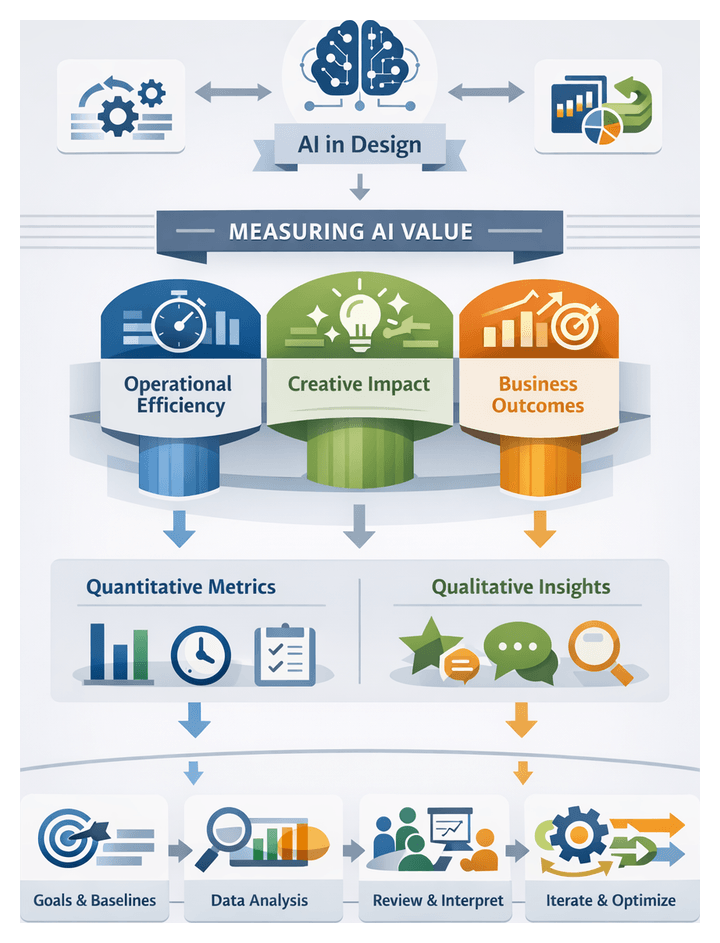
Context and Importance of Measurement
In today’s design environment, artificial intelligence has evolved from an experimental tool to an essential collaborator, reshaping creative workflows and strategic decision-making. As organizations invest in AI agents, they must move beyond anecdotal evidence of speed gains and novelty effects to systematically measure the true value these systems deliver. Clear frameworks for gauging AI impact inform resource allocation, bolster executive sponsorship, and ensure that automation augments rather than undermines human creativity.
Assessing AI value requires capturing both quantitative outcomes—such as time savings and resource utilization—and qualitative contributions, including enhancements to ideation quality, stakeholder satisfaction, and creative confidence. Under growing competitive and budgetary pressures, design leaders need evidence that AI integration drives measurable benefits in operational efficiency, creative impact, and business performance. Furthermore, the exponential growth in process data—from logged prompts to model confidence scores—offers unprecedented visibility into how AI transforms each stage of the design lifecycle, from concept generation to prototyping and market launch.
Establishing a rigorous measurement practice is urgent: organizations that fail to articulate AI’s return on investment risk over- or under-investing in capabilities, misaligning tools with strategic objectives, and conceding ground to competitors who harness data-driven creativity. By adopting a hybrid approach that balances numerical metrics with interpretive insights, design teams can develop a compelling narrative that aligns AI’s technical prowess with broader innovation goals and user-centered outcomes.
Core Dimensions of AI Value
A comprehensive measurement framework organizes AI contributions into three interconnected dimensions, each linking technical outputs to organizational objectives:
- Operational Efficiency: Tracks how AI streamlines repetitive tasks, reduces manual effort, and accelerates project timelines.
- Creative Impact: Measures the novelty, diversity, and aesthetic quality of AI-assisted outputs, reflecting the technology’s role in expanding conceptual exploration.
- Business Outcomes: Links design enhancements to market metrics such as user engagement, customer satisfaction, and revenue uplift, demonstrating AI’s influence on organizational performance.
These dimensions are mutually reinforcing: efficiency gains free designers for more strategic ideation, which in turn drives richer creative outcomes and stronger business results. Aligning metrics across these categories ensures that measurement captures both immediate process benefits and long-term value creation.
Quantitative and Qualitative Metrics
A balanced evaluation synthesizes leading and lagging indicators across four metric categories: operational efficiency, output quality, user and team experience, and strategic innovation. Leading indicators—such as iteration cycle counts—signal early momentum, while lagging metrics—like revenue uplift—confirm realized impact over time.
Operational Efficiency
Efficiency metrics remain central to ROI conversations. Common measures include:
- Cycle Time Reduction: The decrease in hours to complete discrete design tasks, tracked via project management platforms or time-tracking tools linked to AI activities.
- Resource Reallocation: The percentage of designer hours shifted from manual tasks to strategic work, derived from comparative workload analyses before and after AI adoption.
- Error and Revision Counts: The frequency of post-draft corrections, as logged in version control systems, indicating the accuracy of generative outputs.
For example, a global brand’s in-house team recorded a 35 percent reduction in image resizing and retouching efforts after deploying an AI agent powered by Adobe Sensei, translating directly into shorter campaign lead times and greater capacity for strategic initiatives.
Output Quality
Evaluating creative impact combines algorithmic checks with human judgment. Key approaches include:
- Expert Panel Reviews: Blind evaluations by senior designers and brand managers, scoring AI-generated designs against brand guidelines, visual appeal, and emotional resonance.
- Design Quality Indices: Hybrid scoring systems that integrate rule-based validations (for example, accessibility contrast ratios) with machine-learned estimators of aesthetic coherence.
- User Perceptual Testing: Focus groups and usability studies where end users rate prototypes on clarity, trustworthiness, and emotional impact.
Organizations such as IBM leverage Watson Studio to automate compliance checks against brand assets, then layer human feedback loops to ensure that AI suggestions resonate with target audiences.
User and Team Experience
Adoption depends on user acceptance and seamless collaboration. Metrics in this category include:
- Adoption Rate: Percentage of designers regularly using the AI agent, measured via login frequencies and API call volumes.
- Satisfaction Scores: Survey ratings collected through platforms like Qualtrics, assessing how effectively the agent supports workflow needs.
- Cognitive Load: Subjective workload measures—such as the NASA Task Load Index—comparing mental effort when working with AI versus traditional processes.
Teams often integrate sentiment tracking within collaborative tools like Figma‘s AI plugin to capture real-time feedback, enabling iterative refinement of agent interfaces and interaction models.
Strategic Innovation
Long-term differentiation stems from AI’s capacity to seed novel concepts and accelerate pipeline velocity. Indicators include:
- New Concept Generation Rate: The share of proposals introducing genuinely novel ideas, as judged by R&D or innovation teams.
- Market Impact: Changes in conversion rates, click-through performance, or sales uplift linked to AI-influenced campaigns, tracked via analytics platforms like Google Analytics.
- Pipeline Velocity: Time taken for AI-seeded concepts to progress from ideation through prototype to market launch.
Establishing baseline measures before AI deployment is essential; only then can organizations attribute improvements in innovation velocity to agent collaboration.
Implementing an Integrative Evaluation Framework
To align measurement with strategic objectives, leading organizations adopt a phased approach:
- Goal Definition: Clarify AI integration objectives—whether to reduce costs, enhance creative differentiation, or boost user engagement—ensuring metrics directly map to these priorities.
- Baseline Establishment: Use historical data to set realistic performance benchmarks across metric categories.
- Data Collection and Analysis: Leverage integrated analytics platforms such as Microsoft Power BI or custom dashboards to aggregate quantitative data and tag qualitative feedback.
- Interpretive Workshops: Convene cross-functional teams to review metric trends, interpret anomalies, and align data with stakeholder narratives.
- Continuous Iteration: Refine AI configurations, workflow integrations, and evaluation criteria based on analytic insights, fostering a culture of evidence-based improvement.
This cyclical model ensures that organizations neither fixate on a single data source nor neglect the contextual factors shaping design outcomes, echoing principles from the Balanced Scorecard adapted for creative domains.
Addressing Common Challenges and Mitigation Strategies
Despite comprehensive frameworks, practitioners often encounter obstacles:
- Attribution Ambiguity: Disentangling AI impact from parallel process changes requires controlled pilots and A/B testing.
- Data Quality Variance: Incomplete activity logs can skew efficiency metrics. Rigorous tracking standards are essential.
- Overemphasis on Efficiency: Excessive focus on time savings may stifle creative risk-taking. Balancing efficiency with innovation metrics preserves exploratory mindsets.
- Stakeholder Misalignment: Differing priorities across departments can impede consensus. Early alignment workshops help harmonize evaluation criteria.
Mitigation strategies include establishing metric literacy programs—combining guided analytics tutorials and shared case studies—to cultivate a data-informed culture that values both numeric benchmarks and qualitative insights.
Best Practices for Reporting and Communication
Presenting measurement results to executives and clients requires weaving data into strategic storytelling. Leading practices include:
- Visual Dashboards: Condensed scorecards highlighting key performance trends, with interactive filters to explore metrics by project, team, or timeframe.
- Case Study Spotlights: Anecdotes illustrating how specific AI interventions led to measurable outcomes, bolstered by human-centered narratives.
- Benchmark Comparisons: Positioning internal metrics against industry norms or competitor data to contextualize performance claims.
- Executive Summaries: High-level briefs translating metric jargon into business implications such as cost avoidance, revenue potential, or market positioning benefits.
For instance, an agency showcased a dashboard indicating a 40 percent reduction in concept-to-presentation times and a 15 percent rise in client satisfaction for teams using AI agents. The combined narrative of efficiency and quality proved pivotal for securing ongoing investment.
Foundational Steps for Measurement Readiness
Before embarking on detailed analysis, design organizations should prepare by:
- Mapping Activity Taxonomy: Define design phases and pinpoint where AI agents contribute, guiding data collection points.
- Implementing Tracking Mechanisms: Integrate usage logs and outcome data capture without disrupting creative flow.
- Establishing Governance: Clarify data ownership, access rights, and privacy protocols across designers, analysts, and managers.
- Building Analytical Capabilities: Invest in in-house expertise or partnerships to translate raw data into actionable insights, driving continuous optimization.
By laying this groundwork, organizations ensure that subsequent metric collection, analysis, and reporting rest on a solid foundation, enabling design teams to move confidently from conceptual AI adoption to data-driven mastery.
Chapter 10: Future Trends and Innovations
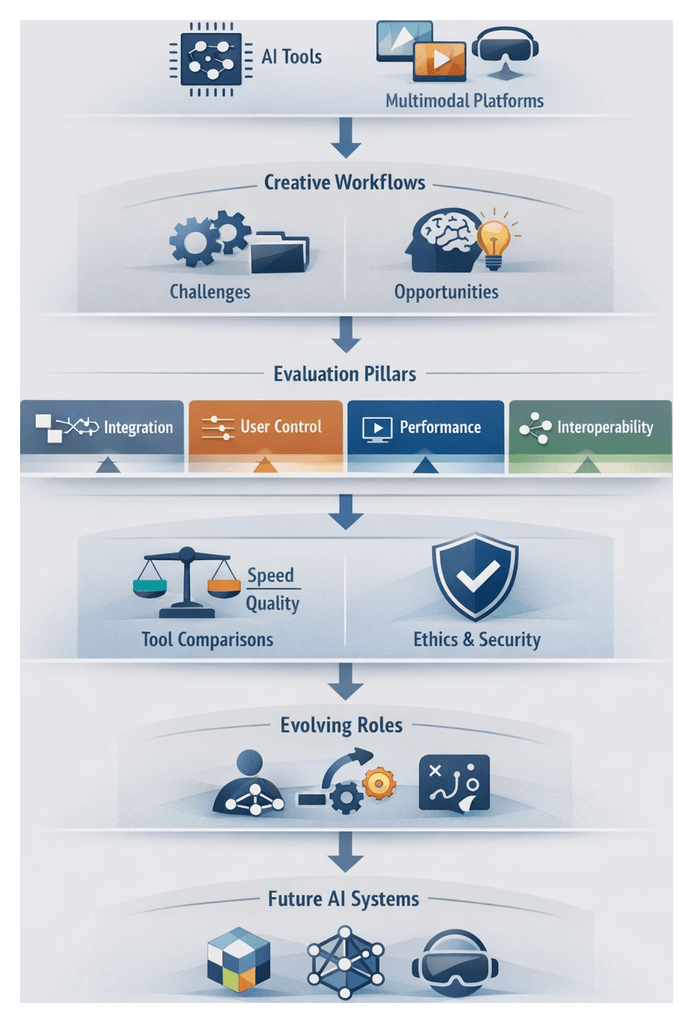
The Evolution of Creative Automation Landscape
The convergence of digital technologies and creative industries has ushered in an era where intelligent systems extend beyond simple batch scripts and rule-based macros. Machine learning and deep neural networks now power tools capable of understanding context, adapting to feedback, and generating original assets. Platforms such as DALL·E 3, Midjourney and Adobe Firefly illustrate this shift from logic-driven automation to generative ideation, proposing palettes, sketching layouts and synthesizing illustrations from natural-language prompts.
As organizations face growing demands for content at scale, creative workflows are both accelerated and complicated by the proliferation of AI-driven tools. Fragmented toolchains, proprietary formats and metadata gaps challenge asset management, while skill gaps in prompt engineering and dataset curation create new training imperatives. Cultural resistance—rooted in concerns over craftsmanship, authorship and job security—must be addressed alongside technical integration to fully harness automation’s promise.
Multimodal and Immersive AI-Driven Design Tools
Multimodal and immersive platforms fuse text, imagery, audio, spatial mapping and interactive environments to support richer ideation and holistic user experiences. Early text-to-image engines like DALL·E 3 and Midjourney evolved into suites that integrate cinematic visuals and soundscapes—exemplified by Runway ML—and spatial computing frameworks such as Unity Reflect and Unreal Engine. Onboarding these platforms reshapes narrative pipelines, moving fluidly from scriptwriting and storyboard generation to 3D asset creation, spatial deployment and real-time user testing in VR prototypes.
Evaluation Frameworks and Industry Perspectives
- Modality Integration—Seamless coordination of text, visuals, audio and spatial data without manual translation.
- User Agency—Degree of control designers retain over constraints, refinement and iteration.
- Performance Fidelity—Quality of photorealistic rendering, natural-sounding speech synthesis and haptic feedback.
- Workflow Interoperability—Compatibility with existing pipelines, including Adobe Creative Cloud and Autodesk Maya.
Advertising agencies prioritize latency and brand consistency in retail activations, game studios focus on procedural content generation and real-time adaptation, while architects demand site-specific realism and regulatory compliance. Learning providers value adaptive feedback loops and cross-hardware accessibility for scenario-based education.
Tool Comparisons and Workflow Impact
- Speed vs Quality—Rapid iteration often trades fidelity for throughput; high-fidelity tools require longer processing.
- Extensibility—APIs and plugin architectures empower customization but increase development overhead.
- Cross-Device Consistency—Maintaining coherent experiences from desktop previews to head-mounted displays.
- Ethical and Security Considerations—Data governance, user privacy and bias mitigation baked into evaluation protocols.
Critical perspectives warn of fragmentation risk as specialized platforms proliferate, skill polarization as designers shift to curatorial roles, and vendor lock-in through proprietary formats. Proactive governance, reskilling programs and modular architectures help organizations navigate these challenges.
Shaping the Future Design Landscape
Redefining Professional Roles
As AI agents assume routine tasks—initial concept sketches, style explorations and variant generation—designers will pivot toward strategy, contextual judgment and ethical stewardship. Hybrid roles such as design technologists, co-creation strategists and AI liaisons will curate AI outputs, align proposals with stakeholder expectations and safeguard brand integrity. Mastery of creative thinking will pair with fluency in guiding generative intelligence.
Organizational Transformation and Value Chains
Linear, project-based teams will give way to networked units integrating human and agent collaborators. Embedding AI liaisons within multidisciplinary pods fosters real-time co-design, continuous iteration and decentralized decision-making. New business models will emerge as agencies evolve into platform providers offering configurable agent ecosystems, subscription-based pipelines and outcome-based contracts tied to innovation metrics.
Education, Standards and Ecosystems
Design curricula will expand to include prompt engineering, agent management and data ethics. Certifications in responsible AI facilitation will equip practitioners to mediate between stakeholders and autonomous systems. Professional associations and consortia will codify interoperability protocols, governance guidelines and audit trails, addressing rights management, provenance and compliance in increasingly regulated contexts. Collaborative ecosystems of technology providers, research institutions and regulatory advisors will drive open innovation and shared benchmarks.
Forecasts for Next-Generation AI Agent Architectures
Over the coming decade, AI agents will evolve toward decentralized, self-supervised and federated learning systems. Designers can expect collaborators that:
- Continuously adapt through self-supervised learning on proprietary design assets.
- Leverage edge computing and distributed intelligence for offline or bandwidth-constrained deployment.
- Employ meta-learning to adjust rapidly to novel tasks from minimal examples.
- Embed causal reasoning to connect design constraints, user intent and aesthetic outcomes.
Integration with immersive hardware will deepen: agents like GPT-4 and Adobe Firefly will project iterations onto physical prototypes via AR overlays, support generative soundscapes and motion modules, and enable fully participatory VR design simulations. These advances will redefine the designer’s role from operator to ecosystem orchestrator.
Strategic and Ethical Imperatives
Risk Mitigation and Responsible Innovation
- Bias and Fairness—Ensure generative outputs do not reinforce stereotypes or exclude minority perspectives.
- Transparency and Accountability—Adopt model cards, audit trails and documented governance policies.
- Intellectual Property—Balance open innovation with respect for original creators and license agreements.
- Regulatory Compliance—Align generative workflows with sector-specific legal obligations.
Strategic Imperatives for Sustained Advantage
- Continuous Learning Programs—Cultivate a culture of lifelong skill development through curricula and hands-on labs.
- Strategic Vendor Partnerships—Engage in co-innovation agreements to influence roadmaps and access beta features.
- Modular Architecture Adoption—Build ecosystems on open standards and interoperable APIs to avoid lock-in.
- Experimentation Frameworks—Fund controlled pilots for nascent AI prototypes and scale successful models enterprise-wide.
By aligning generative AI adoption with strategic business objectives, ethical frameworks and human-centered governance, design leaders can transform automation from a tactical initiative into a sustained competitive capability—elevating human ingenuity at the core of every innovation.
Conclusion
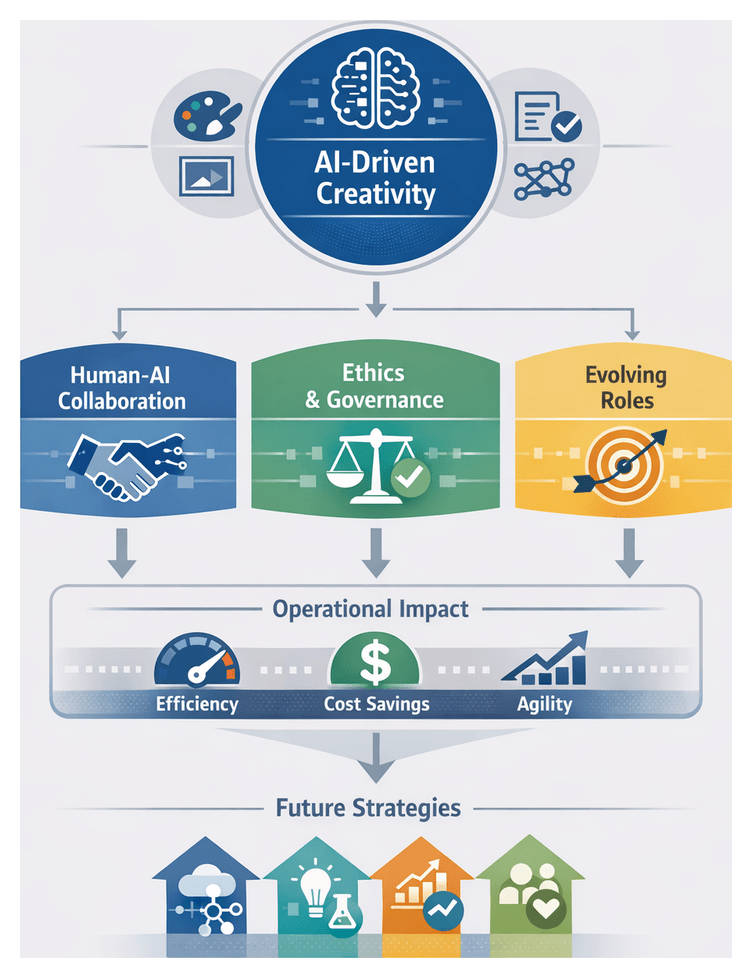
Evolution of the Creative Automation Landscape
The creative industries have undergone a profound transformation, moving from static rule-based systems to dynamic AI-driven platforms. The convergence of advanced algorithms, cloud computing, and rich data sources has democratized access to capabilities once reserved for technical specialists. Tools like Adobe Sensei, DALL·E, RunwayML, and Adobe Firefly now power generative imagery, template-driven layouts, automated copywriting, natural language generation for headlines and product descriptions, and intelligent video editing that reduces manual time by up to 70 percent. By leveraging convolutional neural networks, transformer architectures, and adaptive rule engines, these platforms deliver context-aware content production at scale, freeing human practitioners to focus on strategic and conceptual challenges.
Human-AI Co-Creative Collaboration Models
Industry leaders frame AI not as a replacement for human creativity but as a collaborative partner. Mixed-initiative frameworks guide teams through hand-offs between designers and AI agents, while the levels-of-automation continuum helps position agent autonomy—from discrete tasks like color palette generation to end-to-end design proposals requiring minimal human prompts. Early ideation may rely on Midjourney or DALL·E 2 for rapid concept exploration, while seasoned designers curate, refine, and blend select outputs to uphold brand identity. In text workflows, platforms such as ChatGPT generate draft copy that is human-edited for tone and compliance. This reciprocal model—where AI accelerates idea generation and humans retain creative sovereignty—has emerged as the industry consensus on effective co-creation.
Governance, Ethics, and Standards
Embedding responsible AI practices is essential to sustaining trust and integrity in creative workflows. Governance frameworks must address data provenance, algorithmic bias, and transparent decision-making. Standards bodies including IEEE P7000, ISO, and W3C are developing guidelines for AI accountability, traceability, and accessibility, while consortia like the Partnership on AI and Creative Commons provide resources on fairness and licensing. UNESCO’s Recommendation on the Ethics of Artificial Intelligence offers a global policy framework for cultural sensitivity and equity. Key governance measures include:
- Data and model audits to detect and correct bias
- Audit trails documenting training corpora, prompt histories, and revision records
- Attribution protocols clarifying human and machine contributions
- Ethics review boards embedded within or alongside creative teams
Transforming Roles and Skillsets
As AI agents assume routine generation tasks, designers evolve into curators, strategists, and storytellers. Professionals cultivate expertise in prompt engineering for platforms such as Adobe Firefly, DALL·E, Midjourney, and Figma‘s AI plugins. Continuous learning initiatives—ranging from MITx’s AI for Design Professionals to certifications on Coursera and the World Economic Forum’s Global AI Council—equip teams with AI literacy, ethical reasoning, and data analysis skills. Cross-functional squads combining designers, data scientists, and AI ethicists ensure that outputs remain innovative, inclusive, and aligned with human values.
Operational and Organizational Impact
Strategic AI integration delivers measurable gains in efficiency, agility, and cost management. Generative platforms can cut production time for digital assets by 30–50 percent and reduce revision cycles by 20 percent. Organizations establish AI centers of excellence or embed AI liaisons within creative teams, guided by change-management models like Prosci’s ADKAR to foster cultural readiness. Business models shift toward subscription and platform-as-a-service offerings; for example, firms leverage tools to integrate proprietary data into customized agent workflows. Agile squads, tiered service packages, revenue-sharing tied to performance metrics, and strategic alliances with platform vendors create competitive differentiation.
Key Strategic Imperatives and Future Directions
To thrive in an AI-driven future, design leaders must embrace five imperatives:
- Architect modular technology ecosystems with open APIs and scalable infrastructure to integrate emerging models and edge computing.
- Invest in multidisciplinary upskilling—blending design thinking, AI ethics, data literacy, and prompt engineering—through internal labs, hackathons, and proof-of-concepts.
- Adopt blended measurement frameworks combining quantitative KPIs (iteration speed, cost savings) with qualitative metrics (creative diversity, stakeholder satisfaction).
- Maintain human-centered oversight at critical decision points to guard against generative hallucinations and contextual misalignment.
- Engage clients and end users in transparent co-creation workshops to build trust, gather feedback, and align outputs with lived experiences.
By integrating AI agents as genuine partners rather than mere tools, organizations unlock unprecedented levels of innovation, personalization, and strategic agility. The balanced interplay of human insight and machine intelligence, underpinned by ethical stewardship and continuous learning, will define the next era of creative practice.
Appendix
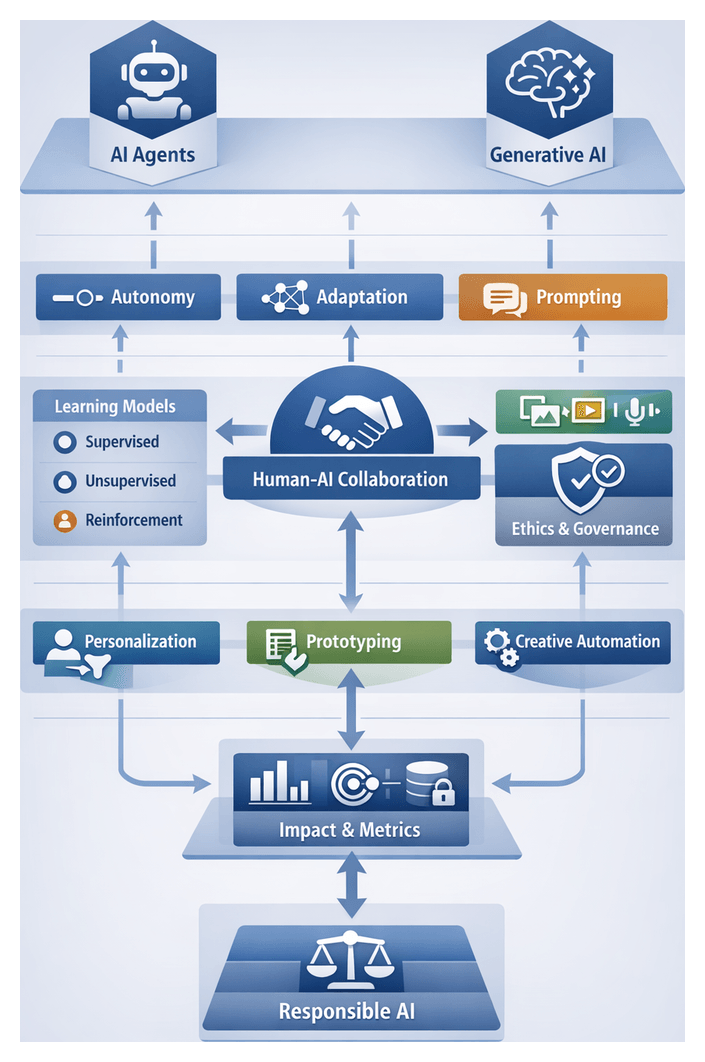
Key Concepts in AI-Driven Design
AI Agents and Generative AI
An AI agent is a software entity that operates with a degree of autonomy to perform tasks, make decisions, and generate outputs toward defined objectives. In creative design, AI agents merge analytical capabilities—pattern recognition, data interpretation—with generative functions to produce visual, textual, or multimodal artifacts. They learn from interactions, adapt to feedback, and plan action sequences to achieve high-level creative goals. Examples include autonomous sketching assistants in Adobe Sensei and generative layout engines within Figma.
Generative AI refers to machine learning models designed to create new content rather than solely analyze existing data. Architectures such as Generative Adversarial Networks, Variational Autoencoders, and diffusion-based systems synthesize images, text, audio, and three-dimensional forms. Tools like DALL·E 3 and Midjourney enable rapid concept exploration and novel creative variations from simple prompts.
Autonomy and Mixed-Initiative Interaction
Autonomy describes an agent’s capacity to operate without continuous human intervention. In creative workflows, autonomy ranges from low—responding to explicit commands—to high—initiating tasks, refining outputs based on cues, and involving human collaborators only at critical junctures. Mixed-initiative systems allow both humans and agents to propose suggestions, with authority shifting based on confidence measures and task complexity. This collaboration framework fosters synergy by combining unconventional machine ideas with human strategic oversight.
Adaptation and Learning Paradigms
Adaptation denotes an agent’s ability to modify its behavior based on feedback, contextual changes, or new data. Techniques include online learning, reinforcement signals, and fine-tuning on project-specific assets. Adaptive generative agents refine a color scheme after reviewing brand guidelines and past approvals, improving relevance over successive iterations.
Machine learning architectures underpinning AI agents adhere to distinct paradigms:
- Supervised Learning trains models on labeled examples to map inputs to desired outputs, often for image classification and style recognition.
- Unsupervised Learning extracts latent patterns from unlabeled data, supporting emergent trend discovery without predefined categories.
- Self-Supervised Learning leverages proxy tasks—predicting masked elements—to pretrain models on large datasets with minimal annotation.
- Reinforcement Learning optimizes agent behavior through reward functions, guiding layout arrangements or interaction flows toward defined goals.
Prompt Engineering and Multimodal Synthesis
Prompt engineering is the practice of crafting input instructions that guide generative agents. Effective prompts balance specificity—color palettes, typographic styles, brand attributes—with openness for creative exploration. Iterative refinement, constraint layering, and contextual anchoring steer multimodal agents in platforms like Adobe Firefly and RunwayML.
Multimodal synthesis empowers agents to process and combine text, images, audio, and spatial data. In design, multimodal agents interpret written briefs, reference imagery, and generate corresponding visual assets or soundscapes, supporting immersive prototyping and integrated marketing campaigns.
Human-in-the-Loop and Creative Automation
The human-in-the-loop paradigm ensures continuous human oversight in AI-driven processes. Designers review and refine agent outputs, providing feedback that agents incorporate into subsequent iterations. This feedback loop safeguards creative integrity, maintains accountability, and embeds ethical judgment throughout the creative lifecycle.
Creative automation uses software systems to perform tasks traditionally manual—asset resizing, color correction, template-based layout assembly. Augmented with AI, automation extends to generative ideation, adaptive prototyping, and data-driven personalization. Effective frameworks blend rule-based routines with learning-driven generative models to optimize efficiency and innovation.
Personalization, Prototyping, and Iteration
Personalization tailors content to individual user preferences or contexts using data analytics and recommendation engines. Customization refers to explicit user choices or template adjustments. AI agents enable hyper-personalization at scale by analyzing user data—browsing patterns, demographic segments—and autonomously generating design variants optimized for each profile.
Prototyping involves creating preliminary design versions to test concepts and gather feedback. AI-assisted prototyping leverages generative models to produce high-fidelity mockups, layout variations, and interactive flows in real time. Agents provide instant feedback on usability, accessibility, and brand compliance, enabling continuous refinement without manual overhead.
Ethical AI, Transparency, and Governance
Ethical AI in design entails responsible development and deployment of AI agents that uphold fairness, transparency, and accountability. Ethical frameworks address bias mitigation, user privacy, data governance, and clear attribution of AI-generated content. Designers implement governance structures—including bias audits and explainability protocols—to ensure AI systems respect human values and comply with regulations.
Transparency involves documenting agents’ training data, model architectures, and decision-making processes. Explainability offers insights into how outputs were generated, using tools such as feature attribution maps or model cards. Governance frameworks define policies, roles, and procedures for AI integration, ensuring accountability for AI-driven outputs.
Bias arises when training data or model structures disadvantage certain groups. Fairness initiatives audit datasets, apply algorithmic corrections, and engage diverse review panels to detect and mitigate bias. In design, fairness ensures that generative outputs reflect inclusive representation and avoid perpetuating stereotypes.
Measuring Impact and Data Governance
Return on investment in AI-driven design measures benefits relative to costs. Metrics include reductions in production time, error rates, and resource utilization, as well as increases in creative throughput, user engagement, and market impact. Quantitative indicators are complemented by qualitative assessments of creative quality and stakeholder satisfaction.
Data governance encompasses policies and practices ensuring data integrity, security, and ethical use in AI systems. This includes data lineage documentation, access controls, consent management, and compliance with privacy regulations such as GDPR and CCPA. Robust governance underpins trust and shields organizations from legal and reputational risk.
Collaborative AI and Co-Design
Collaborative AI describes systems designed for cooperative work with human teams. Agents share mental models, communicate suggestions, and adapt behavior based on collective feedback. In design, collaborative AI fosters hybrid workflows where human expertise and machine intelligence coalesce to produce superior outcomes.
Co-design is a participatory approach involving stakeholders—end users, domain experts, and AI agents—in the creative process. By incorporating diverse perspectives and leveraging agent-driven analysis, co-design ensures solutions are user-centered, contextually relevant, and technically feasible.
Immersive Interfaces and Large Language Models
Immersive interfaces leverage augmented, virtual, and mixed reality to create experiential design environments. AI agents integrated into these interfaces generate spatial layouts, interactive elements, and real-time modifications based on gestures and voice commands.
Large Language Models are deep neural networks trained on extensive textual corpora to understand and generate human-like language. In design, LLMs support drafting copy, translating brand narratives into briefs, and generating code snippets for interactive prototypes. Platforms like GPT-4 exemplify LLMs’ capacity to augment creative writing and conceptual framing.
Federated Learning
Federated learning is a decentralized training paradigm where models update across multiple client environments without centralizing raw data. In organizations with distributed teams, federated learning allows AI agents to learn from local design assets—such as region-specific imagery—while preserving data privacy and corporate confidentiality.
Conceptual Frameworks and Standards
- Collaboration Spectrum and Autonomy Continuum: Maps interactions along initiative (human-led to agent-led) and autonomy (low to high), guiding role allocation and governance strategies.
- MATE Model: Defines four AI roles—Mediator, Agent, Tool, Environment—to clarify integration points and reinforce existing workflows.
- Computational Creativity Models: Margaret Boden’s combinational, exploratory, and transformational creativity frameworks categorize AI-driven innovation.
- Maturity Models: Assess organizational readiness across data infrastructure, expertise, culture, and governance to guide strategic adoption from ad hoc experimentation to enterprise optimization.
- Socio-Technical Systems Lens: Views design as a network of people, machines, and structures, emphasizing shared artifacts, transparent histories, and collective intelligence.
- Ethical AI Standards: Includes IEEE Ethically Aligned Design, the European Commission’s Ethics Guidelines for Trustworthy AI, and UNESCO recommendations for fairness, transparency, and accountability.
- Value Stream Analytics: Maps end-to-end creative workflows, identifying high-impact intervention points for AI agents and measuring cycle time, error rates, and innovation lift.
- Futures-Driven Roadmapping: Scenario planning and technology foresight align R&D investments with anticipated AI maturity, adoption curves, and ethical considerations.
- Autonomy Continuum (ISO/ANSI): Emerging standards propose levels of AI autonomy in creative software from algorithmic suggestions to self-driven generative processes.
- Data Ethics Canvas: A template for documenting data sources, stakeholder interests, risks, and mitigation strategies in AI projects.
- Balanced Scorecard for Creative ROI: Aligns AI adoption metrics—financial performance, customer satisfaction, internal processes, learning and growth—with strategic objectives.
Tools and Platforms
- DALL·E: OpenAI’s text-to-image model converts prompts into high-resolution images, supporting iterative refinement and rapid visual brainstorming.
- Midjourney: Generates stylistically distinct visuals from text prompts, widely used for mood boards and concept art.
- Adobe Firefly: AI-powered text-to-image and text-to-vector generation within Creative Cloud, enabling on-brand asset creation and style transfer.
- RunwayML: Integrates machine learning models for video editing, image synthesis, and real-time style transfer through a visual interface.
- Jasper: An AI writing assistant that generates marketing copy and social media content using GPT-based models.
- Canva Magic Write: A generative text tool within Canva for drafting captions and brainstorming ideas alongside visual layouts.
- Adobe Sensei: Machine learning framework powering auto-tagging, layout suggestions, and content-aware fill across Adobe applications.
- GPT-4: Advanced large language model for prompt-based ideation, code generation, and conversational design assistance.
- Stable Diffusion: Open-source text-to-image model that can be fine-tuned on proprietary assets for domain-specific applications.
- Autodesk Generative Design: Explores design variations within constraints to optimize for weight, strength, and manufacturability.
- Figma AI Plugins: A suite of extensions that generate icons, suggest color schemes, and refine layouts within Figma’s collaborative interface.
- Uizard: Converts hand-drawn sketches into editable digital wireframes using computer vision and NLP.
- Framer: A prototyping platform with AI-driven layout suggestions and real-time adjustments based on user feedback.
- IBM Watson Studio: A data science environment for building, training, and deploying machine learning models with interpretability tools.
- Optimizely: A digital experience platform offering AI-driven multivariate testing and personalization capabilities.
- Dynamic Yield: Machine learning engine that tailors web and mobile experiences through segmentation and behavioral analysis.
- AgentLinkAI: Research platform exploring autonomous AI agents as creative collaborators, providing case studies and strategic frameworks.
Frequently Asked Questions
How do AI agents differ from traditional design tools?
Traditional tools execute predefined commands or automate manual tasks based on fixed rules and user input. AI agents employ machine learning architectures—such as generative adversarial networks and transformer models—to generate novel content, adapt through feedback loops, and evolve over time. They offer adaptivity, generativity, and context awareness by interpreting briefs, brand guidelines, and user data to produce relevant variations.
What level of skill is required to work effectively with AI agents?
Designers need core design expertise and an understanding of generative systems. Key competencies include prompt engineering to steer agent behavior, data literacy to interpret model outputs and performance metrics, and ethical judgment to identify bias and ensure alignment with brand values and accessibility standards. Organizations often provide targeted training workshops and mentorship programs to build these skills.
How can organizations ensure consistent brand identity when using generative AI?
Maintaining brand consistency involves:
- Embedding brand tokens—approved color palettes, typography scales, logo variants—into agent configurations or prompt libraries.
- Developing standardized prompt templates that reference brand attributes explicitly.
- Implementing staged review processes where human curators validate AI outputs against brand standards before release.
What governance structures support responsible AI use?
Responsible AI governance aligns technical, ethical, and business considerations through structures such as:
- A cross-functional ethics board that reviews AI initiatives and oversees bias mitigation.
- Comprehensive model documentation—model cards and data sheets detailing training data provenance, limitations, and performance metrics.
- Approval protocols defining decision rights for model updates, data access, and final content release.
- Audit trails logging agent interactions, prompt histories, and output versions for compliance and post-hoc reviews.
How should designers address data privacy and bias?
Designers must collaborate with data and legal teams to:
- Use data minimization and anonymization techniques for model tuning.
- Conduct bias audits across demographic segments using fairness metric libraries.
- Obtain explicit user consent for data usage in personalization workflows under regulations such as GDPR and CCPA.
- Engage diverse stakeholders—ethicists, accessibility experts, user groups—to validate inclusivity and respectfulness of generated content.
Which metrics capture AI agent impact on creative outcomes?
An integrated measurement framework combines quantitative efficiency metrics with qualitative assessments:
- Time-to-Concept: Reduction in hours from brief to initial drafts.
- Iteration Velocity: Number of viable concept variations per cycle.
- Revision Rate: Frequency of manual adjustments required on AI outputs.
- Creative Novelty Scores: Expert evaluations of concept originality.
- User Engagement Lift: A/B test results linking AI-assisted designs to performance metrics.
- Designer Satisfaction: Surveys gauging confidence in AI collaboration and creative flow enhancement.
Can AI agents replace human designers?
No. AI agents excel at data-driven tasks, rapid variation generation, and pattern recognition at scale, but they lack cultural context, empathy, and strategic vision. Agents should be treated as creative collaborators, handling routine or data-intensive work while human professionals steer direction, apply semantic judgment, and ensure ethical integrity.
How do we balance AI autonomy with human oversight?
Key practices include:
- Configurable autonomy levels adjustable from suggestion mode to autonomous proposal generation.
- Human-in-the-loop checkpoints at critical stages—final approvals, brand consistency validations.
- Confidence thresholds that flag low-confidence outputs for human review.
- Clear role definitions for agent-driven tasks versus those requiring human direction or sign-off.
How do we integrate AI agents into existing workflows?
Seamless integration prioritizes incremental adoption through:
- Modular pilots focused on specific use cases—color palette generation or icon design—before broader rollout.
- Plugin-based tools within established design platforms—Figma or Adobe Creative Cloud—to minimize context switching.
- Cross-functional onboarding sessions for designers, developers, and data teams to surface integration challenges early.
- Iterative rollout with continuous monitoring of adoption metrics and user feedback.
What are best practices for prompt engineering?
Effective prompt crafting includes:
- Clarity and specificity with precise terminology, context phrases, and style descriptors.
- Iterative refinement experimenting with constraint layers like color palettes and emotion cues.
- Maintaining template libraries of proven prompt structures categorized by use case.
- Documenting prompt variations and results to build organizational knowledge.
How do we manage intellectual property for AI-generated designs?
Organizations should:
- Clarify ownership rights and usage licenses in vendor agreements, addressing derivative works.
- Define attribution policies for AI contributions in deliverables.
- Conduct originality audits against external databases to detect potential copyright issues.
- Establish internal guidelines for sharing training datasets, model checkpoints, and source code to maintain chain-of-custody documentation.
What infrastructure considerations are critical for AI integration?
Key factors include:
- Compute capacity for GPU or TPU resources balancing performance and cost.
- Secure data pipelines for reliable access to repositories used in model fine-tuning.
- API management through centralized gateways for usage monitoring, rate limiting, and authentication.
- Model version control systems to track updates, rollbacks, and performance regressions.
- Security and compliance measures—encryption, organizational policies, and data protection regulations.
How do we anticipate future developments in AI for design?
Strategies for staying ahead include:
- Research partnerships with academic institutions and AI labs to pilot emerging architectures like meta-learning models.
- Trend monitoring through industry consortia, conferences, and professional networks focused on multimodal synthesis and spatial computing.
- Innovation sandboxes allocating time and budget for exploration projects beyond immediate client demands.
- Maintaining adaptive roadmaps with feedback loops from pilots, user research, and competitive analyses.
Additional Resources and Further Reading
- AgentLinkAI Insights: A guide on positioning AI agents as design collaborators, with case studies and strategic recommendations.
- Data Ethics Canvas: A template for documenting data collection, privacy considerations, and stakeholder impacts in AI projects.
- IEEE Ethically Aligned Design: Standards and best practices for developing ethical AI systems, including creative applications.
- European Commission AI Act Proposal: Draft legislation outlining transparency obligations and governance requirements for AI systems.
- NIST AI Risk Management Framework: Guidelines for identifying, assessing, and mitigating AI risks, with sections on fairness and accountability.
- ISO/IEC JTC 1/SC 42: International standards committee developing terminology and certifications for trustworthy AI.
- Human-Centered AI Workshop Series: Research initiatives and workshops on aligning AI development with human values and co-design dynamics.
- OpenAI API Documentation: Best-practice guides for integrating GPT-4 and other models into creative workflows.
- RunwayML Learning Hub: Tutorials, case studies, and community projects on generative models in video, image, and immersive design contexts.
- Figma Community Plugins: AI-powered plugins for layout generation and design system automation, with usage guides and reviews.
The AugVation family of websites helps entrepreneurs, professionals, and teams apply AI in practical, real-world ways—through curated tools, proven workflows, and implementation-focused education. Explore the ecosystem below to find the right platform for your goals.
Ecosystem Directory
AugVation — The central hub for AI-enhanced digital products, guides, templates, and implementation toolkits.
Resource Link AI — A curated directory of AI tools, solution workflows, reviews, and practical learning resources.
Agent Link AI — AI agents and intelligent automation: orchestrated workflows, agent frameworks, and operational efficiency systems.
Business Link AI — AI for business strategy and operations: frameworks, use cases, and adoption guidance for leaders.
Content Link AI — AI-powered content creation and SEO: writing, publishing, multimedia, and scalable distribution workflows.
Design Link AI — AI for design and branding: creative tools, visual workflows, UX/UI acceleration, and design automation.
Developer Link AI — AI for builders: dev tools, APIs, frameworks, deployment strategies, and integration best practices.
Marketing Link AI — AI-driven marketing: automation, personalization, analytics, ad optimization, and performance growth.
Productivity Link AI — AI productivity systems: task efficiency, collaboration, knowledge workflows, and smarter daily execution.
Sales Link AI — AI for sales: lead generation, sales intelligence, conversation insights, CRM enhancement, and revenue optimization.
Want the fastest path? Start at AugVation to access the latest resources, then explore the rest of the ecosystem from there.