

Creative Intelligence Agents A Practical Guide to AI Driven Content Innovation
To download this as a free PDF eBook and explore many others, please visit the AugVation webstore:
Introduction
Creative Landscape and Problem Definition
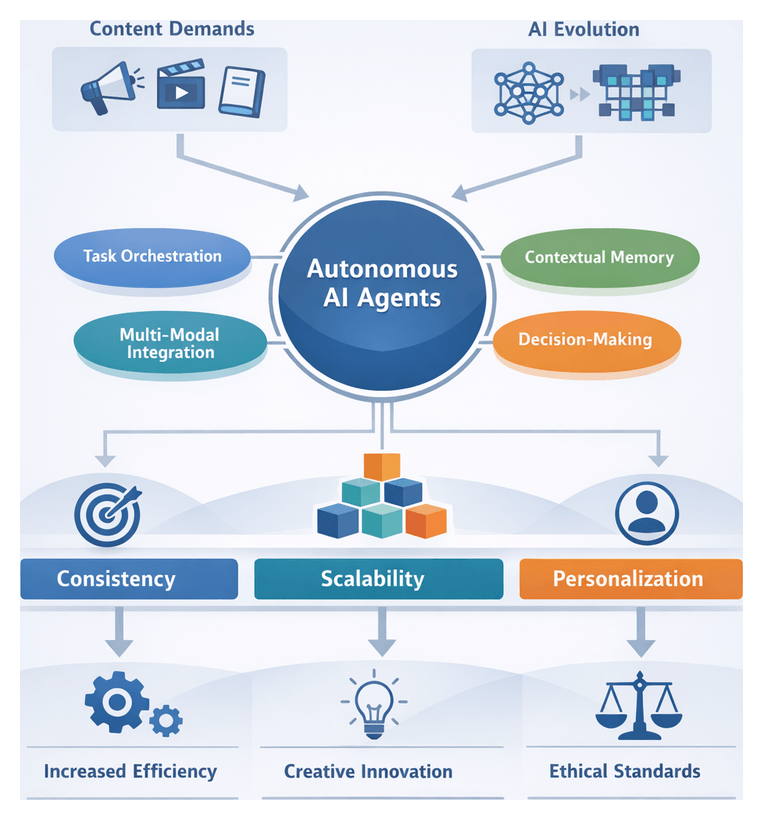
The contemporary creative ecosystem demands high volumes of tailored content across marketing, publishing, entertainment, education and beyond. Organizations face pressure to deliver personalized experiences with speed, precision and consistency across fragmented digital channels. While global spending on content creation and marketing technology is set to exceed half a trillion dollars by 2025, surveys show that 68 percent of marketing leaders struggle with time-to-market pressures and 57 percent with inconsistent brand voice. Traditional workflows buckle under rapid iteration cycles, tight budgets and the need for adaptation to formats, languages and cultural contexts. These challenges underscore the tension between scaling content production and preserving coherence, creativity and strategic alignment.
Evolution of AI in Creative Work
Artificial intelligence has evolved from rule-based automation and statistical models to advanced deep-learning and transformer-based architectures. Early systems optimized headlines or conducted A/B testing via predefined templates and heuristics. The advent of neural networks enabled image analysis, speech synthesis and sentiment classification. Transformer models such as GPT-4 from OpenAI introduced human-like fluency in text generation, while generative adversarial networks and diffusion models powered photorealistic image synthesis and style transfer. Breakthrough tools like DALL·E, Adobe Sensei and Canva Magic Write have integrated these capabilities into creative suites, offering automated layout suggestions, color palette choices and copy variations.
Despite these advances, generative AI often operates reactively: users issue prompts, receive outputs and manually refine them. For complex, multi-step projects requiring cross-disciplinary coordination and dynamic feedback, chaining isolated AI services becomes labor-intensive. Creative professionals spend significant time on prompt engineering, context management and iterative review, diverting effort from strategic ideation and high-level decision-making.
Limitations of Standalone Generative Models
Reliance on single-purpose generative models introduces bottlenecks:
- Maintaining narrative or visual consistency across multiple assets demands meticulous human oversight and hundreds of tailored prompts.
- Scaling personalization for audience segments leads to redundant prompt engineering, inflating time and costs.
- Disparate AI services—language, vision, audio—require ad hoc integration, risking metadata loss, format misalignment and latency issues.
- Quality control remains critical as generative outputs can include factual inaccuracies, biases or stylistic deviations that necessitate rigorous review.
These challenges highlight the need for a new paradigm—one that moves beyond isolated models toward systems capable of orchestrating complex creative pipelines autonomously.
Defining Autonomous Creative Assistants
Autonomous creative assistants, or AI agents, represent the next frontier in content innovation. Unlike conventional generative models, AI agents operate proactively with goal-oriented architectures. They plan, execute and refine multi-step workflows with minimal human intervention. Key characteristics include:
- Task Orchestration: Sequencing ideation, draft generation, asset transformation and quality evaluation into coherent pipelines aligned with strategic objectives.
- Contextual Memory: Maintaining awareness of project context, brand guidelines and audience personas through memory modules or vector embeddings for continuous coherence.
- Autonomous Decision-Making: Leveraging reasoning engines and planning algorithms to select generation strategies, adjust parameters and trigger conditional branches based on metrics or feedback.
- Multi-Modal Integration: Interfacing with language, vision and audio models to synthesize rich deliverables combining text, imagery and sound.
- Self-Evaluation and Learning: Incorporating analytic modules to assess outputs against KPIs such as engagement rates, sentiment scores or conversion metrics and adapting iterations accordingly.
By embedding autonomy and continuous learning, AI agents transform fragmented tasks into a cohesive, adaptive system that upholds brand integrity and frees creative talent for high-value work.
Conceptual Foundations of AI-Driven Creativity
Industry interpretations of AI-powered creative processes draw on frameworks from cognitive science, computational creativity and design thinking. At the cognitive level, the componential model of creativity highlights domain-relevant skills, creative cognition and intrinsic motivation. AI agents contribute vast domain knowledge, generate novel idea combinations and sustain high output without fatigue. Computational creativity assesses systems against criteria of novelty, surprise, value and intentionality to distinguish deep creativity from random generation.
Margaret Boden’s taxonomy of creativity—combinational, exploratory and transformational—guides evaluation of AI outputs. A writing assistant merging stylistic elements exemplifies combinational creativity, while a design agent exploring a parameterized style grid demonstrates exploratory creativity. Transformational creativity, which redefines conceptual spaces, remains aspirational but drives innovation in agent architectures.
Scholars also examine agency and autonomy, debating whether AI-generated content reflects genuine machine agency or human-curated scripting. In practice, many organizations adopt a collaborative model, viewing agents as contributors that accelerate iteration while requiring human oversight for bias mitigation and intellectual property compliance.
Analytical frameworks employed in industry include:
- Quantitative metrics such as novelty score distributions, semantic coherence indices and engagement lift, often measured through A/B testing and perceptual similarity metrics.
- Design thinking adaptations like the Double Diamond model, integrating AI-driven divergence for ideation and convergence for prototyping.
- Value chain mapping in retail and financial services, comparing license fees for platforms like Jasper against training costs, quality control labor and conversion uplifts.
- Ethical frameworks addressing bias, transparency and intellectual property, influenced by reports from organizations such as the World Economic Forum.
These conceptual lenses equip stakeholders to align agent capabilities with strategic objectives, governance models and creative aspirations.
Technological Catalysts and Innovation Trajectories
Recent breakthroughs underpinning AI agents include the rise of large language models, multimodal architectures and agent orchestration frameworks. Tools like Midjourney and Adobe Firefly demonstrate high-fidelity image generation guided by natural language. Orchestration layers maintain state, decompose complex tasks and adjust outputs based on iterative evaluation. Cloud-native infrastructures and optimized inference runtimes enable scalable, low-latency agent deployment on desktop and mobile platforms.
Three innovation trajectories define the technical evolution of AI agents:
- Integration of reasoning modules and symbolic knowledge bases to enhance factual grounding and reduce hallucinations.
- Modular architectures supporting plug-and-play subagents for style emulation, compliance checks and brand enforcement.
- Human-in-the-loop interfaces balancing autonomy with oversight through feedback capture, preference learning and collaborative steering.
These trajectories shift perceptions of AI from passive tools to strategic partners capable of assuming responsibility for discrete creative segments.
Market Imperatives and Business Drivers
Creative professionals face rapid audience churn, proliferating channels and demand for personalized experiences amid budget constraints and talent shortages. AI agents address these challenges by enabling:
- Scalability: Generating diverse asset variations on demand to support omnichannel campaigns.
- Personalization: Tailoring messaging and visuals dynamically using audience data and performance metrics.
- Agility: Recalibrating style guidelines or narratives in real time in response to market trends or regulatory changes.
- Cost Optimization: Automating routine ideation and first-draft generation, allowing human talent to focus on strategy and emotional resonance.
Organizations evaluate agent programs through return on creative investment (ROCI), measuring output volume, engagement lift, conversion impact and brand sentiment. Pilot programs integrate conversational agents like ChatGPT for audience research, generative subagents for rapid prototyping and analytics-driven modules for performance forecasting, weaving them into strategic roadmaps for competitive differentiation.
Cultural and Societal Impacts
AI agents are reshaping cultural norms of authorship, originality and creative labor. Key inflection points include:
- Redefinition of creativity as a collaborative human–AI co-creation process rather than solitary genius.
- Democratization of tools, enabling non-specialists to produce professional-quality content.
- Ethical discourse around deepfakes, intellectual property and provenance, prompting transparency standards and watermarking.
- Evolution of skills and curricula in prompt engineering, AI ethics and human-centered design, reflecting the rise of AI literacy as cultural capital.
These shifts influence how agencies market “AI-enhanced creativity,” how publishers credit authorship and how industry guidelines emerge to disclose AI collaboration in consumer-facing content.
Professional Relevance for Creative Industries
Across disciplines—writing, design, multimedia, marketing and interactive content—AI agents demand new frameworks for decision-making and investment. Practitioners employ models such as:
- Creativity-Efficiency Matrix: Mapping tasks by creative novelty and operational efficiency to determine optimal levels of agent autonomy versus human control.
- Human–AI Symbiosis Model: Defining collaboration patterns like agent critique sessions and blended authoring environments tailored to team skill sets.
- Capability Value Chain Reconfiguration: Evaluating how agents reshape talent needs, vendor relationships and processes across ideation, production and distribution.
Common considerations include alignment with brand strategy, governance protocols, upskilling in prompt engineering and rigorous evaluation of vendors’ security, interoperability and roadmap alignment. By situating AI agents within established frameworks, organizations harness innovation while mitigating risk and preserving artistic integrity.
Reader Roadmap and Learning Outcomes
This guide equips readers with insights and analytical tools to evaluate, implement and scale AI-driven creative agents strategically. Anticipated outcomes include:
- Grasping the shift from standalone models to autonomous agents and implications for ideation, generation and decision support.
- Understanding how NLP, generative networks, computer vision, embeddings and orchestration frameworks interoperate in adaptive workflows.
- Assessing domain-specific impacts on writing, visual design, multimedia production and cross-channel engagement.
- Applying human–agent collaboration models, interface requirements and change-management strategies.
- Evaluating trade-offs in agent orchestration, data governance and interoperability within enterprise content operations.
- Defining performance metrics aligned with quality, efficiency, audience engagement and business objectives.
- Anticipating ethical, legal and regulatory challenges and embedding governance models for responsible deployment.
Analytical frameworks distilled in this section—maturity models, workflow impact matrices, ROI evaluation and ethical compliance spectrums—serve as decision-support tools for content strategists, creative directors, AI practitioners and executives. By beginning with current workflow assessments, leveraging pilot sequencing, prioritizing high-impact integrations and embedding risk-management practices, organizations can scale AI-driven content innovation with confidence.
Chapter 1: Foundations of Creative AI Agents
Understanding Creative AI Agents
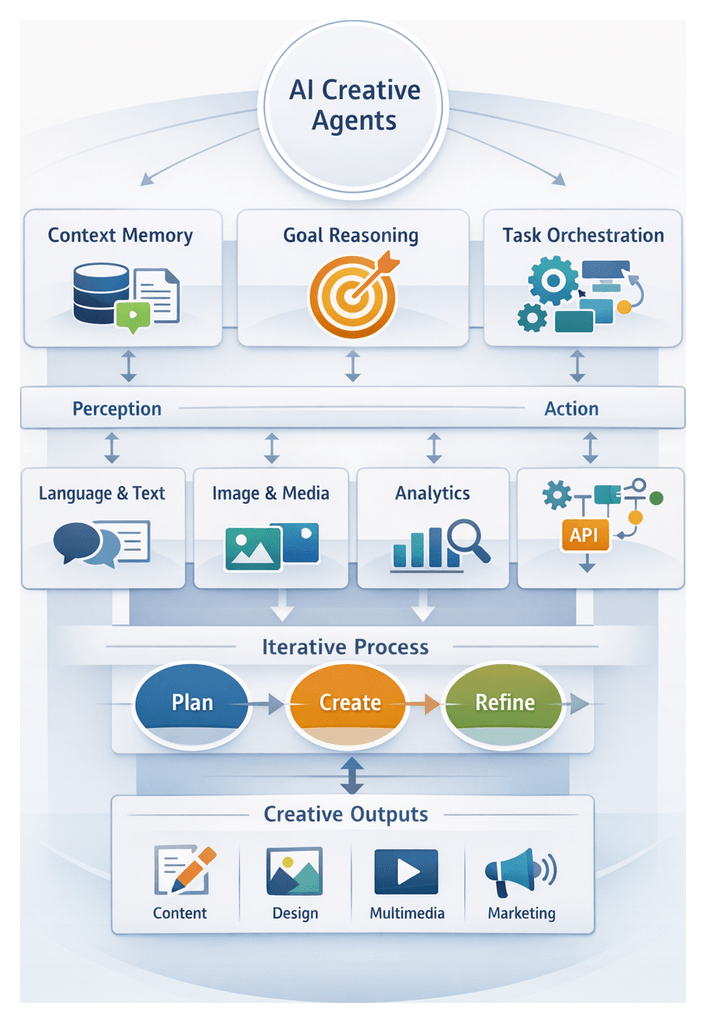
Creative AI agents represent a transformative shift in how professionals approach writing, design, multimedia production, and marketing. Unlike standalone generative models that respond to discrete prompts, agents function as autonomous software entities that maintain persistent context, decompose objectives into sub-tasks, and iteratively refine outputs. By coordinating multiple AI capabilities—natural language understanding, image synthesis, analytics, and workflow orchestration—these systems streamline multi-step creative processes and bridge the gap between ideation, execution, and strategic decision making.
The Agent Paradigm
At their core, AI agents perceive their environment, reason about goals, and execute actions to satisfy high-level directives. Key characteristics include:
- Persistent Context: Agents retain project history, user preferences, and external data feeds, adapting outputs based on prior interactions to ensure coherence across deliverables.
- Goal-Oriented Reasoning: Instead of merely transforming input, agents formulate strategies—such as crafting brand guidelines or refining narrative arcs—to meet overarching creative objectives.
- Autonomous Orchestration: Agents coordinate specialized modules—text generation, imagery synthesis, analytics engines—in sequence, automating sub-tasks like copywriting, image selection, and scheduling.
Evolution from Models to Agents
Traditional AI models—like ChatGPT for text and DALL·E for imagery—excel at generating assets from prompts but lack internal memory or workflow integration. Creative AI agents unify these models into cohesive pipelines. For instance, an agent might draft a blog outline with GPT-4, then refine headings based on keyword analysis, suggest data points via analytics integration, and generate supporting visuals with Midjourney or DALL·E. Throughout this process, the agent tracks style preferences, brand guidelines, and stakeholder feedback without repeated manual input.
Autonomy, Context, and Collaborative Integration
Operational Autonomy and Task Orchestration
Autonomy distinguishes agents from reactive models. Three dimensions define this capability:
- Goal Decomposition: Breaking high-level objectives—such as “develop a full brand guideline”—into discrete tasks and assigning appropriate AI modules to each stage.
- Iterative Execution: Cycling through draft-review-revise loops, incorporating human edits and performance metrics to refine outputs progressively.
- Adaptive Decision Making: Adjusting task sequences and resource allocations based on new information—updated guidelines, real-time analytics, or changing market trends.
Context Retention and Memory Mechanisms
Agents maintain structured memory stores—content libraries, audience personas, style guides—that inform subsequent actions. A writing agent may reference earlier sections, tone guidelines, and stakeholder comments when drafting new material. Memory-driven metrics such as consistency, coherence, and reduction in repetitive instructions help evaluate how effectively agents leverage historical data.
Collaborative and Workflow Integration
Agents serve as connective tissue between creative tools and human teams. Integration criteria include:
- API Extensibility: Standardized interfaces that link to project management platforms, analytics dashboards, and third-party services.
- Co-authoring Support: Features enabling simultaneous contributions from humans and agents, preserving version histories and facilitating shared workspaces.
- Governance Controls: Guardrails, approval workflows, and compliance checks that ensure outputs align with regulatory and brand standards.
Foundational Attributes and Technical Foundations
Creative AI agents draw upon advances in:
- Large Language Models: Engines like GPT-4 that generate human-like text and understand nuanced context.
- Generative Adversarial Networks: Architectures for realistic image, video, and audio synthesis, driving style transfer and visual exploration.
- Reinforcement and Planning Algorithms: Methods enabling agents to set objectives, evaluate outcomes, and refine strategies over multiple turns.
- Multimodal Integration Layers: Systems unifying text, image, and audio outputs into cohesive multimedia assets.
Core attributes of mature agents include scalability, adaptability through continual learning, contextual awareness via internal state management, collaborative interfaces within creative suites, and governance mechanisms—audit trails, access controls, and versioning protocols—that maintain quality and compliance.
Implications Across Creative Disciplines
Writing and Storytelling
Agents such as ChatGPT, Jasper, and MarketMuse transform writing from linear drafting into iterative co-creation. They accelerate ideation, propose alternative plot threads, and adjust style based on reader personas. Hybrid editorial frameworks integrate automated checks from tools like Grammarly and ProWritingAid with human oversight to ensure narrative integrity and brand alignment. Writers evolve into creative directors, supervising agent suggestions and refining final outputs.
Visual and Graphic Design
Generative agents leverage Midjourney, DALL·E, Adobe Firefly, and Stable Diffusion to automate style transfer, asset generation, and layout proposals. Rapid prototyping condenses concept-to-presentation cycles, while enforcement of centralized design systems ensures brand consistency. Designers focus on strategic narrative curation and cross-channel cohesion, guiding human-agent ensembles toward high-level creative rationale.
Multimedia and Interactive Content
Agents like Synthesia, Descript, Runway ML, and AIVA fuel video synthesis, real-time audio generation, and branching narrative logic. They enable personalized e-learning videos, adaptive soundtracks, and interactive story engines that respond to user choices. Creative technologists shift from script authors to architects of immersive experiences, defining metadata schemas, version control, and ethical boundaries for adaptive content.
Marketing, Branding, and Social Media
Platforms such as Persado, Brandwatch, and Hootsuite automate campaign ideation, messaging personalization, and social listening. Agents recommend A/B-tested variants, segment audiences in real time, and trigger crisis responses under human supervision. Marketing teams integrate data scientists and ethical auditors to govern agent behavior, ensuring alignment with brand purpose and compliance standards.
Cross-Disciplinary Considerations
The co-creation paradigm redefines professional roles and organizational structures. Key considerations include:
- Skill Convergence: Prompt engineering, data literacy, and ethical oversight become essential meta-skills alongside domain expertise.
- Organizational Agility: Agile governance frameworks support rapid experimentation, continuous learning, and cross-disciplinary review processes.
- Intellectual Property Evolution: Co-authorship models and rights management protocols adapt to hybrid human-machine outputs.
- Ethical Guardrails: Bias mitigation, accessibility standards, and accountability workflows ensure responsible agent deployment.
Evaluating and Governing Creative AI Agents
Strategic Alignment and Business Objectives
- Objective Mapping: Link agent capabilities to goals such as brand consistency, time-to-market acceleration, and personalization at scale.
- Value Contribution: Quantify efficiency gains, quality improvements, and return on investment through pilot metrics.
- Competitive Differentiation: Assess real-time adaptation, advanced storyboarding, and audience segmentation features for market impact.
Flexibility and Domain Adaptability
- Domain-Specific Tuning: Custom prompt libraries and fine-tuning options for sectors like publishing, advertising, and e-learning.
- Modular Architecture: Swap components—using Midjourney or DALL·E for visual tasks—to meet specialized requirements.
- Multimodal Integration: Support combined text, image, audio, and data inputs for complex deliverables such as interactive presentations.
Integration and Workflow Compatibility
- API Connectivity: Standardized interfaces or SDKs—link agents with frameworks like LangChain—for advanced orchestration.
- Version Control: Co-authoring features, asset revision tracking, and rollback mechanisms to maintain editorial governance.
- UI Coherence: Intuitive dashboards or plugin extensions for environments like Adobe Creative Cloud and Figma, reducing context-switching.
Output Quality, Consistency, and Coherence
- Quality Benchmarks: Evaluate linguistic fluency, visual fidelity, and audio clarity against human-produced exemplars.
- Consistency Controls: Enforce style guides, brand templates, and configurable constraints to uphold corporate identity.
- Coherence Mechanisms: Embed narrative engines or storyline planners to ensure logical progression and thematic unity.
Transparency, Explainability, and Trust
- Decision Logs: Record prompts, intermediate outputs, and reasoning steps for auditability.
- Explainable AI Features: Surface factors influencing generation to enable validation by non-technical stakeholders.
Ethical, Legal, and Compliance Considerations
- Bias Detection: Integrated tools identify demographic or cultural biases, with workflows to remediate problematic outputs.
- Rights Management: Verify that training data sources comply with licensing agreements and copyright laws.
- Regulatory Alignment: Ensure conformity with GDPR, CCPA, and emerging AI governance frameworks.
Scalability, Reliability, and Performance
- Throughput Capacity: Handle concurrent requests without degradation, enabling real-time collaboration.
- Resilience Architecture: Employ redundancy, load balancing, and failover mechanisms for continuous availability.
- Resource Optimization: Balance compute and storage efficiency against iteration speed in high-volume pipelines.
Governance, Human Oversight, and Collaboration Models
- Human-in-the-Loop Checkpoints: Define stages for expert review and approval before publication.
- Collaboration Protocols: Standardize naming conventions, communication channels, and cross-functional workflows.
- Training and Change Management: Upskill creative staff in prompt design, agent oversight, and performance interpretation.
Total Cost of Ownership and Vendor Dynamics
- Licensing Models: Compare pay-per-use and enterprise subscriptions, including overage fees during peak demand.
- Support and SLAs: Evaluate professional services, dedicated support channels, and uptime commitments.
- Vendor Ecosystem: Assess third-party extensions, marketplace integrations, and community resources.
Measurement, Feedback Loops, and Continuous Improvement
- Performance Indicators: Track quality (error rates, style adherence), efficiency (time savings, throughput), and impact (engagement, conversion uplift).
- A/B Testing Frameworks: Run controlled experiments comparing agent-generated content against human benchmarks or varied configurations.
- Model Retraining Cycles: Update algorithms and fine-tuning data sets in response to new use cases or evolving brand strategies.
Limitations and Challenges
- Domain Specialization: Agents optimized for broad use may underperform in niche contexts requiring deep expertise.
- Hallucinations: Language agents like ChatGPT and GPT-4 can produce plausible but inaccurate statements, necessitating fact-checking.
- Cultural Nuance: Automated outputs may miss regional idioms or evolving stylistic trends without ongoing data enrichment.
- Resource Intensity: High-fidelity image and video generation can incur significant compute and GPU costs.
- Over-Automation Risks: Excessive reliance on agents may dilute human judgment and homogenize brand voice.
- Security Vulnerabilities: Exposed APIs and third-party integrations require robust access controls and monitoring.
Analytical Frameworks for Decision-Making
- Multi-Criteria Decision Analysis (MCDA): Weigh strategic fit, technical maturity, cost, and risk to score agent solutions.
- Technology Adoption Lifecycle: Map agent capabilities through phases of early adoption, pragmatist integration, and mainstream scale-up.
- Risk-Benefit Assessment: Balance potential value creation against ethical, legal, and operational hazards.
- Capability Maturity Model: Evaluate organizational readiness across people, processes, and technology to define an entry point for deployment.
Chapter 2: Core Technologies and Architectures
Foundational Components of Creative AI-Driven Systems
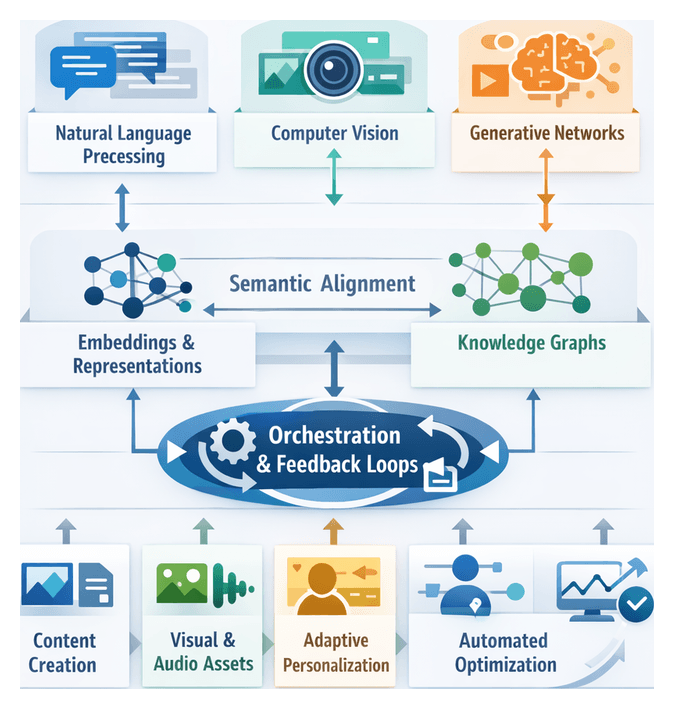
Modern creative production depends on interlocking AI technologies that transform raw data into insightful, original content. Core components include:
- Natural Language Processing (NLP): Algorithms for parsing, interpreting and generating human language. Transformer architectures enable coherent, context-rich text output for concept extraction, sentiment analysis and automated copywriting.
- Computer Vision: Systems that analyze imagery and video—performing object detection, scene segmentation, style classification and feature embedding—to support asset tagging, style transfer and visual metadata extraction.
- Generative Networks: Deep models such as GANs and VAEs that learn latent distributions to synthesize images, design layouts, music and narrative structures—fueling rapid ideation and prototype generation.
- Embedding and Representation Systems: High-dimensional vector mappings that capture semantic relationships across words, images and audio. Embeddings enable similarity search, clustering and alignment between modalities.
- Knowledge Graphs and Ontologies: Structured networks of entities and relationships that provide context, disambiguation and domain knowledge—ensuring thematic consistency and brand compliance.
- Reinforcement and Feedback Mechanisms: Adaptive agents refined through reinforcement learning and human-in-the-loop feedback. Reward signals from performance metrics and user engagement guide continuous improvement.
The evolution from rule-based parsers and early vision heuristics to statistical models in the 1990s laid groundwork for today’s deep learning revolution. Advances in word embeddings, convolutional networks and sequence-to-sequence transformers unlocked scalable language and vision capabilities. Generative networks further expanded creative potential, and open-source libraries plus cloud services democratized access.
By interconnecting these components—sharing embeddings, knowledge graphs and feedback loops—AI agents achieve creative autonomy. They interpret multimodal briefs, produce integrated visual and textual content, adapt style to brand guidelines, iterate through stakeholder feedback and automate repetitive tasks at scale. This forms a closed-loop creative cycle in which human expertise and machine intelligence amplify one another.
To evaluate and deploy these building blocks effectively, leaders apply strategic criteria:
- Performance and Accuracy: Coherence, relevance and visual fidelity against domain benchmarks.
- Scalability and Latency: Throughput capacity and response times under peak loads.
- Integration Flexibility: API/SDK availability and support for embedding exchange.
- Customization and Fine-Tuning: Ease of adapting models to proprietary data and style guides.
- Explainability and Control: Transparency features such as attention visualization and latent space exploration.
- Cost and Resource Requirements: Computational expenses, licensing fees and maintenance overhead.
Synergy and Orchestration in Agent Ecosystems
Rather than operating in isolation, AI components gain emergent capabilities through deliberate orchestration. Key principles include:
Embedding Spaces as Shared Semantic Medium
Unified vector spaces map language, images and audio into a common semantic framework. Agents convert user inputs into embeddings that drive generative image models or layout engines. Maintaining cross-modal alignment through contrastive learning and periodic retraining prevents drift and ensures coherent multimodal outputs.
Feedback Loops and Iterative Refinement
Continuous validation checkpoints embed quality control within workflows. For example, a narrative agent proposes an outline that a style module evaluates against brand guidelines. Discrepancies trigger corrective signals to refine tone or structure. Frameworks like LangChain define primitives for agent calls, state sharing and conflict resolution, while convergence thresholds and confidence aggregation prevent oscillation.
Agent Orchestration and Task Delegation
An orchestration layer acts like a project manager, assigning subtasks to specialized agents and coordinating outputs. Core functions include:
- Dynamic Task Routing: Directing content segments to agents based on expertise.
- Dependency Resolution: Ensuring assets are generated in correct order—for example, completing image synthesis before layout design.
- Resource Allocation: Balancing compute loads across agents to optimize throughput and minimize latency.
Scalability and Latency Trade-Offs
Parallel agent execution boosts throughput but increases inter-agent communication. Teams employ microservices, containerization and message brokers to buffer data flows. Techniques such as caching embeddings, batch processing and circuit breaker patterns enable real-time responsiveness without sacrificing scale.
Interpretive Frameworks and Emerging Trends
Organizations leverage models like the Resource-Based View to assess unique data assets and orchestration logic as competitive advantages. Systems Thinking maps reinforcing loops—such as quality improvements driving engagement that enriches training data. Financial cost-benefit analyses overlay technical metrics (accuracy, speed) with business outcomes (time-to-market, revenue uplift).
Future directions include meta-orchestration, where agents self-select collaborators based on capability reputations, and standardized interoperability protocols developed by bodies like the Partnership on AI. These trends promise vendor-neutral integration of best-of-breed creative stacks.
Autonomous Workflows and Strategic Applications
Embedding AI agents into end-to-end processes transforms content production from linear pipelines into adaptive, parallelized systems. Primary contexts include:
Editorial and Content Production Pipelines
Agents draft, fact-check and align style in concert, enabling rapid iterations while preserving brand voice. Tools such as GPT-4 and Jasper generate headline and summary variants instantly. Maturity models track autonomy levels from suggestion engines to fully autonomous assembly with human checkpoints.
Marketing and Campaign Management
Agents drive concept ideation, asset diversification and automated A/B testing in iterative loops. Platforms like Persado and Jacquard propose messaging hierarchies, while Adobe Sensei produces visual and textual variations. Dashboards monitor conversion lift, ROAS and brand sentiment, triggering human approvals for strategic pivots.
Brand Asset Generation and Management
Generative engines propose logos and collateral within guardrails defined by brand schemas. Canva Magic Write combines brand attributes with deep networks for iconography concepts. Platforms like Frontify enforce guideline compliance across global teams and automate on-demand collateral generation.
Personalization and Audience Engagement
Dynamic personalization frameworks span templating to hyper-personalization. Tools such as Dynamic Yield and OneSpot assemble individualized email streams and web experiences based on real-time behavior. Governance balances engagement lift with privacy and fatigue considerations.
Multimedia and Interactive Experience Design
Video, audio and interactive narratives benefit from rapid prototyping and iteration. Platforms like Synthesia and Pictory generate script-driven videos, while Descript and Auphonic automate podcast editing. Engines such as Unity’s ML-agents and Runway ML enable branching narratives and real-time effects responsive to user inputs.
Cross-Functional Collaboration and Governance
Effective roles are defined along a human-agent partnership spectrum. RACI matrices and version control track agent suggestions and human edits. Ethical guardrails, bias audits and performance KPIs integrate into CI/CD pipelines to ensure compliance, traceability and quality.
Architectural Trade-Offs, Best Practices, and Future-Proofing
Key Trade-Offs
- Compute versus Cost: High-throughput GPUs boost responsiveness but increase expenses.
- Modularity versus Monolith: Modular services enable independent upgrades but add API complexity.
- Proprietary versus Open-Source: Vendor platforms simplify scaling, while open-source demands in-house expertise.
- Latency versus Throughput: Real-time experiences require low latency; batch processes favor high throughput.
- Centralization versus Federated Access: Central data simplifies governance; federated models support sovereignty and resilience.
Balancing Performance, Scalability, and Flexibility
Effective architectures optimize three dimensions:
- Performance: Deploy multi-GPU clusters with Kubernetes and NVIDIA Triton for mission-critical low latency.
- Scalability: Use auto-scaling groups, message queues and services like Amazon SageMaker to handle variable loads.
- Flexibility: Adopt microservices with connector layers to integrate new models and APIs rapidly.
Best Practices for Robust Orchestration
- API-First Design: Versioned APIs and standard protocols (gRPC, REST) promote loose coupling.
- Service Mesh: Frameworks like Istio guarantee uniform traffic management, security and observability.
- Continuous Monitoring: Capture latency, GPU utilization and creative quality metrics in centralized dashboards.
- Version Control: Track model artifacts and pipelines with MLflow and Kubeflow for reproducibility and compliance.
- Data Governance: Enforce encryption, role-based access and lineage tracking across data flows.
- Hybrid Cloud: Combine on-premises and public cloud for sensitive workloads and peak demands.
Mitigating Limitations and Future-Proofing
- Technical Debt: Allocate refactoring phases to standardize integrations and reduce brittleness.
- Vendor Lock-In: Use abstraction layers to facilitate migration to alternative platforms.
- Bias and Alignment: Implement continuous bias monitoring and rapid model updates when misalignment occurs.
- Regulatory Uncertainty: Maintain modular governance components to adapt to evolving compliance standards.
- Legacy Integration: Conduct comprehensive metadata mapping and stakeholder engagement early in the process.
- Human-In-The-Loop Scaling: Provide seamless interfaces for review and feedback without imposing latency.
Strategic Guidelines for Evolution
- Prioritize modularity to incorporate emerging model research.
- Embed observability and governance from project inception.
- Balance on-premises and cloud resources to optimize cost and compliance.
- Maintain abstraction around third-party services to minimize lock-in.
- Incorporate continuous feedback from creatives and end users.
- Plan iterative refactoring cycles to address technical debt and integrate innovations.
By aligning architectural decisions with strategic objectives, organizations can build creative AI agent systems that deliver sustained innovation, adaptability and competitive advantage.
Chapter 3: AI Agents in Writing and Storytelling
Evolving Creative Ecosystem and the Rise of AI Agents
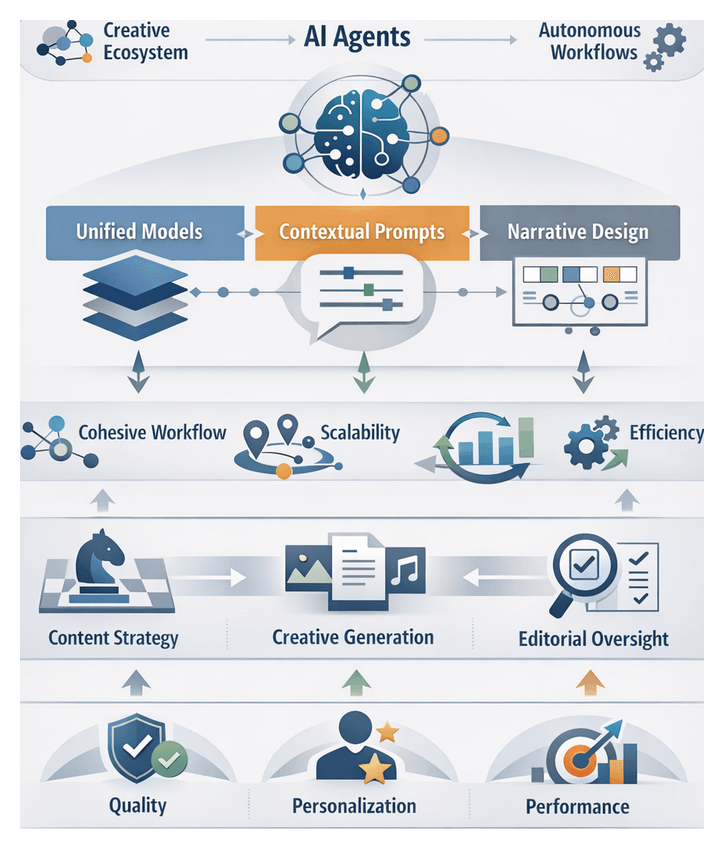
Creative teams today face mounting pressures to deliver personalized, multi-channel content at scale and with rapid turnaround. Traditional generative models—whether for text, image, or audio—excel at isolated tasks but impose bottlenecks when stitched together by human operators. This fragmentation drives integration overhead, slows responsiveness, and risks inconsistencies as assets traverse disparate tools. In response, autonomous creative assistants, or AI agents, have emerged to orchestrate end-to-end workflows, interpret context, and make goal-driven decisions with minimal human intervention.
An AI agent unites specialized sub-models under a governing logic, dynamically selecting and sequencing tasks such as concept ideation, draft generation, review, and final polishing. Powered by reinforcement learning, planning algorithms, and multimodal transformers, agents maintain memory of project parameters, integrate real-time feedback, and adapt priorities based on performance metrics. In a product launch scenario, for example, an agent can ingest the creative brief, coordinate script drafts, synthesize imagery with brand palettes, generate localized copy streams, and flag compliance issues—presenting cohesive deliverables for human approval.
Key advantages of agent-based approaches include:
- Cohesive workflows: Agents manage entire pipelines rather than isolated steps, invoking translation, design, and text modules in context.
- Scalability: Parallel localization, tone adaptation, and style enforcement across numerous markets reduce cycle times and costs.
- Flexibility: Memory retention enables mid-stream adjustments, rapid pivots to emerging trends, and continuous optimization in flight.
- Operational efficiency: Unified frameworks lower integration overhead and free creative teams to focus on strategy and refinement.
Behind these capabilities lies the convergence of cloud-native AI services, API-driven model access, and advanced embedding representations. Organizations leverage secure endpoints for large language models, on-demand computer vision pipelines, and custom generative networks without heavy infrastructure investment. As a result, creative operations shift from project-centric toolkits to capability-centric ecosystems where autonomous agents accelerate ideation loops and foster experimentation at scale.
Designing Prompts and Narratives for Effective AI Collaboration
Prompt and narrative design serve as the strategic interface between human intent and machine output. Well-crafted prompts embed contextual framing, stylistic constraints, and performance objectives, guiding agents toward conceptually aligned results. Narrative engineering extends prompts by imposing structural logic—story arcs, pacing algorithms, and thematic consistency—into multi-turn interactions.
Prompt Design Principles
- Contextual Framing: Embed audience profiles, thematic anchors, and brand voice guidelines within prompts to shape initial outputs.
- Dynamic Constraints: Layer adaptive parameters that tighten or relax creative guardrails based on agent feedback loops.
- Semantic Gradients: Calibrate tone, complexity, and emotional valence along continuous scales to steer generative trajectories.
Narrative Engineering Frameworks
- Three-Act Models: Map outputs to exposition, conflict, and resolution phases for iterative structural refinement.
- Character Arc Templates: Use archetype-driven schemas to ensure coherent growth, emotional depth, and motivational consistency.
- Thematic Cohesion Algorithms: Apply vector embeddings to measure alignment between generated content and predefined thematic vectors.
Balancing Autonomy and Oversight
Optimal agent deployment navigates a continuum from suggestion-only modes to draft-completion autonomy. Hybrid governance models combine automated quality checks with human editorial review. Agencies define autonomy tiers—selecting the appropriate level of agent freedom based on project risk, brand sensitivity, and creative complexity.
Evaluation and Metrics
Effective evaluation integrates quantitative indicators with qualitative insights:
- Semantic Fidelity: Automated scoring using language model perplexity, cosine similarity, and human assessment gauge alignment with prompt intent.
- Creative Divergence: Diversity metrics, including distinct n-gram counts and topic dispersion, quantify novelty relative to baseline patterns.
- Audience Resonance: Sentiment analysis, A/B testing platforms such as Jasper AI, and user panels measure emotional impact and engagement potential.
Industry frameworks from Narrative Science and research collaborations leveraging ChatGPT formalize these dimensions into practical evaluation matrices, enabling teams to diagnose narrative weaknesses and forecast audience response trajectories.
Genre-Specific Strategies
- Fiction: Platforms like Sudowrite illustrate how prompts seed imaginative branches while preserving plot coherence and character development.
- Journalism: Newsrooms adopt templates with source attribution guidelines and fact-checking directives to uphold credibility and ethical framing.
- Marketing: Prompt libraries tied to buyer personas and campaign objectives combine with real-time analytics dashboards for performance monitoring.
- Technical Documentation: Schemas mapping section headings, code examples, and compliance requirements streamline agent-driven authoring.
Emerging Prompt and Narrative Innovations
- Adaptive Authoring Environments: Interfaces suggesting prompt refinements based on real-time analysis reduce trial-and-error cycles.
- Narrative Gap Detection: AI systems identifying pacing inconsistencies or character discontinuities and proposing corrective arcs.
- Cross-Modal Prompts: Unified prompts incorporating visual, auditory, and textual cues enable richer multimedia storytelling.
- Ethical Oversight Modules: Toolkits flagging bias, misinformation, or copyright conflicts ensure responsible content creation.
Integrating AI Agents into Authorship and Editorial Workflows
Intelligent writing agents are reshaping authorship by redefining the roles of planners, writers, and editors. Far beyond efficiency gains, these tools act as collaborative partners, influencing content strategy, personalization, and governance.
Content Planning and Strategy
Agents such as Jasper AI serve as strategic advisors, analyzing social media signals, search trends, and competitive benchmarks to forecast topic relevance and optimize editorial calendars. This evidence-based approach complements human intuition, enabling creative directors to blend data-driven insights with domain expertise during ideation.
Adaptive Storytelling and Personalization
In consumer-facing contexts, platforms like Sudowrite demonstrate how agents can generate and test multiple narrative branches tailored to reader demographics or engagement metrics. While personalization boosts retention and resonance, hybrid governance frameworks ensure that human editors establish high-level guardrails, preserving authorial voice and strategic intent.
Editorial Collaboration and Workflow Augmentation
Agents enhance editorial processes through real-time suggestions for headlines, grammar, style, and multimedia integration. Tools such as GrammarlyGO deliver provisional hypotheses—alternative ledes, tone adjustments, factual cross-checks—that editors validate against brand guidelines and narrative objectives. This human-in-the-loop paradigm augments decision-making without ceding final authority.
Governance, Roles, and Adoption Models
Organizations calibrate agent autonomy according to content type and risk tolerance. Regulatory sectors enforce multi-stage compliance reviews, whereas creative labs allow broader agent freedom to explore speculative ideas. Three common adoption frameworks include:
- Centralized Competency Centers: Specialized teams curate outputs, develop best practices, and oversee governance policies.
- Embedded Augmentation: Distributed responsibility within business units integrates agents directly into existing authoring platforms.
- External Partnerships: Collaborations with vendors such as OpenAI’s ChatGPT or hosted narrative platforms grant access to advanced capabilities without internal infrastructure build-out.
Professional Norms and Skill Development
Emerging standards emphasize transparency and attribution, with authors disclosing AI contributions and documenting editorial interventions. Professional associations advocate “AI statements” in publications and campaign reports to uphold integrity. Concurrently, upskilling initiatives blend prompt engineering literacy with traditional storytelling, positioning authors as strategic narrative designers and quality stewards.
Strategic Trends, Operational Considerations, and Future Directions
Core Theoretical Pillars
Evaluating AI agent ecosystems involves frameworks such as the Agent Autonomy Continuum, Orchestration Architectures, and Feedback Integration Mechanisms. Interpretive lenses like the Capability-Integration Matrix and the Human-Agent Collaboration Continuum assess alignment with human goals, degree of creative autonomy, and coordination resilience. The notion of creative agency captures an AI system’s ability to propose novel concepts, re-scope goals when faced with ambiguity, and drive dynamic content innovation.
Operational and Ethical Considerations
- Data Governance: Robust provenance tracking and licensing compliance safeguard intellectual property and ensure diverse, representative training sets.
- Bias Mitigation: Differential auditing and adversarial testing detect and address stereotypes or exclusionary content.
- Human-in-the-Loop Protocols: Structured review gates maintain quality, brand alignment, and legal compliance despite high agent autonomy.
- Performance Monitoring: Metrics such as ideation velocity, engagement uplift, and resource efficiency guide iterative refinement of models and orchestration logic.
- Integration Complexity: API governance, version control, and interoperability testing ensure seamless connectivity among legacy systems and collaboration suites.
- Regulatory Alignment: Compliance with data protection statutes, the EU AI Act, and industry codes of conduct protects against legal exposure and promotes transparent innovation.
Limitations and Future Trajectories
- Contextual Depth: Agents may struggle with abstract thematic consistency over extended narratives or complex brand ecosystems.
- Interpretability: Intricate orchestration layers can obscure the provenance of creative decisions, complicating accountability.
- Resource Intensity: Training and fine-tuning multimodal networks for real-time performance incur significant computational and financial costs.
- Authenticity: Overreliance on agent outputs risks homogenized content; human curation remains vital for distinctive storytelling.
- Evolving Standards: Adapting governance models, metadata schemas, and audit pipelines is essential as best practices and regulations coalesce.
Looking forward, advancements in explainable AI will enhance transparency into agent rationale. Tighter integration of domain ontologies and knowledge graphs promises richer contextual sophistication, especially in technical and regulated sectors. The rise of decentralized agent marketplaces may democratize access to specialized creative capabilities while introducing new governance and commercial paradigms. By synthesizing these trends with operational rigor and ethical stewardship, organizations can harness the full potential of AI-driven innovation within creative workflows.
Chapter 4: Visual and Graphic Design AI Agents
The Evolving Creative Landscape and Problem Definition
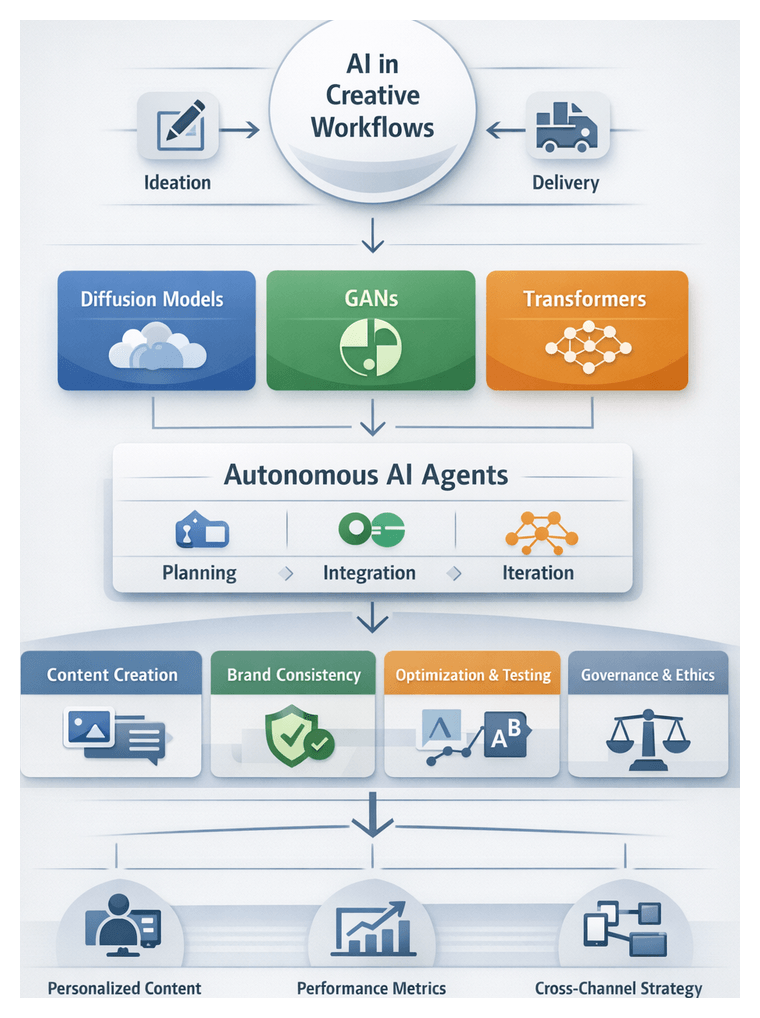
Creative industries are undergoing a fundamental transformation as artificial intelligence augments ideation, accelerates production, and optimizes content delivery. Traditional pipelines that relied on human expertise and manual iteration are now supplemented by standalone models—such as natural language processors for headlines and convolutional neural networks for style transfer—that operate in isolation and demand extensive human coordination. These point solutions deliver valuable outputs but introduce friction when projects require cross-modal integration, adaptive iteration, and brand coherence across written, visual, and audio assets.
The emergence of autonomous AI agents marks a paradigm shift from isolated models to purpose-built assistants capable of orchestrating end-to-end creative workflows. Unlike reactive tools, these agents maintain contextual memory, plan multi-step tasks, refine outputs iteratively, and manage objectives in alignment with brand directives. Advances in computational power, breakthroughs in foundational models such as GPT-4 and DALL·E 2, and integrated platforms like Adobe Firefly and Runway ML have made such autonomy feasible.
Organizations seek to harness AI agents to delegate routine tasks—tagging, formatting, exporting—freeing creative teams to focus on high-value work like narrative refinement and experiential design. Agents can generate thousands of design variations, conduct rapid A/B testing, and personalize content at scale, all within a continuous feedback loop that ensures evolving alignment with performance metrics and brand guidelines. Yet this transition raises critical challenges:
- Maintaining brand consistency across multi-agent workflows
- Integrating agents into existing toolchains and legacy systems
- Establishing governance mechanisms for objective alignment
- Addressing authorship, accountability, and intellectual property
- Balancing agent autonomy with human oversight
Bridging these gaps requires autonomous creative assistants with orchestration capabilities, robust evaluation criteria, and governance models that address technical, ethical, and operational concerns. Real-world examples—from global retailers localizing campaigns to multimedia studios storyboarding animated sequences—demonstrate the imperative for agents that deliver coherent, multi-step outputs rather than isolated functionality.
Generative Frameworks and Architectures
Core Model Families
Modern visual AI agents rely on three principal generative paradigms, each offering distinct advantages:
- Diffusion Models: Iterative denoising frameworks like DALL·E 3 and Stable Diffusion excel at high-fidelity image synthesis. Conditioning mechanisms and latent guidance enable fine-grained control over texture and composition.
- Generative Adversarial Networks (GANs): StyleGAN variants deliver efficient one-shot sampling, making them ideal for real-time portrait generation and style interpolation. However, they require careful dataset curation to avoid mode collapse.
- Transformer-Based Models: Adapted from language applications, vision transformers and token-based approaches—exemplified by Midjourney—offer semantic coherence at the cost of increased computation and longer inference times.
Trade-Offs in Model Selection
- Quality versus speed: Diffusion sampling can be slow at high resolution, while optimized GANs trade some fidelity for near-instant results.
- Diversity versus control: Diffusion frameworks support explicit conditioning, whereas GANs produce more consistent but less varied outputs.
- Compute requirements versus accessibility: Transformer systems often demand extensive GPU resources, favoring managed cloud services over on-prem deployment.
- Openness versus turnkey integration: Open-source ecosystems like Stable Diffusion enable deep customization; proprietary services such as Adobe Firefly prioritize usability and asset libraries.
Control and Customization
- Prompt Engineering Structured prompts combine descriptive keywords, style directives, and reference images. Advanced diffusion systems support weight annotations and spatial masks to localize edits.
- Fine-Tuning and Custom Models Enterprises fine-tune base models on proprietary asset libraries to ensure brand-specific aesthetics, often deploying private checkpoints behind secure APIs.
Performance Metrics and Interpretability
Evaluating generative frameworks involves both technical and creative dimensions:
- Frechet Inception Distance (FID) quantifies distributional differences between generated and real image sets.
- Inception Score (IS) measures diversity and recognizability, though sensitive to dataset biases.
- Perceptual Similarity (LPIPS) offers human perception proxies for stylistic deviations.
- User Engagement Indicators such as click-through rates and time-on-page validate real-world creative resonance.
Interpretability frameworks—visualizing attention maps, auditing bias, and incorporating continuous learning protocols—ensure transparent pipelines and incremental alignment with brand and ethical standards.
Applications in Marketing and UX Design
Marketing Asset Production
Agents such as Adobe Firefly, Midjourney, and Stable Diffusion empower marketing teams to co-create campaign assets. By combining brand attributes with engagement data, agents support strategic ideation and rapid prototyping, reducing turnaround times by 30–50 percent for high-volume deliverables.
- Geo-targeted variants: API-driven workflows that adapt visuals to regional contexts.
- Seasonal refreshes: Automated style transfer for holiday or promotional themes.
- Dynamic content libraries: AI-tagged asset repositories aligned with semantic features and brand guidelines.
User Experience Prototyping and Accessibility
Integrated AI plugins in platforms like Figma accelerate wireframe generation, accessibility audits, and iterative testing. Agents interpret design briefs to produce layout options, alert designers to WCAG violations, and suggest adjustments for color contrast and iconography clarity.
- Real-time feedback: Alerts for high cognitive load elements during authoring.
- Conversational interfaces: Prototyping chatbot and voice flows from support transcripts.
- Responsive layouts: Breakpoint-specific variations informed by device engagement data.
Campaign Personalization and Dynamic Content
By integrating with customer data platforms and DCO systems, agents generate personalized imagery that adapts to user behavior and contextual signals. Creative feedback loops enable real-time optimization of visuals based on performance metrics, blurring lines between analytics and production.
- Behavioral segmentation: Visual variations aligned with user preferences and browsing history.
- Geo-contextual imagery: Localized backgrounds reflecting weather or cultural events.
- Temporal themes: Automated swaps for time-of-day or seasonal elements during campaign runs.
Brand Consistency and Governance
Organizations embed rule sets into agent workflows to enforce color palettes, typography standards, and logo placements. Constraint-based generation parallels feature toggles in software, enabling modular control over generative capabilities and preserving brand integrity.
- Template licensing: Watermarks and metadata for rights management.
- Approval workflows: Automatic routing of AI outputs through creative review systems.
- Version control: Tracking prompts and model versions for auditability.
Cross-Channel Visual Strategies
Agents generate channel-optimized variants—vertical videos for social stories, landscape banners for web—while preserving semantic embeddings that capture brand motifs. This visual language design ensures coherent narratives across digital, print, AR, and out-of-home touchpoints.
- Omnichannel campaigns: Coordinated visuals across email, display, and point-of-sale.
- Augmented reality: 3D assets that align with 2D campaign imagery.
- Physical-digital integration: Print collateral with QR codes triggering context-aware digital experiences.
Adoption Insights and Governance Best Practices
Balancing Autonomy and Brand Consistency
Leading teams treat AI outputs as collaborative drafts, subject to existing design system rules and approval processes. Embedding immutable brand elements alongside flexible parameters for secondary assets ensures novelty without compromising coherence.
- Define core elements: Logos, mascots, primary color palettes.
- Allow variation: Textures, backgrounds, accent graphics within brand bounds.
- Establish review gates: Brand managers evaluate AI-driven variations before release.
Fidelity, Flexibility, and Tool Selection
Organizations evaluate solutions based on render quality, stylistic range, and customization controls. Photo-realistic campaigns may leverage DALL-E, while stylized illustration workflows favor Midjourney or Adobe Firefly for their art-style presets. Decision matrices weigh out-of-the-box fidelity against the effort required for prompt engineering and fine-tuning.
Integration into Design Workflows
- Plugin support: Native extensions for Adobe Creative Cloud and Figma.
- API accessibility: Automated pipelines, batch processing, and version control via well-documented endpoints.
- Collaboration channels: Shared libraries and annotation layers uniting human and AI inputs.
Ethical Governance and Risk Mitigation
- Data provenance: Transparent records of licensed or public-domain training datasets.
- Bias auditing: Automated detection and human review to surface stereotypes or harmful imagery.
- Usage policies: Clear definitions of permissible applications, with restrictions on deepfake or sensitive content.
Cross-functional ethics committees oversee policy guardrails, incident response, and maintain audit trails of generation parameters and review annotations.
Performance, Scalability, and Cost Management
- Compute expenses: GPU hours or cloud credits per generation task.
- Human oversight: Labor costs for prompt refinement and asset review.
- Maintenance overhead: Updates to models, plugin compatibility, and integration support.
Procurement and technical teams benchmark solutions to balance total cost of ownership, deploying open-source frameworks for high-volume tasks and premium services for mission-critical campaigns. Usage analytics inform capacity planning and procurement decisions.
Limitations and Future Directions
- Domain drift: Challenges with proprietary or highly specialized visual styles.
- Resolution constraints: Framework caps necessitate post-processing for print or large formats.
- Contextual coherence: Complex scene generation with consistent lighting and perspective remains difficult.
- Security risks: Unsecured APIs may invite unauthorized access or malicious prompts.
Emerging solutions—hybrid architectures combining symbolic reasoning and domain ontologies, federated learning for fine-tuning on sensitive assets—promise to address current gaps. Continuous reassessment of capabilities, metrics, and governance frameworks will ensure that visual AI agents drive innovation while preserving brand integrity and ethical standards.
Chapter 5: Multimedia and Interactive Content Agents
AI in Creative Industries and the Rise of Autonomous Agents
The integration of artificial intelligence into creative workflows has evolved from isolated automation tasks to sophisticated generative systems that span text, visuals, audio, and interactive experiences. Early applications focused on image enhancement, basic copywriting, and data-driven personalization, supported by platforms like OpenAI’s GPT series for text and DALL·E for images. As transformer architectures, style-based networks, diffusion models, and neural audio synthesis matured, tools such as Runway ML and Adobe Sensei enabled rapid prototyping of user interfaces, synthetic voiceovers, and immersive content drafts.
Despite impressive advances, standalone generative models pose limitations in end-to-end project orchestration. Their stateless design requires users to repeatedly supply context, stitch responses, and curate outputs to meet brand guidelines and narrative objectives. This fragmented approach leads to siloed workflows, duplicated effort, and manual version control, slowing iteration and hindering responsiveness to real-time feedback or market shifts.
The Promise of Autonomous Creative Agents
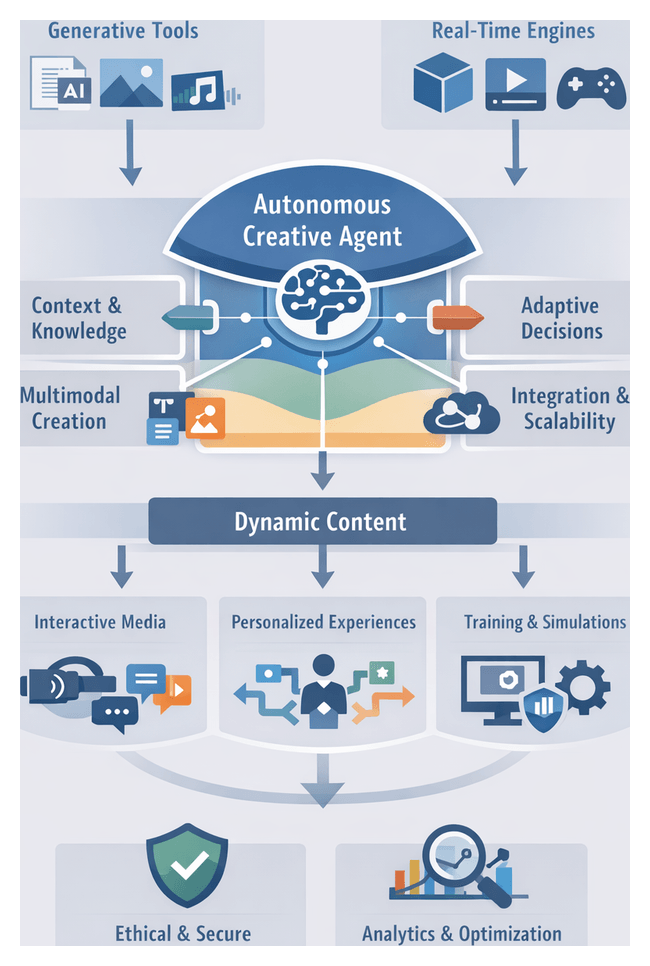
Autonomous creative assistants, or AI agents, address these challenges by embedding domain knowledge, brand rules, and project histories into continuous, context-aware collaborators. Rather than reacting to ad hoc prompts, agents can ingest creative briefs, maintain coherence across multimodal assets, recommend next steps, and adapt outputs based on performance metrics.
For example, a marketing team using an AI agent can generate ad copy, design visuals, and produce audio elements in a single workflow. The agent conducts internal A/B tests, refines underperforming variants, and delivers a unified asset package—all while integrating with analytics platforms to monitor live campaign results and trigger asset refreshes without manual intervention. This shift empowers creative professionals to focus on strategic judgment and higher-order decision making.
Defining the Agent Problem Space
- Context retention and knowledge management: preserving brand voice, project goals, and asset dependencies
- Multimodal orchestration: coordinating text, image, audio, and interactive elements for coherent outputs
- Adaptive decision support: recommending creative directions based on audience insights and performance data
- Scalability and integration: embedding agents within content management systems, digital asset repositories, and analytics tools
- Governance and ethical safeguards: enforcing quality controls, bias mitigation, and intellectual property compliance
Real-Time and Immersive Engines for Dynamic Content
Real-time and immersive engines transform pre-rendered assets into responsive experiences by combining high-performance graphics pipelines, event-driven logic, and asset streaming frameworks. High-fidelity textures and models are delivered through shader architectures and parallel processing, while branching logic systems enable narrative adaptivity based on user actions.
Dynamic Rendering and Iterative Creativity
Unlike traditional film workflows, real-time engines provide immediate visual feedback, accelerating ideation and experimentation. Creative teams adjust lighting, camera angles, and material properties on the fly, but success demands expertise in performance budgets, level-of-detail strategies, and shader optimization.
Adaptive Audio and Interactive Narrative
Adaptive audio synthesis systems respond to engagement metrics using procedural or sample-based approaches. Their effectiveness is judged on generative complexity, branching fidelity, and synchronization accuracy. Interactive narrative engines employ decision-tree or state-machine frameworks to record user choices and dynamically reshape story arcs, with tooling that supports complex story graph visualization for non-technical writers.
Technical and Creative Trade-Offs
- Latency versus visual fidelity: balancing frame rates against graphical detail for target hardware
- Scalability versus control: choosing between device-agnostic engines and specialized platforms
- Toolchain integration versus workflow complexity: managing asset conversion, version control, and cross-department collaboration
Integration with Digital Ecosystems
Real-time engines interface with asset management systems, content distribution networks, and analytics platforms via robust APIs and plugin architectures. Hybrid cloud and edge deployments optimize latency budgets and enable elastic scaling. Mature organizations layer presentation engines over back-end services for user profiles, personalization logic, and behavioral analytics, ensuring seamless content streaming and synchronization.
AI-Driven Applications Across Industries
Virtual Events and Real-Time Adaptation
AI agents like Synthesia and NVIDIA Omniverse power virtual events that respond dynamically to audience cues—chat engagement, biometric feedback, or social sentiment—automating scene composition, lighting, and pacing. Educational webinars switch between whiteboard captures and live polls, while digital expos transform keynotes into personalized breakout sessions, raising engagement, retention, and satisfaction.
Interactive Marketing and Personalization
Brands deploy multimedia narrative engines that draw on CRM and contextual data to generate tailored video stories and audio spots. Platforms such as Runway ML and Pictory produce on-brand variants at scale, measured through A/B testing and engagement analytics. Retailers and automotive firms have reduced local ad production from weeks to hours, aligning omnichannel strategies with consumer expectations for relevance.
Experiential Learning and Training Simulations
In corporate and academic settings, interactive simulations leverage AI agents to create branching scenarios, adaptive audio coaching, and contextually relevant prompts. Descript powers voice feedback, while video engines deliver seamless scene transitions. Instructional designers apply cognitive load and situated cognition frameworks to ensure optimal challenge levels, using agent-driven modules for medical procedures, emergency response, and industrial operations training.
Immersive Entertainment and Gaming
Game developers use Unity’s ML-Agents toolkit and Unreal Engine’s Metahuman framework to generate adaptive dialogue, dynamic lighting, and responsive soundtracks informed by player behavior and sentiment analysis. Production teams focus human talent on core narratives as agents automate secondary storylines and ambient events, raising questions of authorship, ownership, and audience expectations.
Cross-Platform Continuity
Emerging platforms enable seamless transitions between VR, mobile AR, and web-based interactive video. Solutions like Hyperreal Digital Twin Platform orchestrate synchronized assets and modulate interactivity for device capabilities. The Experience Continuum Model guides evaluations of user experience cohesion, narrative integrity, and data sovereignty across ecosystems.
Implementing and Governing Multimedia Agents
Technical Infrastructure and Performance
- Match GPU, inference accelerators, and networking to peak real-time rendering demands
- Evaluate edge computing and hybrid cloud for latency reduction and elastic scaling
- Benchmark end-to-end latency, frame rates, and resource utilization
- Plan capacity headroom, failover, and dynamic quality scaling
Data Quality, Ethics, and Trust
- Audit datasets for representation gaps and bias, maintain provenance records
- Embed consent workflows and watermarking for voice cloning and deepfake synthesis
- Implement cryptographic signatures, runtime detectors, and immutable audit logs
- Align practices with privacy laws, industry guidelines, and governance panels
Pipeline Integration and Creative Control
- Bridge digital asset management, API gateways, and microservices for modular adoption
- Standardize on open interchange formats and interface specifications
- Define human-in-the-loop checkpoints, tiered autonomy levels, and audit trails
- Train teams on prompt engineering and parameter adjustments
Accessibility, User Experience, and Brand Consistency
- Comply with WCAG and Audio Description standards, support alt-text and closed captions
- Conduct usability studies to balance creative complexity with cognitive load
- Programmatically enforce style guides through parameterizable templates and rule-based filters
- Monitor brand recall, sentiment, and cross-channel consistency
Intellectual Property, Cost, and Scalability
- Maintain a centralized registry of licensed assets with metadata and usage terms
- Automate compliance checks and secure indemnification clauses for models
- Perform total cost of ownership analyses for GPU hours, storage, and licensing
- Leverage spot instances, reserved capacity, and volume discounts
Measurement, Feedback, and Future-Proofing
- Define KPIs linking completion rates, session durations, and conversion lifts to objectives
- Implement balanced scorecards, real-time feedback APIs, and routine reporting cadences
- Use insights to retrain models, refine creative parameters, and adapt to market shifts
- Engage with standards consortia, design for modular upgrades, and monitor regulatory changes
Chapter 6: AI Agents for Marketing, Branding, and Social Media
Creative Landscape and Problem Definition
The emergence of artificial intelligence in creative industries presents both unprecedented opportunities and complex challenges. Brands, agencies, and content studios face relentless pressure to deliver larger volumes of tailored, engaging material across an expanding range of channels. Traditional workflows—relying on human ideation, manual asset creation, and segmented review cycles—are straining under demands for faster time to market, deeper personalization, and continuous digital presence. The widening gap between audience expectations and legacy production models has driven a search for automation solutions that go beyond simple feature add-ons to provide fully integrated creative assistance.
Early generative AI models such as GPT-4, image generators like DALL·E 2 and Midjourney, and music composition tools illustrated the potential to automate discrete creative tasks. Yet these standalone systems often require extensive prompt engineering, iterative manual refinement, and careful post-processing to produce publishable results. The result is a fragmented ecosystem in which AI augments but does not orchestrate the end-to-end creative process.
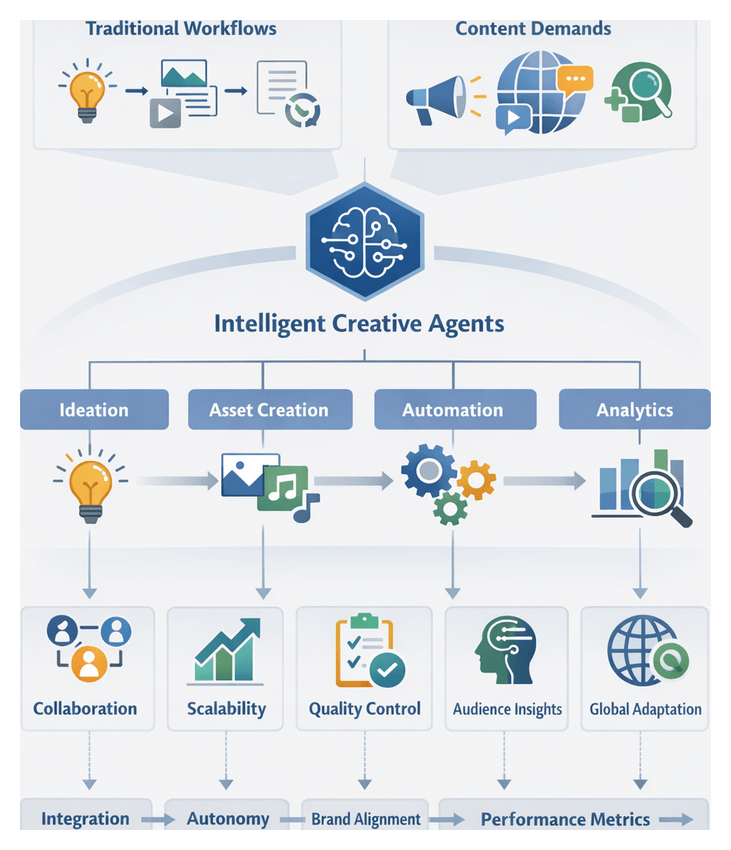
This fragmentation has given rise to a new paradigm: intelligent creative agents. Unlike single-purpose AI models, these agents combine generative capabilities with planning, decision-making, and workflow integration. They drive ideation, generate and refine assets, and collaborate with human stakeholders to meet strategic objectives. By encapsulating natural language understanding, generative networks, and performance analysis within an orchestrated framework, creative agents aim to close the gap between scattered AI tools and cohesive, scalable workflows.
Key pain points in traditional creative production include:
- Inefficient collaboration across strategy, design, copywriting, and approval teams, causing latency and misalignment with brand guidelines.
- Resource constraints from high demands for A/B testing, audience segmentation, and personalized versions.
- Quality variability under tight deadlines, leading to inconsistency in tone, style, and visual fidelity.
- Scalability limits in adapting content across global markets, languages, and channels.
- Data blind spots that hinder rapid incorporation of audience insights into new content iterations.
As digital-native brands leverage AI-assisted frameworks to conduct rapid creative sprints, automated performance optimization, and data-informed tone adjustments, a performance gap emerges between organizations using point solutions and those adopting integrated creative intelligence platforms. To compete, teams must advance beyond “AI playgrounds” of isolated model testing and embrace autonomous assistants capable of orchestrating comprehensive workflows.
Addressing this challenge involves navigating interrelated dimensions:
- Integration complexity: weaving text, image, and audio modalities into a coherent pipeline with flexibility.
- Autonomy versus control: calibrating agent initiative and human review across creative phases.
- Strategic alignment: ensuring outputs reflect brand values, messaging priorities, and compliance requirements.
- Performance metrics: defining engagement rates, production velocity, and cost-per-asset indicators for continuous learning.
- Adoption and change management: cultivating user trust, training teams, and embedding agents into existing processes.
Creative agents must integrate seamlessly with project management systems, digital asset repositories, analytics dashboards, and stakeholder feedback loops. They should support iterative experiments at scale, autonomously capture performance signals, and recommend refinements while operating within guardrails that maintain brand consistency, ethical standards, and intellectual property compliance. Platforms such as Adobe Sensei and Microsoft Copilot for Advertising demonstrate enterprise-grade agent integrations within authoring tools, asset management suites, and marketing automation flows. Open source initiatives and emerging standards further promote cross-tool interoperability, reducing vendor lock-in.
Analytical Evaluation of Engagement Mechanisms
Data-Driven Optimization Frameworks
AI agents transform campaigns into dynamic systems governed by real-time data, predictive models, and continuous feedback loops. Collaboration between marketing analytics teams and data scientists defines key performance indicators—brand awareness, conversion rate, and customer lifetime value—that guide optimization. Agents ingest diverse data sources—web analytics, social metrics, CRM records—and apply statistical modeling to reveal causal links between creative variants and outcomes.
Multi-armed bandit approaches enable adaptive allocation of impressions to top-performing variants, balancing exploration and exploitation through reinforcement learning that updates selection probabilities based on click-through rates and dwell times. Uplift modeling isolates the incremental impact of creative interventions, pairing causal inference with propensity scoring to refine audience segments and maximize personalized returns. This blend of machine learning and rigorous analytics enhances interpretability, allowing strategists to explain why specific creative elements resonate with defined cohorts.
Sentiment Analysis and Brand Tone Alignment
Beyond aggregate metrics, AI-driven sentiment analysis classifies audience reactions by polarity, emotional category, and topic relevance. Brand managers monitor real-time sentiment to detect negative spikes or thematic shifts. AI agents score generated copy against brand voice lexicons—defining tone profiles such as trust, clarity, and authority for financial services firms—by computing a tone alignment index that quantifies adherence to guidelines. Deviations trigger automated revisions or manual review.
Advanced implementations use contextual embeddings to project brand guidelines and audience responses into a shared vector space, measuring cosine similarity to capture nuanced semantic alignment. This technique uncovers latent themes—emerging customer concerns or aspirations—that guide subsequent storytelling arcs and messaging hierarchies.
Behavioral Modeling and Audience Personalization
Behavioral modeling underpins personalization at scale. AI agents build unified customer profiles from explicit attributes—demographics and purchase history—and implicit signals—browsing patterns and dwell time. Unsupervised learning techniques such as k-means clustering, hierarchical clustering, and self-organizing maps reveal micro-personas based on preference vectors. Recommendation systems, both content-based and hybrid, match creative assets to persona needs and motivations.
- Audience profiling: aggregating multi-source data into unified views.
- Segment modeling: discovering natural groupings with unsupervised algorithms.
- Content matching: aligning assets to persona profiles using recommendation engines.
Reinforcement learning agents dynamically adjust content streams, sampling user engagement history to select between image-rich and text-focused formats. Reaction ratios and sentiment uplift feed back into models for continuous refinement, ensuring responsiveness to evolving preferences in high-velocity environments.
Adaptive Content Refinement through Feedback Loops
Effective campaigns rely on multi-level feedback loops:
- Real-time engagement signals: likes, shares, comments, and sentiment tags inform micro-adjustments in scheduling and format.
- Mid-campaign performance reviews: rolling metrics reveal macro trends and enable strategic pivots such as reallocating budgets or refreshing themes.
- Post-campaign analysis: meta-analysis identifies high-leverage creative patterns and builds reusable asset libraries.
Governance models define triggers for agent interventions: thresholds for negative sentiment may require manual review, while high-confidence conversion uplifts can prompt automatic replication of successful headlines. This balance of autonomy and human oversight preserves agility without compromising brand integrity.
Interpretive and Ethical Considerations
Organizations must guard against interpretive biases and ethical risks. Sentiment classifiers may reflect cultural or linguistic biases, and behavioral models can reinforce stereotypes by over-serving majority segments. Transparency frameworks and privacy-by-design principles—employing opt-in consent flows and anonymization—protect user agency. Audit trails capture decision points in agent workflows for accountability and compliance.
Cross-functional teams of data scientists, brand strategists, legal counsel, and ethicists conduct regular mixed-method reviews—combining quantitative audits with qualitative interviews—to surface unintended outcomes, validate brand alignment, and safeguard long-term equity.
Implications for Campaign Strategy
Intelligent agents reshape campaign planning and execution by embedding continuous data analysis and predictive intelligence into high-level strategic decisions. Their value extends beyond task automation to driving narrative cohesion, audience segmentation, and real-time optimization.
- Harmonizing Brand Voice at Scale: Platforms like IBM Watson Marketing translate tone, style, and vocabulary into structured parameters that guide autonomous copy generation—email subject lines, social posts, landing-page headlines—ensuring consistency and strengthening audience recognition over time.
- Dynamic Personalization and Audience Segmentation: Solutions such as Persado leverage natural language generation to tailor messaging frameworks—urgency, social proof, or value propositions—based on predictive models, enhancing engagement and return on ad spend.
- Cross-Channel Orchestration: Platforms like Sprinklr and Hootsuite Insights integrate social listening, content scheduling, and conversational AI to synchronize messaging calendars, optimize timing, and dynamically allocate budgets across channels.
- Real-Time Responsiveness and Adaptive Strategies: Autonomous systems such as Albert monitor KPIs, competitor actions, and social trends to adjust targeting, creative variations, and budgets without human intervention, enabling rapid pivots while operating within defined guardrails.
- Data-Driven Iteration and Strategic Learning: Evaluation frameworks like the RACE model—Reach, Act, Convert, Engage—structure performance tracking across the customer journey. AI agents map metrics to these phases, revealing drop-off points and opportunity zones and informing continuous hypothesis testing.
Key Takeaways for Marketing Integration
Strategic Alignment and Governance
Clear alignment with brand and business objectives is critical. Establish governance councils with marketing, legal, IT, and data science stakeholders to define agent usage policies, data handling standards, and approval workflows. Document style and ethics guidelines—capturing tone, prohibited content, representation, bias, and transparency requirements. Implement version control and audit trails to track prompts, iterations, and final assets, and secure executive sponsorship to champion AI initiatives.
Measurement and Continuous Optimization
Beyond standard metrics—click-through rates, impressions, conversions—incorporate agent-centric KPIs such as prompt success rates, revision frequency, and time saved per asset. Use A/B and multivariate testing via platforms like Optimizely or VWO, and integrate real-time analytics from Google Analytics or Mixpanel. Establish feedback mechanisms for qualitative input from stakeholders and audiences, and maintain a centralized dashboard to consolidate metrics across channels.
Ethical and Compliance Considerations
Audit agent outputs for bias using tools such as Google’s What-If Tool and Fairlearn. Clarify intellectual property rights and attribution obligations with legal counsel. Enforce data privacy and security compliance—GDPR, CCPA—through anonymization and consent management. Disclose AI involvement when appropriate and monitor evolving regulations via industry consortia.
Scalability and Integration Challenges
Adopt API-first agent solutions for integration with CMS, CRM, and DAM platforms. Harmonize data schemas and taxonomies to ensure consistent input. Design hybrid workflows with clear handoffs between agents and human specialists. Leverage cloud platforms—such as AWS and Google Cloud AI—for auto-scaling compute and storage. Support change management through training, documentation, and pilot initiatives.
Cross-Functional Collaboration and Talent Evolution
Redefine roles by delegating data aggregation, first-pass copywriting, and design mockups to agents, freeing humans for strategy and complex problem solving. Invest in AI literacy via programs from Simplilearn or Coursera. Build interdisciplinary teams—marketing strategists, data scientists, UX designers, and compliance specialists. Encourage experimentation in sandbox environments and reward innovation that drives measurable improvements.
Future Outlook and Continuous Evolution
Emerging advances in multimodal creativity will enable richer brand experiences combining text, image, video, and audio. Deeper personalization driven by real-time behavioral and IoT signals will demand enhanced privacy safeguards. Collaborative AI networks based on open standards and federated learning will accelerate innovation. Ethical AI frameworks will mature, and adaptive governance models will evolve to balance agent autonomy with human oversight based on confidence levels and content sensitivity. Staying agile in strategy and execution will position organizations to harness the next wave of AI-driven marketing innovation.
Chapter 7: Integrating AI Agents into Creative Workflows
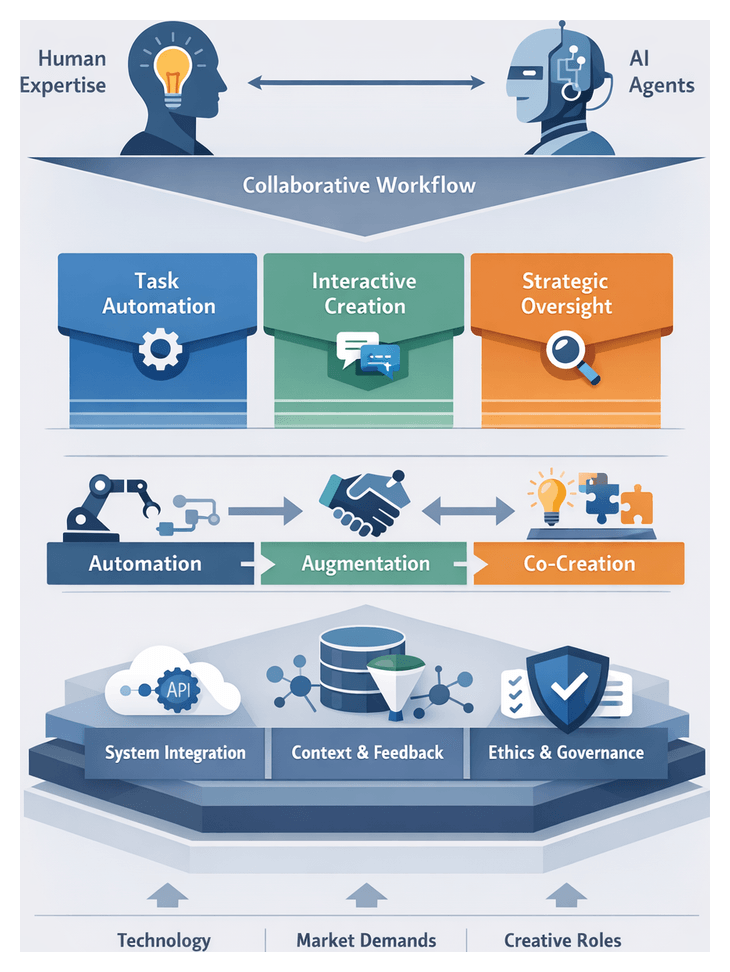
Context and Core Concepts of Human-Agent Collaboration
The creative industries are experiencing a profound transformation as autonomous AI agents augment and, in many cases, redefine traditional workflows. Unlike static generative models that await manual prompts, these intelligent systems initiate tasks, make informed suggestions, and adapt dynamically to evolving project parameters. For writers, designers, and multimedia producers, AI agents unlock opportunities to elevate output quality, accelerate iteration cycles, and explore novel forms of expression. Understanding the mechanics of human-agent collaboration is essential for organizations aiming to harness these capabilities strategically and responsibly.
Over the past five years, large language models and diffusion-based image synthesis tools have excelled at producing standalone content. Yet they require extensive prompt engineering and isolated execution. Autonomous agents, by contrast, coordinate multiple sub-models, maintain project context, and interact with users through intuitive interfaces. Whether generating social media sequences, proposing design variations, or compiling research briefs, agents operate with minimal supervision, freeing creative teams to focus on strategic decision-making.
Human-agent collaboration shifts the paradigm from passive tool usage to active partnership. Agents contribute consistency, rapid iteration, and data-driven insights, while humans provide contextual judgment, aesthetic sensibility, and strategic oversight. This symbiosis unfolds along a collaborative intelligence continuum, ranging from task-specific automation to near-peer partnership. By mapping workflows along this spectrum, teams can calibrate agent autonomy based on task complexity, risk tolerance, and creative latitude.
Several drivers fuel the adoption of AI agents in creative practice: technological maturation in multi-modal models and reinforcement learning; market pressures for faster turnaround and hyper-personalization; cultural shifts that embrace AI as co-creators; and cost efficiencies from automating routine production tasks. Effective collaboration rests on core principles: transparency in agent reasoning and data sources; control mechanisms such as adjustable creativity parameters; iterative feedback loops that refine future outputs; and robust context preservation to maintain project continuity.
Integrating agents prompts role reconfiguration within creative teams. Routine tasks—first-draft generation, style exploration, asset resizing—can be delegated to agents, while human specialists focus on narrative strategy, brand voice, and aesthetic direction. Emerging roles include agent orchestrators, prompt engineers, and oversight specialists responsible for configuring, monitoring, and auditing agent performance. Success demands upskilling, clear responsibilities, and a culture that values both technological fluency and creative expertise.
Interaction modalities span conversational interfaces—for example, Jasper AI for marketing copy or Canva Magic Write for graphic design prompts—to plugin architectures like Adobe Firefly and Figma’s AI plugin, which embed agents within familiar authoring environments. API integrations enable deep orchestration with enterprise content management systems, analytics platforms, and version control infrastructures. Underpinning these interactions, robust infrastructure—including scalable compute, secure data pipelines, audit trails, and standardized interoperability protocols—ensures responsive performance and accountability.
Governance and human-in-the-loop oversight mitigate bias, compliance risks, and creative drift. Checkpoints allow experts to review and approve agent proposals, while access controls and audit logs maintain accountability. Architecturally, collaboration relies on orchestration logic that coordinates specialized models, contextual memory systems that preserve project history, and decision-making modules that balance rule-based constraints with probabilistic reasoning. The result is faster iteration, data-driven variation, scalability across volume tasks, and a fertile environment for experimentation.
Despite its promise, human-agent collaboration presents challenges. Trust must be cultivated through consistent performance and explainability frameworks. Skill gaps in prompt engineering and governance require targeted training. Cultural resistance can impede adoption if agents are viewed as replacements rather than partners. Addressing these challenges through thoughtful change management and clear communication sets the stage for productive human-agent partnerships.
Analytical Evaluation of Collaborative Platforms
Collaborative platforms serve as the connective tissue aligning human creativity with autonomous AI agents. They are dynamic ecosystems that shape the quality, speed, and coherence of content innovation. From an analytical perspective, these platforms rest on three foundational pillars: modular connectivity to integrate language, vision, and analytics services; workflow orchestration to sequence tasks and manage dependencies; and governance and auditability to log decisions, enforce policies, and record provenance.
Practitioners employ interpretive frameworks to evaluate platforms:
- Socio-Technical Integration Model: Balances social factors—team roles and communication norms—with technical elements such as APIs and data schemas, ensuring trust in AI and accommodating informal creative workflows.
- Ecosystem Compatibility Matrix: Assesses interoperability with existing tools—Figma, GitHub Copilot, and Notion AI—by evaluating API reliability, data formats, and vendor support.
- Adoption Maturity Curve: Tracks readiness from proof-of-concept to enterprise rollout across governance maturity, skill readiness, and process integration.
Subject-matter experts further analyze integration mechanisms:
- API and Microservices Architecture: Evaluates endpoint granularity, rate limits, and error-handling for real-time versus batch processing.
- Version Control and Collaboration Layers: Examines branching, merging, and review cycles for AI-generated assets, leveraging systems like Git or Perforce and cloud storage histories.
- Co-Authoring Interfaces and Feedback Loops: Focuses on design patterns that surface AI suggestions—in sidebars or modular widgets—and capture user reactions to inform model retraining.
When selecting platforms, organizations apply evaluation criteria that encompass technical capabilities and strategic alignment:
- Scalability: Support for concurrent users and AI requests at scale.
- Customization: Tailoring workflows, UI components, and models to brand guidelines and regulatory needs.
- Security and Compliance: Robust authentication, encryption, and data governance.
- Extensibility: Openness to new AI services, plugins, and proprietary pipelines.
- Usability and Adoption Velocity: User satisfaction, training curve duration, and time-to-value metrics.
Senior leaders interpret platform integration through lenses of role redefinition, change management, investment prioritization, and ethical oversight. By aligning platform capabilities with creative strategy and governance structures, enterprises can derive sustainable value from human-agent collaboration.
Defining Use Contexts and Collaborative Models
Effective human-agent collaboration begins with identifying use contexts where strategic value is maximized. Contexts align agent capabilities with organizational goals, creative processes, and domain expertise. Core collaboration models include:
- Centralized Creative Hubs: Innovation labs embed agents across departments for high-profile campaigns under unified governance.
- Distributed Agency Networks: Modular agent assistants tailored per account, leveraging shared best practices.
- Embedded In-House Units: Agents co-author content within marketing or editorial teams, reducing external dependencies.
Clear role definitions ensure complementary contributions:
- Creative Lead: Sets vision, strategic objectives, and brand voice.
- Agent Architect: Designs agent personalities, configures prompts, and monitors performance.
- Editorial Curator: Refines agent outputs for style, accuracy, and compliance.
- Quality Assurance Specialist: Evaluates outputs against creativity and coherence benchmarks.
- Ethics and Compliance Officer: Oversees data policies, intellectual property, and bias mitigation.
Introducing AI agents requires structured change management, guided by frameworks such as ADKAR and Kotter’s Eight Steps. Key strategies include stakeholder engagement, pilot programs, role-specific training, continuous feedback loops, and reinforcement mechanisms to celebrate early wins and integrate agent success into performance metrics.
Interdisciplinary teams blend creative experts with data scientists and UX researchers. Cross-functional sprints, agile coaching, and knowledge brokers maintain prompt libraries and best practices, while data stewards ensure dataset integrity. This approach fosters symbiotic teams where agents accelerate ideation and human experts provide strategic context.
Industry-specific contexts illustrate diversity:
- Media and Publishing: Agents draft news summaries, perform fact-checking, and generate localized content.
- Advertising Agencies: Copywriting agents such as Jasper AI produce campaign taglines, social posts, and A/B variants.
- E-Commerce: Chatbots and voice assistants generate product descriptions and personalized promotions in real time.
- Gaming and Entertainment: Narrative engines create branching storylines and character dialogue, with assets from tools like Midjourney.
- Education and Training: Language models produce adaptive learning modules and multilingual assessments.
As agent usage scales, governance models ensure creative agility and risk management. Essential elements include a Center of Excellence, a multi-stakeholder governance board, codified standards and guidelines, performance dashboards, and escalation channels for ethical or technical issues.
Strategic Alignment, Infrastructure, and Governance
Integrating AI agents into creative workflows demands clear strategic alignment. Executive sponsorship articulates a vision for agent-driven innovation, while cross-functional steering committees evaluate performance, manage risks, and authorize new use cases. Formal policies address content quality, revision protocols, and escalation procedures. Dedicated budgets, staffing, and infrastructure ensure AI initiatives receive sustained support. Governance tools and dashboards provide real-time reporting on agent utilization and output quality, enabling rapid course corrections.
From an enterprise perspective, technical integration challenges include ensuring scalability to meet fluctuating demand, standardizing APIs via OpenAPI or gRPC conventions, and securing data pipelines for proprietary assets and metrics. Version control and model update strategies safeguard content continuity during migrations. Managing a vendor ecosystem involves evaluating roadmaps, support SLAs, and integration toolkits to mitigate lock-in risks.
Cultural readiness is critical. Structured training in prompt design, output evaluation, and governance builds internal capabilities. Clear human-agent role definitions manage expectations, while early adopter networks pilot features and share best practices. Transparent communication channels and incentive structures reinforce successful collaboration behaviors.
Ethical, legal, and compliance considerations underlie sustainable AI use. Organizations must clarify intellectual property rights for agent-generated content, conduct bias and fairness audits, and adhere to regulations such as GDPR or CCPA. Transparency practices—labeling agent-generated content—and adoption of frameworks like the OECD AI Principles uphold trust and integrity.
Measuring adoption success requires defining key performance indicators—time-to-first-draft, asset turnaround, brand consistency, and creative novelty—and embedding user feedback mechanisms within creative platforms. A/B testing isolates agent impact on audience engagement and cost per asset. Unified dashboards track usage patterns, error rates, and revision cycles. Regular iteration cadences ensure governance policies and integration priorities evolve alongside organizational needs.
Practitioners must also mitigate limitations and risks: creative conformity from formulaic training data, overreliance that erodes human skills, technical debt from rapid integrations, data drift requiring continuous model retraining, and security vulnerabilities in exposed APIs. By anticipating these challenges, organizations set realistic expectations, safeguard human creativity, and maintain robust, adaptable systems.
Embedding AI agents in creative ecosystems unlocks transformative potential, marrying human intuition with agent precision. With strategic alignment, robust infrastructure, disciplined governance, and a culture of continuous learning, organizations can harness AI agents as sustainable creative partners while preserving quality, compliance, and brand integrity.
Chapter 8: Automation and Platform Integration at Scale
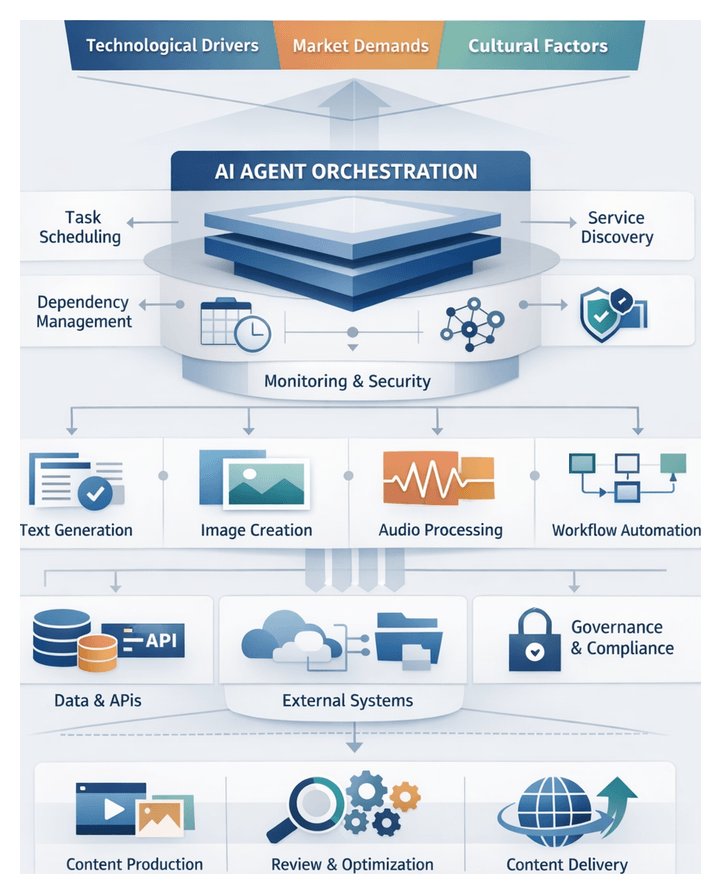
Defining Scalable Agent Orchestration
Scalable agent orchestration coordinates multiple AI-driven services into coherent end-to-end creative pipelines. By abstracting individual capabilities—such as natural language generation, image synthesis, and audio processing—into interoperable modules, orchestration platforms schedule tasks, discover services, manage dependencies, and monitor execution. This approach transforms fragmented point solutions into unified creative engines that handle ideation, content generation, review, and distribution with minimal human intervention.
An orchestration engine performs four core functions:
- Task scheduling and dispatch across compute resources
- Service registry and discovery of agent endpoints
- Dependency and workflow management with conditional branching
- Execution monitoring, retries, and resilience strategies
Architectural principles include modularity, elasticity, and fault tolerance. Each agent presents a clear contract—input schema, output schema, performance profile, and cost metrics—enabling plug-and-play replacement and A/B testing. Elasticity leverages container orchestration and serverless compute to scale agent instances in response to demand spikes, while retry policies and fallback strategies ensure that individual failures do not cascade into system-wide downtime. Declarative workflow definitions, often expressed in JSON or YAML, support version control, templating, and reuse across projects.
Integration with external systems—digital asset management, content management platforms, analytics engines, and stakeholder review portals—relies on connectors or APIs that ingest briefs, fetch reference assets, commit outputs, and publish deliverables. Governance and security are embedded throughout the orchestration layer, enforcing access control, consent management, encryption at rest and in transit, audit trails, and compliance with regulations such as GDPR and CCPA. By embedding these controls, enterprises maintain traceability and protect sensitive data across distributed agent services.
Cross-Tool Interoperability
Interoperability transcends basic connectivity to encompass semantic alignment, protocol compatibility, operational orchestration, and governance enforcement. Analysts categorize interoperability along three axes:
- Data-level: schema harmonization, metadata enrichment, lineage tracking
- Service-level: API contracts, interface consistency, contract testing
- Process-level: orchestration logic that sequences tasks across services
Industry frameworks guide maturity assessments. The ITIL Service Integration Model emphasizes governance and service catalog consistency. The Open Group’s ArchiMate Framework maps application, data, and technology layers. The IEEE P2801 standard prescribes metrics for semantic interoperability. Vendor-neutral maturity models, such as those by Gartner, range from siloed integrations to fully orchestrated service meshes.
Data pipelines form the backbone of AI ecosystems. Enterprises balance real-time streaming for live personalization against scheduled batch processing. Automated schema validation, versioned metadata registries, and continuous monitoring prevent pipeline failures and data silos. Integration tools like Apache Airflow and MuleSoft orchestrate workflows, while platforms such as n8n and Zapier enable low-code connectors for citizen integrators.
API ecosystems rely on standardization—OpenAPI specifications, GraphQL schemas, and gRPC definitions—to reduce integration overhead. Service discovery via API gateways such as Kong and Apigee enables dynamic load balancing and security enforcement. Contract testing tools like Postman and Pact detect breaking changes before deployment. Semantic metadata layers, event hubs such as Kafka, and schema registries ensure that producer and consumer services maintain compatible data definitions.
Workflow coordination uses modular engines—Airflow, Prefect—and service meshes like Istio to define directed acyclic graphs (DAGs), manage traffic, and enforce policies across containerized services. Event-driven orchestration leverages cloud-native functions and event routers to trigger downstream tasks automatically. Adapting to new agent capabilities requires a declarative approach to workflow definitions and standardized connectors, minimizing large-scale rewrites.
Security, compliance, and governance are integral to interoperability. Authentication and authorization frameworks—OAuth2, JWT tokens, mutual TLS—secure agent communications. Data masking, encryption, and audit trails support regulatory compliance. Policy engines such as Open Policy Agent embed governance rules across heterogeneous toolchains, ensuring consistent enforcement of ethical and legal standards.
Technological, Market, and Cultural Drivers
Three intersecting forces propel the adoption of AI agents in creative operations:
- Technological Drivers: Advances in large language models like GPT-4, diffusion-based image synthesis, multimodal frameworks, and standardized APIs (LangChain, OpenAI function calling) enable seamless integration of semantic search, knowledge retrieval, and decision logic. Cloud-native infrastructure and container orchestration deliver elastic compute, while hardware optimizations such as quantization and pruning support real-time inference on enterprise clusters and edge devices.
- Market Drivers: Demand for personalized content at scale, cost pressures in advertising, publishing, and gaming, and expansion of generative asset marketplaces—including integration platforms like Anthropic Claude—accelerate AI adoption. Subscription and usage-based pricing models align costs with unpredictable creative demand.
- Cultural Drivers: Democratization of AI grants individual creators access to research-grade capabilities, fostering participatory co-creation. Ethical awareness—authorship, bias, intellectual property—fuels demand for transparent agent behavior and bias mitigation. The concept of “augmented authorship” positions agents as collaborators that amplify human creativity.
When these drivers converge, organizations must assess AI initiatives through technology readiness, creative value chain mapping, and risk-benefit analyses. Such frameworks ensure alignment with brand identity, governance protocols, and audience trust.
Applications and Expert Frameworks
AI agents find relevance across diverse creative contexts:
- Strategic Content Planning: Agents analyze audience analytics, competitive portfolios, and trend signals to propose thematic calendars and creative briefs.
- Real-Time Adaptive Campaigns: Monitoring user interactions and sentiment, agents dynamically modify copy variants, imagery, or soundscapes for live engagement.
- Multilingual Localization: Semantic translation, cultural adaptation, and region-specific imagery selection scale global campaigns while preserving brand voice.
- Cross-Functional Integration: Agents interface with CRM, analytics, and digital asset management systems to automate handoffs between strategy, design, and distribution.
Strategic evaluation employs four expert frameworks:
- Value Chain Analysis: Identifies stages—ideation, production, review, distribution—where agents offer maximum efficiency or innovation.
- Organizational Readiness Assessment: Evaluates infrastructure, governance policies, and skill sets to pinpoint prerequisites for successful deployment.
- Ecosystem Mapping: Surveys internal and external services, integration touchpoints, and partner capabilities to design interoperable workflows.
- Risk-Benefit Analysis: Balances efficiency gains against ethical, legal, and reputational risks to inform governance and oversight.
For creative professionals, new competencies are essential: stewarding agent prompts and outputs, overseeing ethical considerations, integrating agent workflows with traditional tools, and applying strategic design thinking to agent-generated prototypes. Embracing hybrid workflows enables teams to harness scale while preserving human insight and cultural nuance.
Governance, Security, and Compliance
Effective data governance and compliance frameworks define ownership, stewardship responsibilities, metadata management, and lineage tracking. Embedding privacy-by-design principles enforces consent and usage policies across agent services. Cross-functional data governance councils oversee policy updates, dynamic classification, and the balance between innovation velocity and compliance rigor.
Security architectures apply zero-trust principles, defense-in-depth strategies, and hardware-based key management. Encryption at rest and in transit, regular penetration testing, vulnerability scanning, and supply-chain reviews safeguard API endpoints and model artifacts. Privacy-preserving techniques—differential privacy, synthetic data, federated learning—mitigate exposure of sensitive information, with a risk-based approach prioritizing high-impact data flows.
Ethical oversight relies on governance frameworks—IEEE P7000 series, EU AI Act—and ethics committees that review high-risk use cases, detect biased outputs, and ensure alignment with organizational values. Auditable processes, human-in-the-loop checkpoints, and bias detection tools reconcile the tension between rapid iteration and thorough ethical review.
Operational Resilience and Scalability
Operational resilience draws on Site Reliability Engineering practices—service-level objectives, error budgets, canary deployments, automated rollbacks, and chaos engineering—to validate fault tolerance and rapid recovery. Disaster recovery planning addresses dependencies on external APIs, managed services, and model repositories to prevent single points of failure.
Performance optimization balances latency, throughput, and resource efficiency. Elastic compute, microservices patterns, caching, model sharding, and asynchronous scheduling alleviate bottlenecks. Analytical frameworks such as the CAP theorem and queuing theory inform trade-offs among consistency, availability, and partition tolerance. Continuous benchmarking and capacity forecasting anticipate demand peaks and safeguard user experience.
Organizational Alignment and Vendor Management
Successful orchestration demands alignment of people, processes, and technology. Multidisciplinary AI governance committees, clear escalation paths, and defined roles for data scientists, engineers, legal, and marketing stakeholders foster accountability. Change management—stakeholder mapping, communication plans, targeted pilot programs, and AI champions—mitigates resistance and accelerates adoption.
Vendor management strategies employ due diligence on solution maturity, compliance certifications, and support SLAs. Vendor scorecards and total cost of ownership assessments compare offerings on feature completeness, roadmap alignment, and ecosystem compatibility. Interoperability standards—ONNX, emerging agent communication protocols—and modular contracts minimize vendor lock-in while preserving flexibility.
Future Trends and Key Considerations
Emerging trends include AI-driven integration assistants that generate and validate connectors, semantic metadata layers powered by knowledge graphs, federated learning across agents for privacy-preserving personalization, and industry consortia defining ethical interoperability standards. Organizations that embrace these developments will transform isolated agents into cohesive, intelligent content platforms.
Key limitations persist: rapidly evolving technologies can outpace governance, skill shortages in AI oversight, and the complexity of multi-agent ecosystems may surface hidden dependencies. Continuous observability, simulation of edge cases, and investment in tooling are essential to surface anomalies before they impact creative deliverables. Balancing automation efficiency with human creativity ensures that strategic judgment and artistic vision remain central even as agents grow more capable.
Chapter 9: Measuring Performance and Impact
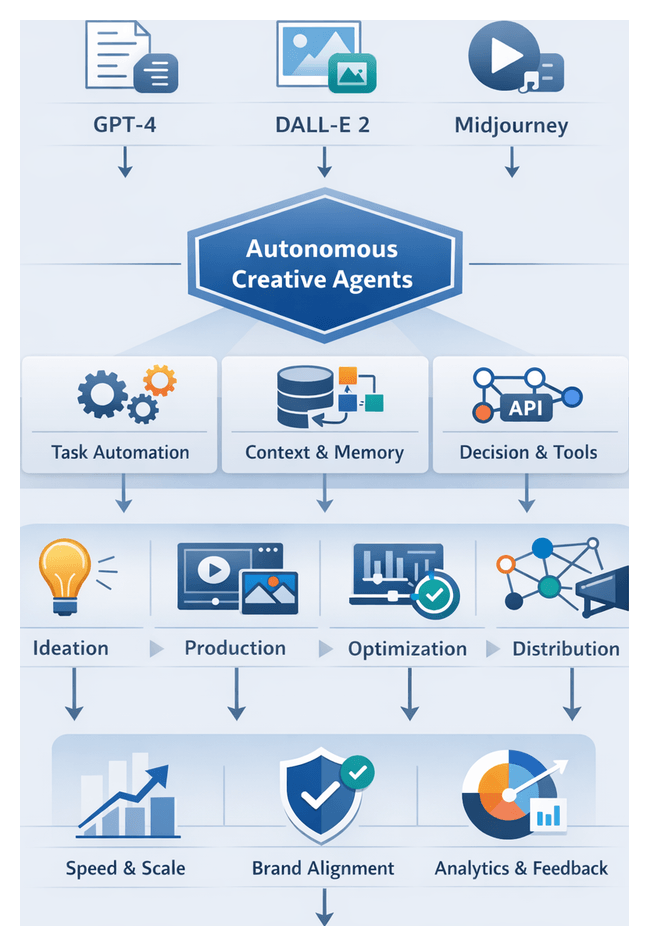
The Rise of Autonomous Creative Assistants
The creative industries have undergone a dramatic transformation as digital platforms and artificial intelligence reshaped ideation, production and delivery. Early generative models such as GPT-4, DALL·E 2 and Midjourney provided proof of concept for automated text, image and multimedia generation. While powerful, these standalone tools often introduced friction: manual data transfers, limited context windows, prompt engineering overhead and repeated fine-tuning to maintain brand alignment. As demand for personalized, on-brand content accelerated, creative teams faced pressures to innovate faster, scale outputs and preserve strategic coherence across channels. It is in this environment that autonomous creative assistants—AI agents—emerged as orchestrators of end-to-end workflows.
AI agents extend generative models by encapsulating logic for task sequencing, context retention and decision support. They can draft outlines, solicit feedback, select optimal assets and adapt outputs based on real-time performance data. Through function calling and tool use within large language models, agents interface with external databases, APIs and creative libraries. Modular frameworks like LangChain enable chaining of prompts, management of dialogue state and incorporation of custom business logic. Advances in multi-modal embeddings allow agents to reason across text, image and audio domains, enabling workflows that span research, ideation, production and post-distribution optimization.
Market forces in advertising, media, entertainment and e-commerce demand high volumes of personalized content delivered with speed and consistency. Fragmented toolchains and manual orchestration become productivity bottlenecks, whereas agent-based systems promise scalable, repeatable processes that adapt to evolving priorities. Culturally, democratized creative tools have empowered user-generated content, influencer campaigns and interactive experiences, increasing the need for guardians of style guidelines, semantic consistency and compliance. AI agents can enforce brand rules, log rationales for auditability and intervene when outputs deviate from established parameters.
Despite their promise, AI agents face challenges in integration complexity, governance, transparency and ethical stewardship. Teams without engineering support may struggle to deploy agents; rigorous frameworks are needed to prevent hallucinations, bias or brand misalignment. User adoption hinges on intuitive interfaces, clear human-machine roles and robust data privacy measures. Addressing these barriers is critical to unlocking the value of autonomous creative assistants, which can revolutionize research, automate repetitive tasks and drive continuous refinement through performance monitoring and iterative feedback loops.
Analytical Frameworks for Evaluating AI Agents
Assessing AI agents in creative workflows demands structured frameworks that balance quantitative rigor with qualitative insight. Unlike conventional software tests, creative evaluation requires interpretive methods aligned with strategic objectives. The following frameworks are widely adopted by agencies, in-house studios and enterprise marketing teams to benchmark performance, manage risk and drive continuous improvement.
Performance Benchmarking and Comparative Analysis
Organizations establish quantitative baselines—drawn from human-only workflows or historical data—and measure agent-augmented processes against these standards. Controlled A/B experiments compare teams using AI agents with those following traditional methods. Key metrics include turnaround time, revision counts and defect rates. Benchmarking against industry peers through third-party studies contextualizes efficiency gains and highlights areas where agents eliminate manual bottlenecks.
Multi-Dimensional Evaluation Models
Adapted from strategic management tools like the Balanced Scorecard, multi-dimensional models assess agents across four perspectives:
- Quality: coherence, originality and brand adherence via expert reviews and semantic scoring.
- Efficiency: time savings, throughput increases and resource utilization improvements.
- Engagement: audience response measured by click-through rates, dwell time, social shares and satisfaction surveys.
- Strategic Impact: alignment with business goals such as revenue uplift, lead generation or brand awareness.
Weighted scores for each dimension yield composite indices that guide investment in agent capabilities and development priorities.
Qualitative and Quantitative Metrics Integration
To capture nuanced aspects of creative quality, firms combine quantitative data—generation speed, performance metrics and A/B results—with qualitative assessments from expert panels, focus groups and narrative audits. Semantic similarity algorithms and sentiment analysis provide proxies for originality and tone, while rubrics evaluate conceptual depth and emotional resonance. Integrating these viewpoints ensures efficiency gains do not compromise strategic messaging or artistic standards.
Process Maturity and Capability Models
Borrowing from CMMI and industry maturity frameworks, capability models define staged paths for agent adoption:
- Level 1: ad-hoc pilots and unstructured usage.
- Level 2: defined processes, documented guidelines and basic governance.
- Level 3: standardized evaluation, cross-team collaboration and performance tracking.
- Levels 4–5: predictive analytics, automated monitoring and continuous optimization.
Scoring against criteria such as governance, data management and integration depth helps executives benchmark readiness and allocate resources to advance maturity.
Value Realization and ROI Analysis
Beyond cost savings, ROI frameworks map agent contributions to direct and indirect business outcomes. Total cost of ownership and discounted cash flow models capture upfront investments and operational expenses. Multi-touch attribution in marketing and contribution margin analyses in product launches link creative outputs to revenue, lead generation and brand equity. Longitudinal studies and mixed-methods evaluation isolate agent impact amid external variables.
Risk and Impact Assessment
Risk frameworks draw on enterprise risk management and ethical compliance standards to evaluate brand exposure, bias amplification, compliance violations and unintended outputs. Heat maps prioritize scenarios by severity and likelihood, while scenario analysis tests agent behavior under edge cases. Bias detection metrics—such as demographic parity and adverse impact ratios—ensure ongoing vigilance. Embedding risk assessments in evaluation frameworks balances innovation with safeguards.
Feedback Loop and Continuous Improvement
Continuous learning models, inspired by Plan-Do-Check-Act and OODA loops, position evaluation as an iterative cycle. Performance data, A/B tests and user feedback feed into retraining pipelines and parameter tuning. Governance teams establish review cadences—weekly dashboards, monthly deep dives and quarterly strategy sessions—to refine criteria, update benchmarks and recalibrate agent autonomy.
Organizational and Stakeholder Alignment
Evaluation frameworks must encompass organizational dynamics and stakeholder expectations. RACI matrices, stakeholder mapping and benefits realization plans define roles, reporting structures and decision authority. Cross-functional environments link marketing, design, data science and legal teams, with dashboards tailored to executive sponsors, creative leads and technical operators. Transparent communication of performance drives buy-in and accelerates adoption.
Selecting the Right Framework
No single framework suits every context. Choice depends on organizational maturity, scale of creative operations, risk tolerance and strategic priorities. Small teams may begin with lightweight benchmarks and qualitative reviews, while enterprises invest in full-scale Balanced Scorecard or hybrid maturity and ROI models. A phased rollout—validating assumptions in pilot evaluations before expanding scope—minimizes overhead and builds credibility.
Impact Assessment in Practice
Effective measurement of AI agents requires adapting frameworks to specific operational contexts. Below are primary domains where practitioners configure metrics and methodologies to capture true value across creative lifecycle stages.
Marketing and Brand Management
- Attribution Modeling: time-series and cohort analyses link agent-generated assets to customer journeys.
- Sentiment Monitoring: Hootsuite Insights and NLP scores gauge shifts in brand perception.
- Dynamic Creative Optimization: Google Ads Dynamic Creative Optimizer automates variant testing of headlines, visuals and calls to action.
Impact is expressed in return on marketing investment (ROMI), customer lifetime value and real-time engagement metrics. Calibration of agent autonomy balances authenticity with efficiency.
Editorial and Publishing
- Content Consumption: organic search rankings, bounce rates and scroll depth measured via platforms like IBM Watson.
- Quality Yield Rate: percentage of drafts requiring minimal human revision.
- SEO Analysis: keyword rankings, impressions and click-throughs from CMS-integrated A/B tests.
Cross-functional review panels evaluate outputs against brand voice guidelines, ethical standards and audience expectations. Localization metrics track translation accuracy, time to publication and regional engagement.
Product Design and User Experience
- Time-to-Prototype: reduction in hours to generate wireframes and interactive mock-ups.
- Usability Testing: Net Promoter Score and SUS ratings for agent-assisted prototypes.
- Brand Consistency: compliance with style guides measured by automated checkers.
Design teams integrate Adobe Sensei with Figma or Sketch and audit accessibility compliance using tools like Axe and WAVE.
Training and Learning Development
- Proficiency Gains: pre- and post-module assessment scores driven by adaptive quizzes.
- Engagement and Completion: session duration, revisit frequency and module completion rates.
- Feedback Surveys: learner satisfaction and perceived clarity of instructional materials.
Agents integrate with LMS standards (xAPI, SCORM) and platforms such as Google Cloud AI for Education to enable continuous refinement of learning pathways and competency mapping.
Enterprise Content Operations and Governance
- Operational Throughput: volume of assets generated, reviewed and published per period.
- Compliance and Auditability: regulatory adherence (GDPR, HIPAA) monitored via platforms like Sprinklr.
- Interoperability: API success rates and data latency across integrated systems.
CIOs and CDOs apply the NIST AI Risk Management Framework to align agent performance with enterprise objectives and resilience targets.
Industry-Specific Variations and Ethical Overlays
- Retail: conversion rate lift, basket size growth and recommendation efficacy in e-commerce A/B tests.
- Finance: error rates in compliance disclosures, client response times and sentiment of chatbot interactions.
- Healthcare: clinical accuracy, patient comprehension and audit pass rates against HIPAA and FDA guidelines.
- Entertainment: engagement metrics, production cost reductions and correlation with box office or viewership.
- Bias Audits: IBM AI Fairness 360 evaluates disparate impact in creative outputs.
Transparency and explainability scores inform compliance with emerging regulations and ethical standards, while intellectual property audits monitor clearance rates and potential infringement.
Key Considerations and Strategic Recommendations
Measuring AI agent performance and impact requires a structured, transparent and iterative approach. The following considerations and practices will guide organizations toward meaningful insights and continuous improvement.
- Strategic Alignment: Ensure metrics directly map to business objectives, balancing brand consistency with cost optimization.
- Metric Balance and Weighting: Combine quantitative indicators (latency reduction, throughput) with qualitative expert ratings (creativity scores, brand adherence).
- Benchmark Selection: Use realistic baselines—human performance, past model versions or industry standards—to contextualize results.
- Contextual Validity: Mimic real production conditions through field trials and pilot deployments to expose practical constraints.
- Data Integrity and Governance: Implement version control, traceability and compliance protocols aligned with ISO and regulatory frameworks.
- Feedback Loop Integration: Embed continuous monitoring and retraining pipelines using tools like Prometheus and real-time dashboards.
- User Experience Metrics: Track adoption rates, user satisfaction and time saved per task to ensure agent workflows deliver human-centered value.
- Ethical and Compliance Safeguards: Regularly audit for bias, maintain transparency and adhere to regional data regulations.
- Scalability: Design data pipelines and monitoring architectures—leveraging services like Google Vertex AI—to handle high volumes of event tracking.
- Interpretability: Provide clear definitions and drill-down dashboards to foster stakeholder trust and informed decision-making.
- Cross-Functional Workshops: Align stakeholders from marketing, design, data science and legal to define success criteria collaboratively.
- Pilot and Iterate: Validate assumptions through small-scale pilots, refining metrics and agent behaviors in rapid cycles.
- Toolchain Integration: Automate data collection and monitoring by embedding analytics tools into deployment pipelines.
- Governance Cadence: Schedule regular reviews with leadership to recalibrate metrics, update benchmarks and approve policy adjustments.
- Knowledge Sharing: Document methodologies, benchmarks and lessons learned in a centralized repository to foster continuous learning.
- Future-Proofing: Monitor AI evaluation research and regulatory developments, preparing to integrate novel metrics such as creativity novelty scores and enhanced explainability indices.
By adopting these best practices and guardrails, organizations can navigate the complexities of measuring autonomous creative assistants, unlock operational efficiencies, elevate creative quality and achieve strategic growth through responsible AI innovation.
Chapter 10: Ethical, Legal, and Future Trends
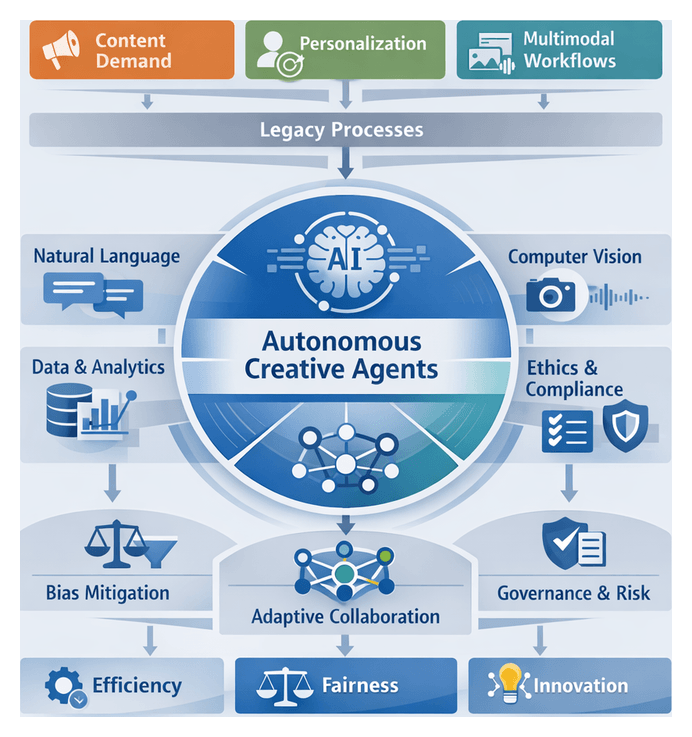
Emerging Creative Landscape and Challenges
The convergence of digital technologies, rising consumer expectations, and demands for personalized, high-quality content is driving unprecedented transformation across advertising, publishing, multimedia production, and independent creative sectors. Traditional pipelines—characterized by manual processes and siloed tools—strain under rapid iteration cycles, omnichannel distribution and agile collaboration among dispersed teams. Creative professionals today must not only generate compelling ideas but also execute complex, multimodal workflows efficiently and consistently.
Standalone AI models for tasks such as natural language generation, image recognition and voice synthesis have shown promise in isolation, yet integrating these point solutions into seamless, enterprise-scale processes remains a challenge. The core difficulty lies in orchestrating multiple AI services, data sources and human inputs into contextually aware, goal-oriented workflows that support end-to-end creativity rather than discrete functions.
Autonomous creative assistants—intelligent agents capable of decomposing complex objectives into interdependent actions, monitoring progress, soliciting feedback and optimizing outputs in real time—represent the next paradigm. By unifying capabilities across natural language processing, computer vision, generative networks and data analysis, these agents extend beyond simple automation scripts to become adaptive collaborators in content production.
Key pressures driving this shift include:
- Volume and Velocity of Content: Demand for tailored messages across social, web, email, video, augmented reality and interactive experiences has exploded.
- Personalization at Scale: Consumers expect content tailored to their interests, behaviors and contexts, requiring dynamic adaptation of assets and messaging variants.
- Complex Multimodal Workflows: Coordinating text, imagery, audio and video through disparate tools and formats introduces inefficiencies and version-control risks.
- Resource Constraints and Cost Pressure: Finite budgets demand higher-quality outputs without ballooning headcounts, while repetitive tasks consume valuable creative hours.
- Speed to Market: Rapid product cycles and agile marketing necessitate swift iteration on concepts, responding to real-time market signals and trends.
- Collaborative Complexity: Aligning global teams, external agencies and specialists on brand guidelines, compliance and strategy is a significant coordination challenge.
Organizations that successfully implement autonomous creative assistants can accelerate idea-to-execution timelines, enforce brand consistency programmatically, optimize resource allocation, integrate data-driven insights into creative decisions and foster large-scale experimentation. However, integration complexity, data governance, ethical considerations and skill gaps pose obstacles that require cross-functional alignment on problem definitions, data standards and governance frameworks.
Analytical Frameworks for Bias and Compliance
Bias and regulatory compliance are central to the legitimacy and strategic viability of autonomous creative agents. Algorithmic bias can manifest as representational, historical, evaluation or operational distortions, while regulatory landscapes encompass data protection, intellectual property and emerging AI-specific legislation.
Dimensions of Algorithmic Bias
- Representational Bias—Over- or under-representation of groups or aesthetic traditions, favoring dominant narratives.
- Historical Bias—Legacy stereotypes encoded in training data affecting generative outputs.
- Evaluation Bias—Subjective quality metrics and annotator preferences skewing optimization toward narrow norms.
- Operational Bias—Uneven agent performance across languages, genres or regions.
Fairness Assessment Models
- Distributive Justice Frameworks—Evaluate equitable allocation of training data and generative capacity across demographic or interest groups.
- Fairness Metrics Taxonomy—Statistical definitions such as demographic parity, equalized odds and predictive parity for detecting disparate impact.
- Intersectionality Lens—Examines overlapping social categories (gender, ethnicity, socio-economic status) to reveal compound biases.
- Stakeholder Value Alignment—Emphasizes participatory design and continuous feedback loops, as promoted by IEEE Global Initiative.
Regulatory Compliance Perspectives
- Rights-Based Compliance—Grounded in GDPR and CCPA, prioritizes user consent, data minimization and transparency for personal-data processing.
- Risk-Based Compliance—Outlined in proposals like the EU AI Act, prescribes obligations based on risk tiers for high-impact applications (e.g., deepfake generation).
A hybrid approach maps rights-based requirements onto risk-based categories to derive control objectives, guiding vendor selection, data handling procedures and contractual safeguards. For privacy and bias audits, organizations leverage tools such as IBM AI Fairness 360 and Microsoft Fairlearn to apply standardized metrics and document workflows.
Intellectual Property Considerations
- Originality School—Argues that human authorship is required for copyright, prompting documentation of human-in-the-loop contributions.
- Tool Analogy School—Treats AI agents as advanced creative tools, allowing outputs to qualify as works for hire under existing statutes.
Industry consortia like the International Association for the Protection of Intellectual Property advise on licensing strategies and standard clauses for data usage, attribution and derivative rights, reducing infringement risk.
Interplay of Bias Mitigation and Compliance
Transparency mandates under privacy laws facilitate bias audits, while non-discrimination requirements echo fairness goals. Google’s People AI Research (PAIR) principles exemplify human-centered design integrated with compliance checklists. Organizations unify bias governance and compliance within ethical AI programs, overseen by corporate AI ethics boards and multi-disciplinary risk committees.
Responsible Innovation and Governance
Responsible innovation embeds ethical reflection, stakeholder engagement and governance structures into every phase of agent design, deployment and evolution. It reframes progress as a balance between capability and societal values, requiring enterprise-wide risk assessments of brand reputation, legal exposure and consumer trust.
Key governance mechanisms include:
- Ethics-by-Design and Value-Sensitive Design—Integrate fairness metrics, logging for explainability and feedback loops during model training, prompt engineering and output validation.
- AI Ethics Committees and Advisory Councils—Cross-functional bodies review agent capabilities, data sources and deployment scenarios.
- External Partnerships—Collaborate with regulators, standards bodies and cultural consultants to align with evolving mandates.
Contracts for AI deliverables must specify IP ownership, data privacy obligations and liability for generated outputs. Transparent disclosures to consumers regarding AI involvement in content production foster informed consent and trust.
Risk Management Strategies
Effective risk management combines:
- Prospective Methods—Horizon scanning for emerging ethical, legal or reputational concerns (e.g., deepfake misuse, unauthorized asset replication).
- Retrospective Methods—Continuous monitoring of agent outputs and user feedback to detect deviations from acceptable norms.
Platforms such as IBM Watson OpenScale provide AI governance capabilities, including drift detection, fairness dashboards and model explainability. Coupling automated tools with human reviews enables dynamic calibration of risk controls.
Technical and Operational Strategies
Bias Mitigation Techniques
Practitioners apply a three-stage framework:
- Pre-Processing—Dataset curation to identify demographic, cultural or stylistic imbalances using quantitative metrics and expert review.
- In-Training—Adjusting loss functions, incorporating fairness-aware regularization or adversarial debiasing algorithms.
- Post-Processing—Output filters, constraint enforcement or human-in-the-loop validation to uphold ethical and stylistic standards.
Governance and Auditing
Comprehensive governance integrates policy, technical safeguards and audit trails. Cross-functional committees conduct periodic reviews to ensure compliance with marketing regulations, advertising guidelines and IP laws. Benchmarking against ISO/IEC 42001 and participation in initiatives like the Coalition for Content Provenance and Authenticity (C2PA) strengthen provenance metadata and chain-of-custody controls.
Strategic and Organizational Considerations
Embedding AI agents into creative pipelines requires balancing innovation velocity with oversight. Organizations allocate budgets for risk assessment and ethics training, adopt layered governance architectures and define KPIs for both performance and ethical outcomes. Small and mid-sized enterprises leverage shared toolkits and open-source frameworks from industry consortia to reduce governance burden.
Transparent communication with clients, partners and end users—publishing AI ethics policies, bias audit summaries and content-generation guidelines—builds trust and differentiates brands in a competitive landscape.
Future Trends and Emergent Challenges
The creative AI ecosystem is evolving toward:
- Domain-Specific Knowledge Integration—Combining generative agents with knowledge graphs or digital twins for context-aware content grounded in real-world data, raising questions of data sovereignty and ethical sourcing.
- Collaborative Agent Ecosystems—Networks of specialized agents orchestrating complex workflows with embedded governance controls to maintain traceability across distributed decision-making.
- Granular Regulatory Mandates—Sector-specific directives and periodic certification of creative AI pipelines, mirroring safety certifications in other industries.
Challenges include managing emergent behaviors, scaling real-time monitoring beyond human review capacity and reconciling privacy and IP tensions when synthesizing licensed material. Adaptive governance—blending automated compliance tooling with strategic human oversight and continuous learning loops informed by user feedback, performance metrics and ethical audits—will be critical. Cross-industry collaboration on best practices and shared standards can harmonize approaches across jurisdictions and drive responsible, innovative creativity at scale.
Conclusion
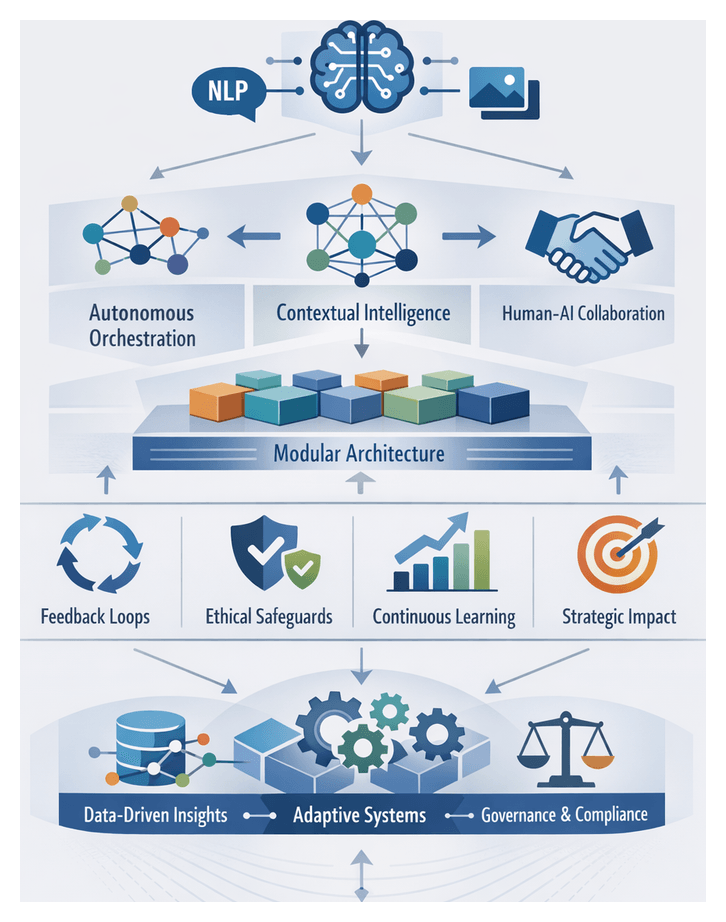
Core Principles of Creative AI Agents
The evolution of creative workflows has been driven by intelligent agents that integrate natural language processing, computer vision, generative networks, semantic embeddings, and orchestration frameworks into cohesive systems. Unlike standalone models such as GPT-4 or DALL·E, these agents coordinate multiple capabilities to manage ideation pipelines, refine outputs through feedback loops, and adapt behavior autonomously. Their transformative value rests on several foundational principles:
- Autonomous Orchestration: Agents sequence tasks, invoke specialized models, monitor intermediate results, and trigger conditional branches with minimal manual intervention, enabling closed-loop marketing campaigns or iterative design sprints.
- Modular Adaptability: A microservices architecture allows seamless integration of new AI components, third-party data sources, and custom business logic, supporting rapid experimentation without extensive reengineering.
- Contextual Intelligence: By maintaining structured memory—knowledge graphs, semantic vectors, ontologies—agents generate outputs aligned with project objectives, brand guidelines, and audience personas.
- Human-Agent Collaboration: Co-authoring interfaces, real-time feedback mechanisms, and version control balance the efficiency of automation with human creativity, strategic oversight, and ethical governance.
- Continuous Learning: Feedback loops powered by performance analytics, A/B testing, and reinforcement signals enable iterative improvements in relevance, quality, and impact over time.
- Ethical and Legal Compliance: Embedded governance frameworks, bias mitigation protocols, content filters, and audit trails ensure outputs respect intellectual property laws, data privacy regulations, and cultural norms.
- Strategic Impact: By accelerating innovation cycles, enabling personalization at scale, and optimizing resource allocation, agents deliver competitive differentiation and sustained value.
Cross-Cutting Patterns and Insights
Across writing, design, multimedia, marketing, and enterprise applications, certain patterns emerge that guide effective interpretation and deployment of creative AI agents.
Data-Human Creative Convergence
Leading organizations view agents as analytical collaborators rather than replacements. Tools like Jasper surface audience trends for personalized messaging, ChatGPT generates narrative variants in workshops, and Runway iterates visual concepts alongside designers. This fusion amplifies human creativity with data-driven insights, enabling agile ideation rooted in strategic objectives.
Modular Orchestration Architectures
API-centric frameworks encourage treating agents as composable services—text generation, image synthesis, audio processing. Integrations of DALL·E with proprietary style-transfer modules exemplify lightweight workflows that preserve brand consistency while exploring novel aesthetics. Modularity reduces vendor lock-in and accelerates experimentation.
Feedback Loops and Continuous Learning
Closed-loop systems feed engagement metrics, time-to-market data, and quality scores back into model fine-tuning. Real-time A/B testing of headlines or thumbnails informs subsequent training cycles, ensuring that agent outputs and human oversight criteria evolve with audience preferences.
Ethical Guardrails as Core Design
Bias mitigation, rights management, and transparency are treated as architectural requirements. Agents embed automated checks for infringement or offensive content, guided by frameworks such as the IEEE Ethically Aligned Design. These guardrails preserve brand integrity and compliance in regulated markets.
Cross-Domain Adaptability
Transfer learning enables agents trained for editorial workflows to adapt to marketing automation, while visual style extractors migrate from graphic design to UI theming. Such versatility reduces the need for bespoke solutions and encourages consolidation around versatile engines.
Real-Time, Democratized Creativity
Intuitive interfaces empower non-technical users—social media managers, educators—to generate quality content on demand. Live collaboration features in virtual whiteboards enable teams to co-ideate with agents, accelerating time-to-market and expanding the creator pool.
Metrics Driving Evolution
Robust analytics infrastructure is pivotal. Dashboards combining engagement lift, sentiment shifts, and brand equity metrics guide investment decisions in agent modules. Evidence-driven scaling depends as much on data pipelines as on generative models.
Emergent Ecosystem Platforms
Unified marketplaces aggregate agents, data services, and connectors with standardized interfaces for discovery, governance, and evaluation. Open-source initiatives and vendor-neutral consortiums foster interoperability and innovation while mitigating dependency risks.
Strategic Governance Alignment
Cross-functional steering committees—marketing, IT, legal, compliance—ensure that pilot projects evolve into enterprise-grade programs. Federated governance balances standardization with team-level customization, embedding agents into strategic roadmaps rather than isolated experiments.
Business Model Innovations and Strategic Impact
AI-driven creativity is reshaping value chains. Agencies shift from project-based engagements to subscription or platform-based offerings, licensing proprietary agent workflows for continuous content generation. Usage-based pricing and revenue-sharing arrangements deepen client relationships through real-time co-creation.
Marketplaces for agent-generated assets enable microtransactions for illustrations, music tracks, and narrative modules, signaling a move toward decentralized creative economies. Participants both source and monetize generative outputs within shared ecosystems.
Strategic Differentiation
Hyper-personalized content at scale enhances audience resonance. Embedding creative intelligence in marketing and product processes ensures contextual relevance. Brands investing in AI-driven personalization consistently outpace peers in engagement and conversion metrics.
Rapid Innovation Cycles
Autonomous agents compress ideation-to-market timelines from weeks to hours. Agile sprints with real-time feedback allow continuous refinement of campaigns, product launches, and experiential offerings, shifting competition from scale to adaptability.
Organizational, Cultural, and Talent Transformations
Effective agent adoption requires new cultural norms, governance structures, and skill frameworks. High-performing teams embrace collaborative experimentation, pairing creatives with AI engineers to co-develop workflows. Interdisciplinary councils oversee bias audits, IP compliance, and ethical alignment.
Collaborative Experimentation
Leadership fosters a design-thinking ethos, balancing guardrails with creative risk. AI agents serve as co-creators, demanding trust and shared accountability for outputs aligned with brand voice and narrative intent.
Governance and Ethical Oversight
Interdisciplinary councils—including legal, compliance, and diversity experts—review agent-generated assets to safeguard values and mitigate reputational risk. Governance frameworks evolve alongside agent capabilities, embedding responsibility into every workflow.
Reshaping Talent Frameworks
- Creative Strategists: Define thematic and narrative direction using agent-sourced analytics.
- Algorithmic Curators: Evaluate and refine outputs for coherence, originality, and brand alignment.
- Data-Driven Storytellers: Calibrate agent parameters with audience intelligence and performance metrics.
Educational institutions are incorporating agent orchestration, AI ethics, and interdisciplinary collaboration into curricula, ensuring professionals are fluent in both creative and technical domains.
Strategic Imperatives and Future Outlook
Long-term success hinges on three interrelated dimensions: vision, capabilities, and governance.
- Ecosystem Partnerships: Alliances with technology providers, academia, and consultancies grant access to research, domain expertise, and scalable infrastructure, forming the backbone of an ecosystem approach.
- Continuous Capability Evolution: Modular agent architectures enable incremental integration of emerging models, ensuring adaptability without disrupting workflows.
- Long-Range Impact Assessment: Expanded metrics—customer lifetime value uplift, brand equity growth, innovation pipeline health—inform resource allocation and strategic priorities over time.
Technical maturity will advance through prompt engineering, few-shot conditioning, and retrieval-augmented generation, anchored by verified knowledge bases and style guides. Scalability demands elastic cloud infrastructure, containerized instances, secure API gateways, and adherence to open protocols.
Ethical and legal considerations require watermarking, metadata tagging, audit trails, bias audits, and inclusive training data to maintain transparency, traceability, and equitable representation.
Key considerations for practitioners include:
- Establish clear frameworks for human-agent collaboration that define roles, responsibilities, and decision rights.
- Implement federated governance models balancing enterprise standards with team autonomy.
- Design hybrid evaluation systems integrating quantitative metrics with expert qualitative assessments.
- Invest in interoperable infrastructure to support seamless orchestration and bursty workloads.
- Institutionalize policies for bias mitigation, IP management, and content provenance.
- Foster a culture of experimentation through training, mentorship, and cross-functional labs.
- Plan for total cost of ownership, including licensing, infrastructure, compliance, and ongoing optimization.
- Anticipate modality convergence by adopting modular architectures and open exchange protocols.
By combining ambition with prudence, organizations can harness the transformative power of creative AI agents, maintaining strategic alignment, governance rigor, and adaptive architectures. Those who master the interplay of technology, ethics, and human ingenuity will define the next frontier of creative excellence.
Appendix
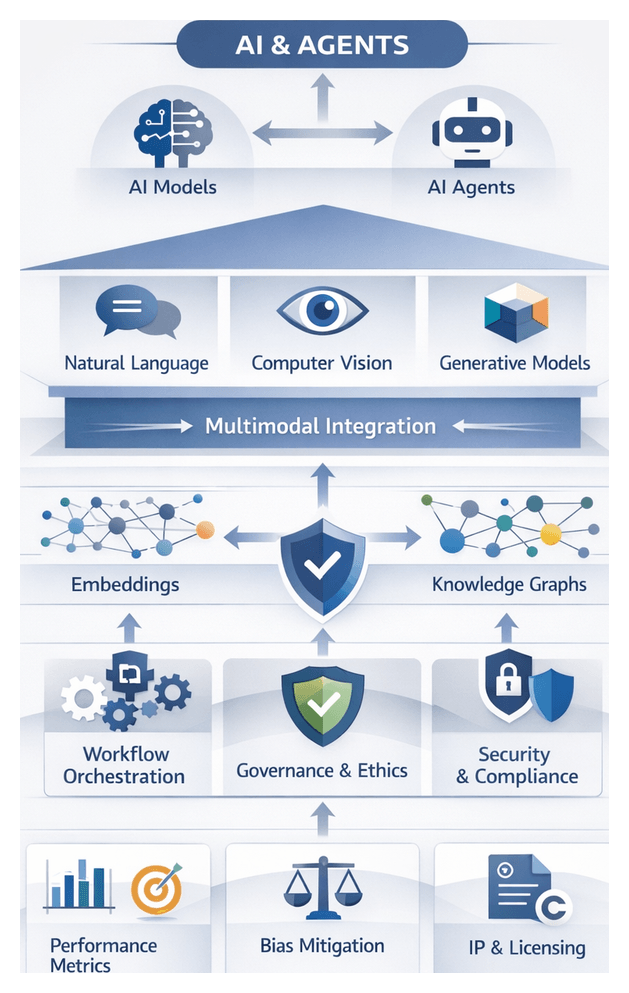
Terminology and Core Concepts
Artificial Intelligence refers to computational systems capable of perception, reasoning, learning, planning and natural language understanding. In creative workflows, AI automates ideation, multimedia asset generation and data-driven decision support. Traditional AI models—such as classification networks or text generators—operate statelessly on individual inputs, requiring manual orchestration and context management.
An AI agent is an autonomous software entity that maintains persistent context, decomposes objectives into subtasks, and coordinates multiple specialized models over extended interactions. Agents plan strategically, adapt to feedback, and execute goal-driven workflows without explicit orchestration at each step.
Natural Language Processing encompasses algorithms that interpret, generate and manipulate human language, powering automated copywriting, summarization, sentiment analysis and conversational interfaces. Computer Vision enables machines to process and generate visual content through object detection, style transfer and scene synthesis. Generative networks—such as Generative Adversarial Networks and Variational Autoencoders—and diffusion models synthesize novel imagery or audio by learning latent representations or iteratively denoising random noise.
Embeddings map text, images or audio into high-dimensional vectors that capture semantic relationships, facilitating similarity search, clustering and cross-modal alignment. Knowledge graphs structure entities and relationships to enrich content with factual context. Reinforcement Learning trains agents to optimize cumulative rewards through iterative decision sequences, supporting continuous refinement of narratives or designs.
Multimodal integration combines text, vision and audio modules within unified frameworks to produce cohesive multimedia assets. Context retention preserves project history and user preferences, ensuring coherence across multi-step workflows. Prompt engineering crafts precise input instructions to guide generative models, while iterative refinement loops generate drafts, solicit feedback and progressively enhance outputs.
Governance constructs embed human-in-the-loop checkpoints, automated style and bias checks, audit logs and policy enforcement throughout agent pipelines. Autonomous orchestration engines manage task sequencing, dependencies and resource allocation across microservices, enabling scalable, adaptable and compliant creative ecosystems.
Analytical Frameworks and Governance
A suite of conceptual frameworks guides evaluation, design and oversight of creative AI agents. An autonomy continuum calibrates agent permissions from suggestion-only to full decision-making. Capability-maturity matrices assess organizational readiness across governance, data infrastructure, skills and model sophistication. Value-risk assessments balance efficiency gains against bias, IP and reputational risks, while Multi-Criteria Decision Analysis ranks vendor platforms by performance, cost and ethical safeguards.
Lifecycle models—from technology adoption curves to adoption maturity curves—inform pilot selection, scaling strategies and change management. Resource-based views identify proprietary data and custom architectures as strategic assets. Systems thinking and socio-technical integration models examine people, processes and technology interactions, anticipating emergent behaviors and unintended consequences.
Specialized frameworks address embedding spaces as shared semantic media, feedback loop governance, orchestration patterns (pipeline, event-driven, actor), creative capital shifts, immersive affordances, marketing flywheels, media convergence and personalization continuums. Ethics-by-design frameworks and governance assurance standards ensure continuous compliance with ISO guidelines, emerging AI regulations and industry-specific mandates.
Infrastructure, Integration and Security
Scalable deployment of AI agents relies on containerized microservices managed by platforms such as Kubernetes or serverless environments. Workflow engines—like Apache Airflow and Prefect—coordinate task sequencing, dependency management and retries. API gateways and service meshes such as Istio or Linkerd handle authentication, routing and observability. Data pipelines ensure secure, low-latency access to training sets, creative assets and analytics inputs.
Security and governance layers enforce zero-trust architectures, encryption at rest and in transit, role-based access controls and audit logging. Data minimization and anonymization reduce privacy risks, while regulatory alignment with GDPR, CCPA and sector-specific standards embeds consent management and data-subject rights into agent processes. Periodic security audits and penetration tests reinforce resilience.
Performance Measurement, Bias Mitigation and Intellectual Property
Performance metrics combine efficiency, quality, engagement and strategic impact. Efficiency gains track time-to-first-draft reductions, iteration counts and human intervention points. Quality indicators include coherence scores, style adherence and expert ratings. Engagement and business outcomes measure click-through rates, dwell time, conversion lift and return on marketing investment through A/B tests and multi-armed bandit experiments.
Bias mitigation employs pre-processing dataset curation, in-training fairness-aware techniques (adversarial debiasing, reweighting) and post-processing filters with toolkits like IBM AI Fairness 360 and Microsoft Fairlearn. Continuous monitoring and stakeholder feedback guard against stereotyping and ensure equitable representation.
AI-generated content raises intellectual property questions. Best practices include clear licensing for training data and APIs, authorship attribution policies, contractual ownership terms and automated copyright infringement checks. Legal and creative teams must collaborate to define rights and commercialization pathways for machine-assisted works.
Pilot Design and Talent Evolution
Effective pilots select well-defined use cases—such as social media copy generation—with cross-functional involvement from creative leads, engineers, data scientists and compliance experts. Rapid sprints capture feedback, surface integration challenges and iterate agent configurations. A measurement plan instruments workflows against efficiency, quality and impact metrics. Scalability assessments identify technical and governance constraints for broader rollout.
Creative professionals evolve into prompt engineers, agent governance stewards and data-literate integrators. Training programs, hands-on workshops and communities of practice accelerate skill development in orchestration concepts, ethical oversight and technical fluency.
AI Tools and Platforms
- ChatGPT An advanced conversational AI for ideation, draft generation and iterative refinement with dynamic prompt chaining and API integration.
- GPT-4 A large language model offering enhanced reasoning, multilingual support and function calling for external data services.
- DALL·E 2 A diffusion-based image model for high-resolution artwork synthesis, inpainting and style transfer integrated into design pipelines.
- Midjourney A stylized, community-driven diffusion image generator with rich customization and collaboration features.
- Stable Diffusion An open-source latent diffusion model supporting local GPU inference, fine-tuning and a broad plugin ecosystem.
- Adobe Firefly A generative suite in Creative Cloud for text-to-image, style transfer and vectorization with royalty-free licensing.
- Jasper A content platform with marketing templates, SEO optimization and tone controls for distributed teams.
- MarketMuse An AI-driven content planning tool that generates outlines and optimization recommendations based on topic analysis.
- Sudowrite A narrative development assistant offering scene suggestions, character exploration and prose refinement.
- GrammarlyGO A writing assistant with grammar checks, style suggestions and generative drafting across browsers and editors.
- ProWritingAid An editing tool delivering grammar, style and readability analysis with generative rewriting modules.
- LangChain A framework for building agent applications with prompt templates, memory management and tool integration.
- Auto-GPT An experimental autonomous agent chaining GPT calls with memory buffers and web browsing capabilities.
- Runway ML A multimedia generation platform offering video synthesis, motion tracking and cloud workspaces.
- Canva Magic Write An embedded AI text generator in Canva for copy on presentations, social graphics and marketing materials.
- Synthesia An AI video service creating avatar-based presentations with multilingual voice synthesis.
- Descript An audio/video editor with transcript-based editing, filler removal and synthetic voice cloning.
- AIVA An AI composer producing musical scores with customizable instrumentation and style presets.
- Pictory A video creation tool transforming text content into narrated summaries with scene selection and captioning.
- Frontify A brand management suite automating style enforcement, asset tagging and template generation.
- Persado A marketing copy generator leveraging emotional language optimization and granular A/B testing.
- Brandwatch A social listening platform using AI agents to monitor sentiment and generate analytics reports.
- Hootsuite A social media manager with AI-driven scheduling, forecasting and automated response suggestions.
- Jacquard An AI copywriting service optimizing subject lines and calls to action via reinforcement learning.
- Auphonic An audio post-production service balancing volume, reducing noise and generating metadata tags.
- Unity ML-Agents A toolkit for reinforcement and imitation learning in interactive narratives and simulations.
- AutoML Vertex AI Google Cloud’s managed platform for AutoML, training, deployment and explainability.
- AWS SageMaker An end-to-end ML service offering data labeling, training, optimization and scalable endpoints.
- IBM Watson A portfolio of AI services for language understanding, tone analysis and visual recognition.
- Microsoft Azure OpenAI Service A managed API for OpenAI models integrated with Microsoft cloud and enterprise identity.
Frameworks, Libraries and Resources
- ONNX An open standard for portable model representation across hardware accelerators.
- TensorFlow An open-source framework for building and deploying neural networks.
- PyTorch A dynamic deep learning library favored for research and fine-tuning.
- Hugging Face Transformers A repository of pre-trained NLP models and tokenizers for rapid prototyping.
- FastAPI A Python framework for high-performance RESTful APIs with automatic documentation.
- Gradio A library for building web-based GUIs to demo AI models and collect feedback.
- Streamlit A framework for creating interactive data apps and dashboards for monitoring agent outputs.
- React A JavaScript library for building interactive user interfaces for agent workspaces.
- Redux A predictable state container for managing UI state in collaborative platforms.
- Partnership on AI A multi-stakeholder organization publishing best practices and research on ethical AI.
- IEEE AI Ethics Standards and training materials on responsible AI design and human-agent collaboration.
- NIST AI Risk Management Framework Guidance for identifying, assessing and mitigating AI risks across the lifecycle.
- OECD AI Principles Intergovernmental guidelines promoting human-centered values, transparency and governance.
- Creative Commons A licensing framework clarifying usage rights for AI-generated content.
- C2PA Standards for metadata and content provenance to verify digital media origins.
- W3C Verifiable Credentials A specification for cryptographically verifiable claims to track content attribution.
- Subreddit r/MachineLearning A community forum for AI breakthroughs, code sharing and ethical debates.
- AI Alignment Forum A research platform focused on aligning advanced AI systems with human values.
- Google AI Blog A resource featuring Google’s research, case studies and ethical guidelines in AI.
The AugVation family of websites helps entrepreneurs, professionals, and teams apply AI in practical, real-world ways—through curated tools, proven workflows, and implementation-focused education. Explore the ecosystem below to find the right platform for your goals.
Ecosystem Directory
AugVation — The central hub for AI-enhanced digital products, guides, templates, and implementation toolkits.
Resource Link AI — A curated directory of AI tools, solution workflows, reviews, and practical learning resources.
Agent Link AI — AI agents and intelligent automation: orchestrated workflows, agent frameworks, and operational efficiency systems.
Business Link AI — AI for business strategy and operations: frameworks, use cases, and adoption guidance for leaders.
Content Link AI — AI-powered content creation and SEO: writing, publishing, multimedia, and scalable distribution workflows.
Design Link AI — AI for design and branding: creative tools, visual workflows, UX/UI acceleration, and design automation.
Developer Link AI — AI for builders: dev tools, APIs, frameworks, deployment strategies, and integration best practices.
Marketing Link AI — AI-driven marketing: automation, personalization, analytics, ad optimization, and performance growth.
Productivity Link AI — AI productivity systems: task efficiency, collaboration, knowledge workflows, and smarter daily execution.
Sales Link AI — AI for sales: lead generation, sales intelligence, conversation insights, CRM enhancement, and revenue optimization.
Want the fastest path? Start at AugVation to access the latest resources, then explore the rest of the ecosystem from there.